Skip to content

Art is 80

  • It’s Late. It’s Late. It’s Late.

    March 6th, 2024

    As you may know, I have published a blog post every single day starting on November 15, 2022. Usually, they are posted by 9 a.m., sometimes later. But today may be the latest one of all. It is now 4.20 p.m. as I start to write this. No real excuse, except I had a hard time sleeping last night, had to leave the house for a couple of meetings this morning before 9, and didn’t get home until 2:30, when I lay down on the family room couch, closed my eyes, and opened them and saw almost an hour and a half had passed. Whew. My guess is I will never really wake up today.

    Now that might rarely happen, but occasionally it does, perhaps more so at age 81, than at age 18. You say “well, it does to all of us regardless of our age”. I guess that’s right, but don’t you think it happens more when you are older?

    That, of course, takes me back to our two presidential candidates, Mr. 81 and Mr. 77. Don’t they ever get so tired that they just close their eyes on their couch and 90 minutes pass? Don’t they ever have nights when they just can’t sleep? I will tell you that last night I had absolutely nothing on my mind. It was blank. I was calm. I was awake. There is no way I could be president.

    My mind is pretty blank now. But there are things I could tell you. Like my last two meals, one carry-out and today’s lunch at a far away Asian restaurant. The carry-out was from our neighborhood Italian restaurant – I’m Eddie Cano. “What kind of a name is that?”, you ask. Just take a deep breath, and say it quickly. Usually, when we carry out, we have their delicious melanzana parmigiano. Last night, I tried their swordfish, which was really good, served with a perfect sauce (who knows what they put in it?), and diced zucchini and eggplant.

    Two diversions:

    1. Did you note my parenthetical “who knows what they put in it”? This is a very unusual English phrase, because – even if you think you might – you have no way to know whether it is written in the present tense or the past tense. When you think about it, that’s pretty weird. Any language should make a distinction between present and past, no? Isn’t that a basic requirement?
    2. Let’s see if I can write this in a way that makes sense: Back in the late 1970s, the mayor of St. Louis (I will not call him out by name because he is still alive and some of you may even know him) came to DC, and a friend of mine worked for him as an aide, and came with him. The mayor (about whom even today I know less than very little) seemed a bit country-boy, odd for a big city mayor. We all had dinner at, I think, Duke Ziebert’s, and the mayor placed his order (I don’t remember what he got for a main course), and had his choice of sides. He looked at the menu and then said to the waiter, “I think I’ll have the zoo-chai-nai”.

    Now, the distant Asian restaurant, with the very Asian name, Gourmet Asian Bistro, located (for those of you who want precision) at the corner of Muncaster Road and Muncaster Mill Road, somewhere in distant Montgomery Country, close to 15 miles from here. A nice looking restaurant in a typical suburban corner strip shopping center. I had the Thai Combination Fried Rice, a just the right amount of spicy dish with perfect taste. Now, I had never been to this restaurant before, so after I got home (and post-couch), I looked it up on Yelp or Trip Advisor or somewhere else, and discovered it had a rating of 4.6, which the vast majority of its customers giving it a 5. I will have to remember this – because I have the option of eating there twice a year. Our accountant is close by, and today is the day that I brought her all of our tax information for 2023. In a few weeks, I will go back to pick it up.

    Let’s go back to I’m Eddie Cano – it is about three blocks from our house, on Connecticut Avenue, north of Fessenden and south of Nebraska. An easy walk. But what if we want something other than Italian food? Anything else nearby? On that block alone, in addition to Eddie Cano, is Rosemary (which is sort of French), Call Your Mother (which is self-proclaimed Jewishy), The Den, which is a coffee house which serves salads and sandwiches, Muchas Gracias (Mexican, of course), Buck’s Camping and Fishing (don’t ask me why – it’s just a nice upscale restaurant), Comet Pizza (yep, the one where the chop up children in the basement), and the Italian Bar (where they sell alcohol, pastries, all sorts of coffee and gelato, plus a few snacks). And, less than a half mile in the other direction on Connecticut, you will find a fancy bakery, another Italian restaurant, a Pizza house, a Turkish carryout (with a few tables for an outside lunch) and a Thai restaurant. We do not live in a food desert.

    Time to go back to the couch.
  • Life in the Big City and the Big Country

    March 5th, 2024

    The city:

    We picked up our 3 year old grandson at his pre-school to drive him home, as we do every Monday (and Thursday). It’s about a 30 minute drive from his pre-school (near our house) to his home. For those of you who know Washington, you might know that most major street spike out from the business and government center, so that traveling cross-town can be a challenge. Most of our drive is normally on Irving Street NW, which we pick up just east of Rock Creek Park. With the exception of the block approaching 14th Street, where the traffic is always tied up, we can usually move right along, stopping only for red lights. But today, for some reason, east of Georgia Avenue, Irving Street looked like a parking lot (I still don’t know why), so I immediately decided to divert while I had a chance and to cut across the first alley and proceed on a parallel street.

    Now comes the interesting part. The alley goes between Irving Street and Columbia Road. I immediately wondered if I had made a mistake diverting because there was car at the other end of the alley pointed at me…..and not moving. Would we be trapped in the alley?

    I drive slowly on. There is a large black mass in front of me in the street. Edie says: “IS THAT A PERSON?” I have to divert not to run over him. It becomes clear that the car at the other end of the alley must be stopped there to keep other cars from coming into the alley and endangering the person lying in the middle of the alley. He’s a man – that’s all we can see. I have to move to the right to avoid hitting him. We call 911. We tell the operator where we are. She asks “is it a man in a black coat?” We say “yes, you already know?” She tells us a car is on the way.

    The car facing us backs out of the alley, and we are able to get to the street. That’s all I know. Drunk? Drugged? Sick? Dead? No idea.

    One more thing. As we are waiting to pull onto the street, I see through the mirror a man walking by the person on the ground. He just walks by him. Doesn’t seem perturbed at all.

    Life in the big city.

    The country:

    Happy to say that the rest of the day was better. For those of you on Facebook, you may have already seen my question regarding the unanimous Supreme Court decision telling states they can’t remove Trump from the ballot based on the 14th Amendment. I understand the Court’s constitutional argument on whether Congress has to implement provisions of the 14th Amendment and it’s probably right. But it was a bit hypocritical for the Court to give as an additional reason that chaos may result if states reached different conclusions about the acceptability of a candidate, since this Court with decisions like Dobbs has itself created chaos, since “originalism” (which I think is a disingenuous way of looking at the constitution anyway) would tell the Court to ignore practical considerations, and since one of the cornerstones of conservative thinking is states’ rights.

    Further, the Court said that states could control state election qualifications, but not federal. OK, but what does that mean for minor party or no party candidates? Kennedy is now striving to meet the ballot qualifications of various states? Doesn’t that mean states do control candidates for federal elections? Why do major party candidates get to be treated differently? And what about voter qualifications and other election day rules involving ballot access? Maybe the Court hasn’t avoided chaos, but once again fomented it.

    And then there was Trump himself , lauding the Court and saying at the vase itself was just political and the creation of the Biden White House. Well, Trump, listen. Yes, any case which seeks to disqualify a candidate is by its nature political. So what? And, as to the origin of the case, the plaintiffs include no Democrats, only Republicans and independents.

    By the way, Joy Reid started her show tonight with a series of recent verbal gaffes by Trump. What if he is elected and becomes a new Mad King George III?

  • Once a Collector…….

    March 4th, 2024

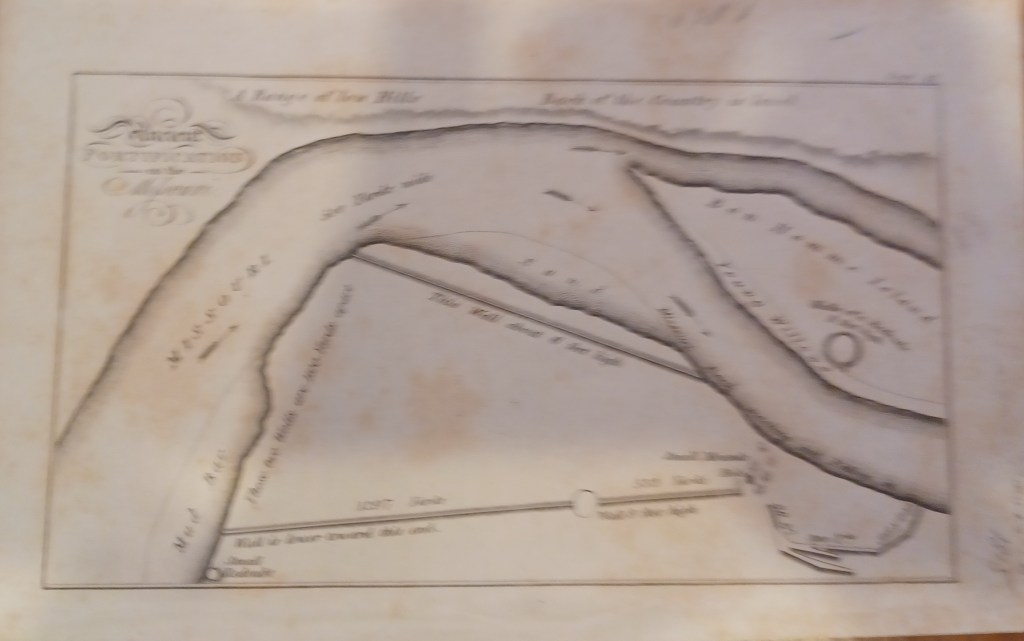
    No, this is not the most beautiful map in the world. But yesterday I bought it at the Little Flea Market on the corner of 19th and Q, near Dupont Circle. Why would I do such a thing?

    This map dates from 1814 or 1815, according to a pencilled reference. It shows a small portion of the Missouri River not far from St. Louis, near Bon Homme Island. It is from a book (as many old maps are).

    You see Bon Homme Island in the upper right. Today, this fertile “island” is I believe no longer an island. The upper part of Bonhomme (now one word) Island is connected to mainland St. Charles County. I am not sure, but I think this land is now fertile farmland still prone to flooding. Someone can correct me. And, if you cross the river and head a tiny bit south, today you would find yourself in the heart of Chesterfield, in St. Louis County.

    Back to the map. What else is interesting about it. For one thing, the date. Missouri became a state in 1820, five years after this map was published. For another, the only geographic name (other than the river itself) is French. Not surprising in that this land was part of the Louisiana Purchase, bought by the United States in 1803, twelve years before the map was published.

    You may have figured it out. This is one of the maps made on the Lewis and Clark expedition of 1803. It was published in a book titled “Travels to the Source of the Missouri River”, published in 1814 and 1815 in London and the United States by Lewis, Clark and several others.

    There are still copies of the publication available in the $15,000 range. I thought this map was worth the $10 that I spent.

    What called my attention to the vendor selling maps was this one. This map of the western hemisphere hangs in my home office now, but hung behind my desk in my various law offices for 40 years. I bought it in 1972 in Marbella, Spain.

    It’s an Italian map, made by a cartographer named Bodiga and published in Milan in 1820. It does not yet show Missouri as a part of the United States, but rather as a part of a large territory called Luigiana. (By the way, this was the first time I connected Louis and Luigi.)

    Yesterdsy, the vendor had a copy of this map posted on the wall of his cart. Not in perfect shape and not colored, but there it was. It obviously caught my attention.

    That’s it for today. Tomorrow, maybe back to the 21st century.

  • Conflation and the War in Gaza

    March 3rd, 2024

    You just can’t stop thinking about the war in Gaza. I gave my latest thoughts just a few days ago, and they haven’t changed. But there are always more ways to look at it. Today, I am thinking about conflation.

    Israel is a country. Jews are not a country. (The question of what Jews are – a religious group, an ethnicity, a state of mind, etc. is for another day.) Yet so many people, including Jews, conflate the two. This is one of the reasons that Jewish kids on campuses across the country are coming in the crosshairs of those who are against Israeli policies and presence in Gaza. This is one of the reasons that antisemitic statistics have increased across the country and across much of the world since October 7.

    Now, it seems clear that Israel’s official position would support conflation. Many pure Zionists would of course maintain that all Jews should live in Israel, and that that is the only way you can be truly Jewish. Several years ago, Israel’s Knesset passed a law that maintains that Israel is Jewish state, in effect belittling the 20+% of its population that is not Jewish at all, and it delisted Arabic as an official language, a status Arabic had held since 1948.

    And groups such as the Anti-Defamation League conflate the two when adding up antisemitic incidents. If there is an pro-Palestinian demonstration on a campus which includes anti-Israel sloganeering, it is my understanding that this goes on the ADL’s list of antisemitic incidents, and that no separate list of anti-Israel incidents is kept.

    The vast majority of American Jews are very much in opposition to the current Israeli government, but they are still identified with Israel (that is understandable in many ways) and therefore with Israeli policies that they may detest and therefore become fair game.

    It is conflation. It is not accidental conflation. It is strategic conflation.

    On the other side, there is another type of conflation. Those who are strongly against what Israel is doing in Gaza (and here I am not thinking primarily of Jews) have varying opinions about Israel. Some may be supportive of Israel generally and just want it to stay within its green-line borders. Some may think that Israel and the Palestinian territories should eventually become one multi-religious country. Some may want Israel, and all Jewish Israelis, expelled from the land they occupy, and either be driven to America (or its equivalent) or into the sea. But in the eyes of supporters of Israel, all of these people become conflated into a group which is out to destroy Israel and murder its citizens. And it is true that a surprisingly small number of strong Hamas supporters seem to even remember the October 7 attack, much less condemn it.

    None of this helps, of course. It makes dialogue impossible. It makes it extremely hard to move to the next step. Especially when the leaders of Israel, and the leaders of Hamas and their supporters, are almost all conflaters.

    As the song says, it is beyond time to “accentuate the positive”. But it can’t happen now because Israel’s leaders won’t stop until there is no Hamas, and Hamas leaders say “hit me again and again, and you still won’t hurt me”. They seem to be safe in their tunnels, and they don’t seem to care at all about what is going on at ground level.

    So it’s a tangled web, as all wars are, but this one is more tangled than others. There are now ceasefire negotiations going on in Cairo – well, one day they are going on, and the next day, they aren’t. The international forces want the ceasefire to get food and aid to the Gazans. Israel is afraid that any ceasefire is just an opportunity for Hamas rearmament, and will take away pressure on Hamas to release the remaining 100 or so hostages. But Hamas doesn’t seem to feel that pressure. It won’t even give Israel a list of the living hostages it is now holding, much less talk about releasing them. Or talk about releasing them except for the return of much larger numbers of Israeli prisoners, most of whom are undoubtedly ready to join Hamas in destroying Israel is freed.

    Hamas is afraid that any ceasefire will diminish anti-Israel protests; it seems to want the attacks to continue in a bizarre way, because Hamas leadership cares nothing for the people of Gaza today, but is thinking about a “river to see” Palestine tomorrow. Any number of martyrs seems acceptable as a means to that goal.

    Of course, poor Joe Biden is caught in the middle, as he is in some many other places. He strongly supports Israel in defending itself against attacks by its neighbors, gaining the support of Jewish voters. He proposes millions of dollars of increased financial military support to Israel, losing the support of Arab (and many younger) voters, yet he condemns current Israel actions and future plans, which doesn’t seem to be getting anyone’s support, although he is correct in doing so.

    And Donald Trump is the ReTrumpican Party? Trump will stop the war in Ukraine 24 hours after his inauguration, but what about in Gaza. I don’t think he has spoken about that, has he? And it was the ReTrumpicans who wanted a stand alone Israeli financial support bill. Do they still want that? I don’t know that, either. Maybe both Trump and his followers have pronounced on this – frankly, I have been ignoring a lot this week.

    It’s almost 60 degrees outside and I am writing a blog? No longer. Time for a long walk. I will re-read this post later and see if I made any sense at all. Let me know what you think, if you got this far and would like to. Or, just go outside and take a walk.

  • What Do Marilynne Robinson, Bruce Boudreau, Jose Andres and Arkady Ostrovsky Have In Common?

    March 2nd, 2024

    I don’t think of myself as having an addictive personality. But I think I delude myself. I don’t smoke, and have never done drugs, so those things aren’t my addictions. But I clearly have a dangerous, and not very understandable, addiction to books. Why, I don’t know. But (and you might already know that) I think we have about 10,000 in our house. When you think about it, that’s ridiculous.

    Now, of course, some of those books are Edie’s, not mine. I would guess fewer than 10%. And at one time, my books probably didn’t exceed hers by many. But then, something happened.

    I think it’s probably been about 30 years, maybe more, that I started to buy books in quantity. Not necessarily hundreds at once. But one or two a day, and every now and then a couple of bags full at book sales. By the time I retired from law practice in 2012, I had about as many as I have now. And, what’s more important, I couldn’t help myself.

    A few years before that, I decided I needed to fight the addiction. I didn’t think I could do it by stopping my purchasing, but I thought I could do it by selling the books that I had. So Edie and I started an on-line business, A. Richard Books and More, and began to sell through Abebooks (then known as the American Book Exchange). We have done this since, and we sell between 250 and 300 books a year, consistently. But since I buy about the same number of books as we sell, I haven’t seen much progress.

    When I first thought about selling books, I thought that the income could be used to fund our travel. But maybe that felt too indulgent, so I thought instead we should take the proceeds and help fund our grandchildren’s education, and that’s why we are doing.

    Now, I should also say that, over this time, I have given away hundreds of books, maybe over 1,000, so it’s not that I am simply hoarding them, irrespective of what they are. And, we have sold – over the time we have doing this – close to 3,000 books.

    At first, I bought books I liked. And most of the books were not new, but used, so the prices I have paid have always been low. But at some point, maybe 20 years ago, I began to buy books signed by the author. Which makes me wonder whether I have a book collection, or an inefficient autograph collection.

    How did that start? It started at Second Story Books, near Dupont Circle in Washington. They have always had outside displays of used books for sale, and walking there when I went out for lunch became a regular kind of thing. I used to look carefully at the mostly (but not all) worthless books, and I noticed one day a book that was signed by the author. I knew that these cheap books ($2 to $4 each) would be recycled if they weren’t purchased for the week or so they would sit outside of the shop, and I thought that a book signed by its author should not be destroyed. That it would be an insult to the author. So I bought the book. And this continued on and on.

    At first, I’d buy everything that was signed. Then I realized this was crazy, and I began to be a little (just a little) selective. I have never been as interested in fiction as in non-fiction, so my fiction books have been limited to books in very good condition, while the non-fiction includes books that are far from pristine. And there were some areas – Judaism and Jews, history and politics – that I am most interested in, so sometimes these were the only sections of books for sale that I looked at.

    And, I should add that although most of the books I buy are signed, if I find something else that is both unusual and interesting, I will take that, too.

    There’s a lot (really a lot) I could say about my book adventures, and I raise the subject on this rainy Saturday because I spent the morning at the annual used book sale at Walter Johnson High School in Bethesda. Now, next week is the annual book sale at Bethesda-Chevy Chase High School, which is really a production. I don’t know if Walter Johnson has a sale every year; this is the first time I have noticed it. Last night, I said to myself “Well, I don’t need more; I’m not going.” But this morning, my addiction took over, and I went.

    It was a fairly dull sale, I thought. A fair number of books, a lot of people, but not much of interest to me. I bought 4 books (paid a total of $12).

    The most interesting book that I took home was a very nice copy of We Fed an Island by Washington chef Jose Andres, his story of bringing meals to Puerto Rico after the island was devastated by a hurricane. It is signed (no inscription) by Andres, and there are no signed copies for sale on the Abebooks web site. Then a nice, signed first edition of Jack by Marilynne Robinson, a book of fiction by a Pulitzer Prize winning novelist. Third, because I like books about Russia, I bought an inscribed copy of Arkay Ostrovsky’s The Invention of Russia: from Gorbachev’s Freedom to Putin’s War. The book was published in 2015, and the war is the 2014 invasion of Ukraine, not the 2022 invasion. My guess is that this book is prescient. Finally, to prove that I buy a variety of books, I bought an inscribed copy of Bruce Boudreau’s Gabby. Gabby is not about Gabby Gifford, but about Boudreau himself, who has been the coach of the Washington Capitals, as well as several other NHL teams. He coached the Caps from 2007-2011 – this books was written in 2009.

    I should write more about my books. Think I will. But no more today.

  • All Tuckered Out….

    March 1st, 2024

    I know nothing about Lex Fridman. Wikipedia tells me he is a computer scientist, with a particular interest and expertise in artificial intelligence, and that he also hosts a podcasts where he interviews famous people. He is 40 years old, Russian born, American educated and a resident of Austin, Texas. That is all I know. And, frankly, I really don’t have any “opinion” about him. Good guy, bad guy? I don’t know. Leftist, rightist? I don’t know. Smart, not so smart? I have no idea.

    Having said that, I recently came across a very recent interview he did with Tucker Carlson. The interview was done shortly after Carlson’s interview with Vladimir Putin and after Andrei Navalny’s death. It is apparently over three hours long. I have listened to the first hour plus, which my phone calls Track 1. Because I have never really watched anything that Tucker Carlson has done, but have come to dislike him intensely for all sorts of reasons having to do both with public policy and honesty (as reported), I thought it would be interesting to hear Carlson as an interviewee, rather than an interviewer. It was.

    Now, Tucker has been, as we know, highly successful, as it were, earning $45 million a year when he was finally fired by Fox. Not that he needs the money – his mother (his adoptive mother – his birth mother ran away when he was a child to live, in his words, a “bohemian life”) is an (the?) heiress (still using sex-driven word here) to the Swanson TV Dinner (and real estate) fortune. He met his wife in middle school (naturally, she was the principal’s daughter), he is now 54, and he says “I have been with the same girl for 40 years”.

    How did he come across? I guess in judging how he came across, I have to answer another question. Do I think he came across as he is, or do I think he came across as he wanted to come across? And I don’t really have an answer to that question.

    But he really didn’t come across the way I thought he would. He came across as sort of a normal guy (not normal in a good sense), a little aw-shucksy, with an odd high pitch giggly laugh that I would think would turn most people away by itself. He has limited loves – his wife, his four children (now adult), his country (which he belittles like Trump does) and his God (about whom he didn’t say very much). And he takes his success as a given – just a normal guy asking questions of world leaders, who are also normal guys (and, I guess, girls).

    He loves (emphasis on all five letters) America – but he finds a lot of things wrong with it. No, he seems to find everything wrong with it. Certainly its political leadership about whom he has nothing good to say. Not our government about which he has little to say good. Not about our cities, which he despises. Not at all the media. And so forth.

    Why? We don’t put American first in our foreign policy. Why are supporting Ukraine? They will lose the war. Everyone but us knows that (“When I told Orban in Hungary that Ukraine might win the war, he looked at me as if I were deranged.”) but us. Russia has more people, a better industrial base (Ukraine has no industrial base), a better economy (Ukraine has no economy), and Russia makes more artillery ammunition than all the NATO countries combined. Whether all of this, or any of it, is true, I don’t know.

    He feels sorry for Zelenskyy (who is not Jesus, by the way, and Putin is not Satan), who has been put in an unwinnable position by the American government. And he hates NATO, which does not serve American interests. If he were president, he would pull us out of NATO on Day 1. And why do we even need missiles on the border with Russia.

    The United States was in its best shape in 1985, when its cities were up to date, and clean and safe. And look at us now. Moscow is beautiful – no graffiti, it’s clean, it’s safe, He drove all around it. Absolutely beautiful, no sign of drugs, no people sleeping on the street. Compare it to American cities, which are filthy, and where you are afraid to go to the grocery store. In 1985, this wasn’t the case. Then, here everything was wonderful.

    He doesn’t believe Biden is the legitimate president – but he is considered the president, so you have to respect that. Putin didn’t badmouth Biden, and that surprised him. It also surprised him that Putin seemed nervous and over prepared. He doesn’t understand at all why Putin said that he didn’t ask him any difficult question and that the interview was disappointing.

    He was not afraid to go to Russia to interview Putin. It was his first time in Russia and he was really surprised. It is thriving. Why are we putting sanctions on the country, since they obviously do no good?

    Is Putin a good guy? No, but he runs a safe country for everyone, as long as they stay away from politics. And you can stay away from politics. Look at the beautiful subways in Moscow; then look at New York. The most important thing for a leader is to be measured by the success of the people he leads – are they living longer, are they safer?

    The human cost of war is terrible. This is true of the Russia-Ukraine war, so Ukraine should end it, and would if the West wasn’t requiring Zelenskyy to keep it going. There should be an end. It doesn’t really matter who gets what as long as the killing stopped. Yet he didn’t blame Putin for the 300,000+ Russians who have lost their lives in the war.

    But he is not Putin’s puppet (I am an American), and he didn’t like Bush’s Iraq War (I am a bipartisan American).

    At any rate, he sounds like a normal guy, who keeps himself informed, and who takes the information he is given and reaches conclusions that no logical person could come up with. Although he is 54, his mind seems to work like an adolescent. At least that is how he sounded to me. Like a young kid with views on everything, and nothing to back up his views. That’s the way he sounded.

    I should one more thing. Tucker Carlson hates a lot of things, because they are terrible, and a lot of people, because they are stupid. And if you listen to him, you will here about his hatred over and over. And what does he like? His concept of America. Oh, yeah, and the city of Moscow.

    I have at least another 90 minutes to go on this interview podcast. You may hear more about it later.

  • From The Horrendous To The Ridiculous

    February 29th, 2024

    The Horrendous: Yesterday, I wrote about my current feelings on the war going on in Gaza, expressing my “enough is more than enough” philosophy, and showing how I felt that Israeli actions now were making things worse for themselves, not better. Today, we wake up to news that over 100 died and hundreds more were injured when IDF troops apparently opened fire on civilians in a food line. I don’t know all of the details, and that may not be important. But my opinions, expressed yesterday, are that much stronger today.

    I started off today with a talk (at my Thursday morning breakfast group) about Free Will – does it exist, or are our actions all a product of our neurons and our previous experiences? A very provocative talk, extremely interesting. But, whichever it is, can not anyone’s free will determination, or neurological makeup and experience, find a way out of the mess in Gaza? The Israelis can’t? The Americans can’t? And clearly Hamas, which does have the ability to take actions to stop the Israeli incursion and end the fighting, can’t. Is this the fault of the parties involved? Or is everyone doing just what their unconscious brain is requiring them to do? This is an important question.

    The Ridiculous: I am not sure what to call the series of articles that Google sends me continually on my smartphone. I call it my Google-feed, but I have no idea if I made that up, or if I am calling it by its proper name. In any event…….

    As you know, the Google algorithm sends you articles based on what you look for and open up. If I look at an article about Taylor Swift (for example), I will be inundated with other articles about Taylor Swift. I have never looked up anything about Taylor Swift, as you might guess, but I do look up a lot of things about St. Louis, my home town. And consequently, I received a lot of articles about goings-on there.

    Last evening I received an article that someone wrote about where to get the best St. Paul sandwich in St. Louis. Now, I have never heard of a St. Paul sandwich, although the article made it sound like it’s as popular in St. Louis as St. Louis ribs, gooey butter cake or Imo’s pizza with processed provel cheese.

    So I looked it up. Here’s a picture.

    Yes, it’s an egg foo yung (with onion and mung bean sprouts) sandwich with bacon, lettuce, tomato, pickle and mayonnaise on white bread. It’s for those folks who go to a Chinese restaurant and want a sandwich.

    And it isn’t new. It was created by the owner of a Chinese restaurant in the Lafayette Square neighborhood of St. Louis about 75 years ago. According to Wikipedia (yes, it has a Wikipedia page), it is only found in the St. Louis Metro area and in a few other Chinese restaurants in Missouri whose owners come from St. Louis. It was named for the creator’s home town of St. Paul, but apparently never served there.

    I certainly don’t remember ever seeing it on a menu, but maybe I have just been blind to it. They best place to get it today, according to the article Google thought important enough to share with me is Stukey’s Chinese Restaurant in Wood River IL. Have never been to Wood River either.

  • My Thoughts Today On Israel/Gaza.

    February 28th, 2024

    It’s hard to talk about Israel and Gaza without also talking about the war in Ukraine and the American southern border, isn’t it? Because of America’s contorted political situation, they are all mixed up with each other. But let’s focus on them one at a time: today – Israel and Gaza.

    Most people I know are generally very supportive of Israel whenever it faces a challenge from its neighbors. And the October 7 attack was certainly a challenge, and Israel’s security is paramount. But there is something about this challenge that we have not been talking about. Perhaps we have already forgotten.

    I am talking about Israel’s momentous security failure. To refresh our memories, we now know that Hamas, committed from its earliest days to destroy Israel, had been planning the October attack for a number of years in a thorough and comprehensive manner. We have also learned that Israeli intelligence had picked up on Hamas’ plans over a year before the attack.

    But, for reasons totally unclear, the intelligence about Hamas’ preparations were ignored, or minimized, and not acted upon as they were sent up the intelligence hierarchy. At some point, we will probably know why this occurred, but at this point, what we cannot forget is that: had these intelligence findings, which had been put into a written report, been taken seriously and investigated further, the attack might have never taken place.

    We also have heard about the billion dollar border defense system that had been recently installed by Israel along the entire Gaza border. But this defense system was not autonomous – it required the presence of Israeli personnel to follow up on any perceived potential attacks. I don’t know the details, but I have heard that the Israeli personnel who should have been watching the border on October 7 were not there. They had been pulled off to protect the right wing settlers in the West Bank, who were having trouble with local Palestinians. Or rather who were making trouble with local Palestinians. The West Bank issues raise totally different, but very important, questions, that we should hold for another day. What is important to know here is that, had these personnel not been pulled away from the Gaza border, the October 7 attack either would not have occurred or would most likely would have been successfully blunted.

    Finally, we know that there was a large music festival being held not too far from the Gaza line in very open country, and that hundreds of young Israelis would be in attendance, with very limited security. Why the festival security was so lax is another question that must be asked.

    We don’t know why Hamas picked October 7 as the day to attack. We can speculate, but we really don’t know. Was it a coincidence that the attack occurred when the Israeli defenses were down? Did Hamas know that they would have an open road on October 7? Was it because it was the 50th anniversary of the 1973 War (and if this was the case, shouldn’t Israel have been more alert, rather than less alert)? By the way, it must also be remembered that an intelligence failure was involved in that war, too. (If you have seen the recent film, Golda, you know what I am referring to.)

    In any event, while we know that the attack was not the fault of Israel, the Israeli errors were certainly responsible for the extent and success of the rampage. Yet, so far, Netanyahu, Ben Gvir and Smotrich et al have been successful in deflecting any blame, at least for now, postponing any investigation until after the fighting has stopped.

    Instead, Netanyahu said that Israel was going to completely wipe out Hamas – we don’t know what this means, but we believe this is not really possible. Hamas members cannot be easily identified (the same being true of supporters of Islamic Jihad and other groups in Gaza), and Hamas leadership is in Qatar. In addition, as long as over 100 hostages are being held by Hamas, any action by Israel is fraught. But by attacking Gaza, Israeli action has killed about 30,000 residents of Gaza and led to the death of a few hundred Israeli soldiers. And a conflict that has apparently displaced 80% of Gazans, and shut down its health system and its food distribution system.

    The majority of the Gaza population has migrated to the south of the Strip, at the instructions of the Israelis, and now are massed in that area where Netanyahu says he is about to order a major attack. The world (including many in Israel, and many, many in the United States) is lining up strongly against this proposed attack and, to the extent that American financial support is needed by Israel, the world is lining up strongly against that financial support without very strong conditions on its use. As to American politics, in addition to those “Israel right or wrong” supporters, those who are in favor of providing funds to Israel without strings are largely Republicans who support Trump. Democratic supporters – especially minorities such as Muslims and Blacks, and young voters – are by and large criticizing Biden, who himself has been strongly in favor of funding Israel, even as he expresses disapproval over some of Netanayu’s remarks.

    Added to the border, Ukraine, inflation, his age and perceived frailty and more, this is one more problem for Biden, whose major political asset at this point is the identity of his likely opponent.

    What do I think at this time? I think that strings should be placed on further military support for Israel for the present. I think it is time for the United States to withhold funds that would support an unlimited Israeli incursion into South Gaza. We should concentrate on freeing the hostages (with the help of those Arab nations willing to help, of course), on supporting the goal of establishing a new moderate government in Gaza, on participating in the Gazan rebuilding process, on working towards the reopening of the hospitals and the creation of a consistent food delivery system, and showing Gazans that they are being treated as human beings. And, although it won’t be easy, we should be leaders in trying to reconcile the Gaza population with the existence of Israel, rather than promoting the more venomous relationship that this war has obviously brought about, particularly with respect to younger Arabs.

    Going back to the beginning, we must remember that the October 7 attack wound up as tragic as it has in part because of Israeli intelligence failures, and over Israeli government support for extremist West Bank settlers. If Israel, under responsible leadership, strengthens its intelligence and defense systems to where all of us thought they were before this attack, attacks like this will remain very unlikely.

    On the other hand, if Israel keeps up the pressure of this war, Hamas will not be neutralized, the population of Gaza will be further radicalized, thousands more will die (and recall, those dying are mainly women and children), and the moderate Arab states, one by one will lose interest, the influence of the United States will be diminished, and even the US will find it difficult to support Israel as fully as it now does.

    Blanket support for further death and devastation in Gaza will do no good for anyone.

  • To Be Rich As Rockefeller? No….To Be Rich As Rothschild.

    February 27th, 2024

    This is Waddeson Manor, located in Buckinghamshire, England. It has been owned by the National Trust since 1957, but before that was the home to members of the English branch of the Rothschild family, having been built in the 19th century by Baron Ferdinand de Rothschild. It is the home of 15,000 pieces of art owned by the Rothschilds (I think still owned by the family) and the wine collection of the late Jacob Rothschild, whose obituary is in today’s New York Times.

    The Rothschild family, descendants of Meir Amschel Rothschild, who was a money lender in early 19th century Frankfurt, may be the world’s most financially successful family ever, antisemitism be damned. I would like to know more about them than I do. Years ago,I read a book called The Rothschilds by, I think, Frederic Morton, a well known book that I recall concentrated on the early years of the family. I am more interested in the present.

    There were things in the Times obituary that fascinated me. Jacob (For some reason, I want to call him Jack) “played an energetic but some what secretive role, in Israel, where he led the Yad Handicap Foundation (don’t know what that is) and “sponsored” the “construction of Israel’s Parliament, Supreme Court and National Library.” Well, that is something, isn’t it? And….who knew?

    Remember, this is just the English branch of the family. Other than Waddeson Manor, where else did Rothschilds live in England? Here are some of their homes:

    But Jack (my new, but deceased friend) had different tastes. Here is the environmentally friendly house, Flint House, he built in 2015:

    How times and tastes change.

    Other things about the Rothschild family that I would like to know include information about gender and religion.

    The Times article said that the Rothschild business were passed on to male family members only, that daughters and their husbands were not involved. But I am sure the daughters were not put out onto the street. What are their stories?

    And what about religion? Jack’s wife was Serena Dunn, certainly not Jewish, but a member of an established British upper class family and well known thoroughbred breeder. They have four children. Are the children Jewish? How do they view themselves? What does/would the Chief Rabbi of the United Kingdom conclude?

    For that matter, Jack’s mother wasn’t Jewish either. And she and Jack’s father Victor divorced, and I think his mother had two very non-Jewish husbands after the divorce.

    Now, I understand there may have been conversions. Maybe that was a requirement of becoming a Rothschild. I don’t know. But the idea of a Rothschild as a stalwart of the Church of England doesn’t quite make sense.

    So there is a lot to learn, isn’t there?

    You may be wondering “How long has he been interested in the Rothschilds?” Let’s see. It’s 9:50 a.m. now. I’d say…..since about 8:45.

  • I Surprise Myself

    February 26th, 2024

    I may have written this before, but if I have, I don’t remember. And I am sure you don’t remember. So here I go (again).

    Growing up in St. Louis, I was part of a very large Reform Jewish community. My public schools in University City, Clayton and Ladue were about 1/3 Jewish. Almost everyone I knew belonged to one of the five or so large Reform temples in the city or the western suburbs. There were a few Conservative and Orthodox synagogues, but virtually no one I knew belonged to them.

    My family went to High Holiday services (one day for Rosh Hashana), had seders (no more than one at home – sometimes we went elsewhere for a second), and celebrated Hanukah. My Sunday School was forgettable at best – I don’t know if I learned anything there at all; I certainly didn’t take it seriously. For my Bar Mitzvah (most of my friends did not have Bar Mitzvahs) training, it took us two years, two days a week after school to learn the Hebrew alphabet, I read a very small couple of Torah lines, a haftarah, and gave a two minute or so speech that I don’t even remember writing (maybe someone wrote it for me).

    I went to a nondenominational summer camp. I didn’t belong to any Jewish fraternities or groups through high school.

    When I went to college, although I did go to High Holiday services, I was completely turned off by the few events at Hillel that I went to. I seemed to have nothing on common with the Hillel kids, who had a very different Jewish identity that I did. I did take some Jewish studies type courses at college, but that was it. No Jewish extracurricular activities at all.

    So how did it happen that virtually my entire extra-work life as an adult in Washington DC has been connected to the Jewish community?

    I have been a Board of Directors member and an officer of two synagogues, first Temple Sinai and then Adas Israel.

    I was a Board member of the Jewish Primary Day School of Greater Washington (now the Milton Academy)

    For twenty years, I was a member of the Board of Directors for American Associates, Ben-Gurion University of the Negev, and for six years I was Treasurer of that national organization.

    I am currently a Board member and the Vice President of the Haberman Institute for Jewish Studies.

    I am currently the President of the Jewish Funeral Practices Committee of Greater Washington.

    Outside of these organizations, the only other non-profit organizations that I have been seriously active in were connected to my law practice, when I was a member of the Governing Board of the ABA Forum Committee for Housing and Community Development, a Board member and one-time President of the National Leased Housing Association and a Board member of the National Housing and Rehabilitation Association. But all of these were history before I left the practice of law now 11 years ago.

    Everything that I have done with all of these organizations has been interesting and I hope useful. But I just must repeat. I surprise myself.

  • What We Did On Saturday: A Day In The City…..

    February 25th, 2024

    Yesterday was a busy day. And a good one. Let me explain:

    My granddaughter goes to Hebrew School on Saturdays at 9 a.m., and the rest of her family usually comes over to our house, close to the synagogue, for an hour or so, and before going back to the synagogue for Shabbat services. That is what happened today. But I held back, did not go with the rest of them, and promised to meet them a bit later. I drove to the synagogue about 11 a.m., hoping to find a parking place within a few blocks, knowing there might not be any reasonable parking space available. But, as a I drove by the synagogue, I saw a space being vacated – a car pulling out at 11 in the morning. Unheard of. And so welcome. So I found a place to park right outside the door.

    There was a double bar mitzvah today and I can’t say that I was unhappy to miss it, but I got to services in time to see the Torah returned to the ark and to hear Rabbi Krinsky’s sermon. I don’t think I have ever heard one of her sermons that I haven’t liked. This was celebrated today’s day of celebration (which I knew nothing about, or perhaps which I simply had forgotten about) called Shushan Purim Kattan. It is a minor variant of a minor holiday, as she described it. In seven out of every 19 years, the Jewish calendar has a leap-month, necessary to sync the lunar calendar of 354 days with the solar calendar of 365. In such years, as this one is, there are two months of Adar, I and II. Purim is celebrated in Adar II, but there is history showing that a minor or small (kattan) Purim should/could also be celebrated in Adar I. Purim is celebrated on the 14th of Adar. But yesterday was the 15th, and the 15th is the day that Purim is celebrated in walled cities, such as Shushan (the home of Esther, the hero of the story) where it took a day longer for the Jews to defeat the warriors of Haman. So yesterday Shusan Purim Kattan – a holiday that hardly anyone celebrates and one which most people know nothing about. But it made for an interesting sermon.

    Then came kiddish and a chance to say hello (or more) to a number of old friends, and then an afternoon study session with Rabbi Alexander to discuss whether there is such a thing as Jewish dogma, such as the 13 attributes of Judaism as listed by Maimonides in the 12th century. We learned that other medieval rabbis had their own lists, with deviations from Maimonides list. And our discussion was around whether today Judaism has any set principles, things which all Jews must believe, any dogma whatsoever. You don’t see the words SPOILER ALERT here, because I am not going to give you any spoilers – perhaps there are not even any spoilers to be given. But the discussion was lively and the approximately 75 attendees I think came away with something that they didn’t bring into the room.

    Edie and I decided to go on vacation for the rest of the day, so we drove to Union Market, about a half hour from our house. At one time, this was the home of Washington’s wholesale produce and meat markets, an area the busiest so early in the morning that most were still in bed. But now, it’s a thriving entertainment and high rise residential area – with many, many, many places to eat, drink and shop.

    We started, at about 3 p.m. with a snack at Maman, a coffee shop on 4th Street NE, and then went into a number of places within a few blocks, including La Cosecha, the large Latin American food court, where two restaurants have recently closed, but where the remaining nine restaurants and six retail establishments seem to be thriving. Looking at the various food locations, as well as stores selling Latin American crafts, Spanish imported foods, leather goods and more.

    After that, we went to the new branch of Politics and Prose, our neighborhood bookstore which now has expanded their two branches, one at Union Market and one at another upscale DC area, The Wharf. This branch has only been open about three weeks, and we were surprised at how large it is (not as large as the main store, but no longer a tiny outpost).

    When there, we saw that there was to be a 5 p.m. book talk by Phillip B. Williams, discussing his new first novel, Ours, the somewhat surrealistic story of an all-Black community located just north of St. Louis, founded in the 1840s by a woman named Saint, who – with magical powers that even she does not understand – was able to free a number of enslaved peoples in Arkansas and bring them north. The author, whose previous work consisted of poetry, and who teaches in the MFA program at NYU, has an extremely lyrical way about him, and – although I don’t normally read fiction, and hardly ever read this sort of fiction – we bought the book, and I started it this evening. I will report on it later. It is getting very good reviews.

    That was our day. We came home for supper (leftovers from last night’s Shabbat dinner for 8 where we probably had enough food for 16), kept our eyes on the Capitals game on TV (they lost to Florida, 3-2, in overtime) and the first Nats Spring Training game on a computer (the Astros beat them 7-4, but the youngest Nats performed well), and each tried to get some reading done.

  • Not Another Holocaust Book…..This One Very Worth Reading.

    February 24th, 2024

    You may never have heard of Bernard Wasserstein. I hadn’t. But he is a British born, Jewish historian, who is now a professor emeritus of the University of Chicago. He has won awards and written several books, each of which, I imagine, is worth looking at.

    I have just finished reading his Britain and the Jews of Europe, 1939-1945, and found it filled with information, some new to me and some not, but all looked at from a different angle. Not from the perspective of an American wondering if the United States should have done more to stop the Holocaust, but from the point of view of Britain, closer to the action and obviously more vulnerable to both Nazi Germany and the Soviet Union.

    Britain was involved with the Jews in several ways. It was at war with Nazi Germany, it held the League of Nations mandate to govern Palestine, and it was home to a prominent and growing Jewish population. The book examines all of this.

    You may recall the reports of antisemitism within the United States Department of State, and particularly within its immigration policy offices. The same was true in Britain, where the Foreign Office was filled with “Arabists”, officials who by and large had a romantic bias towards the Arabs and an equal aversion to the Jews. Part of this was related to British national needs: they needed to keep the Suez Canal open, they needed axis to Iraqi oil, and they needed to protect the sea routes to India, then still part of the British Empire. Some just the result of fascination with the exotic Arab communities.

    At the same time, there was the Balfour population, which had promised the Jews a homeland in ancient Judea, which was controversial from the beginning, but which had been adopted by the League of Nations and made a part of the mandate given to Britain. Britain was clearly in a bind – needing to conform to the mandate restrictions and needing to keep the Arabs happy. These somewhat conflicting goals were made more difficult to balance as Jews wanted to flee Europe, and the Arabs were being wooed by the Nazis. Britain ended its mandate in 1947, but – were it not for the German influence in Araby – Britain might have walked away from Palestine even earlier.

    In addition to the conflicting terms of its mandate, there was another conflict playing out in Britain – the division among government officials as to whether they did or did not support the Balfour Declaration’s goal of a homeland for the Jews. The majority of British officials were clearly not Zionists, but a few were, and most important among the Zionists in Britain was one Winston Churchill, who consistently supported Jewish rights in Palestine. Not that he always had a high degree of influence, but he was always there, and had he not been, again things would have been much different. (Interestingly, with so many British officials mentioned in the book, one was noticeably absent – I don’t think Wasserstein ever mentioned King George.)

    The 1939 White Paper, which cut back sharply Jewish immigration to Palestine, is viewed today as an evil proclamation, trapping Jews in a Europe where their only choices were how to die, while relatively few were allowed into Palestine. But Wasserstein makes it clear that, at the time, the White Paper was itself a major compromise between those who wanted to cut off Jewish immigration into the mandate territory completely and those who did not. And also, as various ships tried to run the boycott and bring their refugee passengers into Palestine, there were so many questions raised. What should the mandate holder do? Sending them back to Europe didn’t seem right (for obvious reasons). Letting them into Palestine as refugees would only embitter the majority Arab population more, and induce additional Jews to try to make the trip. So often a middle ground was implemented. Allow them into the Palestine, but imprison them. But, obviously, then what? Eventually, they had to be let out, although there were many thoughts about moving them to South America, to Australia, to various spots in central Africa and to remote Indian Ocean islands. At the same time, Britain had to cope with increasing Arab violence, and the development of Jewish terrorist groups, like the Stern Gang.

    The book also talks about the Jewish community in England, about various groups of refugees allowed into the country. But should have England allowed even more Jews in? Many thought that they should be (even before the death camps were known), but there were always considerations pointed into another direction, including the fear that if Britain focused to get Jews, and only Jews, out of Nazi occupied Europe, how would non-Jews in Europe feel, people who were also being oppressed and in danger. Would focusing on the Jews just increase antisemitism even more?

    And, after the international meetings in Evian and Bermuda, where everyone talked about saving Jews, but no one did anything about it – it became clear that the entire world felt that letting Jews in would lead to massive influxes of groups who would both overwhelm and change societies, and that temporary asylum was not an answer, because there was no way to see the temporary asylum ever ending. At the same time, within Europe, there was a big market in fake visas – for countries all over the world, giving Jews – who sometimes paid big money for their visas – false hopes, while some countries like Spain and Portugal and (at certain times) Italy and Romania and Hungary kept Jews from German hands, only to hand them over at other times.

    And then the question, as the war went on, and the Auschwitz statistics began to climb, should the camps, or the railroad tracks, be bombed? Wasserstein’s chapter on this delicate question is very interesting – would attacks on the camps have had a negative effect on winning the war? How much money, fuel, manpower would be needed, and what would not be done? And would it had been effective? If railways had been bombed, would other ways to transport the Jews be used? If camps had been bombed, would inmates have been killed and the Allies blamed for the death of Jews along with the Nazis? And the camps were located at places where British and American planes would have a hard time getting to without refueling, and being spotted along the way. His description of the logistical difficulties in carrying out major attacks on the camps in quite convincing.

    There is much more to the book that I am able to write about here. It is a fairly long book, filled with information (most of which you won’t remember, I am fairly sure), but very well written, and worth the time to read through. I recommend it highly.

  • Politics, Show Business, War, Government Shutdowns, And – Before You Know It – The Sun Is Gone (Nothing About Day Care For Embryos In Alabama)

    February 23rd, 2024

    (1) I was listening to a podcast yesterday while in my car.

    Digression: Okay, let me be honest. I don’t know if I was listening to a podcast or not, because I don’t really know what a podcast is, assuming it has a definitive definition. A better way to describe it would be to say that I was listening to an interview on YouTube yesterday while in my car. I could have also been watching it, but my guess is that that would not have been particularly safe. The interview was by someone whose name I don’t remember and the interview was with someone whose name I don’t remember, but who sounded like he had some authority. The interview was apparently one of many conducted by this same mysterious person, whose name I don’t know, under a general “program name”, which I also don’t remember. Was I listening to a podcast? I still don’t know.

    I was listening to a podcast yesterday while in my car, and it was an interview and the man being interviewed was asked why our legislative branch is so dysfunctional. He said, as you would assume that he would say, that there are many reasons, but he also said that there was one that stood out above all the others.

    So I will ask you. What do you think the main reason for our dysfunctional legislature is?

    His answer was C-Span.

    He thought that C-Span, by televising, gavel to gavel, sessions of both the House and Senate, including sessions where legislators speak to totally empty champers, empty that is except the C-Span camera, as well as many Congressional hearings, has changed the political world. He believes that C-Span, well meaning as it has been, and efficient as it is, has turned legislative governmental work into show business.

    Give it some thought.

    (2) “South of the border, down Mexico way…….”

    I’ve long said that the southern border is likely to keep Biden from winning a second term. I still believe that, and that he is in a no-win predicament at the border. Yes, it’s the Republicans keeping Congress from reforming our immigration laws, but it was the Democrats who waited until over three years into the Biden term to propose legislative changes. And, after saying that he can’t take strong executive action, it appears that Biden is strongly considering strong action – again over 3 years into his 4 year term.

    So even if it succeeds, it just looks like he is pandering, doesn’t it? And will it succeed? The order, as currently proposed, will apparently try to limit political asylum to people requesting asylum before they cross our border, not after. The problem is that Trump issued that order during his time in office, and the courts blocked it, saying that the right to request asylum belongs to anyone who crosses the border, no matter how they get here. Perhaps the Biden administration has a twist that will give it a chance to obtain judicial approval. We will probably see.

    (3) Tomorrow is the second anniversary of the Russian invasion of Ukraine. And the partial shutdown of the government is scheduled for next Friday, one week from today. The remainder of the government will shut down a week later. And the full solar eclipse will occur a month after that. Mark your calendars.

  • Bye, Don. Bye-den. Where Is The New Democratic Broom To Sweep Clean? We Need It Now, Not In July.

    February 22nd, 2024

    My friend Milton Shinberg has a letter to the editor in today’s Washington Post. I have copied and pasted it below:

    +++++++++++++++++++++++++

    “David Ignatius’s Feb. 15 op-ed, “3 crises give Biden a chance to prove his doubters wrong,” argued

    that President Biden’s successes can get him reelected. As is becoming increasingly evident, the optics of his aging make that highly unlikely. It’s time for this wise and accomplished president to take credit for his accomplishments, and they are tremendous, and then make space for a more likely 2024 victor.

    Sign up for the Prompt 2024 newsletter for opinions on the biggest questions in politics

    Unlike many presidents, he accomplished his overarching goals. He returned to elective office to prevent Donald Trump from retaining the presidency in 2020. He did it. He aimed to get the economy back on track, and he did that, too. He swore to champion the values that are America at our best, and he has done that eloquently.

    But now it’s time to take his bow. He has earned it, not only for his job as president but for many decades of dedicated service. Of all people, this president can’t be the person who reopens the Oval Office door to Mr. Trump, the very person he correctly identifies as the greatest threat to our country. The Democratic Party, and the appeal of its leaders and ideals, should not be underestimated. Other heroes will step up and carry on Mr. Biden’s battle, but that handoff has to happen now. The time for a new hero, one who can build on Mr. Biden’s worthy legacy, is running out. It’s time for a graceful, gracious and well-earned exit — and our deepest appreciation.”

    ++++++++++++++++++++++++++

    I could not agree with Milt more.

    And time is growing short. I did look this morning at the most recent polls in battleground states such as Michigan, Georgia, and North Carolina on Real Clear Politics. Nothing is changing – or if it is, it is changing in the direction of Trump.

    How this can be is baffling; we all agree with that. But, baffling or not, this is what is happening and the Trump civil verdicts of over $500 million for various civil infractions do not seem to change this is any way. In fact, Trump supporters are raising money to pay Trump bills.

    We need Democratic vision, Democratic vivacity, Democratic charisma. We don’t need someone who, even if he is compos mentis today, may not be tomorrow, and who looks like he may not be today. Perception is so important in politics.

    Milt makes a number of good points in his short letter. One is his list of Biden’s primary accomplishments and what will be viewed as his legacy. If he runs against and loses to a felon, or potential felon, and a man a half billion dollars in debt, who is a prime example of what you don’t want your children to be, and who sidles with our “enemies” as he tries to disrupt all of the policies that have so far kept us in good stead, what will be his legacy then?

    When I looked at Milt’s comments on line today, I saw there were 276 comments. There are undoubtedly more now. I am going to scan them – maybe you should, too. Something must be done before it’s too late – the Democrats keep relying on public opinion changing – but to those Blacks, Hispanics, young voters and Independents who think Biden is too old and too doddering, there will be no change.

  • Thinking Of Petula Clark Today……

    February 21st, 2024

    Many seem to be worried about the future of downtown Washington. Today, only about 60 per cent of workers have returned to their offices after the pandemic. This means that office buildings are running way below capacity, that many restaurants (and especially those which specialize in lunchtime business) have closed, and that many retail establishments are no longer operating, or are operating at a shoe string. It also means that commercial office leases, when they expire, are being renewed with much less space being put under lease, and that some firms have moved to suburban locations which might be much more convenient to their employees. At the same time, as people familiar with DC know, there have been many new and large commercial developments around town, such as at The Wharf and in the Navy Yard neighborhood (near the ball park), which pose competition for the downtown office space. At the same time, attempts to convert office buildings to residential space have proceeded very slowly – the cost is prohibitive, and the building footprints are very hard to use for residential purposes (much too much internal space). There has also been (in parts of downtown, particularly around busy bus stops, I believe) an uptick, or a perceived uptick in crime, and – to top everything else off, of course – there is the prospect of the Wizards and Capitals departing from downtown DC for Alexandria, which means that the Monumental Arena will be repurposed or replaced with (still to be determined) buildings designed for alternative uses, while, at the same time, restaurants near the arena will be hard put to keep operating.

    OK, so that is one thing. But I am thinking about this today for a very different reason. I live just off Connecticut Avenue, a very major thoroughfare in North West Washington, about 5 miles from Metro Center. When I was working, I took Connecticut Avenue downtown every day. Now, in my retirement, one of the non-profits I work with has its offices about 10 miles from our house, but in the other direction. About once every couple of weeks, I drive Connecticut Avenue out to the suburbs in the mornings (generally between 8 and 9:30 a.m.) against the flow of traffic heading into town.

    You would think that, with the downtown area still operating at 40% below its pre-Covid numbers, that the drive into town would be relatively easy. No such thing. The traffic is basically stopped for large sections of Connecticut Avenue on the ten mile stretch from Veirs Mill Road to the District line. I don’t know how long the drive would take form Veirs Mill to downtown DC, but I wouldn’t want to try it.

    To me that means that we have an additional problem. Not only do we have diminished activity downtown. We have a clogged transportation system. As you may know, the underground Metro system does not go beyond Van Ness on Connecticut Avenue. Van Ness is about three quarters of a mile closer to downtown than our house. The Metro goes out Wisconsin Avenue/Rockville Pike, and it goes out 7th Street/Georgia Avenue, but not out Connecticut. Bus service is not bad between parts of downtown and the Maryland line (that’s about a mile beyond our house), but is very sporadic (maybe once an hour and maybe only rush hours?) beyond the District line.

    If downtown activity picks up……how will people get there on a reasonable basis? And if people can’t get downtown on a reasonable basis….why do we think that business downtown will pick up? Of course, you say, if people on the Connecticut Avenue corridor can’t get downtown and others can, people who live off Connecticut Avenue might choose to work elsewhere, but there would be a sufficient number of people to fill downtown’s office buildings. But, that’s not the case because of the nature of many of the people who live in areas like Chevy Chase and Kensington, or who would drive to Connecticut Avenue on the Beltway, are downtown types – lawyers, consultants and so forth and, of course, government officials.

    It’s pie-in-the-sky, but what we need is a commitment to build a transit route (probably most of it underground) between the Van Ness Red Line station, and the soon to be opened Purple Line station at Connecticut Avenue near Manor Road (with parking at that station). What happens when you mix Red and Purple? You get magenta? I think so. The Magenta Line. Of course, it could go (probably above ground) from the Purple Line station all the way to Aspen Hill.

    The problem with that, of course, is that Metro is currently struggling to operate even on its current schedule. And, of course, that a new subway line would probably take ten years (maybe) to move from Concept (that would be today) to Design to Acquisition to Procurement to Construction and through Construction.

    I wonder if other large cities are facing the same problem(s).

  • From Oct 14 – One Week After The Hamas Attack. How Were My Predictions?

    February 20th, 2024
    To The Victors Belong …. What?
  • Sometimes It’s Hard…,

    February 20th, 2024

    to write a post when your task is to babysit a three year old.

    It’s also hard when your are thinking about the aesthetics of a recent Mexican meal.

    or when you really just want a cup of coffee..

    so you have to give your readers a meaningless photo montage.

  • May I Please Have The Privilege Of Confusing You?

    February 19th, 2024

    When I was growing up in St. Louis, we celebrated George Washington’s Birthday on February 22 (we did that because that was the day on which he was born, and it was his birthday) and Abraham Lincoln’s birthday on February 12 (for the same reason). Honestly, I don’t remember what we did on either of those days – were schools closed? did the buses run on Sunday schedules? I don’t remember (and that would take a lot of research – like finding other people my age to ask).

    But in 1968, Congress passed the Uniform Monday Holiday Act, which moved Washington’s birthday to the third Monday in February, moved Memorial Day to the fourth Monday in May, and created Columbus Day, a federal holiday celebrated on the second Monday in October (and yes, it is still Columbus Day, not Indigenous People’s Day). It also moved Veteran’s Day from November 11 to the second Monday in November, but this was reversed some time later.

    So, today being the third Monday in February, February 19 this year, this is George Washington’s Birthday, a federal holiday. Don’t be confused and think that this is President’s Day (or Presidents’ Day or Presidents Day), because this is George Washington’s Birthday federal holiday – no matter what virtually everybody calls it.

    Now you note that today is not George Washington’s Real Birthday Day, which would be this coming Thursday. But here’s something you may never have realized: George Washington’s Birthday never falls on George Washington’s birthday. The third Monday in February has never been and cannot ever be February 22. By the way, Martin Luther King, Jr. Day – which is not called Martin Luther King, Jr. Birthday – which falls on the second Monday of January can fall on Martin Luther King, Jr.’s actual birthday, the 15th; it did this year.

    Having said all of this, there are state holidays in all of the states (and DC, of course), as well as federal holidays. And every state now celebrates George Washington’s Birthday on the third Monday in February – coincident with the federal holiday. But……..

    In some states, like my native Missouri, Lincoln’s birthday is still a state holiday celebrated on his actual birthday, and not on a moveable Monday date, like Washington’s.

    And – believe it or not – as a state holiday, today in Alabama and Mississippi, Martin Luther King, Jr. Day is called Martin Luther King, Jr. – Robert E. Lee Day? I don’t know what the public perception is, but this is its official title. And in Alabama, one of the states where Lincoln’s birthday is not recognized as a state holiday, the third Monday of February is celebrated not only in honor of George Washington, but also as Thomas Jefferson Birthday Day. This even though Thomas Jefferson was born in April. Alabama also still has a state holiday commemorating the birthday of Jefferson Davis, and another holiday, in April, titled Confederate Memorial Day. Again, I have no idea how these days are recognized or celebrated.

    Back to George Washington’s Birthday: It is celebrated as a state holiday in every state, but……(1) ten states call it Presidents’ Day, leading one to conclude that it celebrates more than one president, (2) eight states call it President’s day, a somewhat more ambiguous title, (3) two states call it Presidents Day, leaving out the apostrophe altogether, and making it clear that more than one president, and perhaps all, are being honored, (4) Maine calls it Washington’s Birthday/President’s Day, (5) Arizona calls it Lincoln/Washington Presidents Day, (6) Virginia calls it George Washington Day, (7) ten states call it Washington’s Birthday, (8) four other states use varying titles that include Washington and Lincoln, (9) Alabama, as we know, celebrates George Washington/Thomas Jefferson Birthday (Birthday is singular), (10) in Arkansas it’s George Washington Birthday/Daisy Bates Day (Bates was involved in integrating Central High in Little Rock, (11) California has no state holiday, apparently, (12) Delaware somehow doesn’t even celebrate the federal holiday, and (13) New Mexico, Georgia and Indiana have state holidays celebrating presidents in totally different parts of the year.

    Eight states, by the way, do celebrate Lincoln’s Birthday on February 12 with a state holiday. None of those states are states which were part of the Confederacy.

    Go figure.

    In the meantime, of course, retailers everywhere (I think) offer presumed bargain sales on President’s, Presidents’ or Presidents Day, each term being used interchangeably. Is your head now spinning? It’s a perfect day to honor your favorite president by buying a presidential bobble head. Does anyone know where I can find a James Polk?

  • Putin, Carlson, Trump, And Other Favorites Of Mine.

    February 18th, 2024

    Donald Trump wants a national sixteen week abortion ban. He says that he likes it because it is “even. It is exactly four months.” FACT CHECK: Sixteen weeks from January 1, 2024 is not April 30, 2024. It is April 21, 2024.

    He can screw up even the simplest things.

    In the meantime, he still leads in the South Carolina polls over the state’s former governor Nikki Haley by 30 points. And it isn’t because Nikki Haley is unpopular. It’s because 40 percent or so of this country believes that Donald Trump is another Jesus. And once you believe that someone is another Jesus, it is hard to change your thinking.

    I am not a Christian (never have been), so I don’t understand thinking that even Jesus is Jesus. But that’s OK. And I know that Christians have varying views (to put it mildly) about him. That’s OK. But once you believe that Jesus walked on water or revived the dead or turned water into wine (or was it the other way around?) or was born of a virgin or came back to life after three days and then ascended into heaven, it is difficult to change your mind by pointing out what might be considered as facts, or as to impossibilities. It doesn’t matter. You have your set of facts, and you’re sticking with them.

    And this is the way that a significant portion of American voters view Donald Trump. And anyone who dares to disagree finds themselves guilty of heresy or blasphemy, or both.

    Moving on…..

    I didn’t (and probably won’t) watch the Tucker Carlson interview with Vladimir Putin, but I did see Fareed Zakaria’s commentary on it this morning, and suggest that you find it and listen to it.

    Digression: I must confess a conflict of interest. When my law firm moved out of its offices at 1050 17th Street NW, we were replaced (I don’t know if it was in whole or in part) by Tucker Carlson’s consulting firm (I don’t know if it still exists) and, worse than that, Tucker Carlson took over my very nice, bright corner office. Somehow, I have always felt dirtied by that move – if I had known that was a possibility, we might have stayed.

    In addition to kowtowing (as I understand it) to Putin during the interview, apparently Carlson expressed a number of alternative facts that no fact checker would support. According to Zakaria, Carlson talked about the lack of inflation in Russia (Russia says it is about 7% a year, twice ours), the lower interest rates (Russia’s interest rates are about 3 times ours), and the cheaper groceries in Russia (compared to average incomes, Russia’s groceries are much more expensive than ours). He also said that, compared to American cities (which he derided), Moscow is a much better place to live. Zakaria pointed out that Moscow, outside of its impressive downtown core, is basically a city of disintegrating Soviet era high rises, lacking much that all American cities offer.

    Zakaria went on to agree that the cities that Carlson mentioned as much better than ours were by and large the product of authoritarian regimes, who are clearly better than us at creating architectural masterpieces, but that these edifices come at the expense of democracy and vibrancy and innovation. It was an elegant defense, I thought, whether or not it is correct in fact. And he used Moscow’s beautiful subway stations as an example of what authoritarian leaders can do, when they are out to create monuments of their regimes, and where cost is not a concern.

    By the way, I have noted that Putin himself did comment on the Carlson interview, saying something (I paraphrase, as usual) like: “I was prepared for hard questions, but he didn’t ask me any. I really thought it was a disappointing interview. I didn’t enjoy it.” So there, TC!

    In all of his rally ranting yesterday evening, I understand that Trump concentrated on the prosecutors that he was going to exert revenge against when he is elected, and the terrible Biden Migrant Crimes (his words) being committed by people coming across the border, but did not mention Alexei Navalny. That isn’t surprising, I guess, but I saw Liz Cheney this morning (on CNN) suggest that Trump couldn’t say anything because this was a great example of his “revenge” ideology that he himself would implement (to some extent, at least) if he gets back into office.

    It isn’t surprising that Navalny died in prison, although the circumstances were a bit surprising, I guess. I must admit that I didn’t understand why he returned to Russia when he did, after surviving the poisoning incident, and wasn’t surprised when he was arrested the day he landed at Moscow’s airport. But it does make for worries that similar fates might envelop for those others, including WSJ reporter Evan Gershkovich, and activist Vladimir Kara-Murza.

    Finally, for today, I watched a YouTube video yesterday of a road trip thought Georgia (the former SSR, not the US state), and noted the degree to which Georgian citizens seem to be openly pro-Ukraine, even while its government seems to sidle up to Putin. Why do I mention it? Just because I find it interesting.

  • The $91,000,000 Bunny — Say What??

    February 17th, 2024

    A brief Saturday rant.

    How many of you read the Saturday New York Times print edition thoroughly enough to see the article on page C5, titled “Hey, Picasso Never Made It to the Moon”? A loopy headline, you say, and you are correct. But it’s also obvious. When the first men walked on the moon, Picasso was 88. And another thing about Picasso – he wasn’t an astronaut.

    So what is this all about? It’s about the unmanned SpaceX rocket named Odysseus, which took off Thursday and is headed for a soft landing on the moon. And that, along with whatever else Elon Musk stuffed into the rocket are 125 “miniature moon sculptures” by Jeff Koons. According to the article, this will be the first “authorized” works of art to be placed on the moon, and Koons expects this will “stand in perpetuity as a heritage site”. The article does not say who authorizes art work on the moon, and it doesn’t mention anything about who determines what is a “heritage site” on the moon.

    But OK, who cares? (I know this is what you are saying.)

    The article goes on to praise and insult Koons – saying his sculptures have had varying reviews from critics. But it also talk about a Christie’s auction in 2019, which saw a 1986 sculpture by Koons (a “silver bunny”) sell for $91 million. Now, I don’t know if any of that $91 million went to Koons or not, but it is an extraordinary amount of money for anyone to pay for a rabbit. (See photo at bottom)

    Now, remember that this moon venture isn’t just Elon Musk – this venture was supported (financially and otherwise) by NASA, and, according to a CBS on line article, “the flight is a trailblazer of sorts, for the agency’s Artemis program, which plans to send astronauts to the moon’s south polar region in the next few years. NASA instruments aboard Odysseus will study the lunar environment and test needed technologies for downstream missions.” In addition to the NASA equipment, the rocket will carry 6 commercial loads, including the sculptures. The other types of cargo, privately sponsored, to relate to space travel – cameras, insulated blankets being tested for space use and so on.

    Back to Jeff Koons and the Times article. I quote: “The artist said that launching his miniature moons was only Phase 1. Two other components of the project will remain on Earth: a larger version of each sculpture encased in glass that collectors can take home, and a corresponding NFT showing the installation of the lunar landing.”

    So, this is meant to be a money making venture for Jeff Koons and – to be sure – also for Elon Musk, who must either (or both) have received a chunk of money (or pieces of sculpture which apparently amount to the same thing) from Koons for the privilege of taking his “authorized” sculpture to the moon, and maybe a share of the proceeds of the sale of the larger replicas and the NFTs. Why should what is basically a NASA venture, paid for by you and me, also include this rather tawdry money making scheme?

    One more thing from the Times, which says that some of the information about Koons’ sculptures and his thoughts regarding this venture come from the “Artemis Accords”, which of course I have never heard of but which, according to the article: “protects historically important sites and artifacts in outer space”. To quote myself: “Say, what??”

    When I read “Artemis Accords”, I thought (as I suppose I was supposed to think) about the Abraham Accords, which is actually something that is important. But I didn’t think about the word “Artemis”. Until I read the CBS article and realized that NASA has an “Artemis Program” to get men on the moon.

    Is the Artemis Accords a NASA project, as well? I assumed it was not, but I decided to Google it. Here goes: “The Artemis Accords is a nonbinding multilateral agreement between the United States government and other world governments participating in the Artemis program, an American led effort to return humans to the moon by 2026….”

    Thirty five countries have signed on, and it is actually a comprehensive agreement attempting to avoid national rivalries in space. Included in its many serious components are several that talk about things like heritage sites, and registration of items left on the moon and elsewhere. But my quick read tells me that a heritage site would be, say, a particular landing site, and the items remaining in space would be scientific items – things relevant to the missions.

    There is another part of the accords which talks about the elimination of what they call “space debris”. So, tell me – where do the Koons’ sculptures stand under the Accords?

    A final thought. Odysseus is an odd name. As I recall, his trip was far from direct and problem free.

  • Thank You, Fani Willis

    February 16th, 2024

    I have to thank Fani Willis. If it weren’t for her, I don’t know what I would have written about this morning.

    I spent too much time yesterday watching the hearing where she and Nathan Wade testified in connection with the Trump Georgia election fraud case. You probably know this, but Willis is the Fulton County GA District Attorney, and Wade is an attorney she contracted with to be the lead attorney on the case involving Trump and the thousands of other defendants. Wade and Willis had known each other for some time – but during the preparation of the case they became something more than friends; they became lovers and travel companions. But they didn’t tell anyone. And then they were no longer lovers, but still friends, and still working together in charge of the case. And someone found out.

    One of the defendants accused them of improper conduct and asked them to withdraw from the case, which they refused to do. He then filed a motion to require them to leave the case, and this motion was set for a hearing, which took place yesterday and should finish today. Under Georgia rules, cases are televised, and MSNBC decided to give its day time staff a day off, and show the proceedings rather than its usual day time line of repetitive news shows.

    So…..now I know more about these two attorneys than I did when I woke up yesterday morning, and found them to be relatively boring people, especially Wade, although he seems like a nice man. He has had it rough – his wife had an affair in 2015, leading to a decision to get a divorce, but to act as a family and remain in the same house until their youngest daughter was out of high school. But, beginning in 2015, when intimate relationships between husband and wife stopped, they each felt free to date others, and did.

    In 2019, however, Wade was stricken with cancer and stopped dating, largely because this was the same time that the COVID pandemic was at its highest, and he simply isolated himself most of the time. Wade had a law practice with two partners and also did some teaching, meeting Willis when she came to one of his classes. They became friends, but not dating friends, and she turned to him when she needed extra help for the election fraud case. It was while working with each other that their relationship developed beyond friendship.

    Although their conduct was probably colossally bad judgement, especially considering the nature of this case, it is not clear what law or ethical rule it violated. There doesn’t seem to be anything in the relationship that prejudiced Trump and his co-defendants. But those who brought this motion seem to want to show impropriety in that Willis hired Wade (her lover) and in return he took her on two cruises, on California trips, and on trips to Belize and Aruba. Willis and Wade both testified that their dating and sexual relationship began after the contract with Wade was signed, but there is one witness (a woman worked in the Fulton County D.A. office, but was fired – or perhaps she resigned so she wouldn’t be fired, and can be classified as a disgruntled employee) who testified that their relationship started before Wade was hired. Wade and Willis also each testified that they basically split the cost of their travels 50-50 (without calculating each penny each time), although they had no records to show that. Often, Wade fronted money for flights, hotels and cruises, and Willis paid him her share, but did so in cash, so that there were no records of reimbursements.

    Wade and Willis testified very differently. Wade was controlled, polite and pretty much what you would call a good witness. He made sure he understood each question, he gave short answers, and he was consistent in what he said. Willis, as I understand it, had not wanted to testify and had filed something to challenge whether she needed to act as a witness. But once she was called, she announced she was changing her position and wanted to testify.

    She was a very different type of witness. She was angry and sounded a bit like the defendant in the main case, Donald Trump, as she accused the attorney for the defendant who first filed the motion of lying over and over again. She also wanted to tell her story. So, she did not limit her answers to short ones precisely directed to the question she was asked, but answered each question in great detail, going much beyond what was necessary.

    Everything she did, I thought, was against what she would have been advised by a lawyer representing her. I am not sure that either of them had separate counsel, but Wade at least seemed prepared. Willis, whose decision to talk came right before she walked up the witness chair, did not seem prepared at all, which is not surprising. It did not sound like she rehearsed answering the questions that could have been asked, and certainly it didn’t sound like she was given (or was following) advice on how to be a good witness. Yet, you would think she would know this, as county district attorney, so perhaps there was method to her madness. I guess we will see.

    She is very feisty. You can imagine her as a prosecutor. She also has an interesting background. Her parents divorced when she was fairly young and she was raised primarily by her father, with whom she is very close and with whom she lived for a while. Her father, who had a career as a criminal defense lawyer here in DC, was – prior to that – a founder and active member of the Black Panthers, but one of its most moderate members who left the organization when Fani was a baby.

    Whether any of this will have any effect on the Trump case (and it will, if they are forced to recuse themselves in favor of brand new attorneys) is yet to be seen. The best guess seems to be that they will be castigated for their bad behavior, but not forced out of the case.

    This we shall see.

  • The Facts Of Life……

    February 15th, 2024

    Today, I am going to write a little about being 81.

    One day last week, my wife and I went to the funeral of a friend who we have known from our synagogue for at least 30 years. She was 95.

    This week, on Monday, my wife attended the funeral of a woman with whom she used to play mah jongg.

    The next day, I went to the funeral of the wife of one of the men in my Thursday morning breakfast group.

    Yesterday, I received a telephone call from a friend from a hospital telling me she just had suffered a heart attack.

    I am in regular touch with several other relatives and friends who have chronic and serious medical issues.

    Yesterday, I read that one of my high school classmates, with whom I had been friendly, had passed away. When looking at her death notice in a newspaper that had a number of death notices, I saw that another high school friend, an individual a class behind me, also had passed away.

    This is what it is like to be 81. Glass half full? Glass half empty?

    Sorry – I know this might be a downer. Let me leave you with this. Glass half full.

  • Baskin-Robbins: Time To Re-Introduce Impeach Mint (This Time Using Mexican Jumping Beans)

    February 14th, 2024

    As I have said before, I don’t know whether Alejandro Mayorkas has been a successful Homeland Security Secretary, or a terrible one. The border has long been a problem, during the Trump years and during the Biden years. How much of this is dependent on external circumstances, how much is dependent on a continually failing Congress, how much is dependent on judicial decisions which have made it harder to maintain border restrictions, how much is dependent on presidential proclivities, and how much is dependent upon the administrative ability of the Homeland Security secretary. I just don’t know.

    BUT, and I think I have said this before, as well, if I were Mayorkas, I would have resigned many months ago, and if I were Biden, I would have asked him to resign many months ago. I would have done this irrespective of whether he was doing a good job. I would have done this because Mayorkas had early become a target for the Republicans, and his removal would have removed a target, especially if a successor could have been found who had some Republican blood, and would have shown an attempt to accommodate some of the Republican concerns. After all, isn’t this what the Biden administration is doing in supporting the languishing border bill developed through bipartisan efforts in the Senate?

    Leaving Mayorkas in place simply continued to give Republicans more ammunition, as will the House impeachment (particularly as it will be deemed a fruitless effort since the Democrats in the Senate won’t support it, and it will die there). The Democrats like to think that they will convince voters that the effort to impeach Mayorkas was stupid and that it will backfire, but I doubt that that will be the case.

    And, now that he has been officially impeached (by one vote), it would clearly be impossible for Mayorkas to resign or for Biden to ask him to do so. Each side now has painted its red line in the sand (as they don’t say).

    For an impeached official to be actually removed from office, as we know, a 2/3 vote in the Senate is required. It won’t even get a majority in the Democratic majority Senate.

    This brings up two other questions, which I will list without answering (or trying to answer):

    First, there is a question of whether a basis for Mayorkas’ impeachment exists. If the House believes an official is doing a bad job, or even doing a good job implementing policies that the House does not like, there would not seem to be a basis for impeachment. The constitution is clear that impeachment is only for bribery, treason or other high crimes or misdemeanors. It is unclear (to put it mildly) what high crimes or misdemeanors Mayorkas is accused of. And if he is impeached without having perpetrated high crimes or misdemeanors, is it even a valid impeachment? And who can decide what constitutes a high crime or misdemeanor in an individual case? Is that a job for the House itself, for the Senate (in other words, could the Senate even refuse a trial on the basis that the impeachment is invalid?) Or would the courts (and eventually of course the Supreme Court) get involved? And who would have the standing to bring such a case?

    Okay, that was the first question (with four question marks).

    The second question is whether it makes sense for the House to impeach based on a majority vote, while the Senate (per the constitution) can only convict with a 2/3 vote? The Constitution is silent about the vote needed in the House (and the House obviously decides by majority vote on everything – I think, everything, but I might be wrong. But an impeachment without likelihood of a conviction is an absolute waste of time (which, considering it involves the time of the highest legislative officials of the government, is potentially harmful to the governance of the country), so why doesn’t the House adopt a rule requiring a higher vote in case of impeachment? I don’t know of any reason why it could not do so.

    On another topic, the Democrat, Tom Souzzi, beat the Republican, Mazi Pilip, in the election to replace George Santos (not to be confused with George Soros) in yesterday’s special election. Trump had the obvious response – she’s a “foolish woman” and we need a “real candidate”.

    So it goes.

  • Gimme That Old Time……Television. It’s Good Enough For Me

    February 13th, 2024

    My grandson is 3 1/2 years old. Whenever he comes to our house, he wants us to put the TV on, and he wants to watch Paw Patrol, although he has seen each episode many, many times. When he isn’t watching Paw Patrol, he is focusing on his obsession with Star Wars. He has Star Wars books, and I am told he has watched the three original Star Wars movies (really?). His obsession is usually manifest by his becoming a Star Wars character – sometimes he is Luke Skywalker, and sometimes he is Princess Leia. He likes others in the room to take on other Star Wars identities and, when that doesn’t happen (and it usually doesn’t), he seems to make up Star Wars adventures which he tells to himself, sometimes in the third person, I think, and sometimes in the first. He likes to hunt down the bad guys, and talks a lot about Darth Vader. He is way ahead of me on all of this. I walked out of the first Star Wars movie almost 50 years ago (believe it or not), as I was bored to death, and haven’t seen anything about Star Wars since.

    And I certainly wasn’t obsessed with any television show when I was 3 1/2. In fact, I might not have even known there was television when I was 3 1/2. We did not have one, and my memory is that the first TV I ever saw was at our neighbor’s house. And my guess is I was 5 or 6. I used to go there after school. I think St. Louis’ only TV station at the time, KSD-TV Channel 5, didn’t even come on the air until about 4 in the afternoon, because when we turned the TV on, we watched the test screen, with an Indian in the center. How un-PC. (It wasn’t until later that I also learned that there was a ticker tape with the news scrolling across the bottom. Our neighbor’s TV screen was so small, that we didn’t get to see the news.)

    But in my early years, there certainly were TV shows that I watched religiously. Most important, of course, was Howdy Doody and, to tell you the truth, Princess Summer Fall Winter Spring (whose name I did not think was unusual at the time) might have been my first love. And clearly the puppets on the show were as real to me as Buffalo Bob or Clarabel. I test my memory by trying to name all the characters, including Dilly Dally and Flubadub, and both Phineas T and Don Jose Bluster, and Inspector John J Fadoozle (did I get that last one right?). There were probably others.

    But Howdy Doody wasn’t the only show I watched. There was Tom Corbett, Space Cadet. I remember what their space ship looked like, and I remember that their “engineer” was Roger Manning, who was Venusian. Tom had a co-pilot I don’t remember at all, and I have no idea what type of adventures they were having, but I know they were exciting.

    And before Tom Corbett, there was Time for Beanie. A cartoon series featuring not only Beanie, but Cecil the Sea Sick Sea Serpent. You can find some of the old Beanie episodes on YouTube, and I watch them now and then, especially because of the word play humor that was clearly beyond me as a pre-schooler. I also remember Kukla, Fran and Ollie and, to tell you the truth, this show left me cold. There was nothing in it to attract me, and I became quickly engrossed in something else. Fran was clearly no competitor to Princess SFWS.

    That was about it for my childhood TV, except for some Saturday morning cartoons. When my kids were that age, they obviously watched very different things and – to be honest – I paid no attention to their shows at all, even when I was in the same room. People mention children’s shows of the 1970s, 1980s, 1990s, 2000s, 2010s, and early 2020s, and I draw a complete blank. Never watched any of them.

    I did, of course, make up stories, with make believe people, but I have no idea where my stories came from. My first imaginary friend, believe it or not, was a grown up soldier, who was serving overseas during World War II. Since the war ended before I was three, I must have been pretty precocious to have invented him. And I think I must have been fairly obsessed. Why else would my parents had got me a dog with the same name, Beadie, as my soldier friend, who disappeared, I think, the day four legged Beadie arrived. (Now, I must admit I don’t know how either Beadie spelled their name – with an ie, or a y; with an ea or an ee; even with a d or a t. I was only 3 years old, after all.)

    I think my friend Spike lasted longer than Beadie, although I could be wrong. And I can’t tell you much about Spike. I only saw him when I was sitting at the table eating. I know nothing about his background. I don’t remember what we spoke about. And, no, he wasn’t sitting in the chair next to me. He was somehow sitting on the ceiling (“i after e, except after c”).

    Then, I guess, one day Spike was gone. I don’t remember that day, either. No matter how much I try.

    I saw a clip of Donald Trump this morning. From an old deposition, I think. He was asked if he remembered saying “I have the best memory of anyone in the world” (or something close to that). His response was: ”No, I don’t remember.”

    I am more modest. I have no claim to remember as much as Donald does. But perhaps I should. As Yogi Berra might have said – he remembers more than even he remembers.

    Cheers.

←Previous Page
1 … 40 41 42 43 44 … 62
Next Page→

Blog at WordPress.com.

searching

Loading Comments...
  • Subscribe Subscribed
    Art is 80
    Join 71 other subscribers

    Have a WordPress.com account? Log in now.

  • Art is 80
    View site in Reader
    Manage subscriptionsSign upLog in
    Report this content
    Collapse this bar