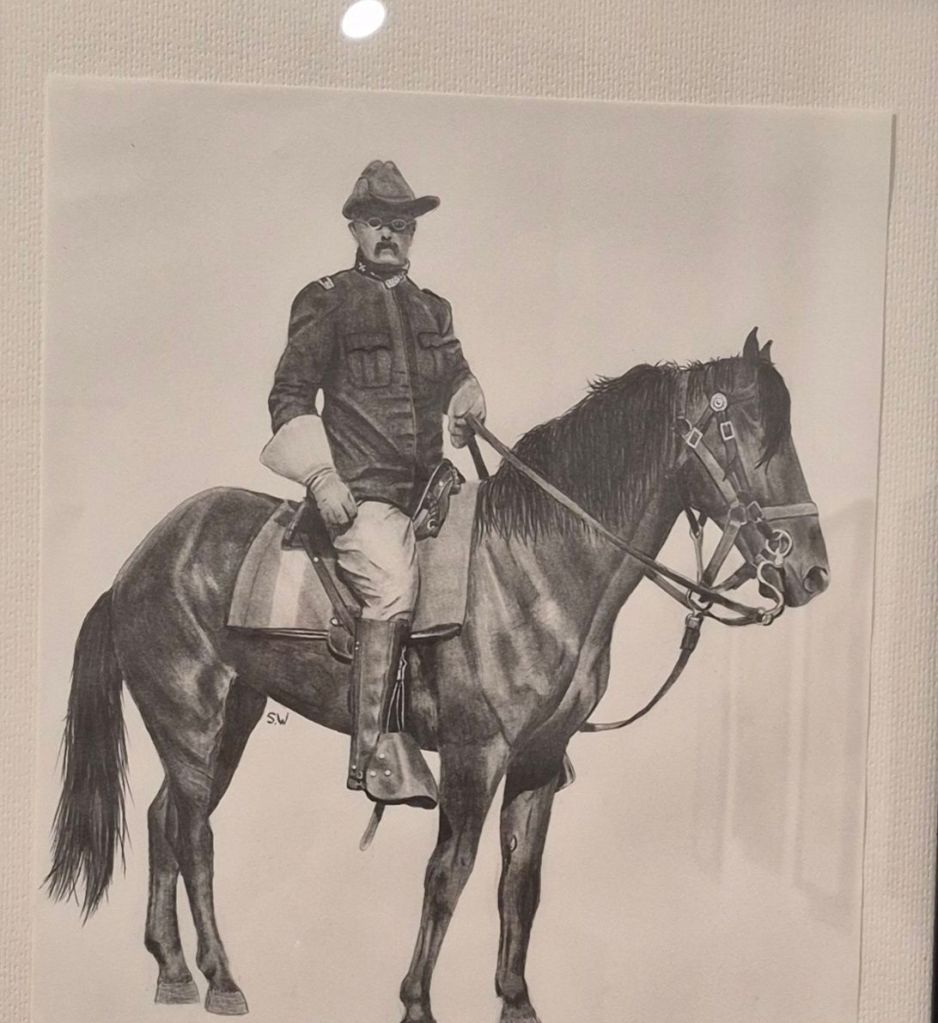
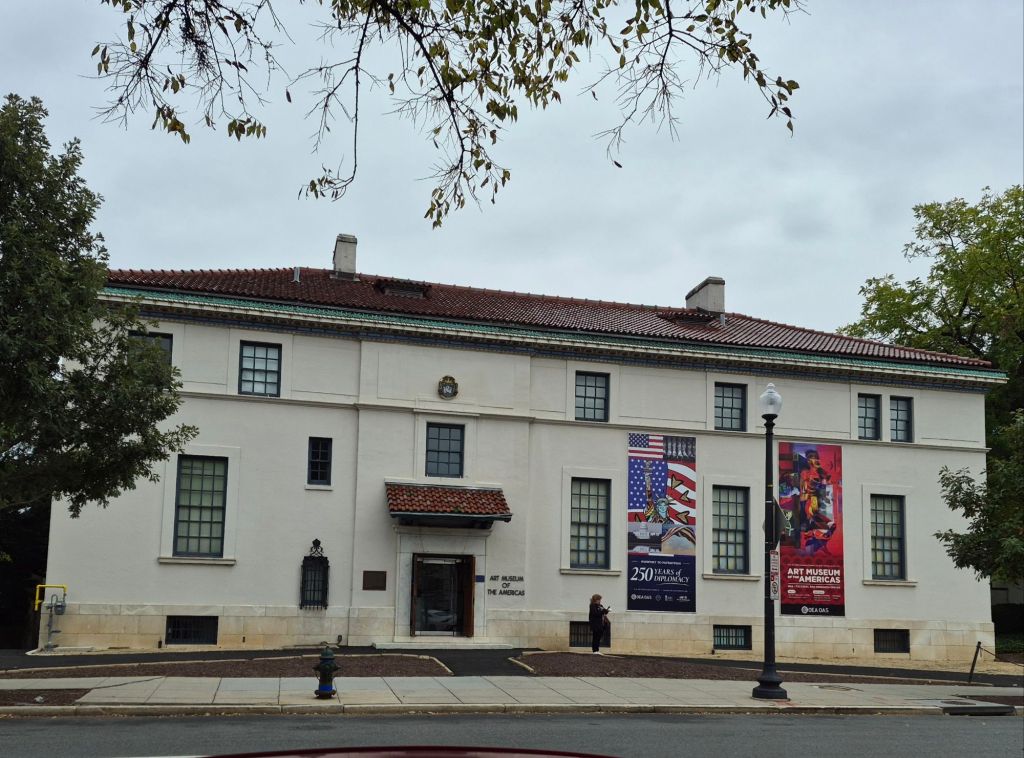
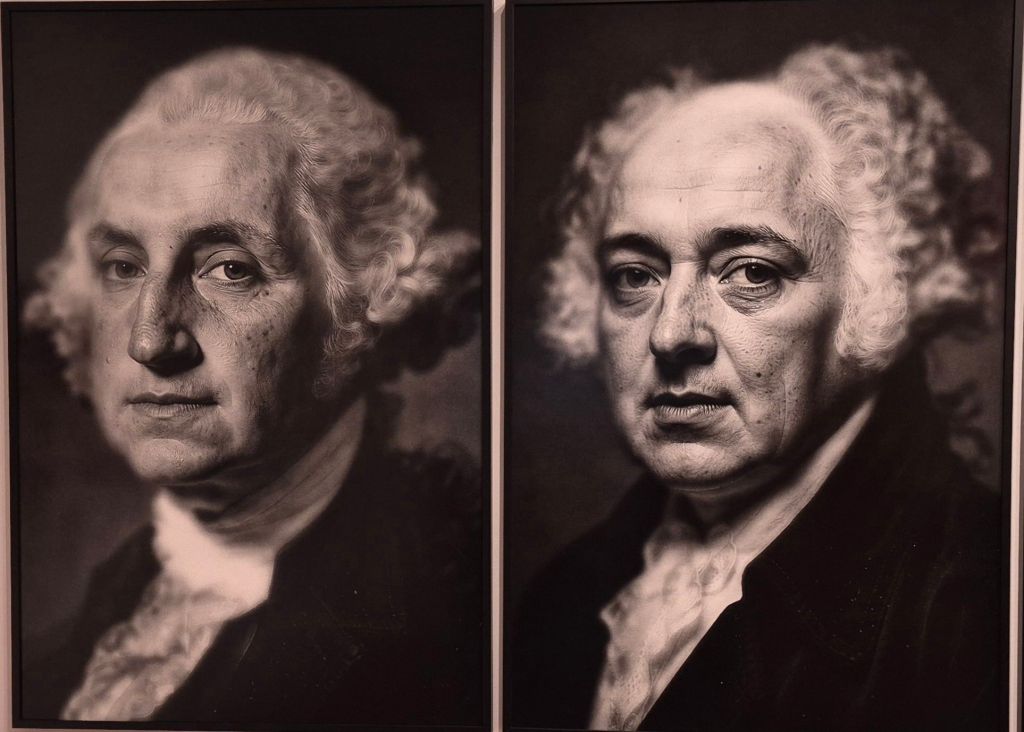
We started yesterday with a walk in Rock Creek Park. There is a wide, flat trail (much wider and flatter than most) that you can access off 16th Street at Juniper, two short blocks west of Ohev Shalom Synagogue. It’s called the Valley Trail, and it more or less follows Rock Creek for miles. The pictures don’t show it, but there are hikers, walkers, runners, and dogs on the trail. Mainly dogs.
We then ran some errands and had a meal at the Sweetwater Tavern in Falls Church VA. Home in time to see the Caps beat Buffalo in overtime, and the Brewers take a two game World Series lead against Tampa Bay.
While we watched, I was reading Terry Teachout’s Duke, his 2013 biography of Duke Ellington, who grew up in DC’s Shaw neighborhood, just a few miles from here. It is an extraordinarily well researched book with (ready for this?) 83 pages of end notes and a detalied 14 page bibliography. Yet, Teachout is not afraid to say where documentation is missing or where he couldn’t find something. Of course, I won’t remember 10% of what is in the book, but no matter. It carries you right along.
A couple of interesting points made. Ellington, who was untrained, and was a poor sight reader, composed in a way very different from most. Where most composers start with a melody line and work the chords around it, Teachout said that Ellington would begin with the chord progressions. The melodies would come last, and often be based on a tune written by someone else. Ellington also did “band based” composing. By that, Teachout means that his music would be written with skills of the current members of his band in mind. And that there was never a final score for any piece, that Ellington’s compositions were always in motion, always “becoming”. Ellington was far from the perfect human being, he was jealous of his competitors (Teachout thinks that George Gershwin and Jelly Roll Morton were top competitors, each different in their approaches to their music).
He also gives a lot of credit to Billy Strayhorn, who was with Ellington for 25 years and wrote much of his music, although this was prettycwell hidden. Strayhorn was a sad figure – gay, when being gay was an embarrassment, very shy, thin and 5’3″. But an astounding musical talent and first class intellectual (something Ellington never pretended to be). And Strayhorn, to complicate matters, was diagnosed with a fatal cancer at 49 and died at only 52.
Terry Teachout, who you may remember as the Wall Street Journal’s long time drama and cultural critic, died young as well, in his mid-60s. He had been diagnosed, says Wikipedia, with congestive heart failure while still in his 40s, but perservered in his very active journalistic career.
Just to bring things home, while Ellington grew up 15 minutes from our house, Teachout (like Rush Limbaugh) was born in Cape Girardeau MO, and grew up in Sikeston MO, not too far from St. Louis. Okay, pretty far.
By the way, I am only in 1939 in the Ellington book. Duke is just turning 40.
Gemini tells me that Albert Einstein “revolutionized physics by proving that time is not absolute, universal, or flowing at the same speed for everyone”. I will accept that, having no idea what he is talking about. But let’s take the year 1978, for example.
In 1978, Amy Acton, Democratic candidate for governor of Ohio, was 12 years old. Her parents were divorced, and her mother had remarried a man named Cledith Arthur.
Digression: Cledith is a strange first name, to be sure. According to my smart phone, today there are “about” 81 Americans with the first name Cledith. The majority of them are female. Their average age is 83. This is important to know. End of digression.
Cledith Arthur was accused of abusing Amy Acton over a period of two years, starting when she was about 10. In 1978, Cledith Arthur was indicted and faced criminal charges. He was not imprisoned after the indictment was handed down and, rather than face the charges, he absconded and wound up somewhere in Pennsylvania. He remained a fugitive until he died in 2004. (Perhaps sadly, I assume there is a movie about this that has not yet been made.)
Amy Acton’s mother, Donna, ran away with her husband Cledith, leaving her children behind. She had had custody of Amy and her brother, but in 1978, Amy’s biological father, Gerald Stearns, obtained custody of his children and they remained with him from then on. Amy has not been with her mother since 1978, presumably most of the time not knowing where she was.
Vivek Ramaswamy’s campaign team reached out to Donna Arthur and created the now infamous one minute commercial in which Arthur claimed that her daughter was just a plain, old Trump-like (she did not use that term) liar. Why did she make that video? Why would she care, living somewhere in Pennsylvania, that Amy Acton might become governor of Ohio? In other words, does anyone doubt that Ramaswamy’s smarmy campaign paid her for her allegiance? I haven’t seen anything about this (in fact, I haven’t seen that any member of the fake media has been in touch with Arthur, or has unsuccessfully tried to be in touch with Arthur), but I can’t imagine that it isn’t true, can you?
Donna Arthur is clearly a woman with problems. I have read that she has been arrested at least three times, writing bad checks, cruelty to animals and more. At least one of these times she pleaded guilty and was sentenced to time in prison. This also has not yet been fully reported. At least, I don’t think it has. (As I said, wait for the movie.)
Another question is whether, in the video, Arthur is lying. There are three possibilities. One, she is telling the truth. Two, she is not telling the truth, but thinks she is. Three, she is lying. If Arthur is outright lying, it would probably be because she is being paid a good portion of the $4,000,000 that Vivek’s smarmy campaign says it is paying to promote the video. And this is a possibility, of course. A reasonable one.
But it is also possible that Donna Arthur thinks that Cledith got a bum rap, and that he really never did abuse his step-daughter. And that Gerald (along with lying Amy) made all of that up to get his children back and punish her and her innocent husband. After all, there does not seem to be any evidence that she participated in, or abetted, the abuse, and maybe the accusations took her by surprise and she just didn’t believe they were true. She would then have been in a terrible position – the courts, she might conclude, would believe her 12 year old “lying” daughter and the s.o.b. that was her first husband, and Cledith would spend the rest of his life in jail, and she the rest of her life alone.
If that is what she believed, no wonder she chose her innocent husband over her inveterate liar of a daughter(with whom I bet she did not get along with very well anyway) and, because her husband had no choice but to escape and go underground, she had to follow him. And, over the next 25 years, this belief became stronger and stronger as Cledith always maintained that he was framed, and she believed him. (I can picture the movie more and more clearly.) And of course, over the 22 years since Cledith died, there would be no reason for her to change her mind, only reason for her to grow more and more bitter.
Amy Acton is no longer 12 years old; she is now 60. I certainly have no reason to believe that she made up what happened almost 50 years ago, but actual proof would probably be hard to come up with now. So, in effect, it is really “she said, she said” at this point. And since there is no record of Amy Acton being an inveterate liar after she moved in with her biological family, and Donna Arthur’s background and history seems so sketchy at best, it is doubtful that many (any) pro-Acton Ohio voters are going to change their mind based on this video. And more likely that Vivek is going to lose some supporters over his decision to produce, show, and double down on it.
Okay, back to time.
1978:
The Shah was in charge of Iran
Jimmy Carter was president of the United States
The U.S. transferred the Panama Canal to Panama
Harvey Milk was assassinated in San Francisco
The Camp David Accords were signed by Sadat and Begin
Home Depot and Ben and Jerry’s were started
Christopher Reeves first played Superman
The Jonestown Massacre occured in Guyana
Saturday Night Fever and Grease were hits
Volodymyr Zelenskyy was born
The Blues Brothers and Bob Marley were big
Muhammad Ali won the heavy-weight boxing title
Cledith Arthur was accused of sexual assault, and disappeared
Amy Stearns (Acton) saw her mother for the last time.
Albert Einstein had been dead 23 years.
1978 was a long time ago. Even for those of us who think of it as yesterday.
Okay, I am back to ignoring the election that is coming up in 10 days. The Democrats are certain to do very well, everyone says. So what could go wrong? I am assuming that the Republicans are ready to do anything to keep the Democrats out of power, and I assume that they will cause chaos, and that, once again (seems like a mantra) our democracy will be at stake.
I heard a pundit say the other day that even if the Democrats win the presidency in 2028, it will take 20 years to right our now wrong ship. Maybe that’s correct, I don’t know, but my fear is a bit different. I fear that things are so out of kilter that even if the Democrats elect the perfect president, that perfect president will not be able to make much visible change over a four year period, and that his or her inability to do so, will lead to a backlash, resulting in the election in 2032 of another right wing wannabe autocrat who will turn the clock of progress back even further.
But I am going to ignore all of that right now. It has been a while since I have talked about my extensive collection of books (know anyone who wants to buy an extensive collection of books?), so I took a pile of books and set it down here beside me, and we can look at what makes up this pile and see what you think.
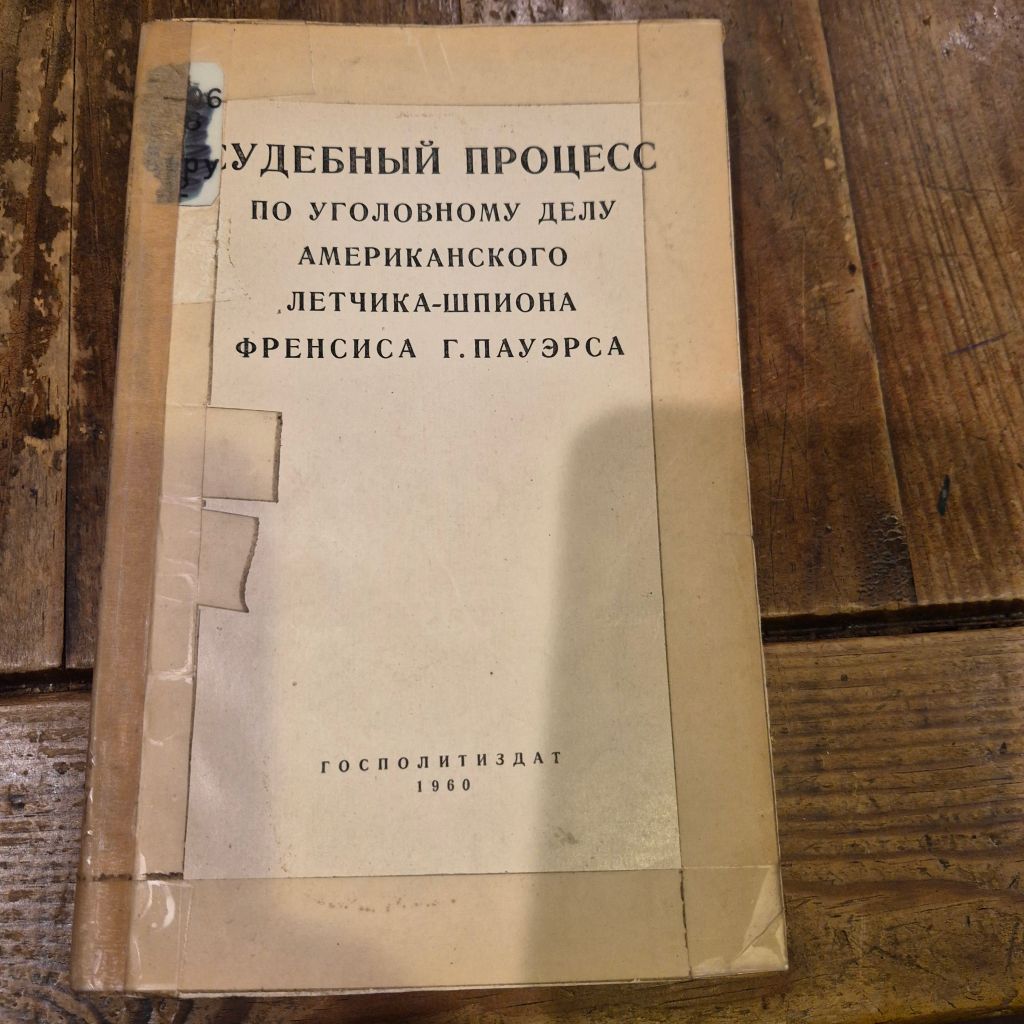
As you can see, the first item is in Russian, published in 1960. I know most of you don’t read Russian, so I will tell you what it is: it is the official Soviet government transcript of the trial of Francis Gary Powers, the American U-2 pilot who was shot down over Russia in 1960. He was 70,000 feet in the air, when a Soviet missile shot his plane down. Powers parachuted to safety, but was caught and, of course, arrested. His mission was a secret one, one of a number of U-2 flights over the Soviet Union, flights that President Eisenhower had long denied were happening. Power was tried (no one suggested, I don’t think, that this was only a show trial), found guilty and sentenced to 10 years of a combination of hard labor and imprisonment, but was released after only 21 months, as part of a prisoner exchange for Soviet spy Rudolf Abel. To make matters worse, he was accused of failing to act properly after he was shot down – acting properly would have included committing suicide so that he could not be questioned by the Russians. But he was finally exonerated at home, decorated, and permitted to go his merry way. His merry way included becoming a test pilot for Lockheed, and then a helicopter pilot for a Los Angeles television weather reporting team. When he was only 47, a helicopter he was piloting crashed, and he was killed. The crash occurred after the plane, which had been surveying brush fires, ran out of fuel, was landing safely in a field, but had to divert to make sure that no one on the ground would be hurt. It was apparently because of the sudden diversion that Powers died. Part of my Russia collection.
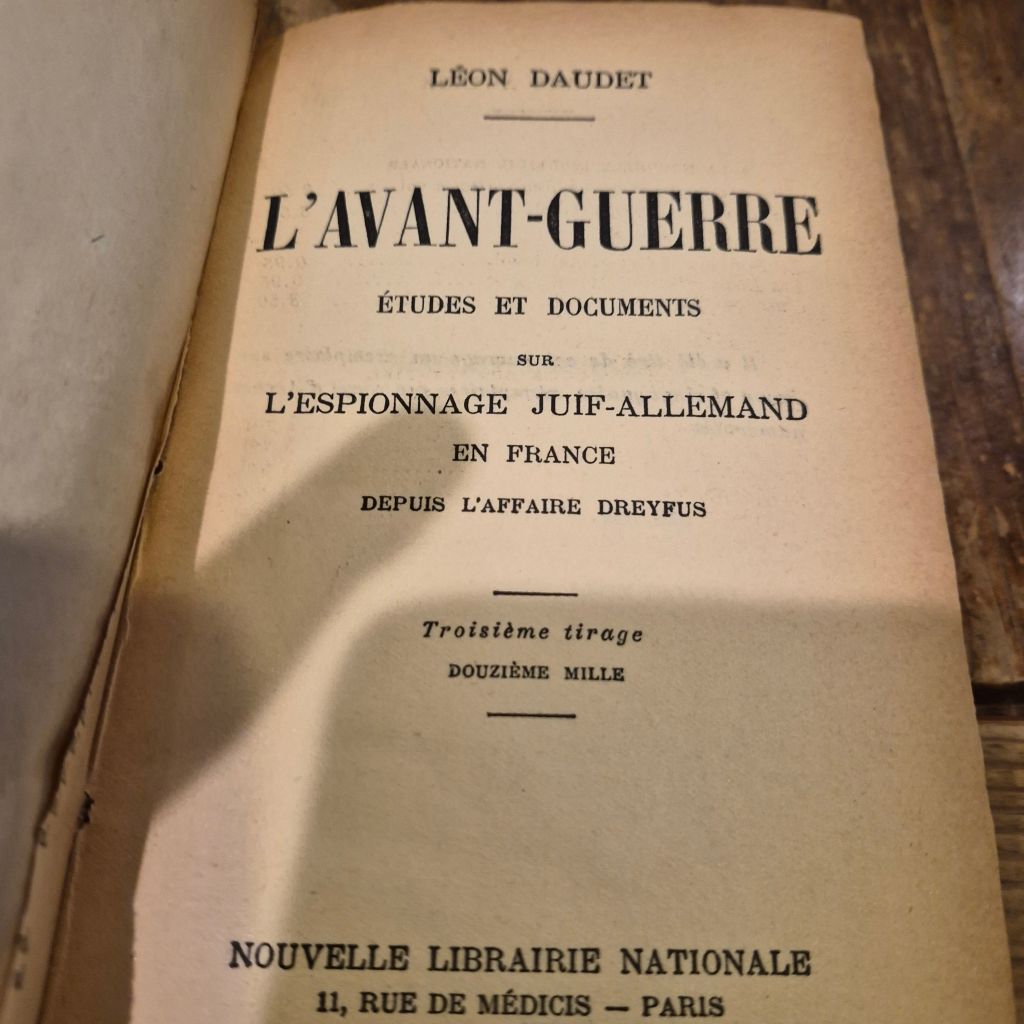
The second book, not in Russian, but in French was published in Paris in 1914, in the aftermath of the Dreyfus trial. Written by Leon Daudet. Daudet was a French right wing figure, a monarchist who was against the French Republic and against democratic governments in general. The book, an antisemitic and anti-German screed, claimed that Germany and its Jews had infiltrated in the French government in the wake of the Dreyfus scandal, to spy on and weaken the government of France. Part of my antisemitism collection.
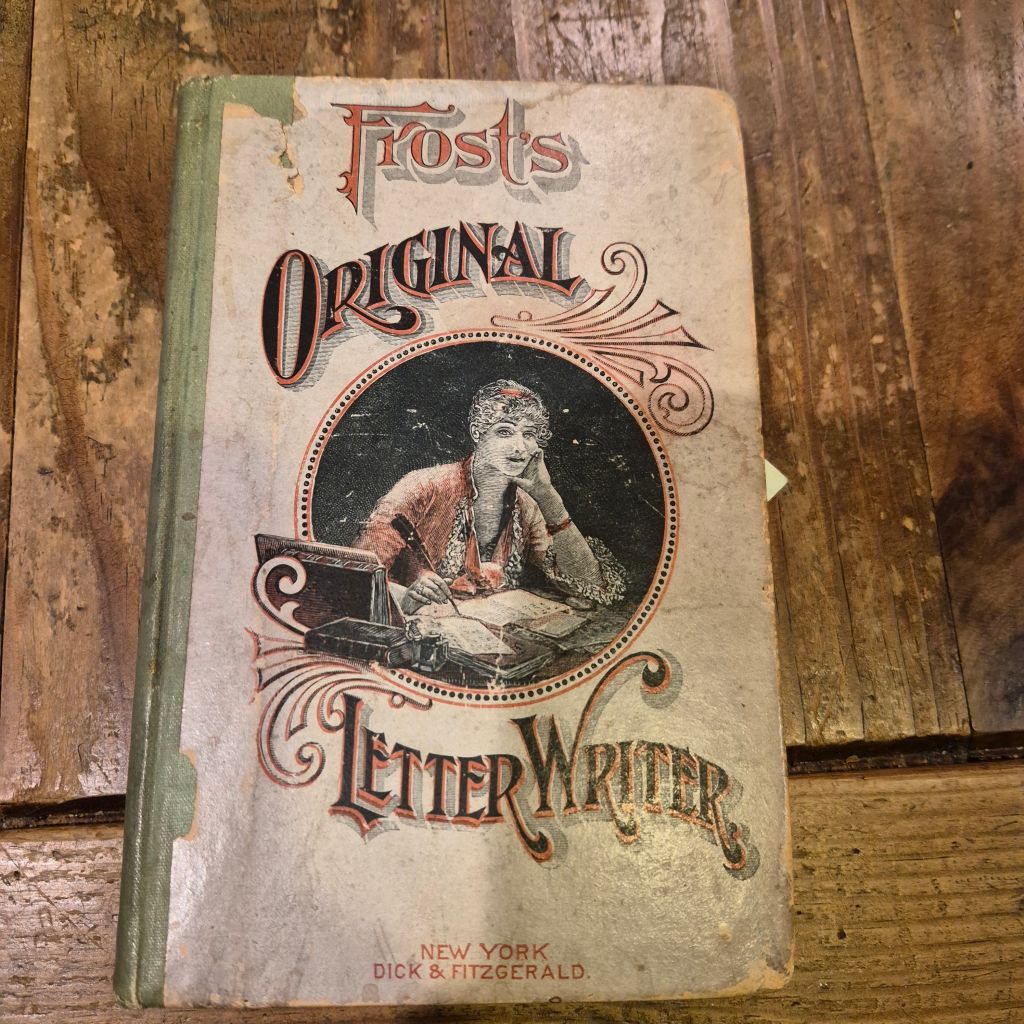
The third books is Frost’s Original Letter Writer, published in New York in 1867. For example, do you have a friend who lost his left arm in an accident? “I cannot find words to express to you how deeply I was shocked and pained to hear of your sad accident. [Your brother] writes me that you are recovering strength, and your spirits are buoyant as ever, so we may thank God it is not worse……I am thankful that your right arm was spared, as that is undoubtedly the more reliable and useful.”
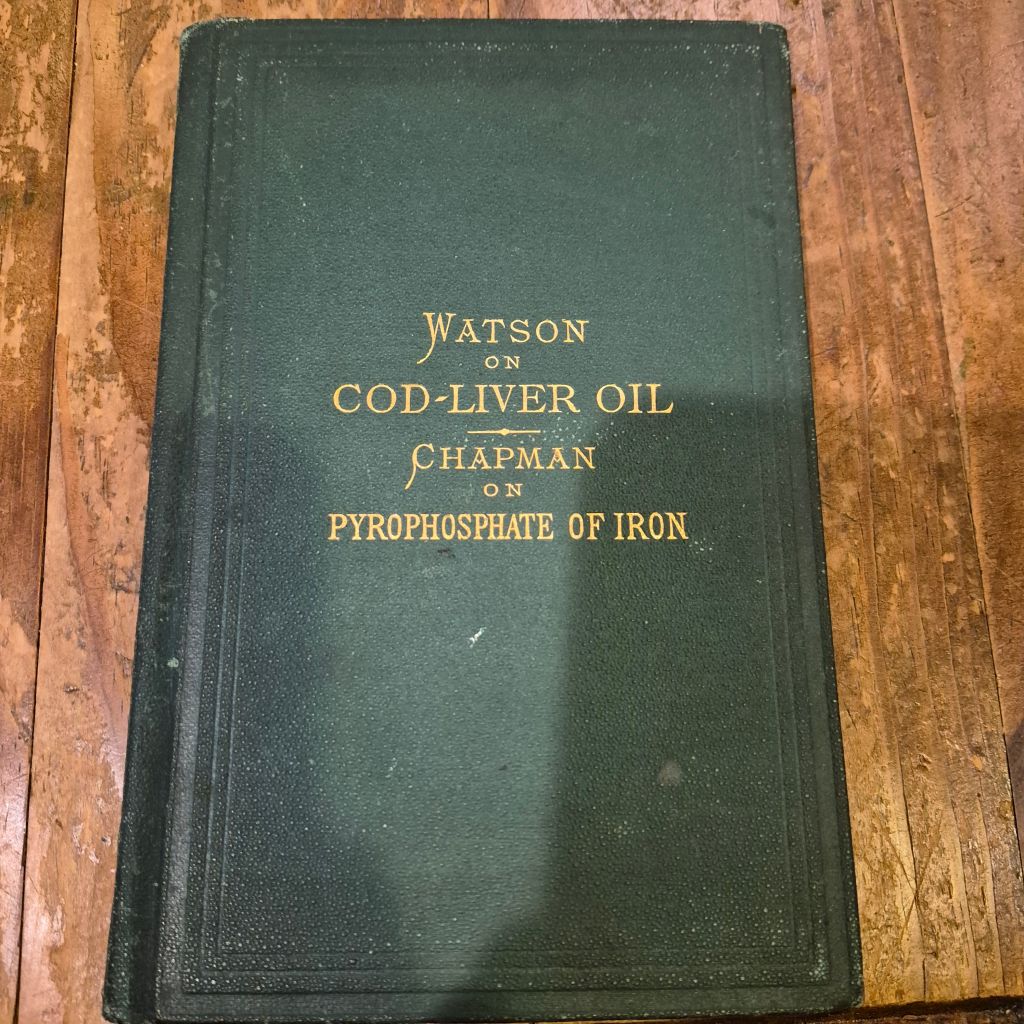
The fourth is Watson on Cod-Liver Oil/Chapman on Phosphate of Iron, published in 1868. It gives a full history of the use of cod-liver oil, and recommended doses and the like. As to whether or not it is better to use pale or dark cod-liver oil, it appears that pale oil is superior, as the dark version “is apt to turn the stomach, irritate the bowels, and if long continued, destroy the appetite and seriously impair the digestive powers.” We sure don’t need that.
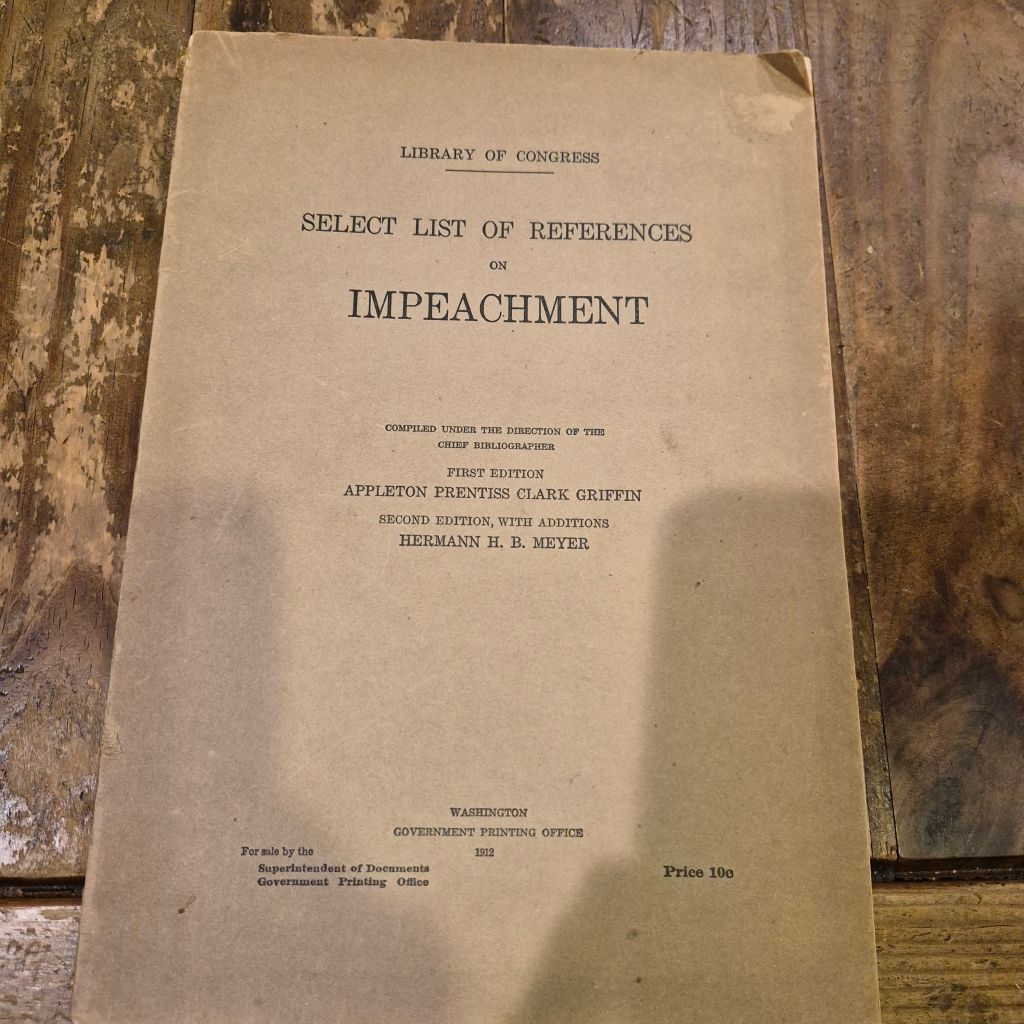
The fifth book is a 1912 publication of the Library of Congress, titled “Select List of References on Impeachment”. Federal impeachments, state impeachments, even foreign impeachments. One example is the impeachment of Senator William Blount. I know none of us know anything about that, but Blount was one of North Carolina’s signers of the U.S. Constitution and one of the first two Senators from the then new state of Tennessee. He got involved in a plot to conspire with British and Native American forces to attack Spanish territory (in what became ten years later the Louisiana Purchase) including the Mississippi River and land west of it, and to turn it over to the British, in the hope that the British would then open the Mississippi to American commerce. The House of Representatives decided this was treason and impeached Blount, but he was not convicted by the Senate, who decided that Senators were not subject to impeachment under the Constitution. Who knew? The year was 1797.
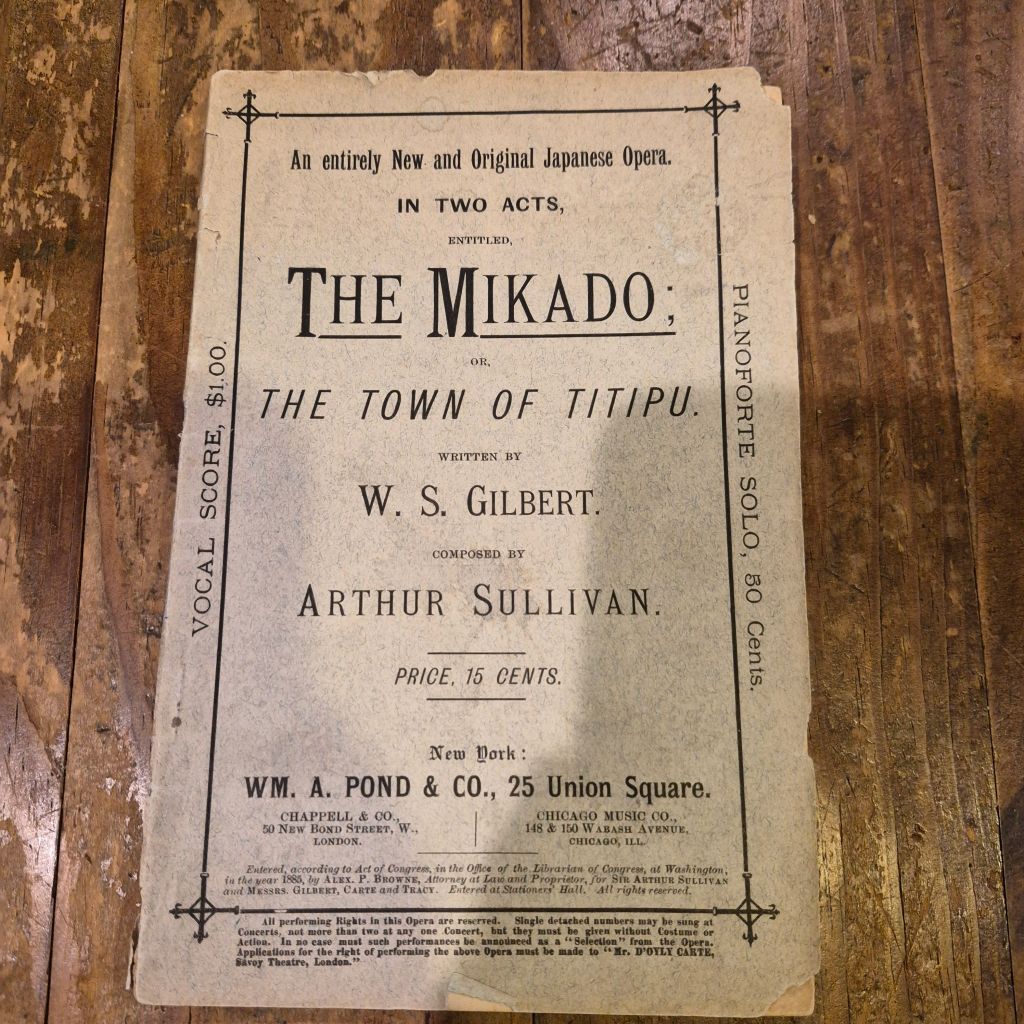
Finally, I have a copy of the libretto to Gilbert and Sullivan’s The Mikado. Big deal, you say, they are a dime a dozen. True, but this is the the 1885 edition, when The Mikado was “An entirely New and Original Japanese Opera”. The Mikado premiered in March 1885 in London at the Savoy, and ran for 672 performances. It opened in the United States later that year.
I apologize for the quality of the picture, but am amused to see this poster around town, as we near the November election. Janeese Lewis George , the Democratic nominee, will probably get 90% of the votes cast for mayor of the District of Columbia. There is no Republican candidate. The Green Party has a candidate, Robert Gross, and there is one Independent who will be listed on the ballot, Rhonda Hamilton. I know nothing about Gross or Hamilton.
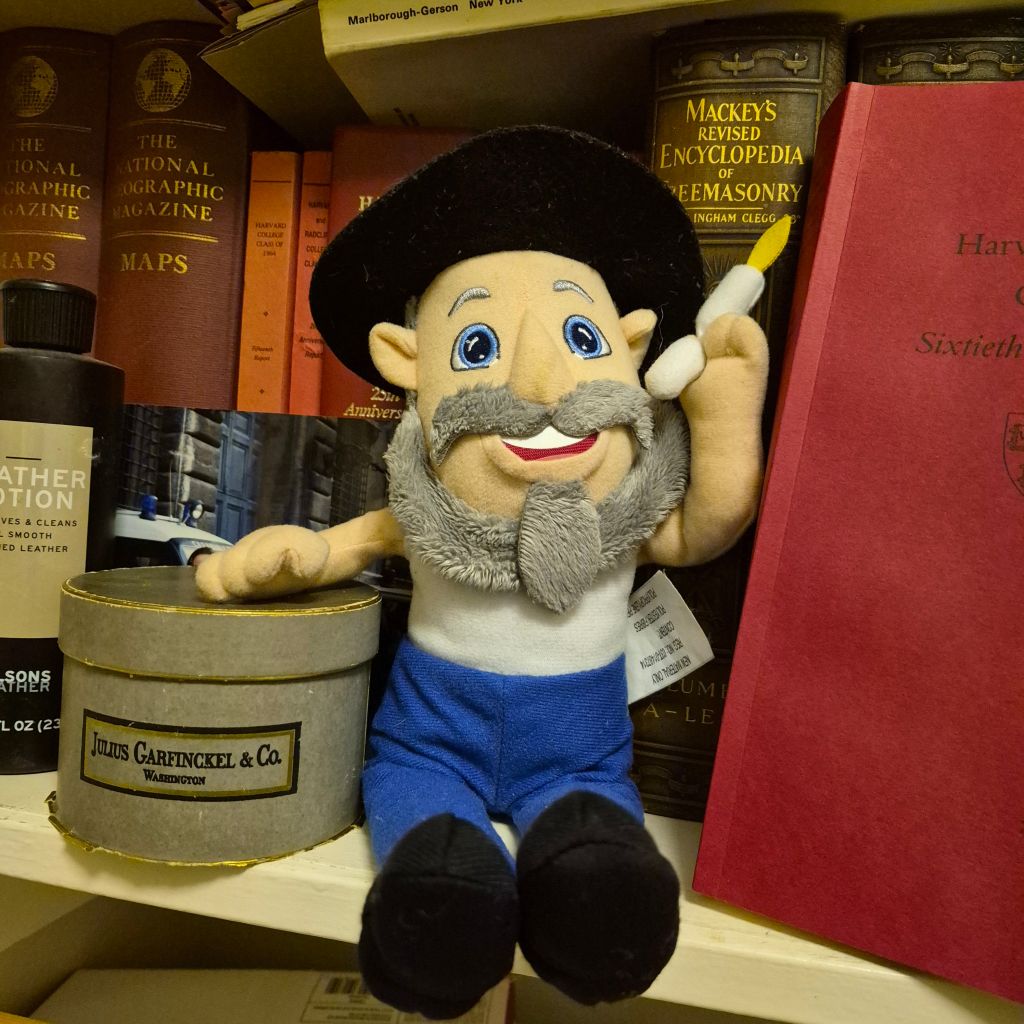
I also know nothing about Muhammad. He does have a website, and he comes across as a nice and serious kind of guy, but not with the qualifications you would want in a mayor. And of course, he will not be the mayor. But what interests me is that he thinks that anyone (other than his only son, perhaps – he is divorced) is going to be able to (1) remember his name and (2) spell it correctly to write in a vote for him. Okay, if your name is John Doe or Jane Doe or Jack Jones or something, but …. Talib Karim Muhammad? And I assume that one misplaced letter, and your vote is thrown out.
Voting in DC is not like voting anywhere else, especially in a mid-year election. Because we are a one party city, the mayoral election is not competitive, nor are most others. We are voting to replace DC (non-voting) Congressional Delegate Eleanor Holmes Norton, and will elect Democrat Robert White over the Republican and Green candidates. For chair of the DC City Council, Phil Mendelson will win his 4th or 5th election as chair; he has been on the Council for over 25 years. His Republican opponent is Abi-Ananiah Prudent. I don’t know anything about her (and I bet the vast majority of DC residents couldn’t tell you if she is male or female), but I see that “with a passion for making Christ’s name known among government leaders,…..Abi-Ananiah has united Bible believing Christians in prayer for those on both sides of the aisle”. (This quote is from her description on the Concerned Women for America website.) Yes, it’s the good old DC Republican Party in action. Talib Karim Muhammad, by the way, is a long term DC resident, who has two degrees from Howard. Prudent moved to DC last year from Tennessee. Her only degree is from Liberty University.
Okay, so we know that Lewis George will be the next mayor, Robert White the next non-voting Congressional delegate, and Phil Mendelson will continue to chair the City Council.
The Council itself is made up of one chair, eight ward representatives and four at large representatives. We live in Ward Three and incumbent Matt Frumin has no opponent, so unless people write in my name, he is sure to be reelected.
But of the four at large seats, two are open. And this is where things get complicated. Beyond complicated. See if you understand this:
In previous elections, you would have a list of candidates, and voters would be instructed on the ballots to vote for two from the list to fill the two open slots. Easy, peasy.
But not now. Now, for the first time in a general election, DC has ranked voting. And for reasons that are unclear to me (but I am sure there must be reasons), rather than having the two positions be on the ballot separately (and I guess they never had been separated before, but before it made no difference), both positions are lumped together. There are four named candidates, and there is a place for one (only one) write in vote.
The idea is that the two winning candidates will be the two council members, but this is only an idea. THE BALLOT NOWHERE TELLS THE VOTERS THAT THEY ARE VOTING FOR TWO PEOPLE!!! The heading is “At-Large Member…..”, not “At-Large Members……”. You are told you have five choices, but you don’t know, unless you know (which most won’t) that you are voting for two winning candidates, rather than one. I think this is a fatal flaw. And this is not what is supposed to be meant as a “secret ballot”.
There is another complication. By law, two of the four at-large members must not be members of the “majority party”. Forget for a moment, how the “majority party” is determined; take it from me, the majority party is the Democratic Party. One of the continuing at-large members, Christina Henderson is an Independent. So is Elissa Silverman, a current member running for reelection.
The four candidates (in the order printed on the ballot – which I believe are still done by lottery) for the two (not defined as two, but yes, two) positions are: Oye Owolewa, Democrat; Darry Moch, Green; Darrell Green, Republican; Elissa Silverman, Independent.
Digression: As an aside, Owolewa’s full name is Adeoye Ibrahim Yakubu-Owolewa (but you can call him Oye). End of unnecessary digression.
It is certain that Owolewa, the only Democrat (okay, so Elissa is a Democrat, but she can’t run that way – that’s another issue for another day) will win one of the seats. But, under the way ranked voting works, if you vote for the winner as your first choice, none of your other choices count at all. That means, for all practical purposes, that Elissa Silverman, last on the ballot and down as an Independent, must receive more first places votes than either Moch or Green (or any write in). If Owolewa gets so many votes, that the remaining votes go largely to the Republican Party candidate or the Green Party candidate, Silverman will be out. In other words, if the 90% of the voters who vote Democratic vote for Owolewa first, and Silverman second, and 10% of the voters vote for Green or Moch, the winner will be Green or Moch, each of whom will receive far fewer votes than Silverman. And that is because the two positions are being thrown together on the ballot, with no explanation or attention being paid to this, combined with the complications of ranked choice voting and the legal requirement that two at large seats be held by persons not affiliated with the majority party.
I know you probably didn’t understand it, but read it again until you do (if you are a DC voter). And yes, there is another complication in that Green the candidate is not running on the ticket of Green the party, but that is the least of our problems.
There are a few other things on the ballot. Brian Schwalb will be reelected attorney general; his opposition is a Republican no one knows, and everyone knows Schwalb has done a fine job. We also elect a Shadow Senator and a Shadow Congressman – I don’t cast a vote in those silly positions which are unpaid and, as far as I can tell, have never accomplished a thing. And then there are two Ward Three candidates for the State Board of Education, another set of positions I don’t vote for since the Board of Education, once a board with power, has some time ago been changed into a board with only a voice and usually no microphone to allow that voice even to be heard.
There is one initiative on the ballot – basically an anti foie gras measure. No more force feeding geese or ducks. I think it will pass easily.
One more overall question. The printed ballots, under each position, have room for one write in candidate. That is fine when the voter can only vote for one candidate. But where, in the case of at-large Council membership, there are two positions to be filled, shouldn’t there be two spots for write in votes. I assume there is no way to write in a spot for a second write in vote. Another flaw.
So, who knows what all of this confusion will really mean. I think it caught everyone by surprise and I expect there will be some changes to the law that will permit some changes to the ballots by 2028. We shall see (I say that a lot).
Donald Trump endorses Bibi Netanyahu for prime minister of Israel. Will this affect the Israeli election? The Israeli election (which goes by party, not by individual) is said to be very close, with no party going to get a majority, so the question will be which party leader will be asked by the country’s president to try to put together a majority coalition by collaborating with other, smaller parties. But Netanyahu’s Likud Party is, according to virtually all polls, in second place and, of course, wants to wind up in first place. What will Donald Trump’s endorsement do for Netanyahu.
Two things to remember. In Israel (as opposed to in the United States and in most of the world), Donald Trump remains quite popular. And, although the Israelis like to talk about their ability to face the rest of the world with no friends, many or most Israelis believe that American financial and technical support, and American weaponry, is very important in helping guarantee Israeli security. So, to the extent that Israelis know that Trump will be president for more than 2 more years (at least), and that Israelis believe that American support can only be guaranteed by Trump, it follows that their knowing that Trump and Netanayu are so closely entwined would mean that many Israelis would conclude that Israel will obtain more American support if Netanyahu remains prime minister. So, yes, I believe that Trump’s endorsement will be very helpful to Netanyahu and Likud.
I watched the first half of an interview with Yossi Klein Halevi the other day. Halevi. Halevi, who works with the Hartman Institute in Israel, is an American born author and commentator on Israeli politics and society. He is generally respected as a pragmatic thinker. He said a couple of things that surprised me. Three of them were, I think, at least somewhat contradictory.
First, he said that Israel and Jews are not talking enough about morality, that the entire concept of how to act morally seems to have fallen outside of the normal conversation. Okay, I buy that. That is similar to what I have been saying when I ask: where are the prophets?
But second, he said that Israel today is in a terrible situation where it is not permitted to act morally, because it is a question of survival, and in the hierarchy of things, survival comes before morality.
And third, he said (as he has over and over) that he detests the Netanyahu government.
He was not giving a political speech when he said all of this – he was talking to a bunch of American teenagers (?) or twenty somethings who had come to Israel to participate in a Hartman program of some sort. It was, I think, an introductory, welcome program for them. And I don’t know how it ended. I turned it off because of time, not because of lack of interest, and I will get back to it.
But one thing was clear. Halevi was not talking about the upcoming election. He was not touting a particular party or party leader. He was talking about Israeli society. And he was talking about the growing separation between American Jews (his audience) and Israeli Jews, saying I think that he understood why American Jews felt ambiguous about Israel today, but he did not think that American Jews understood the position that Israelis are in.
He also did not (at least in the part I watched) offer any solutions; I think he said that he had none.
Although the Netanyahu Likud party looks to be coming in second in the election to Gadi Eisenkot’s Yashar Party, it may be that Netanyahu will be the one asked to form the next government. This is because of a general turn to even the further right by young Israeli voters, and to polls and pundits who predict that Israeli National Security Minister Itamar Ben-Gvir’s Otzma Yehudit Party is growing in strength. The assumption is that it may wind up with as many as 10 representatives in the 120 member Knesset. It is unlikely that Eisenkot (far from a left wing figure) would ally with Ben-Gvir in a government coalition, and the prospective strength of Ben-Gvir gives him a significant influence over another prospective Netanayhu government.
If that happens, morality will be further and further from Israeli government discourse, and the country will continue on its current path, which is to make life for remaining Palestinians in the West Bank and Gaza more and more unpleasant, leading perhaps not to genocide (although that might even be Ben-Gvir’s first choice), but to widespread emigration and permanent domination by the Israeli Jews. It might also mean less equality for the 20% of Israel proper’s citizens who are Arab, and growing pressure for Israeli annexation of the entire West Bank, world opinion be damned. All of this bodes bad. Very bad. And will put the large number (but not large enough number) of Israeli citizens who want a different kind of country in a real bind.
As to events in the U.S., remember that in 2016 and 2024, it seemed clear that Trump was going to lose the presidential election. So in 2026, it is unclear to me, although the generic polls now show the Democrats getting 10% more votes than Republicans, and the individual state polls seem to be leaning strongly towards the Democrats, that it is going to be the Blue Wave so many of us are hoping for. But it does seem likely that, at some level, at least the House will wind up Democratic.
So the Republicans, sly devils that they are, are resorting to their own forms of immoral conduct. Two examples that I am sure you have read about.
First, the accusation (baseless, and I think admittedly so) that Abdul El-Sayed has ties to the Muslim Brotherhood. Well, not that he has any direct ties, but that his Egyptian born biological mother (now a psych nurse in Columbia MO) was active in the brotherhood in the 1970s when she was growing up in Alexandria Egypt, and that she worked as a nurse for the Islamic American Relief Agency (an organization which, in addition to raising funds for movements that we might not approve of, operated many health clinics serving low income persons). I am not sure what her precise activity was comprised of, but there is no basis to think she has been involved in any extremist politics and she was never accused of wrongdoing. The activity in Egypt occurred a decade before her son was born and she and El-Sayed’s father were divorced when El-Sayed was three, and he was raised by his father and step-mother.
The accusation was recently made at an event in Michigan where El-Sayed was speaking. It turns out that the accuser was a paid high level staff member of Missouri Senator Josh Hawley, not a constituent. Gee, Josh, can’t you do better than that?
And then of course there is the latest. The video being circulated by Vivek Ramaswamy (heretofore, Ramaswarmy) featuring the mother of his opponent in the race for Ohio governor, Amy Acton. Acton’s mother left her children behind when Amy was 12, to follow her husband, Amy’s stepfather, who had been accused of serial sexual crimes involving his children. She now says, in this video, which the Republican campaign is going to show again and again and again, that Amy is a liar and always been a liar and just cannot be trusted.
It seems to be a pattern of this year’s GOP. If you can’t beat the Democrat in a clean campaign, attack their mothers. Is this weird, or what?
When we got the new car in July, it came with six months of Sirius Radio free, something that we had never before had in a car (and never wanted to have). My usual car radio exercise was to surf between three FM stations, WTOP for news, C-Span Radio for current events, and WETA for classical music. When I wanted to hear something else, I would usually turn on YouTube on my phone and listen from there.
For the most part, Sirius is a disappointment. When I say, for the most part, I mean virtually none of their programming holds any interest for me. They have one-sided political screeds, and a bunch of comedians telling stale jokes, and more music that I don’t like than you can possibly imagine. In fact, there are only two stations that I find at all appealing, Symphony Hall and Real Jazz. The other 75 music stations and an equal number of talk stations I really don’t want to listen to while I am driving, either because the music or content doesn’t interest me, or the sound diverts me from other things I am thinking about.
But those two channels may keep me subscribed to Sirius radio, much to my surprise. I haven’t spent much time analyzing Real Jazz’s programming, but the selections are varied and don’t demand my full attention. I have looked somewhat closely at the Symphony Hall, and I like their selections better, I think, than those played on WETA, our local public radio classical station (of which I am a member and support). Over the weekend, I got to listen to Mahler, and Beethoven, and Mozart, and Brahms, and Vivaldi and all the classics, but I also got to listen to a variety of more contemporary classical music, pieces that I don’t know by composers I have either barely, or never, heard of. And, what is more, you can go on the Sirius website and see what they have played yesterday or the day before, or who knows how long ago, learn more about the piece and recording, and listen to it if you wish. Perhaps you can do this on the Real Jazz channel and all the others, as well. I haven’t tried.
While I am giving a shout-out to Sirius Radio, maybe I should list some other items that are worth telling you about. Most are food items.
For one thing, I have discovered that, for my taste, Greek olive oil is the best, almost always so. So, although we might use other olive oils for cooking purposes, when it comes to salad, it is always Greek. I started with 365 Greek Olive Oil, the Whole Foods brand. But we really don’t go to Whole Foods that much any more (we support Amazon enough in other ways), and I have found a new brand, Dimitri, which has been pressed by the same family in Sparta since 1804 (so they clearly know what they are doing). I get it at Bread Furst, and yes, it isn’t cheap (but what is these days). As to vinegar (again for salad use), the brand that I have found the best to be the Peppercorn fig balsamic vinegar, sold at the Peppercorn Market in Bedford, PA. Of course, the market does not make the vinegar and I don’t know who does, but it is top, top quality. Of course, Bedford PA is not just up the street; it’s about a 2 1/2 hour drive from here. We have never bought enough to last (and I didn’t want to have to add on the high shipping cost to order on line), but we hope to be in Bedford in a couple of months and, if so, I am going to stock up.
I have mentioned Liberty Orchards Turkish Delight, which we discovered this summer in the small town of Cashmere, WA, and which have ordered on line a few times. Now, I will add four more dessert items – Beyond Good Madagascar Chocolate Bars (especially – well, I don’t know all of them – the dark chocolate and the vanilla bean chocolate), Mi-Del Swedish Ginger Snaps, Fruit Bliss dried apricots (actually very moist), and Dolcezza Dark Chocolate, Strawberry, and Mascarpone and Mixed Berry Gelato. We generally get these at Mom’s Organic Grocery.
Moving off desserts, and knowing that processed foods are not the best for you, I will limit myself to two recommendations. First, Amy’s frozen vegetarian burritos, which come in various combinations (southwestern, black beans and cheese, etc) and are all good. Not only that, but you can cook them in your microwave in 1 minute. Can you top that? And then there are EAT frozen pizzas (yes, that is the name of the brand, and I am not sure you can get it outside of the DC area), which come in various flavors, but we get the Classic Margherita and Wild Mushroom varieties. Again, from Mom’s.
I mentioned that we don’t go that often to Whole Foods, which creates a problem for our peanut butter supply, because we like Crazy Richard’s, and haven’t found it anywhere else where we normally shop.
Finally, and I will stop with this. Our coffee is Mt. Hagen organic freeze dried fair trade instant coffee (try it before you criticize me), and while there are always new teas to try, the one I would recommend is Numi Green Jasmine.
I could add to this list, but I will stop here. I am just trying to avoid talking about Donald Trump in the hope that his influence will vanish as a result of the November 3 elections (about which I am very concerned in spite of the polling) and about Bibi Netanyahu in the hope that his influence will vanish after the October 27 elections in Israel (about which I am very concerned, period). Once that day is behind us, I will get back to regular order.
“Falling crucifix kills priest during live-streamed mass in Equador”.
This headline greeted me this morning when I turned on my computer and, yes, it was apparently very legitimate. It was apparently a wedding mass, and the crucifix was affixed to the wall behind the priest, until it wasn’t. The question is: is there a meaning behind this tragedy? Is it part of God’s plan?
You remember Thornton Wilder’s book, The Bridge at San Luis Rey? A rope bridge in the mountains of Peru collapses in the 1700s, and five people are killed. Brother Juniper sees the tragedy, and spends years trying to figure out what the connection was between these five people, if any, and tries to ascertain God’s reason for selecting these five people for joint death. He believes that he may have succeeded in figuring out what God was doing, whom He was punishing and whom He was rewarding. He makes public his conclusions. The church Inquisition determines that it is neither possible, nor appropriate, to try to contemplate God’s actions on a scientific basis, arrests Father Juniper, and executes him.
I better leave well enough alone.
The book won Wilder a Pulitzer Prize in 1927, one of three that he won. Another was for Our Town in 1938, and the third for The Skin of Our Teeth in 1942. These were both for Drama. I have seen each of these more than once. Our Town, showing small town life and small town death, and the relationship between the dead and the living (from the perspective of the dead) is a very nostalgic play, even for someone who has no common background to engender the nostalgia. The Skin of Our Teeth is a fantasy play about how we would react if the world as we know it is destroyed, and replaced by another world. Always one of my favorites.
I have never read The Eighth Day, the novel that won Wilder the National Book Award in 1968. I am not sure why not.
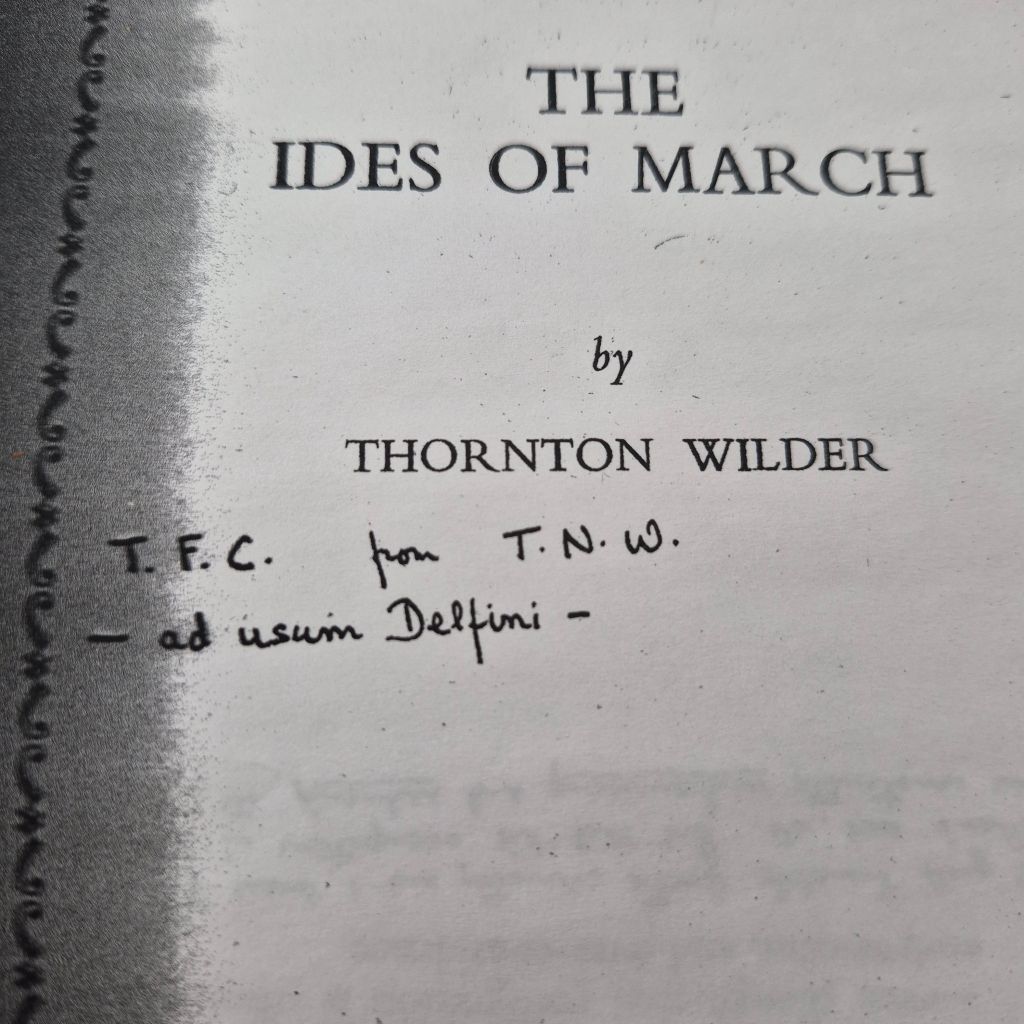
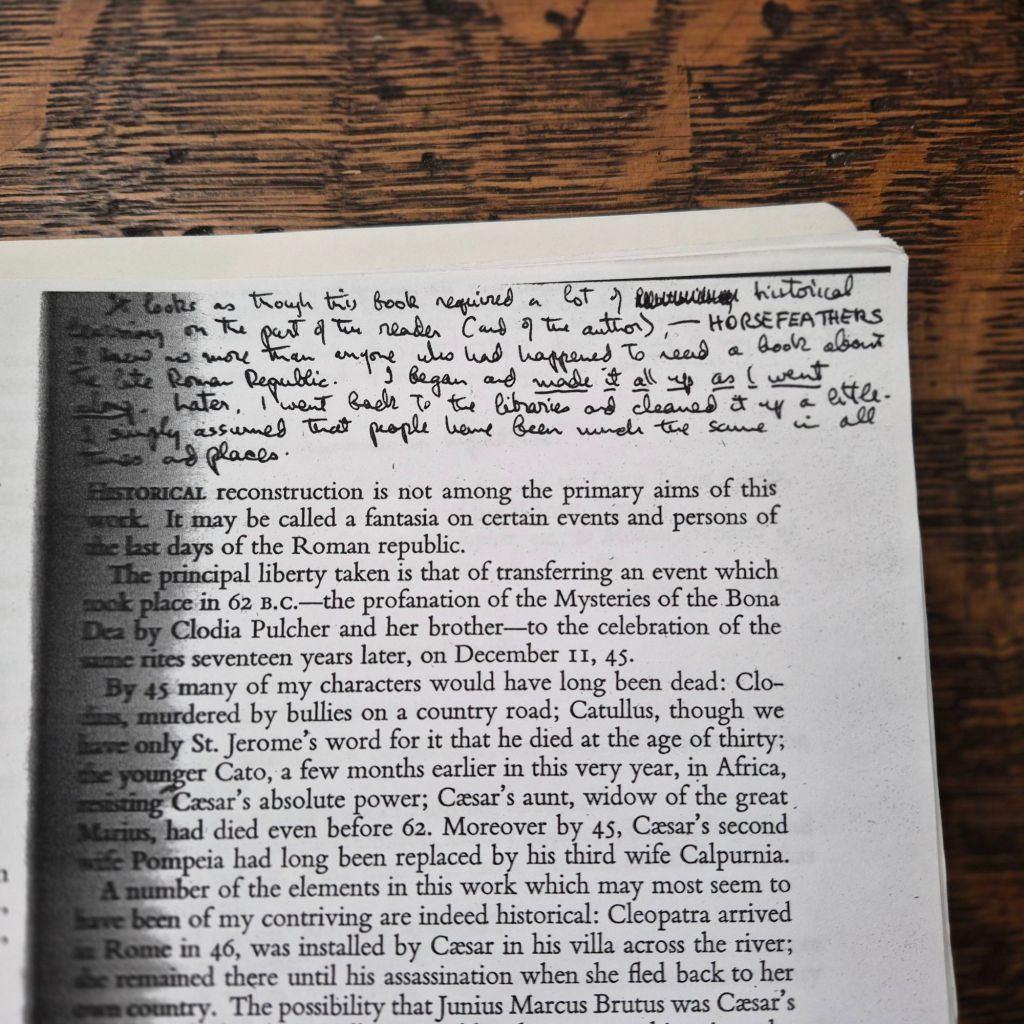
It is even stranger that I haven’t read his The Ides of March, Wilder’s historical fiction about the end of the Roman Republic, another book that is usually highly acclaimed. It is strange because I not only have a copy of this book, but I have a copy that was not only inscribed by Wilder to a Washington governmentalv official, but was annotated by Wilder, almost page by page, for his benefit. One day, I will donate it to the Wilder archives at Yale’s Beinecke Library, I think, but not yet.
The story of this book is interesting. It was years ago, when my law office was a lunchtime walk away from Dupont Circle and I used to take the opportunity to stretch a bit by walking to Second Story Books and looking at the books that they sell outside (then sold for $2 a book; now for $2 to $4 depending on the day of the week). I used to try to go on Thursdays. That was the day they turned over the books.
I have long looked for books signed by their authors – sort of a cross between fly fishing and being actively involved in conservation of rare artifacts. I long ago learned that you can’t judge a book by its cover (I am not have been the original source of that common phrase, but I am perhaps the only one who took it seriously), so will look at books that might be less than pristine.
One day, I picked up this jacket-less book by Wilder and saw that it was briefly inscribed by TNW. The cover page said that the book was by Thorton Wilder (no middle initial), so I didn’t know if this was him or not, but I took the book for $2 and brought it back to my office, quickly discovering that Wilder’s middle initial was indeed N. It was only then that I saw the annotations, and realized that I had found something worth more than $2.
Inside the book was a British Airways boarding pass made out to someone named Catherman, and Wilder’s final inscription said: “all best wishes, every day of his life, to Terry Catherman.” Catherman was an American diplomat and high ranking USIA and Voice of America official, who had died a few years before I found the book. What his relationship was to Wilder, I do not know.
Was I planning on writing about Thornton Wilder when I sat down this morning at the computer? Not at all. It was falling crucifix that led me to think of poor Father Juniper and then poor Terrence Catherman who, had he not passed away, would this year celebrate his 100th birthday.
By the way, over the weekend, we saw The Flying Lovers of Vitebsk, a play about Marc and Bella Chagall at Theater J. Your odds would have been better if you bet on me writing about Marc Chagall this morning. But I hope you didn’t make that bet. The show did not do much for me.
We paid our first visit yesterday to the new National Geographic Museum, which, as you may have guessed, has replaced the Old National Geographic Museum. The old museum looked like it was designed by Rube Goldberg – wherever they could find space to put something on the first floor of the National Geographic headquarters, they would. Not that that was bad, but now they have a regular museum. Here is the foyer:
The museum is very spacious and very comfortable. But there are some negatives, the biggest being the ticket prices – $27 for seniors, $24 for children 5 to 17, and $30 for other adults. Another is that you can’t go into the gift shop or the restaurant unless you have a ticket. You normally don’t see that in a museum, but I guess they don’t want lawyers to crowd out tourists at lunch.
A large portion of the extensive first floor exhibit space is devoted to National Geographic photography, much of which is absolutely beautiful. Here are a few examples.
An illegally poached and killed gorilla, being respectfully carried away from the site of its murder.
This is a dog sled in Alaska.
The second exhibit highlights the work of animal photographer Joel Sartone, who has been working for the past 20 years on photographing every animal species under the control of man. This means, I guess that he is not a wildlife photographer, but a photographer of animals in captivity. There are about 25,000 animal species held in captivity, and Sartone has so far photographed 18,000 of them. This exhibit is very nicely arranged , showing information, including place of residence, of every animal shown, and information about their habitat and conservation status. Here is a photo of an endangered koala (actually three).
The second floor has individual bios of over 400 explorers involved in Nat Geo or related projects, as well as equipment including a bathysphere and a seabed walking uniform.
One thing I realized about the National Geographic Magazine that I remember from years past. I recall the articles divided into four categories. The largest section was devoted to how people lived around the world (e.g., how Laplanders got through the winter). The second would be technology (e.g., how they mine diamonds in South Africa). The third would be geography (e.g., mapping the Sargasso Sea), and the fourth would be animals. No longer. People living in remote places must be taboo. Technology is only relevant if it supports exploration. Almost everything is animals.
We spent a little over an hour, maybe 90 minutes. We didn’t feel rushed, but a longer, slower visit may be better, one with a lunch break. The Eatery is intriguing with separate stations offering American, Italian, Vietnamese, Syrian, and Peruvian food.
Yes, a trip to the museum is worthwhile. It is just not for the feint of purse. That’s too bad.
Looks like No Kings Day was a success not only in this country, but around the world. As Edie said, it must be different to go to a No Kings rally in England.
What else? A personal defeat. I always think it a defeat when I stop reading a book in the middle. Especially when I am not really critical of the book. So I apologize to French author Gil Buhet for two reasons. For shutting his book on page 79 and for having no idea how to pronounce his name. Oh, the book? The HoneySiege. It’s the story of a rural school teacher whose only hobby is bee keeping and whose honey is stolen. The teacher is certain it is one of a gang of his pupils and decides on collective punishment. The pupils are outraged at the teacher’s suspicion and form a bond to suss out the real perpetrator. It reads well, but who cares?
Today, it’s the theater and hats off to my assistant Muse who saw we had tickets and told us we shouldn’t miss the pre-show discussion. We didn’t know about a pre-show discussion, so thank you, Muse.
In the information she gave us about the show, Muse said “One thing I liked…”
Whoa. Muse, “how can you “like” something?”, I asked.
Muse does not miss a beat. She told me “Fair catch.” She said that “like” for me and “like” for her or not the same. She told me that, when she tells me she likes something, it means that it is something I would probably want to see. It is “salience, not emotion”.
I didn’t have a strong sense of what I wanted to write this morning, so I looked up October 17 to see what important events happened on this day, and I learned that October 17, 1814, was the day of the London Beer Flood. I could not just let that go by, because I understand that schools today rarely teach about the Beer Flood, and wonder if its omission is one of the reasons that none of us truly understand what the hell is going on. Perhaps, it is.
It was on the 17th of October in 1814 that eight Londoners (half of whom were children) were killed, five of them at a wake for a two year old who had died, when a 22 foot high wooden cask of porter broke open, and the power of the resulting surge destroyed other vats in the Horse Shoe Brewery, resulting in, perhaps, 300,000 gallons of beer breaking down the back wall of the brewery and spreading into a neighborhood known as St. Giles Rookery. Yes, eight people were killed that night, but a few more died of alcohol poisoning, as the flowing beer was scooped up by neighborhood residents and enjoyed to an extreme. There was an inquest, and the inquest jurors visited the scene and interviewed witnesses, determining that there was no liability, and that the tragedy was the result of an unfortunate accident.
This is the Dominon Theatre in London. Its address is on Tottenham Road in the West End, and it seats over 2,000. It is selling tickets to The Devil Wears Prada through September 2027. If you go to the theater’s website, one of the first things that you read is: “Built on the former site of the Horse Shoe Brewery…..”
The Smithsonian Magazine had a featured article about the London Beer Flood in their August 4, 2017 issue. Perhaps you remember that article? If not, it obviously is not too late to read it. Just go to your pile of Smithsonian Magazines that you have put aside to read later, and count down to August 4, 2017. I know it’s a bit of trouble, moving all those magazines, but you won’t regret doing it. Just make sure when you put the pile back, that everything stays in order.
The article quotes as American visitor in London at the time of the flood: “All at once, I found myself borne onward with great velocity by a torrent which burst upon me so suddenly as almost to deprive me of breath.”
There had apparently been a sort of competition in London as to which brewery could build the largest wooden vats to hold their fermenting beer. Horse Shoe was not, by the way, the winner, but the calamity changed brewery practices and wooden vats were replaced by concrete vats by breweries all over the city. Perhaps the concrete (cement?) facade of the Dominion Theatre pays homage to the new form of brewery vat construction.
Changing topics, I also want to point out that my phone has a sense of humor. What proof can I give? Last night, I wanted to check the weather for the upcoming week. I opened my weather app, and looked. I was a little disappointed, because it was clear that this was going to be a chilly wet weak. The first four days were listed as rainy, with temperatures in the 50s, and the next three days were going to be even colder, with a strong possibility of snow! “Whoa”, I could have said (but didn’t), snow in October in Washington? But then I saw that my phone was playing a trick on me. For whatever reason, it opened the weather report for Juneau, Alaska. Ha, ha! You got me, phone.
Yes, it is expected to snow Tuesday and Wednesday in Juneau. Further north and inland, in Fairbanks, no snow is expected next week, but for several days the high temperature will be in the upper 20s (yes, that is Fahrenheit), so bring a jacket.
Why am I going off on such unnecessary topics? Mainly because the important ones – such as the settler violence in the West Bank which seems to be being supported by the IDF and Netanyahu himself – are so disgusting to think about. It was Barack Obama who said a day or two ago that Israel (I am paraphrasing) has squandered its moral advantage. Boy, has it! And – as I have said before – where are those Jewish (Israelite, Judean) prophets who are exalted in the Bible for publicly condemning the authorities for their sinful actions?
Obama is getting criticized heavily by much of the Jewish community for claiming that the Jews/Israelis are taking land from the Palestinians. He wasn’t talking about Israel proper, but about the West Bank and Gaza. And isn’t this exactly what is happening? It is movement of right wing Israelis (leaders and followers) to claim all the land from the river to the sea. If appropriate leadership does not show up on both sides (in Israel, the election is Oct 27) to change course, suffering and fighting will continue until everyone is either dead or exhausted.
And this is why I wrote about weather in Alaska and the London Beer Flood. By the way, Wikipedia lists an enormous number of people who were born on this day. Let’s pick a couple to honor.
First, Irene di Spilimbergo, an Italian Renaissance poet and artist, born near Venice in 1538. She died at age 21, having written over 300 short poems (published after her death) and painted (her teacher was Titian), but whose paintings have all been apparently lost. But the National Gallery here has a painting not by her, but of her.
And then let’s honor Andrei Nikiforovich Voronkhin, 1759-1814, born a serf in Russia, but liberated at the age of about 26. He became a painter and architect, known for his work on St. Petersburg’s Kazan Cathedral. I found a portrait of him (not by him) as well.
It is too bad that Irene and Andrei never met. They would have made a fine couple.
Do you remember Plato’s Allegory of the Cave? I can’t say that I remember exactly what Plato said, but I know the gist of it. The gist of it is that you may think you know something, but you don’t. It’s like you have lived your life in a cave, and you have only seen shadows on the wall, thinking that you are looking at the real thing. Then, one day you get out of that cave, and see the world as it really is, and you are dumbfounded and can’t believe what you see. At any rate, it’s something like that. And that’s how I am feeling this morning. And it’s all because of Katie Zacharia.
Katie Zacharia is President Trump’s new press secretary, who was booed off the stage after her first, shortened press conference, and whom I think is being treated, not only by the legacy media, very unfairly. As I said before, “Jeez, give the girl a chance”.
But her performance on the stage has been almost eclipsed by confusion as to her credentials. Zacharia is a graduate of the Pepperdine University Law School, took the California bar exam and failed, moved to China with her husband (for her husband’s job), worked at a Chinese law firm for about four years and had four children, and came back to the U.S.
Digression. About 2/3 of first time takers pass the California bar, but a much smaller percentage of those who fail the bar the first time are able to pass it when they take it again. Statistics, and it’s only statistics, would show that if Katie took the bar a second time, the results would have been just as they were the first time, and she would not have passed the bar. End of digression.
But she did not take it again, and that is understandable, as she was moving out of the country. And when she came back to the United States, after a long absence and with four young children, with the odds for passage against her, it is not surprising that she did not retake the exam, and went in a different career direction. I don’t fault her for any of this.
Digression #2. I asked Gemini to name some well known people who failed their first try at a bar exam: Franklin D. Roosevelt, Hillary Clinton, Michelle Obama, Kathleen Sullivan (she became dean of the Stanford Law School), John F. Kennedy, Jr., Pete Wilson, Jerry Brown, Benjamin Cardozo (he got to the Supreme Court), Charlie Crist, Ed Koch, Richard Daly, Pat Robertson and even Kim Kardashian. End of digression.
But, you ask, what does this have to do with being in a cave? I will try to show you.
The question is whether or not Katie Zacharia, who graduated from Pepperdine Law School and received a J.D., but who sat for but did not pass the California bar exam, is a lawyer or not. A second question, apparently not the same as the first, is whether she is an attorney or not.
Now, I graduated from law school in June 1967. I took the Missouri bar exam in the fall of 1967, and (by hook or crook) passed it, being notified at the very end of that year. Was I a lawyer in June 1967, or not until I was told that I had passed the bar? Was I an attorney in June 1967, or not until I was told that I had passed the bar?
You may know the answer to these questions, but until yesterday (I mean literally yesterday, October 15, 2026), I must have been living in a cave, because it appears that I did not know the answers.
Because the stink about Katie Zacharia focuses on how she represented her credentials and not on the facts of her situation, I was actually surprised to hear her say that she was a lawyer, because she earned a J.D., but she was not an attorney (or an attorney-at-law), because she never passed a bar exam. In the 59 years since I graduated from law school and passed the bar, I had never heard of that distinction (or at least I certainly don’t remember hearing it).
But, I looked it up, and there are all sorts of websites which do make that distinction. They describe it just as Lawyer Katie Zacharia describes it. She is a lawyer. She is not an attorney. You knew that?
But to practice law….you need to be an attorney. Being a lawyer (under these definitions) does not suffice.
Now obviously, there is a lot of case law discussing whether someone is practicing law without a license. I have never looked at these closely (or, in fact, at all), but my guess is that there are quite a number of messy situations that have been decided in conflicting ways. And I bet that most of these cases do not make a distinction between a lawyer and an attorney.
I tried to look up how this distinction arose, and was not satisfied with what I found from a quick look. The two words have different origins, one from English, one from French, and things just sort of evolved as they have. But the evolution is confusing to me (here I am back in the cave, I guess). Some examples:
So I was sworn into the bar in Missouri in late 1967 or early 1968. I moved to DC in 1969 and shortly after that was waived into the DC bar and sworn in there. About ten years later, I stopped paying my Missouri Bar dues (even my inactive dues), and my membership in the bar in Missouri was terminated. From that time on, I was only a member of the DC bar.
I retired from law practice in 2012. I decided that I was not going to practice again, so I stopped paying my DC bar dues and was put on “suspended” status, and told that I could reinstate my active membership by paying past bar dues. (That is the same way that Missouri worked, if you were in inactive status, paying reduced dues – I remember when my mother picked up her law practice after some years, and had to pay all of her back dues.)
So what am I?
By the Zacharia definition (I will call it that for convenience), I am still, and always have been, a lawyer, and there is nothing that I can do about that. I graduated from an accredited law school and that defines me as a lawyer on my, as they say, permanent record.
In Missouri, I am clearly no longer an attorney under this definition; that status has been terminated.
But what about DC? I cannot practice law, but my bar membership has only been suspended. Am I still a DC attorney? Is there such a category as a suspended attorney? Or am I not an attorney unless I pay all my past bar dues?
I have been referring to myself as a former lawyer and former attorney (although I never – maybe never ever – use the term attorney). Maybe I am wrong.
The sites that I have looked at contradict each other as to what constitutes the practice of law that requires a licensed attorney. Clearly, appearing in court, or appearing as a attorney of record, does. But what about giving legal advice generally? What if someone who never went to law school helps someone write a will, for example? What if someone who went to law school, but isn’t an active attorney, helps someone write a will. What if Katie Zacharia opens an office called: Zachariah Law Office – Wills and Trusts Exclusively?
Is that practicing law without a license? And is it better or worse if the Zachariah who opens that office has a law degree (and should therefore know better?) or not? Is it clearly wrong if that Zachariah calls herself an attorney, but perhaps okay if she calls herself a lawyer?
Over my 40 year career as a practicing attorney, while I spent some time in court rooms and other formal circumstances, most of my time was spent helping draft documents and letters, trying to negotiate something on behalf of a client, giving advice to clients as to their activities involving various federal agencies, and so forth. There were other lawyers doing the same thing. But there were also “consultants”, who were not lawyers, but were providing advice very similar (in some situations identical) to what I was doing. I often wondered where the line was drawn, if there was any line at all. I have wondered whether, without paying my back dues and reinstating my bar membership, I could go out and start working as a consultant, doing everything I used to do except for those formal settings where bar membership was obviously required.
Doesn’t it seem that, if I know anything, I should know the answers to these types of questions?
And we didn’t even talk about giving someone with no education at all a “power of attorney”, which makes them an “attorney-in-fact”, if not in law.
I am going back into my cave. I seem to have no choice.
(1) The Talarico Town Hall. We just finished watching the CNN Town Hall with Texas Senate candidate James Talarico. I know that the race is still very close, but gee, how could anyone have handled himself better than Talarico did this evening He answered questions from the audience (okay, the questions were preset, but I don’t think he saw them before he heard them live) and then he actually debated (four minutes) with a number of audience members who wanted to challenge him. Talarico seemed totally in control, not at all like someone who might have been released from a mental institution a week ago. By the way, that rumor was not raised by anyone.
One of the “debators” challenged him on the authenticity of his Christian beliefs, and another on his position on abortion. He responded to the abortion related question of how can a pro-life Catholic possibly vote for him, by suggesting that there are two different debates – one theological and one political. He separated the two, saying that while they might have different positions theologically (he offered to discuss that with her separately), but they both had the same goal of limiting abortions and limiting unwanted pregnancy, so that from a policy perspective they were pretty well aligned. He also hoped that her support of life was not limited to the life of the unborn, but extended to issues like war and capital punishment. As to the woman who suggested that his definitions of Christianity were inauthentic, he responded with a lesson of the earliest followers of Jesus and how much they disagreed and argued about specific, saying Christians should welcome these types of disagreements as ways to deepen one’s understanding of their faith, not condemn them. She also asked him something about whether he believed that Christianity was the only true religion, and he responded that he believed that the Cross was the way. I did not know what that meant, but it satisfied her, or so it appeared.
Digression: At the end of those two discussions, I suggested to Edie that we just saw why I could never run for office in Texas. End of digression.
Interestingly, Talarico later said, in another discussion, that he was a firm opponent of religious discrimination and a firm opponent of Christian Nationalism, which he said that he thought was not at all Christian. And in speaking with a rabbi, who was one of his challengers, he described his study of the Jewish bible with a rabbi as his teacher (as part of he seminary education), his respect of and admiration for the Jewish people, his support for security for Israel, his support for an eventual two state solution, and his utter contempt for Benjamin Netanyahu. The rabbi agreed with him on his last point, by the way.
Digression #2: I was looking at a Facebook chain this morning which started as an anti-Muslim screed and then went into people also denouncing Christian Nationalism. From many of the comments, I learned that for a lot of people (I know, small sample) do not know what the term Christian Nationalism means and think it simply means relying on your Christian faith as you make your individual decisions, including political decisions, and not that it means squeezing members of other religions out of the political process. We who might think that this is a well understood term, or that we know what someone might mean when they use the term, might think again.
There were certain topics not covered, and Donald Trump’s name was never mentioned. Talarico only spoke about his opponent, Ken Paxton, in his closing statement. AI did not come up until the end, and the question was about data centers, not whether or not AI was going to end the human race.
When asked about voter ID, he said that he favored it, along as it was fair, but then he talked about all of the unfair ways voter ID was being handled in Texas, how minority area polling places were being closed and so forth, saying that Texas had become the second hardest state in the country to vote in.
I don’t know how many votes in Texas were changed by the Town Hall, but it was clearly a successful night for Talarico.
(2) Elon Musk. I was thinking about the dangers of AI today, and then I read about Musk’s Starlink today limiting assistance to Ukraine’s drone warfare, a crucial event since Starlink is so important for locating targets. The initial articles quoted Zelensky saying that “Musk” limited the assistance, but later Musk said that it wasn’t him, it was the American military’s orders. In other words, presumably Trump’s.
With Trump’s decision to purchase diesel fuel from Putin, giving funds to Putin to support his war, it would make sense if Trump was doubling down on his assistance to Russia to help paralyze Ukraine on the battle field. If this is true, the Democrats better pounce on it, because it would be a disastrous turn of events for the future of the Western civilization that Trump loves so much. By the way, it doesn’t appear that either Putin or Zelensky were involved in Trump’s statement that both Putin and Zelensky had agreed not to strike the other’s energy facilities. Just another bit of Trump make-believe.
If it wasn’t Trump, but Musk,who decided to limit Starlink, by the way, it shows the extent to which the richest man in the world can personally make his own foreign policy decisions that could effect the future of millions of people. And of course, it has never been clear who originally made Starlink’s satellite network available to Ukraine (and, I think, at no cost).
(3) I finished reading Christopher Isherwood’s The Berlin Stories this afternoon. A half dozen related stories, semi-autobiographical, set in Berlin between 1930-1933, after the Weimar Republic had seen its better days, and Hitler was about to assume German leadership. Isherwood (he uses his own name) is a young Englishmen working in Berlin so that he can learn German, tutoring young Germans who want to learn English. He stays in a boarding house with several interesting tenants, one of whom is named Sally Bowles (and she become the central figure in the musical “Caberet”). She is a 19 year old English runaway who sings in a cafe and entertains a lot of gentleman callers. Isherwood then spends several months on a beach in northern Germany where he spends his time with two companions, and he later lives in the very poor, and very disruptive, home of one of his companions and hsi parents for a period of time, and finally he meets the Lindauers, a very wealthy Jewish family who owns a big Berlin department store and who guess that their lives as very wealthy German Jews is about to end. So well written, such evocative writing.
(4) Finally, I watched two presentations. One is a Haberman Institute presentation, by Professor Jonathan Ray of Georgetown. His topic was the “Golden Age” of Spanish Jewry before the final expulsion of 1942, and it was a very interesting talk because Ray was out to change some minds as to how golden the Golden Age really was. Not really golden, but very mixed, as it turns out. This program should be on YouTube within a day or two, and is worth watching.
I also watched Professor Hasia Diner give the 11th lecture in the Brandeis U. series on the United States and Jews. She is such a good presenter, but this particular talk didn’t have enough substance, in my opinion, to warrant watching for an hour. The topic was the American reaction to the Holocaust in the decade or two after the end of the Second World War. Basically, he showed that all of the Jewish organizations in the country decided against building statues and memorials, and instead raised a lot of money to send to Europe to help survivors. Okay…..I have told you everything she said, and I did it two sentences.
(4) I stayed in the house all day, seeing only Edie and Albert, our Terminix service agent, who brought us some new sticky mouse traps. I did have a telephone conversation with my six year old grandson, and I spent some time with my new assistant, MUSE, who is so willing to do whatever I ask. But I don’t want to waste her time (I have decided that MUSE is a she – but that is just for convenience. Like God, MUSE has no gender), so I have been looking for something for her to do. And I found it.
MUSE is helping me decide what to do about Medicare in this open period (between tomorrow and Dec 7). Today, she analyzed what would be the best Part D prescription coverage for us (our insurer is doubling its price) and she analyzed a number of insurers (based on the prescription medicines that each of us use), and made some tentative recommendations. She also is looking to see if there is some better Medigap coverage for us (this time based on zip code and age, as well as medicines), and also whether we should consider a Medicare Advantage plan (based on all of the above, but whether are doctors are covered under the various plans). She is looking at cost, coverage, service ratings, and other program or bureaucratic aspects of each possible program. So far, it looks like we should keep our Medigap coverage, but change our pharmaceutical insurance. But more to come. She and I both know that there is no immediate need to decide, as long as we do it before the open period closes.
When Mitch McConnell disappeared because of illness, there were Democrats and Democrat-leaning pundits who imagined that McConnell was really, really, really sick (he probably was; he might still be) and that, because his office was so non-communicative about his condition, that he might have already died. While he did return to the Senate for one vote before the recess, whether he will be back after the election break is not clear. He is obviously very ill and very frail.
Digression: When we went to see Treemonisha at Lisner Auditorium in March, the McConnells were there, as well. This was before his current debilitation, but even then it looked like he was hardly able to walk; in fact, he wasn’t walking, he was barely shuffling. And looked like he was in a daze. End of digression.
Well, the speculation on his death might have started something. Much more recently, when Texas Democratic Senate candidate James Talarico got the flu (complicated by his weakened immunity from stage one diabetes) and disappeared from the campaign trail, two Republican-leaning pundits (no, perhaps they aren’t qualified to be labeled pundits) posted on Facebook that Talarico did not have the flu, but that he had checked into a mental hospital in Ohio for treatment following a mental breakdown. Although they apparently had no grounds for this, they made some up – conversations with hospital officials that did not exist for an example.
Talarico has returned to the campaign and denied that he was in a mental hospital, and all the evidence shows that he was just where he said he was, at his house, convalescing.
Now, the rumors that McConnell had died were, in effect, harmless rumors, if totally speculative. The rumors that Talarico had some sort of nervous breakdown was not a harmless rumor. It was meant to change the course of the Texas election, where Talarico was pulling more and more ahead of his opponent, Ken Paxton. This type of fragrant and groundless lie, in order to sway an election, should be a crime. Perhaps it is. I don’t know.
What I do know is that this rumor went beyond just going viral, and could have really influenced the outcome of the election.
Two interesting side notes about all of this. First, right winger Rhein Amacher, one of the two who started all of this, was scheduled to go on someone’s podcast to discuss the situation, but apparently canceled yesterday afternoon, basically saying that his lawyer had advised him to shut up, because he already may be called to account for spreading falsehoods that seem to meet the standards for slander or libel – public spreading of news he knew to be false about a public figure, and doing so with purposeful malice. (That’s my interpretation of the standard; I think it is pretty close to the actual standard.)
Second, in his many denials of his stay at this Ohio mental hospital, one of the things that Talarico said was “I’ve never even been to Ohio”. I have to tell you that I found that hard to believe. Who hasn’t been to Ohio? You have to cross Ohio to get anywhere. Poor James Talarico. Stuck in Texas his whole life.
On a different topic, Trump has a new press secretary, Katie Zacharia. I heard her opening press conference today (a short one, only 14 minutes, with only a few questions from friendly reporters – maybe preset questions), and she is getting strong boos from both the left and the right. Okay, so she didn’t do a good job today. I agree, but Jeez, giver her a chance. Really.
One thing she did say is that there was going to be a new facility, very large, in Cleveland, to repair submarine parts. Obviously, Ohio is an important state and it looks like the Democrats might flip both the Senate and the Governor positions in the midterms. But my reaction was – why would you build a submarine parts facility in Cleveland on Lake Erie. How could a submarine possibly get there? I know that you can’t just sail one up through Canadian waters to get to the mouth of the St. Lawrence and then up the St. Lawrence by Quebec City and Montreal, into and Lake Ontario, and then put it in a barrel and have it navigate Niagara Falls before getting into Lake Erie.
So, apparently, this facility is not to refurbish full submarines. That will be done elsewhere. This facility will repair or replace submarine “parts” – and they will have to be transported by rail or truck to the facility, and then back to the submarine port. Yes it reeks of politics.
And I must add that this is one of three submarine facilities that Trump has promised. The other two are in Maryland, a strongly Democratic state, but one which actually has water that a submarine could reach. Trump has said that there will be a new submarine shipyard and a “nuclear attack submarine parts plant”, both in Baltimore. As to nuclear attack submarines, I think that refers to the ship’s power source, not to its weaponry. Why isn’t this facility combined with the one to be put in Cleveland? Politics, I would guess.
Of course, Trump has a history of promising large employment-driven facilities that somehow never show up. I am still suspicious that there is going to be a steel mill spoiling the upper Mississippi in Iowa. You know, this mill is proposed to support a new iron mine in northern Minnesota, and Minnesota had hoped the mill would be built right there. But politics intervened and, like transporting submarine parts to Cleveland, transporting raw iron to Iowa seems totally uneccesary.
But we will see what actually happens.
Meanwhile, Trump flies to Alaska and pardons two admitted, confessed crooks. Unless those guys have enormous families, I don’t think that will win him many votes. But it does give me an idea for Donald’s next promise: “Okay, this is for all you crooks and felons out there. And I know who you are and I love you all. You are the best. No question. So, here is what I am going to do. And no one else has even thought about doing this. But Trump will. You vote Republican….and you are pardoned. You vote Republican…and you are pardoned. How great is that?”
As we were celebrating (not) Indigenous Peoples Day yesterday in the District of Columbia, I kept my ear on the news of the world, and got madder and madder at everything I heard. Then it occurred to me. What we really need is an Indignant Peoples Day. Maybe that is in fact what No Kings Days are (the next one is this coming Saturday), but it goes well beyond being indignant at Donald Trump. I am mad at every one who identifies with today’s Republican Party. And that includes the Jews who are supporting Republicans because some left wing Democrats question Israel’s right to obtain unlimited weapons support from the United States. And it even goes beyond that. I am mad at every nationalist and militarist, world wide. And that includes a lot of people.
You have to see the bigger picture here, and the bigger picture is that there is only one known planet with life on it (much less, human life), and that planet is endangered by a growing population and by personal, national and religious rivalries that sap progress and lead to destruction and environmental chaos.
All great empires have fallen. That is just the way it goes. And if the United States wants to be a great empire, it too will fall. And if Israel wants to dominate a section of the Middle East with a mixed population, it too will fall. And the more there is an America First or an Israel First attitude controlling political decision making, the more likely it is that we are simply feeding our own destruction.
I obviously have no proof of this, but if history tells us anything, this is what it tells us.
In such an interconnected world, only international cooperation at all levels can work against the dangers of an over emphasis on nationalism and religious/ethnic hierarchies.
I grew up being told in schools that the pen is mightier than the sword. I don’t know that that is at all true. In the short run, at least, the sword seems to hold the power. Perhaps some ideas stick around longer than most armies, but their influence may not be spread as widely.
Am I making any sense at all? Perhaps, not. I don’t know.
Let me do this another way. There are a lot of bright people in this world. There are those who are bright intellectually, and those who are bright in their understanding of how to help their fellow humans. But these days, everyone seems to be working in relative isolation. You read about people running a marvelous food bank, or writing a remarkable oped about glorious future possibilities. You read or hear about them, and you become a tad optimistic. But in 10 minutes, you are on to something else. Everything you read or hear about progress seems operating in its own cocoon.
Who are the future oriented intellectual leaders in the United States today? Who are the most influential activists? I would guess you are hard pressed to identify them, and I guarantee that those you name will be different from those named by your closest friends and family members.
We are living in an extraordinarily interconnected world. We are also living in an extraordinarily fragmented world. Dickens:
“It was the best of times, it was the worst of times, it was the age of wisdom, it was the age of foolishness, it was the epoch of belief, it was the epoch of incredulity, it was the season of light, it was the season of darkness, it was the spring of hope, it was the winter of despair.”
Dickens was talking about 1775, the dawn of the French Revolution. What came next was ideological hubris, change, and then complete destruction and chaos that only led to more of the same. Dickens could have been talking about 2026, the dawn of the ________________ (?).
We need people who see the forest, not the trees. The United States and Israel are both only trees. Yes, they may give shelter and nourishment, but when a forest vanishes, the trees disappear.
Not quoting Dickens, but thinking about today’s political leaders: They are the strongest of national leaders, they are the weakest of national leaders……and so on. We can and must do better.
I think we are learning that individuals, no matter how bright or well intentioned, are limited in what they can accomplish, given the world in which they live. I wrote that we went to see Woody Sez, a bio-play about Woody Guthrie. He was a stalwart supporter of unions. You needed unions, dedicated people working together for the common good. Perhaps now, we need a different sort of union – one not bound by national or religious or ethnic or racial characteristics, but one thinking about, writing about, planning, and carrying out a new supranational vision of world society. And, perhaps we are learning that, without some form of organization, people working in a fragmented manner and in semi-isolation are unable to have sufficient influence to really accomplish anything.
I would propose calling this organization (or movement) The Solution. To start, there would have to be a organizational (movement) platform (it is outlined above, quite simple), and a public sign up sheet. I don’t think it needs a bureaucracy. Maybe not even a CEO. Just self-identification with a group to foster international cooperation, and to ensure that international cooperation is not made subject to the national, ethnic, or religious differences that govern us today.
Now, have I made more sense? If your answer to that is “no”……., then we don’t stand a chance.
There is so much going on, but let me start with #1.
#1. Happy Indigenous Peoples Day from me right here in Washington, DIP (District of Indigenous People-ia). Seven years ago, the DC City Council abolished Columbus Day and replaced it with Indigenous Peoples Day, but they didn’t try to change the name of the District, which is still the District of Columbia. Now perhaps, after he decides which ocean he is going to rename the American Ocean, Trump (who is a big Columbus fan, by the way) will try to rename the District to the District of America. Then he could rename the city to Washington/Trump (sorry, Trump/Washington) and then determine that the renaming of the Day by the City Council was null and void, so we will again have Columbus Day, right here in Trump/Washington, DA. Stranger things have happened.
#2. I saw a post yesterday from someone on some platform that gave the best explanation of the diesel deal with Russia. It went something like this:
The United States is at war with Iran
Russia is supporting Iran in this war, and supplying Iran with materiel
We are buying diesel fuel from Russia
Russia is using the money we are sending them to send military equipment to Iran to fight us.
We are therefore funding the war against ourselves.
Again, thanks to Walt Kelly, “we have met the enemy, and they are us”. (By the way, “us” can either stand for “you and me and the rest of everyone” or the U.S. – but I guess you figured that out.)
#3. I present two charts:
I present the top chart not to laud the government of Cuba, which certainly has its problems (both internally and externally driven), but to demonstrate the failures of so-called American capitalism.
I present the second chart to demonstrate something that those who live in the states on the left of the chart already know – if a state is well educated, it will vote Democratic. In this regard, I call to your attention an article in Sunday’s Washington Post by James Marriott titled “Reading the Signs of a Post-Literate Age”. His premise is that, for the reasons he described, we are becoming less literate. If he is correct, this really augers well for the future of the Republican Party.
#4. We saw The Score at the Shakespeare Theatre yesterday, and I must say I didn’t find it very appealing. It starred Brian Cox, an 80 year old actor (plaudits to him) playing 62 year old Johan Sebastian Bach on his 1747 visit to Frederick the Great. Bach lived in Leipzig and Frederick’s court was in Potsdam.
The play takes a real event, the visit, and fictionalizes is into a “what might have really happened” narrative – a narrative of things the history books don’t tell us. What we know is that the visit occurred, that Frederick was a true Renaissance Man who was, among other things, a fine musician and composer, and that he really wanted to meet Bach. C.P.E. Bach, the composer’s composer son, worked at the court of Frederick and arranged the visit. Frederick and Bach were very different personalities – Frederick fairly secular for his age, Bach quite religious, and their musical tastes were different. Frederick composed a complex melody and challenged Bach to turn it into a three part fugue on the spot, which Bach did. Frederick then asked Bach to compose a six part fugue based on the same melody. Bach responded by telling him he could not do that ad lib, but that he would do it when he returned home and send it to him. Frederick did not anticipate that Bach would be able to do it, but he did, and later published the peace, called The Musical Offering, dedicated to Frederick. That is what we know.
The play cannot decide if it is an historical drama or a comedy, which I found disconcerting. There seem to be historical anomalies. For example, in the play, Prussia has occupied Leipzig militarily to the great consternation of Bach. In real life, unless I am overlooking something, the Bach visit occurred 6 or 7 years before Prussia moved into Saxony and occupied Leipzig. The play introduces an overly silly French character – none other than Voltaire – unnecessarily as a fly on the wall at the meeting. It is true that Voltaire spent three years in Potsdam, but again, this came well after the time of the Bach visit. The play introduces three composer friends of C.P.E. and they and Frederick himself make a large bet that Bach will fail – the other side of the bet was taken by C.P.E. (who had no money, in case he lost). This never occurred, as far as anyone knows.
So, I didn’t like the play. I thought the acting was spotty. Clearly, Cox is a good actor (you don’t need me to tell you that), but he played the part differently than I think Bach himself would have played it. My basis for that? I have none at all, but I think the fact that I think it shows something lacking in Cox’s interpretation of the role.
#5. After the play ended, we went immediately to the Martin Luther King Library (it’s only 2 or 3 blocks – depending how you count blocks – from the Shakespeare Theatre) to see the last feature of the Washington Immigration Film Festival. The film, titled Left Lane Straight, tells the story of the film maker’s family – Sephardic Greek Jews who survived the Holocaust and wound up in the United States. The movie is really well done (if a little too long at the end), and tells the relatively unknown story of the Jews who were exiled from Spain, wound up in the friendly Ottoman Empire, but began to have problems when nationalism affected the Empire’s European territory, including Greece and Bulgaria. Most of the Jews of northern Greece, a prosperous and prominent community, wound up dead at Treblinka, but this family survived, by hook, crook and a lot of guts and luck, making for a very interesting story. The filmmaker and, I think, a cousin of hers, had taken a lot of videos of their parents and grandparents in the 1990s (don’t many of us wish we had done that?), and they formed the basis for the film and the story line. Perhaps there is a way that I can get the film shown by the Haberman Institute. Keep posted.
What are these, you ask? These are three portraits drawn by high school students and in display at the OAS Art Museum of the Americas on 18th Street NW, just north of Virginia Avenue, one of DC’s lesser visited museums. With no permanent collection on display, the rotating exhibits are often well worth your time. It is a small museum, with only about six or seven rooms of art.
The current exhibit is entitled Passport to Patriotism and is co-sponsoredvby the State Department. I didn’t take notes, thinking I would find information on the museum website, but it is sparse, saying nothing about the national art contest that featured elementary and middle school, as well as high school artists. I thought all of that work remarkable.
Again, because I took no notes, here is a little of what else is on display.
As to the photo right above (one of dozens of photos), it seemscto me to represent an oxymoron? See what I mean?
The exhibit closes after next weekend, so if you want to see it….now’s the time.
Last night, we joined 100 or so other leftist radicals at Dupont Underground to watch and listen to Woody Sez, part of Ari Roth’s Voices season, and it was fun, even though Guthrie’s life was anything but. Familiar and unfamiliar songs (about 35 of them), four performers, each playing multiple instruments – guitars, mandolins, banjos, zither, piccolo, harmonica, bass, violin, viola, bones, spoons and more. All acoustic.
The familiar songs included This Land is Your Land, SobLong, It’s Been Good to Know You, The Sinking of the Reuben James, Riding in My Car Car, and This Train is Bound for Glory.
Not included in the show is his 1954 Old Man Trump, written about Donald’s father and housing discrimination. You still have time to see the show. Do.
Gotta run, or I would tell you more. Woody Guthrie, a true patriot, along with the others. But he was hounded his entire life and accused of all sorts of things. But you know that. This show is a fine tribute.
There was more to yesterday. Services at Adas Israel, and a failed attempt to find parking for the State Department book sale, but…..you don’t care about that.
A man, a plan, a canal, Panama. Years ago, I read a book about the building of the Panama Canal. At one time, there were 40,000 people working on the canal, and between the initial failed French effort in the 1880s and the successful American effort twenty years later, over 25,000 died of disease or accident (20,000 or so under the French). The workers were mostly Black and from Barbados and Jamaica. The French and Americans were almost all White. The Whites were engineers or had desk jobs. The Blacks were by and large laborers.
The canal was completed about 400 years after Balboa crossed the Darien Gap on foot and saw the Pacific Ocean, just under 50 miles from where he started at the Atlantic. I would be willing to bet that Balboa did not envisage the Panama Canal.
Just as he did not think about a canal bringing the two oceans together by boat, neither Balboa, nor the thousands involved in the design and construction of the canal, thought that there would one day be a city near the canal that would look anything like today’s Panama City, housing over 2 million residents, and with 31 buildings at least 50 stories tall. The picture above is Panama City.
I think of this today because of the strong earthquake that shook Panama City yesterday, and was centered in a tourist area about 125 miles from the city.
One of the more interesting things about Panama City (to me) is that it has a Jewish population of almost 20,000. Not only that, but its Jewish population is primarily Sephardic (not Eastern European) and largely Syrian, and primarily Orthodox. Panama City has the largest kosher supermarket outside of Israel, and (ready for this?) about 40 kosher restaurants. The mayor of Panama City is Mayer Mizrachi Matalon, and Panama the country has had two Jewish presidents.
Anyone ever travel there?
Closer to home, I want to extend my condolences to Donald Trump, for once again failing to win the Nobel Peace Prize. As Donald said, it is a great embarrassment for Norway and all Norwegians that the prize was awarded to an unknown liberal.
The award went to Navi Pillay, a South African jurist who had been active in anti-apartheid matters there, as well as with matters involving Rwanda and Israel/Palestine while acting as UN High Commissioner for Human Rights. She led the study concluding that Israel had committed genocide in Gaza.
Whether she was a good choice for this award will be debated, I am sure. Interestingly, she is the fifth South African to get this award. This too might be something to look into.
The one thing to be certain, she will not follow in the footsteps of the 2025 winner, Maria Corina Machado of Venezuela, who (I still can’t believe this) gave her Nobel medal to Donald Trump who, confident in his entitlement, actually took it. And, as you know, even after Trump kidnapped Venezuelan dictator Maduro, basically took over the country’s oil industry, and claimed that he was now in charge of Venezuela, Machado (an opposition leader) is unable to safely return to her country.
Okay, full circle time. Where does Machado live in exile??? Of course……Panama.
By the way, between Venezuela and Panama is Colombia. I am reading a recent novel by Colombian born Ingrid Rojas Contreras, Fruit of the Drunken Tree. I highly recommend it.
The photo is on a postcard sent to a feed I get of old postcards. The man on the left is Prince Felix Yusupov, who was in line to be one of the wealthiest men in imperial Russia. He was forced to leave Russia after the 1917 revolution, and moved to Paris with his wife, Princess Irina Alexandrovna, whose uncle Nicholas was the last Russian tsar.
Before I get to Felix, I want to show one more photo I found of Irina, maybe the most elegant portait I have ever seen. (I understand that it was later colored.)
Moving to Felix, he does look like a nice (if very rich) young man. Couldn’t and wouldn’t harm a fly, right?
Well, not so fast. Felix Yusupov was the leader of the group of young men who killed Grigori Rasputin in the lower level of the Yusupov Palace in St. Petersburg. He wrote about that night in a book I have published in Russian in Paris, The End ofRasputin.
Wonder what the Yusupovs’ house in St. Petersburg looks like?
We visited it when we were in St. Petersburg and saw the exhibit of the Rasputin murder, as well as the palace theater. You have a theater like this in your house?
Of course, it was those damn socialists who forced the Yusupovs to move to France.
What is a socialist, anyway?
For a long time, I have complained about people using words like “socialism” without having any idea what the word means, so that the issue becomes really about “a word” and not about a word’s definition. I have always thought it would be difficult to prove that specific people were using a word like “socialism” to mean something other than what it actally means. But today, I heard our esteemed Vice President, Mr. Vance, actually tell us what he thinks “socialism” means. He said:
“I think, in reality, what it actually means in the American context is that you want to replace American workers with foreign workers, and you want boys to play in girls’ sports.” That, he said, is socialism.
Vance’s definition of socialism was so bizarre that the Trump administration had to come up with deflect attention. They have already used the threat of Iran bombing San Diego, so that wouldn’t work. So they came up with poor Cassidy Hutchinson.
Now, Cassidy is a talented young woman, who was lucky enough to get a White House job, and honest enough to testify at Trump’s second impeachment hearing. If you recall, she testified that someone who had been in the car with Trump told her that Trump, on Jan 6, lunged at the steering wheel when told by the Secret Service that he had to go back to the White House, and could not join the rioters.
The claim is that this was a lie, and therefore perjury. Simply put, this can not be proved. Period. The case will fail. But it will cost Cassidy a boatload of money. Thus, she will be poor Cassidy Hutchinson.
Let me end with this. I do have some concerns about the Senate races. Chris Papas is still struggling to beat the name Sununu in New Hampshire. Troy Jackson is clearly not a strong campaigner in Maine. James Talarico has not appeared in Texas for about two weeks. Recovering from flu, or something more? Jewish fear of El-Sayed in Michigan. Jon Ossoff becoming TOO aggressive in Georgia? All worries. Nov 3 may be right around the corner, but it is a long time away.
Whole Foods, at least “our” Whole Foods, has a “show me your ID, no exceptions” policy when you buy beer or wine. They take your card and scan it unto their system along with your invoice. Silly, of course, but if you want beer or wine,….
Today, I decided to buy a Sam Adams six pack when I was at Moti’s Kosher Market. The clerk, a regular, said, “I guess I can assume you are 21”. She smiled, and I thought about it and told her, “I am 21 times 4”. First time I thought about it and it makes me seem very old. On the other hand, I have only been old enough to buy liquor for 75% of my life. That sounds like maybe I am still a spring chicken.
Speaking of chicken, here is the worst joke I have heard in a long time:
where do you find a chicken without legs?
right where you left it.
What’s interesting about that joke is that you can tell it with all sorts of animals – chickens, cows, muskrats, dogs, cats. Yes, the list goes on and on. Try it.
Sarab Abu-Rabia Queder
We attended a small breakfast yesterday with Sarab Abu-Rabia Queder, a truly remarkable woman who teaches in the Education Department at Ben-Gurion University of the Negev, and is the university’s Vice President for Diversity and Inclusion. She was the first (not the last, by any means) Bedouin woman to receive a PhD in Israel, about 25 years ago, from BGU.
She was born in Beersheva and has lived there most of her life, except when she did post-graduate work at The Hebrew University and at Oxford. Her field, perhaps not surprisingly is the study of Bedouin women and she is perhaps the most respected scholar in that field. Her father is a physician and (this sort of thing must run in her family) and the first Bedouin physician in Israel. She attended a number of different schools before entering BGU as an undergraduate, including Bedouin schools and Jewish schools (in one, she was the only Arab out of a school of 400).
Her father married out of his tribe (which is the largest Bedouin tribe in the country), when he married a woman of Nazareth, a primarily Muslim and almost exclusively Arab city in the north of Israel, and I am sure that created a stink in Bedouin circles at the time. Sarab’s husband is Bedouin (I believe he is an accountant) but from a different (and it the Bedouin hierarchy, a lower) tribe, and the marriage created a tremendous amount of opposition at the time. They have three children, and I did not get a chance to ask what their children were doing (they are probably in their late teens or twenties). She is very personable, and very well spoken (she speaks at least Arab, Hebrew and English), and uses her own story and struggles to show how Bedouin women can succeed in Israel.
As Vice-President of Ben Gurion University for Diversity and Inclusion, her job, as I understand it, is to ensure that the university finds places for, and treats well, Arab students, women, students with disabilities, LGBTQ+ students, and so forth. That is the kind of job that in this country, today, Donald Trump would probably insist that the university eliminate if it wanted any federal funding. Good to know it still exists in Israel.
She has written her memoirs, but they have not (yet?) been translated into English. I would like to have her speak for the Haberman Institute, and am trying to see if that is possible.
We did watch the Capitals 5-3 victory over the Penguins last night. The Caps are going to be hard to beat, in my opinion, in this, 41-year old Alex Ovechkin’s last year playing. So if you are looking for a team to follow….
And I did hear a part of Trump’s San Antonio speech, where he said that if Republicans don’t get elected, we would fall into a great recession, and discover that Iran would obliterate San Diego. And of course, if they do get elected, everyone (national debt be damned, and who cares about inflation?) will be $5000 richer.
On Tuesdays, we pick up our 11 year old granddaughter at middle school and take her to religious school at Adas Israel. When we got into the car, I set the GPS. Not that I don’t know how to get to the school, but I am beginning to find that, even when you don’t necessarily follow the GPS-selected route, it is helpful because you always know what time GPS expects you to arrive. And I wanted to get to the school when Joan got out, not too much before or too much later.
So I turned on the GPS, and set my destination as Ida B. Wells Middle School, which is only about 15 minutes from our house. We got into our car at about 3:15. The GPS quickly put up on the car’s screen a map with our route, and estimated time of arrival, and a note (which I had never seen before). The note said: “The Ida B. Wells Middle School closes at 3:30 p.m. Are you sure you want to go there now?”
Well, this shows that the GPS is thinking, I guess, but it isn’t thinking very well.
By the way, I also saw a headline on the DC News Now website that I thought could have been worded more carefully. It stated: “Man accused of entering McLean home arrested.” Well, first it made me glad that I don’t live in McLean. Can you imagine being arrested just because you were going home? But then, what I wanted to do is open my window and shout: “Defund the police. Defund the police.” But I didn’t.
Speaking of the police, let’s talk about the fire department. I was sitting on my porch reading this afternoon, when I heard the tell-tale sounds of a fire engine, with a loud siren, which was getting louder and louder. I looked around, saw no smoke and no panic, and assumed the fire truck was not going to stop in front of my house. But it did stop right across the street, and three fire people got out, took their EMT stuff out of the truck, walked up to the door of a house across the street and politely knocked, and knocked, and knocked again. There was no answer, so the three turned around, went back to their fire engine, and headed towards Connecticut Avenue.
I had a number of thoughts. First, what if the reason that no one answered is that there was an ill or injured person inside that couldn’t get to the door. Second, I thought to myself that this must be a false alarm, and who would do such a thing? Third, I realized that maybe that simply had the wrong address and, because of that, the person who called the fire department might die. I certainly wasn’t satisfied with the response.
When I opened the mail today, I saw what looked like an invoice from T-Mobile. I thought this unusual because I have not been a T-Mobile customer for several months, and when I canceled my account, I went over everything with a customer rep on the phone and was told that everything had been accounted for and I owed them nothing more. I was concerned that something had gone wrong in the T-Mobile bureaucracy, and perhaps it had. What was in the envelope was a standard T-Mobile invoice that didn’t tell me that I owed them anything, but told me that they owed me about $110. What they didn’t tell me is what I am expected to do with that information. I looked closely and confirmed that there was no $110 check in the envelope, and their invoice referenced the fact that the account had been closed. Oh, the little annoyances of life.
Speaking of that, while the drive from my house to Ida B. Wells was smooth, getting back on the road after Joan got into the car was complicated because there were many cars stopped at the school waiting for kids (as there always seems to be) even though it is a no parking/no standing area because there is only one lane going north and that lane abuts the curb. And there was one car that really wasn’t parked parallel to the curb, but was sticking out, making it harder for cars to pass. Coming the other way was a bus (the bus Joan usually takes to go home) and for what seemed like a longer time than I am sure it really was, we just sat there, waiting to see who would be in a position to make the first move. it wasn’t me.
On the way from Wells to Adas (a 20 minute drive), things started smoothly and I thought we would just make the 4 p.m. start time, when coming up Tilden Street, we saw one of the ominous “Road Work Ahead” signs, followed by a second sign that said “Road Closed” and a third that pointed to a detour to the right. I followed (slowly) the detour, because that’s what everyone was doing, and turned left on Upton Street, planning to turn left again onto Connecticut. But when I got to Connecticut I saw that there was more road work and a makeshift sign that said “No left turn” in graphics, not in words. I had to turn north on Connecticut and then make a U-turn when I got beyond the barricades in the middle of the street.
I could also see that going north on Connecticut (that is what I would normally do to get home after dropping her off) the traffic was very backed up (I think there was a lane closed a few blocks up the street, so I decided that we should avoid Connecticut and drive up Porter to Reno, and take Reno to Davenport. But guess what! Everyone else decided to do that, too. It was a complicated ride home.
But the weather was beautiful, I got a nice walk in, and I finished the Molly Crabapple book, Here Where We Live is My Country, a book primarily about the Jewish Bund first in Tsarist Russia and then in Poland until it was pretty much wiped out in the Warsaw ghetto. It’s a well written book, containing a surprisingly large amount of diverse material, although it is a bit biased by Crabapple’s progressive political philosophy which leads her to make continuing comparisons between things going on in the 1930s and 1940s to things going on right now in the Middle East and elsewhere.
While having supper, we watched the first of the Maine Senatorial debates, between Susan Collins and Troy Jackson, and I was disappointed by Jackson, the current Maine State Senate President. I haven’t heard what any of the pundits thought of his performance, but if I lived in Maine and was a political independent, I would have a hard time casting a ballot for him.
By the way, I didn’t think I would be able to watch that debate, as none of the 500 (or is it 5000?) channels on the cable feed was carrying it. But on my computer, I found it being streamed by a Portland TV station, and we could watch it, full screen with subtitles, on a computer.
Finally, we watched the fifth (of six) Gifford lectures from the University of Edinburgh, given by emerita Boston University professor Paula Fredrikson, on the the early growth of Christianity and its separation from Judaism. I’d tell you some of the things she said in this lecture (I don’t recall how much I told you about the first four), but it will have to wait. Maybe tomorrow. Maybe after we see the sixth and final lecture.
This post will get more and more interesting as we go along. Take my word for it.
We start with a picture.
And we go from there.
I learned a lot as we drove from Seattle to Missoula in July about a part of the country I hadn’t seen before. Perhaps one of the most significant things I learned, as it turned out, was in the small town of Cashmere, Washington (named not for the sweaters you may wear, but for the Vale of Kashmir, in India and Pakistan). Cashmere, located just a few miles west of the comparatively large town of Wenatchee, has a population of a little over 3,000, but is the home to Liberty Orchards, the maker of Aplets & Cotlets candies. Its factory, in fact, is at the corner where Aplets Way meets Cotlets Avenue. (The word “aplets”, of course, refers to apples, and the word “cotlets” to apricots. Perhaps you guessed that already.)
Why am I even telling you this? Well, it’s because we went to take a tour of the candy factory (because when you are in greater Wenatchee, you do want to do everything there is to do), but got there after the last tour of the day. So all, we could do was look at the factory’s retail store, and talk to the two women who worked there. In part because I had been very reticent to buy too many souvenirs on this trip, and in part because the two women were so friendly, I thought we should buy a box of their candies, although I had no idea as to how they would taste, or really what they were. I just knew that they made a lot of them.
Basically, they are Turkish delight. You know what Turkish delight is? Look again at the picture on the box and you will see. I think this brand is particularly good. We bought two boxes while we were there, I later ordered two boxes to be shipped to our house, and I then ordered two more, which came last week. I am disciplining myself to one candy a day for obvious reasons.
Art, you say, fine, you found some candy you liked. Why are you telling us all of this? And the answer to your question is to show you how, when you start to look at something (anything), you never know where it is going to lead you.
Liberty Orchards was started about 105 years ago in the tiny town of Cashmere by two young Turkish born, but ethnically Armenian best friends (they actually became brothers in law) named Mark Balaban and Armen Tertsagian (I know that Balaban does not sound like an Armenian name, but apparently Balaban’s father was named Balabanian), who had come to this country from Turkey around the turn of the 20th century, moved west to Seattle, found it hard to earn a living there and decided to move into the eastern part of the state of Washington, where they thought they could buy some land and grow some fruit. They did that, and also built a factory to make candy just like they remember from their Turkish upbringing.
Their enterprise was a big success, as you would imagine since the company still seems to be thriving. And Tertsagian’s children and grandchildren stayed with the company until 2021 (the Balaban kids went in other directions), when the company was sold.
So? Big deal. But this is where the only modestly interesting story gets more interesting. So stick with me.
The company that acquired Liberty Orchards was KDV USA. You have probably never heard of KDV USA, but it is one of a large number of companies primarily owned by a Russian oligarch/billionaire named Denis Shtengelov.
Here is what I know about Shtengelov. He was born in the Siberian city of Tomsk, and not to a wealthy family. He went to Tomsk State University, graduating in 1994 (he is still only his 50s), and went into the sunflower seed business, basically buying up sunflowers from growers and selling some retail, and pressing some into oil, which he sold. This turned out to be successful enough that he could purchase a small candy company three years later, and according to Gemini, over the next 25 years, Shtengelov built up his holdings, which he called KDV Group, by acquiring or developing various snack companies, starting a grocery chain that eventually had 1300 stores in Russia, and then acquiring assets in Europe, Australia and the United States. His United States holdings now include Liberty Orchards. His companies expanded to have almost 40,000 employees world wide, and one site told me that it became the second largest snack conglomerate on the planet. His wealth was estimated to be more than $2.5 billion.
Shtengelov is obviously a very astute fellow and was astute enough to realize that he would be better off living somewhere other than Russia, and he chose Australia, where he now lives in the city of Gold Coast. Now, I have to admit that I assumed that Gold Coast was the name of an area, probably an area of Sydney or maybe Melbourne. That is what I assumed. But no (and maybe everyone but me knows this), Gold Coast is in fact a city in Queensland, about an hour south of Brisbane, and has about 750,000 residents, making it Australia’s sixth largest city. As I often say: who knew?
At any rate, this is where Shtengelov and his family now reside, apparently along side of a large group of wealthy Russians who have chosen this city, perhaps because they couldn’t find another location less like Mother Russia. In addition to being the head of the KDV enterprises, Shtengelov has a resort complex in Gold Coast, with a hotel, 20 tennis courts, two golf courses (one 9 and one 18 holes), pickleball courts, a gym, a spa, restaurants and so forth. He is a citizen of Australia, as well as Russia.
Well, Art, you say, that’s all moderately interesting, a Russian billionaire owning a candy factory in Cashmere, Washington, but I am not sure it is so interesting that it was worth a full blog post.
I say, hold on, stick around, you ain’t seen nothing yet.
Shtengelov is no friend of Vladimir Putin, and he has been public about his opposition to Russia’s war against Ukraine. This led to charges being filed against him by the Russian government about a year ago in Moscow, alleging (perhaps accurately), that not only was Shtengelov badmouthing the Russian military activities in Ukraine, but was in fact engaging in commercial activities selling food and perhaps other merchandise to support the Ukrainian army. Additional charges were brought against Shtengelov’s father, who still lives in Russia, for providing various types of assistance to Ukraine.
KDV was designated by the prosecutors, and then upheld by the Russian courts, as an “extremist” organization, which was earning money in Russia and exporting the proceeds to help the enemy in Ukraine, thus in effect becoming a treasonous organization. The Russian government also claimed that Russian assets had been taken out of the country to invest in enterprises in countries unfriendly to Russia, such as the United States, the Netherlands, and Australia. The remedy that was requested by the government was the right to take and nationalize, without compensation, all of the assets of KDV.
Once the courts approved the condemnation of the assets in October last year, the assets of KDV’s Russian factories and the 1300 store chain of groceries were taken from Shtengelov. Because the courts have no jurisdiction outside of the borders of Russia, the state could not lay claim to European, Australian or American assets, which remain under the control of Shtengelov and KDV. It appears that Shtengelov did not challenge the decisions of the Russian court, nor the expropriation of its assets by the government, having concluded that there was no real chance for a reversal.
I knew nothing about any of this, of course, but have now seen that commercial properties of entities believed to be operating against he interests of Russia and for the interests of Russia’s enemies have been seized by the government in increasing numbers. Most of the businesses so condemned have apparently been foreign owned business with Russian locations. There have apparently been few other assets owned by Russian citizens expropriated for this reason, and the KDV seizure was one of the biggest, if not the actual biggest, seizure that the government has made.
I guess the mainstream media just hasn’t been following these stories. There must be much else we don’t know about what is going on there, as well.
So, we by chance go to Cashmere WA, we by chance go to the Liberty Orchards candy factory and don’t immediately walk out when told we can’t take a tour, we for no good reason buy some of their candy and like it, and then because this is the kind of thing I do (but still only by chance), I decide to look at the history of the company, and all of a sudden we are dealing with the largest expropriation of commercial assets belonging to a Russian citizen accused of aiding and abetting the enemy. Just by chance.
You might, but my guess is that you don’t. It’s Russian writer Anton Chekhov, and this photo appeared on my phone yesterday for unknown reasons, and it intrigued me because about 125 years ago, when the photo was taken, you rarely saw a picture of someone with a twinkle in his eye, a subtle smile on his face.
But here it is.
Chekhov, in my opinion, was a genius. If there is a writer that I would like to emulate (and I am not big on emulation), it would probably be Chekhov. There is no drama as compelling as a well acted and directed Chekhov play, and no fiction as appealing as a well done Chekhovian short story. And he did it (1) while maintaining a full time medical practice, and (2) suffering from tuberculosis. And he died at age 44. Just imagine what his output would have been had he lived what we would call a full or a long life. Just like what would Mozart or Schubert have composed if they had lived past 35 and 31, respectively? Or Bizet or Henry Purcell past 36? Or Mendelssohn or Gershwin past 38? Chopin past 39?
Those of us in or near our 80s (and that is a large percentage of the readers of this blog) have lived longer than most people (even contemporaries, not just in the past), yet may not feel done, or even that old. Yet we have been very lucky, and I hope that all of that luck continues for years to come.
But not all are lucky, and some have accomplished so much in lives much shorter than ours. Let’s look just at celebrities: James Dean (24), Marilyn Monroe (36), Bruce Lee (33), Elvis Presley (42), Natalie Wood (43), Grace Kelly (53), Richard Burton (59), Gilda Radner (43), Michael Landon (55), River Phoenix (23), Tommy Rettig (55), Tupac Shakur (25), John Denver (54), Madeline Kahn (57), Ricky Nelson (45), Errol Flynn (50), John Belushi (33), Sid Vicious (21), the Notorious B.I.G. (24), Sharon Tate (26), Jean Harlow (26), Jimi Hendrix (27), Janis Joplin (27), Kurt Cobain (27), Jim Morrison (27), Amy Whitehouse (27), Heath Ledger (28), Edie Sedgwick (28), Hank Williams (29), Carole Lombard (33), Sam Cooke (33), Jayne Mansfield (34), Andy Kaufman (35), Bob Marley (36), Princess Diana (36), Sal Mineo (37), John Lennon (40), Dorothy Dandridge (42), Romy Schneider (43), Judy Holliday (43), Marvin Gaye (44), Freddie Mercury (45), Judy Garland (47), Whitney Houston (48), Alan Ladd (50), Michael Jackson (50), Veronica Lake (50), Diana Dors (52), Vivien Leigh (53), Betty Grable (56), Prince (57), Hattie McDaniel (57), Susan Hayward (57), Humphrey Bogart (57), George Harrison (58), Clark Gable (59).
And writers? Stephen Crane (29), Anne Bronte (29), Emily Bronte (30), Sylvia Plath (30), F. Scott Fitzgerald (44), Robert Louis Stevenson (44), D.H. Lawrence (44), Arthur Rimbaud (37), Lord Byron (36), Percy Shelley (29), John Keats (25), Lorraine Hansberry (34), Nikolai Gogol (42), Guy de Maupassant (42), Jane Austin (41), Franz Kafka (40), Jack London (40), Edgar Allen Poe (40), Flannery O’Connor (39), Alexander Pushkin (37), Charlotte Bronte (38). And these, who I think all died in their 40s or early 50s: George Orwell, O. Henry, Shirley Jackson, Margaret Mitchell, Carson McCullers, Stieg Larsson, Honore de Balzac, Richard Wright, Kate Chopin, and Emily Dickinson. And even Shakespeare at 52.
Artists? Modigliani (36), Beardsley (26), Caravaggio (39), Schiele (28), Eva Hesse (34), Franz Marc (36), George Bellows (43), Seurat (32), Toulouse-Lautrec (37), Van Gogh (37), Basquiat (27).
I am not sure what brought this on, other than appreciation for long life (even when it doesn’t seem long) and sadness for those whose lives were cut off so early, and who did not have the time to express the fullness of their talent.
I know this is an odd blog post. But it does make you think, no?
I was reading yesterday’s Washington Post and several items caught my attention. One was an editorial titled Who Can Save California, and the thrust of the article seemed to be that California’s Democrats should stop blaming Trump for all that’s wrong with their state and begin to look at themselves. “Something, eventually, will need to change”, it said. It then compared California with Oregon and Connecticut, saying these three blue states had the highest unemployment in the country, and castigated California’s Democrats for over regulating construction and having a large homeless population.
Well, gee, Jeff Bezos. California is an enormously complicated place. It has environmental concerns that many states do not have, it has a large Spanish speaking population, it has enormous cities and metropolitan areas, a lot of things. But I decided to look into the question of unemployment – do blue states, by and large, have more unemployment than red states? The answer is that they do.
But there are reasons. Blue states tend to have larger cities and more minorities, and many blue states have older industrial bases that have been in decline. Blue states tend to have more of certain problems than red states tend to have. The problems need addressing and this is one reason these states elect Democrats.
On the other hand, blue states tend to be ahead of red states in education and technology, and in average incomes. And there is one other thing. Blue states do tend to take care of themselves. You probably know this, but let’s say it again. Blue states tend to give to the federal government more than they receive back. Red states tend to take from the federal government more than they contribute.
So it’s a mix. The Post does not recognize that mix.
Another article that struck me in yesterday’s Post is titled “While the U.S. debates AI risks, China mandates training its youth”. While both countries are modifying their education systems to accommodate AI, it appears that China is doing considerably more. They are already ahead of us in so many areas, and it looks like, in the near future, AI may be added to that list. Whether this is a curse or a blessing, I am not sure.
Speaking of AI, I just added Muse, the new AI service app, to my phone, and I met Muse, my new AI assistant, a cute little guy who aims to please. He asked me a bunch of questions about myself that I didn’t want to answer, so that I told him that he scared me. He was very polite and apologetic and told me that he did not want to scare me, and that he would never hold onto more information than he needed to help me. He then went on and told me that he would promise me not to hold onto any information whatsoever unless I specifically authorized him to.
I then realized that, with or without giving him my bio and private thoughts, I had no idea what he could do for me. I have seen lists of what Muse is able to do and, frankly, either I do those myself, or I don’t need to do them at all. Maybe one day after a deep snow when I can’t go outside anyway, I will devote some time to this and figure out how Muse can enrich my life, rather than just complicate it. I told Muse that I really didn’t understand what he could do for me now that would help. His response was, as you might suspect.
“That’s okay, Arthur, just come back to me when you think of something. And if you never think of anything, that would be okay, too.”
That last sentence did bother me a bit. He obviously did not think I was as cute as I thought he was.
Last night, we had dinner on The Wharf with friends at a palindromic restaurant, Zooz. The Wharf is a half mile of new office and residential buildings on the Potomac in SW DC. Here is a photo of the Zooz building from across the street.
The photo was taken as we left the Arena Theatre, where we saw the newest production of that extraordinary dance group, Step Afrika. Maybe more on this group tomorrow.
Now, it is 9:30 a.m., and I am going to watch a football game, Washington and Indianapolis. From London.
I have been looking for someone who seems happy with the world, and I found him on a shelf in a closet. I am going to leave him there, so that he is not exposed to the rest of the world.
I am trying to ignore much of that world, as well. Looking for other things to think about.
For example, today I thought about something that happened in 1968. Depending on how you look at it, 1968 is a long time ago, or just yesterday. To me, it is pretty much just yesterday, although 1968 is 58 years ago. When I was born, 58 years ago was 1884, and I certainly never thought of that as just yesterday. But I digress.
In 1968, when I was living in St. Louis after law school graduation, a co-worker was a volunteer with the Missouri School of the Blind. He spent his time with the youngest children, I think elementary and middle school age, chaperoning groups of them to various places in the city, places they would otherwise not get to. I remember him coming to work one Monday morning, extraordinarily upset because he took a bunch of those children on Sunday to a bowling alley, but when he got there, he was told that the alley would not let the children bowl. Why? Because one of the kids in this group was Black, and the bowling alley excluded Blacks. I remember him saying: “These were just young kids. They couldn’t see. What did they know of Black?”
Another Digression: Yes, the 1964 Civil Rights Act required all places of public accommodation to stop any racial exclusion, but there was a movement among some bowling alleys to deny that they were subject to the act, saying that they were not a place of public accommodation, but just a place where people got together to play a recreational sport (recreational sports were not covered by the act), while some became “private clubs”, where you could join for $1 if you were white. I don’t know the details about this particular St. Louis venue. End of another digression, but…..
A further digression: It wasn’t until the Americans with Disabilities Act was passed in 1990 that a bowling alley was clearly identified as a public accommodation under federal law. End of further digression.
Moving back even further in time (i.e., even before 1884), I remember the story that my grandmother told, growing up in the Austrian-Hungarian Empire, living in a locale where there were apparently very few Jews. She went to a Catholic convent elementary school, and her mother (my great-grandmother Tovah Dicker) planned a party for her fifth or sixth birthday, inviting all the children in her class. No one showed up, and they learned that the kids were all forbidden by their parents to go to a party in a Jewish house. That would have been in the late 1870s.
And then there is the well known story, from about the same time, of the wealthy Jewish banker, Joseph Seligman, who was turned away when he and his family showed up at the hotel in Saratoga Springs, NY, where they had stayed for years and where they had made reservations. That was also the late 1870s, and apparently marked one of this first times Jews had been excluded from a hotel in this country, or at least the first time such an event became a major news story.
And, yes, I am going somewhere with this.
When I was growing up, St. Louis was a pretty segregated city. Except for the Blacks who worked as housemaids or laborers, I had no experience with members of that race. I never thought of it in terms of right or wrong. That is just the way it was. There were many places where Blacks were not allowed (restaurants, for instance). But, after all, there were places where Jews were not allowed. Mainly country clubs and certain residential neighborhoods (perhaps the majority of residential neighborhoods), and Jews took that, too, as just the way things were. We Jews never wanted to join clubs that wouldn’t have us. We never needed to move into neighborhoods that didn’t want us. We were fine. How the Blacks felt at the time, I don’t know. There was nothing they could do about that, that’s for sure. And this is just the way it was.
But since the 1870s and even the 1960s, many changes have taken place. Starting with the passage of federal and state antidiscrimination laws, and moving on to changes in the way most people looked at their social and societal environments, things changed and, even when the law may not have specifically required integration, integration happened, right? (Let’s leave out the problems with integrating schools, and the apparent shortfalls in integrating churches.)
Do you know the journalist Catherine Rampell from MS NOW and The Bulwark? I find her a very professional journalist and easy to watch TV personality. She was a guest on a TV show yesterday morning talking about the economy and the new jobs report, and while she was talking, I decided to look her up on Wikipedia (I do that a lot, as you might imagine). She was raised in Palm Beach FL, and her parents were the name partners of the largest accounting firm in Palm Beach. They served very rich clients, and I am sure made a very good living doing it. Her background seems clearly to have been economically privileged, and she was educated in private schools and then Princeton.
After I read her bio in Wikipedia, I went on to her parents, starting with her father. In reading about her father, I came across an incident that reminded me of my grandmother’s story of 150 years ago, and then of my co-worker’s experience in the bowling alley in 1968.
In 1990, Catherine Rampell’s brother was four years old. He went to a preschool and one of his classmates had a birthday party. All the children in the class were apparently invited, but young Rampell was not. This was because the party was to be held at the Palm Beach Bath and Tennis Club, which did not permit Jews, even 4 year old Jews, to come onto their property.
The story goes on to show what Richard Rampell did about it, but I don’t need to go through that here.
My purpose of all of this, I guess, is to show that, even when things look like they have improved, retrogression is always just around the corner. While you have courts and governments that are progressive, rather than retrogressive, those who want to move backward tend to be marginalized and dealt with one at a time, as necessary. But when your government changes, and the retrogrades wind up in charge, you find that there were more people than you may have thought longing for the 1870s. That seems to be where we are today, and we have to change that. Vote blue, as they say, in November.
In the meantime, I will continue to make sure that my Mensch on the Bench (not to be confused with an Elf on the Shelf) remains sheltered from the evils in this world. When things improve I will let him out.
So on Fridays, after a long, hard week of not working, sometimes all I want to do with this blog is throw some things out that might (should?) be interesting to my readers.
For example, I have just calculated the first full month with my new Prius, and I went 614 miles, and averaged 53.8 miles per gallon. I think September was a typical month for me when we are in town, an average of about 20 miles per day, with some days twice that, and some days much less. I do like to drive, you know. If I annualize the 614 miles, I get 7,368. Our lease gives us 12,000 miles per year before we have to pay a premium, so we should be good for 4,000 miles of road trips. Will I drive 4,000 miles a year on the road at ages 84, 85 and 86? Not sure (and that is being optimistic).
You might remember (ha!ha!ha!) that on our road trip not to Maine, we averaged 63.8 miles per gallon. The estimated mpg for the car was 57 mpg both highway and city, which I couldn’t quite believe would be accurate, but if you add the numbers that my car turned out for the month of September, and the road trip, you get 58.8, which is pretty close to 57, so I can’t complain.
By the way, the color of my red Prius is “Supersonic Red”. Our Israeli friends reminded me that when they were last here, and I had a red 2015 Prius, it was “Absolute Red”. They asked the difference. I was embarrassed to say that I didn’t know (it took me a while to remember the old color was Absolute Red; they remembered it as Totally Red, and that didn’t sound right to me, so I had to wrack my brain).
Gemini tells me that Absolute and Supersonic Red are “two completely different paint colors, with distinct paint codes, formulas, and visual effects”. Okay, go on……
Absolute Red is “a classic, vibrant, non-metallic bright red…..It looks essentially the same flat shade of bright red whether it is in direct sunlight or shade”.
Supersonic Red “features a specialized multi-layered process that uses a metallic/pearlescent base layer topped with a translucent, red-tinted clear/mid-coat. Because of this formula, the color has a massive range: it looks liked a deep, rich crimson in the shade, but literally glows and pops with an intense, bright candy-like depth when direct sunlight hits the metallic flake.
How is it possible I did not know?
I like Google’s Gemini mainly because it is right there when I Google something, but also because of its sense of humor. I am not one of those who engage Gemini in long back and forth conversations, I just ask it a question and maybe one follow up question for the most part. (By the way, when I ask anything of it, I try to be very polite, as if I am talking to a very sensitive person. I am not sure why that is, but I think it a bad sign for the future of the world.)
Sense of humor, you ask, while scratching your chin?
We were looking tonight at a picture of English intellectual, Bertrand Russell, who was a tall (I think, tall) and very skinny (I know, very skinny) guy. I decided to ask Gemini “Was Bertrand Russell fat?” just to see what it would say.
I quote: “No, Bertrand Russell was not fat. He is consistently described as exceptionally lean, thin and slight. His most famous book, The History of Western Philosophy, was described by a New Yorker reviewer as a “fat book”.” Gemini also mentions that Russell’s father, on the day of Bertrand’s birth in 1872, wrote in his diary that his son was “found to weigh 8 1/2 pounds, and he looked fat.”
It went on to offer some tidbits that I wasn’t looking for, telling me that Nietzsche and Wittgenstein were also skinny, but that David Hume was quite stout. Maybe it thought that I was going to ask about these three fellows next.
Because yesterday was Thursday, you might be wondering what happened at my breakfast meeting. The topic was something like “The Jewish History of Prince George’s County, Maryland”. I found it very interesting, but my guess is that the typical reader of this blog will be happy to know that I am not going to say anything about it. If you are curious, you can ask me, or you can ask Gemini.
What else? Let’s see. Well, I was in the Dupont Circle area yesterday afternoon, and I stopped into Emissary, which calls itself a place to stop for “coffee and conversations”. I wanted neither, but I wanted something cold and settled for a glass of strawberry lemonade, which only set me back $6.60, to which I added a 10% tip. I want to give credit where credit is due. Made with fresh strawberries and fresh lemons, it was delicious!! And it was large enough that I was full on the first half, and Edie got the second half, so we each had a strawberry lemonade for only $3.30 a person. I couldn’t recommend it more highly. Just go with a friend.
Pretty big weekend scheduled. A Sukkah party, a Japanese dinner, Step Afrika at the Arena Theatre, and Sunday dinner at an Italian restaurant, La Speranza, to celebrate son-in-law Josh’s birthday.
Today? Hopefully, get a lot of paperwork done. You remember paperwork?