Skip to content

Art is 80

  • Why is This Passover Not Different from All Other Passovers?

    April 23rd, 2024

    We all know that COVID played havoc with Passover seders. No need to repeat all of the make-dos needed in 2020, 2021 and even 2022.

    But the thought was that 2023 would be different, that it would be like 2019, or 2018, or even 1965. For those of you who remember my post on this blog on April 7, 2023 (that’s a joke!), you know that our 2023 seders did not turn out as planned. A reprise: Hannah’s family was to fly to Massachusetts to be with Andrew’s parents, but then 2 year old Izzy got sick, and Hannah and Izzy had to remain at home and go seder-less. In the meantime, Edie got sick three days before Passover and I started to feel ill the day before Passover, so we cancelled the first night seder that we were going to hold for Michelle’s family, and assorted other relatives and friends. Edie and I streamed the Adas Israel community seder which (at least for streaming, did not give us a seder experience). The next morning, however, both of us felt well enough to host a seder, Michelle’s family agreed to come, Edie prepared everything in a day, the seder was held, all enjoyed themselves and no one else got sick.

    My blog ended with a promise that next year (i.e., this year, 2024) all would return to normalcy.

    Not so fast, Arthur.

    Because of our advancing ages (or should I say advanced ages?), it was agreed that no seders this year would be at our house, and that Hannah would host both (Michelle and family moved into their new house 3 days ago, and certainly was not seder-ready). Edie was to make dessert, and I had no assignments whatsoever.

    We were surprised when our phone rang a little before 7 yesterday morning, with the news that Andrew didn’t feel well and had a slight fever, and Hannah’s seder was off.

    So once again, the Hessel house (i.e., Edie) went into action to prepare a seder meal for a smaller crowd – for a total of only 5. My role was as a wing man only – two grocery stores, one wine store, a fish market, pick up one of our guests, assisting at home when asked, and oh yes, buying a new food processor because our Pesach processor just conked out.

    At 6:30, the five of us gathered around our beautifully decorated seder table (that’s not being sarcastic; it was – even if it was the breakfast room table, not the dining room) and turned on my computer to Zoom with Hannah’s family for the first part of the seder – up until the beginning of the telling of “the story”. The reason we did that was to see the main events: 3 1/2 year old Izzy asked the intro “ma nishtanah?” and the first of the four questions (the one about eating only matzohs) in perfect 3 year old Hebrew, and Joan followed through with the other three questions. (Actually Joan too started with “ma nishtanah” because she said the couldn’t start in the middle.)

    After that bravura performance, the Zoom went off, and it was time to explain the matzoh. Usually that was my job, but Michelle had (with no intention) sat down in the chair nearest the three matzohs, so I told her “you’re on”. Well, I had never heard Michelle lead a seder before, but let me tell you this. She gets an A+. She obviously employed her stage presence, she knew how to insert the right amount of humor, she knew exactly what sections to skip over, she knows many of the songs and prayers in Hebrew, and she knew how to throw in a few references to the current situation without affecting the flow of the evening. A perfect first night.

    Now, what is going to happen on the second night? Andrew was feeling pretty good last night, so the thought was that maybe they could still host seder sheni. But I don’t think we really know yet. It is after 10 a.m., and there has been no contact.

    Whatever it is, it will be fine.

    But next year, 2025? I am sure we will be back to normal by then.
  • I Do Like Some Things, I Do.

    April 22nd, 2024

    Yesterday, we saw “Hester Street” at Theater J. The reviews have been good. The run has been extended.

    Here is my review: I really liked the violin.

    I appreciate the hard work of the cast and crew, but I really didn’t like much else.

    Some background:

    “Hester Street” is a world premiere, a stage version (with music) of the 1975 film “Hester Street, which itself is a screen adaptation of a book by Abraham Cahan, written in the 1890s, called “Yekl”. My friends at Wikipedia tell me that Abraham Cahan originally wanted to call the book “Yankele the Yankee” – a much better title – but was convinced to change it to “Yekl” by his good friend William Dean Howells, who thought the book an important addition to American literature and who convinced the publisher Appleton to release the book. The book apparently was not a commercial success, but was read extensively when published, in Yiddish, the The Forward (Forwertz), Cahan’s Yiddish language newspaper.

    The story was then a contemporary story of Jews immigrating to New York City’s Lower East Side, some wanting to keep Old World customs, and others wanting to become “Yankees”. Yankele, who changed his name to “Jake” and moved to America three years earlier brings his wife, “Gitel” and son “Yossele” from Russia to join him. He changes Yossele’s name to “Joey”, but can’t convince Gitel to change her Old World ways. And he meets “Mamie”, also an immigrant, but one, who just like Jake, wants to forget what happened on the other side of the ocean and become an American. This dilemma is the basis of the show.

    I have not read the short novel by Cahan, although it appears to be available in full on line, as well as in many print editions. So I can’t judge it. I did see the acclaimed film twice, once shortly after it was released and the second time several years ago, streaming on TV. Just like the stage play, most people really liked the film, and it won some awards. I didn’t like the film the first time I saw it, and when I saw it again, I think I went in with an open mind. But I didn’t like it any better the second time.

    It’s not that I objected to the story line. It’s a good story line. What I didn’t like in the film was that it was very stylized, that none of the characters had any depths, that each seemed to be a caricature. I had the same reaction to the stage play. Plus, the playwright (not connected to the 1975 film) wanted to be able to explain the noise and chaos of the Lower East Side, and decided to do it through music (live musicians, who also have a role in the story – a pianist, a violinist and a trombone). But the music was not very profound, IMO, sort of a cross between music hall and klezmer, and the lyrics were down right silly – “the land of milk and honey” and “when will they kick us out?”. Except, as I said, I liked the violinist, who was able to use her instrument to actually create some of what was intended.

    I think that the show is set in the 1870s. One hundred and fifty years later, American Jews don’t have to worry about this dilemma – Jews who want to remain attached to Orthodox religious customs may be do so, and those who want to be “cultural Jews” may do that. And perhaps that’s remarkable. Even with an upsurge in antisemitism (i.e., anti-Israel sentiment), no one is thinking that we are about to be kicked out of the country, or about to be the victims of wide discrimination.

    So at the first Passover seder tonight, we can worry about the situation Israel finds itself in and the repercussions existing on so many university campuses, but we don’t have to worry about ourselves and our own security. We can still say “Next year in Jerusalem”, knowing that it is much more likely that we will celebrate next year in the same place we are celebrating this evening.

    And that is quite an accomplishment.

  • The Gentleman in Moscow

    April 21st, 2024

    One of the books I own is a copy of Thornton Wilder’s The Ides of March, which Wilder himself annotated, page by page. The Ides of March, as you might guess, concerns Julius Caesar and his last days, and it set in Rome, about 2000 years ago.

    In one of his annotations to the preface, Wilder writes: “It looks as though this book required a lot of historical learning on the part of the reader (and the author). HORSEFEATHERS. I knew no more than anyone who happened to read a book about the late Roman Republic. I began and made it all up as I went along. Later, I went back to the libraries and cleaned it up a bit. I simply assumed that people have been much same in all times and places.”

    I actually have never read The Ides of March, and don’t know what I think of it as a novel. The reviews were quite mixed, but I have not read them either.

    But I have read Amos Towles’ A Gentleman in Moscow. I read it shortly after it was published in 2016. I read it because so many friends had raved about it. I didn’t like it at all. I may be the only one.

    The reason I didn’t like it is that it was neither factually conceivable, nor very well done fantasy. And it didn’t present itself as a fantasy. Rather, it seemed to have been written in a this-could-have-happened style, even if it didn’t. HORSEFEATHERS.

    Towles is apparently a child of fortune. His father, his Wikipedia bio says, was an investment banker and philanthropist. He went to Yale and Stanford, and spent some time on a fellowship in China. Was he ever in the Soviet Union? Or in Russia? I don’t know the answer to that, but if he has been, it was probably on a brief vacation or business trip.

    If you look up the book itself on Wikipedia, you will see that Towles says he got the idea of the book from the time he spent in luxury hotels in Switzerland (yes, that’s what he said – no matter how many times you read it over) and the fact that Russia has a tradition of “house arrest”. I frankly know little of the Russian tradition of house arrest – unless the house that someone was chained to was somewhere in Siberia, perhaps – but Russia’s tradition of internal exile was far from house arrest (someone might be confined to a city, or a region, but to their own house?).

    In the book, and the new miniseries (more on that below), the Metropol post-revolution remained just as it was in tsarist times. In fact, this was not so – it was almost immediately converted into quarters (living and work) for Soviet bureaucrats. Later it was turned back into a hotel – but largely for foreign visitors. The idea that it remained as the host of formally attired Russians is absurd.

    Further, Russia was chaos during the early and middle years of the Soviet system. Nothing was as clean as the book and series presents, with just occasional interruptions of an elegant life by cartoon-like Soviet officials and soldiers. The problems of the Soviet Union were much more serious than a lack of veal for the hotel restaurant’s saltimbocca.

    I was curious to see what the 4 part mini-series, which dropped (is that the correct word?) on Paramount/Showtime recently, would be like. Would they rescue the flawed book? Alas, no chance.

    We watched the first two episodes last night. All of the problems of the book are still there. Plus two.

    For reasons only known in the UK, it appears that all television series originating there must have a requisite number of Black and Indian actors. I have noticed this for several years – but never researched the background. Normally, it is pretty much irrelevant. You know it might not be exactly like this in real life, but honestly, who cares? But in a historical drama, I care.

    There were very few Blacks in pre-revolutionary Russia, Pushkin’s grandfather notwithstanding. But in the TV version of A Gentleman, 10% to 20% of Russians turn out to be Afro-Russian, including some of the main characters. And while I am not sure we have seen any south Asians yet, I bet you they will surface by the end of Episode 4.

    And, secondly, something that never occurred to me reading the book. That is that all Russians speak English (even though they sing in Russian) with a heavy aristocratic English accent. Who knew?

    Yes, I am going to watch the final two episodes, although nothing can correct the problems of the first two (and nothing will attempt to correct those deficiencies).

    And yes, I understand that I am in a small minority here. But that has never bothered me. When you grow up in St. Louis rooting for the Browns and not the Cardinals, you learn how to live in the minority.

  • Pre-Pesach Pondering

    April 20th, 2024

    Remember this one?

    “A six year old returns home from Sunday School. His father asks him what he learned. He tells his father that he learned about Passover. How God told the Jews they should leave Egypt, how He led them to the Red Sea (OK, the Sea of Reeds), and when they came to the shore, he sent atomic helicopters to take the Jews over the sea, while He used lasers and ray guns to push back the Egyptians, so the Jews could leave in peace.

    The father says: Did they really teach you that?

    The son responds: Well, not really. But if I told you what they really said, you’d never believe me.”

    I have no opinion on the overall question as to whether or not the Exodus took place. Well above my pay grade. There is a long tradition connected to this story, of course, with Biblical origination. Although there has been no real evidence, as I understand it, that the Exodus took place, more and more of Biblical history has been found to be accurate, so I can’t categorically deny the Exodus. And in fact, I don’t really care if the Israelites (whomever they may have been at that time) lived in today’s Egypt, were enslaved in Egypt, or (one way or another) escaped from Egypt. I don’t care. Well, that’s not quite right. I care from a historical point of view – I don’t care from a religious point of view.

    As most of you know, it is traditional, at a Passover seder, to read the Haggadah, so as to tell the story of the Exodus to the children at the table. The Haggadah, composed primarily from Biblical sources, was first put together over a thousand years ago by the Gaons in medieval Babylonia, today’s Iraq. It remained virtually unchanged for centuries until sometime in the 20th century, when it became common to modify it for various purposes. You could have a women’s Haggadah, a save-the-earth Haggadah, various children’s Haggadahs and so forth. I have never felt comfortable with any of the modifications, all of which I think distort the message of the holiday.

    Not that I necessarily know what that message is, but I know it isn’t about what the modified Haggadahs turn it into.

    So, do I like the “original” Haggadah? Not really. Parts of it are repetitive, parts make little sense. And parts I just downright disagree with.

    For example – I know that the Egypt of the 21st century is not the Egypt of 3500 years ago. But the name is the same – Egypt in English, Mitzrayim in Hebrew. But think about it. When you hear the words “Egypt” or “Mitzrayim”, you don’t really differentiate. You think about the geographic land of today’s Egypt.

    So, reverse things a minute. You are an Egyptian. And you know that every year the Jews, all over the world, have a holiday where they talk about being enslaved by Egyptians, by Egypt being beset with plagues by God, with God casting the Egyptian army into the sea and drowning them, etc. How would you feel? Wouldn’t your reaction be: hey, that’s my ancestors they’re talking about?

    So, in my ideal Haggadah, the badmouthing of Egypt and the Egyptians would end. There would, for example, be no mention of the plagues.

    Well, you say, the plagues are fun. Frogs jumping here and there and all that. But the plagues devastate the land, and honor the murder of Egyptian children. Yes, but you say, we dip our fingers into our wine and droplets of wine fall on our plate to show we have compassion and shed tears about this. Big deal!

    We know that there was a Jewish kingdom that, in one form or another, lasted over 1,000 years, covering part of today’s Israel and part of the West Bank. That is history. We really don’t know who the Israelites and the Judeans were (they weren’t “Jews” yet), and how they came to be a distinct group. We don’t know how this group was expanded. There is a lot we don’t know. So the Bible, the same document that said that Adam was the first man and Eve the first woman (fashioned from Adam’s rib), tries to explain: Abraham went to Canaan, he went into a covenant with God, who promised the land to his survivors, there was a famine, some of his descendants went to Egypt (for a while, this is what Abraham did, too) and there (somehow) they became a “great nation”. It’s a terrific story, but at this point of our knowledge, that is all that it is. It may be true, somewhat true, just a bit true, or completely false. And we shouldn’t, in this day and age, make more of it than it is.

    There are other things in the Haggadah that I don’t like. Such as the statement that in every generation “they” are out to kill us. But that God will protect us. History belies this on both sides – some generations have not been assaulted by others, and in some generations, God’s saving qualities have been starkly insufficient.

    And then there’s Elijah. He comes, like Santa Claus (except he gets wine, not milk and cookies), to every seder. I really like Elijah – he is the precursor to the Messiah. And, boy, do we need a Messiah. But when we open the door to let Elijah in, why do we have to “pour out our wrath” and ask God to destroy the nations that don’t believe in Him? Ridiculous, I would say. Leave that out.

    I will stop my criticizing here. I am not objecting to seders, per se, by any means. Getting everyone together with a rather ritualized meal is great. Having children participate, have them learn about their community’s history…..all to the good. But there are ways to do it, and there are ways not to do it. And too often we choose the second.

    Now, if you really want to know what I think…….

  • If Kafka Were Only Alive

    April 18th, 2024

    First, for those who have been wondering (from yesterday’s post), how to access Ori Soltes’ presentation for the Haberman Institute from Wednesday night, you have come to the right place.

    Secondly, the Trump jury. I, like most, thought that the jury selection process for the Trump “hush money” trial would take weeks and weeks. But, lo and behold, it looks like the jury will be seated within about a week of the beginning of voir dire.

    Now this works both ways. On the one hand, it seems to mean that the trial will be held in a very efficient and time sensitive manner. On the other hand, since it is important for the prosecution to have a jury where not one person would be a hold out from a guilty decision (assuming the evidence supports guilt), nothing can be more fatal (is that even a term – more fatal?) than selecting jurors quickly without sufficient vetting. And it appears this is what might be happening.

    From what I understand, two things: First, jurors with a history of possible bias are being selected – one juror, for example, listens to CNN, one reads the New York Times, one has an account on Truth Social, etc. Recognizing that it is undoubtedly difficult to find potential responsible jurors in Manhattan who don’t pay attention to the news, it is important, I think, to note that the playing field is not level. By that, I mean that, from the perspective of a prosecutor, you need a vote of 12 out of 12 to convict. All you need is one hold-out, one person for whom you thought wrongly that their potential bias would not control their thinking, and you have lost the case. From the perspective of the defense, it is much simpler – you can make 11 mistakes in jury selection, and still be found not guilty, or have a mistrial declared.

    Second, I understand that, although it was determined that jurors’ identities would remain secret, this may not be the case. This is because the voir dire is very detailed, and will be part of the public record. And already people who have been questioned for jury duty, or even selected, have been identified by some in the media, and undoubtedly by others who may have nefarious aims.

    And that category might include the defendant himself and undoubtedly would include his followers. The idea that this jury trial could continue without jury intimidation is undoubtedly fantasy.

    And if Trump or those working for Trump or under his control are involved, we will have violations of the gag order. What will the judge do, and how will that affect the trial? And the presidential campaign?

    Is it possible for the Court to select a jury that may be biased, but that, nonetheless will cast their votes based on the evidence and not on their biases? Of course it’s possible, but in this case may not be likely.

    My one experience:

    Many years ago, in law school, I participated in a mock trial. We had to present a real case to a volunteer jury. We had the record of the case, the trial transcript and, I think copies of all motions and depositions. We had students playing the role of all the witnesses and the defendant. I do not think we were told how the case was actually decided.

    We were of course in New Haven. The case, a rape case, involved a well known local gangster from West Haven. Our volunteer jury was made of women who were all members of a local social club. I was one of two lawyers representing the defendant.

    In order to make the case as real as possible, we decided not to change any of the names.

    That was a big mistake. My co-counsel and I really felt good about the way we handled the case. It was perfectly clear that the prosecution had presented a weak case. Their witnesses were not as convincing as ours, and their only evidence was circumstantial at best. So we were shocked when the jury came back: “Guilty”

    We asked the jury why they voted as they did. And the answer was they knew the defendant by name and therefore knew he must be guilty.

    So….innocence or guilt according to the evidence turned out to be irrelevant, even though the jurors pledged to decide based on the evidence. It was their biases that controlled their votes.

    This is why I worry if even one juror goes into this trial with a pro-Trump bias. And, although I don’t really care what happens to Trump in the case, I am concerned that an acquittal will help his campaign. And that I do care about.

    As to the trial itself…..if Kafka were only alive.

  • Art on Art

    April 17th, 2024

    Last night, I had the privilege of introducing a speaker for the Haberman Institute for Jewish Studies, Professor Ori Z. Soltes of Georgetown University, whose presentation was titled: “The Changing Face of Jewish Art in the Modern and Contemporary World”. It was a truly wonderful presentation which not only discussed individual works of art, but also posed the obvious question of how a piece of work could be defined as Jewish.

    For example, there are works of art portraying a Jewish subject, but by a non-Jewish artist. Conversely, there are works by Jewish artists which seem to portray totally non-Jewish subject matters. There are works of art by artists who were born Jewish, but were neither religious, nor whom necessarily identified with the Jewish community. There are works portraying “Jewish symbols”, which were not necessarily Jewish symbols. And so forth. And of course, Soltes did not give his own definition of Jewish art, but demonstrated the ambiguity in the term itself.

    Within a day or two, the program should be available to be watched on the Haberman website: http://www.habermaninstitute.org. I suggest you look at it.

    But as I listened to the presentation, my mind went to a question about Jewish art that Professor Soltes did not discuss (that isn’t a criticism) and to my recent visit to the Montgomery Museum of Fine Arts in (of course) Montgomery, Alabama. It is not a large museum, but it’s a museum with a lot of good art, and I did what I usually do at a museum. I stopped at works for art that seemed interesting to me, and I took a picture.

    What I realized (maybe while even I was doing this) was that virtually all of the art that was the most interesting to me was, in fact, Jewish art. That is, it was either a work of art by a Jewish artist, or a work showing a Jewish subject. I do not know why this is. Perhaps, it is because things Jewish are the most interesting to me intellectually. Or perhaps it is because I am genetically drawn to such works. Or a combination. I am not sure.

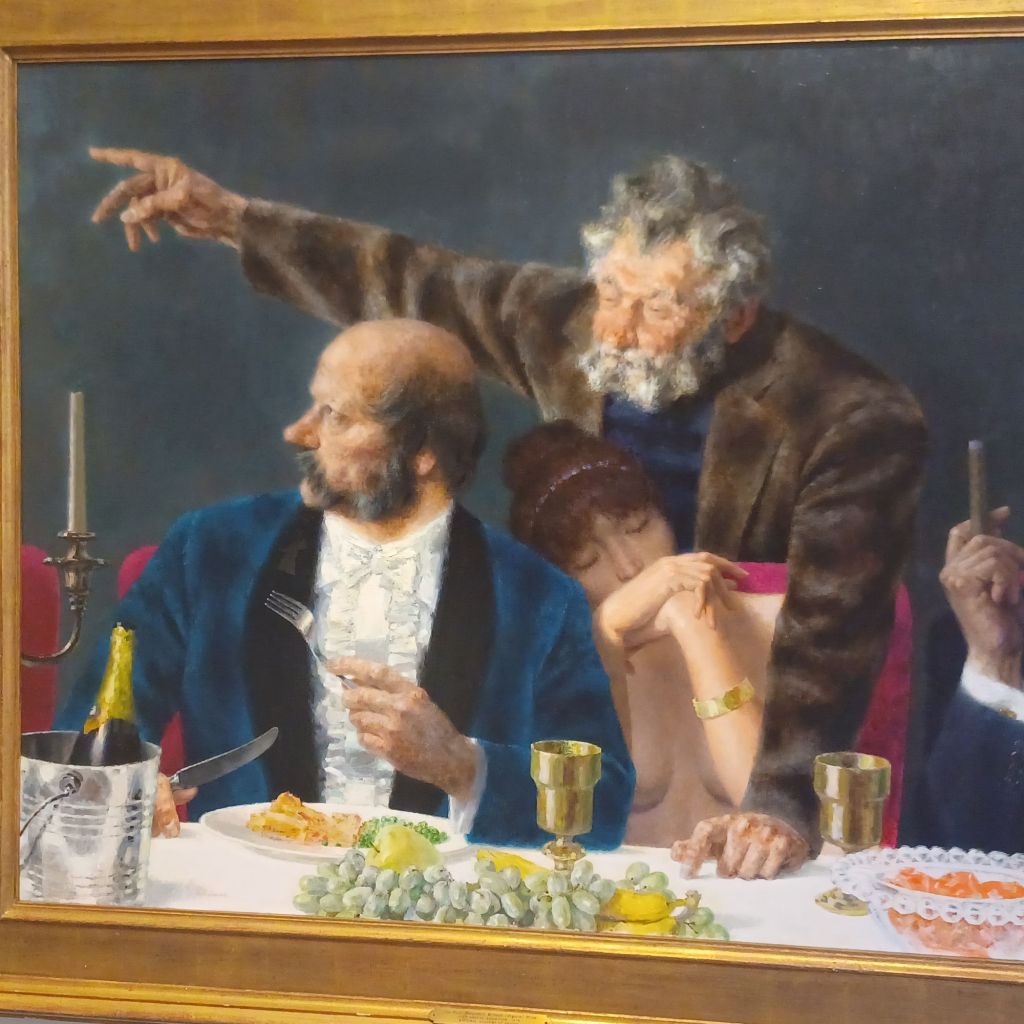
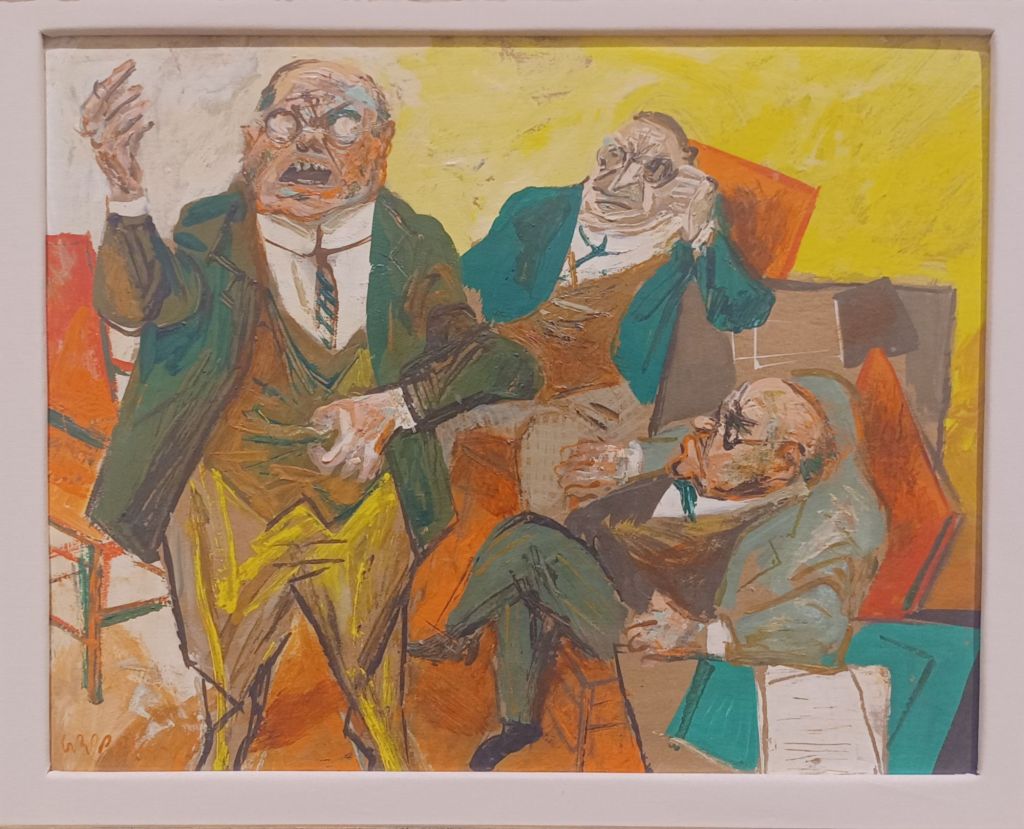
    This first piece is called “The Caucus” and is by Jewish-American artist William Gropper (1897-1977). He was born to immigrant parents. His father was university educated and spoke eight languages, but couldn’t find appropriate employment. His aunt was killed in the Triangle fire. He became a radical. Not a Communist party member, but someone who spend time in the USSR and worked for radical publications. He was of course also strongly anti-Fascist.

    The Caucus shows three men, presumably American, presumably quite self-important, in some sort of a meeting with one of them clearly expressing his opinion. You can assume that the other two would, as well. And you can conclude that whatever they are so engaged in is of no real importance.

    There was a lot of this type of art done in the middle third of the twentieth century. I think they called it social justice art, or social realism. Is there something Jewish about this work? I don’t know. Is this a work that would only be done by a Jewish artist? Other than Gropper, I think of Ben Shahn, also Jewish. But German caricaturist George Grosz – he wasn’t Jewish.

    Let’s move on.

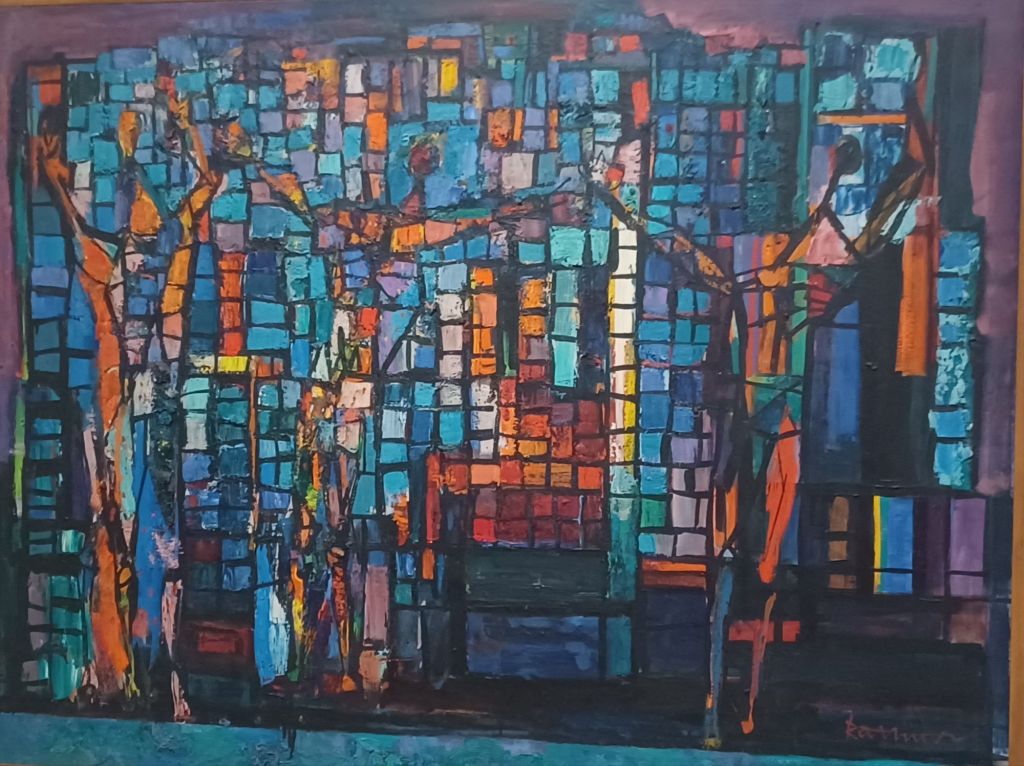
    This one, called Composition With Three Figures, is by Abraham Rattner (1895-1978), like Gropper, American born of immigrant parents. As opposed to Gropper, I don’t know what Rattner’s politics were. He was not a caricaturist. He was more of an abstract artist, a master at the use of color. But many of his paintings, I now know, had a religious tinge about them. Whether that tinge was purposeful or accidental, I am not sure. I don’t think he tried to make religious paintings. But you can feel something of the spiritual in his work. Rattner’s work and Gropper’s are very different. Was there a commonality that attracted me to both?

    Let’s do two more.

    First, Daniel by Joseph Hirsch (1910-1981). Hirsch, whom I had neve heard of, apparently did a lot of religious painting……sort of. He took scenes from the Bible and updated them, placing them in modern backgrounds, clothing the subjects with contemporary dress. Here is apparently shows Daniel speaking to the king, Belshazzar, and entreating him to bring morality back into his government. An updating of a portion of the Daniel story, and a criticism of modern government – two in one.

    In style, nothing could be more different than the other two. But again, I was attracted. And, oh, I guess I should make it clear that I was attracted to each of these paintings before I looked to see the names of the artists.

    Finally, look at this one.

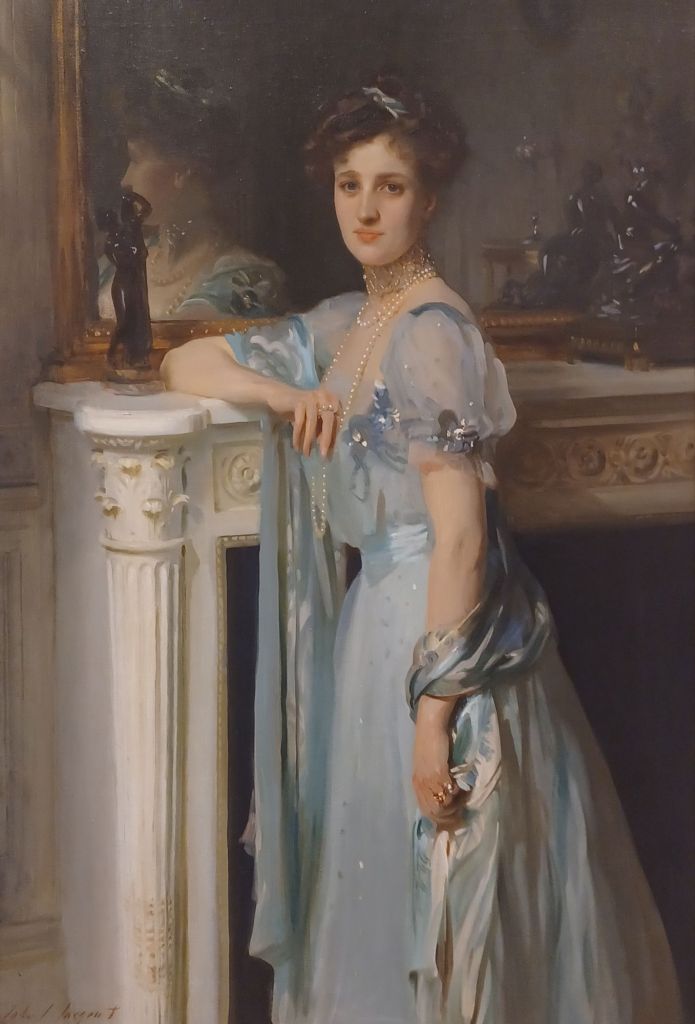
    This is not by a Jewish artist. In fact is is by John Singer Sargent. But when I looked at the description, I saw it’s a portrait of Mrs. Louis E. Raphael (Henriette Goldschmidt). I don’t know how this painting wound up in Montgomery, but the Raphaels were, as I understand it, the second wealthiest Jewish banking family in London, behind only the Rothschilds.

    Again, a very different type of art. But again, I really liked it. More than most Sargent portraits, I think, although I have never seen a Sargent that I haven’t liked. But there was something about Henriette Goldschmidt that spoke to me, I guess.

    OK, to be honest, there were other pieces that attracted me that had nothing Jewish about them. Something by Reginald Marsh, by Edward Hopper, by William Christenberry, a Washington DC artist born in Alabama. But still.

  • How Do You Keep Them Down on the Farm After They’ve Seen …….

    April 17th, 2024

    Our 13 day journey ended last night as we took our suitcases out of our car just as the sun was setting shortly before 8 p.m. We had traveled just under 3000 miles (2994.6 to be exact), and our 2019 Prius, as usual, took each gallon of gasoline 61.6 miles. No complaints there, and I treated the car to the super-duper overpriced Flagship special car wash in gratitude.

    Much of today was devoted to being tired, I must admit, although I faked being wake, if not woke, as I went through my first day back errands. For many, I had an 8 year old companion as my granddaughter Joan accompanied me on much of my sojourn.

    First, we walked the laundry to Zips (a little less than a half mile away), and Joan engaged the clerk in a conversation about whether it was worth $39.99 to get your Uggs cleaned. “That why I only have rain boots”, she said, since you just need to get them wet to get them cleaned. And, having never been to a Zips before, she was amazed when the clerk said that everything would be ready tomorrow. “That doesn’t happen where my daddy takes the cleaning”, she said.

    Next, we went next door to Bread Furst, our neighborhood bakery/cafe and while I just pointed to one of the pastries to take home for my breakfast (as well as a baguette, of course), Joan had other ideas. She pointed to the Messy Bacon and Egg Sandwich, and said “I’d like Messy Egg Sandwich”, she told the server, “but no bacon”. She also got me in a weak moment, when we were checking out, and she brought over a chocolate milk and said, “I think I’ll take this, too”. (Who am I to say “no”?)

    She didn’t come with me to the car wash. “I only go to car washes where you can sit in the car and watch the water come at you”, she explained, “like they have in Massachusetts”. But she did come with me on my biggest purchase of the day, a dryer. Ours had conked out just before we left on our trip.

    It was a last minute decision to come with me; at first she said she didn’t like picking our dryers. But she changed her mind. On the way to Bray and Scarff in Bethesda, Joan told me she was thirsty, and wondered if I had water in the car (which I didn’t).

    It didn’t seem to be a big problem, and I admit I was surprised after we walked into the appliance store, and the sales clerk said “hello” to us, “how can I help you?”, and Joan responded with “Do you have any water?” The salesman didn’t miss a beat and said, “Sure, let me get you a bottle”, and I really he thought that is why we came into his store. Until, I said “I think we’d like a dryer, too.”

    Now, those of you who really know me may know that I am anything but a careful shopper. I am a fast shopper. I had done no research. All I knew is that our old dryer, which lasted maybe 20 years, was a Whirlpool, and that Joan’s family had bought a Maytag about a year ago when their old dryer died.

    So I asked the clerk if I should get a Maytag or a Whirlpool, or should I get something else. I knew I wanted large capacity, and I wanted something that would last. He told me I could get a Speed Queen, which would last about 25 years and cost me an arm and a leg. Or I could get something else.

    Well, I still wondered about Maytag versus Whirlpool, and he told me they were now made by the same company; that it made no difference. He pointed out a model that he suggested. I asked him if there was any reason that I shouldn’t get it. He said there wasn’t. I asked him how long it would last. He said 8 to 12 years, and then he told me there was a one year warranty, but I could get another 5 years, for just an arm (not an arm and a leg), and that meant that if anything happened to it during that time period, they would fix or replace it. I said “well…….”, and he said “you know how things are made today, anything can happen”, and “most people do buy the five year warranty”. So, of course, I said “OK”.

    While I was buying the dryer, Joan was busy looking at refrigerators. She told me that she found the one that had the bottles of water in it, and another that had an empty egg carton. Now, Joan likes to tell me that my jokes aren’t funny, so I wasn’t surprised when she told me that after I asked her whether she thought the carton came with the refrigerator or it was an egg-stra. But, in fact, she did me one better, telling me that she thought the egg carton was there so that customers might know what they might put in their new refrigerator. As she put it, “so they just put it in there as an egg-sample.” That’s Joan.

    And that was pretty much my day. Tomorrow will be different – I might even unpack. I might also plan our next road trip, scheduled for July. And on Thursday, I think Joan and I will go on another adventure. “Where do you want to go?”, I asked her. “To Ikea”, she said. And if not that, “we can go get a treat”. Oh, it’s Spring vacation.

  • Day 13. Drive, Baby, Drive, Part 2 (or We Are Home)

    April 16th, 2024

    We clocked in just before 8 p.m. Later, I’ll let you know how the recovery went.

    For those of you who thought we must have put 3000 miles on the car – nah. Only 2994.6. And that includes over 500 miles today, an exception to our general 5 hours or 300 mile rule. But it’s the last day, and you don’t want to stay in another hotel if you are only 2 or 3 hours from home.

    So we started in Spartanburg SC and drove on I-85, bypassed Charlotte, turned on to I-77 and then I-81 and finally I-66.

    We did make two major stops. First in Statesville NC for coffee. It’s a exurb of Charlotte, a town with an appealing central area and many beautiful homes. It is no Selma.

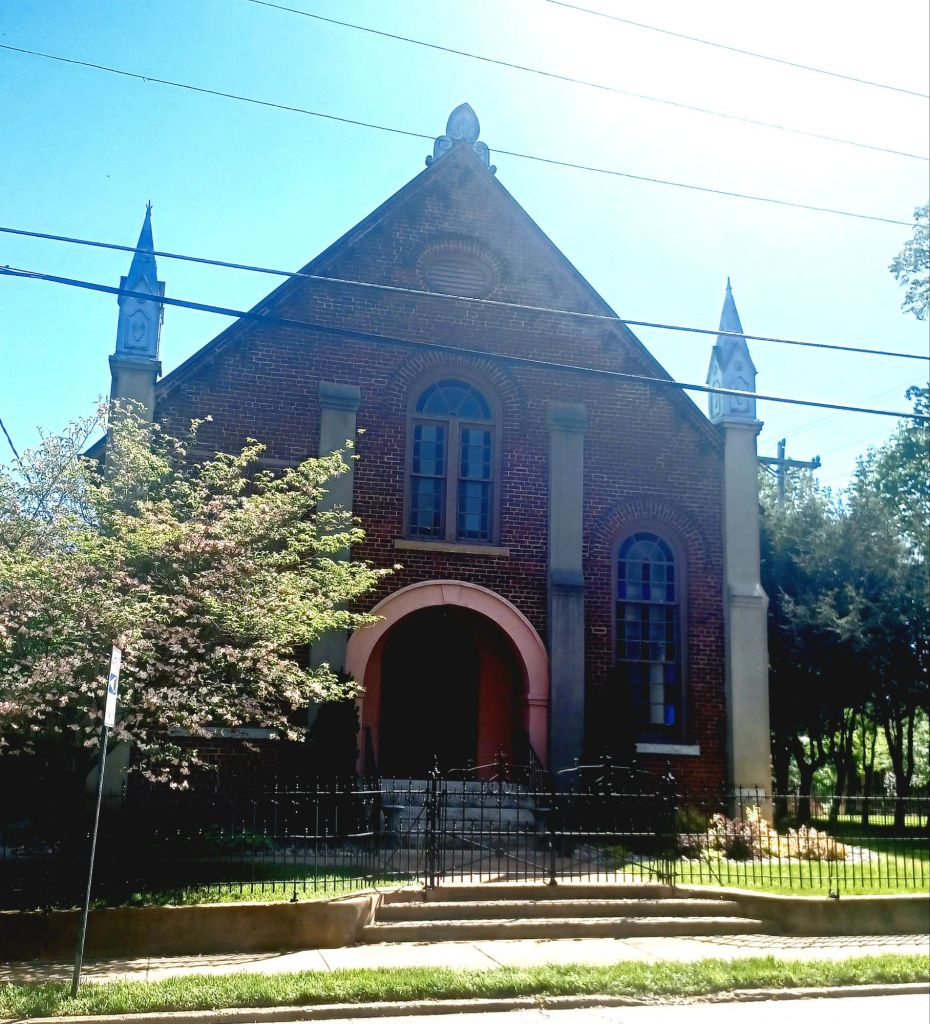
    We were also surprised to see that there is an old synagogue in Statesville. And I mean old. From the 1890s. One of the oldest synagogues in the country still in operation and the oldest religious institution in Statesville.

    Congregation Emanuel, Statesville NC

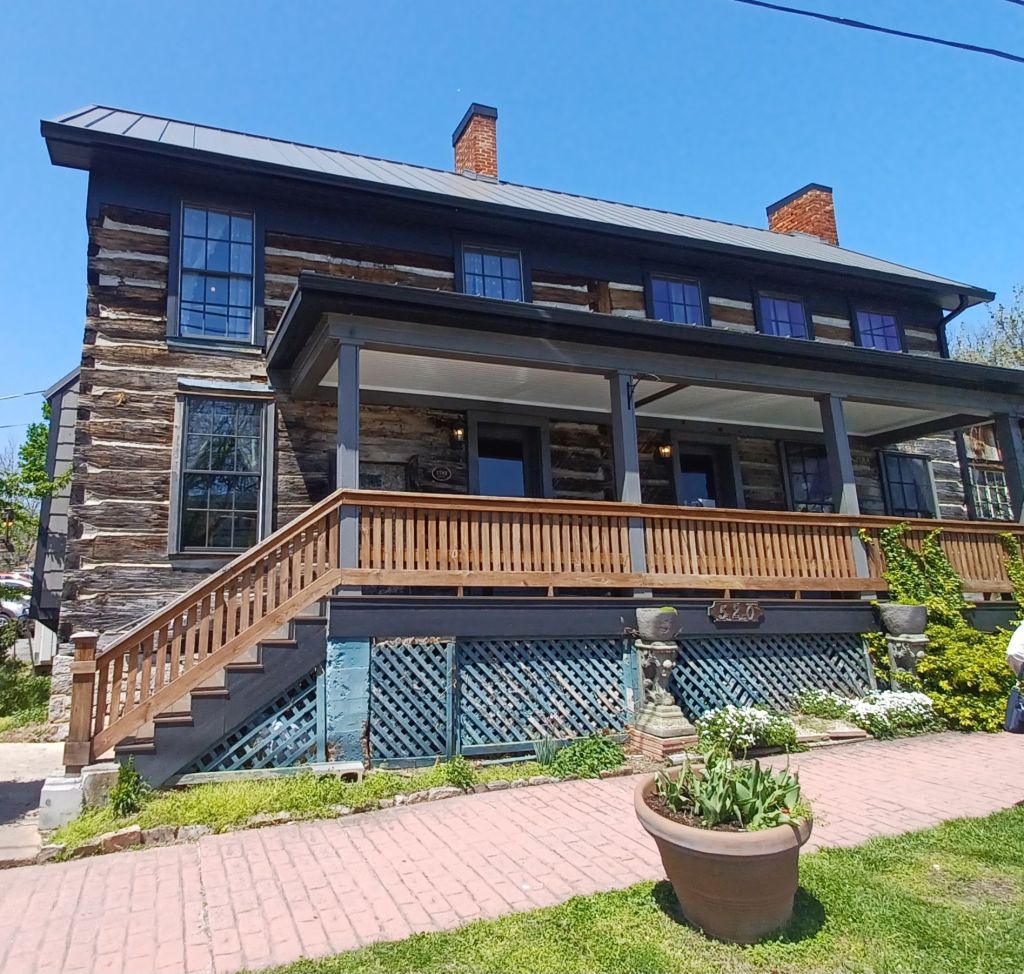
    Our second stop was in Wythesville VA. We had lunch at The Old Log Cabin, a labyrinthine restaurant in a building whose core was built in the 1780s and whose newest portion was completed in the late 19th century.

    The Old Log Cabin Restaurant

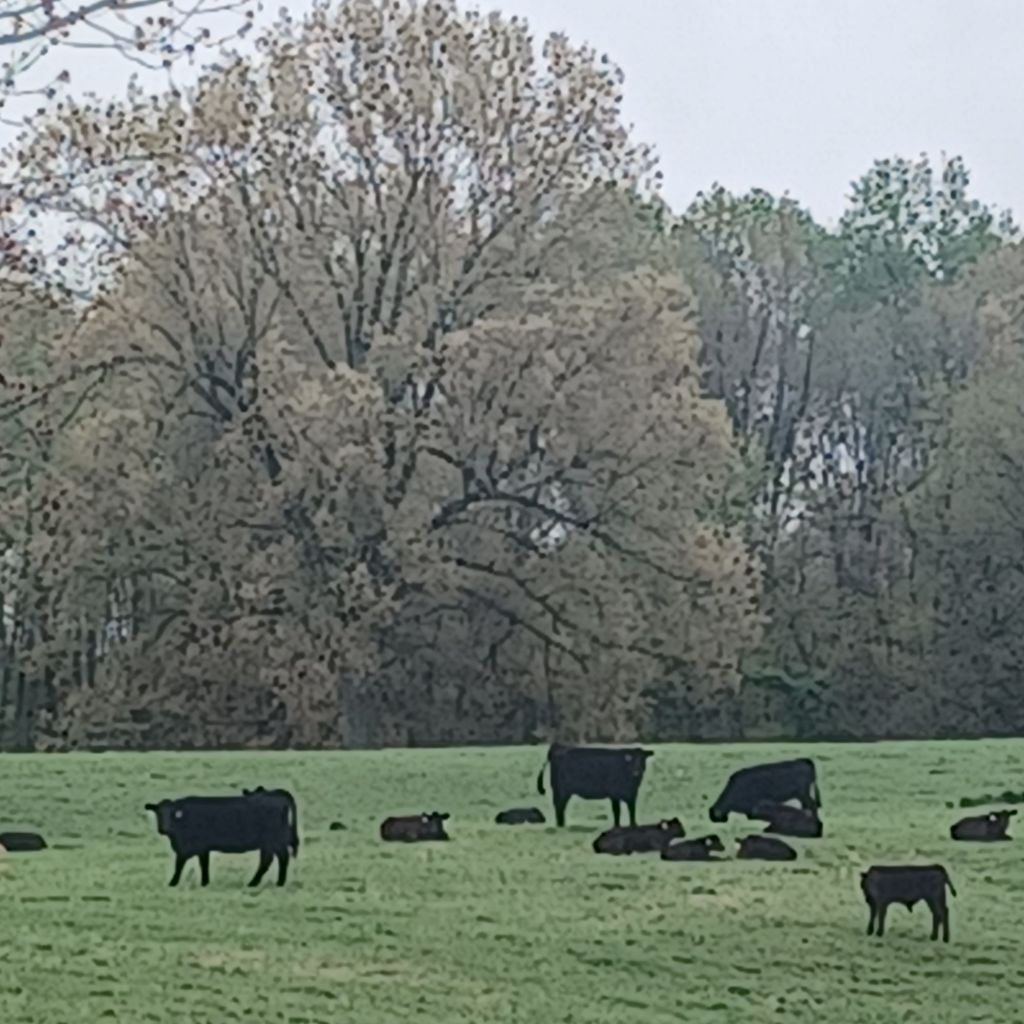
    Finally, we did see cows, horses, sheep and even a farmer as we drove across the country.

    Now back to our regularly scheduled activities.

  • Day 12. Drive, Baby, Drive. Part 1.

    April 15th, 2024

    Yesterday was the last tourist day of our vacation. Today, we started to go home. From Montgomery to Washington takes about 12 hours of driving time. At our tender age, we try to schedule no more than 5 hours, but because we are anxious to get home before everyone runs out of whole wheat matzos, we decided to divide it up 6 and 6.

    The best laid plans….

    First, I had a hard time sleeping last night, really for the first time on the trip. I assumed I would get tired mid-afternoon but hoped it wouldn’t slow me down. We got our usual start at about 9, gassed up the car and headed up Interstate 85, with a goal of reaching Charlotte. We failed (more about that ahead) and we are in Spartanburg SC for the night. About an hour and a half short of our goal.  But we tried.

    At first everything went swimmingly and before you knew it, two and a half hours had passed and we were nearing Atlanta. We had two choices. Stay on 85 and go through the city, or take 285 and bypass it. An easy choice. We hadn’t been to Atlanta for a decade or so we decided to drive through and gawk at the tall buildings.

    And gawkworthy they are. The tallest building is 73 stories and there almost 30 buildings 30 stories or more. I-85 and I-75 combine forces and go right through the center. Unfortunately, something was going on, half the lanes were blocked and we crept through downtown slower than you could walk through. Probably lost 30 to 40 minutes.

    Digression 1. Coming into Georgia, we entered the eastern time zone. We had forgotten that. By my calculations, we lost another hour. Exactly.

    Then, as we neared Greenville SC and Bob Jones University we saw an ominous sign, telling us an incident had occurred 20 miles ahead and all lanes were blocked. GPS said the delay would be well over an hour. So we diverted, taking a nice road through SC’s lake country to Anderson, which we really didn’t see, but from which we got on another state highway which took us back to I-85. Again, by my calculations, we used up over an hour to save about the same amount of time.

    Digression 2 (or should I say Anti-digression 1?). As we drove this morning, we passed a number of turn offs I would have liked to explore. In Alabama, there was Tuskegee, Auburn and Opalika. In Georgia there were Callaway Gardens and Warm Springs and Something Else.

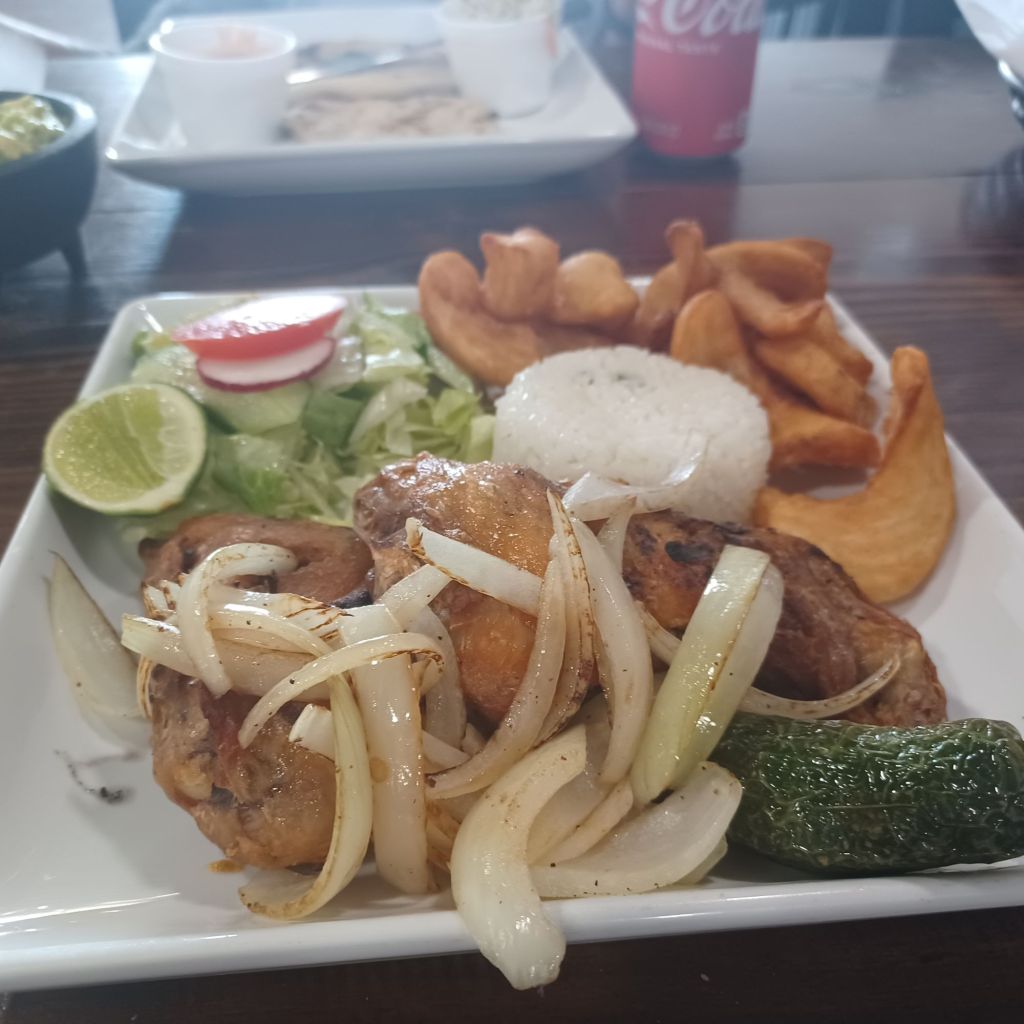
    After leaving Atlanta we stopped for lunch in the, I think, suburb of Norcross, where we ate at Flora’s in a small strip shopping center, chosen randomly. Norcross, it turns out is over half Hispanic, and we could tell that Flora’s was Salvadorian. How? By the flag and the papusas. The food was pretty good and cheap, the restaurant itself the model of unpretentiousism. But what was amazing is that no one seemed to speak English. There were three young waitresses, none of whom could. The menus were in Spanish. We had entered another country. Here is my lunch:

    Chicken Dorado at Flora’s

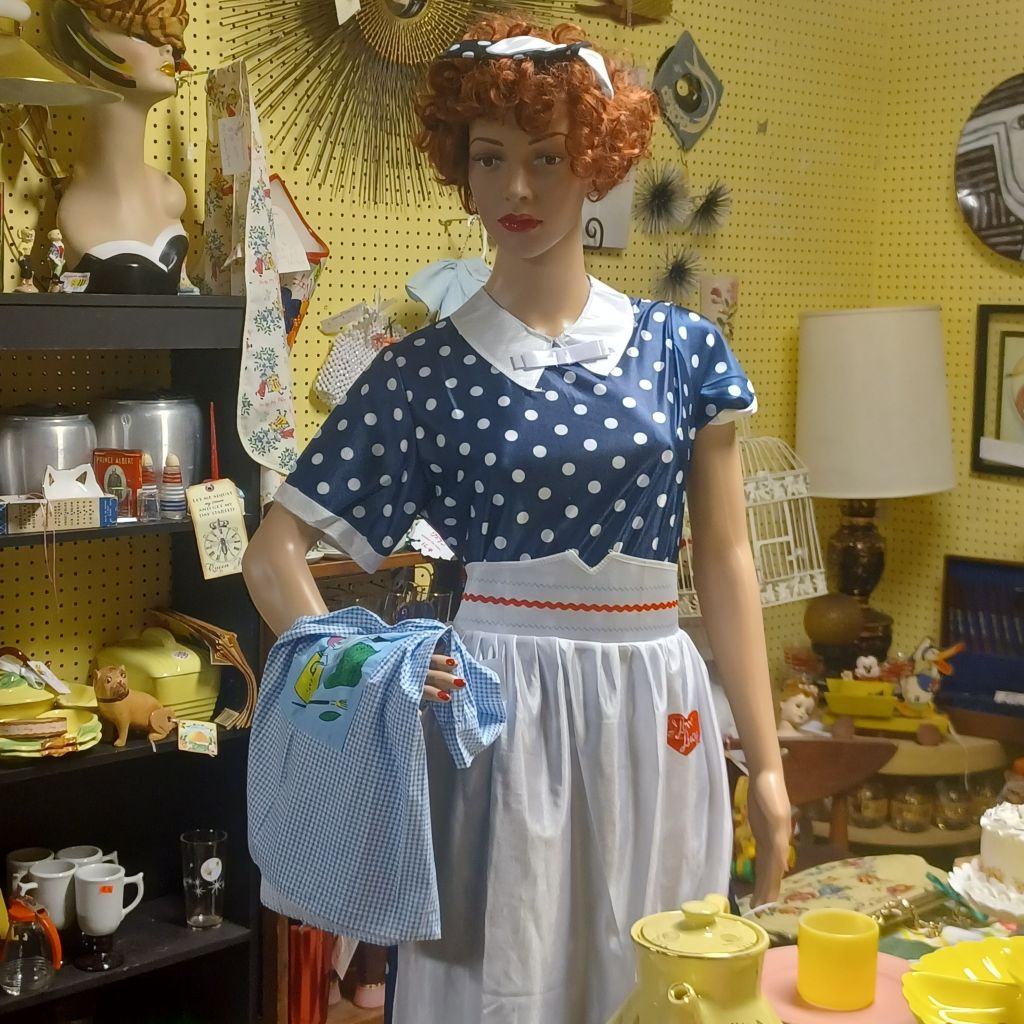
    About an hour after lunch, my lack of sleep caught up with me. We stopped at McDonald’s for a $1.39 cup of coffee and saw a very large antique mall with over 40 vendors and went in. We made some modest purchases, but if you are ever at that McDonald’s, go into the mall. It is first class.

    After that, everything seemed normal until we had to divert to and from Anderson, and as we went through Greenville and approached Spartanburg, the clock on the wall said 6:30 and we figured it was time to stop. Back in another Hampton Inn, our fourth or fifth. Do we love Hampton Inns? Not really, but it avoids the “where shall we stay?” discussions.

    This one, by the way, is in Moore SC, not quite Spartanburg. And, as you know, this is the most God-fearing part of a God-fearing state. That means that, except for fast food, almost all restaurants are closed on Sunday night. We had to go Latino again, this time a Mexican restaurant (or one with a Mexican name), Los Mexicanos. That is Mexican, isn’t it? The vegetable fajitas were quite good.

    So that’s the story with one exception. We were leaving the hotel waiting for a light to change to turn left to go to dinner. A black car came roaring at us at a high speed — backwards!!  I swerved out of the way, it roared past us, and turned into a shopping center parking lot and sped on — all still backwards. Truth is stranger than fiction.

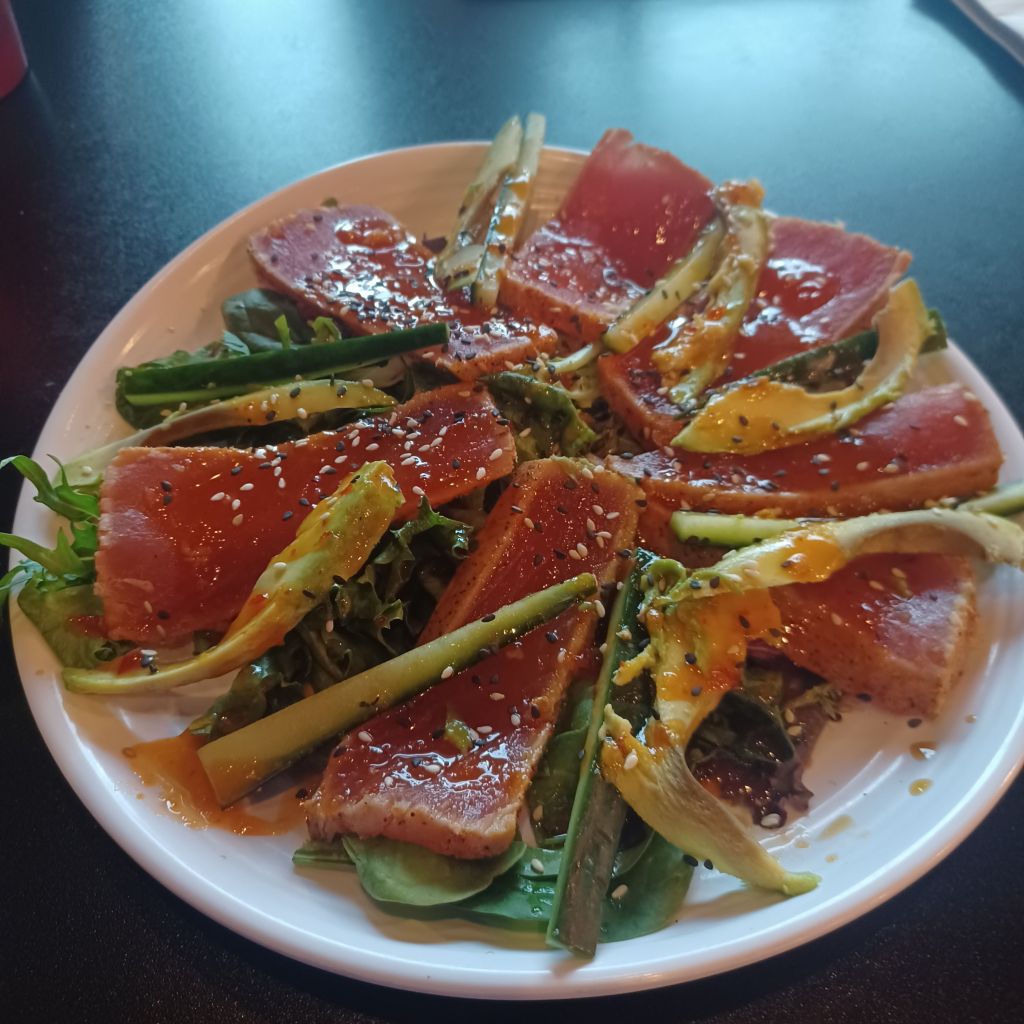
    By the way, speaking of food, I didn’t mention that yesterday we had supper at Rock and Roll Sushi in Montgomery. Rock videos to accompany your meal. But the ahi tuna salad was memorable.

    Tuna Salad at Rock and Roll Sushi

    I just saw that there are 80:Rock and Roll Sushi locations. Can you believe that?

  • Day 11: Selma and More

    April 13th, 2024

    When I went to upload this post, it told me that some of the photos did not upload. When I publish this, I will see what failed and I will work around the problem.

    Today, our goal was to drive an hour to Selma, look at the bridge and go to the National Voting Rights Museum, maybe have lunch and come back to Montgomery or maybe come back to Montgomery for lunch. Selma was so fascinating, though, that we didn’t get back to Montgomery until about 3:30, and we never got to the Voting Rights Museum.

    Let me explain. Once you get outside of Montgomery, the road to Selma (about 50 miles away) is very pleasant. It’s a divided road that goes through very attractive farm country. You go through no towns. As you approach Selma, you see some typical roadside commercial structures and you pass the Voting Rights Museum, which we decided to visit on the way out of town.

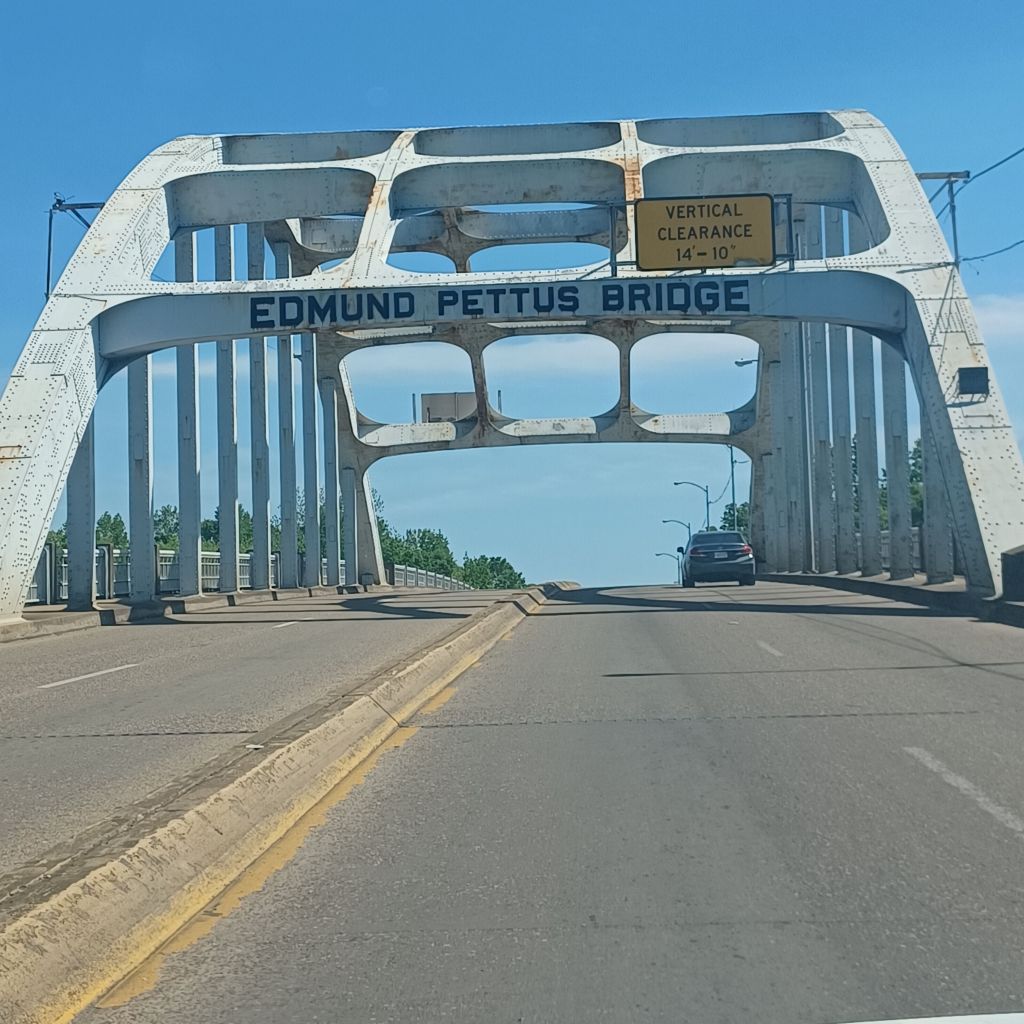
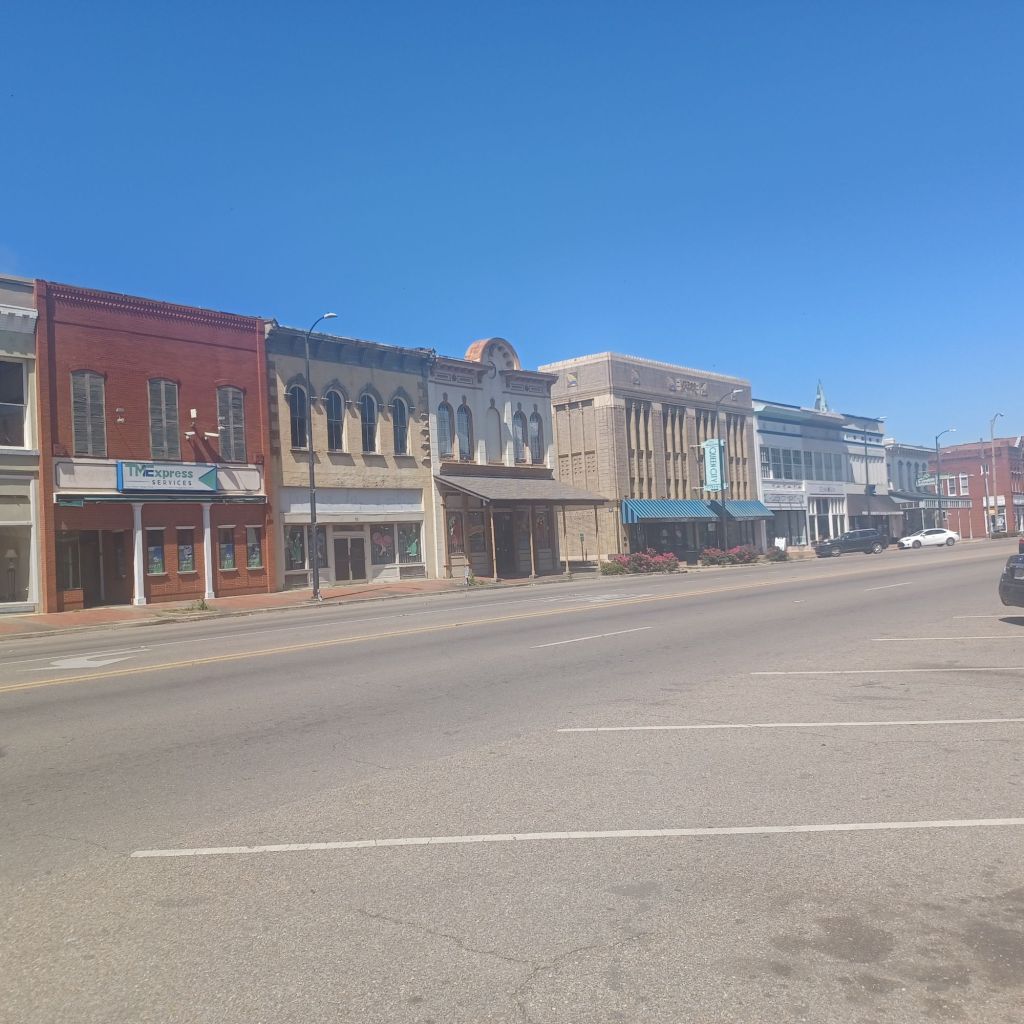
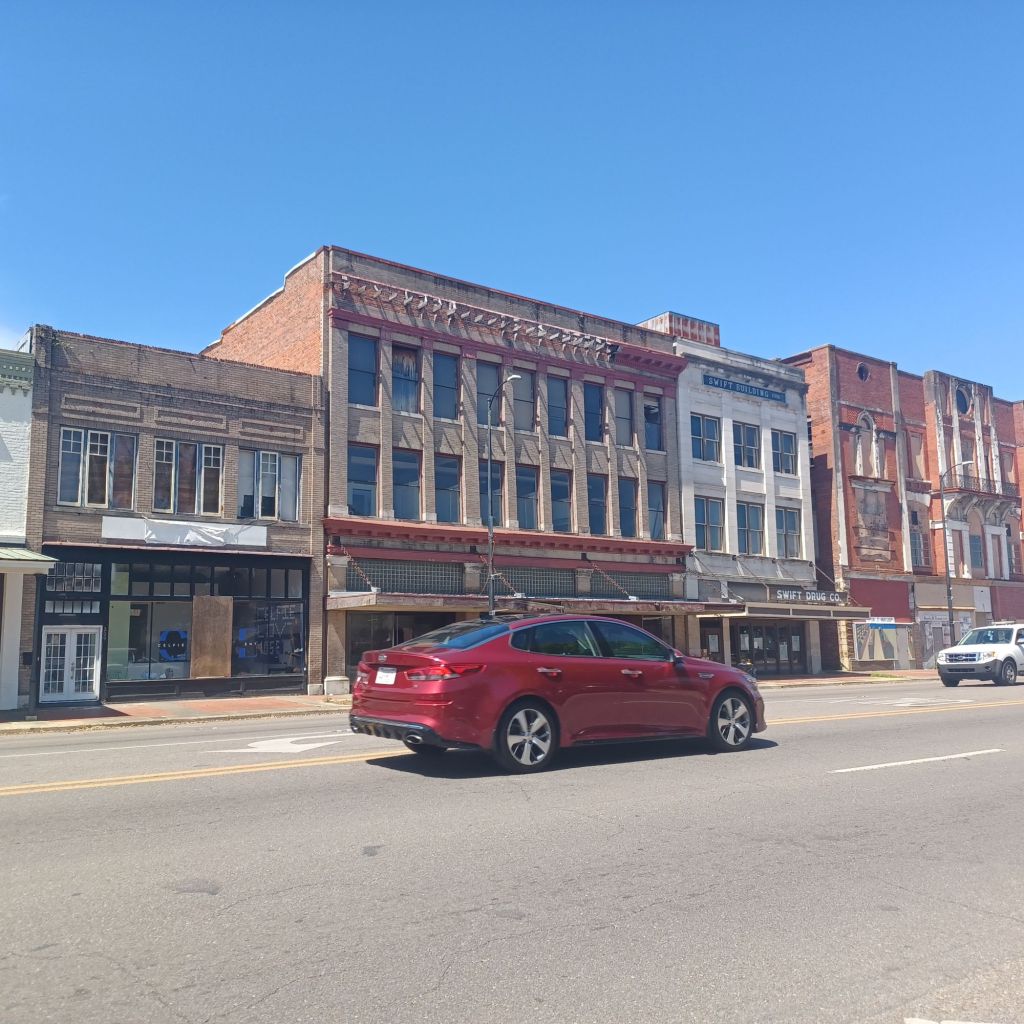
    Then, before you know it, you are crossing the Edmond Pettus Bridge that you have seen so many times before when you watch led the violence that occurred at the start of the Voting Rights March to Montgomery. You drive across the bridge and there you are in downtown Selma on Broad Street.

    Some things to know about Selma: first, it was settled in the 1820s as a trading post on the Alabama River. Then, during the Civil War, there were armament factories. And then things looked better through Reconstruction but stagnated after. Finally, the population is almost 50% less today than in 1960 (today about 17,000) and today the population is 80% Black

    When a city has lost half its population, you can’t expect its downtown to look like it once did. But what you see in Selma is shocking.

    Nobody’s home.

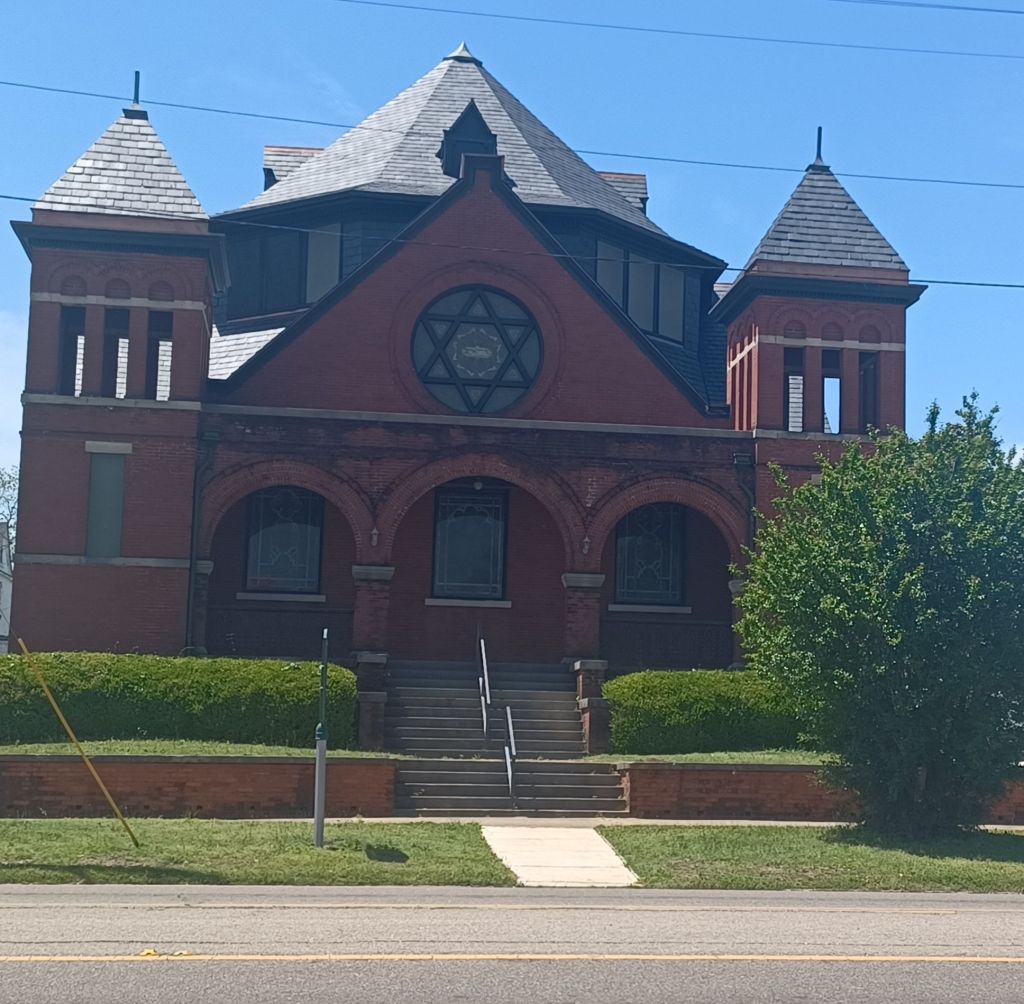
    We met a very nice woman who lived there all her life and heard how vibrant Broad Street was back in the day, as she pointed to vacant storefronts and told us what used to be there. She also told us about the active Jewish community with members who owned buildings and operated stores downtown, and told us to sure to drive by the now closed but still preserved synagogue, Congregation Mishkan Israel.

    Congregation Mishkan Israel, Selma

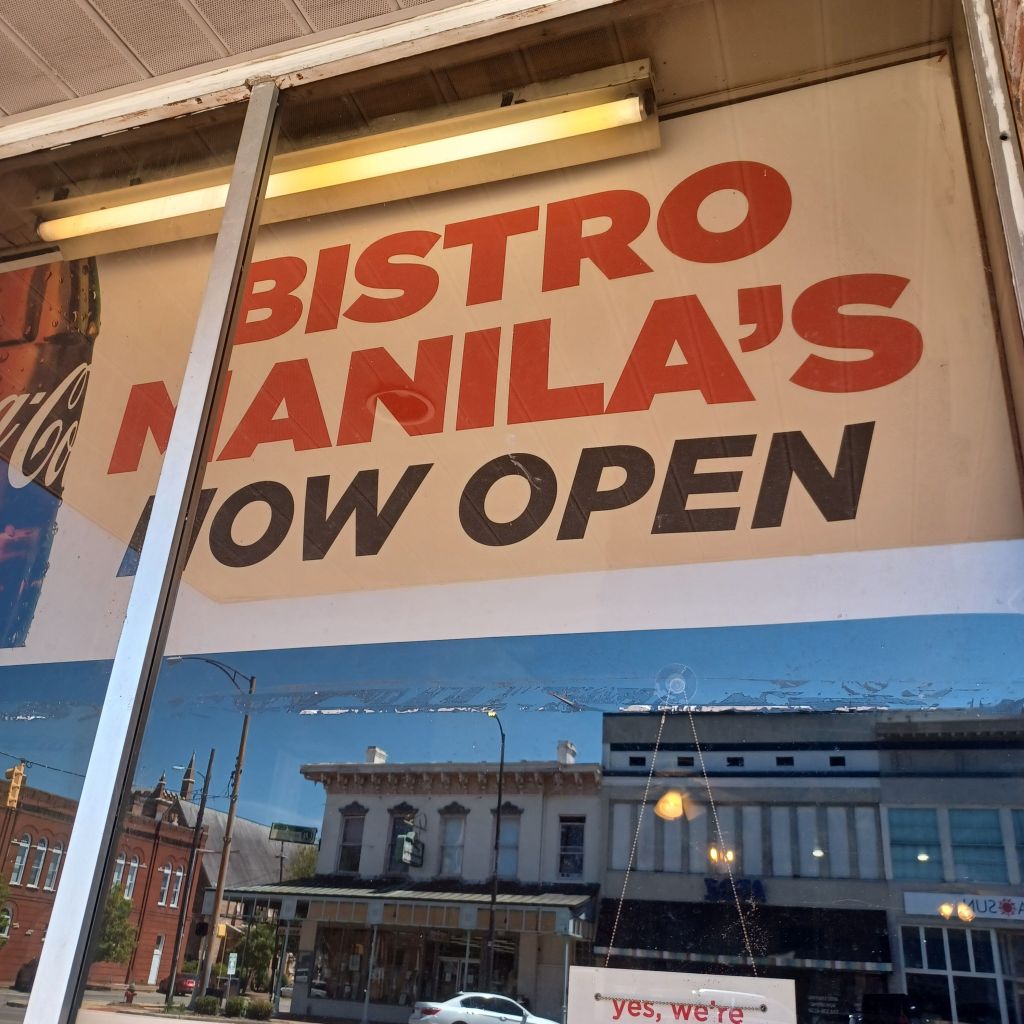
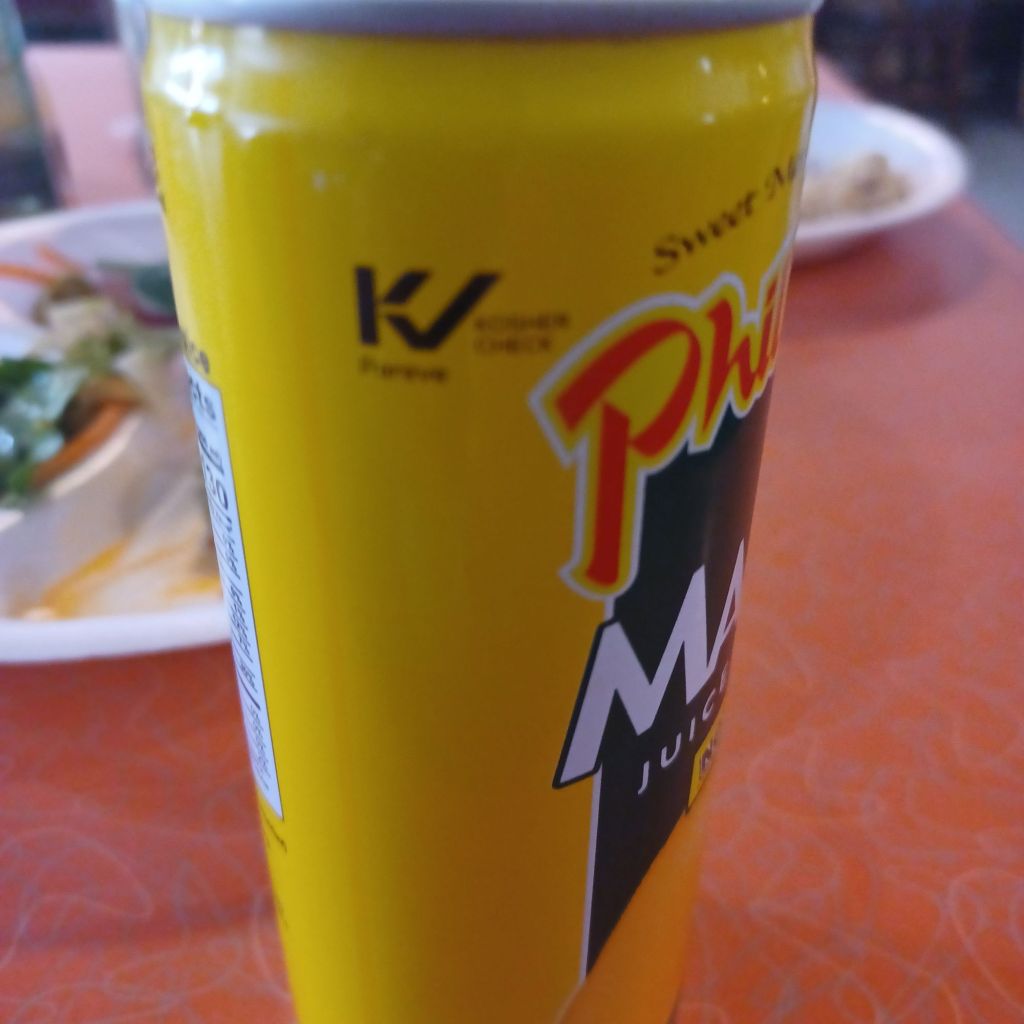
    There seemed to be no place to eat in Selma, except for a new and very odd Filipino restaurant, called Bistro Manila’s, which we thought really needed our support. On Saturday, they don’t use their menu but have a buffet of Manila street food. The restaurant, which has been open about 60 days, seems to be owned by a local man and his wife from the Philippines. I wouldn’t go out of my way to eat there again, but it was interesting and did the trick. My drink was a Philippines canned mango juice, which had a kosher hecksher that I had never seen before

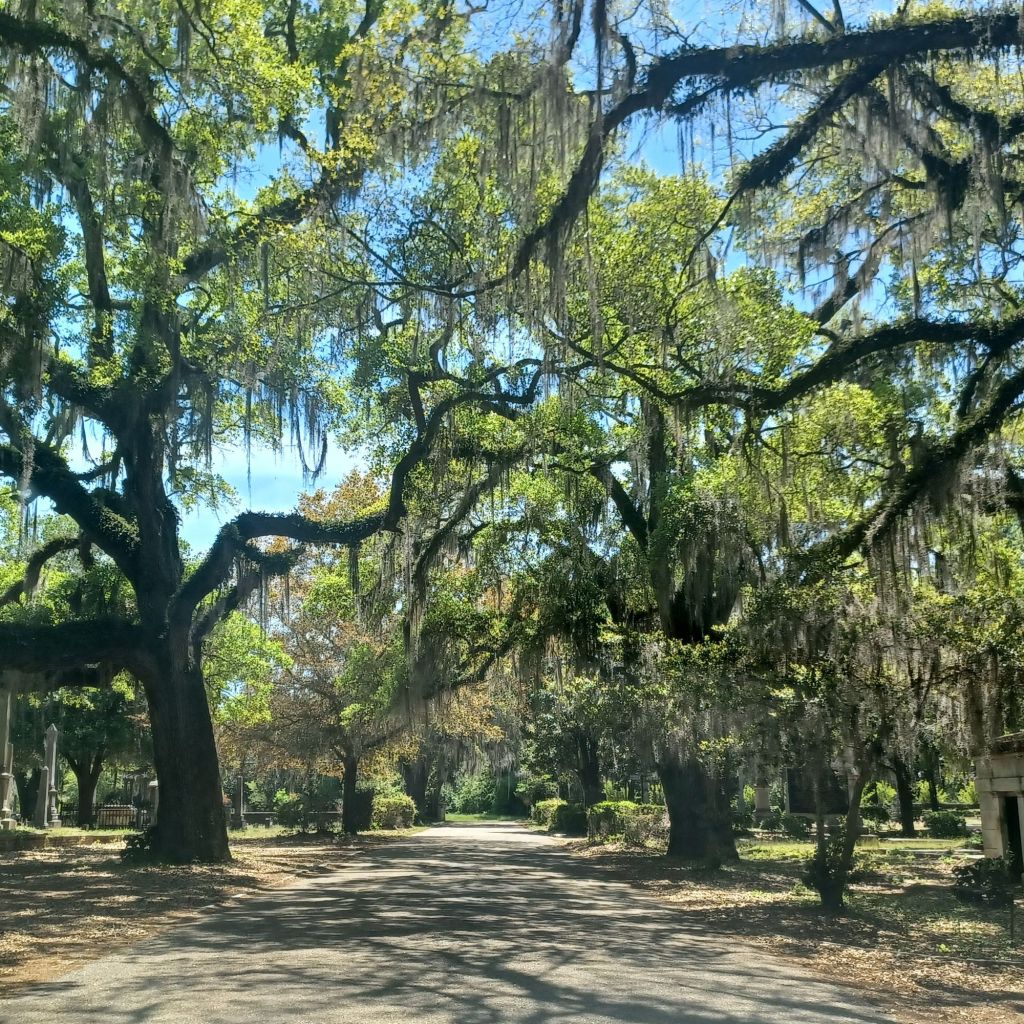
    The local owner told us we should visit the Live Oak Cemetery, which we did, and found the graves of former Vice President Wm. Rufus King, and Gen. Nathan Bedford Forrest, whose reputation is not the greatest (although the Daughters of the Confederacy praise him to the skies; they maintain his grave). There are many Confederate flags at the old and very large cemetery, and it is beautiful

    In memory of all fallen Confederate troops

    Between Broad Street and the cemetery there is an extensive historic residential area, with many large and medium sized historic homes. All of a sudden, we felt we were in a real place, not a ghost town. In fact, we drove around quite a lot and much of Selma a normal tourist wouldn’t see.

    We found the arts district and a first class coffee/lunch spot. We left Selma, back over the bridge and drove past the Voting Rights Museum because we wanted to get to the Fine Arts Museum before it closed at 5. Which we did.

    The art museum is not large, but it’s set in a beautiful park and is airy and comfortable. We looked at two special exhibits and the permanent collection. I am going to put some of the paintings that appealed to me most in a separate post after we get home.

    Ready to start the drive back. Two of three days on the road. Stay tuned.

  • Day 10. Museum Day.

    April 13th, 2024

    First, a digression. Remember a day or so ago when I said I knew nothing about Pulaski TN. I forgot to mention one thing. Pulaski is the home of the Ku Klux Klan. The place where the Klan began. It’s also the hometown of post John Crowe Ransom who did not write any poem where Klan was used to rhyme with began.

    Ok, today.

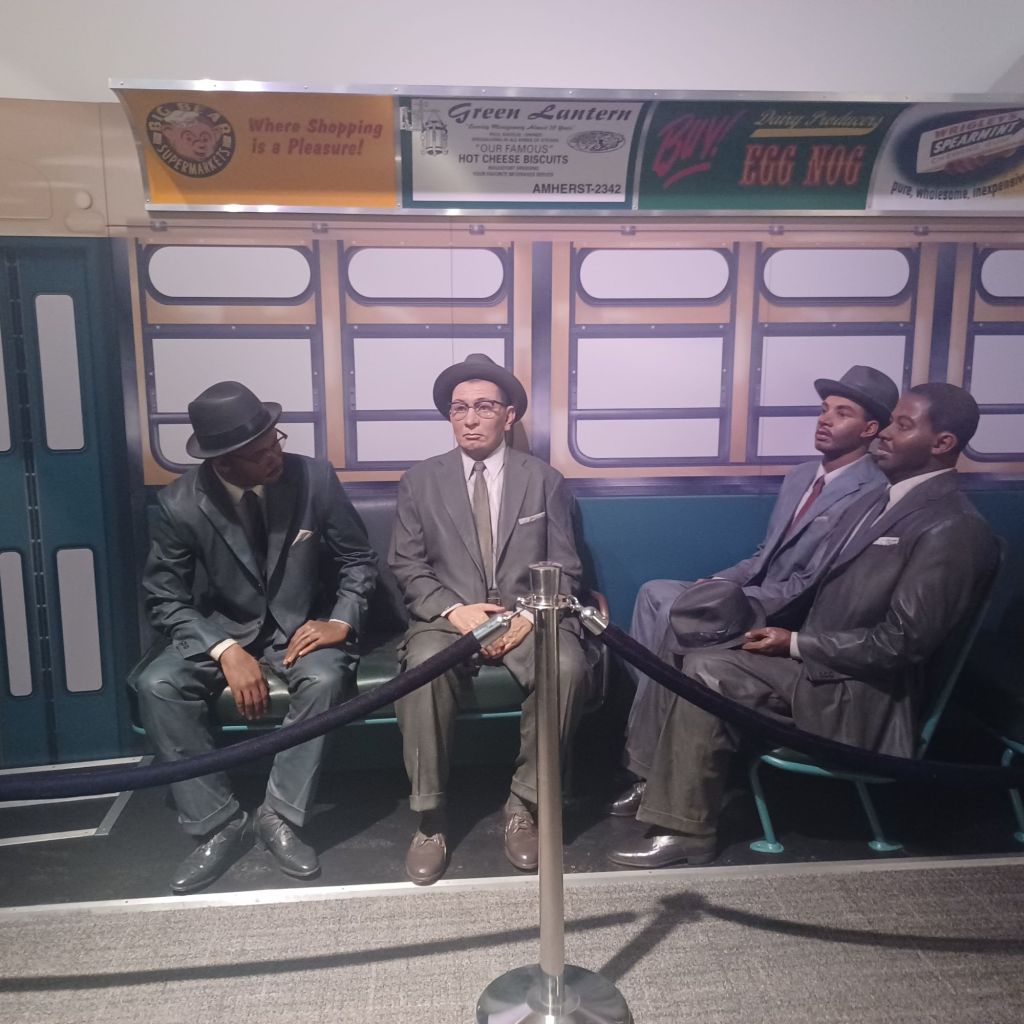
    My quick impression of Montgomery. It’s the Capitol of Alabama (and has all the requisite government buildings attractively laid out). But that’s about it for the downtown portion of the city. When you see photos of 1955 Montgomery during the bus boycott, you see a vibrant commercial area. That area just doesn’t exist anymore. There is a placque on the spot where Rosa Parks boarded the bus. But it’s at a spot where there is no trace of 1955.

    The Dexter Road Baptist Church is still there with appropriate homage to Martin Luther King, Jr., but where are the houses in what must have been a vibrant surrounding neighborhood? They must have existed.

    Where are the historic black areas? Where do the prominent residents of the city live? No idea. Where to find a place to park your car downtown? That’s the easy one. Parking lots galore.

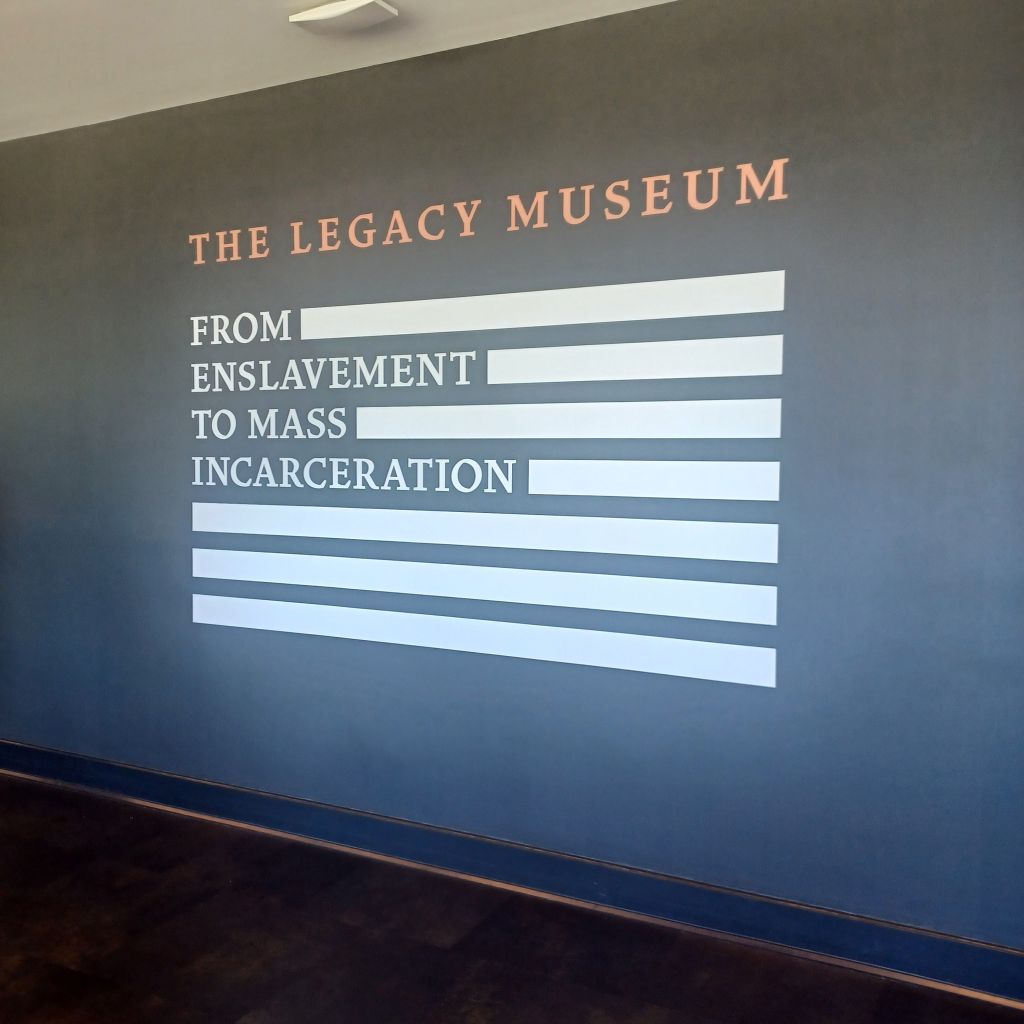
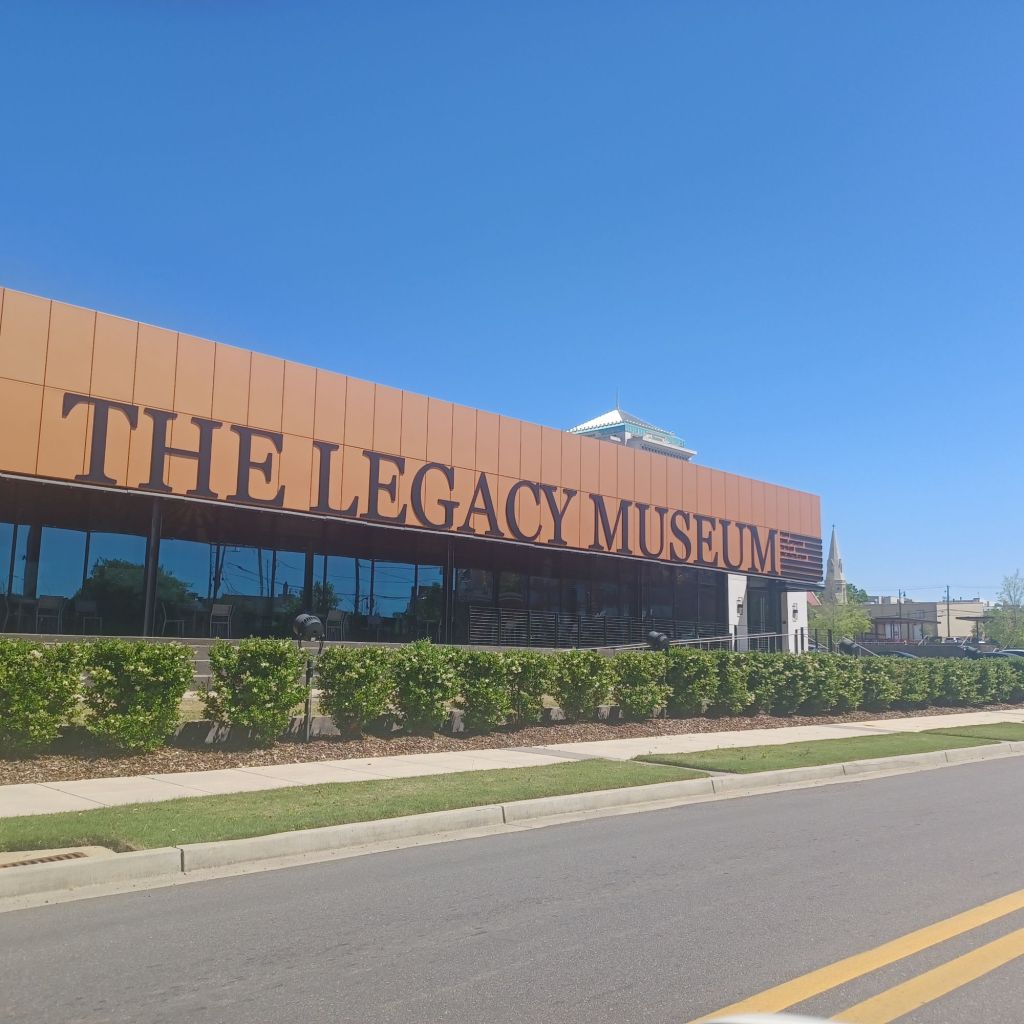
    We came here to see the new Legacy Museum and it  is terrific and everyone should go and see it. It is very large and tells of the African American experience very broadly. But it is not a museum of artifacts. It’s a museum of history told with words and videos and photos.

    I read that the average visitor spends three to five hours there. That seemed impossible. But we arrived a little after 9 a.m., and left about one p.m. That’s four hours. And we could have seen more.

    It starts with transport from Africa, tells of slavery, Reconstruction, Jim Crow, segregation, the civil rights movement. And it’s mainly in printed words on walls. If you come, be prepared to do a lot of reading. Yes, there are many videos (vintage films and animations), and some really well done, but the story is in the descriptions and the articles, and the quotations.

    On the other hand, there are fascinating statistics and story lines you may have forgotten or never learned. And this is important. And the stories are told in a very engaging manner.

    Do I have any criticisms? Sure, as always. In a sense, it’s too much. And it doesn’t seem to have been created with children (of any age) in mind. We saw some school groups – the kids don’t have the necessary patience. And it tells one side (yes, the better side) of a complicated story at times, so while everything is factual, you don’t always see all of the facts. And it’s about Blacks as victims and Blacks who fought against victimhood – it doesn’t have any focus on Whites that helped Blacks move forward, for example..

    This museum will broaden your appreciation of the Black experience. And, living today in America, broadening your experience is crucial.

    Another digression. Two weeks ago we saw The Lehman Trilogy at the Shakespeare Theatre. The Lehman Bros. got their start as cotton brokers in Montgomery. The Legacy Museum is on the site of a Lehman Bros. wearhouse.

    The museum was opened in 2018 by the Equal Justice Initiative. Just two weeks ago, EJI opened the Freedom Monument Sculpture Park on the banks of the Alabama River, a 17 acre site where a large number of large sculptures of very good quality tells the same story in a different way. We had no idea the Park just opened (the official grand opening is not until June 19, 2024), and that park is now undergoing a soft opening only. It is an important supplement to the museum.

    Unfortunately, neither museum allows photographs.

    We also went to the Rosa Parks Museum, a small museum operated by Troy University. It’s a Montgomery story, so it was worth seeing although there was some redundancy with what is told about Parks at the Legacy Museum. And you can take pictures.

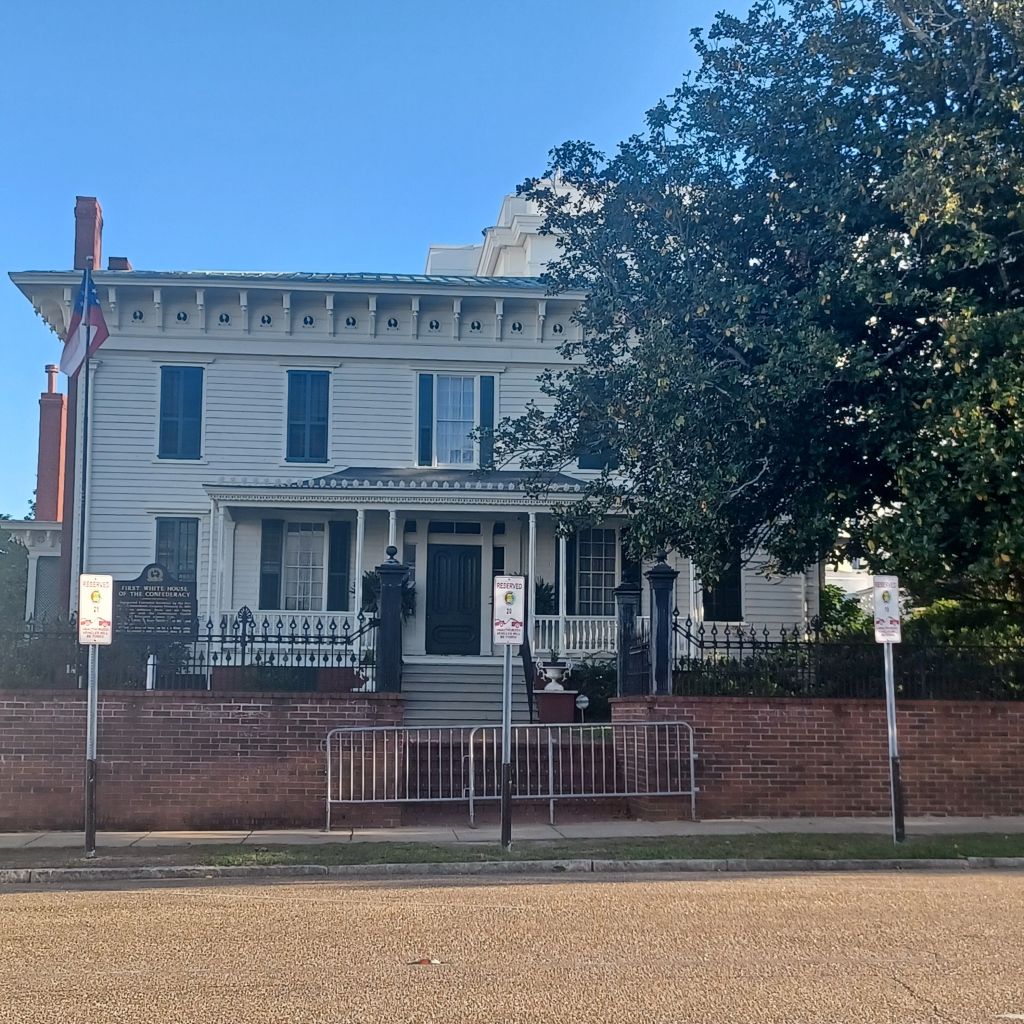
    And finally, as Montgomery was the first capital of the Confederacy, we went to see the first “White House” where Jefferson Davis lived before the capital was moved to Richmond. I was surprised to see it right next to the Capitol. Then we read this was not the original site, but that the house was moved to this site a mere 103 years ago.

    Food today? Not important. An odd lunch at the museum, and a Mexican dinner at Ixtapa.

    Digression 3. Did you know that not that long ago the Mexican government financed two new resorts to build up tourism? One they call Ixtapa. The other they called Cancun.

    Today we are off to Selma.

  • Day 9. Baby, the Rain Must Fall

    April 11th, 2024

    Our day started off nicely. We stayed in Franklin TN, just south of Nashville. Getting there had been painful because of rush hour traffic, and our hotel was next to a large shopping mall, not in the old center of Franklin. I had been there years ago with a client and knew it was much more interesting than the Galleria, so I thought we should explore a bit before moving on. The “explore a bit” turned into almost three hours.

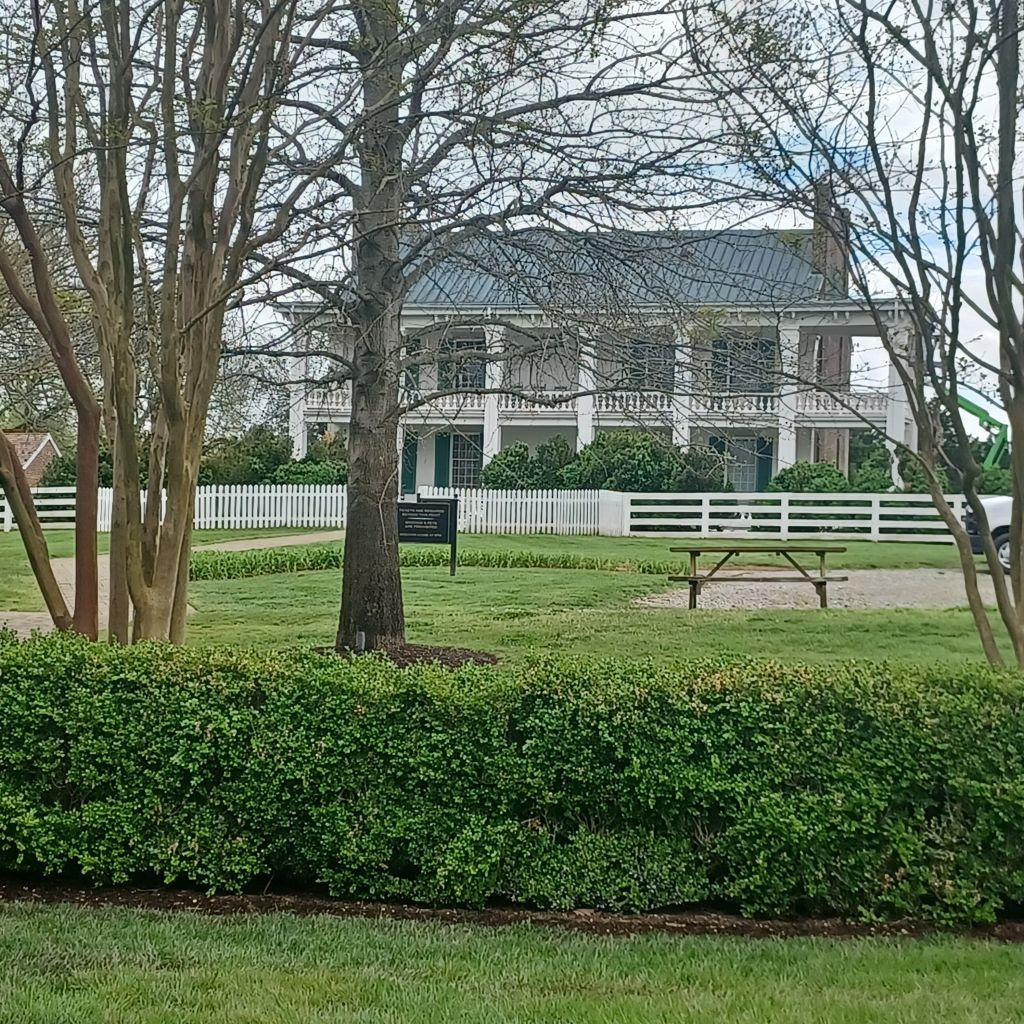
    We looked at the historic markers and buildings near the central square/circle, and did a fair amount of gift shopping before driving through some of the battlefield and looking at some historical homes. We saw that 10,000 soldiers, Union and Confederate, died or were wounded within 5 hours at one sight, Carnton Hall, which was turned into a Confederate hospital and where a cemetery was built for those who didn’t make it. We saw the oldest Masonic Hall still in use, where the treaty with the Chickasaw Indians was signed, we drove on some of the Trail of Tears,we read of some of the experiences of Franklin’s African Americans before and after the war.

    Carnton Hall

    And finally we left. And when we did the rains started and they kept up until about 30 miles from our destination. And the rains were heavy and sometimes blinding, and we got off the Interstate where the speeds were much too fast for the visibility. And the traffic as we went through Birmingham was ridiculous. Which means that a three and a half hour drive took closer to five.

    Because it was raining, we really didn’t do any exploring. We stopped for lunch in Pulaski, Tennessee at Kitchen 218, a sports bar type place right on the main business street. This was a good choice. Actually, not a choice. It was the only restaurant we saw. But if you are hungry in Pulaski, it’s the spot. And, for the second time in two days, the waitress gave me a cup of coffee, not charging me.

    I don’t know much (i.e., anything) about Pulaski. But before we entered the town, we passed a large, ornate wrought iron gate with the words “Welcome to the Milky Way Ranch” written above it. What could that be? You know?

    It turns out that the Milky Way Ranch, all 1100 acres, 20 bedroom house, and 80 other buildings of it, had been the property of the Mars family. (My stars, how does Mars, make such wonderful candy bars?”) And the ranch was named after Mars’ Milky Way candy bars. Now, it’s a fancy event venue.

    At about 6:30, we checked into our third Hampton Inn and, on the clerk’s recommendation, had an excellent dinner at Charles Anthony’s restaurant. Salad, salmon, snapper, potatoes, asparagus, grits and okra. Whew.

    More tomorrow.

  • Day 8. Bonfire of the Vanities  Redux.

    April 10th, 2024

    We left St. Louis at 9 this morning. We wound up in Franklin TN a little after 5. In between:

    1. After two days of driving through rain, we had four dry days in St. Louis. The minute we got on the road this morning, the rains started again and stayed with us most of the day.

    2. I had decided on our route and, I thought, set the GPS. But the GPS had its own ideas and by the time I realized we were driving the route I had decided against, it was too late to get back on our route. So the day went different than planned.

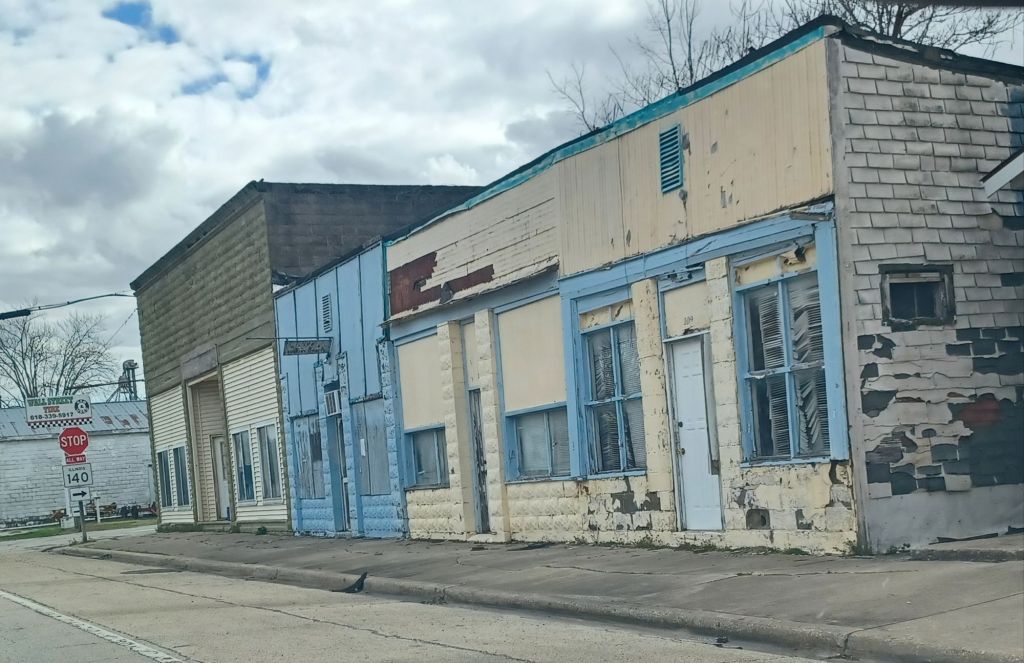
    3. In fact, the GPS never conceded that I was the boss. Driving east on Interstate 64, when Edie was napping, it led me off the Interstate onto a country road in Southern Illinois. I followed the changing directions and found myself stymied, realizing that nothing I was doing made sense. I was in a town that was too small to be called a town. Belle Rive, IL. Belle Rive, according to the most recent census, has approximately 300 residents, of whom two are African American. I needed to put gas in the car and GPS told us that there was a gas station in Belle Rive. Not. There was one in the next town on Illinois Route 147, Dahlgren. The key word is “was”. The pumps no longer work.

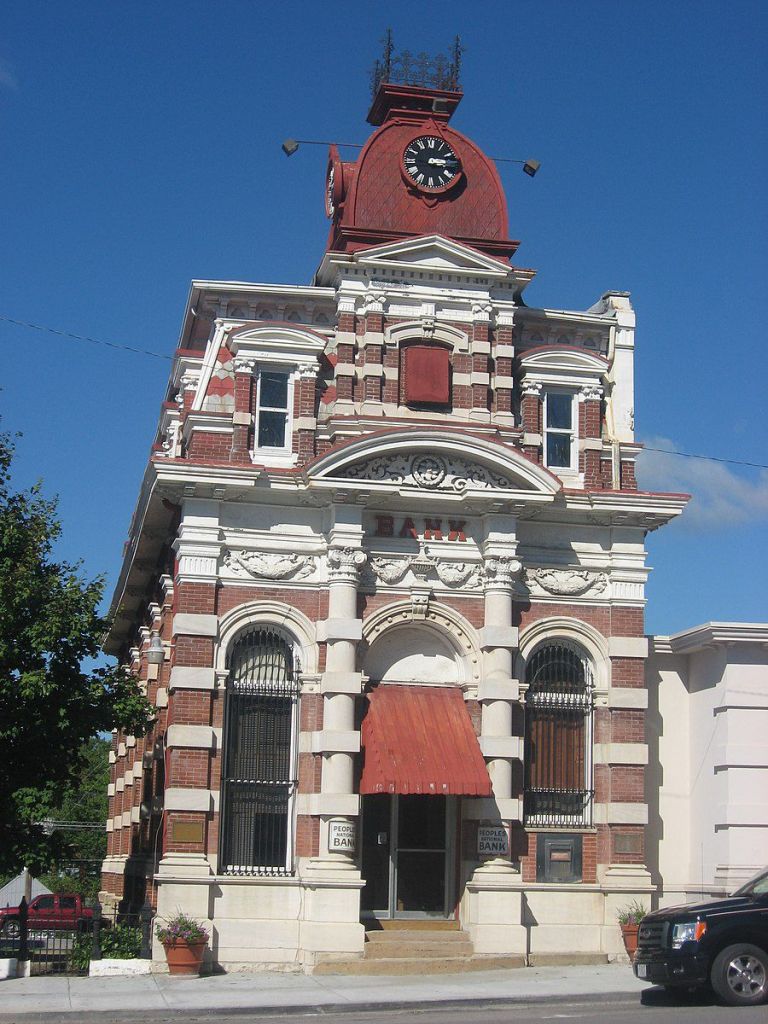
    4. We wound up in McLeansboro, a town of a few thousand. No problem. I got the gas at a Roc One station. It has a mini-store and went in to get a cup of coffee. I asked the cashier how much I owed her. “Just take it”, she said. Wow. The Roc One may be the best thing in town, other than the architecture of a small bank.

    Almost all the other downtown buildings were empty, something we saw over and over today.

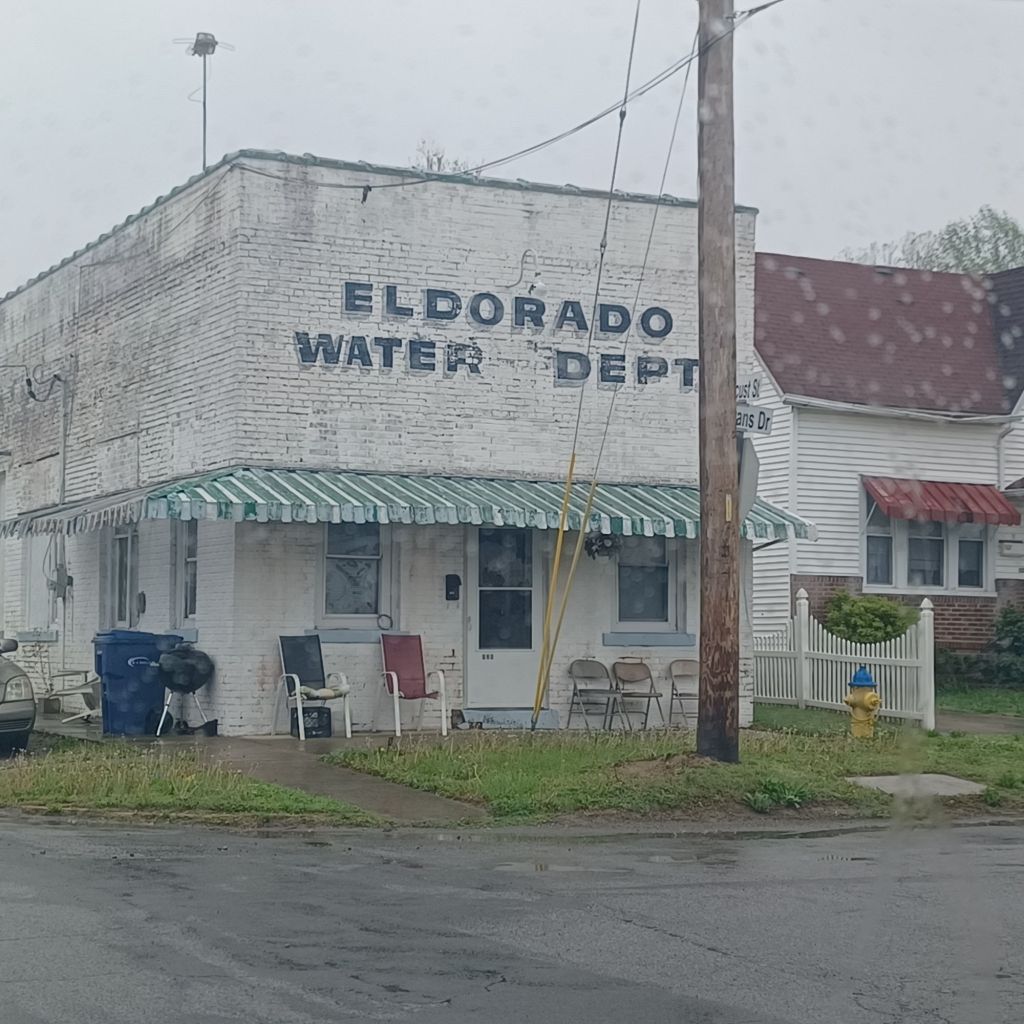
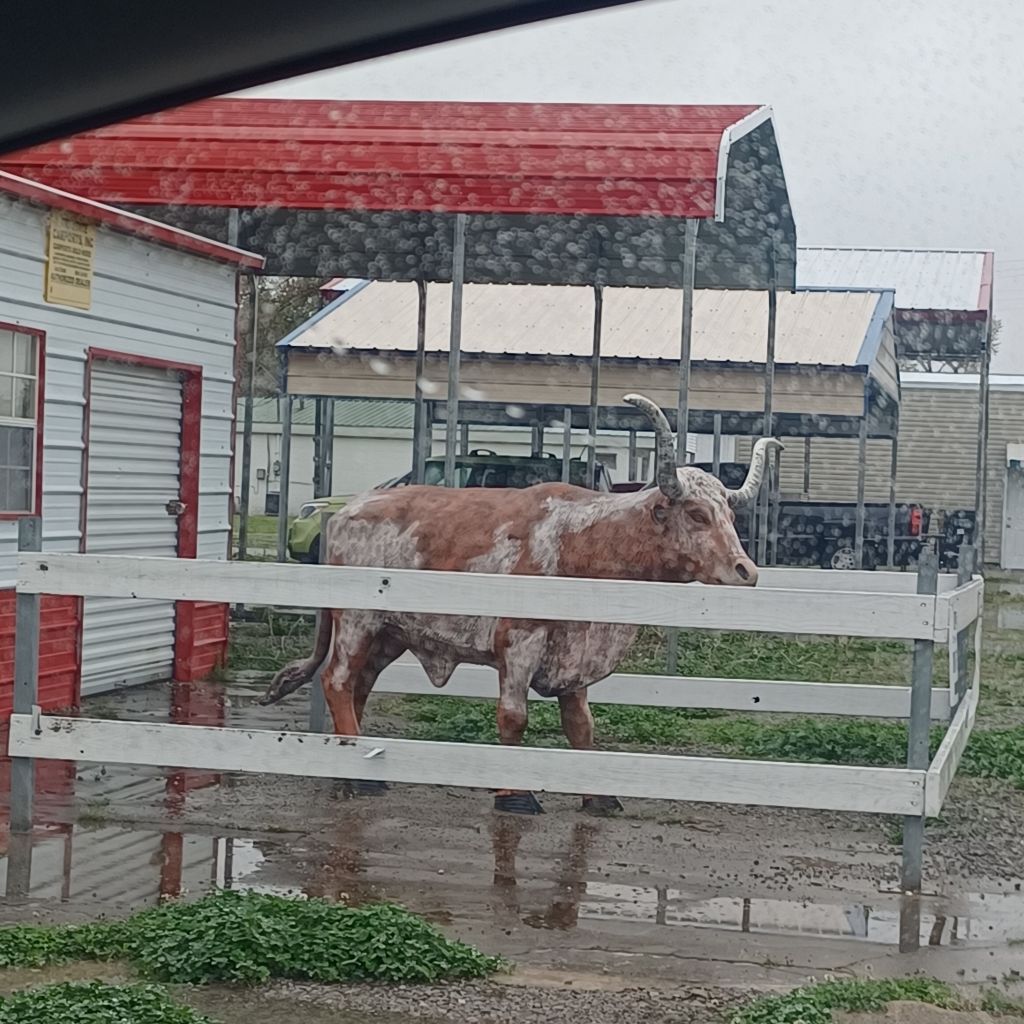
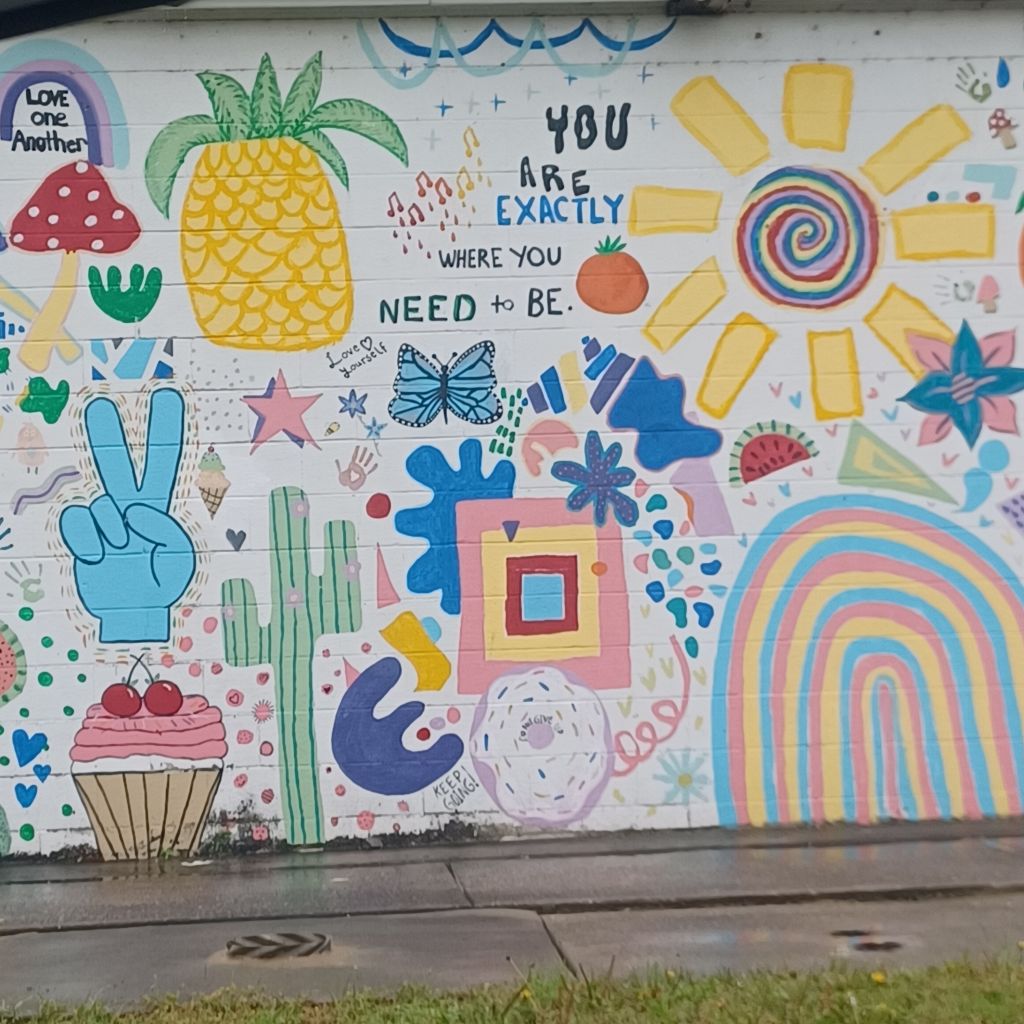
    5. We then went through El Dorado, which I think is pronounced el-do-ray-do. Named after two original settlers, Elder and Reed.., with the name being distorted over the years. Lunch in Eldorado at a Mexican restaurant, where Edie won the lottery with a mushroom quesadilla. Here are pictures from El Dorado.

    6. From El Dorado to Equality. A very small southern Illinois settlement with an absolutely fascinating history. Google it and learn about Native American salt works, taken by the US by “treaty”, worked by slaves in free state Illinois(!!). Then learn about John Crenshaw, who ran part of the salt works, but made his money capturing run away slaves and bringing them back south.

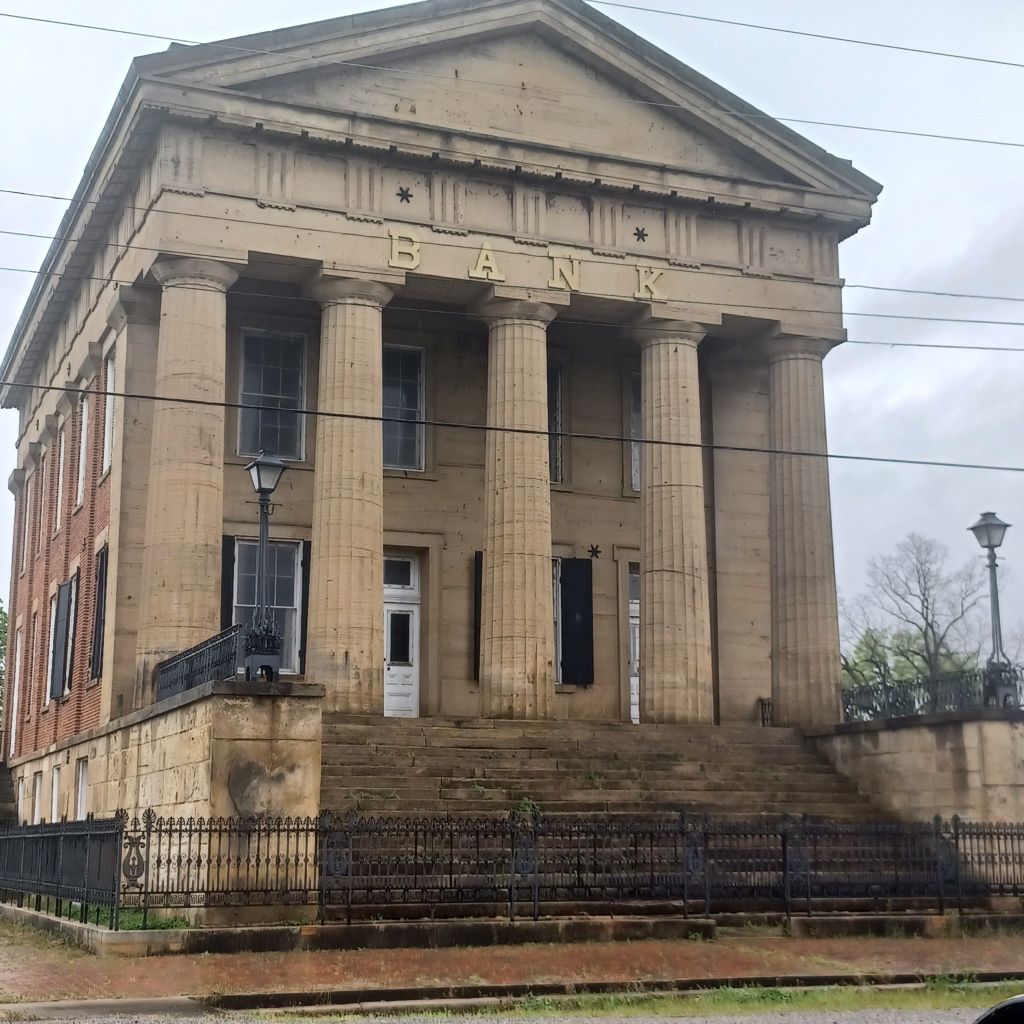
    7. From there to Shawneetown, another empty down and Old Shawneetown, on the Ohio River. There is virtually nothing in Old Shawneetown except for two old bank buildings. Here is one of them.

    Old Shawneetown IL

    8. Crossing into Kentucky, where the flat land turned into beautiful rolling country. Learned the grass is green not blue and that cows greatly outnumber thoroughbreds.

    9. We drove into Sturgis (and yes they have a bike festival), where again everything seemed vacant, but they have a very fine 100 booth antique mall, where we bought some gifts for the grandchildren.

    At the Sturgis antique mall.

    10. By now, we were tired and anxious to get settled. We went through more places without stopping and wound up back on an Interstate and drove by Nashville to Franklin where we now are. Again a Hampton Inn, and a sub-sub-sub-sub standard meal at Jonathan’s Grille next door where everything was fine but the food.

    Yes, this was too long. But so interesting.

  • Day 7. Last Day in the Home Town

    April 10th, 2024

    And busy it was.

    Our first stop in the morning was picking up my second cousin, once removed, whom we had met for the first time a few months ago in Virginia Beach. She is an artist and lives in an apartment building for artists in downtown St. Louis. The building, a classic building formerly an office and retail building provides affordable apartments for artists along with studio space and other amenities. Washington DC is talking about converting over capacity office space to residential and is finding it so challenging. St. Louis has found the trick, it appears, and has done it time and again.

    We drove a mile or a little more to the Lafayette Square neighborhood and a little coffee house on Park Street called the Park Avenue Cafe and had breakfast and talked. Then we drove all around the Lafayette Square neighborhood and looked at the gentrified old housing stock. it’s quite a classy area now. When I lived here it was hopelessly falling to pieces. Now virtually all homes have been renovated at least once. Most of the houses date from the second half of the nineteenth century. The park itself, the oldest public park west of the Mississippi, was laid out in the 1830s. The neighborhood also has many shops and restaurants.

    From there, a little wandering around downtown and close by areas and then lunch at a combined nursery and restaurant, Bowood, located midtown on Olive Street. Here we were with a law school friend and his wife (obviously also a friend) and an old college friend whom I had not seen in many years.

    Then back to Missouri Baptist Hospital where we spent a few hours with my cousin, who has been moved out of the ICU and looked good.  And then driving down Geyer Road into Kirkwood, where we met another couple with whom we have been friends for almost 50 years at Peppe’s Apt. 2, where we had a nice Italian dinner. Well ..with one exception. I didn’t get what I thought I ordered, but didn’t know that I didn’t get and only thought it was a very subtle version of what I ordered until I discovered that Mark, the waiter, and I the customer heard and said very different things. And who knows? Maybe I ordered by accident what he thought I ordered. After all, nothing is simple these days.

    At any rate, one more great conversation.

    We are heading southeast this morning, eventually to wind up in  Montgomery, Alabama. We are sorry we couldn’t see everyone in St. Louis this trip, but in three days we saw Donna, Ed, Richard, Jacci, Bob, Simone, Andrea, Judy, Michael, Wendy, Brigid, Pat, Nora, Molly, Suresh (and kids), Stuart, Betsy, Fran, Peggy and Charlie. Not bad.

  • Day 6. The Eclipse.

    April 9th, 2024

    So, having watched the solar eclipse through my free Warby Parker glasses (a huge shout out to Warby Parker), I am now convinced more than ever that the moon is closer than the sun. Not only that, but I am convinced that the sun is very bright. What I mean by that is that, when the moon has blocked out 90+ % of the sun, it is still very light outside. So my advice to the sun is to relax a bit. Don’t burn yourself out. And my advice to the moon? It was very cool when you blocked out the sun. You didn’t need to rush it. Next time, go slower.

    We watched the full eclipse from Makanda, Illinois, just south of Carbondale.

    A digression. The son in law of good friends, with whom we spent time on Sunday, calls Carbondale “CarBAHNdali”. Once that gets into your head, you will never be the same.

    Carbondale has the honor of being the one place that the lines for the 2017 and 2024 eclipsed crossed and Carbondale, the home of about 30,00 people and Southern Illinois University with its 15,000 students, was buzzing. The special production at the football stadium seems to have thousands of spectators, each of whom from the looks of the parking lot must have driven two cars.

    A few miles south in Makanda, at it’s “hippie” boardwalk, there must also have been teems of people. We were advised to stay away if we didn’t want our car to be trapped for hours

    A two hour drive took about three. Better than we feared. We took Illinois state roads and avoided Interstates which turned out to be a good move. Except at stop lights, where things got quite backed up, traffic moved smoothly. Coming back, the roads were slower. On the route we tok after the eclipse, the problem was roadwork, not stop signs.  Each way, the 100 mile trip took over an hour longer than usual.

    Second digression. We are lucky we didn’t take an Interstate. Friends who took an Interstate toward St. Genevieve never got there, the traffic was so bad.

    The day was beautiful. Blue sky. Temperature exceeded 80. We were at the home of Randy, our friend Judy’s son, who is a physician and works at the federal prison at nearby Marion. They have a beautiful place on 67 wooded acres, and the setting was beautiful and the group was small. We all enjoyed the silence, the subtle light changes, the eeriness, the sudden drop in temperature and the four minutes of quasi-darkness. We followed the moon’s progress and marveed at the entire situation.

    Third digression. The other four people with us were Brian, Britt, Julia and Mary. I am so bad at names that I have been saying these four names over and over. But I don’t really know who these people are.

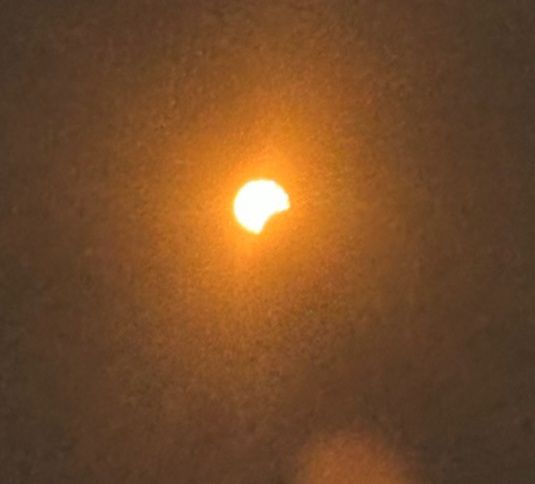
    I wish I had a camera good enough to distinguish the changes in light, or to catch the moon’s encroachment, but alas, my cell phone camera was not up to the challenge.

    One picture from one of those watching with us.

    At the Start

    And one more from the Japanese restaurant that ended our day.

    Sushi for three
  • Day 5: Poetry in Motion

    April 8th, 2024

    Today was primarily a family and friends day. Or…….

    Twas the day before eclipse,

    And all through St. Lou,

    People were asking

    “Now what should I do?”

    “Stay in Missouri and

    Drive to the south?

    Answer me, answer me,

    Open your mouth.”

    An Arkansas traveler, now

    that I could be.

    Will the sun be eclipsed

    In nearby Tennessee?

    Or should I stay home

    And miss the eclipse?

    Answer me, answer me.

    Open your lips.”

    Our plan is to hit the road early and drive just south of Carbondale, Illinois, about 100 miles. I will report back tomorrow.

    We started today visiting old collge friends of mine. As usual, a great conversation. But today, it was special. Their two daughters were in town – one from Seattle and one from New York. And Seattle (who in days gone by spent a summer in our basement) came with her husband and three children. Our friends, who are ridding themselves of their long-standing house and moving into an apartment in a seniors building  in Clayton are in the process of downsizing. And I mean “in the process”. What a task that is.

    We then had lunch at a little cafe call Meshughah. If you are on Facebook, you probably also know we have seen Strange Donuts, Cursed Coffee, and The Joint (a chiropractor’s office). Ah, St. Louis

    Meshugah

    We then paid a visit to my hospitalized cousin, and had dinner (pizza) with two other cousins and spouses.

    Hopefully tomorrow, the sun will shine, the traffic won’t be bad, and we will get home in time to have supper with another friend. Did I say “home”?

    Until then…..

  • Day 4: A Matter of Taste.

    April 6th, 2024

    We started in St. Louis and ended in St. Louis.

    First, hooray to Waterway Car Wash. Second, boo to Strange Donuts.

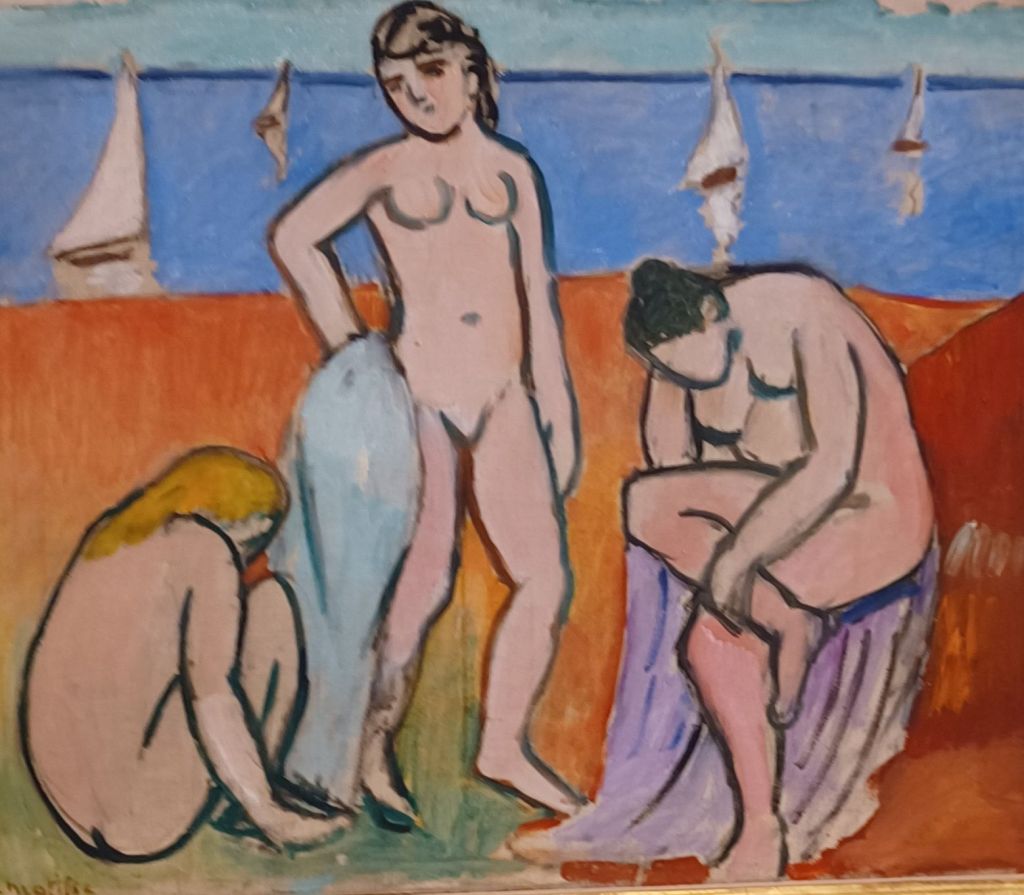
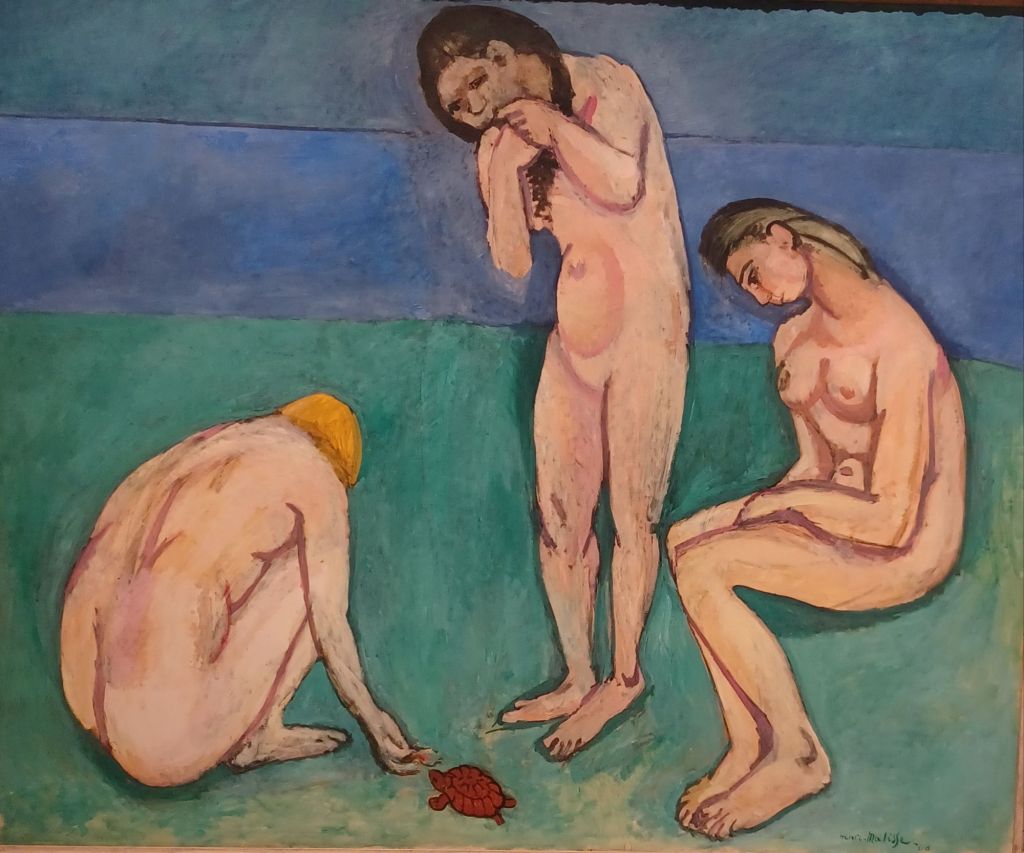
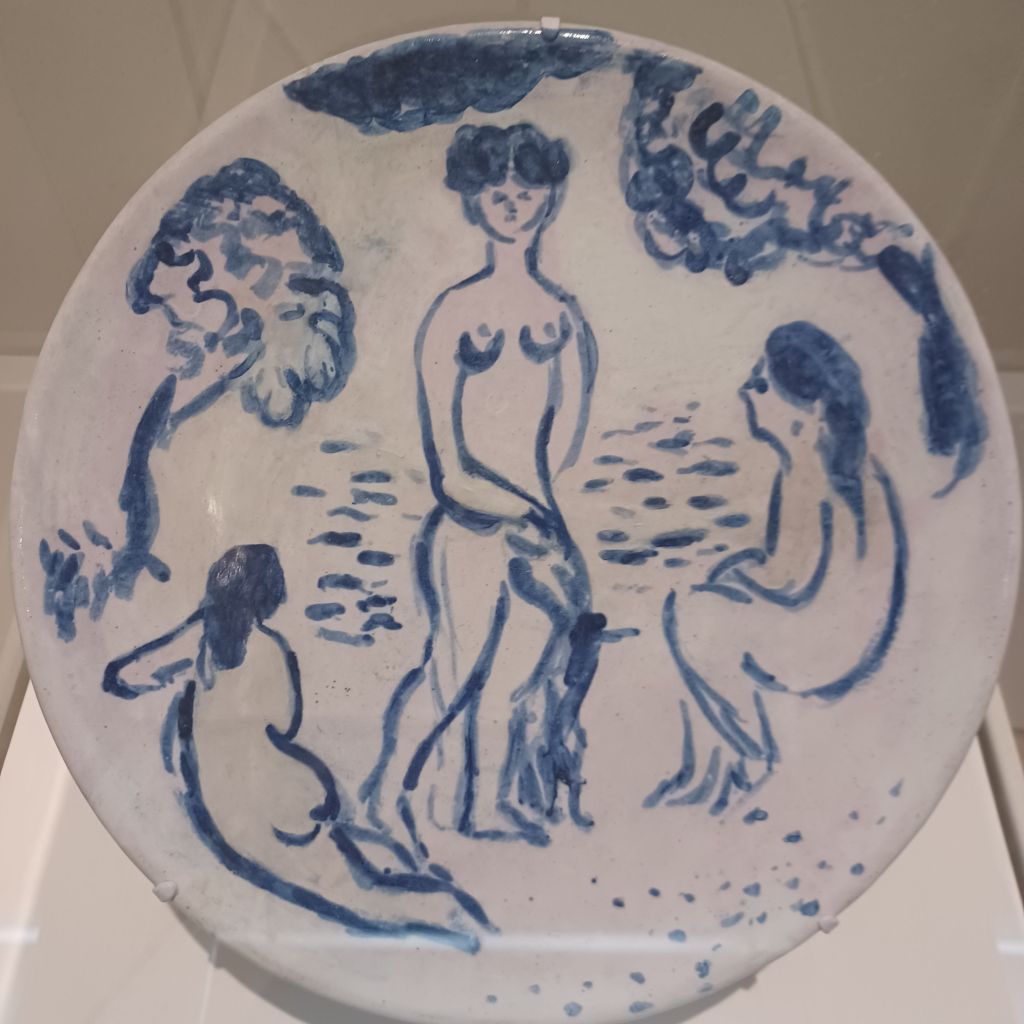
    We spent most of the day with our friend Judy at the St. Louis Art Museum, one of the best. The special exhibits included one titled Matisse and the Sea. You can figure out what it’s about.

    I like these three pieces, I must admit. But I also must confess that I have never really been a Matisse fan. In fact, I think he’s one of the four most overrated artists of the 20th century. The other three are Ellsworth Kelly, Cy Twombley and Joan Miro. I know no one would probably agree, but that’s my opinion. Period.

    One of my favorite 20th century artist is Anselm Kieffer. Here is one in the St. Louis museum.

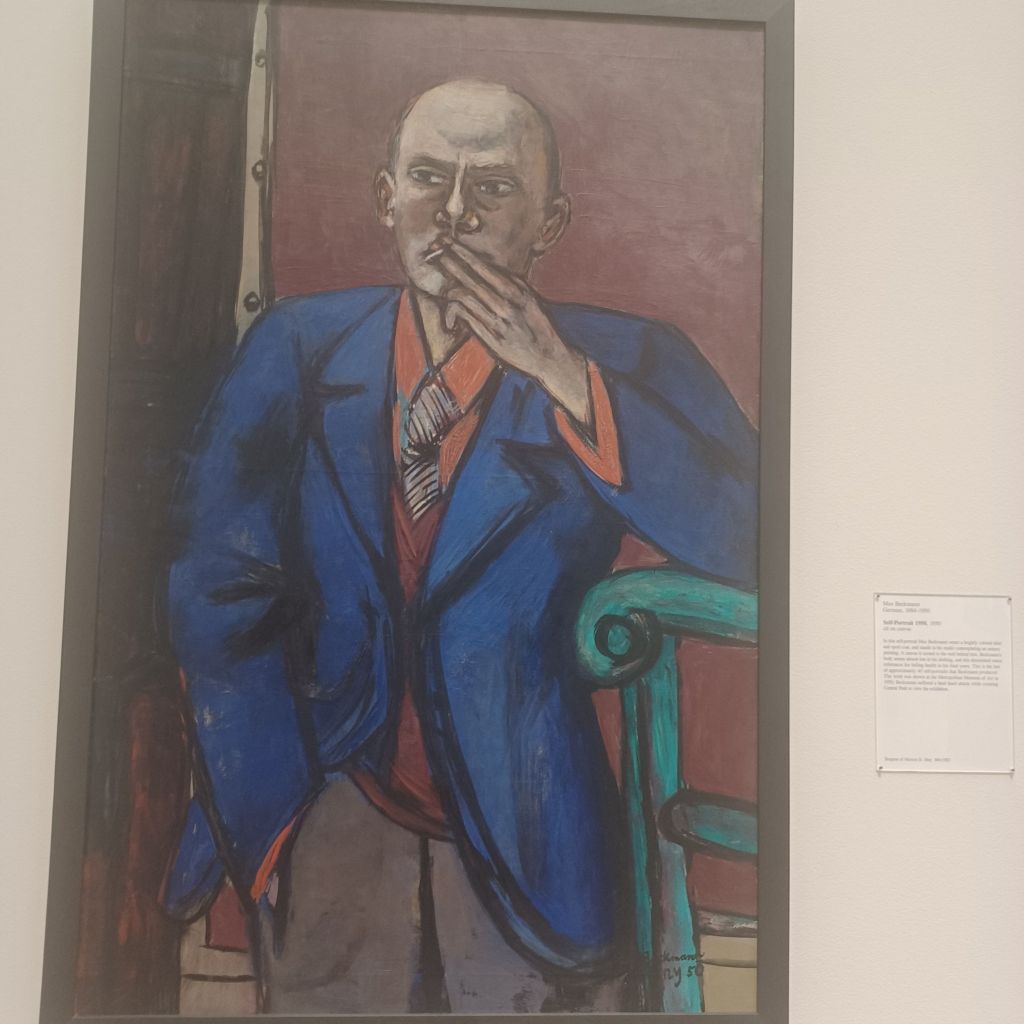
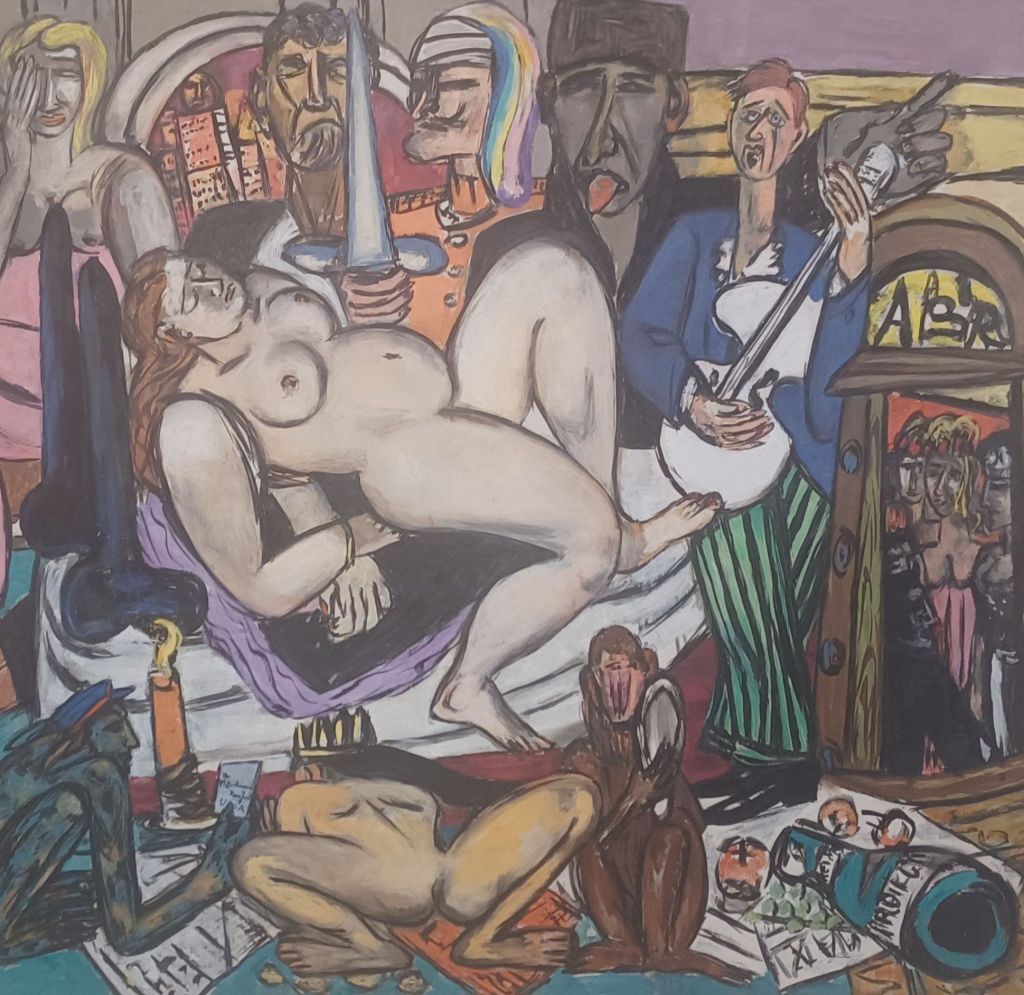
    And I like Max Beckmann.

    And then I saw this great urban overview made only from miniature electric circuits by an Ethiopian artist, Elias Sime.

    And finally

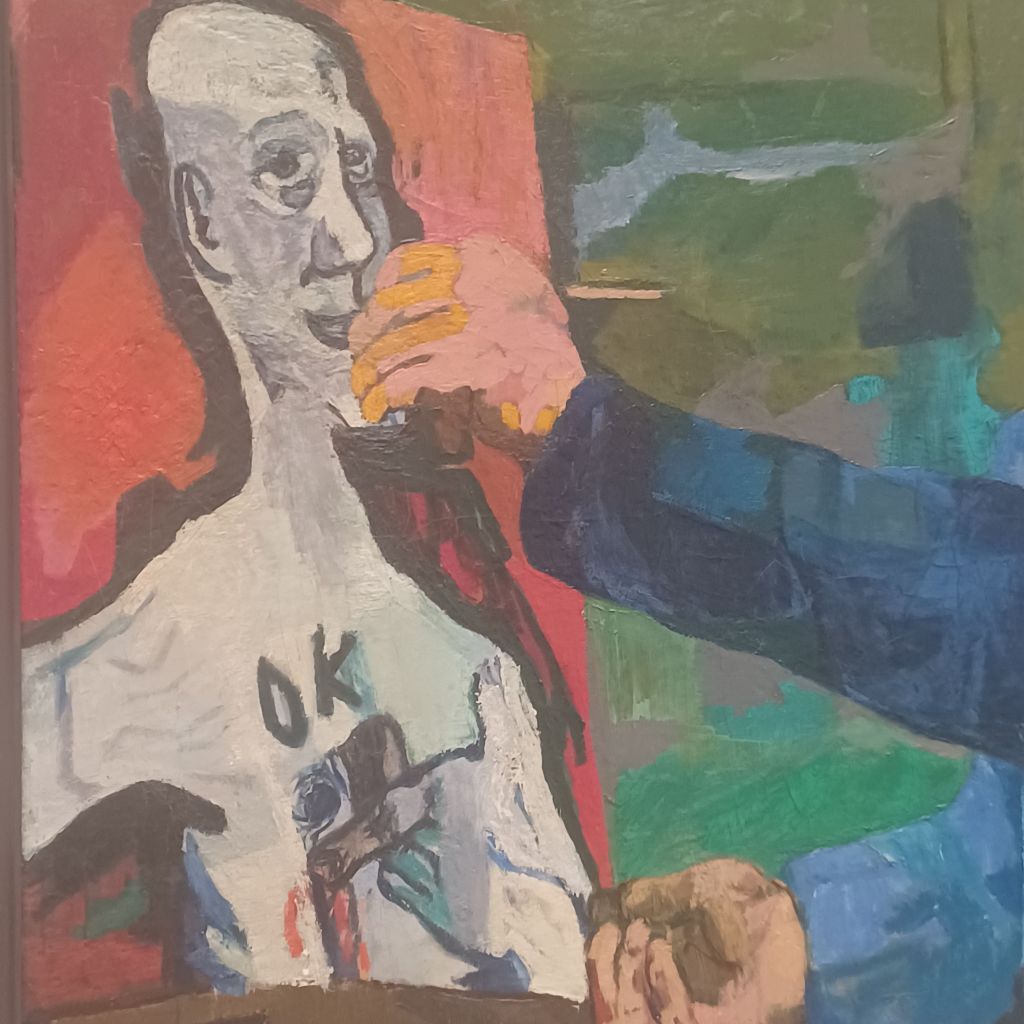
    a detail of a painting by Oskar Kokoshka. O.K.?

    We had lunch in the Panorama Room at the museum. A fine lunch it was, but the service took forever. Not sure I’d want to do it again. The waiter assured us it was not his fault, that he was controlled by the chef.

    Dinner, which was delicious at our friend Wendy’s, with Judy and Michael. Much reminiscing and much trying to remember things that our younger selves would have figured out much more quickly.

    Today promises to be busy, so… let’s get to work.

  • Day 3. Many Surprises. How About Abe Lincoln’s Covered Bridge?

    April 6th, 2024

    To end the suspense: we arrived in St. Louis at about 5. The skies were sunny.

    We started off at the Hampton Inn in Richmond Indiana. The night was better than I feared. About 10 o’clock from our room, I heard the siren of a railway train which seemed very close, and again at 10:30 and I feared being up all night. My PTSD returned, thinking of our disastrous times at the St. Regis in Houston and at Badlands National Park in South Dakota, where trains keep me up all night, and in Albuferia Portugal where the villain was a church bell. But the later trains turned down the volume and I slept pretty well.

    We explored Richmond in the morning. An extraordinarily interesting 19th century business area, where most buildings and storefronts are empty and the chance of restoring the area seems dim.The same is true of the historic residential neighborhood, the Starr neighborhood, Interesting homes, falling apart. (The day before we went through the historic residential area of Springfield Ohio which is in much better shape.)

    But outside of the center of town, Richmond seems to be doing all right. What make some of these towns fail and some thrive? Even just west of Richmond, there are small towns which are in great shape – shops, homes, all in pristine condition

    We drove through Indiana, stopping for a lunch in a town that hardly exists, Cloverdale Indiana. Lou’s Diner, like the restaurants the last two nights, was filled to capacity. I think we were the only tourists. Where did they all come from?

    We had stayed on the freeway through Indianapolis as time seemed to be growing short. We were moving quickly and then a problem arose. There was apparently a crash that closed I-70 and we were stuck for about 30 minutes. By the time we got to the detour exit, though, they had just opened the road and off we went.

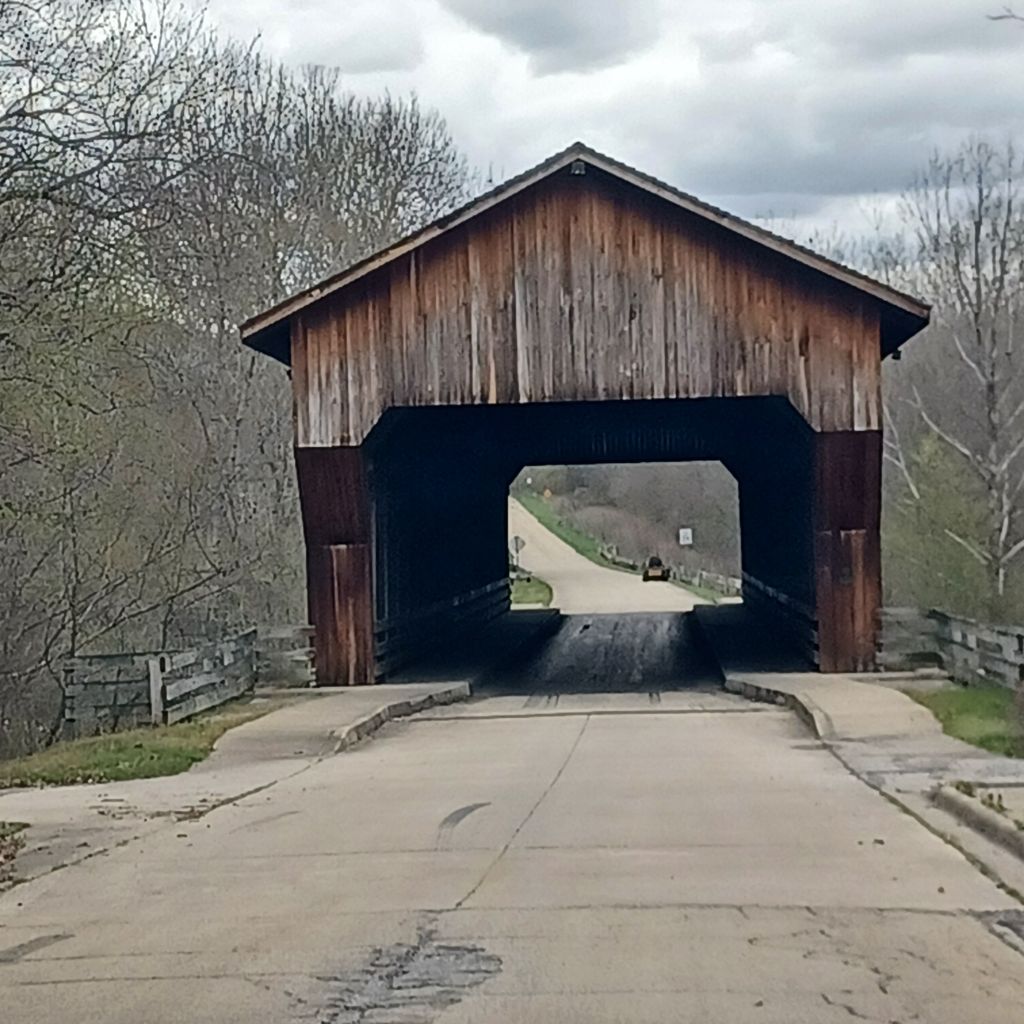
    We then made 5 stops in Illinois. First to see a 200 foot long covered bridge over the Embarras River. The bridge was just built in 2000. But it was an exact copy of the original bridge built in 1832 and washed away about 30 years later. The original bridge was built by future president Abraham Lincoln and his father Thomas.

    Then we stopped Effingham, a midsize small city, which I expected would be in sad condition like the three other cities we had explored. But no, it looked to be thriving. No vacancies, people walking on the streets. It looked like a thriving 1950s city.

    And then we went to Greenville. An old friend grew up there and I had never been there. Turned out Greenville was atypical, busy and attractive. The layout was unusual, there is a university, a large number of well kept houses.

    And, oh, I should also mention Casey IL, a town that hardly exists but has a DQ where I got a chocolate sundae. And Mulberry Grove, which used to exist but is now has a few empty stores, a closed school and a church.  I closed my eyes for 15 minutes, which was very refreshing.

    Main Street, Mulberry Grove

    We got to St. Louis about 5:30, went to our friend Judy’s house, and then to dinner at a restaurant in Clayton, called Oceano. Fish all around. My salmon, Edie’s trout and Judy’s sea bass. All excellent.

  • Day 2. We Are In Indiana. Why O why O why O?

    April 5th, 2024

    Ohio Day is done. Of course, it started in Pennsylvania (where there were snow flurries on April 4) and we had to cross the West Virginia panhandle to get there. Crossing through Wheeling, I caught a glimpse of the worst motel we ever stayed at, a Comfort Inn that overlooks I-70. I remember a room filled with mildew and the desk clerk, before she finally moved us, telling us that it only smelled that way because no one had used it in a long time. She grudgingly moved us to the other side of the motel, which was not much better.

    But that was then. Yesterday, we buzzed by and soon found ourselves in Ohio, near St. Clairesville (where I left my credit card two years ago). We whisked by there, too.

    That’s when, with some trepidation because the weather was still off and on problematic, we decided to get off I-70 and travel via US 40, the old National Highway. We got off at Old Washington OH (see a pattern?), a very small town. Traveling quickly, I noted that much of the country along the road was quite marshy. Soon I realized that it was not marshland, but oversaturated forest and farm land. And then Highway 40 was closed due to standing water. And no, there was no warning, no marked detour and none possible. We had to backtrack and get back on the Interstate at Old Washington.

    By the way, a digression. Going all across Ohio, largely off the Interstate, we only saw 3 Trump signs. Four years ago we would have seen dozens. One of the three was at Old Washington, where a house had a big Trump sign, a Trump flag, an America First banner

    Back to the main text: We got back on Highway 40 after a few miles and had no additional problems the rest of the day. Highway 40 is pleasant enough, with a few historical sites and buildings. We only stopped once more that morning at a 50 vendor flea market. They had nothing of any interest to me that I saw, and I can’t imagine much of it ever being sold. Sort of like a large store filled with Goodwill rejects.

    We noticed several other antique malls. Any would I am sure have been better. But we were done with that for the day.

    We got to Zanesville about 12:30. A town about the size of Washington PA, formerly a pottery center, it was named after Ebeneezer Zane, an ancestor of writer Zane Gray, who was born there. And it’s the home of the Zane Gray Museum. A county seat, it has a wonderfully ornate county courthouse and a few historic homes. It has a sizeable central business district with a lot of vacancies and, we thought no restaurants at all. Then we found the Downtown Exchange, a unique food court with about a dozen small stands – pizza, Greek, Japanese, Mexican, Sandwich, desserts, coffee shop and more, and a good amount of common seating. Not bad and certainly not expected. But Zanesville seemed a bit lost and forgotten, and apparently is very different from what it used to be.

    Then, after some discussion, we decided to stay on 40 and drive right through Columbus, knowing that would add an hour to our trip. We don’t know Columbus at all and it was worth doing. East of the city, the suburbs of Bexton and Reynoldsburg hold miles of upscale shopping, downtown Columbus is filled with attractive tall buildings, as well as the Ohio State buildings and so on. Moving west, the neighborhoods are maybe a bit more sketchy, but interesting. It looks like a city worth a few days as a tourist to be sure.

    From there it was across the western part of the state, farms, towns, rain, clouds, hills, plains. The only city of note is Springfield , which seems much more vibrant than Zanesville. Then, without fanfare you are in Indiana and almost immediately after that in Richmond, another old, old place.

    We will explore Richmond today. But last night we went to another large Italian restaurant, Galo’s. I’d give it an A. We had eggplant Parmesan and breaded cod over pappardelle. Strawberry gelato for dessert. It’s not downtown, but in a large building of it’s own, near a big mall. The dining room is very large and ornate, a unique design where most of the tables are within a round area, but behind the round area, the room is square with other tables and the bar located a step or two up.

    Then, back to a different Hampton Inn to prepare for Indiana/ Illinois Day, and falling back an hour.

  • Washington to Washington. The More Things Stay the Same, the More They Change

    April 4th, 2024

    The first day of the trip belongs to the history books. We left home in heavy rain at just before 11 a.m. and arrived in Washington PA at about 3:30. We stopped for lunch in Hancock MD. We had rain most of the way. Sometimes strong, sometimes drizzle. But never a real problem. Never blinding. No wind to speak of. But because it was gray and wet, we didn’t do our usual exploring but stuck to the Interstates (270, 70, 68, and 79). Traffic was less than anticipated everywhere.

    We have stopped in Hancock before. We remember going to the local Hancock historical museum and finding much of interest. We don’t remember if we went to any restaurant and nothing looked familiar.

    A few things about Hancock. First, it’s a fairly depressing place on a beautiful day. Even more so today, when much seemed to be closed, including the museum and several restaurants.. Some places open on weekends. Some perhaps open never.

    Second, we did find a restaurant , the Triangle. It’s friendly and clean and the food was pretty good. We had a fish basket (fried haddock and steak fries) and a Reuben. Very nice waitress. I’d give it a strong B. Why not higher? The place was totally devoid of personality of atmosphere. Just plain boring.

    Third, Hancock is small. Only about 1500 and holding.

    Fourth, it was not named after John Hancock.

    Finally it’s located at the narrowest part of Maryland. The width of Maryland at Hancock is 2 miles, making it the narrowest such place in any state in the country.

    Washington PA is a different case. It’s about 10 times the size of Hancock and was at one time twice that size. That means a lot of downtown Washington is vacant.

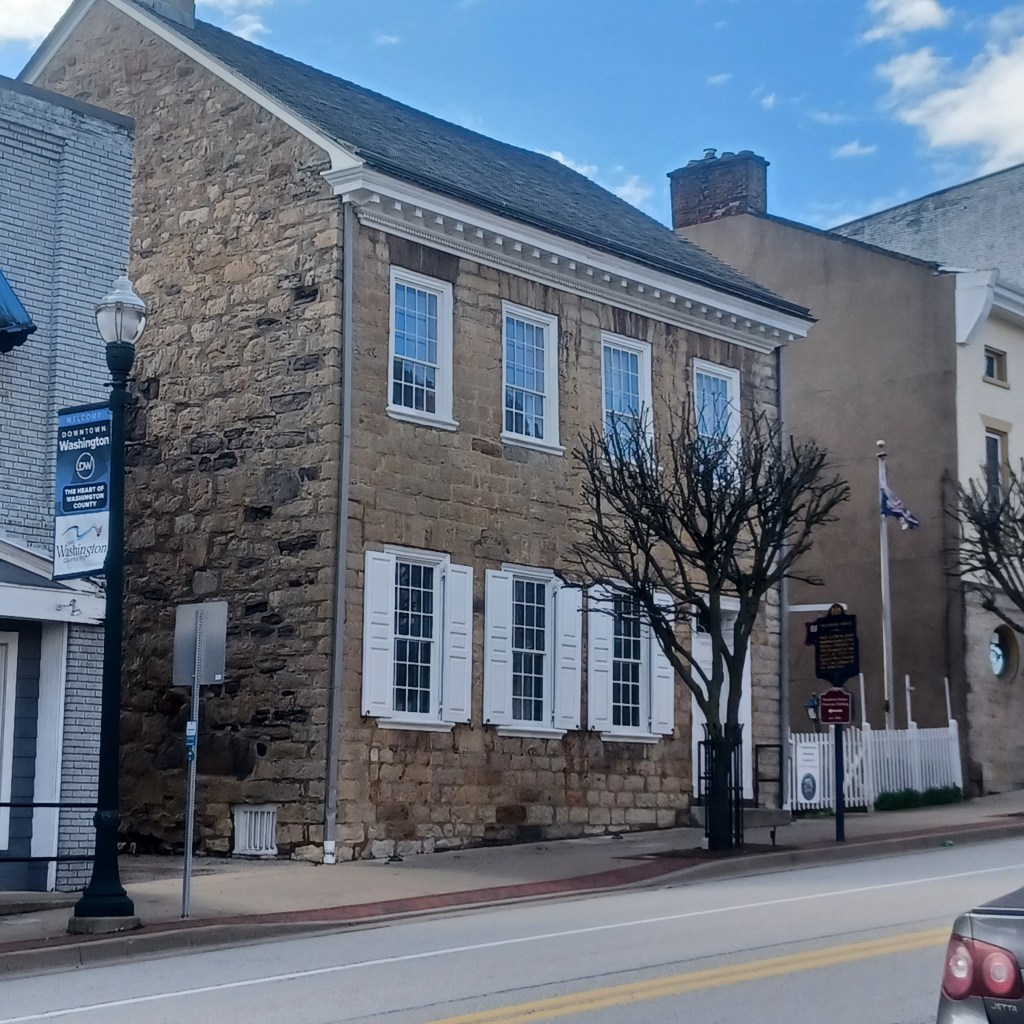
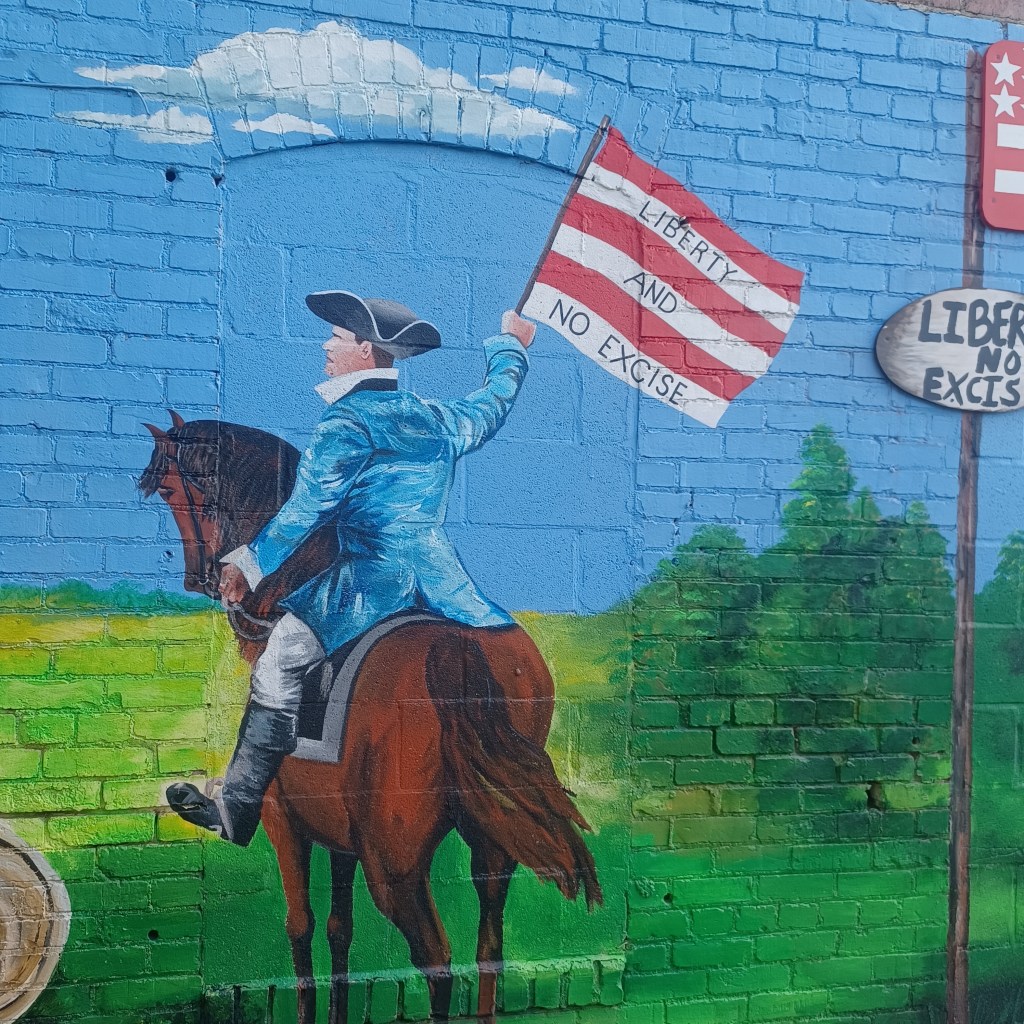
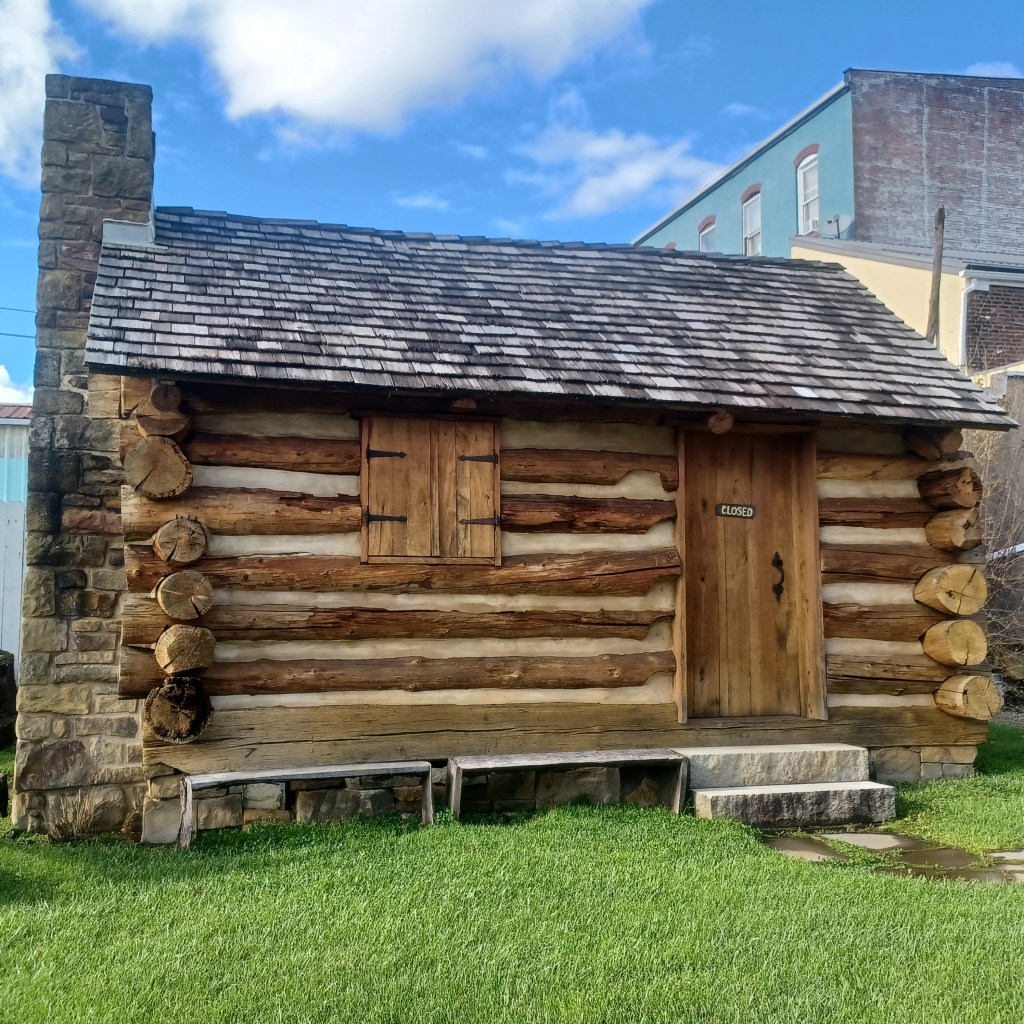
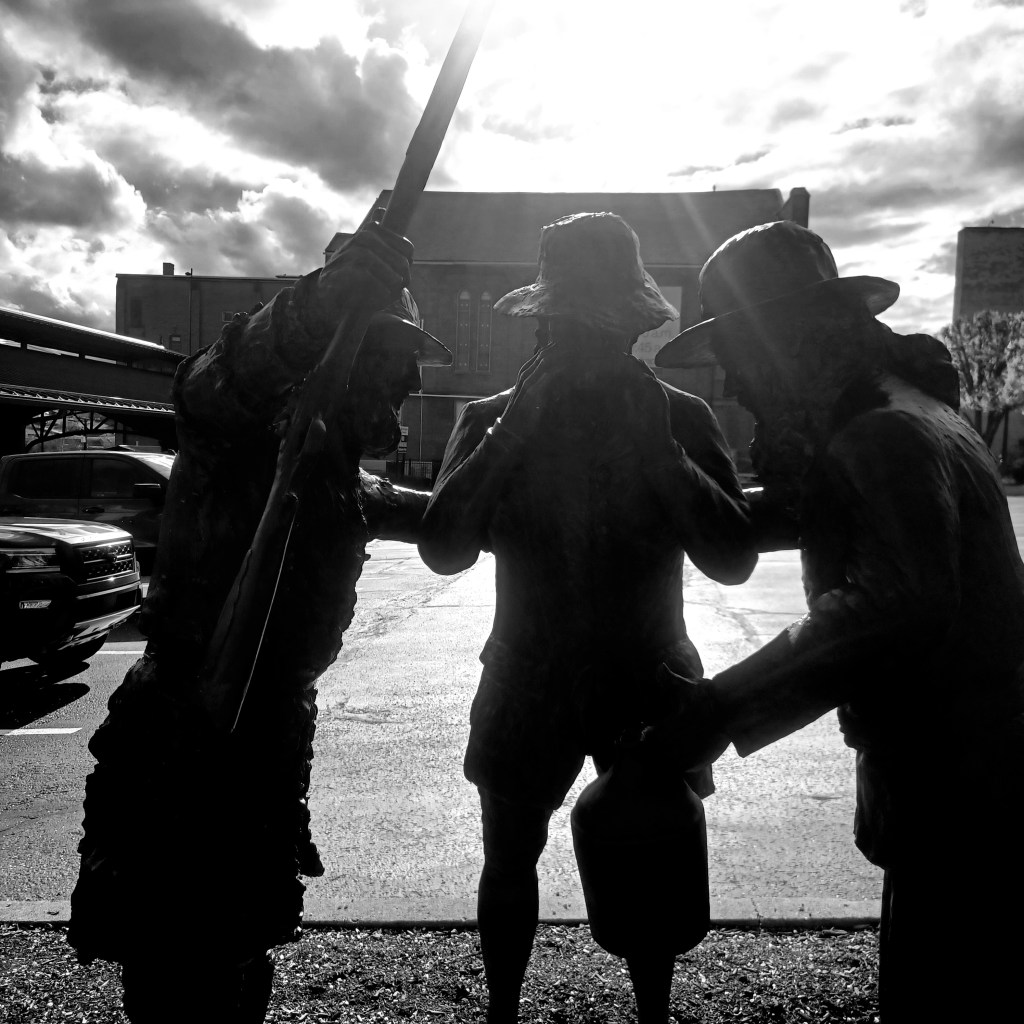
    But there’s a lot of history there, including much concerned with Whiskey Rebellion. This is the home of the rebellion and its leader, David Bradford. Here are some photos of historic Washington.

    The Bradford House.

    A sample 18th century log cabin.

    The three Whiskey Rebels

    We decided to get an early dinner and looking on our phones decided on the Union Grill, a downtown restaurant that, in spite of its name, is Italian. Located in an older building, down a half dozen steps so that you are sort of in the basement ,it is quite large, with a bar and several dining rooms. We went in at 5:45, expecting it to be fairly empty. It was packed, with tables of people eating big Italian meals. Our waitress told us it was this way every day. And when we left about 7, tables were still filled and people still coming in. Outside, the tow looked, both at 5:45 and at 7, deserted. Go figure.

    The food was pretty good, angel hair pasta primavera, and swordfish with linguini.

    We drove around town, saw the campus of Washington and Jefferson University and went back to our hotel.

    That’s it for Day 1. Day 2 will be Ohio Day. Bet you can’t wait. I can’t. Because it’s still raining in PA, but it will clear up in Ohio.

  • We’re On the Road Again.

    April 2nd, 2024

    Lucky you. You’ll be able to follow our trip as we leave Washington and go to St. Louis to see friends and family, Carbondale IL for the eclipse, and then Montgomery and Selma AL for a civil rights tour.  Ambitious to be sure, but I think we can do it.

    Today, we are going to start off (and maybe end up) in rain and we aren’t going to rush it. Slow and steady, we don’t really care how far we get.

    Looking forward to a couple of days in the car, hopefully relaxed and care free.

  • To Robert F. Kennedy, Jr: You’re No Robert F. Kennedy.

    April 1st, 2024

    I wasn’t planning on writing about Robert F. Kennedy, Jr., but I just saw his interview on the Erin Burnett show on CNN, and attention must be paid.

    The most striking thing that I heard on the interview is that Joe Biden is a bigger threat to American democracy than Donald Trump. Apparently, this is because Kennedy thinks that Biden has politicized the Department of Justice, and that no other president has ever done this before. Since that is false as to both claims, there are only two possibilities: one is that Kennedy is out of his mind (this is a good bet) and the other is that he is trying as hard as he can, any way he can, to take votes from Joe Biden. That is what makes him so terrifying. He doesn’t have to take away a lot of votes, particularly in those bell weather states.

    I will give Kennedy credit for being able to list all of the problems we have in this country, domestic and foreign. He went through a laundry list of them. And he then declared that neither Biden nor Trump have a ghost of a chance of resolving any of them. He claims that the Democratic Party has given up on the working class, and that Trump is just fooling the working class to make them believe that he is working for them. But Kennedy himself, he says, is really for the working class.

    You would think that he would then have given at least some hint of how he would help the working class, that he would describe some of his policies and how they would differ from the two major candidates, of how he would work with a Congress with no members who belong to the same party as President Kennedy, Jr would belong to and who would be positioning themselves immediately for the next presidential elections. But no, he didn’t go there. Didn’t go near there. He did say that there was basically no difference between the Biden and Trump policies (except on the very margins).

    Of course, he also didn’t talk about the various conspiracies he subscribes to. He is very anti-vaccine (but you know that), but he says that, well, not anti-vaccine, he just thinks they need to be tested more, because as they exist today, they cause autism and peanut allergies. But apparently he is also against fluoridation of water, against acetaminophen, He accused Anthony Fauci and Bill and Melinda Gates of profiting off of COVID-19, and of forcing people to get vaccinations or have their Gates subsidies all cut off. He accused them of trying to prolong the pandemic to increase vaccine sales. He posted a picture of Fauci with a Hitler mustache. He said that COVID was engineered to attack certain groups of people, like Caucasians and Blacks, but that Chinese and Ashkenazic Jew were mostly immune. He claims that no one really knows if HIV and AIDS are related. He has also expressed doubts about Lee Harvey Oswald killing his uncle Jack (and apparently believes that the CIA might have been involved), and believes that Sirhan Sirhan did not kill his father. He believes the 2004 election was rigged and stolen and that Jack Kerry was the legitimately elected president. He does not seem concerned about guns (he says we have the same number of guns per capita as Switzerland, which is not true, I am told).

    He does have a strong environmental background, both as a litigator and as a non-profit leader. You can’t deny him that (I don’t think).

    His sisters Rory, Kathleen and Kerry and his brother, Joe have all come out against his candidacy, as have Joe’s son Joe III, and cousins from the Shriver and Schlossberg families.

    Unfortunately, the Kennedy name still means something to some people. This is why, according to one critic, he is a candidate for the presidency and not just another crackpot.

    It is unclear today how many states will put them on their ballot. That question, if you are really observant, takes us back to another of my posts from a few months ago. If Colorado cannot tell Trump he can’t go on the ballot, how can any state tell that to Kennedy? Or, if I wanted to run, to me?

  • April Fools!

    April 1st, 2024

    Today is the home opener for that Nationals and we have tickets. The problems are (1) while this morning’s rain will probably stop by game time, the temperature is not to rise above about 55 degrees, (2) I woke up yesterday feeling like I was coming down with something and still today I am not 100% cured, and (3) we are scheduled to leave town Wednesday morning on a road trip, and I want to be fully recovered by then. Plus, yesterday the Nationals blew a 5-3 lead in the bottom of the 9th with two outs, and their closer allowed a double and two home runs to lose to the Reds 6-5. As a loyal fair weather friend, that takes away some of my enthusiasm. So……what should we do?

    As to April Fools (and I have no idea who invented that day), my mind always goes back to that April 1 long ago, when I was taking a business trip. Why and where I don’t remember. But I do remember it was Southwest Airlines, from BWI. There was a typical boarding line, and as we got on the plane, we slowly moved towards the back. A man two or three people in front of me stopped to open a top rack and stow his carry-on. He opened the rack door, and there was a Southwest stewardess hiding in the luggage rack who put on a big smile and yelled “April Fools!!”. (Yes, she was very short, and very animated) The problem was that the poor man looked like he was having a heart attack, and the stewardess knew she had made one big mistake. I wonder if, every April 1, she thinks about this, too. She is probably now about 60. When she thinks about it still, I bet she is both embarrassed and in disbelief. Do you think she ever told her kids?

    I started this day pretty early, because I wanted to get to Warby Parker (that’s an eyeglass store) when it opened at 10, because I had read that they were giving away glasses for the upcoming solar eclipse, which we plan on attending in southern Illinois. I went to their Union Market store, entered at 10:06 and seemed to be their fourth customer. One other was looking for eclipse glasses. They seemed to have about 100 pairs.

    So, I think I should give Warby Parker a shout out. I don’t do that often enough, but I really should have a shout out list. Let me add, as number 2, Mamman Cafe, up the street from the Warby Parker store, which is a very comfortable coffee shop/lunch place and has first class coffee and good pastries. It was carry out this morning – an almond croissant and a “small” coffee (their “small” is 12 ounces; they also have an 8 ounce size, which they call “kids” – go figure).

    Shout out #3: Echo Falls smoked salmon. I don’t usually pay any attention to what brand of lox I buy at a supermarket. But yesterday, I had lox, cream cheese and a bagel which I thought was much better than usual. The brand was Echo Falls, so I will give them a shout out. I looked them up on line to see what others thought. The first URL that came up showed Echo Falls with a 5.0 rating. Can’t beat that, I thought. I wonder how many people had sent in reviews. The answer? One. I’d make it two.

    Other shout outs? Everyday Sundae on Kennedy Street. Fresh Baguette on Wisconsin Avenue. Izumi Japanese Restaurant on Columbia Road. Cafe of India on Wisconsin Ave. I’m Eddie Cano on Connecticut Ave. Gourmet Asian Bistro on Muncaster Mill Road. Those are my March shout outs.

  • The Lehman Trilogy and More (501)

    March 31st, 2024

    It was the last performance of “The Lehman Trilogy” at the Shakespeare Theatre. We took the Metro, which lets you off on the block of Shakespeare’s Harmon Theatre; nothing could be more convenient. And the round trip only costs us $2 each. But, no matter how convenient, when a 3 and 1/2 hour show starts at 8, and you have to leave the theater, walk about 2/3 of a block to the Metro, etc., you don’t get home until about 12:30 a.m. For us, that’s beyond late these days.

    The show is fascinating. Although I haven’t done any fact checking, I would venture to say that this show is a history lesson, a lesson not only in the establishment, growth and demise of the Lehman Brothers’ various business enterprises, but a lesson in long term business economics. On the one hand, it’s simple – buy merchandise and sell it at a profit. Figure out who needs something, and who has something, and become a necessary middleman.

    So far, so good. But then there are disruptions. There was, for example a Civil War that destroyed the cotton market, and the Lehman Brothers’ business was at that time all cotton. Later there was World War I, and after that, there was the Great Depression. Throughout all of these cataclysms, the Lehman enterprise held on, when so many others didn’t. But, then, when there were no more Lehmans, and when greed took over and Americans believed that markets would go up and up and up……that’s when the company finally failed. It’s a history lesson – and maybe an economics lesson at the same time.

    Of course, beyond the history lesson is the play itself. The Lehman Trilogy has only three actors, each playing multiple roles, each on stage virtually (maybe even actually) the entire 3 and 1/2 hours of the play. Each with thousands of words to say, in different personae, with different accents, even different genders. It was a bravura performance by Edward Gero, Mark Nelson and Rene Thornton, Jr. Thornton is African American. I wondered how he would be playing a 19th century German Jewish refugee, and playing all of these other White parts, especially in the parts of the play set in pre-Civil War Alabama. It worked fine. (I saw from the program that one of the two understudies was a woman, Julie Ann Elliott. I don’t know if she ever had a chance to perform; that would have been interesting – I bet that would have worked, too. And kudos to the unseen Elliott – she had to remember 2/3 of the lines of the play – to be able to go on at a moment’s notice to play either of two of the roles. Wow.)

    The structure of the play, with very simple staging, is unique. The multiple roles played by each of the actors transition smoothly. It’s quite worth seeing if you have a chance.

    By the way, as to fact checking – which I usually do – in this instance, I didn’t. Because, even though I found this play to be a history lesson, I didn’t think the facts were that important. Uh-oh! Am I on the proverbial slippery slope?

    Once we got home and I went to sleep, I had one of my repetitive type dreams. My law firm was falling apart. I had been working hard, but for the past few years, I hadn’t been paid. I always figured that one day, all this would be reconciled, and I would get the hundreds of thousands of dollars I was owed. But I kept putting the day of reckoning off. Now it was almost too late. But who do I talk to? Who do I tell that I haven’t been paid for years? I had worked so hard. But then I remembered. I had never billed any of my clients. And for those clients whose billing responsibility was one of the other lawyers – even when I worked for those clients, I never submitted any time sheets. This clearly would complicate my conversation. What to do?

    I had a second dream I remember as well. 8 year old Hannah (not 8 year old Joan, 8 year old Hannah) had received the opportunity to spend a week with a family in Cardiff, Wales, on a program sponsored by the Wall Street Journal, and she really wanted to go. She had to leave in two days, so getting ready was frantic. Then someone asked me about the family she would be staying with and other similar questions. My response was “I have no idea. I am just relying on the Wall Street Journal.” That, I realized this was stupid. But it was too late.

←Previous Page
1 … 38 39 40 41 42 … 62
Next Page→

Blog at WordPress.com.

searching

Loading Comments...
  • Subscribe Subscribed
    Art is 80
    Join 71 other subscribers

    Have a WordPress.com account? Log in now.

  • Art is 80
    View site in Reader
    Manage subscriptionsSign upLog in
    Report this content
    Collapse this bar