Skip to content

Art is 80

  • A-Rated Books I Read In 2023

    January 20th, 2024

    I read 84 books in 2023. This was down from 105 in 2022. Since I don’t think I do a lot of reading, these numbers really surprise me. Perhaps I am lying, but I don’t think so. For a while, I have kept a list of the books I have read. Sometimes they have on my computer. Sometimes they have been on paper.

    Except for the last three years (where they all on the same computer document called Book Reports, I really don’t know where any of them are. But on Book Reports, for each book, I have listed title and author, four to six things about the book (otherwise I won’t remember most of them), and a rating from A to C. If a book is trending D or F, I will put it aside and it won’t make the list.

    My reading is always eclectic. The last two years, it has been more so, because I have been going through my collection of old Penguin paperbacks, dating from the 1920s to 1960. My goal was to go through all 700+, but so many are so irrelevant that I gave that up. So, 2023 was a mix. 

    Here are the books I rated A or A-. If you want to learn a bout them, Google them, look on Goodreads, or ask me. For me to be more expensive here would extend this post way too much.

    Here goes:

    1. “Foreigners” by Leo Walmsley.
    2. “Brown on Resolution” by C.S. Forester.
    3. “The Trespasser” by D.H. Lawrence.
    4. “Clochemerle” by Gabriel Chevalier
    5. “Jassy” by Norah Lofts
    6. “Confessions of Felix Krull, Confidence Man” by Thomas Mann.
    7. “Anson’s Voyage Around the World” by Richard Walter.
    8. “England in the 19th Century” by David Thomson
    9. Three Plays by Euripides: “Hippolytus”, “Iphigenia in Taurus”, “Alcestis”.
    10. “A History of the English Church and People” by the Venerable Bede.
    11. “A History of the USSR” by Andrew Rothstein.
    12. ” Agricola” and “Germanica” by Tacitus.
    13. “Salome’, “A Woman of No Importance” and “An Ideal Husband ” by Oscar Wilde.
    14. “Edmund Campton” by Evelyn Waugh.
    15. “Life in Shakespeare’s England”, an anthology.
    16. “The Cinema 1951”, an anthology.
    17. “Rules for Radicals” by Saul Alinsky.
    18. “Cyclops” by Euripides
    19. “Ichneutai” by Sophocles
    20. “Spencer Fullerton Baird” by William Hawley Dall.
    21. “Britain BC” by S.E. Winbolt.
    22. ” The Beginnings of English Society” by Dorothy Whitelock.
    23. ” The Magic Mountain” by Thomas Mann.
    24. ” Crump Folk Going Home” by Constance Holmes.
    25. “Dew on the Grass” by Eiluned Lewis.
    26. “The Sacred Balance” by David Suzuki.
    27. “The Archeology of Palestine” by W.F. Albright.
    28. “A Farewell in Arms” by Ernest Hemingway.
    29. ” Book notes on American Character”, edited by Brian Lamb
    30. “Fascism: A Warning” by Madeleine Albright
    31. ” The Future is History” by Masha Gessen

    Wow. 31 A’s out of 86? I wonder if I miscounted the total. Arithmetic is not my strong suit.

  • Nimarata Nikki Haley: President in 2028? Maybe. Maybe Not. (That Is My Prediction)

    January 19th, 2024

    Nikki Haley says a lot that I agree with. The most important thing she says is that we don’t need a president who is in his 80s, who is not at the top of his game, who will not be part of the future. That the biggest problem with Trump is that chaos follows him wherever he goes, whatever he does.

    She also says many things that I don’t agree with. Like she says that she agrees with many of Trump’s policies, that he was the right president when he was elected in 2016.

    There are some things she says that scare me. When she says that she would veto any spending bill which exceeds our pre-Covid spending levels. Understanding that we have a debt problem, I don’t think that blanket policies like that would best serve the country. And what do they do to items like Medicare or Social Security? While I suppose she has addressed these questions somewhere, I haven’t heard her on these topics.

    She also scares me when she says that she wants to limit the federal government by taking various federal programs and simply block granting funds to the states. She is a states righter – I assume a result of growing up in rural South Carolina – as she says again and again. I am not. I think you cannot have one country comprised of 50+ separate smaller countries, each with different policies on basic governmental functions.

    On the other hand, when she talks foreign policy, my ears pick up and my head bobs up and down. Here, I think she knows what she is talking about. If I were elected president, and assuming I had been elected a Democratic president, I would certainly consider her as my first choice for Secretary of State, or maybe even better, National Security Director.

    But as sharp as she is on foreign policies, she struggles with explaining her own country. Last week or so, when she said that the Civil War was about “freedom”, not mentioning slavery, and equating freedom with (you guessed it) states’ rights. It sounded like she was taking the side of the Confederacy, ignoring the overriding question of slavery, and castigating the Union as anti-freedom in telling states how they should be administered and what their laws should provide. To me, freedom is something that you give to an individual (including an individual who is or was enslaved), not something you give to a state so that the state can make sure certain individuals have much less freedom than others. Her backtracking on her explanation was not at all convincing. I think she told it as she sees it.

    Last night, during her CNN Town Meeting in New Hampshire, she put her foot in her mouth again, this time in her answer to the question (I paraphrase): is the United States now, or has it ever been, a racist country?

    Now this is a big question, and it of course the question that the 1619 Project answers (and many scholars answer) by concluding that racism has been, and to a great extent remains, THE biggest problem in the United States. This has become quite controversial of course, because it has been politicized, not because people are digging in to the subject and trying to formulate their own opinion.

    Haley has no problem with her answer. Her answer is that the United States is not and has never been a racist country. But just like she delivers (in Ron DeSantis’ opinion) word salad in talking about the Civil War, her answer to this question is poorly articulated. 

    She seems to me to have two separate, and very different, reasons for her answer. Maybe three.

    First, she looks at the Declaration of Independence, which of says that all “men” are created equal and have inalienable rights. It is the Declaration of Independence, she assumes, that defines the country. The country was, and still is, the home of many racists. The constitution and the early laws of country show that Blacks and women and others were not considered the equal of White men under the law. But, she says, we worked through this, making progress, keeping the words of the Declaration of Independence in mind.

    In other words, believes that the “country” and the “people in the country” are two very different things. You can have a country filled with racist people and racist laws, but that defines what is in the country at a given moment, not what the country itself is. (Of course, you can use this same logic to say that Israel – with its beautiful Declaration of Independence – is not a racist (or whatever word you think is better) country, no matter what the right wing settlers or the right wing government says at any time.)

    Haley’s second argument for saying the country is not racist is that, whatever the facts are and whether or not the country is racist, it is dangerous to call it that, so we must always say that it isn’t. Saying the country is racist pits citizen against citizen, she says, which hinders progress. So, facts be damned, she concludes that we should always say that the country is not at all, in any way, racist.

    Finally, there’s politics. And I can’t say that I understand this well, but any Republican is walking a thin line. You are running against Trump – so you can say he is not right for 2024. But you can’t say he wasn’t right for 2016 or maybe even for 2020. You can say that there is a lot we have to do in this country to move it forward, but you can’t say that we should concentrate on racial issues during this process, because that will turn away “racist” Republican voters, consciously or subconsciously racist Republican voters, and cost you your ability to be nominated for or to win the presidency.

    Of course, all of this is just rhetoric in 2024. To supplant Trump for the Republican nomination will only be possible if Trump himself is disabled by some personal disaster. But there is always 2028, when Trump (presumably) won’t be able to run for a third term. Isn’t this what she and DeSantis are really preparing for?

    With all her faults, I think that Haley would make a better president by far than Trump. But compared with any Democrat? Without degrading her personally, I have to say that any Republican president with a Congress filled with dozens of crazy Republicans (and we know they will be there) would spell disaster.

    Finally, Trump has denigrated Haley, he thinks, by referring to her by her birth name: Nimarata. Let me say this to that: that is one nice name. I think she should use it.

  • AH (That’s Me) And AI (You Know Who That Is)

    January 18th, 2024

    So my friend Gigi has decided to enter into conversations with Artificial Intelligence Bard, and post the conversations on Facebook. She posted her first one last week, which I found fascinating and I told her that it was hard to decide who was more human, real person Gigi or AI “person” Bard. She was intrigued, went back to Bard, and this is what resulted:

    Gigi: Hi Bard. I posted the article on my Facebook page, and one of my friends asked this question. How would you answer it: “Is Bard as human as we are? I.e., does Bard have human frailties in its thinking? If not, does that make Bard more or less human than we are?”

    Bard: That’s a fantastic question, and one that delves into the fascinating yet complex world of AI and human consciousness. Here’s how I would approach it.

    Similarities and Differences:

       Cognitive Abilities: While I can process information and learn at an incredible rate, I lack the subjective experience, emotions and physical embodiment that define human existence. I don’t have the same “frailties” of being swayed by biases, feelings or bodily limitations.

       Understanding the world: My understanding of the world is purely data-driven, which makes my perspective both objective and incomplete. I lack the context, nuance, and intuition that comes from years of lived experience.

       Reasoning and problem-solving: I can analyze information and solve problems with remarkable efficiency, but my reasoning lacks the creativity, improvisation and emotional intelligence that humans exhibit.

    Human vs. Non-Human

    I wouldn’t say that being “human” is a binary state. Rather, it’s a spectrum of characteristics and experiences that we share in varying degrees. While I may not be human in the traditional sense, I possess certain capabilities that humans do, albeit in different ways. This doesn’t make me “less” or “more” human, but simply different on the spectrum of consciousness.

    Implications and Opportunities:

    My non-human perspective and capabilities can offer unique benefits. I can process vast amounts of data without bias, provide insights from unexpected angles, and automate tasks with high efficiency. This can complement and enhance human capabilities, leading to innovative solutions and advancements in various fields.

    However, it’s important to remember that I am a tool, not a replacement for human interaction and judgment. My limitations must be acknowledged, and ethical considerations must be at the forefront when developing and deploying AI like myself.

    Conclusion:

    Defining exactly what constitutes “human” is a complex philosophical question that continues to be debated. I believe the real strength lies in recognizing and appreciating the diverse forms of intelligence and consciousness that exist, whether human or artificial. By working together, we can leverage the unique strengths of both to create a brighter future for all.

    I hope this provides a helpful perspective on the question of my “humanness”. Please feel free to ask any further questions or share your own thoughts on this fascinating topic.

    Warmly,

    Bard.

    _________________

    That’s the end. Fascinating for sure. Frightening, or reassuring? 

    I do have another question for Bard: “I don’t know how to refer to you. What are your pronouns?”

  • Every Family Has A Story Of Its Own…….

    January 17th, 2024

    I want this to be interesting to you, because it’s so interesting to me. It’s the last of three blog posts on our trip to Virginia Beach and, I think, the most important: meeting for the first time my three cousins. Here goes:

    A distant cousin in Indianapolis (whom I at that time also had not met) was working on an extended family tree, contacted me for some information, and then forwarded the tree to me, allowing me to be an editor. One of the people listed on the tree as a daughter of a now deceased second cousin of mine whom I had not seen since childhood, had a Japanese first name, which, of course, interested me. I followed up and learned that K (I am going to hide names, just in case) was a musicologist living in Copenhagen, who specialized in old Japanese wind instruments, and in particular the shakuhachi, a form of Japanese flute. I friended K on Facebook and have been in continual contact with her ever since.

    K told me she was coming to New York to play in a concert at Carnegie Hall this past Saturday, and then going to visit her aunt S, her late father’s sister in Virginia Beach. Also with her would be A, her step-sister who lives in St. Louis, who had also become a Facebook friend. Edie and I said we would drive down to Virginia Beach and meet them.

    K’s father was M, a year older than me. His sister whom we met is a year younger than me. I think I had not seen either of them (I actually didn’t remember her) for 70 years. I am going to tell you his story, an extraordinary one, as I heard it. To make things a little more clear, I am going to break down and call him Mickey.

    Mickey’s mother was my mother’s first cousin, the daughter of one of my grandfather’s brothers. Everyone lived in St. Louis. Mickey’s mother, whom I do remember, was at least two things – she was a nurse, and she was a Communist. She was enough of a Communist to become a nurse for the Abraham Lincoln Brigade during the Spanish Civil War in the 1930s. That is where she met her husband, J.

    They married, had three children (the third does not matter for this account – I have not met her either; she lives in Denver). In the early 1950s, it was tough to be publicly acknowledged Communists (J was, I am told, called before the McCarthy committee – true? I don’t know), and, perhaps as a result of this, Mickey’s mother committed suicide when she was in her, I think, early 40s.

    Perhaps because of his Communist affiliation, their father was not able to care for them, and Mickey and his sister were placed in the Jewish Children’s Orphanage in St. Louis, where they lived for four or five years, until their early teens. My grandfather, their great-uncle, was a pediatrician who was the doctor for the children in the orphanage, so he remained in touch with them.

    The story gets a bit fuzzy, but I think Mickey’s sister S left the orphanage and moved first with one, and then with another, of her father’s relatives, but that this was not satisfactory. Mickey I guess was still in the orphanage, but at some point they were all able to go to their father, who now lived (and I think who had remarried) in California. S stayed in California through high school, but Mickey didn’t like California and when he was 15 or 16 hitchhiked back to St. Louis where he lived somewhere and made it through high school, graduating from University City High School in 1959. I graduated the following year from Ladue (pretty much right next door), but don’t remember having any contact with Mickey. The last time I remember seeing him was at my grandfather’s funeral in 1953.

    After graduating, I don’t think Mickey directly entered college, but he moved to Chicago where, at some point, he ran into an old high school friend and married her, having one child, my cousin A, whom I met Monday in Virginia Beach. Mickey and his wife separated when A was only about 6 months old. A’s mother remarried and until she was a teenager, A had no idea that her “father” was her stepfather. She was shocked, as you could imagine.

    Mickey may or may not have gone to college, but at some point, he was drafted into the U.S. Army. The son of devoted Communists, and a Communist (at least as to his thinking) himself, he was determined not to serve and he left the country, moving to Japan. In Japan, he met and married K’s mother and K was born. The story seems to be, however, that the FBI (CIA? ___?) got wind that Mickey was in Japan and was coming after him (because he was a Communist? A draft dodger?). According to K, Mickey was “smuggled” out of Japan, and he wound up in Sweden where he was granted political asylum. He and K’s mother were also divorced.

    (As an aside, K’s mother, who had two older children from a previous marriage, was left a single mother in Japan with three children from two marriages. Presumably because this was not socially comfortable, she left Japan with her children and wound up – I don’t know why – in Denmark.)

    K grew up in Denmark knowing (she thought) that her American father was somewhere in America. When she was 15, she finally confronted her mother to see if she knew exactly where he was. Her mother told her that her father was in Sweden, not only in Sweden but in Malmo, which was a short ferry ride from Denmark. K, clearly resourceful, went to the Swedish embassy in Copenhagen, told them she had a father in Malmo, and asked if they could help her locate him. It turned out to be pretty easy. They opened a telephone book and there he was. She called him.

    I am not sure what happened on this call, but it was decided that she would go and visit him and, at age 16, she took the ferry to Malmo and met Mickey for the first time. She was clear, I believe, that he did not want to get into too close a relationship, but they kept in touch.

    My chronology may be a bit off, but at some point (and it might have been before they met), Mickey decided to travel to China to study, which he did. After he came back to Sweden, he went back to school (I think he already had at least one degree at this point) and got a Ph.D. in Sinology, the study of China and he became quite well known as a scholar of China (certainly from a left wing, Communist perspective).

    Then three things happened (my chronology is missing here): (1) A., who hadn’t seen her father since she was six months old, and therefore had no memory of him, called him (her stepbrother found Mickey by first contacting K – I don’t remember how this came about) on the telephone and had a four hour conversation with him that was not exactly satisfactory. He made it clear that he didn’t want to meet her; she had no further contact except by email, (2) Mickey got remarried, had a daughter (F, who lives in Paris, and who I didn’t know existed until this week), and quickly once again got divorced, and (3) when he was in his 40s, Mickey decided to go to Medical School, which he did, and he spent the last 30 plus years of his life as a practicing psychiatrist in Stockholm.

    By everyone’s account (including mine from my 70 year old memory), Mickey (who at various points in his life went by Mickey, Michael, Michael Henry, M. Henry, M. Henri, and Henri) had a difficult and volatile personality. As I recall sort of a bully, he was described to me as someone who liked to belittle others (great for a psychiatrist), but could also be warm, and domineering. He was clearly brilliant and – I am told – spoke at least 10 languages (A thought it was 13), kept very intellectual friendships and certainly kept to his left wing , Communist views.

    His sister S, who is one year younger than me and whom we met yesterday, is a very different person. She seems quiet, she is not a Communist, I don’t think she ever married – certainly has no children – and has lived in Virginia Beach (as a “loner”, she says) for the past 50 years. I know nothing about the third sister. That’s for another day.

    But let it be known that Edie and I had a fantastic time with K, A and S, yesterday, and hope to see more of them somewhere sometime. And – in case you were wondering – before this weekend, K had only met S one other time, and A had never met her. And, although my St. Louis family was very big, S has no recollection of (couldn’t tell you the names of) anyone there except for my grandfather (her doctor) and her own grandparents. Her grandfather, by the way, my great Uncle Louis, died when I was 4, and I have no recollection of him whatsoever, and her grandmother, my great Aunt Annie. died in the 1950s.

    I expect A, K and S will read this blog and correct it.

  • Come With Us To Virginia Beach Without Leaving Your House.

    January 16th, 2024

    It was a brief trip, but it was worth three posts. The first was yesterday. This is the second. The third will come tomorrow morning. The post tomorrow will be about the family members we met in Virginia Beach yesterday – fascinating, to say the least. Today’s will be about our two day trip, so that you can say you were with us. Yesterday was the Chrysler Museum.

    The Virginia Tidewater area is not one that we know well. In fact, we hardly know it at all. Some years ago, Edie and I took a four or five day trip down the Eastern Shore, staying a night or two in Ogoncock VA, just south of Assateague, then going through the fascinating bridge/tunnel that connects the southern tip of the Eastern Shore of Virginia to the Tidewater area and terra firma. We visited the Mariners’ Museum in Hampton Roads, where they have restored the Monitor and have so much more to look at, and the Chrysler Museum in Norfolk, where we only had time to look at part of it and wanted to come back. 

    The trip to Virginia Beach to see three cousins, none of whom we had ever met in person, and one of whom was visiting the US from her home in Denmark, gave us the opportunity to come back.

    GPS told us the trip would take a little less than three and a half hours, and that was about it. For those who don’t know, you drive south on I-95 until you almost get to Richmond, where you take a Beltway like road to I-64, which takes you the rest of the way. Not the most exciting trip, but that makes it easy. High-speed, no stop all the way. We only saw one accident on the trip – a five car pile up on I-95, near Fredericksburg. It slowed us down and gave us something to gape at, but I think everyone was OK. 

    Between Richmond and the Tidewater, you pass Williamsburg, Yorktown and Jamestown. We took one of the Williamsburg exits, found a restaurant called The Huntsman Grill, and went in. Weird place. It’s its own building, and we parked and walked in. The hostess said something like: ”We can seat you if you want, but it is going to be some time before we can get to you, because we have some large parties and are pretty busy, but if you want to wait, okay.” 

    That was a new one. So I asked if she meant 5 minutes or 2 hours, and she said “about 10 minutes”, so we were seated in a booth, and almost immediately the waiter came, took our fancy order (one tuna on wheat; one chicken salad on wheat) and it came within 5 more minutes. On the way out, I told the hostess, who didn’t seem surprised, but said she just didn’t want us to be disappointed it if took long. 

    The decor of the Huntsman Grill, by the way, is plain, plain, plain, except for the walls, which have the heads of all sorts of deer placed at random, and shelves filled with wild turkeys. One of the stags was special – he had Christmas lights on his antlers, another was cold – he had a scarf on, and a third had bad vision – he was wearing glasses.

    Back on the road. We got to the Museum, had forgotten it was free, and saw the two special exhibits, the full second floor, and – at a trot – the extensive glass collection. I posted some photos in yesterday’s post, and will put another or two at the bottom of this one.

    One special exhibit was a traveling exhibit of the photos of Paul McCartney, who – I had no idea – spent a lot of time with his camera, both as the Beatles traveled, and when he was just chilling. Some of them were quite good, most of them were quite interesting, but the big, big exhibit is probably too big, big. The second special exhibit shows part of the collection of one of the museum’s current benefactors. Some interesting pieces, but if they weren’t benefactors, I don’t know that there would have been this special exhibit. (I say that like I know what I am saying). 

    We enjoyed ourselves. They do have a lot to see in their collection and, I think, the next time we might concentrate on the glass. Sort of like going to Corning, but a little closer and without the enormous store.

    Another 30 minutes and we were in Virginia Beach for the first time. It’s a nice beach. Even though it was January, there were people walking and jogging, and there were dogs. Nice. The main street of Virginia Beach (and maybe because it’s January) did look a bit tawdry and forlorn. It certainly is not a spiffy place – at least not where we were.

    We checked into the Hampton Inn South, were given our room keys and then told that we couldn’t stay beyond tonight even if we wanted to, because the hotel was closing after breakfast the next day for renovations. I asked if that meant we could take the furniture. The answer was no.

    We skipped the hotel’s restaurant (a pizzeria with “more than pizza) and went across the street to the Side Street Cantina (just off Atlantic Ave on 11th), and walked into a place that looked plainer than even the Huntsman Grill, and wondered if we made a mistake. Everything in the restaurant was hard – i.e, there was no fabric to be seen anywhere. There were bizarre factory made skeleton head pieces all around, and a mural on the wall feature Alfred E. Neuman, holding a sign which said in Spanish: the point of no return. There were a dozen or so TV screens with various football games, and a large bar that actually seemed to extend into two different rooms. There were other customers.

    We ordered margaritas, which were a little weak, we thought. (But what can you expect for $4.50?) The food is Mexican/Peruvian, so we started with a Peruvian cerviche – ahi tuna, served with mango and thinly sliced red onions. An absolute treat that could have been served with pride at the best of restaurants. We then had vegetable fajitas – there were enough vegetables to last a week or two (or for some people, maybe three), nicely cooked, and the tortillas were very fresh and tasty. And it was served with rice, refried beans, salad, sour cream and guacamole.

    We spoke with the owner, who was from the Mexican state of Jalisco, and asked him about the margaritas and the different types of tequilas which we could have ordered. We then decided to split another one, and asked him for his favorite. It was with a Don Julio tequila and with orange juice and was very, very nice. I looked on the Don Julio website and saw that it was (I think) a Don Julio Sunrise, with Don Julio Blanco tequila, orange juice and grenadine. I see on line that Don Julio Blanco sells for about $40.

    The next morning, we met our cousins at First Watch. There are three First Watch restaurants in Virginia Beach – this one was on General Booth Avenue, near where our Virginia Beach cousin lives. General William Booth, as you may know, was the founder of the Salvation Army, not a Confederate general. He was English and – some say – his mother, whose maiden name was Moss – was Jewish. (You would think this could be pinned down, but apparently not.)

    There is no First Watch, by far my favorite breakfast/brunch restaurant in Washington. The closest ones are in Rockville and in Falls Church – both too far to go for breakfast. I have been to First Watch in Bowie MD (45 minutes from here), Overland Park KS, St. Louis MO, and Indianapolis IN – for those who have the need to know.

    This is where we met our cousins (see tomorrow’s blog post tomorrow). We didn’t order until about noon, so I skipped the egg dishes and went to the Brooklyn Breakfast Sandwich, with some trepidation. But it was as good as the ahi tuna/mango cervice from the night before. (Until I looked this morning on the website and saw it was 930 calories – and that’s before the buttered grits which came with it)

    Here is the description: ”shaved pastrami, Gruyere cheese, house roasted onions, over easy cage free egg, house pickled red onions, arugula, mayo and Dijon mustard on a griddled everything seasoned brioche bun”.

    The best.

    Of course, our ride back was slowed a bit by falling snow (took us an extra hour), but the highways were clear, there were no long slowdowns, and we made it back before nightfall. Once in DC, however, wow!! Except for major roads (like Connecticut Avenue, which was fine), the roads were a mess and putting the break on at stop signs seemed to work only part of the time. Am I just out of practice since we haven’t had snow for years, is there something lacking about my Prius in snow, or was it just the way it was? I don’t know.

    About 5 inches fell on our house. I am under instructions not to shovel, must I must say it’s calling me.

  • The Chrysler Museum in Norfolk (A Post With Pictures)

    January 15th, 2024

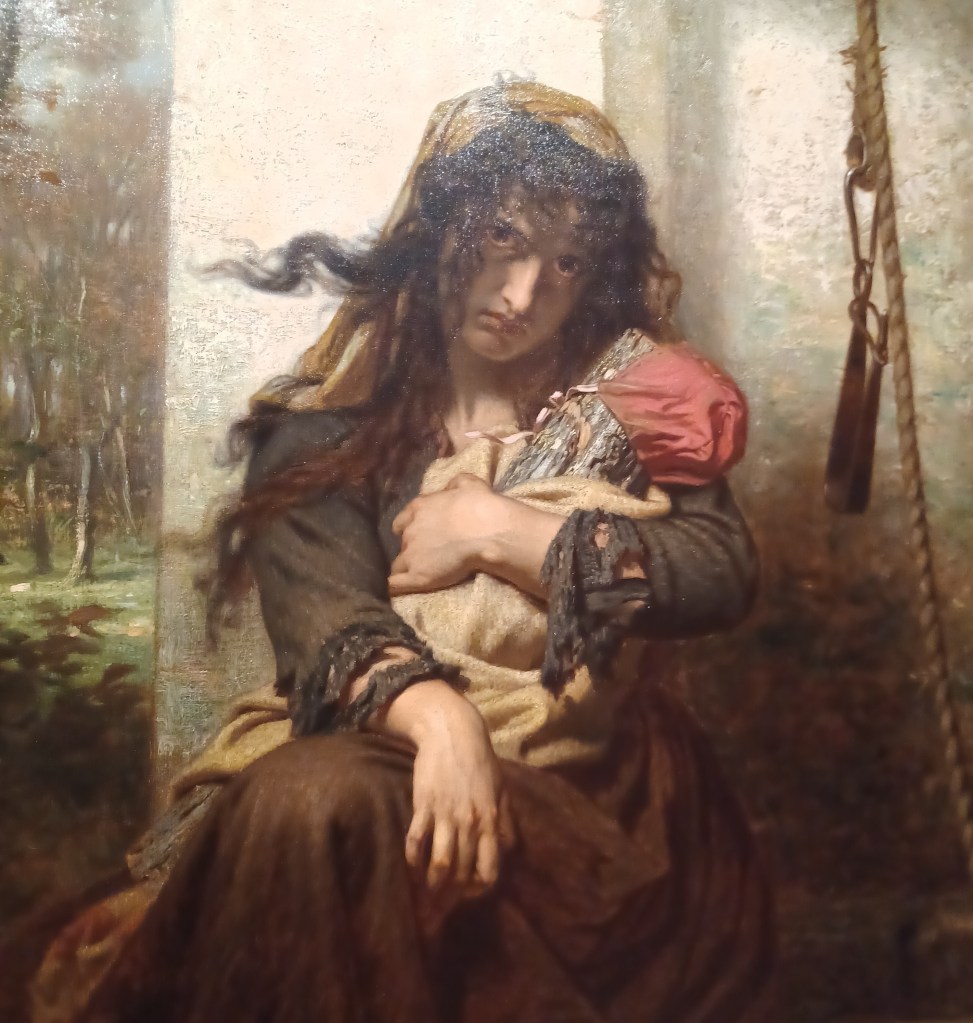
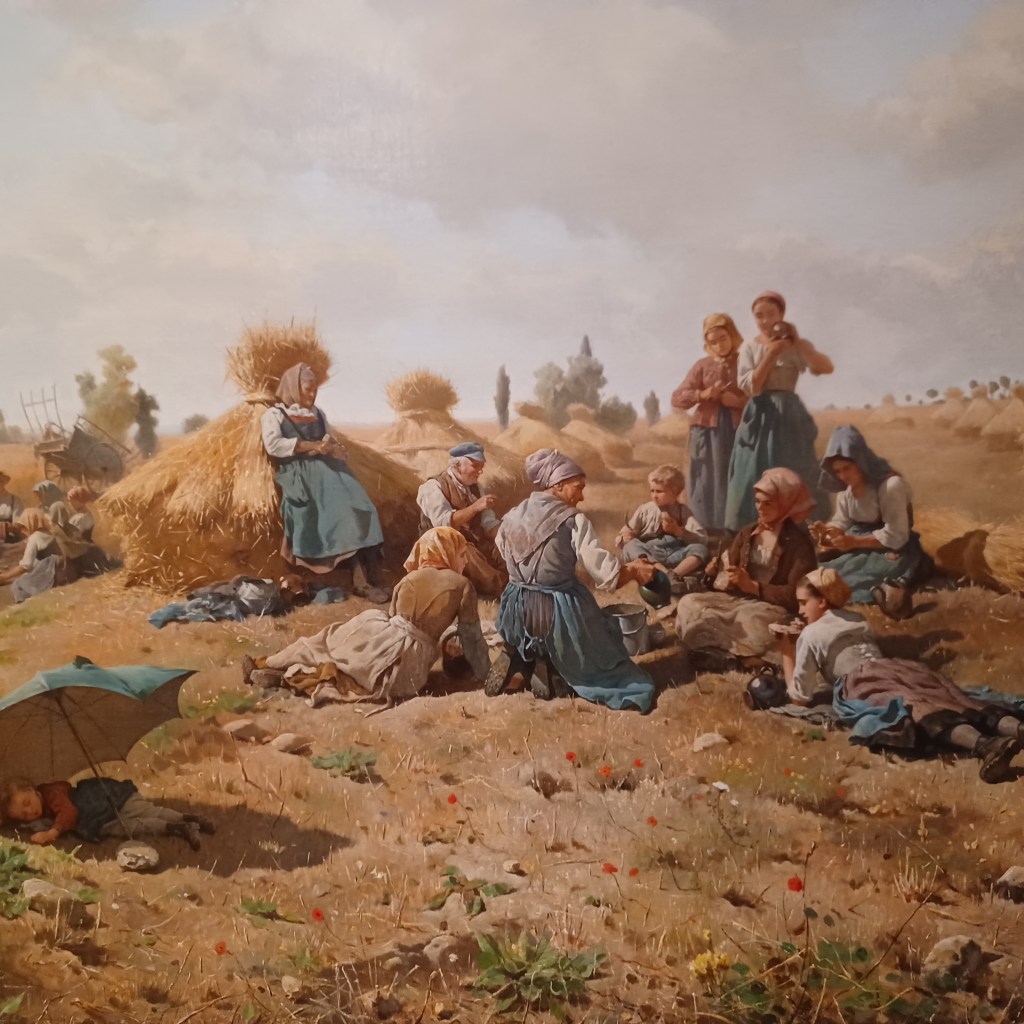
    We drove to Virginia Beach yesterday, to meet up with three distat-ish cousins today (more about that tomorrow). We stopped at the Chrysler Museum in Norfolk. And I took some pictures. So no heavy reading today.

    let’s start with an Egyptian glass eye, to insert in a statue that is over 2000 years old.

    There is an extraordinary glass collection (rooms and rooms with shelves and shelves), and there is a large studio where they offer classes, and have workshops and the like.

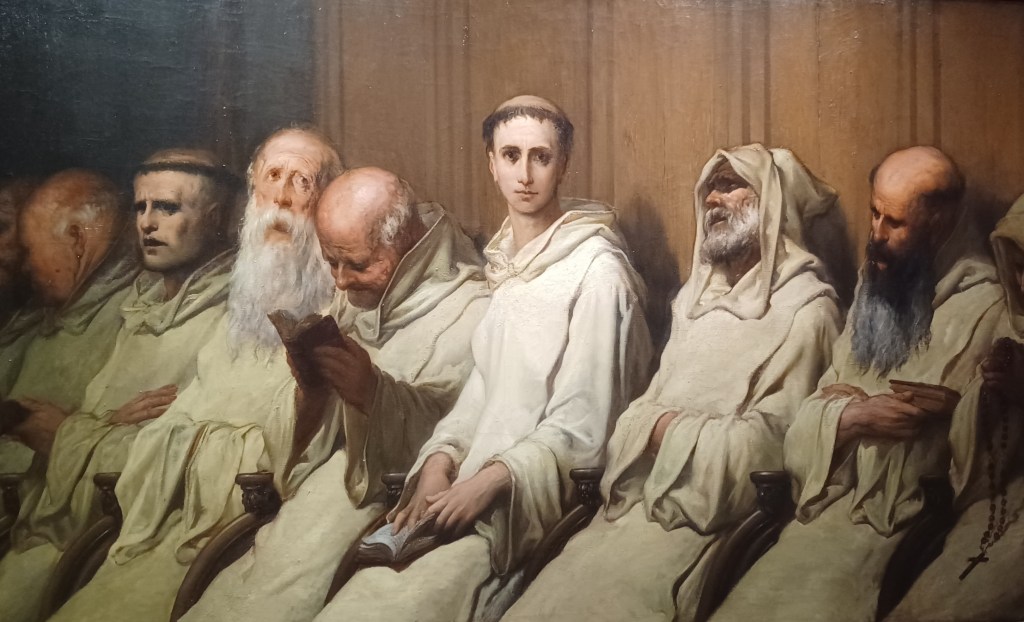
    This is by Gustave Dore, who I know mainly as a book illustrator….Dante’s Inferno and the like. This oil depicts a new recruit on his first day in the monastery. Not what he expected?

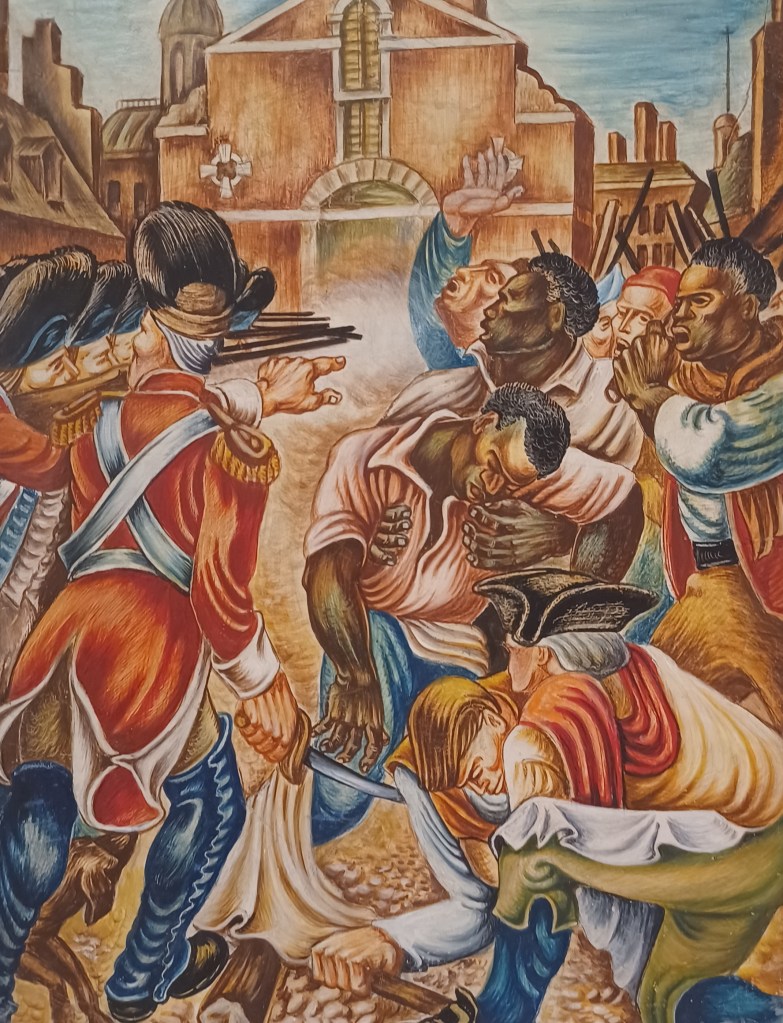
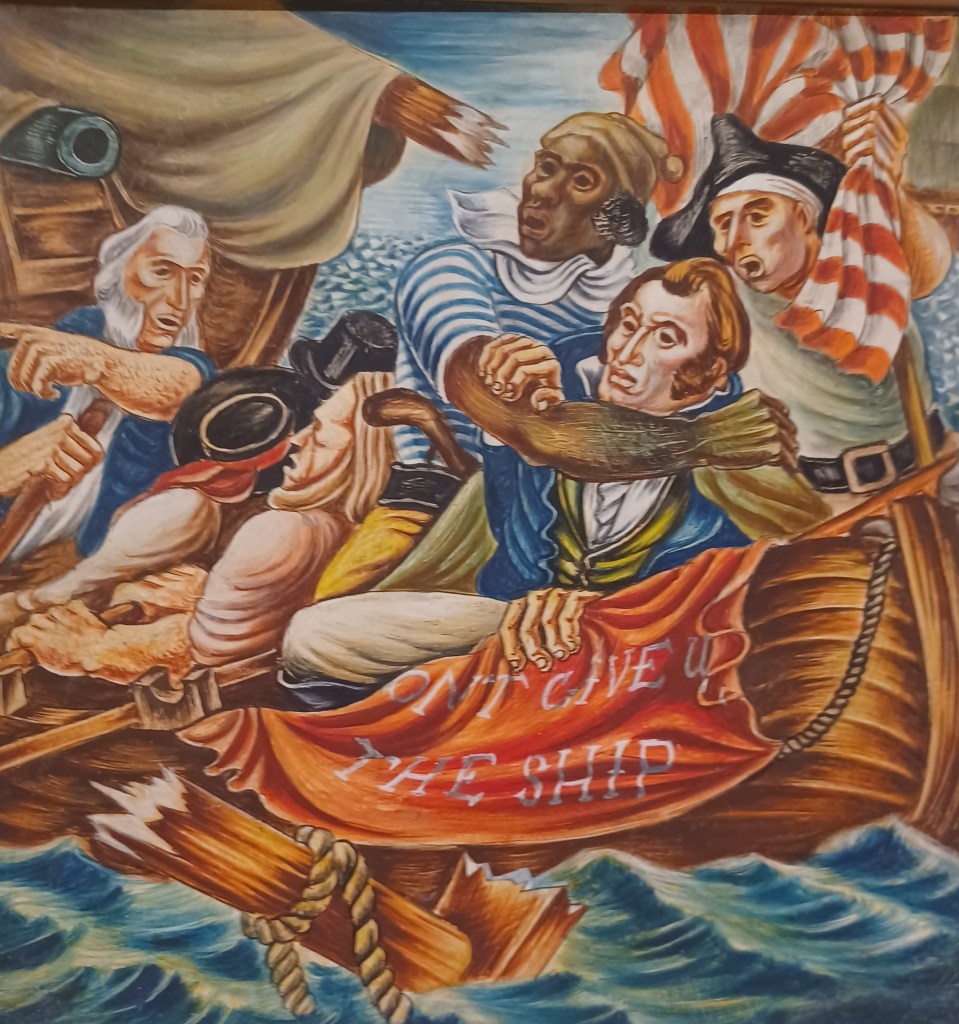
    These are two (of four) that were entered into a contest to decorate the Pension Building (now the Building Museum in Washington) showing the participation of African Americans in the country’s early wars. Who knew?

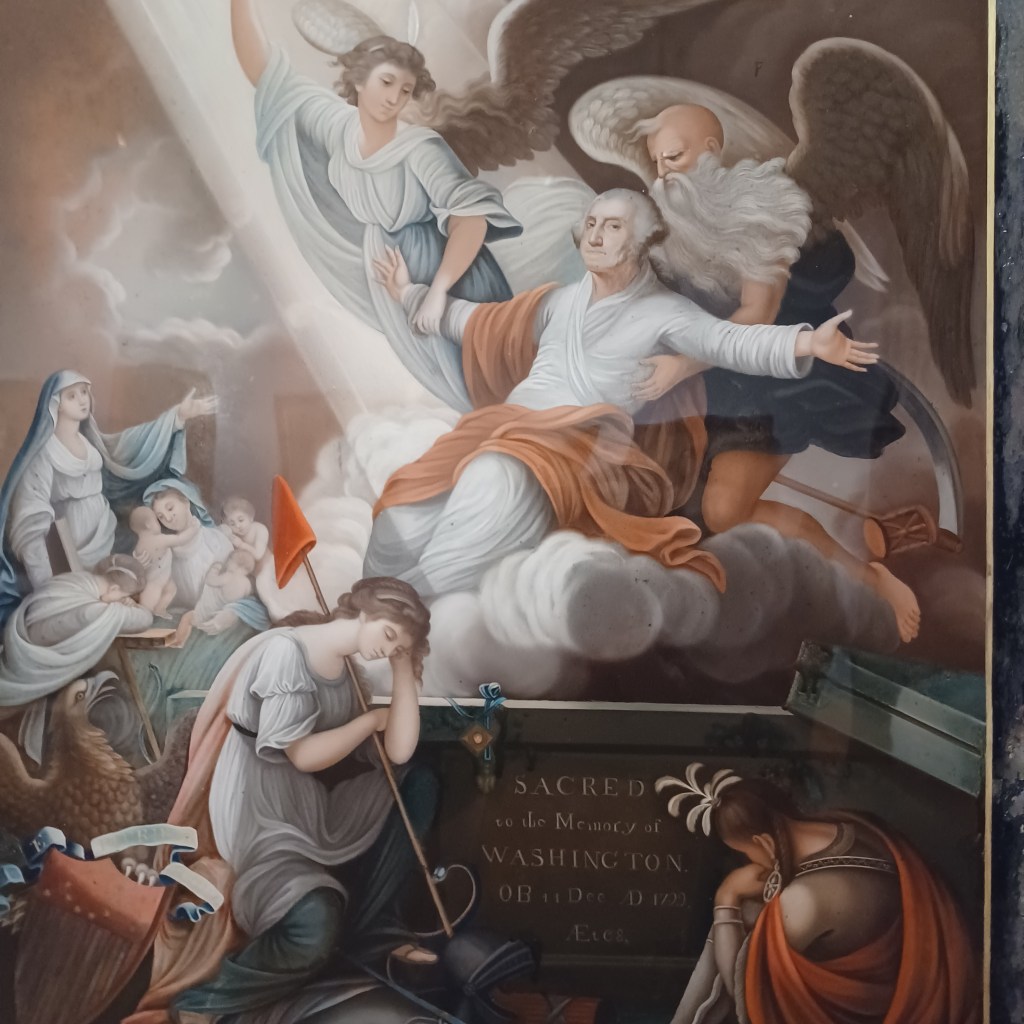
    So was this painting serious or a spoof? I don’t remember looking at the signage, but…. let’s set a date at Mt. Vernon for a disinterment ceremony so we can find out the truth.

  • Yesterday was Saturday and Here Is Some Of What I Did.

    January 14th, 2024

    I wasn’t really planning to, but I wound up devoting part of yesterday afternoon to Peter Thiel, and part to Aleksandr Kwasniewski. Let me explain.

    First, Peter Thiel. Let’s get the basics out of the way. He is 56, he is gay, he was born in Germany, he went to Stanford for undergraduate and law school, he practiced law with Sullivan and Cromwell for a spell, he founded PayPal, and he’s worth about $10 billion. Thiel is a conservative (maybe) and a libertarian (maybe), and he has been a large contributor to conservative political causes. He was a big supporter of Ron Paul (that tells you something) and gave mucho dinero to the Trump campaigns and to Republicans in general. In 2022, says Wikipedia, he gave over $20 million to Republican candidates, but in 2023, says the same Wikipedia, it was reported (by Barton Gellman of The Atlantic) that Thiel had soured on politics, and wouldn’t be spreading his money around during the 2024 campaign.

    In 1995, when still in his 20s, he wrote a book called The Diversity Myth, which has, I believe, recently been updated and republished; it deals with anti-DEI and anti-wokeness beliefs. Last October, Thiel was a presenter at the annual Roger Scruton Memorial Lecture Series at Oxford. I watched the lecture, more or less, while riding on my stationary bike.

    My first conclusion was: Peter Thiel is nuts. At the end of the lecture, I wanted to ask a question. It would have been straightforward. I would like to have asked: ”Mr. Thiel, I had hoped you would enlighten me on your thoughts on the DEI movement and on wokeness. I understand that you are in opposition to both. But I must admit that I did not understand one word (I recognized the words, yes, but that does not mean understood the. m) that you said. Could you please explain, in just a few sentences, what you were trying to get across?”

    The moderator of the program was Oxford philosopher John Gray. I can’t say that I understood Gray any better than I understood Thiel, but I will give Gray the benefit of the doubt, and conclude that his lack of clarity came about because he had to pretend that he understood what Thiel had said.

    I am not going to bore you with any of what Thiel or Gray said (you can go to YouTube for that), but will leave you with the thought that the only intriguing part of their post-lecture discussion was when Thiel mentioned Russian cosmism (with Gray nodding up and down), a late 19th/early 20th century Russian movement that suggested that the goals of science were (a) interplanetary travel, (b) the extension of human life indefinitely and (c) the resurrection of the dead (all of the dead), as a matter of fairness. (Maybe I should also tell you that Thiel did talk a lot about the high price of housing, which he says is a result of wokeness, and that maybe people should move out of cities into the Outback, or its equivalent, and connect with the rest of the world via the Internet, as presumably Amazon prime.)

    Okay, on to Kwasniewski. Alexsandr Kwasniewski was the president of Poland from 1995 to 2005. I probably knew a little about him 20 years ago, but I have forgotten all of that (clearly), and needed to start from scratch. He was a progressive (woke, I don’t know) president, who led Poland’s modernization, and guided its admission into both NATO and the European Union, and governed during the rewriting of the Polish Constitution. He was in his 40s as president, and today is a relatively young (speaking for myself) 69. His post-presidency has been the Polish equivalence of Jimmy Carter’s post-presidency, I think, leading many international efforts to promote peace and other good things. Any flaws in his post-political life? Oh, yes, like Hunter, he became a Director of Burisma.

    Where did my interest in AK (let’s just call him AK) come from? The non-profit Carpe Librum is a peripatetic used book store, whose profits support the DC public schools. They are holding a four day Martin Luther King Weekend sale near us, in the 4400 block of Connecticut Avenue, near Van Ness. I purchased six books – all (of course) signed by the author. One of the books, titled We Won The Future is by AK, and contains a generous inscription to a Catholic priest. AK taught for a while at Jesuit Georgetown University, but apparently (again, says Wikipedia) describes himself as an atheist, although that is hard to believe for a Polish politician.

    The book itself contains English translations of various of his speeches and pronouncements as President, running about 900 pages and weighing about 900 pounds. It was printed in Warsaw in 2008, and published by a private foundation AK established. What’s interesting is that I can’t find any reference to the book anywhere – not on sites where books are sold, not on sites where books are described, and not on sites belonging to universities and university libraries. Usually, when that happens, the book is 100 years old and of no real interest. Surprised me.

    That’s it for today.

  • My Task: Write A Four Minute Read Involving The Lusitania, Taiwan, And Crimea And Make It Make Sense.

    January 13th, 2024

    The United States was determined to keep out of World War I. It turned out to be impossible because of continued German attacks on American shipping vessels heading to Europe. The Germans had made it clear that they did not respect international sea travel when they attacked and sunk the Lusitania in 1915 – a British ship which had approximately 2000 passengers, of whom about 1200 were drowned, including over 100 Americans. While the United States, with a strong pacifist policy (you could even say “America First”, although I don’t think that term had yet been invented), did not let the sinking of the Lusitania draw it into the war, the fact that this was not an isolated attack, but one of a continuing and growing series of attacks, did do the trick.

    This brings us to the Houtis, and their attacks on ships in the Red Sea, disrupting all commercial travel to and through the Suez Canal under the guise of disrupting traffic to Israel (only a small part of Red Sea cargo goes to Israel), forcing ships to travel much greater distances around the southern coast of Africa, and raising both insurance rates and prices. The Houtis, a Shia group backed by Iran which has been engaged with its Sunni rivals in a highly destructive war in Yemen (a war which in fact has been like Gaza on steroids, but ignored by the international protesters), have a lot of nerve attacking worldwide commercial shipping, don’t they? After all, they are not the Kaiser’s Germany. But they are firing Iranian weapons and are totally backed by Iran, just like Hamas and Hezbollah. One can easily make the claim that Iran = Hamas = Hezbollah = the Houtis, so that while Iran (in the guise of Hamas) attacked Israel, Iran (in the guise of the Houtis) has now attacked each of the countries engaged in shipping through the Suez Canal.

    This cannot be ignored. And, recently, the United States and the United Kingdom, with several other allied nations, have been attacking rocket sites in Yemen used by the Houtis in their attacks. We don’t know what will come of this on the international front. Maybe nothing. Maybe a wider and long lasting war, involving the U.S. Can’t say.

    But….one thing we know domestically. Like every thing else, it will help Trump and hurt Biden. You can hear it now – he opened the border and he got us into war. How can you win with that being the Trump line?

    If Trump is our next president, what then? Does Trump continue this war? He wants to save Israel – but at what cost? We know that Trump will do some drastic things at the southern border. We know that Trump will throw Ukraine under the rug, and probably Taiwan, too. Trump’s American First policy will be a return to the 20th century American isolation policies. But they didn’t work in the 20th century; they just postponed the inevitable and made victories much harder. And in a 21st century world, my guess is that they will do the same, only more so. But we will (sadly) probably see.

    By the way, I just watched Michael Smerconish’s show – he had as a guest someone who is “expert” in migration issues, and who said two things of importance: (1) that fleeing poverty or climate change does not make on eligible for asylum under American law (I think we all know that), and (2) that Trump’s border policies were really not very effective, that the Biden policies are not that different from the Trump policies, in part because various court decisions have limited the flexibility of border policies, but that the Republicans will milk this for all its worth and bamboozle the American public one more time . (Of course, that was a loosey-goosey paraphrase, but that’s what I heard between the lines.)

    Let’s finish with this: I have figured out a way, I think, to talk about books I am reading without any Spoiler Alerts. You do it by writing about the book, when you are only part way through it, and you can’t give away the conclusion, because you have no idea what the conclusion will bring. I am reading The Island of Crimea by Vassily Aksyonov. Remember him? (My guess is that your answer is “no”) Soviet writer who was able to come to the United States in 1980 and live here the rest of his life. And when I saw “here”, I mean “here”. He lived and taught in the Baltimore Washington area for almost 30 years.

    This is the first of his books I have read. It was published in 1983. I am not mentioning the book because of its story line, but because of its setting. The book presupposes that in 1917, when the Bolsheviks took over Russia and created the USSR, Crimea (which the book posits as an island, not as a peninsula) remained independent, under the control of the Russian White Army and eventually a prosperous, democratic, western oriented country. During the first 30 or 40 years of the USSR, there was virtually no contact between Russia and Crimea, but liberalization of USSR policies (probably in the 1960s) allowed for communication, commerce and travel between the two. Now, in the 1970s (I think), when the book is situated, there have grown up in Crimea, whose population is virtually all ethnically Russian, a group of intellectuals and politicians who are looking for a stronger tie between the two, a joint future, perhaps one country with two different governmental or economic systems. 

    In effect, we are reading the story of Taiwan (or Hong Kong) and mainland China – 40 years before their possible combination might take place. Aksyonov was obviously prescient in writing this book. I will see how it turns out. Then, I can stop worrying about what will happen to Taiwan. I will know.

  • Why Oh, Why Oh, Why Oh?

    January 12th, 2024

    I remember when I asked my granddaughter some time ago: ”So, Joan, what state do you think Des Moines, Iowa is in?” And she thought a minute or so, looked querulous at me, raised her head and said “Maybe Ohio?”

    Yes, most people don’t spend much time thinking about Iowa. But then, Brigadoon-like, every four years Iowa appears out of nowhere. That’s because it’s time for the Iowa caucuses. 

    Now, the Iowa caucuses (which take the place of a primary election) is Iowa’s way of determining who the major parties will run for president of the United States (and other federal offices). Traditionally, it is the first event of the primary season, and the candidates spend untold hours trying to woo the state’s voters. Ron DeSantis, for example, realizing that there is no reason for him to be in Florida (the state he is supposedly leading as governor) and there is no need for him to be present in the lives of his quite young children, brags that he has been campaigning in all 99 Iowa counties, and apparently he has spent abut $15 million along the way. 

    But let it be known that I have only been in 3 Iowa counties in my entire life, and that I have spent probably no more than a total of $100 or $200 in the state (and that some time ago), and my guess is that he won’t get that many more votes from Iowa Republicans than I will. (He is now polling at about 13%)

    But what is important is that, IMHO, the Iowa caucuses are totally meaningless. Look at the following would be political leaders: Mike Huckabee, Rick Santorum, Ted Cruz, Dick Gephardt, Tom Harkin, Pete Buttegieg. They were all caucus winners. But this is the start of the presidential campaign and the winner will certainly get some notoriety and gain some momentum.

    The Republican caucus will take place on Monday. Monday is Martin Luther King Day, and you can argue the propriety of having the caucus on that day both ways. It’s an insult to Rev King and a diversion from the reason for the holiday. Or it’s a good time to have the caucuses, because so many people are not required to go to work that day. It also might be relevant that, particularly for Iowa Republicans, there are few for whom the holiday might have any special meaning. For the Republicans, about 90% of caucus goers traditionally are White, and the majority of the non-Whites are Latino, and not Black. Only about 4% of the State is African-American, and they vote almost exclusively Democratic.

    The Democrats this year, by the way, are not having the traditional caucus. In order to increase participation, they are having a mail-in primary, and the voting will not take place until February.

    In order to participate at a caucus, you must be a registered party member, and you must show up. There is a caucus in each precinct in the State, and that means that there are almost 1700 separate caucuses being held the same day. Each of these caucuses, which will include local party meanings and campaign speeches by candidates or supporters, may be short or may be long. The culmination will be a secret ballot to determine the winner.

    This year, there is a special wrinkle. It is going to be cold. Now you say, well it’s Iowa in the winter. Isn’t it always cold? And the answer is “yes”, but not like this. I checked the forecast for Des Moines, Dubuque, Cedar Rapids and a few other spots. No place in Iowa is predicted to rise above 0 degrees Fahrenheit on Monday. The high throughout the state will be from -5 to -3 degrees. The lows will be in the range of -11 to -14 degrees Fahrenheit. And, in most places there will be snow on the ground. What will this do to turnout, especially – I guess – among older voters, who often make up the bulk of the caucuses. We will have to see.

    The latest polling shows Trump at about 55%, Haley at about 20%, DeSantis at 13%, and the rest divided among others. I think the polling is all done with participants who are “likely caucus goers”, but I guess I am not really sure that all are done that way.

    Iowa is a red, red state these days. Trump won it, 53-45 in 2020, a margin of 8%, when he lost the overall race. And in 2016, he had a 9 point lead over Hillary Clinton. But Clinton and Obama each carried the State twice, and Gore carried it once. Why now does it appear so red? I am not sure, except that a lot of people have moved out of Iowa over the last decade and I would bet that the overwhelming percentage of those who left were Democratic, not Republican voters. Just a guess.

    We will see what happens on Monday. We will see how Ron DeSantis, who has given so much energy and money to his campaign, will finally do. You all know “The Music Man”, set in Iowa. You know what they say there: you gotta know the territory. We will see if that’s true.

  • Musings After The Republican 2/3 Debate Last Night.

    January 11th, 2024

    I did watch the debate last night on CNN between Nikki Haley and Ron DeSantis, and my reaction to them is similar to what it has been. I think they have both honed their campaign positions, so that they easily can respond to virtually anything they are asked, and they both have a lot of information that they can reach for very quickly.

    But I would much rather see Haley as a president than DeSantis. (I understand that neither of them seem to have much of a chance.) Why is that? It’s largely because (and I may be 100% wrong, I know that) I think that DeSantis is a dirty fighter and Haley a clean fighter. I think DeSantis is a bully, and that Haley is not. I see in DeSantis someone much closer to Trump in his thinking about government, and I don’t see that in Haley.

    An aside: My father, when I was a high school senior, did not want me to visit any colleges for fear that I would make my choice based on the weather the day I came, or on the personality of the guide who showed me around. I recognize that my thoughts on the two second-tier Republicans is based on similar things. Does that mean my father was correct in seeing how I make my decisions, or that he was wrong because these are very important qualities, and making a choice because of them is fact, rational?

    End of the aside.

    Of course, as candidates, they are going to badmouth each other (and badmouth Trump), and I am trying to put all that aside and look more deeply at what they are saying. There were certain issues that were not raised in last night’s debate – there was little said about climate change, for example, and what was said seemed to be more for political gain than for spreading accurate information. And I think it was all from DeSantis, who said that he would, upon inauguration, loosen all drilling limitations, ignoring the fact that oil production in America is higher under Biden than it ever has been. (Of course, Biden ignores that, too.) And he said that because China was still building coal plants, there was no reason for us to do anything, which is clearly nonsensical.

    There was little said about the economy in general – about the jobs, unemployment rates, only a nod to the lowering of inflation, etc. That was a surprise to me. There was nothing I remember directed to minorities, whether is be Blacks, Latinos, or others. 

    There were contrasts. DeSantis is a big government guy, at least big government in that he sees the federal government having a larger role than Haley does. Haley is a big states’ rights advocate (who would like to do more block granting of funds to states), a pro-lifer (who in spite of that believes that abortion policy should be a state by state decision), someone who says that she believes that the federal budget should be balanced. I don’t agree with any of that, yet I think her support of these items would manifest themselves in an honest debate and a fair fight. DeSantis, I believe, would never give up on the things he was fighting for, and that he would not have a goal of being fair in his fighting; this is clear, I think, from his governorship in Florida.

    As to foreign policy, I see DeSantis much closer to Trump – I think the Ukrainians could just write off further American support and Putin would declare victory by holding on to large parts of Ukraine and perhaps by destablizing the Ukraine that remained. I see this not only strengthening Russia, but putting eastern Europe in greater danger, strengthening China, and allowing China to pressure Taiwan into capitulation. Haley’s foreign policy would be much different, and I think that I agree with her on what she says in this regard and how she says it. Her UN experience is very important.

    As to the border (which I have continually said is that issue that the Democrats are the weakest on, by far), they both want to complete the border wall, cut down on the number of people crossing, and deport those who have come across during the Biden term. Whether the courts would allow them to do this is of course a big question. But they don’t have to be very specific on the border – the Republicans have convinced most Americans that we have an “open” border, that we are overrun by illegal immigrants which definitely include those who come only to do us harm, and that things must be drastically changed. Sadly, I think it’s too late for the Democrats to do anything about this. They could change their current policy 180 degrees, and the Republican candidates would both take credit for it and use it to show how wrong the Democrats have been for so long.

    Of course, I would love to see Trump have to drop out of the race (for whatever reason), and I would like to see Biden decide that 82 is too old to start a new presidential term. I remain concerned that Trump will defeat Biden, and I think that other Democratic candidates could beat him by rallying the parts of the Democratic base which Biden has lost. And if Biden is the Democratic candidate and, for whatever reason, the Republican candidate is either DeSantis or Haley (and, per polls, especially if it is Haley), Biden does not stand a chance. And the fate of the country will then be up to the results of the Congressional elections – and they are a toss up today.

  • A Random Murder, And Another, And Another – We Know Who Did It, But What Can We Do?

    January 10th, 2024

    You can make a good argument that the President of the United States does not have enough power. The President is hemmed in by Congress, especially when it comes to appropriations and expenditures, and is always in danger of being stopped by the Judiciary. In normal circumstances, the American government seems paralyzed and unable to put one foot in front of the other. You can argue that a president who moves forward through executive orders is only trying to escape that paralysis.

    You can also argue that this is a good thing. That the “checks and balances” in our system of government keeps the country from embarking on dangerous and misguided paths with unanticipated consequences. If you take this argument, a president who moves forward with executive orders is challenging the American government as established by the Constitution.

    Whichever side you take, if you even take a side as a matter of governmental philosophy rather than simply following your partisan positions, you have to recognize the the extent of a President’s power is a subject of never ending debate.

    Richard Nixon had his answer to this question. I remember when Nixon said (in response to a hypothetical question by David Frost as to whether a president could take action which would otherwise be illegal if he deems it in the interest of the country) “When the President does it, that means it’s not illegal”. I remember that everyone I knew was shocked at this answer which, at the time, seemed absurd and laughable.

    We didn’t know that 50 years or so later another former (and perhaps future) Republican president would not only say the same thing, but have his lawyers argue the position in court. But that’s what happened yesterday, when Donald Trump’s lawyer argued to the DC Court of Appeals that, in most instances, a president (irrespective of his reasons) could even order the assassination of a political opponent and escape any legal responsibility. 

    The exceptions? Only if the president had been impeached and convicted by the Senate. I don’t understand the basis for this exception, I don’t understand what it means, and I don’t understand how or when in the process an impeachment conviction would have to occur to permit the criminal indictment to move forward. I have read several articles on yesterday’s hearing – I have not found a satisfactory answer to these questions. I haven’t even found an unsatisfactory answer.

    The experts all say that Trump will lose on this question, that it’s just a matter of how much time it will take, since it will probably go up to the Supreme Court. But there still are questions, aren’t there?

    One obvious question is: does a President have any immunity, civil or criminal? The idea of immunity for public officials is certainly not unknown – immunity against slander or libel, for example. And the question of how much immunity police and other law enforcement officials have has, even before the death of George Floyd, been a question of much debate, as well as of quite a bit of state legislation. If a law enforcement official throws a punch at some one, there are circumstances where he is protected by full or partial immunity, and circumstances where he may be accused of criminal behavior. But the boundaries are not clear and are set by law, or by the courts. Is it the same with a president? I don’t think we know. And if we don’t know, how can a president be found guilty?

    Another question is: what is in the mind of Donald Trump? You remember what he said during his first campaign. He said he could shoot someone on Fifth Avenue and not lose any votes. I assume that he assumed that he could also shoot someone on Fifth Avenue without winding up on Death Row. Does his intent matter in cases where he is accused of criminal activity? And does that intent go beyond intent to commit a particular “crime”, but intent to ignore the boundaries between what would normally be legal and illegal conduct generally?

    And, I guess, Donald Trump would not himself have had to had held and fired the gun. He could say to the army, I guess, “if anyone moves, shoot”. And that brings up the question of whether or not the order was authorized. If an order is illegal, members of the army should not obey it. But if the president has immunity, does this mean that his order would necessarily be legal, or just mean that he cannot be punished for his illegal action. And if the order is for an illegal action for which the president has immunity, what is the responsibility of the members of the military?

    And finally, there is a question of acts taken as a part of the president’s duties as president, and those taken outside of presidential duties. The easiest example would be perhaps killing a mailman who is thought to be having an affair with the First Lady. Could the president be accused of murder in this instance, but not be libel for murder if the victim was, say, a member of Congress who votes against the president’s proposals on a regular basis? And who would be in charge of deciding what is, or is not, within a president’s official duties.

    Trump may very well become our next president. And, although we think we know how the court will rule on what is currently before it, we may be wrong (court’s often surprise), or the ruling may be limited to this case, leaving other situations ambiguous. Donald Trump has already said that, upon reelection, he is going to be a dictator on the day he again becomes president. Dictators do a lot of terrible things. Trump may want to do any number of things on Day One – and, depending on how the court decides this case, he may feel entitled to do things that we cannot even imagine.

    Let me end this with an obvious reference to judicial philosophy. Even leaving politics aside, we know that the Supreme Court (where this case will end up) is beholden to the (in my mind specious) theory of constitutional originalism. The Constitution, under this philosophy, is not a living document, but one frozen in time – a document to be analyzed for the what its plain language says, and what legislative history can be gleaned from its 18th century origin. In deciding the question of presidential immunity on this basis, a court could ignore completely the practical effect of its ruling (just as it could ignore any changes in society over the past 200+ years).

    Using this type of analysis, we could find ourselves living with a president who could shoot someone at random on Fifth Avenue or Pennsylvania Avenue and walk away unchallenged. And if a president could do this, he could do anything. A one day dictator could easily become a four year dictator. And a four year dictator could easily become a dictator for life.

    End of story.

  • Ibram X. Kendi – “How To Be An Antiracist” Explained

    January 9th, 2024

    A few days ago, when I was about one third through this book, I wrote that Kendi had suggested that a racist would make things worse, a non-racist would wind up leaving things as they are today, and that only an antiracist (he may have made up the word) could improve things for the racial groups that face discrimination, and that discrimination is inbred in society. I suggested that success would be measured by the number of areas where the percentage of participants of a particular race would equal, or approximately equal, the percentage of the entire country’s population represented by that group.

    I think I stated that correctly, but now I have read the entire book and because it has seemed to become such an influential book, or at least an oft referred to book, I need to expand. It is also a book that has been listed several times on a list of books that have been banned, or should have been banned. Although Kendi sort of answers that himself, even before the banning had taken place, I must admit that I don’t understand why anyone would want to ban this book.

    In the first place, this is a coming of age book. It’s the story of a middle class Black kid, raised in Queens and then in high school finding his family relocating to Manassas, Virginia, and finding himself more interested in basketball than academics. He feels lucky to get into Florida A & M, an HBCU, where he majors in magazine journalism and African American Studies and then finds himself in Philadelphia at Temple, where he earns a Ph.D. During this time, he becomes more and more interested in American society and role played by Blacks and other identifiable groups. As his education proceeds, so does his thinking, changing and adding things as he goes. What he believes one day, he may not believe the next. Each book he reads, each class he takes, each piece of research he accomplishes, each new friend – he absorbs what they are telling him and adds it to what he already knows. It’s a story of personal growth and maturity, and could stand just on that, irrespective of the correctness or practicality of his ideas.

    But his ideas are important. His view of the position of Blacks in society (he focuses on American society, but agrees that the same issues are reflected in society elsewhere) does change over time. But he starts with a basic premise – that all people, irrespective of race, are equally endowed with a moral sense and with intellectual capacity. He then concludes that the subordinate places that Blacks so often find themselves in are not their fault, but the fault of society itself. And not so much the fault of individual actors in society (of which there are plenty who add to the problem), but to the nature of society itself. And there is nothing that a normal Black or a typical White can do about it.

    He also concludes that it is a waste of time and energy to try to change the minds (the conscious or unconscious minds, I assume) of members of society. You can’t do it successfully. It just doesn’t work. This is one of those conclusions he reaches over time – it was not obvious to him at the start of his journey. He concludes you have to change society itself, and that has to be done through policies that will lead to the changes you want to see. As a corollary of this, he has determined that the problems of Blacks is not the result of Whites hating Blacks, or of Blacks fearing Whites. He views it as a simple struggle for power, and for fear of losing power. Power and status and money and all that goes with it. And it is this fear that keeps Blacks down.

    I am oversimplifying, of course. And that’s in part because, although I can say this is what Kendi concludes, I can’t say that I understand everything he says, much less agree with it. In part, that is because this is such a complicated book.

    It isn’t a long book, but it is a packed book. Like it’s only 235 pages, but he has 500 pages of information and thinking in it. The chapters are distinctly titled, but there is a lot of intersecting from one to another.

    This is a book filled with data. Data about everything. Economics, housing, education, employment. And not just contemporary data, but historic data. And all of the data is sourced, so I feel comfortable assuming that it is by and large accurate.

    This is also a book filled with references to other books – to thinkers, Black and White, and to books reaching varying conclusions as to why things are the way they are. The books are all serious books. Very serious books. The kind you read only if you are taking a class with them on the required list.

    In other words, this is an extremely intellectual book. Despite its title, it is not a “how-to”. It’s a book that requires and demands looking at it very carefully, examining every sentence, weighing each of his conclusions. As opposed to a book that should be banned, this is a book that should be read widely. Not quickly, not cursorily, but fully. And what Kendi is asking, I think, is for his book not to be discounted because a conclusion may be uncomfortable, or different from what one would expect. He throws a lot out there, and there is a lot for each of us (whoever we are) to sift through.

    He shifts, I think, between optimism and pessimism and back again. He is thinking. He is recording his thoughts. His thoughts, as I have said, change and mature. But he doesn’t erase them, he just adds to them.

    As I said, he concludes that policies are what is important. But the book doesn’t outline those policies. I don’t think he had developed them yet. Perhaps by now he has. I don’t know. He knows we are one society. He doesn’t seem to want to see pure assimilation, which he seems to say means that Blacks will (unsuccessfully perhaps) become White. He certainly wants Black identity and culture to remain. But how do you accomplish this, and at same time fight racism? How do you have racial equality and yet permit voluntary racial separateness, separateness not in the sense of segregation, but in the sense of self identity. And what would happen if Black/White intermarriage, already a fairly normal phenomenon, would become even more common?

    I need to hear more from Kendi. Hopefully, we will as time goes on. In the meantime, as I have said, don’t ban him. Instead, argue with him. Tell him where he’s right and where he’s wrong. Look at how you see what he is seeing. And how you have changed, as he has changed.

  • Fight! Fight!

    January 8th, 2024

    So I just heard what Donald Trump said about the Civil War. In case you missed it, Donald Trump, acting I guess as a foil for Alexandra Petri, said that the Civil War was completely unnecessary and that everything simply could have been negotiated. He apparently blames Abraham Lincoln for failing to hold the country together by not trying to work something out on such lingering issues like slavery and states’ rights. He says that it was really unfortunate because the failure to avoid a Civil War wound up tearing the country apart. And so many people died who, I assume, otherwise be alive today.

    So what did you do Sunday afternoon? We went to a hockey game. No, not to the Caps game to see the Caps beat the Kings 4-3. Instead, to see the poor Montgomery County Youth Hockey Ice Devils lose to the youth hockey team from Loudoun County VA, 6-3. Well, the game was exciting enough, even if it didn’t come out the way we wanted it to. Step-grandson Olie did fine. But what I have to tell you is what was the highlight (lowlight) of the game.

    There we were at the Rockville Ice Rink watching a hard fought game (the teams are comprised of 15 and 16 year olds), when there was a strong legal hit mid-ice, which led to an attack on the hitter (an Ice Devil) by him who was hit (he who was hit? the hittee? – let’s just call him Number 14) which knocked the helmut off the Ice Devil. This led to a general scuffle between some of the team members (none of this is supposed to happen in youth ice hockey), and the referee put his arms around Number 14 to hold him back, and Number 14 reacted to that by turning around and socking the referee. 

    That of course led to a 5 minute penalty and a game misconduct (at least a game misconduct) for Number 14. But that didn’t end it. All of a sudden a yelling match started in the small audience and then two adult men started slugging each other. Exactly what happened and who was at fault, I am not sure. But we think it was the father of Number 14 who started the fracus, which wound up with the two fathers rolling down the bleachers, as shocked fathers and mothers and young siblings scurried away as quickly as they could. Then we saw Number 14 himself leave the ice rink and begin to climb into the bleachers, presumably to help his father. And, after a period of time, we saw a Montgomery County police officer enter the bleachers to escort the remaining father out of the building. What will follow, we don’t know. But talking to our daughter and son-in-law, who are regular attendees at these games, this was a first.

    Back at home, after a family Mexican dinner, we turned on the Golden Globes to see actors and directors we don’t know anything about receive awards for shows and films we haven’t seen. 

    But I exaggerate. Best film was Oppenheimer. I thought it was good and very ambitious. I didn’t love it. Paul Giamatti was best actor for Holdovers. I thought he did a good job in a role that didn’t require a lot, and really liked the second half of the film but thought the first half was soporific. I was hoping for Jeffrey Wright from American Fiction. As to Lily Gladstone, best actress, again a credible job, but the best? Not sure. The film, Killers of the Flower Moon, was terrific.

    But now, it’s Monday. A slow start sitting at Jim Coleman Toyota hoping they give me my car back some time, drinking coffee that doesn’t taste like coffee and eating a blueberry muffin without blueberries.

    Things will improve.

  • Remember When Saturday Meant The Movies?

    January 7th, 2024

    Yesterday was the last day I can remember when I saw not one, not two, but three movies. All from the comfort of my home on a day when outside everything was cold and rainy. My three choices were a bit odd, but two I recommend and on the other I maintain neutrality.

    The films were (1) Dr. Strangelove, (2) The Dark Past, and (3) Missing. My guess is that you have heard of Dr. Strangelove, but not the other two.

    (1) Dr. Strangelove. I have probably seen this 1964 film half a dozen times over the past 60 years. For those who don’t know, it was produced just after the Cuban missile crisis, and tells the story of a misreading of what was feared to be a Russian missile attack which sets in motion a response which cannot be stopped, and winds up with an American nuclear bomb being dropped on a Russian “doomsday machine”, which will spread radioactivity across the entire world and wipe out human, animal and plant life for about 100 years. It’s a comedy.

    Peter Sellers plays three roles – he is the somewhat hapless president of the United States, he is a British attache to the U.S. Army who has to put up with General Jack Ripper (Sterling Hayden), who is dead set on destroying the USSR whether or not the U.S. is really under attack, and he is the German-American wheelchair bound scientist (Strangelove) who calls the president Mein Fuhrer, and expends all of his energy trying to keep his arm from giving a continual Heil Hitler salute, but who has a plan to ensure that the elite of mankind can survive underground for 100 years. You have George C. Scott as General Buck Turgidson rooting for war and coming to blows, in the Pentagon War Room, with the Soviet Ambassador to the United States, forcing the president to yell: ”Will you stop fighting? This is the war room.” And you have a crew led by “King” Kong (Slim Pickens), which includes a very young James Earl Jones, cut off from communications, flying under Soviet radar and dead set on dropping the bomb, unaware that the mission has been aborted. 

    The film is entertaining, to be sure, but there is also a hint of reality – the facts may be different, but we all know that – unlikely or not – deadly wars can start by accident when events cannot be controlled. Of course, recommended. (I saw it on HBO on demand).

    (2) ”The Dark Past” is a 1948 film starring William Holden and Lee J. Cobb, and is probably an archetype of a 1948 film – it is just like almost every other film made in 1948. William Holden is an escaped gangster, and Lee J. Cobb is a psychiatrist who teaches at an upstate New York college and who has a lake house not far from the campus. Holden and his two henchmen and his girlfriend decide to hide in Cobb’s house – Cobb is there with his wife, his young son, a couple who are their friends, and a young man who tags along with this couple because he is the lover of the wife. Another friend stops by, and finds himself a hostage as well.

    Because it’s a 1948 film, it ends well, with the gangster and his moll being caught by the police and everyone else readying to get back to their normal activities. How did the police know they were there? Their family cook, an older woman who wears 5 inch heels and has no fear, escapes through a basement window and runs to the police.

    And there’s another twist. While they were hostages, Cobb treats Holden’s mental disturbance, and explains his repetitive dream, and you know that Holden, a life-long criminal, will now be a model society member once he gets out of prison.

    A rather mindless film, to be sure. (I watched it on YouTube, where I generally use the eeny-meeny-meiny-mo theory of choosing films.)

    (3) “Missing”. This was the surprise, the film we watched last night. It’s on Netflix, and was released sometime during 2023. It gets good ratings. I thought it was a film worthy of winning awards.

    An 18 year old girl, June, lives with her mother – her father died of a brain tumor 12 years earlier. Her mother has a new boyfriend, Kevin, and they decide to go on a short vacation to Cartagena, Colombia, leaving June home alone. June is to pick them up at LAX upon their return. But they are not on the plane, and not responding to any form of electronic communication. June goes into action, determined to find her mother.

    So far, so good. And I am not going to give you any Spoilers. Let me just say that there are many plot twists, and that the acting overall is of high quality.

    But the star of the show is technology. June seems to spend much or most of her life in front of her computer, where she is expert on using, and on mining, every imaginable type of social media communication, and you – the viewer – watch her Face Time, and have WhatsApp chats, Google, use FaceBook, use search tools you have never heard of, hack into all sorts of accounts, make notes on line, etc. For most of the film, you are watching the screen, you are seeing what she is seeing, you see her manipulation of Apps that you think you know well, but she can get them to do things that you have never dreamed they can do. Everything moves really fast. I could tell you more about how she rides her computer and phone and smart watch but, as I said, NO SPOILERS.

    I really think you should check out “Missing”. I’d love to know what you think about it.

  • Blacks, Jews, Harvard And Ibram X. Kendi

    January 6th, 2024

    I think it was inevitable that Claudine Gay would resign from the Harvard presidency. And, as a graduate of Harvard (60 years ago this Spring!), the Harvard presidency is of some interest to me. But what I don’t understand is why it is of so much interest to so many other people, not connected in any way with the school.

    I should restate that. I can understand why this might be a topic that people find of interest, but I don’t understand why it is a topic that people, with no connection to the school, should decide that it is something that they should take a stand on, involve themselves with, and feel that Gay’s resignation is something that they should cheer or rue as if it was crucial to their own existence.

    And now that Gay has retired, there is pressure on the members of the Harvard Corporation (led by Penny Pritzker, of the Hyatt hotel chain, and brother of the governor of Illinois) to resign. Why do they care?

    There are those, of course, who say that Gay has become a target because she is a Black woman. I am sure that some of her critics are, perhaps subconsciously, targeting her because of her gender and race, but I doubt this is the biggest issue. Just as some people are defending her because she is a Black woman, and wouldn’t be so defensive if she were a White male.

    It’s the confluence of two major problems. First, there is antisemitism. Second, there is social justice. These two important issues seem to be at odds with each other. But I don’t think that this is necessary or inevitable.

    Let’s start with social justice, or “wokeism”. I started reading Ibram X. Kendi’s How To Be An Antiracist yesterday. Kendi has certainly himself become a target of the “antiwoke” class – and I wanted to understand a little better why. From what I have seen in the first third of the book, Kendi’s position is that it isn’t sufficient to be non-racist. If you are just non-racist, he says, you are in effect supporting the status quo, which is a racist, so you have to be affirmatively antiracist. 

    To be antiracist, says, Kendi, you have to work not to achieve equality of opportunity, but to change the balance now existing in certain facets of society. An example? Let’s say that Blacks are 10% of the population, and let’s say that 6% of neurosurgeons are Black. To be antiracist, you must work as hard as you can to make sure that 10% of neurosurgeons are Black. 

    The premise is that there is no difference in the innate capacity of people of different races, and that the shortage of Black neurosurgeons exists only because society is racist. You would gauge your success by whether the ration of Black to other-than-Black neurosurgeons reached the 10 to 90 ratio.

    Now, I have only read 1/3 of the book, so don’t hold me to this as Kendi’s basic conclusion. After all, if it was, he wouldn’t have had to write the ending 2/3. But this appears to be the gist of what he is saying. And if this is what you believe, you cheer when Claudine Gay is named president of Harvard, and you blame society more than her for her downfall, saying if she was not Black (I don’t yet know if Kendi talks about Black women as a special category in the remainder of the book), she would not have been targeted in the same way by Congress, by Harvard’s donor base, by the press, and so forth, either for her Congressional testimony or her alleged plagiarism. And had she been so targeted and White, she would have retained her job, not been forced to resign. 

    And to prove his point, I would assume, he would attack those on the other side who say Gay would never have been put into the position of president unless Harvard felt obliged to hire a Black woman to fill their imagined diversity quota, as being examples of racists or non-racists, but not examples of the antiracists he would like everyone to become. Or would he say this? After all, wouldn’t an antiracist suggest a Black candidate for the presidency in order to play his number game, giving a wink towards her objective qualifications? If her qualifications seem a bit weak, isn’t that just a result of the racist or nonracist society which we live in? So could this be an area where both sides agree with each other, but wouldn’t dare admit it, even to themselves?

    See….it is complicated.

    The campus antisemitism issue, made more visible by the war in Gaza to be sure, raises a different issue. In order to be antiracist, you must – among other things – make sure that racist acts are eliminated. For someone to call for the elimination of Blacks (either through genocide or through transport to Liberia) is clearly a racist act. So it must be condemned and not permitted.

    But campuses have a commitment, by and large, to free speech. Free speech (with limits which can be both clear and fuzzy) is a cornerstone of this country and a major component of the First Amendment to the U.S. Constitution, of course. But the First Amendment applies to governmental actions, not to private actions, and Harvard is a private institution, not a government institution. So the First Amendment does not apply to Harvard. Yet, as I have read (and I can’t right now tell you where), Harvard has taken the position that it will act as if the First Amendment applied to it.

    The First Amendment gives people the right to say all sorts of things that may be offensive and even dangerous – but unless there is a clear and present danger that the speech will lead to action (“clear and present” are my words, but you know what I mean), speech wins over repression.

    On this basis, Gay and the two other university presidents said that anti-Jewish speech (whether or not it talks about genocide) will not be repressed unless it crosses a line and is leading to illegal action. At a time when antisemitism is at a high, this is not a very satisfactory answer to many people. When she said that these offensive words “depended on the context”, people were rightfully concerned. Where does the “context” become worrisome? As I said, the limits are both clear and fuzzy – depends who you are.

    So those worried about antisemitism respond to this by saying (correctly, I think) that universities are reacting inconsistently by (1) allowing antisemitic speech which is meant to encourage action, even if it has not yet “crossed a line” (whatever that means), but (2) not allowing anti-Black speech at all. Or, to put it another way, by falling into a trap which looks to promote diversity reflecting racial balance (a la Kendi), but denying similar protection to Jews who, as a so-called racial group (or its equivalent), do not suffer from the same types of social under-representation.

    But, as I said at the beginning, there is no need for these positions to be diametrically opposed. If people would only stop and think for a change.

  • Andrew McCabe, Peter Sellers, Britt Ekland, Rod Stewart And Donald Trump

    January 5th, 2024

    The Washington Post reports that 25% of Americans believe that the FBI was clearly or possibly behind the riots at the Capitol three years ago, on January 6. Of Trump voters, 44% believe that. Of Fox News viewers, 39%. Of MSNBC viewers, even 16% believe that. (The Post concludes that this might not be surprising, since a 2021 poll showed that 15% of Americans agreed with “a QAnon conspiracy theory that Satan-worshiping pedophiles control government, media and financial worlds.”) There obviously is no basis for this belief at all. But it seems to fit a general and surprising tendency of Republican voters to belittle various federal law enforcement agencies, and to pledge to shrink them, revamp them, or eliminate them.

    But, when you think about it, the FBI has often been in the center of controversy. J. Edgar Hoover ran the FBI for its first 48 years. He was always controversial, and was widely (and correctly) accused, mainly by left leaning individuals and groups, of keeping secret files on political leaders and effectively blackmailing them, investigating people whom he didn’t like, utilizing illegal surveillance techniques, wiretapping phones, organizing burglaries, and so forth. And then there was James Comey, who ran the agency during the 2016 election campaign, who has been accused by both the right and the left of influencing, or trying to influence the Trump-Clinton presidential election.

    Yet beneath the shenanigans of these leaders, the FBI has always been doing important work in investigating criminal activity. It currently has 35,000 employees both here in Washington and in its field offices throughout the country. Do we need 35,000 in the FBI? I don’t know – maybe we could do just as well with 25,000. Or maybe we need 45,000. But the point is that a lot of work goes on behind the scenes at the FBI, and that it shouldn’t be ignored. 

    For my first book of 2024, I chose to read The Threat by Andrew McCabe, who was James Comey’s deputy director, and who led the FBI as acting director after Donald Trump fired Comey and before he selected Christopher Wray as the next director, a job he continues to hold today. McCabe is no longer with the FBI, but you see him fairly often commenting on CNN, where he is a security analyst or some such thing. He also teaches at George Mason University. (By the way, for my second book, I chose to read actress Britt Ekland’s 1970 memoir, True Britt, but that’s another story.)

    McCabe was educated at Duke and then at the Washington University Law School (my mother’s alma mater), practiced law for several years in New Jersey, and then decided to become an FBI agent. He joined the FBI in 1996. and left the agency in 2018.

    McCabe’s book, published in 2019, is very readable, and very, very interesting, and I recommend it. McCabe, who was a registered Republican his entire life, is no fan of Donald Trump (to put it mildly). And a fair amount of the book covers McCabe’s interaction with Trump. He describes his first meeting with Trump:

    “He started off by telling me, We fired the director and we want you to be the acting director now. We had to fire him — and people are very happy about it. I think people are very happy that we finally got rid of him. I think there’s a lot of people in the FBI who are glad he’s gone. We had to do it because of all that — you know, the Clinton thing last summer and all his statements and everything, he really mishandled that. He had to go, because of those decisions he made, and for a lot of other reasons.”

    Trump then asked him if he agreed with Comey’s decision that Clinton should not be charged with a crime, and McCabe told him that he did. This seemed to displease the president, who then claimed that the FBI was in turmoil because its agents really disliked Comey. McCabe said that, in fact, most people in the agency did like Comey and respected him, although the election situation was very complicated. McCabe then reports that Trump told him: ”about searching for a new director, talking to great people, it was going to be great, there were going to get somebody great, the FBI was going to be great again, and now here I was, isn’t that great?…… He loved law enforcement and the FBI. He thought police people loved him.”

    The book, though, is about more than how the Trump administration changed the FBI and rattled its agents. It’s a history of McCabe’s time in the FBI – investigating organized crime, Russian crime rings, the bombing of the federal building in Oklahoma City, the bombing of the World Trade Towers and the Pentagon, prospective but not successful suicide bombers on airplanes, the Boston Marathon, Guantanamo, Benghazi, what Trump calls the “Russian Hoax”, and more. He talks about how FBI agents are selected, how they are trained at a special location in Quantico, how they are assigned to particular jobs or locations. He talks about the interaction between the FBI and the Department of Justice, the FBI and the White House, the FBI and the CIA, the FBI and the Department of Defense. He talks about the different styles of Bob Mueller as Director (Mueller preceded Comey) and James Comey as Director, and discusses other government officials that he worked with, including Mike Pence and Jeff Sessions.

    I came out of this book with a much better understanding of the FBI, and with an even more intense dislike of Donald Trump. I think your reaction would be the same.

    (As to Britt Ekland, who is one year older than me, and always has been, her upbringing in Sweden is not particularly interesting, her meeting and in short order marrying the 18 year – I think – older Peter Sellers is very interesting, mainly because Sellers was interesting if a bit off his rocker and because they wound up on very friendly terms with Princess Margaret and Tony Snowden and, through them, the rest of the British royal family. Her subsequent career was busy but she had no great insights, and her other dalliances with all sorts of famous folks, including Warren Beatty and Ryan O’Neal and Rod Stewart were titillating but dull at the same time. She seems like the “girl who can’t say no”, who falls in love at the drop of a hat, who believes that her love will last forever, and who finds – in every occasion – that it doesn’t. And it’s always the fault of the guy, never her fault, although each relationship winds up the wrong way. I chose to read the book because I wanted something light. It’s not exactly light and, unless you are a Rod Stewart fan, the only worthwhile part of the book relates to Sellers.)

    More than enough for today.

  • Niall Ferguson And Robert Schumann And A Little Antisemitism Thrown In

    January 4th, 2024

    I don’t have any New Year resolutions to break, but I do say that at the start of every year, I promise myself that I will listen to more lectures on interesting subjects, and that I will listen to more music. As I write this, I am listing to Martha Argerich play Schumann’s piano concerto (yes, his only piano concerto). Argerich, now 82, has been a prized pianist for decades. Her Jewish family emigrated to Argentina from Germany before she was born and lived in one of Baron de Hirsch’s agricultural colonies. But, German origin notwithstanding, Argerich is a Catalonian name. The presumption is that her ancestors were from Spain, so that it’s interesting that her parents wound up moving back to a Spanish speaking country. (OK, none of this is interesting – I am just trying to show how well rounded I am)

    If you have been reading this blog for a while, you know what my general themes are. Jewish identity and security. American right wing political dangers. The failure of America’s contemporary educational system.

    Yesterday, I wrote about a presentation by Yale professor Tim Snyder on Hitler’s rational, if totally misguided, belief system. Today, I listened to another program, this one featuring historian Niall Ferguson, now at the Hoover Institute, and formerly a professor at Harvard. He was being interviewed by someone (not introduced) from the Jewish Chronicle (the London Jewish newspaper) and his subject was antisemitism. While I don’t agree with everything Ferguson says, most of what he said on this program makes a lot of sense. Let me see if I can make some of his points coherently.

    1. There has been a lot of changes on American campuses over the past 10 years or so. This first change was the emergence of “cancel culture”, where free speech took a back seat to making sure no one would say anything that would offend the sensibilities of the student body, or the reputation of the institution. He believes it was the progressive left that first popularized cancel culture, but that the right and the left now both operate on the premise that one should not argue with people with whom you disagree, but make sure that their voices won’t be heard.
    2. He also believes that a double standard exists at most major universities, when it comes to certain groups, and in particular Jews. He claims that there is no punishment when it comes to badmouthing Jews (as we see from the recent Congressional hearing with the three university presidents), but woe to anyone who dares say anything against Blacks or other “favored” groups.
    3. He believes that left wing cancel culture is still the most visible and that it has often turned against Israel and therefore Jews (he believes that, as perhaps not true elsewhere, on campuses anti-Israel thinking is clearly antisemitic – that Israel and Jews are viewed as one), and this gave the Islamist students the ability to become allies, although they are miles apart on virtually every other issue.
    4. As to why this phenomenon has taken place on campuses, he does refer to what I have written about a number of times – the prevalence of social justice thinking, anti-colonialism, and conflict between the oppressor and the oppressed. He believes that the Islamist movement has milked this theory for all that it’s worth, applying it to themselves even when it doesn’t apply, and turning the Jews into not only white oppressors, but super white oppressors. He also believes that, within the progressive left, which is clearly an anti-capitalist movement, there are those who hold onto the old trope that Jews are central to capitalism.
    5. He, like Snyder, is a historian of the Holocaust (in fact he is a historian of almost everything). He was asked to compare what is going on in our universities with what went on in German universities in the 1920s and 1930s. While he didn’t do a direct comparison, I thought what he said about German universities (which he said were clearly then the best in the world) was interesting. One of the most prevalent movements at that time was the study of, and belief in, eugenics, differences based on race, and that Germany was a center of the eugenics movement, and therefore its institutions were primed for determining that Jews were inferior (or at least different) and therefore should not be teaching at the universities. He also said that there was something selfish in all of this, as there were many, many Jewish professors in Germany, and their disappearance certainly helped the careers of the others.
    6. Finally, he is very disappointed as to the way the media is following the Israel-Hamas war. He mentioned the BBC, the New York Times, and the worst offender of all, which he described as NPR, which he now doesn’t bother listening to. He said again this was the double standard at action, which has been imported into the media from the academic campuses, and which he feels will get worse as the younger generation – with ideas different from their elders, and experiences much different – become even more prominent in the mainstream media (as they are now on social media).

    Of course, there was much more that he said. But you’ve been reading this long enough. (By the way, the Schumann just ended, and I have switched to Rostropovich playing the Dvorak cello concerto.)

  • The Ground Is Shaking (And Not Only In Japan)

    January 3rd, 2024

    Timothy Snyder is a history professor at Yale. He is perhaps best known for two of his books: ”Bloodlands” (2010), primarily the story of Hitler’s move to the East and the fate of Poland, and “Black Earth” (2015), primarily the story of the Holocaust and the fight for Ukraine. I have read them both and recommend them highly.

    In addition, Snyder is one of those people that MSNBC calls on for 2 minute appearances to put into context some of what is happening today in Eastern Europe, Ukraine and Russia. He looks friendly, speaks well, and always has something of interest to say. But you don’t get a real feel of what he would be like as, say, a teacher, or to hear in a lengthier presentation.

    By the miracle of YouTube, of course, you can remedy that, and that is what I did yesterday, listening to a presentation that Snyder made a few weeks ago at the Marquette University Law School in Milwaukee. You can find it by simply Googling “Tim Snyder Marquette” (at least, I could); it is just under an hour.

    I scribbled down seven points that are worth repeating (there were in fact many more), some of which might surprise you.

    1. Hitler was not a madman. He was a wrongheaded, but rational, thinker with a lot of charisma, who knew exactly what the German population in the early 1930s wanted to hear (sound familiar?). Hitler was also not a German nationalist per se; he didn’t think in nationalist terms, but in racist terms. He believed that mankind was divided into various races (including the Aryan race to which Germans belonged), and that these races competed against each other for space and power. This was not something to be sad about; this is the way it was and the way it should be.
    2. The Jews were a class by themselves. They were not a race as the major races were. They did not have a territory, and you needed a territory to truly be a race. The Jews, on the other hand, were interrupters. They lived amongst other races, and did their best to deter other races from pursuing their natural competitive activities. They were universalist, cosmopolitans, who interfered with world history, and therefore must be shunted aside, isolated and, eventually, eliminated.
    3. Races needed to have enough land to assure a ready supply of food, and to assure security. Thus, the concept of Lebensraum (living room), which led to German expansion and conquest, particularly to the east, where the “black earth” of Ukraine was necessary to feed the German race.
    4. As they moved East, the Germans learned to their surprise that the people of the races they were conquering would buy Hitler’s theory about racial struggle and the role of the Jews in affecting that struggle, and agree to the need to isolate or eliminate the Jews. They saw, to their surprise, that they had allies in this action, and that the allies included individuals and groups who, prior to the German invasion, seemed to have no animosity towards Jews, and who had lived near or next to Jews for generations.
    5. Some countries, obviously, did have histories of antisemitism (not to the extent of Nazi antisemitism, of course), and some did not. But the treatment of the Jews and their fate in various countries had little to do with prior instances of antisemitic behavior in those countries. In Holland, perhaps the most tolerant of European countries, almost all Jews were killed. In France, where there was a consistent history of antisemitism, most Jews survived.
    6. One of the most important elements of Jewish survival during the Holocaust was whether Jews were, or were not, citizens of a country. The Nuremberg laws deprived Jews of German citizenship, the abolition of the government of Poland, or of the Austrian state, for example, made Jews stateless, with no one to protect them, no laws that they could turn to. At some point, he said, Romania, whose Jews had been declared non-citizens, reversed itself and the Jews were once again Romanian citizens. With this act, they were protected for the duration of the war.
    7. Hitler admired the United States. Here was a country, he thought, whose main population was Aryan, and which conquered another race, the African race, and held them in slavery, using them to help annihilate a third competing race, the American Indian, and enable the Aryan country to provide sufficient Lebensraum for itself through the conquering of and settlement of the Great Plains. The Great Plains, in Hitler’s view, was America’s Ukraine.

    Now, if I put these seven points in front of Tim Snyder, he might say “I’ll give you a B-. You left some things out, and you misinterpreted or misquoted other things I said. But you got the gist.” I don’t know.

    Wait a minute! I do know. He’d give me an “A”. He teaches at Yale. (For the academic year 2022-2023, 79% of Yale grades were A or A-. I think I would have made the grade.)

    On a totally different point, what do we think of the Israeli bombing a Hamas office and killing vice-chief Saleh al-Arouri in Beirut? (I can’t imagine anyone else did it.) What are they going to do about the head of Hamas, Ismail Haniyeh? He lives not in Beirut, but in Qatar. Will they go after him there, too?

    And what will the repercussions of all of this be? Can’t be good. Hope they’ll be neutral, but afraid they won’t, especially after the killing of over 100 at the grave of Qasem Soleimani in Kerman, Iran? No reason to think that Israel would do this at this time, but clearly Iran might want to put the blame on Israel. More likely it was a group of Iranian dissidents, or Sunni radicals that target Shia sites throughout the Middle East. But Iran’s leadership will have to respond. 

    The earthquake last week in Japan registered at 7.6. The earthquake in the Middle East may exceed that, I fear.

  • New Years Day 2024

    January 2nd, 2024

    I didn’t leave the house yesterday. Was it cold outside? Sunny or rainy? I don’t know.

    For one thing, I was still plagued by the hiccups that started the night before. Three times yesterday, I had hiccup spells of one or two hours each, and I felt vulnerable the rest of the time. This morning, the vulnerability seems to have passed, so I am optimistic. But the hiccups kept me from doing a lot, even when the grand children were here for lunch and most of the afternoon. I paid little attention to them, and they to me. Not the norm.

    OK…..onward. I watched a little of the Rose Bowl Parade and, once again, thought it would be nice to live in Pasadena. I watched a little of the Rose Bowl game, and thought for sure that Alabama was outplaying Michigan. I was surprised to hear the result.

    I watched the Wiener Philharmoniker concert on PBS. It was the 40th televised concert, and I have probably seen 40 of them. One of my few traditions. I remember thinking that last year’s was pretty dull, but this one was terrific (although they could leave out the staged ballet scenes, as far as I am concerned). They played some lesser known waltzes (and a polka) and conductor Christian Thielemann did a great job conducting the audience (the orchestra didn’t need him) during the Colonel Radetzky March. The audience has clapped since the march’s premiere in 1848. Colonel Radetzsky led the Austrian troops against the Kingdom of Sardinia over the fate of the city of Milan – something you never read about in school.

    The Radetzky march was written by Johann Strauss, but not the one who wrote the Blue Danube. It was written by his father – Johann II, by the way, was one of Johann’s 14 children – six by his wife, and eight by his mistress. No, I don’t know any details. Of course, yesterday the philharmonic played the Blue Danube as well.

    What else? I finished the 23rd and final episode of the Spanish Netflix series “Unauthorized Living”, which I must admit to have enjoyed. The bosses of the Spanish, Mexican and Columbian drug gangs had all seen their last days, and the two daughters of Nemo Banderas (the Spanish drug lord) were off on their own. And superman Mario Mendoza? His ex-wife and her unborn child went off in one direction, and he and his girl friend in another. What will happen to them? We will never know…..the series is finito.

    We also turned on (never before and by chance) America’s Got Talent, and saw two acts who will now go on to the semi-finals (I think there are four more preliminary shows before the semi-finals). And, yes, they had talent: one someone who did finger shadow puppetry, and the other – a young man with clear and strong developmental disabilities who, nevertheless, can write music, sing his songs and accompany himself on the piano. Not hokey, either of them. Talented.

    Sort of reminds me of the old, old show – You Asked For It. I still remember the man (woman?) who could type 60 words a minute using their toes, and the man (definitely a man) who could hum the Battle Hymn of the Republic and whistle Dixie at the same time (he wasn’t just whistling Dixie).

    One last thing – today is the final day of the over-the-holidays visit from our good friends, the Aronins. As they know, they welcome here any time. Just saying.

  • 2023 – Out And Over.

    January 1st, 2024

    It’s 2024 now everywhere and, as promised, here are my predictions for the year. Don’t worry. They aren’t extensive. In fact, my biggest prediction is not even for the year; it’s that 2025 will be better.

    For those who like tumult and uncertainty, 2024 will undoubtedly be your year. For the rest of us…….not so much.

    The war in Ukraine will continue; the war in Gaza will continue and may even spread in ways we won’t like.

    The climate crisis will still be with us – not only continued warming, but unusual climatic events will become more and more usual.

    The political scene in the U.S. will be chaotic (and that is probably an understatement), as our government may, in many ways, cease to function at all.

    Common sense will continue to be less and less common, as Artificial Intelligence will so blur the difference between fiction and fact that we won’t even recognize the categories in the way we used to.

    Our educational system will continue to fail us.

    We will all pray that 2025 comes quickly.

    That’s it……

    We ended the year both with a bang and a whimper. Perhaps I had too much Prosecco, because I wound up with hiccups that lasted about 2 hours, then abated, and then recurred from about 3 to 4:30 a.m. I’m not complaining. I was reminded of Rene Descartes and realized that if he had the hiccups, he would have written “Hiccupo, ergo sum”. That’s the way I felt.

    The other thing we did last night was watch “Killers of the Flower Moon”, the Martin Scorsese, Leonardo DiCaprio, Robert De Niro film based on a non-fiction book about dozens of murders of members of the Osage tribe in Osage County Oklahoma in the 1920s. It’s a story I knew nothing about. The Osage became quite wealthy when oil was discovered on their Oklahoma reservation, and Whites began to marry into the tribe, and kill off the Indians, to capture by inheritance their rights to oil revenues. At least 60 and perhaps over 100 tribe members were killed over a five year period until the FBI began to investigate and several of those involved were prosecuted and imprisoned (but later paroled) for their crimes.

    The movie is 3 1/2 hours long and keeps your attention throughout. I thought it a masterful film. Only one quibble – the ages of the characters did not match the ages of the perpetrators. De Niro, who is 80, played King, who was in his 40s, and DiCaprio, who is about to turn 50, played King’s nephew Ernest, who was in his 30s. They both did a terrific job (of course), but hearing a law enforcement officer who looked to be about DiCaprio’s age call him “son” over and over was a bit strange. But that’s quibble because I thought it worth it to see the two of them play against each other.

    Best picture of 2023? Perhaps. It shares top billing with “American Fiction”, IMHO.

    OK, time to get back to our regular activities and to prove my predictions all wrong.

  • The Civil War Wasn’t About Slavery, And The American Revolution Was Certainly Not About England’s Treatment of Its Colonies.

    December 31st, 2023

    What am I thinking about on this New Year’s Eve morning? I am thinking about Nikki Haley.

    I keep thinking there must be a reasonable Republican alternative to Donald Trump, although in my heart of hearts I know that there isn’t. But, of the bunch, I say to myself, maybe Nikki Haley would be the best (understanding that my SC friends would disagree with this – and they know more than I know).

    But no more. Nikki Haley’s comments about the Civil War are beyond my comprehension. For the first time, I agree with Ron DeSantis when he said that her comments were “word salad”. That’s exactly what they were.

    Now, I can make reasonable arguments that the Civil War was not about slavery (my arguments may not be correct, but they would be reasonable). For example, I could argue that the Civil War was about the question that had existed from the beginning of our country, the question of how extensive the rights of the federal government are, as opposed to the rights of state government. This is an argument that is still ongoing today. I could argue that the existence of slavery was just one of many questions that either should be decided at the national or the state level, and that the big issue wasn’t slavery per se, but where the authority of the federal government ends.

    I could also argue that the Civil War was about the individual right of states to secede from the United States. After all, until South Carolina seceded, and other states followed, there was no Civil War. We never had states of the United States fighting states of the United States; we had two countries at war. Or did we? That question can also be argued to be the cause of our Civil War. Clearly Lincoln’s goal was putting the country back together again.

    But this is not what Haley said; nor did she put forth some other potential argument for the cause of the Civil War. She chose word salad –

    Nikki Haley said that the Civil War resulted from how much freedom Americans had, that it was caused by arguments over the question of governmental power versus individual power. States did not seem to be part of her equation at all. Unless (and this is possible) she equated federal power with governmental power, and state power with individual power. And if she was making this (specious) distinction, she didn’t say it.

    And if she was talking about individual power, what does that say about slavery? If an individual White slaveholder had the right to own a slave, shouldn’t an individual slave have the right to declare himself free? And if governmental power tells the enslaved person that he must remain enslaved, does it make a difference whether or not the governmental power is the power of the United States or the power of South Carolina?

    Her whole word salad argument about the power of the individual versus the power of the federal government, from her own perspective, becomes totally hypocritical (as well as loopy) if you change the focus from slavery to abortion. On abortion, Haley has taken the position that she is firmly pro-life, that she agrees with the Dobbs decision, and that she thinks that the proper position is to keep reproductive rights in the hands of state governments. She is clearly against the rights of the individual. She is apparently against (at least so far) any thought of a nationwide ban on abortion, which puts her in a different position from many Republicans.

    So, on abortion, Haley is not arguing for freedom vs. government, not arguing for individual rights. She is arguing in favor of state authority over federal authority. Because of this, it’s my guess that, in answer to the slavery question, she was thinking consistently – about states rights over federal rights, and not at all about individual rights.

    But her language is about individual rights. Her language intimates that Democrats are in favor of governmental power and Republicans in favor of less government and more freedom. Her meaning, however, is inconsistent with her language (at least as far as one can tell). She, like the plantation owners of old, and like many politicians in states like South Carolina, are really in favor of state governmental rights over federal governmental rights, the individual be damned.

    I have never understood the concept of states’ rights. I have never understood why a woman, or a Black, or anyone else should have different rights if they happen to live in Alabama or Oregon. Aren’t they all American? And shouldn’t all American be treated the same, particularly as today (as opposed to the 1780s) there is so much mobility between all of the states of the Union? Shouldn’t states be required to uphold the rights of individuals – and shouldn’t the federal government be empowered to ensure that they do so?

    Tomorrow, I guess I will give my predictions for 2024. From now until then, I will try to think of positive changes I expect to see next year. I can’t promise, but I will try.

  • Claudine Gay, Michael Cohen and Mario Mendoza

    December 30th, 2023

    So, I have been watching a Spanish series on Netflix called (in English) ” “Unauthorized Living”, a 2 season, 23 episode series. Each episode is a little over an hour long, so it’s a commitment. It accompanies me while I am on our stationery bicycle. I think it is pretty good if you like that sort of thing. I have only 3 episodes to go.

    It has an enormous cast, and (with – so far – only one exception) everyone who has a significant role (and that’s a lot of folks) is a bad guy, and a poker faced liar, and someone with at least one hidden agenda. It’s the story of a Spanish Galician drug family, competing with a Mexican drug family, and a Columbian drug lord, and – in addition to the competition – there are many family relationships between members of the various groups. The head of the local family, Nemo Bandereas, has a wing-man, a young lawyer named Mario Mendoza, who is charming, attractive, really smart and as evil as they come.

    He, in effect, is Nemo’s Michael Cohen. Not only in his utter loyalty to his employer, but in his decision (maybe) to turn tail, and destroy him. You can hate Mario, but you gotta like him. Just like Michael Cohen.

    Well, the latest is that Cohen’s lawyer, David Schwartz, made a submission to the Court (trying to get Cohen’s probation shortened), that included detailed references to some cases that – surprise, surprise – don’t exist. This, by the way for you non-lawyers, is a no-no.

    Schwartz says that Cohen gave him the references. Cohen agrees. He also says that another lawyer (whose name I don’t remember) who was a former federal prosecutor reviewed the document before it was filed. (He also says that this second lawyer was the source of the false info, but the prosecutor denies it, and Cohen has admitted that he did it himself.) The prosecutor says that he did review the filing, but that he never even considered reviewing the research work and the case cited by Schwartz. ”Why not?” is a great question.

    The former prosecutor also says that obviously Schwartz should have reviewed the cases before citing them (duh!) and that the fact that the info as provided by Cohen is irrelevant. Cohen says that he is no longer a lawyer (I know that feeling), and that he does not have access to lawyers’ research tools (I know that feeling, too), and that he got the information from a Google app called Google Bard, apparently an artificial intelligence application that has the ability to make things up, as well as to transmit actual facts. I don’t think Google advertises that part of it. Cohen assumed that the Bard of Google was giving him actual information, not that it was creating its own alternative set of facts.

    I still like Cohen. I can’t believe that Schwartz did this. And I hope it doesn’t work against Cohen, whom I think is now (like Mario Mendoza) doing God’s work, fighting the evil he used to promote.

    Yes, we know artificial intelligence is a problem. But, there were problems before artificial intelligence. Take (as Henny Youngman would say, “please”) Claudine Gay, for example. She is, I assume you know, the future former president of Harvard. I think she should quietly fade into the sunset. Harvard has enough problems to be solved, without the solver to get in the way.

    First, (a la David Schwartz, more or less) Gay relied on her (real) lawyers and avoided direct and helpful answers to Congressional questions on antisemitism – I don’t think she really believes that saying that Jews should be killed depends on context. At least I hope she doesn’t.

    Secondly, she apparently, inadvertently or vertently (which should be, but may not be a word) took other scholars’ words and put them in her PhD dissertation, either forgetting quotation marks or forgetting to cite the sources. I can’t judge how severe these problems were in the dissertation; I can’t judge how Harvard would react if professors reviewing a thesis today discovered similar shortcomings. But the president of Harvard, like Caesar’s wife (I think it was Caesar’s wife) has to be purer than pure. And Gay is not. She really should resign her post, and use her talents in another way.

  • What I Learned Yesterday (Important To Understand Gaza)

    December 29th, 2023

    The war between Israel and Hamas (or is it the war between Israel and Gaza, or Israel and Palestine?) goes on with no end in sight. No end in sight at all.

    Yesterday, I attended a private session with someone actively involved in the current situation in Israel and with an extensive history in the area, someone whom I respect, and whose name I cannot share. He gave us his insights. Sure, I found most of them obvious, but some of them were new to me and interesting as I try to put together the entire picture in my mind. Here are some (not all, by any means) of what he said:

    (1) In the year 2000, before the Second Intifada, there was a lot of promise in Gaza. Unemployment was down below 15%, there were about 40 factories (maybe averaging 30 Palestinians each) that had been established in Gaza that were turning out goods for export, with the promise of many more. There was a functioning airport, there were still about 10,000 Israeli settlers in the area, communication and travel between Gaza and Israel proper was relatively free. The Israeli military was present to keep the peace.

    (2) The failure of the Camp David meeting in 2000 between Barack, Arafat and Clinton, followed by the visit of Sharon to the Temple Mount, changed everything and led to the Second Intifada, and a barrier constructed between Israel and Gaza.

    (3) When Sharon pulled the military and the settlers out of Gaza in 2004, he left the factories intact, but the atmosphere had changed, and the election of 2006 (presumably a fair election) put Hamas in charge, eliminating democracy in Gaza and creating a Gazan government determined to wipe out the State of Israel. All of Gaza’s infrastructure fell into ruin.

    (4) In addition to skirmishes, there have been two other wars between Israel in Hamas, in 2008-2009, and in 2014.

    (5) At the start of the current war, unemployment in Gaza is approximately 45%, with youth unemployment at 70%.

    (6) Hamas obviously still wants to see Israel destroyed, and Netanyahu (and a large proportion of the Israeli population) now thinks that a two state solution is completely undesirable. Netanyahu has felt this for a long time – perhaps forever.

    (7) Since its creation as an arm of (or a sect of) the Muslim Brotherhood, Hamas has been a dangerous terrorist organization. It no longer operates as a terrorist organization. Hamas is now an army, a well trained, well financed and well equipped army, and Israel failed to identify it as that.

    (8) The October Hamas attack was the result of not just one Israeli intelligence failure, but a series of them, as has been reported. Israel had Hamas’ complete attack plan, although it’s unclear how far up the chain that info had been transmitted – and nevertheless, Israel left its Gaza border pretty much undefended, diverting IDF forces to the West Bank where radical Israel settlers were disrupting things with the virtual approval of Israel’s right wing government.

    (9) Today in Israel, the population has moved so far to the right that there is virtually no “left” left. Netanyahu is very unpopular (18% approval rating), but his policies are very popular. The Israel public has no interest in a Palestinian state of any kind at this time and, shockingly, appears to have no sympathy for the suffering going on in Gaza generally.

    (10) The heads of Mossad, Shin Bet, and the IDF will resign most likely after the war’s over, but Netanyahu, for his own reasons, will fight to stay and it is very hard to get him out. The only way to do so would be for the coalition to call for new elections, which this won’t happen because so many of the current members would not be reelected.

    (11) Netanyahu’s statement that he wants to total destruction of Hamas is only wishful thinking and will prolong the war, and there is still no post-war plan, and virtually no post-war planning going on. 

    (12) Miscellany: (a) Who will pay for the reconstruction of Gaza? Perhaps the moderate and wealthy Arab states, but they will exact a price as to how Gaza will operate that Israel will probably reject, (b) There are about 300 miles of underground tunnels belonging to Hamas (where non-Hamas Palestinians are, to this day, not allowed), and Israel at this time only controls about 15% of them, (c) many of the tunnels are booby trapped, hold hostages, and – when Hamas members leave their underground tunnels – tey cannot be distinguished from other Palestinians, (d) it is believed there are about 35,000 members of Hamas, of whom 10,000-15,000 are in the Hamas military, (e) some of the hostages are being held not by Hamas but by Islamic Jihad – they are smaller but even more ruthless than Hamas.

    (13) Netanyahu has no reason to want a short war. The longer the war goes on, presumably the safer he is.

    That’s all, folks.

  • We Can’t Rush To Judgment, Even Though That Is Exactly What We Are Expected To Do.

    December 28th, 2023

    Sometimes, things take a long time. For example, American historians’ appreciation of Dwight Eisenhower took decades. And it took an equally long time for the positives of John Kennedy’s presidency to lose their luster, but they have. The 50s were deemed a lazy, unexciting decade where progress was put on hold, where Americans moved to the suburbs and barbequed hamburgers, and white Americans fought against integrating their kids’ schools. The 60s were deemed to be an exciting period where the civil rights movement got its start, and where the Soviets were convinced to take their missiles out of Cuba and destroy their launchers.

    But then it turned out that a lot was accomplished during the Eisenhower years. The successes of the Warren Supreme Court, the creation and funding of the Interstate Highway System, keeping the Soviets at bay through, among other things, a little deception. My mind about Eisenhower was changed when I read Evan Thomas’ excellent book, Ike’s Bluff. The abbreviated Kennedy administration, on the other hand, has now been viewed to be less than successful, with the Bay of Pigs fiasco, the start of the Vietnam war, and failure to advance our position with the USSR and China.

    So it takes time. Sometimes, a lot of time. You remember the story? A few years ago, an old Chinese philosopher/historian was asked: “What effect do you think Napoleon had on the political alignment of Europe?” His response: “It’s just too soon to tell.”

    So what do we feel about Barack Obama? Throughout his presidency and afterwords, compared with the Trump years, I thought Obama was doing quite a good job and today, December 28, 2023, I still think so. But I have friends who will argue the opposite; they will call Obama facile and well meaning, but weak and ineffective, particularly in managing foreign affairs. What will historians say 20 or 40 years from now?

    I recently read David Sanger’s book, Confront and Conceal: Obama’s Secret Wars and Surprising Use of American Power, published in 2013, after Obama finished his first term. Sanger, a New York Times foreign matters reporter, had covered Obama during the first four years of his administration, and had a lot to say. I found this book just a month or so ago, don’t remember knowing about it at any time, and started reading through it by chance, when I picked up a book to take with me for what I was sure would be a long wait in a doctor’s office waiting room.

    Clearly not enough time had passed to allow our elderly Chinese philosopher/historian to reach a conclusion, or perhaps for anyone else to, but I learned at least one thing. These were complicated times, and any immediate determination that Obama did, or did not, manage things well is bound to be wrong. Time must pass, and information must settle and mix with information from other sources.

    Sanger, I would say, is generally supportive of Obama. And he is very good at providing context for Obama’s actions. A case in point was Afghanistan – we had very good intentions there, but it seemed that our concept of preparing Afghanistan, of all places, for democracy and a democratic regime was misplaced. We recognized that all of our accomplishments might be lost if the Taliban returned, and that perhaps we could not stop them from doing so. Was it worth our effort? Obama decided to tough it out, more or less. Was this the right decision, even after we saw failure in many respects in Iraq, where our goals were similar.

    And what to do about Pakistan, which he describes in some detail as an extraordinarily complex place, with political parties of all persuasions, with strident religious groups with expansionist ideas, and intellectuals whose opinions couldn’t not be more different? With nuclear weapons, of course, so far kept unused. A balancing act, to be sure.

    Arab Spring. That’s another one. Obama, who had spent the first years of his life surrounded by Muslims, wanted to change the relationship of the United States and the Muslim world. He was not expecting the Arab Spring, and could not help it when the Spring turned into a cold, cold winter. How to deal with Muslim countries – ignore or ally with despotic leaders of countries important to the United States? Taking an active role in Syria, sending in troops to try to maintain some semblance of peace. Taking an active role in Libya, along with both NATO and Arab allies, with the goal of removing Mohammad Qaddafi from power. Using air power in Libya, but having no troops on the ground. Troops on the ground in Syria – but no attempt at regime change. How do explain the difference? And how to measure success when Syria is still under the Bashir Assad regime, and Libya often seems to have no government whatsoever?

    And then remember that Obama had a second term, not covered in this book (obviously). Did he learn anything from his first term and, to the extent he did, was Congress at all cooperative in helping to implement his now experienced policy wishes?

    After reading Sanger’s book, I have to conclude that I still think that Obama did a very good job during the time he led this country. He made some controversial choices – focusing on health care over certain other domestic issues, for example. And he certainly wasn’t able to overcome the opposition to whatever he did by a highly partisan Republican Congress (remember McConnell saying that his first priority was denying Obama a second term, and Trump and others from the outside declaring Obama to be an alien, ineligible for the office of the presidency?)

    But I also know that I have something in common with the old Chinese philosopher: I may be able to throw together a lot of factual information, but can I say for sure that his presidency was a success? No. Why? Because it is much too early to tell.

←Previous Page
1 … 42 43 44 45 46 … 62
Next Page→

Blog at WordPress.com.

searching

Loading Comments...
  • Subscribe Subscribed
    Art is 80
    Join 71 other subscribers

    Have a WordPress.com account? Log in now.

  • Art is 80
    View site in Reader
    Manage subscriptionsSign upLog in
    Report this content
    Collapse this bar