Skip to content

Art is 80

  • Thinking About New Orleans Today

    June 10th, 2024
    Little Red and the Renegades

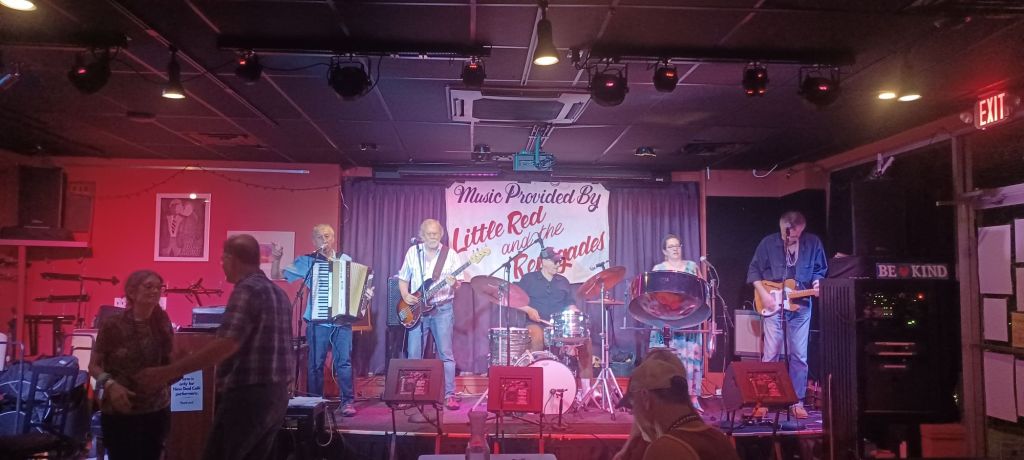
    We went to hear our friends Little Red and the Renegades play their always good Zydeco music Saturday night at Greenbelt’s New Deal Cafe, and – for reasons that should be clear to you – Zydeco music reminds me of New Orleans.

    I haven’t spent a lot of time in New Orleans, but I have been there quite a few times, usually just for a few days. And not for quite a while. But I started thinking about the times I had been in New Orleans and what I remember.

    The first time I was there was in 1958, on a trip with my parents, sister and maternal grandmother. The trip was actually to the Gulf Coast of Mississippi, but we went into New Orleans for a day or two. I think we spent all of our time in the French Quarter. We had dinner at Antoine’s, then the most famous and (maybe) one of the best restaurants in the city. I don’t think that’s the case any more. I just looked at a list of the best 38 restaurants in New Orleans on the Eater New Orleans website, and it isn’t listed. And on Yelp, it only gets a 3.3 rating. I remember we got a tour of the restaurant, including the wine cellar. I think the food was OK, but my father wasn’t impressed. He thought the place 65 years ago was dingy and old. “In St. Louis”, he said, “I’d never set foot in a place that looked like that.”

    I also remember, on that trip, that we were looking at the art work on Pirate’s Alley and we ran into the mother of someone in my high school class (this was 1958, remember, I was a 15 year old sophomore). I was very surprised to see my friend’s mother wandering around New Orleans, especially since she was by herself. I remember her telling my parents that sometimes she just wanted to be alone, so she got in her car and drove to New Orleans for a few days. I just didn’t know what to make of that – one the one hand, I couldn’t imagine one of my parents just taking off on a solo trip, but on the other, it seemed to me an example of admirable independence. I got a better idea of what might have been going on when, a month or two later, my friend’s mother committed suicide.

    The only other things I remember is being surprised that the main tourist church was called St. Louis, and that beignets were really good.

    The next time I was in New Orleans was about ten years later, when I took a road trip from St. Louis with a friend and New Orleans was our furthest destination. I remember we stayed at what I guess was a bed and breakfast. I remember a white house, with a garden and a white picket fence in front. But – believe it or not – I don’t really remember anything else about that trip, although memories of one trip or another often do get confused.

    Another ten years or so passed, and Edie and I got one of the only two time share invitations we ever responded positively to. We were told that we would be flown to New Orleans from BWI, that we would be put up in a time share development on St. Charles Avenue in the Garden District, that we could select the time we wanted to come, and that all we had to do was listen to a sales pitch for an hour (or maybe two). Sounded easy, we looked at the calendar, picked the time of the New Orleans Jazz Festival, and went. The festival then was a lot of fun, even though it is nothing like what it is today. It was about the 8th or 9th annual festival, I think, and there were multiple stages, but all in the same area. The crowds were manageable, and we heard some good music (I don’t remember who we heard), including music from some of the city’s krewes (google it). I don’t know if the krewes today take place in the jazz weekends, or just at Mardi Gras.

    We also got a chance to see the Garden District, the St. Charles and Desire streetcars, and – I am sure – more. The building we stayed, a converted apartment building, was not a place we would want to return to. I remember we watched a film about the building, took a tour, and then spent an hour with a nice young man, who tried to sell us a time share not by talking about the building in New Orleans, but by using our time share time to travel the world. He did a fine job, but he was very new to the business. I asked him what he had done before. “I sold cemetery plots”, he told us.

    I went to New Orleans several times on business trips. I remember going there by myself, I remember going for a conference or two, and I remember traveling once with a client. Because my mind totally blanks when I think about who most of my clients were and what I did for them, I don’t remember who I traveled there with or why, but I remember that he and I spent a couple of evenings just walking around the French Quarter talking, and that I ran into someone I new from Washington, who seemed to be doing the same thing.

    At any rate, I have explored the French Quarter thoroughly in my day, I have gone to Preservation Hall (it’s closed now?) and heard a lot of music. I have witnessed New Orleans drinking, and been amazed at the early hours the bars open, but don’t remember ever over-imbibing myself. I do remember going alone into a bar once and ordering a drink. I think I watched a hockey game at the bar, and started talking to a stranger doing the same thing. He was in town on business as well, and I was surprised, when I asked him where he lived, when he told me Edmonton, in Alberta, Canada. I couldn’t imagine a more different town in North America, especially since this was winter and it was spring-like in New Orleans and clearly not so in Edmonton. I asked him how his family (if I remember they were Irish, although maybe something else, but European) established themselves in Edmonton of all places (I now know that a lot of people moved to Edmonton, which now has a population of over 1 million), and his only answer was “I think it was summer”. (By the way, my smart phone tells me that the average high in Edmonton in June is 70.)

    And I remember going into a small corner grocery years and years ago. The owners were a young couple who came from India and who spoke with heavy Indian accents. They had two young children running around, maybe 4 or 5. The children had no Indian accents at all. I was really surprised. I guess I never had thought about it as a possibility. You think times don’t change?

    What else? I remember being in New Orleans in the summer when it was hot (to be sure), and humid (even more humid than hot), and when the skies broke loose with thunderstorms every afternoon at 4. I remember, on one trip, spending a day driving around the bayou country, which I found fascinating. I remember driving to Baton Rouge to go to what was then the country’s largest used law book store. I remember crossing Lake Pontchartrain several times on that wonderful bridge that is so long (20 miles?) that you can’t see either shore from the center.

    But I have never really toured all of New Orleans. I’d like to see the Tulane campus. I certainly would like to see the new Museum of the Southern Jewish Experience that just opened within the past couple of years. And the other museums in the city – if you Google New Orleans museums, 49 come up. That would fill a weekend.

    The funny thing about all of this? Except for that night in 1958 at Antoine’s, I do not remember one restaurant in New Orleans that I have ever eaten at. And there were probably dozens of them. Strange?

  • Took Me Out to the Ball Game.

    June 9th, 2024

    We went to Nationals Park yesterday to see if the Nats could extend their one game winning streak. And guess what? They doubled it.

    Sitting near us was a woman with a lot of tattoos. She was as interesting as much of the game. Was she pretty? I have no idea. My eyes never got above her neck.

    I have written about tattoos before, generally negatively,for reasons I am not going to repeat here. But there are always exceptions. And this woman, with her not yet full body set of artistic tattoos is an exception.

    I obviously only could see some of this art work. And you can see even less from the photo. You can see the red vehicle on her back and part of a slogan that ends “be nice”. You can see the Ferris wheel on her shoulder that is part of an amusement park display. And beneath the amuset park, covered by the bar in the photo, is a 1950 style blond bathing beauty in a two piece bathing suit. And there was more.

    So that reminds me of a short story by H.H. Munro, or Saki as he was known. Written before World War I (Saki was killed in the war), and titled “The Background”, it tells the sad story of M. Henri Duplis, a middle class resident of the Grand Duchy of Luxembourg who, by chance, comes into a little bit of unexpected money.

    He decides to splurge and spend it all in one place. He decides to get a tattoo, and travels to the north of Italy, where the continent’s most renown tattoo artist lives. He agrees to a tattoo which will cover his entire back, from his neck down. It will be an artistic rendition of The Fall of Icarus.

    (By the way, Henri did not know what The Fall of Icarus was about, but that’s another story.)

    The cost of the tattoo is 600 francs, the precise amount of our hero’s windfall.

    Two unfortunate things happen. First, Henri spends some of his money on other items. Second, after finishing his work, the tattoo artist dies, leaving collection of the 600 francs to his widow.

    When Henri tells her that he can only pay 430 francs, the widow becomes livid, consults a lawyer, and determines that under Italian law, the tattoo does not become the property of M. Duplis until the full bill is paid. Recognizing that it will never be paid, the widow does the most logical thing. She, a civic minded individual, decides to donate the work to the City of Bergamo, which happily accepts it.

    Legal actions ensue and the courts determine that Bergamo has full rights to this work of art. Bergamo determines to exercise its rights, first by telling poor Henri that he is not allowed to display this work of art in public or in private without their specific permission. Secondly, that he cannot get it wet, by means of swim, bath or shower, for fear of diluting its value.

    This is too much for Henri. He realizes he must leave Italy and return to the friendlier environment of Luxembourg. But not so fast, Henri.

    He is stopped at the Italian border. Don’t you know, he is asked, that it is illegal to take public art out of the country?

    Like Charlie on the MTA, it looks like he is stuck.

    I wanted to tell our neighbor at the stadium about the story, but was afraid her boyfriend might send me from Section 205 down to Section 105.

    As Groucho would say: “Lydia, oh Lydia, Lydia the tattooed lady.”

    You think that’s really her name?

  • Some Days Are Like That….

    June 8th, 2024

    It is almost 10 o’clock in the morning, the weather is good, and I really should take a walk. But I want to post something first before the day gets away from me. But what do I want to write about? After all, I have posted something every day since November 15, 2022. That means this is the 572nd straight post, and I don’t want to stop here. After all, Lou Gherig played 2130 consecutive games, and Cal Ripken played 2632. What am I? A wimp?

    Now, I admit I know very little about those two records. And, they are both records. Gherig’s lasted 56 years, and Ripken’s ended in 1998 (you do the math).

    So, you ask, what’s new? Let’s do it another way. What’s news? I don’t really know because I am tired of watching TV news, and that’s rare for me. I think the reason I am tired is that I got sick of watching the coverage of the Trump New York trial. As you know, New York doesn’t allow trials to be televised, but they allow reporters into the courtroom and into an overflow room (where the trial is in fact televised), so we had reporters running in and out of the courtroom, reporting to their TV hosts, everyday for weeks. And then, when the trials broke for the day, the reporters stood outside of the courthouse (rain or shine) and reported exactly what they had already reported, and then the networks got a bunch of reporters together to confer on whether they saw the same thing, and then the reporters disagreed about exactly how long Donald Trump had his eyes closed, and what the significance of that might be (in a perfect world). Then, after a short break where the reporters could get tuna on whole wheat, it started again, because then the reporters who had spent the day in the courthouse came to the studio, wearing fresh clothes and new makeup, and talked about what they had seen in court that day, how many steps they had taken that day running in and out of the courtroom, what they had said standing outside after the day’s trial ended and how the weather was, and then of course, the quality of the tuna fish and the whole wheat bread.

    Now, they want to do the same regarding Hunter Biden’s trial, and to tell you the truth I have very little interest in Hunter Biden’s trial, and I agree with his wife (wife?) that she should have thrown out that gun, and I think everyone should throw out their guns. I just don’t like guns and don’t think they do anyone any good except for those individuals who make their money off guns, and I don’t care of those individuals make money or not.

    And the border. And Biden’s new executive order (the details of which escape me at the moment) and how does it get to be enforced? As I understand it, we can stop letting in people on any day when the number of unauthorized migrants who come into the country is more than 2500. Okay, we have a 2000+ mile border, right? And people come in by swimming across a river, by hiding in trucks, by walking across a bridge, by climbing a wall or digging under it. All sorts of ways along a 2000+ mile border. Who is counting? Do our border agents start the day with a “let ’em in” notice and then at some point, they get an alert on their smart phones saying “keep ’em out”? It makes little sense to me.

    Poor Joe Biden. First, he’s a week older than I am, and that’s old. Second, and I have been saying this for two years now, his border policies will cost him the election – and now, six months before the next election, he has changed his policy and looks like Donald Trump (minus the wall). This doesn’t please his supporters – some of whom want more people to be able to seek refuge here – nor his opponents. I give him a D on the border, and that’s because I am generous (to a fault).

    But I will tell you this. Something that I have noticed. Except for my family and my closest group of friends, no one speaks English any more. I was at the post office on Veirs Mill Road in Rockville yesterday. There was a spirited conversation going on between one of the clerks and another customer about the proper way to send a certain package. The conversation was going on in Spanish. And what’s also true? That seemed very natural to me. In fact, as I go about my business (ha, my business?), I never hear English. I hear a lot of Spanish, I hear a large variety of Asian languages, and I hear people speaking totally unintelligible languages – which I always assume is Portuguese, because this is a language which I find totally unintelligible. And I do commemorate all those Brazilians and Portuguese folk who pretend they understand each other speaking this unintelligible language, and seem to get along in the world as well as anyone else.

    That reminds me of something. When I used to spend summers working (ha, working?) for my father at 722 Chestnut Street, St. Louis (the building was mysteriously called the International Building – I never knew why since the only international event that ever happened in the building was that, if you went to a high floor and looked east, you could see over the border into Illinois, which by the way was something no one wanted to do or ever did), I often ate at the restaurant (think one step below a 1950s coffee shop) hidden away on the first floor, away from the street so that no one knew it was there. I’d sit at a formica table. The fellow who ran the restaurant would stand behind the counter (where you could sit on a stool, but I thought that too intimate) and every day at about 12:30, the mailman would come in.

    Now the mailman was White and the restaurant owner was White, but they would talk in Korean, because they had both served in the Korean War and knew enough to say “Good morning. Hot outside? You feel OK? See you tomorrow?” That’s about all they could say, but they were sure to say it anyway everyday for the benefit of me and the one or two other customers eating their tuna on whole wheat. This, to me, was a miracle. These two men speaking a foreign language. Now, if I could turn the clock back and go back to that restaurant with my 2024 mind, and if I heard them speaking Korean or Tagalog or Urdu, I’d think nothing of it. But if they spoke English, I’d probably stare.

    Well, time for a walk. It is now 10:20. I am not going to read this over to see what I wrote. No, siree. Or no, ma’amee.

    Obrigado pela leitura. Ate Amanha.

  • Mother Russia Seen Anew

    June 7th, 2024

    When you were busy celebrating (or not) the turn of the millennium on December 31, 1999, and concerned that the year 2000 was going to bring about the complete destruction of all of our time sensitive technology systems, Boris Yeltsin was resigning from the presidency of Russia, and handing the country over to one Vladimir Putin. I don’t remember ever reading, or seeing clips from, Yeltsin’s resignation speech, but it included the following: “Russia has to enter the new millennium with new politicians, with new faces, with clever, strong and energetic people. And we, who were in power for many years, must leave….” He then apologized to those who “believed that we could, in one big swing, in one thrust, jump from a gray, totalitarian past into a bright, rich and energized future. I believed this myself…..it seemed one thrust, and we would do it. We did not…..I’ve done all I could. A new generation is coming to replace me….a generation of those who can do more and better.”

    This excerpt (obviously translated from the Russian) was quoted by Arkady Ostrovsky, now a columnist for “The Economist”, a Russian born journalist, in his 2015 book, The Invention of Russia, which I highly recommend. And it clearly shows the frustration of the outgoing, alcoholic, quite popular first President of the Russian Federation after his attempt to create capitalism and a western-oriented society in Russia was clearly on the road to failure. And, after he was replaced by the quiet, KGB trained Putin, even an attempt to create a Russia that looks like the countries of western and now central Europe was abandoned.

    Ostrovsky’s book, like so many others, attempts to tell the story of what happened, and it succeeds by looking at the passing events from a Russia-oriented viewpoint, but explained to a western-oriented readership.

    Obviously, I can’t tell you everything that is in the book. You will have to read it if you want even to come close to that. But, a broad outline might be possible. Ostrovsky starts with the death of Stalin and the immediate cessation of the type of dictatorship Stalin ran – the terror, the purges, the sporadic attempts, often successful, to push Russian science and industry forward, the famines, the strict collectivization, the tragedies of World War II. We know that Stalin was succeeded by Malenkov and then by Khrushchev and others, but what I had never thought about was that these individuals were not inevitable choices, nor unanimous ones. That there was a large amount of behind the scenes debate and political jockeying, trying to figure out who should come next, and what should be the next stage in the life of the Soviet Union. He explained how, within this in-fighting, hung the specter of Stalin, his strength, the fear he engendered, but also how on some level he held the respect of everyone engaged in this secret debate, as all of the owed their position to Stalin’s favor. And the true shock when Khrushchev, at the Party Congress in 1956, gave his secret (but leaked) speech on the vices of Joseph Stalin, and their deleterious effect on the Soviet Union.

    Things changed then. No more Stalinist terror. But the Soviet Union remained the Soviet Union, under ambitious and charismatic (Khrushchev), or ambitious and bureaucratic (Brezhnev) leadership, until it was clear that things were heading in the wrong direction, that the economy was faltering, the satellites getting more and more restless, and the West was moving ahead further and further.

    Then came Gorbachev. Gorbachev was right about some things and wrong about other things. Sadly, he was more wrong than right. He was right in thinking that change must happen, that the USSR was on a downward trajectory, falling further and further behind the West, and that it couldn’t be corrected without massive changes. He was probably right when he said that one of the changes had to be the opening up of the political system. He was wrong thinking, as a life long Communist, that you could open up the political system and remain a Communist or Socialist country, that the majority of the citizens would agree with him that holding the economic course was crucial. And he was wrong in not seeing that so many, or all, of the Soviet Republics would try to break away from control by the Russian Federation. Whether he could have stopped the collapse of the USSR is a question; it is a fact that he didn’t try very hard and that, once he made clear that military action to stop an SSR from exiting was off the table, there was no stopping the breakup.

    Regarding Putin, Ostrovsky makes a number of points. First, that Putin was relatively unknown and therefore not feared, particularly when he came with the imprimatur of Yeltsin. Second, that although Putin had a KGB background, no one really focused on that; times were changing and that just didn’t seem to be very important. Thirdly, that as the opposite of the extrovert Yeltsin, Putin was not only very quiet, but he was quite secretive; he was very good at making people think he agreed with them at first, he was very good at playing a role.

    Ostrovsky of course also talks about the evident failures in bringing capitalism to Russia, something that can be ascribed largely to the eight years Yeltsin was in power. As you can see from the quote at the start of this post, Yeltsin was a Westerner at heart, and he thought the transition to capitalism would be relatively easy and relatively smooth. He did not recognize (and maybe his much too frequent alcoholic state had something to do with this) how a small group of ambitious men (all men, to be sure) were able to wrest control (sometimes with Yeltsin’s help) of the major industries in the country, how the “voucher” program which distributed putative shares to all Russian citizens to be invested in business enterprises didn’t benefit the shareholders, but simply gave this small group of would be oligarchs another target for their greed, leaving common citizens without any share in the new capitalistic economy.

    The Oligarchs became all powerful (until one or another of them lost favor under Putin) and this power not only extended to their business activity, but to involvement in and control of Russian media, especially all-influential Russian television. He describes times when Oligarchs battled each other, and times when they cooperated, each time having great influence over Russian policy, but always in coordination with Putin. Once the system was established, cooperation between Oligarchs and government was needed to keep the country again from going on the path to self-destruction.

    Ostrovsky also discusses the typical Russian views on various topics and how they influence and help Putin. Certainly there were Russians who became totally Western and globalist in their thinking, but they were far from the majority, and many of them have now left Russia behind for greener pastures elsewhere. Most Russians, though, are not globalists; they have no experience as globalists. They are proud Russians. And for them what is important is that Russia be a powerful, independent country, acknowledged as such throughout the world. And they generally feel that the only way for this to be accomplished is for the Russian “state” to be powerful. Yes, Ostrovsky says, Russian people like freedom, but if they had to choose between a powerful state and freedom, the powerful state would win hands down.

    Further, the Russians have never forgiven Gorbachev for what they believe is the destruction of the USSR (and they haven’t forgiven Khrushchev for his 1954 “gift” of Crimea to the Ukrainian SSR). His failure to hold the Soviet Union together made him as unpopular in Russia as it made him popular in the former Soviet republics and in the West.

    These observations of Ostrovsky, assuming they are accurate ones, go a long way to explain Putin’s actions, both domestically and with regard to Ukraine (and perhaps other former SSRs – at least those with Slavic majorities). They go to explain the internal support Putin gets at home, how is personal power is not begrudged, how his aggressiveness is tolerated, and how his fear of being subordinate in power to the United States and a united Europe is shared by many.

    Ostrovsky talks about the “fake” elections, about the continuing role of the media, no longer Oligarch controlled, but controlled by the Kremlin, giving its audience the news “it needs to know”, helping create support for administration goals. And he talks about the original entrance of Russia in the Ukraine into Crimea and the Donbass region, once the pro-Russian president of Ukraine was deposed. To Putin, all of that was a Western operation designed solely to make Russia look weak and evil, requiring Russia to respond as it did. Want proof? Look at Russian TV

    For this reason and others, The Invention of Russia is, I believe, well worth a read.

  • Frustration #2 – Will I Go Postal??

    June 6th, 2024

    Many (or most) of you know that in addition to writing a blog and counting my daily steps, my wife and I buy and sell books through an on-line business we have been operating for the past dozen years or so. It started as a way to downsize my large book collection, but since one of my most favorite thing to do is to search for books and then buy them, it hasn’t served that goal very well. Okay, it hasn’t served that goal at all. (It has served another goal -which is accumulating income for the purpose of helping the education of our grandchildren.)

    We ship our books through the United States Postal Service (USPS). We have shipped between 2000 and 3000 books across the world, with remarkably few problems. In fact, we have never had a problem with a domestic shipment that I recall. We have had some overseas problems – the Royal Danish Post Office lost a book after it informed our customer it was waiting for him, twice the French postal service had been unable to find the addressee and returned books to us (in neither case did the recipient ever surface), and the German post office has failed to allow books through their customs giving us one bureaucratic excuse after another (we simply stopped selling in Germany).

    But last month, the inevitable happened. We sold a book to someone in Liverpool, in the UK, for $450. That is an expensive book for us. The purchaser gave us an additional $30 to cover postage to the UK (our standard UK postage charge), but because the book was expensive and I didn’t want it languishing over the Sargasso Sea, I splurged and gave the Postal Service $86 to send in “priority express”, so that it would get to Liverpool in three or four days (rather than a week or two). We all know that no good deed goes unpunished, and this good deed was no exception.

    The book arrived late, and it came with a note from the British postal authorities saying that they had received it from the Americans damaged and that it had to be repacked. The book arrived in Liverpool with the cover spine virtually pulled off, what almost looked like a knife had cut it evenly, although it could have been pulled off, I think.

    The letter from the British postal service gives no details – it was just a form letter. In fact, as I think about it, I don’t know if it was in the package, or just accompanied the package. It doesn’t even identify the shipment; it’s really just a form. The buyer, who has been very accommodating, sent us pictures of the damaged book.

    I tracked the book on the USPS website, and the website gives a very detailed description of the book’s journey until it gets on the plane heading over the ocean. But it does not say anything (I understand it never does) about damage along the way. So the damage could have been in the US, or on the flight, or even in Britain.

    So, the story is, I guess, that we really don’t have a story. The book was insured up to $200 by USPS. I didn’t spend the few dollars it would have taken to insure it up to the purchase price because I have never had to make an insurance claim before. I am going to file a claim for this one (my local postal clerk told me “good luck”; that proving responsibility and valuation on international shipments was always complicated).

    USPS has, on its website, precise instructions on how to make an insurance claim on an international delivery. Too precise, in fact. They have an on-line form you have to fill out, and a way to upload and send up to ten supporting documents.

    So we have three levels of frustration. First, the fact of the damage itself. Second, the exercise of filing a claim. Third, what I anticipate will be a problem collecting.

    As to filing the claim, USPS does not make it easy (for me). Filling in the form is easy enough, but uploading my exhibits (the order, the shipping receipt, the British letter regarding repacking, and the two pictures) is a little complicated.

    You see, most people assume, because I have a blog, because I put all sorts of things on Facebook, because I send emails through multiple addresses, because I look things up a lot, and because I can even put together a rudimentary (emphasize that word) Power Point presentation, that I certainly can manipulate documents and pictures on my computer. In fact, I have no clue. Back when I was working, and used earlier editions of Windows, I in fact was able to do more than I can now. Now, I have little need of sophistication. I can type a document in Word, but when I save it, I save it by name only. I used to save things in folders, like I do with my email, but now, everything in one place and I rely on my knowledge of the alphabet, my sense of when something was created, and my ability to name a document so that I can later identify it. That’s OK; I can deal with that.

    But I am at a loss regarding photos. I have no idea what to do with them. In fact, I use my smartphone for photos. I have thousands of photos on my phone, I have most of them organized, I can find them, and I can send them or post them as required from my phone. But my phone is not synced with my laptop (at least if it is, I don’t know where to see that it is). When I want to save a photo on my computer, I email it from my phone and then save it on my computer.

    And to make things more complicated, I don’t know how to store photos, and therefore I don’t know how to find them. The obvious ways don’t really work and they seem to be here and there, and I don’t know where all the heres and theres are.

    The USPS form requires that all attachments be downloaded as PDFs. That means not only do I have to find things, I have to make sure they are in PDF form, and I have to have them in one place, so that when I will out the form and get to the attachments, I can pull them all up one after another.

    Because you see there seems to be another problem. It does not appear (to me) that you can fill out the USPS form and then save it until you get your exhibits together. You fill it out, add the attachments and transmit it as one action. Otherwise, you have to start all over again.

    You see my frustration?

    Meanwhile, my buyer wants to keep the book. He has asked for insurance proceeds (if any) and has not asked anything from me directly (yet). He is going to see about rebinding the book and I told him I would help him with the cost of that. I think rebinding is probably a good idea.

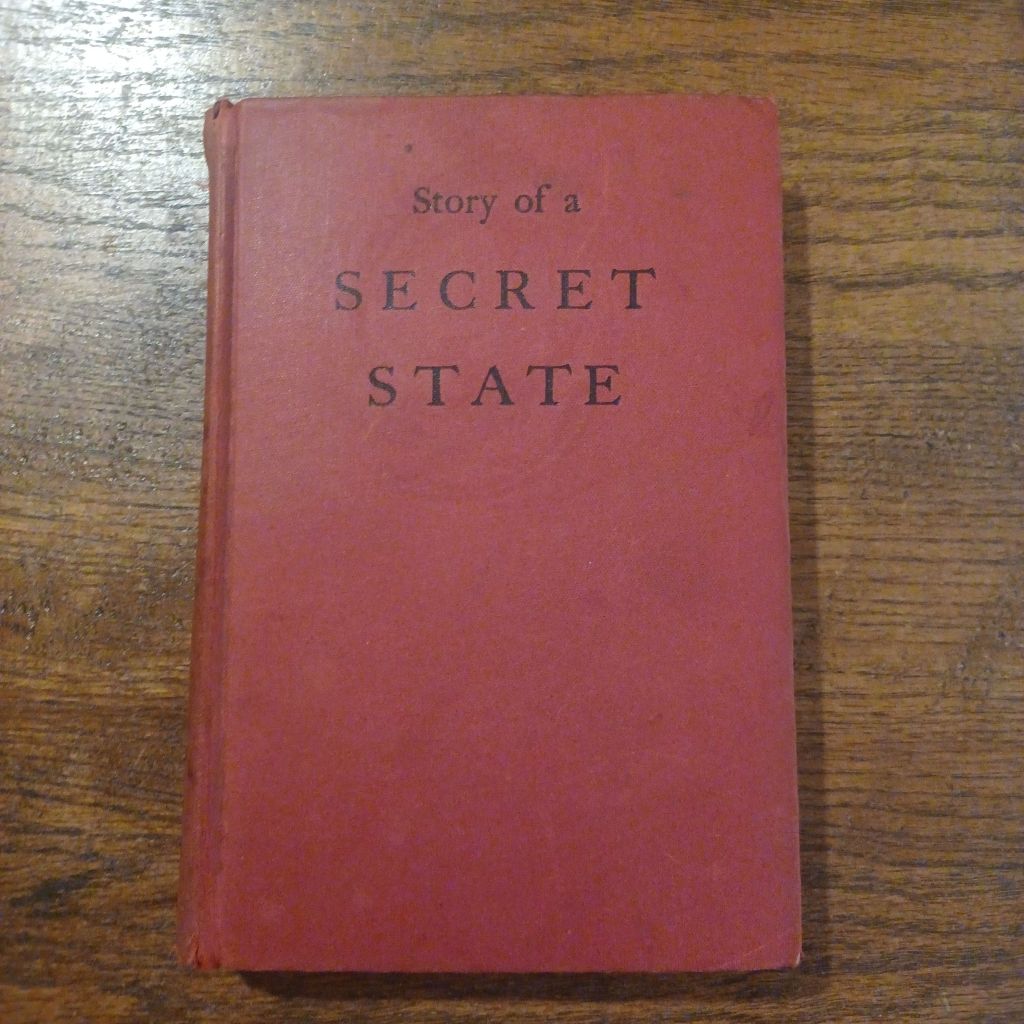
    Oh, the $450 book. You are interested in what it is? It’s a 1944 copy of The Secret State by Jan Karski, which Karski inscribed twice, once in English and once in Polish. It was in good condition for an 80 year old book, but certainly not pristine condition. It was one of my favorites. I hated to see it go. And now this…..

  • My USPS Frustration Can Wait: Let’s Talk About Something Else. Something Italian…..

    June 5th, 2024

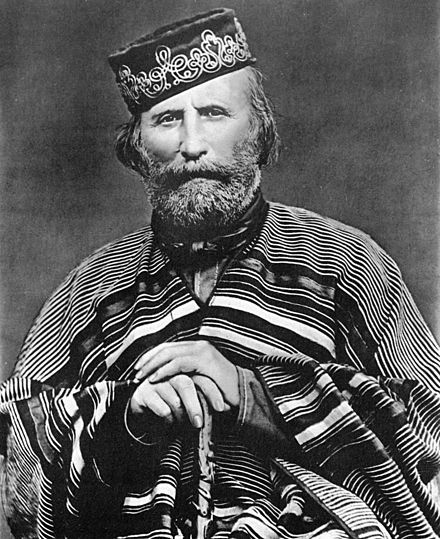
    I did my usual. I got in my car to drive to Rockville, opened my phone to YouTube and selected a talk about a subject I thought might be interesting to listen to as I drive. Being tired of podcasts on Ukraine and Gaza, I decided to learn a little about Garibaldi, the architect of the unification of Italy in the mid-19th century. I know the name Garibaldi; you probably do, too. But who was he and what did he do? I listened and was amazed.

    Garibaldi (dressed as Garibaldi?)

    I am doing this from memory, so don’t cite this post as evidence in a court of law (that includes you, Michael Cohen), but here goes.

    You may know him as Giuseppe Garibaldi. But in fact, he was born (when Napolean was still lord and master of much of Europe) in Nice, on the Riviera, and given the birth name of Joseph-Maria Garibaldi. His parents were Italian born, but they lived in a French speaking land, and Garibaldi was fluent in both languages.

    His father was a business man from Genoa and teen age Garibaldi went to sea, coming back to shore when he was about 21 and earning his living as a tutor and teacher (Garibaldi, you see, was one very smart guy). But travel called.

    In addition to being smart, Garibaldi was an inveterate traveler. Over his life, he went everywhere. First, in his mid-20s, he went to Russia, as a crew member of a ship delivering oranges. There, he met a man involved in the early Young Italy movement. Garibaldi decided to go to Italy and get involved, and stayed there a short time, becoming a political activist, something that would last him his entire life.

    Italy, of course, during this time was not one country, even after Napoleon was no longer around. There was part of northern Italy occupied by the Austro-Hungarian Empire. There was part ruled by the Kingdom of Sardinia. There was part ruled by the Kingdom of Sicily. And there was part under the control of the papacy. Unification, for most, seemed a daunting task.

    Having been involved in pre-revolutionary activity in Italy, and marked for arrest, Garibaldi escaped and went to Tunis, in north Africa. Then, his journey continued and he went to South America, where he apparently lived for almost 15 years, first in Brazil and then in Uruguay. In both places, he got himself involved in more revolutionary activity, in an attempt to separate the state of Rio Grande de Sul from the rest of Brazil. It was called the Ragamuffin War and you, like me, probably know nothing about it. But the Riograndense Republic resulted from this rebellion and existed for about ten years before it lost its independence. Again, at some point during this conflict, Garibaldi decided to leave Brazil and went to Uruguay.

    Uruguay was a relatively new country, a barrier land to separate Argentina and Brazil, and it had its own political turmoil, which led to a civil war. Garibaldi collected a large number of Italians (I assume expatriates who had moved to Latin America) to form an army (this is where he adopted the “red shirt” uniform he became known for) and fought on the “good guy” side of that war, trying to keep Uruguay from being gobbled up by the military leaders of Argentina. He lived and fought in Uruguay for about six years. During this time, he also married, had several children, and became involved in the Freemason movement, guided not so much by Masonic imagery, as by the Masonic ideal of non-denominational, ethnically based, freedom.

    A new pope, Pope Pius IX, was elected when Garibaldi was about to turn 40, and for the first time since he was in his mid-20s, Garibaldi began to think again about the unification of Italy, something that it was rumored the Pius favored (he really didn’t). He decided to return to Italy, taking a number of red-shirted army members with him from Uruguay, to help with the unification of his homeland. (Well, not really his homeland, I guess, French born as he was)

    Garibaldi wanted first to help the King of Sardinia, but that didn’t work out, but he led armies against the Austrians (unsuccessful) in the north and against the French in Rome (who were protecting the Pope and the Papal States). He escaped with a few of his men (the majority if his army left him after the defeat in Rome) to San Marino, and then was able again to leave Italy, and he wound up this time in Tangier. He stayed there a short time only and, in 1850, when he was 43, Garibaldi came to New York, where he took up residence, perhaps surprisingly, on Staten Island.

    He worked in a candle factory for a year or so (his wife had died in San Marino), and then went with a friend to establish business ventures in Latin America. They stopped as various points in Central America and then went all the way around Cape Horn and up to Lima, Peru. Throughout all of these travels, Garibaldi was treated very well, and known as an Italian patriot and military leader. In Lima, he was apparently given command of a trading ship of some kind, and he went on a still further journey, traveling to China, to the Philippines, and to Australia. He became one of the most traveled celebrities of the 19th century.

    Garibaldi sailed the ship back across the Pacific to Chile, where it was loaded with copper and wool, and then he against went around Cape Horn and brought the ship to Boston, where it was unloaded. He then went back to Staten Island, but was soon given a ship to take across the Atlantic, taking goods from New York to England, so he said good-bye to America and found himself back in Europe. He was now 43.

    It would be too much to describe his next six years here. Let us just say that he went back to the Italian peninsula, this time allied himself by and large with the Kingdom of Sicily, but working with others managed to remove the Austrians and wrest everything from the Pope except for what is now Vatican City and then combine the kingdoms of Sardinia and Sicily. In fact, Garibaldi became the head of the Kingdom (no longer a kingdom) of Sicily and voluntarily gave up his leadership to Sardinia for the purpose of united the peninsula in 1861.

    Garibaldi was now a genuine hero. According to the podcast, he was then invited to come back to the United States by President Lincoln (or on behalf of the president) and create an army of Italian immigrants in the Union (there were many) to join the war against the Confederacy. This did not work out (it would be interesting to look into this further), and I think Garibaldi stayed in Italy until…….

    Until Bismark attacked France in 1870 or so, when Garibaldi went back to his birthland (if not his homeland), and helped the French repel the Prussians. Yes, first fighting against Bonaparte France, and then fighting for France against Prussia. And, believe it or not, he stayed in southern France and even became a member of the French Parliament.

    But he was restless, and Italy called once again. He spent the rest of his life there, dying in 1882.

    During his last years, he remained active, not militarily but politically. He was an influential member, this time of the Italian parliament. He was a progressive’s progressive. OK, for this I did go back to Wikipedia – this was not part of the podcast. Quoting Wikipedia:

    Garibaldi suggested a grand alliance among various parties of the left. “Why don’t we pull together in one organized group Freemasonry, the democratic societies, workers clubs, Rationalists, Mutual Aid, etc., which have the same tendency towards good?”

    He suggested a Congress of Unity, and had an illegal, but well publicized meeting, which endorsed such policies as “universal suffrage, progressive taxation, compulsory education, administrative reform and abolition of the death penalty.”

    I again quote Garibaldi: “Shouldn’t a society (I mean a human society) in which the majority struggle for subsistence and the minority want to take the larger part of the product from the former through deception and violence but without hard work, arouse discontent and thoughts of revenge from those who suffer?”

    Before he died, Garibaldi became involved in one more crusade, albeit from afar. This was the independence of the Balkan countries from the Ottoman Empire. In fact, he wanted the Turks to return to the Asian side of the Bosporus, so that even Constantinople would free itself from the Ottomans.

    Again to quote him: “On this side of the Bosporus, the fierce Ottoman will always be under the stimulant of eternal war, and you will never obtain the sacred rights of man.”

    One last quote, this not by Garibaldi but by English historian A.J.P. Taylor, who called Garibaldi “the only wholly admirable figure in modern history”.

    Who knew? Not I.

  • Utter Frustration, Part I

    June 4th, 2024

    Frustration is a normal human emotion, I am sure. But I realized this morning how rarely I am frustrated. In fact, I can’t really remember the last time I really felt frustrated for more than a minute or two. I guess this is what members of the faith community call being “blessed”.

    So why did today I even think about the concept of being frustrated? You guessed it. I am frustrated. In fact, I am doubly frustrated. And I don’t like it one bit.

    (1) Washington National Insurance Company. 30 or so years ago, I put some of our money into two funds – one was an IRA, and the other wasn’t. I don’t even remember who administered these funds  at that time, but they have changed hands several times, and now seem to be under the control of Washington National Insurance Company. In case you don’t know WNIC,  they are one of the few major companies to get a 1 our of 5 rating on a major rating site.

    Usually, the servicer, whoever it is at the time, sends me one document every year for each of the two funds, telling me the status. I look at those to make sure the money is still there, that’s it. This is not money that we need day to day, so it really just sits. For the IRA fund, on the other hand, there is a minimum distribution requirement, and I get another letter telling me, for that one fund, what the RMD will be for the year. Later in the year, I get a check in that amount, which counts as part of my income (for income tax purposes) and goes into our joint checking account. Simple.

    This year, I got neither status letter, and I got two letters telling me my minimum IRA distributions for 2024, one of the IRA account and one for the non-IRA account. Huh? In addition, the RMD for the IRA account was listed at just over 10% of what I know it should be. And, although the amount held in the IRA account seemed correct, the amount in the non-IRA account was not. The non-IRA account was listed at about $2,500,000, a nice amount to be sure, but well in excess of what it really is.

    So, I called and got a nice lady who eventually understood what I was saying, could pull up on her computer the letters I received as well as the amounts currently in the accounts, and realized I was correct. She didn’t know how this happened, but she would contact the appropriate people, and I should have corrective letters within a week. Great, I thought. But of course, the letters never came. So after a month, not a week, I called again.

    I got a different nice lady this time, she saw what I was saying, she couldn’t understand why it hadn’t been corrected, she would follow up and I would for sure get two corrective letters. I should give it two weeks.

    About ten days later, I did get one corrective letter – the one for the non-IRA account. The account no longer held $2.5 million; it held what I assume to be the right amount. But it still told me what my Required Minimum Distribution for the year would be – even though there is no RMD. So, now I am worried they are going to liquidate part of the account to send me the funds that I neither want nor need. As to the IRA account, I have yet to receive a corrective letter at all.

    When I talked to pleasant lady number two, I asked her what I should do if the letters she promised didn’t come within the two weeks. She told me I should call back and ask for a supervisor.

    When I looked up Washington National on line, I saw how poorly it was rated, and read the customer reviews, I realized that this company is totally incompetent and that I probably will never be able to talk to a supervisor. “You want a supervisor; they are all busy; you want to hang on forever?” You want a supervisor? Leave me your name and number and they will never ca you back.” Those seemed to be the two most likely probabilities.

    I need to figure out what I should do. Thoughts?

    (2) My second frustration? It will wait until tomorrow. Hint….it involves a package sent to the UK.

  • My Mind Wanders From Thing to Thing This Morning

    June 3rd, 2024
    1. Hunter Biden. His gun trial starts today, I think. He bought a gun without giving accurate information as to drug use on his application. I am waiting for Donald T to come out with a defense of Hunter. I am waiting for him to say that this is a political trial, instituted by a corrupt Department of Justice, etc. Or have I missed it and he’s already said that?
    2. Fast Food Restaurants. Yesterday, after I walked about 3 miles down to Dupont Circle, I thought I should get something to eat and, more importantly, something to drink. I went into a coffee house, Roasting Plant Coffee, on Connecticut Avenue which promised coffee and more. They had three sandwiches listed on their menu board – cheese, ham and turkey. I ordered a turkey and an iced coffee. Sorry, they said at noon, we are out of everything but ham. So I walked around the corner and just stopped into a Subway and got a 6″ sweet teriyaki chicken and a coke. The ice machine was out of ice and the coke was at room temperature. After I finished the sandwich, I decided to go to the men’s room before I hit the road. There were two bathrooms. The man behind the counter (probably the franchisee on a slow Sunday morning downtown) asked me if I wanted to wash my hands. Weird, I thought, and said “not really”. Then, he said, “Don’t go in there; it’s blocked up.” “OK, I’ll use the other one.” “No, they are both blocked up.” “OK”, I said, very sorry that I had eaten the sandwich and given him a tip. My tip should have been “Call a plumber.”
    3. Tattoos. I should do a broader study of tattoos, but I never know how one should react to them. Do people with tattoos want you to look at their tattoos (and hopefully admire them), or do they tattoo their bodies in the hope that you will ignore their tattoos completely? (“What? I have a tattoo?”) A question well above my pay grade. Maybe you only can look at a tattoo once you get to know the person well. (“Excuse me, but is that skeleton on your shoulder a tattoo?”) I began thinking about tattoos (as I occasionally do) this weekend because of three that I saw. (1) I normally think of tattoos on the bodies of people much younger than I, but yesterday I saw a tall woman, who looked about my age, wearing a sleeveless dress, with a large and colorful tattoo on her exposed shoulder. I thought she looked perfectly silly. Why did she do this? (2) At a Mexican restaurant where we had lunch on Saturday, there were a number of Hispanic men eating lunch – they were dressed for work, their work being a landscaper or a construction worker or something. One of them at a nearby table had a large tattoo on the inside of his forearm that read, in big black letters, ROBERT GARCIA JR. Now, maybe that is his dead best friend, or even his young son, but, gee, for the rest of his life, he is going to see that name staring him down whenever he looks at his arm. (3) I was walking behind an ordinary looking youngish (40s?) woman yesterday, who also had a tattoo on the backside of her forearm (so easy for me to see behind her). I walked closer in the hope that I could read the script and it said “Well, that is mighty White of you”. She, by the way, was White (by appearance). What could make you put that on your arm as a permanent reminder of…..what?
    4. The Film. We saw that well-touted French Film, “Au revoir, M. Haffmann”, at the Avalon last night. A little disappointing as a film (what else is new?), but an interesting story about a talented Jewish jeweler in Paris in 1941, who sends his family to the unoccupied south, and sells his store to his apprentice, planning on meeting up with his family shortly. His timing is bad, there are roundups, his smuggler has quit smuggling, and poor Mr. Haffmann cannot get out of Paris. Where should he hide? Back to his former shop’s basement. And that’s when things get confusing. Not a must see, but certainly not a must stay away from. A depressing film, to be sure, but not without its interesting facets (that a jewelry pun).
    5. The Book. More about this later, but I am reading Arkady Ostrovsky’s The Invention of Russia, which tells the story of the evolution (probably not the best word, if evolution connotes progress) of Russia from Stalin to Putin. I am in the section that deals with Gorbachev and his fall, Yeltsin and his fall, and pretty soon we will have Putin. Throughout this period of Russian chaos, when oligarchs were trying to outsmart each other, and good government types were in short supply, it was unclear where the country would wind up. Sadly, and in spite of the obvious factual and situational differences, there is a lot in this particular period of Russia’s story that reminds of me of the USA today. But we will talk about that at another time….
  • Trouble in the ‘Hood…….

    June 2nd, 2024

    Our local high school is named Jackson-Reed High School. Until 2022, it was Woodrow Wilson High School, but the name was changed because of the tarnished legacy of Wilson who was a segregationist (in addition to being a pretty good president in all other ways). Jackson was the first Black teacher at the school, and Reed the first Black principal. Whether this was a good name change is for another day. There were those who thought they could rename the school for playwright August Wilson and save money on new signage, but that’s for another day.

    The student body is very diverse, racially, ethnically, religiously, nationally, in all ways. I read that about 30% of the student body comes from outside of Ward 3, the neighborhood for the school, and 70% from within the Ward.

    There was an “International Night” the other night at the school, a tradition of many schools here, where people from various parts of the world cook foods indigenous to their homelands. Apparently, this year there were a number of attendees who were unhappy about the Israeli booth and said so in words that were unpleasant, intolerant, and uncalled for. The Israeli and Jewish students felt very uncomfortable, I am told, and the entire evening became very unpleasant. I have also read that there have been similar instances of anti-Israel, turning into antisemitic, at the school, but I don’t know anything about them.

    The Jewish Community Relations Council for Greater Washington put out a statement basically telling the school that it better get its act together to protect the Jewish kids at the school. I read it last night on Facebook. I saw that there were many comments posted regarding the statement, and I decided to look at them. That was my first mistake. The comments outraged me. No, not that there were anti-semites commenting on the JCRC website. That wasn’t the problem. The problem were the commentators (a good portion of them) who blamed the situation not on the school’s failure to protect the students, but on Joe Biden (in particular) and the Democrats (as a group).

    You see, it turns out that the reason that all this came to a head at Jackson-Reed was, in the opinion of some, that Joe Biden hadn’t stood up strongly enough for Israel, but gave into those in the Democratic Party who were more interested in a ceasefire than a continuing one-sided war. And there were others who didn’t seem to blame Biden personally, but who blamed “The Squad”, who – in case you did not know – were hand-in-hand allies of Hamas. And they topped their comments by concluding that only the re-entry of Trump into the presidency would clear up all the problems at Jackson-Reed. OK, they didn’t exactly say that, but…..only Trump can fix it. That, they did say.

    That’s when I made my second mistake. I violated a cardinal principle of mine. I commented. I said: “Of course, this is Joe Biden’s fault. Why did I have to read all these comments to know that? I must have been blind. And remind me: who was the guy who said there were good people on both sides?”

    Well, yes, I have received quite a few “likes”. But I have also spawned my own nasty comments: “The Squad open supports Hamas and Biden is afraid to stand up to them….[someone needs to] take back the DNC from a minority of ultra left-wing radical fascists.” “[Biden does not] have the brain [to do so].” “There were good people on both sides in Charlottesville…….stop spewing the MSM [sic] crap, you’re embarrassing yourself.” “It’s not just Biden’s fault; it’s all the Democrats.” “When has Donald Trump ever said anything antisemitic? You’re ignorance is showing”.

    By the way, other posts (not directed back at me) are also interesting:

    “DC govt and MPD have been antisemitic since the days of the mayor for life, Marion Barry.” [This one surprised me actually – nothing can be less factual than this comment. Never heard anyone say this before.]

    “Democrats and their radical Islamic allies need to be taken out of political positions as they are no better than Nazis.”

    “These places are just petri dishes of hate that should be defunded….” [That one got 21 likes, so far]

    And many more.

    I must get back to my core principles.

  • A Photographic Post for a Saturday

    June 1st, 2024

    The photos are from today’s stroll on the Dyke’s Marsh Wilderness Trail off the Potomac south of Alexandria VA.

  • A Friday Diversion (Murder, She Said)

    May 31st, 2024

    If you are planning to watch the recent Danish film, “Loving Adults”, stop reading this now. What will come will be a SPOILER.

    Okay, so it isn’t the greatest film ever made. It’s a simple film, well acted, and there is really only one plot line. You won’t get lost. It gets mediocre reviews on both IMDB and Rotten Tomatoes.

    But what intrigued me (and entertained me) was not so much its twists and turns, but that each twist and turn was so unexpected. Here goes:

    Christian and Leonora have been married for twenty years. He is half owner of a successful construction firm. She, trained to be a concert violinist, gave up her career to care for their only son, now 19, who needed care because of a chronic medical condition, now less severe.

    All seems well, except for one thing. Christian falls in love with Xenia, a young engineer who works for him. Leonora finds out about the affair, much to Xenia’s pleasure. She wants Christian to leave Leonora, so the more Leonora knows, the better.

    But Xenia does not count on one thing. Unknown to her, in order to provide medical care for their son (they brought him to the US for surgery, which saved his life), Christian, through his business, engaged in some sort of illegal activity which earned him unearned income, and which the company has covered up ever since. Leonora knows about the criminal activity and tells Christian that if he dares leave her for Xenia (leaving her without an income and with a son who still needs much attention), she will go right to the police and expose the fraud and, as far as she is concerned, Xenia will have the opportunity to visit Christian for the next several years in jail, and his business will fail.

    What to do? Christian can think of only one thing. Leonora is a runner. She runs lengthy distances every morning, generally on the same route, wearing a dark red hoodie. Christian decides he run her over and get her out of his way. He drives up to her from the rear as she runs along a country road, hits her, sees her still writhing and backs up and runs over her again. Then he drives to the car wash, and then home.

    His son notices that he is nervous and asks him what’s wrong. He, of course, says he is fine. And he is fine, if shaken, until…….Leonora comes in the room and says “Good morning”, and talks about a longer route she decided to use for her run that morning. Christian has killed a stranger, a young woman, a mother of three. It’s clearly a hit and run, and there is nothing apparently to tie Christian to the crime. He has an alibi; he was at his office and the char staff saw him there.

    At the car wash, Leonora learns that her husband was there the morning of the accident. She asks to see, and is shown, the video of him bringing his car, which shows his concern that the front of the car is clean. She puts two and two together. She realizes that her husband not only wants to live the rest of his life with Xenia, but that her husband wants her dead.

    Her reaction is not what you might think it would be. She suggests that Christian and she go out for a nice dinner to talk things over. She tells him, at a restaurant which has as a complete floor to ceiling wall a crowded aquarium-worthy fish tank, that she can get him put away both for financial fraud and for murder. But she doesn’t want to do that, she says, and she has another idea that will solve their problem and keep them together the rest of their lives. What does she suggest? She suggests something very simple. He should kill Xenia.

    What? He can’t do that. Why not? He has already killed one person, and he did it in a way that left no trace of his guilt. And, with Xenia, he would have an active partner, Leonora, who would help him plan it out. Desperate, he agrees.

    Of course, when it comes to it, he cannot bring himself to murder Xenia. But, don’t despair, Leonora knew he couldn’t pull it off, so she puts into action that part of the plan that Christian is unaware of. And, poof, Xenia is no more.

    How can it be that Leonora herself is so cold blooded? Well, for that, you have to go back into her history, when Leonora was just a teenager, and her boyfriend died after falling off a cliff. He didn’t really fall, you see. He was pushed by young Leonora who found out he was cheating on her.

    So what brought these two together – Leonora the murderer, and Christian, the future murderer? We are not sure. But all we know is that they never were caught, Xenia’s body was never found, and Christian and Leonora sold their house, left town, and, who knows, maybe lived happily ever after.

    That’s it. A simple, unique story line. And a movie you now don’t have to watch. The film is about 1 hour and 45 minutes long. It only took you about five minutes to read this post. I saved you 1 hour and 40 minutes. You’re welcome.

  • Three More Middle Eastern Thoughts to Ponder….

    May 30th, 2024

    (1) Many of us still remember the Vietnam War. The idea that it ended 50 years ago seems absurd. And for those of us who do remember, we certainly recall the tremendous polarization in the country. We had governments from both parties (Johnson and the Democrats; Nixon and the Republicans) who were supportive of what we were doing in Vietnam (trying to stop the Communists from the North from taking over the country and trying to keep an important domino from falling). The majority of the country, I think, was supportive of the war, but a strong minority of the country, and I think the majority of those under, say, 30, were vehemently opposed to it.

    There were all sorts of demonstrations, marches, and other actions (legal and otherwise), and all sorts of confrontations, confrontations between opposing groups, and between activists and governmental forces. The country was falling apart. But it didn’t.

    The war ended when our government decided we couldn’t win it. We pulled out one day (just like we pulled out of Afghanistan). Some celebrated. Others were appalled. But the world went on. And the country was fine.

    Israel is now engaged in a war in Gaza which it, too, may not be able to “win”. There remains much opposition to the war and/or its conduct in Israel, and large demonstrations continue on a regular basis. The government seems, however, to be ignoring the demonstrators and continuing to prosecute the war. But one day, they might realize that they have to stop. If so, the world will go on. Israel might not then be “fine”, but it will be in better shape than it is today.

    (2). What the Israeli leadership does not seem to understand is that whether Israel wins, loses or draws, it will have to continue to live in its neighborhood, and with its neighbors. You would think it would be preparing for that day, but it does not seem to be.

    This is one of the reasons that opposition to everything Israeli grows around the world. And the Arabs are consequently left off the hook.

    But let’s remember that this fight started when five Arab countries attacked the new country of Israel in 1948. Had they not, had the Arabs accepted the United Nations’ partition plan for the Mandate Territory, we would not be where we are today. Instead, chances are that there would be a prosperous primarily Jewish Israel, and a prosperous primarily Arab Palestine, living next to each other in peace.

    Let’s remember the number of subsequent times that Arab countries have attacked or were prepared to attack Israel. This would include 1967, when Israel captured the West Bank from Jordan, and Gaza and Sinai from Egypt. Had the 1967 war not been necessary, none of that would have happened. After that war, when Israel signed a treaty with Egypt and returned Sinai, Egypt simply refused to take back Gaza. And Jordan, when faced with the possibility of a treaty which would have included the return of the West Bank, refused to take the West Bank back.

    Until then, Palestinian nationalism was latent, but then it exploded. And it was given additional strength because of the absolute refusal of the Arabs in neighboring states to do anything for the residents of Gaza and the West Bank, except to treat them, their children, their children’s children and their children’s children’s children as Palestinian refugees who had the right to return or to migrate to Israel proper. In other words, from the beginning, the Arab states have planned for the destruction of Israel and the creation of a larger Arab state stretching from the river to the sea. (Yes, Jordan and Egypt signed treaties with Israel – no one else did – but these were for pragmatic purposes and never reflected the overwhelming feeling of their own citizens, nor probably the feelings of their leaders, who continued to educate the next generations about the eventual destruction of Israel and the evil of the Jewish people.

    (3) Today in the United States, we are faced with many young people, on campuses and off campuses, some even Jewish, who are calling for a Gazan victory of Israel, for the “right of return” of Palestinians to the land of Israel and to the possible destruction of Israel and maybe of the 6+ million Jews living in Israel.

    We bemoan this. We call it antisemitism (whether it is or not), as well as anti-Israel. And we wonder how it came about. And we speculate. Latent antisemitism is talked about a lot, but in my opinion is a very small part of the problem. One large part of the problem is the actions of the Israel government, and its messaging. We can’t overlook that. Then there is the overall “social justice” movement, dividing the world into the oppressed and the oppressing, and which classify the Jews as oppressors (oppressors far in time removed from those who were oppressed during the Nazi years). Then, there are the Arabs and the Arabists on campus, both as students and as faculty. And Arab money coming into universities (most often from Qatar) funding Middle East Studies departments, and with a not so subtle agenda. And extraordinarily successful creation of student organizations on a national basis. None of this happened by accident. Israel’s neighbors have long known how to vilify Israel and brainwash their young. Now, they know how to do it here, too, it seems.

    Just saying.

  • Books, Baseball…..Baseball, Books

    May 29th, 2024

    Sometimes, it is so hard to decide what to write about in the morning. Today will be either Books or Baseball. Or both.

    Let’s start with baseball. I know that for some of you this is a foreign subject, so I will make it as clear as I can. In 2019, the Washington Nationals won the World Series. Then (for reasons not necessary to detail here), the team fell apart, and the owners decided to get rid of everyone and start from scratch. They call it rebuilding. Five years later, the team is rebuilding and the fans are tired of it.

    The worst year was 2022, when they only one 55 games and lost 107. For those who are unfamiliar with baseball, that is very bad. Last year, they won 71 and lost 91, still not very good. As of today, May 29, 2024, they have won 24 and lost 29. Still not very good.

    This is not going to be a long essay. Just a few points. Results in baseball depend a lot on five things (in addition to luck and the strength of your opponents). Batting average, batting power, pitching, base running and fielding.

    The Nationals’ base running and fielding has been very good this year and last. They have not had much power either year; clearly something they must work on. But as to batting average and pitching, strange things have happened.

    Last year, the Nationals’ strength was their ability to get on base; even when they were losing most games, they were among the top teams in team batting average. This year, the team batting average has plunged. Players who have returned from last year are by and large hitting for much lower averages than they did.

    On the other hand, last year’s pitching was very bad. The Nationals ranked 27 out of 30 for Earned Run Average (roughly, the number of runs per game allowed by team pitching) at 5.02. This year, so far that number is 3.94. There is a reason for this – the Nationals (like most teams) have five starting pitchers who rotate. All of a sudden, we have four terrific starting pitchers: Trevor Williams (2.29), Mackenzie Gore (3.04), Jake Irvin (3.43) and Mitchell Parker (3.45). Our fifth starter, Patrick Corbin (6.12) is in his last contract year and it would be nice if he were gone sooner than that. The numbers in parentheses are, of course, their individual ERAs.

    They are also young. Williams is 32, but Gore is 25, Irwin 27 and Parker 24. (Corbin is 34). There is another young Nats’ pitcher, who is touted to be a star, but who has yet to reach stardom and is now on the injured list. That is Josiah Gray, who should be ready to pitch again soon. Gray is 26 and if he comes back as a starter soon, someone has to go. Wish it could be Corbin – maybe turn him into a reliever for his last year. The Nats also have a couple (at least) of very strong pitching prospects in the minor leagues. Keep your eyes on Clyde Cavalli, who is 25, and DJ Herz who is only 23.

    The Nats are also strong with young outfielders, both now on the team (like Jacob Young and even Lane Thomas), and in the minors. James Wood, Robert Hassell, and Dylan Crews are top prospects. Alex Call comes up now and then and helps out nicely. And then there is Stone Garrett, who was having a terrific rookie year last year until he broke his leg, and he has not yet returned, but is expected to relatively soon.

    And their middle two infielders (CJ Abrams and Luis Garcia) should be strong for years. Their catching staff is also adequate. But first and third base remain problems, although young Trey Lipscomb (only 23) should be back up soon at third.

    It’s unclear why the hitting has been so weak so far. There are games where everyone gets hits, but more games where almost no one does. Part of the problem is that the Nats acquired some mid-career players to help in those positions where their prospects are not quite ready – Nick Senzel at third base, Joey Gallo at first. They have proven very disappointing, and weaker than Dom Smith and Heimer Candelario at third from 2023.

    So let me conclude: The Nats have a lot of talent, some of it now on the field, some of it currently injured, and some of it in the minor leagues. The talent may not be perfectly balanced. They have too many outfielders (that’s why they had to let Victor Robles go last week when Lane Thomas came back from the injured list). And they really need to get first string first and third basement. Perhaps Joey Meneses could be their first string first baseman (now he plays there at time, and is the Designated Hitter at other times), but he hasn’t lived up to what was hoped for him. And perhaps Trey Lipscomb will be back soon at third. I would like to see the Nats turn one of their outfield prospects into a first baseman (easy to do, I think), but I haven’t seen anyone suggest it.

    I don’t know how the rest of 2024 will go, of course, but it could go well. All the Nats need to do is hit. And bring James Wood up from the minors for power. Couldn’t Woods play first base? I think he could.

    As for Books…….some other time.

  • Prague is the name of its Capital. But What is the Name of the Country?

    May 28th, 2024

    I have only been to Prague twice. The first time was in 1974 and the second time in 1998 (both dates are approximate). In 1974, Prague was one of the saddest looking cities I ever had seen. Everything was gray. Everyone building looked like it needed attention. Every passerby was looking down and looking morose. There were few shops open that I saw. The restaurants were depressing. Even the skies were gray.

    In 1998, gray Prague had come to life. Not only did every building look like it had just received a new coat of paint. Not only did everyone seem to be in love with life. Not only were there too many tourists sites to see, as well as too many tourists. Prague itself looked less like a normal city than like an inhabited Disneyland.

    The transformation had been complete. That was then; this is now. How did it happen?

    I can’t say that I understand it well, but I understand the transformation better than I did, say, a week ago, when I had not yet read Michael Zantovsky’s book Havel, a Life, published in 2014. I found a nice copy of the book, signed by the author, at Lost City Books in Adams Morgan, where I had not been in years. Zanatovsky was, for a short while, Vaclav Havel’s press secretary when Havel was the Czech president, and then, as a Czech diplomat, was Ambassador to the United Kingdom, to Israel and to the United States. He is also a scholar and translator and now very active with the Aspen Institute.

    It takes a commitment to read a 500 pages biography of Havel, but he is worth the time. I am not going to recite his life story. Only enough to give you some background you may not already know.

    Vaclav Havel was born in 1936 in the Republic of Czechoslovakia, a country carved out of part of the Austro-Hungarian Empire at Versailles after World War I, and a country doomed to be dismembered first as a result of the agreement between Hitler and Chamberlain at Munich, and then by the Nazis ignoring the agreement reached in Munich altogether and marching in and taking over the entire country. Havel came from a wealthy family. His father was a factory owner; his father’s brother was a leader (I think maybe THE leader) in Czech film production. Under German rule, his family lost everything.

    His family was patriotic and anti-Nazi. Havel became well educated; he was an intellectual. He became a playwright and well known in avant-garde circles. In my mind, he was the inheritor of the senses of humor, satire and anarchy of another famous resident of Prague, one Franz Kafka. Havel’s dramatic works were, from the descriptions given in Zantovsky’s book, clever, sharp, biting, but all had to be done with an eye to the Communist society that enveloped Czechoslovakia at the end of World War II, starting in the mid to late 1940s.

    Although he was not one of the leaders of the 1968 Prague Spring Czech revolt, he was one of the premiere dramatists and essayists of the time, well known in academic and popular circles. And of course, the march of Soviet troops into Czechoslovakia to crush the revolt, curb the intellectuals, and clamp down on any sense of personal individualism both affected Havel deeply, and explains the Prague I saw in 1974.

    In 1977, Havel was one of the leaders of the group behind, and one of the signers of, Charter 77, an attempt to open up Czech society to more freedom of thought and expression. He was probably the most visible of the Charter 77 activists, visible enough to be thrown into prison for four years in 1979.

    When he was released from prison, he lay low. But after the next Czech revolt, the Velvet Revolution, which spelled the end of Soviet influence in Czechoslovakia in 1988, Havel found himself chosen as the first president of the post-Communist country.

    Now things will start to seem more familiar. Havel was clearly what we would call politically liberal. His name was known world wide both for his intellectual accomplishment and now his political position, and he traveled world wide. He was a globalist in that he was one of the first to work to get Czechoslovakia allied with the west, both through EU and NATO membership. This was quite a task, as there were those in his country who were tired of foreign alliances, those who felt Russia would be provoked, and those who felt Czechoslovakia would be called on to participate in conflicts they would otherwise avoid. But he carried the day, as he did on many domestic reforms.

    But things weren’t completely smooth for several reasons. The biggest was that longstanding disagreements and jealousies between Czechs and Slovaks led to a split of the country during Havel’s presidency. Yes, Havel the peacemaker and globalist could not keep his country in one piece. And within the Czech Republic itself, there were continual battles between legislators and the executive. All of this took its toll on Havel, physically and emotionally.

    Digression: Can you tell the difference between a Czech and a Slovak? Did you know that these groups apparently never really liked each other, and that there was a feeling when Czechoslovakia was created after World War I that it was a bad marriage of two different peoples? Did you know that Slovaks were often looked down upon by Czechs? That Slovaks were much less happy with the end of Communism than Czechs? That the capitalistic transformation of the country hurt the Slovak economy and helped the Czech economy? That when the country was still together, there was concern that some agencies were overly-Czech? That for a short while, the two parts of the country had two different parliaments, with the overall president often caught in the middle? I didn’t. And, by the way, if a Czech and a Slovak marry and have a child, what is that child anyway?

    Digression number two: The Czech Republic? Czechia? What is it anyway?

    The book also talks about Havel’s long marriage to his wife, Olga, and that they seemed to have a somewhat open marriage, permitting dalliances here and there on both sides, and his second marriage to a younger and ambitious actress after Olga’s death. And, even more than his private life, Zantovsky talks about Havel’s health, which was never good, but which got appreciably worse after he left the presidency in 2003. He was a smoker, developed lung cancer, which was successfully operated on but weakened his lung capacity. He was in an out of hospitals, and suffered greatly from depression, and the thought that he had failed in everything he ever tried to do.

    If you are interested in looking at Czechoslovakia as an example of how a country coped with the collapse of Communism, and are interested in how Havel, a talented playwright became a charismatic, respected, and in many ways successful president, dealing with a substantial amount of transitional internal chaos, you may want to read this book. I don’t think you will remember most of the details, but you will certainly see the big picture, and appreciate the difficulties changing all social norms in an ongoing society.

    Now that I have finished reading Havel, a Life, I have started on a book with a related theme, The Invention of Russia, written by Arkady Ostrovsky. I have read the long first chapter, which deals with the thinking going on in the minds of various elite Communist leaders in Russia, as to how to deal with changes that might need to be made after Stalin’s death, how all prospective modifications were met with internal objections, and how this back and forth led to the ascendancy of Mikhail Gorbachev and the end of the Soviet Union. More on this to come.

  • One Million, Two Hundred Thousand……

    May 27th, 2024

    You know what this is? This is the approximate number of members of the American military who have died in wars in which we have been involved, from the Revolutionary War forward. One Million, Two Hundred Thousand.

    And today is Memorial Day, in theory the federal holiday on which we commemorate our war dead, and remember their sacrifices and the sacrifices of their families. But we don’t really do that, do we?

    I understand that the holiday, or its predecessor, was first celebrated in the South, to commemorate the dead from the Confederate army and navy during the Civil War, and that it quickly spread to the North, and around the country. It was General John Logan, head of the Grand Army of the Republic, who is credited with creating the holiday, then called Declaration Day, in 1868. Today, no one thinks of John Logan except when strolling around Washington’s Logan Circle.

    It was originally called Decoration Day because it was a day to decorate the graves of fallen soldiers. That was a way to remember, for sure. And even today, in military cemeteries such as Arlington’s, there are American flags placed in front of each tombstone. And the holiday was celebrated on May 30, whether that day was a Sunday, a Tuesday, or a Friday.

    Everything changed in 1971, when the then recently passed federal law creating Monday holidays came into effect. Decoration Day officially became Memorial Day. May 30 was changed to the fourth Monday in May. And the holiday became another three day weekend, with trips to the beach, barbeques and the opening of public swimming pools in much of the country. The summer had unofficially begun.

    Most American military deaths occurred during the earlier years of the country – the Revolutionary War, of course, and then the big one – the Civil War – where over 600,000 died. We got into World War I late, so fewer than 200,000 Americans met their deaths, but in World War II, where we fought four years, American deaths exceeded 400,000. Although over 50,000 died in Vietnam, and similar numbers in Korea, our wars since then, mechanized as they have become, have seen fewer and fewer American casualties.

    Fewer war deaths is certainly a good thing. But it means something else. It means war deaths, and the memories of war deaths, have receded into the past. The percentage of families who experienced these tragedies during the Civil War and during World War II were enormous. The last Civil War veteran (I remember he was an underage drummer boy) died, I think, in the 1950s. World War II ended in 1945 – almost 80 years ago, which means that the youngest living World War II veterans are now 97 or 98, and the children of those killed in the war are all now in their 80s. Memories certainly recede.

    But shouldn’t we do more to remember those who gave up their lives, some necessarily perhaps, and some accidentally or without necessity in the defense of their country. And shouldn’t we look at not only the deaths of those who fought in the wars, but those who are considered collateral damage – civilians caught in the fight. Of course, since the Civil War, we have not had battles on the home ground, they have been abroad. But we have participated in wars that resulted in deaths in Southeast Asia, in Iraq, in Korea, and in so many more places. We should remember those who died at our hands in those wars, too.

    Perhaps moving the holiday to Monday to create a three day weekend was just the thing not to do. The Fourth of July would have been a better holiday to move, wouldn’t it have? After all, it is a holiday of celebration. Maybe we should have left Memorial Day as it was, maybe it should have remained as Decoration Day, and maybe our activities should be less celebratory and focus more on memory.

  • Turn, Turn, Turn……

    May 26th, 2024

    There are those of who know what is best for America and, to a large extent, for the rest of the world. We vote Democratic, we are uncomfortable with the positions of virtually all Republicans and the personas of most of them, we only cringe a little bit at the “far left” (in American terms) Democrats whose ideals we may share, but whom we view as politically impractical. We call ourselves liberal, but not too liberal. We certainly don’t agree with those progressives who divide the world into oppressors and oppressed, and find the totalitarian Moslem countries oppressed and liberal (if often misguided) Israel as oppressors.

    We think we have common sense and don’t understand why some people don’t agree with us. Whether we live in Arizona or Maine, Florida or Idaho, our educations have been similar, so we think pretty much alike. We are aghast at Trump and his followers, we are aghast at Robert F. Kennedy Jr. and his, and we are sad that the Democrats aren’t gaining more traction as the November election nears.

    But there is something that it appears that we do not understand. We are in the minority. Most people in this country do not think like we think. They think differently. And, unfortunately, neither I nor you can explain how the majority of Americans are thinking this day, because we cannot understand how they think (yes, we can say it’s because of this or that, but we are only partially correct) because it seems so wrong.

    We are used to the possibility of very close elections in this country. The Republicans have a candidate that is a disgrace to American politics, completely outside of the pale, as they say. But he may win, and he may win by a large margin.

    I am a White male, and most of my friends are White. White males, they say, are favoring Republicans by 20 points. This is an extreme difference, but there has been a Republican-favoring difference for some time. The Democrats have been winning elections, for the most part, because of the vote of minorities – Blacks, Hispanics, Asians, and yes, Jews. But those groups are beginning to change, and if members of these minority groups move only a bit towards the right, we will find Democrats losing all over.

    We all recognize that much of the world is a mess. When the world is a mess, those in power suffer. It is so easy for the opposition to say: elect me, and I will get you out of this mess. It is much harder for the incumbents to say: elect me, I will govern as I have been governing, and this mess will disappear.

    If the Republicans do well in November, as I suspect they will, the Americans who voted for them will see that the world is still a mess. Maybe they won’t see that immediately, but they will eventually see that. And things will turn back again. They always have. But now, we sort-of-liberals are in the minority.

    Now, of course, being in the minority does not mean that you are wrong. To the contrary, people in the minority are often, perhaps usually, correct. And the worse thing is to give up your principles because they don’t capture the approval of the majority. It’s when the minority gives up, goes into hiding, allows themselves to be influenced by majority opinions they know to be wrong, that things really get into trouble. An active minority is necessary to get things turned around, and I am afraid that’s going to be our job for the next four years.

    Now of course, I may be wrong. Maybe, the rabbit will be pulled out of the hat, and the Democrats might find themselves remaining in power. I can foresee all sorts of scenarios where this might happen. But at this point, that doesn’t seem what is most likely. So let’s be prepared.

    Remember the old saying: I’d rather be right than be president? I am not saying that, either. We would rather be right and have a president who agrees with us, supported by the vast majority of voters. But sometimes that doesn’t happen. And we need to recognize that, and realize that.

    The song “Turn, Turn, Turn” dates only from the late 1950s, but Pete Seeger, the composer, took the words from the biblical book of Kohelet, or Ecclesiastes, the same book where it is declares that “there is nothing new under the sun”. Some find this book very pessimistic – but no need. The message is clear to me. People are people, the wind blows first one way, then another, you can work hard and find your work still undone, waiting for the next generations to finish it. The human condition.

    Enough of “May you live in interesting times!”. How about “May you live long enough to see the world turn once again!”?

  • Bang, Bang, You’re Dead and Why Are You Surprised?

    May 25th, 2024

    Whenever I am asked to list my favorite authors, I always put Robert Ardrey on the list. Although I have read four of his books, the one that always comes first to mind is African Genesis, which was first published in 1967. Subtitled “a personal investigation into the animal origins and nature of man”, it is just that, his conclusions as to how mankind evolved in Africa from its animal ancestors. One of the conclusions I recall him reaching is how various forms of primates of they types we call apes or monkeys developed the use of crude weapons long before mankind came on the scene. In his musings about war and peace, he talked about how some authors wonder how, throughout all these centuries, there has been so much war. He, as I recall, on the other hand, finds it a wonder that, throughout all these centuries, there has been so much peace.

    My well worn copy

    I can’t say I remember exactly what he said, but perhaps we can put it this way. Mankind emerged from animal groups that shared many of mankind’s most prominent characteristics. This includes the drive for self-protection, which means you must have a society and social relations, and that means you must have real estate, or territory, where you can live unmolested, and you must have dominance over that territory and be able to organize and protect it against assault, or – to turn things around – to assault neighboring territories when either you need more space, or you fear that you will be attacked by your neighbors, who perceive that they need more space.

    At least, this is close enough. And if Ardrey didn’t say it, I just did. And I think he’d agree with it.

    Yesterday on YouTube, I listened to a lecture by Canadian professor Margaret MacMillan (University of Toronto), who gave this year’s Isaiah Berlin Lecture at Wolfson College, University of Oxford. Her topic was “Thinking About War in the Modern Age”. You should watch/listen to this if you have an hour to spare (and if you do, stay on for the Q and A). Why? Because MacMillan is a terrific presenter, and because she has organized this talk perfectly. Although she did not cite Ardrey (and, who knows, perhaps she has never heard of him), much of what he had written resonated in what she said. This includes her conclusion that war is such an integral part of human nature and human society, and that evidence of war exists before evidence of, say, language, that talks about ending war and “making the world safe for democracy” are naive, and should be abandoned. She also concludes that war and violence are two different things. Violence is spontaneous, while war (at least offensive war) is always planned and thought out well in advance. (Of course, she adds that the planning rarely works, and that every war takes on a life of its own, in spite of what those who start the war think will happen.)

    MacMillan’s conclusions are very similar to Ardrey’s. She is not surprised there is a war going on the Ukraine or in the Middle East, or that tensions are rattling up around Taiwan and the South China Sea. She is surprised that we, in the west, have been without war, or at least without a war noticeable to our societies, since 1945. And she thinks we have grown complacent, to our disadvantage, and are unprepared (psychologically unprepared I think she means for the most part) for what may be long and vicious wars which have now begun. Of course, in talking about the genesis of mankind in Africa, Ardrey does not speak about modern weaponry, while MacMillan, speaking about war in our modern society, does, and finds much to be aghast about.

    Am I going anywhere else with this? I will tell you that what got me thinking about Robert Ardrey and what got me to turn on Margaret MacMillan was the claim by Trump and the Trump campaign that, in executing and enforcing the search warrant at Mar-a-Lago, President Biden and the Department of Justice were seeking to assassinate Donald Trump. This is because there was a boiler plate authorization to use deadly force as necessary in enforcing the warrant (I have not seen the exact language; I am repeating what I have heard on the news). The fact that this was standard language (used, for example, in enforcing similar search warrant’s on President Biden’s homes and former office) was irrelevant in the Trump mind, and the fact that he was 1000 miles away when the warrant was served was also irrelevant.

    There are many terrible things about Trump making this off-beat claim. Most terribly, it gets people thinking about assassinations. We have had four (is that right?) presidents assassinated – Lincoln, Garfield, McKinley and Kennedy. We have had live attempts on, at least, Theodore Roosevelt, Gerald Ford and Ronald Regan. We don’t need another one.

    Yet with 350 million people in the country, and with close to 450 million guns in the country, shouldn’t we be surprised that there have been so few attempts on the lives of our presidents and not that there have been so many? Part of this, of course, has to do with our law enforcement agencies. Maybe most of it does. And we do protect our presidents, past and present, with a substantial amount of resources. But isn’t it only a question of “when”, not “whether”, it will happen again?

    There are so many things that Donald Trump and his crew have done, do and are threatening to do that seem to dangerous to me. We don’t need one more.

    By the way (before I close for the day), one more thing. Donald Trump says many things I do not believe. But one thing he says I do believe: I believe he can obtain freedom for Evan Gershkovich from his Russian prison. And that we will not have to pay a penny for it. I imagine the following:

    Trump: If we stop supplying Ukraine with arms, tell them we are now neutral in the conflict and suggest that they agree to a ceasefire on your terms or get annihilated, and if we drop out of NATO and tell the members of NATO that we will not protect them or come to their aid if you attack them, will you free Evan Gershkovich and also let me and my family build world class office buildings in Moscow and elsewhere?

    Putin: Let me think about that a minute……..YES!!

  • My Fix On Some Netflix Flix.

    May 24th, 2024

    One day last week, we saw an article from a respected publication that suggested ten films to watch this month on Netflix. I dutifully wrote down the names of the films, not knowing anything about any of them. The first on the list was a film called “Madame Web”. It was number one on the list, and – when I turned on Netflix – I saw that it was the number 1 searched film on Netflix. What could be bad?

    I will tell you what could be bad. “Madame Web” could be bad. We stuck with it for about 15 or 20 very uncomfortable minutes. You know what it’s about? It’s about a rare poisonous spider in the Peruvian Amazon which is connected to a civilization of spider-people who live in the treetops of the jungle. A young pregnant American anthropologist found the rare spider thirty years ago, but was shot by her guide, who wanted it for himself. She was rescued by the spider people, gave birth and died. Thirty years later her daughter is (of course) a New York Fire Department EMT, and seems to have spider people allies to help her out when she gets into trouble.

    Clearly not the film for us. And guess what – 89% of Rotten Tomatoes critics didn’t like it either. So what could be the secret of its “success”?

    And where do we go from here? To India, of course, and to a film I selected at random (not on any list that I know) called “Laapataa Ladies”. (I just realized that I have no idea what “Laapataa” means, if anything). What a charming film. And what does Rotten Tomatoes think? 100% approval rating. Until this morning, I had no idea.

    In deepest rural India, two young men get married. They don’t know each other, but they wind up on the same train with their brides, heading back to their native villages. The same train, different brides, different villages.

    The brides just happen to be dressed in identical traditional bridal veils which hide their faces, impossible to tell one from the other. And, the brides (perhaps this is another custom) remain silent. And it’s a long train ride, people go to the “loo”, they move around, they get something to eat, they fall asleep. And suddenly, one of them realizes that he is home, grabs his wife’s hand, and leaves the train.

    When he gets to his home village and it’s time to introduce his new wife to his extended family and friends, he lifts off her veil, and …… voila. He has brought home the wrong wife.

    The other groom does not make the same mistake. All he knows is that his bride is missing. The “abandoned” bride, who has also left the train, has no idea where she is, or how to reach her husband. She is completely lost.

    I am not going to tell you more, except (1) it’s a comedy, (2) the scenes of rural India are fascinating, and (3) because it’s a Bollywood film, everything turns out perfectly in the end. In addition to the four main characters, the family and friends of the groom who lost his bride, and the three unusual people who befriend the lost bride, the plot centers around the police chief of the village and his two assistants, one perfectly stupid, and the other completely amoral. They become convinced this is an example of a marriage scam ravaging the country – a fake marriage, a fake groom, a real dowry putting gold jewelry into the hands of the fake groom, and a disappearance, leaving the “bride” bereft. But this is not the case here. Here, it is a more complex story, showing the vulnerability of women in traditional India and their attempts to lead lives of purpose.

    Recommended. “Laapataa Ladies”. Netflix.

    So, it’s a story about two different women. Recently, while on my stationary bike, I have been watching a Spanish series, titled “Between Lands”, the lands being Almeria on the southern coast, and La Mancha in the center of the country. This is not a tale about two women, but about two men. Maria’s long time boyfriend leaves town and doesn’t contact her, and years go by. In the meantime, she marries (under very strange circumstances) Manuel, the nephew of an ornery olive farm owner from La Mancha. Then her boy friend re-appears.

    The first six or so episodes have been interesting enough, but on a visit back to Almeria to see her mother and her ailing brother, Maria reconnects with her ex-boyfriend, and they engage in one episode of passion before she decides that he is history, and her marriage is her future. She goes back to La Mancha with her husband. And she discovers she is pregnant.

    Now this is one of those series that focuses on unexpected twists. Whenever something good happens, you know that within fifteen minutes something equally bad will happen. The twists get a bit tiring, but it’s clearly a series where things will work out in the end, so you stick with it. You felt really good that Maria has decided that her husband Manuel is her choice, and that all they have to worry about now is his evil uncle, his young son, and some of the other characters you have met in La Mancha.

    But the pregnancy has made things messy again. Who is the father? It could be either. So far, neither prospective father knows about the pregnancy. I don’t think I can take whatever is coming next as they try to figure it out and cope with the possibilities. I am through with “Between Lands” prematurely.

    The search for the perfect entertainment continues…..

  • To Recognize or Not to Recognize. Is That the Question?

    May 22nd, 2024

    So, I got a little push back when I put something on Facebook yesterday, suggesting that the recognition of a Palestinian state by Ireland, Spain and Norway might be just the thing to do. And, by the way, these three countries are not the first to recognize a Palestinian state – many others have done so over past thirty years. So far, those recognitions have been meaningless.

    Here is my thinking.

    Do we favor a two state solution? If so, guess what…..you can’t have a two state solution if you don’t have two states. So, the second state is a necessary step. And this recognition has to come some time. Maybe this is the time.

    Now, Benjamin Netanyahu is yelling and screaming about this. But you can’t take his emotional reaction too seriously, if you want a two state solution. Netanyahu does not want a two state solution. And because he does not want a two state solution, he has to want one of two things: either he wants the continuation of the Israeli occupation ad infinitum, or he wants an Israel from the river to the sea with a guaranteed Jewish majority, or with two classes of citizenship. Probably neither of these choices are possible, so why should we play along with him?

    Of course, you also can’t take the Hamas leadership seriously either. They don’t want a two state solution. What do they want? They want to induce Israel to act more and more irrationally against both Gaza and the West Bank, losing friends along the way, until – one way or another – Israel collapses, and a single state, this one run by Palestinians, will stretch from the river to the sea.

    Under the Hamas one state solution, what will happen to the Jews? Under the Netanyahu one state solution, what will happen to the Arabs? We don’t know either way, and we can’t take a chance that either will be mercilessly endangered, can we?

    There has been talk about a two state solution for decades. It appears that there will never been the perfect time for its implementation, especially as long as no one in the immediate area is in favor of it. So, if you really want a two state solution, you have to bite the bullet (figuratively) for once and for all and get started.

    But there is a big difference between recognizing a state-to-be and recognizing a state-that-is, and there now is no Palestinian state-that-is to recognize. Many things must be resolved in order for a Palestinian state to actually exist. Palestine may think it already exists as an independent state – it’s been about 35 years since it has claimed it was. But it really isn’t, and it knows that. The 1988 Palestinian Declaration of Independence has had no real effect and has been forgotten by many outside observers today. There was no on-the-ground follow-up.

    Let’s look at a few of the things standing in the way.

    For example, at this point, the two parts of the territories occupied by Israel (and which would make up a future state) are being led by two very different and competing factions, neither of which seems competent enough to do the job on its own, and neither of which has shown the ability to work with the other, and where one of the two factions is a true terrorist organization bent on Israel’s destruction. Until the Palestinian state has a governmental structure (with all that entails) and recognized leadership, you can only recognize a state-to-be, and not a state-that-is. There will have to be a constitutional convention, or a constituent assembly, or something to create such a structure.

    Then again, it won’t help the situation if you recognize a state which will pose a continual threat to Israel, with the ability to make, store and use as it will destructive weapons against its neighbor. One the other hand, residents of a Palestinian state-that-is must have control over their own travel, and their importing and exporting (especially as to food and other necessities).

    Therefore, recognition of a Palestinian state-that-is must come with a treaty between the parties, and this treaty must be monitored and enforced, presumably by outside forces. This will require concessions on the Palestinian side, and even bigger concessions on the Israeli side, as Israel refuses to rely on any outside party to help secure their border. The United States will undoubtedly have to use its influence to assure Israel that it can relax with some external controls, as unpopular as that will be among some circles in this country.

    And finally, a state-that-is must have boundaries, and the situation in the West Bank, where hundreds of thousands of Israeli Jews live, will require boundary adjustments of the type that have been almost agreed to in past years, and those Jews living outside of the negotiated boundaries will simply become citizens of new Palestinian state. And, of course, similar decisions have to be made regarding East Jerusalem.

    So, I am all for recognizing the Palestinian state-to-be, and setting the rules and beginning the process to create the Palestinian state-that-is. I will say it again – the moderate Arab states, the United States, and other interested parties (but probably not the United Nations) will have to come together as the sponsoring parties of the new state-to-be (and eventually the new state-that-is), and move things along with (to quote a book with which most of us are familiar) “a heavy hand and an outstretched arm”.

    Having said all of this, I must recognize that I have no idea what Ireland, Norway and Spain have in mind in saying they are going to recognize a Palestinian state in short order. I doubt that they and I are thinking the same way, although they have said it’s to spur a two state solution.  And the actions of the three European powers might be a catalyst for the creation of the Palestinian state-that-is, but only if all parties of interest treat it as progress, and chip in to guide it along, and don’t treat it simply as something to be fought tooth and nail.

    And by the way, if all they want to do is say “we now recognize the existence of a Palestinian state, whatever that is”, only chaos can result.

    Remember Portnoy’s Complaint? At the end of the book, after working out all of the dysfunction in the Portnoy family that has so seriously crippled their son, at the very end of the book, when Portnoy goes to his psychiatrist, having increased his understanding but knowing he has more work to do, his psychiatrist looks at him and simply says “Now vee perhaps to begin? Yes?”

  • Art and Art

    May 22nd, 2024

    Yesterday, we renewed our membership at the Phillips Gallery. Actually, “renewed” is not the right word, because there has been a lapse. The polite young lady at the admission desk looked us up and saw that we had let our membership lapse in 2004. This was probably about the year she was born. She asked for certain information. While our address had not changed, she had my old office telephone number, and no email address. “There probably wasn’t email back then”, she offered. At any rate, we are now up to date.

    The occasion yesterday was our going to look at the museum’s large exhibit of the work of Pierre Bonnard. According to Wikipedia, Bonnard painted 242 works of art. According to the Phillips, the exhibit has 58 of them. Not bad.

    I really knew very little about Bonnard. The last exhibit of his work at the Phillips was (ready for this?) twenty years ago, in 2004, the year our membership lapsed. Did we go to the 2004 Bonnard exhibit and say “Meh”? Or was this the first major exhibit at the gallery after we let it lapse? This is probably something that we will never know (or think about again).

    I should say that today, after spending an hour or so with him yesterday, I am not a Bonnard fan, although I understand him better than I did. Let’s see. He was French, and it seems that everything he painted was set in France. Either in Paris, or somewhere in the South where he had a home overlooking Cannes, or elsewhere on the Riviera. He was sort of an impressionist, and sort of not (i.e., he seemed to like fuzzy lines and paintings that look a bit unfinished, but – at least to me – he didn’t have the skill of a, say, Monet). He used a variety of colors, and was able to capture light, and sunlight, through his use of color.

    I don’t think he was particularly imaginative. He painted pretty much what he saw. Landscapes out the windows of wherever he was, or landscapes a short walk from his house. Scenes of bedrooms and bathrooms, and coffee drinking. His wife Marthe, over and over again, clothed and unclothed, youngish and oldish. He had an, again to me, annoying habit of painting a landscape and then throwing a face of his wife in for good measure. Or throwing in his dog. Or his wife and his dog.

    I always throw Bonnard in with another French painter, whom I think I like better, Edouard Vuillard. I am sure I have a good reason to do that. But there are other artists whom I have never paired with Bonnard. One of those is Henri Matisse. If you asked me before yesterday, I would have told you that Bonnard was older than Matisse by, say, 20 years?

    But, no. Bonnard was born in 1867, and Matisse in 1869. Bonnard died in 1947, Matisse in 1954. They were contemporaries. They were friends. And what I noticed even before I checked the dates is that their work had a lot of similarity, largely I think because of their use of color, and of large areas of color within the scenes they were painting.

    Now, having said that, I think that Matisse (who I also think a bit overrated, although his art is often more appealing to me that Bonnard’s) had a much broader range. He didn’t stick to what he saw outside his window or in his bathroom. But the structure and the use of color were similar, even if Bonnard’s lines were fuzzy, where Matisse’s were more precisely drawn.

    At any rate, it was nice to see the exhibit (and by the way, the curators did quite a job bringing together pieces from many, many museums and collections, and their placing of the work by subject, rather than by chronology, was interesting). I did learn something.

    I will leave you with a few examples of his work which I thought were some of the best.

  • East Bank, West Bank, All Around the Town

    May 21st, 2024

    There was an article in last Sunday’s New York Times Magazine titled “Israel’s Extremist Takeover”. Did you read it? If not, I think you should, unless reading about all of Israel’s problems and shortcomings just make you sick. Then you should skip it.

    Israel, like all countries, is made up of many countries. Or, to put it another way, there are many Israels. The Israel I like to think of, and the ones that most of my Israeli friends live in, is a beautiful country, with open, generous, intelligent people doing amazing things, with high rise buildings and fields of flowers and desert views with camels and mountains, with buildings from the biblical period and from last week, and beaches, and museums, and extraordinary universities. A mix of religious Jews and secular Jews, religious Arabs and secular Arabs. But it’s also a country surrounded by enemies. And a country that has occupied external territory now for 57 years. And a country filled with zealots, none of whom I have ever knowingly met personally during my ten or so visits to the country, but who in many ways are now in control.

    This is not the time to go through the history of Israel, but a few points might be helpful. As a political movement, Zionism started around 1900. Towards the end of World War I, in 1917, the British issued the Balfour Declaration supporting a homeland for Jews in the area now called Israel. This declaration was adopted first by the League of Nations, and then by the United Nations, and in 1948, by a vote of the United Nations, the State of Israel was created, and the State was immediately attacked by five (I think) Arab armies. While Israel won the war, there was no treaty, simply an armistice, with temporary armistice border lines, but no formal agreed upon borders.

    And the war in 1948 resulted in thousands of Palestinians fleeing from, or being forced out of, their homes in Israel proper, and becoming refugees, stateless refugees whom surrounding Arab states refused to absorb, except on a temporary basis. The United Nations, for the first and only time, created an organization (UNRWA) to serve the Palestinians refugees, not to enable them to resettle elsewhere, but to maintain them as permanent refugees with a hope to return home.

    Another war occurred in 1967, with Israel coming out on top again and quickly, and finding itself occupying the entire city of Jerusalem, the Sinai, Gaza and the West Bank of the Jordan River. Again, no peace treaty, although later treaties were worked out with two of the parties – Egypt (in return for Sinai), and Jordan. But Israel occupied the remaining areas – Gaza (because Egypt, its former occupier, wouldn’t take it back), the West Bank and East Jerusalem.

    While the original Zionists were by and large secular, after 1967, a group of religious Zionists began to plan for the eventual inclusion of the West Bank in the State of Israel. After all, most of the biblical events occurred in the West Bank, not in Israel proper. And they began to argue for Jewish settlements in the occupied territory. Others thought there should be Jewish settlements in Gaza, not for religious reasons, but basically for security (as well as access to additional land for agriculture and sunbathing). Although the Israelis withdrew physically from Gaza under Ariel Sharon, they maintained control of Gaza’s borders.

    Although Israel has remained in control of East Jerusalem, the Palestinians still maintain that East Jerusalem (and perhaps all of Jerusalem) should be theirs. Neither of these areas are analyzed in the Times Magazine article, which is devoted to the West Bank, which now has hundreds of thousands of Jewish Israeli settlers. And while most of those settlers are ideologically inactive and live in highly urbanized ares, there are groups of radical settler leaders who are out to make the West Bank Palestinians disappear.

    The article goes through the history of the West Bank since 1967, focusing not only on the radical religious Zionists, but on their allies in the Israeli Defense Forces, the Israeli Shin Bet (security service), the Israeli police forces, the Israeli courts, and the Israeli government in general. And it focuses in particular on the current Israeli government, and on ministers Ben-Gvi and Smotrich, who were some of the most radical of the radicals in the West Bank.

    I am not going to repeat what is in the article now. I really think you should look at it. It confirms what you have probably already been thinking, but adds more than you realized. And, of course, under the camouflage of the Gaza war, the radical settlers in the West Bank have been emboldened, and unrestricted.

    What to do? I go back to what I have said before. Israel can’t help itself, and Palestinians can’t help themselves. They are unable to work out an arrangement between them. The United Nations, as an organization, is compromised, and governed under an archaic structure. Only the moderate Arab nations, with the help of the United States and like-minded countries, can bring about, police, and control a fair peace in the area, and set the stage for long term progress and reconciliation. And this to-be-formed coalition cannot let Israel’s government, nor the Palestinian leadership (whoever that may turn out to be), stop it from working towards a solution.

    And this means that, here in the United States, the polarization must stop. There needs to be a national policy on the subject. Without that, we will be part of the problem, as we have been. We cannot abide either knee-jerk Palestinian supporters, or knee-jerk Israel supporters. There must be a solution as fair as possible to everyone.

    And what do I feel about the ICC possibly indicting Israelis as well as Gazan leaders. You know….the Israeli leaders are not worthy of adulation. Maybe they are committing war crimes, or other crimes outside the borders of their country. If so, I am not going to defend them. Any more than I would defend Donald Trump and his gang if they faced similar charges.

    I am strongly for the security of the State of Israel, and today that is far from assured, as there seem to be more and more people who question Israel’s right to exist. That position should be off the table. But how do you remove it from the debate? Not the way we are going about it now.

    OK, onward. Time for the rest of my day.

  • The Collapse of the World As They Knew It

    May 20th, 2024

    I am not going to do justice to this one, but will do the best I can.

    Last night, we went to B’nai Israel in Rockville to here George Washington University Professor Eric Cline talk about the collapse of an entire civilization. The talk was sponsored by the Biblical Archeological Forum, the Biblical Archeological Society of Northern Virginia (in case you haven’t figured it out, which you haven’t, BASANOVA) and the Haberman Institute for Jewish Studies. By my count, there were over 150 in attendance.

    When did the civilization collapse? In the 12th century B.C.E., over 3000 years ago. (By the way, looking at the audience, it wouldn’t surprise me if some of the people there were present at the time.)

    Cline is an excellent speaker and presenter and the tale he told was a fascinating one.

    We are talking about the Bronze Age, and we are talking about the lands of the eastern Mediterranean. And we are talking about evidence from all sorts of archeological findings and – yes – there is some uncertainty about some of what he tentatively concludes.

    He describes are period that, he says, has not been duplicated until very recently. A world in which several powerful empires, spread out over a large amount of land and water, cooperated with each other, traded with each other, and were dependent on each other. We are talking about Egyptians, Cypriots, Hittites, Assyrians, Babylonians, Philistines, Mycenaeans, and more, ranging throughout most of today’s Middle East, Turkey, and Greece. And their relatively peaceful and codependency lasted for about 500 years.

    Then, chaos hit. The perfect storm. There was drought, there was famine, there were invasions (from the Sea Peoples, as we call them), there were earthquakes, there was disease, there was an enormous number of deaths. Everything came apart. Starting with the ports of today’s Lebanon, the trade and business centers of that world, which no longer received the goods to trade and which were at the same time invaded, it was the proverbial domino theory, as one empire fell after another.

    He makes it clear that this did not happen in one day, although you can point to a short period of time when things came to a head, but over maybe a century. But it is clear that it happened.

    Between this Bronze Age collapse and the growth of the Iron Age (he makes it clear again that you cannot point to a particular day or week and say “this is the start of the Iron Age”), there is a period that some scholars call a dark age. But Cline says it wasn’t a dark age, it was an age of transformation to a new period, and the transformation took several hundred years, and some areas transitioned better than others.

    The areas that had the easiest transition to a renewal of organization and power were Cyprus, one of the first areas to smelt iron, and what became the Assyrian and Babylonian empires we know from the Biblical texts. Areas such as Egypt, he puts in the middle, and the area populated by Hittites (in today’s Turkey) and the areas of what are now Israel, Palestine, etc. had the most difficult and unsuccessful transitions.

    This meant that there was a power vacuum in the area now known as “from the land to the sea”, it was this area that was filled by Israelites, and Canaanites, and Philistines, and Moabites, and Edomites, and all of the others tribes we know from biblical texts and which can be identified through archeological findings.

    And, unfortunately, this is where things get a bit murky. We don’t really know where all these groups came from. They weren’t there before; they were there after. Did the Israelites come from their exile in Egypt? Quite possible, he says, but the archeological evidence is lacking. And the other groups? Did they come down from the hills of the north? Were they Hittites who moved south? It is apparently still unclear.

    Equally unclear is how the Israelites became the most powerful group in the area. The biblical account is clear, but again, as there is no real evidence of the account as set forth in the Book of Joshua. When you look at Jericho and others cities mentioned as conquered and destroyed during the conquest of the land in the Bible, you find no archeological evidence of their destruction. When you look at cities where there is such evidence of destruction, they are not cities mentioned in the Bible.

    So there are many theories put forth by many scholars. Invasion and conquest, peaceful assimilation, no migration at all but a transformation of existing peoples. None of these conjectures can be proven.

    He went on to talk about all of the current archeological work being done in this part of the world. All of the new techniques being used – including DNA research. New discoveries, new sites. He thinks the next twenty years of archeological discovery will be by far the most exciting yet. He thinks we still have a lot to learn.

    Cline ended his talk by speaking of the present. He believes that our society is in great trouble, is probably now in decline, and that further decline is probably inevitable. All of the problems of 3000 years ago are with us today. War, disease, climate change leading to drought and famine, fires, invasions. All here. He believes it is important for us to recognize that, and to prepare for it. So we will wind up like the Cypriots, and not the Hittites.

    I didn’t do his talk justice. It was masterful. In 2014, Cline published a book titled 1177 B.C.: the Year Civilization Collapsed, which came out in a revised edition in 2021 (he says ignore the 2014 edition; the revision contains much new material), and this year he published After 1177 B.C.: the Survival of Civilization, on which he based most of his presentation. He thinks that, within ten years or so, that book too will be revised because of a cascade of new discoveries not yet made.

    This talk was in person only. I am going to see if we can get him to repeat it for the Haberman Institute. If so, we will do it on Zoom and have it available on YouTube. As RM says, keep your eyes on this space.

  • Macbeth and a Loving God

    May 19th, 2024

    Before we start, let me say this …….. this is the 550th consecutive daily blog post under Artis80.

    (1) Macbeth. Washington’s Shakespeare Theatre recently featured a production of Macbeth starring Ralph Fiennes and Indira Varma as the loving couple. It ran for about a month in an unusual space that had room for a very limited audience, so limited that all Shakespeare subscribers were not able to see the production. It had rave reviews.

    Luckily, the same production ran in London last year and was filmed. Same cast, and also directed by Simon Godwin, the artistic director of DC’s Shakespeare Theatre. The movie version is being shown this weekend, and we saw it at Shakespeare’s Harmon Theatre last night.

    Maybe it’s just a Shakespeare thing. Yesterday, you might recall, I wrote about Richard III, and compared the Richard III character is Shakespeare’s play of that name (evil incarnate) with the Richard III character in Josephine Tey’s 1951 book The Daughter of Time. Tey’s book, and current scholarship, find that the early histories of Richard III (the last of the Plantagenet kings) were written during the early days of the Tudor kings (Richard’s enemies and successors) and most likely portrayed a much more balanced individual as demonic.

    In Macbeth, the title character is also a pretty evil guy (albeit with a now and then conscience) married to a pretty evil woman (without a conscience, but who does appear to go mad at the end). Whether the real Macbeth (about whom not much appears to be really known) is as evil as portrayed by Shakespeare is also a question. And, although Shakespeare in Macbeth had to be more creative in his plot and character development than he did in Richard III, there are parallels.

    In Richard, Shakespeare based his play on historical writing by which the Tudors had to prove their legitimacy as the rulers of England, and in Macbeth, as I understand it, Shakespeare wrote to please King James I of the Scottish Stuarts, who identified themselves as descendants of Banquo’s sons.

    As to the production itself, it lived up to the reviews, unsurprisingly. But the real question is whether it would have been better to have seen the play than the filmed version of the play. I guess there are benefits on both sides, although I would guess that seeing the play might have been the preferable experience. With the film, although you might pick up more of the audio, you lose the spontaneity of live theater, and more importantly, although you get to see closeups of the actors, these are closeups of actors playing on stage, and not playing to the screen. What do I mean by this? I mean that, particularly in their soliloquies, when on stage, the actors might look as if they are talking to themselves, but when filmed, they all seem to be looking just above the camera – it’s a bit disconcerting to me. They look like they are trying to talk to the movie audience (which is not what they are doing), but don’t know exactly where the camera is.

    But it was a nice night, access by Metro was easy, we ran into friends we hadn’t seen in a long time, and had an interesting talk with our seat neighbor, who actually had seen the stage version as well.

    (2) A Loving God. I should probably not even start this, but here goes, as succinctly as I can be. We heard Rabbi Shai Held, the president of the Hadar Institute, a Jewish learning organization, speak yesterday afternoon and this morning at Adas Israel. Held is a well respected scholar and administrator, and the author of a new book called Judaism is About Love, which he wrote to contradict the oft stated axiom that the Old Testament God is a God of Vengeance and the New Testament God a God of Love (which Held says is one of the only antisemitic tropes that still has a life of its own). The book, published about two months ago, has had very strong reviews, and I am curious about it.

    I must say, however, that I didn’t find the two sessions with Held very inspiring. In fact, I went to the session this morning to give him a second chance after yesterday’s talk. My problems (maybe not worth writing about) is that I don’t believe in a God with human emotions – to me that is a form of anthropomorphism that is old school. Held, although he says that “love” as a human emotion and “love” as maintained by God are two different things (or perhaps one thing, but on two different levels), conceives of a God who has love. And Held demonstrates his understanding of God’s love (again this is what I got from his two talks, not from his book) by cherry picking verses from the Bible and ignoring others, or saying that the others are not part of the core of the biblical message. He also seems to accept the “truth” of stories of God in the Bible as being accurate (maybe no historically accurate, but spiritually accurate, if that makes sense).

    He talks about the covenant between God and the Jewish people as being upheld by God even when the Jewish people ignore it. To me, that makes no sense. I don’t think there is a God who drafted a covenant. I think the covenant is man made, and therefore can continue as a matter of faith whether or not it is followed; and because there is no thinking God on the other side, there is no way for God to get out of it even if God wanted to. (Am I making sense?)

    He contrasted his theology to “process theology”, about which I know nothing except that I understand it is a way of looking at the world as being unfinished, and having a partnership between humans and God to perfect it. That is sort of a bottom up theology that involves mankind actively. On the other hand, it seems that Held’s theology is top down – looking at it from God’s perspective, something that I am unable to do.

    I know, I really should read the book before criticizing Held on the basis of two short talks. Maybe I will – but you know, this isn’t the kind of book I normally read (or that I am able to finish if I start to read it).

  • My Kingdom for a Horse (Or Maybe Not)

    May 18th, 2024

    If you had told me a week ago that my blog post today would be about King Richard III of England, I would have given you a look of disbelief. I probably had never given two minutes of thought to Richard III and if you asked me to tell you what I knew about him it would be limited to (1) Shakespeare wrote a play about him, (2) he was bad, bad, bad, and (3) they recently found his bones buried Jimmy Hoffa style under a parking lot or in a construction site or something. That’s it.

    Today, I am still far from expert, but I know more than I did then (and probably more than I ever will again) because of my odd reading habit. I have such a strange way of deciding what book to read next. I pick a book at random, say to myself “this is the next one”, and start reading – unless the first few pages convince me otherwise, I will read to the end. I do not have what is typically called a plan.

    A few days ago, I picked up a short book (I admit that short books do often win out over long books when I pull one off a shelf or from a pile) titled The Daughter of Time by Josephine Tey. I had no idea what it was about. I hadn’t heard of it. I didn’t know that Josephine Tey was a pseudonym for Elizabeth MacKintosh, who wrote plays and books under various names. I didn’t know it was about Richard III. And I didn’t know that the British Crime Writers’ Association in 1990 voted it the best crime novel of all time, or that the Mystery Writers of America had voted it the fourth best mystery novel of all times. I bet you didn’t know that, either.

    The format is odd and original. Scotland Yard detective Alan Grant (presumably not related to my late friend Alan Grant) is laid up in bed following an embarrassing on the job injury, and is looking for something to wile away the hours. As a detective (by the way, he is the protagonist in several other Tey mysteries), he is an expert in face recognition. He discovers a portrait of Richard III and decides he does not look villainous, and with the help of some friends, including a young American who enjoys researching and has time to spare, he looks into the history of Richard III, one book at a time. Was he really as bad as they say?

    Not that I remember ever seeing Shakespeare’s Richard III, but the King in the Bard’s play is demonic – he is hunchbacked, has a withered right arm, kills his two nephews to gain the throne after his brother, King Edward IV, unexpectedly dies, and is defeated by Henry VII in a battle in which he is willing to give away his kingdom for a horse, but is in fact killed. He died in his early 30s and reigned only about two years. He was the last of the Plantagenets, and Henry the first of the Tudors. It was the late 15th century.

    But how much of that is accurate? What if the real Richard was not hunchbacked, and did not have a withered right arm? What if he was not at all demonic. What if he did not kill his two nephews (known as the “Boys in the Tower”, although they were not toddlers, but rather in their late teens)? What if he accepted the crown reluctantly? What if he was an all around good guy, and in fact that his largesse was one of the causes of his quick downfall? What if in fact it was the Tudors who were the bad guys? What if the history books got it all wrong, because it was the Tudors who wrote the history books?

    Each character in the book has studied something about Richard III during their schooling, and the Richard III they have studied is much closer to Shakespeare’s Richard than to any alternative version of Richard. How did this come to be, if the real Richard was in fact so different from the Richard that is taught throughout the United Kingdom?

    Today (2024), there is a lot of intellectual activity concentrated on discovering who Richard III really was. Spurred on by the discovery of his burial (proven apparently by DNA), the Richard III Society is trying hard to restore, if that’s the right word, his reputation. Reading The Daughter of Time would, one would think, make that a relatively easy task. The book is filled with citations to reference works that Grant and his American friend look at. Whether anyone has done a specific analysis of Tey’s book, I don’t know.

    I guess what surprised me was that Tey’s book was published in 1951. That’s over 70 years ago, and well before most of what I have discovered to be the research conducted to find the real Richard. And the book intimates that these questions have been asked for hundreds of years. Nevertheless, the curricula in the British schools stuck to the picture of the bad, bad Richard, citing as a regular matters, books that were either written by Richard’s enemies, or written later, but based on those earlier writings. During the two years Richard was king, there appear to have been no contemporary writings on the subject, and – again according to Tey – it would not have been wise to write anything favorable about Richard III during the early Tudor days.

    The “history” unraveled in The Daughter of Time is complex, some of it confusing to a novice like I am, and I am not laying it out here. You can look into it if you want. Let me give you just a hint – Alan Grant, in his bedside research, discovers that the early books were written by Richard’s enemies, that Richard really had no reason to kill his two nephews (one of whom was to have been the next King of England), but the Tudors did. And he carefully goes through the time lines, the fate of various historic characters, some of whom were clearly “survivors” and others “innocent victims”.

    One last thing: fake news. Once again, fake news comes to the fore. The winner gets the spoils, yes, but also creates the history. Refuting that history is very, very difficult. Once the fake news spreads, it can affect generations. It ignores factual history and creates its own history, and its own made up history that sets the stage for the future.

    Was Richard III a good guy or a bad guy? Obviously, I don’t really know, but – having read the book – for now, I will stand with him against those god-awful Tudors. You have to take a stand, you know. “Which side are you on?”

    Digression: why did she call the book The Daughter of Time? That’s the real mystery.

←Previous Page
1 … 36 37 38 39 40 … 62
Next Page→

Blog at WordPress.com.

searching

Loading Comments...
  • Subscribe Subscribed
    Art is 80
    Join 71 other subscribers

    Have a WordPress.com account? Log in now.

  • Art is 80
    View site in Reader
    Manage subscriptionsSign upLog in
    Report this content
    Collapse this bar