And so it’s time once again to go back and look at some of the conversations I had with her when she was even younger. On May 2, I published some of the conversations we had when she was 4. Let’s go back another year, and look at what we spoke about when she was 3.
Three year old Joan had a wonderful time at her birthday party today in spite of the fact that sometime during the party, she and her 3 year old friend Noah announced to everyone that they were leaving and going to a playground.
Three year old Joan’s birthday party was in full swing in the family room and breakfast room. Everyone was having a good time. Joan wandered into the living room and sat on the piano bench. An adult saw her and asked what she was doing. She looked up and answered simply: “I just need a little alone time”.
At the Zoo, Joan says hello to the orangutan. No response. The woman next to her says “Maybe he speaks Spanish.” Joan looks at her and says “Maybe Hebrew”.
Three year old Joan spent some time watching the wolf at the Zoo. “This is not the Big Bad Wolf”, she told me.
Three year old Joan says some surprising things. “Can we go to the dentist every day?” Her mother responds: “No, but every six months.” But Joan was not satisfied: “Every five months?”
I tell Joan that I have known one of our Shabbat guests for 58 years. She responded: “That’s really a lot of years”.
When Edie and I drove three year old Joan to her house from preschool, there was a lull in the conversation. Apparently, Joan, like nature, abhors a vacuum, so she turned to her grandmother and, in a serious tone of voice, said: “Tell me about your work.”
Three year old Joan stayed at our house Friday night. Saturday I went out and brought in the two newspapers that get delivered to our house. Joan, who knows everything, looked at the newspapers and said: “What’s that?”
I have a pair of painted duck decoys that three year old Joan seems to have developed a relationship with. Friday night, she brought them to the dinner table to show one of our guests, and put them next to his plate. He moved to pick one of them up. Joan said: “No, you can’t touch them.” “Why?”, he asked. She responded: “Because they might swim away”. I reminded her that she had just touched them. She was ready for that, too. “The zookeeper is allowed to touch them, and I am the zookeeper”.
I say something to three year old Joan. She says “you’re joking”. Edie compliments Joan on knowing I was joking and says: “your G-pa jokes a lot”. I ask her “is that good or bad?” She looks at me and says: “Baaaad”.
On good authority: Her Aunt Michelle asks Joan: “want to come to my pool next weekend?” Joan responds: “I have already been there.”
When faced with a dinner of eggplant stew and tortellini, Joan says calmly: “May I have a Popsicle?”
Why does three year old Joan ride the bunny rabbit and not the horse on the Glen Echo carousel? “Because they don’t go up and down”.
“How do you spell Joan?” “J O A N” “How do you spell hippopotamus? “J O A N”.
Three year old Joan wanted to drive today and tried to turn on the car. But because she couldn’t reach the brake, the car wouldn’t start. I told her she wouldn’t be able to start the car until she reached a certain size. She responded: “I AM a certain size”.
Looking to show her affection, Joan tells her father: “I love you the worst.”
Three year old Joan explains how her four month old cousin fits in. “He is on my side of the family”, she says.
Three year old Joan sadly realizes she will never be a princess. Why? “Princesses have straight hair.”
Three year old Joan bolts out a complex rendition of “It Ain’t Gonna Rain No More, No More”, with a long riff containing references to Dinah in her kitchen, e-i-e-i-o, and various other things. I ask her if she wrote the song herself. “No”, she said, “someone posted it to me. They instagrammed it to be on my phone.”
Me to three year old Joan: “What did you have for lunch?” Joan: “Watermelon and cactus”.
On May 10, my blog post was titled Once in a Wile (No Spelling Error), and told the story of unknown journalist Frederic William Wile (1873 to 1941) through the first 250 pages of his memoir, News is Where You Find It. Like me, several readers were intrigued and wondered what the remaining 250 pages would show. I will tell you today. But first, go back and read the first one if you have not already.
I do have to say that the even journalists must age, and that included Fred Wile. He stopped being a young, energetic guy eager to prove himself, and turned into a seasoned journalist, with habits, responsibilities and all that entailed. That did take some of the fun out of reading the book to be sure, but there was more than enough remaining to keep me going.
We left his story when World War I broke out in July 1914 and, all of a sudden, the German population turned into a bunch of militant partisans. His description of Berlin in the days immediately following the start of the war (and of the German government of pressing for what might have been an unnecessary war) were fascinating. What Wile was probably not expecting was the he himself would be caught up in the partisan reaction.
Because Wile, an American, was writing for both American and English newspapers at the time (the US being neutral, but Britain being quickly at war against the Germans), Wile was arrested and accused of violating a newly established ban on transmitting information from Germany to England. Specifically, Wile was charged as being party to a scheme to send information to America (permitted) for transmission to England (verboten). His many German contacts were unable, or unwilling, to help him, but the American embassy was able to get him on a special train chartered to move the entire staff of the British embassy out of Berlin.
Wile was the only American on that train. His description of the long train trip (more than twice as long as usual) to the Dutch border, and the number of troop trains he saw as they went through Germany was interesting. He got to Holland, then Britain, and the took a liner through the dangerous Atlantic to New York, where his family already had come.
He spent his first months lecturing around the country, and then took a job in Washington where he had a regular weekly column on the goings on with the war in Europe. He was now in his 40s, and settling down, and Washington was neither as exciting or interesting as Europe was, but he had regular employment. And then, when the war was over, he went back to Europe to cover President Wilson at Versailles. He talks in the book a bit about the negotiations and participants, but his main focus is on the adulation that Wilson received in Europe, both as the man who ended the war, and as the man with a vision of how a post-war world would look. Not only in Paris, but everywhere he went, Wilson was looked at as a savior, a superman, a man of the future, almost as the second coming of you-know-who.
A digression. Today, Woodrow Wilson is a damned individual, so disparaged because of his southern attitude towards Blacks that his name is being taken off public buildings as if he was a clone of Robert E. Lee and Stonewall Jackson. Even my neighborhood high school, which from the day it opened was Woodrow Wilson High School has now been renamed. But when Wile was writing, the nation’s treatment of Blacks was far from front page news. Segregation was the law and basically not questioned. And, when he was in Berlin pre-war and decided to show the Germans what American entertainment was like, he got his friends together and they put on a black-face minstrel show without second thought or qualms.
Back to our main story. Wile spent most of the rest of his life here in Washington DC as a regular columnist for the Washington Star, then the premiere DC newspaper. His focus turned some from foreign to domestic affairs. He mentions but for some reasons decided that “this is not the time” to discuss the failure of Wilson’s international visions.
He was of liberal bent, as journalists go, and he is not very complementary about the three Republican presidents who served in order: Harding (no one looked more like a president, and acted less like one), Coolidge (he was “silent Cal” not because he didn’t talk, but because when he did he never said anything), and Hoover (a big disappointment because he had been so effective when he was helping in so many ways the recovery of Europe after the World War). On the other hand, he was fascinated by Roosevelt: his triumph over disability, and his determination to remake the country in a new way and the energy he used to accomplish his goals. He recognized Roosevelt’s attempt to stack and increase the Court was a big mistake and rightly unsuccessful. He was unclear if Roosevelt’s economic policies themselves were the ones that ended the Depression, although he welcomed them, but he thought Roosevelt’s primary achievement was in giving the American government a social conscience. An interesting thought, since we question that social conscience today.
But there’s more. In addition to his work as a print journalist, Wile became a radio journalist. Okay, big deal, you say. But wait. Wile (perhaps along with H.B. Kaltenborn) became the first radio journalist. His first broadcast for NBC came in 1923. And in 1923, radios as we know them had not yet come to be, except experimentally. Those few people who had radios still had crystal radio sets…..and that is what Wile’s first broadcast was on. Reception, to put it mildly, was problematic. When you think of it (or at least when I think of it), 1923 was really not that long ago. Yes, 101 years from today, but only 19 years from when I was born. To think that radio was just in its infancy back then is a surprise.
But he stayed on radio, and became a regular, and, in 1928, when the Allied countries had a large conference in Europe to talk about extending the earlier post-war agreement on limiting naval armaments, Wile went to England and reported the proceedings (NBC now working in conjunction with the BBC) back to America. This meant that he was the first journalist to broadcast live from Europe to the United States. Or, as he said, he was the first journalist to report live today to people who were listening to him yesterday.
Finally, a remark about the difference between reporting today and reporting back then. Wile commends (really commends) FDR for his ability to speak to the public over radio – his voice, his timing, his words. He thinks that will be crucial for politicians in the future. He also talks about Roosevelt’s press conferences, held sometimes in the Oval Office, sometimes elsewhere in the White House. There might be up to 100 reporters and photographers present. And there were unwritten rules that each and every journalist followed. Roosevelt categorized what he said. Some things he said were not for distribution to the public at all. Some things could be used as background, but could not be attributed to himself or his administration. Some things could not be reported until an all-clear was given. And of course, some things were for immediate consumption. Wile doesn’t even mention Roosevelt’s disability, which was so well hidden from the public.
No one broke these rules except, very very occasionally by mistake. Can you even imagine this today, when transparency is demanded? Have we made progress or regressed? Hard to say.
Final digression of the day. When I was in college and came to DC one spring vacation on a Young Democrats trip, we had a nice meeting with then attorney general Robert Kennedy, who told us various things “off the record”. The Harvard Crimson reporter who covered the trip for the newspaper, reported our meeting with Kennedy as follows: “Speaking off the record, Attorney General Kennedy told us……” I think that is the precise moment when things changed.
For the past week, we have been hosting a couple from Israel. They each have been in Washington once before, but it was a couple of decades ago and, in case you don’t know, the city has changed. I spent yesterday showing them the city, something I like to do, and don’t do as often as I used to.
We started about 9 and ended, after lunch, at around 2. We each had one rule. Theirs was that we should skip the mall, because they spent parts of the last two days there, visiting museums and monuments. Mine was that we stay within the boundaries of the District of Columbia. Oh, yes, one other thing – it was chilly and off and on again raining the entire time.
Here is our route (and what you may treat yourself to if you come to town).
We started at our house and drove them by the Israeli ambassador’s house, two blocks from ours. The house was built by Macedonian speculators six or seven years ago and sat empty with a price tag of $15,000,000. I assumed there was something untoward about the Macedonians and their investment, but I’m probably wrong. At any rate, Israel finally bought it for just over $9 million, which still seemed like a lot. Then they put a security fence around the property, and put flesh colored bars on the first floor windows. The house has escaped pro-Palestinian protestors for the most part. There is 24 hour Secret Service protection at the property; perhaps that is why the demonstrators have let it alone.
Then, I pointed out the residence of the Kuwaiti ambassador, two houses away. We then drove to Connecticut Avenue, past the condominium where (when it was a rental property) Harry Truman lived as vice president, and turned right onto Van Ness, so I could show them the embassies. Of course, we started with Israel’s, now bedecked in blue and white flags, and surrounded by signs and posters and trash and one lonely woman holding a sign saying “Israel kills babies”, or something totally different that means the same thing. The woman was wearing a keffiyeh; my friends said that women never wear a keffieyh, but we decided to let her alone in her ignorance, rather than tell her of her mistake. I can never remember all of the embassies in the area off Van Ness, but I can try: China, Singapore, Ethiopia, Ghana, Bangladesh, Malaysia, Pakistan, Morocco, Austria, Slovakia, Egypt, UAR – what did I forget. We also looked at the old Intelsat Building, a building of large and unique design – I told them that its future is very uncertain, and has been since Intelsat decided to move to Tyson’s Corner some years ago.
(Yes, I get it. If I continue at this rate, it will take me another 5 hours to write a blog you won’t have time to read anyway. We will speed up.)
From there? Wisconsin Avenue to Cleveland Park, with a loop involving Newark and Macomb Streets and a numbered cross street in order to show them Cleveland Park’s 100+ year old homes, and back to Wisconsin.
We passed (and looked at) the National Cathedral, and then I drove down Massachusetts Avenue to look at more embassies and embassy residences, at the statues of Churchill, Mandela and Ataturk, at Bill and Hillary Clinton’s Washington House and the Harvard Center for Hellenic Studies, the Kahlil Gibran park, the Mosque and more. Then again back to Wisconsin Avenue and down the Glover Park and then Georgetown, where we wound around several commercial blocks, and then several residential blocks, and then went to the Georgetown University campus, where we thought about taking a walk, but there was no obvious parking spot. We drove down to the water at the foot of Georgetown and looked around there, and I pointed out Sweden House and a sign that mysteriously points to the Embassy of Liechtenstein, and then drove on.
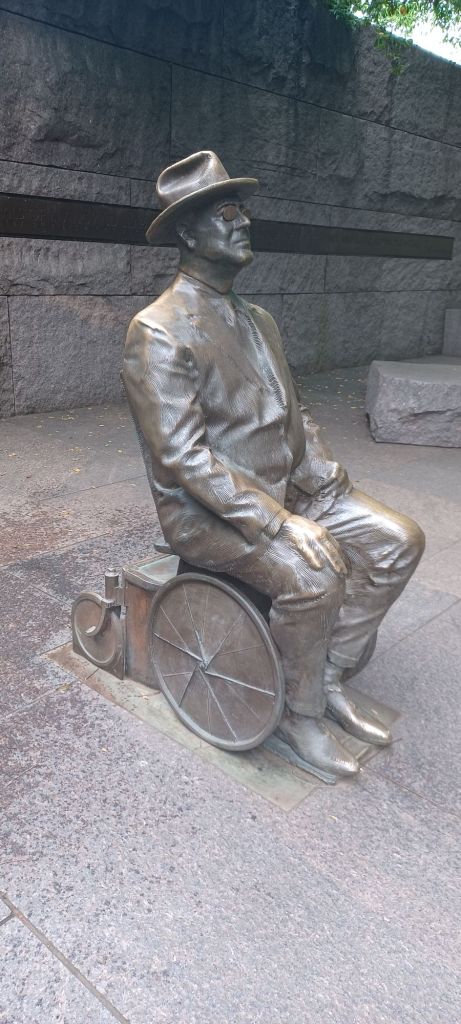
We went onto the Rock Creek Parkway, past the Watergate and the Kennedy Center, and then we wandered around south of the Mall and parked near the Franklin Delano Roosevelt Memorial, which they hadn’t seen. We parked the car, and spent maybe 20 minutes at this large memorial; they were duly impressed.
Digression: when we looked to park for the FDR memorial, something seemed off. First, it was that there were twenty or more police cars parked on the road. Second, the police cars all looked like they were 30 or 40 years old. It turns out that it is a police appreciation week of some sort, and these cars were driven here as part of the celebration. I was told by one of the drivers that each of the cars was privately owned – they came from New York, California, Ohio, Massachusetts, Pennsylvania, Illinois and I am sure elsewhere. I only took one picture, thinking I would take more but when we left the FDR, they were all gone. Like it was all a mirage.
Back in the car for more touring. SW DC – the Wharf, Arena Stage, the Mies van der Rohe apartments, Buzzard Point, Ft. McNair, Audi Stadium. SE DC – Nationals Stadium, the new Navy Yard area, the Navy Yard itself, the path on the Anacostia. Then Capitol Hill including Barracks Row and the Marine Barracks, and on up to H Street and the streetcar, Gallaudet University, and Union Market, where we had a nice, casual lunch.
After lunch, I drove up New York Avenue to 7th Street NW, and went south, showing them the Convention Center, the arena where the Wizards and Caps play, the National Portrait Gallery and Chinatown. I dropped them off at the Natural History Museum, the one Mall museum still on their to-do list. It was a little after 2 p.m.
OK, so first the Boy Scouts decided you could be a Boy Scout if you were gay, and then they decided that you could be a Boy Scout if you were a girl, and now they aren’t Boy Scouts anymore, they’re just Scouts. But – I think the official organization is still the Boy Scouts of America, or rather Scouts BSA, which is sort of silly. Am I right?
Who’s the loser in all of this? The Girl Scouts? I haven’t seen that the Girl Scouts are welcoming boys to join. Or that it’s even under consideration.
And then there are the question of those who are non-binary. They can be Boy Scouts to be sure, but can they be Girl Scouts? (I don’t really care about this question, by the way)
Somehow, it is clear to me that there is something wrong with this picture. It’s confused. And it’s a sign of the times.
Digression #1. I decided to make a list of the U.S. presidents who were Eagle Scouts. So I looked it up. Here is the list.
Gerald Ford
End of digression.
From the start of this post, you are probably thinking that it is going to be a post about Scouts (boys, girls or otherwise). But, no…….it is about being prepared. Because, with all of the changes, “Be Prepared” remains the motto of Scouts BSA. Unchanged.
And I am thinking about how necessary it is to be prepared. You and me.
First and foremost, we have to be prepared for a Trump victory in the 2024 presidential election.
Second, we have to be prepared for the failure of Israel to eradicate Hamas, and the loss of international respect for the Jewish state.
Thirdly, we have to be prepared for a Russian victory in Ukraine, and further Russian incursions into NATO countries at a time when Once Again President Trump wants to pull us out of NATO.
Fourthly, we have to be prepared for a total disruption of the world’s climate, leading to the collapse of power grids, the flooding of coastal areas, the drying up of vast amounts of now marginal land, and the continuing migration of desperate people from south to north.
Fifthly, we have to be prepared for …………I think I should stop here.
The thing is that we would not have to live through any of this if we just used our common sense and worked together to solve or mollify so many of the world’s problems. The only reason we can’t do this is that we are members of the human species. And, it appears, there it no getting around that. We need to embrace it.
So, for that reason, I am not trying to write a depressing post. I want us to embrace our humanity. And embracing our humanity means in part recognizing that many or most of us are irrational beings prone to believe that we are going to be saved in an afterlife, or that bad things really don’t happen to good people, or that – whatever clan or group is ours – all the other clans or groups are out to get us. Or that what happens to them won’t happen to us, and therefore it’s OK. Or that, if we can only earn enough money or garner enough riches, we and our loved ones will be just fine.
None of this is true, of course, and maybe we all know it. And it’s our reaction to knowing it that makes us act so irrationally.
But we can’t let it get to us. We must be prepared. Be prepared to let it be, because one day – soon or not – things will change again. That’s something you can bet on for sure, even if you won’t be around long enough to see it happen.
By the way, I am not saying that you should not fight against trends you think are harmful. You should. Of course. But while doing so, you have to recognize two things. One: you might lose the fight. So….be prepared. And Two: you might win the fight but lose the war. After all, there are unintended consequences to everything, as I hope we have learned by now. So….be prepared.
The Chinese are very smart (that’s a generalization that may or may not be true). We have misinterpreted some of the things they have said. For example, we think that “May you live in interesting times” is a curse. I don’t think so. I think, in fact, it’s a blessing. Embrace it.
One last thing: I give myself very good advice, but I very seldom take it. (And that has nothing to do with the Chinese.)
Last night we saw the film “Who Are The Marcuses?” at the Jewish film festival here in Washington. I will tell you who they are. They are the remarkable couple who gave more than $500,000,000 to Ben Gurion University of the Negev several years ago, the largest gift ever made to an Israeli institution. I was involved with Ben Gurion University for a period of about 20 years when I was a board member of American Associates, Ben Gurion University of the Negev, and for six of those 20 years, I was the organization’s treasurer. I have been to its campuses in Beersheva and Sde Boker 8 or 9 times, and only once to its campus in Eilat, on the Red Sea. I never met the Marcuses, but I do know their daughter Ellen quite well, who served with me on that board.
The film was made a few years ago and, particularly with COVID and all, and because I left the board a few years ago, we had not had the opportunity to watch it until last night. While I cannot tell you what I would have felt about the film if I didn’t have the background that I do have, I can tell you that I was disappointed in the film when I saw it.
First, the story. Then, my disappointment. Howard and Lottie Marcus were both refugees from Germany, each of whom left the country shortly after Hitler came into power and wound up in New York City. Howard was a dentist, who was able to establish a practice in New York. Lottie was a young woman who was able to gain employment, make friends, and create an active life in her new country. They met. They married. And Howard’s practice began to earn him a good living, and he wanted to set aside some money to save for the future.
Benjamin Graham was a British born Jewish economist who became a mentor to a young man from Omaha, Nebraska named Warren Buffet. Graham was also a friend of young Lottie; they were both members of a New York based ski club. Graham became a dental patient of Howard Marcus. Marcus knew of Graham’s reputation in finance and asked him how he should invest his money. Graham suggested his young protege, Buffet.
The rest is history. The Marcuses began investing money with Buffet shortly after Buffet began helping people invest their money, kept doing so, and never touched the money they invested. It grew and grew.
Meanwhile, Howard kept up his dental practice, although the Marcuses at some point decided to move west, and relocated to San Diego. They had only one daughter, Ellen. They lived very modestly.
At some point, as the Marcuses aged, their estate lawyer said that they had better plan what they wanted to do with their money, and learned that they had never discussed their financial situation with their daughter, by then a mature adult. You can imagine how surprised she was to learn that her parents’ estate would be worth several hundred million dollars. She told them that, while she wanted them to leave her enough so that she would never starve or be homeless, and the same for their one granddaughter, that she did not want to have to deal with hundreds of millions of dollars, and that they should find a place to give it away.
Eventually that led to Ben Gurion University, a growing and progressive university in Israel that, among other things, was at the forefront of the study of water resources and water recycling as a necessary key to the future of humanity. And eventually, the Marcuses made this enormous gift to the university, which had to wait patiently because both of the Marcuses lived long lives, Howard living to 104, and Lottie to 99.
It’s a wonderful story. But what about the film? The main problem with the film, I thought, is that it tried to do too much, which would have been impossible even if Cecil B. DeMille had directed the film. And Cecil B. DeMille did not direct the film.
“Who Are The Marcuses?” tried to do at least four things: (1) tell the story of the Marcus family and their gift, (2) tell the story of water research and accomplishments not only at Ben Gurion University, but throughout all of Israel, (3) tell the story of modern large scale philanthropy and its importance, and (4) tell the story of the University in general. Talk about biting off more than you can chew!
Yet the film provided a teaser for all of this. Stories and photos of the Marcus family, largely narrated by Ellen. Stories about Israeli water management, largely narrated by Seth Siegel, the author of the remarkable book, Let There Be Water, which really does tell the complete story. Stories about large scale philanthropy in general, largely told by Warren Buffet, who spoke warmly of the Marcuses and much more. And stories about BGU, told by three University presidents, Avishai Braverman, Rivka Carmi and Danny Chamovitz. as well as a number of BGU faculty members, and Doug Seserman, the executive director of Americans for Ben Gurion University.
You can see why I can’t tell how someone unfamiliar with these topics would react to the film. From my perspective, knowing a fair amount about each topic, all I could think about is how much better and more completely each story could have been told.
But maybe for someone new to all of this, the movie would have been an eye opener. For that reason, I absolutely think you should see it the next time you see that it is playing near you. I always want people to understand what an important place BGU is, and this film at least gives you a hint of that.
I don’t mean to be too hard. There is nothing in the film that I disagreed with. I just wish it would have been better. Maybe, for me, that feeling would have been inevitable, irrespective of whether the film succeeded for others.
If you read this blog on a regular basis, you may know that I attend a breakfast meeting every Thursday (sometimes live with real food, sometimes each to his own, on Zoom) with about 30 or more men, all about the same age (if you consider 70-100 the same age). Each week, one of us makes a presentation on a subject of our choice.
You may also know that I attend a breakfast meeting on most Friday mornings, with a smaller and less cohesive group, a breakfast sponsored by my ex-law partner of 20 or so years. These sessions have a guest presenter.
This week, I had both meetings, and each of them told me some things I didn’t know.
The Thursday presentation was about 19th century photographer Eadweard Muybridge. You may know Muybridge, who was born in England in 1830 and died there is 1904, although he spent almost all of his adult life in the United States. He is known for his sequential photographs (at least that is what I call them), mainly of horses and people, where you see a series of photographs, taken one shortly after another, so that if you flip the pages they are on, they almost look like a primitive motion picture. Indeed, some regard Muybridge as a founding father of motion pictures.
His series pictures included running horses (he was able to actually show how horse legs moves during faster gaits, something that cannot be caught by the naked eye), and people (often nude, and including himself, which were accepted during a rather prudish era because of their scientific interest. He also photographed nature (as Ansel Adams would do much later), and made stereopticon photos, able to be watched through stereopticons in three dimensions.
But I never thought how these sequential photographs were made. It turns out that the famous horse photographs were made using 24 sequential cameras, set at a very fast shutter speed, and timed to go off within something one and a half seconds of each other, all operated automatically. Quite an achievement for 1878.
Muybridge was an interesting guy. He early went to San Francisco where he was a book dealer, but left shortly after he learned that his wife was pregnant and he was not the father. Why did that require him to leave town? Because he shot and killed his wife’s male friend during a card game, was arrested, and tried for murder. There was no question but that he fired the shots that killed his rival, but he was acquitted at trial on the basis that the murder was justifiable. I guess that’s the way things were in those days.
His departure ended his book selling days, and that’s when he became interested in the still new art of photography. And, his career mushroomed, his innovations in his new field multiplied, and his murder trial was apparently simply forgotten.
The guest at my Friday breakfast meeting was Katie Frohardt, the Executive Director of an organization called Wild Earth Allies. I had never heard of Wild Earth Allies, and was amazed at all it seems to be doing.
Frohardt, born in Connecticut, schooled in Virginia and back in Connecticut, married and moved to the DC area. Her new husband, working for the United Nations in the mid-1990s, became part of a team working to help Rwanda recover from its 1995 holocaust, and Katie, not wanting to be a new bride left at home, got a job with US AID, also in Rwanda, where they lived and worked for a few years.
Sometime after their return to the United States, and after she had a variety of jobs related to her field of land use planning and conservation, she founded her current organization to work on specific projects around the world, providing technical help to other local organizations involved in worthwhile projects. She talked about some of these projects, including projects still in Rwanda to conserve certain wild animal species such as silverback gorillas, and in the neighboring Democratic Republic of Congo (working with Grauer’s gorillas and with blue monkeys (previously thought to be extinct). But they are also working in the United States (she gave as an example work being done to restore the Great Cypress Swamp in Delaware) and in Belize (where they have been working with fishermen to keep tortoises from being caught in fishing nets), and in Cambodia (preserving the forest habitats of Asian elephants) and elsewhere.
What a fascinating group of important programs assisted by an organization with only 8 employees in its home office. Frohardt is an excellent spokesperson, and made many interesting points. One concerned animal poaching, obviously a major problem, but she didn’t talk about the problem, she talked about the poachers, who poach to make a living, and how expert they become on animal habitats and animal habits, and what great employees they make for conservation organizations once they leave poaching behind. As to the fishermen in Belize, they mainly fish for lobsters, and they use netting. It was discovered the small LED lights in their netting will both keep tortoises away and increase the lobster harvest; this is something now being tried in other places across the world.
This coming week? I don’t know about the Friday program yet, but I have been informed that the topic of the Thursday program is “Why, why not, and because”. We will see…….
There are a lot of people who flock to air shows. That’s not us. We have never even been to an air show. But once, ten or fifteen years ago, we were visiting our friend Joan Levin in her upper floor apartment on Michigan Avenue in Chicago overlooking Lake Michigan on the day of the annual Chicago Air Show. The show takes place off the city on Lake Michigan and, looking out Joan’s window, it was like we were part of the show. It turned out that the height of the planes and the height of Joan’s apartment were not too different, and we hardly had to raise our eyes to see each show entry just a few hundred yards from us. We had a great time.
But have we gone to any air shows after that? No, in part because we were spoiled by our vantage point in Chicago.
I read, though, that there was to be a 60 plane air show today, or if not a show, a flyby today, focused on the Mall and the Lincoln Memorial and the Washington Monument, but with the planes starting in Frederick MD and coming down the Potomac. The show was to demonstrate the history of general aviation (I wasn’t sure exactly what that meant). But we decided we would watch the flyby not by going down to the mall, but by stopping at the Palisades upriver from its journey through the heart of DC, but near our house.
The weather today is beautiful, sunny with fleecy white clouds, temperature in the 60s. We picked a spot which overlooks the Potomac below and where there is a space to watch between the green trees which block a view of much of the river. There were several others who picked the same spot and we stood there for about an hour watching the planes go by.
I can’t say it was an exciting hour. But it was very, very pleasant. Apparently, there were 56 planes, including several old biplanes, three helicopters, a sea plane or two, both single engine and double engine planes old and new, most flying solo, but several following each other closely, and three three-plane formations. A nice way to spend a little time on a pretty day.
The Palisades is part of the regular flight path to Reagan National Airport, and before the show began, we saw the planes flying away from the direction of the mall. Then, the planes from National stopped flying, even though the flyby planes were flying at a much lower altitude than today’s jets fly. When the show was over, the jets began to fly again.
Then, we decided it was lunch time. About 1:30 or so. Where to go? We wanted somewhere we could eat outside, and I remembered that we weren’t that far from Pralines, a restaurant over the line in Maryland, and there we went, eating on their large outside and very flower bedecked grill. The last time we had eaten there, we had dinner with friends that was excellent. When was that? Last summer? The summer below? At any rate, today was a disappointment. We had lunch, not brunch. I had a chicken pot pie (something I order now and then, and used to order a lot when I was really young), and it was OK, although the crust was not really edible. Edie had a salad Nicoise (the large, not the small), which had about two tablespoons of tuna, two pieces of potato, one and a half (I think) anchovies, several string beans and a lot of lettuce. Just not what you’d expect.
From there, we went to the Italian Bar, up the street from our house, for espresso and gelato. And then home.
A nice Saturday. Now relaxing with the Nationals-Red Sox game on (the Red Sox are not wearing red socks). We have house guests this week from Israel, and they will be our supper companions.
A little off the beaten track today. I mentioned a week or so ago that I had picked up a book titled News is Where You Find It by a journalist that I had never heard of, Frederic William Wile. Wile was born in La Porte IN in 1873 and died in Washington in 1941. The book was published in 1939 and is a memoir, with the first few chapters devoted to his childhood and education and the remainder to his career. The book is close to 500 pages long, and I have read the first half. I found the book so interesting that I am writing about the first 250 pages today. These 250 pages end with the start of the First World War, when Wile was in Berlin as a correspondent for American and English newspapers.
La Porte is in northern Indiana. In 1873, it had about 6000 residents (today about 45,000). Wile’s father, and some of his Wile relatives wound up in La Porte, where his father became a small town banker and someone active in local political affairs. Wile was the youngest in his family – his oldest brother was about 15 years his senior. His father had been born in a small town in Germany and, like many other Germans, came to the United States in 1848.
Surprising to me his father (and his mother, whose last name had been Guggenheim) was Jewish, and was active in the local synagogue, where he was the “reader”, presumably because he had had a Jewish education of some sort in Germany. In 1939, when the book was written, the synagogue was already struggling. There is no longer a synagogue in La Porte (the closest is in Michigan City IN, only about 12 miles away), but there is a cemetery in which Wile (as well as his wife and parents) are buried. And, by the way, the history of the Wile house in La Porte, built in 1861, is written up on the website of Preserve Historic La Porte. The website also tells you that the Guggenheim house was right next door.
In spite of being Jewish, Wile was sent to Notre Dame for college. South Bend is only about 40 miles from La Porte, so that’s not surprising. What is surprising is that, according to what I gleaned from the book, anti-Catholic feeling in northern Indiana was much stronger than anti-Jewish feeling and that Notre Dame (founded exactly 100 years to the day before the day I was born) was having difficulty buying property to expand its small campus. Fritz Wile’s father to the rescue – he bought the property in his name and later transferred to the school, thus thwarting the opponents of Catholics in Indiana.
It was also surprising that Wile was not the only Jewish student at Notre Dame in the 1890s. He says there were six in a small class, and that (although they were required to attend chapel), there was no proselytizing and no antisemitism visible amongst the faculty or student body. Throughout his life, Wile remained loyal to Notre Dame and close to his classmates and teachers. He praised Catholic liberalism generally.
Enough of that. Based on his life story, Wile must have been a charmer. He always wanted to be a journalist, and although his first job in Chicago (the magnet for all those growing up in La Porte), he soon talked himself into a stringer position with a local newspaper. The deal was basically for him to cover a small local story, turn in copy, and if the story was used, he could become a regular stringer. Not much, right? But it was something. He excitedly covered the story, wrote it up, sent it in and, without one word being changed, it was printed on the first page of the newspaper. He never looked back.
After several years in Chicago as a cub reporter, he was called into his editor’s office one day. Feeling he did something dreadful, he was shocked when his editor said that he wanted to assign him to London, where the paper’s correspondent had said that the work was too much for one man. It was the middle of the Boer War and a lot of news was coming out of England. Within a few days, Wile – who had not been east of South Bend in his life – was on his way to New York, then on a boat, and then in England. He was in his mid-twenties.
One of the things that amazes me about Wile is his ability to talk to anyone and get them to speak back to him. He also (and this is clear from the book itself) was an extraordinary writer, and had an amazing memory, as he soon learned to interview without a notebook. And he had another talent – he was always in a place where something was going on, and where he encountered people on a regular basis that others only read about.
Take the ship carrying him to England. Who else was on this regular commercial liner? Well, for one, John Philip Sousa, traveling not alone but with his entire band on the way to their first European tour. And then there was Henry Adams, and the president of U.S. Steel, Charles Schwab (no, not the Charles Schwab who advertises on TV today), and others, all of whom he met. And when Wile met someone, he remembered them later and, more surprising, they remembered him.
He stayed in England several years and then was transferred to Berlin, where he stayed for 14 years, until the war broke out. The book talks about his time in both countries – his personal activities, his professional work, and what generally was going on in that part of the world.
He interviewed everyone. Take, for example, Mark Twain (Samuel Clemens, of course), whom he met in 1900 in London, and to whom he devotes seven pages in his book. Twain, the 65, spent the summer of 1900 being idolized in Britain, and was staying at the elegant Brown Hotel in London. Wile arranged to interview him, showed up at the hotel, but was given a note by the concierge that said “Will Mr. Wile please come to 26 Eaton Square? SLC”.
Taking a hansom cab (this was 1900 after all) to that address, he was surprised to find that it was a “Swedish massage” establishment and that (and I quote) “a liveried doorman said that Mr Clemens was waiting for me, and would I mind walking right up to the second floor, where he was receiving his daily treatment? There, in a morgue-like room lay the great humorist, prone, on a marble-slabbed table and naked as the day he was born, the while a muscular Norseman pawed him vigorously and rhythmically from head to foot, as Mark obliviously pulled and puffed on a strong cigar. We shook hands, and he smilingly apologized for so unconventional a reception of a reporter.” The interview (including a walk through Hyde Park) went on from there. Clemens told him that the book of his he thought was the best was Huckleberry Finn.
Another interview which I enjoyed reading about was his brief meeting with J.P. Morgan, who was apparently someone who never agreed to be interviewed, who was genial and smiling, told him nothing whatsoever, walked him to the door, still smiling, asking Wile to give him a call the next time he was in New York to speak with him again. And his interview with the Swedish king, a man who also never had one on one interviews with foreign reporters. That interview started with King Haakon saying: “What shall we speak today – English, French, German, Italian, Russian, Japanese or Spanish? You see, I know them all…….”. And there were so many more.
But the culmination of the first half of the book was the beginning of World War I on July 25, 1914. The heir to the throne of the Austro-Hungarian Empire had been murdered in Sarajevo by two Serbians. Austria gave an ultimatum to Serbia (apparently written in conjunction with Prussia, which had been building up its military for a number of years), containing a number of demands. There was concern that if Austria invaded Serbia, the Russians would jump to Serbia’s defense, and that the Prussians would then feel obligated to defend Austria, and the French would jump in to help their Russian ally. Whether England would enter such a war was unclear. But we all know what happened.
Apparently (and I did not know this), Serbia agreed to all but one of the Austrian demands, and that was satisfactory enough to Emperor Franz Josef to call off any plans of invasion. But now, once again, fake news takes the foreground. Perhaps because the Prussian War Party (as Wile calls it) was just looking for an excuse to show its muscle and win a quick victory, the Austrian position was not reported to the people of Berlin. Berlin was told that Serbia had rejected Austria’s demand and that war was imminent.
I quote again: “My long standing preconceptions of Berlin as the phlegmatic capital of a stolid people were obliterated for all time at eight thirty o’clock on Saturday evening, July 25, 1914. Along with them went equally cherished beliefs that, however incorrigible the War Party’s lust for international strife, the German masses were pacific by temperament and predilection. As soon as the news of Serbia’s alleged rejection of Austria’s ultimatum was made known, Berlin gave way to a babel and pandemonium of war frenzy probably never equaled in a civilized community.” And, again the rest is history.
I will leave it here for now, only to say that my chance encounter with this unknown book by a today unknown journalist was an extraordinary find. I am confident that the second 250 pages will be just as informative and enticing.
Remember the scene from “Fiddler on the Roof”? I don’t remember the precise context, but Tevye, responding to the opinions of others said to one “you’re right” and to another espousing the exact opposite “you’re right”, forcing a third to say “they can’t both be right”, to which Tevye said “you’re right, too”.
In general, people seem to lack what I would call “subtlety of thinking”. In other words, you can be on one side or another, but it’s very difficult to find that both sides are right, or equally right, because if both sides of an argument have their points, what’s the next step?
Isn’t this the situation that we find ourselves in regarding the Israel-Hamas situation? Everyone must have a side (or remain completely disinterested), and must self-identify with that side. No one can say: we have a big problem here, let’s not take “a side”, let’s figure out how to solve the problem.
We see how taking a side can be existentially dangerous. “If you take “their” side, then it shows that you are rotten to the core. Period.” And you know where that can lead.
And there are, of course, always victims. Here, the people of Gaza. I will make an assumption. A significant percentage of the Gazans hate Hamas, a significant percentage support Hamas, and a significant percentage just wish the whole issue would disappear. I don’t know how to define “significant percentage” in these three categories, and don’t believe anyone else could. And of course, identifying how specific individuals think is impossible, and their thinking might change day to day, or week to week. But I will make another assumption. Virtually all Gazans hate Israel.
One would hope that the American position would be “secure Israel, stop the fighting, support the population of Gaza”. But that is a position that requires one to stop thinking that you have to identify with one side or another. And it doesn’t look like this is going to happen.
So, let’s look at it another way. What are the goals of each side? Does Israel simply want to go back to October 6 and before? Does Israel want to eliminate Arab control of Gaza? Does Israel want a workable two state solution? We do not know what the answer to this question is. Israel (and I speak of the government, not the people) wants to “destroy Hamas”. But what does that even mean? And how is that even possible? There are many in Israel who believe that security of their country is impossible as long as Arabs control Gaza. They are right. And many who think that you can’t secure Israel as long as the occupation continues. They are right. And there are those who say they are both right, and they are right, too.
On the other hand, clearly people in Gaza want political freedom. But what does that mean? Do they want to be governed by Hamas? What today is the alternative? Maybe there isn’t one. Do they even think of the possibility of a joint free state with the West Bank, split in two by the State of Israel?
The Palestinian authorities say that about 35,000 Palestinians have been killed in the war, and that 2/3 are women or children. We don’t know if these figures are correct – and some question the 2/3, but I don’t. Look at it this way – half of the adult population are women, and 50% are 18 or younger, so if you take the 50% younger and half of those older than 18, 2/3 is actually a modest number.
But this is not what I even wanted to talk about today. I wanted to talk about Americans. I have so many questions that I can’t even narrow them down and ask them in a sensible manner. Neither can anyone else, I am afraid.
So what’s a president to do. We don’t want to be complicit in increasing the number of Palestinians killed and wounded. We don’t want to be complicit in keeping food and health care from the Gazan population. But we don’t want Hamas to come out of this war with control over Gaza. What is a president to do?
And what about Jewish Americans? Where does their loyalty stand first? With Israel or with the U.S.? That’s a real question. Think of all the American Jews who cast their American votes based on candidates’ positions on Israel, for example. Are they right? For many, Jews are a fifth column in the United States, influencing American decision making to benefit a foreign country. What if they are right, too?
Israel wants American Jews to identify with Israel. Israel wants to be a “Jewish” state, irrespective of the 20% non-Jews who are citizens of the country. Palestinians (and others) want the area of Mandate Palestine to be a “Muslim” state. Most Muslims have voted Democratic, and most Jews have voted Democratic, but now things are split – a significant portion of the Democratic party is coming out on the side of the Arabs, and a significant (very significant) part of the Republican party is coming out on the side of the Jews.
Joe Biden, at first known as a president extraordinarily supportive of Israel, is now seen differently, if he decides to withhold weaponry to Israel if it is to be used against civilians in Gaza. But who are civilians, and how can we tell another country how to use weapons we supply them once we supply them? We can’t run Israel’s war strategy. And we want to protect Israel.
Those who favor sending arms to Israel are correct. Those who favor conditioning arms on not further harm to the civilian population are correct. Those who say that they both can’t be correct are correct. What’s a poor president to do?
We need an internal discussion that does not “take sides”, that has a goal of creating peace. The multinational conversations going on in Qatar and Cairo don’t seem to be doing this. That’s in part because Hamas finds itself benefiting from the chaos, and apparently doesn’t mind how many Gazans will be martyred. And they certainly seem to have no desire to return any hostages, most of whom are probably dead, anyway.
Months ago, I said that we need a multi-Arab coalition (supported by the United States) to go into and take control of Gaza, run it as a UN mandate, perhaps, and take control from Hamas. As long as Hamas remains in power, there cannot be true progress, and I don’t believe that Israel can eliminate Hamas. But if a united Arab organization takes control, perhaps under the auspices of the Abraham Accords, peace can be attained, and we (all of us) will have time to sit back and really plan out the future. But to expect the Palestinian population to organize itself and overturn or even replace Hamas is pie in the sky. Not going to happen.
I understand I am just rambling on, and these paragraphs are not necessarily even connected to each other. But……that’s the purpose of a blog, isn’t it?
For past 35 years, Washington’s Adas Israel Congregation has hosted an annual program titled “Garden of the Righteous”, each year honoring some individual, group of individuals, who hid or saved Jews during the Nazi years. There is normally a ceremony, followed by the dedication of an inscription on a bronze marker set in an actual garden on the Adas Israel lawn, on the Quebec Street side.
In years past, the Garden of the Righteous program was often held in conjunction with other programming, and the agenda included a role for Adas Israel religious school students to participate. This is no longer the case, and the programs now are generally stand alone programs held typically on a Sunday afternoon. Each program is informative and extraordinarily uplifting, but for whatever reason or reasons, attendance has fallen off. The program this past Sunday, for example, had perhaps 50 attendees in addition to those who had a place on the agenda. Something needs to be done.
Of course, time is running out. The Holocaust ended in 1945, and next year that will be 80 years ago. So while some Jewish survivors, who were young at the time, still live, I would guess that none of the actual rescuers do. So now, the honors generally go to the children and grandchildren of the rescuers, and sometimes to the children and grandchildren of those rescued as well.
This year, the honors went to the van Damme family of Antwerp, Belgium, and the daughter and son-in-law of one of the rescuers came over from Antwerp for the occasion. There was also one of persons saved by their family – a now 95 year old Washington area resident, who was a teenager during the years of World War II. He gave a stirring (if a bit long) account of the story, thanking not only the van Damme family, but also several other Belgian families involved in the rescue.
Hirsch Grunfeld, his parents and younger brother lived in Antwerp, and in 1941 and 1942 were in grave danger as the occupying Germans, with the help of Belgian collaborators, were rounding up Jews and sending them east to extermination camps. Hirsch was 15 at the time, and his brother was 9. Young Alice van Damme girl (who was 22 at the time) witnessed a round-up and decided that she had to do something. What gave her the courage to actually do something, who knows? Those who were involved in hiding Jews or other resistance activities became involved for various reasons, sometimes reasons actually unknown to themselves or surprising themselves. But they put their lives at grave risk (and this is of course not an exaggeration) and went about their business.
Alice van Damme sprang into action, got in contact with the underground in Antwerp, and convinced her extended family to take in and hide Jewish children from two families, the Grunfelds (the parents, and each of their sons being hidden in different places) and another. All of the Grunfelds survived the war.
If you go to this website: https://www.adasisrael.org/garden-of-the-righteous you will see the stories of all 35 honorees, starting with Jan Karski, the famous Polish diplomat who traveled back to Poland and sneaked into Auschwitz in disguise, and then tried to warn the Americans as to what was happening, and running all the way to the van Dammes.
The programs themselves generally go beyond a “thank you” and a presentation by someone who was rescued. This year the program included a very fine talk about a counselor from the Belgian embassy, and a full musical program by soprano Lilly Arbisser and pianist/musicologist Malignan, performing pieces composed by Jewish composers murdered in the Holocaust.
It was a special program, and the fact that a total audience of about 70 (20 of whom were participants) was a shame. The website says that the program was live streamed. I assume this means that a recording will soon be available for you to watch. I suggest you do and that next year, if you are in the vicinity, you attend. You won’t be disappointed.
I don’t like being late with putting up a post. But it happens on those days when I am busy all morning, and didn’t have time to write one the night before.
Actually, I had a topic, I was going to write about, but I think I will postpone it to another day, and talk about antisemitism. I have done that before (my general themes being (a) Jews sometimes falsely identify a comment as antisemitic, (b) I don’t think that criticism of Israel is necessarily antisemitic, and (c) we are not living in 1933 Germany because we have a government that is supportive of us, not against us), but I am going to look at things a bit differently today.
And that is because of something I heard yesterday.
A digression: My vocabulary fails me. As I understand it, a podcast is something that is audio only, and if it is also on a screen, it’s a video cast. Is that correct? I actually am not certain. But I tend to listen to programs on YouTube through Bluetooth in my car when I am driving a distance of 30 minutes or so or more. It’s a video cast, but I don’t look at it (for obvious reasons), just listen to it. So what am I doing? Am I listening to a podcast, or am I listening to a video cast, or is there still another way to describe it?
At any rate, yesterday I heard a talk by Rabbi Yossi Goldman, who was speaking to the Jewish Learning Institute. The Jewish Learning Institute, as you may know, is a Chabad entity, run out of Brooklyn, and puts out educational programs through the Chabad world. I have not heard very many of their programs and don’t seek them out, but Mr. YouTube thought this is one I might be interested in, and he was right.
Yossi Goldman, born in New York, is an Orthodox rabbi and was (or maybe still is), a Chabad rabbi. He was apparently the first Chabad rabbi in South Africa, where he lives, but at some point became a large congregation’s rabbi in Johannesburg, and I think he is still there.
Second digression: South Africa has a substantial Jewish population, although it has diminished over the past several decades. Religiously, it is by and large Orthodox. Ethnically, it is by and large Lithuanian. The synagogue that Rabbi Goldman leads is in a suburb of Johannesburg, the Sydenham-Highlands North Hebrew Congregation.
Third digression: Correct me on this if I am wrong, but this is what I think I heard and when I googled it, it seemed accurate. During the COVID pandemic, South Africa closed all religious institutions to in person services. Everything was done remotely. A couple of years ago, this was relaxed and in person services were permitted under two conditions: first, that everyone is masked, and second, that no more than 50 persons can attend a service. Goldman said that, in his shul, he has 50 live congregants and 1400 seats.
Okay, here goes:
Basically, Goldman says that there always has been antisemitism, and that there always will be. Not that it isn’t important to fight against antisemitism, but the battle will never succeed in actually eliminating it (that reminded me of trying to eliminate Hamas, but that’s another story). So, he says, get used to it being there, and don’t let it get you down. Instead, he says, hold your head up, be proud that you are Jewish and continue to do what you can to better the world. You can’t control what other people do when all is said and done, but you can control what you do.
As to why there is antisemitism, he concludes that you shouldn’t look at what people say, because their reasons are just excuses. He says that there is one reason for antisemitism, and that is that Jews irritate other people. That’s because they are never satisfied with what is, and are always the prime voices behind what could be, or what should be. Moving back to South Africa, for example, he pointed out that when Nelson Mandela was arrested in 1963, there were others arrested at the same time. These others included (he didn’t name them in his talk) Lionel Bernstein, Denis Goldberg, Arthur Goldreich, Harold Wolpe and Bob Hepple, all Jewish.
He said that it isn’t surprising that in Soviet Russia Jews were accused of being bourgeois and globalists, and in America, they were accused of being Communists. In each situation, Jews were irritating the power structure.
Goldman concludes that being irritants is part of the mission of the Jews to improve and better the world, and that irritants were always be opposed by those they are irritating. So, he concludes, antisemitism must be fought, but we must expect it to be with us forever.
Now, it’s not that I agreed with everything Goldman said. He thinks, for example, that all anti-Israel speech is antisemitic. I don’t agree. But he thinks that Jews are irritants in the Middle East (and need to be), just as they were irritants to the Nazis in Germany in the 1930s. That’s just the way it is, and always will be.
You may want to listen to or watch Goldman’s speech. It’s called “Why the Jews?” and I found it on YouTube.
Here we are, living in 2024, our senses bombarded with fake news, conflicts on our border as some people are trying to get in and others trying to stop them, and – for these and other reasons – everything seems topsy-turvy.
I have a collection of over 700 Penguin paperbacks from the 1930s to the early 1960s, and, during COVID, I read them to the virtual exclusion of any other books. I read, I think, about 150 of them and then stopped. But I just read three more. Two were re-reads (not from recent years, but from years long past) and one was new to me. What did I discover? Fake news, problematic borders, and a topsy-turvy world.
The books were first written in 1872, 1914 and 1936,but we’re all set in the late 19th century. Sure, that was a different time, but the problems then were like the problems today. Just on a different scale.
Let’s start with fake news. The book published in 1914 was by French writer Andre Gide and is called The Caves of the Vatican. I had not read it (or, to my knowledge, anything else by Gide before). I found the book fun, and assume that’s what Gide intended. I am not going to go through the entire plot – the book concerned three sisters, each of whom married a very different type of husband and, to that extent, it’s a family story. It’s also a crime novel – although the crime (a random murder that turns out to be not very random) does not occur until quite late in the book. But the story revolves around fake news, even in France (where it is set) and in 1890 (when it is set).
I will try to simplify and stick to the point. One of the three sisters is married to an odd businessman, who doesn’t seem to have much of a knack for business, and who is about as unworldly as you can get. Because the sisters inherited a good deal of money, though, she lives very well. One day, at her country estate, she is visited by a man who tells her that he has been sent to her by the Cardinal himself, and that he has a very important message that has to be delivered orally, and that requires absolute confidentiality – she cannot tell a soul. She agrees, and he explains to her the problem. The Pope (Pope Paul III) has been kidnapped by the Freemasons, and is being held in Rome in Castle San Angelo. The Vatican does not want the story to get out for obvious reasons, and the Freemasons have agreed to keep the kidnapping secret as well, provided that they get, by a certain date, a very large ransom that Church emissaries are trying hard to raise. He asks his hostess to help in this effort and provide him a significant donation. Of course, the donation must be made immediately, and it has to be made in cash, with nothing traceable to any financial institution. Of course, she agrees.
But also, of course, she tells her husband, who decides that he, too, must do something and what he decides to do is to set off for Rome to rescue the Pope. Why himself, who has never been out of the neighborhood of his estate in his life? Because, of course, the Pope must be rescued and he is blessed to be one of the only people in the world to whom this terrible secret has been disclosed. He can’t just sit there and do nothing.
See, even in 1890, purveyors of fake news existed (at least in Gide’s fiction), and the news spread, and the news was believed and acted upon with alarming consequences. (To find out more, you will have to read the book)
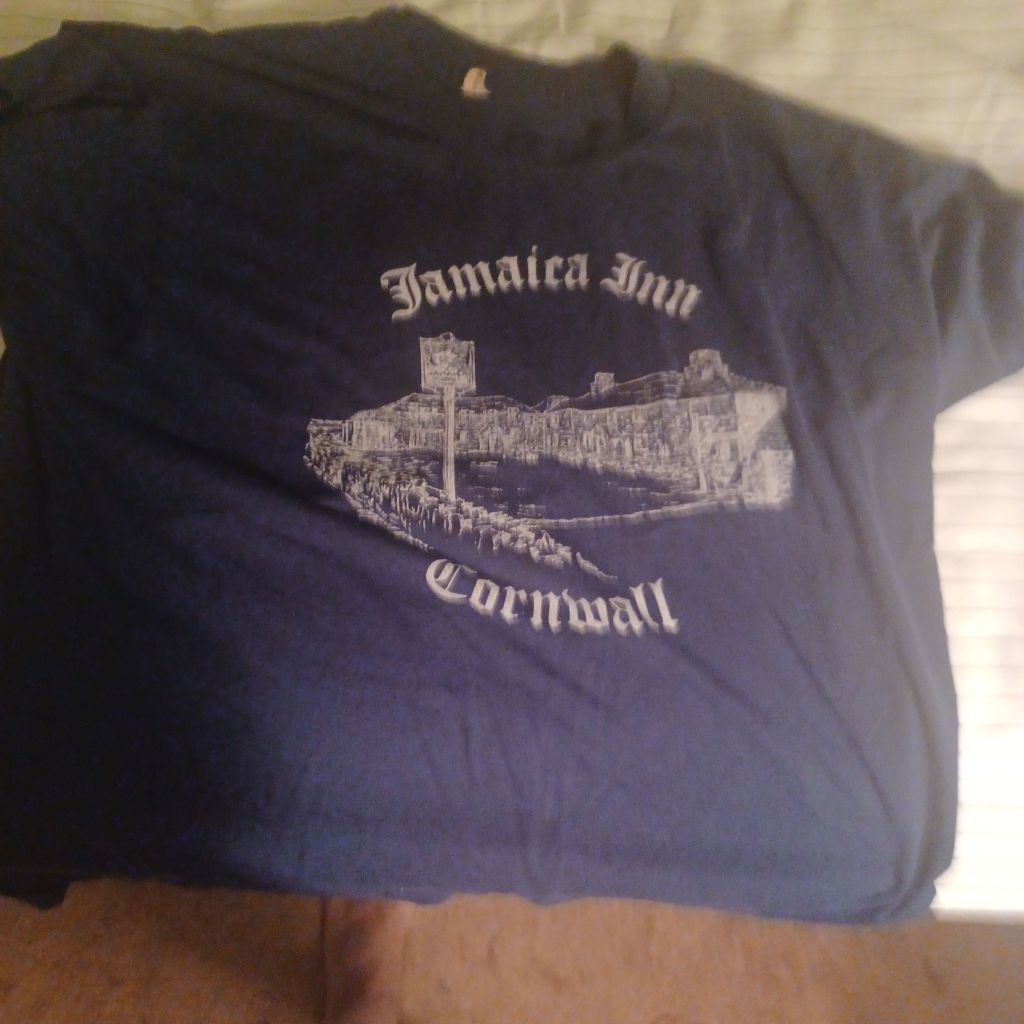
The second book, one that I had read before and like as much now as I did the first time through is Daphne du Maurier’s Jamaica Inn, which you may have also read. This is a story about border control, in Cornwall, the very southwest of England. Again, I am not going to give away the plot. I am only going to tell you that the inn called Jamaica Inn is set in the moors and is no longer frequented by travelers, but is instead the site of an enormous fencing and smuggling enterprise. Clearly, the local authorities cannot control it, try as they might, and clearly the national government cannot control the border in any meaningful way.
Of course, the border in Cornwall is not a land border, but a sea border, where ships come in and dock at will. There are all sorts of ships – some carrying stolen cargo or cargo to be smuggled into the country, and some holding families and other innocent travelers. The owner of Jamaica Inn, a very troubled and powerful man, is (it turns out) second in command of a group of men known as the “wreckers”. The wreckers go out to sea, capture ships coming into shore, take them over, drown all on board, take the cargo themselves and then sink the ships.
It is only towards the end of the book that the gig is up, not only regarding the guilty individuals who hang out at Jamaica Inn, but for others, because the government is beefing up its patrols. England will now protect its borders.
I understand this is not a perfect analogy to our border situation. In fact, it may not be an analogy of any type at all. But the point remains – at the time when the book is set (and again we are probably talking about late 19th century), border control was a problem.
By the way, if you have never read Jamaica Inn, I recommend it. It is a quick read (about 250 pages), and very engrossing, if a little too cute at the end.
A short digression. Jamaica Inn actually exists, or it did 30 years ago when we visited it, and is apparently the inn on which du Maurier based her story. Whether it was ever a hotbed of crime, I don’t know, but there is a history of maritime crime in Cornwall. After all, think of the Pirates of Penzance. They really did exist, doing nefarious things (and not nearly as comical as described by Mr. Gilbert), boarding ships, sinking ships, taking contraband.
OK, now the third book. I had read this one before and perhaps you did, too. It is Erewhon by Samuel Butler. When I read it so many years ago (high school?), I remember being intrigued as I started and then getting real bored as the book went on. This time……I had exactly the same reaction.
You probably know the general story. In a remote British colony, the story’s protagonist, a young man, wants to know what’s behind the mountains that no one (no “white” man) has ever crossed. He ventures out and after having an adventurous and lengthy multi-day hike, he finds himself on the other side of the mountain and in a world unknown to any Brit. A world of another civilization, in some ways much like his, in some ways totally different, and a civilization which – years and years ago – gave up technological progress as unnecessarily evil and harmful to society.
Yes, the only machines are in a museum and anyone found with a machine of any sort, or perhaps even a machine part, is guilty of a terrible crime. Why? Because the machines were dehumanizing, they became more important than humans, there was a belief that machines would get better and better and one day rule the world, rule human beings. They must be stopped before they get anywhere near that point.
But other parts of this society are very strange. People are punished for not being perfect, for example. You can be punished for poverty, and you can be punished for physical imperfections. And you can be punished if you get sick.
So no one will ever admit to sickness, will ever go to a doctor (I think there are no doctors), because if you become sick, you can be sent to prison, flogged or fined. Your entire family will suffer.
Of course, you may see this topsy-turvy world in different ways. It is totally opposite our society, of course. We don’t punish people who are sick or poor or physically unattractive or disabled, do we? Or….do we?
In any event, you get the idea. All societies are topsy-turvy. Even ours, and not only in the 1800s, when the world of Erewhon was discovered, but today. Especially today.
Final digression. When I was in Moscow in 1972, the Moscow that was the proud capital of a Communist country, I went to the circus. And the famous Moscow circus with dancing bears and all, was a one ring circus, not a three ring circus, so everyone was watching the same acts. And, at the mid-point, there was a break for a short, maybe 15 minute, skit.
The skit involved a beautiful little rural Soviet town where everyone was a Communist and everyone was happy. But then an Orthodox priest came to the village and tried to convert the people and especially the children, who in turn ridiculed and attacked him unmercifully. I was amazed. In the United States, a religious figure coming to a small heathen town would be a hero, right? Here it was just the opposite. Topsy-turvy. It was the best possible example of how societies can have opposite values, so opposite that when you – a member of one society – views another, you can’t believe what you see. It was a real life Erewhon, I thought, but called the Soviet Union.
For the past several weeks, the temperatures have been basically in the 80s, with an occasional jump to the 90s or decline to the 70s. Today, the high is expected to be closer to 55, and the hourly forecast for rain or drizzle winds between 50% and 65%. Okay, that happens. What’s the big deal?
The big deal is that this is Star Wars Saturday at Nationals Park and, because 3 1/2 year old Izzy is a Star Wars fanatic, we decided this would be a good day for a family outing to the baseball game – and we invested in six tickets. The game is at 4 p.m., and I think it’s 50-50 whether they are going to call it off. The reason is that tomorrow, although the temperature is supposed to climb back into the 70s, the chances of rain and the intensity of the rain are likely to be higher than today, and that game is more likely to need to be canceled.
But the problem is that this series is against the Toronto Blue Jays, an American league team that the Nationals don’t play very often. How will they reschedule two games in Washington DC for these two teams? For that reason, my guess is that they will go out of their way to get today’s game in – that means rain delays. And rain delays generally last at least 45 minutes each, because each time you have to cover and then uncover the infield with a tarpaulin. (Sign of age? It took me a while – “tarp”, I knew, but what is it short for? “Tarpolion”? “Tarpulin”? Or was that one of the lesser known emperors of Rome?)
What to do? (Talk about first world problems?)
Yesterday, I had a pretty free day. I started with my normal early Friday morning bakery trip to pick up our weekly challah, and then had a 9 a.m. Zoom interview with a potential new board member for the Haberman Institute for Jewish Studies. But other than that, nothing really scheduled until dinner.
I saw that the Reston VA library was holding its semi-annual sale and, even though it was Day 3 of the sale, I decided to take the drive. Reston, for those who don’t know it, was a planned city, about 20 miles west of Washington, still in Fairfax County, that was imagined and designed in the early 1960s by developer Robert E. Simon, who had an ego large enough to decide to name that place after himself. I remember the early days, when its survival was questionable, but where a town center and mid-rise apartments were built on the edge of a small but attractive lake, and middle and upper middle income housing subdivisions were carefully located nearby.
I remember that, when I started working at HUD in 1969, my direct superior lived in Reston and commuted to Southwest DC every day, something I then found astounding. I still find that commute astounding, although today, you can make the trip a bit easier (even considering much more traffic) either by taking a limited access toll road, or by taking the Metro (Reston is on the Silver Line that goes to Dulles Airport, about five miles further west).
Today, there is no question about Reston’s success. Its population is now over 60,000, and it’s skyline makes it look like a very successful mid-sized city. General Dynamics has its main headquarters in Reston, along with many other government contracting firms, especially those with a defense orientation, and Fannie Mae has a major facility there. It is no longer in the boondocks. (By the way, do you know that “boondocks” is a Tagalog word form the Philippines, and it means “mountains” and came into use in English as a remote place during the war in the Philippines at the end of the 19th century?)
At any rate, I went to the Reston library yesterday, and was a bit disappointed with the sale, perhaps because people already had two days to pick it over. I only bought two books, signed by the authors, and paid a total of $6.50.
The first is called Nofziger and it is from the early 1970s, a memoir by Lynn Nofziger, Richard Nixon’s and Ronald Reagan’s long time aid, and the man who John Dean said helped Nixon compose his “enemies list”. I met Nofziger once in what I would guess would have been the 70s. Nixon was no longer in office and Nofziger was working, I guess, as a consultant and had an office in an old town house, off Dupont Circle. I wish I could remember why I went to see him (it had something to do with my law practice, but I have no idea what) and was quite surprised. In those days, when lawyers wore two and sometimes three piece suits and every man seemed to wear a sport jacket, Lynn Nofziger had no jacket, just a dress shirt with an open collar. But more than that – he wasn’t wearing any shoes. He was in his stocking feet when he opened the door to meet me, when we spoke in his (quite elegant and comfortable) office and when he saw me out. That, I remember clearly. Why I was there? No clue.
The other book that I bought was one that I had never seen before or heard of. It was published by Bobbs-Merrill in 1939, is titled News is Where You Find It, and was written by Frederick William Wile, whom you have never heard of. Wile was a journalist – he passed away in 1941 – and I don’t (at this point) know anything about his career. But he had inscribed the book nicely and signed it, so I brought it home.
I must admit to some surprise when I opened it. Wile was born in La Porte Indiana in the 1870s. The first chapter, the only one I have looked at yet, told about his German father, who had immigrated to the United States in 1848 (no surprise there) from Binswangen, Germany. I looked up Binswangen (that’s what I do) and found it to be a very small town (under 2000 people even today) in the Rhineland. The Wikipedia entry says very little. In fact, all it talks about is its historic synagogue (spared by the Nazis from burning), now a community center, and the age of its historic Jewish community. That was it.
Going back to the book with this in mind, I was still surprised to see that his father was Jewish (as was his mother, a Guggenheim), and was a banker in La Porte and a founder of, and the “Reader” in, Congregation B’nei Zion in La Porte.
I have been to La Porte, located in northern Indiana, just southeast of Michigan City (on Lake Michigan), and never thought of it as a very interesting place, and certainly not as a center of Jewish life. I looked up Congregation B’nei Zion, and it no longer exists. In fact, it was already struggling when Wile wrote his book in 1939. But the B’nei Zion Cemetery is still maintaining its own (although it looks like it may not have had any burials in the past 15 years or so), and there are 18 Wiles buried in the cemetery, including Frederic William and his two parents.
In any event, I found all this very interesting. When I finish reading (re-reading) Daphne du Maurier’s Jamaica Inn, I am going to go right to it, and see if it’s worth reading (slowly or quickly) through. If so, I will dul report and Fritz Wile will no longer be forgotten.
By the way, as to Michigan City, still considered a good weekend retreat from Chicago, was the home of my great aunt Sophie and her large family of Kottlers. Not sure where any of them are now.
That’s it for today. Now back to thinking about the weather. Go, Nats.
Many of you remember when I posted on Facebook some of the conversations I had with Joan when she was younger – when she was between the ages of 2 and 5, to be precise. Then, I stopped, largely because her conversations with me became more grounded in reality, no longer as “cute” as I found them in her earlier years.
Well now, in just a few weeks, Joan will turn 9. And I thought it time to think about those years gone by.
Let’s go back beginning when Joan turned 4, in May 2019:
I asked Joan, the day after her birthday, if it felt any different to be four. She said “a little” and I asked her how she felt now. She responded: “I feel I’m almost five.”
I asked Joan what the doctor said after her four year checkup. Joan said “she told me I should work on phone numbers.”
Four year old Joan has dinner at our house. It was getting late, so we decide to take her up before we clean up. We get up to go, but she turns to me and says “Not you, Cinderella, you have to stay here and clean everything up.”
Me: Why did the chicken cross the road? Joan: Because the light turned green.
Four year old Joan told me she had a very unhappy friend today, who wanted chewing gum, but didn’t have any. “Why”, I asked, “did she need gum?” Joan looked at me and said: “She didn’t need gum. She wanted gum. Need and want are two different things.”
Four year old Joan is singing a song she wrote: “Can you survive? Can you survive? Hiding behind the door without a flashlight. Can you survive?”
Four year old Joan is very precise. She told us that her class walked on Friday to a playground and a splash park several blocks away. Her grandmother said to her what she must have walked by a certain store. “No”, said Joan, “we didn’t.” Knowing that was impossible, her grandmother told her she must have walked past it. “No”, insisted Joan, “it was on the other side of the street”.
Four year old Joan is confused about baseball. “How can you sit in the stands?”, she asks
Her grandmother told four year old Joan that she (her grandmother) had a play date with a friend that afternoon. Joan looked at her and said: “Not a play date; you had a talk date”.
Her father often talks to Joan in Spanish. Joan seems to understand but we have never heard her speak Spanish. On the way home today, I asked her if she knew the word for “basement”, assuming that it was a word she wouldn’t have learned. Casually, she says “sotero”.
Her preschool is closed this week, so we will take care of Joan. Her grandmother says: “Maybe we’ll do some weeding”. “OK”, says four year old Joan, “I’ll bring my gardening gloves.”
“How was Mt Vernon today?”, asked four year old Joan’s mother? “Did you know”, she answered, “that George Washington died in his own bed?”
I was trying to teach Joan tic tac toe. The first three games, I was X and she was O and I won all three games. Joan’s response was “I want to be X so I can win”.
When we went to Baltimore the other day, I told Joan we were going on the Beltway. Joan told me she knew the Beltway: “It’s the road to IKEA”.
At dinner last night, Joan’s father was talking about his job. He works for a government contractor. Edie asked him a question, and he said; “That’s up to the White House”. We didn’t know Joan was listening, but she immediately said: “You mean Trump gets to decide?”
Four year old Joan started her final pre-school year this week. One of the teachers is a native Spanish speaker. Because Joan’s father often speaks to her in Spanish, she has developed a pretty good comprehension of some basic Spanish. So her teacher has been talking to her in Spanish and told me Joan understands everything. I asked Joan if her teacher taught her any new words. She gives me a quizzical look and says: “No, I already know all the words”.
Four year old Joan asked me if I knew her two children. I asked their names. She responded: McTunafish, and McPictureframe.
Four year old Joan, Edie and I walk from the store to our car. We pass a beautiful 2019 Corvette. I say: “Look at my new car”. Joan says “nooooo”, that there is no car seat. We walk on past a massive and complex construction vehicle, with a dirt bucket in front and more attachments than a Swiss army knife. Casually, Joan says, “Look at your new truck.”
Four year old Joan says she is going to be a food designer. Her first new food she has named a kabobka. You put a piece of bobka on a stick and hold it while you eat it.
Yesterday, I was reading an article about the origin of Jewish last names. I said to Edie: “Do you know where the name Sachs comes from?” Joan answers: “I think they were named after a saxophone.”
At the dinner table, we were talking about what adults call their parents. Four year old Joan’s father asked her what she was going to call them after she grew up. Without missing a beat, Joan said: “Poppy and Peepee”.
I went to the National Gallery this week to see a special exhibit called “The Anxious Eye: German Expressionism and its Legacy”. I enjoy, if that’s the word, German art of the early 20th century, to see how the turmoil of those years is reflected in artists’ visions. My disappointment, if that’s the word, with this exhibit was how each work of art, irrespective of who the artist was, was so similar every other work in the exhibit. Almost “seen one, seen them all”.
So when I left that exhibit, and after I had a half serving of “deep chocolate” gelato (the other reason to visit the NGA), I decided to do something different: to select one piece of art, concentrate on it, and learn more about it than I otherwise would.
The portrait above is by Titian. A master artist, perhaps THE master artist if 16th century Venice, Titian lived a long (even by today’s standards) and productive life. Approximately 300 of his paintings remain today. Several are in Washington at the National Gallery.
Titian, known for his use of color, painted many portraits, as well as landscapes, religious scenes, and everything else. This portrait, painted by Titian when in his 40s, is of 12 year old Renuccio Farnese.
My thoughts was that this is a very attractive 12 year old, almost contemporary in his look, but that he seemed out of place in his fancy red and gold outfit. And what about that oversized cape? And who was young Renuccio anyway?
It turns out, from what little I could find out, that Renuccio had what in Yiddish is termed yichas, i.e., he comes from good stock. His father was a Farnese and his mother an Orsini, and both of those families were Renaissance Italy elite. And Renuccio’s grandfather, Alessandro Farnese had a very important job as well, where he was better known as Pope Paul III.
At the time this painting was done, the Farnese family was the leading family in Parma, just a bit west of Venice, where successful Titian was plying his trade. And this portrait was apparently commissioned for Renuccio’s mother.
What was our 12 year old Farnese doing at the time? Yes, of course he was studying. But, thanks to his grandfather and to the Italian custom of nepotism at its highest level, Renuccio was also the custodian of properties, including a large church, of the Knights of Malta, in Parma. And that oversized cape with the Knights of Malta cross is, of course, a Knights of Malta cape.
But what was Titian saying? Here’s a little boy with a man’s job? Here’s a little boy with too big of a job? Here’s a little boy who we hope will grow into his job? We don’t know. Just like we don’t know what his mother thought of the portrait.
By the way, I only know a little about what happened to Renuccio, other than he died at only 35. I have read that he became a cardinal at 15 (I think that, in those days, you didn’t have to be a priest to be a cardinal) and that he became Bishop of Naples, Ravenna and Bologna (and I don’t know if those were three separate positions or just one).
I wish I knew more. Was a smart or dumb? Nice or nasty? And why did he die so young?
Going back for a minute to German anxiety, the exhibit also included a room of more contemporary works influences by the artists of the 1920s and 1930s. Here is one I like, by Israeli artist Orit Hofshi. Called “Time….the Ceaseless Lackey to Eternity”.
A few days ago, I posted my thoughts after reading the first parts of Michael Cohen’s book Disloyal, the story of his relationship with Donald Trump. Cohen, of course, will be a major witness in the “Stormy Daniels” trial and, while it is doubtful that he will saying anything too surprising, his credibility as a witness is very important. Because he had plead guilty to lying to Congress and served jail time, it is important that the prosecutors convince the jurors that he is believable.
My main point earlier was that Cohen, likeable as a TV commentator, is not likeable based on how he conducted his life pre-Trump, nor how he conducted his life during his first years working with Trump. Having now read the full book, I still find him a rather scurrilous individual. Perhaps the Michael Cohen of 2024 is not the same as the Michael Cohen of 2020 and before. It will be up to the prosecutors to convince the jury of that.
Cohen was a self-admitted sycophant of Donald Trump, mesmerized (he uses that word) by him for reasons he claims not to understand. He also was a successful lawyer and businessman, who had earned many millions of dollars (taxi medallions, law practice and real estate), who had no need of employment by Trump. But he enjoyed the challenge, he says, and he liked playing with the big boys and yes he was mesmerized by Trump.
But Cohen was already a big boy. He had run for public office twice (lost both times) and had met, and kept in contact with, New York’s top journalists and politicians. He was interested in money over everything and strove successfully to hob nob with those who controlled money. Without Donald Trump, he would have been fine.
I have met people like Michael Cohen, of course. And every time I meet someone like him, my reaction is: boy, he sure is different from me.
I have never understood the concept of making money (really a lot of money) as a major goal. I’d like to have the money, of course. I think everyone would. But doing what you have to do to get it has just never interested me.
Go back to when I practiced law. The firms I was with were generally connected to the low income, assisted housing industry. Representing people connected with constructing, developing, maintaining and financing government assisted low income housing projects. I enjoyed that work – thinking I was doing good for the world. But there were aspects of that work that I didn’t enjoy. I didn’t enjoy representing clients in transactional work. Buying and selling land or property. I never cared who owned the property. And I certainly never had any interest in the negotiations leading to a deal. Do I care if the price of a building is $17 million or $18 million? Not at all.
But for people out to make millions (billions, in fact) in New York real estate (and there are a lot of them), transactions and the details of transactions, are their love and their life. And they also like to buddy up with rich and powerful people who can introduce them to deals, or smooth their deals through approvals once the deals are underway. I myself don’t ever think I have made a friend because of what I think that person could do for me financially. But Donald Trump certainly does. So does Michael Cohen.
The other thing I learned about Michael Cohen from his book is that (even if he didn’t know it), Michael wanted to be another Donald Trump, and he thought he could be one if he stuck around Trump enough. I learned that, just like Donald Trump, Michael Cohen has an enormous ego. An enormous ego. Unpleasantly enormous.
But it, at the same time, is a mystery. How Michael Cohen, who wanted so much for Michael Cohen, could in effect stick around as Donald Trump’s fixer for so long.
What else did I learn? Of course I learned that every bad story I have heard about Trump is true. I learned that Trump does not believe what he says. I learned that he really does want to be a dictator. I learned that Cohen, in 2000, believed that if Trump lost in 2020, he would not leave office, but would do whatever he could to stay in office. There would be no peaceful transition of power. You gotta give it to Cohen here.
I learned one more thing about the Trump phenomenon. I now know why Trump is so popular among evangelicals. Cohen didn’t tell me why. But I think it is clear from what he does say. He says that, early in the campaign, there was a fear that believing Christians would not be able to support Trump, and that something needed to be done about that. It was decided to hold a large meeting for about 50 of the biggest personalities in Evangelical Christianity, where Trump could present his case. The meeting was held. And, according to Cohen, Trump was able to end the meeting with each of the guests eating out of Trump’s hands.
Cohen attributes this to Trump’s duplicitous being convincing style. I go one step further. Trump got along with the top evangelicals because they are clones of Trump, or Trump is a clone of them. They too strive for money, and respect, and a large audience, and don’t believe a thing that they say as literally as they say it. They were a natural audience and partners for Trump and, of course, their congregants listen to them and believe everything they say. So while it might seem an impossible partnership in one sense, in a different sense it seems obvious and inevitable.
Cohen was investigated as part of trying to determine why he paid Stormy Daniels $133,000, and his Congressional testimony that he never got reimbursed made no sense. Of course, he did get reimbursed, being paid “legal fees”, so it might have been inevitable that he was indicted. But Cohen’s telling of his indictment and prison experiences are interesting. Cohen says that, after the FBI raided his house and took his computers and papers, he was indicted not only on lying to Congress, but on some things related to his taxi medallion business and on tax evasion. He was also told that his wife (whom he describes as unbelievably honest and innocent) would also be indicted (I assume on the tax charge, with them filing jointly). And that all the charges would be increased against both unless he pleaded guilty. And so he did, even though that, on other than the lying to Congress, he never understood what he did that was criminally wrong. He finds himself a victim of the American judicial system as do so many others.
I am not quite sure what to make of that. I did have a client who served time in prison for something having to do with overcharging the government in connection with a low income property. He told me that he did not do what the government said it he did, but that his brother (who worked for him) did commit the crime. But his brother, he said, was divorced and had young kids, and he couldn’t let his brother go to jail, so he pleaded guilty and served a year in federal prison. Was my client telling the truth? Is Michael Cohen? Who knows?
Finally, one other thing. Perhaps obvious. He and Donald Trump may have been partners in crime for 15 years or so. But as soon as he was indicted, Trump dropped him like a hot potato. Between the time when Cohen’s apartment was raided by the FBI and he called the President to tell him, and when he wrote this book three years later, Cohen and Trump had not spoken at all.
Last night CNN’s Kaitlan Collins made a fool of former attorney general William Barr after he said he will vote for Donald Trump by pointing out that Barr, the former chief legal officer of the United States was backing an insurrectionist and a man with 88 criminal counts against him, among other things. Barr looked about as uncomfortable as one can look before muttering that he will support the Republican ticket.
I assumed that would be the highlight of the show, but no, it wasn’t. Her next guest was Michael Moore, who (in spite of sounding a bit incoherent) gave a plea to President Biden to cut off funding to Israel until the Gaza War is ended. It was an “l support Israel and I hate antisemitism but this war is outlandish” kind of plea, calling – among other things – on the moral authority of the Pope and Biden’s Catholic faith.
But then he said something that took me aback. He quoted what he called the Likud Party charter from 1977. The Likud Party of course is the party of Benjamin Netanyahu and in 1977 was the party of Menachem Begin, who became Israel’s first Likud Prime Minister.
From what I can see, Moore was not quoting the party’s charter, but their 1977 platform. The platform said that Israeli sovereignty would control the land from – you may have already guessed it – the river to the sea.
Wikipedia has an entire entry called “From the River to the Sea” that you may find interesting. I did. But it got me thinking. What if “they” are right? What if Israel is engaged in what should be viewed as a form of genocide?
Let’s look at it in two different ways. First, let’s look at those religious (is that really the right word?) Zionists who believe God did give the land of Israel to the Jews and that the land of Israel goes from the river to the sea. Presumably they would do anything to fulfill God’s wishes, using the conquest of much of this area by Joshua, as related in the biblical texts, as a model. We could call them Aggressive Zionists.
And then there are those who are tired of now-and-then wars and constant pressure and tension from Arabs who want to destroy Israel and who believe that the only solution to totally eliminate the threat. Let’s call them Defensive Zionists.
And we can assume that most Jewish Israelis have a little, or a lot, of both in them. (I say Jewish Israelis of course because 20% of Israel proper is Muslim…but that’s another story.) And let’s assume from the perspective of a Jew living in Israel, neither position is irrational.
The current Israeli government is made up of Aggressive Zionists and Defensive Zionists. Extreme examples of both. They were voted into the Knesset by the Israeli population. And, by my definition, they believe in Israeli sovereignty from the river to the sea. And their strength has grown, it would appear, substantially since 1977.
So now let me extrapolate. The horrific attack by Hamas occurs. As bad and perhaps unnecessary as it was, it gave Likud the excuse it needed, or the rationale if not the excuse, to – in effect – go nuclear.
By this, I mean to work to eliminate the possibility of non-Israeli sovereignty anywhere from the river to the sea. To simply flatten Gaza. To set the stage for the mass emigration of Gaza residents because it will be impossible for them to stay. And all those other Arab countries with room to spare will no longer be able to bury their heads in their omnipresent sand, and will have to take them in.
Certainly there will be casualties, and these are to be regretted, at least for the most part. But the casualties will be forgotten or fade from importance as time passes. At least, this is the theory.
And while this is going on, there will be similar pressure for dispersal from the West Bank and, after Gaza is resolved, West Bank pressure may be increased even more.
After all, they may think, the vast majority of Jews in Israel were either kicked out of Europe or out of the Muslim middle east or North Africa. Horrendous situations then, maybe even worse than what is happening now. And people move all the time. All around the world. Voluntarily. By necessity. For all sorts of reasons. Why should these moves be any harder or special in any way.
This is obviously not a pretty picture, and we may want to oppose it. But what is the way to do that? Or, you may think that we shouldn’t oppose it. You may be an Aggressive or a Defensive Zionist who thinks it’s time to take a stand. You wouldn’t be alone.
One last thing – this presents one facet of this story. A similar piece written about Palestinian leadership would probably look even worse.
People (and I include myself in that group) like things to be simple. Thankfully, the situation regarding Ukraine is simple. Ukraine is a recognized sovereign country and Russia had agreed to respect and protect its borders, and then Russia invaded Ukraine with more than 100,000 troops. Simple. Russia is wrong, and Ukraine is right.
Unfortunately, the situation between Israel and Palestine (or is it Israel and the Palestinians, or is it Israel and Hamas?) is much more complicated, and the rights and wrongs are much murkier. This is the reason that I haven’t written about the student protests until now. I am not sure what to say.
What I do know is that the participants of the protest groups are not monolithic.
Some would like to see Israel disappear and the Jews disappear (from the region or completely) with the disappearance of the state.
Some would like to see Israel simply stop occupying Gaza and the West Bank.
Some would simply like a ceasefire.
Some would like to see one state containing Jews and Arabs.
But they all know that they cannot force any of those things to happen. So they become more and more frustrated. They decide to narrow their goals, even as they keep their vocabulary broad. They focus on the universities against whom they are protesting. The universities should not support Israel (or should not support Israel’s war, depending on whom you ask). They should divest! If they divest, the companies from whom they are divesting will struggle. How will they stop struggling? They will themselves diversify from Israel.
Or they concentrate on the United States government. Any American can do that, of course. They concentrate on the money which the U.S. gives Israel, and especially the money that Israel uses to support its military.
But there is no subtlety here. There can’t be. Subtlety is too complex.
So supporters of Israel are caught in the crossfire. And because subtlety is too complex, all supporters of Israel are caught. Even those who are against the Gaza war.
And Jews are caught in the crossfire. That’s because most Jews are supporters of Israel, whether or not they support this particular war, the occupation in general, or the current Israeli government. Subtlety is too complex, so unless a Jew declares himself in solidarity with the protests, Jews are caught in the crossfire.
And the more Jews speak out against the protests, the more they become targets. And for sure, protests look for targets.
But does this mean that the protestors are (as a whole) antisemitic (obviously some are)? I don’t think so, unless you identify being Jewish with support of Israel. Israel likes to think of itself as the homeland of the Jews – this is one of the ways it garners support from the diaspora. Jews have a right of return to Israel. It can be hard to separate the two, to be sure. It, again, is complex.
And, of course, the protestors want their protests to be successful. You try to achieve success in any way you can. Is it more like to exceed of you attack Jews as well as the state of Israel? Perhaps it is. At least that is what protest leaders bank on.
And protestors can’t go halfway. They can’t acknowledge anything good about Israel, or bad about Hamas or other Arab leadership. They can’t talk about release of the hostages. Much too complex.
And, yes, there is the question of leaders and followers. Followers follow leaders; they always do. And followers usually take what leaders say very seriously. Typically, followers take what leaders say much more seriously than leaders themselves. The leaders are tacticians, the followers are the true believers.
I am not sure how much sense any of it makes.
But you see why I haven’t written about this yet. I don’t want to be knee-jerk; I want to be nuanced. But I do crave simplicity.
But what about simply fighting fire with fire? I hear that all the time – but can you tell me any time when that has been successful? When there is a real fire……do you fight it with fire?
(You will note that I have not even hinted at what I believe are the appropriate actions for a university to take. I bet you know why.)
For those of you who followed our recent road trip, you may remember that I posted about our visit to Selma, Alabama, and how surprised we were to find the central area of the city almost a ghost town, with vacant storefronts and abandoned buildings. The date of the post was April 13, if you want to go back and look at my description of Selma in general.
Of course, I didn’t mention everything (that is never possible), and one of the things I didn’t mention was that there is a used book store on the main street of the city (Broad Street) that is one of the few commercial businesses that seems to remain open. It had its hours posted on its front door, but – irrespective of that – it was closed when we were there on a Saturday morning. Nevertheless, it appeared to be an active business, as outside the store (as you often find in used book stores), there was a “free bin”. As in most used book stores’ free bins, most of the books, which were available for the taking, were overpriced as free – by subject or condition they probably had negative worth.
But sitting there in the free bin was an almost pristine copy of Michael Cohen’s book about his time with Donald Trump, Disloyal, which Cohen wrote while he was languishing in prison, and which he published in 2020. Since it came out and especially as Michael Cohen became a regular TV news show guest and now a prospective main witness in the “Stormy Daniel” trial, I had been intrigued by the book. But I wasn’t going to shell out my hard earned dollars to buy a copy.
But here it was. In Selma, Alabama of all places. Staring me in the face. In great condition. At no cost. I couldn’t refuse. So I took it.
And last night, while I was watching the Nationals beat the Marlins, 11-4, I started reading the book. It’s well enough written (i.e., it’s very readable) if not great literature, and the print is big, which always helps. The book is about 400 pages long, and I read just over 100 last night. Those pages describe the pre-Trump Michael Cohen and the early Trump (year 2006) Michael Cohen, and that’s easily enough for me to set forth my impressions. I will read the rest of the book, and maybe my impressions of Cohen will change after he talks about his decision to swap loyalty for disloyalty. We will see.
Until his presidential run in 2016, I never paid much attention to Trump. Since that time, of course, I have learned too much about Donald Trump. I also thought I had learned enough also about Michael Cohen, who had been his lawyer (sort of) and his fixer (more his fixer than lawyer, perhaps) and liaison with the public. I learned that at one time, Cohen had said he would take a bullet for Trump, and then that he had changed his mind. That he had gone to jail for lying to Congress, and that he had publicly atoned and was cooperating with officials, and writing a book. I saw Cohen on TV from time to time and found him surprisingly appealing personally.
I guess that my surprise, though, is what is surprising. It shouldn’t be surprising that someone whose success depended in part on his appeal is, in fact, appealing. And because I find him an appealing and intelligent and well spoken person, I tend to take his conversion from mouthpiece to critic as honest, and I tend to believe what he is now saying. This is, I think, still my position, in spite of what I have read in the first 100 pages of his book.
But what I think about his truthfulness is not very important. What is important is what the 12 jurors and 6 alternates and Judge Juan Merchan think when Cohen testifies in the coming days in the Trump criminal trial. And what I learned from this book (and what I am sure the defense attorneys know in spades) is that Michael Cohen was no naif who got caught in the Trump web unawares of what was going on, but rather that Michael Cohen, from his early years, was someone one needed to treat with wariness.
Cohen grew up in an upper middle class family on Long Island, in a wealthy suburb of New York City, Lawrence NY. His father was survivor of the Holocaust in Poland, who hid with his family during the war, and then immigrated first to Canada and then the United States, where he went to medical school and became a well respected physician. Michael went to a Jewish Day School for elementary school, and then to a prestigious private high school, the Woodmere Academy. He says that he could have been a good student, but never wanted to be, so he fooled around a lot, became a class clown, and palled around and pranked around with his friends.
He also says he was always interested in money – money was always his goal. Even at age 6, he says, when he had a lemonade stand in front of his house, he would drag a picnic table into the middle of the street to make sure that the traffic would have to slow down. His lemonade stand was, he says, very successful.
His father really wanted him to become something – either a doctor or a lawyer, and Cohen, a very good son it appears, obliged, although he never studied at American University and when it came time to choosing a law school, he simply chose one he knew he could get into, Cooley Law School in Lansing Michigan, then affiliated with Western Michigan University, but now on its own and unaccredited. Then he went back to New York.
During high school, college and law school, Cohen spent his summers working for his mother’s oldest brother, Morty Levine, who ran a “country club” in Brooklyn (sort of a private community center with both restaurant and athletic facilities, including a swimming pool) that catered largely to Mafiosi and other mobsters. Young Michael liked and respected these gangsters, and palled around with some of them. This was big time stuff – Cohen tells about the time one “member” shot another “member” at the club and paid young high schooler Michael $500 to remain quiet.
At the same time Cohen was making money in other ways – and not small money. He was importing cars from Europe and selling them at a large profit. Working through some of his gangster connections to do so.
After law school, Michael opened a law office and I guess was pretty successful (personal injury cases and the like), but his heart wasn’t in it. It was more into his side businesses. And the side business that made him a lot of money was the acquisition of New York City taxi medallions. He tells the story of how he did this, and of how he made a fortune in a less than respectable business, so that by the time he was in his 40s, he was a millionaire many times over, had bought an apartment in the former Delmonico Hotel, now a Trump condominium, where three units were combined for the Cohen family home. He bought other Trump units and rented them out. And he convinced his parents and his in-laws to buy into the Trump Building that is next to the UN Building.
Throughout this time, as Cohen was intent on not only being rich, but being an important man in the center of things, even before he was working for Trump, he had run twice for political office in New York (and met the city’s political leaders and leading journalists) and was ingratiating himself into the highest levels of New York commercial society.
It was through his acquisition of his units in the Trump world that he first met Donald Jr. and through Donald Jr his father. The rest is history, of course.
My obvious point is obvious. Before Michael Cohen was doing outrageous things for Donald Trump, he was doing outrageous things for Michael Cohen. He was no naif. He knew exactly what he was doing, although even he was surprised as to how much he, an unabashed egoist, was captured by the charisma of the amoral and sometimes irrationally vicious Donald J. Trump.
So, how genuine is his current conversion to decent human being? And how much will his testimony stand up against Trump’s defense lawyers in the current trial?
As Rachel M would say, “keep your eyes on this space”.
I am a simple minded person. I find the subtleties between a president acting in his official capacity and a president acting in his personal capacity too difficult to determine. I am not looking forward to court challenges after court challenges suggesting that a particular presidential act is one or the other.
One of the man points of pride that Americans have is when they look at the chaos that develops in so many parts of the world and are able to say “But we are a nation of laws”. It’s as simple as that. If a president is above the law…..we are no longer a nation of laws. What could be simpler to understand?
Now, the courts have dealt with questions of immunity and limited immunity, particularly when it comes to law enforcement officials for some time. Let me again be simple minded. If a law enforcement officer takes an action which, if taken by another person, would arguably be criminal, and he does it in the course of his occupational work, he has limited immunity……unless he does it knowing that he is wrong in doing it, and shouldn’t be doing it. Now, of course, it’s hard to look into someone else’s mind (in any criminal case), so you have to rely on a somewhat different standard. If the official should have known that what he was doing was illegal – because of his training, because of societal norms, because of other examples of which he was aware – that sort of thing – he can be guilty of a crime.
So go back to former president Trump. If he knew, or should have known, that he lost the election, and he was still trying to overturn the election, he is guilty of a crime. If he honestly believed that he won the election and that everything he was doing was legitimate, then – no crime. That’s the way I look at it.
But the Supreme Court doesn’t appear to be looking at it this way. The justices seem to be considering saying: if an action is in within the official duties of a president, he is immune from prosecution, no matter what. And that is what Trump’s lawyers are maintaining. That’s why they hope at least for a remand to a lower court to determine whether Trump’s actions leading to the January 6 riots were within his presidential duties. Or better, a blanket immunity determination.
This is why, both in arguing before the Supreme Court and in the lower courts, the lawyers say such outrageous things. If a president targets a rival for assassination, no problem; he is immune. If the president cancels an election; no problem, he is immune. If the president wants to ignore or change the results of a vote, no problem, he is immune.
In other words, I think the focus is all wrong. The idea of having individual District Court or Courts of Appeals judges trying to determine whether the assassination of a political rival is within one’s presidential duties could lead to all sorts of results – one judge says yet, one says no, it goes to the Supreme Court, whatever the Supreme Court says is viewed as political, and we are no longer a nation of laws. It is that simple.
Instead, the Court should be focusing on whether Trump knew or should have known that his conduct was illegal. Again, it is that simple. This morning’s New York Times front page says something similar. I think they got it right.
A guest on Lawrence O’Donnell last night put it a different way. Even more basic and frightening. By even considering the arguments in the way they are considering them, she declared that the Supreme Court is moving outrageous positions which should be ignored into the mainstream. That no matter what the Court decides, these positions can now be part of the American political debate and that that, in and of itself, harms our democracy.
There’s a lot to think about here. Think about it.
Last week, I wrote a post which listed some of my problems with the wording of the traditional Haggadah and with the modifications that over the past fifty years or so everyone seems to feel empowered to make. Now that the seders for this year are history, I can stop thinking about the Haggadah for the rest of the year. Now, all I have to do is to respond to the 8 days of Passover.
I have said this before, and I will say this again, but I don’t like any holidays. They disrupt my routine for (at least at this time of my life) no reason. I don’t seem to gain benefit from holiday religious functions, from festive meals (or non-festive fasting), or from partying in general. I like an undisturbed calendar, which allows me to spend most of my time as I want.
Of course, Passover is the ultimate routine messing-up holiday, lasting 8 days (4 days actual holidays and 4 days semi-holidays), and mandates dietary rules that are difficult to follow. And, of course, this is the point of it all. But…..
If your house is kosher for Passover, you see all sorts of changes. For one thing, you use different dishes, pots, pans and silverware. Of course, it is a pain to move all of these things and then move them all back again, but I really don’t mind doing that. It’s like exercise, so it’s OK. And I like our Passover dishes.
But the food changes, too, beyond what you might think. While there may not be any issues with fresh fruit and vegetables, processed foods generally must be marked kosher for Passover. That limits some foods altogether, and certainly limits brand that you might be accustomed to the rest of the year. A simple example: let’s say you like Ben & Jerry’s Cherry Garcia Ice Cream. Well, you can’t have it in your house on Passover. Do I understand why that is? No – to me, much of the requirement to have a “P” is simply a way for the certifying rabbis to be able to send their kids to expensive yeshivas. But, that’s the way it is.
And then there is the central question of “no leavening”. Do I understand why matzoh is OK, but bread is not? Not really. And now that everyone is so sophisticated and can make Passover rolls that look and taste just like ordinary rolls, do I understand why that is OK? Not really.
To make matters more confusing, I understand that the five grains prohibited on Passover (unless refined in a way that avoids the prohibition) are wheat, barley, oats, rye and spelt. Yet, at the same time, I understand that matzoh, which must be made without leavening (which, as I say, I really don’t understand) must be made with one of the five prohibited grains. Go figure. (I have also read that, due to translation issues, oats may really not be oats, but a kind of barley – but it is a few thousand years too late to change this one).
Then there is a question of what is known as kitnyot, certain types of grains and similar foods that the Ashkenazic rabbis, in their wisdom, have decided should also be prohibited on Passover, but which Sephardic and Mizrachi rabbis have decided can be eaten on Passover. This includes legumes, and corn, and rice and a number of other things. So think of this confusion – what do you do if you are Ashkenazic and your Sephardic friend invites you over for dinner. Do you eat as if you are Sephardic in their house? Does your friend agree not to serve you any food that is not approved by the Ashkenazic rabbis? Or do you say, “I can’t come because you have cooked rice in your house on Passover and therefore I can’t eat anything you make this week”. Or do you just ignore your Sephardic friends over Passover. See the confusion?
And then there’s another “rule” that the majority wins – so that, as I understand it, in Israel where the majority of Jews are Sephardic, the Sephardic rules are supposed to apply to everyone. But do you think you can enforce that against observant Ashkenazic Jews?
It is all just confusing. And I don’t know why I am bothering to talk about any of this today in this post, because there’s nothing I can do about it, and I don’t really want to think about it.
You ask about me. Let’s just say I am Ashkenazic in my house and Sephardic outside of my house. And that I think back warmly on that Passover maybe 25 years ago, when I was on a business trip in Charleston West Virginia and ordered dinner in the dining room of the Marriott Hotel, forgetting all about Passover and enjoying a normal dinner. Guess what. Lightning did not strike, nothing evil occurred and life went on. And one more thing: what happens in Charleston, stays in Charleston.
All right, I think this might bet he most chaotic post I have ever written. ’twill be better tomorrow. (Should I have capitalized ’twill?) By the way, I am not even going to proof this one…..
Last night, we went to see At the Wedding, the play by Bryna Turner, at the Studio Theatre until April 28. I knew little about it, had read no reviews, and only knew that it took place at a wedding (duh!), and that one of the guests was the bride’s ex. Oh, yes, and it was a comedy and only 75 minutes long.
Hannah works at Studio and she was able to get us comps, so we didn’t have to actually buy tickets. Because of this, the easiest thing for me to say is that it was worth every penny we spent. But I am not going to say that because it would have been worth the full price of our tickets. Rare, indeed, for a 75 minute play; normally, whether or not you like the play, you do feel a little cheated. But not tonight. It was absolutely the right length.
The play is very funny. The script is extremely clever. The direction, by Tom Story, is right on. And each actor played their part with precision. In fact, “precision” is a good word to use here. It was like the play was both very natural (I think thanks to Dina Thomas, who plays Carlo) and completely, movement by movement, choreographed. All for comedy.
The gist of the play is the Carlo is the ex (not sure what that means here; I don’t think she was married) of the bride, who is now changing her life style and marrying a man (the groom himself never appears in the play). Carlo, who is now alone, subconsciously (or perhaps consciously) tries to torpedo the wedding by, first, not sending an RSVP, second, trying to make a “boring” party more dramatic, and third, telling the bride she should forget the wedding and run away with her. Meanwhile, you have a rather ditzy blond friend who has a love/hate relationship with Carlo, an ill at ease English teacher named Eli, a bisexual woman who thinks she is in a six year “open” relationship with the Eli (does he?) , of course Eva the bride, and the bride’s mother (who of course knows Carlo well and perhaps misses her), played by the wonderful Holly Twiford (who really knows how to get drunk on stage). And the lone bartender/server, a comic character who only speaks in one scene but is there throughout.
And the music. Of course, with the exception of YMCA, I hardly knew any of the playlist than ran through the show, but the selection was perfect. It was continual, each song complemented the one before, and each song was just right for each scene. And the music plays both in the background and, for short sequences when the cast burst into the well choreographed dances, in the foreground.
And then it turns out that the entire show was a take on Samuel Coleridge’s The Rhyme of the Ancient Mariner, where the ancient mariner (here, Carlo) shoots the black albatross that is guiding the ship to safety (here Eva) , resulting in the death of the entire crew (nobody here is calm and collected), other than the mariner himself. But he, because of his action, has to carry the albatross across his back and feel his responsibility every day all day. And there was Carlo, happy with Eva but clearly afraid of her happiness, who leaves Eva and has been carrying Eva on her back ever since.
It’s not like there is a real plot. More like vignettes at the wedding, all involving Carlo. My question was: how could Bryna Turner have written this clever dialogue, with no plot but with people, and thoughts, weaving in and out. I think the script is masterful.
And then, how did Samuel Taylor Coleridge come to play his part? Did she start with The Rhyme of the Ancient Mariner and say – I want to riff off that poem? Or did she write a first draft with no mention of the Ancient Mariner and it just happened that someone who read the draft said “Hey, Bryna, this is just like Coleridge’s Ancient Mariner? Hard to know.
Oh, and did the audience like it? On their feet as soon as the cleverly choreographed curtain call began.
So for those of you who have seen a couple of recent reviews where I have been less than complimentary to things that most people rave about, I offer my opinion of At the Wedding as evidence that there are some things I really do like.
I was graduating from college, and we are only about 30 days from the 60th reunion that I am not going to attend. But that’s not important.
What is important, as I look at the 466 page Harvard and Radcliffe Class of 1964 Sixtieth Anniversary Report is a statistic that I find interesting. If you can believe what you read, there were 1509 members of the combined graduating classes, and of the 1509, 1052 are still alive. That means that, in a country where the average life span is now registered at just over 76 years (ouch!), over 70 percent of the Harvard/Radcliffe class of 1964, individuals now (with exceptions, of course) 81-82 years old, remain alive.
We can speculate as to why that is, but that is not my purpose here. It is just to lay out an interesting, and I think relevant, fact.
But let’s move the clock back 60 years (and maybe I have said some of this – maybe all of this – before). Final exams. I have a vague feeling that I didn’t have final exams the semester before graduation. Do I remember that correctly? Why was that? Did no one have final exams? Did I have some, but not all, final exams? I just don’t remember.
What I do remember is that we had a week or more between the end of classes and graduation day, and my roommate Doug and I decided to hit the road, rather than just hang around Boston. We took a trip to Montreal and Quebec (that would be my first time in Canada, I believe, other than driving Detroit to Buffalo between St. Louis and Boston), and we got there by hitch-hiking. We just left Kirkland House, wearing sport jackets to look respectable (in retrospect, why we thought that made us look respectable I don’t know), carried a small amount of baggage (I don’t remember how much – maybe we each only a green Harvard book bag), and stuck out our thumbs.
The trip was fine. None of the people who picked us up turned out to be an axe murderer. The Canadians, after a little conversation, let us into the country, although we were on foot and didn’t know how we were going to get from the small border crossing in (I think) Vermont to Montreal. We played tourist in Montreal, although I have no real memory of what we did, other than we visited Doug’s grandfather, who lived at the time outside of Montreal in a nursing home, or a seniors home, and was 100+ (which then seemed old). And we met a women friend of his who had participated in the Oklahoma land rush.
I remember hitchhiking to Quebec City from Montreal turned out to be difficult because no one wanted to pick us up and the rain kept falling, and I remember hitchhiking from Quebec back to Boston was almost a disaster because there was virtually no traffic on the road we were on and we were about to become Canadian citizens when a car with a Massachusetts license plate appeared out of nowhere and drove us back not only to Cambridge, but to Kirkland House.
Then came graduation itself. My parents, my sister and my grandmother all came from St. Louis for the festivities, although I don’t remember how much time I spent with them. I recall being awakened at a terrible hour (maybe 6 a.m.) on graduation day (that was maybe 3 hours after I went to bed) with horns and drums and being given a ridiculously short amount of time to get into the courtyard and to be marched to Memorial Church for some kind of religious-ish service (I bet that doesn’t happen any more).
I remember the weather was perfect and the speech by a former president of Costa Rica, whom no one ever heard of, was as dull as can be. But the concert for the graduation and reunion classes with the Boston Pops conducted by Leonard Bernstein (he was at Harvard for his 25th reunion) at Symphony Hall was a real treat.
And that’s what I remember. Was anyone there for their 60th reunion? I don’t know. I remember there were some old timers there for their 50th and that seemed extraordinary at the time. And of course anyone there for their 60th would have been a member of the class of 1904, and that seems downright ridiculous.
After graduation, I drove with my family for a few days in Washington DC. It was my third or fourth time here, and I remember a lot about those earlier visits. About the visit with my family, I remember not a thing.