Skip to content

Art is 80

  • More Thoughts on the Supreme Court and Presidential Immunity

    July 2nd, 2024

    Another possible scenario: Trump gets reelected in November, and has vowed retribution against his political opponents. He convinces the Justice Department to indict Joe Biden. But……..”not so fast”, says the Supreme Court.

    On one level, there seems to be so much wrong with the Supreme Court case about presidential immunity. On the other hand, unless we have a crooked president (I understand, we might have one again soon), which hopefully will be rare, what’s the big deal?

    But having said that, and having run through some, but not all, of the opinion of Chief Justice Roberts, I find it – as usual – filled with intellectual hypocrisy. One major thrust of the argument is that you can’t have a president worried that any action he (or she – duh!) might take would land him in the slammer. Well, gee, Mr. Roberts, we have had 46 presidents, and I don’t know that any of them let that control any of their actions, so why focus on that as a major reason for the decision?

    Another reason given is that there are separation of powers in our government, set by our constitution, and having the president subject to the whims of the judiciary would violate that separation. Okay, maybe I read that part wrongly, or somewhat wrongly. Clearly, while the president has been given a lot of power in the constitution, being above the law is not one of them. And the president’s job is to carry out laws that come from the legislature, and the job of the judiciary is to make sure that the president does so and does so with objectivity.

    The decision itself is not too different from what I predicted yesterday morning. But it’s worse. I figured that the Court would conclude that there were presidential actions (official actions) and there were actions that were not official. I did not foresee a difference between “core” official acts, and those official acts that are on the outskirts of the perimeter of presidential authority, and there are acts on the outside of those outskirts which, presumably, are not official acts.

    Now, you have heard by now that the Court did not define those categories, but it did give hints although I am not sure it even determined whether those hints were now law, or just hints, like dicta in a case. And presumably, they left it to the lower courts to make those distinctions. And this will, in the Trump obstruction case, require some time consuming rethinking on all sides. (And most lower court decisions themselves will wind up reviewed by higher courts.)

    But it gets more complicated. Is, for example, the decision one of facts or law? If it is law, the judge will say: When President Trump did XXX, that was a core action and beyond the jurisdiction of the court. Or, he might say, that it was near the outside periphery, but didn’t cross into unofficial action. Without further guidance (or maybe even with it), this would be a political decision, would it not? Depends on who the judge is to a great extent.

    But maybe whether an action falls into these categories is not a matter of law at all. Maybe a judge can tell a jury: I will give you definitions of core actions, etc, but it is up to you, as a factual matter, to decide whether President Trump’s action lies within that category, or within another. And if it is a jury’s factual determination, what is the extent of a judge’s review of that jury’s decision?

    Now, we are talking about criminal liability, not civil actions here. Because the Court was so concerned about people looking over the president’s shoulder, the decision does make some definite statements. For example, any communication between a president and presumably anybody else in the executive branch (at least) cannot be used as evidence in a criminal matter. At least, that is what I understand it says. And this seems to be the case whether or not we are talking about official or unofficial actions. A president says to the attorney general (or presumably anyone in the DOJ), “Hey, let’s rob a bank. You do it, and I’ll keep the money.” Let’s say that conversation is on tape, and the bank is robbed, and the DOJ employee is caught with a bag of loot. What happens?

    The DOJ employee will be arrested, tried and presumably convicted. On the basis of his actions, not on the basis of his conversation with the president which presumably cannot be introduced as evidence. As to the president’s involvement, things are different. Not only can the tape not be introduced into evidence, but a statement by the DOJ bank robber that he did this upon an agreement with, based on a conversation with, or because of an order from, the president cannot be introduced as testimony in the case. But, the Court didn’t, I don’t believe, say anything about discovery during the case, did it? Would the tape have to be turned over to the prosecution, even thought it was inadmissible as evidence?

    You see the problem we are having here? Even if the president is engaged in unofficial criminal activity, a prosecutor cannot use normal techniques to gather evidence to bring to a court. Yes, it is possible that a President Trump could shoot someone on Fifth Avenue and not only not lose any votes, but also not be subject to any liability.

    The Court also said that, in a criminal proceeding against a former president for actions taken in office, you cannot look at a the president’s motives. What? Every crime depends upon a motive. If you “rob a bank” without trying to rob a bank (say, by picking up the wrong brief case or having money deposited in your account by accident that you don’t even know about), you are not guilty of bank robbery (unless you decide to keep the money). But if a former president robs a bank, and you can’t look into his motive, how can you show he committed a crime?

    As to overturning the election and obstructing justice and inciting a riot, etc., things get even more confusing, I think. The Court said that the speech he gave telling his supporters that he will join them in marching to the Capitol was clearly an official act (I am unclear why – in part because I would think that one act could combine official and non-official activities), but that the other things he did that day might not have been. But, again, you can’t look at his motives and you can’t use as evidence his conversations or communications with others in the executive branch of the government.

    The Court did say (again, I think) that the president could be held criminally liable for actions he undertook either has a private individual or as a candidate for office. So look once more at his January 6 activities, where he tried to make sure that the vice president didn’t certify electors who would place Biden into the presidency – was that an action as the president, or was that an action as a office seeker? If you use, for example, the Hatch Act distinction which defines political action, I would think that you would conclude he was acting as a candidate. But you would think that regarding the speech he gave that day as well. So that does not help us. And remember, even if it was clearly as a candidate that he acted, a case against him still apparently can’t look to motive or use internal documents or the testimony of government officials in the case.

    One thing is clear. The Supreme Court once again has determined that the Supreme Court is indeed supreme, that it is the most powerful entity in the government of the country, composed of unelected, lifetime appointees, without a code of ethics, without being able to be checked by the other branches of our government. Where, oh originalists, does it say that in the Constitution?

  • Important Ruminations

    July 1st, 2024
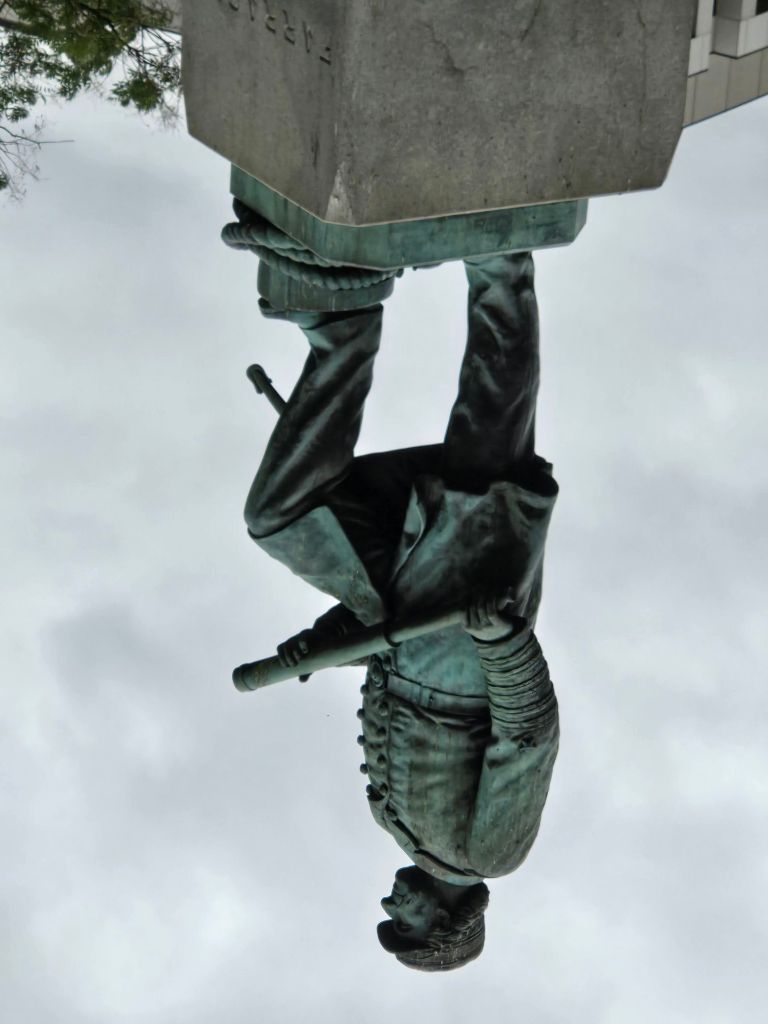
    Admiral Farragut

    Does the world seem upside down today? I am sitting in Farragut Square. It is 9:45 a.m. It’s the tourist season and I was able to explain to a new friend why Admiral Farragut was important. Here is my friend.

    Looking for his hometown in the Outer Banks

    We are waiting for the Supreme Court to decide on Donald Trump’s immunity. You might already know when you read this, but here is my prediction:

    Ambiguity reigns. Trump can not be liable for acts he takes as President.  Were his actions on Jan 6 taken as President? Send it back to the Court to decide. Can any actions at all be taken or continued if he is reelected for four more years while he is serving? That question is for a later date.

    How did I do?

    On another subject, I have been saying for months that Biden shouldn’t run for another term. Now, I am pretty sure that he won’t. Will he back out today or a month from today, I don’t know. But he will back out.

    When do I want him to announce his withdrawal? I am not sure as a strategic matter. But when and how he does it will be important.

    And here’s an idea. What if he not only backs out but resigns? This would cement a part of his legacy and give us our first female president

    If this happens  Harris can also announce that she is not running, giving the party the opportunity to pick from their strong bench a centrist Democrat without connection Biden’s failures on the border.

    Okay, this post is shorter than most. But weightier.

    Does the world still seem so upside down?

  • A Whale of a Tale About Whales

    June 30th, 2024

    Do you remember when I posted something about the Voyager spacecraft, a rocket now 15 billion miles from Earth and going further, and how it’s ability to transmit data to NASA was compromised by a faulty computer chip? And how NASA engineers were able to identify the chip, create a work around, and enable Voyager to start transmitting information back to Earth again? Extraordinary, I think we all agreed.

    That post was based on an article in the Washington Post. Today, I am writing about what I think is equally fascinating – this time from the July-August edition of Harvard Magazine. The article was written by Jonathan Shaw, the magazine’s managing editor. It’s titled “The Language of Whales”. Let’s see if I can do it justice.

    First, the basics. We are talking about sperm whales. When you think of a whale, chances are you think of a sperm whale. Sperm whales, in spite of being hunted by humans for ages, are not an endangered species. They are found all over the world. They grow to be very large – the average adult sperm whale is about 50 feet or more in length. They live almost as long as humans – usually between 60 and 70 years (in fact, as whales only sleep about an hour or two per 24 hours, maybe you could say they live longer than humans). They spend most time under water and can dive thousands of feet down, and they really eat a lot of squid, which they have to locate. They also have, by far, the heaviest, largest brains in the animal kingdom.

    The question is language. It has long been known that whales can make clicking sounds, very very loud rhythmic clicking sounds. As to loud? They are the loudest sounds made by any species.

    But what do these sounds signify? Are they just sounds? Are they warnings? Or could they be sophisticated, linguistic communications? As for this last question – until recently it would probably never be asked.

    The article talks about Project CETI (the Cetacean Translation Initiative), which is looking to determine if humans will be able to understand and translate the meaning of the whales’ clicking and, for the next step, whether humans and whales will ever beg able to talk to each other. This effort started only seven years ago, at the Radcliffe Institute for Advanced Studies, when two scientists, David Gruber of the City University of New York and Shafi Goldwasser of MIT, had a chance encounter, then joined by Michael Bronstein, who now teaches at Oxford. The three were, I believe, all fellows at the Radcliffe Institute when they began thinking about deciphering the clicks of sperm whales. Two years later, they organized another Radcliffe conference on this topic, decided the project was worthwhile, and received enough money from the TED Audacious Project to continue the project for the next five years. (Don’t know TED Audacious Project – Google it – it’s basically a source of funding for “audacious projects”.)

    The project is audacious, to be sure. For example, there is a Harvard scientist, who has recorded about 10,000 instances of sperm whale clicking. That sounds like a lot, but to do what they want to do, those working on Project CETI think they will need billions of recordings. In addition, they want to be able to identify the individual whales making the sounds, so they have to tag the whales. Did you ever try to tag a whale? In the first place, these tags aren’t just post-its. According to the article, they record “sound, location, light, depth, temperature” and sometimes even have video. They are obviously very complex and, considering you are dealing with an animal whose skin is very slippery and whose skin continually sloughs off, and an animal who operates at such differing depths and pressures, coming up with a type of tag which would not fall off the whale’s body is beyond tricky. The amount of science in the development of these instruments (a better word, perhaps than tags) is itself remarkable.

    Sperm whales do a lot of migrating. And this world is quite big. So tagging a sperm whale will do little good if you can’t keep track of the whale. It turns out that the only place in the world where the whale population is stable year round is near the island of Dominica, in the Caribbean, so that is where the scientists have set up shop.

    As to what they are hearing, let me quote from the article:

    “…they have detected previously unknown complexities in the sounds generated by the whales.

    “In the past, sperm whale codas [that is the term used to refer to the rhythms] have been analyzed principally in terms of the number of clicks and the intervals between them. A representative discovery, for example, deemed in shorthand by the researchers as the discovery of a ‘whale phonetic alphabet’ , as reported last September by a team at MIT, detailed detection of ‘fine-grained modulation of inter-click intervals relative to preceding codas’, as well as the addition of an extra click to existing codas, that change depending on the context in which the whales were vocalizing. The researchers also documented independent changes in rhythm and tempo. When combined, these elements suggested complexity of the click communications of a magnitude greater than previously suspected.”

    And then add a linguist, Gaspar Begus of the University of California at Berkeley, who says that his study of the clicks reveals “the presence of acoustic properties in codas that are analogous to the vowels and diphthongs in human speech, and that they seem “not to be artifacts, but rather are under the whales’ control”.

    If you can get a hold of this article, read the entire piece. One more example of “who knew?”

  • Some Analogies Are Perfect. Some Are Not. Same Thing About Titles.

    June 29th, 2024

    Several weeks ago, the main air conditioning system for our house went out. It was about 20 years old, and had faltered late last summer and needed coolant added, so it really wasn’t a big surprise. But we had to get it replaced, something that was both disruptive and fairly expensive.

    About the same time, the toilet in our basement guest bathroom began to run if not flushed precisely. Because it is not a bathroom used everyday, we noted, but ignored, the problem, just being careful when we or guests used it.

    Last week, our master bathroom toilet began to run continually, and we needed to call a plumber, and had him look at both bathrooms while he was here. The guest bath now seems fixed, but the upstairs bath has already had a second visit and now looks like it will need a third, as the toilet seems to have a mind of its own.

    On the same day, the gasket that surrounds the freezer of our refrigerator/freezer came loose, and we needed to call someone to come out and fix it; that fix seems to have been successful.

    On the very next day, our microwave oven stopped heating our food. The light goes on, the plate spins round, the timer works perfectly, the food stays cold. It looks like we need a new microwave.

    And we have other problems that need fixing. The shower door in the master bath has become unhinged, we have brick walks that need caulking, and flagstones that need leveling. We have yet to get to these projects.

    Why do I tell you all of this? Because as you hear news about what is happening in our country, it seems so familiar. It just seems like our house writ large. In both cases, ignoring the problems are impossible and dangerous, so fix them we must.

    For the Democratic Party to continue to support its presumed presidential nominee, Joe Biden, is similar to our ignoring the things in our house that need repairing. For our house, we would have a much harder time living without air conditioning, a freezer, convenient toilets, and a microwave. For our country, it would be difficult to live with a Republican President starting in January, particularly if that president is Donald Trump.

    There are many reasons for that, as we now know. One of the most important reasons relates to which president will have the right to nominate our next Supreme Court justices. Ruth Bader Ginsburg did not retire, when suggested, so that Joe Biden could appoint a replacement; she waited until she died during the Trump presidency. It has been suggested that Justices Kagan and Sotomayer (the oldest liberal justices) resign now to give President Biden the right to nominate two younger justices; they find this suggestion ludicrous. If Trump regains office in January, most likely he will have the opportunity to nominate new conservative justices to replace the elderly Clarence Thomas and Samuel Alito, thus securing the strong conservative majority in the court for years to come.

    We are already seeing what an activist conservative Court can do, parading under the false flag of originalism, and this does not need to be repeated here. But a few principles must be noted: (1) this Court has no trouble upending precedent, thus changing the Supreme Court’s practice for well over a hundred years, (2) by ending the Chevron doctrine (that provided that deference be paid to executive agencies’ decision making when ruling on the acceptability of regulations), the conservative Court has given to itself even more authority than it has had to decide whether regulations issued by the Executive Branch will stand, and (3) the Court continues to narrow the rights of individual citizens in all sorts of ways, but perhaps most importantly in health related circumstances, and to be able to live freer or the possibility of gun violence. In other words, the non-elected judges are setting the Judiciary up as the strongest of the supposedly independent branches of government, giving itself the right to judge the conduct of the other two without accountability.

    I hope that Joe Biden will not become another Ruth Bader Ginsburg. I hope he has the strength to determine (difficult as it may be) when to fold and go back to Delaware, when to turn the government over to a new and younger and more agile and energetic generation. For if he fails to see this, and to act upon what he sees, he will most likely still turn the government over in January – but not to someone who will celebrate and build on his positive legacy, but who will destroy it and who will most likely destroy or degrade us (330 million Americans, and more worldwide) in the process.

  • Biden Hits a Trump in the Road…..

    June 28th, 2024

    Years ago, when I was a new partner in the DC office of a large New York law firm (which I hated), I had a case in the US Court of Federal Claims. I was in charge of the case, but the argument was to be done by one of the firm’s full time litigators. I said at the counsel table while the litigator (who knew the case well and had rehearsed with me quite a bit) started to fumble and say things that had nothing to do with how we planned to present our argument. I looked very disgruntled, I am sure, because when the litigator finished his presentation, the judge looked at me and said: “Mr. Hessel, you look like you want to say something. I don’t want you to leave here thinking I didn’t give you a chance.” He obviously saw what I saw. I got up, explained the case, and we won a nice victory. (I never worked with that litigator again)

    That is exactly how I felt last night watching the debate. “Jake Tapper”, I thought, “let me talk.” In my imagination, Jake and Dana Bash started whispering to each other and then Dana turned to the camera and said “Thank you, President Biden. Now we’d like to hear from Art Hessel.”

    That did not happen.

    I heard a C-Span caller this morning refer to Biden as a Zombie President. That is how he looked. I read that he had a cold, and of course that happens. But considering it was a cold that his makeup team (I am sure he has a makeup team – just as I am sure he’d like to make up this debate) couldn’t cover, why didn’t he come out at the beginning and tell the world that he had a cold and it was affecting his voice (for example)?

    Trump, I must admit, sounded like he was 25. His voice never faltered at all. Of course, almost everything he said was nonsense and counterfactual, but he looked like he was telling it straight if you didn’t know better. And, yes, the media will fact check him to death, but his supporters will believe him and not the fact checkers. We all know that.

    So, now there is talk about replacing Biden on the ticket. Some of us have been saying that for months. It doesn’t mean that we support Trump over Biden (duh!), but it means that we think Biden will have a difficult time winning (now a more difficult time), and that a Trump victory spells chaos and more.

    And so the talk is going to rev up about finding a new candidate, or having some sort of an open or brokered convention. There is time, since the convention is not until August 19. But how that will work, no one knows. And, as Edie points out, if the Democrats say “we must replace Biden” and then fail to, this would probably cinch a Trump victory, and prove that even the Democratic party does not have faith in the Democratic candidate. And poor Kamala Harris – if there is a replacement, it should not be Harris (based on her popularity, not on objectivity), so – to make everything clean – she would have to drop out as well.

    But we were with two other couples watching the debate – all never Trumpists, pretty much never Republicans, and certainly Democrats. All of us were shattered by the President’s performance. And you can imagine the “uh, uh, uh, we beat Medicare” clip and others being rolled out all throughout the campaign.

    In addition to the Trump lies and the Biden stumbles, it was an ugly debate, insults (instigated by Trump) flying both ways, followed by a stupid debate about golf handicaps and winning tournaments at clubs you own when asked about age. And Americans were obviously not the only ones watching the debate – what do our worldwide allies and adversaries (political leaders and would-be political leaders, journalists and thinkers) think about these two candidates, one an obvious liar (more obvious to them than to Trump’s supporters here) and the other only vaguely looking like the man who was Joe Biden?

    The Trump positions are frightening (NATO, tax cuts, climate change, Putin, women’s rights and so on), and Biden should have been able to counter them, but he wasn’t. And Biden needed a sharp focus on his two biggest vulnerabilities – the border and inflation, and was not able to speak to them coherently either. In fact, Biden simply flailed from topic to topic, with no sense of direction or organization.

    Of course, debate success is not related to the ability to govern, or to negotiate to reach consensus. But it is certainly related to the ability to win an election. And you can’t win an election, looking like a Zombie or a deer caught in the headlights, and having every other sentence trail off in undecipherable words (I assume they were words).

    You want to know how I felt sitting in the Court of Federal Claims watching my case slip away? I felt exactly the way you felt last night watching the debate.

  • Trump Will Try to Flummox Biden Tonight, but Will Biden Take de Bait?

    June 27th, 2024

    I am nervous about the debate tonight. We are going to watch it with friends. We are going to bring something to drink. We are going to need it.

    I want to divert my mind today. How about three Jewish jokes? I usually don’t like Jewish jokes. But I like these. Maybe you know them. Maybe you have never heard them before. Maybe you have heard them before and have totally forgotten each of them. Even I might be in that last category.

    (1) Jewish Joke Number One:

    A very elderly man is lying on his death bed. His wife of more than 60 years sits by his side, holding his hand. There is no need to talk and silence prevails. His wife interrupts the silence. “Is there anything I can do for you? Anything at all.” He smells something. Coming from the kitchen. He whispers to her: “I smell the cookies you are baking. I don’t know if I can eat a whole one, but I really would love to try.”

    She looks at him with pity and says: “That’s the one thing I cannot give you now……They’re for the shiva.”

    (2) Jewish Joke Number Two:

    The young man in his early 30s calls his mother on the phone with good news: “Mother, I have something to tell you. I am getting married”. “How wonderful”, his mother says. “And,” he says, “I want to introduce you to your new daughter in law, and I think I will come by tonight with three or four young women. One is my fiance; the others are our friends. We can sit around and talk for a while, and then later you can tell me which one you think she is.”

    “Okay”, says his mother, “that sounds like fun.” Her son brings four young women with him, all obviously in on the plan, and they have a fine evening. The next morning, the son calls his mother and asks: “You know which one I am marrying?” “Yes”, she says, “I think it’s the redhead.”

    “Mom, how did you guess? You are right!”

    “It was easy”, his mother says, “she’s the only one I didn’t like at all.”

    (3) Jewish Joke Number Three:

    Elon Musk (or was it Jeff Bezos) decides to send an experimental manned satellite into orbit to go around the earth twenty times, each time taking a little more than an hour. In addition to the pilot and the engineer, he asks three men of faith to travel in his machine – a Catholic priest, a Protestant minister, and an orthodox Rabbi. The three enter the capsule, the rockets blast them off, the flight is successful and they all return safely and in good health.

    A reporter asks them: “So, what were your reactions to traveling around the Earth like that?”

    The priest says that it was an experience of a lifetime, and all he could think of as he looked at the Earth below was how remarkable God is to create such a universe and to allow him to participate in it in this remarkable way.

    The minister talked about the beauty of the Earth, the closeness to God, and the remarkable aspects of the solar system, which he could appreciate even more fully from such a wonderful vantage point.

    The reporter then turned to the rabbi, who had been uncharacteristically quiet and asked him what his reaction was. Did he have the same overwhelming feelings the other two had? “No,”, said the rabbi, “Not really. I found it exhausting.”

    “Why?”, asked the reporter. The rabbi answered: “I had to put the tefillin on, take the tefillin off, put the tefillin on, take the tefillin off, put the tefillin on, take the tefillin off. I didn’t even have time to look out the window.”

  • Yesterday? Two Steps Forward. Two Steps Back

    June 26th, 2024

    I must explain. Yesterday was very confusing to me, and perhaps I confused you as well. But what would you expect when your day starts off with a dinosaur sighting?

    I took my Prius to the dealer yesterday morning for regular servicing. My dealer is located across the street from a large mall, one of those few malls that continue to seem to prosper. My routine when I bring my car in is to drop off my car and then to cross the street and walk across the mall parking lot to a third rate restaurant (I am being harsh. It’s second rate) where I can get very ordinary coffee and a not-so-good blueberry muffin or bowl of oatmeal.

    But when I looked towards the parking lot where I normally went across, I saw myself fenced out, and I saw within the fencing an entire herd of dinosaurs, big and small, brown and green, friendly looking and dangerous. Hundreds, maybe, of dinosaurs. (On closer look, I saw that it is an “immersive experience” in preparation, and that it is going to cost about $30 to enter and even more if you want to go on any rides or take advantage of their special treats. I demur). [demur is another new word for the blog]

    I had to skirt around the fencing, climb up steps I had never seen before, in order to get my coffee.

    My plan for the day was to go from the automobile dealership to a T-Mobile shop for two reasons. One – my smart phone case had begun to disintegrate and I thought a new one was in order. Two – my main home charger had begun to slow down and I thought a new one would be faster.  I certainly didn’t expect to buy a new phone.

    But…..I went into the Rockville T-Mobile store and asked for a new phone cover. “Sorry”, said the clerk, “we don’t have anything any more that fits that phone.”

    “Uh-oh”, I thought, “I am in trouble here.” He then said “you know this phone is 2 1/2 years old, and you are eligible for an upgrade after 2 years.” “Oh”, I said, what does that mean? “Well, it really doesn’t mean anything. Except that you fully paid off your phone in two years, so if you bought a new phone today, you only have to pay for a new phone, not to finish paying for the old phone.”

    Then, I began to think. I had been having some problems with my phone slowing down, being less sensitive than it had been in the past, so I said “So if I were to buy a new phone, what would you suggest?”

    “Well”, he said, you have a Samsung A class phone, so why not just buy an updated one of those?” “What other choices to I have, sticking with Samsung?” “Your other choices would be S class phones – they are about twice as expensive.” “What are the differences?” “Mainly the camera, but if you liked you camera before, even the A Class camera is better than what you have now.”

    He didn’t have any reason for me to spend an extra $300 to buy a more expensive camera and nothing else. I asked which phone they sold more of. He said, to my surprise, “the S Class, but there’s really no reason to buy it outside of the camera.”

    So, it was obvious what I would do, right? Yes, I bought the S Class for an additional $15 per month for two years, for the better camera. The phone also has twice the storage and memory of my old phone – either A or S would give me that.

    It only took about 20 minutes to transfer everything from the old phone to the new. I had to reload my Yahoo and Google accounts – luckily I had the passwords. I didn’t really think about anything else, except that I made sure that all my photos transferred. It wasn’t until I got home that I realized that my FaceBook account would also require me to reload it through use of my password.

    And I don’t know what the Facebook password is. I have tried to use a password a number of times, and am always told that I am using an old password that has been changed. The problem is that to change a password, you need to have your identification verified and this is done either through your email address or your backup phone. But because I went on Facebook when I was still working, and I no longer have the email or the mobile phone number I had then, Facebook is unable to verify me. Both of them were issued through my office. So, there is no way for me to validate my identity for Facebook.

    Sure, I can open a new account, which I did, but I have 0 friends on that account and, as people today don’t want to accept “friend” requests because they fear being hacked or compromised, it seems to me that is going to be difficult. My old account hadn’t disappeared from Facebook – all my friends could continue to see it. But I couldn’t see it (not being a friend of myself) and I couldn’t post anything on it.

    Then my daughter Michelle told me that she thought that, through WiFi, I could still access and manipulate my apps on my old phone, even though it is no longer a “phone”, and, lo and behold, she seems to be correct.

    So it looks like I can continue to use Facebook on my old phone and everything else on my new phone. This is confusing since it involves two phones and I have to see if I can post a photo taken on one phone (my new phone) onto Facebook from my old phone. My assumption, since all of my photos are uploaded on a Google App which is now on both phones that this won’t be a problem, but we will see.

    So, I have spent a lot of money to get a new phone which suffers from a disability and will need, for the foreseeable future, assistance from a second phone. But I do now have double the storage and presumably a better camera (among other things, a Zoom that will expand to 30x, instead of 10x), which I have yet to try.

    And yes, I did get a case that fits the new phone, and I got a new, fast charger and new cables.

    So….not perfect. But more perfect that what I thought I had before Michelle came up with a fix.

    Two steps forward (storage and camera). Two Steps back (Facebook and cost).

  • Update. It looks, thanks to daughter Michelle, that I can still access Facebook but only on my old phone and only on WiFi. So until I figure this out, I will use two phones. But you can ignore my previous message.

    June 25th, 2024
  • My Facebook account seems to have vanished. I will try to start from scratch so accept my friend request.  See my blog at artis80.blog. 

    June 25th, 2024

  • All the Nudes are Fit to Sprint

    June 25th, 2024

    This is an posting about journalism. I wrote it after a book talk last night at Politics and Prose with Steven Brill, lawyer and journalist, podcast host, TV network owner, website creator, Yale Law instructor and author. His new book is The Death of Truth, the story of how the internet and social media have given “snake oil salesmen and demagogues the weapons they needed to destroy trust and polarize the world”.

    One of Brill’s many activities is running the website Newsguard.com, which reviews and rates the truthfulness of websites (real and fake), newspapers and other written publications. He has statistics to show that there are now more fake news websites portraying themselves as local newspapers than there are real local newspaper sites, that the Russians have opened at least 167 fake news sites over the past few months, and that more people get medical advice from websites than from their medical professionals and the medical websites get their information more from people with opinions that from true medical sources.

    He talked a lot about how real news sites spread false news from fake sites, how algorithms are able to adjust content person by person and how advertising follows these algorithms without human intervention. He also spent time talking about the major news publications – the New York Times, the Washington Post and so forth. While Newsguard rates them both highly, Brill did throw some criticism their way, particularly to the way they combine fact with opinion, without disclosing what is which. I have noticed that myself as I read through the print Times and Post most days.

    But there is something else that I have noticed that was not part of his presentation and not brought up during the Q and A period. I remember in the good old days that journalists were taught to write their articles so that a reader did not have to read all the way through them to get the main points. They would state the main points in the opening three or four paragraphs, and use the rest of the article to fill in background and details and sources for those who wanted more information.

    Now, it seems to me that all of this has been turned around. Now,  while you might get the gist of an article from the headline, you can no longer get away with reading only the first part of the article. The first part often contains fluff, perhaps interesting fluff but fluff nonetheless, and you need to read deep into the article to find out what it is trying to tell you. If it’s a front page article, you often need to turn to the continuation page to make sense of what the article is saying.

    Now, why has journalistic style been upended, and why has opinion and fact been mixed together? I think the main reason for each is pretty clear, and the reasons are different.

    I blame the topsy-turvy journalistic writing on the internet, pure and simple. Obviously, all newspapers are also online and, I think for all, the online readership is larger than the print readership. And no media outlet can afford to, or wants to, have two different articles on the same subject, one for print and one for the screen. So the needs of the screen prevail, and the needs of the screen are to force the reader to read as much of the article as possible. Thus, the most important points of the article and its conclusions are saved to the end. Otherwise, the reader would not read a sufficient amount of an article to allow him to see all the ads. And it is the ads that keep the websites in business.

    As to mixing fact and opinion, that I blame on Trump and his coterie of lackeys. If Trumpers are going to say, three years after the election, that he was the real winner in, say, Pennsylvania, in 2020, a newspaper can’t ignore it (it is news, after all) and can’t simply report that as a possible fact. They have to point out that such statements are false, disingenuous and dangerous. Well, sure, that’s an opinion. But since we are dealing with people in important positions who you would normally assume are at least trying to tell the truth, but who in fact have no regard for truth, newspapers that don’t call them out throughout the paper, not only in editorial columns, would be complicit in the deception. And, as the journalists get used to throwing their “opinions” in these stories as a matter of necessity, they begin to develop the habit elsewhere, and opinions sneak into other stories as well.

    It was a fascinating discussion. There was also a discussion about headlines.

    And my headline? Well, like all media, I wanted it to say something that would lure you in. What nudes am I talking about, do I really mean ALL of them, were they physically fit or emotionally fit, and why and where did they sprint? It’s simply a play on the New York Times motto “All the news that’s fit to print”, and has no relevance to my post.

    I remember the coup in Vietnam in the early 1970s, when Madame Nhu and her brother (as well as President Diem) were booted from office and someone reported that “All the Nhus were fit to sprint”. I like my version better. (And if you have ever visited a brothel in a city where the authorities are serious about closing them down (places where I have never visited, of course), you would probably find that there is quite a bit of truth contained in this headline. It’s a matter of self-preservation.

  • Today, I am a Theater Critic! Everything You Need to Know About a Play You Will Most Likely Never See.

    June 24th, 2024

    I generally have two rules when I write a post for this blog. I don’t say anything about anyone that could be traced to that person. I will refer to “a friend”, but not to the friend by name. Secondly, I try not to criticize for the purpose of criticizing – what’s the point? If I can change the world with my criticism (i.e., if I can convince someone to vote against Donald Trump and for someone who can defeat him), I will do it. But if I don’t like a play, why should I bother to criticize it? Especially if it is at the end of a run, and no one who reads this blog will likely ever see it?

    But there are exceptions to everything and last night I wrote a very critical post (sitting in “drafts”) about the production of Lauren Yee’s The Hatmaker’s Wife that is ending its run at Theater J. And just because I did not find it a good play, and thought it even a worse production, who cares? Particularly since others must have liked it, and the actors got a 50%+ standing ovation at the end of the show.

    My memory often fails me when thinking of things I have seen in the past (often I don’t remember seeing them at all), but my memory of Tom Stoppard’s brilliant play Arcadia involved a house where the current residents and prior residents interacted in mystical ways that looked real, but maybe weren’t. Maybe we were in a realm of dreams or mysticism. I don’t remember details, but I remember being overwhelmed by the play, which I think I saw at the Folger Theatre. Maybe 20 years ago.

    Perhaps Arcadia was an inspiration for Yee, who has a young unmarried couple move into a house where the walls not only have ears but talk and write, and throw individual sheets of paper over themselves, so that the young woman can read the story of the prior residents of the house, and find herself enmeshed in it in a very personal way. And while the wall is writing this story and the young woman (not named in the play, and cited only as “Voice”) is reading aloud what is on the papers, the prior residents are also in the house, acting out what the Wall is telling the Voice about the past.

    The young woman is, in the Theater J casting, an Asian-American (more American than Asian) , as is the eponymous [second day in a row using that word] “hatmaker’s wife” (who is more Asian than American), who lives with her husband, who is not Asian-American at all, but looks and talks like he just came out of a shtetl in deepest Romania, as does his neighbor and friend who plays a major role in the play. An unlikely duo for older people now dead – how many European born, ethnically identifiable, Jewish hat makers back in the day married Chinese Americans who looked like they just arrived in the country.

    And then it turns out that this very Americanized young woman (probably in her 20s) is the daughter of this mixed couple (she resembles her mother only) who look like, if they were still alive today, would be in the 90s or so. And, as you watched the story, it looked like her father didn’t want a baby and simply lost her at home one day, when her mother went to the bathroom or something. How did he lose her? He didn’t love her enough, so she disappeared up into the sky (the ceiling of the room did not seem to stop her) and was never found again. Except she obviously landed somewhere, grew up not knowing about her parentage at all, and by chance moved into her parents’ house where the Wall could talk to her and write down this story to her, with pages magically flying to her over the wall, while we – the lucky audience – get to watch her parents story play out in real time?

    Oh, and did I tell you about the golem? The monster who appears in the house and is at first scary, but then becomes the hat maker’s best friend (along with his neighbor to be sure) until the hat maker’s wife (who has left the hat maker and stolen his favorite hat to find another hat maker to make a replica of the hat but one that she could wear since her shtetl born husband refuses to make hats for women, who should never been seen in a hat). It turns out that the golem is not a friendly guy after all, because he has come as the harbinger of death for the hat maker’s wife, just hanging around until she returns. Who knew?

    Have a told you enough? Let me end with this: there seemed to be no reason in the script for the hat maker to be European born Jewish, nor for his wife and Voice to be Asian or Asian-American. So what was Theater J trying to say? Damned if I know.

    Okay, so this post is the exception to the rules which I outlined at the start. Some things just call out to be exceptions. And to my friend who doesn’t think I should detail plots of books, movies or plays……for you, too, this is an exception.

    But, more broadly speaking, why do I tell you any of this? Because maybe I missed something? Maybe it’s obvious? Maybe this play will be a classic and the Theater J production will spoken of over the coming millennia? Only time (and the walls) will tell.

  • We’re Not the Men of Texaco…..the “Fall” of Harry F. Sinclair.

    June 23rd, 2024
    Marx toy truck

    This is my 1940 vintage toy Sinclair truck. I also have a coresponding red Texaco truck. They are part of about a dozen vehicles that I have had for about 75 years. They were hand-me-downs from my older cousin Eddie Zerman, who probably never missed them. But I have dragged them with me since wherever I have lived.

    We have had five house guests this past week, who range in age between 81 years and 14 months old. Our youngest guest has played with the cars, and our oldest guest and I began talking last night about the name Sinclair. (To be more accurate, I started talking about the name Sinclair and he humored me.)

    I had learned years ago, when first reading Graham Hancock’s The Sign and the Seal, his fascinating book about the Ark of the Covenant and the Knights Templar, that Rosslyn Castle in Scotland, a building with many Templar inscriptions, belonged to members of the clan Sinclair, and that the clan’s founders had come from present day France and been named St. Claire. At least that’s my recollection.

    [Digression #1: Everyone should read The Sign and the Seal]

    Then I began thinking about whether or not the Sinclair of Sinclair Oil was related to the Scottish clan. After extensive (i.e., virtually no) research, once again I conclude I don’t know. I am sure you are surprised.

    What’s more. I don’t care. But I became interested in Harry F. Sinclair, for whom the company is named, sometime last night and devoted a little time to learning more about him.

    If you go http://www.sinclairoil.com, you can look at “How We Started”, and see a brief description of “The Legendary Harry F. Sinclair”, described as the founder of the company, a “brilliant, stubborn, ambitious risk taker”, who created the company in 1916 after merging several small petroleum companies and quickly built it into the 7th largest petroleum company in the country within about ten years. You learn he was the son of a druggist, who suffered a financial reverse when he was 21, losing the store along with everything else, but within 10 years was the richest man in the state of Kansas.

    What a story!

    [Digression #2] Remember Paul Harvey on the radio? A very professional story teller/journalist who would have a program discussing all of the great things someone like Harry Sinclair did and then remind you to stick with him during the commercial, because after the break, he was going to tell you “the rest of the story”.

    OK, here goes. The rest of the story.

    Yes, Harry Sinclair’s father was a pharmacist and Harry studied pharmacology at the University of Kansas, and took over the store, but the business failed. He became a lumber merchant, selling lumber to petroleum companies and began himself to speculate in buying and selling oil leases, became very successful, and indeed was a millionaire when he was 30.

    With three friends, he bought and expanded a bank in Oklahoma and went on to found his eponymous [another word used in this blog the first time] oil company. He also found time to own a professional baseball team (the Indianapolis Hoosiers which became the Newark Peppers in the short lived Federal League) and a thoroughbred stable, which owned a Kentucky Derby champion, and three Belmont Stakes winners.

    BUT, remember Teapot Dome? Or at least hearing about the Teapot Dome scandal of the Harding administration, even if you don’t know what it was? Well, there was a large oil reserve in Wyoming, owned by the federal government as set aside as an emergency military reserve supply. That is, that’s what it was until Secretary of the Interior Albert Fall decided to lease the oil field to Harry Sinclair in 1921. Six years later, the Supreme Court voided the leases, saying that they had been issued corruptly.

    Harry Sinclair and others were indicted for violating various criminal statutes. The judge declared a mistrial in his criminal trial, because it was discovered that Sinclair had hired a detective to follow each of the jurors. This led to new charges and a conviction. And jail time.

    Interestingly, according to Wikipedia, while in the DC prison, the authorities allowed Sinclair to work as a pharmacist and to travel outside of the prison to provide medication to prisoners on work details, leading to continuing accusations that he was being given special treatment. Which he was.

    When he got out of prison, his personal reputation was ruined for life, but he went back to the presidency of Sinclair Oil, a position he held until 1949. He passed away in 1956.

    So let’s go back to the Sinclair Oil website. You remember when Trumpist Kellyanne Conway talked about “alternative facts”, right? With Sinclair, we clearly have “selective facts”. Where is Paul Harvey when we really need him?

  • Was it Victor Borge, who said he was going to play Shostakovich, and put his hands to be keyboard, then lifted them, and said “Shosta-moment”? [This post has nothing to do with Victor Borge]

    June 22nd, 2024

    The (excellent) presentation this week at my Thursday morning breakfast group was about Babi Yar, the ravine in Kiev which was the site of the massacre of at least 100,000 (mainly Jews) by the occupying Nazis in 1941. For a long time, there were no memorials placed at the site by the Soviet Union.

    Yevgeni Yevtushenko, young Russian avant-garde poet (then in his late 20s), visited the site in 1961, twenty years after the massacre occurred, and was saddened by what he saw. He immediately wrote what remains his most famous poem, called simply “Babi Yar”. Here are excerpts:

    “No monument stands over Babi Yar

    A steep cliff only, like the rudest headstone.

    I am afraid.

    Today, I am as old as the entire Jewish race itself…..

    “I see myself an ancient Israelite.

    I wander o’er the roads of ancient Egypt

    And here, upon the cross, I perish, tortured

    And even now, I bear the marks of pain………

    “There is no Jewish blood that’s blood of mine.

    But hated, with a passion that’s corrosive,

    Am I by antisemites, like a Jew.

    And that is why I call myself a Russian.”

    (1996 translation by Benjamin Okopnik)

    When the poem was published, it was very polarizing, as you might imagine, within the Soviet Union. Although I have never studied the reactions, the reasons seem pretty straightforward. The official Soviet policy was to deny the existence of antisemitism and, more than that, to disregard the entire concept of ethnic differences among the Soviet people. Of course, in real life, this policy was more absent than observed. Even when monuments were placed at Holocaust sites, the references were never to “Jews”, but to “Soviet citizens”.

    Yevtushenko called out Soviet antisemitism, but did so carefully enough not to touch Soviet ideology. But his message was clear. In addition, as you can see, he referred to himself as a Russian, and not as a Soviet citizen. This too could have ruffled some feathers. This, by the way, was before the movement to permit Soviet Jews to leave the country picked up steam in the United States and elsewhere. While I don’t know this as a fact, I would assume that Yevtushenko’s poem was one of the things that influenced the creation of that (eventually successful) movement.

    But while the poem was criticized heavily in official circles, it was highly praised in others. And one of Yevtushenko’s supporters was Dmitri Shostakovich, the composer, who decided to write a symphony (his 13th) based on Babi Yar and several other Yevtushenko poems, a symphony designed to be played with an accompanying narrative.

    Shostakovich was perhaps the best known Soviet composer of his time, and once he wrote his 13th Symphony, it didn’t take Kirill Kondrashin and the Moscow Philharmonic long to premiere the work. You can listen to the 1962 performance on YouTube, and I recommend you do so.

    Both Yevtushenko and Shostakovich were able to escape the dangers of being judged an antisocial artist in the Soviet Union of their time. How they managed to do this (with some close calls, as I understand it), I don’t know. [This is where it is appropriate to say: “If he don’t know anything, how come he thinks he can write about this?”]

    The poem and the symphony begat even more references to Babi Yar in the Soviet Union. Take for example, a book by Anatoly Kuznetsov, a Soviet writer who published in 1966 a book called: Babi Yar: a Document in the Form of a Novel. I haven’t read it, and probably should. Kuznetsov wrote the book, had it published in a shortened censored (or perhaps self-censored) version, and then was able to defect in 1969, bringing his original manuscript with him on microfilm).

    [And this is where you might ask: Kuznetsov? Didn’t he used to play with the Washington Capitals? In fact, Kuznetsov is, according to Wikipedia, the third most common name in Russia. There are 85 Kuznetsovs with their own articles on Wikipedia. And – for your further edification – a “kuznets” is a blacksmith in Russian. So, Kuznetsov = Smith. Thank you.]

    Antisemitism continued to be an ongoing problem in the Soviet Union, of course, and Shostakovich continued to be outspoken in his attacks on antisemitism. For example, from his memoirs:

    “I often test a person by his attitude toward Jews. In our day and age, any person with pretensions of decency cannot be anti-Semitic….

    “I never condoned an anti-Semitic tone, even then, and I didn’t repeat anti-Semitic jokes that were popular then. But I was much gentler about this unworthy trait than I am now. Later I broke with even good friends if I saw they had anti-Semitic tendencies….

    “It would be good if Jews could live peacefully and happily in Russia, where they were born. But we must never forget about the dangers of anti-Semitism and keep reminding others of it, because the infection is alive and who knows if it will ever disappear.”

    BUT YOU MUST READ THIS (if you have read this far). Shostakovich’s memoirs were published by Solomon Volkov, a Russian music scholar, four years after Shostakovich died, and there has been a lot of debate as to whether these are really his memoirs, meant to be published as such, or a collection of older essays, or a combination, and even whether included are things that Shostakovich never said, but Volkov thought he would say. There are people who agree with Volkov that these are Shostakovich’s words, those who think this is a novel posing as memoirs, those who say that Shostakovich wrote some but not all of this, those who say that Shostakovich didn’t write all of this, but that everything in the memoirs conforms to Shostakovich’s positions. And there are other people, by the way, who originally thought the memoirs were the composers, but then changed their minds. And still others, who originally thought these were not by Shostakovich, but later changed their minds. As to the accuracy (or actual authorship) of the paragraphs copied above, I have – of course – no clue. [This is where you may return to the first bracketed statement in this posting]

    Is this post too long? It takes about 4 minutes to read it (and another 4 if you didn’t understand a word of it and have to read it again) and another 55 minutes if you listen to the symphony and other material in the link. So, is an hour today devoted to artis80 too long? You decide.

  • Ask Me No Questions, I’ll Tell You No Lies…..

    June 21st, 2024

    Every day, I have to figure out what to write about. Sometimes, it’s obvious. Something I read, somewhere I went, something I remember, some place I ate, something on the news.

    But sometimes, it isn’t obvious at all and I say: take a deep breath …… and go.

    I started thinking about people who illustrate books, and how their works don’t hang in galleries. I’ve thought about this before, and one time I ……. well that was then, this is now.

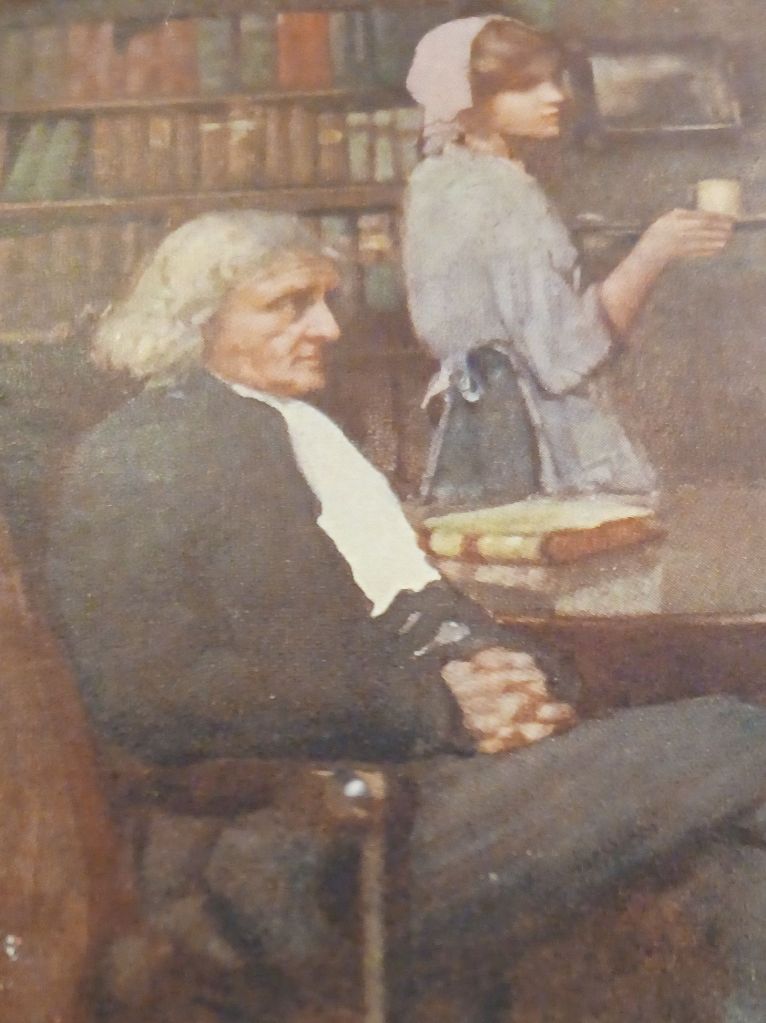
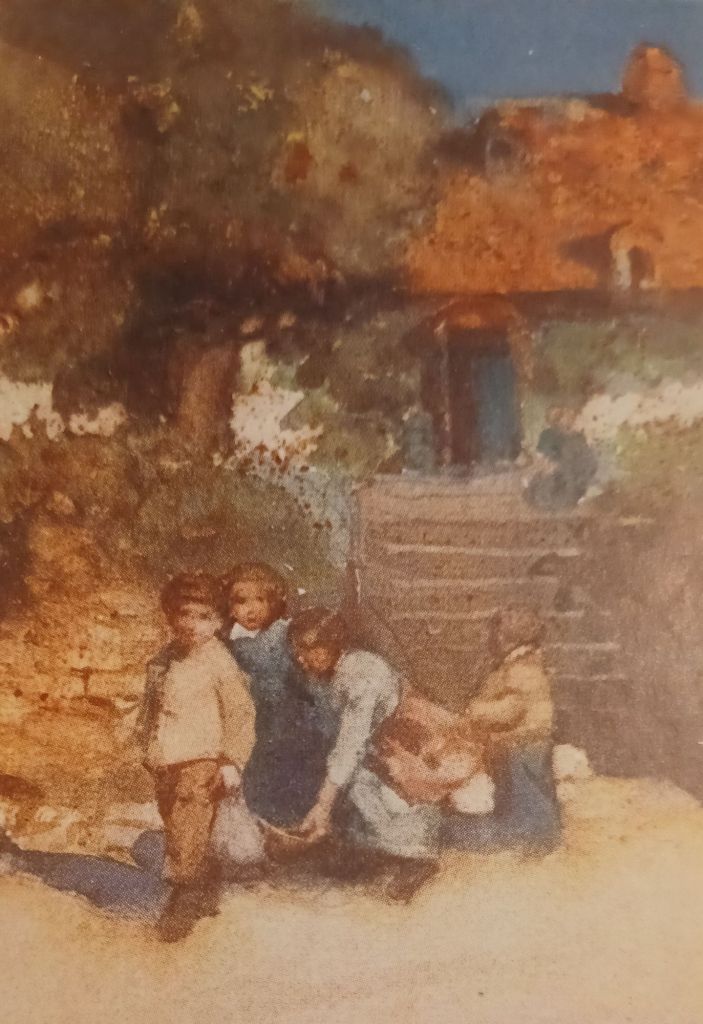
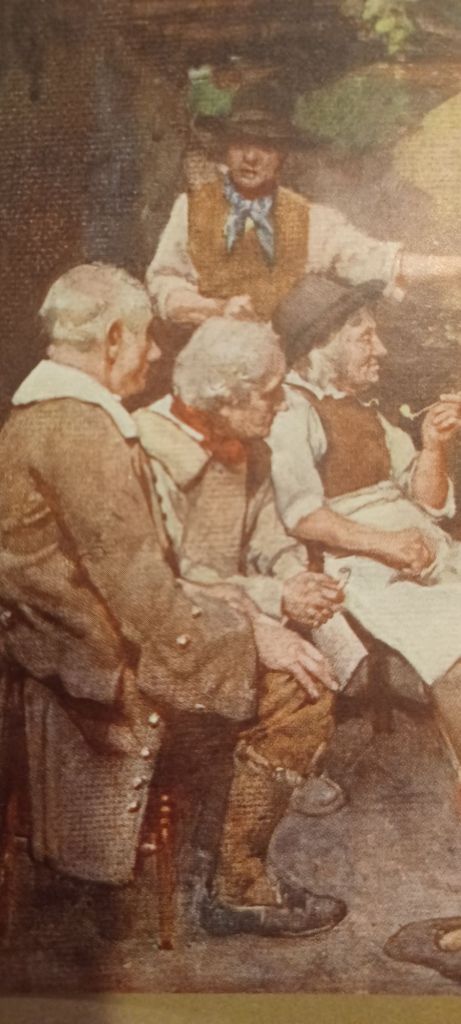
    I picked up a rather old book I have, a simple book, not something worth a lot of money (at all), but with really nice illustrations. The book is a 1912 edition of The Deserted Village by Oliver Goldsmith, and the illustrations were done by a man named William Lee Hankey.

    I looked Hankey up and there he was, right on Wikipedia where he should be. He was an English painter and book illustrator, who was born in 1869 and lived until 1952. He painted portraits and landscapes, lived in England and France, and was very well respected. I think his work is beautiful. You can look him up, if you want to.

    He made these illustrations sometime around 1900, but Goldsmith wrote the book in the 1770s. I have had this book quite a while, and have no idea where I bought it (or stole it, or found it), but I never paid any real attention to it. It just sat in a closet. Until today.

    Now I know Goldsmith as the author of The Vicar of Wakefield (another book I have not read) and She Stoops to Conquer (a play I have not seen), but really don’t know much about him. I knew nothing about The Deserted Village, which is a lengthy poem whose lines end with rhymes (e.g., dear/year; race/place; power/hour; prize/rise; etc, from page 14 of my edition), and which is pretty easy to follow. It is both an elegy for times which are passing, and concern for what is coming. This makes it pretty contemporary.

    Goldsmith remembers the England of his youth, the rural villages, the pleasant life, active communities. They are now disappearing and the Village of Auburn has been totally deserted, its buildings falling to ruin. The reason? Goldsmith blames it on the Enclosure Laws, which took and privatized communal lands used for grazing and planting, and created large estates for the gentry, at the expense of the rural peasantry. With no land to farm or graze, with jobs scare and money scarcer, the rural towns, he says, were fast vanishing, their residents fleeing from England, many going all the way to the New World, impoverished farmers going to English colonies such as newly opened Georgia, in North America.

    What kind of a country does such a thing? What kind of a country favors the gentry, the nobility, the wealthy, over the masses? What kind of a country lets the rich get richer, the wealth gap between rich and poor expanding more than ever before?

    The villages will not be restored. The country will be changed forever. The displaced poor will never be able to recreate the lives they once had, whether they remained in England or left for other places.

    So, the poor-rich gap is not a 20th or 21st century development. People were worried about it in the 18th century. But apparently unable to arrest its progress.

    Goldsmith’s political positions are not fully known. He was not a politician. He is known as having a strong leaning towards nostalgia. He favored old fashioned values over change,a small self-reliant homogeneous community over a larger, more diverse kingdom. As he said: “I love everything that’s old – old friends, old times, old manners, old books, old wines.”

    As to Hankey, living until his mid-80s gave him a lot of time to make art. And a lot of his artwork is available to purchase. His paintings are generally in the $5,000 to $10,000 range. His etchings are mainly about $300 to $750, although some are more and some less. I found one I liked for only $195. A bargain.

    “Ask me no questions, I’ll tell you know lies”? Actually, it was “ask me no questions, I’ll tell you know fibs”. Perhaps the most famous line of ….. Oliver Goldsmith?

    Or how about: “He who fights and runs away, lives to fight another day.” Or: “All is not gold that glitters….”

  • Moshe and Yael, Yael and Moshe (a Mysterious Headline, To Be Sure)

    June 20th, 2024

    All right, so my friend told me that I am not to write about more than one topic per day. And he told me that there he does not need to read the plot of a book that he will never hear about again. Okay, BUT…..another friend last night told me that he LIKES to see the plots of books he won’t read, because this lets him learn a little about something he would otherwise know nothing about. So what’s a blogger to do?

    It reminds me of the story (which I am making up right now) about how Shakespeare was once approached by his boyhood friend Yitzhak ben Yinglish, who said to him: “Why do you keep writing about Kings of England? I get so tired of reading about those. Can’t you find a more interesting topic?”

    Shakespeare, who respected his friend Yitzhak, decided to change his subject matter to honor his friend, and he wrote The Merchant of Venice. Yitzhak never spoke to him again.

    So we Bards have to be careful, you see.

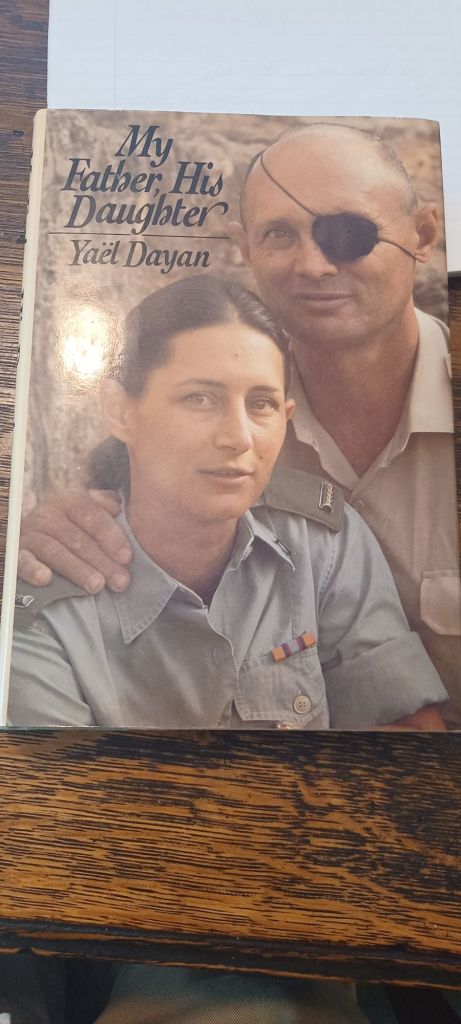
    My plan was to write about Yael Dayan’s book, My Father, His Daughter, about her relationship with her father Moshe Dayan. You remember Moshe Dayan? Israeli military leader and politician, who became the GOAT after the 1967 war and the goat after the 1973 war? He was a bright, talented leader, and his daughter, who became a writer, and died a month or so ago at 84, was equally not just an overage Joe. She wrote this book in 1985, a few years after her father passed away.

    I read it at the suggestion of a third friend. (I know what you are saying: “He has THREE friends? Who knew?” I will admit that this is about all there are, and so goes life.) This friend is an academic, a biblical scholar, and I was surprised that she recommended this book, which seemed out of character for her, so I thought I better read it. I prepared to be impressed.

    But I wasn’t.

    Sure, there are interesting things. For those of you who saw the film Golda, starring Helen Mirren as Golda Meir, you might remember the scene where, during the most worrisome part of the 1973 War, it appeared that Moshe Dayan had a nervous breakdown and was out of commission for a while. This never happened, according to his daughter, but……maybe it did?

    And, the descriptions of the two times Moshe Dayan slapped his daughter very hard seem out of character with their otherwise close and loving relationship. What was their relationship really like? Dayan clearly seemed to favor his daughter over her two younger brothers (so says his “favored” daughter), and took her along with him whenever she wanted to accompany him, to review secret military locations, to review the troops, whatever. Sort of irresponsible, it seems to me.

    You probably know that Dayan lost an eye. It happened during World War II, and he wore a patch after that. You may also know that he was sexually very active and his wife of thirty some odd years, according to her daughter, accepted his various affairs. (She also said that a doctor once told her that he felt that Dayan’s head injury which led to the eye loss might have also led to uncontrollable promiscuity. “Hmmmm”, as they say, the number of “m’s” reflecting their credulity.) Yael would never write a memoir called My Mother, Her Daughter, because her relationship with her mother hardly seemed to exist. Maybe her mother favored her brothers? Who knows? (We do know that her brothers were not in favor of her writing this book, and she respected their wish to be mentioned only now and then in the book, so there is more to the story of this family.)

    Eventually, Yael’s mother Ruth, who passed away at 103 a few years ago, did leave her husband. And Moshe became more involved with other women, and now Yael seemed less approving, criticizing both her father for his bad taste in women, and the women themselves, about whom she was never complimentary.

    But what goes around, comes around, as somebody once said (and others repeated repeatedly). When Dayan died at the age of 66 of long term heart issues, he left a will which he had written just written a few months before. He left everything to his girl friend, with whom he had been living for some years, and who didn’t get along with Yael or her brothers at all. He left Yael a letter saying that he did that because his children had enough money to take care of themselves, but his girl friend didn’t. There was no question that he was of sound mind when he wrote the will, but to say it was disappointing to Yael and her brothers is an understatement of the greatest magnitude. The Dayan house, and everything with in it, and all of his archeological treasures (he had many) went to his friend. Nothing went to his ex-wife of 35 years.

    Moshe Dayan does not come across as very likeable. Neither does Yael. She was very much an elitist, whether or not that is how she looked at herself. You can almost read at the end of every paragraph the words that she did not, but could have written. Something like: “My father was an exceptional man, and I am his exceptional daughter.” I just didn’t like her. And I didn’t think the writing was very good – but who am I to say that about anybody else?

    My friend who recommended the book says she knows someone who knew Yael, and that I am misreading her. Perhaps so. But, if so, I think she is deserving of my misreading.

    Okay. The end. Yes, this it too long. No, I didn’t go through the plot of the book (to satisfy my first friend) but I did say something things about it that you might otherwise not be aware of (to satisfy my second friend). No, I did not talk about more than one thing. And did I proofread this post? That will remain my secret.

    And I tried to satisfy my third friend (whom I don’t think has ever read my blog), by at least reading the book.

  • This Post Comes with a Surprise at the End…..

    June 19th, 2024

    I started my day having breakfast with an old college friend (of course, all college friends are old) in Shirlington, which is 20 minutes from his house and 22 from my house. This means that if you travel from his to mine via Shirlington, the trip would take you about 42 minutes or (to put in another way) you are better off using your GPS.

    We ate a Busboys and Poets (named for Langston Hughes, who earned a living for a while as a busboy at the Sheraton Hotel in Washington, and Zora Neale Hurston, who didn’t and is therefore known only as a poet. As I understand it, owner Andy Shallal was trying to bring them back together after they quarreled and broke up a long and close friendship.) I was looking forward to a bowl of oatmeal and some coffee, and was shocked and gobsmacked (I have been using so many first time words recently; bet you haven’t noticed) to discover that they had no oatmeal on the menu and I was stuck with getting an egg dish, buttermilk pancakes or corn beef (you can substitute tofu if you dare) hash. I chose a Western omelet without the ham (which I dubbed a Midwestern omelet, much to the confusion of the European born waitress who may never have heard of the Midwest). My side was grits. I ate the grits (with a little butter), and about two bites of the omelet. I paid a pretty price.

    My friend is a reader of this blog and he complemented me effusively before saying to me “Do you want to know what I really think?”. Of course, I said “of course”, and he told me four things. First, that sometimes they were too long. Second, that I should only talk about one thing at a time. Third, that no one is interested in the plots of books they won’t read and films they won’t see. And fourth, I need a proofreader. I both agree with and disagree with all of these points, and I will take them under advisement.

    I am not going to discuss his comments here, but will say the following. First, this post is probably too long, but the best may come at the end. Second, that I will try to start only discussing one thing at a time…..tomorrow. Third, that I was going to write about a book no one was going to ever read today, but in deference to my friend, I will put that off until tomorrow as well. And fourth, my wife wants to be my proofreader, but I push that “publish” button fast, and no one has been able to catch me yet.

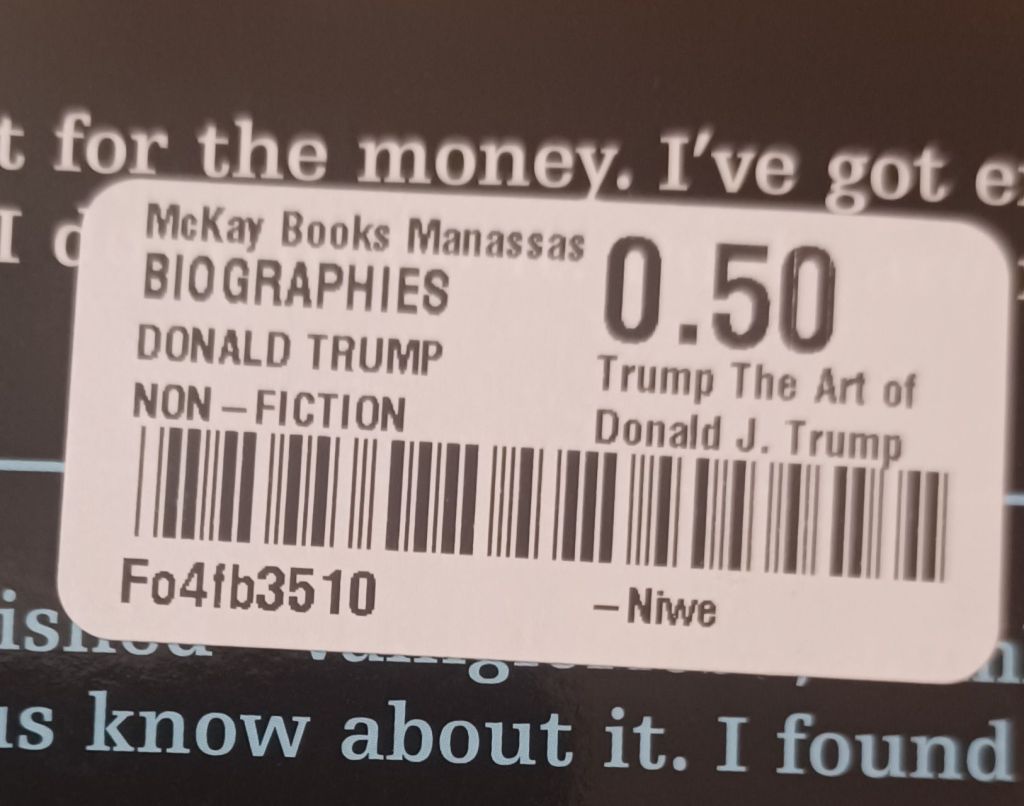
    Okay, enough of that, and on to something else. I want to talk about a book I will never read, Donald Trump’s (really Tony Schwartz’s) The Art of the Deal. After breakfast, since I had a free Juneteenth today with no responsibilities, I decided to drive on to Manassas VA for my semiannual trip to McKay’s Used Books, which is a terrific book store, IMHO. As in most book stores, each book is marked separately, but at McKay’s they seem to be priced with no rhyme or reason whatsoever.

    I went to the biography/memoir section, as I usually do, and started with the Z’s, working backwards through the alphabet. When I got to the T’s, I saw a copy of The Art of the Deal. Now, I generally only buy books that have been signed by the author, and what chance would there be that this pristine copy of this ridiculous book was signed by Donald Trump? And besides that, this was a pristine copy of a book that was written in, when, the 1980s?

    It turns out that the Trump campaign, in 2016, republished The Art of the Deal as part of his presidential campaign. And some of these included fancy-dancy book plates which were personally signed by His Disgrace. And this was one of them.

    So, I bought it. Now, remember what I said about McKay’s irrational pricing policies? Maybe I reached that conclusion too quickly. As I looked through the store, I thought that I could sense that books by Republicans were all very inexpensive. Was this because McKay’s didn’t think they were worth any more, or because McKay’s really wanted to sell these books quickly so that people would read them? I don’t now.

    But before I tell you the price, let me tell you that there are three signed copies of this edition of this book, looking identical to mine, for sale on the Abebooks website. They are listed at $725.00, $860.00, and (for some reason) $1500.00. What did I buy this book for at McKay’s? 50 cents.  Talk about the art of a deal.

    That’s it for today. It’s already after 8 p.m. in the East – my latest posting ever. Below are two photographs. The first shows the $0.50 price for the book, and the second – perhaps – the license plate of the individual who put that price on it.

  • Meryl Streep and the Ismaili Muslim

    June 18th, 2024

    One night last week, we watched “Out of Africa”, filmed in 1984, starring Meryl Streep and Robert Redford. Had we seen it before? Maybe. Who knows?

    It’s a beautiful film. At the 1985 Oscars ceremony, it won seven, including best picture. It is based on the writing of Isak Dinesen (Karen Blixen), a Dane who married a British (?) Kenyan colonist, lived on a farm somewhere between Mombasa and Nairobi for about 15 years, was never really in love with her husband, but fell in love with free spirit Robert Redford (or his real life equivalent), divorced her husband and left Africa after her Redford was killed and her farm taken over by creditors. There you have it. And, oh yes, there was also World War I, and the Germans were in Tanganyika. It was the first two decades of the 20th century.

    Africa, in the film at least, was beautiful and fairly empty, except for the wildlife, the natives, and the fuddy-duddy colonists. And Redford and Streep.

    I have never been to sub-Saharan Africa, and I guess never will be. People who go as tourists generally go for camera safaris and love it  The politics, the economies, the cities rarely make the news.

    Nairobi wasn’t founded until the very end of the 19th century. During the time the film was set, it looked something like this:

    By the time I was born, it had grown to a population of about 100,000. But today, Nairobi has about 4,500,000 residents and Kenya has over 50 million. This is contemporary Nairobi.

    I don’t know much about Kenya today. My smart phone tells me that the cost of living and inflation are high, as are urban crime rates. Sound familiar? Add  in high unemployment rates, something we don’t have (or maybe we do but it’s hidden because of how we measure employment). And, just like here, it’s apparently safe for tourists more or less.

    Kenya and the rest of Africa are becoming more and more central to world economic growth. As they say, Africa is the future. Actually, I am not sure that anyone says that, but they probably do. They should.

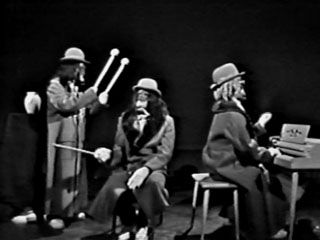
    I have two personal memories of Nairobi. First, in the 1950s, I was a big fan of Ernie Kovacs. Remember his Nairobi Trio?

    Did anyone even think this might not be politically correct?

    And then, when I was at Yale at law school, there was this extraordinarily attractive and always dressed to the nines young woman (known then as a girl) who would show up at events now and then, and put everyone in awe. Was she a Yale graduate student (this was before undergraduate Yale went co-ed), a student elsewhere, or what? If I knew them, I don’t remember now. But I learned she was an Ismaili Muslim (think the  Aga Khan), very rich, very smart……and from Nairobi.

    My guess is she is no longer in either Nairobi or New Haven. Her name? I don’t think I ever knew it. Her name was not important.

  • It May Be 90 Outside, but Burrrrrrrr.

    June 17th, 2024

    You may have already guessed it, but today I am writing about Aaron Burr. And, yes, sort of about Donald Trump (just sort of), because there is a connection.

    My biographical information comes from David Stewart’s book “American Emperor”, which I finished last night.

    All you may know is that Aaron Burr killed Alexander Hamilton in a duel. (“I could shoot someone on Fifth Avenue and I wouldn’t lose a vote.” See what I mean?)

    Let’s learn a little more. Burr was a lawyer, a New Yorker, a widower and womanizer, a Federalist, a narcissist, and a man who was brilliant, charming, easy to like, easy to upset, and excellent at making enemies. Especially making enemies among other Federalists (such as Hamilton).

    He ran for president against Thomas Jefferson and finished second. Under the rules of the day, this made him vice president president under a member of an opposing party. He thought Jefferson a dunce, was upset that as vice president he had nothing to do except chair Senate sessions and, with all that, was furious when he was dropped as Jefferson’s second term vice president.

    What to do? Basically (no reason to get too detailed), Burr decided to raise his own army, with the help of some high ranking, but not necessarily clear thinking, Jefferson appointees with a number of quite immodest goals in mind. For example, convincing the residents of the newly purchased Louisiana territory to rebel and create their own country. Secondly, to attack Spain and wrest away Florida and the Gulf Coast. Thirdly, to extend the war against Spain and capture Mexico and then perhaps more of South America.

    He accomplished more than you might expect, drawing others into his plans and ruining the lives of most of them until they turned against him. And then, of course, his plans just fizzled out. And his efforts, long rumored, were publicly confirmed.

    Now, remember, Aaron Burr was not an ordinary Joe. He was a former vice president AND there were murder indictments pending against him in New Jersey and New York for the murder of Hamilton. He couldn’t set foot in either of those states and extradition was always a possibility. Living in a new western country, being a hero, would save his skin. Get the picture?

    Burr was in fact arrested in Virginia and charged with many crimes, including treason and (by virtue of his plans to move against Spain) violation of the Neutrality Act.

    About a third of Stewart’s book is devoted to the trial which was presided over by Chief Justice John Marshall, acting as a circuit riding judge. Again, I will spare you details, but there were weeks of arguing about juries and witnesses and allowable evidence and definitions of terms like treason (very narrow) and jurisdiction and on and on.  So, yes, we have never tried a former president for felonies, but there are lessons to be learned perhaps from the trials of Aaron Burr, even though the American legal system was then in a much different state.

    A few more simple truths about the trial. Politics, politics, politics. Shenanigans, shenanigans, shenanigans. If you think things are wild today…..

    And, oh yes, Federalist justice Marshall seemed not very happy with Democrat president Jefferson’s vendetta against Burr, and Burr was found innocent and freed.

    Burr, by the way, was also always short on funds and deeply in debt (that’s the one thing he shared with Jefferson), and now had lost all of his friends and supporters. So he went to England and France to enlist their help against Spain’s territory in the Western Hemisphere. Struck out there, too.

    No money, no friends, almost not allowed back in the country, his one grandson killed by a fever, his only daughter killed in a ship wreck. He returned to New York and lived to 80, an apparent shadow of himself. And clearly at 80 too old to run for president.

    (this post written in the West End Tatte coffee shop. All errors are theirs.)

  • This Post Has Nothing Whatsoever to do with Father’s Day.

    June 16th, 2024

    I hope that’s a relief.

    It has to do with Craig’s List. Now, I have never used Craig’s List for anything. I say that with neither pride nor regret. Just the facts, ma’am. Just the facts.

    Until a year or so ago, I gave Craig’s List no thought. It was just one of those things that was just there, and had nothing to do with me. Then I learned that there really was a Craig. A man named Craig Newmark. And I saw a YouTube presentation he made to some group here in DC, and decided to listen to it. I could have watched it, of course, but I was in my car, and I don’t drive a Tesla with an IMEX screen, so I had to be satisfied with the sound.

    I learned a little about Newmark, that he was an engineer of some type, and that he had founded Craig’s List sort of as a lark, as a small way to bring community to his neighborhood, or to people he knew, or something like that. I learned it was a for-profit operation, and that Craig Newmark had made Millions (with a capital M) and was giving it away almost as quickly as it came in. I also learned that he was a character, a one of a kind character, who had been hooked on science fiction books since he was a kid, and who had grave forebodings about what Artificial Intelligence might bring us down the line. And I learned that he was funny, and had a self-deprecating sense of humor.

    Last week, Craig Newmark spoke at a relatively small luncheon (maybe 75 people at the most) hosted by a friend of mine on behalf of Moment Magazine at the National Press Club here in Washington, and I went. Moment was presenting Newmark with an award of some sort. He was introduced by Judy Woodruff of PBS and interviewed by Robert Siegel, recently retired from NPR. I found it a lot of fun.

    Going back for a minute to Craig Newmark and his particular “style” and brand of humor, I must say that it apparently is not for everyone. At least two friends at the session were not impressed by him at all. As one told me, “Craig is not on my list.”

    Well, I dissent. Craig Newmark looks to me like someone I could be good friends with under other circumstances. He is about 10 years younger than I am (Craigis70), and a couple of inches shorter than I am (always a good trait in a friend, I think), and a few pounds heavier than I am, and slightly balder than I am and, besides that, he makes me look like a fashion plate. You can see the photo that I am including in this post, and you can ask yourself if you would dress like that going to speak to and pick up an award from Moment Magazine and its supporters. He, by the way, is a supporter of the magazine.

    Robert Siegel was a great choice to be the interviewer. Not only does he have the perfect voice for anything (maybe other than opera, I don’t know) that requires a voice, but he is low key and seems to be actually listening to, and reacting to, the answers of the questions he poses. And, he is about as short as Newmark, so the stage didn’t tilt either way.

    To learn more about Newmark, to get basic background, just go to Wikipedia. And, by the way, Newmark is a major supporter of Wikipedia, and a major fan (as am I), worried that Wikipedia is going to be more and more attacked by fake news sources and wants to make sure they have the resources to fight it.

    Free, honest and truthful news is one of the aims of Newmark’s philanthropy, as are Veterans programs, cybersecurity, family leave support and environmental programs. He apparently donates, through his charitable foundation, between $50 million and $100 million a year.

    So there was a lot of conversation about fake news, artificial intelligence, and in general the dangers of the modern world. There were also discussions of birds. Newmark is also a vocal birder – not that he hunts birds obviously, and he doesn’t photograph him as far as I know, he doesn’t paint or draw them. He just watches them and feeds them. He lives in Greenwich Village and he says that the variety of birds there is limited, so he spend a lot of time watching pigeons, many of whom are “regulars”, whom he can identify. He is particularly jealous of one male pigeon who is now on his fifth mate. He is jealous of him because he, as a bird, is so much more socially adept than Newmark is as a human being.

    Craig Newmark seems like an accident. He was in high school, he says, the very definition of a nerd, with his pens in his short pocket, and became an engineer, working for IBM for 17 years (hard to imagine, that, IBM the white shirt company), starting Craig’s List for just a few friends, before it mushroomed. The idea that his service for his friends would grow into such a big business is hard to imagine, especially for Newmark.

    Siegel asked him if he ever wanted to own a media company himself, rather than making contributions to so many others. “I don’t have that kind of money”, he said, “I’ve given all mine away.”

  • Out of this World! (An Amazing Story, to be Sure)

    June 15th, 2024

    This is a sort of a lazy post, because all I am going to do is repeat what I read in an article yesterday in the Washington Post. It would be even easier, of course, simply to post a link to that article, but the Post has a paywall and I don’t want you to miss it. So all credit goes to Post reporter Joel Achenbach.

    The article, on page 2 of the first section, was titled “NASA unsure how long revived Voyager I can keep exploring deep space.” It contained some of the truly most amazing things I have ever read. And not only that – but I bet that it also contains some of the most amazing things you have ever read.

    A little (very little) background. On September 5, 1977, NASA launched the Voyager I spacecraft to explore some of the outer reaches of space. It later launched Voyager II for the same reason. Both have been extraordinarily successful in their missions, and both continue even today traveling further and further from Earth.

    When I say traveling further and further from Earth, I mean traveling further and further from Earth. For example, Voyager I is now 15,000,000,000 (that’s 15 billion) miles away. [OK, you need a little context? That means that for every mile away from Earth Voyager I is today, Elon Musk will earn $4 this year. But I digress.]

    That means that Voyager I, having photographed Uranus and Neptune and Pluto, has continued on beyond the edge of our solar system. Again for context, if you traveled to Pluto, you would only be 1/3 of the distance Voyager I has traveled so far.

    Because Voyager I is so far from the sun, it cannot operate on solar power, but it still is able to perform somewhat because it is powered in part by plutonium, which has a lengthy half life. It also is powered by what the article calls a radioisotope thermoelectric generator. Not surprisingly, I have no idea what that could possibly be, but it seems to work.

    The goal of NASA apparently is to continue to obtain some information from Voyager until it’s 50th birthday on September 5, 2027. It appeared, last November, that this goal would not be met. Everything went silent. Voyager I stopped sending back any information.

    But leave it to NASA. Here I quote Achenbach: “A ‘tiger team’ of engineers at JPL [The Jet Propulsion Laboratory of NASA in Pasadena] spent the ensuing months identifying the problem – a malfunctioning computer chip – and restoring communication.”

    OK, let’s repeat that in our own words. There is this spaceship 15 billion miles away, out of the solar system, which was still sending back information and then it stopped. These NASA folks were able to locate the problem as one malfunctioning computer chip – and fix it.

    Now, I looked up a definition of a computer chip at amazon.com, and this is what I got: “A computer chip is a tiny wafer of semiconducting material with an embedded electronic circuit. It contains millions of microscopic electronic components called transistors that transmit data signals.”

    I don’t know how many computer chips are in Voyager I, and Voyager I was not transmitting any data back, and it was 15 billion miles away, and nevertheless NASA was not only able to identify the particular problem, but solve it and put the ship back in business.

    Of course, even after it stops transmitting data, Voyager I will continue to travel. I now go back and quote the article:

    “Voyager I is heading toward the constellation Ophiuchus, according to NASA, and in about 38,000 years, and it will come within 1.7 light years of an unremarkable star near the Little Dipper. But although it will have long gone silent, it does carry the equivalent of a message in a bottle: the “Golden Record”.

    “The record was curated by a committee led by astronomer Carl Sagan and includes greetings in 55 languages, sounds of surf, winds and thunderstorms, a whale song and music ranging from Beethoven to Chuck Berry to a Navajo chant. The Golden Record is accompanied by instructions for playing it, should the spacecraft someday come into the hands of an intelligent species interested in finding out about life on Earth…..

    “But the advanced spacefaring civilization may not be an alien one, NASA scientists point out. It’s conceivable that the cosmic message in a bottle could be picked up by a human deep-space mission eager to examine a vintage spaceship.”

    Enough said. Keep me posted.

  • But First a Word from our Sponsors

    June 14th, 2024

    There are so many big things going on the world that are irritating, it is very sad that there have to be small irritating things, as well. But there are, and many of them fall under the category of “TV Ads”.

    I thought I’d tell you the ones that irritate me the most, the ones which convince me never to buy the products they tout. And I already know that this listing will be incomplete. Otherwise, it would be a book, not a post.

    And, I am not listing them in any specific order of irritatedness. Just random. They are all over the top irritable.

    What about the juvenile band that plays on the Kars for Kids ad? I think I have seen those pre-teens for the past ten years. They must be all out of college, married with children, driving SUVs for now. I turn the sound off. Even forgotten the tune by now.

    And what about those ads of the animal protection groups – the ASCPA and the Humane Society – that drone on and one with pictures of emaciated dogs, scenes photographed by cameramen who clearly have no sympathy for the posing canines. Again, the sound goes off, and sometimes even the TV.

    But it’s not only the dying dogs that get to me. It’s also the sick children, who populate the 90 second ads for Shriners Hospital and St. Jude’s, some smiling and singing like good little children and others clinging to a crying parent, while the other parent sings the praises of the hospital. I understand that both of these hospitals treat very sick children without charge, and I am sure they do a very good job. And although I don’t know about Shriners (I have never looked), I know that St. Jude’s is a fundraising machine, and has more money than it will ever need. Don’t believe me? Google it.

    When those ads show on CNN, I switch to MSNBC. When they appear on MSNBC, I switch to CNN.

    And then there are those ads that just do not seem to work as assumed. Take the new PNC Bank ads that tout PNC as perfectly boring, claiming that people want a boring bank. The fact is that no one wants a boring bank, as I expect PNC will find out one day. But if their ads were simply boring, perhaps that would be okay. But the ads are considerably worse than boring, and the fellow they pay to talk about how boring befits the best bank is not only boring, but looks like he would rather be somewhere else, somewhere more interesting.

    And then there’s Botox. I watched a new Botox ad today, probably the third or fourth that I have seen. They are before and after ads, and as I watch each of them, it seems to me that the “before” picture is better than the “after” message. that Botox makes people look worse. Do the Botox people know that I (and the other I’s) feel this way? How could they not?

    Then, there are the “screamer” ads, ads that are intended to catch your attention because they have an unpleasant, loud, rude person at the center. Like the insurance company that produces the ads that star Mayhem, the disheveled rascal that puts everyone he sees in trouble. Real trouble. Or they Kayak ads. I know Kayak has something to do with travel arrangements, I just don’t know exactly what. I don’t know exactly what because I turn off the ads as soon as the lady involved goes ballistic. I don’t need to put up with that.

    Then, there’s Fisher Investments, which tries to portray itself as different from other financial advisory firms because they do better when their clients do better. It’s hard to believe that when the people that pretend they are Fisher employees are so swarmy, isn’t it? (By the way, my computer doesn’t think that swarmy is a word. It likes smarmy better, but I sort of like swarmy, because that’s what those actors are. Let’s make it a word.) By the way, I have looked up Fisher Investments. If they do such a wonderful job, guess what? They’re customers don’t know it.

    And then of course, there is no longer just one commercial. Usually, six or seven of them are banded together, and go on and on. And most of the time, one of those six or seven has a much greater volume. Impossible to listen to. You run to the remote to turn the volume down, only to have to turn it up 30 seconds later. What is the purpose of that, I ask? It never used to happen.

    I am going to stop soon. I know this is getting long. I just want to add one category: pharmaceuticals. I wish all of them would disappear. They are equally bad, I think. The only exceptions to my general feelings about pharma ads are the ads for Skyrizi. This is not because their ads are better. I can’t even tell you what the ads look like. It’s also not because I have a disease (or know I have a disease) that Skyrizi is meant to treat; I can’t even tell you what those diseases are. It’s just that I have decided to like Skyrizi. Pure and simple. That is it.

    So, what’s this all about? One thing I realize is that I remember the bad ads more than those that don’t offend me. So maybe this is all a trick of the advertising world. Want to sell your product? Create an annoying ad. That way people will remember it. And when it’s time to buy something, maybe we, without knowing, head right to them. Fool me once…… Fool me twice…..

  • Recommendations for Today on Music and Antisemitism

    June 13th, 2024

    Let’s start with music. A friend recommended to me the Trumpet Concerto by Mieczyslaw Weinberg. Do you even know who Weinberg is? He was one of those Soviet composers who was virtually unknown in the West, and who is now being discovered (not rediscovered, but discovered). He was a good friend of Dmitri Shostakovich, and very well known in the Soviet Union. He lived until 1996. His concerto might remind you a little of Stravinsky, a little of Shostakovich and, for me at least, a little for Russian contemporary art of the early 20th century. I recommend you listen to it.

    Let’s go to a podcast. I listened this week to a presentation by Douglas Murray, a conservative British journalist and associate editor of The Spectator. He spoke about antisemitism, the war in Gaza, and to a lesser extent about American campus protests to an audience in Rotterdam, Netherlands. I recommend you listen to/watch it.

    Murray is a conservative, to be sure, but I think that what he says makes a lot of sense. He talks about the historical foundation of antisemitism, and how it relates to the way that so many in the world react to Israel even if they aren’t conscious of it. Why they react to what the Jews are doing in Gaza, more than what Gaza wants to do in Israel, and more than what non-Jews are doing in, say, Ukraine, South Sudan or Yemen, to name just a few places. In his presentation, he does mention the church as an important institution in the development of antisemitism, but in response to a question from the audience, he lists “envy” as perhaps the most important contemporary cause of continuing antisemitism.

    This is in contrast to Rabbi Yossy Goldman of the Sydenham-Highlands North Hebrew Congregation in Johannesburg, whom I also listened to and watched recently, and who thought the prime cause today of antisemitism is that Jews are “disturbers” whenever they are in the minority. Their ideas as to social justice, globalism, and so forth are often at odds with the majority community.

    Perhaps it is a combination of the two, and these two presentations do give you ways to think about the problem that might be helpful and useful.

    Going back to Douglas Murray, I should add that he talks not only about the causes of antisemitism, but the results. Wherever there is pervasive antisemitism, he says, there is a society in trouble, trouble beyond the antisemitism. The Jews, he says, are the canaries in the coal mine. But rather than treat them as such as search for what is wrong, it is often easier, apparently, simply to shoot the canaries, as if this will help. It doesn’t.

    That’s it for my writing today, because I would like you to at least start these attachments, in the hope that you will want to see them through.

  • Fee, Fie, Pho, Fum……. and a Little About David Tatel and And Politics in the State of Missouri.

    June 12th, 2024

    Part One: We went to Politics and Prose, our neighborhood book store, tonight to hear retired U.S. Court of Appeals Judge David Tatel speak about his new book, Vision. It was, not surprisingly, an overflow crowd (a few hundred, I would guess), many of whom were friends of the author, or attorneys who had appeared before him or otherwise interacted with him.

    The reviews for Vision have been very positive, and David Tatel, who I have heard speak before, talked not only about the contents of the book, but about how and why he wrote it after retiring from 30 years on the bench.

    For those of you who do not know, Tatel is blind. Like our friend economist Sandy Greenberg (who wrote his memoir Darkness My Old Friend), he was not born blind, but lost his sight as an adult and achieved more than the typical sighted person could ever hope to do. Tatel made several important points about blindness today. It is easier to be blind, he says, because of the technological changes, which among other things allow the written word to be converted to audio, thus allowing him to read and write pretty much on his own. On the lower tech side, he spoke warmly about his seeing eye dog Vixen. He had no seeing eye dog until he was in his 60s, if I understood him correctly, and says that it changed his life. Before he got a dog, he used a cane. A dog is much safer crossing streets, he said, and if he drops something, the dog can retrieve it, something that he could not do himself. And, for the first time in 30 years, he can go for a walk with his dog on a country trail without another human being. He finally can get more thinking time and alone time.

    As to the law, he said some very pointed things about today’s Supreme Court, being careful (“judicious”, as he called it) not to speak about any individual justices. He also said he only wrote about cases in which he was involved in Vision, and not about others. His problem with the Supreme Court he said is that it is an activist court, arrogating more and more power to itself, making itself the most equal among the supposed three equal branches of government. And it does this by ignoring the principle that the court should only involve itself when it has to, by ignoring precedents, by incorrect readings of the law and so forth. He went on to emphasize that the only way to reform the Court is through voting, and he thinks that our failure to vote sufficiently is a shortcoming that we should be able to end.

    He was asked about, and did speak about, gifts to judges. No one ever gave him a trip to Bali, he said. And the only extra income he ever earned amounted to $500 and was reported on his disclosure forms. As to recusal, he said that he recused himself whenever his presence on a case might raise questions (such as a matter, which he discussed, involving blind people). But he added that it was more of a problem for Supreme Court justices to recuse themselves. When an appellate judge recuses himself, another judge is appointed to take his place on the case. When a Supreme Court justice recuses himself or herself, the number of justices hearing the case is simply diminished.

    All in all, Tatel comes across as a very nice and very ethical individual. So different from so many who we are now used to in public life.

    Part Two: Which reminds me. Did you see the article today about 25 year old Valentina Gomez, who wants to be the Republican candidate for Missouri Secretary of State? About four weeks ago, she had an ad which showed her burning “queer books” with a flamethrower. Another showed her jogging on a country road, saying to the camera “Don’t be weak and gay”. Yesterday, she said that Brittney Griner should be sent back to Russia. “Brittney Griner should be rotting in a Russian prison, not going to the Olympics”. [This from LGBTQnation.com]

    For MAGA Republicans, remarks like this seem to be more and more the rule, and not the exception.

    Part Three: On a totally different subject, I went into a pho restaurant today for lunch. I was in Prince George’s County on University Boulevard, it was lunch time, and I pulled into a small strip shopping center. I first went into the Salvadorean restaurant, but there was something about it I didn’t like (such as no customers), so I went a few doors down to Pho 75. I have been to Vietnamese restaurants before, of course, but never to one that served pho exclusively. Maybe you all have, and you know that pho is virtually always made with beef. This restaurant served 17 different kinds of pho. 16 of them were made with various cuts of beef. Only one with chicken. That’s the one I chose.

    I am not a soup eater, so don’t usually order this type of a dish, but it was very tasty, very filling, and very inexpensive. For $10, I got a “small/regular” bowl (much bigger than what I would consider a regular bowl) with a fairly tasty broth, thin slices of white meat chicken, sliced onions, basil, and of course rice noodles. I was given a second plate of bean sprouts, hot green peppers, cilantro leaves and slices of lime, which (as I watched other people) was to be poured into the bowl of pho. I also added some hot sauce (which some people tell me is a no-no, but there it was on the table, looking like something I should add). Very, very tasty, I thought. Of course, I couldn’t finish it.

    The only negative is that, after I was done, and walking back to the car, I had a feeling that there was too much salt in the broth. I am sure my feeling was accurate. Doesn’t restaurant broth usually have too much salt? Or maybe it wasn’t salt,but MSG.

    Okay: that’s it for this morning.

  • Took Me Out to the Ballgame, Part 2

    June 11th, 2024

    Have the Nationals developed the G.O.A.T. scoreboard?

    Let’s give credit where credit is due. But, of course, I don’t know whom to credit But I think that the new Nats scoreboard is about as good as it could be.

    I am not going to be able to do it justice, but referring to the two photos above, let’s work through what you can learn by looking at the scoreboard, even if you decide not to look at the game.

    First, it should be obvious that the Nationals are playing the Atlanta Braves, and that the Braves are up to bat. And that the current Brave who is at the plate is Adam Duvall. In the center, you see his picture, you see that is uniform number is #14, you see that his major league debut was on Hannah Hessel’s birthday in 2014, that he was born in Louisville in September 1988, and that he bats and throws right handed. You can see that this year, he has hit 122 times, has had 23 hits and scored 14 runs, has doubled four times, hit no home runs or triples, has been on base 27.5% of the times he has come up to bat, and has a slugging percentage of .369.

    (You should know that the center screen does not stay this way. It is where you see live feed, whether it’s the batter coming up to the plate, or a replay of the play after he has finished batting, or (in later innings) a list showing what he has done in previous appearances during the game, and – between innings and before the game – ads, promotions, the national anthem singer, information about the game and whatever else they want to show you.)

    And one more thing. If Duvall happens to hit his first home run of the season (he didn’t), right below his picture, you would see another chain of numbers, showing statistics about that home run: how far it went, what was the speed of the ball off the bat, and what was the angle of its arc. That is all new stuff.

    To the left of the middle screen, you see the Braves hitting line up, its 8 position players and its designated hitter, in the order in which they will bat. For each player, you see their position and their uniform number. You will see that Duvall is hitting fifth, and because he is at bat, you see a little more information about his – his current batting average, the number of home runs he has hit, the numbers of runs he has batted in, and his OPS. If you don’t know what an OPS is, it’s a calculation based both on the number of times a hitter gets on base and the number of times he gets extra base hits. It’s an arcane measure, and all you really need to know is the higher the better, and Duvall’s is not very high. Those who are having a good year at the plate may find their OPS at .900 or even higher.

    Now, if you move to the right of the screen, you see information about the Nats, who are in the field. Obviously, when this inning ends, the information you see about each team will reverse.

    You start at the top with the identity of the Nats’ pitcher, who is Mackenzie Gore. You see his uniform number is #1, and that he is a left handed pitcher. We were still in the top of the first inning when I took the picture, and Gore had thrown 19 pitches (pitchers usually don’t throw more than about 100 on a good day), of which 7 were balls and 12 were strikes (you’d like to see a pitcher throw twice as many strikes as balls). You also see something about his last pitch. It was an 86 miles per hour curve ball.

    Below the information about Gore, you see an outline of the ball field, with the name of each Nationals position player at the place where he is playing. You also see that the name of one of the Nats position players, Abrams, playing short stop, is circled. This shows you that when the Nats come to bat, Abrams will be the next (in this case the first) to get to the plate.

    Looking below everything I have mentioned so far, you see the traditional center of a baseball scoreboard. An inning by inning account of the runs scored by each team. At this point in the game (the top of the first inning), no runs have scored. (By the way, to take away the suspense, the final score will be Washington 7, Atlanta 3.) To the right of the inning by inning scoring, you will see the total runs to date, the total number of hits each team has had, the total number of errors (if any), and the number of times left that there can be a visit of catcher, manager or coach to the pitching mound (the total allowed per game is only 4).

    Then, to the right of that, you will see statistics regarding the person presently at bat. You will see that there is one ball (four balls and the batter advances to first base, just as if he had hit a single), and two strikes (three strikes and you’re out). Under that you will see that there are already two outs – one more out, the inning ends, and the Nats come to bat.

    Even further to the right, you see a promotion for a Mike Rizzo (he’s the general manager) bobble-head on June 14. That promotion stayed up on and off throughout the game. But each time a batter finishes, the display changes to show what happened to the batter in the “language” one would use if he/she were filling in their own scorecard. For example, if a hitter grounded out to the second basement, who then through to first, it would GB 4-3. If the hitter, struck out with a called strike, it would say K. And so forth. (There is a whole language here – Google it if you want to learn more)

    That’s pretty much it for the big screen. But remember that the large center panel changes and changes, as I described above.

    But the big screen is not all. Below, in front of the first deck spectators, the wall going down to center field shows more, as you can see from the second photo. To the right, you see what is going on in every other game being played that day; that, like the inning scoring, is an old standard for baseball scoreboards. But to the left, you see information that there just was not room for above. This is information about the pitcher, again in his case Mackenzie Gore. I took this photo a few innings later, so the info doesn’t correspond with the first inning information on top.

    Here you see that Gore has pitched two innings, struck out three, allowed two hits, and walked one batter (BB – base on balls – is the official name for a walk). Below that, you see Gore’s statistics for the entire season – he has pitched 65 innings, struck out 77 batters, has a win-loss record of 4-5, and has allowed an average of 3.46 runs to be scored against him per every 9 innings (a game). This is actually quite a good record; the 4-5 win-loss statistic is a result of the Nationals weak hitting record so far this year. (The Nats overall record today is 30-35, five below .500).

    This tells you pretty much what you will learn from the scoreboard. Of course, if you sit in the outfield seats, you won’t see the scoreboard at all. You will be much more basic statistics shown down the first base line, but you really miss out on something, I think.

    And for those of you who knew nothing about baseball, if you study this post, you will learn about 10% of what you need to know to really understand the game.

    And is anything missing from the scoreboard? What about a clock. Usually, I think a scoreboard has a clock. At Nats park, the clock is located above the Nats bullpen. Not a problem (and it’s digital, so you don’t even have to be able to tell time).

←Previous Page
1 … 35 36 37 38 39 … 62
Next Page→

Blog at WordPress.com.

searching

Loading Comments...
  • Subscribe Subscribed
    Art is 80
    Join 71 other subscribers

    Have a WordPress.com account? Log in now.

  • Art is 80
    View site in Reader
    Manage subscriptionsSign upLog in
    Report this content
    Collapse this bar