Skip to content

Art is 80

  • A Walk Down the Street (Part 9)

    August 13th, 2024

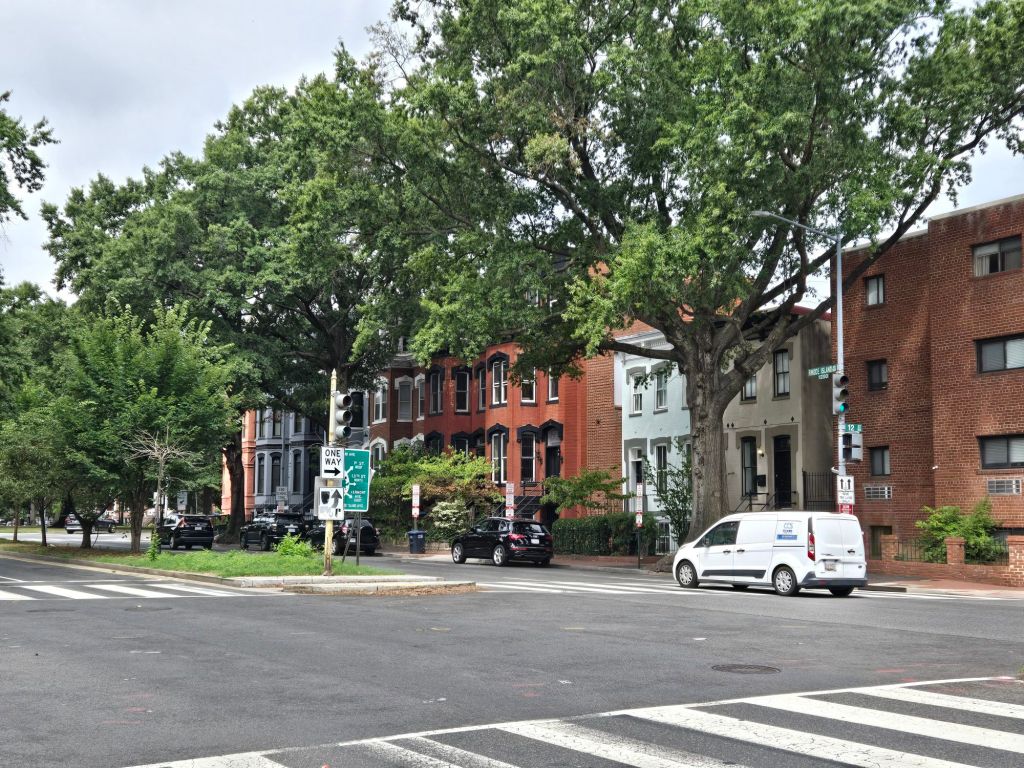
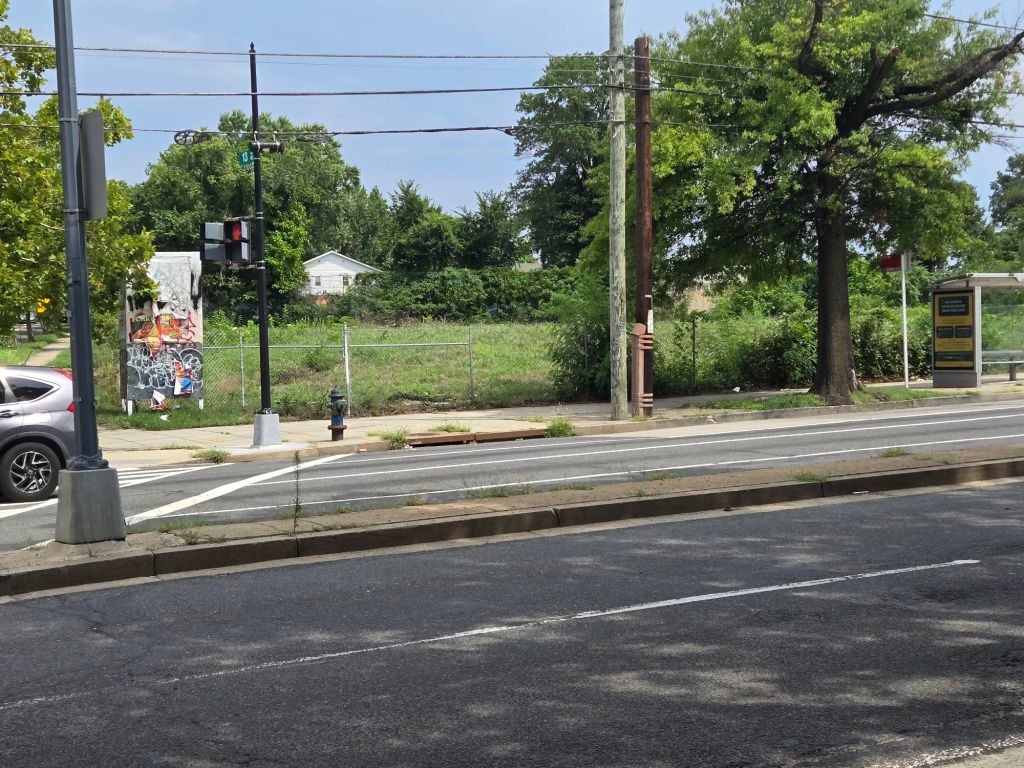
    As the crowded commercial area near the Metro, clearly in transition, is left behind, we enter a few blocks where the development is less intense. I think this is ahistorical and is the result of buildings having been torn down, although, with one exception, I can’t really prove that. But we do see a few vacant lots, which I am sure weren’t always empty.

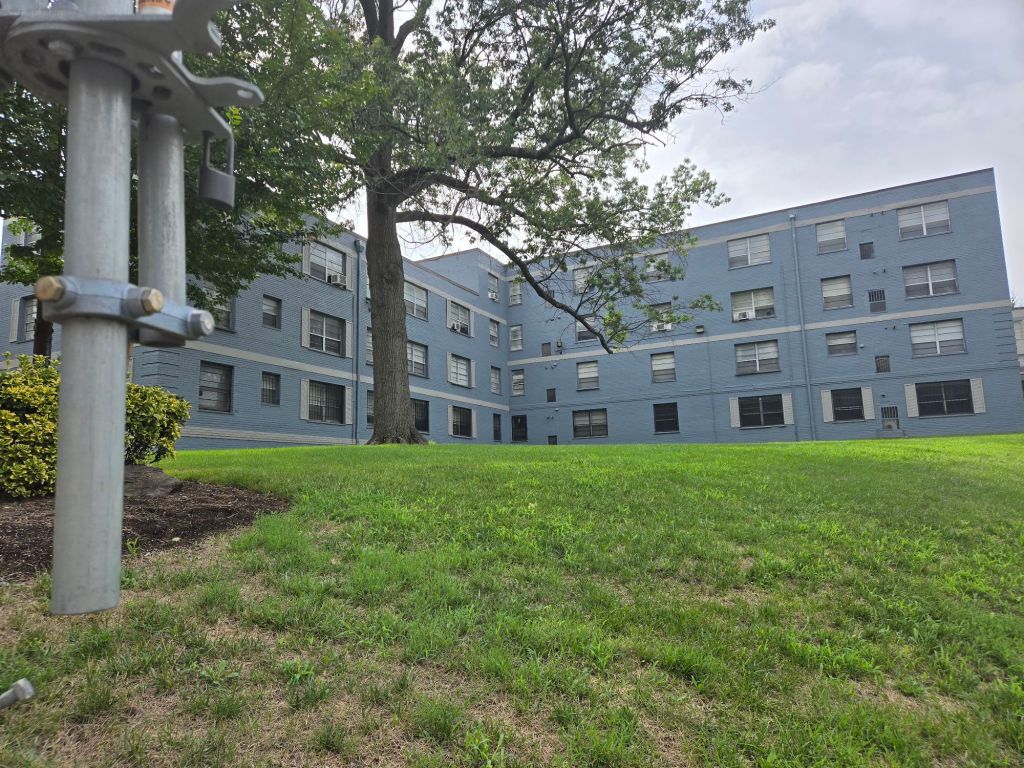
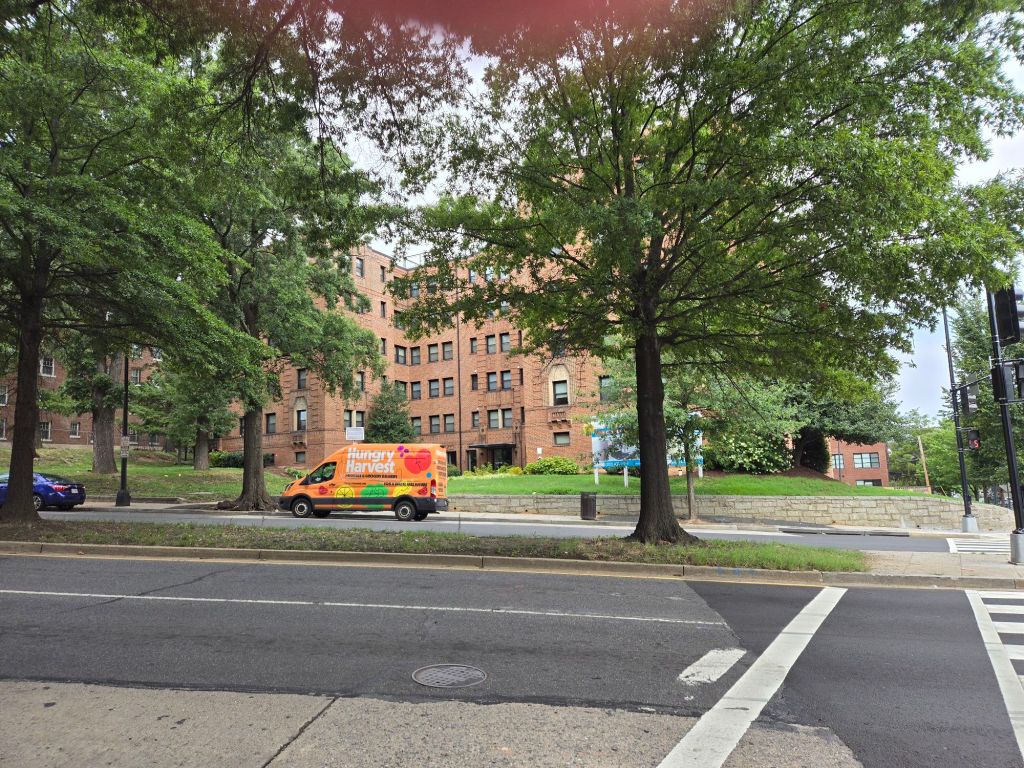
    We walk past one of the city’s largest apartment developments, formerly called Brookland Manor, but now with signs that say RIA (I bet you can figure that one out).

    Here is one building, but there are many, with something like 1700 separate apartments. Built in the 1940s for working class families, the property was acquired by a former client in the 1970s, and rehabilitated as Section 8 subsidized housing. It provided an important city resource as it contains, if memory serves, many three and even four bedroom units, of obvious importance for large families and rare in government assisted housing. But it was always controversial, was viewed as harboring too many children and too much crime. It was, in part, because of its age and size difficult to manage and maintain and I think my clients, serious people, did as well as possible.

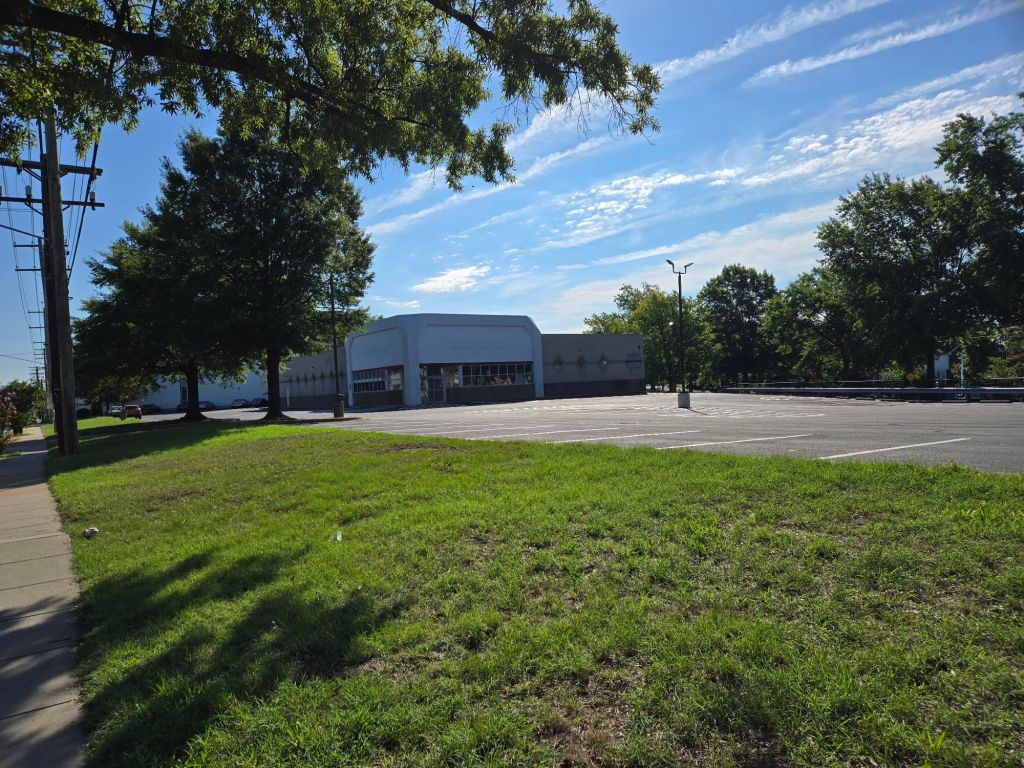
    Then my client decided it needed a full scale rebuilding that became very contentious. I am not sure where things stand today. It looks the same (still looks well maintained), the name has changed, but I am not sure what the plans are today. Probably still in flux. On the lot on Rhode Island next to this property was a small, old strip shopping center that was part of the problem. It was purchased by my client and has been leveled. That is one of the empty lots. Keep your eye on that space.

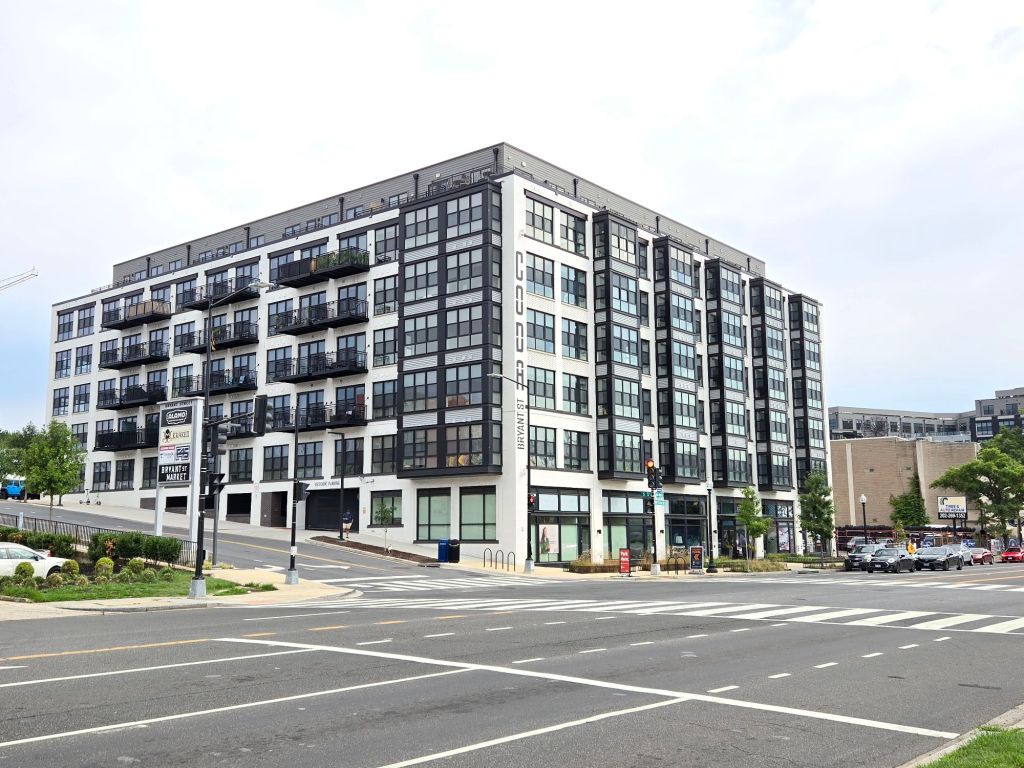
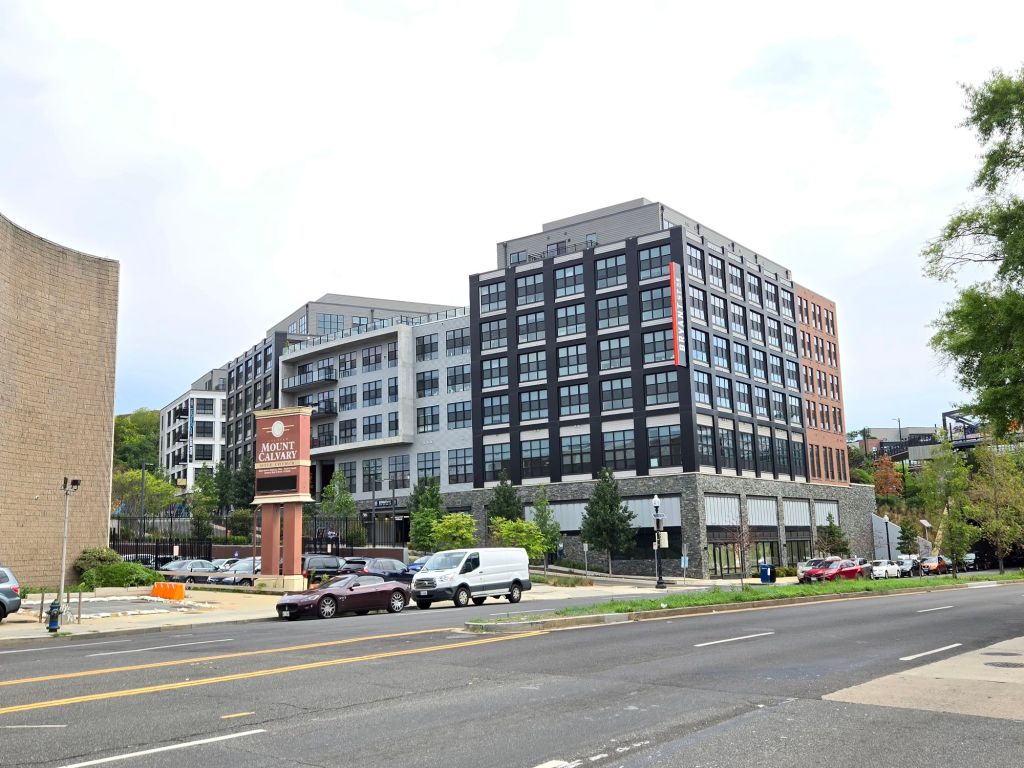
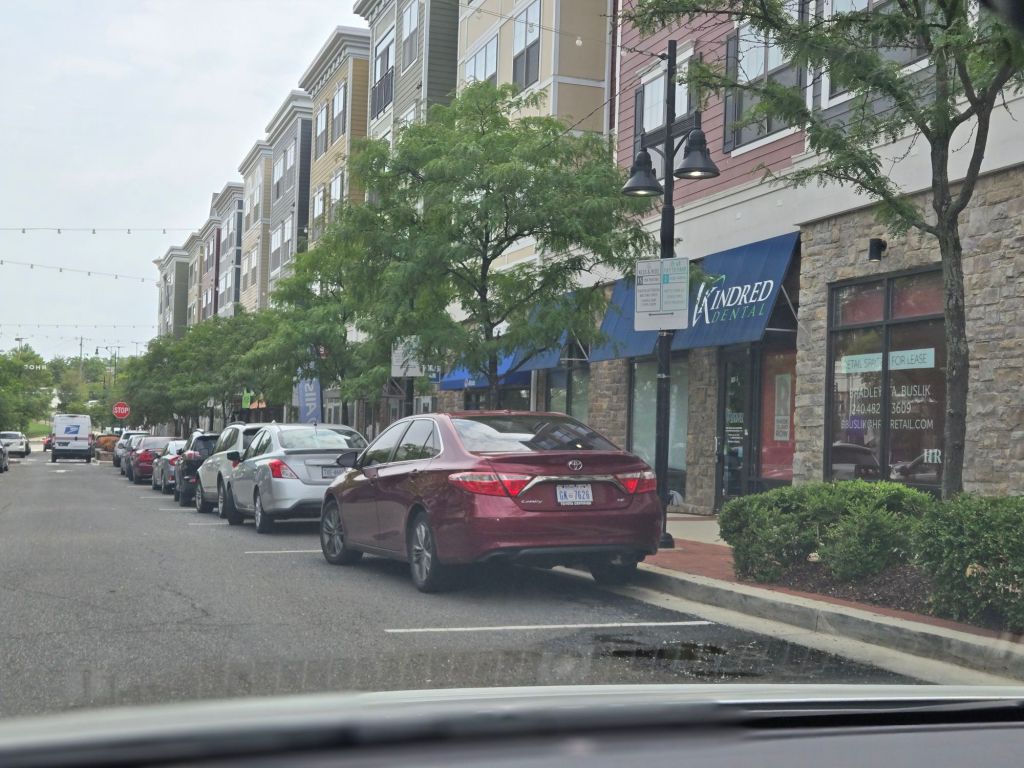
    As we continue,  we see more transition in action. New rental or condo buildings are interspersed among older buildings and some commercial properties along with the vacant lots and vacant stores. This, for example, was a Wallgreens.

    But never fear. The McDonalds, the 7-11, the laundromat right across the street – they are still there.

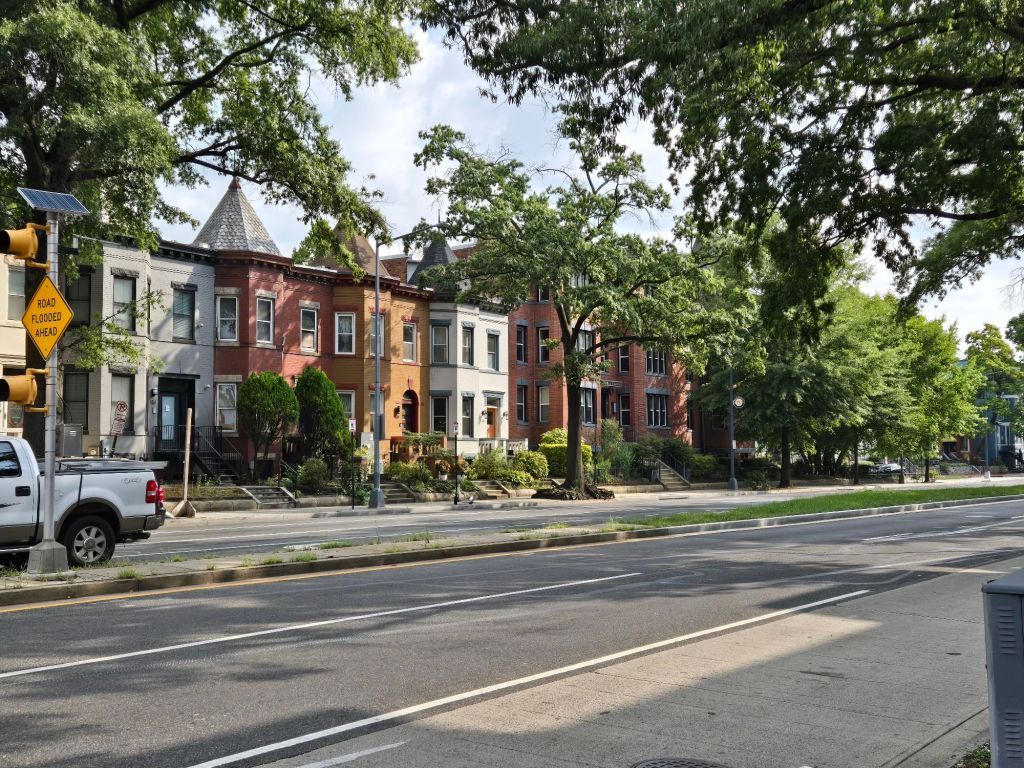
    We walk on. And then again the neighborhood changes and we now enter several blocks of active commercial activity that looks like what you might see in older cities across the country. Yes there are still some vacancies, but most buildings are well occupied.

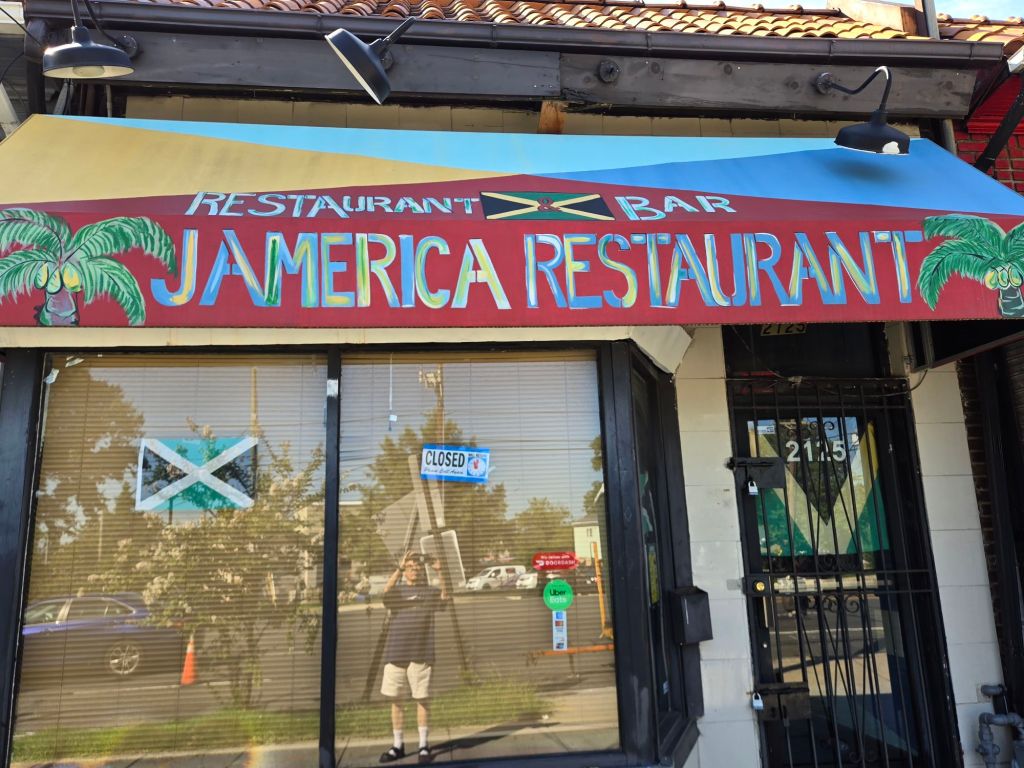
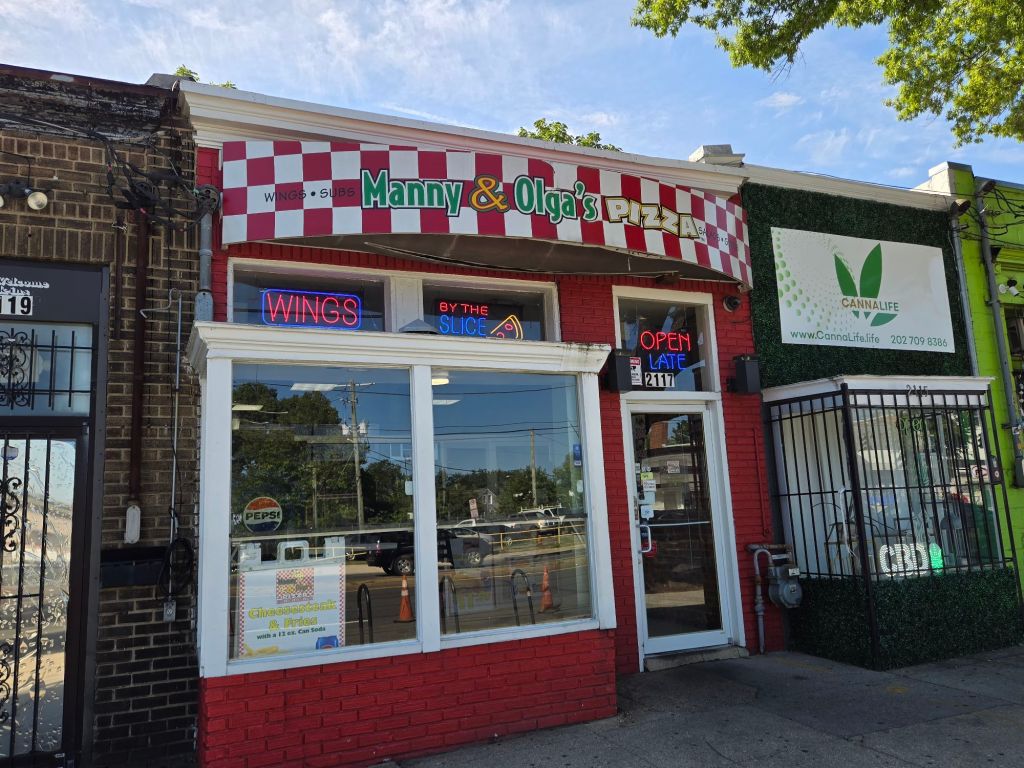
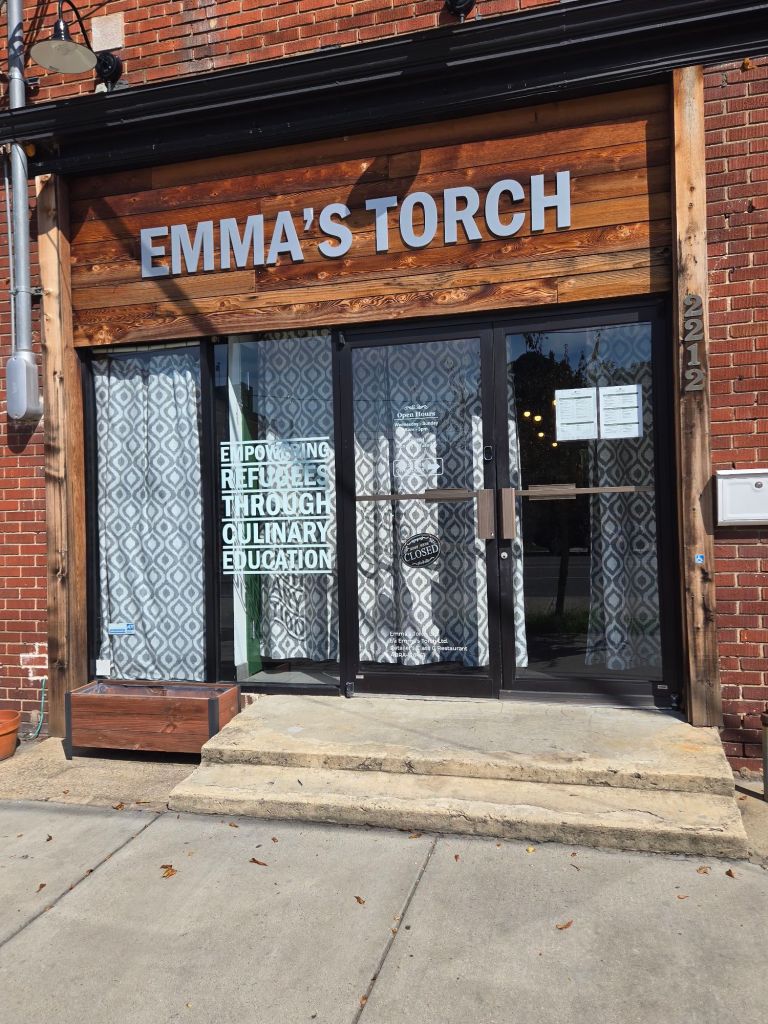
    There are several small restaurants, including a Jamaican restaurant (which I just heard has closed), pizza, and a restaurant that also serves as a culinary school. There is also a Chinese carryout.

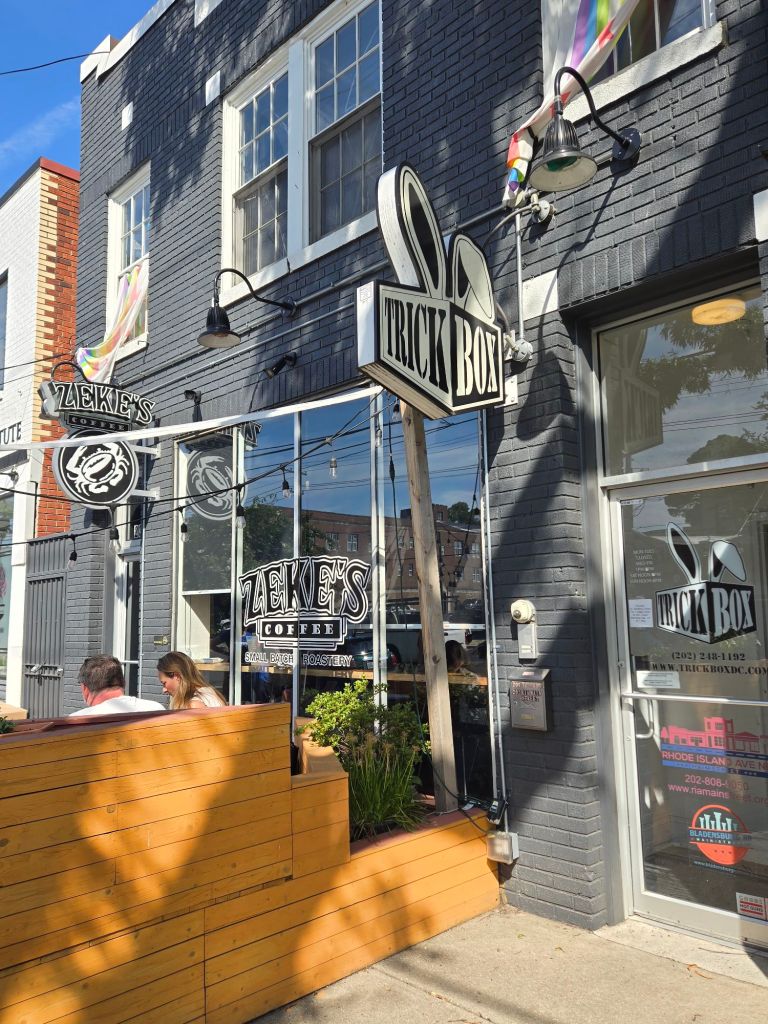
    There is a wonderful coffee house, where you can watch the friendly, busy staff, pack the beans, grind them, roast them and make your drink.

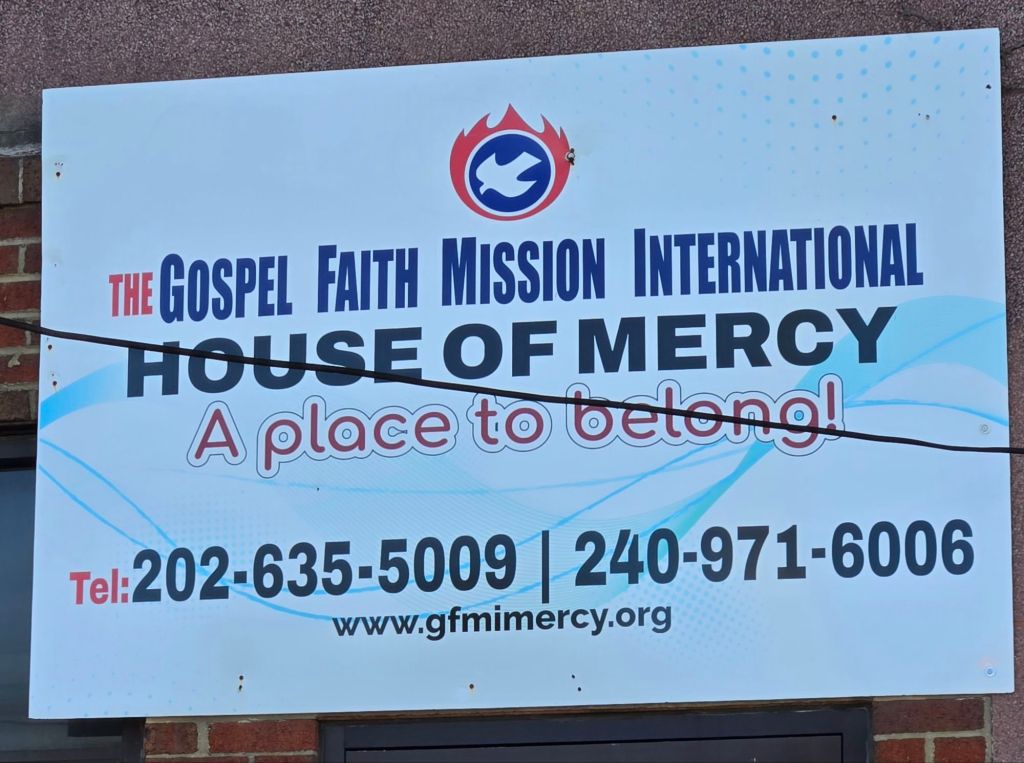
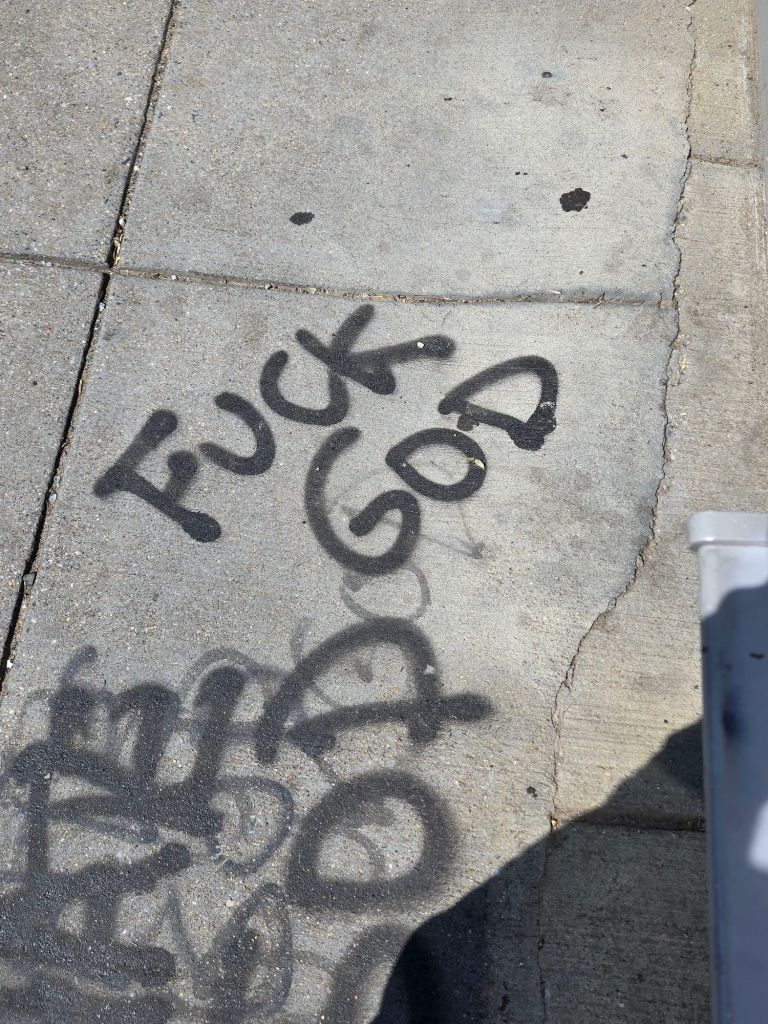
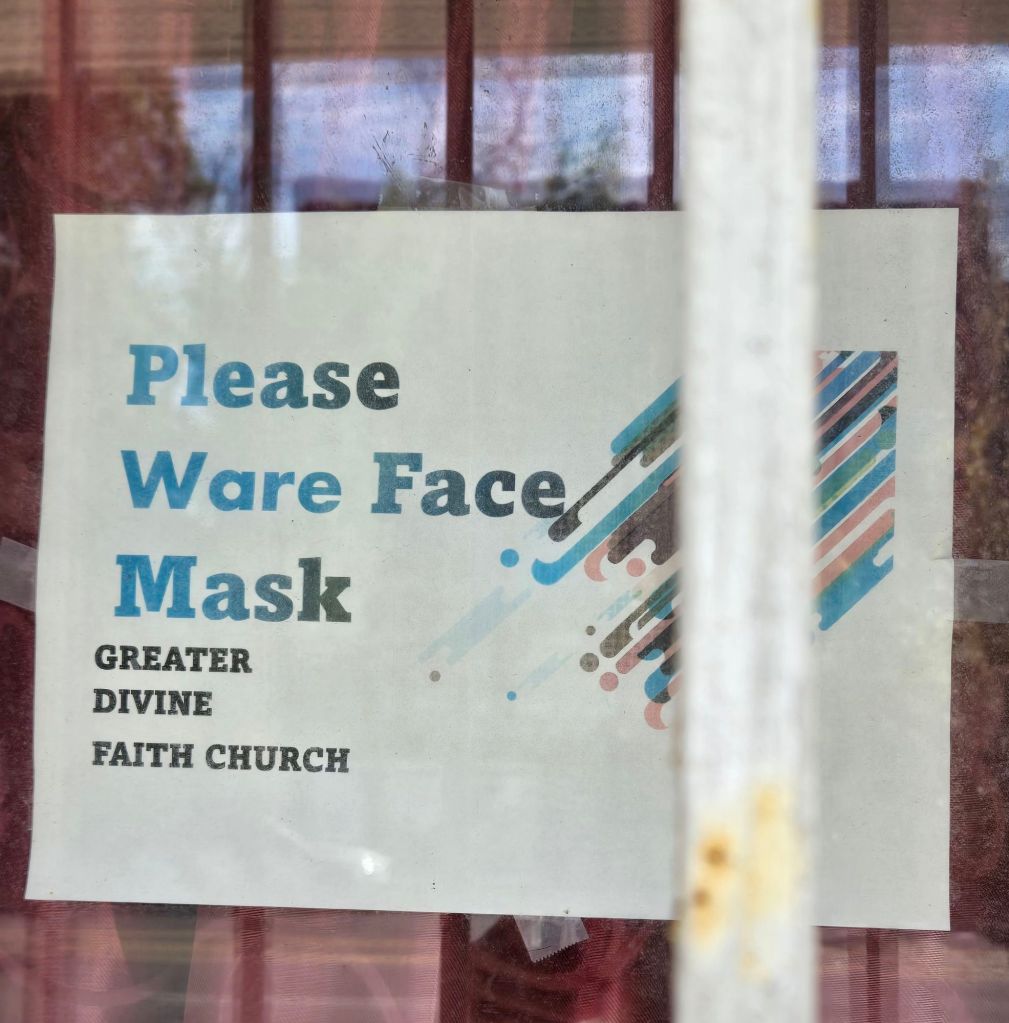
    There are no big churches here, but some smaller ones. And not everyone here seems to be religious in a conventional sense, or to know how to spell.

    And oh yes, there is a beauty school, where you can learn to do this.

    Finally, we don’t want to forget where we are. And on the side of the now closed Public Option pub, we remember.

    We might see a bit more of this neighborhood next time. Then, we will walk a few exclusively residential blocks, after which we will tiptoe into the State of Maryland, and everything changes once again.

  • Chicago’s Dirty Politics, Grover Cleveland and European Antisemitism.

    August 12th, 2024

    Remember when last week, I mentioned a book I bought. Reminisces and Comments by Adolf Kraus, Czech-Jewish immigrant, Chicago lawyer, Board of Education member and B’nai Brith president. It was published in 1925 and discusses each aspect of his fascinating life, including his early life in the town of Blowitz (now Blovice), his first struggling years in the U.S. and his early days practicing law.

    Among other things, Kraus got involved in Chicago politics, especially through his relationship with Carter Harrison, who was mayor of Chicago during the late 19th century. To show you where ex-President Trump may have received his ideas, let me quote from page 59 of the book, referencing the year 1981:

    “In one of the precincts of the eleventh ward, the ward in which Harrison lived, the judges sat behind closed doors, with challengers and watchers on the outside. A small hole was cut in the door about six feet above the floor, through which the voter was required to reach up and deposit the ballot. What was done with the ballot on the inside nobody on the outside could tell, but in this precinct the Cregier [Harrison’s opponent] delegates were certified to by an overwhelming majority…….

    “In the precinct on West Monroe Street, in the block east of Ogden Avenue, the votes were cast in the ratio of approximately two votes for Harrison to one for Cregier. Notwithstanding this, two of the judges signed a certificate showing the election of the Creiger delegates, and handed it to the third judge for signature. Now it turned out that the ward boss had made a mistake in the selection of the third judge, who was an ex-prize-fighter, and favored Harrison. He said to the other two, “I will not sign this, but you either sign a correct return or fight , and I am ready to whip both of you.” They reluctantly signed a correct return…..”

    “As town of Lake was democratic, it appeared that Harrison would surely be elected, since he always carried the town of Lake by a large majority, but until after midnight, not a single return came in from the town of Lake. It was learned afterwards that the returns from the town of Lake had been held back in order to ascertain how many votes Cregier might need to be elected. It seems that the person in the City Hall whose business it was to tabulate the returns and determine the number of votes needed by Cregier made a mistake of two thousands in the addition, the result being that more votes were actually needed for Cregier than he reported as necessary. The returns, when they were finally received, showed a remarkable increase in the normal vote of that territory. Precincts which had ever before polled more than three hundred votes, came in with more than five hundred votes, nearly all of which were for Cregier.”

    A couple more things from the book:

    For a while, Kraus was Chicago Corporation Counsel (in effect, the attorney general of the city), when Harrison was mayor. He received several messages from a man he did not know. The messages were, generally speaking, demands that he, the writer of the messages, be allowed to take Kraus’ place as Corporation Counsel, and that if Kraus refused, he would kill him. Kraus called him in for a meeting, and told him that he agreed with him, that they could switch places that day. Clearly, this is not the message that his visitor expected to hear, and he excused himself to think it over. Kraus told the police to follow and arrest him, but they lost him. The message writer, that evening, went to the house of Mayor Harrison and assassinated him. He then turned himself in to the police.

    Rather shocking, no?

    Kraus met President Grover Cleveland twice. First in Chicago at the time of the 1893 Pan-American Exposition, and several years later at the White House. When they met in Chicago, Cleveland said to Kraus “I know we met before.” Kraus says he didn’t want to argue with the President of the United States and commended his memory, although they had never met. Later, in Washington, the President told an aide that he wanted to speak with Kraus and they arranged a White House meeting. It turned out that the President wanted an update on various political goings on in Chicago, which Kraus reported to him on, feeling good that he made a good impression on Cleveland and that Cleveland respected his opinions. But then the President said something like “Mr. Kraus, I really appreciate your coming to see me today. It is really surprising, isn’t it, that we have never met before?” Again, Kraus responded simply that it was because they lived in different cities and that they were both so busy.

    Finally, for 20 years, Kraus was the President of B’nai Brith, the largest Jewish social service organization in the country. The last part of the book talks about what was going on with the Jews of the world during the first quarter of the twentieth century. Pogrom and riot, riot and pogrom. By looking at the correspondence to and from Kraus as B’nai Brith president, and reading excerpts from newspaper articles of the day, you see how much anti-Jewish activity was occurring. In Russia, and in other parts of eastern Europe, especially. Hitler clearly didn’t arise from nowhere. He had very fertile ground to plow.

    What an interesting book.

  • A Walk Down the Street (Part 8)

    August 11th, 2024

    Our last walk up Rhode Island Avenue ended at its intersection with North Capitol Street, where we crossed from the northwest to the northeast quadrant of the city. Now, we move on.

    The topography changes and the walk becomes a bit hilly. Unfortunately,  it’s not all downhill from here.

    The first few blocks are like the last few, as we get close to the turnoff for my daughter Hannah’s house. We see row houses, apartment and condo buildings, and a few churches. When we get to 4th Street, everything changes.

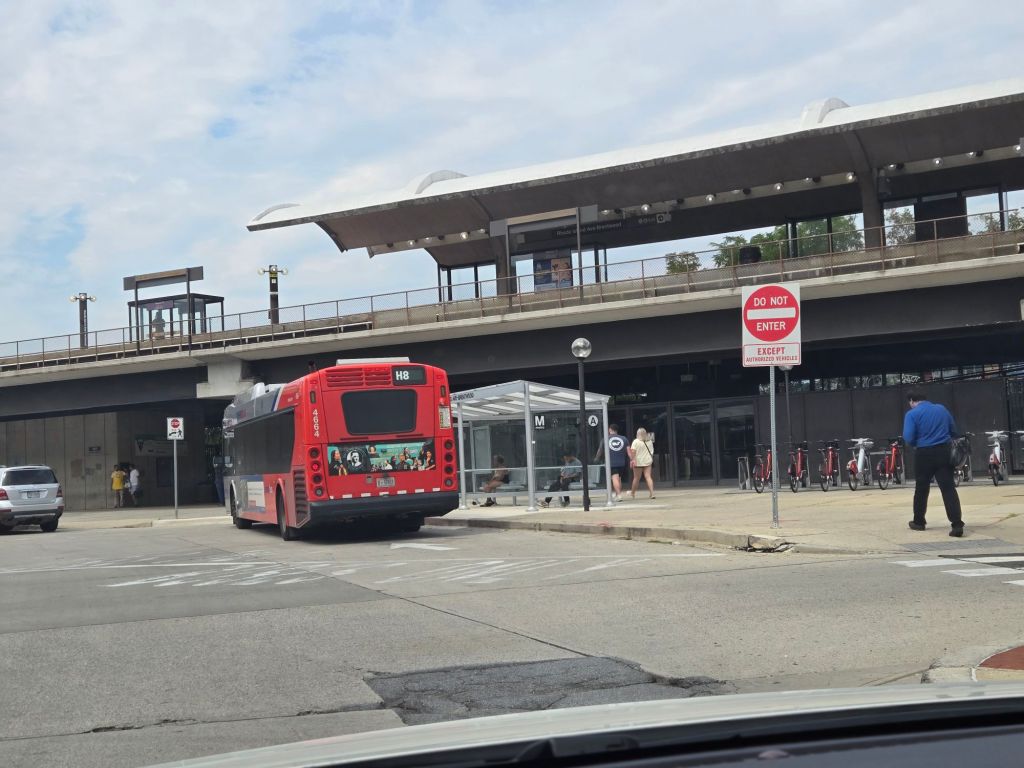
    We then find ourselves on a complex part of our walk that takes us to a neighborhood that has old and new residential development, old and new commercial development, a few more churches, two shopping centers just off the road, and a Metro station to boot. It has everything but a personality.

    Old and new residential buildings;

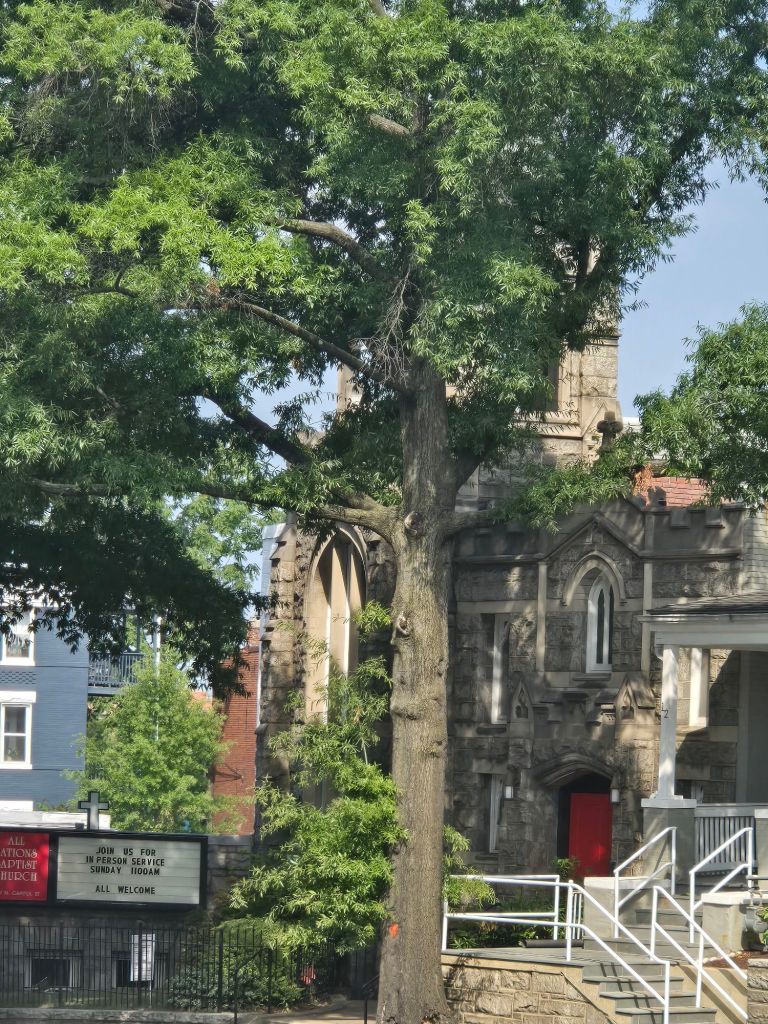
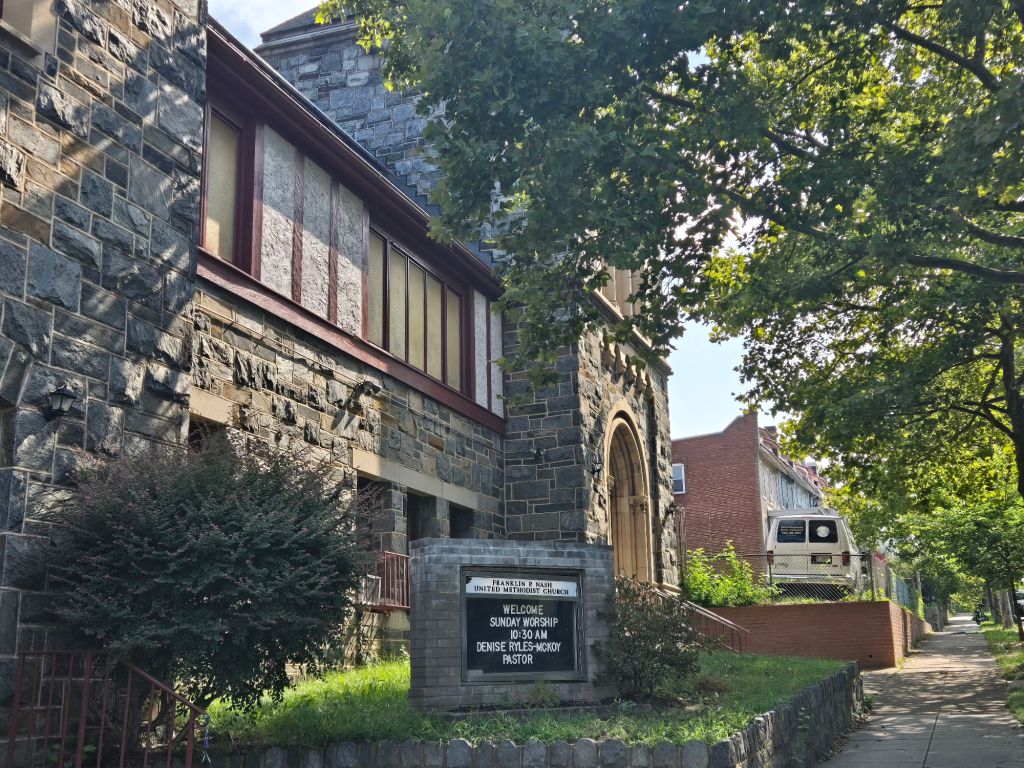
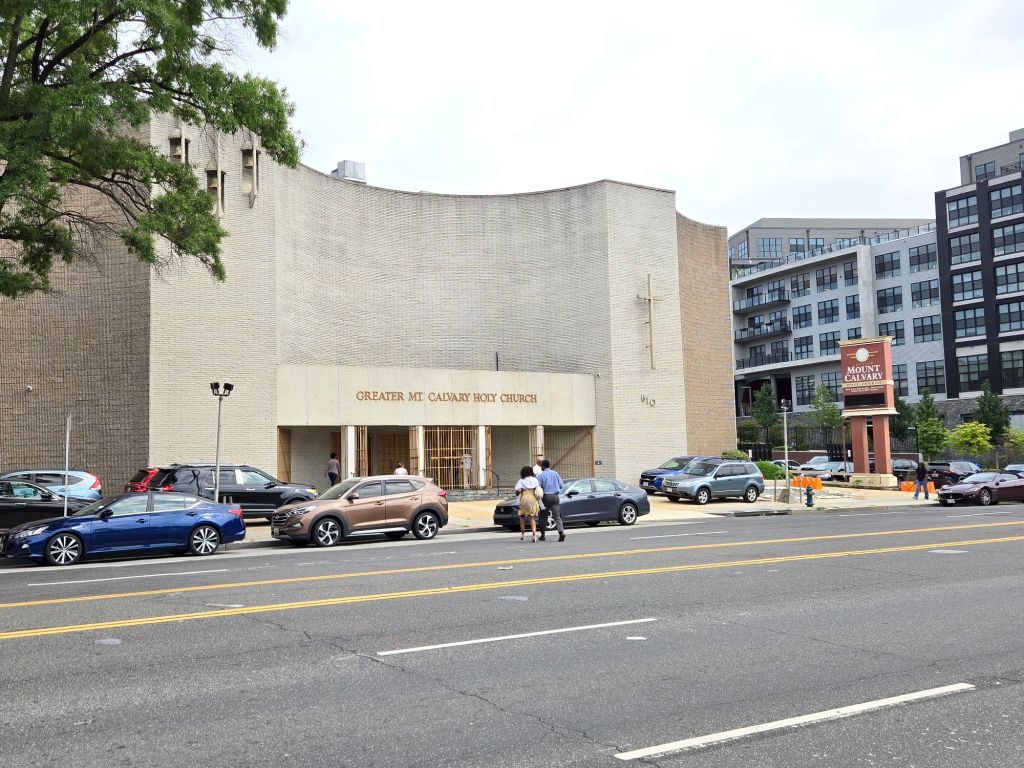
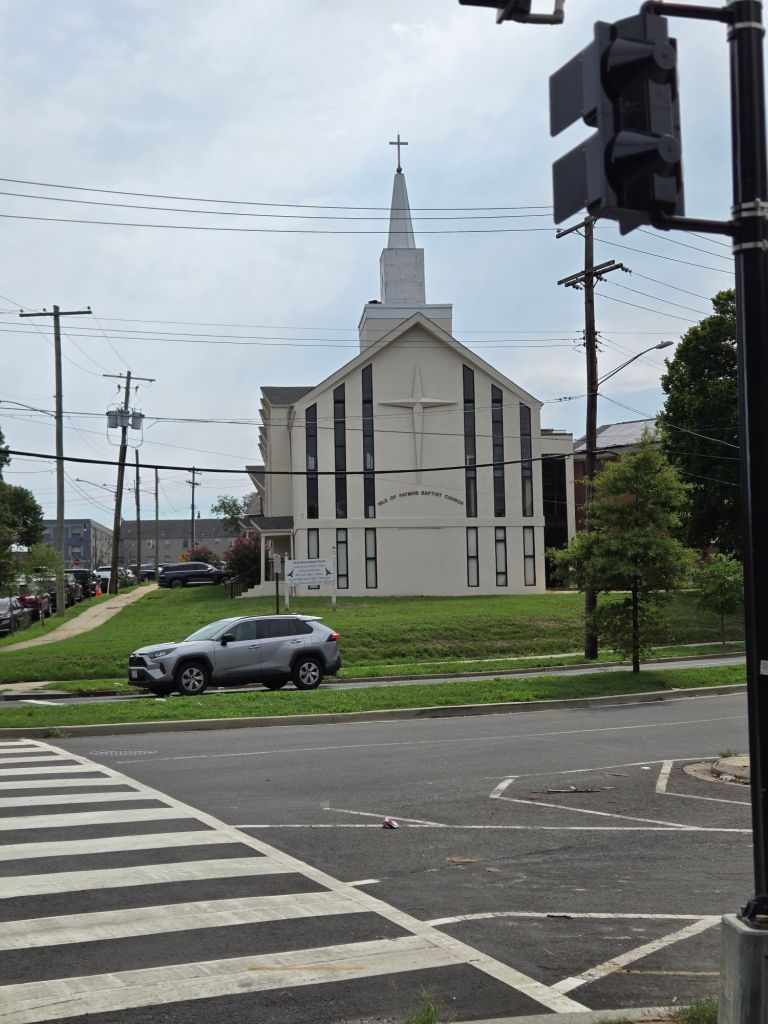
    Churches:

    A Metro station with surrounding development:

    Shopping centers with a Home Depot and an Alamo Draft House and Cinema:

    A few other points of interest include

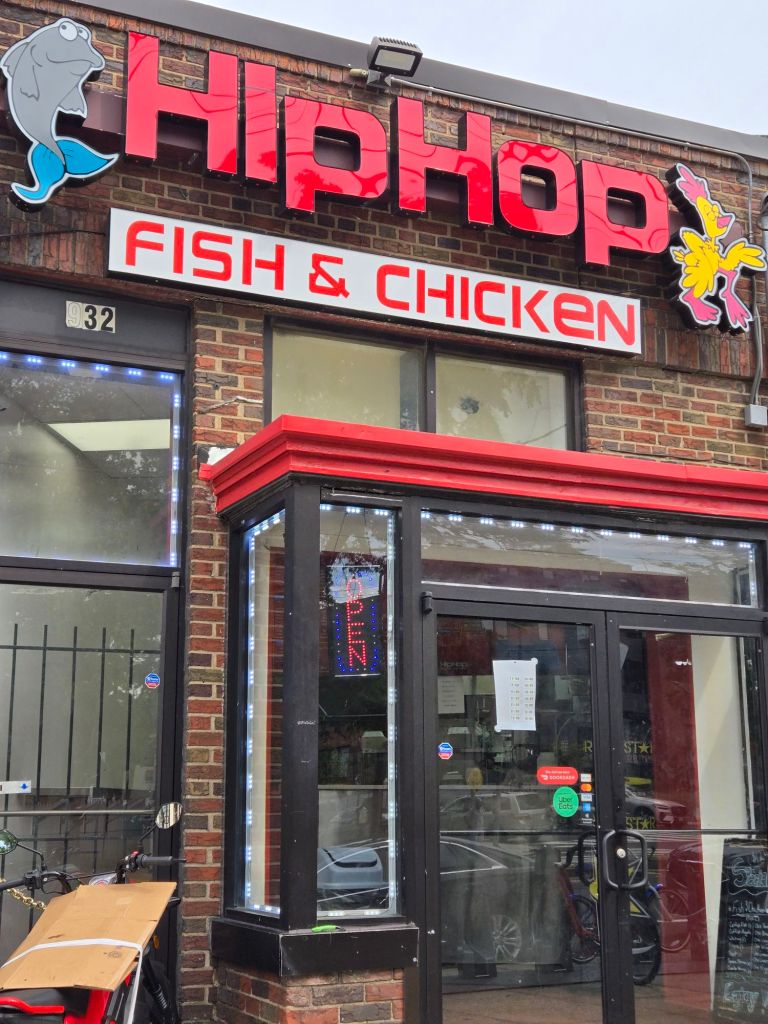
    A carryout restaurant with an interesting menu:

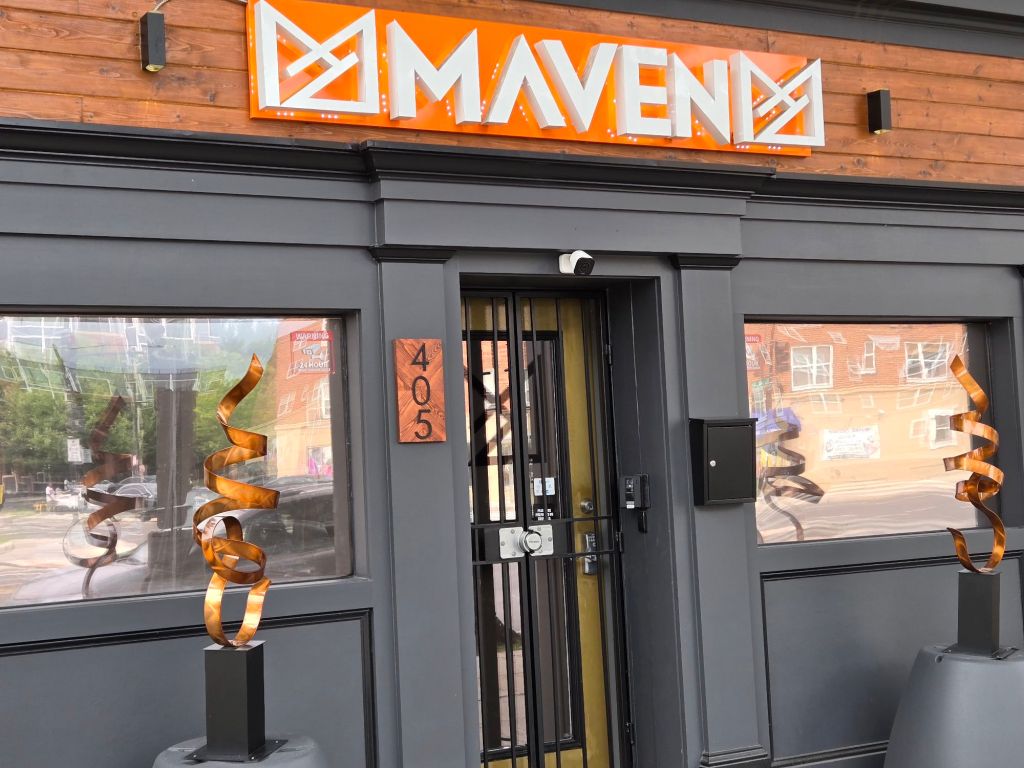
    A brand new cannabis store and a place to check in if you are out on parole:

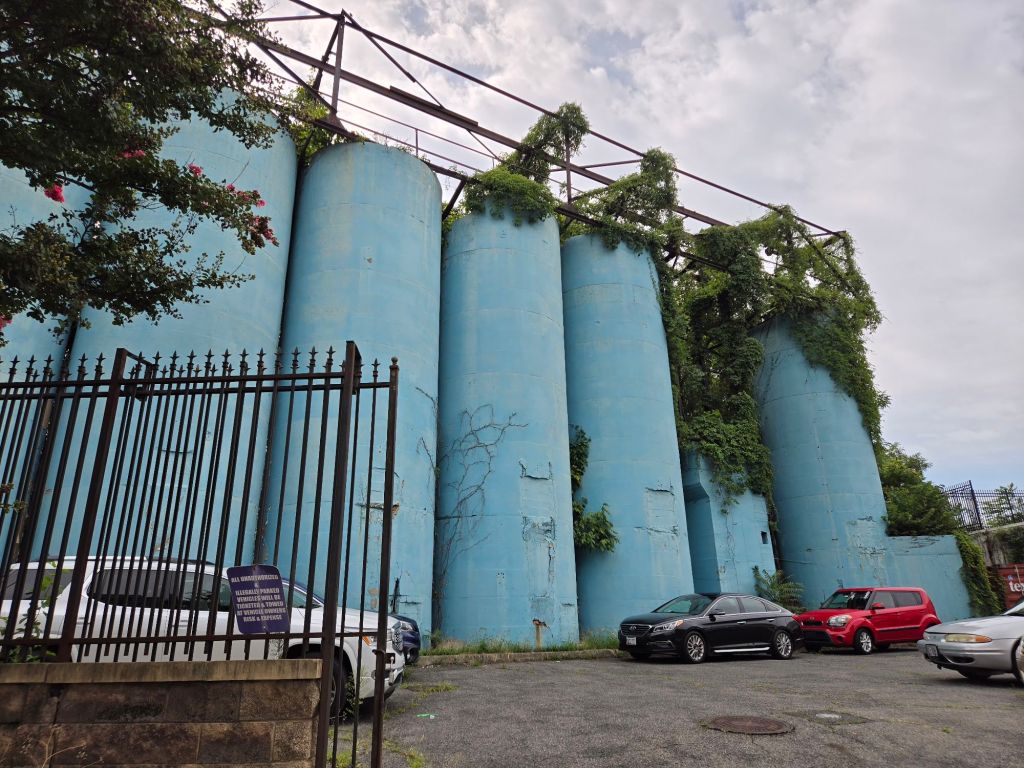
    In addition,  there is an overhead passage for the Metro and another for foot traffic, steps if you are inclined to take them, and seven very mysterious silos:

    Next, we will head further to the northeast. Twelve more blocks or so, and we will be in Maryland.

  • Art and Baseball

    August 11th, 2024
    Jeff Koons

    Yesterday, we went to the Glenstone Museum in Potomac. For those of you unfamiliar with it, let me describe it for you. Two brothers, the sons of a real estate entrepreneur, go into business for themselves and begin buying up companies and properties, and before you can blink your eyes, they are multi-billionaires. One is now in his early 70s and one in his late 60s. The younger brother, Mitchell Rales, owns a swath of property in suburban Potomac, Maryland, and builds a fancy house there. He collects art, and gets involved with a number of Washington DC museums. Even today, he is the president of the National Gallery of Art, the largest art museum owned by the U.S. government.

    Rales has been himself a major collector of contemporary art for some decades. What to do with it? Oh, I should have said that the swath of property he owns, which is in one of the most high end areas of one of DC’s wealthiest suburban areas, is about 300 acres in size. What a perfect place for a museum.

    So, ten or fifteen years ago, Rales establishes Glenstone, hires some well known contemporary architects, and builds two museums (one considerably larger than the other), and two separate restaurant buildings (one more casual than the other), installs part of his art collection in the museums, and invites the public to come and view the art and the setting (around which he has placed a considerable amount of contemporary sculpture) for free (the food isn’t free).

    Yes, there are some rules. And they are, as Tim Walz might say, weird. No children under twelve is one of them. Another is that there can be no photography inside the galleries, only outside.

    And right now, there is a problem for visitors, in that the main gallery, the Pavilions he calls it, is closed for renovations, to be opened sometime after the start of 2025. But there is more than enough to see now, both on the grounds and in the smaller gallery. But you have to go because, as you now know, pictures are verboten. Let me just say that virtually every work of art in the, say, six or seven gallery building is a work of art. Works by artists you know (or should), and primary works, not secondary.

    The art work is all from the period following World War II. The full collection now is comprised of approximately 1300 pieces. Glenstone is the largest privately owned art museum in the United States.

    You enter at the “Arrival Center”, and from there, it is about a half mile walk, past the Pavilions, through the meadows, to the Gallery and cafe. There is cart service available. There are several trails which blend the natural beauty with the sculptures placed here and there.

    The number of visitors each day is limited to about 600, and you generally need advance reservations on line (a very easy process) and, with the main exhibit space closed, it might be easier to get immediate access now. And, oh, yes, it was over 90 degrees yesterday. That is actually too hot to do much wandering. You probably want to pick a cooler day.

    The net work of Mitch Rales and his wife is in excess of $5 billion dollars. I don’t know if that includes the value of the museum, museum site and art collection. Since it is privately owned, I assume that it does. But maybe not, as Glenstone is actually owned by a foundation created by Rales. It is said that the value of the assets of the foundation itself is $4.3 billion dollars. That is a lot of money, no? In fact, it puts the worth of Glenstone on a par with the worth of the Metropolitan Museum of Art in New York. Try to process that for a minute.

    Two more points. First, the entire area is landscaped organically, with native plants only. Secondly, the Rales family have planted about 13,000 new trees since acquiring the property. And nature is as much a target as the art.

    And even one more point. The guides in the gallery (and there are many of them) are terrific. They are all (I think) art or art history students or graduates, they are there to talk to guests as well as to protect the art work, and they know everything. Don’t be afraid to ask them a dumb question. Their answer will be very smart.

    After Glenstone, we went to Nats Park to see the Nationals play the Los Angeles Angels. The Nats won 5-4 in 10 innings. What was most interesting about the game was the Nats’ third baseman, a young fellow named Jose Tena. Jose Tena came to the Nats fewer than two weeks ago from the Cleveland Guardians at the trading deadline (July 31) in a trade that sent Lane Thomas to Cleveland. Tena is an infielder who had done very well in the minors and was considered to be a sold future big leaguer. He was assigned to the Nats’ Rochester NY AAA team, but called up yesterday (the Nats sent another young infielder back down to Rochester).

    It was, I think, an unexpected call up, and Tena arrived in Washington a little before 4 p.m. for a 6:45 game. That meant, although he was the starting third basemen, that he hadn’t even had a chance to meet or say hello to many of his new teammates. He had two hits, and drove in two runs. One of his hits was a walk off hit in the 10th, when the Nats’ fifth and winning run scored. It was a good debut. He probably won’t do that every game.

    Many were unhappy when Thomas, who had played in the outfield for a number of years, and was a good steady ball player, was traded. For three years in a row, the Nats have traded some of their better players (especially those in their late 20s or early 30s) away at the trade deadline to get younger prospects. The Nats, and their farm teams, are now filled with young prospects. But I would hope that these prospects can do something for the team before they, too, are in their late 20s and early 30s and just get traded away at the trading deadline. Just saying.

  • The National Debt, Ferguson MO, and a 100 Year Old Book.

    August 10th, 2024

    You may have seen this on Facebook. I remarked that, gender aside, this looked like me and my conscience at a book store. And my conscience seldom wins.

    (1) For example, a few days ago, I had to run a simple errand in Rockville. It would have been easy enough to finish my errand, turn my car around, and drive home. But, no. I said to myself “I should stop at the Second Story warehouse. They may have something I need.” Of course, they always have things that I want. After all, they have an enormous number of books. They say that have more than 500,000. I myself have never counted them. But it sure makes it easy to visit again and again and never look at the same group of books twice.

    I stopped by after my errand, deciding I would only spend a few minutes looking around. I went to the “vintage books” section, a section I really never look at. It is fairly large, and contains books of all kinds, all mixed together. I, of course, was looking either for something that I thought really unique, and/or which included a signature or inscription by the author. On the third shelf I looked at, I picked up a book titled “Reminisces and Comments“, by a man named Adolf Kraus, which he inscribed to his friend Lewis Fabrikant. The book, in quite good condition, was published in 1925.

    It was the subtitle of the book that intrigued me: “The Immigrant, The Citizen, A Public Office, The Jew”. Who was Adolf Kraus?

    I don’t know everything about him, to be sure. I saw that he came from Bohemia (now part of the Czech Republic) when he was 15 and penniless in 1865. He eventually wound up in Chicago, where he became a lawyer (by reading law in a lawyer’s office, not by going to a law school), founded a law partnership with a friend, Levy Mayer (now the firm is known as Mayer Brown – not sure what happened to Kraus’ name), became involved in Chicago politics, became chair of the Chicago Board of Education, because Chicago head of B’nai Brith and involved with the Union of American Hebrew Congregations (the governing body for American Reform Judaism) and was a friend of presidents.

    I picked up the book last night and started reading it, getting through the first 50 or so pages. It turns out to be very readable and it is certainly interesting to see how a young immigrant from what he terms Bohemia, after several false starts, decided to “read law” and make his way in Chicago. He came to Chicago in 1871, right after the great fire destroyed much of the city, deciding that this should be a place where a future could be secured. He was obviously fluent in Czech (again, he calls it Bohemian), and says that Chicago had about 30,000 Bohemian immigrants at the time, but no Bohemian speaking lawyers. This provided a spark for what obviously became an impressive career. I think I will read some more.

    By the way, as I always do, I looked on the Abebooks website to see if other copies of the book are available for sale. There were three, one of which was also inscribed by the author. The two unsigned copies are each for sale for $100 at a well established bookstore that specializes in rare Jewish books. The signed copy is for sale for $230. I paid $10.

    (2) Read these statistics involving Ferguson, MO, the St. Louis suburb where Michael Brown was shot and where the reaction created major headlines in 2014, and think about how racism still stalks aspects of American life, particularly housing and school integration. The statistics reflect the percentage of Ferguson residents (the total population is about 20,000, just as it was over 60 years ago) who are Black:

    1970 – 1%

    1990 – 25%

    2000 – 53%

    2020 – 70%

    Enough said on that.

    (3) The New York Times this morning reports that the United States’ national debt is about $35 trillion (that is $35,000,000,000,000), and that eight years ago, it was “only” $20 trillion. In the Trump and Biden years, the debt has risen about $15 trillion dollars, half under Trump and half under Biden. These are big, big numbers. The Times also reports that Trump’s tax cutting plans (even if you include any projected revenue increases) would add about an additional $4 trillion, while Harris, who has yet to state any specifics, is suggesting that the Biden budget proposal would be close to hers. It projects a debt reduction of about $3 trillion over a ten year period.

    Just saying…..

  • We Watched the Women Fight

    August 9th, 2024

    Last night, we turned on a film on Netflix that is not at all like the type of film we usually watch. The film was The Woman King, released in 2022, starring Viola Davis and Thuso Mbedu. It got 94% on Rotten Tomatoes, and IMDB gave it 6.9 out of 10.

    The story is fiction; the setting is historical. One character (I think only one) is based on an historic figure, King Ghezo of Dahomey.

    In the film, Davis plays Nanisca, the leader of an all-female military force (the “Agojie”), who, after a victory over a neighborhood dominating tribe, is selected by King Ghezo to serve along with him as a female king. She had defeated the leader of the Oyo, a neighboring and dominating tribe. Within the mix is the relationship of the Dahomey, the Oyo, and other tribes, to the enslavement of fellow Africans.

    The story is sort of silly – with a young Thuso Mbedu (Nawi), joining the Agojie at age 19 and becoming a top recruit, learning she was the abandoned daughter of Nanisca, falling in love with a half-African, half-Brazilian man who accompanied a slave trader to visit his mother’s homeland, and deciding – after the battles were won – that she was an Agojie, and would forgo leaving Africa with the man she loved. Throughout were Agojie’s participation in battles, showing great courage, a more luck than a real person could possible ever have.

    But what the film did was get me into looking at the history of Dahomey (basically now the nation of Benin, although it was still Dahomey when I was young and actively collecting stamps) in the 19th century. And, what little I looked at, is pretty interesting.

    The Oyo tribe dominated the region from what is now Nigeria I think, collecting tribute from neighboring tribes, including the Dahomey. Both tribes were also active participants in the slave trade, collecting people (often after military victories) to sell to traders, who landed at their port of Ouidah. In the film, the traders were Portuguese speaking Brazilians. In fact, they may have been the most common traders in Ouidah, as the buyers of more slaves than any other New World groups.

    At the same time, the smaller Dahomey tribe was known for a number of things, including their use of female warriors, the Agojie. And King Ghezo was a real monarch, ruling for about 40 years during the earlier years of the 19th century.

    Agojie fought for centuries for Dahomey, but their numbers were increased by King Ghezo from about 600 to about 6000. As in the film, the Agojie fought to end the dominance of the Oyo in the 1820s. The film also has a subplot where Nanisca convinces the king to stop participating in the slave trade, and instead concentrate on the production and export of palm oil. This didn’t really happen. There apparently was an attempt to export palm oil at this time, but it was not very successful, and participation in the slave trade did not end until the 1850s. In fact, according to Wikipedia, more than 1 million enslaved people were sold in and transported from Ouidah.

    It apparently also true that, during the time the Agojie were active, there were Women Kings in Dahomey. They were selected by the Male King (they were not his sexual partners or queens) and shared power with him (with the King having ultimate say, when they disagreed).

    During the 19th century, Dahomey and most of Africa was still free of European political dominance. France took over Dahomey as a colony in 1894, and all this changed (well after the events as portrayed in the film). It was at this time, I have read, that the last Agojie were disarmed and dismissed.

    The film itself gets an A for energy, a C for plot, and a B for general interest. It is leaving Netflix in 3 days. If you happen to miss it…..that is okay.

  • A.I. Where Are You When I Really Need You Most?

    August 8th, 2024

    I know little about Artificial Intelligence. I have never used ChatGPT, and have no plans to, although if I did, maybe my blog posts would be more interesting and better written. But many that I know have been using ChatGPT, or other similar programs, for research or for first drafts of documents they continue to massage, either my their own editing, or by refining their AI questions (which I understand to be an art in and of itself).

    But there is one way I would use AI. I don’t think it is able yet to do what I need it to do. If I am incorrect, please let me know.

    I want AI to take my dreams and turn them into real images that can be streamed or printed out and shared. If AI could do this, I’d be sold.

    You see, my most interesting dreams are often architectural dreams, or (and this is closely related) cityscape dreams, and I would like to have them recorded.

    Take last night. We (I am not sure who the “we” in “we” is) were driving from place to place last night. I don’t know exactly where we were. It was in this country and I now think we were in the South, maybe Mississippi, but I don’t know if this is what I thought (or knew) during the dream. We decided to take an “old” road, one that would have been used in the past, rather than a modern paved road.

    The land was very flat and mainly forested (the kind of forest that’s a jumble, not one you can see through). The road itself was not paved (I remarked on that), but was something more improved than I dirt road (although I remarked on how it must have been in years past to drive down this road when it was only a dirt road, especially after a rain, or something). I don’t think the road was graveled either. I can’t tell you exactly how it was constructed, but an AI representation could, I am sure Because at the time, I knew exactly.

    Because the land was so flat, you could see far down the road. And the road was as straight as it could be. You could see miles. We passed at least one perpendicular cross road. Perfectly perpendicular to the road we were on. Equally straight, equally flat.

    We passed on house on our right. It was an old house, hard to tell if it was one or two stories. It had eaves and things, so probably a story and a half or something like that. Made of a yellowish, or yellowed, cut stone blocks. Not particularly attractive. Was it occupied? Couldn’t tell.

    Then, all of a sudden, and to our surprise, we were pulling into what looked like an old town. We weren’t on the main commercial street of the town, but were driving parallel to it, just a block off. So, looking out of the car on the driver’s side (I was the driver), you could see the back of what we knew were adjoining buildings containing stores at street level and probably apartments above. The buildings seemed to be for the most part two or three stories. There were back doors, steps in back leading to the upper floors, full size balconies, etc.

    What was unique about these buildings is that they were not only very old (that was apparent), but they were all constructed on what appeared to be unpainted wood, and they seemed in disrepair.

    We drove to a cross street, turned left, and then turned left again to see the front of these buildings. There were probably three or four long blocks of them. They were falling apart. Completely abandoned. None of them seem to be occupied; the stores were clearly empty. Yet, there were a few cars parked on the street in front of the stores. The cars were old (not Model Ts, but old), and I would like AI to be able to capture these cars as well, just to see what kind of an engineering designer I was, in addition to an architectural designer.

    It was eerie driving down this street. We wondered where we were, what this town was, how long it had been like this, whose cars were these. We went back to the cross street we had used before, but rather than continue our journey (or maybe we couldn’t have continued, because our road ended at a T, now that I’m thinking about it)), we stayed on the cross street. To the left, again the driver’s side, there was, on a very large lot, a large building, also made of wood, very, very ornate, also in a state of disintegration. We didn’t know what this building was. We thought maybe it had been an old resort hotel. It was too big for a house. It had been beautiful.

    We continued. Now we came to a more active scene. More old buildings on our left. These might have been brick or stone. They were in the process of being demolished. There was a lot of demolition equipment there, but we didn’t see any people. But I think some of the equipment was moving about, tearing down buildings. Maybe an old factory or something.

    The road we were on then seemed to come to its end. At the end of the road were two stone columns. Fancy ones. There should have been a gate between them, but there wasn’t. It was like you were entering private grounds, and we kept going. There were some yellow brick buildings up ahead of us. Again we saw no people, but we decided this was a boarding school for high school students (probably). Our assumption was that the school was functioning, although we weren’t positive. But we were almost positive. How, we thought, could parents send their children to such an isolated place? How could the school even function here?

    That was it for the dream, as far as I can remember. But going to strange towns, seeing unusual buildings…..I do that all the time when I am asleep. Why can’t the images be preserved? (Of course, if I had any artistic talent, I could perhaps put them on paper myself.)

    One more thing. Music. I don’t compose as often as I design in my dreams. But sometimes I do. And I write very good music. Classical. Jazz. A combination of the two. Very detailed – notes and rhythm both. I’d like AI to be able to preserve these as well.

    If anyone has any ideas for me…..let me know.

  • A Walk Down the Street (Part 7)

    August 6th, 2024

    We start today at Rhode Island Avenue and 3rd Street NW. And we will end at North Capitol Street, where NW becomes NE. On these three blocks, we will see houses, churches, and restaurants, and end with a surprise. Or at least I wI’mas surprised.

    We are leaving out one thing at the beginning. We omit the headquarters of the United Planning Organization, at the corner of 3rd and Rhode Island. We omit it because we can’t see it. There’s a small berm, followed by a fence, and then a parking lot. So you can’t see the large UPO building (large for Rhode Island Avenue, smaller than, say, the Pentagon). UPO is a social service agency created in 1962 as part of the Johnson War on Poverty and going strong ever since.

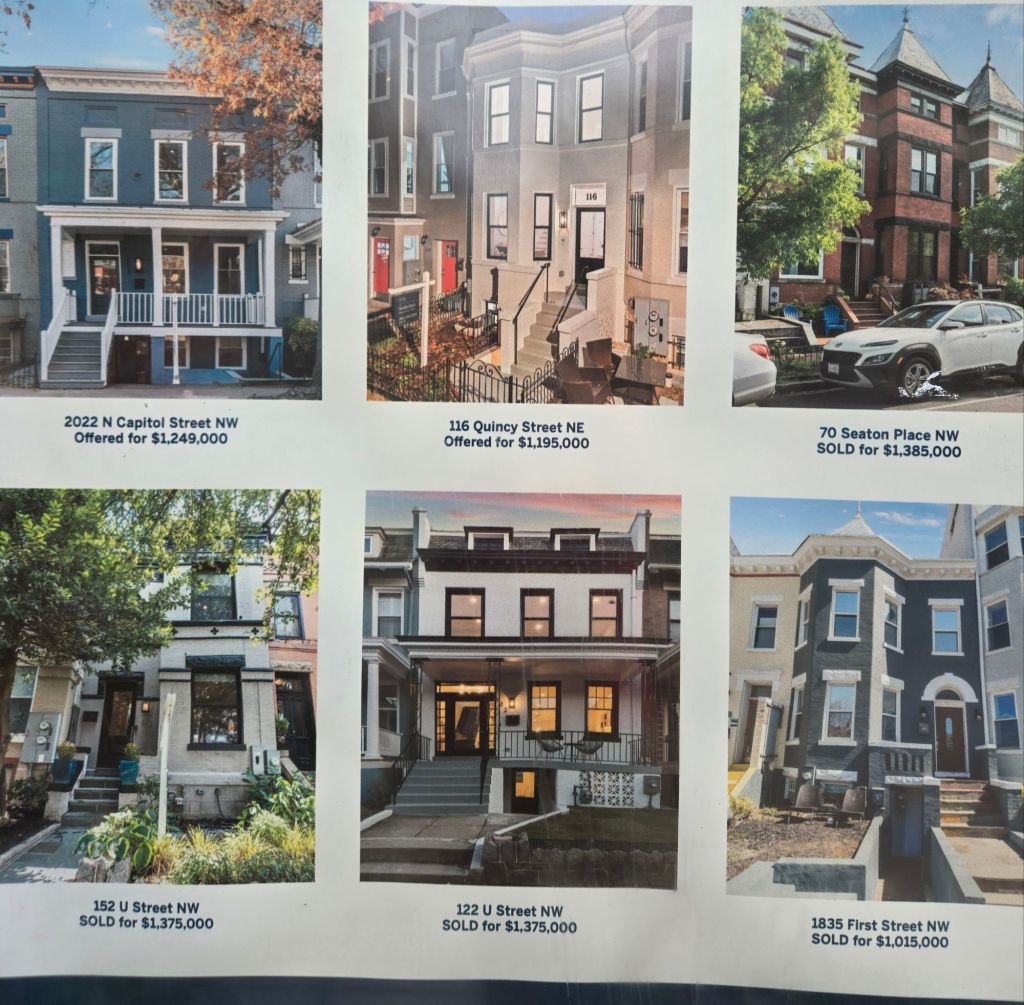
    We then come to brick row houses from the early 20th century, many of them recently renovated. You can buy them from about $750,000 to well over $1,000,000.

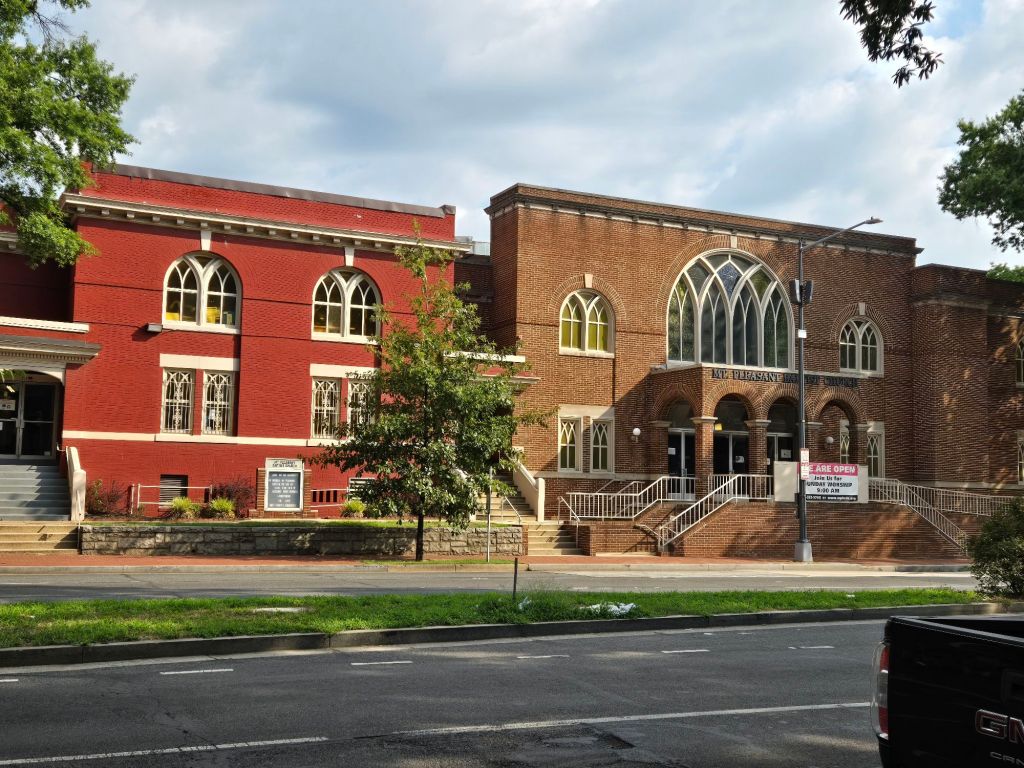
    We also come to our first church, Mt. Pleasant Baptist.

    Mt. Pleasant Baptist is primarily a Black Baptist church (I say this from looking at website pictures), which has been here for 75 years, having bought the property in 1950 from a white congregation that moved away. It looks to be thriving.

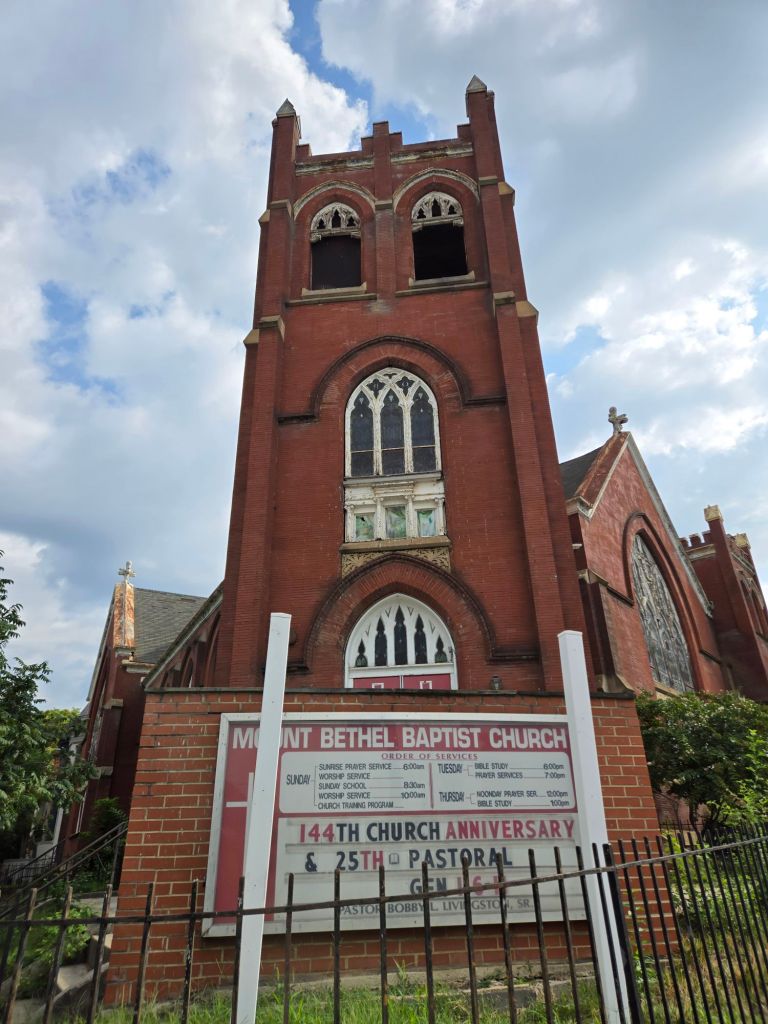
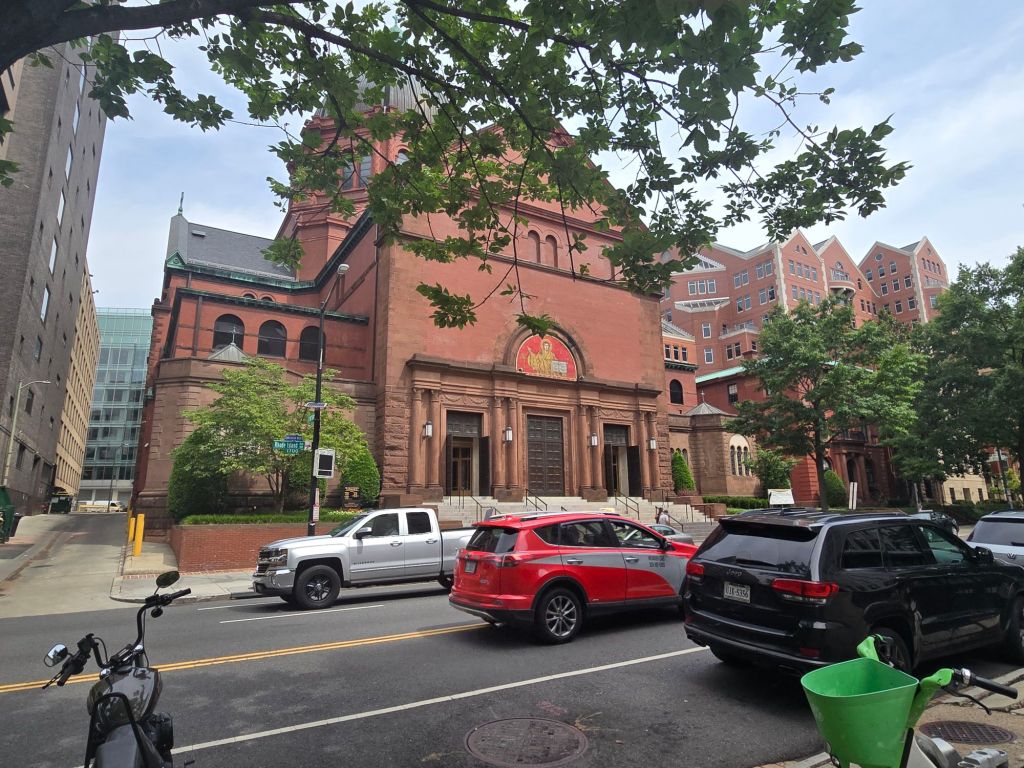
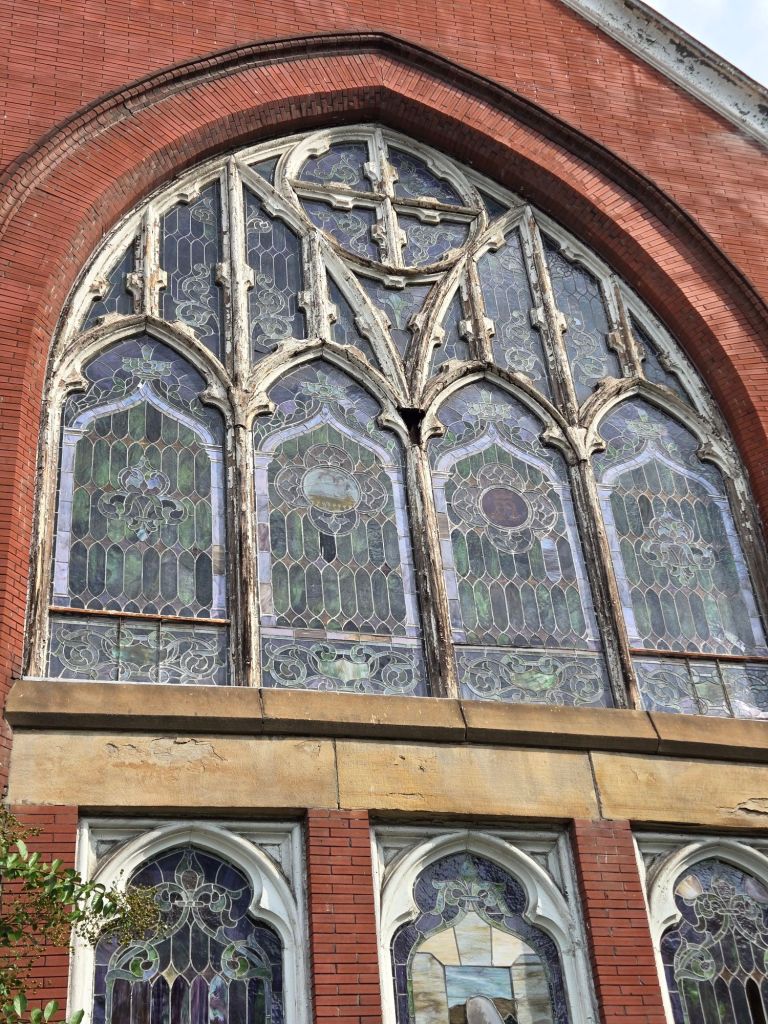
    On the next corner, you see the Mt. Bethel Baptist Church. This is an impressive building, about 120 years old, with extensive stained glass windows. Sadly, it is abandoned, as the church sold the property for almost $6 million to a developer, and moved to a different location. I don’t know who bought it or what their plans are.

    The church itself has moved onto 9th Street, not too far away, into a modern, large facility.

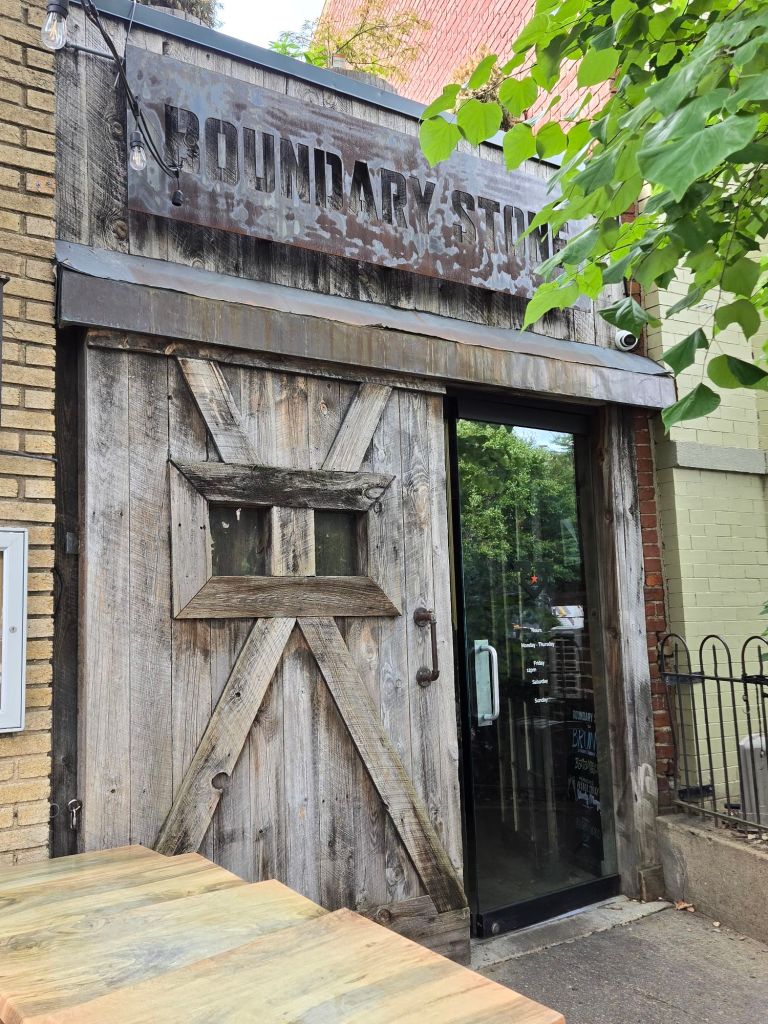
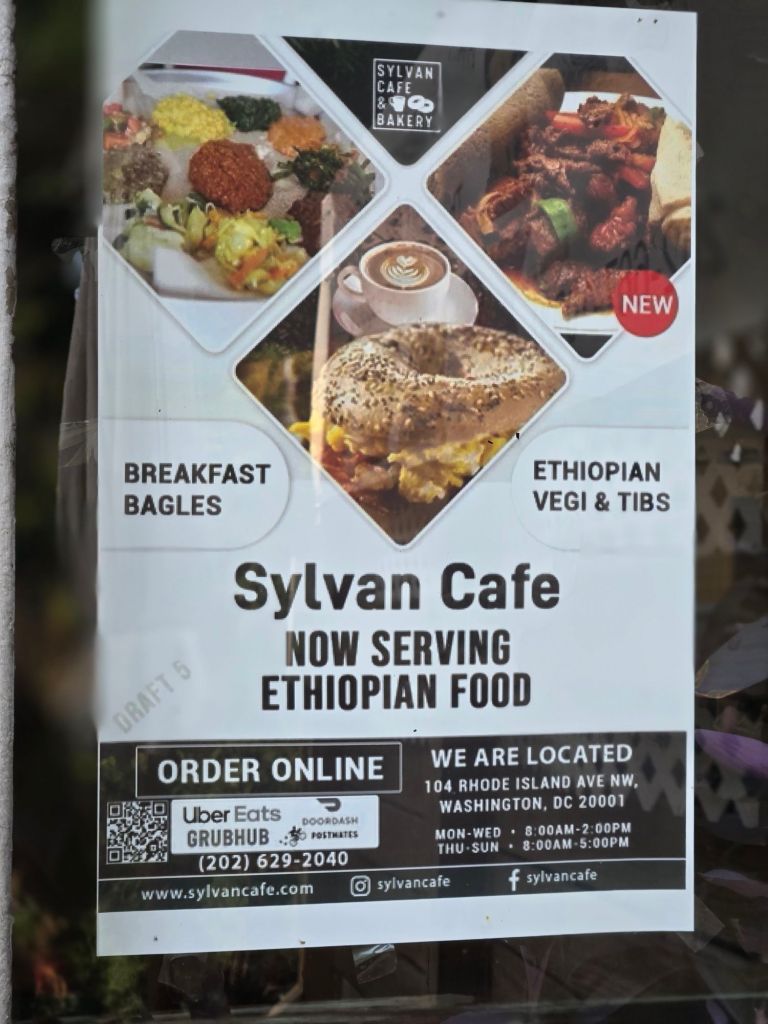
    When you get close to 1st Street,  you pass three restaurants which share one building. Boundary Stone is a typical pub, El Camino is a typical Mexican restaurant, but Sylvan Cafe is more interesting. It’s an Ethiopian/bagel shop. As you can see, they serve New Jersey bagels (sometimes spelled “bagles”, like they might do in Gondar) and great coffee, and Ethiopian food.

    The interesting thing about these restaurants is that they share the former Sylvan Theater. The Sylvan was the first theater in DC built for movies, opened in 1913. It closed in 1965 and the building has been used in various ways afterward,  including serving as the home of the Back Alley Theater, the city’s first live Black theater.

    We are now in a neighborhood known as Bloomingdale,  which is filled with rowhouses and restaurants. If you turn the corner onto 1st, you find more restaurants, including the popular Red Hen and the equally popular Big Bear Cafe. As well as a yoga studio and a real estate office, where you learn that this neighborhood might be old, but isn’t cheap.

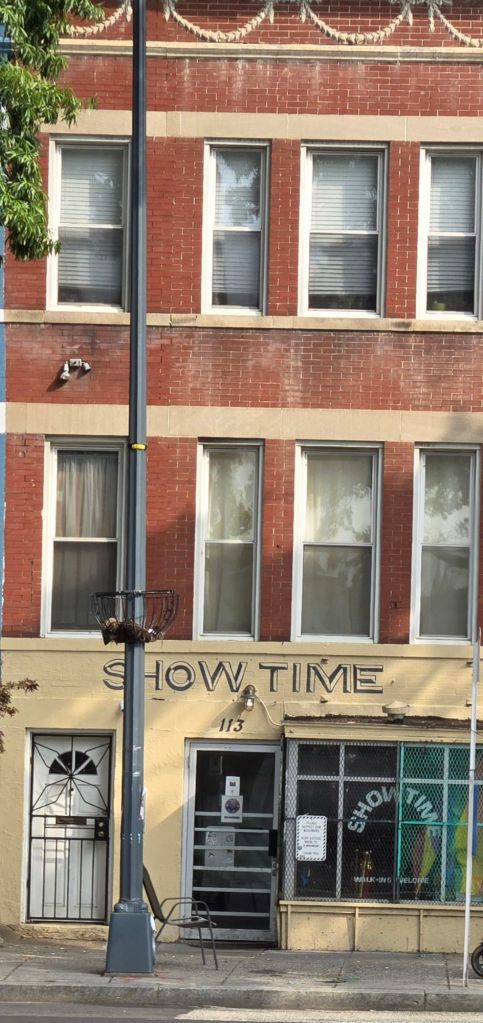
    There are two more restaurants on  the other side of Rhode Island. One is Turkish and the other Vietnamese. So, you see, quite an ethnic mix. And let’s not forget Show Time, known as a dive bar with music every night until 2 or 3 a.m.

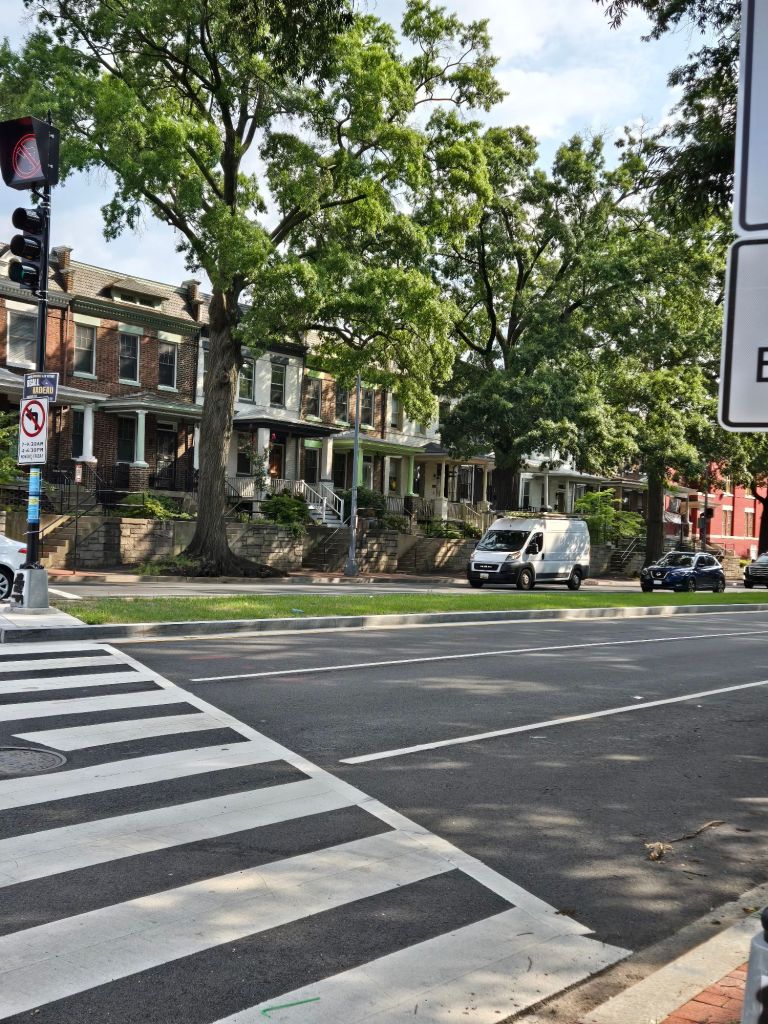
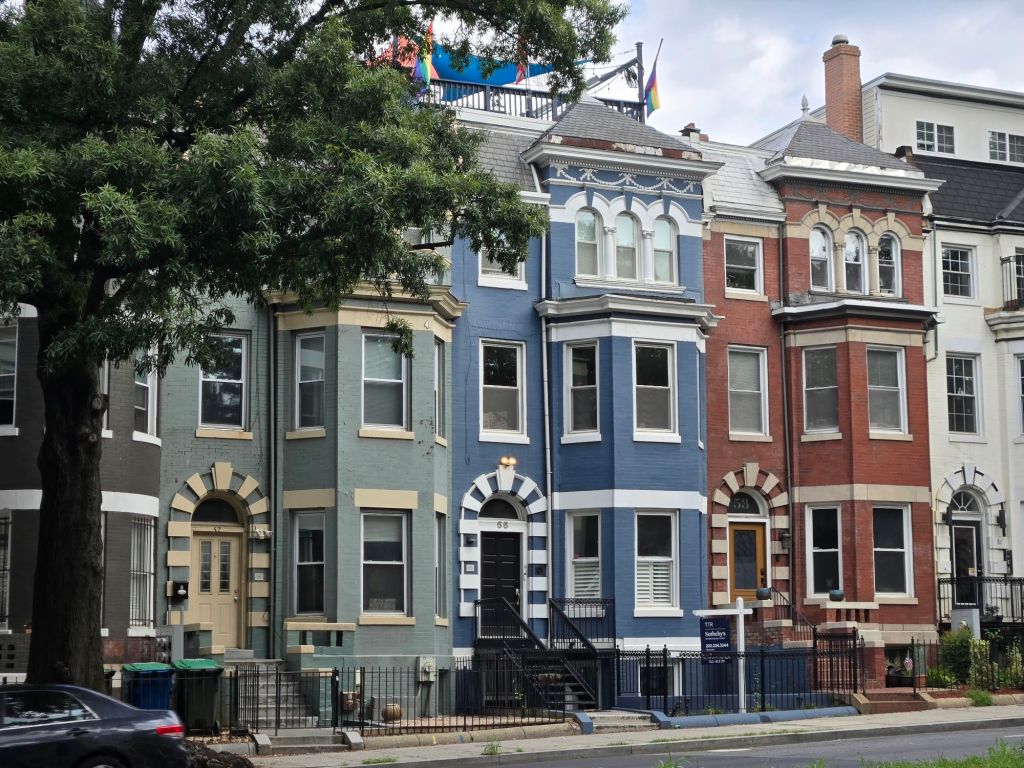
    We cross 1st Street.  Only one block until North Capitol. A primarily residential block, where about a third of the town houses seem to be under renovation. One house has a for sale sign. It’s part of a group of 11 houses with identical doors. We also see an iconic bicycle art display. The bikes stay constant. Their decorations are seasonal.

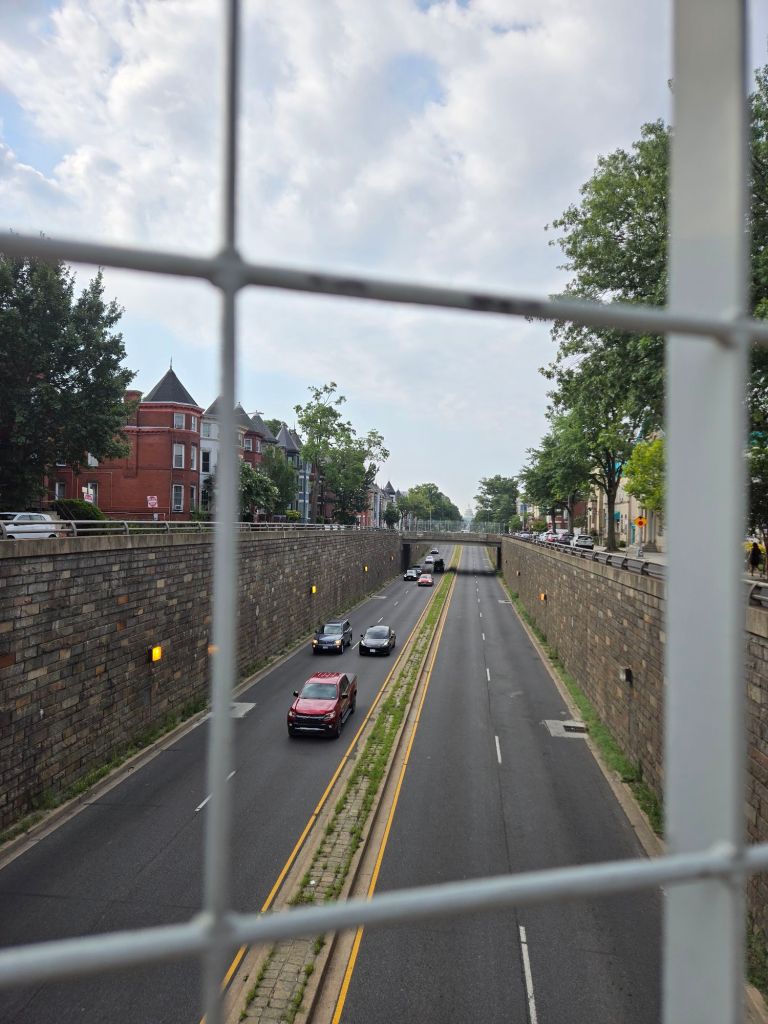
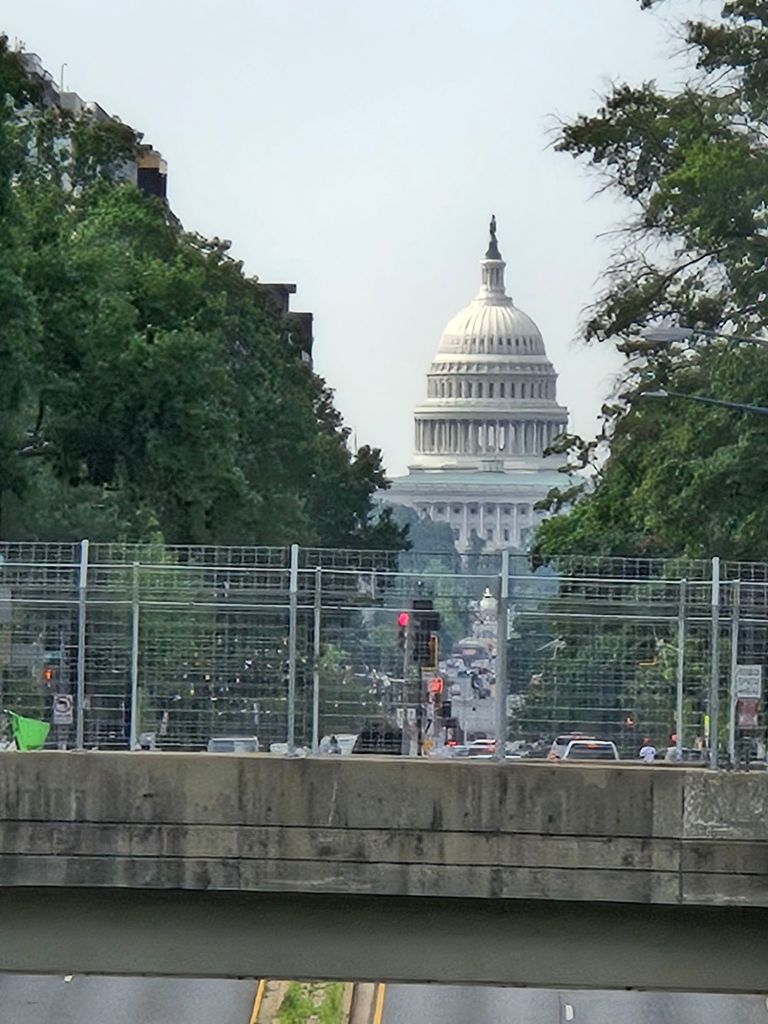
    Finally, North Capitol Street. Here is the photo I took looking south from the bridge that carries Rhode Island over North Capitol.

    Then, I decided to test my phone’s zoom lens. I took the same picture from a few feet back.

    See you next time from Northeast DC.

  • A Peep at the Veep?

    August 6th, 2024

    Months ago, I said that Joe Biden was not going to be the Democratic candidate in 2024 and people told me that I was wrong. I wasn’t. When I made that prediction, it was not that I felt that Biden was not able to fulfill his responsibilities as president, but it was clear that he was getting older, and the idea that he would be a safe candidate for four more years seemed misplaced.

    I didn’t know how his withdrawal would come about. I certainly didn’t forecast the disastrous debate with DJT. I also didn’t assume that Kamala Harris would be his successor. At the time, I thought that there would be a internal Democratic debate to come up with a candidate and my favorite would have been Cory Booker, but (among other things) Booker didn’t seem too interested in the job.

    After the debate, when it looked like one way or another Biden would have to drop out, I was pleased to see everyone rally around Harris, because it was clearly too late, and politically dangerous, for an internal debate within the party, which would have clearly involved everyone’s weaknesses being put out into public for the Republicans to use in the campaign.

    The next question of course was who was Harris going to select for her running mate. Again, like yesterday, maybe she has selected someone by the time you read this, but I will pretend that she hasn’t. The field narrowed to eight candidates. All seem qualified. So the question is which candidate would help her the most. And helping her the most means helping her win the purple swing states. Two candidates are from open states (Shapiro of Pennsylvania and Kelly of Arizona), and they seem to be the ones being talked of as having the inner lanes. And Shapiro particularly has his detractors, from his co-Pennsylvania Democratic Senator John Fetterman to those who don’t trust him on Gaza to Jewish voters who are afraid of a Jewish candidate and so forth. Kelly is obviously a man of many talents, but of little executive experience.

    When all of this discussion started, I suggested that Andy Bashear of Kentucky would be a good candidate – a two term blue governor of a red (if blue grass) state, I thought he had the administrative experience, sufficient charisma, and – at least as far as I know – no real enemies. He was the candidate who would offend no one, and who – although he came from a red state – could attract Republican or at least independent voters in all of those important midwest states that are up in the air, and maybe southern states as well. He is one of her six choices, and although the media has not been focusing on him, he is consistently ranked well by the gambling sites. So we shall see. Or, perhaps, we have seen.

    But another question arises. Will Biden resign his presidency? Should he? For those of you who see me on Facebook, as well as on this blog, you might know that I have been in an active discussion with one (actually more than one) of my west coast cousins, who leans (shall we say) to the right. His position is that Biden is today unfit for office and either should resign or should be subjected to action under the 25th amendment to the Constitution. I have maintained that nothing has occurred yet to lead me to conclude that Biden isn’t fit for office, even if his ability to communicate has been compromised. That we don’t know that he has been diminished in any other way. But…..

    Sunday night, CNN had an hour long program on Biden’s capacity, filled with examples of problems in his speaking, as well as in his movement, and filled with interviews of his allies in the Democratic party talking about what they have noticed recently. This, I will say, has me rethinking my position.

    But there are problems with this, as well. For one thing, as vice president, it is easy for her to be given no, or few, assignments over the next three months, so that she can be a full time campaigner. If she were all of a sudden a p7thresident (our first female president to be sure), that would really cut down on her campaign time, and that might well offset any advantage she would have as an incumbent.

    If Biden left the presidency before the January inauguration of the next President, there is another issue to dwell upon. We would have no Vice President, and that means that if anything happened to Kamala Harris before she (or DJT) is inaugurated, our president would be Speaker Mike Johnson. That is something we really don’t want to see happen.

    Yes, the 25th Amendment does provide a mechanism to select a new Vice President, but it requires approval of both Houses of Congress. Can you imagine the Republican led house approving someone to fulfill this role two or three months before an election?

    On balance, let’s just sit tight. The time is short.

  • Habemus Veep?

    August 5th, 2024

    Perhaps President-to-be-elected Harris has already selected her running mate by the time that you are reading this, but she hasn’t announced anything at the time I am writing it. So, you might know more than I do. And I am certainly not going to speculate.

    I am also not going to post today anything about Rhode Island Avenue. Rather, my plan is to go back to Rhode Island this morning, and begin the preparation of the next few posts before the temperature rises over my relatively low tolerance level, so we can continue our trip tomorrow or the day after. The next segment should take us from 3rd Street NW to North Capital Street. Then we will go into North East DC for about 30 blocks are so, when we move into Maryland.

    So what to write about today? Three shows I have recently watched. You may have watched two of them. I cannot imagine that you have seen the third. Two were recent Netflix series; the third a film that Edie and I saw yesterday at the National Gallery. (The National Gallery shows films you are unlikely to see elsewhere on weekend afternoons.) And what do these three shows have in common with the Trump/Vance ticket? They were all weird.

    We finished Friday night watching the new seven part (each part only about 30 minutes) series “Baby Reindeer”. Have you seen it? It was written by a Scottish comic (I use that word only because he uses that word to describe him, not because he makes me laugh) who first put together a semi-autobiographical production which he presented at the Edinburgh Fringe Festival, and which, surprising to him, won a major prize. So he did what all fringe festival winners do, he turned it into a full scale production, a show that he traveled with around the world. And then, it becomes a Netflix series, no longer a one-man show, but now a production with a full cast.

    Donny Dunn, the protagonist, fails in his first attempt to storm Edinburgh, but meets a predatory TV writer who promises to give him some career help. He then goes to drama school, where he meets a beautiful girl. He moves to London with his girl friend and he tries to become a comic, taking advice from the predatory TV writer, who turns out to be predatory plus. Exactly the man you would never want to meet. Drugs and unwanted same sex sex, all those sorts of things.

    To make at least some money, Donny also works at a pub in Camden (you know Camden? Not the one in New Jersey, but the very pleasant “I’d-like-to-live-here” one on the north side of London), and a down in the dumps, bedraggled woman named Martha comes in and says she can’t afford anything. He treats her to a diet cola, her drink of choice.

    Martha begins coming in every day, talking to Donny, staying longer and longer, sipping a free soda. Then she learns his email address, becomes his Facebook friend, and learns everything there is to know about him. She wants something more from this relationship; he says just enough to egg her on.

    Martha is, it turns out, a graduate lawyer, and a serial stalker, who has served time in prison. She has some emotional problems, to be sure. But Donny, it seems, is as disturbed as Martha is, and neither of them are really fit for normal life. Martha becomes the stalker, Donny the stalked. He claims that his life has been turned upside down. He is correct. But his life, to be honest, has never been upside up.

    “Baby Reindeer” is the story of Donny and Martha, and Donny’s girl friend from acting school (no longer his girl friend), and the trans woman whom he seems to maybe really sort of fall in love with, and his parents in Scotland, and the guys at the bar and at the comedy club and, oh yes, the police handling his complaint.

    What did I think of the show? On a scale of 1 to 10, I’d give it a W for weird. I also give it a U for unique. Also a 7. It’s not a comedy, although it’s about a comic. It’s now and then quite uncomfortable. You might like it.

    Next. Season 2 of “Kleo”, another Netflix series. It is a real comedy (I think) with a fantasy plot. I had watched Season 1 a few years ago, although it took me a while to remember it enough to really help me through Season 2. But you can see both seasons now on Netflix. Season 2 only has six episodes, although each episode was close to an hour long. It’s in German and Russian, with a smattering of English. It’s pretty basic German and Russian, the two languages I have studied in the past, and I could understand a fair amount of it……as long as I was looking at the English subtitles while I was listening.

    Have you watched any of it? The general plot is that Germany has reunited, but in Berlin there are still those who are both to the former East Germany and to Moscow, and they have formed a group, it seems, to stage a coup to reverse German unification, to recreate the eastern German Democratic Republic, and then somehow to meld it into the Soviet Union as a constituent part. The CIA knows about this plot, and probably isn’t going to worry about its success, but it is interested in the participants because they are said to have a copy of the “Reagan-Honecker Pact”, a document that has some importance that I could never really figure out. I learned what it contains, but I just couldn’t see why that matters.

    What else should I say about it? Oh, yes, it is extraordinarily violent. Not the way war movies or movies about the Mafia can be violent, but in the ways that a slapstick comedy can be violent. And yes, this is a comic, with people getting shot left and right, generally in the middle of the head. Here today, gone tomorrow.

    Kleo herself is a young woman who grew up in East Berlin and whose family was at the highest rank of East Berlin Communist society, so high that they also hobnob with Russians at the highest levels of Moscow Communist society. She knows the importance of the Reagan-Honecker Pact, and she is determined to get it, so that the world can be saved from whatever it would be like if the Pact wound up in other hands. She is no longer a Communist; she is certainly not a capitalist. And everyone is out to get her, because she is determined, powerful, impossible to stop, and Otto’s granddaughter. Who is Otto? He was the man who came up with the idea of the Reagan-Honecker Pact, and of the plan to take over the government of Germany through a coup. Kleo is under the eye of the wary CIA, and is approached, befriended and not let alone by Sven, a West Berlin police officer, who has been kicked off the force by failing to follow orders, and who would be more comfortable in a Keystone Kop farce than the Berlin police force anyway. His job is to follow Kleo around, and try to keep her from killing everyone she comes across, and to provide comic relief.

    The show takes a little suspension of belief (obviously), and realization that you aren’t going to understand everything, and that if people get shot in the head, it’s all great fun, and that Kleo clearly will always come out okay, because if she didn’t have an imaginary shield around her, she would not have made it through Season 1, Episode 1.

    Sort of spoiler: Kleo kills her grandfather and her father (to be fair, for a long time she didn’t know he was her father), her father kills Kleo’s mother and tries to kill Kleo, and Uwe – a socialist moron – kills Ernest Honecker (the real former head of East Germany) and his wife, known both as Aunt Margot and the Purple Lady. (You can Google Margot Honecker and see why she deserves this title)

    How do I rate this one on a scale of 1 to 10. An 8. I give it a W and a U, as well. But it’s fun, while Baby Reindeer is more of a “let’s see how uncomfortable this can make me” show.

    What should I say and “Night and Day”, the film we saw yesterday afternoon. It’s a 2008 Korean film written and directed by Hong Sang-Soo, a prolific Korean film maker, with a very unique style who makes very weird films. You got it: I give it a W and a U on a scale of 1 to 10.

    A Korean man, thinking he is going to be arrested on a charge of smoking marijuana, flees to Paris, leaving his wife behind, running into an old girl friend, meeting two young Korean women (much younger than he) and falling in love (so he says) with one of them whom he gets pregnant, and, after two months, returns to his wife in Seoul and leaves his pregnant girlfriend to fend for herself (he told her he had to go to Seoul because his mother was seriously ill). It gets a Rotten Tomatoes 87%, but it’s really an awful film. The next paragraph, quoted from the Wikipedia article on Hong, will tell you why:

    “Hong is often spontaneous when shooting, delivering the day’s scene on the morning of the shoot and changing the story on set. He rarely prepares scripts in advance….and writes his scenes on the morning of the filming day, making changes throughout the day….he sometimes shoots scenes while the actors are intoxicated.”

    In addition to the W and the U, I’d give this film, still on a scale of 1 to 10, an L. And a 3 (being nice). For long. Not only is the film poorly made and acted, it clocked in at about 2 and a half hours. The National Gallery seems to be showing four or five of his films this August. I wonder why.

    By the way, there was something similar about all three. A totally clueless man. No more ditzy young blondes.

    Tomorrow, back to more normality here.
  • A Walk Down the Street (Part 6)

    August 4th, 2024

    We have seen that Rhode Island Avenue has entered Washington the city as opposed to Washington the capital, and in Part 5 looked a number of “affordable” housing developments. Today, we will look at different aspects of this part of Rhode Island and hopefully end up at 4th Street.

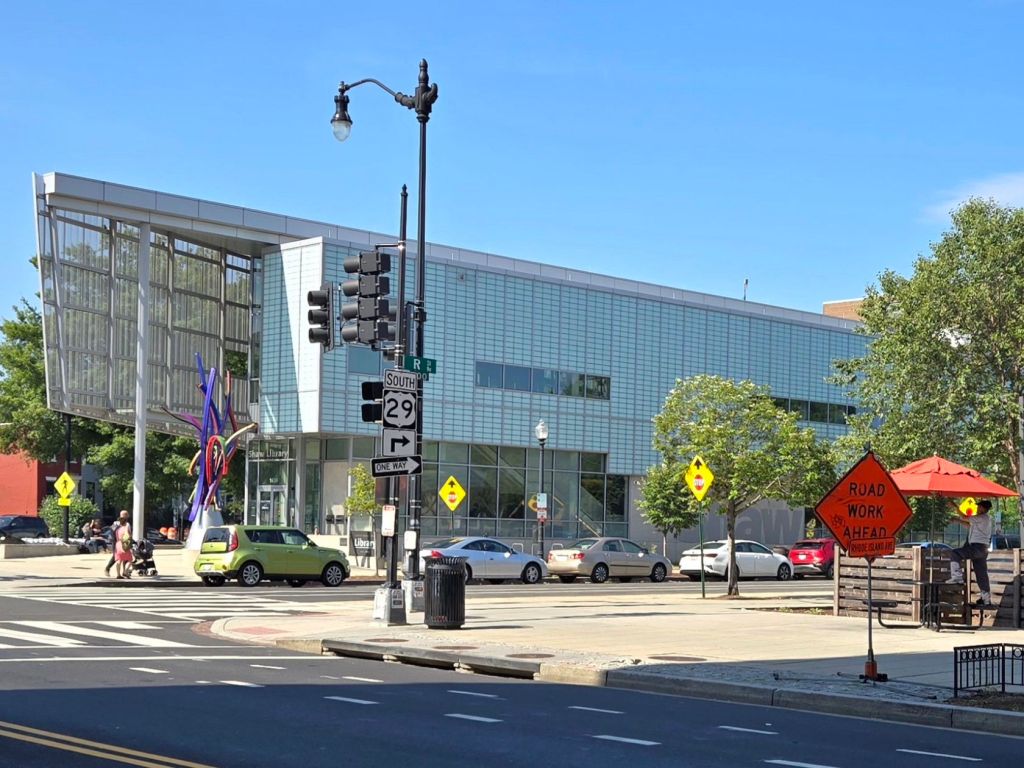
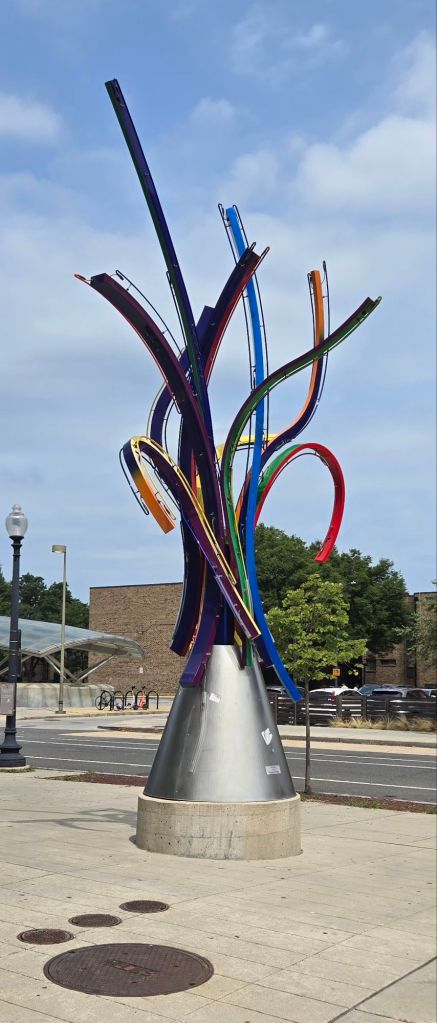
    We can start with the local branch of the DC public library. Named for civic activist Watha Daniels, it is emblematic of the effort the city has put into the rebuilding of its library system over the past fifteen years or so. In front of the library entrance stands a sculpture by local artist Craig Kraft, one of the best known neon sculptors of the country. His nearby studio on 9th Street is in one of Washington’s oldest firehouses, built in the 1880s, Station No. 8. In keeping with Washington’s history of segregation,  this was a firehouse for Black firemen only.

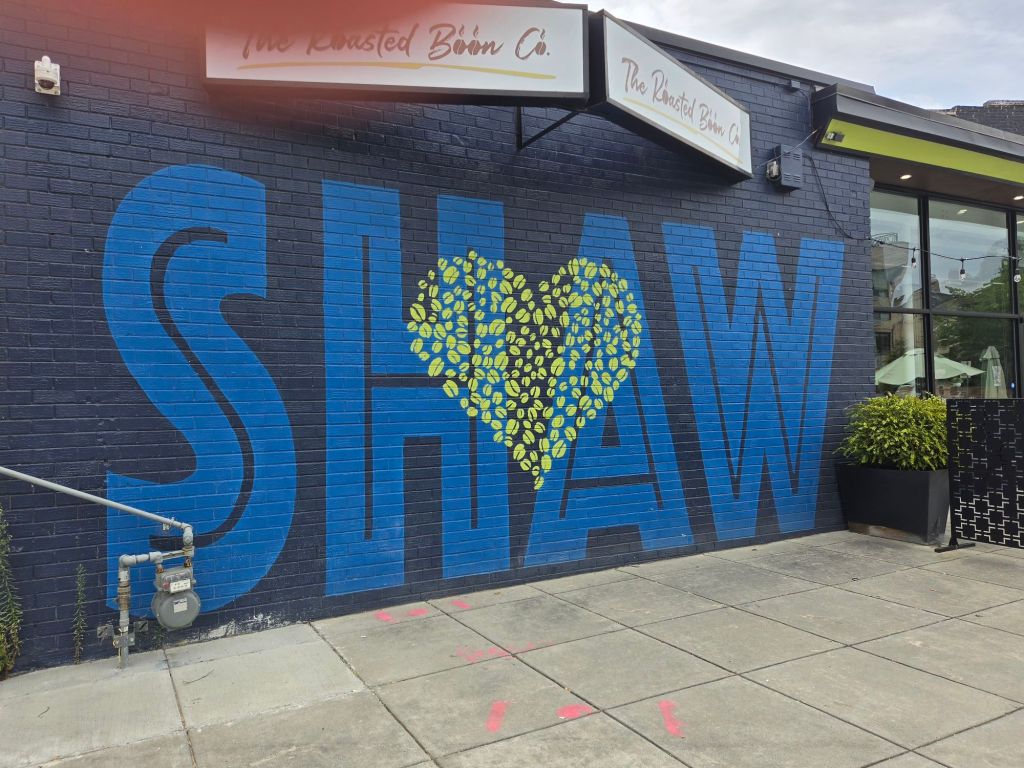
    The entrance to the Shaw Metro station can be seen behind the sculpture.  Which reminds me that this part of Rhode Island Avenue runs through the DC neighborhood known as Shaw.

    You can Google Shaw and learn about it. It could be the subject of books, not just noted in a short blog post. This mural is painted on the wall of The Roasted Bean, a trendy coffee shop I have yet to try.

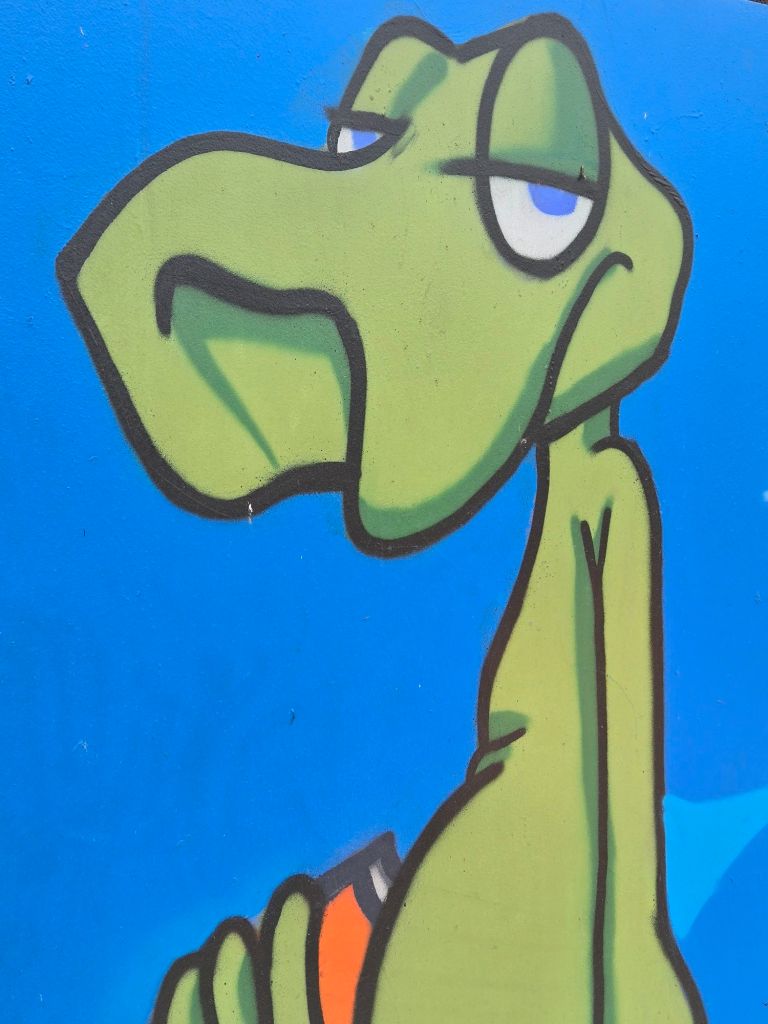
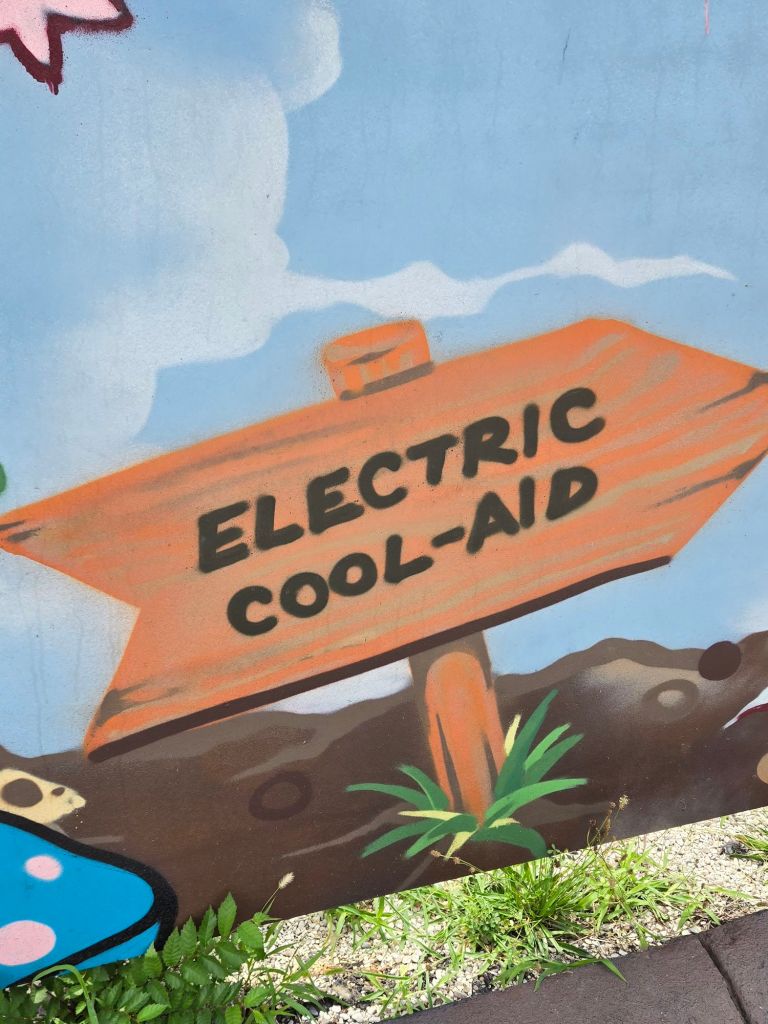
    Speaking of murals, we have several leading to an outdoor beer garden, Electric Cool-Aid, another place I have yet to enter. I think it is a popular place. But not for me.

    You see a mural on the inside, on the second floor overlooking the garden, and on the fence enclosing it. Is there more outside art nearby?

    Yes, we have a three-dimensional animal, a two-dimensional animal, and a skeleton in the Confederate army?

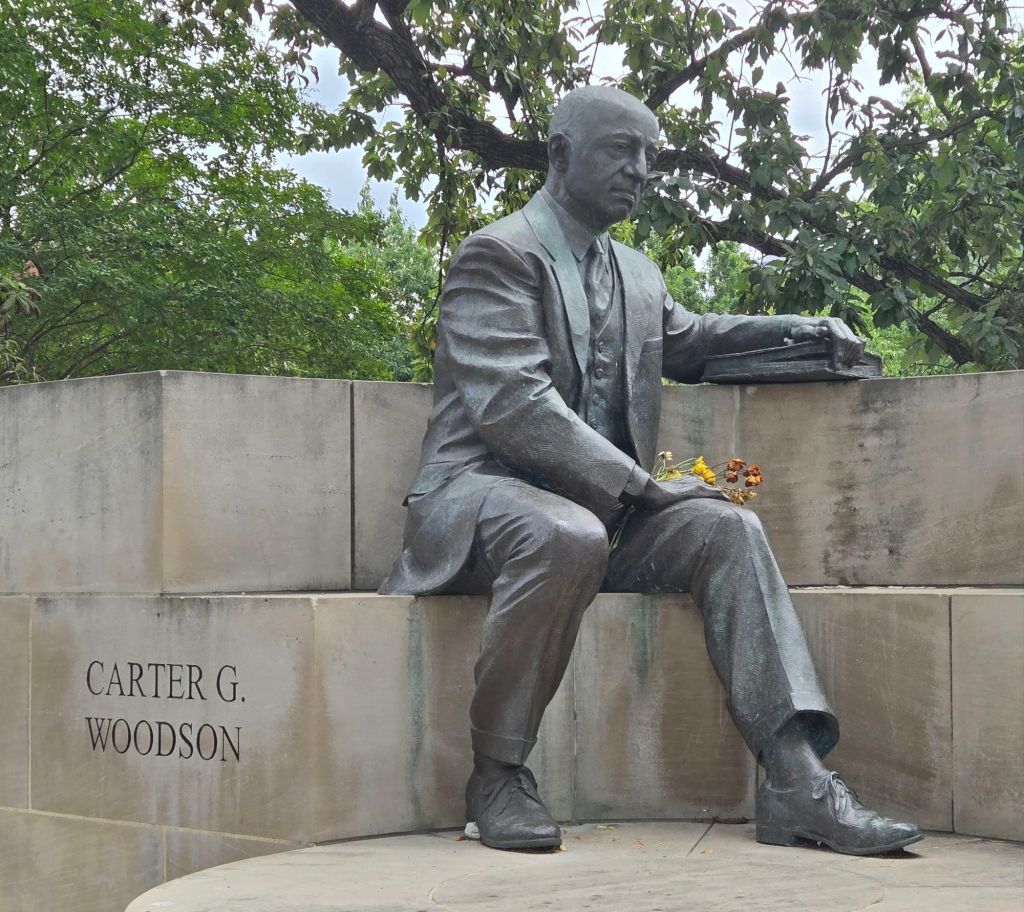
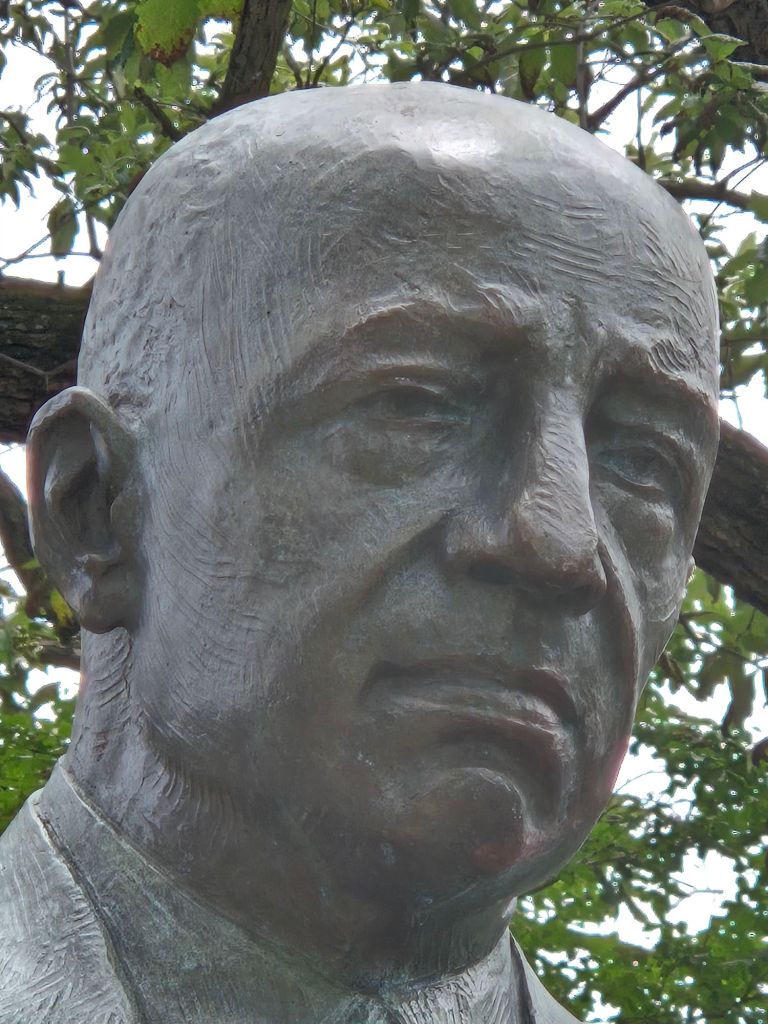
    We also have a very tasteful momument dedicated to Carter Woodson, an African-American historian and Dean of Howard University, who lived in the neighborhood. W.E. DuBois was the first Black man to receive a doctorate from Harvard. Carter Woodson was the second.

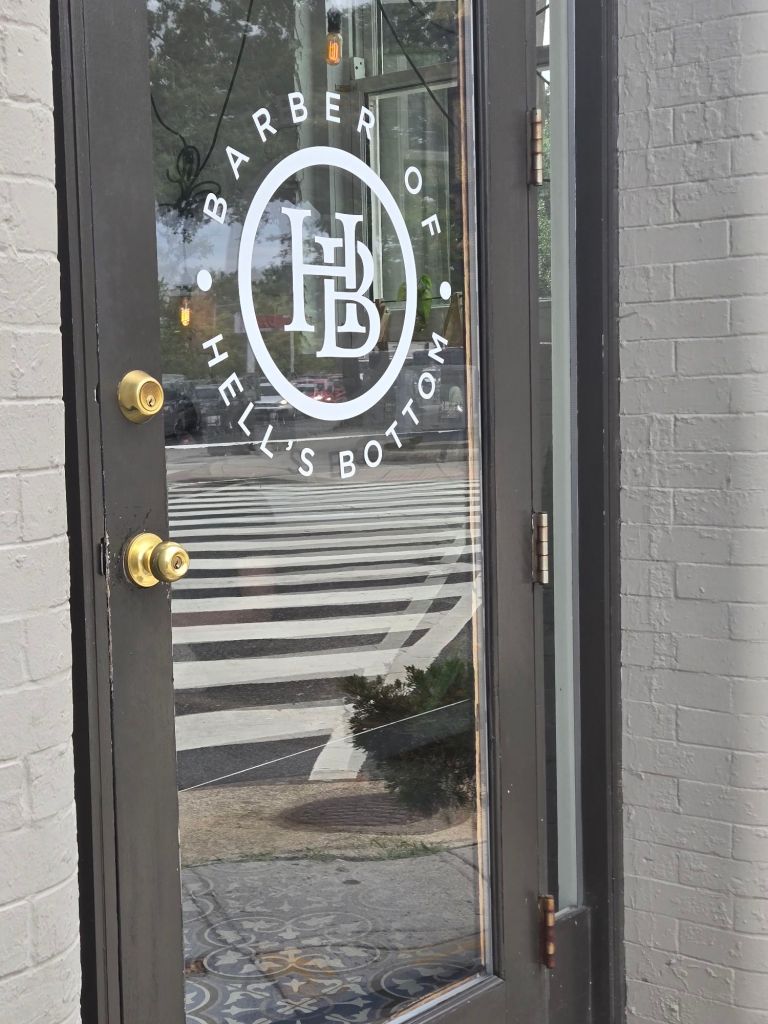
    One more thing. At Rhode Island and 6th, you will find the Barber of Hell’s Bottom. What is special about this place? It seems that a simple man’s haircut would cost you $95.

    Oh, you want to live here but don’t qualify for affordable housing? Try the Bailey

    Or the Josephine

    A small 900 square foot two bedroom on the first floor of the Josephine is for sale for $600,000.

    We have now reached 4th Street NW. It’s three blocks to 3rd Street. Two major diagonals, New Jersey (turn right for the Capitol) and Florida (turn right for Gallaudet University, left for Adams-Mogan) interrupt your walk and there are three gas stations and one Dunkin Donuts at the intersections. Next time, we will pick up at 3rd Street.ll

  • Welcome Home! Wish You Were Still There!

    August 3rd, 2024

    This seems to be the message of many Republicans after the announcement yesterday that Russia was releasing 16 prisoners, 7 of whom are Russian citizens and 3 of whom are American citizens, in return for western countries,  including the United States, releasing 8 prisoners and returning them to Moscow. The Republicans wish the deal was never done.

    Of course, the overall question of whether negotiating for the return of hostages in fact simply encourages more hostage taking is a question as old as the hills. In Jewish tradition, redeeming the hostages is a necessity. In American political tradition, it seems to be the standard practice, but seems always to be questioned as a matter of principle.

    The primary criticism of this week’s release goes to the release from German prison, where he was serving a life sentence, of Vadim Krasikov. Krasikov was convicted of murder in Germany following the killing in 2019 of Zelimkhan Khangoshvili in cold blood (shots to the head) in a German park in broad daylight. Let’s assume that Krasikov in fact committed the crime – there is no reason to doubt it. Let’s also assume that he did it upon orders from Moscow, from Moscow at the highest level. No reason to doubt that. Let’s agree that he is a Russian “hit man”. He obviously is.

    Now let’s look at Krasikov’s crime. Khangoshvili, his victim, was born in the then Georgian Soviet Socialist Republic (now the independent Republic of Georgian) and is fully or partly ethnically Chechen. (Under Trumpian terms, I guess he would have had to have selected one or the other, because you can only be one thing at a time, but……that’s under Trumpian terms.)

    At some point, Khangoshvili left Georgia and went to Chechnia, not an independent country but a sub-republic constituent member of and fully a part of the Russian Federation. During the second Russia-Chechnia War, he was a Chechen platoon commander, fighting against Russia. Because Chechnia was a part of Russia, to Russians, this makes Khangoshvili a traitor. After serving as a Chechen fighter, Khangoshvili returned to his home country Georgia, no longer an SSR, but an independent republic. Georgia and Russia are far from friends, and, as you may remember, fought a war in 2008. In that war, Khangoshvili was an officer in the Georgian army. After the war, the Russians claim (no reason to doubt them) that Khangoshvili infiltrated Russian spy circles in Georgia and reported names of Russian operatives to the Georgian government. All of this made Khangoshvili an enemy of the Russian state, to be sure.

    My point being that this was a political crime and, for example, from a Russian perspective, may be not that different from the three recent Israeli assassinations of Hamas and Hezbollah high level operatives, or even the American killings of, say, Bin Laden or of Qasem Soleimani of Iran. If the “perpetrators” of those “crimes” had been imprisoned by Iran or Hamas, wouldn’t we want them released? The answer is “of course”, and if Iran or Hamas told us they couldn’t release them as part of a swap because they were simple “criminals”, we would be outraged. Krasikov  may be no different than the American who targeted Soleimani with a drone.

    I say all of this simply because those people who say we are obtaining the release of our hostages by releasing dangerous criminals back to Russia are either not looking deeply enough at the circumstances, or being somewhat unknowingly hypocritical. None of the others released to Russia were violent criminals, either. They were either spies or perpetrators of financial crimes.

    This is not to say that I believe Russia had a legitimate right to hold the three Americans as prisoners, but once they were there, it was our duty to get them out, and the price we paid was not close to being excessive.

    I also have to say something about Mr. Trump. First, President Biden was correct when he said that Trump failed to get Paul Whelan out when he was president. Whelan has been imprisoned almost six years. (And, by the way, although my knowledge is very limited, the Whalen case is an odd one. He was found with a flash drive on him containing some confidential Russian military information. He says it was planted on him by a “friend” and he was the victim of a sting. I don’t think many details have been released. But Whalen, now an American hero, it appears, has a very spotty background. Yes, he was a Marine, but he was a Marine who was court martialed and reduced in rank after allegedly being involved in theft in Iraq. Maybe we need to know more about him?)

    Secondly, when Trump said that, after he won the election, Putin was going to release the Americans held in prison as a gift to him and not before, he was obviously wrong, and he had no basis for his comment.

    And third, when Trump said he could have had them released without giving Putin anything, as opposed to paying much too high a price, he knew this not to be true.

    Finally, during his four years in office, Trump released to foreign governments many people we had imprisoned in trades to get Americans released from other countries’ jails. In 2019, he did a one-for-one swap with Iran. In the same year, three Taliban members held by the legitimate government of Afghanistan were returned to the Taliban in exchange for the release of two Americans, a swap in which Trump’s office was involved. In 2020, there was a second one-for-one trade with Iran, and there was the release of 200 Houthis held by Oman in return for two Americans, another American brokered deal.

    And of course, you remember the release of 5000 Taliban members in 2020, as a quid pro quo for starting peace negotiations with the Taliban. That extraordinarily misguided deal was made by the Trump administration without even informing the American backed Afghanistan administration that it was being discussed. We know where this got us – making it clear to the people of Afghanistan that we did not acknowledge their government as a serious governing body (thus making it impossible for that government to continue to operate with any gravitas). Trump then made a promise to withdraw from Afghanistan by a date certain, setting the stage for the chaos that occurred in 2021.

    Beyond Trump, there was J.D. Vance yesterday, who said that the release of prisoners by Russia shows that dictatorships all around the world want to “clean house” before Trump returns to office, because they know that – after that – they won’t get away with anything. All that comment deserves is a big “Huh?”.

    The prisoner release was a discussion point on  C-Span yesterday morning. Most (not all) of the callers thought the deal was bad. I wish they could read this post.

  • A Walk Down the Street (Part 5)

    August 2nd, 2024

    We are crossing 9th Street NW on Rhode Island Avenue, and heading towards 5th Street, our next stopping place.

    Three of the larger buildings on this part of Rhode Island Avenue qualify as affordable housing.

    Their stories are very different.

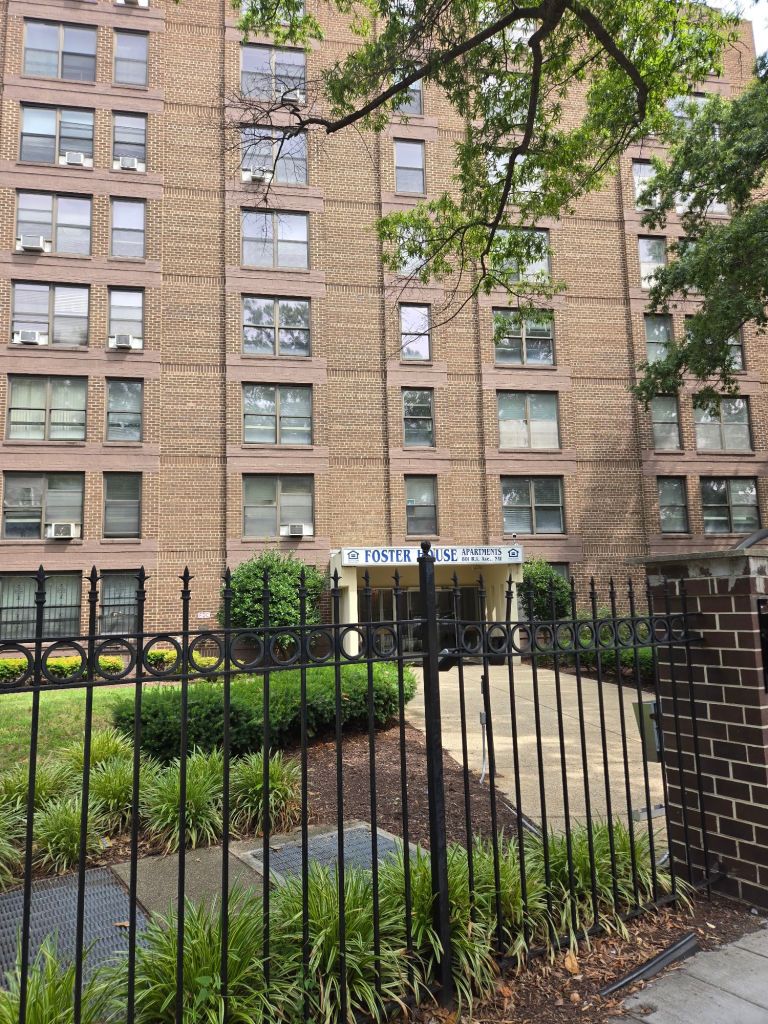
    The first, Foster House, at 8th and RI, is a development for low income seniors that was built over 50 years ago by New Bethel Baptist Church. The church, located a few blocks from this property, still owns Foster House through a non-profit corporation.

    This is a 76 unit property, and about four years ago, it was about one third vacant. Whether this has changed, I don’t know, but Foster House is one of the three subsidized housing developments in the city that has been targeted through enforcement actions by the DC attorney general. The allegations relate to failure to upgrade or update the building since it opened in 1973, and failure to provide adequate maintenance. There was an attempt to put the building into receivership last year, but I don’t know where that stands.

    The church maintains it just does not have the funds to do what is needed and that the building can not be fixed, and should be demolished and replaced. The church proposed to do just that a few years ago, but the plan has been caught up in processing issues since that time.

    The second building, at 7th and Rhode Island, is much different. It is brand new, opening up within the past year.

    This is also an “affordable” building, but I believe was constructed under a program that primarily serves middle income tenants, rather than low income tenants. On the first floor, there is retail space. 7th Street, like Rhode Island Avenue, is a major street that deserves its own walk. As it heads north, it passes the Howard University campus (its name is changed to Georgia Avenue), it goes by the former Walter Reed Hospital grounds (now the site of major development activities) and goes on to downtown Silver Spring, Wheaton, Olney and beyond (“beyond” literally means “the great beyond”), to Judean Gardens cemetery, where Edie and I have our plots).

    But I digress. This building at 7th and Rhode Island will, I am sure, be very successful. And it is attractive, something you cannot say about Foster House (well, I guess you “can”).

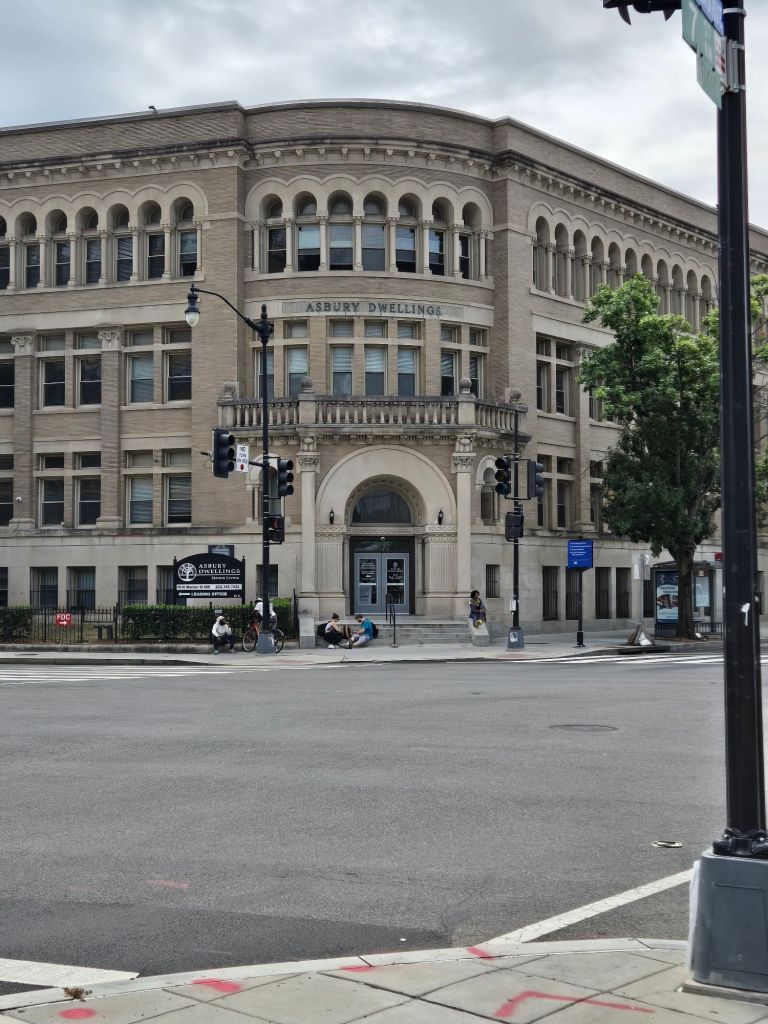
    The third building, Asbury Dwellings, has the most interesting story of all. Like Foster House, it is an apartment property serving low income seniors. While Foster House was built in 1971, Asbury Dwellings was built in 1902. It started out as McKinley Vocational School, a trade school for White high school students. When McKinley moved to a new campus, it became the Shaw Junior High School, a school for Black students. (Remember, until 1956, DC schools were completely segregated.)

    I am not sure when the building was remodeled and converted to housing, but it has been several decades. From the outside,  this building has always looked immaculate. I assume it fills its role more than adequately.

    Let’s finish up today with one other group of residential buildings in this area.

    These small row houses look like they were built before 1900. While most DC row houses are brick, these have wood facades. The houses look to be in very good condition,  with fresh paint and clean yards. That’s all I know about them. But they provide one more element in the eclectic mix of housing on this part of Rhode Island Avenue.

    Tomorrow we will look at other aspects of these few blocks. Sculpture, restaurants, monuments and more.

  • Special Second Post of the Day: I WAS WRONG (and I Admit It)

    August 1st, 2024

    The news of the swap for Russian prisoners (24 prisoners in all affected, as I have heard) is phenomenal. Phenomenal. Evan Gershkovich, Paul Whalen, Vladimir Kara-Murza and 13 other western prisoners held by Russia. Extraordinary.

    Where was I wrong? I expected a swap, yes. A smaller swap. But I did not expect it today. I thought it would be a gift from Putin to Trump as an unofficial quid pro quo for the second Trump administration pulling back support for both Ukraine and NATO, and that Trump would be able to announce this as an October surprise to help win back the presidency. I did not expect this to be accomplished by the Biden administration. I was wrong. And I admit it.

    This is an enormous victory for the prisoners and their families and for this country and certain of our allies. It is one more defeat for Trump and his campaign. I wonder how he is going to spin it.

    While I am at it, I will add one more thing. Yesterday it was announced that a deal had been made to spare Khalid Sheikh Mohammed and two others from the death penalty. I have heard Republicans screaming about how this demonstrates the incompetence of the Biden administration and demonstrates the weakness of our country. I want to try to counter that position.

    The cases against the 9/11 masterminds, strong as it may be on the facts, faced a number of problems. First, there was a question of jurisdiction of military courts and civilian courts. Second, the limitation passed by Congress that would not permit them to be transferred out of Guantanamo even for trial or punishment. And thirdly, defenses which would have been raised by their lawyers about procedural shortcomings, especially allegations that they had been tortured (e.g., waterboarded) while in American custody.

    In other words, their convictions were far from assured, and their trials already been postponed for decades. Now, we are spared all of that, and we have guilty pleas. And they will spend the rest of their lives in prison.

  • Put It Together and What Have You Got?

    August 1st, 2024

    The news reports are that the Earth is spinning more slowly on its axis. Some reports even say that it is spinning backwards. I admit to not really knowing what that means or how that affects us. But I must say that it doesn’t sound good.

    In fact, there is not a lot that sounds good these days. But there is one thing that does, the increasing probability that Donald Trump will lose his attempt to retake the presidency. And we can only hope that the current trajectory continues and that nothing happens to disturb Kamala Harris’ move towards victory.

    It’s quite amazing. Two weeks ago, we were all down in the dumps because we didn’t like either of the presidential candidates, and we were afraid that, because the Democrats were so demoralized by the possibility of Joe Biden running and losing (or even running and winning), and that it seemed that Democrats would stay home, and Independents be tempted to vote Republican and that Trump was destined to win.

    The pressure for Biden to withdraw was growing, but Biden himself seemed to be impervious to the hints that he should leave the race. He was on a mission and he, like his putative opponent, Biden seemed to think that “only he could fix it”, and that (was this a sign of mental deterioration?) that only he could beat Trump.

    But then something happened to change his mind. I actually think that the thing that changed his mind was Covid. When he was diagnosed with Covid, a number of things happened. First, he had to slow down, get off the treadmill, sit and relax. That broke his momentum. Second, he had time to think and to listen to the increasing number of people, people very close to him, suggesting it was time for him to leave the race. Third, he had time to listen to himself in recent appearances, to watch himself on recent videos. Fourth, he was in contact with his doctors, although we don’t know what they told him, or suggested to him. Finally, he had to face his own mortality and realize how he felt as an 81 year old who was sick.

    What am I saying? I am suggesting that, had Covid not struck the President, he might still be in the race, destined to lose.

    As an aside, I do feel quite bad for Biden. Two weeks ago, he was running for president. Now, he is the lamest of lame ducks, and has been told by virtually everyone who previously supported him that he made the right choice to get out, that he was not physically or mentally strong enough to continue. There doesn’t seem to be anyone telling him anything else, and the “too old and too decrepit” mantra seems to be repeated everywhere and often. He can’t turn on a TV, or look at a newspaper or at social media, without hearing it over and over. He must feel awful. He has been abandoned by most of his political allies, and probably most of his friends.

    Not only that, but he is still president. He says he has things to do over his last six months in office (remember, even though the election is in November, he is in office until January 20), like bringing peace to the Middle East, bringing down consumer prices, and reforming the Supreme Court, either through law or through a Constitutional amendment. Of course, he won’t accomplish any of these things. That’s in part because they are impossible things for anyone to accomplish. But, it is also true (I think) that no one is paying any attention to Biden anymore. As I said, he is the lamest of lame ducks, and he must know that.

    Another part of this situation is equally fascinating. Only a few weeks ago, Democrats who wanted Joe Biden to step down were suggesting a number of potential replacement candidates. Most of those Democrats suggested people other than Kamala Harris, and the most interesting articles were about timing and process.

    Well, timing and process turned out to be a bit too complicated to contemplate, it appears, and the Democrats, knowing that they needed a candidate and certainly not wanting to highlight internal disagreements or fights between “progressive” and more middle of the road Democrats, came together quickly and settled on Kamala Harris, someone already on the proposed ticket, the sitting Vice President, as the rightful, and the only practical, candidate, whether or not she was anyone’s actual first choice.. Suddenly, there appeared to be no opposition to her and endorsements kept coming in. Democratic party dissension was not going to be a problem.

    And then? Then, something miraculous happened. All of a sudden, Harris was the perfect candidate. Experienced, charismatic, Black, female, smart, funny, upbeat……absolutely everything you would want in a candidate. And Democratic dismay turned into Democratic excitement, Democratic lethargy turned into Democratic activity. Money began pouring in, volunteers began signing up, and polls, especially polls in the six or seven states that really matter in this presidential election, began to turn (quickly turn) from Trump to Harris. This is something that no one foresaw.

    And then there’s Israel.

    As all of America’s attention has turned to this riveting race, the world continues to fester in so many spots. Israeli Prime Minister Netanyahu gave a speech before the American Congress that deepened, but did not change, the views of individual Americans as to what was happening in and around Israel, and what should be done about it. IDF attacks into Gaza continued, settler/Arab unrest on the West Bank continued, armed drones kept arriving from Lebanon and from Yemen, over 100 hostages remained under Hamas control in Gaza (assuming they are still alive), and ceasefire/hostage release negotiations continued to drag (really drag) on. Then, a Hezbollah rocket kills 12 Druze children in the Golan Heights, and Israel retaliates by targeting and killing a very high level Hezbollah official in Beirut, the capital of Lebanon. The same day, or maybe it was the next day, the Israelis kill one of the highest ranking Hamas political officials, a man they were negotiating with to get the hostages released and reach a ceasefire agreement, and what is more, they killed him by shooting a rocket into Tehran, the capital of Iran, where he was a guest during the installation of Iran’s new president.

    Tonight, Prime Minister Netanyahu gets on Israeli TV and says (my usual paraphrase): tough times are ahead of us; we will be united; we will win in the end.

    I have no doubt that the United States will support Israel in whatever type of conflagration arises. But tonight, listening to Netanyahu speak, I thought of something else. For months (in some respects for years), we have been saying that Hamas (and that means Iran as well) does not want a ceasefire, does not want a temporary or “final” peace treaty, because they are playing a long game, and believe that in the end, no matter how far in the future the end is, they will succeed in wiping Israel (at least as an independent nation) off the map. If Arabs die in the process, so be it. They become martyrs, and after all we all have to die sometime.

    But today, I wondered if it might be possible that Netanyahu and his followers are (at least now) of the same mindset. That they want a war, even if it’s a terrible war, because they are confident in their (and our) strength, and they are confident that they will win such a war and destroy the enemies on their borders and in their neighborhood. And to the extent Israelis die or suffer in the process, it will be worth it in the long run.

    Neither side wants a stalemate. Each side wants a victory. How can you possibly have a victory without having a war. So, Netanyahu is saying, bring it on, Ayatollah! The next move is yours.

    It will be a challenge for our current president and our next president, whoever that may be. Maybe Israel can win such a war. But maybe, at the same time, the cost that they will have to pay isn’t worth it.

  • A Walk Down the Street. Part 4.

    July 31st, 2024

    On the day I walked from Logan Circle on Rhode Island and 13th Street, I went as far as 5th Street. I don’t think we will get that far today in this post, but then, I guess you don’t really know before you start.

    You may recall that I said that we are leaving Washington the capital and entering Washington the city. Here are three examples of residential developments on the next two blocks. First, row houses, now restored after some years of decline, a typical modern apartment/condominium building recently completed, and another new building,  designed to fit in with and resemble older architecture.

    Walking on, I wanted to meet some neighborhood residents. I found Gary, who looked very comfortable,  and who obviously only spoke to me in sign language.

    I also found our first example of street art. These delicious murals, painted in an alley on the side wall of a moderate townhouse,  draw a lot of attention from passersby.

    And we are already now walking between 10th and 9th Street.

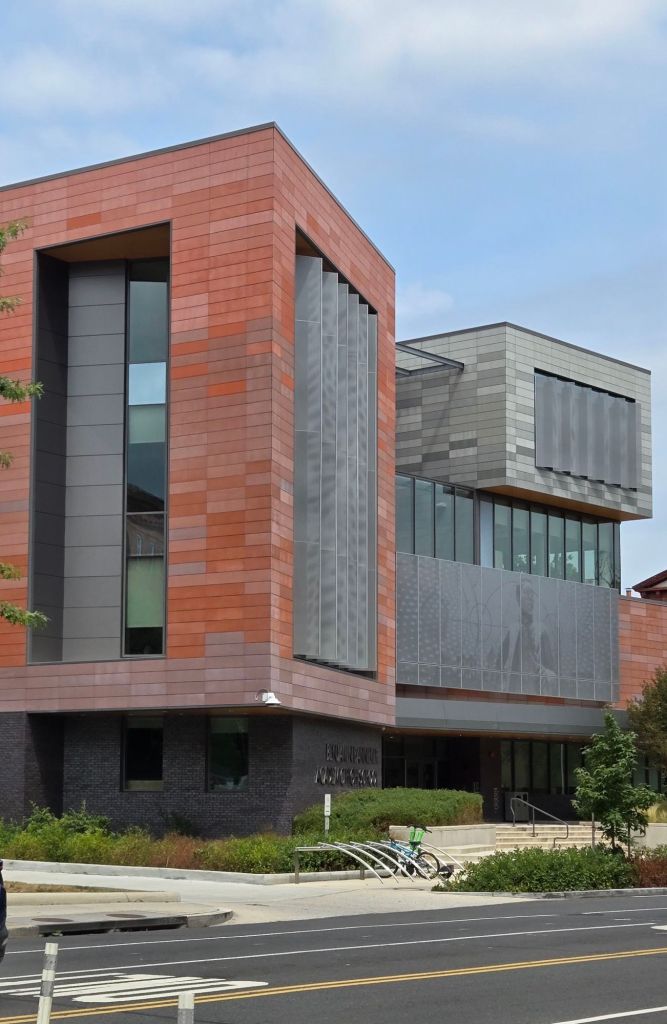
    We pass some school athletic facilities, and if you look around the corner onto 9th Street, you see the entrance to Banneker Academic High School.

    Banneker High School is known for many things, including being the school at which my son-in-law Andrew teaches. Beyond that, it is known as an academic magnet school, one of two in the DC public school system, which admits its students in 9th grade and admits no transfer students, and from which virtually all students move on to college. It is a relatively small high school, with about 500 students overall, who come from all sectors of the city. It was named after Benjamin Banneker.

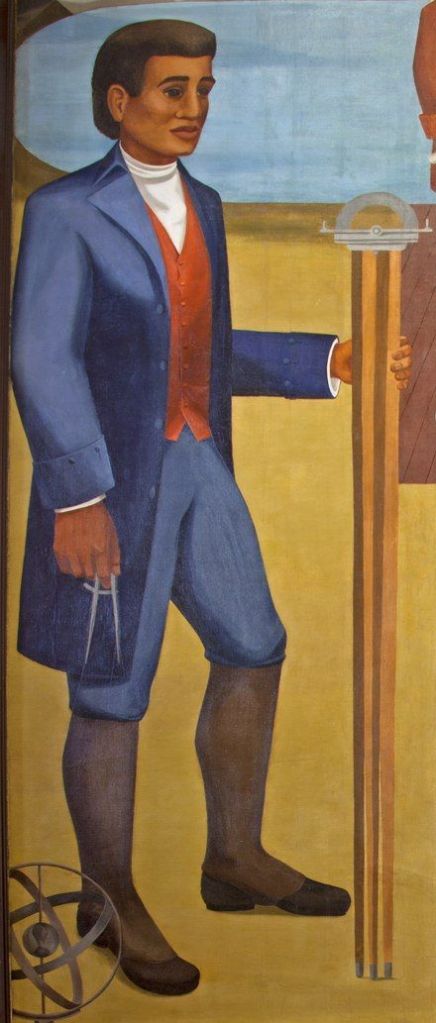
    Benjamin who?

    Banneker (I downoaded this mural from the DC Recorder of Deeds office) was a free Black, born in Baltimore in 1731. He died in 1805.

    He was the owner of a hundred acre farm, a naturalist, an astronomer, a surveyor, and the author and publisher of several almanacs. Exceptional accomplishments for an African-American in the 18th century in colonial America (or for anyone else). You can see an extensive summary of his life on Wikipedia.

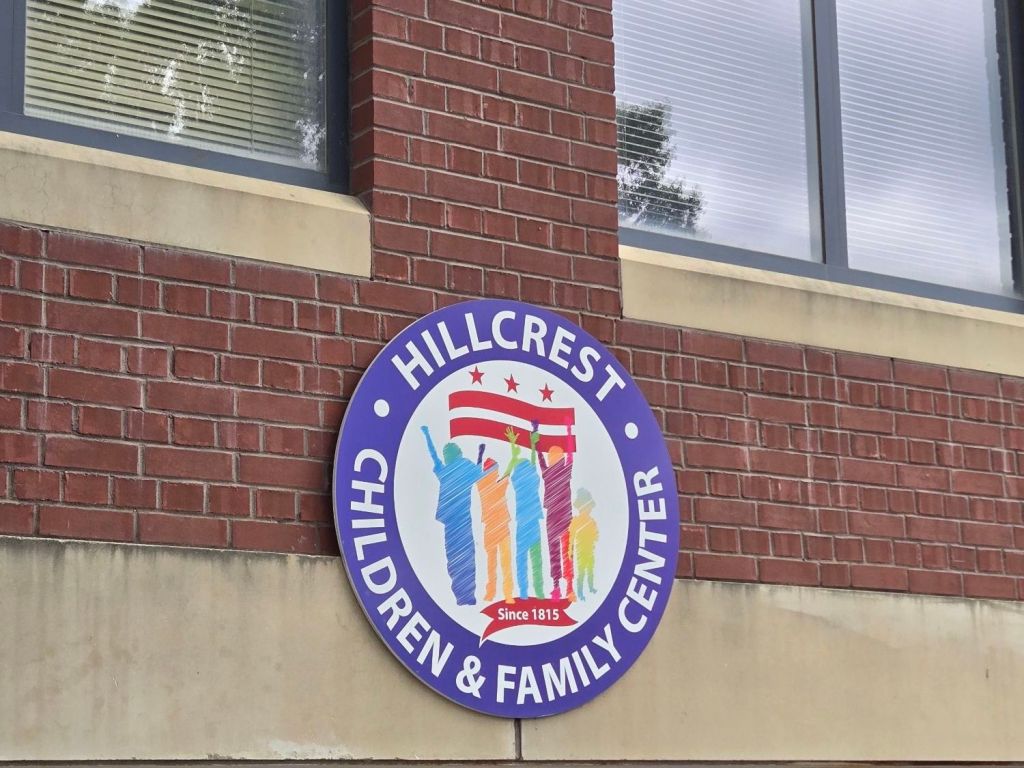
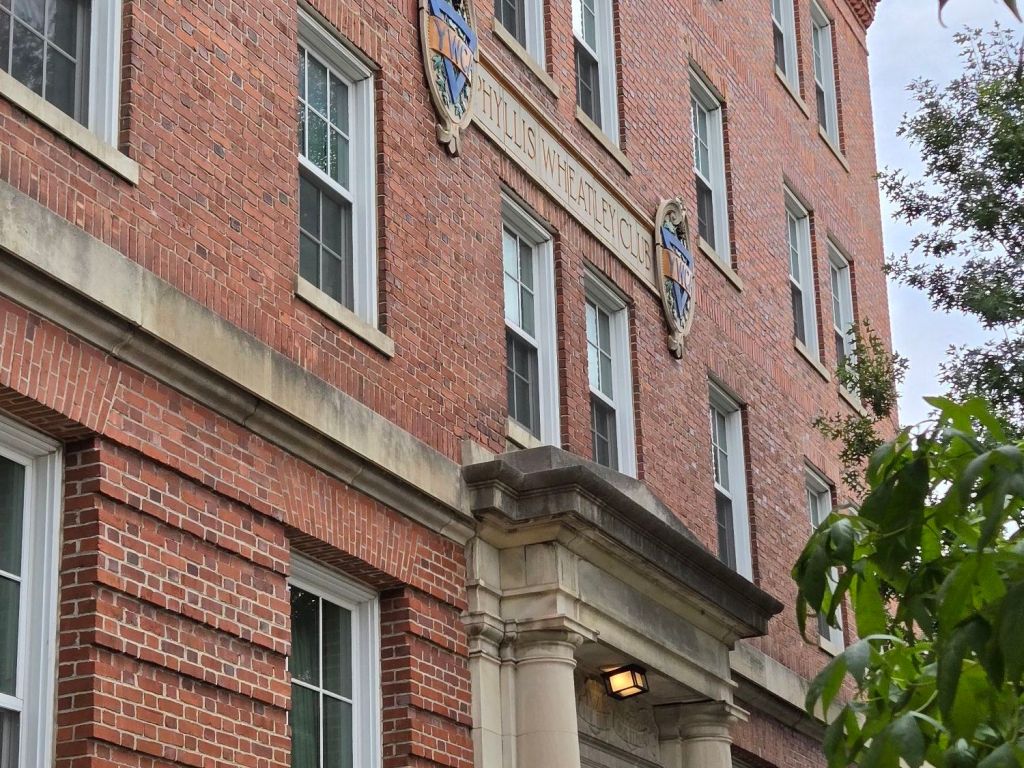
    Between 10th and 9th Streets, you pass two other important institutions on the north side of Rhode Island Avenue. The first is the Hillcrest Children and Family Center, the second the Phyllis Wheatley YWCA.

    The Hillcrest Children and Family Center is a social service agency which concentrates on mental health assistance and substance abuse recovery programs. It is not, by the way, a new organization. It was established in 1815. And not only that.  Its founder was Dolley Madison.

    The Wheatley Y also has an interesting history. Unfortunately I don’t know enough about it. But its building is 100 years old, and it was established as a Y for Black women (maybe the first). For the last decade, and after a full renovation, the building now contains 86 units of housing for low income women of several races, and provides related services. Phyllis Wheatley, by the way, was an African-American poet who, like Benjamin Banneker, lived in the 18th century.

    On the south side of Rhode Island Avenue,  there is another school, the Seaton Elementary School. Its entrance has this sign:

    William Seaton, by the way, was mayor of Washington for about ten years in the 1840s, and was a supporter of public education (as well as a slave holder). I looked at the school’s website. The school is 1/3 Black, 1/3 Hispanic, and 1/3 White and Asian. Its students come from about 30 countries.

    So…..we have reached 9th Street. Enoigh for today. Next time, we will see if we can get to 5th Street. I think we can. I think we can.

  • Am I a Zionist? Is Joe Biden? Kamala Harris?

    July 30th, 2024

    (This is such a complicated subject that I fear you may get lost in my short(ish) post. If you do, just remember that it’s my fault, not yours.)

    Because I don’t know what Zionism means, I have no idea if I am a Zionist. I know exactly what I think about Israel, but I don’t know if that puts me within anyone’s definition of Zionism. The term, except to those who view everything as either black or white, is too ambiguous. There are religious Zionists, there are secular Zionists, there are spiritual Zionists, and there are political Zionists. There are Zionists who believe that the Zionist mission is not fulfilled until the Third Temple is built on the Temple Mount. Their are Christian Zionists who believe that until the State of Israel completes its mission, Jesus will not return for a second visit. There are Zionists who believe that Israel should be a home for those Jews who want to (or who are forced to) come, and there are Zionists who believe that all Jews should resettle in Israel. There are Zionists who believe that Israel should be a liberal democracy, with equal rights for all who live there. There are Zionists who believe that Israel must be a Jewish state (some even say a theocratic state), where non-Jews have no role, or a role only as second class citizens or residents.
    Joe Biden says he is a Zionist. But I have no idea what that means.

    In fact, I think the concept of Zionism, and the use of the term, should probably be relegated to history and retired. Zionism was a crucial concept in the latter part of the 19th and first half of the 20th centuries, before the State of Israel came into existence. But since then? You be a supporter of Israel without calling yourself a Zionist. Wasn’t the premise of Zionism fulfilled when Ben-Gurion declared a state, and most of the world agreed? Yes, you may feel it is important that Israel continues to exist, grow, and prosper. But you can feel that without thinking yourself a Zionist.

    And now Israel’s future is really being tested. It’s being tested as a result of a terrifying invasion from Gaza by Hamas that never would have happened but for a massive security failure.
    Security failures can be devastating. Think of Pearl Harbor. If American security had been working as it should have been, the Japanese invasion would have been thwarted. Who knows what might have happened then. When the US declared war against Japan, its ally Nazi Germany declared war against us. If that had not happened, would America have still even fought the Nazis, or would the isolationists have won out and the whole of 20th century history changed?

    Or think about September 11, 2001. We had a lot of intelligence about the Saudis who organized the devastating attack on the Twin Towers. Think how different the world might be today if that attack had never occurred.

    Even think about young Mr. Crooks who took a shot at former President DJT. As it turns out, Trump was not seriously hurt. But obviously, he could have been killed and, were he killed, it too would have been the result of a security failure.
    Yes, security failures do occur, and do have consequences. And it’s the response to a security failure that really counts. As jazz pianist Errol Garner once said (I paraphrase): Everyone now and then hits the wrong note, but if you are talented, you know what note to hit next.

    In politics, it is hard to find that talent. In the case of World War II, we had no choice but to fight back, and it took over four years, but we won when both Germany and Japan agreed to unconditional surrender. In the case of the Twin Towers, the American reaction was to go to war against Iraq, a country not involved in the attack on America, on the basis of a false belief as to the intention and capabilities of Iraq’s political leader. In the case of the Hamas attack, the Netanyahu government’s response has been harsh, and its success still unproven and not looking very promising.

    You walk to the side of a cliff. You wonder if you should jump. You can always turn away and get to safer ground. It is never too late to do that. Until you jump. Then, it’s too late to save yourself. You are done for. Unless you tied that bungee cord tight enough. If you did, you still have a chance. If not….you are done for.

    This is where Israel is. On the cliff. We, the United States, are the bungee cord.

    Back to the first question. What does it mean that Biden calls himself a Zionist and that Harris has not? I suggest that it means nothing.

    I am not concerned that a Harris administration will make decisions that will harm Israel’s ability to prosper, or that will make that country less safe. (Of course, she will be coming into office, it appears, when Israel’s prosperity is under attack and its security highly compromised.)

    But I am concerned about what her position will be during the three month election campaign. She has a tightrope to walk to keep all Democrats happy. And all Democrats include those young Democrats who seem to be aligning themselves with the Palestinian cause. These young Democrats, which include some Jewish Democrats, are of many minds. Some are simply anti-Israel – they believe that Israel is an illegitimate country that simply should not exist. It is a colonial outpost, it is on land that rightfully belongs to Muslims, not Jews. How can land belong to a people? Uh-oh, I guess that is one premise of Zionism.

    Others will defend Israel’s right to exist, but believe that Israel’s general treatment of its Arab neighbors has been heartless and wrong from the beginning. And then, of course, there are the traditional Democrats, young and old, who support Israel in its battles with its neighbors, but who are not always comfortable with Israel’s methods.

    Harris must cope with these varying positions among her party’s supporters, knowing that this is far from a simple problem, knowing that most of Israel’s neighbors have fought against its existence for the past 75 years, since the day the State of Israel came into existence. She knows that telling Israel to lighten up might work to weaken Israel beyond saving, and that refraining to tell that to Israel, might lead to never ending wars.

    As to those who believe that Israel should not exist, and for whom Israel’s existence with almost 10 million citizens does not change their position, there is little that she can do, except hope that they vote for her for other reasons. As to those who think Israel is too tough, she should sympathize with them – most of us probably feel that way. But she must also try to educate them as to the dilemmas facing Israel, that ignoring the enmity of its neighbors won’t automatically lead to greater security.

    I have said much of this before, I know. The changes must come from better leadership on both the Israeli and the Arab sides. How and when this changed leadership will come about we don’t know. But that should be a goal of American policy.

    And let me add something. My source is Donald Trump, who says, speaking about our border with Mexico, that without a border, you don’t have a country. It’s a silly statement regarding our southern border, but it is true with regard to Israel. Israel does not have settled borders. Seeing to final borders between Israel and its neighbors should be another goal of American policy.

    New leadership, established borders. Add to that continued support for Israeli security,  continuing to build strong relations with moderate Arab countries, and the education of the American public, and you have the position that the Harris campaign should take.

    If she does this over the next few months, I think it might be helpful. But it would be very difficult to do it well. And there would be mistakes made along the way. But as Errol Garner says: “Everyone hits wrong notes, but if you have the talent, you know where to go next”.

    Oh. Am I a Zionist? Do you know?

  • A Walk Down the Street. Part 3.

    July 29th, 2024

    We are now leaving Scott Circle, where 16th Street tunnels under Rhode Island Avenue, and heading up Rhode Island Avenue towards Logan Circle at 13th Street. We see a change in the neighborhood. No more downtown type office buildings. We now see some residential buildings, both midrise apartments and elegant row houses.

    But there is more than just this. There are about six hotels on these three blocks, including the Beacon, the Darcy and a Holiday Inn, to mention three. But the picture below is of the Viceroy Hotel, a 180 room upscale hotel which has an art gallery inside and a tube of toothpaste outside.

    But there’s even more. Washington is the home of many associations, as everyone knows. But some of these are often overlooked. Such as the National Society United States Daughters of 1812, located at 1461 Rhode Island.
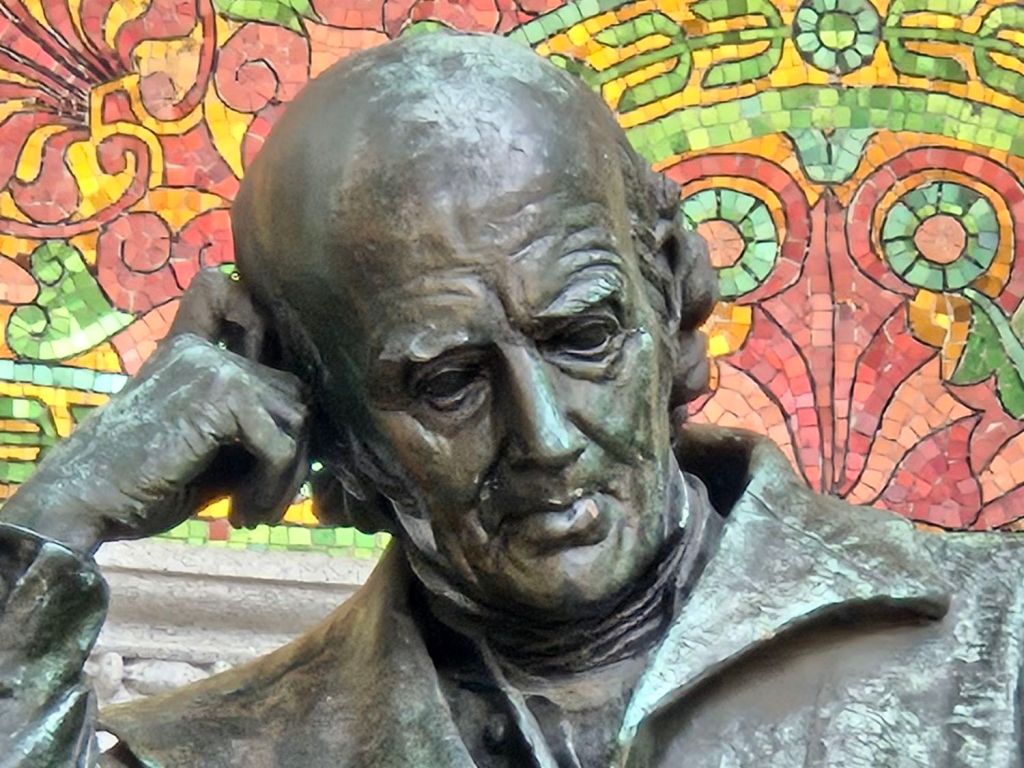
    Located in a older house, the NSUSD1812 has a museum and library, open to the public upon request. I have never been in, but the library is an extensive library of the period, and the small museum filled with items donated by members. Even without making special arrangements,  though, you can see an important piece of American history. The flagpole in front of the society is not just a flagpole. It is the original mast from the USS Constitution, ” Old Ironsides”. The Constitution,  available to visit in Boston Harbor, was first floated in 1797, and was particularly busy during the War of 1812.
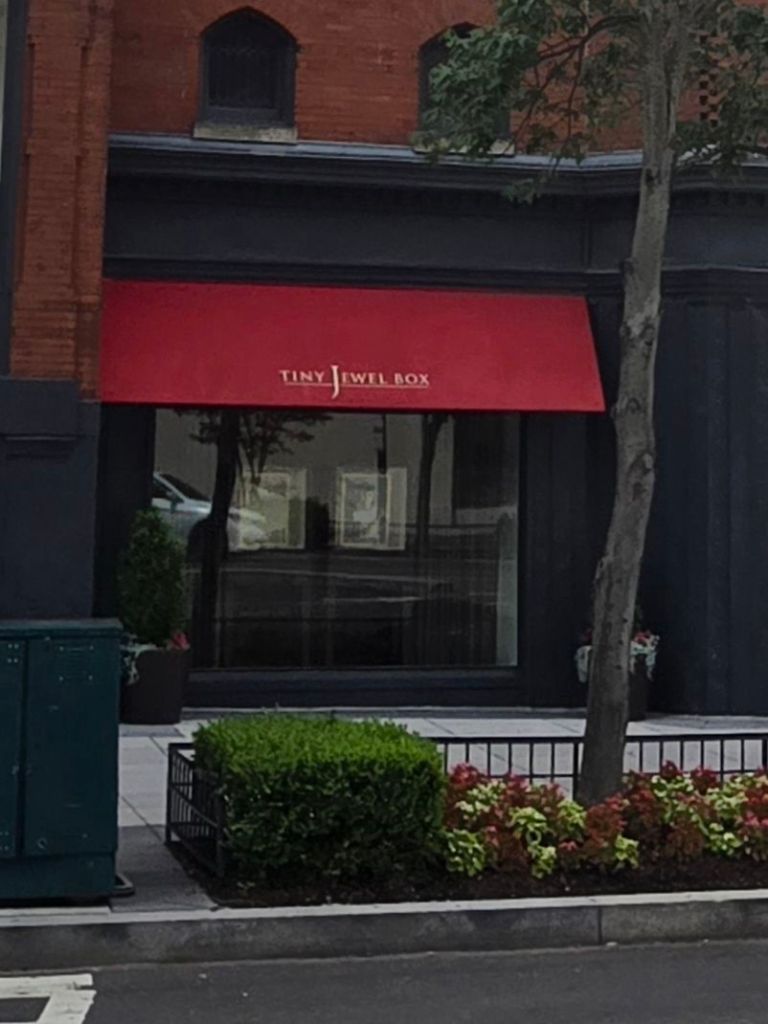
    And again because this is Washington, there are a few hundred embassies scattered across the city, including the very unattractive Australian embassy at 16th Street, which was recently completed.

    And then there’s the Hungarian embassy at 15th.

    The Hungarian embassy is located in one of the few remaining late 19th century mansions in this neighborhood. And a special house that at times has served as the residence of Alexander Graham Bell, Vice President Levi Morton, and Secretary of State Elihu Root. It was constructed in 1879 and remodeled by famed architect John Russell Pope in 1912. In front of the embassy, which is surrounded by a wrought iron fence, is a statue of a Hungarian freedom fighter to commemorate the 1956 failed insurrection.

    And then we get to Logan Circle, named for Civil War general John A. Logan, who later became a Senator from Illinois, and a Vice President candidate in 1886.

    The sculptor of Logan’s statue is Franklin Simmons. The base was designed by Richard Morrris Hunt, who also designed the Metropolitan Museum of Art in New York and the Breakers in Newport RI.

    Interestingly, one of the bas-reliefs is flawed.

    This relief shows Vice President Chester Arthur swearing Logan in as a Senator. Unfortunately,  Arthur never did this. He wasn’t vice president at the time.

    Around Logan Circle are some magnificent mansions. Look at this one.

    Ulysses S. Grant lived there for a while.

    Next time, we will find we are getting closer to Washington, a dynamic city, rather than Washington, the capital of the country.

  • The 1619 Project and All That……Three Cheers.

    July 28th, 2024

    I must admit that I have not read all of the criticism that has been thrown at The 1619 Project, and that I don’t intend to. But I will say this: I have just finished reading through the entire book, and I don’t find much to criticize.

    The 1619 Project started out as a lengthy article in the New York Times Magazine sometime in 2019 by Times reporter Nikole Hannah-Jones (or was it an entire issue of the magazine?) that claimed that the central feature (or at least one of the most important of the central features) of American history was slavery, and that the lengthy and widespread historical existence of slavery in this country influences the way we are and the way we think even today. And that this history begins in 1619 when the first slaves were brought to what is now the United States, one year before the landing of the Mayflower. What’s to argue about?

    Now, I understand that one may quibble with this or that incident and its relative importance or how it may continue to resonate today. But that is not what the argument that has been thrown against The 1619 Project is about. The criticism of The 1619 Project is holistic. Donald Trump, for example, told Judy Woodruff of PBS that The 1619 Project, along with Critical Race Theory, is a “crusade against American history”, and “toxic propaganda, ideological poison, that if not removed, will dissolve the civic bonds that hold us together, will destroy our country.” (As an aside, how many things has Donald Trump says will destroy our country, or have already destroyed it?)

    Let’s make this clear. The 1619 Project is not a “crusade against American history”, and it is not “toxic propaganda” or “ideological poison”.

    What is it? It is telling (I won’t even say retelling) of American history from the perspective of Black American history, and I don’t think it is easy to refute. It clearly demonstrates the centrality of Black America not only to the America that existed during the almost 250 years when there was slavery in our land, but subsequently. And how the treatment of Blacks after the end of slavery has been clearly influenced by those 250 years when slavery was permitted to exist. Things that should be obvious, and are to most or many of us, but which will be even better understood by those who take the time read through this book.

    And that gets me to my next point. If I ran the Zoo, I would make this book, or large parts of it, required reading in America’s schools, because what it says is so, so important. And, although it is a fairly long and heavy book, it is surprisingly easy reading, smooth reading. They must have worked hard at that.

    The book was published in 2021 and, until I picked up a copy and started looking at it, I didn’t think I would ever read it, and certainly didn’t think I needed to read it. But I was wrong. Everyone – White, Black or something else – does need to read it. (And, I should add that parts of the book deal with Native Americans and refer to Asian immigrants; this is not a “black power” book.)

    The book has, in addition to a valuable preface, 18 chapters, each written by someone different (I admit not to have looked up the background of each of the 18). Their titles give you an idea of their breadth, and each of the chapters takes a general aspect of American history, demonstrates how Black Americans, slave and free, have been treated by the country in connection with each of these topics, beginning with the country’s early history, through the Civil War years, and beyond until today.

    Let’s look at the chapter titles (with my brief and simple minded explanations):

    (1) Democracy (how it was determined who could vote and who could not, for example)

    (2) Race (how race affected how people were/are treated, beyond the question of slavery)

    (3) Sugar (how the plantation system developed)

    (4) Fear (how fear of Blacks influenced White reactions)

    (5) Dispossession (how, even after slavery ended, Blacks had a difficult time not only obtaining, but retaining their property)

    (6) Capitalism (what is the goal of our society after all, assuming there is a goal?)

    (7) Politics (Blacks in politics – from Reconstruction onward)

    (8) Citizenship (the Constitution didn’t define it)

    (9) Self-Defense (White self defense; we are back with “fear”)

    (10) Punishment (Just look at our statistics)

    (11) Inheritance (the rich get richer – and not by the sweat of their brows)

    (12) Medicine (it’s more than just the Tuskegee scandal)

    (13) Church (what’s the real history of the Black church – why is it the most segregated activity in the US today?)

    (14) Music (Black music – Black and White performers – appreciation or exploitation)

    (15) Healthcare (who gets treated and who does not)

    (16) Traffic (why is Atlanta so congested anyway?)

    (17) Progress (two steps forward, one step back? one step forward, two steps back?)

    (18) Justice.

    Each of these chapters is filled with interesting facts and history. I guarantee you that, no matter how much you know about these topics today, you will gasp at some of the things you see. I guarantee you that this book will expand your appreciation of the Black situation in this country.

    Now, does that meant that you will look at everything that is written and say “I agree!!”? Of course not. And you may not agree with Hannah-Jones’ concluding position that reparations are owed to Black Americans (although they were paid to some Native American tribes, and they were paid to the Japanese who were incarcerated during World War II – I did not know that, b the way), or her “easy” definition of which Blacks should be entitled to reparations.

    But that is besides the point. This not central to the book or the “project” itself. And, I should add that this book does not give, or attempt to give, answers to our problems, or to the additional problems many Blacks face. This is a history book, not a book attempting to create a predefined future, or a book of predictions

    But this book will get you thinking. And if you think that it is wrong in some, or even most, aspects, the thinking you will do will be worth it.

    But again, let’s be clear. There is nothing in this book that sets race against race or class against class. There is nothing in this book that should lead White children to feel “guilty” or Black children to become anti-White. This book is meant to show how we got to where we are. The next steps should be better be able to understand what the next steps should be. That will be a continual discussion, to be sure, but not one that will “destroy our country”. Donald – once again, you should be ashamed of yourself.

    Tomorrow, we will continue our walk up Rhode Island Avenue. That is, unless you want to talk about who Harris should select as her running mate. I still sorta like Andy Beshear.

  • My Best Restaurant Meals in 2024

    July 27th, 2024

    One thing is true. I know how to avoid boredom. It’s the one thing I have learned in 81 years. I keep busy. Sometimes with little things, but I keep busy.

    For example, when I eat out – breakfast, lunch, dinner or sometimes even a snack, I make a note of it, and I give it a grade. A+ is the best, C- the lowest grade. Just a note and a grade – not a review. Don’t think I am really qualified to write actual reviews.

    As we are now almost 7 months into 2024, I thought it might be good to look at my restaurants experiences and give a report to you (after all, sometimes a grade gives you as much information as a review would). And, because I really don’t want to badmouth anyone based on one meal, I decided to stick with my A reviews. You might think that A’s would be rare, but actually I have given 30 As, or about 2 a week. I guess this is why I continue to eat out.

    One other thing. A disproportionate number of the A grades are meals eaten when we are out of town. I think this is because a greater proportion of our out of town meals are dinners at some of the best restaurants in town. Here, we go out for dinner less often and, when we do, it is more down the street, rather than across the town.

    The DC area restaurants are:

    1. Villa Maya – a Tex-Mex restaurant near daughter Michelle’s house in Rockville, off Norbeck Road and Bauer. (4.4)
    2. Puzukan Tan Korean Grill in Arlington (4.7)
    3. Cafe of India – our go-to Indian restaurant, often for carry-out, located on Wisconsin Avenue, five minutes or so from our house. (4.4)
    4. Java Nation – a coffee house/lunch spot, with two locations, one in Kensington MD on Connecticut Avenue, and the other on Rockville Pike in North Bethesda. (4.4)
    5. Ambar – a Balkan restaurant on 7th Street NW in Shaw (with other locations on Capitol Hill and in Arlington) (4.8)
    6. Sushi Toro – a small Japanese restaurant on Nicholson Lane in North Bethesda/Rockville. (4.8)
    7. Ada’s on the River in Alexandria VA (4.5)
    8. Izumi, a new Japanese Restaurant in Adams Morgan on Columbia Road NW (4.6)
    9. I’m Eddie Cano, our neighborhood Italian restaurant with very good eggplant Parmesan. (4.3)
    10. Fresh Baguette, a breakfast/lunch/bakery with a branch in Georgetown on Wisconsin Avenue. (4.6)
    11. Mamman, a coffee shop/lunch spot in Washington’s Union Market neighborhood in Northeast. (4.1)
    12. Maya Cuisine – our go-to Nepalese restaurant in downtown Bethesda (4.6)
    13. Moko Sushi – Japanese next to Villa Maya (4.2)
    14. Jyoti – Indian food in Adams Morgan (4.0)
    15. Taco el Costalilla – casual Mexican off Route 1 in Alexandria
    16. Shanghai Lounge – Wisconsin Ave (4.3) between Georgetown and Glover Park (4.2)
    17. Buck’s Camping and Fishing – on Connecticut Avenue next to Politics and Prose (4.3)
    18. Mother Earth Cafe – coffee, breakfast and lunch on 6th Street NW (5.0)

    On our Virginia Beach trip, good food at Side Street Cantina (4.4) and First Watch (4.4). On our St. Louis trip, Oceano in Clayton (4.5), Panorama at Art Museum (4.5) and Oishi Sushi in Creve Coeur (4.5). On our recent trip to Maine, Pressed Coffe and Books in Pottsville PA (4.6), Toscana in Oneonta NY (4.7), Blue Benn Diner in Bennington VT (4.6), Chez Rosa in Kennebunkport ME (4.9), The Tides at Goose Rocks Beach (3.9), Loretta (Newburyport MA) (4.6), Himalaya in Scarsdale NY (4.7), and French Roast in Manhattan (4.6).

    The numbers in parentheses are Google ratings.

    Any thoughts more than welcome.

  • A Walk Down the Street. Take 2

    July 26th, 2024

    The first post in this series got us exactly one block from Rhode Island’s start at Connecticut. Let’s see how far we get with this one. We start at 17th Street and move northeast.

    The first building we see on our right is the headquarters of the Human Rights Campaign.

    The Human Rights Campaign is a non-profit which serves the LGBTQ+ community. Their website states that they have already come out in support of Kamala Harris for President. And, although they are not a race-oriented organization,  they have adorned the 17th Street side of their building like this:

    The HRC has occupied this building for the past 20 years. Before that, from 1953 through 2002, it was the headquarters of B’nai Brith and the small but excellent B’nai Brith Museum. And for those of us who remember the incident, it was the site of the attack by the Hanafi Movement,  which held hostages in the building for several days and gave Washington DC its first taste of Islamic terror.

    By the way, the artifacts previously housed in the B’nai Brith Museum are now located on the campus of the Hebrew Union College in the Skirball Museum in Cincinnati.

    Next to the HRC building is a flat front building, the home of the Center for Strategic and International Studies.

    CSIS was established, I think, as part of Georgetown University, in 1962 and became independent in 1987. It moved to Rhode Island Avenue in 2013. I don’t see much about CSIS, but a visit to http://www.csis.org will show the range of its studies and activities. In the last week of July alone, CSIS is offering web programs on  Gaza’s Water Crisis, Countering China in the Gray Zone; Lessons from Taiwan, Global Regulation of Essential Patents, and The Defense of Guam.

    And next to CSIS is the Washington branch of the University of California, one of the many university branches here in Washington.

    16th Street, Rhode Island Avenue and Massachusetts Avenue meet at a circle, Scott Circle. 16th Street runs under the circle.

    Scott Circle is named for General Winfield Scott.

    This 15 foot high statue stands in the middle of the Circle. Created by New York sculptor Henry Kirke Brown, it is said to have been the third major equestrian statue in the United States.

    Winfield Scott (“Old Fuss and Feathers”) led the American Army for 20 years  prior to the Civil War. He had fought in the Mexican War and in various of the Indian Wars and, in 1852, he ran for President, but lost to Franklin Pierce.

    There are two monuments on the sides of Scott Circle, one dedicated to Daniel Webster and one to Dr. Samuel Hahnemann.

    Daniel Webster served as both a Congressman and a Senator, and served two terms as Secretary of State. He was a lawyer who argued over 200 Supreme Court cases, including the Dartmouth College case, which solidified the validity of contracts. Webster was an orator and an opponent in the years prior to the Civil War of the theory that states could ignore, or nullify, laws which they disliked. This bas-relief, one of two on the monument,  depicts a famous debate between Webster and Senator Hayes of South Carolina.

    Two more things. The sculptor was Gaetano Trentatove, originally from Italy. And, no, Daniel Webster did not write a dictionary.

    The opposite sited memorial is to German doctor Samuel Hahnemann. He was a contemporary of Webster, was German and never visited the United States.  This made him an unusual and controversial  subject for a monument. Hahnemann was the founder of the medical science of homeothopy, now largely discredited, but then pretty much the rage.

    The sculptor, Charles Henry Niehaus, was born in Germany, but was living in Ohio.

    Both the Hahnemann and Webster monuments were dedicated in 1900. Now, onward toward Logan Circle, three blocks away.

  • The Netanyahu Speech

    July 25th, 2024

    Let’s start out with the one thing that is clear: if the solution to the problems of Israel in the Middle East were simple, they would be resolved by now. But in fact, they are more complicated than ever, now that Israel is dealing with the aftermath of the October 7 Hamas attack, and now that Hezbollah, from the north, and the Houtis, from the far south, are attacking the country as well, and threatening what could amount to full scale war.

    Let’s continue with another thing that is clear: Bibi Netanyahu is a very controversial fellow in his own country, for many, many, many reasons, with polling showing he is supported by a decisive minority of Israeli voters.

    Let’s continue with still a third thing that is clear: Israel’s response in Gaza has (if you believe Hamas figures) killed almost 40,000 and injured more, and has resulted in physical and economic disruption at home, with hundreds in the IDF killed and many more injured.

    And one final clear thing: Hamas has shown no signs of giving up and is taking a long view that eventually, if only by numbers, they will succeed.

    In the midst of all of this, while the United States has greatly assisted the Israeli war effort, there is much opposition at home, some to the continuation of providing any aid, some to providing aid only under certain conditions that will alleviate the condition of the residents of Gaza. By and large, the further left an American is in his/her politics, the greater likelihood that he/she will at least want strings attached to any additional Israeli aid. Further, those who wish to make further aid contingent, or who want to stop all aid whatsoever, include Jews as well as gentiles.

    What to do?

    I obviously don’t know what to do, but I think I know what not to do. What not to do is to have invited Prime Minister Netanyahu to give a talk before a joint session of Congress.

    In his speech, Mr. Netanyahu said (1) that Israel will win, (2) that no one in Gaza is suffering from a shortage of food, except to the extent Hamas is stealing it, (3) that the IDF is the kindest and most careful army in the world, and (4) when the war is over and Israel declared the winner, Israel will continue to control the borders and finances of Gaza for a significant period of time. In addition, he said that those in this country who protest against Israel are “Iran’s idiots” and those who do so saying they love Israel are the equivalent of those who would say “I love chickens” while transporting them to KFC. As to the 114 or so remaining hostages, when some are talking about a potential deal, all Bibi could say is that he won’t rest until they are all brought home.

    In the meantime, the Republicans in both House and Senate applauded him and whooped it up, as if he were the head of the GOP and not the head of a foreign party, Likud. And the Democrats, looking uncomfortable, did not know quite what to do.

    Perhaps that was the goal, this election year.

    This will be a tough one for Kamala Harris (in fact, for the Harris-Emhoff family). Let’s see how she handles it.

    I have two suggestions for the future:

    First, no foreign politician should be invited to speak to a joint session of Congress without an invitation approved by the leaders of the majority and minority parties of the Senate and the House. And of course, none should be invited to speak to only one of the two houses.

    Second, when a foreign politician speaks, there should be a “no applause” rule. Polite applause when the leader enters the chamber, okay. Appreciative applause after the speech is completed, okay. But that is it. And the foreign leader should not be permitted to bring his own guests as prompts for applause (boy, did all but one of them look uncomfortable). This is a speech, not a show.

    Wonder if I am telling it like it is? Look at journalist Anschel Pfeffer’s column on Haaretz: https://mail.google.com/mail/u/1/#inbox/FMfcgzQVxlMmPDdLzvJHhNvvPKJpCQCT.

    By the way, a lot is being said about Kamala Harris’ absence. Let it be known there was someone else absent: a certain J.D. Vance.

  • A Walk Down the Street. Take 1.

    July 24th, 2024

    Rhode Island Avenue is one of the major diagonal streets in Washington named after a state. Named, in fact, after the smallest state, it is one of the longest avenues in the city, starting at its intersection with Connecticut Avenue NW and heading through the city in a northeasterly direction. At 6th Street NW, it begins also to be US Route 1, which – as you probably know – extends from Fort Kent, Maine (on the Canadian border) to Key West, Florida, over 2000 miles.

    As Rhode Island Avenue leaves the city of Washington, it enters Prince George’s County, MD. About 10 miles or so out, it bridges above the Beltway, passes Ikea, and heads on to parts unknown. Between Connecticut Avenue and the Beltway, Rhode Island Avenue is quite interesting and I decided to explore it on foot, a mile or so at a time and create a series of posts which I hope will interest you. Each will be identified, so that you can skip them if you wish.

    The first segments are the only downtown segments,  so they will look a little different from the others.

    Starting at Connecticut Avenue,  the two sides of the street are bounded by two stores, each with a story to tell. On your left, you have Brooks Brothers.

    Everyone knows Brooks Brothers and this is one of five stores which it operates in this area. Just two interesting points. First, founded by the Brooks family in 1818 in New York City, it is the oldest clothing store in the country still in business. Second, from 1967 to 1981, Brooks Brothers was owned by a DC based company, originally known as the Julius Garfinckel company, and has since then changed ownership a number of times. When Garfinckel bought Brooks Brothers,  it apparently had 8 stores. Now, it has 140 in the US alone.

    Across the street is The Tiny Jewel Box, which is not so tiny. Its story is different from Brooks Brothers.  The Tiny Jewel Box was started by the Rosenheim family in 1930 and is still family owned. Why is it Tiny? Because when founded, it was in a little space of only 100 square feet (that’s 10 by 10). Now it occupies 22,000 square feet.

    On the same block, near Connecticut Avenue, you find a monument dedicated to 600 Catholic nuns who worked as nurses during the Civil War. There were no other “professional ” nurses at the time. Many of the 600 were Irish, and this monument was approved by Congress but commissioned by the Ancient Order of Hibernians. It was not commissioned until after World War I, and in September 2024, it will be 100 years since its dedication.

    The sculptor was also Irish, Jerome Connor, who had a studio in Washington from 1910 to 1925. His work in Washington include the statue of Archbishop John Carroll on the campus of Georgetown University,  the statue of Irish revolutionary Robert Emmet on Massachusetts Avenue NW, and the tomb of John Alexander Joyce in Oak Hill cemetery in Georgetown.

    One other thing. After he completed the sculpture for the Hibernians,  he had to sue for his fee. Maybe they didn’t like it?

    Obviously, I can’t post a photo of every building on Rhode Island Avenue,  so I have to pick and choose.

    I first pick and choose this one:

    This is 1701 Rhode Island Avenue NW. It’s a new building, and to me very attractive, walled of glass and copper, and standing on the site of the old (really not that old) YMCA building.  When the Y was torn down, there was a lot of opposition, because it was a popular downtown spot for gym and pool. But you cannot stop progress.

    This building is now four or five years old. All seven floors are occupied by WeWork.

    On the same block, you find the massive St. Matthew the Apostle Cathedral. Known as the site of the funeral of President John F. Kennedy,  the cathdral was completed in 1917. It was designed by a prominent New York architect, Christopher Grant La Farge, and I believe was his only Washington project. The cathedral is the “mother church” of the Washington archdiocese and has been since 1947, when the Baltimore-Washington  archdiocese was split in two.

    In front of St. Matthew’s is a sculpture by Canadian Timothy Schmalz.

    It is a cast of one of six sculptures made by Schmalz, portraying the six situations listed in the Book of Matthew 25:36. When I was hungry, you fed me. When I was thirsty, you gave me something to drink. When I was a stranger, you took me in. When I was naked, you clothed me. When I was sick, you healed me. When I was imprisoned, you visited me.

    This sculpture obviously portrays nakedness.

    Another of his six sculptures is apparently on G Street NW in front of the headquarters of Catholic Charities.

    All of these items are on one block, between Connecticut Avenue and 17th Street. We have a long way to go.

  • What is Secret About the Secret Service Anyway?

    July 23rd, 2024

    I often refer to the end of Jules Feiffer’s play Little Murders, when a father and his estranged son sit at a window in their New York City apartment, shooting random passers-by. Their wife and mother looks on appreciatively and says something like “It’s so nice to have the family together again.”

    This the feeling I got yesterday watching the House Oversight and Accountability Committee hearing on the attempted assassination of Donald Trump.  The witness was Kimberly Cheatle, Director of the Secret Service, and the attack on her was truly bipartisan. In fact, the outrage was so universal that, if did not know otherwise, you’d often not know to which party an individual speaker belonged.

    Yes, it took a terrible situation to bring the family back together.

    Cheatle admitted failure in Butler Township Pennsylvania on July 13, but she couldn’t or wouldn’t describe exactly what led to the failure. Sometimes blaming her lack of response on an ongoing investigation,  sometimes on the lack of information at hand, and sometimes not blaming anything in particular, she simply refused to provide a meaningful answer to virtually any question. Not since Donald Trump’s performance at his infamous debate with Joe Biden, have I seen so many questions ignored.

    Perhaps the best example of this was the series of questions asked by Virginia Democrat Gerald Connolly, who started with a no-brainer, asking Cheatle if the existence of AK-15s (and the existence of 400 million guns in the country) made the job of the Secret Service harder. This one seems pretty easy, but she hemmed and hawed and tried to say something about how the Secret Service worked in whatever conditions existed at any time, and then saying something about the Second Amendment and so forth. She couldn’t give an easy answer to a soft ball (as they say) question. It reminded me of the three Ivy League school presidents when they testified, and it was just the type of testimony that Congress members of both parties did not want to hear.

    The facts seem pretty stark, although that is often the case in hindsight. Why did they let President Kennedy ride in that open convertible? Why didn’t they check the Texas Book Depository when it provided such an obvious place for a shooter? And so forth.

    Yes, in every case, it is easy to look back, but today, when the 13th is still fresh in our minds, and the pieces are still being put together, some of the warnings, the general relationship between the podium and the roof, make a failure seem quite apparent. Yes, it seems clear that people saw the shooter and warned officials before the shots were fired, yet no one told Trump to stay away from the podium. No one considered cancelling the rally. And then there was the idea that Secret Service agents don’t go on sloped roofs?

    Of course, there may have been some limits on what Cheatle could or should say. There is an ongoing investigation (or perhaps more than one) being undertaken not only by the Secret Service, but the FBI, and you don’t want to say something that could compromise an investigation, but there was no sign that Cheatle and those leading the investigation had talked about what could or could not be said. And you don’t want to compromise the Secret Service with regard to future activities. In other words, you don’t want to give prospective shooters hints as to how the Secret Service operates, so that they will have a better chance of avoiding being stopped from carrying out their plans.

    But I didn’t get a sense that this was the driving factor. It appeared that Cheatle, who remember had to be subpoenaed to appear before the Committee, just didn’t want to tell these guys anything. Like she thought it was just none of their business.

    I have no doubt that she will soon be out of a job. But that does raise other questions. The Secret Service and its 8000 agents have a lot of responsibility always, and especially in the months preceding a presidential election. Under Cheatles’ leadership, can candidates feel safe? Do they need more protection than they get, or a different kind of protection? Should outside venues be dropped altogether?

    And a couple of other questions. Does the leadership of the agency really matter that much? Cheatle said that she did not review individual assignments or venues. And she made it appear that no one does. In response to questions about responsibility for individual events, she talked about different reviews from different perspectives, but made it appear that there was no one person who says: “OK, that’s it We got this one.” If that is correct, is that a failure of Cheatle’s leadership, or is that the way it always has been?

    And, if a new leader is appointed 100 days prior to an election, does that harm the agency’s performance while the new leader is just getting his/her feet wet? Which is better, to stick with the unappealing date you came with, or to finish your evening with the cute guy/girl you just happened to meet?

    It’s a parlous time (another new word for the blog – parlous), and we gotta be careful.

←Previous Page
1 … 33 34 35 36 37 … 62
Next Page→

Blog at WordPress.com.

searching

Loading Comments...
  • Subscribe Subscribed
    Art is 80
    Join 71 other subscribers

    Have a WordPress.com account? Log in now.

  • Art is 80
    View site in Reader
    Manage subscriptionsSign upLog in
    Report this content
    Collapse this bar