Skip to content

Art is 80

  • Things Fall Apart. Remember George Kennan?

    December 4th, 2024

    So, there are some serious things going on right now, right?

    1. France’s government has just fallen.
    2. South Korea’s president is being impeached.
    3. Syrian rebels have overtaken Aleppo, and I don’t know who we should root for.
    4. The fighting in Ukraine is getting worse and worse.
    5. Germany’s government is on life support.
    6. Israel and Hezbollah have signed a ceasefire agreement that says that they don’t have to cease their fire.
    7. And Gaza? Don’t even ask.

    And all that is in addition to every thing that is going on here with the transition to Trump.

    Sometimes, you have to think about other things.

    Sometimes, you have to read a book. And today I finished one. Daughter of the Cold War by George Kennan’s daughter, Grace. I didn’t think I knew enough about Kennan. I knew he wrote an “anonymous” published letter (signed by “X”) which authored the concept of “containment” for the USSR and Warsaw Pact countries, and because of that became quite famous. I knew that he had been the U.S. Ambassador to the Soviet Union and to Yugoslavia. I know that he spent years at Princeton. And I knew he lived to be over 100. But those are only tidbits.

    I thought that reading a memoir might tell me a bit more about Kennan. I was certainly more interested in him than in her. I thought I would get a unique point of view. And I did. But it was very different from what I expected.

    In the first place, the memoir isn’t really about her father, and that is in large part because Grace’s contact with her parents was consistently off and on. Even when she and her somewhat younger sister were very young, their parents pretty well ignored them. They sent them to live with their grandparents in Norway, with more distant relatives in the U.S. Midwest. They boarded Grace at National Cathedral School when she was 10 or 11. They sent her sister to boarding school in Switzerland. Often even when George wasn’t being assigned by the Foreign Service to faraway outposts, he and his wife often chose to leave their children (eventually four) in equally faraway places. They just did not seem to be caring parents. They didn’t attend school events, didn’t come to Grace’s wedding, or come to meet their grandchildren when they were born.

    Secondly, while George Kennan looked to the world as the most diplomatic of diplomats, with a demeanor calm in the most tense situations, Grace reports something different, that he was moody, and rigid, and demanding, and selfish, and often emotionally out of control. The Kennans were also continually worried about money, and acted accordingly. None of this did I know.

    Finally, and I should have known this, his time as Ambassador to the Soviet Union, right after the end of World War II, only lasted six months. Yes, it should have lasted longer, but on a trip from Moscow elsewhere in Europe, Mr. Diplomat Kennan responded to a question from a journalist that he thought was off the record, but turned out to be very much on the record. He was asked how he liked living in Moscow, in the Soviet Union. And Kennan, thinking of all of the restrictions placed on where he could go and who he could associate with in Moscow, responded that it was fairly similar to being in a prison. The immediate result of this was that Moscow quickly said to Kennan not to bother trying to come back, because they don’t want him in the country. With this, his wife had, I think it was three days, to pack up everything, including the children, and come back home.

    As to exactly what Kennan did in his decades at Princeton is not clear. He wrote several books. Did he also teach? I just don’t know.

    Grace herself had a terrific childhood if you measure it by the places she got to see, the people she met, and the languages she learned. But it was a terrible childhood if you measure it by parental affection and support, by having a stable homelife, and by staying in one place long enough to make friends.

    She was married twice, first to a McClatchy of the newspaper family, which got her involved with San Francisco society and very close to the Kennedys, especially Bobby. She had three McClatchy children (one now head of the company) and plodded along with a life she never expected, until she learned from an acquaintance that her husband was gay (as now are two of her children), something that explained his aversion to sex. She had a second marriage to a man who felt he was in an open marriage, even if she wasn’t.  And she had an extended affair with  a Russian film producer, who just happened to have a wife on the other side of the world, and young children. Her emotional reactions to men she found appealing were not very praiseworthy, to say the least.

    She went from one job to another until she was in her late 50s, when she and another woman started a consulting business  for those who needed assistance navigating Soviet bureaucracy, a gamble at first, but then something that got her into all sorts of activities, forst in the USSR, and then in Russia.  Later for four years she ran a women’s empowerment NGO in Kiev. The chapters about these years were extremely interesting.

    Her book is very well written and readable. Her life, so different from mine, has been interesting, to be sure, even if often distressed or uncomfortable.

    I believe Grace is still alive at 92, living in New York. I am happy I read the book. Learned quite a bit. Icsee there is a video of her talking about the book on the Wilson Center website. I will watch it.

  • Back to Closet Box 2: 3rd Collection

    December 4th, 2024

    We continue to see what we can learn from this box.

    1969

    The Harvard Club of St. Louis, 55 years ago. It looks like there were about 350 members. I wonder how many are still alive. It gives names, graduation dates, address, phone number and occupations. There are no women.

    My address is a townhouse/apartment in Brentwood, which I remember as having no air conditioning, but a large community pool. My phone number is totally unremembered.

    1961

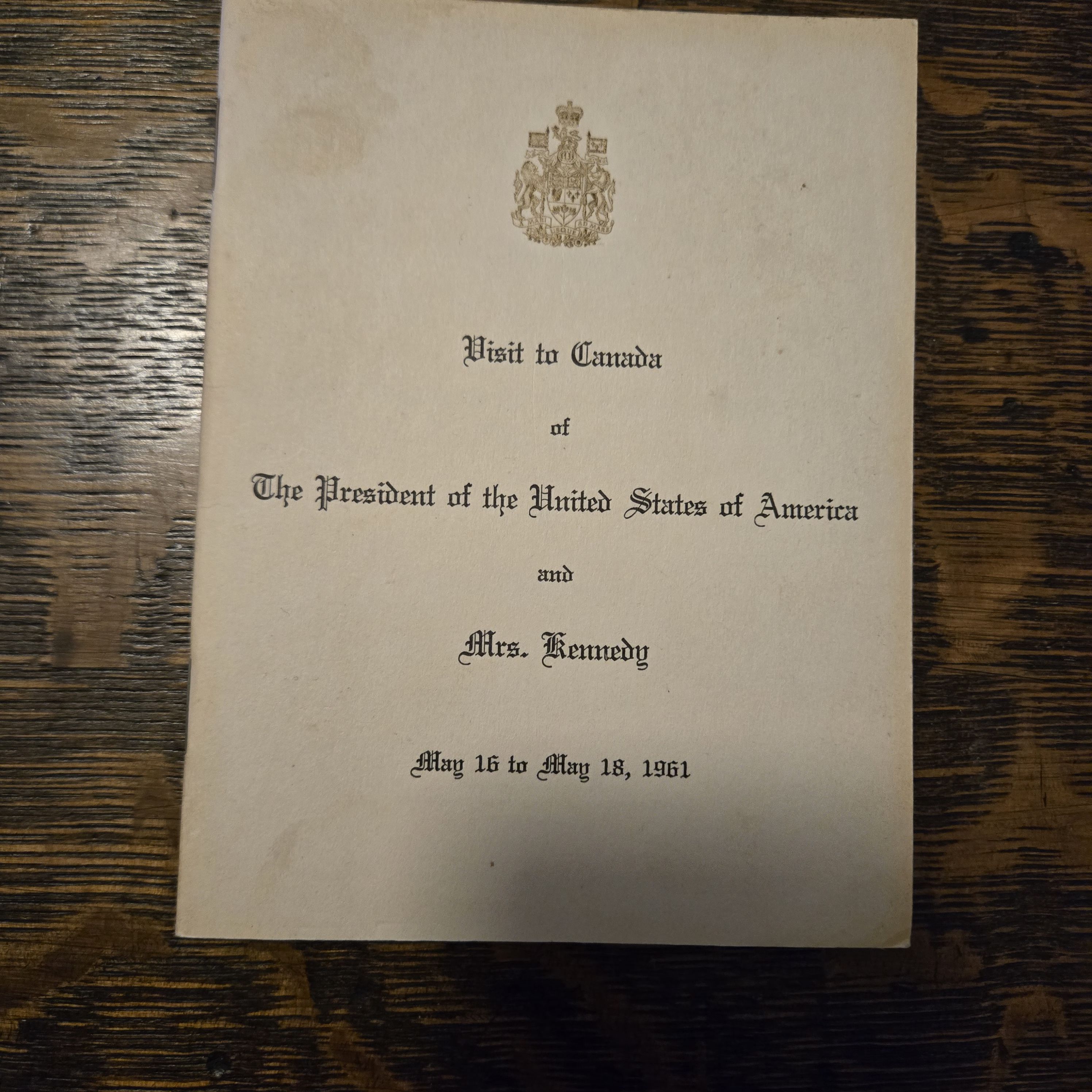
    The Kennedys visited Canada in 1961. It was a 3 day visit, and this brochure gives a detailed schedule of activities. Now, think of Dallas two years later. The schedule here tells you which of the 9 cars (each numbered in the order in which they will travel) the President will drive in from the airport, and exactly what route the motorcade will follow, turn by turn. You can bet that doesn’t happen now. Or maybe it does.

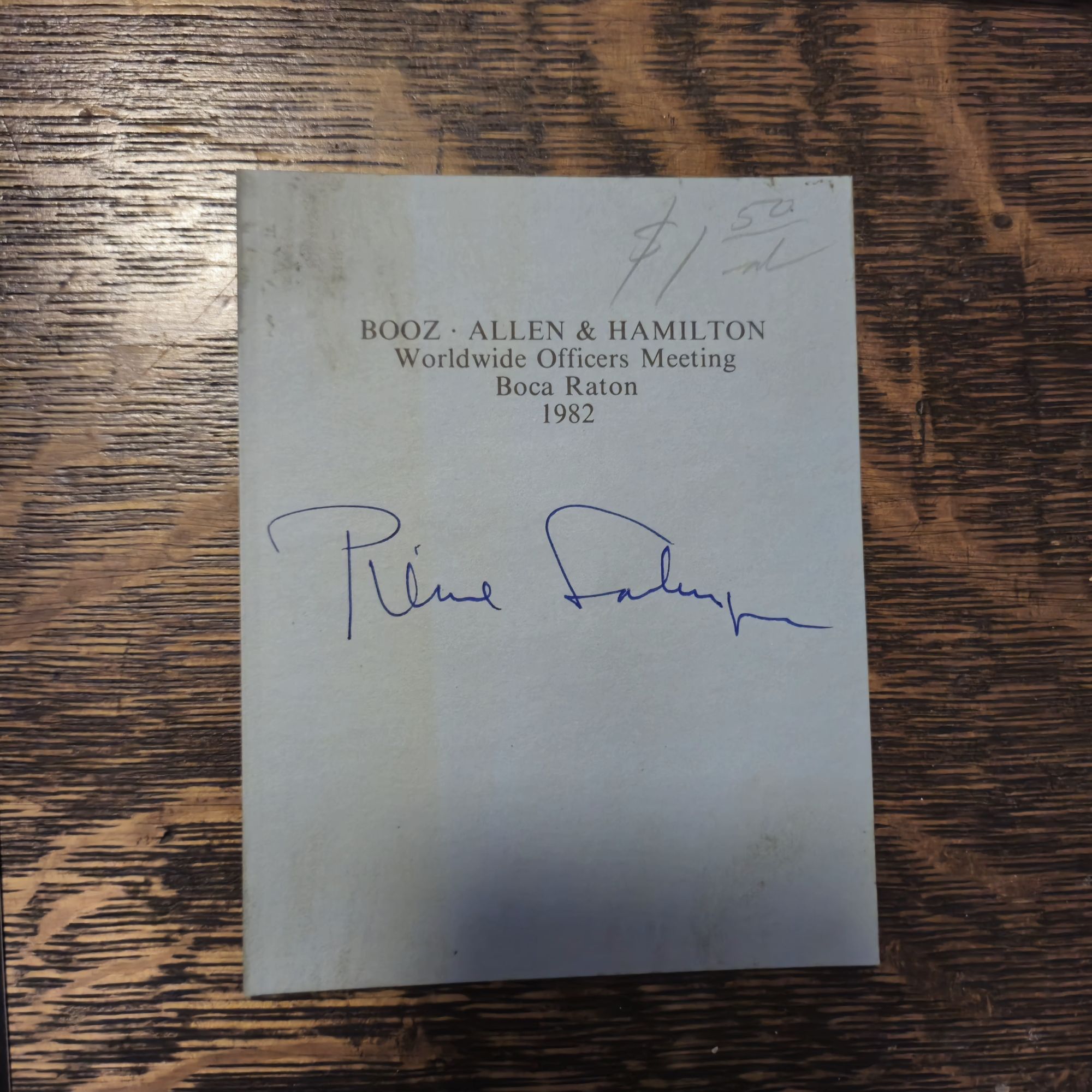
    Pierre Salinger

    Pierre Salinger was Kennedy’s press secretary. He was on the 1961 trip to Ottawa. And 22 years later, he was at a Booz Allen worldwide officer meeting and signed this piece of paper. You now know what I know. Oh, how did I get this? Don’t know. Did I pay $1.50? Doubtful.

    Matchbox

    Ah, Asitane restaurant in Istanbul. It was my favorite. It got very high ratings. But it looks like the pandemic may have overtaken it, and it might have closed in 2020.  It was an atmospheric restaurant set right next to the Chora Church, an old Byzantine church/museum with wonderful murals, and it served Ottoman food from historic recipes. You can still go to its website and see the menu. Your mouth will water. 

    http://www.asitanerestaurant.com.

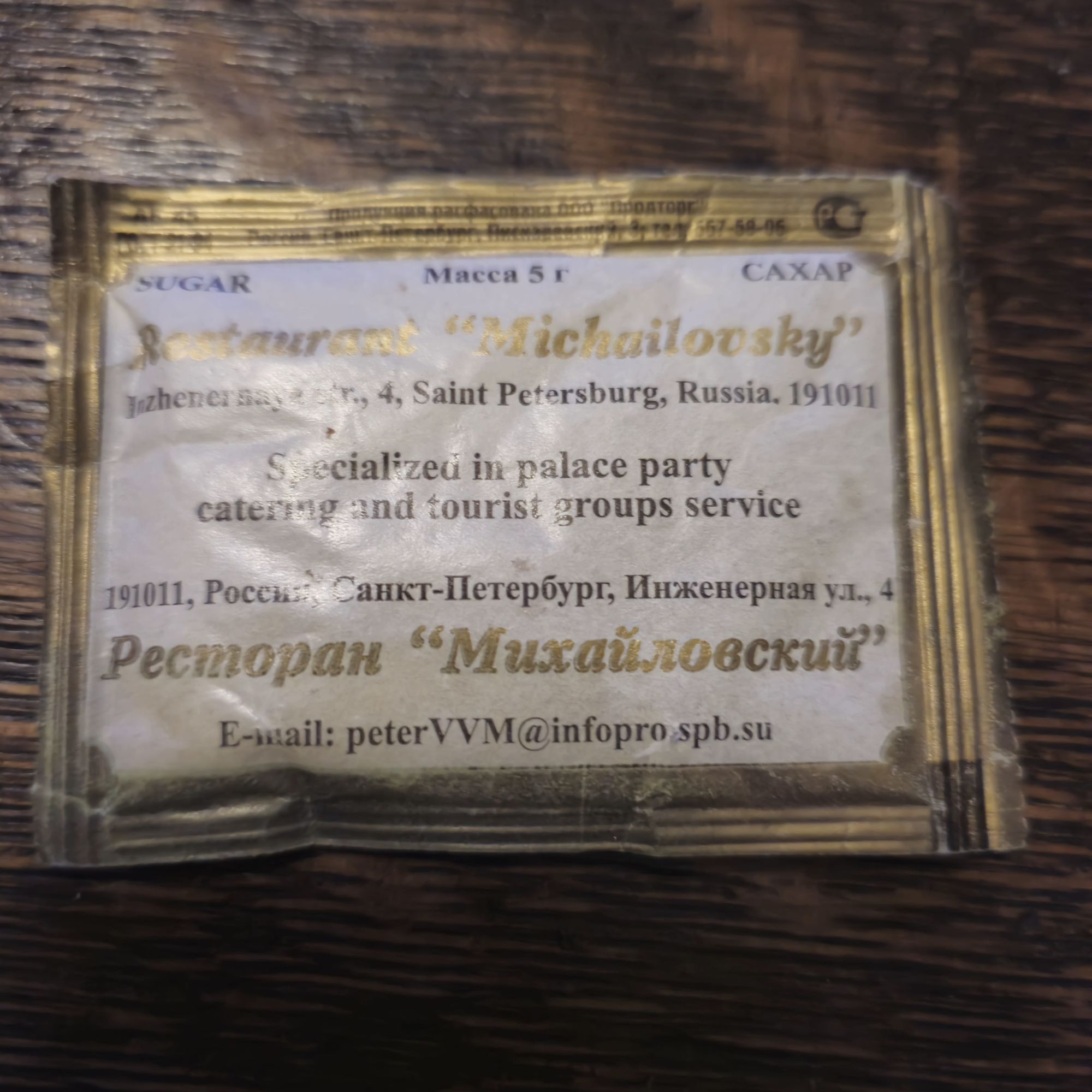
    Sugar

    I don’t remember the Mikhailovsky restaurant, but for some reason, I kept the sugar packet. I do remember some of the St. Petersburg restaurants we went to. Casual ones: Idiot (named after the Dostoevsky book, not the chef, I assume) and Teplo, where we went twice. They are both still in business. Mikhailovsky? Maybe not.

    Jordan

    No, I was not at this event. I remember finding this chocolate wrapper on the street. I don’t even know what the Great Arab Revolt was, but I admit that those three words placed together make me a bit uneasy.

    The White House

    Except for my 1958 high school class tour of the White House, this is as close to entering it that I have been. Don’t know where I got this. Or why I still have it.

    Georgia on my Mind

    I must have soaked this off a bottle of Georgian champagne. This must date from my 1974 trip. The food in Russia in January 1974 was awful. The one good meal we had was at a Georgian restaurant where tourists and boisterous groups of important Russians could dine.

    Okay, how many of you remember the short-lived Trump Shuttle? Who would have guessed?

    And finally, we all remember these glorious days:

    The Nats

    Stephen Strasburg, Adam Eaton, Bryce Harper and Victor Robles. Strasburg and Eaton no longer playing, Harper in Philadelphia, and Robles in Seattle. No current Nat was on the team 5 years ago.

    That’s it for today. More to come.

  • Give the Guy a Break

    December 2nd, 2024

    I am already tired of all of the criticism that Joe Biden is getting for having pardoned his son Hunter. Hunter is his son, after all, and he is his father. What else would you expect him to do? What would you do?

    I understand the Republican reaction. It’s natural since they are looking to criticize Biden for everything and, lo and behold, here is one more thing, unexpected. I don’t understand the Democratic critics, who should be sympathetic to a President in his last months, forced to forego a reelection campaign because of serious and presumably irreversible age related issues, and forced to turn the country over to the man whom he beat four years ago, and a man who will seek to undermine everything he has done over the past four years.

    I am exacerbated at those who say that pardoning his son is going to destroy Biden’s legacy; I don’t think it will have much of an effect at all, and I think whatever effect it might have may in fact be positive, showing the humanity of the man. And I am certainly frustrated at those who say that Trump will stand on firmer ground when he decides to pardon some or all of the January 6 rioters. I can not imagine that this move will, in fact, encourage Trump to use his pardon authority, even though he will undoubtedly add it to his list of reasons and excuses.

    Biden has stated that Hunter had been treated differently because of who his father is. This may be true; I don’t know. And whether I “believe” it to be true is irrelevant to whether it is true. And whether it is true may, in fact, be never known, although there will undoubtedly be those who will investigate this questions to death, and those who will broadcast their opinions, as if they matter, even without further investigating.

    As to Hunter himself, he has clearly led a troubled life for a period of years; we don’t have to repeat all of his shortcomings. But, those years aside, he does seem to be a serious, and a bright, individual who is set on retaining his sobriety and living a moral life from hereafter. He has suffered greatly, both from his addictions and the attacks against him (resulting of course in a criminal conviction), as a very public person. Let’s just hope he continues on the course he is on, and doesn’t give into the pressure he will most likely continue to be under.

    As to Trump’s presumptive pardon of the January 6 convicts now in prison, I must admit that I am fairly indifferent. Many of them (most or all of whom have political differences with me, to be sure) are normal citizens, who got carried away one time in their lives, and they too have already paid a price. I don’t think they are going to get out of jail and form an SS-like militia; I think most will just go on with their lives. That’s okay by me. (If Trump is going to use his pardon authority here, I do hope that he would not pardon any of those accused of physically attacking or injury law enforcement officials; that small group deserves whatever they got.)

    I don’t think that Biden has used his pardon authority much, yet. I expect, like most presidents, he will use it to pardon a significant number of people before his term ends. This is is prerogative, like it is of all presidents. Sure it is a gift from a president to a convicted criminal, but it is also a gift to a president, guaranteed by our constitution. Unless he lets out child murderers or the like, I would support his right to pardon anyone he wants. It’s a “thank you for your service” to the president.

    When he was in office, Trump used his pardon authority to pardon his machuten (I am told that is the male singular for machatunim, which is Yiddish for the parents of my son–in-law or daughter-in-law, for which there is no word in English), Charles Kushner, who not only committed federal campaign violations, and tax evasion, but also witness tampering. The witness tampering was not normal witness tampering, but to encourage his brother in law not to testify against him, he hired a prostitute to seduce him, Charles’ thought being that he could in effect blackmail him to keep quiet. And this man will now be our Ambassador to France. He also pardoned Steve Bannon and Roger Stone. In fact, the website for WTSP in Tampa has an article (dated December 2) that lists and gives a short bio of approximately 180 people pardoned by Donald Trump in his first term. Hunter Biden clearly did not do anything worse than the vast majority of those Trump has freed.

    So, let’s not be too hard on President Biden. As someone recently said, “let’s give the guy a break!” Now, who said that? Oh, yeah, it was me.

  • More From Closet Box #2

    December 2nd, 2024

    This is a box that keeps on giving.

    The Browns

    This is part (okay, a substantial part) of my collection of St. Louis Browns baseball cards. I grew up, with my grandfather, a Browns fan. Most everybody else rooted more for the Cardinals, but not us. I think this taught me it was alright to be in the minority. When the Browns moved to Baltimore in 1953, I learned something else about what can happen if you are in the minority.

    $2000 Dollars

    Two thousand Jamaican dollars. I must be rich. Well, they are worth about $13 American. Michelle and Josh are heading to Negril on Saturday. Do I give them these, or keep them in my estate? Hard choices.

    50 Rubles

    No one is going to Russia these days. So I will hang onto my 50 ruble note. Rubles are a dime a dozen these days. Literally. 50 rubles equals 47 cents.

    Welcome

    How is your Arabic. The back side of this note is in English, so I know what it says. We stayed at the Golden Tulip when we were in Tunis on a fascinating trip sponsored by Ben Gurion University. I should tell you about it one day. By the way, the header says Carthage, not Tunis. Don’t be fooled.

    1988

    If you want to fly Air Vietnam 36 years ago, you can borrow my timetable. I have never been to Vietnam and can’t remember where I got this, but in 1988, not very many Americans boarded these planes.

    The Ukrainia Hotel, Moscow

    This one actually was from my 1974 visit to Moscow. The hotel was (is?) right off Red Square, as I recall, on the other side of St. Basil’s. Perfect location. The hotel itself, old in 1974, was fairly drab. It was also buggy. No, not the insect kind.

    My mother’s business card

    My mother graduated from Washington University Law School in 1936. After giving up practicing to raise two children, she opened an office in Clayton in about 1960 and lawyered on for about 25 years.

    Welcome Aboard

    I have never flown with either a president or a vice president.  I found each of these in used books I have bought. And speaking of used books….

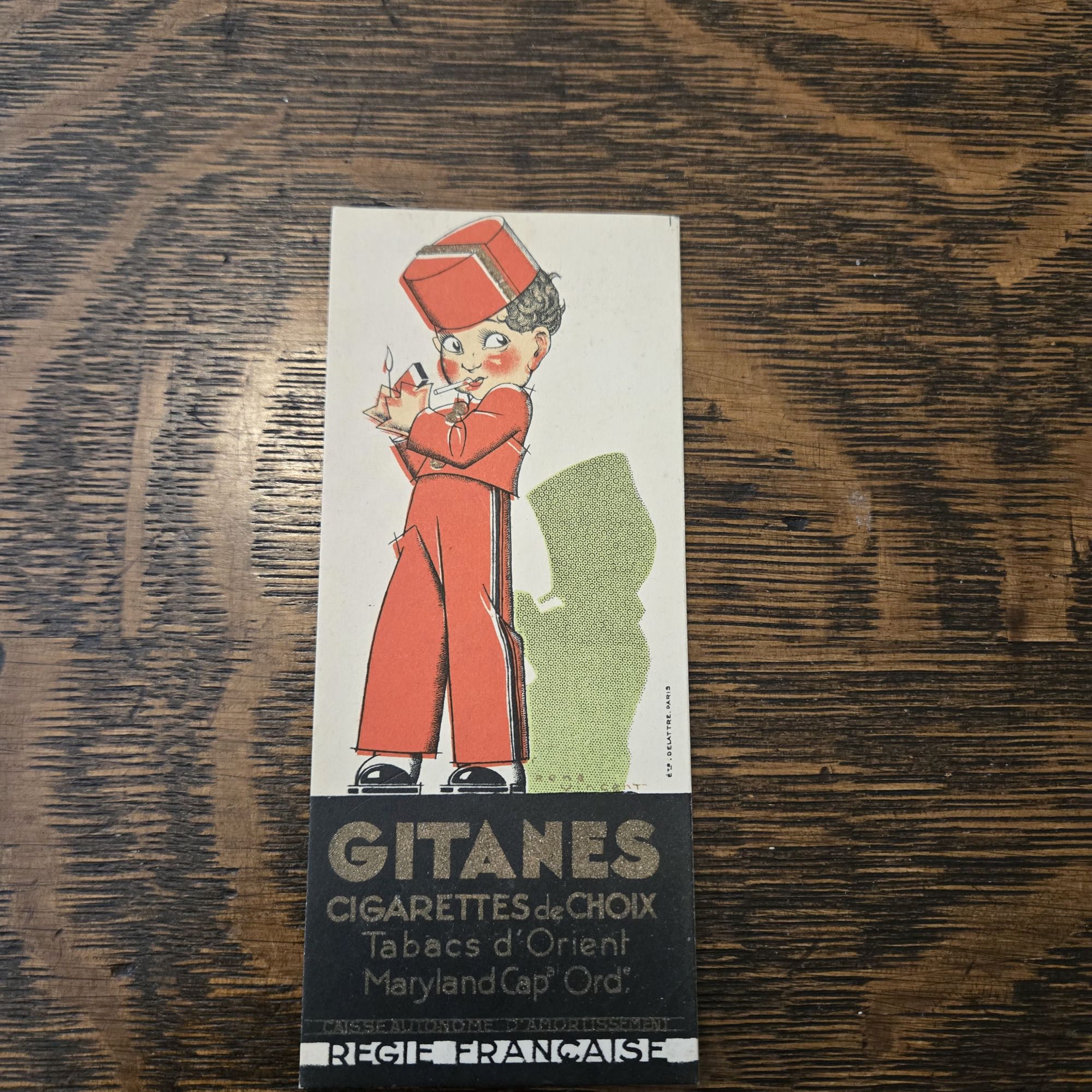
    Those French really know how to make attractive book marks. No pictures of cancer sufferers here.

    The final item of the day, but don’t worry. The box has more. As to this card, I must admit something: I have no idea what these words mean.

    More, tomorrow. 

  • We Won’t Go Back?

    December 1st, 2024

    “Did he believe all that he said? The question is inapplicable to this sort of personality. Subjectively, ____________ was, in my opinion, entirely sincere even in his self-contradictions. For his is a humorless mind that simply excludes the need for consistency that might distress more intellectual types. To an actor, the truth of anything lies in its effect; if it makes the right impression, it is true.”

    This sounds like it was written in 2024 to talk about Donald Trump, doesn’t it? In fact, it was written in the 1930s, to describe Adolph Hitler.

    Don’t worry – I am not saying that Donald Trump is a reincarnation of Hitler. But I am saying that there are certain personalities who can gather millions of followers who do share certain traits, and this refers to one trait clearly shared by the two of them.

    The quote comes from Edgar Mowrer, an American journalist, who published a book in 1933, with 1937 and 1938 revisions, called Germany Puts the Clock Back. We still remember Kamala Harris’ slogan “We Won’t Go Back”, right? It’s another similarity. It looks like we have.

    I just finished reading this fascinating book, which was apparently a best seller when first published. It is primarily about Germany after World War I, the time of the Weimar Republic. It continues through Hitler becoming dictator of Germany in 1934, but ends prior to Kristallnacht in November, 1938 and the start of World War II in September 1939. Mowrer, obviously aware of the difficult position of the Jews in Germany when he wrote the book, had no clue about the eventual fate of the Jews not only in Germany, but throughout most of Europe, that was to come. As to World War II itself, he had his suspicions, but attempts were still being made to forestall armed conflict even at his final revision of the book.

    So the book is not about World War II or the Holocaust, but about what happened between the time Germany admitted defeat in November of 1918, and the time that he finished his writing and revising, probably in 1938. We know the general story. Germany admitted it was at fault, it accepted a very onerous treaty developed by the winning powers at Versailles, it adopted a democratic constitution, and for 13 years, until the Nazi takeover in 1934, it became a very different country than it had been before World War I.

    Germany in the 1920s and the United States a hundred years later are, of course, very different places, and can’t be compared to each other in any comprehensive way. But there are facets of Germany in the 1920s that may be similar enough to facets of today’s United States that they deserve examination.

    Let’s look at some of the features of Weimar Germany, and see what we can glean from them that might be applicable to us today.

    According to Mowrer (and I don’t know), the Weimar constitution was the most democratic and liberal constitution ever developed, but it was adopted by a country with no democratic traditions, and even at the beginning of Weimar, was supported by a minority “elite” of the population – well education, Western oriented, cosmopolitan. Most Germans then were not well educated, were certainly not Western oriented, and were very, very provincial. So there was a major gap between the government and the population.

    At the beginning, this might not have mattered a lot. After the destruction of the first World War, the Germans appreciated time to rebuild, and the new government, supported many of Germany’s industrialists at the beginning, seemed to be succeeding, with full employment and a return to prosperity. This did not last, however, and soon the country was torn by extraordinary inflation and then massive unemployment. When the economy is failing for the majority of inhabitants, and the government seems far removed and controlled by people very different from the average man on the street or man on the farm, trouble cannot be far away.

    At the same time, during the 1920s, there was a remarkable cultural revolution going on in Germany. Whoops. Let me restate this. There was a remarkable cultural revolution going on in Berlin. Avant garde art, atonal music, wild theater and dance, a sexual revolution, nudity on stage. You can imagine. All of this was very different from anything that Germany had ever experienced before. And, as visible as it was, these cultural phenomena did not run very deep at all throughout most of the country.

    Germany had no experience of democracy, and most Germans distrusted democracy, did not see it bringing any improvements to their lives, and saw it run by people very different from true Germans. This is where the Jewish issue comes in. The Jews in Germany had been relatively free for a century or so, but not completely. Before World War I, there were always areas in government and levels in the military where they were not permitted to join. But under Weimar, the Jews were completely equal to any other residents of Germany, and they took advantage of it, becoming leaders in the government, and leaders of all of the cultural changes. An easy target, to be sure.

    At the same time, even every government official was not a supporter of the Weimar regime. There was no equivalent of a de-Nazification program in Weimar Germany. Members of the pre-war regime were not cleared out of government. Many were allowed to keep, or to regain, their own positions. This was true particularly in the judiciary, where each jurist had, both before and after the war, lifetime appointments. The judges during Weimar Germany were by and large the same judges who presided during pre-war Germany, and according to Mowrer, their decisions evidenced that anti-Republican bias.

    And finally, of course, there was the Versailles treaty itself, which put enormous financial burdens on Germany, prohibited the country from providing for its own self-defense (much less potential offense), and caused bitter resentment.

    Enter the Nazis. They stood up for the little man, the working class man. At least that is what they said, although Mowrer points out this was strategy, not fact, and that in fact Nazi Germany was very elitist (as pre-war Germany had always been), and the working man was eventually completely forgotten. The Nazis stood up for the German people, the Volk. They showed that the Germans were Aryans and the Aryans were a special and advanced race, much more advanced than anyone else, especially than the Jews and the Blacks. They could blame every thing that was bad on the Jews, and their collaborators in the government. They could envision all the European Germanic people (the Austrians, and those in the Polish corridor and in Czechoslovakia, for example) joining together and establishing a super state. They would end inflation, they would end unemployment, they would end these dangerous cultural changes and revert to historic Germanic themes. They would rid the country of outside influences, including the dangerous notion that democracy was a desirable form of government.

    And they would do this under the leadership, the absolute leadership, of Adolph Hitler, a man who could say anything and be believed, and whose oratory was mesmerizing to the masses. They would (and did) follow him anywhere.

    Clearly, the United States today is not Weimar Germany. And, in extraordinarily important ways, Donald Trump is not Adolph Hitler.  But some of the points raised by Edgar Mowrer in the 1930s do resonate today.

    Kamala Harris might have thought she had a winning slogan in “We won’t go back!”, but she was wrong. For a great many Americans in 2024, as probably the majority of Germans in 1924, going back is just what they wanted to do.

    The German desire to go back led to their own eventual misery,  another World War, and the Holocaust. Out of all this, 100 years after Weimar, came a democratic Germany, western oriented, with an active Jewish population, and cosmopolitan. The old hierarchical, provincial, arrogant Germany appears to be no more. That requires another book. Probably been written a hundred times. Probably more.

  • Dream On…..

    November 30th, 2024

    For forty years, I practiced law in DC. I retired in early 2012, now almost 13 years ago. I have no regrets about my career, and no regrets about retiring. When I stopped working, I was so determined to move away from any temptation to change my mind, that I stopped paying my dues to the DC Bar. I am still classified as “suspended”.

    Then why is it, I ask, that I still have “work dreams”, dreams of being a lawyer, on a regular basis, and according to repetitive patterns?

    Here are some of my recurrent dreams.

    (1) I am told that an out of town client wants me to come to his office so we can move his situation forward. He doesn’t tell me by telephone. In fact, his initial communication is not part of the dream. But somehow, I get the message.

    The problem is that I don’t really remember him, and I certainly don’t remember what I did, or should be doing, for him. It’s not his mistake. It’s mine. I know he’s a client. I know I am supposed to be doing something. I don’t know what it is. I feel guilty and very embarrassed.

    Sometimes the dream peters out here during my prep for the trip. Sometimes I start the trip, which usually ends in confusion. Like I wind up in Portland ME, and he’s in Portland OR. Or I miss my plane, because I left for the airport too late. Or I get to the airport and can’t find where the gates are. Those sorts of things. In none of these dreams do we meet.

    (2) I have retired from practicing, but either because I missed it or because my firm needed me and asked me to return, I returned. I work hard, just like I always did, and am an integral part of the office. The problem is that I neglected to work out any salary arrangements when I returned and the consequence is that I am not being paid. This has been going on for some times (usually several years), and although I am not short on funds, I feel that I should be compensated. I am convinced this situation is the result of my pay being overlooked. I don’t think the firm is trying to take advantage of me. I try unsuccessfully to calculate what I should be paid – how many hours I work a week, how much business I bring in, and so forth. I make plans to talk to those in power to rectify the situation, but the meeting never takes place.

    (3) The office is moving, or it has moved. This is the basis of several plot lines. In one, I go to my office and it has been cleared out. In another, I look for my new office, and it doesn’t seem to exist; I am told to sit in the hall. For a third, the office is new, and I can’t figure it out. Where is the door? What building is it in? Where does this hall go? Who are these people? Where is the elevator?

    (4) I am at a conference or large meeting of lawyers. It is not the first time I have been here, but I don’t see anyone I know. Everyone is new to me and, I think, very young. Someone is speaking, but I can’t concentrate on what they are saying. I am very uncomfortable. I have to leave. But when I get outside, I don’t know where I am, or which direction is the right one. I look around. The city is unrecognizable.

  • Another Closet Box for a Holiday Friday

    November 29th, 2024

    Let’s see:

    Ruth Ginsburg Judgmints

    The tin also says, “Don’t lose your appeal.” It could have  also suggested that you don’t have to eat them, but you can just open the tin and enjoy dissents.

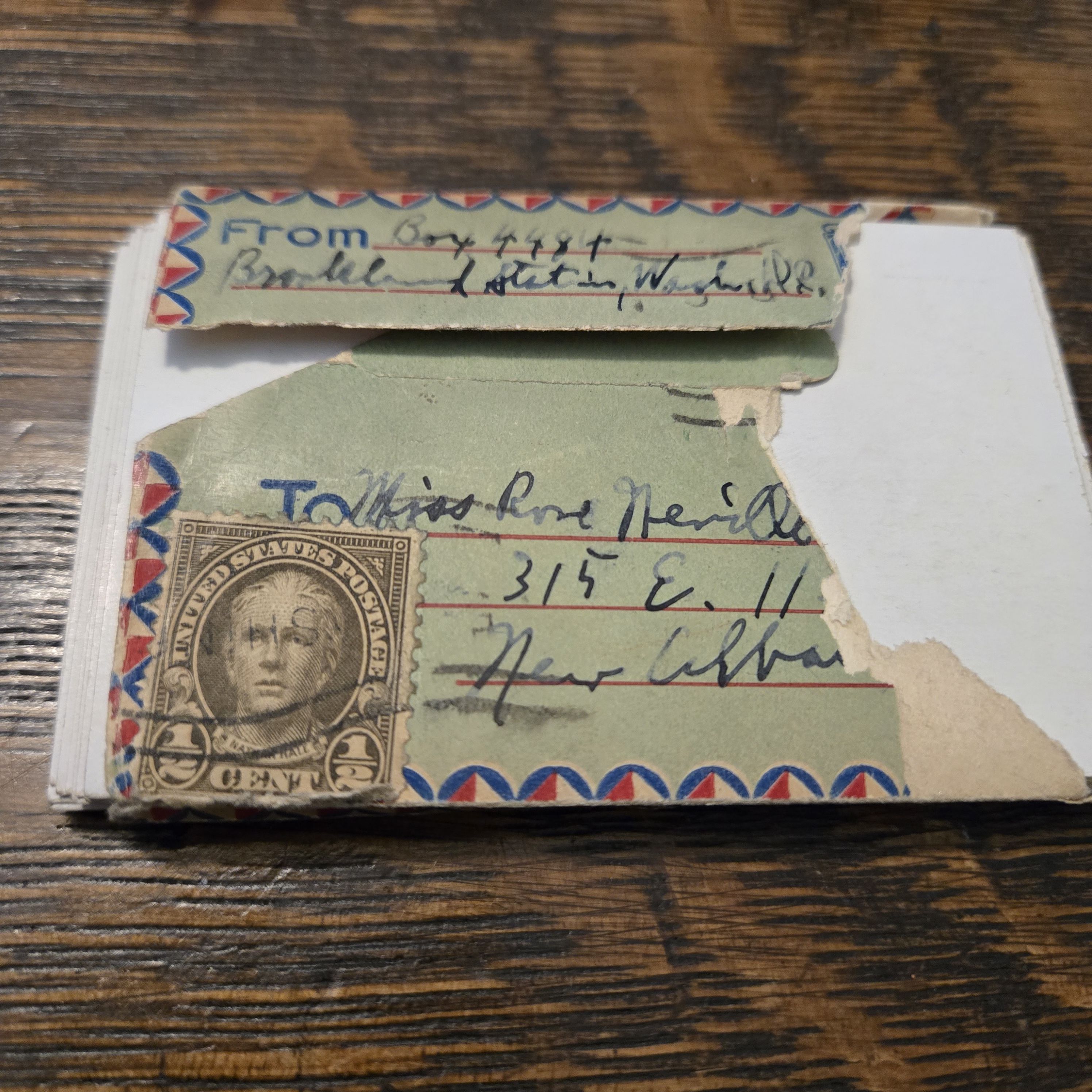
    Twenty views of DC
    Nathan Hale

    I can’t tell when this DC package was mailed. But it’s before my time, for sure. And, back then, how did you go into a post office and buy one half cent stamp? “I’m sorry. I just don’t need two.” The stamp is from the early 1920s. I have long wondered whether Nathan would be happy he was honored by a stamp, or disturbed that they gave him the half cent.

    I actually have a bunch of these in the box. Boston, Chicago, Grand Canyon, and others as well as these.

    Happy birthday to me

    A birthday card from decades ago from our friends, the Hammers. None of us knew the definition of “Old Guy” back then.

    My grandfather’s luggage, or maybe doctor’s bag,q we Q she decided to go work with him. He was like I won’t be bored. You said you didn’t want a bagel and there’s some child. There’s some ocean chips there. If you want to so and when I said you don’t want to watch people tag. He passed away in 1953.

    As kosher as kosher gets

    This is from a wedding of one of the sons of our friends, the Zimbalists. Now and then, I would put it on our table when we had guests. The Vaad never caught me.

    This is part of my really random collection. $20 will get you into this event where you will have no idea what is going on.

    Finally:

    Remember when Bryce Harper was a Nat?

    That is enough for a quiet Friday. I have to go to the grocery store. Black Friday, right? I guess I will fill up on licorice.

  • Thanksgiving, a Piano and Saving Paris

    November 28th, 2024

    I am going to try to do the Trump weave today, melding three distinct topics that seem to have nothing to do with each other into an intricate pattern that will appear seamless. My expectation is that I will fail. But who’s counting?

    Today is Thanksgiving (you probably know that, at least if you are in this country), and my initial question is to whom is one expected to be giving thanks? Thanksgiving is, in most people’s mind, the ultimate secular national holiday, and certainly it is to the extent that it isn’t typically marked by religious services or rituals. But you can’t give thanks without directing your thanks somewhere, so it isn’t surprising when you look at Abraham Lincoln’s proclamation of 1863 creating the national holiday used words such as “[we]…..fervently implore the interposition of the Almighty Hand to heal the wounds of the nation and to restore it as soon as may be consistent with the Divine purposes to the full enjoyment of peace, tranquillity and Union.” As well as “to set apart and observe the last Thursday of November as a day of Thanksgiving and Praise to our benevolent Father who dwelleth in the Heavens.”

    So, at least in its origins, the holiday was not fully secular, although maybe it was – to a great extent – not denominational. There is nothing specifically Christian in the wording, I don’t think. It is wording that religious Jews could endorse (after all, each Shabbat service includes a prayer for the country). And maybe Muslims, although I actually don’t know that, and there were virtually none in the country in 1863. Native Americans who had not been Christianized? That, too, I don’t know.

    But, from what I can see, prior to Lincoln’s proclamation, there had been various types of “Thanksgiving” traditions that had developed, and most (if not all) of them were religious in origin.

    So, how did Thanksgiving become a secular holiday? I read an interesting take on that, which said that secular Thanksgiving was a product of American education and American schooling, starting in the late 19th century, when the country was suddenly beset (that’s not the right word) with immigration on a scale never before imagined, and the task of American public schooling (which was for everyone then but the elitist of the elite) was to Americanize them. I don’t know if this is a good explanation, but it certainly is a thought provoking and interesting one, and one which I sorta like.

    As an aside, it was in this educational secularization of Thanksgiving that the 1621 “harvest festival” of the Massachusetts Pilgrims and their neighboring Indian tribes became connected with the holiday. Until the late 19th century, when the American education curriculum was expanded to include Thanksgiving, it appears there was no connection between this historic event and Thanksgiving. The 1621 meal and meeting was probably held in early autumn, not in late November. And certainly Lincoln, in his rather lengthy proclamation (I should count words – was it longer than the Gettysburg address?) did not mention the Pilgrims.

    That takes me to the second strand in my weave. Lincoln also did not refer directly to Blacks in his proclamation. That wasn’t a moral failure in and of itself, although in 1863, in the southern states and the four border states, slavery was still legal and practiced. For Blacks, therefore, was there any reason at that time to celebrate Thanksgiving? Who would they be thanking, and for what?

    Last night, we watched the latest Denzel Washington Netflix August Wilson film, The Piano Lesson. I urge you all to watch it. It has received a 90% Rotten Tomatoes critics’ review score, although there has been some criticism for some of the choices made in adapting the stage play for the screen. I liked everything about the film, even when the mysterious “ghosts” of the play were made physically manifest on the screen. And the performances are extraordinary.

    The story takes place in Pittsburgh in the 1930s, and the central, though nonspeaking, character is a piano dating from before the Civil War. A beautiful hand carved piano depicting family history, made by the grandfather (great grandfather?) of the current Charles family members. The piano was the property of the slave holding Sutters, but was stolen from the Sutter house by the carver’s son (who was afterward brutally murdered) and moved to Pittsburgh. And just recently, the last of the Sutters was murdered, found dead at the bottom of a well on his farm. The ghosts of both murdered men haunt the Charles family members.

    The Charles family in the 1930s was no longer enslaved, but still haunted by slavery. Where was Thanksgiving in their consciousness? They might have believed in God, and this God may have their individual salvation at heart, but certainly not a national salvation. That, I am certain. What they would have done on the fourth Thursday of November, I don’t know.

    So the concept of Thanksgiving,  once you get beyond the food, Macy’s parade, the football games, and such, gets very complicated. Luckily, we don’t usually think about all of these things. Let’s keep it simple.

    Thing number three? No time now. But look at yesterday’s New York Times obituary for 100 year old Madeline Riffaud. Can you weave her remarkable story into this post?

  • My Post-Birthday Thoughts (Which Have Nothing To Do With My Birthday)

    November 27th, 2024

    As I ride my stationery bike, I have been watching, one episode at a time, the Netflix series, “Killing Eve”. I have just finished watching the first half of the third year of the four year series. I understand that there are major problems with this series (starting with the main premise), and that to say that each of the characters is flawed would be to state a world class understatement, but each of them are so intriguing that I seem to keep watching.

    OK, you have no idea what I am talking about. Eve is, at the start, a British bureaucrat who works for what appears to be the British equivalent of the American Secret Service, the agency that guards politicians and others who need to be guarded. She soon loses that job, but is picked up by a branch of MI6, the British equivalent of the CIA. The goal is to track down a mysterious assassin who has engaged in a number of seemingly unrelated murders of prominent individuals at various locations in the United Kingdom and Europe. It turns out that the assassin is a Russian woman whose name may be Oksana, but who goes by Villanelle. She is “controlled” by a Russian man named Konstantin, and Eve works under an MI6 veteran named Carolyn. And, oh yes, Konstantin and Carolyn turn out to be old friends. And Villanelle and Eve turn out to have the deepest love of each other and the strongest hate of each other as any conceivable love-hate relationship could hold. And, one more thing: everything that happens seems to relate to a secret organization called The Twelve, who pays the bills for Villanelle and Konstantin, and which is both a target and mystery to Eve and (maybe) to Carolyn.

    The murders are all shown on screen, and each one is more gruesome than the others (the most recent I have seen involved a pitchfork on a Polish farm). That in and of itself should make this show off limits for me – I am not a fan of horror movies. But I stay.

    My point, though, is not to convince you to watch this series (although you might find it as interesting as I do), but to talk about the characters, who go about their business of chasing killers, and killing themselves, as if it was as normal as getting a cup of coffee. While they all have their own internal struggles of course (and this is crucial to the series), none of those internal struggles involve, say: “Am I doing something wrong here?” These are people who are disconnected in any real sense with any world outside of their own limited world, who totally lack empathy for their fellow human beings, and who just can’t help or control themselves.

    Read this last line again. “These are people who are disconnected in any real sense with any world outside of their own limited world, who tally lack empathy for their fellow human beings, and who just can’t help or control themselves.” Does this remind you, as it reminds me, of Donald Trump and Elon Musk (to take two random examples)? Don’t you get the feeling that they would do anything, regardless of its effect on anyone else, without ever feeling a moment’s regret. Don’t you get the feeling that they could easily be Two of The Twelve? I do.

    Put Trump aside for a moment. Concentrate on Musk. I have written about him before, you may remember. My question then was (and one of my questions remains) how a man who leads X, SpaceX, and Tesla has time to hang around Donald, and run what might become the most influential government agency of the second Trump term, the Department of Government Efficiency. And, by the way, I now see that, even with that question, I have sold Musk short. I had failed to recognize his role in the new up and coming corporation, XAI, which is going to be challenging Open AI in the race to see who can come up with a way to accidentally destroy civilization first.

    The utter brashness with which Musk and his fellow job and money slicer Vivek Ramaswamy describe their plans for DOGE is mind boggling. While it’s easy to brush some of their rhetoric away as overblown, we need to remember who we are dealing with. We are dealing with Konstantin and Villanelle, and they are likely to do anything, ruthless as it might be, and walk away unscathed.

    But what about Tesla? Tesla is (duh!) and electric vehicle company bent on controlling that market and the market generally for self-driving vehicles, totally identified with Musk and the basis of his outlandish fortune. Joe Biden is an advocate for electric vehicles. Donald Trump is not. Donald Trump wants to keep gas powered vehicles as the major types of automobiles. The oil business certainly supports this, as perhaps do some members of the UAW. But what about Musk? Isn’t he more in line with Biden than Trump on this issue? How will Tesla weather the Trump campaign against EVs?

    And then there is China, against which Trump says he is determined (you note I add the words “says he”) to impose devastatingly strong tariffs. I have read that Tesla has a number of factories in China (four or five, I believe), which make auto parts and full grown Teslas, and that China is Tesla’s second largest market for vehicle sales.

    If Tesla can’t make parts in China as it currently does and has to transfer is manufacturing and supply sources elsewhere, won’t that have an adverse effect on Musk? And wouldn’t you imagine that China, which has a number of large domestic manufacturers of electric vehicles, will put the kibosh (is that a word?) on Tesla sales in China?

    Maybe, X, SpaceX and XAI are so important to Musk that he is willing to let Tesla go by the wayside. Some have suggested that he might even drop Tesla, sell the company. But he would be selling a company which, for all the reasons stated above (and maybe more), would have a very depressed market value. That doesn’t sound very Musky.

    So here I am, watching “Killing Eve”. Am I also watching “Killing Tesla”. But somehow I doubt it. Somehow, whether it’s The Twelve or The Two, I think there are surprising things deep below (okay, if not the Deep State, the Deep Something), that we may never understand. And that, more and more, these are things that will, or at least think they will, control us.

  • Artis82

    November 25th, 2024

    Yes, it’s my birthday, and I’ll cry if I want to. After all, 82 is a pretty big number. I’d much rather be 28 (I think). And, no, I am certainly not crying.

    I thought about the birthday parties my parents gave me when I was young, today. Or rather, I thought about thinking about my early birthday parties, but the truth is I really don’t remember them. Did I have birthday parties? I mean real birthday parties, with friends and classmates, not just birthday cake and candles with my family. I am not sure. Michael Bobroff, do you remember?

    Actually, I do remember one party. I don’t know how old I was, but I was in elementary school, and my memory is that the party was the party that I wanted to have. My guess is it was a Saturday afternoon, and I think we all went to see a matinee at the Tivoli or the Varsity, the two theaters then operating in the Delmar Loop area in University City, Missouri. And then we went down the street to the Velvet Freeze Ice Cream Store, and had ice cream. My memory is that I became very upset while I was at Velvet Freeze, and that my party was ruined. But I don’t know why I was upset. Maybe because my friends were more interested in the ice cream and in each other than with me. But that’s just a guess. And now that I am thinking about it, maybe there was no movie, just Velvet Freeze. I have no idea.

    Since I couldn’t remember much about my other birthdays, and I only remember Velvet Freeze (if you aren’t from St. Louis, or maybe Kansas City, you have never heard of Velvet Freeze), I decided to look up Velvet Freeze. The article I saw at losttables.com, a website devoted to old St. Louis restaurants, was very informative. The article started with the invention of the ice cream cone at the 1904 St. Louis World’s Fair (an accidental invention to be sure, when someone took a waffle from the waffle man and wrapped it around his ice cream, and everyone said: “Voila, you have invented the ice cream cone.”

    Well, in fact, we don’t know the name of the guy who wrapped his waffle around his ice cream (it was probably not Voila), but we do know the name of one guy who decided that this might be a business opportunity, and quickly became a large manufacturer of cones in the city which then supplied most of the cones made in America, and shipped them around the country. His name was Grosberg. Oscar Grosberg.

    Now, until today, I didn’t know anything about Oscar Grosberg and his cone factory. I found it interesting that Grosberg was spelled with one “s”, not two, which is not typical. And then I remember that my father’s sister, Mary (I called her Aunt Mary, by the way) had a very good, long time friend named Roz Grosberg, and I just looked her up on findagrave.com, and – lo and behold – she was a one “s” Grosberg. Could she have been the daughter of the cone king? Is this something you would like me to look into further?

    Well, back to our story. It turned out that another Jewish immigrant to St. Louis, Jacob Martin, started what he called the Union Ice Cream Company (later the Original Double Dip Ice Cream Company), which operated at the same time that Oscar Grosberg was making cones. And, wouldn’t you know it, Jacob and Oscar decided to join forces and make both ice cream, and they named their new company: Velvet Freeze, Inc.

    This was no small company. It had two ice cream factories, one in South St. Louis on Gravois (do you know how to pronounce Gravois?), and another in the north of the city. And, according to the article, by 1936, it had 50 stores in the greater St. Louis area, and then expanded into Kansas City and elsewhere.

    The company continued to thrive through the 1970s, under different ownership, but eventually the stores began to close and, in 1986, the Velvet Freeze factory stopped making ice cream. A major St. Louis dairy, Pevely (“white in the bottle, pink on the cheeks”) began to manufacture ice cream under the Velvet Freeze name, but it really didn’t catch on.

    Today, November 26, 2024, there is only one Velvet Freeze ice cream store left. It is a homey looking place on West Florissant Boulevard in the suburb of Jennings. You can’t go there today, because they aren’t open on Mondays or Tuesdays, but they should be there tomorrow, opening at 2 p.m. Next trip to St. Louis, I may try it out. They have over 50 flavors, and they make their own ice cream using the original Velvet Freeze recipes, on Saturday nights.

    By the way, the “lost tables” website is a great one, if you are interested in old St. Louis restaurants. I did also read the write up of Rinaldi’s Pizzeria, located just a few blocks from the Velvet Freeze on Delmar, where I spent much of my high school years with dates and friends and the likes, eating the square cut, extraordinarily greasy, pizzas with home made (I think home made) sausage. And – and this is true – I tasted every bit of that pizza as I read the article this afternoon. It was that good.

    Rinaldi’s is not there anymore either (in fact the block that it was on has been torn down I saw a few weeks ago, getting ready for something big, I assume), and moved from University City west to Creve Coeur in the early 1970s. It’s not there any more either. I don’t think any of Al Rinaldi’s kids wanted to take over a pizza business.

  • Let Me Entertain You……Movies, Plays and Books. Here Goes:

    November 25th, 2024

    (1) Let’s start with something great: We just finished watching the second season (just 6 episodes) of the Netflix series “The Diplomat”. If you haven’t watched it, or any of “The Diplomat” yet, now may be the time. It is, I thought, brilliant – at least compared to the other things I have watched recently. At the end of the first season, a car bomb injured the husband of the American ambassador to the UK, along with her deputy, and killed another embassy staffer. It was rumored that it was a Russian hit. In the second season, there is another attack, this time on a British ship that killed 40 people. Again, the Russians were suspected and the assumed Russian hit man was gunned down by the Brits. But the ambassador and her husband (a former ambassador, who seems just as involved in her job as she is) begin to think that it wasn’t a Russian hit after all, but rather an inside job, a false flag operation, and that the British prime minister might be behind it, and that it was somehow contrived to foil the secession of Scotland. Wonderfully cast and acted, beautifully staged, very professionally scripted. For those of you who think a lot of things get shown that shouldn’t, this will show you that there are still some things that deserve all of the acclaim that they receive.

    (2) A book: The Nixon Memo by Marvin Kalb. “What”, you ask, “Is Marvin Kalb still writing books at 95?” The short answer is “no”, that he wrote this book 30 years ago, when he was a mere spring chicken of 65. I alluded to it a few weeks ago, but want to say a little (not a lot) more about it now. I read it on a whim (it was on a pile of books staring at me for a while and I decided it was sending me a message). I didn’t expect to think as highly of it as I did. It really told two stories at once. The first was how Richard Nixon, after falling in disgrace on account of the Watergate caper, reinvented and resuscitated himself to be able, for the last decade or so of his life, to be considered an expert on world affairs, and particularly on Soviet affairs. He did this through writing well placed articles, mainly in the Wall Street Journal, as well as several books that were very respected by those who were in a position to judge them, and by a memo (the Nixon memo of the title) addressed to George H.W. Bush, telling him how crucial it was for the United States to support then President of Russia (before the collapse of the USSR, still headed by Gorbachev) and his desire to westernize and democratize Russia, and how the United States should unleash what would be a replica of the Marshall Plan to help. The second story is the story of how George Bush disagreed with the Nixon approach and pretty much ignored the memo, but how his successor Bill Clinton was much more sympathetic to what Nixon was proposing. So you had the disgraced Republican Nixon become a close advisor of the Democrat Clinton, a relationship lasted until Nixon passed away. Of course, Kalb tells a much more complete story than my one paragraph summary, and it is worth reading.

    (3) A play: We went to Studio Theatre yesterday to see Summer 1976, a play with two actors (in this case Holly Twyford and Kate Eastwood Norris, both veteran Washington performers), about two women, seemingly very different, who meet one summer because they are part of a babysitting co-op, and their 5 year old girls hit it off. The summer of 1976 for them turns out to be emotionally fraught and, although they see how different they are, they become very connected, and think that their connection with outlast the test of time, which it does not. The play has been very well reviewed, but both of us were quite disappointed. The story line really didn’t intrigue us that much and, yes, the acting was quite good. But you would expect that and, frankly, this is not a play that requires any particular acting skills.

    (4) Another book: This one was totally random, a Penguin English mystery, written in 1911 and published by Penguin in 1945. I chose it from my Penguin collection because it was short and I thought I could probably finish it in a day. Which I did. Called Under the Red Robe, it was written by Stanley J. Weyman (1855-1928), about whom I knew, and know, virtually nothing. It is historical fiction, set in France during the first half of the 17th century, the time of Cardinal Richelieu. I enjoyed it, although I wouldn’t call it a great book. An aristocratic vagabond (not really a contradiction) kills a young man in a dual, at a time when duels in Paris are not only illegal, but when the punishment was death. Richelieu knows the man in question and tells him that he will let him go if he will do him a favor, and if he will then agree not to return to Paris. The favor is to go to a small town on the Spanish border, where there is a wealthy man who is active in attempting to overthrow the French king and who is very well protected. Our hero’s job would be to get into the man’s large, guarded house, arrest him in the name of the king and get him transported back to Paris. Of course, through many close calls and adventures, and with the help (in a way, because she does not know she is helping have her brother arrested) of the victim’s sister, he captures the target and begins to lead him, with several others under arms, and (after a while) with the sister who has followed them on the road to Paris, and – alors! – agrees to release the man upon urging of his sister. He is a changed man and goes back to Paris without the prisoner to turn himself into Cardinal Richelieu and accept his punishment, when – lo and behold – he learns that Richelieu is no longer in power, no longer in the favor of the king. So, he is now a free man, he turns his eyes south again, finds and marries his old adversary’s sister and, it really implies this, they do live happily ever after.

    (5) Another Netflix film, and this one was the worst: Anna Kendrick’s Woman of the Hour, a film, starring Kendrick, about a real life rapist and serial killer in southern California. The murderer, Rodney Alcala, actually appeared on The Dating Show, and Kendrick plays the female contestant on that show, and who does not get raped or murdered. After killing a still unknown, but large, number of women, he was caught through the intelligent thinking of a teenage runaway, who talked him out of finishing her off by telling him that he was really okay and that all she wanted was a promise from him that he wouldn’t tell anybody about what he did to her (he probably had raped her, and he pushed her off a ledge, which bruised her, but did not kill her), and he agreed and they went off together and she was able to call the police when they stopped for gas. I thought this was just a terrible film, both its subject matter, and the film itself. In spite of what I thought, Rotten Tomatoes gives it a 91% critic rating. Go figure.

    (6) The final film: A Real Pain, which we saw last night at the Avalon. Two cousins take a “heritage” trip to Poland to visit the birthplace of their grandmother, who was a Holocaust camp survivor and who recently died. One, David, lives in Brooklyn with his wife and 5 year old son and has a respectable job. The other lives in his mother’s basement in Binghamton, has no job, spends his days smoking pot, and recently tried to commit suicide. They are the same age, but have obviously taken different paths, one working towards respectability, the other avoiding it. Their guide is British, and there are five others on their short tour, which seems to whiz through Warsaw, Lublin and Maidenek. The two cousins then go to the town (didn’t look like a remote shtetl) of their grandmother’s childhood. I thought the film was awful. I liked none of the characters, not the cousins, the guide, the fellow travelers. No one. I thought the film looked at a number of sensitive subjects, and dealt with each of them poorly. Does everyone agree with me? Apparently not. 96% on Rotten Tomatoes. Even better than Anna Kendrick.

  • Uh-Oh. Box #2 from my closet.

    November 24th, 2024

    It’s a quiet Saturday afternoon, so I took another shoe box out of the closet to see what random treasures it contained. Here we go……

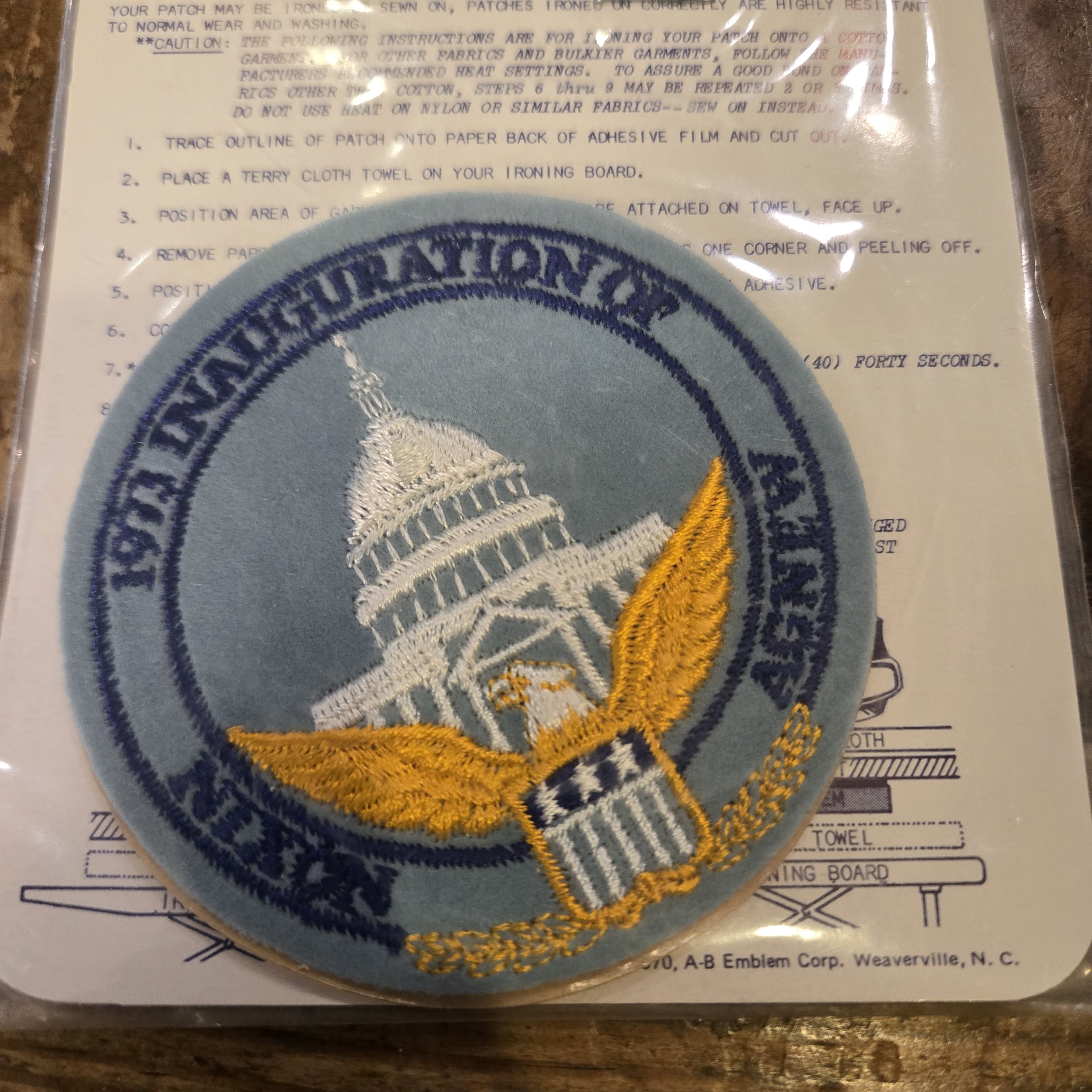
    Patch from 1973

    An iron-on patch from the 1973 Nixon-Agnew inauguration. I wonder how this duo turned out over the next few years.

    I become a member of the firm.

    January 1974. Herb Franklin and I become members of Frosh, Lane and Edson, P.C. Jack Betz became a member a year or so later, then left the practice to become the owner of a bread and breakfast inn in Pocomo MD. After getting tired of the hours, he went back to school and became a Lutheran minister. Herb, when the law firm disbanded in 1989, ran the Office of the Architect of the Capitol. Sadly, neither are still with us.

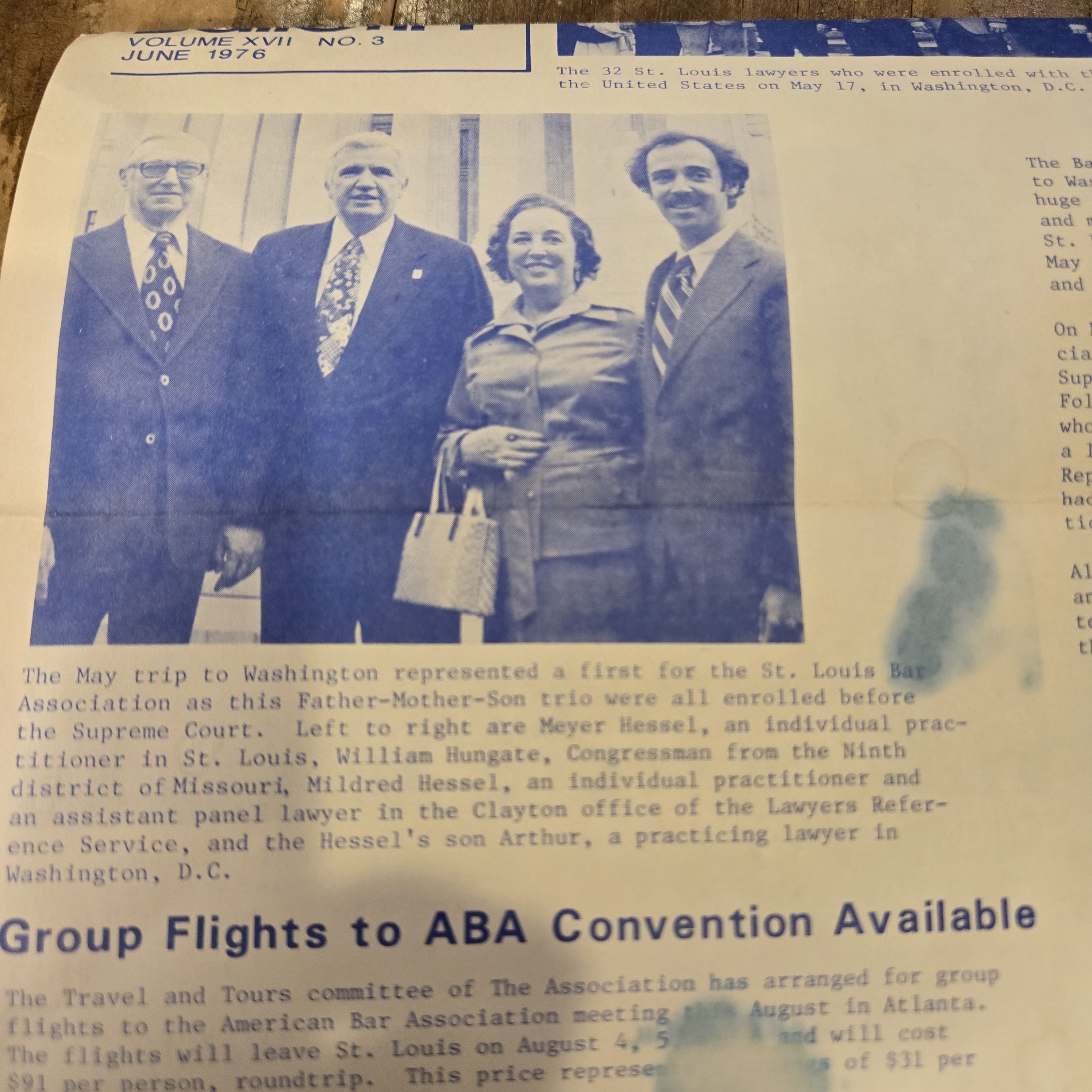
    My only photo with Rep. Hungate

    This from the St. Louis Bar Journal in June 1976 when I, along with both of my parents, got sworn into the Supreme Court bar together. My parents’ Congressman (I think then my mother’s law school classmate, Tom Curtis) was out of town, so we got Hungate, who I recall represented places like Hannibal.

    They let me in Jordan

    We took our first trip to Israel with six other couples in 1999. Included was a journey to Petra and Madaba, in Jordan. This is, sort of, proof that they let me in.

    Honeymoon

    Edie and I married in 1976, and honeymooned in Haiti. No, I wouldn’t suggest doing it today. One of the places we stayed was the Hotel Roi Christophe in Cap Hatien. A nice spot, with a beautiful pool with an excellent view, and a wonderful restaurant. I doubt it’s there today. Oh, this is a book of matches. Unused. The honeymoon deserves a post of its own.

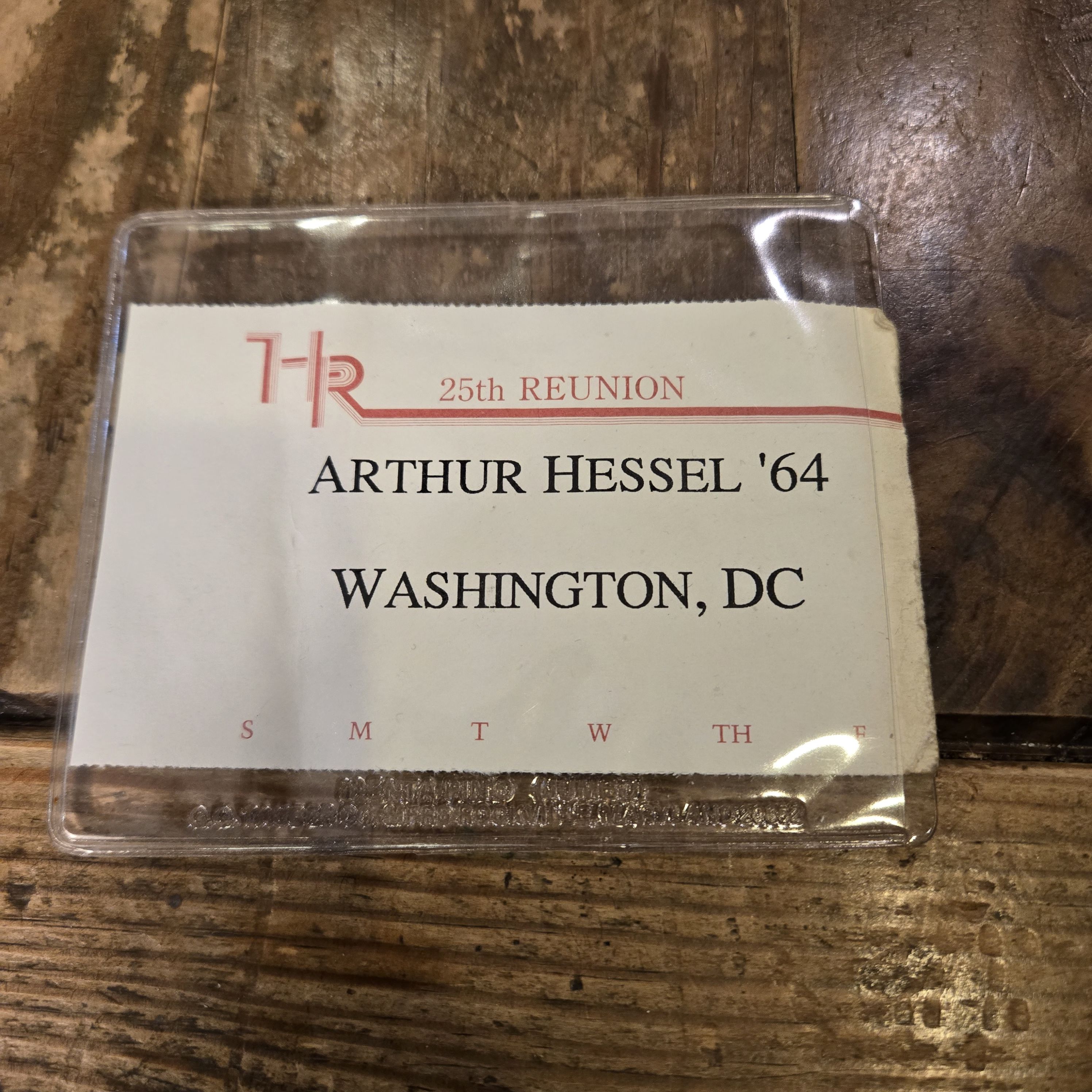
    1989

    My name tag from the 25th Harvard College reunion. The entire family went. We stayed in Wigglesworth Hall. This, too, deserves a full post.

    Edie, not me

    Another iron-on patch. I am sure Edie had an illustrious intramurals career, and that they still talk about her there today.

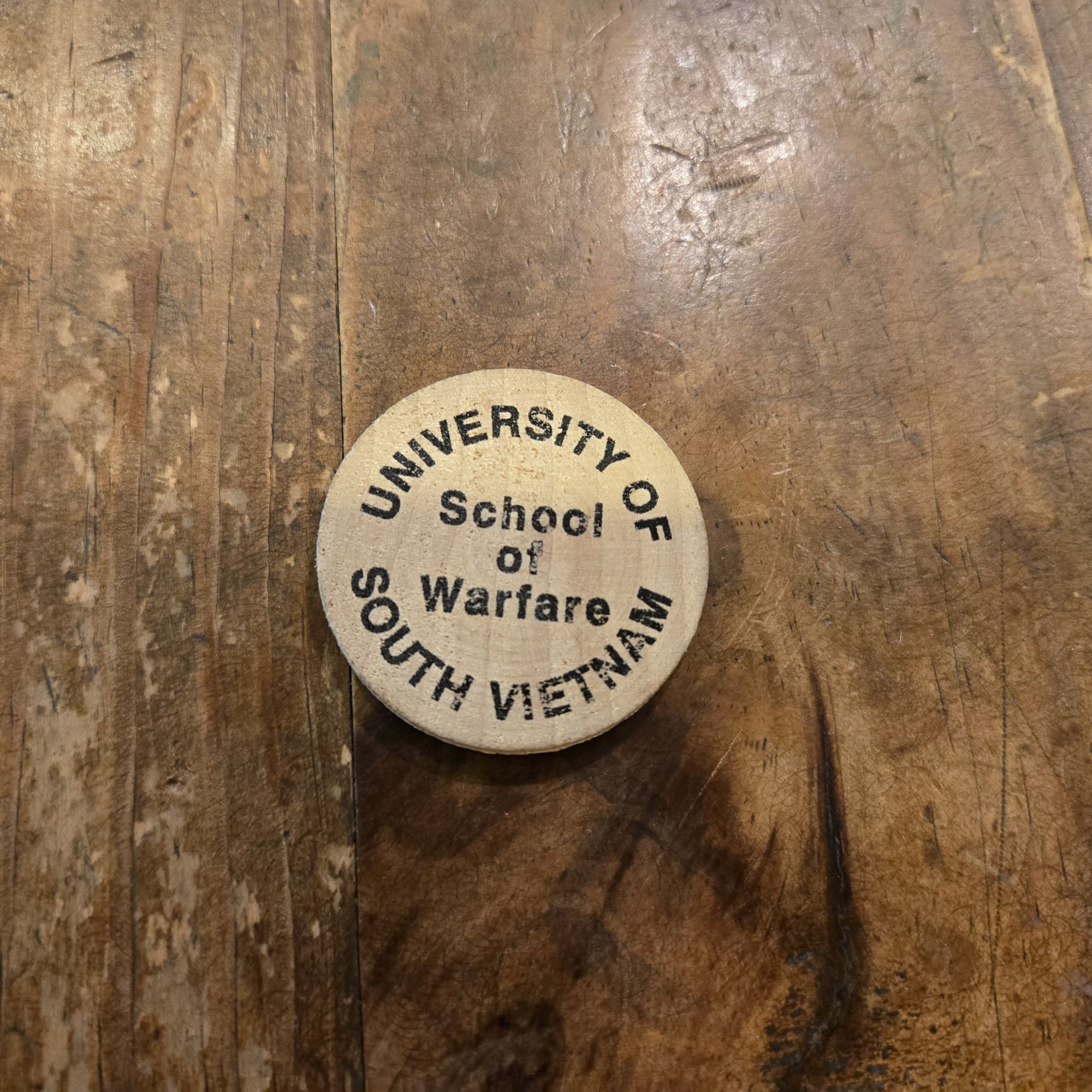
    Now, we get really random. A brochure for 1949 Kaisers. I have never been in a Kaiser. Then, a wooden coin from a non-existent university. The backside says “Some gave all. All gave some.”

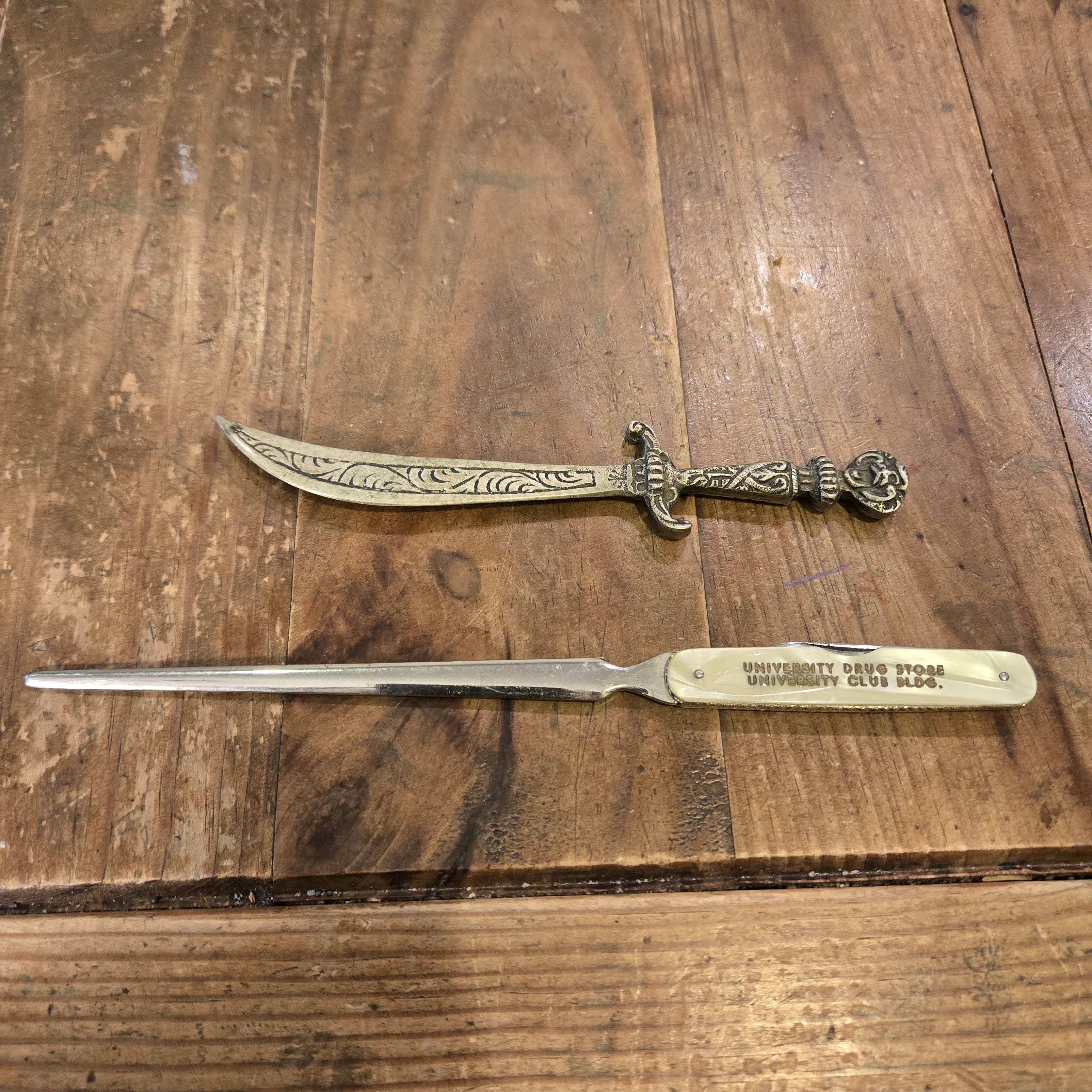
    And, finally, two letter openers. One is Italian, and the other says “University Drug Store. University Club Bldg.” The University Club Building is up the street from the St. Louis University campus. This letter opener has a separate knife embedded in the handle. Tough neighborhood,  I guess.

    More to come from this box. Bet you can’t wait.

  • My Take on the Upcoming Trump Years (Perhaps Not What You Think)

    November 22nd, 2024

    It’s hard to write a political blog post right now. We are in the middle of a big transition from business-as-usual to something that may be, and surely will attempt to be, very different. And while people are thinking about what is going on, no one is watching the news with religious fervor (MSNBC and CNN journalists are speaking into the void), and certainly no one wants to read this blog post. They want me to take another shoe box from my closet and see what’s in it. Maybe tomorrow. Plus, I have the next 16th Street post almost ready to go.

    Let’s focus on just one thing today, that being the fact that none of Trump’s cabinet and cabinet-equivalent picks are perfect individuals. In fact, each of them seems to be far from it. The question is: does that matter?

    Does it matter that the new Director of Intelligence has spoken up for the leaders of places like Syria and Russia? Does it matter that the new Secretary of Education has been accused of running a business where she ignored prevailing child abuse? Does it matter that the head of Health and Human Services has put a dead bear in Central Park? Does it matter that the Secretary of Defense has been accused of sexual and possibly criminal misconduct? Does the matter that the heads of DOGE has egotistic, narcissistic billionaires, and one of them runs businesses totally dependent on the federal government? And of course, does it matter that the President of the United States has a background identical to a fault with that of Donald Trump?

    A friend, at last Thursday morning’s breakfast meeting, spoke somewhat about Pete Rose. Pete Rose, who was clearly a Hall of Fame baseball star (no question about that), but who has been denied entry into the Hall of Fame because he gambled on games in violation of MLB Rule 21, and because he hadn’t declared his gambling income was convicted of tax fraud.

    I am no expert on Pete Rose, but as I understand it: (1) all of his gambling on baseball came after his playing career was over, and (2) although he bet on games when he was the Manager of the Cincinnati Reds, he never bet against his team. So no games themselves were compromised. The question is should he be kept out of the Hall of Fame because of what appears to have been a gambling addiction?

    And of course, we don’t have to keep to politics and baseball. Look at music. Just this week, the Country Music Association’s artist of the year designation went to country singer Morgan Wallen. I don’t know anything about Wallen, so I looked him up on Wikipedia and read, among other things, the following: “On April 7, 2024, Wallen was arrested after allegedly throwing a chair of the roof of Eric Church’s newly opened bar on Broadway in Nashville. He was charged with three counts of felony reckless endangerment and one count of misdemeanor disorderly conduct after the projectile landed near two police officers on the ground.”

    This obviously did not deter the Country Music Association.

    Yes, it is embarrassing to have a bunch of morally suspect people leading your country. No question about that. But does it foreshadow anything about their competency to do their jobs?

    It might. Not because of their past sins, but because these sins show a weakness that will most likely be exacerbated by their loyalty to a man with all of the faults of Donald Trump, so that they will never being able to stand up to him, rather than to do his general bidding, whatever it may be.

    Donald Trump wants people who will not be able to stand up to him, and he is probably right, since his agenda depends on loyalty without conflict. He is selecting people with character weaknesses which will probably lead them to give in to his whims. He is also selecting attractive people (“central casting” types, as he calls them), often from Fox News, because he thinks they will be able to sell his programs to the world at large. And he is selecting people whom he believes will outrage his opponents.

    We will see how this works out. We know it will be a bumpy ride (perhaps for us less than for most). Let’s hope that that is all it will be.

  • The Rest of the Box

    November 22nd, 2024

    So many have asked about what else is in the box I described yesterday…..

    Well, there is

    Checkbook

    a checkbook from the National Metropolitan Bank of Washington. This bank, second oldest in the city and now long gone, was founded in 1814, just before the British burned the city.

    Unused expense book

    An unused one year expense and tax record, perfect for the traveling salesman in the family. Available on request.

    Parlez-vous?

    A conversational French speaking guide, published in 1945. It has 125 pages, and is actually pretty good (as long as you don’t want to refer to anything that has reference to the past 80 years).

    German things

    If I were a better Catholic (or perhaps any kind of Catholic), I might know what these cards (probably pre-Nazi era) are for. Biblical verses, old script. The photo shows 3 of a total of 7. Maybe they were a church fundraising gimmick.

    Flag of St. Louis

    This St. Louis flag is ready to be unpeeled and placed on the window of your car. My guess is it is about 50 years old. A promotion of Channel 11, KPLR TV. KPLR was established by Harold Koplar, owner and president of the Chase and Park Plaza hotels and father of my high school classmate, Bob, who – for reasons that may be obvious – was voted Most Likely to Succeed.

    Scrabble, anyone?

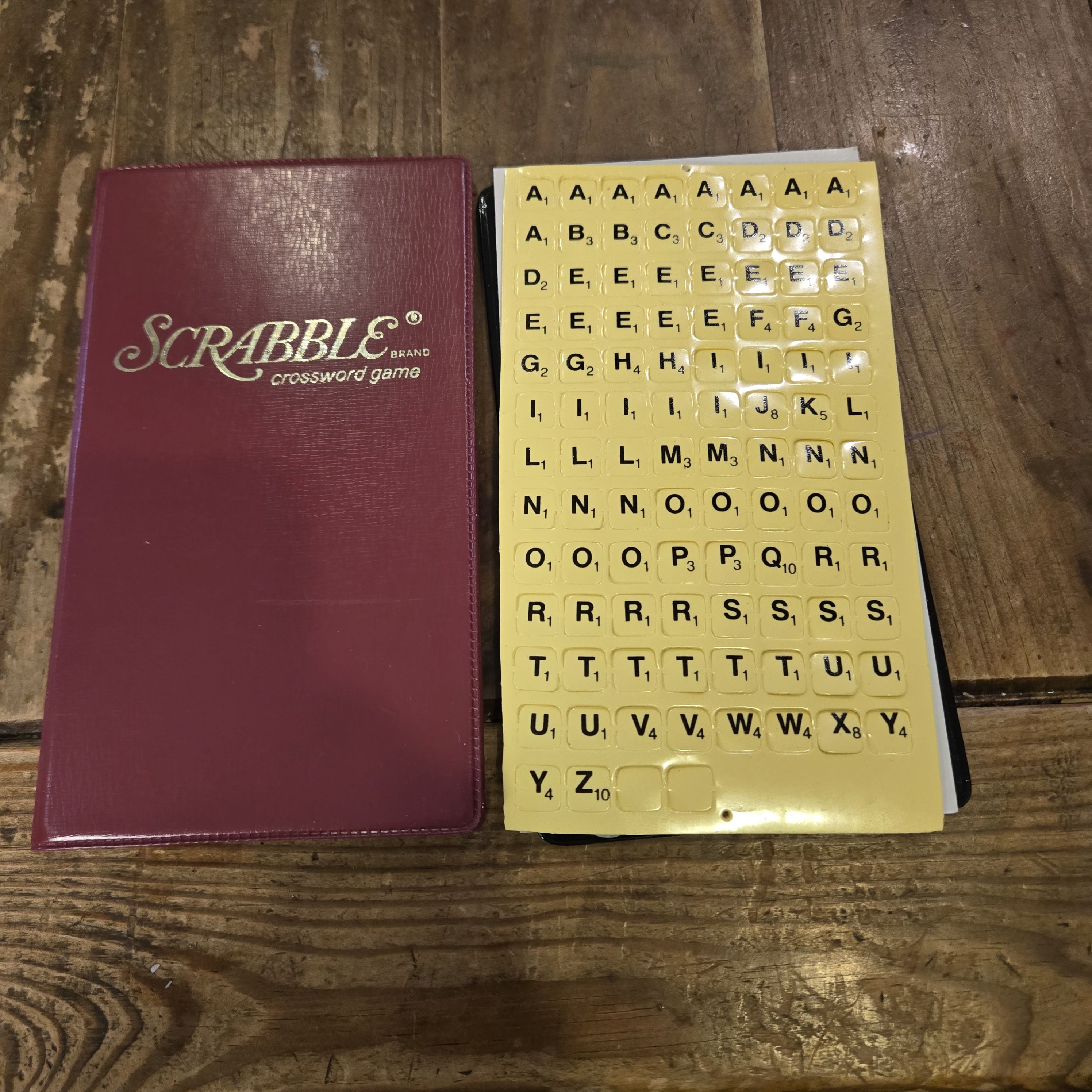
    A never used, magnetized, portable Scrabble set. Have no idea why it was never used.

    Congratulations to Frank Henneburg

    This is an announcement from my original DC law firm 41 years ago when we had 45 attorneys. 20 were partners, of whom 13 are still alive. The firm disbanded in 1989, but I am still in contact with 11 of those 13 (including Frank H.).

    Christmas Club

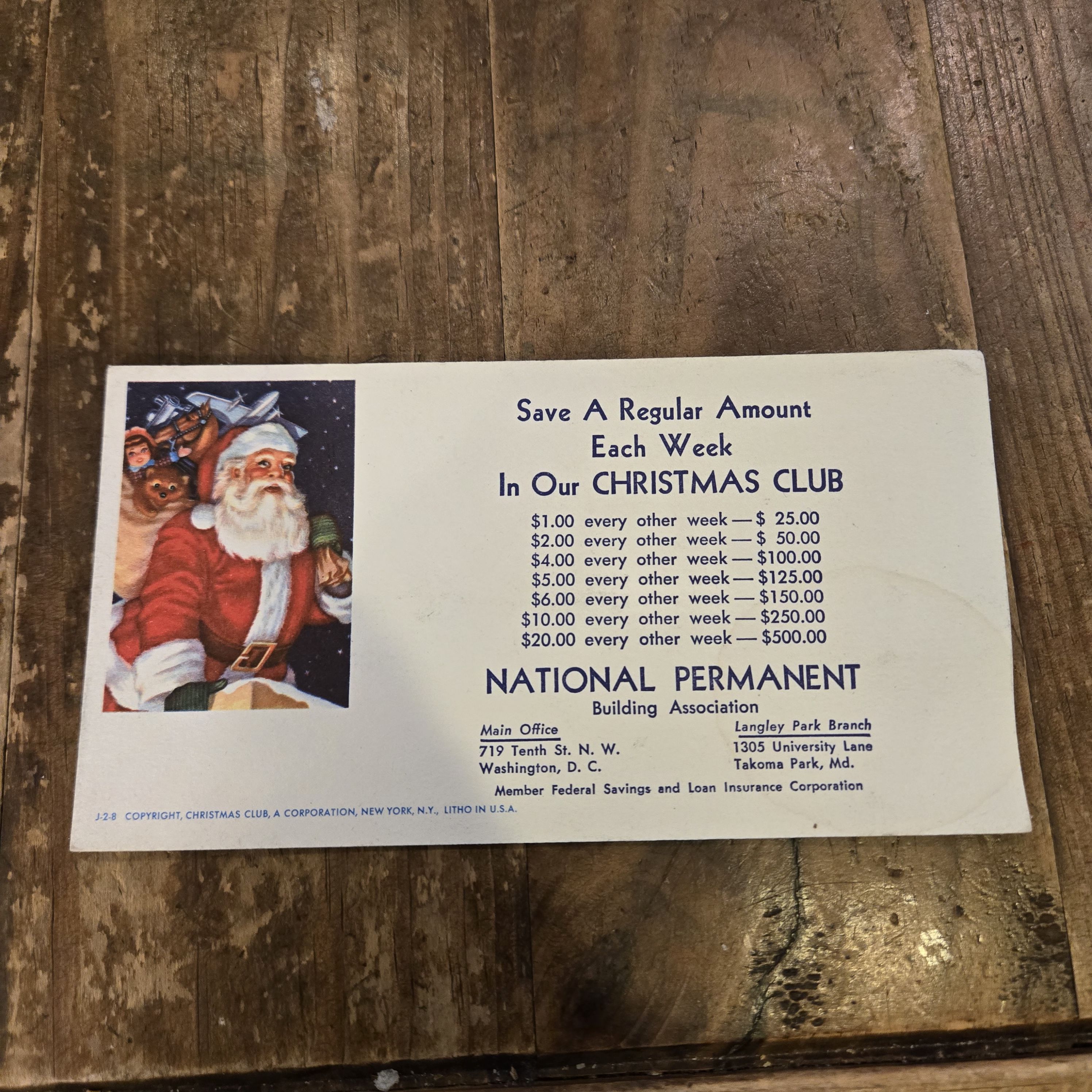
    Here’s a good deal from your local S & L. Put in $1 every other week ($26), and they will give you $25 at the end of the year.

    Mr. Leo

    And last, but far from least, several blank appointment cards from Leo to get your hair done at Garfinckels, Spring Valley. Leo, if you don’t know,  was Edie’s father. And his name, outside of Garfinckels, was not Leo.

    That’s it.

  • The Contents of Mystery Box #1.

    November 21st, 2024

    Once again, my schedule today did not permit a thoughtful blog post. But don’t despair. I have gone into one of my closets and pulled out one of my many shoe boxes filled with valuable ephemera.

    Mystery box #1

    I then pulled out seven items (out of maybe 30?) guaranteed to educate and entertain you.

    With no further ado:

    Reagan Door Mat

    This official Ronald Reagan door mat (no, not this one yet) lists for $20 to $30 on Ebay. It is really more of a small dish towel. Reagan, you may remember was the host of Death Valley Days, the star of Bedtime for Bonzo, and president of the United States.

    Cleveland Heights, Ohio

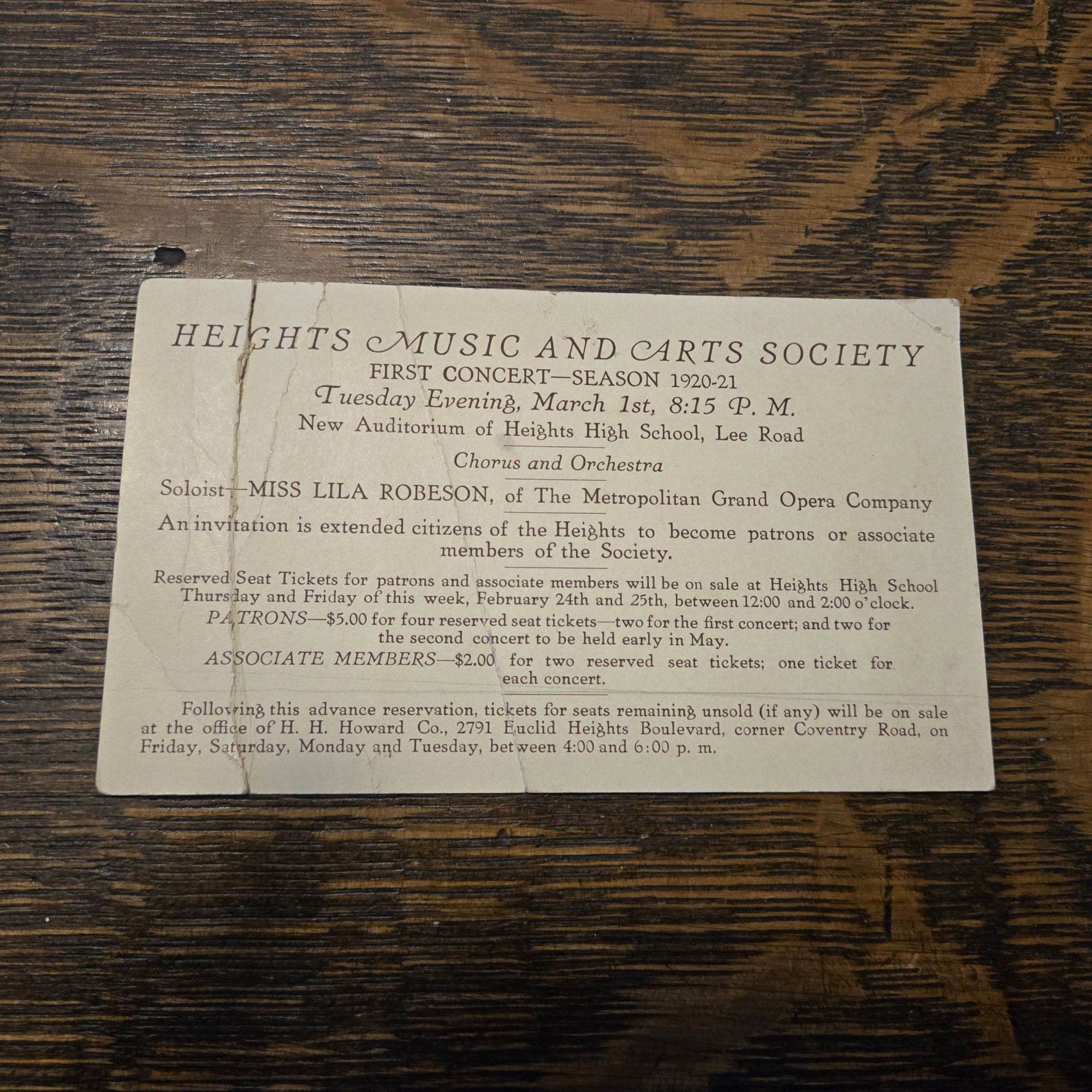
    Yes, an invitation to come to the first concert of the 1920-1921 season of the (Cleveland) Heights Music and Arts Society. Lila Robeson sang at the Met and was, and looked like, a Wagnerian heroine. In 1922, she retired and spent almost 40 years teaching voice in her native Cleveland. She does not appear to be related to Paul. I can not imagine that this card has any value, other than to descendants of Ms. Lila.

    Krakow, Poland

    If you have been to Krakow recently, you will probably not recognize this bucolic scene. This is a post card actually sent to me from behind the Iron Curtain 46 years ago. Makes Communism look so relaxing.

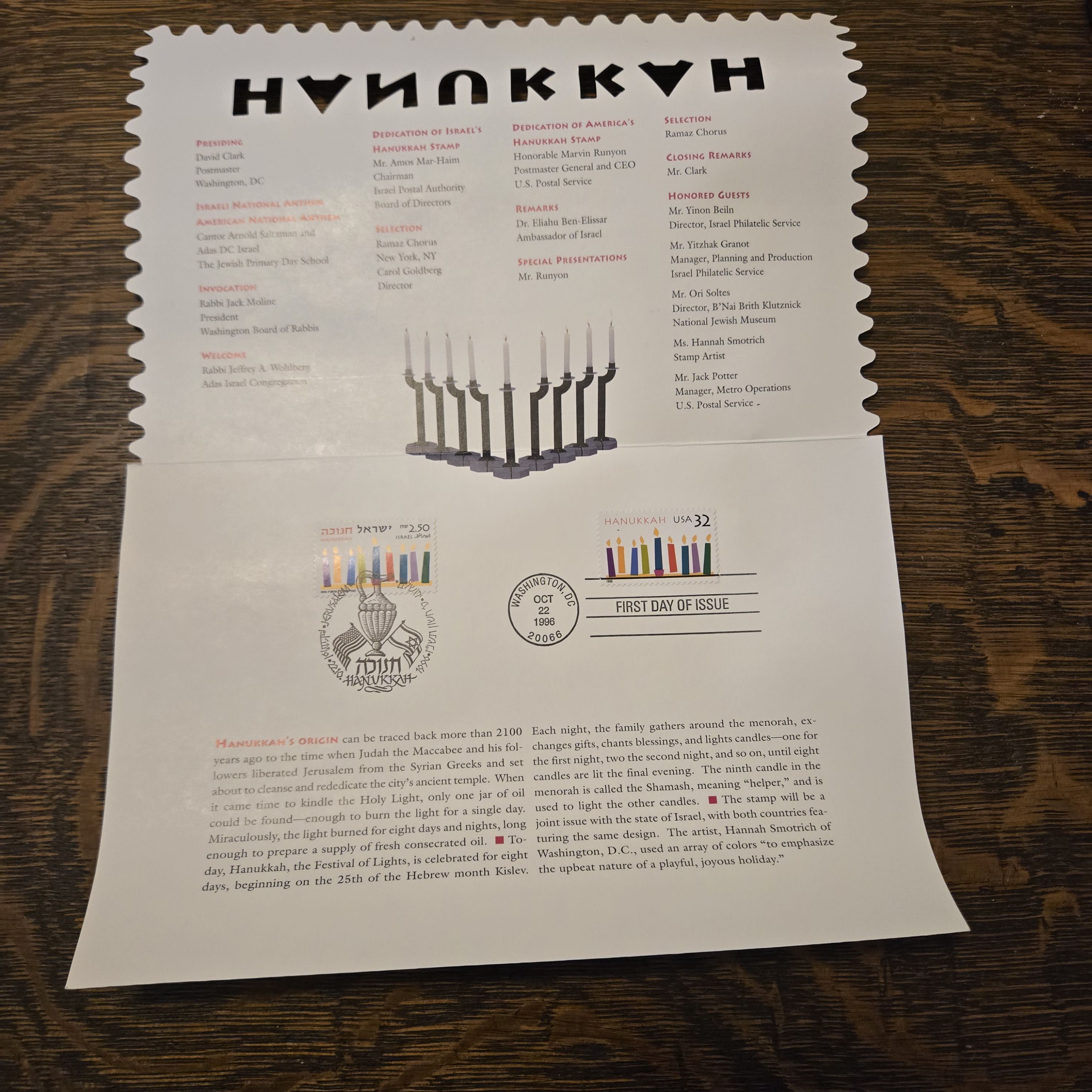
    Hannukah 1996

    This is my entire collection of first day covers of U.S. and Israel jointly issued Hannukah stamps. From 1996. And, no, I can not begin to explain the font choice at the top. Well, actually, I can. You?

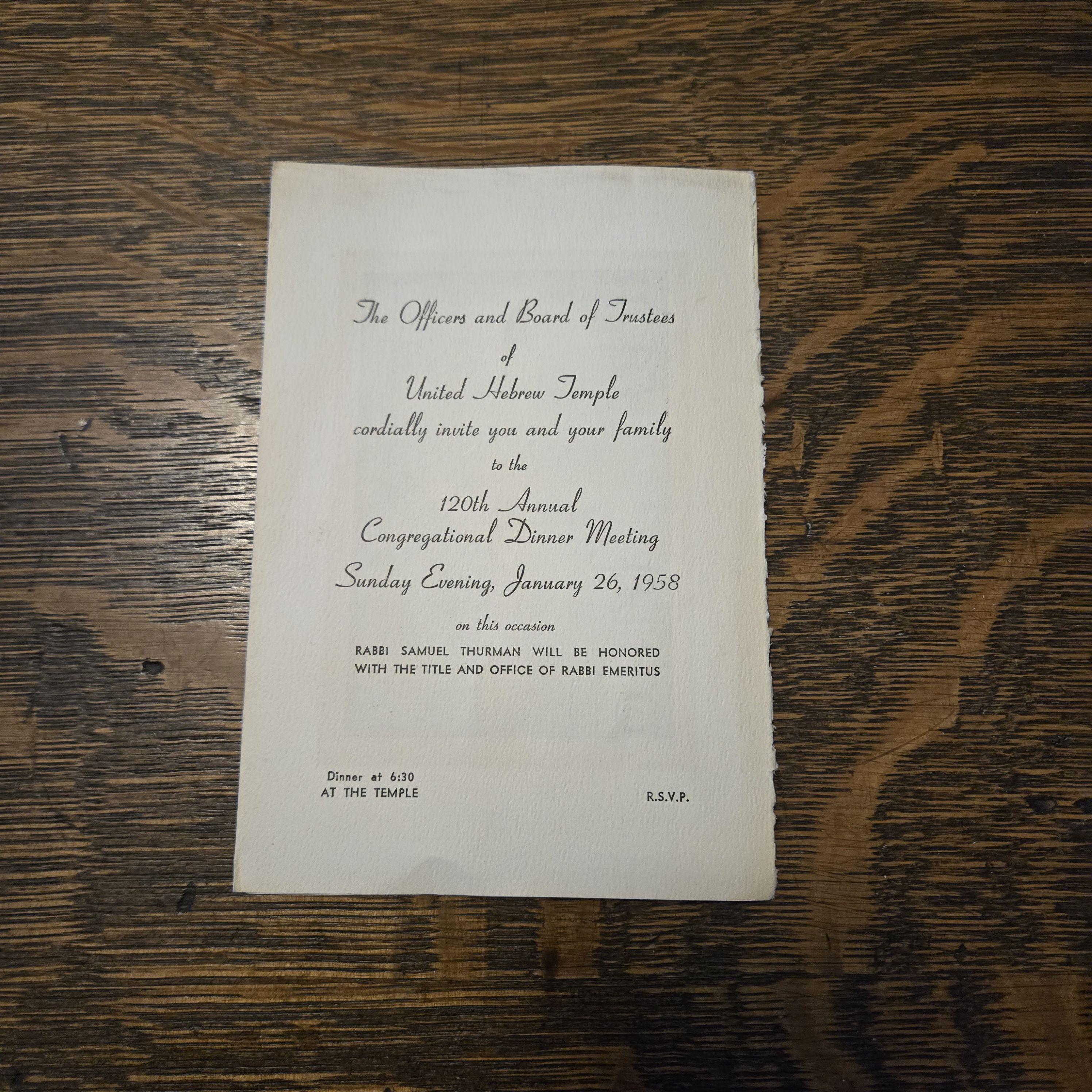
    Good-bye, Rabbi Thurman

    This is the 1958 program for the conversion of my childhood rabbi, Samuel Thurman, into Samuel Thurman, Rabbi Emeritus. United Hebrew Congregation,  St. Louis. Rabbi Thurman retired that day at age 76 after serving United Hebrew for 44 years. He was a friend and Masonic brother of fellow Missourian Harry Truman, and was the first rabbi to give an invocation at a presidential inauguration.

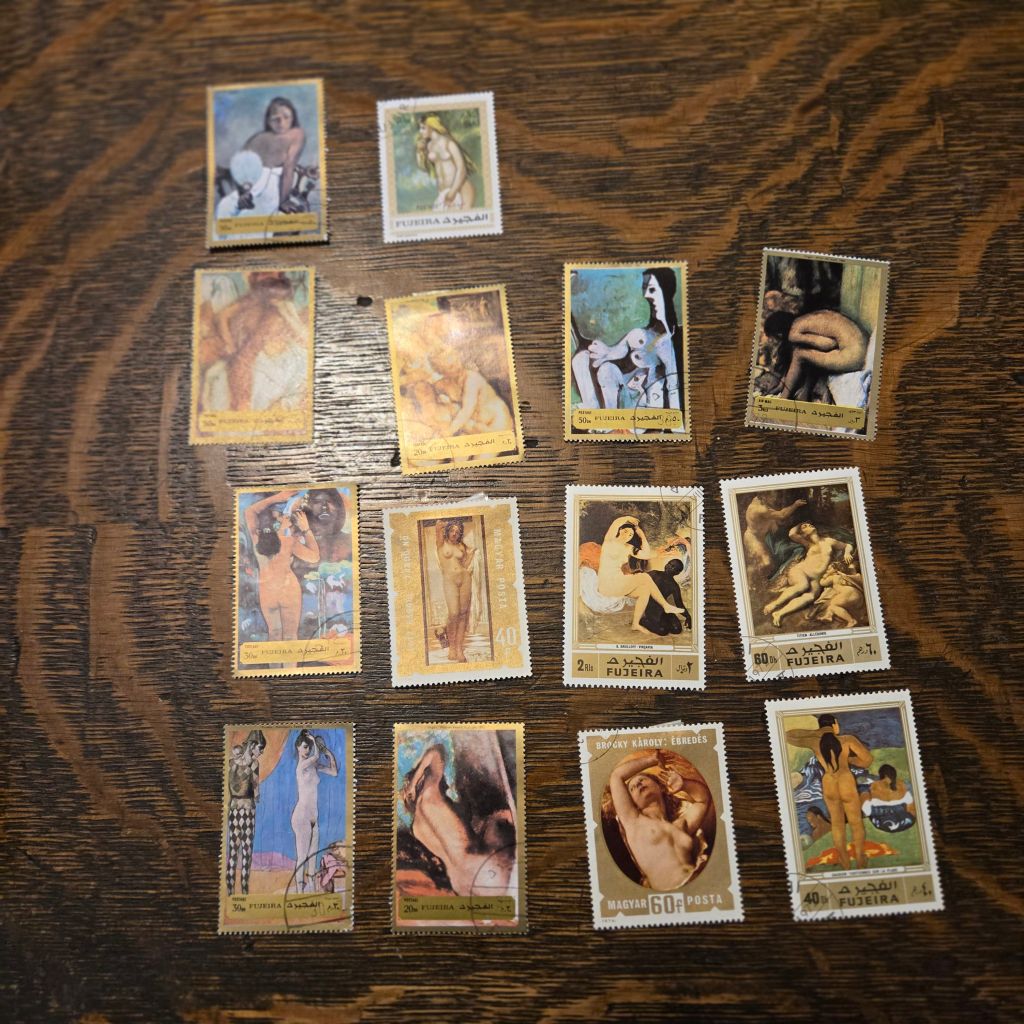
    Stamps from Fujairah

    Here you have 14 stamps (they were in an envelope) from the Emirate of Fujairah, one of the smaller emirates of the UAE. In great Muslim tradition, they each contain a reproduction of an art work featuring a completely nude woman.

    As opposed to places like Dubai, Fujairah is quite conservative. I guarantee that you can not buy these stamps at the local post office. These stamps, for collectors only, do not have any value.  Not even prurient value.

    Take Me Out to the Ball Game

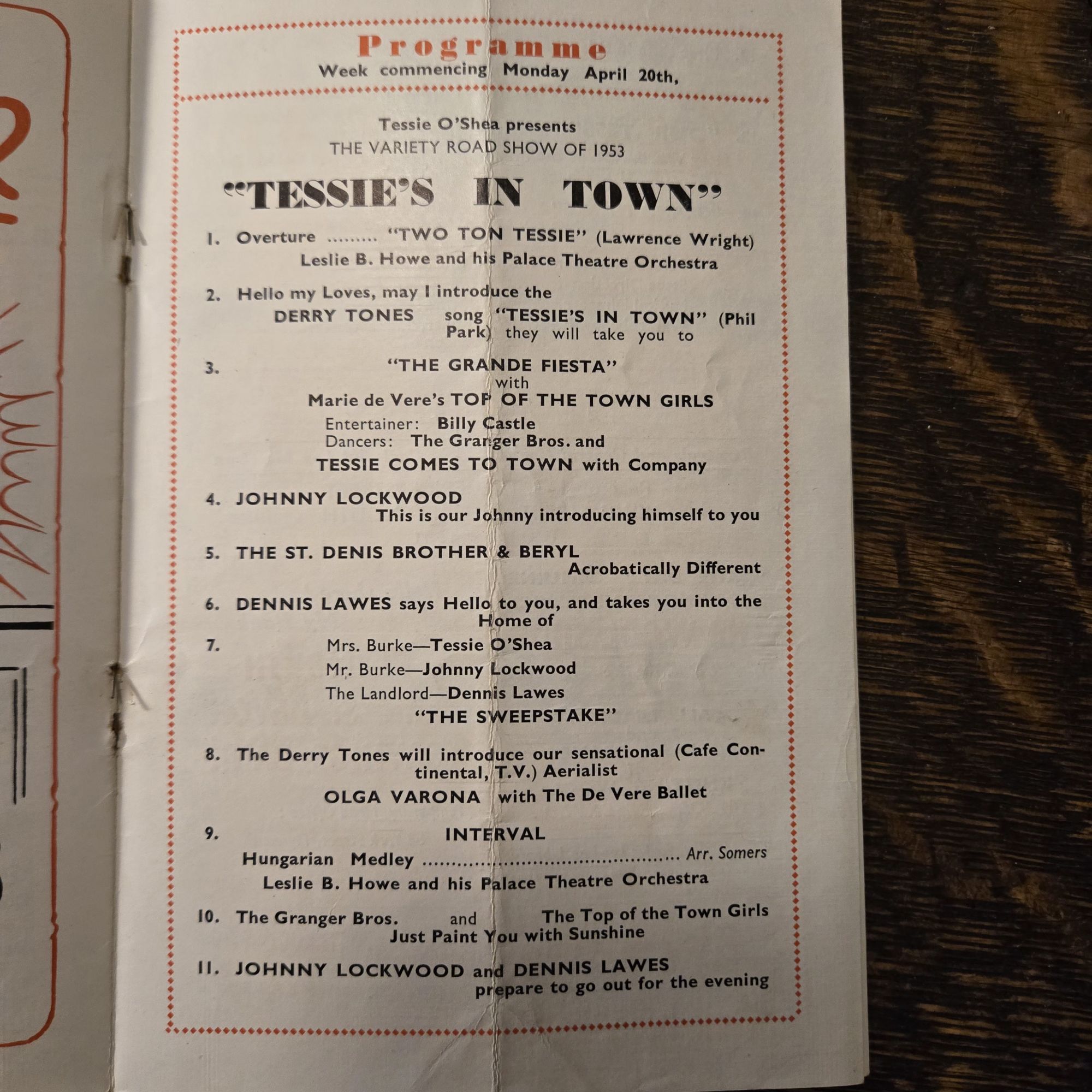
    This baseball lineup is the treasure of the seven items I took from the box. The teams were the 58th Bomb Group Wingers, and the 73rd Bomb Group Bombers. Players, if you look closely or even if you don’t,  included Howie Pollett of the Cardinals, Vic Wertz and Birdie Tebbetts of the Tigers, and Bob Dillinger of the Browns. The Bombers won the extra inning game by scoring 4 runs in the 11th.

    All but one of these items have something in common. I have no idea when or where I got them. The exception is the postcard. It says on the back.

  • The Republic of France, Joe Lieberman and the Nazi Titanic (3 in 1)

    November 20th, 2024

    (1) Prayer for the French Republic. Playing through this weekend at Theater J. Let’s do the negatives first. The play is 3 hours long, with 2 intermissions. Second, the plot, while interesting, is relatively ordinary.

    Now the positives. First, the 3 hours pass quickly, so you won’t get fidgity. Secondly, “relatively ordinary ” does not mean uninteresting.

    The Solomons have been in France forever. Their piano business goes back five generations. Marcelle Solomon’s husband, Charles, was born in Algeria, but forced to leave. Everyone in the play is Jewish. Marcelle’s father is the only one of his siblings to live through the Second World War. Her grandfather spent time in a concentration camp. Her great grandparents were able to stay in their Paris apartment during the war.

    Marcelle has a son who becomes religiously observant and, because of his kippah, religiously observed. He is attacked on the street. The question presented: should the family leave France and move to Israel?

    More positives. The acting is first class. Some of the writing is masterful. And…you always run into people you know at Theater J.

    It’s an age old Jewish  question, right? Where do you belong? What is your identity? Who gets to answer these questions?Where will you be safe?

    I am not going to tell you what the family decided. But I will tell you that I think they decided wrongly.

    A week or two ago, I wrote about a podcast we listened to after the Amsterdam soccer riot. Aayan Hirsi Ali talked about the growing number of Muslims in Europe living in a “parallel society” and how that would inevitably make life more difficult for Jews in Europe, whose numbers were not increasing. Maybe so.

    But for the playwright, I have a suggestion.  Write a second ending for the play. At the end of the second act, poll the audience. Let them decide. Go, or stay? Would be very interesting to see what the observers who are not participants, think.

    (2) Centered: Joe Lieberman. Last night, we went to the DCJCC (which is also where we saw Prayer for the French Republic) to watch a new documentary about Senator Joe Lieberman, best known as my law school classmate. The film is premiering in DC this week, and the crowd on the third night of its showing was large. It’s a well done and interesting film, concentrating on Joe both as a Jew and as a centrist Senator, who could reach so far across the line that he wound up being considered as vice presidential candidate for Republican Senator John McCain and being elected to the Senate from Connecticut as an independent.

    The film is good history and is presented by and large chronologically. Historical footage is interspersed with what was apparently a 7 hour interview with Joe, and additional conversations with his wife, two of his children (the ones living in this country; the third is in Israel), and many who worked with him over the years.

    As the film was being made, there was no thought to the possibility that Joe would not live to see it released. At least, no one thought about that except perhaps Joe himself. For Joe had been diagnosed with a dangerous blood cancer, about which he told no one (at least, he did not tell his children; I do not know whether his wife knew), and when he died suddenly after falling last March, his illness was first disclosed and his fall likely attributed to his weakened condition.

    A number of things occurred to me as I watched the film. First, although there was a fair amount in the film of Joe as a Yale undergraduate, there was virtually no reference to his time as a law student. I guess this did not surprise me, as I recall Joe paying little attention to his law school years while he was living them. He married after his first year, and did not live on or (to my knowledge) very near campus, so he had a life beyond the law school classes. And he was working (perhaps volunteering) at the time (again as I remember it) for the Connecticut Democratic Party, so very busy elsewhere.

    I also thought about his career before his successful run for Connecticut Attorney General. Joe practiced law in New Haven for a couple of years at what was then, I think, New Haven’s largest law firm. I don’t know what his work there consisted of, but a few years out of law school, he left the firm and ran for and was elected to the Connecticut Senate, where he served for 10 years. And then he became Attorney General. In other words, Joe Lieberman became Attorney General of the State of Connecticut, having no extensive law practice experience, and never having been a prosecutor (and probably his law practice had no involvement with criminal law).

    Of whom does that remind you? Yes……Matt Gaetz. Oh, well.

    (3) The Nazi Titanic. Robert Watson, a Florida academic, gave his second presentation for the Haberman Institute Monday night. He was talking about the subject of his 2017 award winning book, The Nazi Titanic. I gave the talk an A+ . You can see it either on YouTube or on the Haberman website (habermaninstitute.org) – no cost.

    I will give you a very basic outline. The German ocean liner, the Cap Arcona, made over 90 trips between Europe and Latin America between the two world wars. It was perhaps the most luxurious of the many quality German ocean liners.

    During the Second World War, the ship was first used as a troop carrier, having been stripped down, and then allowed to rot in the Nordsee; otherwise, it would have been an obvious target. But at one point (hard as this may be to believe), Hitler, who was a big American movie fan, decided that Germany should make its own epic film as a major public relations effort, so that the rest of the world would see how powerful and creative the Nazi regime was. So the ship was refloated, and restored to its pre-war elegance and made to look as much as possible like the Titanic itself, and the very expensive film was in fact made. The subject of the film was the 1912 sinking of the real Titanic, and the remade Cap Arcona was the star of the show. (This film is available to watch on YouTube. It did not do what Hitler expected it would for Germany’s reputation.)

    The ship was again mothballed until the very final days of the war, when it was packed with Holocaust victims, of course mainly Jewish, who had survived the death marches from the east back to Germany. And “packed” means “really packed”, no room to move around at all. It was all about getting rid of evidence; the ship could always be sunk so that any remaining prisoners would disappear from potential rescue.

    Clearly this was a tragedy, and the tragedy was compounded when the Royal Air Force, assuming the ship was still being used by the German military, bombed the ship and sunk it, killing perhaps 7000 prisoners on board.

    This event was not spoken about because everything involving it was declared confidential by the British government, , embarrassed at Britain’s involvement in so many innocent deaths, to be held without release for, I think he said, 100 years. All RAF crew members were sworn to lifelong secrecy. And it was only by accident that Watson got on the trail of the Cap Arcona, and was able to have the British agree to release the previously confidential material. This is part of the story.

  • Cool, Cool Water

    November 19th, 2024

    “All day, I face the barren waste, without a taste of water….”

    At 4:45 a.m. this morning, a 12 inch water main broke on Connecticut Avenue, a block or two from our house.

    Back to the song (which will be in my head all day). Written in 1936, it was first recorded, they say, in 1941 by the Sons of the Pioneers. It was later recorded by Vaughn Monroe, Frankie Laine, Marty Robbins, and others.

    When I think of Vaughn Monroe, I think of “Riders in the Sky”. When I think of Frankie Laine, it’s “Mule Train”. The Sons of the Pioneers brings me to Roy Rogers and “Happy Trails”. It was also recorded by Hank Williams and Eddy Arnold.

    These are all country cowboy singers. But Marty Robbins? I know he was a country guy, but all I think of is “A White Sport Coat and a Pink Carnation” (“Once you told me long ago, to the prom with me you’d go…”), recorded in 1957, and the travails of high school dating. If it is true that high school kids don’t date any more……good for them.

    Now, all this information comes from Wikipedia, of course, and I take it as gospel. But another site, Genius.com, tells me it was first recorded by Bob Atcher and Bonnie Blue Eyes. The year before the Sons of the Pioneers. I don’t really care about Bob Atcher, but who was Bonnie Blue Eyes? Maybe an Indian princess? A German refugee whose name was Bonnie Blau-augen? I must find out.

    It turns out that her name was Loete Applegate, and for three years, 1939 to 1942, she sang duets with

    Atcher. And even though I don’t care about Bob Atcher,  B.B.E. did because she married him.

    You may know that, besides singing about his lost prom date and his thirst, Marty Robbins was a Nascar racer. You may know the Gene Autry (how did he get in this mix?) became a very wealthy and overweight oil tycoon. But did you know that Kentucky born Bob Atcher became the long time mayor of Schaumburg Illinois? Go figure

    You can see a list of songs recorded by Atcher on Wikipedia, but “Cool Water” is not there. This is a mystery.

    But who wrote “Cool Water”? Attention must be paid. It was Bob Dolan! I know you might never have heard of him, but he was one of the founders of the Sons of the Pioneers. And, like I am sure  many American country singers, he was born in Winnipeg, Manitoba. And he also wrote ” Tumbling Tumbleweeds”. Attention must be paid.

    Are you one of the few who read this post all the way to the end? Wow!

    I am going to check on our water main.

  • I Am Not Expressing an Opinion Here (Or Am I?).

    November 18th, 2024

    This week I read another interesting book that you probably know nothing about (you can ignore the word “probably”): Around Cape Horn to Honolulu by L. Vernon Briggs, published in 1924, but detailing his seafaring trip from Boston to Honolulu in 1880. Briggs (who later became a prominent Boston psychiatrist), the son of a prominent family, was diagnosed with a serious case of asthma. and his family doctor thought he could use a change of climate to improve his health. He was 16.

    Briggs was a curious young man and his family agreed that a trip at sea might be just the thing, and they found a commercial cargo ship which was willing to take him on as its only passenger (although, as the trip went on, he became a virtual crew member) on its journey around the southern tip of South America to the Kingdom of Hawaii. It was by no means a smooth trip. They hit a number of strong and lengthy storms in the Atlantic, and then had to face the terrible storms and waves as the crossed the Straits of Magellen, when it appears as likely or not that their boat would not make it through.

    The entire trip took about 5 months, and – this should be obvious – Briggs had not heard anything from or been able to transmit anything to his family in Boston. For this entire time, they were at sea; they stopped at no intervening ports along the way. (The book, by describing the way a cargo ship traveled and how its crew fared in the 1880s, is very interesting, but that is for another day; not the subject of this post.)

    When they got to Honolulu, there was mail waiting (the mail was brought on ships that came directly from San Francisco; I assume mail was sent from Boston to San Francisco by railroad. And Briggs was able to write his family that he was fine (actually better than when he left home), and send his mail by ship back to California.

    What I am interested here is that his parents sent their son on a dangerous voyage, where communication was impossible, and where – at the end of that voyage – he would be over 5,000 miles from home (and have to get back).

    Of course, travel without communication was very common in those days. Men and women, and sometimes children, were leaving the more remote parts of Europe, for example, to come to the New World, and it was very difficult for them to communicate with people back home. Sometimes, they had no contact with them ever again. I was glancing through The Adventures of Marco Polo (should I read it/should I not) the other day, and realized that Marco and his father traveled for years without being able to hear from to communicate with their family in Italy.

    I have never been in that situation, although when I took my 3 month long trip to Europe in 1962, I had no contact with family (I did send them a few post cards, I guess) for that period of time. And when I was in basic training at Ft. Ord California (and the base was locked down because of meningitis), I was only allowed one three minute phone call home per week, and no one could call me. But that was far from the same.

    And then there was that old joke (certainly neither politically correct not accurate) showing the differences between Italian and Jewish husband. The joke was that Italian husbands would leave in the morning, saying “I’m going. I may come back”, while Jewish husbands would call home as soon as they crossed the street, saying “I’m across the street. I will call you when I get to the corner.”

    Today, our ability to communicate is astounding. Virtually everyone, middle school age or older, has a cell phone, and younger people apparently talk to their friends on the phone, or text them, more than they do in person. They even take their phones to school where they can apparently use them (with permission or without) even during class. This has to be terrible for the teachers, and certainly must have a bad effect on the ability of a student to absorb what is being taught.

    For some reason, it took the education establishment in many places years before they realized that something had to be done and only now are school districts forbidding the use of cell phones during class. But there are, apparently, many parents who strongly object to this change of policy. “What”, they say, “will we do if there is a shooter incident and we cannot reach our kids?”

    How different this is from the parents of Vernon Briggs, who put him on a boat, knowing he had a physical illness, although the trip was ostensibly for his health, knowing they won’t know how, or even if, he is for a half of a year, and maybe longer.

    Right, wrong? Better, worse? I don’t know. I am not expressing an opinion. Why? Because both seem right, and both seem wrong to me. It’s hard not to be a helicopter parent, I think, when helicopters are available. It’s impossible to be a helicopter parent, when they aren’t.

  • A walk in Rock Creek Park in November (A Photographic Esssay)

    November 18th, 2024
  • 16th Street (Part 10)

    November 17th, 2024

    Some of my St. Louis friends told me that they really weren’t that interested in 16th Street, Washington D.C. That surprised me, of course. And I don’t understand why. No street in the country is more interesting.

    We stopped posting these short walks a few weeks ago, so it is time to pick them up again. We were at the northern end of Meridian Hill Park, at Euclid Street. To give you an idea how far north we are, take a left on Euclid and walk two blocks to 18th Street.  You are now in the heart of Adams Morgan. Yes, they are that close, and so very, very different.

    For women only

    This apartment building on the east side of 16th Street used to be for women only, a place where young women who came to work for the government coukd feel safe. In 1958, on my high school junior trip to Washington,  my memory is that this is where the girls stayed. The boys stayed a block or so down the street.

    The Inter-American Defense Board.

    Across the street, you find the headquarters of the Inter-American Defense Board. This house was built in 1906 and was the home of Mrs. Marshall Field, but has been the headquarters of the IADB since the end of World War II. The IADB is now a branch of the Organization of American States (headquarters on 17th Street, near the White House) and is the parent Organization of the Inter-American Defense College (open to member government officials), located at Ft. McNair in SW D.C.

    The embassy of Lithuania

    Next, we find the embassy of Lithuania, an impressive stone building flying the flag of Ukraine. Some years ago, I attended a number of meetings in this building as a member of a group of Jewish Washingtonians trying to help Lithuania better its relations with the Jewish community. At the time, Lithuania had a very liberal ambassador, and Lithuania was engaged in many activities in Israel and had an extensive domestic Holocaust education program. We had just traveled to Lithuania and I was enthused. Then, the ambassador was replaced, the effort died down, and that’s all I know.

    The next building is even more impressive.

    The Cuban embassy

    It’s the embassy of Cuba, maintained in very good condition. The building was built as Cuba’s embassy in 1915. Between 1971 and 2015, there was no diplomatic relationship between the two countries, and relationships were handled through Switzerland.  But, even during this period, I think this property continued to be owned and occupied by Cuba. A statue of Cuban hero Jose Martì stabds at the front door. A separate visa office is located in a small building across the street.

    Josè Martì

    The embassies keep ping on, although there are larger clusters of embassies in Washington. But right next to Cuba, you find the Polish embassy.

    Embassy of Poland.

    The Polish embassy, built as a private residence of Missouri Senator John Henderson in 1910, was purchased by Poland in 1919. I am told that there is a concert grand piano in the foyer, which was a gift of pianist and prime minister Ignacy Paderewski.

    We will stop here today with Modera Sedici, at 2700 16th Street.

    Modera Sedici Apartments

    If Modera Sedici, the main building of an apartment complex, looks like an embassy, that should be no surprise. For about 100 years, it was the Italian embassy (now located on Massachusetts Avenue), but now redesigned as apartments, which seem to rent for $3000 to over $6000 per month.

    All this…..and we have covered one block.

  • What Do Robert F. Kennedy Jr., and Emilia Perez Have in Common?

    November 16th, 2024

    Nothing!

    (1) This article, republished yesterday by Tablet Magazine, containing a transcript of an interview with Robert F. Kennedy Jr about 18 months ago is perhaps the most fascinating thing I have ever read. Just saying.

    https://www.tabletmag.com/sections/arts-letters/articles/robert-f-kennedy-jr-interview-david-samuels

    If the link doesn’t work, Google: Samuels Kennedy Tablet Interview.

    (2) We watched the new film “Emilia Perez” last night on Netflix, and it is about the strangest film I have ever seen. Just saying.

    The leader of a Mexican drug cartel wants and gets a sex change, wants to atone for all of her wrongdoing, wants to live with her wife and children (who don’t know she is he), falls in love with a woman whose husband had been murdered by a gang (his/hers?), and almost pulls it off. But doesn’t.  Oh, yes, it’s a musical.

    If this plot line intrigues you, watch it. If not, watch a rerun of the Mike Tyson fight. By the way, who won?

  • Let’s See How Richard Nixon Looks at 2024.

    November 15th, 2024

    With all of the talk today about the effect of the election on Russia and its war in Ukraine, and about the relationships between not only Trump and Putin, but the relationship between Putin and Tulsi Gabbard, I thought something I happened upon yesterday was interesting. These are the opening lines of Marvin Kalb’s book, The Nixon Memo.

    “On March 10, 1992, Super Tuesday in the presidential primary calendar, and most extraordinary story appeared on the front page of the New York Times. The headline caught my attention: ” Nixon scoffs at the Level of Support for Russian Democracy by Bush”. The lead of the story, written by Tom Friedman, then the paper’s diplomatic correspondent, was equally dramatic. “Nixon has sharply criticized President Bush and Secretary of State James A. Baker 3d for what he calls the Administration’s pathetic support of the democratic revolution in Russia. He says one of the historic opportunities of this century is being missed.” According to Friedman, these views were contained in a memo that Nixon wrote and circulated to a limited number of officials and journalists. There was no doubt Friedman had seen the memo.

    The Times quoted the Nixon memo as saying: “While the candidates have addressed scores of significant issues in the presidential campaign, the most important issue since the end of World War II – the fate of the political and economic reforms in Russia – has been virtually ignored.” Nidismissed Western efforts to help Russia as “penny ante” and warned that if Boris Yeltsin and the emerging “democracy” in Russia collapsed, “we can kiss the peace dividend good-bye”.

    We now know that Russia is in the hands of Vladimir Putin, a former Communist, former KGB operative, and current strongman. Could we have done something to prevent that? I think that would have been very difficult. After all, how did Putin get into power? He achieved his position because he was the designated choice of Boris Yeltsin himself. It is very unlikely (read: impossible) to believe that Yeltsin thought that the Putin of the 1990s would turn into the Putin of the 2020s; in the early 1990s, Putin did not appear as a future strongman. Perhaps we could have helped Russia by providing options in the transformation of the country into capitalism, but it would have been difficult. The big problem, as I see it, was the manner in which the common elements (talking in condominium language) of the Soviet Union were converted into private property. The method used was to sell some assets to favored future-oligarchs at bargain basement prices, to give all Russian citizens, even the most lowly, chits giving them a piece of the common property but, at the same time, giving them every reason to sell those chits at highly discounted prices to future-oligarchs, and then set up a political system that allowed the oligarchs (now, no longer future-oligarchs) to finance politicians in return for favors and, finally, to allow the politicians to become so powerful that they no longer had to rely on the oligarchs, and in fact could control and manipulate the oligarchs. (There you have it: my 60 second course on the history of Russia from 1990 to the present.)

    Are there parallels in our country? We have elected, for the second time, a billionaire, who seems to be powerful enough to control everyone around him. Everyone, that is, except for the richest man in the world, who has become the billionaire’s best friend and boon companion, and who obviously must think that he himself is so strong that the billionaire president will favor him when it comes to government contracts and that in fact, before you know it, the richest man in the world will control the billionaire president the way the oligarchs used to control Putin.

    In Russia, Putin outsmarted the oligarchs. He did that by weaponizing the government, including the judicial branch of the Russian government (never an independent branch like ours has always been), against the oligarchs. And he did this out of the personal ambition of a man in his 50s. Can Trump do the same to Musk? Musk is betting that he can’t, that Musk is too powerful, that he is in a league of his own (which means that Trump can’t play one oligarch off against another), and that because Trump is pushing 80, he will not be able to carry on the fight. And I assume Musk thinks that, after Trump leaves the scene, Musk can bully his way around the next president (Vance or someone else) because Muskworld at that time will become so crucial to so many governmental activities that fighting Musk will be all but impossible.

    With all his faults, Richard Nixon was a very astute individual, and his post-presidency advice tended to be on point. What would he think of today? I think he would be one of the RINOs, who continues to call himself a Republican, but who be railing against the dangers of Trump II, and who would take seriously the many arguments that can be raised alleging that the Trump playbook could lead to the demise of democracy in this country as we have known it, just as he feared that, without intervention, the nascent Russian democracy under Yeltsin would fail.

    And, to top it off, it appears that we may start supporting not Russian democracy,  but rather the autocratic Russian government anout which Richard Nixon was so concerned.

  • There Will Always Be an England

    November 14th, 2024

    No time for writing a blog post today.

    So let’s just look at some examples from my English guidebook collection.

    Madame Tussaud’s 1943
    Madame Tussaud herself
    Palace Theater 1953
    Playing at the Palace

    Includes my favorite opening number, “Two Ton Tessie”. You agree?

    Not England, I know, 1943
    Definitely England
    King George, Queen Mary (I guess)
    Late 19th century?
    21 volumes include many pathetic narratives

    And ….

    1905

    This guidebook has many adVERTisments, such as

    100 years of manufacture, starting in 1790s.

    How do you downsize when your life is filled with treasures?

  • Here We Go Again

    November 13th, 2024

    Donald Trump has just said he is nominating Pete Hesgeth as Secretary of Defense. My guess is that at least 48 Democrats will vote against him. It will be an extraordinary nomination.

    What? You don’t know Hesgeth? You can’t even say his name five times quickly without wondering why you are even trying?

    If you don’t know him, it means either (1) your memory is not what it used to be, or (2) you don’t watch Fox and Friends on the weekends. Which is it? I understand. If it’s (1), it might really be (2) as well.

    Hesgeth has of course never run an operation as large as the Pentagon. The only people who have done that are former Defense Secretaries and Elon Musk’s personal assistant.

    And this brings up an interesting point. As Musk will be a co-chair of the new “department” of government efficiency, his goal will be to cut, baby, cut the government deficit. But the task of Hesgeth Hesgeth Hesgeth Hesgeth Hesgeth will be to build up the military, which, under VP Harris, is now weaker than that of, say, Monaco. Who will win this battle?


    Speaking of potential battles, I see one coming up at DOGE (Venetian for the Department of Government Efficiency) between the two play-well-together co-chiefs, Musk and Ramaswamy. (When you say his name, by the way, the emphasis is on “swam”, but if you want to say it five times quickly, and you can if you try, put the emphasis on “ram”.)

    At any rate, can you imagine Musk saying to himself, “I know what I would like to do, but I want to make sure Vivek agrees before I say anything.”? And can you imagine Ramaswamy even stopping talking long enough to listen to Elon, even if Elon bothered to say anything? My prediction that the marriage of this Odd Couple will be given an annulment soon.

    Back to Hesgeth. I have read a little about him and he does seem at least as qualified to handle our defense as the man in the street (or, to put it another way, as the typical Trump voter). And I read two other things about him. First, he doesn’t like NATO. Second, he thinks that Ukraine shoukd defend itself if it wants, but that the US should stay out of European affairs,  and certainly not be provoking Gaspadin (or Tovarich, if you prefer) Putin.

    This was not to be my topic this morning. I actually had not been overly upset at some of Trump’s appointees. I am happy to get Stefanik out of the House, and think the UN, meaningless as it is in its most important task of keeping the peace, is a great place for her to spew her venom. And I think Rubio is actually not a bad choice for state.

    Noem at Homeland Security gives me  qualms, to be sure, and it certainly scares those would-be asylum seekers who want to bring their pets with them. I think this task will quickly show Noem’s limitations. After all, doesn’t Homeland Security have more employees than South Dakota  has people? I don’t expect her to be long at this job. And, by the way, this is another Department which, to fulfill Trump’s goals, will require more, not fewer, resources. Take that, Elon!

    I will stop here (Zeldin is too far down the alphabet to deal with today), but did you read about, or see videos of, the UFO over Michigan? What do you think? Me? I think it’s our only hope.

←Previous Page
1 … 28 29 30 31 32 … 62
Next Page→

Blog at WordPress.com.

searching

Loading Comments...
  • Subscribe Subscribed
    Art is 80
    Join 71 other subscribers

    Have a WordPress.com account? Log in now.

  • Art is 80
    View site in Reader
    Manage subscriptionsSign upLog in
    Report this content
    Collapse this bar