Skip to content

Art is 80

  • 16th Street (Part 7). U Street to W Street.

    October 21st, 2024

    We start at U Street to continue our walk up 16th Street. The first building we see, on our left, is the Balfour Condominium.

    The Balfour

    The Balfour was built as a luxury apartment at the northern tip of developed 16th Street in 1900. Originally named something else, the building was renamed the Balfour in 1909. Arthur Balfour had left the British prime minister’s position in 1905. His Balfour Declaration was not issued until 1917, when he was serving as foreign minister.

    The building has been renovated several times. When built, it had 36 rental units. Now, as a condo, it has 54. Units seem to sell between $500k and $700k.

    Across the street from the Balfour is the Brittany, another rental building turned condominium,  built in 1914.

    The Brittany

    The Brittany has 57 units. Today, none are for sale.

    As we continue up the street, with both townhouses and apartment houses, I saw a building with a flag I couldn’t identify, and no clear markings on the outside. The flag has red, white, blue, and green portions, and a tree in the middle. “What could it be?”, I asked Google and was told it’s the flag of Equatorial Guinea. So the building has been identified

    The embassy of Equatorial Guinea.

    We then cross V Street, and find ourselves in front of another enbassy, this time the embassy of Angola.

    The embassy of Angola.

    Next to this austere brick building is another building, of a very different style, but also owned by the government of Angola.

    The Angola chancery

    Looking once again across the street, we see the Camden Roosevelt Apartments, opened in 1920 and named after former President Theodore Roosevelt.

    The Camden Roosevelt Apartments

    This building, like many, has had its ups and downs. It has been an apartment building, an apartment hotel, a seniors facility and again an apartment building. I believe all of the units are either efficienvies or one bedroom apartments.  They rent for about $2500 to $3000 a month.

    Living at Washington House, at the corner of 16th and W Street is a little less expensive. This building, dating from 1941, has 142 relatively small units. It advertises mainly its views and its tight security.

    Washington House

    This brings us to the end of a short, two block walk. Next? We start walking up Meridian Hill, and find the right (east) side of the street borders one of the most interesting and beautiful parks in D.C.  That will be Part 8.

  • A Break in the Action?

    October 21st, 2024

    I have the next segment of 16th Street ready to go, but before we move ahead there, here is something else to focus on.

    My grandson’s fourth birthday party was held yesterday at the Harry Thomas Recreation Center in Washington’s Eckington neighborhood. The park is bounded by the Metropolitan Branch Trail that runs from Silver Spring to Union Station. The trail, at this spot, is separated from, I think, the CSX rail tracks by 30 adjoining decorated panels. Here are some of my favorites:

    There are 22 more. And, on a beautiful Sunday morning, the trail and the rec center were very busy.

  • Elon, Elon, Rah Rah Rah

    October 20th, 2024

    I really don’t know a lot about Elon Musk. My concern is that he is too rich, too young, too powerful, and apparently absolutely nuts. I find this to be worrisome.

    Musk controls at least these companies: X, Space X (which includes Starlink), and Tesla. But here is my question: what role does he actually play in connection with each of these enormous companies? And how essential is he to these businesses?

    I think I understand X the best. He bought Twitter, installed his own people, streamlined the operation, and decided that free speech trumps (ha ha) responsible ownership. This means that the company has lost a lot of money, lost a lot of responsible users, gained a large number of irresponsible users, and – perhaps, to a large extent – become more of a danger than it had been when it was Twitter. It also means that, as owner, Musk can change the direction of Twitter at will. He could make it the Newsmax of social media companies if he wants, and ban all but far-right political voices. Yes, he could. How much time does he spend on X? (That is a purposely ambiguous question.)

    As to Tesla, I have no idea how much time Musk devotes to Tesla. After an extraordinary increase in production, he now sees production slowed or falling, and is obviously facing competition from other electric vehicle makers (domestic and foreign, especially Chinese) while the interest of American consumers buying electric vehicles has become somewhat shaky. At the same time, Musk seems convinced that electric vehicles are the future (more on this below). I have heard Musk talk about this, and I have heard him talk about his other focus: cars without drivers (his Tesla driverless system nowvunder investigation). But how much does Tesla depend on Musk himself?

    I ask a similar question about Space X, and here the question is much more important. Space X, under contract to NASA, is now our only way to reach the International Space Station (other than through Russia). This is important. Space X is also way ahead, I believe, in the development of reusable rockets, and has been very successful as recently as last week on capturing a returning rocket forcreuse.

    Through Space X, Musk also controls Starlink, which is a way to communicate through a low orbit satellite network. Starlink, for example, is the way Ukraine’s army communicates, and it does this through Musk’s largesse – he is providing this to Ukraine for a cost of $Zero. And this is not being done with the United States as an intermediary; at least, I don’t think the U.S. is formally involved. What to make of this? If Musk wants to cut off his Ukraine largesse, he could do it. Immediately, if he wanted. Or if Trump asked him to.

    Elon Musk “runs” (in various ways) each of these companies, and more that I haven’t listed here (such as The Boring Company – Google it). At Space X, he is Chairman, Chief Executive Officer and Chief Technical Officer. At Tesla, he is chief Executive Officer. At X, he is the Chairman.

    This seems like more than enough for one person. Even if he is a technical genius or a business genius.  But he wants more.

    Musk has come out strongly for Donald Trump. I could say that this decision alone raises questions about Musk’s sanity, but I will forego that here. But the way he has announced his support for Trump is a different story. He has so far donated at least $75,000,000 (a pittance for Musk, of course). On X, he has not only allowed Trump back on the app (he was banned when it was Twitter), but he has himself not only posted about Trump over and over, but shared hundreds of others’ posts about Trump (many with fake news), while (I have read) having the algorithm altered so that more X users see Musk’s posts. He is currently scheduling a number of events in which he will participate to promote Trump in the last few weeks of the campaign.

    In return, Trump has said that, if elected, he will bring Musk into his cabinet and put him in charge of governmental efficiency. If so, I ask, wouldn’t that be a full time job? And does Musk think he can take a cabinet position and at the same time run his various companies? Both with regard to time and energy, and of course, with regard to conflicts.  On second thought, if conflicts don’t bother Trump, why should they bother Musk?

    What else does Musk expect to gain? Much more business for Space X, I assume? Taking advantage of Trump cutting business regulations in general? Having an influence in government regulation of social media companies, of course?

    And what about Tesla? Trump has been vocal against the future of electric vehicles. Clearly, Musk wants at least to neutralize Trump on electric cars, and wants to encourage Trump to put confiscatory tariffs on foreign made vehicles.

    And Trump? If Trump tells Musk to cut off Starlink access to Ukraine to help Putin win the war, for example?

    By the way, what do you think they really think about each other? Musk used to say that Trump is too old, and Trump used to call Musk a bullshit artist.

    Yuck, I say. And Musk is right about Trump’s age. And – one last big problem – Musk is only 53. He could be active another 30 years.

    Cheers.

  • I Made A New Years Resolution

    October 19th, 2024

    You wonder why I am mentioning this on October 19, and not on January 2? It’s because I made it on Rosh Hashanah, just two or so weeks ago. I know that most people don’t make new year resolutions on Rosh Hashanah, but I couldn’t come up with a good reason why they don’t, so I decided to start a new trend. We will see if it catches on.

    My resolution related to my biggest problem as an American citizen in 2024. It’s perhaps the reason that I don’t understand why Kamala Harris isn’t running away with the election. My problem is that I don’t, and really never have (or at least haven’t since I was, maybe, 17) understood contemporary American culture. I haven’t followed musical trends since high school. When someone talks about going to a “concert”, I automatically think of, say, the Boston Symphony Orchestra. And when they tell me that concert was some pop or rock or hip-hop, or rap singer, I can’t figure out why they call that a “concert”. And, truth be told (I think), I have never been to a “concert” that didn’t feature a classical performance.

    Similarly, I haven’t watched network TV shows is, I don’t know, forty years? Maybe fifty. So when someone tells me that “everyone loves Raymond”, I have to admit that I don’t, because I have no idea who Raymond is. Someone’s young son? A visitor from outer space? A dog? No clue.

    I could go on and on. At times, I have vowed to correct this insufficiency, but have always failed. Then, sometime last year, I thought I might have found a way to do this. I saw that you could get a master’s degree in “popular culture” from Bowling Green State University. Then, I realized that not only would this be impractical, but that I might have to spend a year in Cleveland and even thinking about that brought a black cloud over my head that I knew would not go away until sometime in May. Plus I probably would not be eligible for a full scholarship.

    I needed something different. And that’s what led to my Rosh Hashanah resolution.

    We are among the few subscribers to the New York Times who still actually receive a printed newspaper every day. (Statistics that I have seen put us in a category comprised of only about 10% of Times subscribers.) Each day there is an Arts section. Yes, perhaps it is New York centered and a bit high-brow, but I can deal with that. And clearly, it’s a start. So my New Year’s Resolution was to read (or at least read through) the Times’ Arts section every day. And so far I have.

    Of course, I have discovered (as you might suspect) that I hardly remember anything I read – after all, at 81 and 5/6 it is getting harder and harder to remember names of people, or books, or films and so forth. So I have to live with that, and assume that – as I look every day – things will begin to add up in my mind. We will see.

    I find that the articles that mean the most to me, not surprisingly, are those from the classical music critics and, since I always have a phone or computer by my side, I make it a point to sample parts of what I read about. I have discovered already new composers, and recommend you go to YouTube and listen to music by Gabriela Ortiz, Mark Andre, and Osvaldo Golijov. And the articles about ballet, something I have had little contact with, are also interesting, and you can then watch parts of the dance.

    As to less highbrow music, often the stories are biographical, which is always interesting. For example, there is a story about Van Halen today and how Alex dealt with the death of his brother Eddie. It was interesting (and probably forgetful), but at least today I know that Van Halen was a family name and the name of a hard metal rock group (I really don’t know what that means) that came to prominence about 40 (is that right?) years ago. And that Alex and Eddie Van Halen were brothers, one sort of the lead singer and the other the bassist and writer (if I have that right).

    I will admit that I don’t have enough curiosity to play an Van Halen music (maybe I should drum up my courage), but there are some young musicians that I think are pretty good. What comes to mind is Chappell Roan, a 25 year old fellow Missourian, whom of course I had never heard of, and whose music I find really enjoyable. And, by the way, although she isn’t a singer, I found reading about another almost-Roan, actress Saoirse Ronan, very interesting. What a serious and adaptable actress she is. (And I learned how to pronounce Saoirse.)

    I see, today, that Lin-Manuel Miranda and someone I never heard of are putting out a new album (I don’t know what that means today) called “Warriors” that is based (I don’t know how) on a 1979 film (which I have not seen) also called “Warriors”, which was “about a group of gang members fighting their way home from Brooklyn to the Bronx”. The article, which talked extensively about the film, said it was based on the ancient Greek book “Anabasis” by Xenophon. Aha! Now we are getting somewhere close to something I know a little about. And I know that “Anabasis” is a surprisingly enjoyable book about a Greek mercenary army enticed to come to Persia to help fight off the barbarians, only to discover that they were really expected to fight a civil war against the king’s brother, who wanted the throne. At least that’s what I remember. And they refused to get involved, and had to get back to Athens, which took them on adventure after adventure. Just like going from Brooklyn to the Bronx.

    So, there is one more thing to add to my routine. I give myself a year to see what it does to me. If I find myself becoming an expert on American popular culture, I just may apply for a position to teach at Bowling Green. As long as I don’t have to move to Cleveland.

  • Today? Not 16th Street, Not Trump or Harris, Not Even Yaya Sinwar. Something Else.

    October 18th, 2024

    I am sitting here in front of my computer with a pile of six books by my side. The books are the ones I have most recently read, and none of these are books you have recently read. Here goes:

    (1) Caught in the Act by Peter Dupre (1988, revised 2002): a memoir by a man who was smuggling families out of Communist Hungary into West Germany, until he was caught and spent seven (I think it was seven) years in a series of just awful Hungarian prisons. The basic lesson I learned from this book? No matter how much money I am offered, it isn’t worth it to try to smuggle families out of Communist Hungary. Do I think you should read this book? Well, if the subject interests you, it’s well written and informative. If it doesn’t interest you, don’t bother.

    (2) Poland, a Green Land by Aharon Appelfeld (2005 in Hebrew, 2023 in English). Appelfeld, a Holocaust survivor who taught for many years at Ben Gurion University, and who passed away in 2018 at 85, wrote a number of novels, many set in pre-Nazi Europe. This book tells the story of a contemporary Israeli, an ordinary guy with an ordinary family, who decides to revisit the small village in Poland where his parents had lived before World War II as one of the few Jewish families. The village, located somewhere not too far from Krakow, hasn’t grown at all since the War, and was still living as much in the 20th century as the 21st. It is almost like time travel, especially as he meets and interacts (some quite intimately) with people who remembered his parents. The story itself is a bit far fetched (maybe this is why it took almost 20 years to have the novel translated), but it is a vehicle to look at a small Polish village in 2005 to see how those who live there remembered and reflected on what their lives were like when the Jews lived in the village 60 years earlier. Not a great book, but an interesting one.

    (3) Through the Russian Revolution by Albert Rhys Williams (1921). Williams was an American journalist who, until he died in 1962, was a supporter of the Soviet Union (although he greatly disapproved of Stalin and Stalinism), and who was in Russia when the Czarist Russia collapsed and the Soviet Union came into being. It’s just one man’s view of Russia in 1917, but it was someone who was in St. Petersburg (and then took the railroad through Siberia to Vladivostok) and who actually became involved in several incidents where his life was clearly at risk and targeted by all sides.

    (4) Snow Goose Chronicles by Olya Samilenko (2015). Samilenko teaches Russian at Goucher College. She wrote this novel, published by a small press. I don’t think it’s the best written novel and doubt it will win any prizes, but it carried me right along. It’s the story of a village in Ukraine which was devastated during the Stalin purges of the 1930s, and of what happened to members of a kulak (farmers who owned their own land) family over decades, including time some spent in the Gulag, and what happened when people returned after years and years to meet up with those they had not seen in decades. Communists, capitalists, peasants, intellectuals, soldiers…..they are all here. I picked the book up by chance; glad I did.

    (5) Verdict of Twelve by Raymond Postgate (1940). This is one of my old Penguin mysteries. And what an original format! It’s the story of a murder of a young boy in England by his guardian/aunt (yes, that’s a spoiler), and the motives are money and freedom from responsibility. But that’s not important. What is important is how the book is organized. Three main sections. First, you learn about each of the 12 members of the jury, none of whom are what they might seem to those who select the jurors. Then, you follow the trial of the aunt, witness by witness. Then, you back to the jury, which will eventually vote to convict the aunt, and explore the thinking of each of the members of the jury, showing how their individual (often hidden) backgrounds influence the way they approach the case. It is a fascinating way to look at a trial.

    (6) Upheaval: Turning Points for Nations in Crisis by Jared Diamond (2019). This is the most substantive of six books. Jared Diamond is a fascinating 87 year old UCLA professor, whose background (as told in the opening chapters of the book) is pretty special. A very bright prodigy who remained very bright throughout his life time, Wikipedia lists his fields as “physiology, biophysics, ornithology, environmental science, history, ecology, geography, evolutionary biology and anthropology”. His examples of “nations in crisis” include Finland in its war with the Soviet Union, the opening of modern Japan, Chile during the time of Pinochet, Indonesia and its independence, Germany after World War II, and Australia when it stopped being totally racist. Each of these chapters if fascinating, although it isn’t clear why he made these particular choices, as he fits them into various categories (which I don’t fully understand). The latter part of the book gives Diamond’s prognosis as to what is going to happen to the world in the short term future (and, I guess, mid-term future, depending on your definitions of the terms). I found this less interesting because, as you might expect, his guesses appear no better than yours or mine. But the first 2/3 of the book get an A from me.

    OK, that’s it for today. What am I reading now? I am about 2/3 of the way through James McBride’s Deacon King Kong. McBride really knows how to keep you interested in what he writes, even if the underlying story line really isn’t that interesting at all.

  • 16th Street (Part 6) Q Street to U Street.

    October 17th, 2024

    I think Part 5 of this series was a bit confusing in that I organized the tour by type of building, not by address. I won’t do that again.

    We start today at 16th and Q and walk north.

    Chastleton Apartments

    The Chastleton contains 300 units, opened as a rental, and is now a co-op. It has had several lives, including at times being partially or fully occupied as a hotel, and was almost seized by the federal government during World War II to house female government workers. It was originally opened in 1920, and was most recently renovated in 2007. It appears that recent 1 bedroom unit sales average about $450,000.

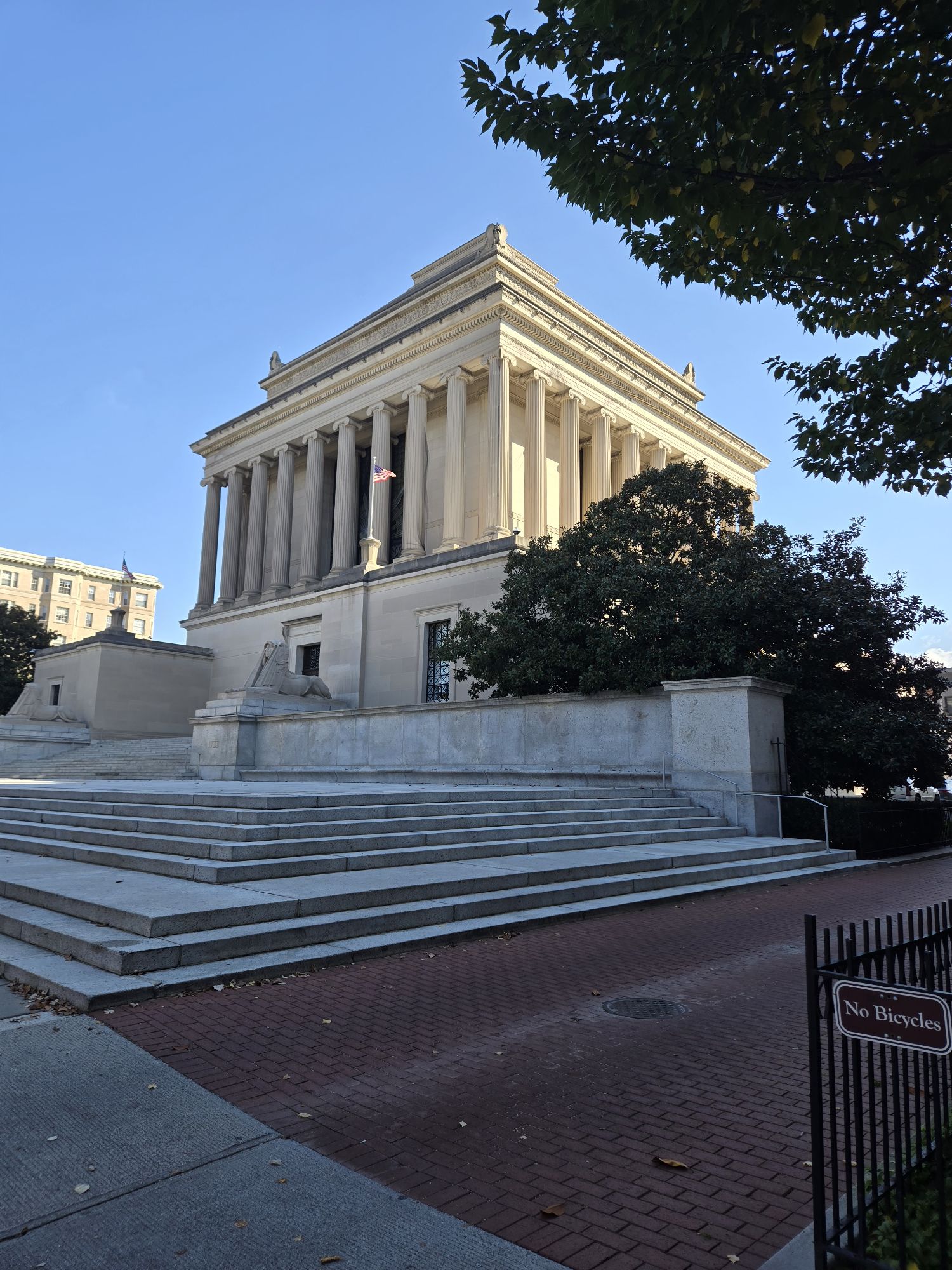
    Next to the Chastleton is the masonic Scottish Rite Temple.

    The Scottish Rite Temple

    This building was completed in 1915. If it reminds you of the Mausoleum of Halicarnassus, don’t be alarmed. That was the model, and the architect was John Russell Pope, who also designed the National Gallery, the National Archives, the Jefferson Memorial and more.

    You can go through the Masonic meeting rooms, the library, the archives, the Robert Burns collection, and more with tours given three or four times daily. The building was built on a deep lot going all the way to 15th Street. The back lot is now home to a large, new, attractive apartment development, still in its initial leasing.

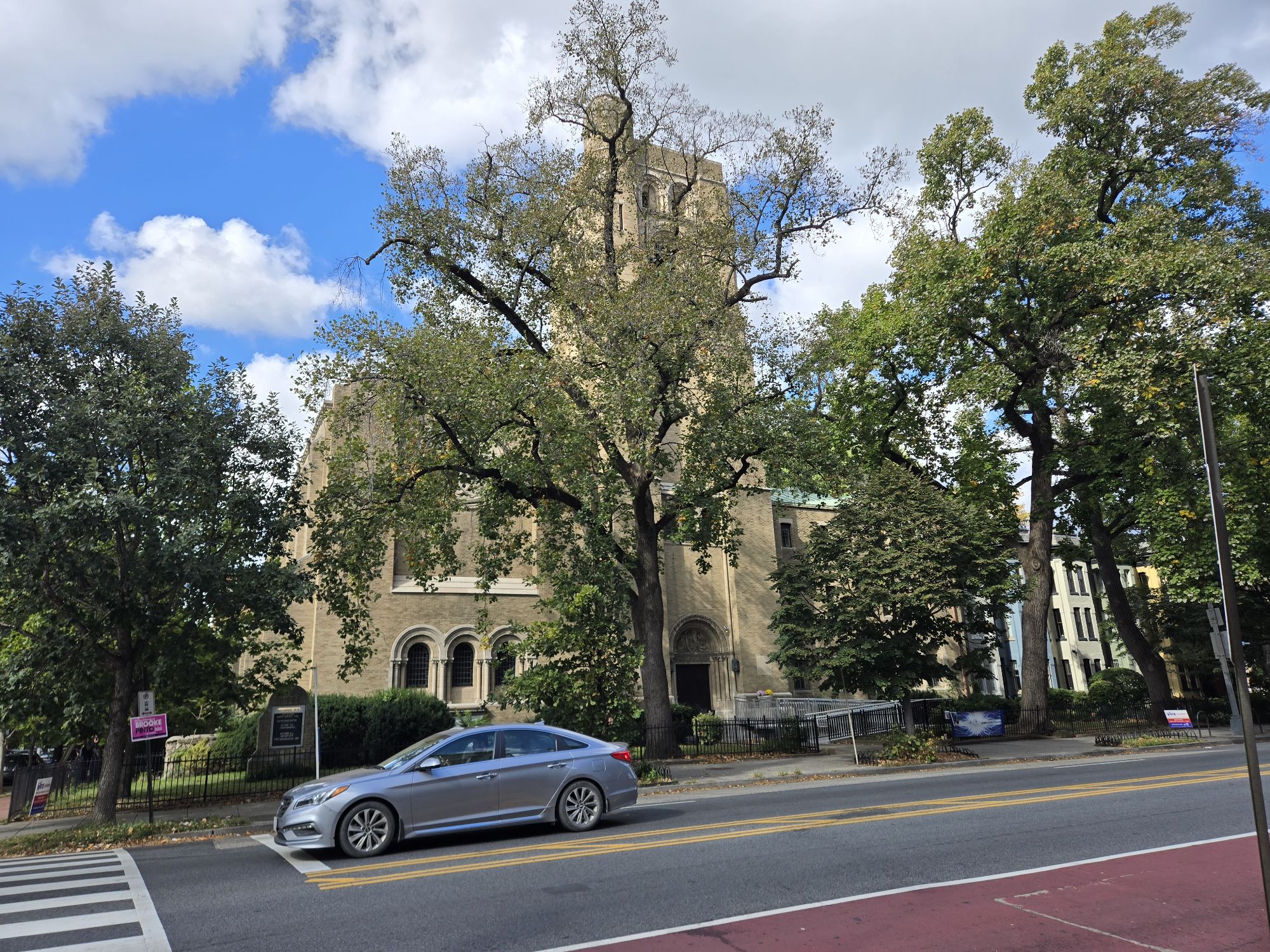
    We continue walking and pass on our left the Universalist National Memorial Church, built to be the main Universalist church in the country, as I understand it, and now a standard Unitarian Universalist church. It opened in 1930. Its architect also designed the Riverside Church in New York,  although you can’t tell by looking.

    Continuing to walk, up from the church, you find elegant townhouses, most of which are now broken into apartment units, some rental and some condo.

    Townhouses

    There was one for sale sign in front of a very nice building. I looked it up. It was a $400,000, 525 square foot, one bedroom unit.

    More townhouses

    Continuing, we see high rise buildings interspersed between groups of townhouses, and one small hotel, the Windsor, whose website pictures look a bit austere.

    High rise apartments and the Windsor Hotel

    We then see two unusual buildings. One is an art deco apartment house, built rather late for the neighborhood in 1952, and looking out of place, but intriguing. There are only ten units in the building, and they may be the least expensive in the neighborhood. The building is named the Stanford.

    The Stanford

    Across the street from the Stanford, there is a modest building with an awning with the initials ICUA prominently displayed.

    The ICUA

    The ICUA is the Interdenominational Church Ushers Association.  Its mission is to provide training for church ushers and networking opportunities, but its website has no upcoming events listed, so whether or not it is functioning, I do not know.

    We are now at the intersection where 16th, New Hampshire and U Street meet. U Street is a major commercial street, and this gives us one of the few opportunities to see anything commercial on 16th Street. We look to our left at this corner and see a building housing a Starbucks. We do not go in.

    Starbucks

    In part 7, we will explore two more blocks. And then, the neighborhood changes.

  • 16th Street (Part 5). O Street to Q.

    October 16th, 2024

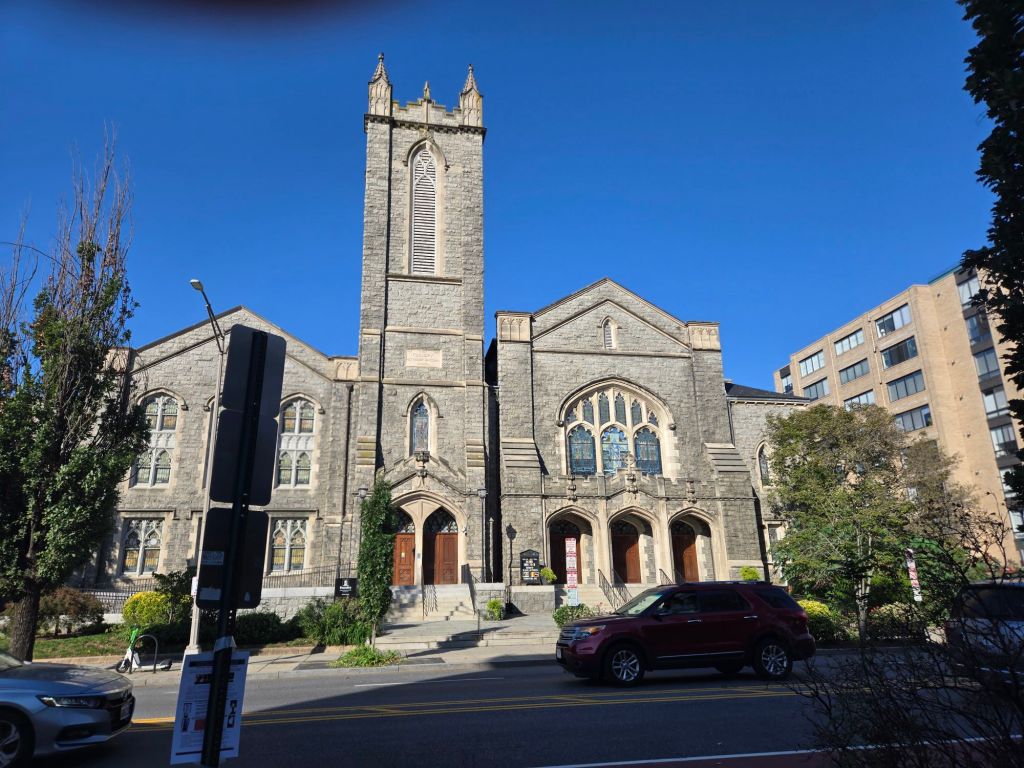
    There are several very important buildings to look at on this two block stretch of 16th.  First, the churches.

    Church of the Holy City

    Let’s start with the Church of the Holy City (1611 16th). The Church of the Holy City dates from the 1890s, and was built by, and is still owned by, the Swedenborgian Church, something that may surprise you, since nothing on the outside sign identifies it that way. In spite of its long history, the congregation no longer needs a church this size (that may not surprise you), and the building has recently been put up for sale (that may surprise you because there is no “for sale” sign). ln the meantime,  it appears there is little activity in the building itself, and most events, including Sunday services, are virtual. The website points out that Helen Keller, a Swedenborgian, spoke here several times.

    The second church is the Foundry Methodist Church (1500 16th).

    Foundry Methodist Church

    I have been in this building several times, not to attend services, but to attend small theaters’ performances in the church social hall. The inside is as gray and heavy as the outside, and I always feel that I have stepped back in time a few centuries. The building dates from 1904, the congregation from 1815. The church has hosted many presidents.

    There is only one embassy on this stretch of 16th Street, that of the Republic of Congo. (Let’s recall that Republic of Congo and the Democratic Republic of the Congo are two separate countries, even though their capitals, Brazzaville and Kinshasa, are directly across the Congo River from each other, and could almost be considered one city).

    Embassy of the Republic of Congo

    The Congolese embassy (1720 16th) is in a large house built in 1894 for Supreme Court Justice Henry Billings Brown, the justice who is known for authoring the Plessy v. Ferguson separate but equal decision, and perhaps not much else. It has housed the Congo for 12 years, and has had other owners before that, including Iran (then known as Persia) and, for a period of six years ending in 1848, the Zionists of America.

    I said there is one embassy. Perhaps I should have said there are two. But one is the embassy of a country that does not exist – Kurdistan.

    The “embassy” of Kurdistan

    Now to the Carnegie Institute of Washington building (1407 16th).

    Carnegie Institute

    In 1902, Andrew Carnegie created the Carnegie Institute as a scientific research organization.  He housed its administrative offices this building. Its research facility is located on Broad Branch Road NW, about a half mile from our house, in a park-like setting. I don’t think anyone really has any idea what goes on there.

    But the 16th Street building no longer houses the Carnegie offices, I don’t think. The building was sold to Qatar about three years ago, with the expectation that it would become its embassy. The current embassy is on 25th Street NW in DC’s West End, and I don’t know where the move to 16th Street stands. But maybe I should have said there are three embassies.

    There is no sign referencing Qatar in front of the building. Around the side on P Street, there is a modest entrance with an even more modest sign that says Embassy of the State of Qatar. If memory serves, a decade or more ago, that side entrance took you into a separate suite, then occupied by Ralph Nader. The building also has a large formal auditorium, seldom used for public events.

    Residential buildings (1500 block)
    More residential buildings

    There are residential buildings, as well, on these two blocks, including the art deco building, Hightowers, where our cousin Alison lives. She can tell you about the ghost of Hightowers.

    Three more buildings, and then we will stop for the day.

    PETA DC

    This converted residence, complete with an anti-circus circus elephant in front, is the DC headquarters of PETA (People for the Ethical Treatment of Animals), standing at the corner of 16th and Q.

    Directly across the street is the Edlavitch DC Jewish Community Center, a building we have been in hundreds of times and where daughter Michelle has for years and years taught pre-schooler music classes.

    DC Jewish Community Center

    An entire column could be written about this building, which houses two theaters (this is where the professional Theater J is housed), a gym, a swimming pool, a basketball court, meeting rooms, etc, and from time to time, a restaurant.

    The building was opened as the JCC in 1926. When a new JCC was built in Rockville MD, the DCJCC was closed in 1968 and the building sold to the DC government. In 1997, the building was sold back to the Jewish community, totally renovated and reopened once again as a Jewish Community Center. Of course, the Rockville Center is still thriving, and a third active Jewish Community Center is now operating in Fairfax County VA.

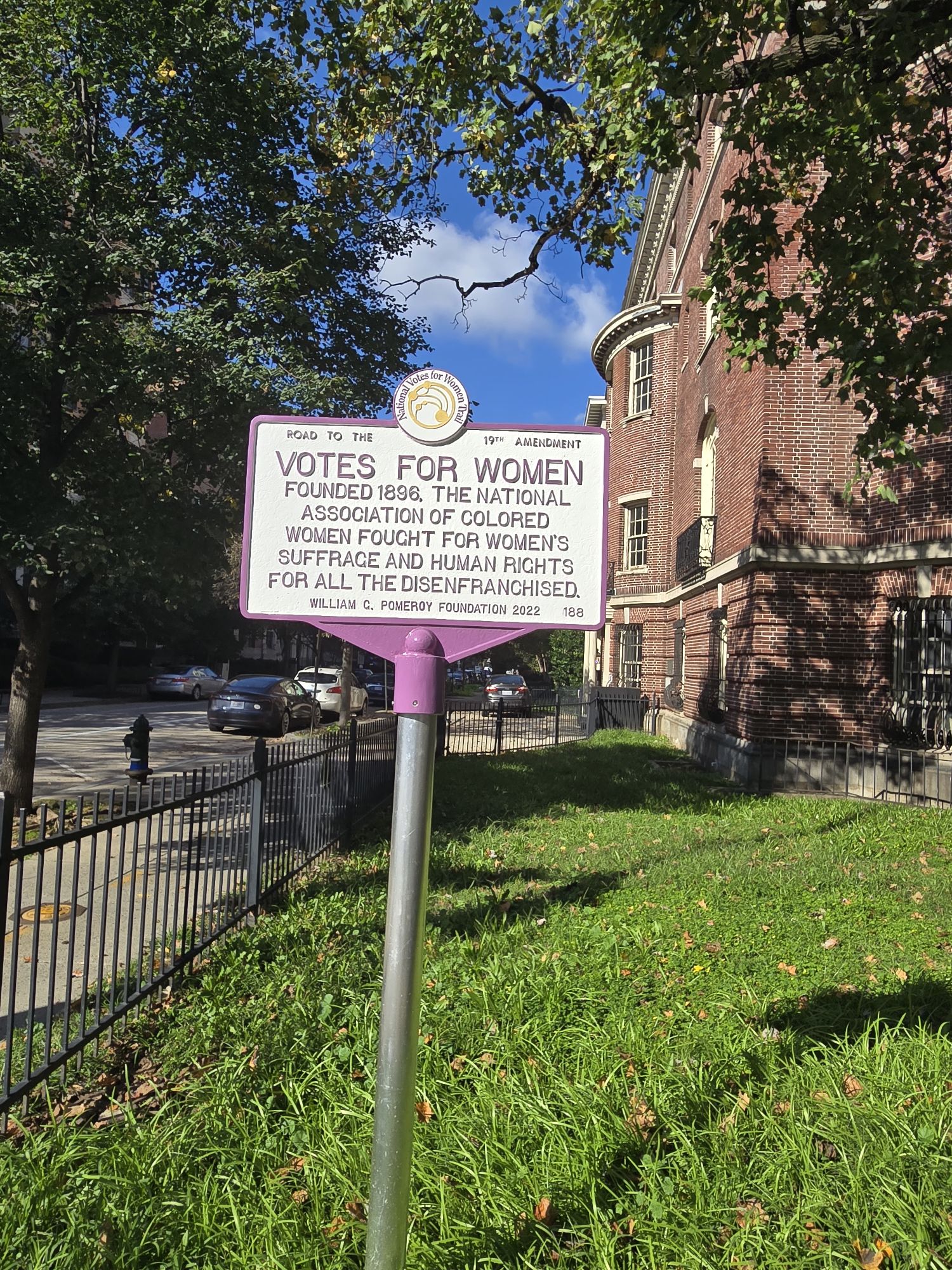
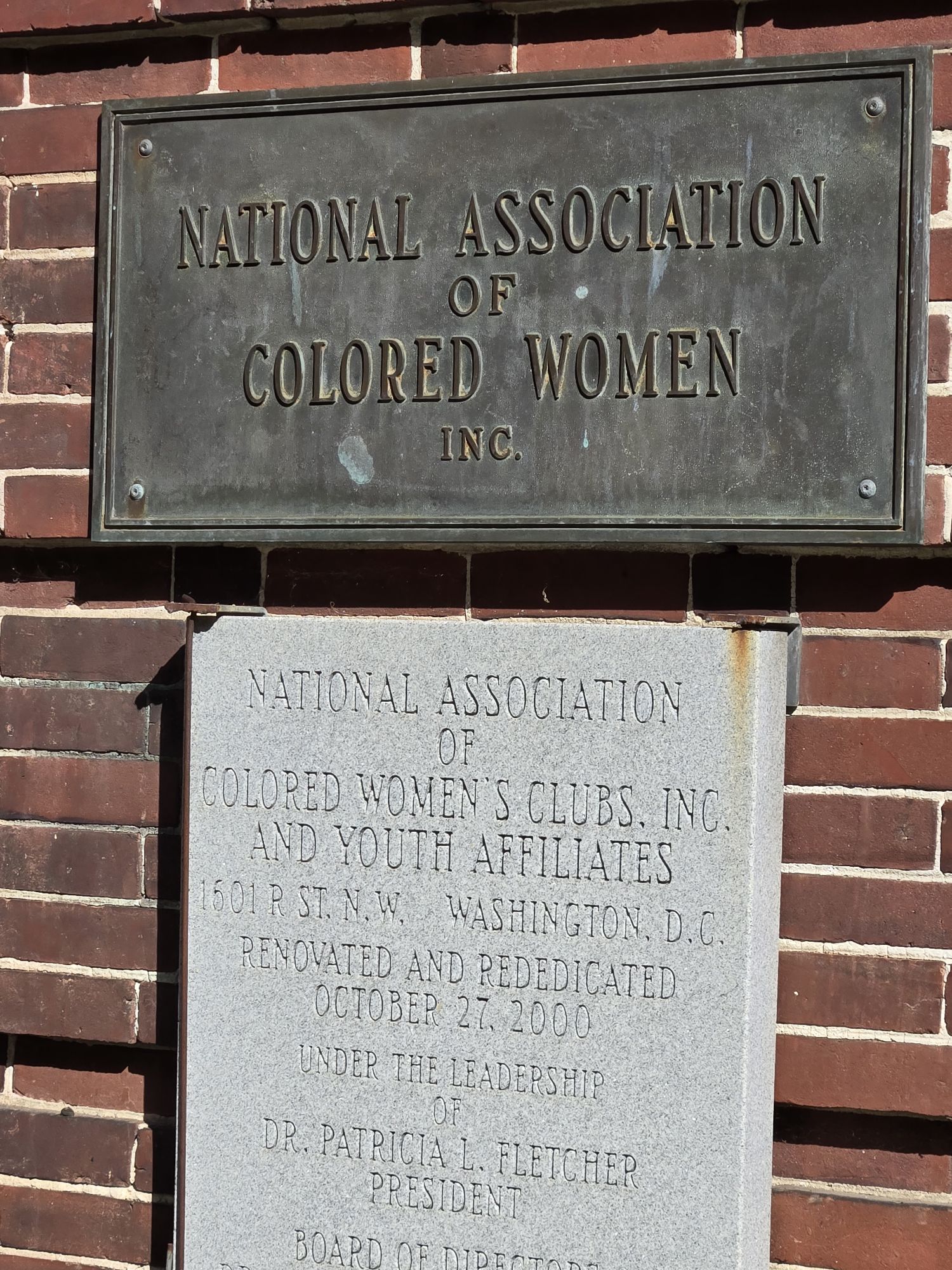
    The last building is another old red brick house with a sign in front and another around the side.

    The National Association of Colored Women

    We will continue our slow walk up 16th Street soon. In the meantime, I should tell you that this is the 700th consecutive day when I have published a post. Perhaps I will break the Cal Ripken record yet.

  • This Post Mentions Hamilton College, Yale, Princeton, Vanderbilt, Arizona State, Sarah Lawrence, the Universities of Missouri, Wisconsin and Indiana, and Of Course, Harvard.

    October 15th, 2024

    This one will be a little different, but bear with me. I know you will learn something.

    Edie’s first cousin, once removed (the son of her first cousin, Ted), Steven Tepper was inaugurated as the President of Hamilton College about two weeks ago. Before taking on this enormous responsibility, Steven had occupied senior level positions at Princeton, Vanderbilt and Arizona State. We watched the impressive inauguration ceremonies on YouTube last night.

    Hamilton is located, as you may know, in upstate New York, in the “village” of Clinton. I was on the campus one time, about twenty five years ago, when Hannah was looking for schools and she and I did a New York/New England trip. I was very impressed with Hamilton then (we had a very good tour leader), and thought that it would be a very good place for Hannah. She, as I recall, had no interest in the place, and the second she stepped on the Sarah Lawrence campus, said “this is where I want to go”. She made a good choice.

    I had not focused on the obvious. Hamilton College was named after Alexander Hamilton. It was founded, I learned last night, by a Presbyterian minister named Samuel Kirkland with the active cooperation of Alexander Hamilton in the 1790s, and officially chartered in 1812 and named after Hamilton eight years after he was killed by Aaron Burr in 1804. Kirkland also was no longer alive when the school was formally chartered as Hamilton College.

    The ceremonies began with a reference to the College being established on the land of the Oneida Indians, and with a further reference to the work that Rev. Kirkland had done with the Oneidas. It was proudly stated that the school was started as a school for both “White” and native boys, and that this was unique and something to be proud of. I was intrigued and decided to look a little further.

    Well…….

    Samuel Kirkland spent decades among the Oneidas and other Iroquois tribes. But it wasn’t because he loved them; it was because he wanted to civilize them and convert them to Christianity. In this, I believe he was somewhat successful. But he was also a negotiator who convinced the Oneidas to sell their land, or a part of it, to the State of New York, and to the federal government, and in the process he himself wound up to be a landowner. And he started the school (as you would expect in those times) as a Christian seminary, and (as Wikipedia tells it), none of the Oneidas who enrolled in the new school lasted more than a year. None of this was mentioned during the inauguration ceremony.

    I am not necessarily being critical of the ceremony planners (I really don’t know enough to be critical), but as I have listened to several classes of the eleven class series involving Yale and its relationship to slaves and slavery by Professor David Blight, and how Yale has had a special project to dig into this touchy question, I wonder whether Hamilton has done the same, and if they will under Steven’s leadership.

    Samuel Kirkland died in 1808. He and his wife had six children, only two of whom survived into full adulthood, a son and a daughter. His son, John Thornton Kirkland, became a Unitarian, not a Presbyterian, minister and more importantly became president of Harvard, where he served from 1810 to 1828. He was an important Harvard president, liked by all. Not that I have searched hard, but I haven’t found anyone who had anything to say about Kirkland that wasn’t good, as a teacher, an administrator and a human being. Kirkland House at Harvard, one of the Harvard residential houses, each of which is named after an ex-president, was (I guess, obviously) named after John Kirkland. I lived in Kirkland House for three years (Suite B-22, overlooking Boylston Street), and never once thought to look to find out anything about John Kirkland. I don’t even think I knew President Kirkland had a first name.

    Samuel Kirkland’s daughter married a man named Lothrop, and her daughter (Samuel’s granddaughter) confused things completely when she, a Lothrop, married a man named Lathrop, John Hiram Lathrop. John Hiram Lathrop was also a university administrator in the mid-19th century.

    Ready for this? Lathrop became the first President of the University of Missouri at Columbia (the first state land grant college west of the Mississippi), and then became the first Chancellor of the University of Wisconsin at Madison, and then became (not the first) President of the University of Indiana, following which he became, for the second time, the President of the University of Missouri. Before his administrative career, he had graduated from Yale, taught high school, become a lawyer, become a professor of mathematics, a professor of philosophy, and a professor of English literature. Oh, yes, one more thing. Before he took the Missouri job, his professorial work was at Hamilton.

    So, you can’t say you didn’t learn anything today.

    As Steven begins his career as the President of Hamilton College, we wish him nothing but the best. I think Hamilton and Steven both made a very good choice, and am sure they will both go from strength to strength.

  • Christopher Columbus- Good Guy or Terrible?

    October 14th, 2024

    Obviously everyone is thinking about the return of the hostages today and the release of the prisoners, but it is also a federal holiday (yes, a holiday during a shutdown is a weird concept), one which has long recognized the now controversial Christopher Columbus. I wrote about my Gaza feelings yesterday, so today I will divert you with an unedited repost of my 2024 Columbus Day writing. It is especially relevant as our president has proposed that any of Columbus’ shortcomings be forgiven and forgotten.  Here goes. Hope you find it enlightening.

    Today, Monday, October 13, is Columbus Day Observed or, if you prefer, Indigenous Peoples Day. Columbus Day itself, of course, is October 12, this year otherwise known as Yom Kippur.

    And that is not irrelevant. Because, as you probably know, although Columbus was born in Genoa, and Columbus Day itself was originated by an Italian organization on the 300th anniversary of his “discovery” of America in 1492 (it became a federally recognized holiday exactly 100 years later, in 1892), there have always been rumors that Columbus was not really Italian.

    Of course, in the 16th century, there was no nation called Italy, and Genoa was in what might be better referred to as the independent Republic of Genoa, and the language of Genoa was not today’s Italian, but a separate Romance language known as Ligurian, one of several languages spoken on the Italian peninsula. So the fact that it was reported that Columbus was not fluent in Italian is sort of a red herring as to his origins.

    But there have been consistent rumors that maybe Columbus’ family was Jewish in origin, migrating from Spain to Genoa. I have read several impressively researched books on this topic, and became kinda convinced that these books were right.

    Now, after a DNA study of more than twenty years, conducted by Spanish scientists, it has been declared, based on Y chromosome studies of Columbus’ two sons and what had been presumed to be (and now appears to be confirmed to be) the DNA of Columbus himself, that Columbus was Jewish, or at least of Jewish family origin. The news was released the day before Columbus Day (October 11) in a Spanish language documentary that I don’t believe is available here quite yet, but will be soon, I am sure.

    Okay, where is this going? I belong to a Thursday breakfast group where, each week, some member makes a presentation on a subject of his choice. Last December, I gave a presentation on Columbus. I had a hard time figuring out how to present it without it being too fact loaded and dry, and came up with a concept of a “deathbed letter”, written by Columbus (obviously actually written by me), penned the night before he died at the young age of 55.

    I know it is somewhat long for a blog post, but if you read it, I think you will enjoy it, and I know you will learn a lot. Here it is:

    “Deathbed letter of Christopher Columbus

    Dec 2023

    It’s the 19th of May 1506.  I am lying in my bed in Valladolid, Spain, hoping to see the dawn.  But I am sick. Very sick. This is not something new.  I have been sick off and on for almost fifteen years.  I am only 54 years old, but I feel much, much older.  I have seen so much.

    After I die, my will will be read, I am sure.  It will be noted that I am leaving one half mark in silver to “the Jew at the entrance to the ghetto in Lisbon”.  That is going to raise a question that will be discussed over the centuries.  Was I Jewish.

    I want to clear up this question right now.  My answer is:  I just don’t know.  After all, what is a Jew anyway?

    So why am I leaving this poor man in Lisbon a token bequest? Good question. I really don’t know that, either.  In fact, I don’t know his name, and I don’t know if he is still there. How could he be?  All the Jews left in Portugal have been baptized, whether they wanted to be or not.  No one in Portugal identifies as a Jew today. But after all, what is a Jew anyway?

    Let’s go back to my childhood. I was born in Genoa. At least that is what I tell everyone.  But some think I was born on Majorca. Really?  Do I speak like was born on Majorca?

    Genoa was a fascinating place to grow up.  The sea in my front yard. A large city. A prosperous city.  The capital of the Repubblica di Genova. The year was 1451.  The date?  I’m not sure of that – August, September, October?  Is that very important?

    Were there Jews then in Genoa? Again, that’s hard to say.  In 1451, there were lots of Jews in Spain.  And in Portugal. 

    But in Genoa, there certainly wasn’t a Jewish community.  No synagogue or anything like that. But let me tell you a secret.  There were Jews everywhere. Perhaps especially in commercial ports like Genoa.  Not religious Jews, perhaps.  All Jews weren’t religious.  Some were just ordinary folk.

    My father? Domenico Colombo. He was born in Genoa, too.  In 1418.  Passed away just seven years ago.  My grandfather’s name was Giovanni.  I actually don’t know if he was born in Genoa or not.  Could have been – I didn’t get a chance to know him very well. But he, like my father, was a weaver.  You know, Genoa in those days was famous for its woven wool.  Fabrics were exported everywhere, and my father was an artist in his field.  He wanted me to be a weaver, too.  I think he expected it. I gave it my best for a few years.  But – to tell you the truth – it just wasn’t for me. There was also a lot of weaving in Spain.  Most of the weavers were Jewish there.  Not sure why, but that’s a fact.

    You are going to find out, I am sure, that no one ever heard me speak Italian.  That’s probably true – I rarely did, and when I did, it certainly wasn’t as a first language.  In Genoa, we spoke Ligurian.  Another Romance language – pretty limited geographically.  Might not pass the test of time. And you didn’t generally speak Ligurian when you were out of Genoa – no one would know what you were saying.  To be from Genoa, and to have contact with the outside world, you needed another language.  One, at least.

    I spoke Castilian.  In fact, in my house growing up, we often spoke Castilian.  Why? I don’t know.  I never questioned it.  But it helped when I went to Spain.  I could talk to people. Although I must say that my Spanish was a bit different from the Castilian spoken in Spain.  Weird, you say.  True, and I could never understand why. But then one day, I ran into someone who said to me:  You’re Castilian is so old-fashioned.  Like you learned it one hundred years ago!  Then I realized that it must be true.  Maybe my family came to Genoa from Spain, and brought the Castilian that we still spoke with them.

    Oh, I forgot to mention my mother.  Susanna Fontanarossa.  Or maybe she was Susanna from Fontanarossa.  Names are funny things. She was from Genoa, too, but from a neighborhood on the outskirts.  She was quite wealthy. My grandfather owned a lot of land. In fact, a village.  The village was called Fontanarossa (that’s the Italian name) – but was the village named after him, or he after the village?  I don’t know.  His first name was Jacob – okay, Giacomo.  Where did he come from originally?  Once more, I am really not sure. But he spoke Castilian too.

    There are those who say that my family, or maybe part of my family, were at one time Jewish.  That has always intrigued me and I was interested in why they suggested that. You know, there are no Jews in Spain today, and haven’t been for about 15 years now.  In 1492 (a famous year, to be sure), my queen and my king exiled all of the Jews, or at least those Jews who did not fully convert to Christianity. But the problems for the Jews in Spain started about 100 years before that.  There were major riots (following an extensive church inspired campaign) in and around 1391.  It is said that more than half of the country’s Jews became Christian back then, leaving about 250,000.  And, at that time, some Jews who had the resources to leave Spain, left and went to various places around the world – Genoa was one, for sure.  Is this what happened to my father’s family – weavers leaving Spain to head to a commercial center like Genoa? Is this what happened to my mother’s wealthy family – with my grandfather’s family being wealthy enough to buy so much land on the outskirts of Genoa?  Did this joint background bring my parents together?

    We were Catholics – at least that’s what we said we were and that’s what I think I am – but we only did what was expected of families like ours.  Were we performing any Jewish habits inside the house?  I don’t think so, but maybe I just didn’t pay enough attention.  Everyone in Genoa was Catholic. I don’t know if I ever heard the word Jewish until I left home.

    I was only 14 when I first left home and took a job as a cabin boy on a ship.  For the next few years, I divided my time between land and sea, helping my father when I was home, and learning everything I could about navigation when I was at sea.

    In 1473, when I was 20, I was hired by three wealthy families in Genoa to act as an agent for their commercial businesses.  I traveled all through the Mediterranean and even went to Britain and Ireland. In 1477, I went to Lisbon and found my older brother Bartholomew. He began to work for one of the families with me, one of the families that had engaged me four years earlier.  I met Felipa during this time – on a trip to Madeira – her father held an important position there; he was governor.  We married and had a son, Diego. Because of the connections Felipa’s family had, and the people I had met representing the Genoese families, I was pretty well connected. But  then I spent three or four years working on ships trading along the west African coast, but went back to Portugal in 1784, when I heard that my wife had passed away.  It was a real loss for me.

    Shortly after that I met Beatriz – she was only 20 and we never married, but we had another son, Fernando.  I still see Beatriz, and I hope that my brother Bartholomew takes care of her financially from the resources he will inherit. I trust him to do this.

    I admit I am a fairly smart fellow.  And if you are smart and apply yourself, you can learn a lot while you are at sea. I already had, as you know, learned to speak Ligurian, Italian, Castilian, and Portuguese.  At sea, I also taught myself Latin.  And I did a very large amount of reading.  There is so much dead time at sea that you can do all of this.  I read history, travel and geography books.  I read about astronomy and navigation. And I read the bible.  I became especially interested in the Old Testament.  And the Jews.

    People are surprised that I knew so much, because I really never went to school.  But take it from me, you can learn more by yourself on a ship than in a musty classroom with a half educated teacher.

    I also paid attention to what was going on in Portugal, now my home.  Portugal was trying hard to find a sea route to the east, to the Indies, so they could bring back spices and other eastern delicacies, and compete with the Muslims. For decades, they had been exploring the coast of Africa, hoping to find a sea route around the bottom of that continent.

    But I had a different idea. You may think that we in the late 15th century were pretty stupid and thought the world was flat.  No one – at least no one of any intelligence – thought that.  The world was round, a sphere.  And, having read so much, it seemed to me that it would really be feasible by sailing west across the Atlantic and winding up east, in the Indies.  Easier than going all the way around Africa.

    Unfortunately, I couldn’t convince the royal family of Portugal to fund such a trip. They thought the future was to send ships around the Cape of Good Hope.  And they thought that the trip I suggested would greatly exceed my budget.  I couldn’t convince them otherwise even though I was close to most of the Portuguese cartographers (and most of them Jewish, as you may know).  Some I met through my wife; some I just met on my own.

    So I approached the Spanish monarchy as well, and they thought we had underestimated the distance to the Indies. I couldn’t convince them otherwise.  They thought I had not planned correctly for the voyage. Now, I know they were right.

    And we approached the English.  They had no interest at all.

    Then back to Spain. In Spain, I had a lot of supporters.  I had supporters who were close to the king and queen, and I had very wealthy supporters who were willing to financially support my trip.  Guess what?  They were all Jewish.

    Spain was a very Jewish country, and I enjoyed that.  Some of the Jews had converted to Christianity, but – to me and to everyone else, including themselves – they were all still Jewish. And many of them were very wealthy.

    So when I went to try to convince the king and queen, all of my supporters were Jewish, or formerly Jewish, and they were my supporters and my friends.  And I was very comfortable with them.

    You know there were many reasons for this trip.  There were many reasons to reach the Indies and commerce was a very important one – but not the only one. The others included acquiring new lands in the name of Ferdinand and Isabella. And then there was the question of spreading Christianity to areas which had never seen a Bible.  Or maybe it was finding people who had seen the Bible, who were already Christians (or Jews) and who were simply isolated from our part of the world. The lost tribes. Or maybe we would find some relics.

    But the end was clear – we were free to go, at the expense of the queen and king, and even more at the expense of the Jewish Sanangelo family, and if I was successful, Queen Isabella promised that I would be named Admiral of the Ocean Sea, and viceroy and government of all captured lands, and I would get 10% of all profits from these lands, in perpetuity.

    I got together my crew.  I made sure I had Jewish crew members.  First, if we ran into the lost tribes, we wanted to be able to speak with them, so I had a Jewish translator, but there were others as well. I can’t even list them all.

     So on August 3, 1492, we left Spain, and on October 12, 1492, we landed in what we assumed were part of the Indies.  That was a big day.  Remember it – October 12.  My crew joked.  One day, they said, they are going to call this day “Columbus Day”.  Who knows if that will ever happen?

    We had left Spain with three ships.  The biggest, under my command, was the Santa Maria, and the others, smaller caravels, were the Pinta and the Nina. Actually, the name of the second wasn’t the Pinta – but we called it that because it was painted very nicely; I don’t even remember the real name.

    We thought we could sail straight through, but shortly after we left Spain, the Pinta had a problem and we stopped in the Canary Islands for repairs.  We had to stay several weeks in Las Palmas.  We were lucky that they were able to help us.  After all, it had been less than 10 years since the Canaries were given to Spain.  Before that, they had belonged to Portugal. Portugal was not likely to help a Spanish ship.

    Everyone had a different idea about how long the trip should take us – different ideas about the size of the Earth, and about how far away the Orient would be.  And we also didn’t know precisely which direction we should take to find land earliest.  But about four weeks out, about a week before we landed, we saw birds – large birds.  So we decided it would be best to follow them, so we changed course a bit and proceeded. And on October 11, a sailor on the Pinta spotted land.

    Of course, we did not know exactly where we were.  I named the land San Salvador – made sense to me, right? Ferdinand and Isabella would approve.

    We knew we were on an island, not the mainland, and we spent the next few months exploring this island and others close by.  We saw that the islands were inhabited. The natives were very welcoming.

    It was similar on most of the islands.  Until we got to the last one – this island was populated by very aggressive people, who didn’t want us there at all.  And we were told about still another island, where the natives were even worse.  They were said to be cannibals, and we were warned to stay away.  They were called Caribs.

    We left the Indies to return to Spain in the middle of January, 1493.  We only took the Nina and the Pinta; I sailed on the Nina.  The trip back was not as pleasant as the trip forward.  We went into a big storm, and we were separated.  I didn’t know if the Pinto survived or not.

    The Nina took refuge on the Azores, which were Portuguese, not Spanish.  I was afraid of trouble.  The Portuguese leader in the Azores thought the Nina was manned by Spanish Pirates and didn’t believe the story I told him.  It took some time, before the Nina and its crew were freed, and permitted to go back to Spain.  I don’t know if we could say we were prisoners while in the Azores, but we certainly weren’t at liberty.

    After we left the Azores, fate intervened with more with more bad weather, and we were forced to land in Lisbon, my home of so many years but an enemy of Spain.  At first, we thought there would be trouble, because the King of Portugal, who was generous enough to meet with me, told me that we should not have undertaken the trip, that it was a violation of a treaty between Portugal and Spain, which had given the Canary Islands to Spain, but had determined that Portugal had the right to all Atlantic travel.

    But he did let us return to Spain, and soon after landing we were able to meet with King Ferdinand and Queen Isabella in Barcelona. I had brought back four natives from the islands to Spain with me.  We also brought back some gold, and some pearls, and a few things that we never had in Spain – I am not sure what the natives called them – I just don’t remember – but maybe one was called “pineapple”, one was called “tobacco” and one was called a “turkey”.  Something like that. I told them about the beauty and the wealth of the land.

    It was too bad that we couldn’t go further and had to return.  If we had been able to proceed west from these islands, I am sure we would have reached the known part of the Indies and China in short order, which would have been so important for our trade. But we didn’t.

    I made three other trips to these new lands.  They were not as pleasant as the first, and I am not going to write about them here in detail.  We went with a much larger group of sailors.  We had over 15 ships.  And our hope was to continue our friendly relations with the native population and bring them to Christianity, and to set up trading posts, which could be used for future trading with China.  And of course to explore more. But things got out of hand.  This time, we ran up against all sorts of unfriendly natives – people who had very uncivilized habits.  Eating male captives. Raping and enslaving female captives.  That sort of thing.  And our men also caught natives stealing from us.  I had to allow my crew to treat the natives in their own way – to punish them harshly when appropriate, but also to teach them to be Christians at the same time.  But they never got to that stage.  And I know all of this is very controversial, but I think we only did what we had to do under the circumstances.

    But that was also when I began to be sick.  For a long time on this voyage, I was bedridden. I couldn’t lead my men and they did what they did, and I must admit some did things that I did not support. Like taking natives as their own slaves, and buying and selling them.  That sort of thing.

    We had discovered and explored many new islands on that trip, some of them quite large, but we hadn’t got to China or anywhere on the mainland.  That was the point of the third voyage, which followed the second in short order.

    This trip was even more of a disaster.  We explored more islands, and found what we thought was the mainland, the eastern continent, with China and all that.  But it wasn’t China; we don’t know what it was. 

    It was on this third trip that we brought with us a few hundred men to remain in the islands, to establish permanent settlements.

    At the same time, I got very sick again, and could do little.  That’s when many of my men began to disregard me, just ignore me, to turn against me. They claimed that I had brought them to this place, and promised them they would find riches beyond their imagination, but they found none of that – only hard work.  They also accused me of ignoring the goal of religious conversion and of engaging in the slave trade myself.  Can you believe that? Some of my men were so much in rebellion that I had to have them hanged.  I didn’t realize how badly that would go over with the rest of the Spaniards who had made this third trip.

    You know that’s when the Queen and King had me arrested, ordered me back to Spain and I was enchained the whole voyage.  They took away all my rights as governor of the newfound colonies, and completely violated the contract they had made with me after the first voyage.  But my health was bad, making it difficult for me to even respond.

    So here I was, no longer in charge of anything, in continual pain and bad health.  We are only talking about five or six years ago.  That’s when I was faced with so many accusations:  that I wouldn’t allow slaves to be baptized because I wanted them to remain slaves, that I was trafficking in slaves, that I punished and sometimes killed both Spaniards and natives by having them starved, or beaten, or chained together, that I cut off hands and noses and ears, and more that I can’t even begin to write about.  There was a trial.  What could I do?  I confessed to some of these things, and awaited my punishment.

    It could have been worse. I was jailed for six weeks.  My possessions were all removed from me.  Then the King showed some mercy and let me go.  For all that I had done for Spain, you would have thought they would have rewarded me and not made me suffer like this.  But one thing:  they said I could return to sail across the Atlantic once more.  And I did.  Just three years ago.

    I had a new goal.  I wanted to sail all around the world. No one had ever done that.  But once again, the weather did us in.  We sailed the Atlantic quickly and smoothly, but then hit what I can only call a hurricane.  We were stopped for a long time, and then made our way to part of the mainland called Panama and we were told there was another ocean across the land.  We hoped to be able to sail around to it.  After all Vasco di Gama had just sailed around the southern tip of Africa for the Portuguese and had already reached the Indies that way – we have lost so much time here.

    But the storms and the unfriendly natives kept at us, and we were forced to the island of Jamaica where we remained, if you can believe it, over a year, with no way out.  We had lost about 1/3 of the men who had sailed with us already and on Jamaica there was more mutiny and fighting.  Finally, the King sent some ships to rescue us.  While some of the men decided to stay longer or permanently in Jamaica, the rest of us went home to Spain.  My son and I had to pay our own way.

    And that was just a little over a year ago.  And here I am.  I am at the end of my days.  That last journey, after all of the terrible times of the trial and its aftermath – no one could be expected to survive.

    So, here I am.  I am sure I am on my deathbed. I need to pray to God.  I know how the Catholics do this.  I know how the Jews do this, too.  Please help me!  I have no idea what I am.  I have no idea what to do.  It has come to this.”

  • Yesterday……

    October 13th, 2024

    At Adas Israel, the Conservative congregation we belong to, Yom Kippur is an extravaganza. In fact all holidays are. Located about a mile from our house, just off Connecticut Avenue, the latest statistic that I have seen shows Adas with about 1900 membership units (a membership unit can be a family of 12, or a single individual). On Yom Kippur, for the most part, Adas holds three simultaneous services, a service in the sanctuary (which holds about 900), a more traditional service in a smaller room (which holds about 300), and an outdoors service under a large tent (which, according to one of the rabbis yesterday, has been set up with 2500 chairs). So, all in all, about 4000 people attend Yom Kippur services at Adas Israel.

    We spent Friday night and Saturday in the tent. Throughout the day yesterday, the tent was pretty well filled. Yom Kippur at Adas Israel is also an all-day affair. Services begin at 9 a.m. The published schedule showed the services primarily ending with the blowing of the shofar (the only blowing this Yom Kippur, since the shofar is not blown on Shabbat) at 7:18 p.m. In fact, the shofar was blown at 7:18 p.m. Like clockwork.

    Over Yom Kippur, we heard two sermons, one by each of the two senior rabbis. I thought they were both good. (I don’t always feel that way, of course). My very short descriptions of the sermons here won’t do them justice, and (in fact) may not even be accurate, but it is what I remember.

    Rabbi Holtzblatt’s sermon was on being true to oneself in recognizing who and what you really are, something that she says is often hidden as you put up an identity for the public (and often private) that may not be your true self at all. She hears this as a rabbi when she counsels people and discovers that they may not, deep inside, be anything like what they appear to be. And she talked about herself. Her message was that Adas Israel was a community, and in this community, you should not be afraid to express and be your true self and, as a community member, you should be accepting and encouraging to those who let you in on who they really are. That Adas Israel should, in effect, be a safe space.

    Rabbi Alexander’s sermon was on what happens after one’s life ends. No, not heaven and hell, or gehenna or any of those things. Not about resurrection of the dead, either. But about how the presence of people who have passed away continue to permeate one’s life. His prime examples related to his mother, who died eight years ago. When Rabbi Alexander and his brother were playing music together, he felt his mother’s presence. When he met the grandmother of a newborn (the grandmother not a member of the Congregation) and they both learned that she had worked with Rabbi’s Alexander’s mother in Florida for years and that they were very close, he felt his mother’s presence in the conversation. He elaborated from there, and went on to other things, but frankly I don’t remember where he went with the sermon, although I do recall that it was very passionate. Someone will remember this better than I, and tell me what I have already forgotten.

    During the quiet time between the end of the morning service (which doesn’t end until close to 2 p.m., and the start of the afternoon service (about 4:30 or 5:00, I think), there is usually a prominent guest who gives an informal presentation. Last year, it was Kamala Harris’ husband, Doug Emhoff, who is a congregant and was back as a congregant this year. This year it was Lin-Manuel Miranda and his father Luis. I didn’t attend the talk (I am not that interested in the Mirandas), but I understand that the tent was packed and it was well received. The Mirandas, of course, are not Jewish, but there has been a fair amount of Jewish connection in their lives. One of the other Adas rabbis, the education director, was a college classmate of Lin-Manuel’s at Wesleyan (I think, Wesleyan) and they sang together in a Jewish acapella group at college. And, it turns out, that he has connections with a number of Adas congregants (who knew?).

    Coincidentally, a law school classmate of mine who attends a synagogue in Los Angeles sent around a recording of a guest lecture from his synagogue yesterday, New Jersey Senator Cory Booker. Booker is someone else who is not Jewish, but who has been surrounded by Jews his entire life, and whatever he says is, in my opinion, always inspiring.

    At any rate, it was a very successful day at Adas Israel and, of course, when you attend, you do have a chance to greet and talk with many people you have known forever, but don’t necessarily see that often. And, yes, our daughters, son-in-law and grand children were there for part of the day as well. 9 year old Joan spent most of the time with her friends – neither her parents nor we had any idea where she was much of the time. And 3 year old Izzy got his glo-stick (is that what it is called?) to be able to join his sister and the other young children on the bima during the shofar blowing. Of course, he left the bima before the shofar blowing, heading into the crowd, and giving his sister (who was in charge of him) a panic attack. Naturally, all was well.

    A break-fast at our house for our entire family (including those who are not Jewish or were unable to attend services) finished the day with equal success. Only two bagels remained uneaten – I thought that was almost as efficient as holding the 7:18 shofar blowing at 7:18.

  • Yom Kippur

    October 12th, 2024

    As was the case last year, I post on Yom Kippur only to keep the consecutive streat alive. For those who fast today, may your fast be easy.

  • Q: Has Obama Lost His Touch? A: Absolutely Not.

    October 11th, 2024

    I have been saying it over and over, and as far as I know, I have been the only one. Until last night. Last night, someone else said what I have been saying. And I must admit he said it better than I did, and certainly said it to more people. The speaker was Barack Obama, talking last night in Pittsburgh. I am not going to get the words exactly as he said it, but basically it was: “Donald Trump boasts of his great economy in the first years of his presidency. He did have a good economy in those years. But the economy that he had was MY ECONOMY!”

    Yes, the second Obama term is the basis of the early Trump economy, just as Donald Trump’s governing was the basis of whatever problems the economy had under the early years of Joe Biden. Why, I keep asking, don’t all the Democrats keep saying this?

    It reminds me of the other thing the Democrats should be saying, but aren’t. Knowing that Joe Biden’s oft perceived shortcomings (accurate or not) are giving some nominally independent voters a push to vote for Trump, why don’t they push back when the Republicans call the current administration the Harris administration, and not the Biden administration? They hint that a vice president can tell a president what to do, or at least veto a president’s decision that could have been better. Or they hint that Joe Biden, from the day he was inaugurated, has been mentally unable to lead his administration and that he, internally and somewhat secretly, told Kamala to take charge. But the Democrats do not push back on this, either.

    Just yesterday, Tim Walz had to take back his very reasonable opinion that the Electoral College should be abolished because it is not “the opinion of the campaign”.

    For a minute, I want to get back to Liz Cheney’s book Oath and Honor, which I finished and really appreciate. I wrote a few days ago about her discussion of the events of January 6 and their buildup, and how I felt every Republican voter and independent voter in the country should be given a copy of at least that part of the book to read. The remainder of the book was about the reaction of members of the House and Senate after January 6 (and particularly the dishonesty and hypocrisy of the Republicans, and about the House investigatory committee on which she and Adam Kitzinger were the only Republican members.

    After doing its preliminary work, the committee held seven public sessions, as you may remember. One interesting point she made is how the focus of the sessions were established, how each was made to focus on one topic and each differed from the one before. What I did not know and now do, if I read everything (somewhat quickly, I admit) accurately, is that Liz Cheney and her husband Paul Powell, both lawyers, developed the outline of the seven sessions, which the committee adopted.

    And, while the first part of the book made Trump and his GOP crew appear dangerous, this second part added to the first and made them appear downright villainous. Because now, in addition to the events as they appeared leading up to and on January 6, we had sworn testimony of many involved on the inside.

    An abbreviated description of the seven sessions:

    1. How Trump tried to persuade the public that the election had been stolen and that he was still the president.
    2. How Trump tried to persuade state officials to “flip official certified electoral votes to Trump”.
    3. How Trump created fraudulent elector slates
    4. How Trump tried to politicize the Department of Justice to force states to flip votes or certify votes of fake electors.
    5. How all of this was done to permit Vice President Pence to count the false Trump electors, rather than the official Biden electors, on January 6.
    6. How Trump promoted a massive turnout of his supporters in Washington on January 6 to further apply pressure on Pence.
    7. How, when it became clear that Pence was not going to cooperate, Trump instructed his supporters to break into the Capitol, disrupt the proceedings and stop the count, keeping quiet even after the invasion of the Capitol when he was begged to call his rioters off and to tell them to go home.

    Obama, in his typically excellent speech in Pittsburgh last night, said that he understood that there were a lot of people in the country who are hurting, and would like to see some change in the direction of the country, in the hope that the change would help them overcome their current problems. But, he said, that he could not understand how anyone can think that Donald Trump is the vehicle that could bring about that type of change.

    Clearly, anyone who has the opportunity to, and who takes the time to, read Liz Cheney’s book would agree with him.

  • Today, I am booked.

    October 10th, 2024

    Today, the DC public schools have a parent conference day, so there is no school, and we have the grandchildren. This means that I have less free time than usual to write a post.

    So what could be interesting and quick? Let’s try this….

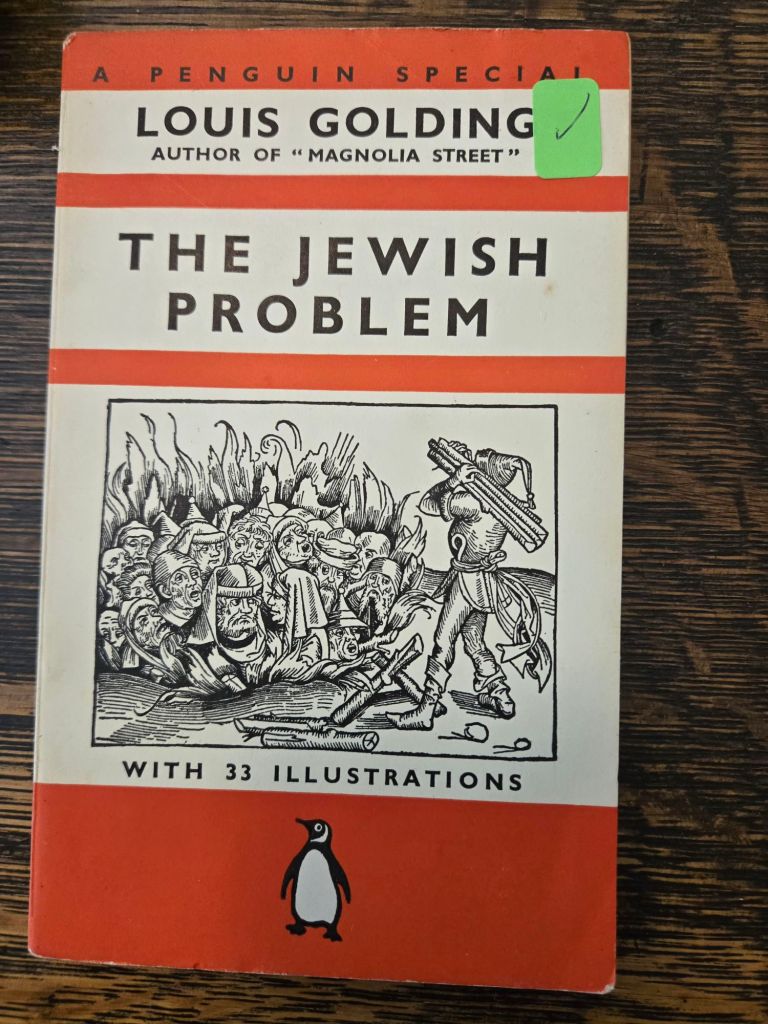
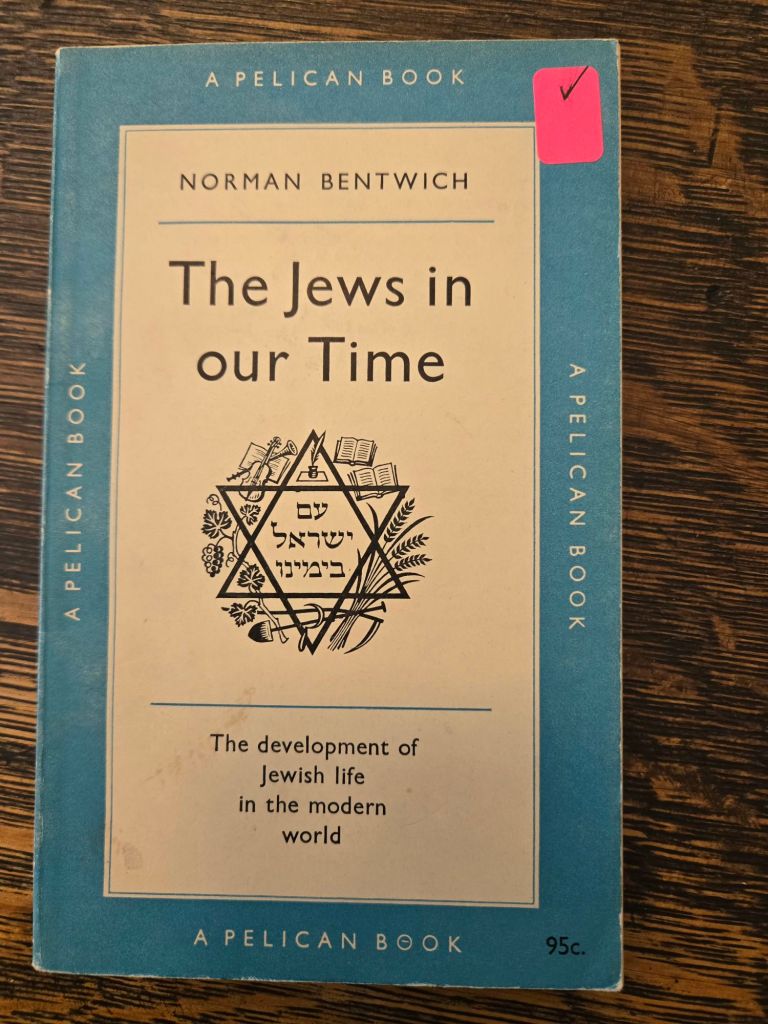
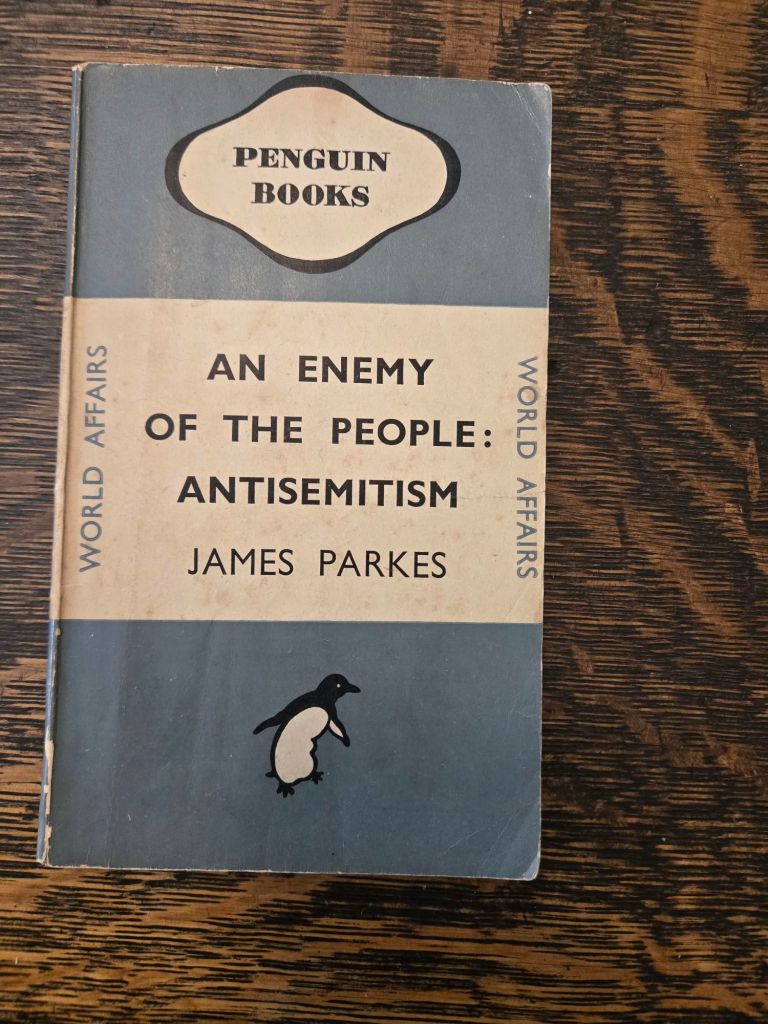
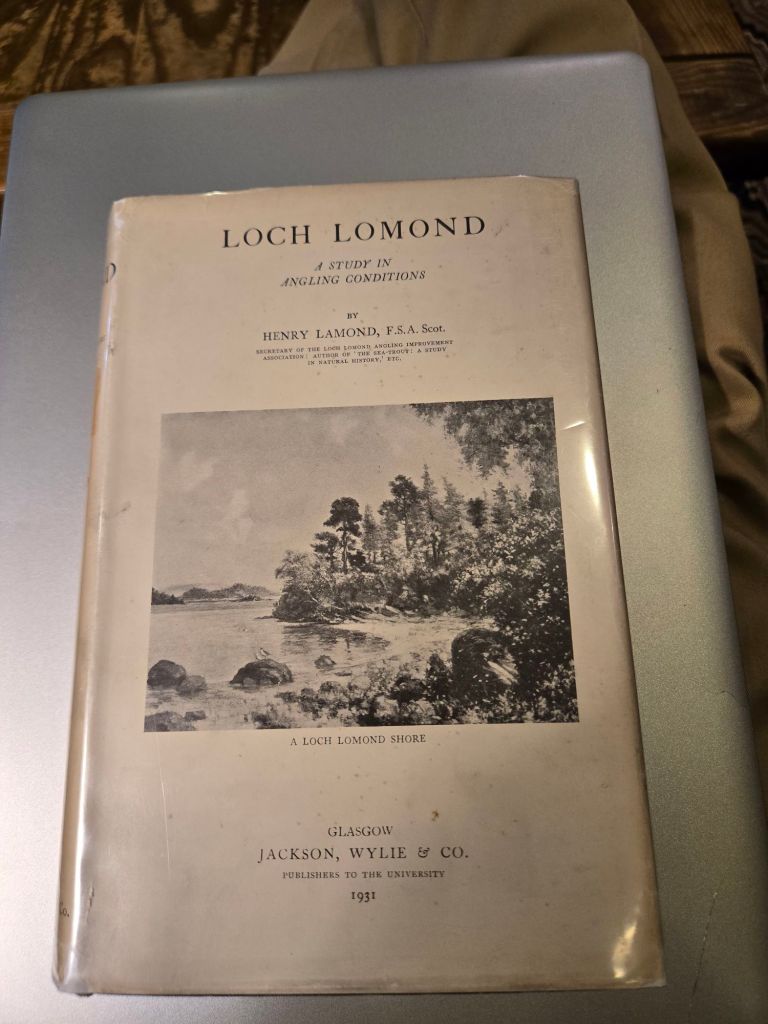
    Of my 700+ Penguin paperbacks, only a small number are of primarily Jewish interest. I have read these six. Each is of interest.

    The Allegro book is a classic, Parkes was a philo-Jewish English writer, and the Epstein book is a really good one volume synopsis of Jewish history.

    Now, to grandchildren…….

    Three year old Izzy is interested in baseball. Here is what he brought out.

  • 16th Street (Part 4) Scott Circle/M Street to O Street

    October 9th, 2024

    Between weather and holidays, there has been a gap since the first three 16th Street posts, on September 23, 25, and 27. We had started at the White House, and moved first through Lafayette Square,  and four blocks up 16th Street to Scott Circle. In those short four blocks, we saw four or five hotels, three small museums, the headquarters of the AFL-CIO, the NEA, and the American Chemical Society, the home of the Russian ambassador, two churches and more.

    Now, we continue up the next two “only in Washington” blocks. We can’t look at everything, but we can see and learn a lot.

    For example, there are four embassies on these two blocks, our first of many. Right on Scott Circle, we see the new Australian embassy, first occupied about three years ago. I find it quite undistinguished on the exterior, but the interior tells another story.

    Australian embassy

    Then, we see the Serbian embassy, located in a 110 year old commercial building, bought by Serbia only two years ago.

    Serbian embassy

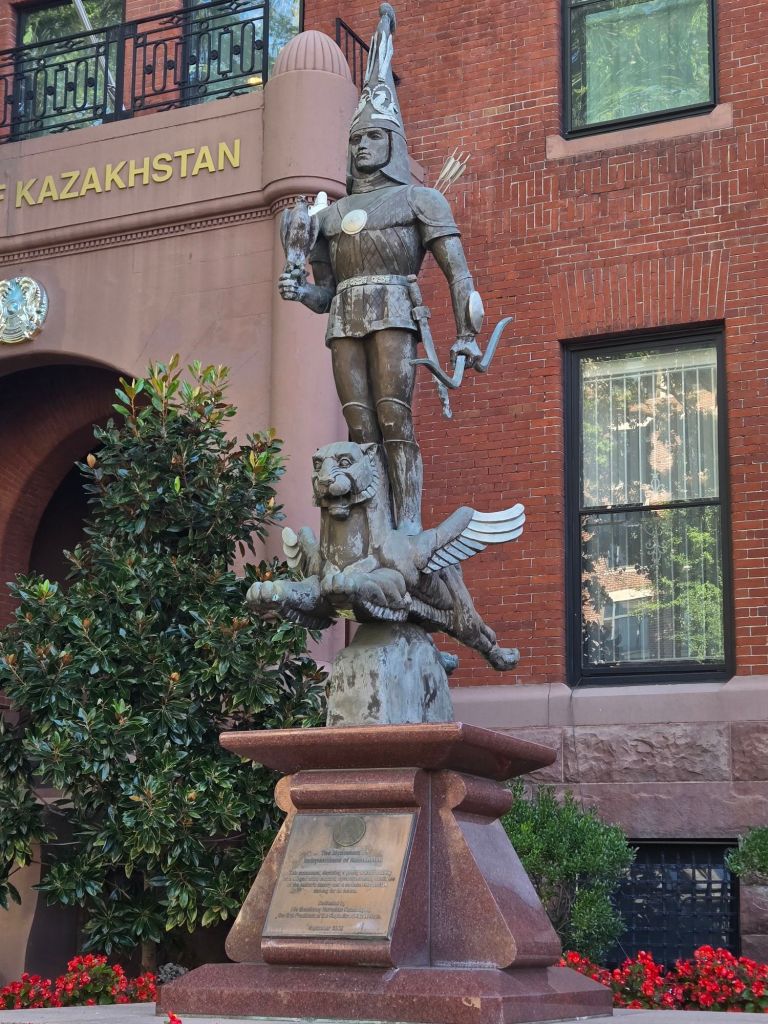
    Up the street from Serbia, we run into Kazakhstan’s embassy, in an 1888 house which had been home to a Vice-President, a Senator, and a publisher, among others. In front of the embassy, you see a replica of the Golden Warrior Monument, the larger original of which stands in Republic Square, Almaty. Its story is interesting. You may want to look it up. Or not.

    The Kazakhstan embasssy and the Golden Warrior.

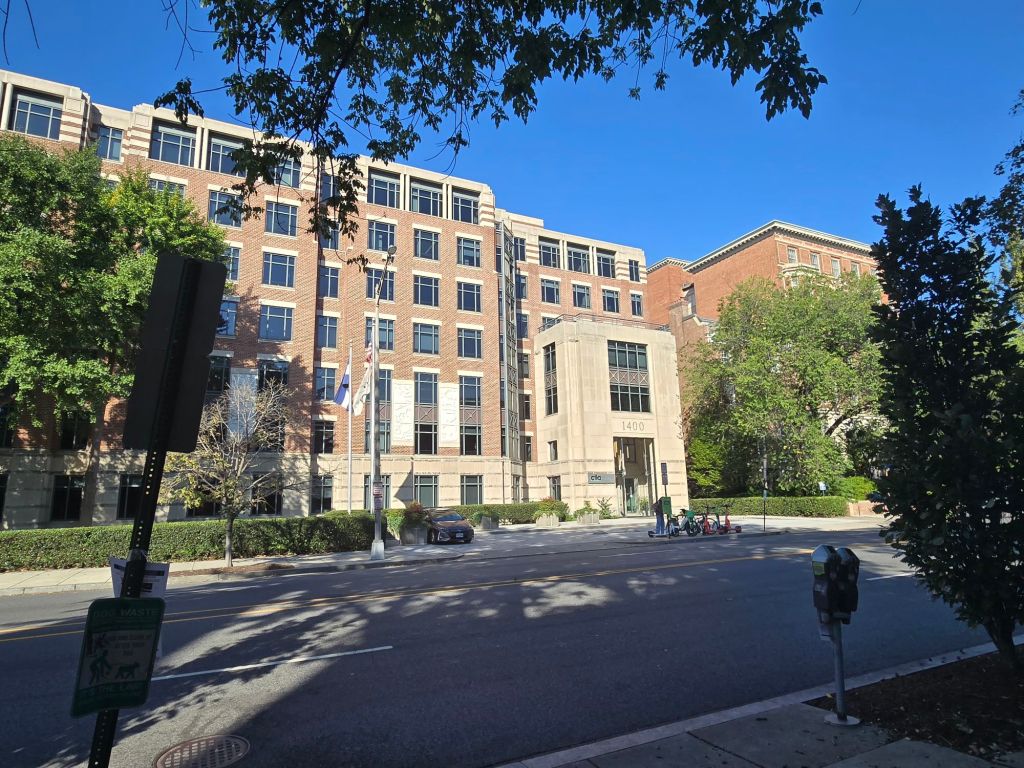
    The fourth embassy is that of the El Salvador. It is different from most because it is not located in its own building, but is in rented space in a new office building located at 1400 16th Street NW.

    This building houses more than this embassy. Among its many tenants are CTIA (the powerful, if little known, trade and lobbying association for the wireless communications industry), the Washington affairs office of the University of Notre Dame, and the Avesta Ketamine Clinic, among other tenants. The ketamine clinic interests me most. I really only know about ketamine through Matthew Perry’s tragic death, but  apparently, it can be quite useful in treating depression and anxiety if controlled. This clinic seems to know what it is doing.

    1400 16th Street – El Salvador’s embassy and more.

    Of course, we don’t want to forget the churches. There are two on these two blocks. The First Baptist Church is located just up from the Australian embassy. The building was completed in 1955 on the site of the congregation’s 1890 church structure. The previous church was apparently architecturally important, with a 140 foot high tower, and controversial when proposed for demolition. But even this building was not the congregation’s original. Established way back in 1802, First Baptist has had several locations, including one on 13th Street which it sold to one John Ford, who converted it into Ford’s Theater.

    One trivia point about First Baptist, and one question. Trivia: during the two years that the present building was under construction, the church conducted services a few blocks up the street at the Jewish Community Center (we aren’t there yet). The question: what 100 year old former U.S. President worshipped at First Baptist?

    First Baptist Church

    The other church is the Founding Church of Scientology of D.C. its building is unchurchlike and I don’t know if there are other tenants as well. It was originally built as an apartment house, with one luxurious apartment on each floor. But that was long ago. It has been many things since. Just have not checked today’s uses out.

    The Church of Scientology

    Ine final point for the day. There is a nice upscale hotel, with a very appealing restaurant and outdoor cafe, on 16th Street at Scott Circle, just across from the Australian embassy. I did not get a good photo.

    It is the Banneker Hotel, named after the same Benjamin Banneker that DC named its academic magnet high school after. The hotel is called the Banneker, because he was the surveyor who first laid out 16th Street moving north from the then proposed  White House in the late 18th century. And 16th Street was laid out as a meridian. I don’t really understand what that means, but we will learn more when we get further up 16th Street to Meridian Hill Park.

    Moving on to my next scheduled activity. Will proofread later. But I did try to be careful.

  • Thanks to Liz Cheney, I Finally Have Something Important to Say

    October 8th, 2024

    I have an important suggestion to make. Read on …….

    Last night, I read the first third (100+ pages) of Liz Cheney’s recently released memoir, Oath and Honor. I call it a memoir, and in a way it is, but this book does not tell you the story of Liz Cheney’s life. In fact, so far (and I would guess this is true for the rest of the book, as well) I have learned virtually nothing about Cheney, except that she has a strong moral compass and the strength and willingness to act in accordance with it. There is nothing in this book about growing up in Wyoming (after being born in Wisconsin, as I heard her say last week), about being the daughter of a vice-president, of marriage and children, running for Congress, or any other such thing. There is also nothing in this book whatsoever about policy.

    This book is about honesty, and loyalty to the concept of the United States as a country of laws, under a constitution. It is not about which laws are good laws, or about whether the Constitution is perfect or flawed. She is not arguing for any sort of revolution. She is arguing against all revolutionary concepts that require the breaching of that Constitution. I don’t think this is a conservative trait. It’s a moral stance.

    Following a prologue, the book is divided into five parts. I have read the first two, titled “The Plot Against America” (homage to Philip Roth?) and “The Attack”. Still to be read are “A Plague of Cowardice”, “No Half Measures” and “The Relentless March of Evidence”. This book is about Donald Trump and his attempt to remain the President, irrespective of the results of the 2020 election, his failure to succeed and the impeachment that followed.

    I read the first two sections of the book with my mouth open. It didn’t even occur to me to close it. The story Cheney tells is (a) very readable and intelligible, (b) remarkably concise, and (c) puts all those things that you have heard a thousand times and have become numb to in once place, so you can see them as a whole, and shudder at their implications.

    The book, so far, is not only damning of Trump, and of some of his White House staffers. It is damning of his personal attorneys, from Rudy Giuliani, Sydney Powell, and John Eastman on down. And it is particularly damning of virtually all Republican members of the House and Senate of whom she speaks. So far the only House exceptions seem to be Illinois’ Adam Kinzinger and Texas’ Chip Roy. On the Senate side, so far (I expect this might change), Mitch McConnell is given, I would say, a grade of C-/D+, much higher than the grades she would give to most of her Republican colleagues.

    The problem, as I glean from her writing, is simple. Trump, to stay in office, was making outrageous claims, even after 60 judges had rules against them. And, she says, most (virtually all?) of her colleagues either knew that his claims were bogus the day he made them, or that they had been unanimously show to be wrong by the courts and that once the legal challenges had been played out, they should be dropped. Yet, she said, virtually every Republican, irrespective of what they thought or even of what they were willing to say to her privately, publicly continued to give Trump’s false claims support and credence. This, she found surprising, disappointing and outrageous.

    While she paints with a broad brush, she does single out three of her fellow members of Congress as being perhaps a step worse than the others. One is Kevin McCarthy, who she describes (my words) as a liar, a hypocrite, and as someone who knows right from wrong, but is too much afraid to act upon what he knows. The second is Mike Johnson, now the Speaker of the House, and the third is Jim Jordan, whom she seems to believe is completely worthless. Perhaps I should add Marjorie Taylor Greene, whom she paints (my words, again), as a clown.

    I am looking forward to the remaining three parts of the book, to be sure. But having said that, the first two parts, one of which deals with the planned and executed attacks against the November 4 voting and the naming of alternative electors and presenting them for approval, and the other of which deals with what happened on January 6, both the rioting, and the actions of House members to certify, or fail to certify, the electoral college votes that had been presented to the House by the various states. And it should be remembered that 139 Republicans, and a half dozen or so Senators, voted against the certification of the constitutionally valid electors.

    So, and although this is at the end of my post, this is what is important, and I am going to write part of it in capital letters because of its importance, just to make sure you look at it.

    I understand that Cheney must have had a number of reasons to write this memoir. One is to preserve what she experienced for history, another is to get it off her chest, perhaps a third is to extract a little revenge against the villains of the piece, and fourth is to make some money. Whatever the reasons, the publication of the book took guts, just as her actions supporting the investigation and then impeachment of the President took guts.

    But I think the first two parts of this book are so important that, money and copyright and all those good things have to be sublimated to making the text available to everyone. And, in this day and age, when you don’t have to pay to bind and distribute hard copies of material, when you can just push a button and circulate material to millions of people, I think that is what should be done now.

    I THINK THAT THIS MATERIAL SHOULD BE CIRCULATED TO EVERYONE ON ANY LIST OF REPUBLICAN DONORS, OFFICIALS, AND PROSPECTIVE VOTERS, YOUNG AND OLD, THROUGHOUT THE COUNTRY. AND I GUESS TO DEMOCRATS AND INDEPENDENTS, TOO, TO ENCOURAGE THEM TO COME OUT AND VOTE.

    Of course, most won’t read it (even if it comes with an introductory paragraph or two showing why they should read it), but we don’t need big numbers. If 5% of those who receive a link to this by email read it and if it changes the vote of even a portion of those people, it could sway the election. And if it circulated widely, its circulation will be reported widely, and it will become news in itself, perhaps leading others to give it a look.

    Now – how do we go about this? We don’t have a lot of time.

  • Photos To Go With Today’s Post.

    October 7th, 2024

    I must have pushed the wrong button. The photos did not get published. Here they are, if you are interested.

  • Books, Books! Read All About Them. (A Change of Pace)

    October 7th, 2024

    Many (read: most) of you know that one of our activities (not quite a business, not quite a hobby) is selling used books on line. We sell about 250 a year, averaging about $30 a book (except for those which sell for many times that). We pay an average of $4 or $5 for each book, and we have about 7,000 on line for sale. We are very lazy about this non-business/non-hobby. We have our inventory listed in one place only, and we sure don’t try to promote. Maybe someday all that will change.

    The books are all second hand. The majority are signed or inscribed by the author. Many relate to politics. Many relate to Jewish subjects. The others relate to about everything you can imagine. We have learned that the signed books that sell, sell because it is hard to find signed copies. In other words, although many people would like to own a book signed by Tom Clancy, there are so many available that someone is bound to undercut your price and the chance that someone would select the copy you have as opposed to copies held by 50 or more other booksellers is not very likely. On the other hand, if you have one of the only copies of a book signed Author ben Author, even if the demand is not very wide spread, it is more likely that yours will be acquired.

    How do I price the books? Not very scientifically, I am afraid. I go to the Abebooks website (www.abebooks.com) and look to see how others have priced the book, comparing condition, edition and so forth. It gets tough when you can’t find out how others have valued the same book, or when there is something that makes your books stand out from others that are being sold.

    Let’s take some examples. Nathan Glazer was an American sociologist who passed away at 95 in 2019. He taught at U Cal Berkeley and at Harvard. His best known book, among many, was Beyond the Melting Pot: the Negroes, Puerto Ricans, Jews, Italians and Irish of New York City, which was published in 1963. There are two signed copies of this book for sale on Abebooks, one offered at $350 and one at $950. Sure, these prices seem high, but it seems that Nathan Glazer did not autograph many books over his long career.

    Nathan Glazer had friends named Joe and Millie. That’s all I know about them, except they were friends over many years, and Glazer inscribed at least four books to them over those years. The books are Beyond the Melting Pot, Remembering the Answers: Essays on the American Student Revolt, Ethnic Dilemmas, 1964-1982, and The Limits of Social Policy.

    Either Joe and Millie, or their children, decided it was time to depart with their books, and they were donated to the Montgomery County library, and put up for sale at $5 for three of the books and $10 for the Melting Pot. (Remember, we are not “profiting” by the sale of the books, which go into an account for grandchildren education)

    When I said that Glazer didn’t appear to sign books, I meant it. The two Melting Pots on sale are the only ones listed on the website. So the question is: how should I price these books? The answer is: I have no idea. So, they will just sit here a while longer.

    A few other examples. I have a copy of a book titled Years of Content, 1858-1886, written by Sir George Leveson Gower, K.B.E., and published in London in 1940. I know you have never heard of Gower. Gower was born in 1858, and at the age of 22 became the private secretary to British prime minister William Gladstone, a job which he held until 1885, ending when the period covered by this book ended. He later entered Parliament as a Liberal, ending his career as Commissioner of Woods and Forests (I don’t know what that entailed, but I bet it was fun).

    This book is not signed by Gower, but that is okay, because accompanying it is a six page letter written by Gower (I have not had the energy to read the entire thing) in 1940 to his friend “Florence”. (I assume Florence was a friend; maybe a relative.) And I have a copy of another, somewhat shorter letter, written to Florence by Cicely Gower, his wife, in 1951, shortly after Gower died, giving Florence the news.

    I don’t know if Gower himself was “important” as far as British history goes, but the fact that he spent five years as Gladstone’s secretary is quite important, and it is this period that the book discusses. And clearly these letters, being originals and one of a kind, add to value to historians and perhaps others. There are only three copies of this book available on the Abebooks site, and one of them is signed. You can have it sent from England for about $45. But how do I price the book with these letters included?

    Do you know Benedict Sarnov? He was a very prominent Soviet (and later Russian) literary critic and intellectual who died in 2014. I have a copy of his books Perestante Udivliatcia (yes, it’s in Russian), which he inscribed and signed (also in Russian). The title means something like “Don’t be Surprised” and the subtitle is “unpublished history”. Nobody has anything signed by Benedict Sarnov for sale. And not that many Americans read Russian. How do you price something like this?

    One more example (out of hundreds). Speaking of the High Holy Days, I have the first volume of a Machzor (the liturgy for Rosh Hashanah and Yom Kippur), covering the first of the two holidays. Hard copy. Very nice condition. I don’t have a date. It was published in Warsaw. The editor was named A. Kahan and the publisher G. Piment. It contains not only the full liturgy, but much commentary, with each level of commentary written in a different font.

    There are many liturgical books from pre-war Poland available, so most are not priced too high. And while there are experts on pre-war Jewish books, I am not one of them. I would guess that this book was published between 1920 and 1938, but I can’t get more specific than that. I have no idea how to price it, even if I wanted to sell it.

  • Help! May Day (in October)! May Day!

    October 6th, 2024

    Let’s see if I can do this quickly. Before I have to leave for a memorial service for a friend who passed away last year. Actually, last night I put together a post about certain of the books we have in the house, but I am going to let that go for another day.

    This morning, I am concerned about a few things. Okay, about a lot of things. Prime Minister Netanyahu, according to CNN, gave a speech saying “Israel faces war on 7 fronts”, and it seemed to me that he said it with a degree of pride. War against “Iran, Hezbollah, Hamas, the Houthis, West Bank terrrorists, and Shiite militias in Iraq and Syria”.

    As I have recently said, it is getting harder for me to judge Israel’s actions, because I just don’t know what is right anymore. Yes, this may be the “time” to try to change the paradigm once and for all. Tomorrow may be too late. And, yes, maybe a war on seven fronts is just one war, not seven and if you don’t do it all at once, it is bound to fail. And perhaps doing it now and doing it all at once is so essential that the extraordinary collateral damages that results from the military action (death, injury, property disruption, economic dislocation, etc.) is a cost that must be paid and, if that cost is not paid today, it will be paid with even greater numbers tomorrow.

    But can Israel do this alone? Can it do it with help from the United States, but not elsewhere? At what point does Israel run out of bombs, or drones, or ammunition, or even personnel? At one point does the war(s) come back so strongly to Israel that Tel Aviv’s high rise luxury office and residences wind up like the Twin Towers?

    And what is the plan after the war is over? Are there back room conversations that we just don’t know anything about? Are the moderate Arab states, the members of the EU, the United States, involved in coming up with plans for modifications of foreign policies for Israel’s neighbors, and the rebuilding of their countries? Or are there not?

    The threat to Israel is enormous, of course, and Netanyahu’s policies real show what happens when you have a gambler in charge. This is an enormous gamble.

    And – yes, it may be secondary, but it is real nonetheless – what is its effect here in the United States? How does it affect antisemitism? How does it affect American Arabs? How does it affect the teachings at American universities? And how does it affect politics.

    The Trump side, so far, has it pretty simple. They support Israel. Period. Full stop.

    The Harris side, not so simple. Harris has so much to worry about. First, can she take a position that is different from Biden? Second, how can she keep the overwhelming majority of the Jewish vote? Third, how can she keep the majority of the Arab vote, so important in Michigan and, I think, in Pennsylvania as well. What should she say? What should she not say?

    Let me segue a bit here. The problem Harris has is not limited to the Middle East. She has to become Mike Pence, and not remain Hubert Humphrey? Know what I mean? The Democrats celebrate Vice President Mike Pence, who broke with Donald Trump to certify the 2020 presidential election. They mourn the fact that Vice President Hubert Humphrey did not win the 1968 election, but lost to Richard Nixon, in large part because Humphrey did not separate his position on the Vietnam War from that of President Lyndon Johnson’s.

    Harris has to separate herself from Joe Biden, and state her own positions, whatever they may be, clearly, even when they differ from her current boss. That reminds me of another question. Are Marcus Johnson and I the only Americans who understand that a Vice President has limited power?

    In his comments after the Walz/Vance debate, university student Johnson made it clear that the vice president’s job is to do what the president asks them to do, not to set their own policies or priorities. This should be obvious. But the Trump/Vance campaign wants us to overlook this distinction. They want us to assume that the current administration is as much Harris’ as it is Biden’s. In fact, because they want us to think that Biden is non compos mentis, they portray the Biden administration as the Harris administration or at best the Harris/Biden administration.

    Okay, that may be good politics on their side. But why didn’t Walz, for example, counter this in the debate by saying: “Hey, this isn’t the Harris administration you are talking about. This is the Biden administration. Was the 2016-2020 administration the Pence administration?” But he didn’t, and the campaign doesn’t. They let the current administration be named the Harris administration without complaint, falling into the hands of Trump, just to be loyal to the president. Big mistake.

    I gotta go. I wanted to say something about Elon (“I am dark MAGA”) Musk. What happens when a billionaire who is more than a billionaire, but someone whose business are are REALLY IMPORTANT, goes completely nuts. But no time now. No time to proofread. Happy Sunday.

  • Spoiler Alert? Read It and Decide For Yourself.

    October 5th, 2024

    We watched the first five episodes of “Nobody Wants This” last night. There are ten altogether, so one more night should do it. Don’t congratulate us for watching 5 episodes; they are each only about 25 minutes long.

    You may have read about the show. Adam Brody is a rabbi and, by the way, is Jewish. He has to be Jewish – for one thing, he’s a rabbi (one day, there will be gentile rabbis, I am sure, but not yet – as far as I know). For another, his mother is Tovah Feldshuh. She could not have gentile kids if she tried (and who knows? perhaps she has tried).

    He falls in love with Kristen Bell. Now, I don’t know Kristen Bell (never met her), and I don’t know Adam Brody (never met him), but they make a cute couple, so I wish them luck. The problem is that Kristen Bell is not only not Jewish (this gives Tovah Feldshuh enormous problems, as you might imagine), but she is a sex podcaster. What is a sex podcaster, you ask? A sex podcaster is a podcast host who talks about her personal sexual and dating experiences (the worse, the better for the podcast) and interviews experts in the subject. Kristen’s character’s name, by the way, is Joanne, but Kristen fits a sex podcaster better, I think, so I will stick with it. Adam’s character’s name is Noah. I see little difference between those two names.

    Adam is the associate rabbi at Temple Chai. It is somewhere in southern California. The senior rabbi, of course, is Rabbi Cohen. Adam is in line for a promotion (if we know what that promotion is, I missed it, and he didn’t tell that to Kristen, who found it out by accident and didn’t seem to care one way or another). But, truth be known, at 44, Adam is a bit old to be an associate rabbi under Rabbi Cohen. Although his congregation seems to like him, he seems to lack ambition. Kristen at 41 is a bit old to be a sex podcaster, too, but they both looks ten years younger than they really are, so we can get beyond this.

    In case you are wondering, it seems that Adam is concerned that his congregation might not accept a rabbi with a shiksa girlfriend, much less wife. He knows that his mother Tovah won’t and he knows that his father will never say anything to make it seem that he has an independent mind. If you are married to Tovah, you tow the line. Clearly.

    But Adam promises he will never hide Kristen and he spends half of the first five episodes hiding her in plain sight. At his temple, at the Jewish camp where he gives a class, in a very public restaurant with the Grand Poobah of the podcast world. You get the picture.

    Oh, yes. Adam has a brother. Now they are nothing like each other, so one of them must be adopted. I vote for the older brother. His name is Sasha since Tovah and Adam’s dad are Soviet refugees. He is the “loser sibling”, and Kristen has a “loser sibling”, too, who shares her podcasts. The difference is that Sasha is really a loser and whats-her-name (she made a great impression on me) is not. But that’s a detail. Don’t worry about it.

    And, oh, yes, there is another complication. For three years, Adam has been with Esther, who is as Jewish as Kristen is not, but he breaks up with her, shocking the entire Jewish world. Especially shocking Esther, her parents (also Sovietniks) and his parents and, probably, even Rabbi Cohen (although he doesn’t show it).

    It’s a cute show (with some of the situations purely ridiculous, like when Adam brings Kristen to the camp in Ojai and then tries to hide her in their cabin, but has to deal with her escape and her joining a candle making class and confiding in a bunch of 13 year old girls), and we will watch the other five episodes, I am (somewhat) certain.

    Rabbis with unusual girl friends must be the thing in show biz, these days. You might (I know you don’t, but you might) remember the film we saw live at the JCC several months ago, called “The Two Temples”. That was another rabbi, also an overage associate rabbi, but a guy with some emotional issues, who worked at a different temple in a different time zone, and who fell in love with his old music teacher from high school. I don’t remember the names exactly, but she was something like Mrs. O’Connell, and after some emotional get-togethers, she decided she wanted to have a bat mitzvah.

    He, too, was supposed to marry a Jewish girl, the daughter of the senior rabbi, who had been living in “the city”, but was willing to return to this upstate town to be a rebbetzin, and they had a ten minute affair, but his heart was with O’Connell (probably 20 years older than he), and everyone – including of course his parents (not from the USSR) – were shocked.

    Then, it turned out that O’Connell was her married name and she was really Susie Schwartz (or some such thing) and that might have helped for twenty minutes of the film or so, until it turned out that her father might have been Sidney Schwartz, but her mother had been Angelina Santa Maria, or some such thing, and everything was off.

    While “Nobody Wants This” has ten episodes, and makes you make a minyan of choices, “The Two Temples” hit you all at once as a 90 minute film. Which is better is hard to say.

    For centuries or millennia, perhaps, rabbis have had to marry Jews. But inspired by media such as this (or perhaps the other way round), in June of this year the Reform Movement announced that it is acceptable for rabbis to be “in relationships” with non-Jews. So, when I say that one day there will be gentile rabbis, who can say I am wrong?

  • 5785 – Who Will Live and Who Will Die?

    October 4th, 2024

    This is part of the Rosh Hashanah liturgy (and the Leonard Cohen songbook), and it is true, of course. We know nothing about the future.

    I was listening to a podcast the other day (just a part of it, although I would like to finish it). Anne Applebaum was interviewing Yuval Harari, the Hebrew University professor who seems to have invented himself as an expert on virtually everything and, although I am suspicious of people who are treated with such great respect, including Harari, I did think he had some useful things to say. The podcast was filmed about two weeks ago.

    Don’t take what I say as literally what Harari said (after all, it has been about three days since I listened to it), but basically he said that we have been living through extraordinary times, we of the “west”. Things have by and large been peaceful, and things have by and large been prosperous. And to think that this will continue this way throughout the measurable future is probably pie in the sky (not his term).

    There are some things that seem certain from a study of human history, and one of those is that things change, that good times do not last. And he thinks that one of the reasons that the current “good times” won’t last is that we think that they will probably go on forever.

    He talks about time he recently spent in Toronto, which he describes (not his words) as perhaps the most successful city in the most successful country of recent times. What interested him (at least for the purpose of this interview) was not so much the success of Toronto per se, but the fact that everyone who lives there just takes Toronto’s success for granted. Like it was always this way and always will be. To him (and I think he said it; if not, he could have), this may be a recipe for future unrest and disaster. And Canada is at this time having its share of internal disputes, and concerns about its short term future direction, as I understand it.

    In addition to talking about how change (and negative change) is inevitable, Harari talks about how it can come about. Sure, it can come about slowly, and you can be the toad in the pot with the water slowly coming to a boil, so slowly that at first you don’t notice it. But change can also come with remarkable abruptness. Can take you by surprise and totally upend your life.

    This session was obviously before Hurricane Helene tore the idyllic community of Asheville to pieces, but after – say – so much of Ukraine, or Gaza were hit with unscheduled (and to an extent unmerciful) warfare. Or even when Springfield Ohio was so strongly affected by allegations that Haitians were eating their neighbors pets. Who expected that to happen? For Springfield schools to have to close, for death threats to come in from all quarters to many segments of society? And who expected, 30 or so days before our presidential election, for all the east and southern coast longshoremen to go on strike, threatening both supply chain shortages and more price increases? And, for that matter, who expected that strike to end two days after it began?

    Yes, the Unetannah Tokef prayer of Rosh Hashana (“who shall live and who shall die?”) makes it appear that all of this is in God’s hands. I must admit to not understanding the entire prayer. Things are in God’s hands, but yet humans can repent and do good deeds and that will help, even if it doesn’t change things, etc., etc. I see the spiritual strength of the prayer (just like Leonard Cohen obviously did), but I don’t see it as anything more. Other than, perhaps, that as bad things happen to you, it can give you some perspective that you might otherwise not have and, with this additional perspective, allow you to accept what happens with more equanimity than would otherwise be the case. And that is something.

    But it does ignore one important thing: change can also be the result of human action. If I kill you, you die. Presumably, nothing to do with a God.

    They say it was Heraclitus (yes, I looked it up) who said that the only constant in life is change. And those of us who do not like change that much have to get used to the idea.

    Which takes me back to Yuval Harari and the attitude he found in Toronto about taking current peace and prosperity for granted. And that, of course, takes me to how easy it is to think that, no matter how much mischief you may seek to bring about, the world around you really won’t change that much. And that brings me to Donald Trump and to today’s Republican Party, which believes that the circulation of lies and untruths for the benefit of exalting your own position is simply a game you can play, with the hope that you will be the winner, and that the negative effects on the greater world will be minimal.

    If those with influence continue to believe that their actions do not have the ability to bring about not only change, but sudden change, and destroy what we have been so lucky to experience, Yuval Harari will be proven correct. And, although I don’t accept him as a source of knowledge on all subjects, on this one, he will be proven to be spot-on.

  • It’s a New Year……

    October 3rd, 2024

    Spoiler alert. This will be depressing. I suggest you don’t read it and come back tomorrow.

    Today is the first day of Rosh Hashanah,  and this post will be shorter than usual. There is a lot going on in the world, and I feel much more like observing Yom Kippur than celebrating Rosh Hashanah. I have a lot on my mind,  services seem remote and limited in importance, and do I really need another sermon.

    The situation in Israel and the Middle East  is so fragile, and it is getting harder and harder to tell Israel to restrain itself. Its power seems strong at the beginning of 5758. It may be less strong in the future, and this may really be the time for a “let’s end this once and for all” solution.

    Here, we face a very dangerous election in just over a month. It may be hard for those of us with common sense to understand it, but the majority of electoral votes could easily bring Trump back into power. That could cause untold harm to pregnant women, lead to deportation disruption throughout the country, see Ukraine defeated, and Europe placed in very volatile circumstances  and see the United States in trade wars around the world and facing new inflation pressures. Natural disasters are increasing in severity, large due to climate change, and a new administration may accelerate climate change. We don’t need any of that, but American voters are both so easily misled and so lazy. And faced with potential economic problems as a result of the potential bombing of Iranian oil facilities and potential supply disruptions caused by the dockworker strike, I am afraid that the Trump vote might grow.

    None of these worries should be on one’s mind as we enter a new year. We should look forward to only good things and be thankful for what we have. And we have so much. We have lived through rare times.

    No God will straighten all of this out. It is up to us. And we may not be up to it.

  • The Debate, Yale Law School, and My Past.

    October 2nd, 2024

    Van Jones, J.D. Vance and I are all graduates of the Yale Law School. Jones was one of the pundits on CNN last night after the Walz-Vance debate. He commented on Vance’s performance in the debate, basically saying that Vance did a great job as a debater, if you assume that it makes no difference whether you are giving factual or misleading answers. Okay. I think that is right. But then Jones went on, and said that he and Vance were trained at Yale to debate just the way Vance debated.

    Say, what? Now, I went to Yale about 25 years before Jones, and Jones went to Yale about 15 years before Vance. Different teachers, and different teaching, I am sure. But when I went to Yale Law, I don’t remember any training whatsoever on how to debate. In fact, the training that I received was virtually all academic training. You know, a course on torts, a course on contracts, and so forth. I did participate in one appellate moot court (I actually reached the finals), and one mock trial. But both of those exercises, as I remember, were voluntary, not required.

    Now, every lawyer is bound to defend his/her client. I did that through my career. But I never stood up in any trial or administrative proceeding and lied. I never presented false facts, or – as far as I know – facts so far out of context that they were misleading.

    I have said this before about the first time I was ever in an actual court room. It was when I was doing post-graduate work at Washington University. I was already a member of the Missouri bar, and one of its requirements (I think it was a state requirement; maybe a St. Louis bar requirement) was that a new lawyer had to participate as a co-counsel in a criminal proceeding. The reason that this requirement existed is that there was a practice, in the 1960s and in St. Louis or the entire state, that lawyers could be called upon, I think once a year, to represent an indigent criminal defendant.

    I was working with an experienced lawyer. A government lawyer was prosecuting. The defendant was a young man accused of going to a high school dance while armed with a rifle. In fact, he had hidden under his overcoat part of a rifle. He came with a friend who hid the other half under his own overcoat. The friend had the barrel and trigger mechanism. Our client had the stock. Our client did not have a firing weapon; his friend did. Our client could only have hurt someone with the stock if he bopped him on his head. The facts were clear. There was no argument as to the facts. The question was: under Missouri law, was carrying the stock of a rifle considered carrying a weapon (or whatever the precise term used in the law was). There was no precedent in Missouri on this question. There were precedents in some other states. I had done a fair amount of research on the precise facts and the applicable law.

    I was sitting at the counsel table, when the prosecutor was presenting his case. He cited something from Corpus Juris Secundum , a multi-volume compilation of legal principles, that I had just read a day or two before, during my preparation.

    The prosecutor quoted CJS with great confidence. Like he had found the key to why this defendant should be found guilty. But I immediately realized that he had left something out. The citation he read had an introductory clause that he had left out. The sentence started with the words: “The minority opinion is……”

    Our client was found not-guilty.

    In quoting CJS, there was nothing in the confident tone of the prosecutor to let you know he was trying to trick the court. He sounded like he knew exactly what he was talking about.

    Why did I think of him while I was watching J.D. Vance yesterday? It should be clear. We saw a very smooth J.D. Vance telling things that were wrong, misleading, needed context, and exaggerated.

    If you look at the media fact checking today in the New York Times, Washington Post and the various TV networks, you will see how much of Vance’s performance fit into these various dangerous categories. Of course, most people watching the debate are not fact checkers, and do not look at the fact checkers after the debate, dismissing them (if they pay any attention at all) as biased.

    So, back to my take on the debate, for a minute. J.D. Vance was smooth, confident, and deceptive. He did not look “weird” and, with one major exception (having to do with whether Trump lost the 2020 election), Walz did not effectively call him out for his misstatements.

    Most pundits seem to feel that, if anyone won the debate, it was Vance. For sure, his debating skill is stronger than Walz’s. But that’s only if you ignore facts, and you can’t blame that on Yale Law School.

    It was, by and large, a very civil debate, and this is something that is probably welcome by many voters. But you can remain civil in a debate while, at the same time, calling out your opponents effectively when they veer away from the truth. This is something that Tim Walz was not able to do.

  • Abortion, Cats and Dogs, and Jewish Law

    October 1st, 2024

    Let’s see how much sense this makes to you.

    I was listening to a Haberman Institute program yesterday. The presenter was the Haberman Executive Director Matt Silverman, and he gave a class centered on different approaches taken to matters of Jewish rabbinic law by varying individuals, including Jesus, during the latter Second Temple days.

    Part of his discussion involved strictness and leniency in breaking the laws of the Sabbath. As you probably know, today traditional Judaism prohibits working on the Sabbath and has a complex set of standards as to what constitutes work and what does not. To someone who is not familiar with these varying rules, some may seem counterintuitive.

    But throughout history, they have been most often taken quite seriously. I was listening to a lecture yesterday on the history of the Jews in Ukraine, giving by Fairfield University Professor Glenn Dynner, and he showed an old drawing of a Jew who was imprisoned by a chain around his neck, and connected to a building (presumably a synagogue) as punishment for violating the Sabbath. Dynner said that, in most instances, payment of a fine could forestall physical punishment, however, but that the failure to submit to one or the other could lead (but perhaps never did) to excommunication and banishment from the community.

    But there were exceptions. There were certain times when you could violate the limitations of Sabbath activity without punishment. The most common of these situations was when you act to save a life. Saving a life is more important that avoiding “work” on the Sabbath.

    During the time of Jesus, there were disagreements as to what types of activities would be allowed to save a life. Jesus was the most liberal of the cited sources. (This is opposed to, say, the rules on divorce, where Jesus was the least liberal.) Today, many of these disagreements are avoided in Jewish practice, because, after all, there have been 2000 years to work these details out.

    Everything I have seen on this subject focuses on what types of actions are appropriate in saving a life, and I think the years have expanded permitted activity. Nothing I have seen has focused on how you know that a life needs to be saved. It seems (and since I really have never looked closely into the subject) that determination of whether action is needed to save a life is left in the hand of the actor.

    So I began thinking about the states which have enacted (or will enact) strict laws prohibiting abortions, except in those instances where the life of the woman carrying the fetus is at risk. These laws have already ended in tragedy a number of times, and are causing tremendous anxiety, turmoil and confusion. They are worrying not only the pregnant woman (and her loved ones), but the doctors and health professionals, who might get in legal or financial trouble performing an abortion if they wind up being accused of performing an illegal abortion. The result is that doctors might wait until death is imminent, and then it turns out to be too late.

    Maybe the thinking is wrong, and (if these terrible laws have to exist), the focus should not be on whether the medical professional wrongly guessed that the woman was in danger of death. Maybe that should be considered a professional judgement to be viewed with as much leniency as possible, and the focus should be on whether the actions taken were themselves medically appropriate actions (a type of judgement made in every malpractice case).

    By the way, in Jewish law regarding abortion, this question also exists, although in a more liberal context. In Jewish law, the life and health of the mother outweighs that of the fetus, so a professional never has to get to the question of whether the patient is going to die. But, nevertheless, someone has to be the final judge as to whether the mother’s health is at risk, and here again the Jewish tradition, as far as I know, lets the health provider make that decision.

    After running all this through my mind yesterday, I was innocently sitting watching CNN, when once again someone mentioned Haitians eating cats and dogs and defending J.D. Vance’s comments. And the conversation went on to show the total disruption being caused to the city of Springfield OH as a result of this beyond silly accusation. Death threats, schools closed, fear of some native Haitians to even leave their houses.

    Then it occurred to me. This is exactly analogous to ritual murder accusations made against Jews throughout the ages. The oft recurrent claim is that Jews kidnap and kill Christian babies in order to use their blood in the making of matzohs for Passover. Of course this has never been an ingredient of a single matzoh, but that hasn’t stopped the accusations at the time of rampant antisemitism, and hasn’t stopped many people from believing them, or at least giving them some credence. (Google the Beilis case if you want a good example.)

    The thinking here is just the same. Jews kill Christian children. Haitians kill their neighbors’ cats and dogs. Kamala Harris caused inflation and designed and implemented an open border policy. It used to be, as Hitler supposedly said, if you tell a lie often enough, people will believe it. That was obviously true. But today, maybe things have changed. You don’t have to tell a lie often; you only have to tell it once. As long as the lie reaches the ears of gullible people (you know who they are), those people will believe it the first time they encounter it.

    And there seems to be no cure, even when the life of a nation or a planet is threatened.

  • What is News, Anyway?

    September 30th, 2024

    The New York Times yesterday reported the death of Amadou Mahtar M’Bow, who died at age 103. I didn’t recognize his name at all, but it turns out he was a native of Senegal, who became the first African director of a United Nations agency, UNESCO, the United Nations Educational, Scientific and Cultural Organization, in 1974, 50 years ago.

    I read that in the first few paragraphs of his obituary, but the obituary took up a full half of a page. So there must be more to it than that. And there was.

    I am not going to repeat everything in the Times (you can read that yourself if you want), but will focus on part of his legacy that is quite controversial.

    From the article: “Criticism of Mr. M’Bow centered on his promotion of what came to be known as a “new world information order”, a vague body of recommendations that many in the West regarded as a threat to freedom of the press…..an international “code of conduct” for journalists; proposed that they carry identification cards, which governments could withhold if they were dissatisfied with the news coverage; and backed ‘the notion that governments have the right to control information for their own ends’.”
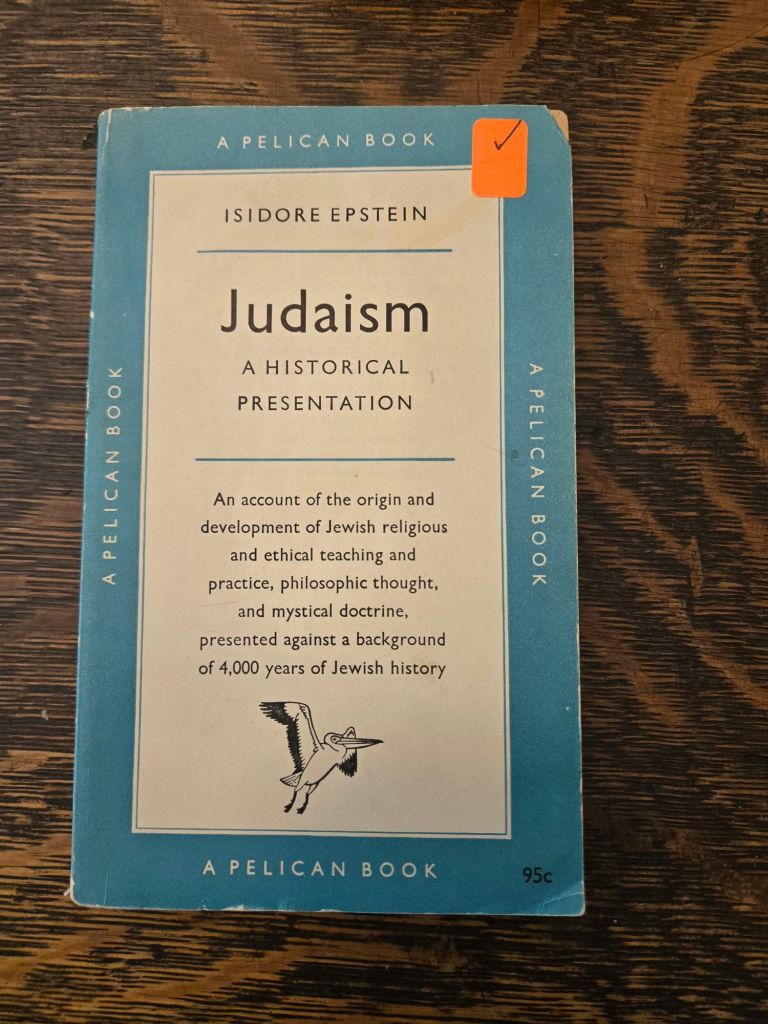
    This sounds like (and probably is) a wholesale attack on free press, right? M’Bow would respond to that, I think, by saying that there is really no such thing as a free press. Or to put it differently, someone will always decide what is news, and how the days events should be portrayed. That “someone” can be the journalist (or the boss of the journalist), or it can be the government. The government is responsible for order in the community, for establishing the direction of the community. The journalist is responsible for nothing, other than satisfying their boss, or maximizing their profit. Why should the unelected journalist, lacking any official responsibility, make the determinations as to what constitutes news?
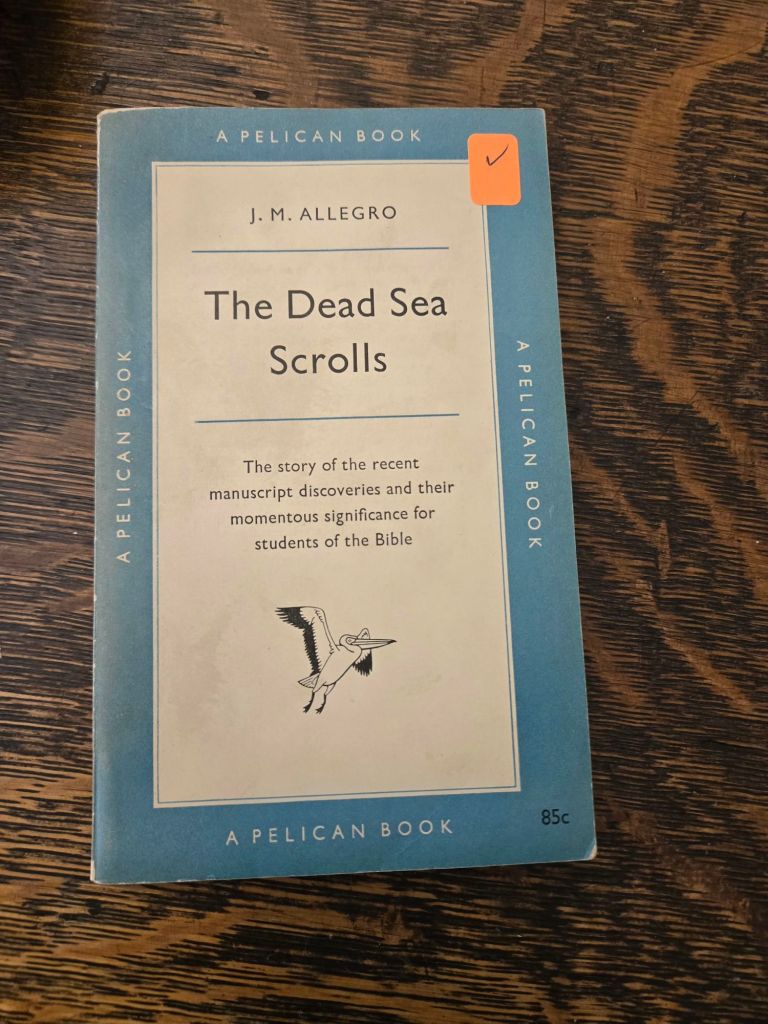
    I am extrapolating a bit here – the article does not state that M’Bou actually said all of this in this manner. But this does express his thinking. And he came upon this as an African leader during, or just after, the end of European colonization of much of the continent. And he did a lot of complaining about the nature of the news coverage of emerging independent Africa. He declared that the news that was selected to be published was being selected not by Africans, but by what he called people from the North, who had their own agendas, and whose agendas were much different from the agendas of Africans, themselves.

    Okay, you can argue with this, of course. And you may be correct. But it does raise a perspective that is not normally raised by the journalism I see.

    My assumption here is that he is not necessarily talking about what you see in opinion pieces, whether opinion pieces by established journalists, or op-ed pieces or letters to the editor by others. I assume he is talking about what purports to be straight news, the kind of straight news that purports to be factual and unbiased. And about which news articles are published or aired, and which are not.

    Let’s for a minute compare, say, MSNBC and Newsmax. You know, tuning in, that these two networks have very different political biases, and you expect this to be obvious from what the commenters say. But, beyond what you see on the air, there is what you do not see – what subject matters a network chooses not to cover. For example, as we are in the middle of an election campaign, one network can choose to cover the policy statements of one candidate and cover the verbal gaffes of the other candidate, even if they give them equal time. Or, to put things more in M’Bou’s thinking, there may be very important things going on in Senegal, but American TV networks may not even mention Senegal. In each case, someone will make that decision.

    There are plenty of countries that don’t have a free press. Russia today certainly does not. Nor does China. Neither country will permit journalists to say things against their national interest. Russians don’t come close to getting unbiased articles about the “military action” in Ukraine. The Chinese don’t hear what is going on with the Uyghurs.

    On the other hand, in countries where there is a free press, like the United States or, say, Israel, you have other problems. You still have subject matter ignored, but you also have articles that are meant to be provocative. You have journalists who stand in the tradition of investigative journalists, who like to prod, to uncover secrets, to find weaknesses in those who appear strong, and so forth.

    In the countries with controlled journalism, you can have a controlled society – for better or for worse. In countries with free journalism, you can have a chaotic society – for better or for worse.
    I am not arguing for a controlled press. But I think we should be cognizant of the risks and dangers of an unregulated press. They are real, as well.

    Let’s go back to M’Bou for a minute. As a leader of an emerging society, the one thing you want to avoid is social chaos. If you are part of a group not just governing a nation as a temporary shepherd, but creating a nation out of a subservient colonial society, chaos can be fatal. So you don’t want investigative journalists running around uncovering all of your skeletons and encouraging your political opponents. This is true for journalists who are citizens of your aspiring country, or journalists who are reporting on your activities for foreign interests. Particularly, where those foreign interests may serve your former colonial overlords, or serve those outsiders with deep commercial interests in your country.

    Free press may only work in democracies. And may only work in stable democracies. We have a greater challenge today than before. With the easy ability to spread falsehoods, and with the ease with which false news seems to be believed by so many, will we one day find out that a free press endangers the stability of our democracy and no longer works? And if we do (understanding the constitutional ramifications), how will we react?

    Yes, a free press can certainly help in overturning dangerous or harmful governmental policies, or even dangerous or harmful governments. But today, a free press can also help destroy governments which are neither overly dangerous or harmful. This is a conundrum, to be sure. This is also a topic about which I knew nothing – has anyone come up with the best path to follow in the year 2024?

←Previous Page
1 … 30 31 32 33 34 … 62
Next Page→

Blog at WordPress.com.

searching

Loading Comments...
  • Subscribe Subscribed
    Art is 80
    Join 71 other subscribers

    Have a WordPress.com account? Log in now.

  • Art is 80
    View site in Reader
    Manage subscriptionsSign upLog in
    Report this content
    Collapse this bar