Skip to content

Art is 80

  • It Seems Pretty Good To Me

    April 25th, 2025

    Yes, it seems pretty good to me.

    I am talking about what I understand to be the Trump proposal to end the war between Russia and Ukraine. As I understand it, it would be an agreement between Russia and the United States to end the war. At least, that is how it was described in the broadcast I heard this morning. Ukraine is not yet part of the deal (I am not sure if Russia and the US actually have a deal yet), and will be expected to be bludgeoned by the two superpowers to agree to it. I would suspect that, if Russia and the US have reached an agreement and Ukraine does not agree, Russia will increase its bombing, the US will stop protesting, and the US will stop giving any support whatsoever to Ukraine’s resistance. That sounds fair, doesn’t it?

    Now, I am just going by a CBS radio broadcast I heard this morning, but what I understand is that Ukraine would agree to three things: (1) Crimea is Russia, (2) the eastern part of Ukraine which Russia now occupies remains with Russia [Russia has already “annexed” it]; and (3) Ukraine will never, never, never try to become a member of NATO. When asked if Russia was giving anything up, our President says that they are being asked to give up a lot. When pressed to be a little more precise, he said: Russia will be giving up the right to keep fighting.

    So, as I say, that sounds fair. That is, if you are Russian. If you are Russian, then you would describe this proposal as follows: We win!

    It does put Zelensky in a tough place, and I don’t know enough about what is going on internally in Ukraine to know what popular sentiment would want. Look at it from a couple of ways.

    As to Crimea, the home of Russia’s naval base (decimated in the Black Sea from what it was prior to the conflict), there are more Russian speakers than Ukrainian speakers. Neither group is native to the place, but the Soviets moved the natives out of Crimea long ago. On the other hand, Crimea is part of Ukraine’s identity, has the best weather of any place around, controls the northern part of the Black Sea, and – not least – is part of Ukraine, as it has been since Khrushchev’s time, and as it has been when the boundaries of Ukraine were demarcated thirty years ago.

    As to Donbas in the east of Ukraine, also a part of the country since its creation with the breakup of the Soviet Union and part of the Ukraine SSR during Soviet time, it is the industrial base of the state, but not the agricultural base. And the industrial facilities are heavy, dirty, old and to a great extent out of step with the 21st century. It is also by far the poorest part of Ukraine and, again, has a large number of Russian speakers. I understand that no country wants to lose part of itself, but…..I honestly do not know if Ukraine of the future would be better off with this region, or without this region.

    As to NATO, I don’t know how you can enforce this if, say, twenty years from now Ukraine and NATO think that its joining would be beneficial for both.

    On the other hand, if there is one thing Ukraine knows, it is that Russia (even beyond Putin) can’t be trusted and that Russia does not believe that Ukraine really is a separate country (I know, that might be two things). How do you reach an agreement with a party you distrust in this manner, particularly when there are no security arrangements being put in place. And, from the perspective of the rest of Europe, which also does not trust Russia, how do you keep from feeling that once Russia wins the Ukraine war, a war with Lithuania, say, won’t be far behind, with similar results. For that matter, why wouldn’t China feel the same way when it comes to deciding their next step regarding Taiwan?

    I was thinking the other day about Trump telling Zelensky he should just give in, so that the fighting will stop. King George could have told that to George Washington, no? And someone could certainly have told that to Abraham Lincoln. Such messages are somewhat circular: stop fighting while the war’s results are still up in the air because if you stop fighting, you will be able to stop fighting. And when the party being asked to stop fighting didn’t start the fighting, you are simply back to the big guy bullying the little guy.

    Donald Trump certainly has no problem with Russia starting a war to take over all or part of another country. He probably has no real problem if China decides to invade Taipei, because it would mean one less headache for him to manage in the long run. And after all, we have to keep in mind that he believes that the United States can takeover Canada, Greenland and Panama on whatever basis he chooses. Oh, yes, and Gaza.

    Speaking of Gaza…….you know what? I’d really rather not right now. Maybe later. It’s already time for lunch.


  • The Weird Witches or the Wayward Witches? The Answer? No One Knows.

    April 24th, 2025

    Does everyone know the Folger Shakespeare Library?

    It’s located on Capitol Hill at 3rd and East Capitol Streets SE, and of course, it is more than a library, although if it were only a research library, Dayenu. It is a theater, a museum, and now a cafe, and probably more.

    It’s an independent non-profit created to house, maintain, and build upon the collections of Henry Clay Folger, former president and chairman of Standard Oil, and its endowment is controlled by Folger’s alma mater, Amherst College.

    Long a DC cultural attraction, the Folger closed a few years ago to undergo a virtually complete renovation and expansion. It reopened about 9 months ago. I visited yesterday for the first time.

    For those who have not yet seen the new Folger, let me describe it in one word: spectacular!

    I didn’t go through the entire building. For example, I didn’t go into the theater itself, which is a virtually exact replica of Shakespeare’s Globe Theatre, and where they are getting ready to open a production of Twelfth Night, which will run through the early summer. But it is open to visitors.

    Those who have been to the Folger may remember the paneled faux-old English gallery, where manuscripts were displayed. It’s a gallery no more, but has been turned into an inviting  cafecand lunch spot.

    There are entrances on the east and west sides, and to the left in this picture are two glass doors through which you can look into the public reading room, which was also quite busy yesterday.

    But what I really wanted to talk to you about is the 12,000 square foot exhibit space on a downstairs level that had not been public space before. It is through this level that you now enter, and go past the information desk to see the two large and extraordinarily interesting exhibits.

    The first exhibit is, not surprisingly, about Shakespeare. There are examples of early Folios, published in the 1630s. The Folger has over 80 First Folios, about a third of the world’s total. And of course, even more later folios, published shortly thereafter.  Were it not for these publications, the first published collections of any playwright’s works, many of his plays would have been completely lost.

    The exhibit also concentrates on the performance of Shakespeare over the past 400 years. Included are the earliest playbill still existing, just to give one example, from 1697.

    The second, even larger,  exhibit is called “How to be a Power Player: Tudor Style”. It tells you everything you need to know…how to dress, how to speak, how to run a house, how to be a soldier. You name it.

    The items on display are amazing. Here are some examples.

    A first edition of Machiavelli’s The Prince from 1564.

    How to plan the perfect funeral, and how the funeral of Sir Philip Sydney turned out.

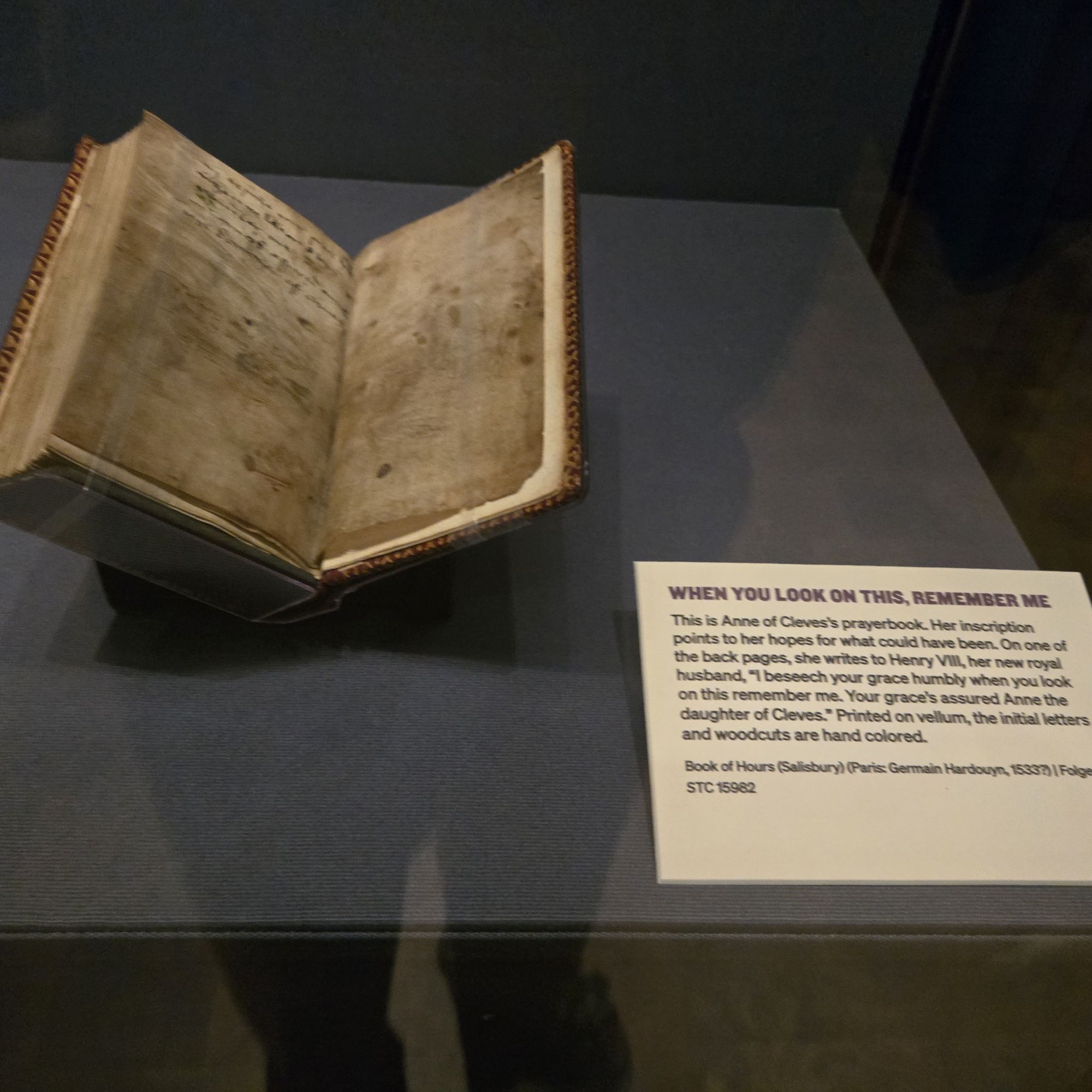
    How about Anne of Cleves’ personal prayerbook?

    Or the proclamation releasing Sir Walter Raleigh from the Tower of London?

    And this is only a smattering of what is on display.

    By the way, the Folger’s website is excellent.  I could have saved my time putting this together and just sent you there. Maybe I will do that next time.

    And as to the Macbeth witches – weird or wayward? One of the many unanswerable questions. Another is: Who really wrote these plays, anyway?

  • One Way Ticket to Zurich, Please

    April 23rd, 2025

    I think I want to learn more about Daniel Kahneman. Kahnman, as you may know, was a behavioral psychologist who won a Nobel Prize in Economics in 2002, and was the author of the best selling book, Thinking, Fast and Slow, which was published in 2011. Thinking, Fast and Slow posired that there are two kinds of thinking, one which works largely by instinct (fast thinking), and one which works largely through logic (slow thinking), and that one is not better than the other. When something calls for fast thinking, and you hold back to put your logical hat on, you are not necessarily going to come up with a better reaction, just a different one. There is a place for both types of thinking.

    Yes, maybe that is what he said; I don’t claim to fully understand it, and over his career, he said a lot more. Look at the 18 points listed under “notable accomplishments” on his Wikipedia page. He was a prolific writer and public speaker. I heard him once speak at Ben-Gurion University of the Negev and was impressed. I felt a minor connection to him because his son was a Technion classmate and old friend of one of our Israeli friends.

    But none of that is what I want to talk about today. I want to talk about Kahneman’s death in 2024 in Switzerland at 90. I remember reading about it then, and thinking “that’s too bad”, and going on with my life. But I didn’t know how he died until I read a column in Sunday’s New York Times Opinion section by Katarzyna de Lazari-Radek and Peter Singer. Maybe you saw it.

    They stated that it was revealed last month that Kahneman died via assisted suicide, something that is legal in Switzerland (or perhaps. That Kahneman, who was not fatally ill, had written the following: “I have believed since I was a teenager that the miseries and indignities of the last years of life are superfluous, and I am acting on that belief. I am still active, enjoying many things in life (except the daily news), and will die a happy man. But my kidneys are on their last legs, the frequency of mental lapses is increasing, and I am 90 years old. It is time to go.” They also report that Kahneman was their guest on their podcast a week before he died where he talked about his plans, among other things. And that he carried them out as promised.

    I didn’t know much about assisted suicide, other than what I have read from time to time in the newspapers. I knew that it was legal in some states (now I know 10 plus the District of Columbia and under consideration in about eight others), and that it is highly regulated and restricted in all of those states, requiring a number existing preconditions, such as a fatal disease, or chronic excruciating pain or discomfort, and that various forms of certifications by doctors and other professionals are required. What I did not know at all was that in Switzerland (and it has been the case in Switzerland for over 80 years), none of those preconditions are necessary.

    In Switzerland, you only have to be of sound mind. And you have to do the deed yourself. In other words, no one can administer to you the medications that will end your life. You are given the means and the instructions, and left to your own devices.

    Kahneman was provided assistance through a Swiss non-profit called Pegasus, and I looked up their website, too. They have only been established since 2019, but look to know what they are doing. Their English language website is very tastefully done.

    I also read a bit about assisted suicides in Switzerland. There are apparently about 1000 assisted suicides in Switzerland each year (do not hold me to the number – sources vary), and most of them involve assistance from nonprofits like Pegasus, which are not medical organizations. As I understand it, doctors do not get involved in these assisted suicides; and euthanasia (which involves helping someone perform the final act itself or actually administering the dosage) is illegal.

    And as I said, although many who commit suicide via this practice are very ill, one’s medical condition does not affect eligibility. Of course, many are against this practice, and many (perhaps most) Swiss doctors are some of the biggest critics. Yet it seems to be ingrained in Swiss culture and recent votes in Zurich on abolishing its legality have upheld the practice by very large margins (like 3 – 1), and by margins almost as large when the question was whether it should be made illegal for foreigners who come to Zurich for this purpose. In fact, the majority of those seeking this help are from abroad, and I now have read that 60% of them are German.

    Kahneman wasn’t German (he was Tel Aviv born and American). Nor was French director, Jean-Luc Godard, who died via assisted suicide in his house in Switzerland. He was 91, and also apparently not fatally ill. A family member quoted on Godard’s Wikipedia page said “He was not sick, he simply was exhausted”. Another example given was the case of Sir Edward Downes, a well known British symphony conductor and his wife Joan, who committed suicide together with the help of another Swiss suicide organization, Dignitas, in 2009. Downes was 86 and had become virtually blind and deaf. His wife, who had been a choreographer, was his caretaker and only 74. But when she was diagnosed with pancreatic cancer which had already spread to her liver, and was only given weeks or months to live, they made a choice. She was fatally ill, and he did not know how he could carry on, given his condition, without her. He did not have a fatal condition and could have lived, with diminished senses, for years.

    So how do I feel about this? In fact, I don’t know. My instinctual feelings (fast thinking per Kahneman) are to sympathize and emphasize with the individual who wants to end their lives, and to support their choices. And my logical conclusions (slow thinking per Kahneman) reach the same result. But there must be a third type of thinking that even Kahneman didn’t describe. Because, truth be told, something holds me back from giving my approval. What kind of thinking this is, I am not sure.

  • Autarky – The Word of the Day.

    April 22nd, 2025

    I learned a new word today. Autarky. A country which is economically self-sufficient is an autarky. The United States is obviously not an autarky. Apparently, North Korea is the country today which is closest to being an autarky. What it is not able to make or extract or grow itself, it just does without. Yes, North Korea can operate in isolation, but it certainly is not a place where any of us want to be.

    I have not anyone heard anyone use to word “autarky” in discussing the Trump attempt to refine the American balance of trade. But I did recently hear an analyst say that, throughout the world, countries are looking to increase their self-sufficiency, something that will certainly rattle what has been a fairly accepted global economy. It is certainly what Trump has in mind.

    I was thinking about this because I remember our extensive tour of western Turkey about 12 or so years ago. It was my first time in Turkey, and it became one of my favorite countries for many reasons. One of the reasons is that Turkey looked to me to be a self-sufficient country. It seemed to have everything.

    For example, the agriculture of Turkey looked so prosperous that I thought Turkey could feed itself completely without looking outside the country. I had no idea (I still don’t know) whether this was an accurate impression, but every place looked fertile, and the country had such a variety of climates that it seemed so to me. Then, when we were in Istanbul, I remember walking through an area filled with shoe manufacturing companies, shoe stores, really everything that had anything to do with shoes. Blocks and blocks of businesses having to do with providing shoes for the Turks. Our shoes are all made in east Asia, with the exception of luxury brands made in Europe. It seemed clear to me that Turkey never had to depend on China for their shoes.

    Then, we went to the metropolis of Bursa, an industrial center with a population of over 3 million. Maybe you have never heard of Bursa, located on the Sea of Marmara across from Istanbul, but it is an impressive place, filled, among other things, with large automobile plants. It seemed that Turkey must make everything it needs right in Bursa; I had not seen such extensive (and tasteful) architectural manufacturing plants anywhere else.

    But it turns out that Turkey is not an autarky. Turkey has an energy shortage and imports most of its energy. But it also turns out that Turkey is apparently working hard to increase its energy production with more solar, wind, and other forms of renewable energy. It also turns out that Turkey is working hard to make its entire defense industry self-sufficient, not dependent on the U.S. or Russia or anywhere else. And it looks like it might succeed. Finally, Turkey is now operating, according to sources I looked at, with a positive balance of trade, something that most countries strive for.

    Of course, Turkey has its problems. And they are big ones, including employment problems, inflation, religious fundamentalism, and a power hungry leader who wants to stay in power at all costs. But, with regard to economic sufficiency, it seems to be on the right path.

    It is hard to find countries who are not dependent on the global market. North Korea is one, but it costs them too much to be so. Turkey is striving to be one, but it will probably never succeed in its entirety. I couldn’t find a perfect index on the internet, and most of the articles I did find concentrated on food. In order to be self sufficient in food, you need a wide variety of climates and you need a sophisticated agricultural center. The countries with the greatest amount of food sources are places like Argentina, because of its climate and fertility, and New Zealand, in part because of its limited population.

    Trump would like to turn the US into an autarky. It’s a big task. It can not be done without throwing the entire world into a global marlstrom, and when that happens, we become the center of that maelstrom, particularly if it is attempted to be done too quickly, with everything changing at the same time.

    If Trump concentrated on only certain segments of the economy – pharmaceuticals and electronics for example – there might be a chance over time. But that is obviously not his style.

    His style is to destroy worldwide and then to rebuild in this country, the rest of the world be damned. It will not work. And in destroying everything around him, he will destroy himself. We already see this coming.

  • Easter Thoughts

    April 21st, 2025

    I admit to not paying much attention to Easter. Sometimes, Easter passes by me completely. But I think that is largely because I am not a Christian. If I were a Christian and a believer in Christian theology, I would of course take Easter very seriously. And even if I were a Christian who took much of the theology with a grain of salt, I would still take Easter seriously, and expect the holiday to be respected by everyone. Yes, by everyone, but especially by people who claimed to be, or self-identified as, Christian.

    And I think that if someone who presumably was a Christian disrespected the holiday, I would be upset, I would not have any respect for the individual, and I would conclude he was, at best, a hypocrite.

    So what do we make of Donald Trump and his Easter “greeting”? And I quote: “Happy Easter to all, including the Radical Left Lunatics who are fighting and scheming so hard to bring Murderers, Drug Lords, Dangerous Prisoners, the Mentally Insane, and well known MS-13 Gang Members and Wife Beaters, back into our Country.” And “Happy Easter also to the WEAK and INEFFECTIVE Judges and Law Enforcement Officials who are allowing this sinister attack on our Nation to continue, an attack so violent that it will never be forgotten”. And more, including calling “Sleepy Joe” a “highly destructive Moron”.

    I don’t think I have to provide an answer to my question. We all know that virtually no Republican Christians will do anything about it. They will just let it pass by and, yes, they will agree with its sentiments. And some of them will conclude that the way Christians should think about Easter and the resurrection of their savior just doesn’t apply to Donald Trump, although it applies to everyone else. This is the America we now live in.

    Of course, we have to admit that, for most of us, it is still better to live in the United States than to live in, say, Sudan. Did you happen to see the front page article on Sunday’s New York Times, with the headline “Aid Cuts Hit Hungry in a City of Shellfire and Starvation”? And if you saw it, did you read it? I quote Declan Walsh’s article:

    “Abdo, an 18-month old boy, had been rushed to a clinic by his mother as he was dying. His ribs protruded from his withered body. The next day, a doctor laid him out on a blanket with a teddy bear motif, his eyes closed.

    “Like the other 11 children, Abdo starved to death in the weeks after President Trump froze all U.S. foreign assistance, said local aid workers and a doctor. American funded soup kitchens in Sudan, including the one near Abdo’s house, had been the only lifelines for tens of thousands of people besieged by fighting.

    “Bombs were falling. Gunfire was everywhere. Then, as the American money dried up, hundreds of soup kitchens closed in a matter of days.”

    So, who in the United States government is to blame? Certainly, Donald Trump, with whom the buck stops. And Elon Musk, who has been in charge/not in charge of decimating the government. And Marco Rubio, our Secretary of State, who has given strong verbal support to the collapse of USAID, and into whose department the remnants of AID have been placed. And Peter Marocco, who was apparently directly in charge of the destruction of USAID and who has just been fired by Rubio for reasons apparently not completely clear.

    But if deaths result from both the actions taken and the method by which these actions have been taken, shouldn’t, as they say, someone be held responsible? And the responsibility of all of these pro-life individuals should be responsibility for taking lives, right? And in my book, putting aside legal niceties, this means “murder”. Not “killing”, like in a war or when someone is threatening your spouse, but “murder”.

    Now, going back to these folks all being Christians. One of the Ten Commandments, to which both Jews and Christians should adhere, is explicitly a prohibition of murder. Once again, most Republican Christians will let this just pass by. Most of them don’t read the front page of the Times, and don’t have any idea of the various ramifications of stopping the AID funds. And, guess what? No one is really going to tell them.

    And then there is bombing the Houtis in Yemen. We are doing this because there needs to be a response to the Houtis targeting ships in the Red Sea and firing missiles at Israel. I understand that something needs to be done about this. And careful bombing would seem to be a possible reaction. But for two problems. First, that the bombing is, from all accounts, accomplishing nothing. Second, that the result of the bombing of a country with whom we are not at war, is resulting in multiple deaths of Yemenis and this again comes close to the definition of “murder”.

    So maybe Easter should be a motivator for some of the true Christians who are supporters of Trump and his programs to take a closer look at the effect of his policies and at Trump himself. They may be able to find somewhere in themselves the ability to put aside their blinders and let the sun shine in. And that could make a lot of difference.

    I will end this where I should have started it, with Easter greetings to all who celebrate. And I just saw that Pope Francis has died. He put up the good fight on most issues. I hope the Catholic Church does not follow so much of the rest of the world and move backwards.

  • I Don’t Play Bridge or Know What This Means, but it’s a No-Trump Post.

    April 20th, 2025

    We did get to a museum yesterday. The Phillips Gallery.  I assume, without really knowing, that the Phillips does not depend on federal funding, so that all Trump could do is to try to take away its tax exempt status. As Harvard’s tax exemption has been threatened, this now seems to be a Trump weapon that, if successful, could be widely used.

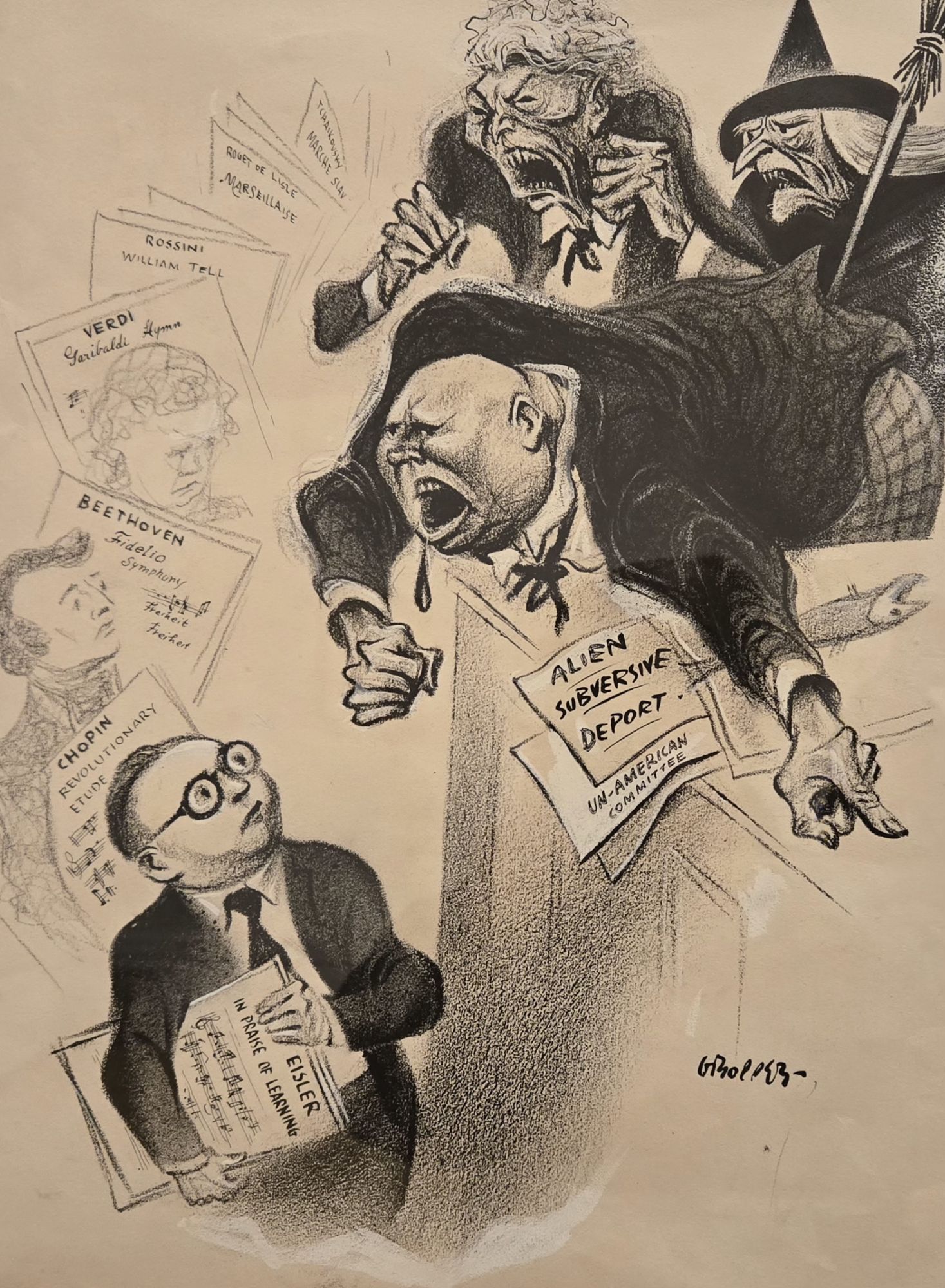
    Now, why would Trump attack the Phillips? Perhaps he won’t,  but I can’t help thinking about the recent Phillips exhibit of George Grosz anti-Fascist drawings.

    So you never know.

    But there is less chance that anyone will object to the exhibit of the work of Alphonse Mucha (1860-1939), Czech artist whose work has been so influential.

    I learned a couple of things about Mucha that I didn’t know.  I learned, for example, that for a time he shared a studio with Paul Gaugin. I had never thought of them in the same world before.

    As my wife pointed out, Mucha was basically a commercial artist. Maybe he was the first successful commercial artist, and I heard a docent answer a question and say that he earned a very good income. His art work was not for collectors or museums. He designed advertising posters for cigarettes, and travel locations, and liquor. He made posters for theatrical productions. He drew many, many book and magazine covers. These are all on display at the Phillips. 

    Another thing I did not know is that he had a contract with Sarah Bernhardt for six years, not only designing the still famous posters for her agow, but also designing sets, printed programs, jewelry and costumes.

    Unfortunately, because his art work is all on paper, it is all shown behind glass, so that photography is difficult because of glare. But here is one example of his work:

    Standing at one of his smaller pieces was a young woman with a sketch pad in one hand and a bold ink pen in the other. She was copying the drawing, and I must say her work was near perfect. She told me it was only a hobby for her and that it was the second of the Mucha drawings she had copied. The first had taken her 5 hours. Her work amazed me, but also that she could do it so precisely and casually, just standing there, her pad resting only on her arm.

    One other thing about Mucha. He was very influential in the development of what might be called psychedelic art – the posters for the Grateful Dead et al. There were a lot of pschedelic art from the 1970s in the show as well.

  • I Dare You! I Double Dare You!! I Triple Dare You!!!

    April 19th, 2025

    I listened to/watched an conversation between Tim Miller and Anne Applebaum yesterday on Bullwark, which as usual gave me some new perspectives to think about.

    Here is one. What is the parallel between the Russo-Ukraine and the Israel-Hamas wars? The parallel is that Hamas denies Israel’s existence as an independent state, and Russia denies Ukraine’s existence as an independent state. I had never equated these two antagonists in this way before, but now it seems obvious. Russia’s attack on Ukraine and Hamas’ on Israel come from the same basic position, and this is one of the reasons that both of the wars are so difficult to end and, at least as important, as difficult (or impossible) to keep from reprising themselves in the near future. Of course, there are differences. In the case of Russia, Russia was attacking a force it deemed much inferior to its own, and in attacking Israel, Hamas was attacking a force deemed much superior to itself. And the results to date have been different. Israel is destroying Hamas’ home of Gaza, while Russia and Ukraine have to date fought to a standoff (albeit that the fighting has virtually all been on Ukrainian territory).

    Nevertheless, the wars continue and the magic hand of Donald Trump has so far done nothing to bring them to an end, or even to workable ceasefires.

    The second point is that totalitarian governments may succeed in bolstering the power or finances of the totalitarian leaders for a time, but they virtually always succeed in destroying the country under their control. Applebaum talked about Hungary and Viktor Orban. She cited the current position of Hungary in Europe as being the poorest (or, by some standards, second poorest) country in Europe, whose population is much less financially secure than before he took power. And she then looked at various other indexes, which also show Hungary at or near the bottom. She made it clear that this was all as a result of Orban’s leadership, as before he came to power, Hungary looked to be one of the more successful of the ex-Communist countries.

    She also talked about Venezuela, now the poorest country in South America, formerly the wealthiest. She did not mention Cuba, but presumably could have done so. Her one exception was China, which she attributed to China’s careful opening of itself to the world’s free market.

    On this basis, she does not seem to feel it unlikely that the United States will suffer financially as a result of Trump if he is allowed to continue doing what he has been doing. And she made it clear (she didn’t need to do this; it’s obvious) that it is very hard to stop him.

    She also compared Orban and Trump in two more ways. First, she said that Trump, now only three months into his four year term (that means 94% of his presidency is in front of us), has been consolidating his power much more quickly than Orban did. She feels this a very concerning comparison. Secondly, she looked at the steps that Orban took and believes that much of what Trump is doing is copy-catting him. Trump’s attacks on universities, the press, and various businesses, including law firms, apparently parallel steps taken by Orban in Hungary.

    This reminds me of Hitler, and his using American race laws as a basis for some of his antisemitic legislation – or at least as a basis for knowing that he could get away with his antisemitic legislation without expecting a major outcry from the populace.

    And this shows that people can get used to a lot. I always hearken back to my first days in U.S. Army basic training at Ft. Ord in California. I was a young, free American, with all the rights given me by the constitution and the laws. Suddenly, I was in the most totalitarian of existences. People with a higher rank (that was almost everyone) could yell and curse at me, force me to do things that no one would even think to ask me to do outside of basic training, and keep me from doing anything I might have wanted to do outside of what they insisted I do. The American constitution no longer seemed to apply at all.

    Of course, I was not alone. In my platoon alone, there were probably about 40 of us, all in the same position of shock. Did we yell and scream? Did we rebel? Did we fall into massive depression? Did we try to escape? We did none of these things. We accommodated. Within approximately 2 seconds, we accommodated. And I think that, by and large, that is what happens when people are suddenly faced with massive totalitarian inspired societal changes.

    Today, there are massive protests scheduled around the country, as there have been now daily, as well as weekly. The Supreme Court seems to be holding its own against the administration, with only Alito and Thomas sticking to the party line. There are rumblings of discontent among Republican legislators, but rumblings get you nowhere. So we still don’t now where all this is going.

    It looks like there will be more than one showdown between the administration and the courts. The administration is now warned that it cannot deport individuals without giving them a modicum of due process. The administration has been told that it cannot fire certain groups of people en masse, or use en masse firing to effectively shut down agencies established by Congress. The administration has been told that the First Amendment prohibits them from shutting out the Associated Press just because they keep calling the Gulf of Mexico by its name. There have been decisions that stop the administration from putting restrictions on law firms for objecting to governmental actions. Cases involving universities are pending.

    There is little question at this point, it appears, as to where the courts are going on all these cases. There is also little question but that the administration will try to weave its way around what will be a series of anti-administration decisions. But when will the administration cross a judicial “red-line”? And what will happen when it does?

    Enough for now. Going to a museum.

  • Obituaries, Life Lessons and ….. Back to Trump.

    April 17th, 2025

    I quote from the NYT obituary of Irmgard Furchner, who was a secretary to the commandant of a Nazi concentration camp and who was convicted by a German court of being an accessory to murder (in fact, to 10,000 murders) in 2021: “But in the ruling against her by Germany’s federal court of justice in August 2024 [on appeal], the judges wrote: The principle that typical, neutral professional activities of an everyday nature are not criminal does not apply here since the defendant knew what the main perpetrators were doing and supported them doing it.”

    Yes, this is a German, not an American, court. And, yes, this deals with the Nazi period, not the Trump period. Yet, one wonders how much mid-level and lower-level federal employees during the Trump administration should be concerned about what might happen after the Trump days are over, and it becomes time when their activities during these years are examined. Something to think about.

    On the same page of yesterday’s newspaper, there is an obituary for former Deputy Secretary of State Richard Armitage. A different lesson can be learned from the Armitage obituary. He was the individual who, during the run up to the Iraq War, apparently in a private conversation let slip the fact in 2003 that Valerie Plume was a CIA operative, something then reported publicly by Robert Novak (if you remember none of this, that’s okay). A barrage of criticism followed, and Armitage went on to apologize profusely for his error, to serve honorably in his position and to have the bravery as a life long Republican to speak out against Trump during the 2016 campaign and to actively support both Clinton and Biden in 2016 and 2020.

    The lesson to be learned here? Actually, a few. First, mistakes will be made and it is not necessary to cancel someone when the make a mistake. Second, that apologies are brave, not cowardly. Thirdly, that when your side is wrong on something significant, admit it and don’t just follow the crowd or stay silent.

    All important lessons.

    I saw that Senator Van Hollen has met with Kilmar Abrego Garcia, not at CECOT, but at what appeared to be a luxurious hotel restaurant. I also saw that President Trump, asked about various of the allegations against Abrego Garcia, said that “We will have to see the truth”, providing something that will be put into the court record, showing that even Trump is apparently at this time not sure about him.

    I spent a little time last night looking at the evidence against Abrego Garcia, although this is not, or at least should not be, the crux of the case. Here is what I found out.

    1. He came to the US from El Salvador at age 16, after his family had been threatened by gangs in El Salvador.
    2. He has lived in Maryland since he got here.
    3. He had been arrested in 2019 at a Home Depot parking lot. He says he was looking for a day job. He was one of four men; the government says that two of the men were clearly known as MS-13 members (I don’t know anything about this), and that Abrego Garcia was assumed to be an MS-13 member because he was wearing a Chicago Bulls cap, and a sweatshirt that showed rolls of money covering the faces of American presidents (I looked for a picture of sweatshirt, but could not find it). The Prince George’s County policeman who made the arrest was later fired for improper activity in an unrelated case. There were two hearings at this time, and immigration lawyers ordered that he  not be sent back to El Salvador because of fears of retribution.
    4. He had been stopped, but not arrested, in 2022 in Tennessee because he was driving a van with 7 passengers and the officer who made the stop thought that it might be a case of sex trafficking. No charges were filed, and Abrego Garcia and the passengers were let go and not retained.
    5. Four years ago, after a domestic fight, his wife got a temporary restraining order against him. Since then, she says, things have gotten much better, they have worked on their marriage and even gone to counseling. He has one child with her, by the way, and she has two from previous relationships or marriages whom he now fathers.
    6. A Fox News commentator, Jesse Waters, says that everyone in El Salvador knows that a Bulls cap means the wearer belongs to MS-13. I read that, in fact, that a government profiling document says that a Bulls hat can indicate membership in Tren de Aragua, the Venezuelan gang, not MS-13.
    7. Pam Bondi has said that Abrego Garcia “is” a sex trafficker, which there is no evidence of whatsoever.  She has said that two courts have said that he is MS-13, which is also untrue.  She calls him a “terrorist”, and says that his wife and child are safer now that he is not in the country.

    In fact, none of this is relevant to whether or not Mr. Abrego Garcia should be returned to the United States. He should be returned to the United States because he has received no due process, required under the constitution, and for other procedural reasons. The president is correct: we have to find out the truth.

    More than this, once Abrego Garcia is returned to the country, his return will make it more clear that all of the 260 or so men sent to

    CECOT, presumably all Venezuelan, will have to be returned as well for the same procedural reasons, something that the courts have already ordered. But I think that the impact of returning Abrego Garcia on the fate of the other prisoners, and the potential threat to the entire CECOT arrangement, are some of the reasons that Trump et al are digging in so strong.

    But I think he will be returned. I don’t think that any judge would believe that an American president, especially one who prides himself on his dealmaking, can’t facilitate his release.

  • Trump, Trump, Trump

    April 17th, 2025

    Here is the difference, Mr. Trump:

    When you buy a building, you want to get it for the best terms possible. If the seller needs to sell it and wants to receive $5 million, you can say to him, ” Here’s the deal. I will buy it for $2 million. If that works, fine. If not….goodbye.” And you can walk away and wait to see if he calls. If he does, fine. If not, no problem; there are other buildings you can buy. Either way, the deal is over.

    Working out, say, tariffs with China is different. You can not just say “nevermind” and the deal is never over. A deal that is bad for China will cause you problems, not only China. And once you make a deal, you don’t walk away from each other, like the parties to a real estate contract. You have to live with it. If you just decide you don’t like the deal you made and abruptly announce you are changing it, you lose credibility, no one will want to deal with you, and once again you have a big problem.

    A real estate deal and a deal involving tariffs are not even distant relations. The Art of the Deal is irrelevant.

    You don’t seem to understand this.

    And then there is Harvard. You want to turn the president of Harvard into a Trump employee who will spend his time implementing your policies as to what to teach, whom to hire, whom to admit, and so forth. You want him to do this because you think that Harvard doesn’t take care of its Jewish students because it is too woke. Come on…….

    When Harvard told you that you don’t run their university, you said that you would cancel $2 billion of federal support for programs that you may or may not like, that may or may not be important, etc. You obviously don’t care, but guess what? Your sledgehammer approach is one reason (there are many others) why you should never become the president of Harvard (or any other university).

    When Harvard said that they were not willing to respond to your Mafia-like protectionist demands, you raised the ante, and have now told your independent Department of the Treasury’s IRS  to take away Harvard’s tax exempt status. Lotsa luck, as they say. You don’t have much of a chance to succeed here, even if the IRS follows your instructions. And, obviously, this threat is not going to move Harvard to accept your demands.

    So, I am wondering what you do next? Do you bring criminal charges against all Harvard administrators? Do you take any Harvard faculty members who are not citizens and send them to El Salvador. Do you tell any organization or entity which continues to have any relationship with Harvard that you are going to have the IRS audit them? Are you going to burn down the entire Harvard campus? Yes, you have a lot of choices.

    Let’s go back to antisemitism for a minute. I, for one, don’t you think you are antisemitic. No, let me put it another way. I don’t think you dislike Jews any more than you dislike everyone else. You clearly dislike everyone, I think, except maybe Ivanka. No, let me put it still a different way. You don’t really dislike any of these people. How could you? You don’t even think of them as people. Obviously.

    But, as to antisemitism, let’s talk about Josh Shapiro. Did I miss your message to him after the arson attack on the Pennsylvania governor’s mansion by someone who didn’t like his stance on Israel? What about “good people on both sides”? And what about those acknowledged antisemites that you entertain at Mar-a-lago, or who have positions in your government? How can you allow that? What about the Musk salute, or the dalliance between Vance and Germany’s right wing party? If you weren’t you, and you were serious about antisemitism, you would surely take some actions against you. Maybe you should ignore that you are you, and give you what you deserve.

    Finally, for now, I would like you to explain one thing to me. When you say, or when your much too young press secretary says, that you will always obey the rulings of the courts, what does that mean? I can see that it doesn’t mean that you will always obey the rulings of the courts, but then I get stuck. Which of your words do I not seem to understand. Is it “always”, is it “obey”, is it “rulings”, or is it “courts”? Can you at least give me a hint?

    Oh, wait a minute. I think I see my problem. You and I may agree on the definition of each of these words, but we may there is another word, one that seems innocuous but which clearly holds the key. The word is “will”.

    I look at the word “will” in this context as referring to any time after you make the statement. But you may be looking at “will” as meaning “any time in the future”. Not the future from the time you make a statement, or from any other definite time, but simply the future, the future that never comes. As you look at it, you can always disobey a court because whenever you disobey the court, it is the present, and quickly it is the past. And as you disobey the court, you can say that you “will” never do that in the future.

    Clever, Don, clever. You have my respect for that one. Brilliant.

  • The World We Live In

    April 16th, 2025

    I wasn’t happy with my post yesterday. The subject was good, but the organization and writing could have been better. So, for the first thing today, I am going to try to restate some of what I said yesterday, but restate it better.

    Here goes: who would imagine that the president of the United States would have people grabbed off the street, incarcerated but not accused of or indicted for criminal behavior, kept from their attorney, and moved out of the country to a notorious prison in Central America without any hearing or other procedure, and with the United States giving up any control over the individual or over the conditions or length of their incarceration? Just like the “desaparecidos” in Argentina. Or those who wound up in the Gulag in the Stalinist USSR.

    That is what I tried to say yesterday. I have a few more things for today.

    First, another podcast I suggest you listen to. This one was posted yesterday by Ezra Klein. He was in conversation with Tom Friedman, and the main topic was China. I learned a lot, and it gave me a lot to think about. Friedman has just returned from a trip to China. He said so much of interest that I know I can’t do it justice, which is why you should listen to it. Basically, he believes that the U.S. and China no longer know enough about each other. There has apparently only been one Congressional delegation to China in the past six (I think, six) years, and that there are virtually no American tourists in China now, and virtually no American students. He says that any thought that China is able to steal our secrets, but not able to innovate is 100% wrong, and he talked about the quality of their electric vehicles, the development of their solar panel industry, the speed of their construction and development, their dark factories (factories where everything is done robotically, so they don’t need lights) and much more. He doesn’t think China is perfect, by any means, but he also thinks that the Trump policies are going to put us at an enormous disadvantage and that we should be working to open China and partner with them to serve the world, not to try to isolate and ostracize them. The podcast can be found, as they say, wherever you listen to podcasts. I just go to YouTube.

    Next, if you missed Joe Biden’s speech yesterday, that’s ok. He read the speech, his voice was soft, his energy not very energetic. On the other hand, former Maryland Governor Martin O’Malley gave a good introduction. He has been getting a lot of press lately. Shouldn’t he be in the mix for 2028? He is an attractive candidate.

    And did you watch Marjorie Taylor Green’s town hall? I missed the scuffling and tazing, and was a bit shocked when she said that over 50% of Democrats wanted to see Trump assassinated. So I looked it up. It was a Rasmussen poll after the Butler PA attempt last year. The question asked was whether the United States would be better off without Trump. That is a bit different, I think. And a no brainer.

    And so it goes.

  • Politics, Harvard  and NYC

    April 15th, 2025

    Congressman Ritchie Torres said it very well: “If a superpower were intent on engineering its own decline, it would antagonize its allies, paralyze its economy with the certainty of uncertainty, erode confidence in the world’s reserve currency, discard due process, defund medical and scientific research, sabotage the most critical form of critical manufacturing – domestic chipmaking – and grow its deficit until debt service devours the largest share of its budget. That is the story of America, circa 2025.”

    Such a superpower would also be controlled by a dictator who believed himself above the nation’s court system. We are looking at many examples of Trump ignoring the courts, while pledging fealty to them. That is another example of a country’s decline – for its dictator to fool the people by convincing them that he is following the law, when in fact he is paying no attention to it.

    Two of the most striking examples today are, I think, (1) the failure of the government to “facilitate” the return of Kilmar Armando Abrego Garcia to the United States from the notorious CECOT prison in El Salvador, and (2) the failure to allow an Associated Press reporter into the Oval Office yesterday for the press conference with Trump and the president of El Salvador.

    The second is the easier to discuss. The Trump administration kicked AP out of the White House press pool because it refused to change the name of the Gulf of Mexico to the Gulf of America, a criminal refusal to be sure. U.S. District Court Judge Trevor McFadden ordered the administration to immediately readmit the AP to the press pool. The government has appealed the order (which has not been stayed) and there is a hearing of some sort scheduled for Thursday at the U.S. Court of Appeals to deterimine if the order should be put on hold until the case finally plays itself out.

    Notwithstanding the current validity of the McFadden order, and the president’s statement that he always follows what the courts say, the AP is still being excluded.

    As to the situation Mr. Abrego finds himself in, things are either murky or perfectly clear. Mr. Abrego, a native of El Salvador who has been living in Maryland for 14 years, and never been accused or convicted of criminal activity, was subject of a United States immigration judge’s order in 2019 that he could not be sent to El Salvador. According to the government’s attorney in the case before the District Court, the government had no explanation as to why Abrego was arrested and sent to El Salvador, and deemed it a mistake. The DOJ has put this attorney on “administrative leave”, saying he did not support the government’s position vigorously enough.

    Yesterday, during his White House visit, the president of El Salvador said that it was ridiculous to think that Abrego would be returned to this country, and equally ridiculous to think that they would let him (a “terrorist”) free in El Salvador. Again, he has never been accused, much less convicted, or any crime. In 2019, a county sheriff, I believe, said they had evidence he was an M-13 member of a New York group. He has never lived in New York.

    Trump (and his henchman Rubio) says: well, if El Salvador won’t return him, we can do nothing about it, and neither can the courts, but if El Salvador decides to return him, we will make sure he gets back here safely.

    It is obvious, is it not, that Trump has not asked El Salvador to return Abrego to the U.S.? If he did, of course El Salvador would say “sure”. Why would they rather keep him in prison, rather than let him leave the country? If Trump thinks he can tell Zelensky, Putin, the President of Iran, Xi, and Netanyahu what they can do, you would think that he could tell President Bukele what to do. Especially since we have some sort of arrangement to send prisoners to CECOT for which we are paying El Salvador.

    But do we have a contract with the country? Any written agreement? Where is the money coming from? Are these people going to stay in prison forever? No one seems to know the answer to any of these questions.

    And, of course, a lot of this is based on the definition of the Supreme Court’s word “facilitate”, rather than the original District Court’s “effectuate”. What does facilitate really mean? And if the president of El Salvador says he does not want to “smuggle” him into the U.S., doesn’t the president at least have to request his return as part of “facilitating”?

    One more thing. Finally, there is Harvard. Harvard has now lost $2 billion in federal funds because it has refused to bow to Trump’s determination that he should be able to tell Harvard whom to hire and what to teach. Google the letter sent by Harvard President Garber yesterday to the Harvard Community. It is hard to argue with what he said.

    That’s all for right now. We are back in DC after one more long drive yesterday. Highlights? A very good onion omelet at the Galaxy Diner in Bridgeport CT, a drive down the Grand Concourse in the Bronx and both Lexington Ave and 5th Ave in Manhattan,  and an Adana chicken kabob at the Brooklyn Kabob in a Muslim shopping area near the Verrazano Bridge.

    In Manhattan, we wanted to see how the congestion tolls were working out.

    Now, yoi see.

  • The Answer is: Springfield Mass.

    April 13th, 2025

    There are two possible questions: (1) What Springfield is the oldest in America, and (2) Where did you spend yesterday?

    As is typical, I learned a lot roaming around Springfield.  Things I didn’t know. First, we saw a lot of beautiful but older houses in a neighborhood called Forest Park. And, it is an extensive neighborhood and one of six in the city that have been designated historic districts. In fact, they are so extensive that Springfield was once known as “The City of Homes”. Many of these homes have been built between 1880 and 1930.

    Those were the years that Springfield was a manufacturing powerhouse. We learned about much of the touring the wonderful Springfield History Museum.

    Springfield was, for example, the home of Duryea Automobiles, one of America’s first, and until the 1930s had a large Rolls Royce factory. Here is, first, a Duryea, then a Rolls:

    Springfield was also the home of Smith and Wesson guns, and Indian Motorcycles. The first dictionary in America, The Merriam-Webster Unabridged was published here. Friendly Ice Cream started here. And there were Milton Bradley toys and games, and Breck Shampoo. Why, even basketball was invented (if that’s the right word) here. Thatwhy the Basketball Hall of Fame Museum is here.

    But all that is gone now. So a Springfield resident has much to be proud of and nostalgic about, but with a tinge of sadness.

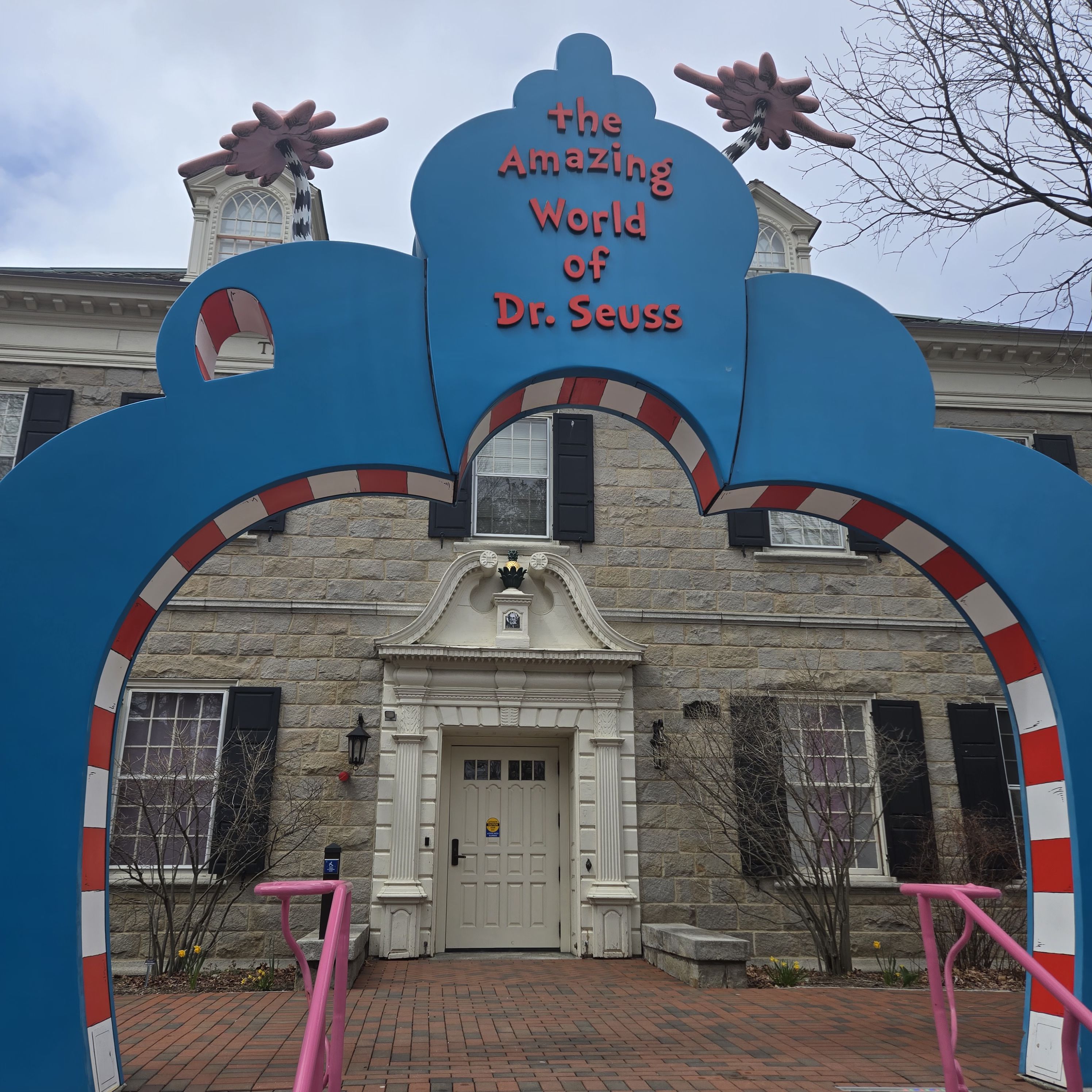
    The history museum is located on a campus which also contains two art museums, a natural history museum, and the Dr. Seuss Museum. He lived in Springfield.

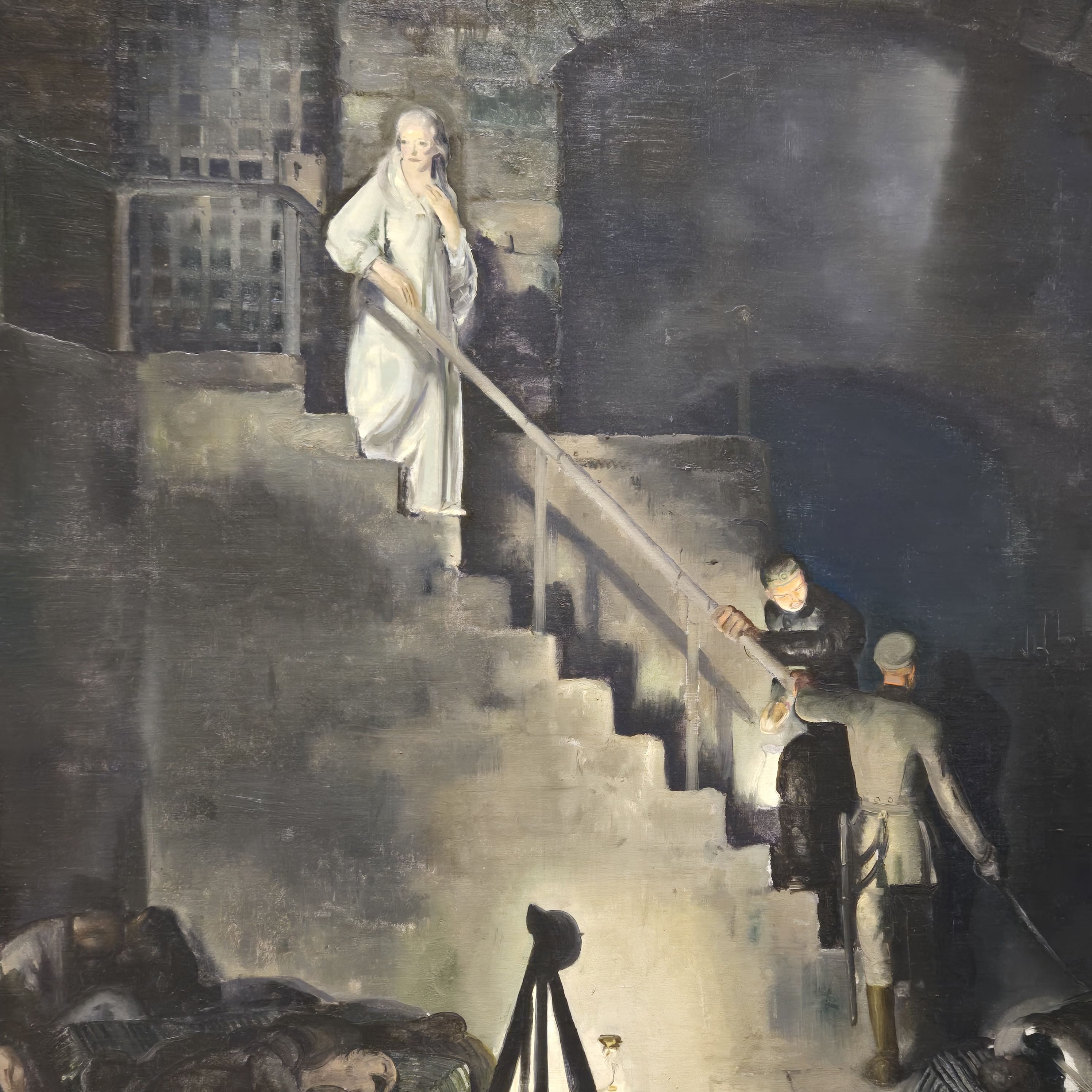
    The Michele and Donald D’Amour Museum of Fine Arts has some fascinating American paintings (its collection is much broader than just American). A few examples:

    I could tell you about each of these, but I am afraid it would take too much time. The first is by Harold Rabinovitz, who was killed in the Pacific in World War Ii before he reached the age of 30. The third is a detail from a work by Paul Sample, who painted this church supper using people he knew as models. The gfourth, by Bill Vuksanovich is a work with graphite on paper (looks like a photo). The bottom one, by Reginald Marsh shows nurse Edith Cavell before her execution by the Germans.

    This is just to give you a taste of the museum. There is much more. The other art museum contains only the work collected by  George Walter Vincent Smith. American paintings of the 19th century. Extensive Japanese, Chinese and Islamic works, and a large room of plaster casts of Roman statues. I galive you a few examples of the museum’s large netsuke collection.

    After the museum, the second seder, with the same five kids and the same results. I should say one thing. Almost 10 year old Joan, the oldest of the five, not the youngest, did a masterful job on the Four Questions.

    Today? Driving home.

  • Life in the Big City

    April 13th, 2025

    When your seder has five children under the age of 10, things are a bit different.  For one thing, you start at 5. For another, the service is abbreviated. For a third, someone finds the afikomen before the Four Questions. For a fourth, there are a lot of frogs. And for the 5th, there is certainly no after-dinner completion of the Haggadah. So last night, we were back at the Hampton Inn by 8. I expect tonight will be a repeat.

    Now, it is another 8, and it’s time for breakfast. We have a box of matzoh in the room and can get coffee downstairs, and yes, we are grateful for the freedom, but isn’t someone supposed to feed us manna?

    I can’t say we accomplished a lot exploring cold (temperature never even hit 40) Enfield CT yesterday, but we did learn that things used to be better. Once, for example, it was the home of Bigelow Carpets. “A name on the door rates a Bigelow on the floor”, or something like that. The Bigelow campus was very large  and now looks to be a housing complex called “Bigelow [something]”.

    It’s in a part of town called Thompsonville, I think, and is surrounded by what used to be company housing, including many fourplexes, some of which have been fixed up. Like this one:

    Enfield also used to be the home of a sizeable American Lego factory. No longer. And George Washington never slept here, but Paul Robeson did live here. That reminded me of a trip a few years ago when we stayed in a different Connecticut town, Danbury, and learned that Marian Anderson had lived there (and we saw her studio).

    We lucked into a place at lunch. Called Mark’s, it is a few blocks from the Bigelow campus. It has only 5 tables, seating I think 12 or 14, and is only open for breakfast and lunch. The prices are from maybe the 1980s:


    I had a “Good Start” breakfast sandwich, made up of eggs, spinach, tomatoes and roasted red peppers on toasted marbled rye. Here is a picture of half of it:

    Not much else happened.  I didn’t pay a lot of attention to the rest of the world yesterday, but saw an article a few minutes ago that said 84% of Republicans like the job Trump is doing. For shame.

    One of those people is the owner of a funeral home here in Enfield. His family started the home about 140 years ago. The entire family are Democrats, involved in local politics forever, but he has broken away. Just couldn’t take any more Pelosi and Schumer, he said. Now, no one in his family talks to him.

    That’s the way it is in the big city.

  • Happy Spring

    April 12th, 2025

    Did you ever wonder what spring was like in Enfield, Connecticut? Now, you know. Daffodils and, yes, snow.

    We drove up yesterday for seders at Hannah’s inlaws’ house in Longmeadow Mass. Edie and I drove up with Hannah and about-to-turn 10 Joan.

    Digression. But before I get to that, let me thank Harry Rado for reminding me that today is the 80th anniversary of the death of Franklin Delano Roosevelt. This is an important event, not only for the Roosevelt family,  but for me. It is the first thing I remember.  I was playing (?) in the room we called the library, and my grandfather was sitting in a chair listening to the radio when the news came across. I don’t know, at age 2 1/2, if I knew who FDR was, but it was clear that this was something REALLY IMPORTANT.  But for years, I have wondered that, if I remembered this, why couldn’t I remember what happened five minutes before. End of digression.

    So our 6 hour drive yesterday took 9 hours. This was, in part, because we stopped for both lunch and dinner, and in part because of torrential rain that fell for about 80% of the ride.

    Joan has told me that this blog post had to be about her. To quote: “You didn’t do anything you can write about today that didn’t involve me.”

    Well, she had a good time, as did I. At one point, she told me that she had learned at school every important event that ever happened and I should quiz her. Of course, when I asked her about the Mexican-American War, she told me that it was a war between Mexico and America and people were killed. Then, I asked about Panama, and she said that (1) it was a country, (2) it existed, (3) people lived there, (4) it had trees and (5) it had animals. I then asked her the tallest mountain, and she said “Everest”. Good, I said, “Where is it?” Naturally, she answered, “Panama?”

    Other questions she refused to answer on the grounds that they weren’t important events.

    Well, we also had a good time reading signs, especially on trucks. We twice saw trucks for the Piece of Cake Moving Company, and thought that was the best.

    One more thing. Joan is in the habit of complimenting people at times I find a bit weird. Like when she told a waitress “I like your hair” or a woman we passed “I like your lipstick”. I asked her why she did that (in a mildy disapproving tone) and she said. “Because it makes people happy. They smile and say thank you. That’s important.”

    That looks like it for today.

  • I Know Nuthin’

    April 11th, 2025

    Ask me if I understand any of this…..

    I take Edie’s car to the car wash for its Passover deep clean. Our two neighborhood car washes are now owned by the same company, Flagship, and their charge for a super duper (not so super, really) car wash is (sit down, please) $44. I know that is an outrageous amount to charge for a car wash. Before Flagship took it over, the same wash at the same place was about $30, which was bad enough. And Flagship is the only car wash within 4 miles of our house. Maybe Trump’s tariffs will bring cheap car washes back to America.

    [Digression. The car wash clerk is a very nice lady. She has been there a while. I have never really thought about her name, but looking on the bill, which I just did, I see her name is given as Wondwossen. I look it up. Ethiopia is filled with Wondwossens.]

    On the short drive home from the car wash, I see a bunch of dashboard lights go on, like someone has just hit a grand slam. Then a sign pops up that says “Hybrid System Failure. Contact Dealer. Park Car in Safe Space”.

    Of course, my first instinct is to ignore the sign. But because things keep flashing, I don’t, and pull over to the curb, right next to the sign that says “No parking anytime”. I should really put the car in a legal parking space, I think, but when I try to restart it, the same message appears, and it is clear that it is not going to restart.

    Is there any good news in this story? Yes, the good news is that the service station we normally use (normally for the last 40+ years) is only one block away, so I walk there and tell them my sad tale. The fellow in charge today asks one of their technicians, a nice, tall African born fellow, whose name sounds suspiciously like Wondwossen, to help me. He tells me that we can walk to my car and he will try to jump start it and bring it back to the station. His terms are: “I will charge you $80 if we are successful, and if I can’t jump it and it needs to be towed, I won’t charge you anything. And the $80 is to me, not the station, and needs to be in cash.”

    What can I do? Especially, since we are leaving town the next day for several days, and I am parked illegally. I say “OK”. We walk to the car, he opens the hood, connects his jumper cable and says to me “Get in!”. I do, and we drive for one block to the station.

    But the lights are all still on, and it is unclear that the car will move again, or at least move very far. And he tells me that he has to check the Hybrid system and probably reset it. I have no idea what that means, but as I watch him for a half hour (only interrupted by the driver for the Kuwaiti ambassador coming in with his sleek black Land Rover which has a nail in its tire. Or maybe, since it’s a Land Rover, it’s a tyre.) as he dissects the car.

    Yes, it was like high school biology class (which I don’t remember at all, really), where you had to dissect an amphibian of some kind. Or it was like going to a doctor and being told that he has to operate on you while you are conscious and watch him taking you apart, piece by piece.

    Things come out of the hood. The trunk is opened and everything including the spare is taken out, so he can get underneath it. Same with the back seat. All of the innards piled next to the car. It is clear to me that this car can never be put together again.

    He unscrews that, he sets his computer to this, he brushes off something else, he scratches his head, he says “uh-huh”, he tells me that he’s on it, not to worry. Then, after I pace around and around and around, he tells me to go home, and that he will call me.

    Now, I said this is our neighborhood, so going home just means walking about 3 blocks, so that is okay. Several hours later, I get a text that the car is ready.

    I walk to get it, it starts, it works, it looks fine, I am told by the station manager that Nunu (maybe it’s not Nunu, but Bugu, or Gubu, or something like that) has reset the Hybrid system. I act gracious (I was), but tell him I have no idea what he did. I don’t think the manager knew, either. Bugu or Gubu wasn’t there, so I couldn’t talk to him.

    Now, I had no idea what the price would be. It turns out that it’s just over $300, and was for $282 labor and taxes. Is that a good price? Did he put in $282 labor time? Did he do a good job? I have no answer to any of these questions.

    What the manager did tell me was: if it turns out that there is still a problem, let us know and we won’t charge you any more to fix it.

    I drove it the half mile or so home. It’s in the driveway. Luckily, it’s not the car we are taking on our trip to Massachusetts. I will check it again when we return.

  • Who Shot the Tariffs?

    April 10th, 2025

    Let’s start with a digression: Bill Wyman is or was a member of the Rolling Stones. (I know virtually nothing about the Rolling Stones.) He is now 88, but when he was 52 he married Mandy Smith, an 18 year old with whom he had been in a sexual relationship for four years. They were together for two years after they married and then separated and were divorced. What I read yesterday is that Bill Wyman’s son Stephen later married Mandy Smith’s mother. (I am assuming, for the purpose of this digression, that what I read it true; I don’t otherwise know, one way or the other.) When they married, Stephen was 31 and Patsy (Mandy’s mother) was 46. That means that Stephen married his step-grandmother (right?) making him his own step-grandson (right?). I am trying to picture the tree.

    End of digression.

    We went out for dinner to a nice upscale restaurant (Le Chat Noir in DC) last night with old friends. Because of the amazing stock decline, I thought that I should hold back on my spending and consumption and, to do that, I decided I wouldn’t get a drink. But then the market climbed about 3000 points, and I decided a drink was in order, and I had a very soothing vodka gimlet. Now the market has declined about 1,000 points from it’s last night high, and there is only one thing that I am thankful for. I am thankful for my vodka gimlet.

    So once again, MSNBC’s Lawrence O’Donnell was right. What he always says is that there is one thing you can always count on regarding the behavior of Donald Trump. When he proposes to do something bold (and crazy), you can always count on him to back off before he does it. And, once again, he did. He backed off his reciprocal tariffs, we can buy vanilla beans from Madagascar without paying a penalty, and life is back where it was, right?

    Wrong. We still have 10% tariffs on everything, we still have 25% tariffs on all steel and aluminum imports, we still have the tariffs he put on Canadian imports and of course we still have the 1,000,000% tariffs on Chinese goods (or whatever the correct number is today). That is the reason, I guess, that the 3000 Dow rise yesterday has turned into a 1000 Dow decline so far today.

    Apparently, the biggest problem yesterday was not the stock market drop (from the Trumpian perspective) but the unprecedented decline in the purchase of US bonds, which threatens everything in our economy. I am not sure where the bond market is today. The market can lose confidence in our bonds quickly, but how long does it take to regain confidence. Trump says that he had been “following the bond market” and that now it is “beautiful”.

    As to who convinced Trump to back off, that’s another story. Probably everyone but Peter Navarro, the man whom Elon called “dumber than a stack of bricks”, and then apologized profusely to the bricks.

    Another quick digression. Since whatever Trump does has a gargantuan effect on markets, and since so many in Trump’s circle depend on the markets and have so many conflicts, what are the odds there has been insider trading and market manipulation? 100% is probably a conservative guess.

    End of digression.

    Of course, the reciprocal tariffs that Trump was to put on the world have only been postponed for a 90 day period until mid-July. My own thought is that the 90 days mentioned in Trump’s Truth Social tweet is meaningless. Based on the market’s experience yesterday, the pause may last the remainder of Trump’s term. Or, Trump being the loose goose he is, the 90 day pause itself could be canceled, and the tariffs could be imposed this afternoon. You just never know, which is why the question of market confidence is so much up in the air.

    And then (if this is true), Trump has said that 70 countries have requested meetings to discuss individual tariff “deals”, or as he puts it 70 countries have said that they want to “kiss my ass”. Maybe now, they won’t be so anxious to meet.

    As to China, from which we get about 16% of our imports, who knows? Even if we are in a fight with China alone, that fight will affect us in some ways unforeseen. And as to what will happen to our federal workforce, our federal buildings, our claims to Greenland, Panama, and Gaza, the wars in the Middle East, the war in Ukraine, and the people being whisked off the street and sent to El Salvador………

    We had an interesting conversation this morning with my Thursday breakfast group about the ethical roles of lawyers. The discussion was presented as the responsibilities of lawyers representing corporations whose activities create public health issues (tobacco companies, chemical companies, etc.), where the “client” is engaged in conduct which is dangerous and will be continuing (as opposed to representing a defendant in, say, a murder trial where the particular crime has already been committed and cannot continue), and the discussion quickly morphed into the responsibilities of lawyers who are working for the government and taking positions supporting actions which are both wrong (define that as you wish, or define it as positions which the lawyers themselves believe to be wrong) and continuing. The discussion goes to the definition of “client” when it comes to a government lawyers, the ethical responsibilities of lawyers which trump (now a cute word I guess) their responsibilities to their clients (however defined), and questions of failing to tell the truth in court proceedings or enabling witnesses to lie in court proceedings.

    Guess what? It was an interesting discussion.

  • Chopin and Cod Liver Oil (in that order)

    April 9th, 2025

    Every Tuesday, the Church of the Epiphany in downtown Washington has a free (donations requested) classical music concert. I used to go on a fairly regular basis, but when the programs had been canceled during the pandemic, I got out of the habit and now rarely seem to go. But I did yesterday and her a wonderful concert of Chopin by young Koren born pianist Jiin Kim, now working for her Ph.D. at the Peabody Institute in Baltimore. It was a refreshing break at a fraught time. And it was nice to get some fresh air on a beautiful December day. (Yes, I know the calendar says it’s April.)

    Oh, and to prove it’s April, look at this, just down the street.

    Changing the subject…..

    I recently received a gift from an old (yes) friend and law school classmate, now living in New Mexico. Three old publications, including this one:

    Yes, “Watson on Cod-Liver Oil”, published 1868. Dr. Watson was writing about the effectiveness of treating tuberculosis with cod-liver oil, a remedy first used in England in the 18th century, but which seems to have been forgotten in America in the 19th. According to Watson, cod-liver oil, when used with other recognized treatments, helped stabilize or cure the disease.

    I knew that must be Robert F. Kennedy-like nonsense, but I googled it and discovered that it is again today recognized by some as effective.

    You don’t hear much today about cod-liver oil, but it is readily available, I think, and used as a source of Omega 3, among other things.

    And I learned quite a bit about it from the article. I learned that there are gradations of cod-liver oil, and you only want to take it is it is a clear yellowish color, with no trace of red or orange. I learned that cod is related to haddock and pollock, but that the liver oils of these related fish do not have the same properties as cod-liver oil, and should be avoided. I learned that there are unscrupulous folks who purposely mislabel the oils. I learned that one other fish oil is as effective as cod-liver oil, and that is shark-liver oil, which is (no surprise) harder to get. I even learned that combining the oil with orange juice makes it more palatable.

    The two other old publications were the 1864 report of the National Academy of Sciences made to Congress by Professor A.D. Bache, and a Discourse on the Objects and Importance of the National Institution for the Promotion of Science from 1841. I don’t plan to tell you anything about either of those.

    It’s been a busy morning. It’s about 12:30 and I don’t even know how the stock market is doing. Back up to 45,000?

  • Playing Jeopardy? The Answer is: Ivan Voitski.

    April 8th, 2025

    The question, as you might have already guessed (or perhaps even known – nah, I doubt it), “What is Uncle Vanya’s real name?”

    “Uncle Vanya” is one of Anton Chekhov’s most famous plays, along with “The Cherry Orchard”, “Three Sisters” and “The Seagull”. It is now playing at Washington’s Shakespeare Theatre, the first time Shakespeare has put on a Chekhov play. We went to see it Sunday night, something that I was looking forward to. And, as often when your expectations are too high, you come away disappointed.

    I have seen each of the four major Chekhov plays, and at least three of them I have seen more than once. These include “Uncle Vanya”. My impression of his theatrical works is that, when you simply read the text, they are fairly dry, but they have a sort of magic that becomes apparent when they are well performed. I have seen “Uncle Vanya” well performed.

    Now, I have to start with talking about the current production of “Vanya” by talking about Shakespeare’s Harmon Hall, which seats approximately 750 people. To me, this is a theater that is much too large for a Chekhov play. Now, I am not a professional critic, so I decided to ask a real critic, like Google’s AI (which I assume is an amalgam of critics worldwide), and here is what it told me: “For staging Chekhov’s plays, an intimate, yet flexible, theater space is ideal, allowing for a sense of realism and allowing the audience to feel close to the characters and their everyday lives.” I agree 100%, and I think staging “Vanya” at the Harmon was a mistake.

    (Now, on a personal level, I have to say that the mistake was compounded by our seats, which were in the fifth row of the balcony, meaning that we were really a long way from the stage, which was well below us. We seemed to be like on the third or fourth floor, looking down. No, I did not select these seats. These were replacement seats, because it turns out that we will be out of town on the day we were scheduled to see the show.)

    But it wasn’t simply the vastness of the theater that created the problem. I think a problem at least as serious was wh”at I believe was simply poor casting. And that the poor casting was compounded by the decision to set the show in a massive, old, estate in rural Russia (which is where Chekhov set it), to make this clear in the opening oral introduction to the show at Shakespeare, in keeping the names of all of Chekhov’s characters, in referring to Russia, Russia, Russia, but in not having the actors play their roles as if they were Russian, much less as if they were in Russia.

    Playing Vanya was Hugh Bonneville. Probably everyone but Edie and me know who Bonneville is. He’s best known, I have read, for playing a major role in Downton Abbey, a show that we have never seen. Don’t hold that against us, please. But those who know Bonneville know that he is English. And he played Vanya with a very English accent. No one told him that Vanya was Russian, not English, I guess. And no one told any of the other six or seven cast members that they should play their roles with English accents. The result was that each of the other characters had American accents, and dear Uncle Vanya spoke with a pronounced British accent.

    My other problems (and I know I am going to sound like Donald Trump talking about D.E.I., but take it for granted that is not how I am trying to sound) come from the choices for the other cast positions. The story line, if you do not know it, has Vanya’s former brother-in-law and his new, much younger wife, come to live on the family estate, because it has become too expensive to stay in St. Petersburg on a retired professor’s salary. Vanya, and the local physician, Astrov, both fall in love with young (but married) Yelena, and complications result.

    Bonneville was all right, I guess. The actor playing Astrov, though, did not seem up to the task. This was not all his fault. The role of Astrov is the role of a man so sexually appealing that women simply fall all over him, although he is, or pretends to be, not interrsted. This Astrov is not a heartthrob, and you wonder why either was attracted to him. Period.

    The actress playing Yelena, Ito Aghayere, was born in Canada, and is of a Nigerian ethnicity. Why would anyone cast a Black actress in this role in a Chekhov play? (I told you I would sound like Donald Trump.) Now, I could understand it if you took “Uncle Vanya” and reset it to another location at another time. But this was not the case here. In this production, you are supposed to think that you are watching a very Russian family on their very Russian estate. Ito Aghayere, as attractive as she is, just does not look Russian.

    Another Black actor, Craig Wallace, is also in the play as Ilya Ilyich, or Waffles, a retired landowner who also lives on the estate. I had a problem with his casting as well.

    So, in this time bound, very traditional Russian estate, we have an English man, a Black man, a Black woman, and three other cast members, who  look to be White Americans.

    Now, all of this could have been overlooked if the cast members could overcome their physical differences with fine acting. But this just did not seem to be the case. In fact, in a play where emotional relationships have key roles, none of the actors seemed to have any real connection to the others. It sounded to me more like a first read than a polished play.

    (I should say that, with regard to the many plays I have seen with actors playing roles written for different ethnic or racial groups, I have no problem. But for this particular production of this particular play, it seemed to me that it just did not work.)

    Now, the surprise ending. Edie and I (she pretty much agreed with me, I think) are the only two people who feel this way. The published reviews for both the production and the acting are glowing.

    Can I blame it all on our seats?

  • What Happened to Uncle Vanya?  Poof!!

    April 7th, 2025

    Thinking outside the box? I was listening to the C-Span call-in this morning, and a Republican caller had an interesting take on America’s problems.  It is all the fault of Roe v. Wade. Can you guess his reasoning?

    Were it not for abortions as a result of Roe v. Wade, the US population today would be 600,000,000. If our population was 600 million, with so many of them young, we would (1) have a working population ready to fill manufacturing jobs brought back to the country, and (2) we would have so many more people paying into Social Security that we wouldn’t worry about it going bankrupt. Can you refute that?

    Thinking outside the box? So many people describe Trump’s following as a messianic cult, Trump as another Jesus or as a harbinger of the Second Coming. For those who believe that, the chaos that he is fomenting may actually deepen their belief, that a time of troubles and final battles may indeed pressage the Golden Age.

    But of course, there have been many false messiahs, and I wonder if Trump may be more akin to Shabtai Tzvi than to Jesus. Know him? A Jewish would-be messiah who developed a following across the 18th century Jewish world, including famous rabbis and thousands of families who sold their homes and possessions to move to the holy land. What happened to him? He was arrested in Istanbul and decided that conversion to Islam was better than immediate death. If you see Donald prostrate himself five times a day, you will understand what is happening.

    It’s 10 a.m., and the Dow is down another 1000 points. Treasury Secretary Bessent says that normal Americans are not concerned about daily market fluctuations, or about the possibility of a recession.

    By normal Americans, he may mean billionaires. Even Warren Buffet is apparently not concerned that his life savings may disappear.

    And Commerce Secretary Lutnick, the billionaire whose 94 year old mother won’t care if her April social security payment is delayed a month, put his other foot in his now overcrowded mouth over the weekend. When asked why Trump put tariffs on two islands in Antarctica which are inhabited only by penguins, he said (with as straight a face as is possible for him): if we didn’t do that, other countries would take their goods to those islands and be able to export them to the US without any tariffs at all.

    Oh, Vanya. Last night, we saw Uncle Vanya at Shakespeare Theatre. When I opened up this app this morning,  I thought Uncle Vanya would be my subject. Maybe tomorrow.

  • AI Takes the Stage

    April 6th, 2025

    Some time ago, I watched a film on Netflix called Subservience. It was one of those films that was by and large terrible, but by and large fun to watch. The gist of the film, which took place sometime in the not too too distant future, is that a young husband, after his wife became ill, went to a local firm that rented out robots (called sims) to help with household matters. The sim in question, whose name was Alice, looked just like a human being. In fact, she looked remarkably like Megan Fox, believe it or not.

    The engagement of Alice was not that unusual apparently, and in fact, sims who looked like people were being hired for all sorts of uses, such as replacing human beings on construction projects. And, yes, there was a lot of backlash.

    Alice did a fine job with the children, but Alice also took a fancy to her master and, boy, did that lead to complications, mostly from Alice’s determination (I guess an AI creature can be very determined) to win her master from his wife. In the fracas that followed, Alice was seriously injured and returned to her manufacturer.

    But Alice is not to be brought down easily. In fact, what she does is replicate her “brain” in the bodies of other sims, and life clearly will become terrible for everyone.

    Okay, that sounds like a horrible plot, right? Yes, it was, but the depiction of a society where there were human beings, and where there were these AI creatures as well, was really interesting and thought provoking.  (Take care, Elon Musk)

    A similar society was depicted in the play we saw today at Theater J. The play, called Your Name Means Dream (not a great title), shows what happened when an elderly (pretty young elderly – 74), ailing woman is provided an attractive non-human AI creature to be her caretaker. (Naomi Jacobson, who does a lot of cursing and screaming, plays the unpleasant human.) All of the shows we have seen this year at Theater J have been excellent. Until this one. I thought this one so bad that it made me long for Subservience, something I never really thought possible. Luckily, the run ends today. So you don’t have to see it.

    What was wrong with the play? Everything. With the exception of the acting of one of the two cast members, Sara Koviak, for whom the play was apparently written, I thought it was an enormous waste of time and even made me wonder if Donald Trump might be right about purging American theater of harmful influences.

    And Koviak, who had to act like a robot (but a robot with too many human characteristics) in her communication and in her mannerisms, and whose role also demanded a great deal of physicality, played the role just right, once you accepted that this was the way to play the role (and since the role was written for Koviak, it obviously is the way it was intended to be played), you cannot fault her at all. I fault the playwright, however, with coming up with an AI character who was, on the whole, not AI enough (i.e., too human) and whose abilities, such as making telephone calls internally and becoming the character who she called as long as the call lasted, were someone outlandish.

    (I should add that this play has been put on elsewhere to good reviews. Go figure.)

    Luckily, we don’t live yet in a society where human-appearing robots compete with human-appearing humans for jobs and strike relationships with each other. Or do we? Can anyone prove that either Donnie or Lonnie are in fact 100% human? I can’t.

    I keep reading and hearing that even Republicans are getting tired of them or their policies. But that they are simply afraid to say so. Cowards, all. Really.

    Franklin D. Roosevelt: can I quote you? “The only thing to fear, is fear itself.”

  • Take Me Money and Run Venezuela? Too Late for That?

    April 5th, 2025

    I don’t understand it. Among all the problems with the Trump immigration actions, the fact that they sent the “wrong person” to that prison in El Salvador is not surprising (and not excusable). They have admitted that he should not have been sent there, and a federal judge has told them to bring him back to the United States. The government had argued, as I understand it, a number of things, including taking the position that once he was out of the country, the judge no longer had jurisdiction, and that once he was out of the country, the government had no way to get him back. In fact, the 20-something year old press secretary of His Lowness said, to a questioning reporter, something like: “You should be talking to the president of El Salvador”.

    This pretty much typifies everything, doesn’t it? Total callousness on the part of the government to the individual involved and his family. Total disregard of an order of a federal judge. Total impertinence on behalf of the press secretary. Total disregard of law.

    This is what is happening. The government is picking up people off the street whom they believe to be members of a gang that they believe is directed (at least to some extent) by the government of Venezuela, and is sending them (without any due process rights to, for example, prove that they are not members of a gang) to a prison in a third country, El Salvador. Apparently, these arrests are being made on the basis of a name (that’s the problem with the man who they admit was incorrectly arrested) and on the basis of tattoos (Pete Hegseth, watch out, you are next).

    Once someone is picked up, they can be put on a plane and sent abroad without even any notice to next of kin. The wife (a citizen of the US) of the individual in question here found out where her husband was when she saw him being herded into the prison in El Salvador while she was watching TV.

    How you can arrest someone on the basis, say, of tattoos, or on the basis of name recognition and nothing more, I don’t understand. Neither did the judge, I don’t think. The question of membership in the gang is questionable for many of them, and the entire question of whether the gang is under the aegis of the Venezuelan government is apparently only speculation, if that. Certainly, it is a bad gang, and I guess members have been engaged here in criminal activity, but what about someone who escaped to the US to escape the gang he was forced to be in in Venezuela? Just for example.

    We have some sort of arrangement with the Salvadoran government to house people from third party countries whom we send there. But what is that arrangement? Even looking beyond the question of its legality (a real question, of course), what exactly are the arrangements? Is there written documentation of a contract? Or is it a handshake agreement? Or ….. ? Don’t you think we should see what it is?

    I doubt that it says: we are going to send you a bunch of folks to imprison. They are from another country. Once you have them, they are yours. You can torture them if you want. You can starve them. You can free them. You can keep them three days, three years or three centuries. They are yours. We are washing our hands of them. If they say we should not have sent them to you, we don’t care. Again, it is up to you. It is like we never saw them.

    Horrific. It can’t happen here, can it?

    I have to run. Luckily, I have no tattoos, and my name is really not that common, certainly not in Venezuela. I think I am safe. For today.

    ERRATA: I now see that the individual I was referring to was actually Salvadoran, not Venezuelan, and I can see how that could complicate things. Everything I said about Venezuelans was, I think, correct, and there are several Venezuelans now in El Salvador who are proclaiming innocence of gang membership.

  • So, Can it Happen Here?

    April 4th, 2025

    I think my presentation went pretty well. I spoke about the failure of the Weimar Republic, and whether today in the United States we can learn anything from studying why it did not succeed.

    I would like to upload my text (which I have in a Word file) onto the blog, but when I looked at the instructions on how to do that, they seemed to involve about a dozen steps, none of which I really understood and none of which I had the patience to learn about. So…..

    The German Weimar Republic was the government set up after World War I and the signing of the Treaty of Versailles in 1919 ending the war, and placing significant burdens on the losing German Empire, including reparations, military limitations and territorial losses. A constitutional convention was held in the city of Weimar, resulting in the formation of a liberal republic that governed Germany until it was replaced in 1933 by Hitler’s Third Reich.

    My presentation, which I think went well, was primarily based on a book titled “When Germany Put the Clock Back” by American journalist Edgar Mowrer and originally published shortly after Hitler obtained control of the country.

    Germany had no democratic traditions, and Mowrer said the Germans, always aggressive in foreign affairs, were always docile in internal matters, leaving governing to their better classes, and that the idea of a western style democracy was brand new to them. They, for the most part, did not understand how it was suppose to work, making it easier for the opponents of the Republic to undermine it.

    In addition, most elements of the population were against the new governing structure, including the old noble class, the military, the Catholic Church, and nationalist right wing groups, such as the brand new National Democratic Socialist Workers’ Party, otherwise known as the Nazis.

    There was tremendous bitterness about the terms of the Versailles Treaty. There was a country which had been destroyed, and there was unbelievably high inflation coupled with unemployment. There were those who believed in Aryan superiority and could not except defeat, and there were those, including many Jews, who found a liberal democracy just what they wanted, and who succeeded in changing the books Germans read, the films and plays they watched, the art they produced, and the sexual practices they were accustomed to. All this fed opposition to the Republic.

    Things settled down for about five years after 1924 when the Versailles terms were adjusted, but the global depression, which began in 1929 hit Germany hard and turned many of those who had voted with the Social Democrats ten years earlier into ardent supporters of the Nazis, who gained 38% of the vote for the German parliament in 1933 (as opposed to 2% of the vote which they won only a few years earlier).

    Of course, the Nazis always based much of their program on “the Jewish problem”. The Jews just didn’t fit into the Nazi way of thinking. The Nazis believed that humanity’s unchangeable pattern was to have ethnic or national groups compete with each other for power. A cosmopolitan group like the Jews, who believed in tolerance within the communities in which they lived and who all seemed to have international connections, just did not fit in the German/Nazi worldview.

    The Weimar government was led by a president, General von Hindenburg, a military hero and a man not identified with any of Germany’s 40 political parties, and by a Chancellor, the last of whom was Baron von Papen. The Chancellor ran the non-military side of the German government and reported to the President, who was also in control of the German military. In 1932, von Papen and von Hindenburg decided that Germany had become too unstable and fired all of the country’s ministers (something arguably not permitted by the constitution), replacing them with a more conservative, right wing group. In early 1933, von Hindenburg appointed Adolph Hitler as Chancellor. Von Hindenburg was not a Nazi, and not a fan of Hitler, but was afraid of him and believed that he would be easier to control in the government (in a high position, but one where he answered directly to von Hindenburg) than if he remained outside the government agitating.

    The deposed cabinet ministers left without putting up a fight prior to Hitler’s appointment. They thought they were helping save the country from further instability, and had not contemplated Hitler as Chancellor. They were even more surprised when Hitler was able to put through the Parliament (the Reichstag) legislation known as the Enabling Act, which basically gave the Chancellor the power to adopt and enforce new laws without parliamentary approval and without the approval of the President. Von Hindenburg died less than a year after he appointed Hitler Chancellor. He was not replaced. Hitler was now all powerful.

    This is the briefest of outlines. If you want my entire presentation, just let me know and I will send it to you.

    The question is: can it happen here? No one thought it could happen in Germany until it was too late. And when it did happen, it happened very, very fast. And it happened because not enough people fought against it, and because the Enabling Act gave unlimited power to an individual who had much less power the day before its passage.

    The United States in 2025 is not Germany in 1919. But even so……anything can happen anywhere, which means that “yes, it can happen here.”

  • A Film, a Book, a Presentation

    April 3rd, 2025

    I am writing this post quickly rather late at night. So let me get right to it.

    (1) The Film. Our neighborhood, community theater had one showing tonight (all 450 seats filled) of the 2025 Academy Award winning documentary No Other Land, a joint Palestinian-Israeli film about the Palestinian villages comprising a region known as Masafer Yatta, in the southern part of the West Bank, and their continual destruction by the Israel Defense Force and – in recent times – by Israeli settlers. The villages, which had apparently existed since before 1900, were designated as unapproved settlements by Israeli authorities and designation for destruction when the land they were on was declared as a military training facility. A legal battle of two decades ended when the Israeli Supreme Court sided with the IDF, and said that the villages could be destroyed and the residents forced to move elsewhere. For most, elsewhere would be leaving their land, their animals, and their rural life, and moving to a West Bank city, probably Hebron, the closest.

    It’s a well made film, showing collaboration between Basel, a young Arab and second generation activist, and Yuval, an Israeli of the same age, a journalist who is sympathetic to and supportive of the villagers’ cause. They both appeared to accept the Academy Award a month or so ago.

    Not surprisingly, the film is a downer, makes you mad, and makes you wonder why everyone can’t just accept each other and live normal lives. And the film certainly lets you see the fragile lives lived by rural Palestinians in the West Bank. But for me, there was something else. For me, it struck close to home. My home. You know, the United States of America.

    I imagined the same story set not in the south of Palestine and not in the 21st century, but somewhere (almost everywhere) in the United States, some time in the late 18th or early 19th century. The Palestinians would be played by Native Americans. The IDF by the U.S. Army. And the settlers…..well, by the settlers. It struck me that it was the same. The Indians always under attack, their villages destroyed and rebuilt and destroyed again, and so forth.

    There is nothing new under the sun. And the Americans at that time (and now) who support Manifest Destiny and think of the Indian wars just as an inevitable series of events required to enable our country to become what it is today, and no different from the Israelis, who think of the West Bank as biblical lands given to the Jews by God as part of Israel’s Manifest Destiny, and view the Palestinians exactly as the Americans viewed the Indians.

    (2) The Book. On Monday, I felt the need to read something light, so I went to my book case filled with books by people in the entertainment industry, and pulled one (primarily based on its size) to see if it was readable. It turned out to be quite readable.

    The book, by Shirley MacLaine, is called You Can Get There From Here, and was published in 1975. Shirley MacLaine, who is now 90 (remember when that sounded old?), and has had an interesting life and career, to be sure. This book deals with a much younger Shirley, obviously, a Shirley who was in her late 30s or early 40s.

    I still have a couple of chapters to go, but I think that I get the gist of what’s to come. The book can be looked at as having three major sections, and a fourth shorter one.

    The first part of the book talked about the period during the very early 1970s, when the Vietnam War was raging, and opposition to it was raging. Apparently, this was a time when Hollywood was in the doldrums, and everyone was turning to television, something that Shirley never wanted to do, finding most TV shows mindless and a waste of everyone’s time. But she had to make a living and signed on to do a show called “Shirley’s World”, which was to be a comedy about a young woman trying to make her way through life, and was to be filmed in various cities around the world. From almost the beginning Shirley thought she had made a big mistake, and after looking at the first draft of the scripts for the first episodes she knew she did. The show was aired for only a few episodes, I think, received terrible reviews, and was canceled.

    I had never heard of “Shirley’s World”, which was just as well, but she gives a very interesting description of how the show was put together, obviously from a very different vantage point than that of someone who simply turns of a TV.

    The second part of book deals with her giving up show business for several months to campaign full time for, and very closely with, George McGovern as he ran first for the Democratic nomination in 1972, and then against Nixon for the presidency. I did not know that she had done this, and had done it at such an intensive level (she was even with the McGoverns in a hotel room on election night, to give you an idea of her centrality to the campaign), so again her writing here was from an insider’s perspective. This insider perspective, by the way, was quite critical of the way the campaign was run and, as time went on, quite critical of McGovern as a candidate.

    The third part of the book (the one that I haven’t completely finished) involved a trip to China which MacLaine took in 1972 as the leader of a group of about eight “normal” American women, selected by herself, the first group of American women to be allowed into China shortly after the opening of the country to Americans. Again this was interesting, because China in 1972 was interesting, but was not a particularly successful trip, in part because the women were “too normal”, and not sufficiently prepared to be pioneers in this sort of travel, and in part because Shirley herself was so interested in China that she didn’t pay enough attention to her job as the leader of her pack. I should also say that, for whatever reasons, perhaps because China travel was so new and the country so unexplored by Americans, that I really didn’t trust her descriptions of the places she went or the people she was in contact with. China in 1972 was not the China that exists now at all.

    Finally, the short part. After the end of the McGovern campaign, Shirley decided to visit her parents for several days, something that apparently she did not do that often. Her parents lived right here in the DC area, in Arlington VA, and her visit, as she describes it, was an interesting one. No need for a long description. Let’s just say that if Carroll O’Connor and Jean Stapleton had not been available to play the Bunkers, MacLaine’s parents could have taken on the roles, playing themselves.

    (3) The Presentation. The presentation is one that I am making at 9 a.m. this morning to my Thursday morning breakfast group. That’s the reason I am rushed to write this blog tonight, and would not have time to write it in the morning.

  • Happy Liberation Day!

    April 2nd, 2025

    I know you have heard of L.L. Bean. But have you heard of D.D. Bean? No? You will, because D.D. Bean is the only company in the United States that makes matches. And without American matches, how will you light the bonfires you will need to rid yourself of all foreign made goods so you can feel truly liberated?

    As Edie and I wonder (or should wonder) if we should be downsizing,  this does seem like one way to do it. I went to the D.D. Bean website, and wanted to buy some matchboxes with our name on them. I saw that the minimum quantity is 100,000 boxes. We have a lot of foreign stuff in our house, and sometimes we find it hard to get a match to catch on fire, so we might need two orders.

    But it goes to show you how much we depend on foreign goods, not only high-tech goods, but…….matches. And how many things will be affected by liberating tariffs.

    Digression: “tariffs” is not a beautiful word. Putting two f’s together does not make for beautiful music.

    I am trying to remember what Donald Trump campaigned on…bringing down prices immediately, keeping Americans employed, ending the war in Ukraine before Inauguration Day, straightening out the Middle East. What else? Tariffs on all, ending our alliances, destroying the federal government, ending the role of lawyers and the courts, kicking qualified people out of essential jobs, picking people off the street and sending them to a prison in El Salvador without any recourse or due process, banning books, absorbing Greenland and Canada, controlling the Panama Canal, taking over cultural institutions and universities? Were these part of his campaign promises?

    Liberation Day will be January 20, 2029. And this may be a very different country then.

    And what if the thinkable happens? What if Trump’s dementia grows to the point that it becomes clear he can not do his job anymore?

    Trump did one thing presidential candidates often do. Choose a vice-president so clearly incompetent that his incompetence becomes insurance that the president will be allowed to serve out his term. I have no ready response on this one other than to say a Vance regime would be short-lived.

    In the meantime, higher prices are just around the corner. Buckle your Chinese made seat belt. It’s gonna be a bumpy ride in your Mexican made car.

    By the way, did you catch Cory Booker’s speech yesterday? I missed it, but I am going to listen to it this morning, this afternoon, this evening, tonight, and tomorrow morning.

    And I am going to be thinking about Liberation Day.

    “Matchmaker, Matchmaker……”

←Previous Page
1 … 22 23 24 25 26 … 62
Next Page→

Blog at WordPress.com.

searching

Loading Comments...
  • Subscribe Subscribed
    Art is 80
    Join 71 other subscribers

    Have a WordPress.com account? Log in now.

  • Art is 80
    View site in Reader
    Manage subscriptionsSign upLog in
    Report this content
    Collapse this bar