Skip to content

Art is 80

  • So It Can’t Happen Here? It Already Has.

    May 18th, 2025

    After Japan bombed Pearl Harbor and Germany declared war on the United States,  President Roosevelt signed several “Presidential Proclamations” affecting citizens of enemy nations, whether German, Japanese or even Italian. But the severest of his proclamations came a few months later when he signed Order 9066, which had a more limited, but more unjust, scope.

    Order 9066 affected residents of western United States were of Japanese, or partial Japanese ethnicity only. It didn’t matter if these individuals were citizens of Japan, whether they were in the United States legally or without authorization,  or even whether they were natural born or naturalized citizens. They were rounded up, forced to abandon businesses and homes, and moved to barracks in isolated “camps” in remote areas of California, Arizona, Idaho and Utah. Altogether, about 200,000 ethnic Japanese were subjected to this treatment. Of these, approximately 120,000 were U.S. citizens. They were kept in these camps for up to four years.

    Yes, there were objections. Lawsuits were filed, and the issue went up to the Supreme.  In the well known Korematsu case, the Court ruled 6 to 3 that the dangers created by the war overrode the Constitutional rights of these individuals.

    I had long known about this outrage, but paid little attention to it. Then, some years ago, there was a craft show at the Renwick, and a very, very good show, of works created by internees in these camps. It really humanized the situation for me.

    Now, at the Smithsonian’s American Art Museum, there is a large exhibit of paintings by three women, two of whom were interned in these camps, and one of which was able to avoid interment by moving to another part of the country. Their names are Miki Hayakawa, Hisako Hibi, and Mine Okubo. I visited the exhibit today and listened to most of a tour given by an excellent museum docent.

    By Mine Okubo

    This painting was made before the car during the depression, when Okubo worked for the Federal Arts Project.

    Here is another by Okubo from the same period.

    By Mine Okubo.

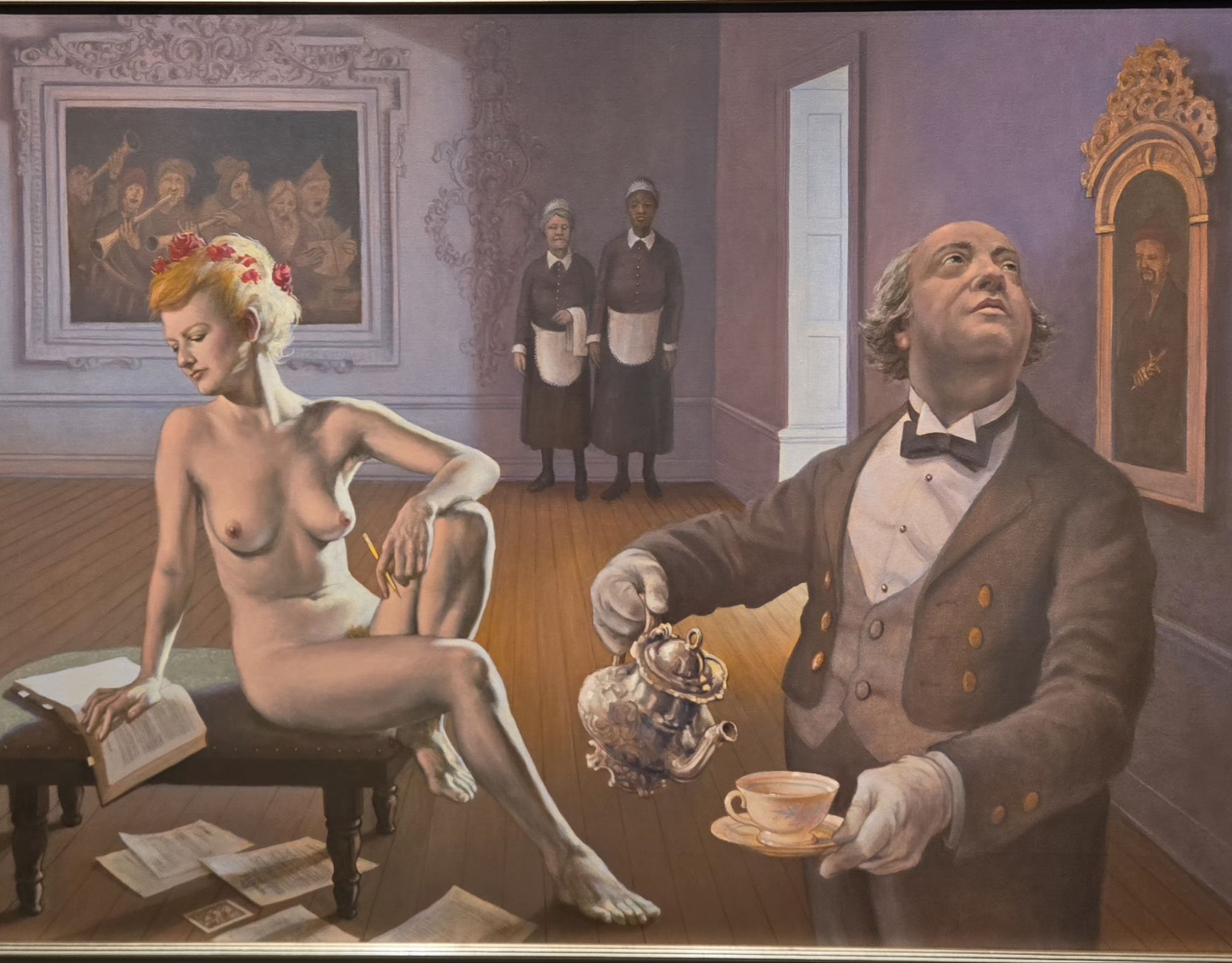
    This is a prewar painting by Hayakawa.

    By Miki Hayakawa

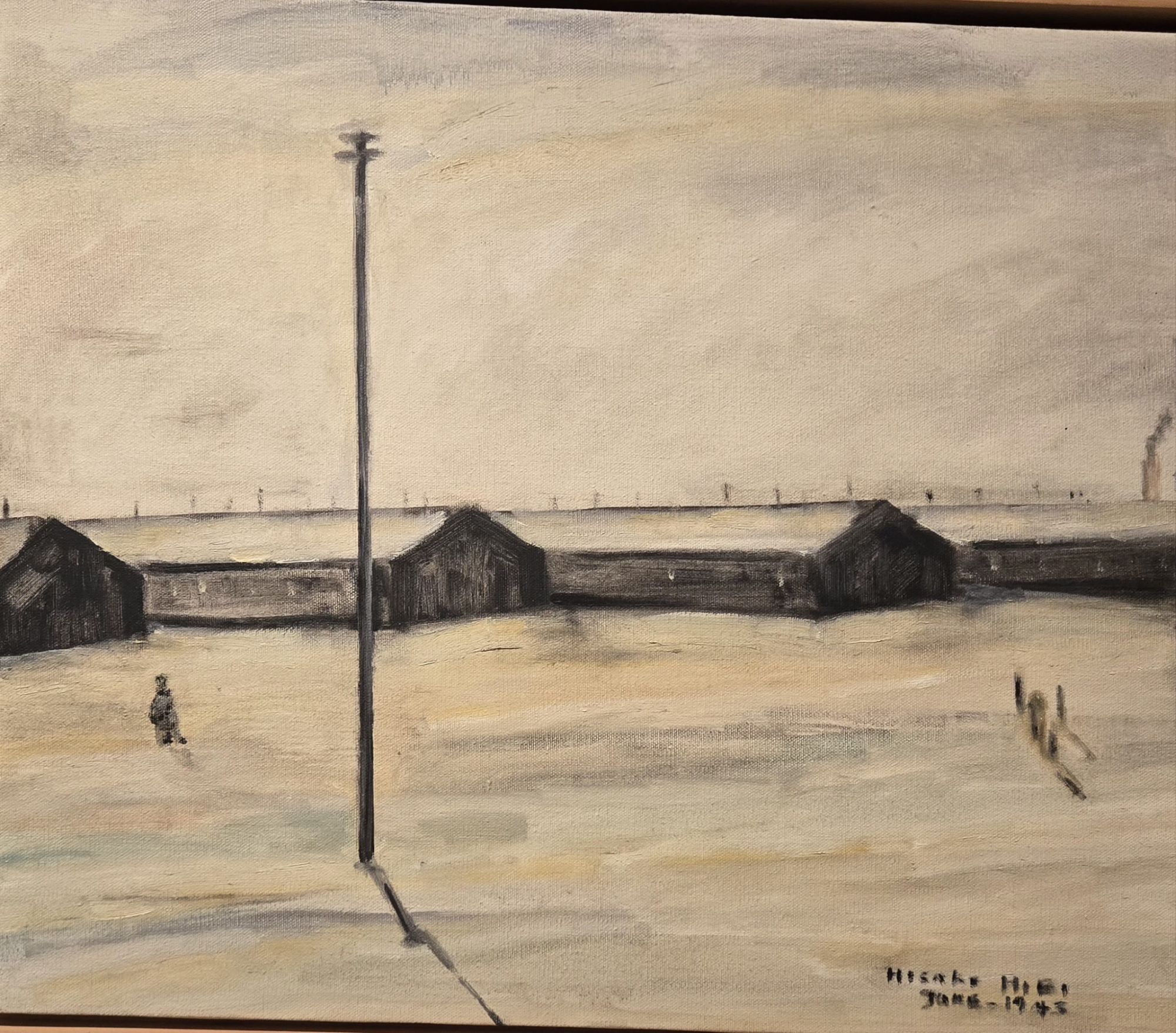
    The style of painting changed after they were removed. Here is what Hibi saw when she reached the first camp, a transit camp.

    By Hisako Hibi

    Here is an actual photo of Mine Okubo at the Topaz, Utah camp, where I believe she lived over two years.

    Mine Okubo at Topaz Camp

    In the years after liberation, styles changed again. Here is a work of Okubo from the 1960s.

    And a very different work by Hisako Hibi from that same period.

    And a final one, by Okubo. It’s simple, but I liked it.

    It’s a large exhibit of history and human resilience, as well as art. Try to see it. It will be there until mid- August.

  • I Have A Secret…..

    May 18th, 2025

    I have a secret, and I am going to tell you what it is. You know the Saudi royal family, and the royal families of the UAE and Qatar? Donald Trump thinks that they are his friends and, believe it or not, not only do they not consider him a friend, they consider him stupid. Believe it or not, that’s the truth.

    That’s something that those Arab royals and I share in common, by the way. The difference is that Trump’s stupidity isn’t going to hurt the royal families and might even help them, but it might really hurt my family and friends and everyone else living in the United States.

    The royal families of the Arabian peninsula are out to enhance the wealth of the royal families of the Arabian peninsula. Not that one royal family cares about another royal family; each cares only about it self. This is the way royal families are. And this is also the way that wannabe royal families are – wannabe royals like the Trumps, for example.

    Hitching the Trumps to the Saudis and the others may be good for the Trumps. It is hard to believe that it is good for the United States. And it seems to be in direct conflict to the concept of America First. The history of Arab peninsula politics should make that clear.

    Of course, becoming the leader of a royal family is not enough for Trump. Royal families themselves are internally notoriously unstable, as we know. They have internal rivalries and they tend, from time to time, to witness ruthless goings-on, with people being killed, exiled, and who knows what else? They also spawn members who become very ambitious and consequently stir up enormous amounts of trouble wherever they may go.

    So while Trump wants the Trump name to connote royalty, he does not want to share the glory with other Trumps as long as he himself is alive. He wants all the power. So in addition to wanting to become the equivalent of an Arab royal, he wants to be a political dictator. Like Putin, or Xi, of any of the Kim Jongs. But while they, his fellow political dictators, want to control parts of the world that they consider to be within their spheres, Trump would like to control all parts of the world. Well, maybe not Africa – I don’t think he wants to get involved at all in Africa. We can guess why that is.

    So, as I have said before, in all of his doings, Trump may be thinking of the Trump family more than he thinks of the United States. America First may in fact be much closer to Trumps First. And, to be a bit less cruel to him, perhaps he thinks that if Trumps come first, his version of America (a Trump creation in the making, to be sure) will just tag along and be all right, too.

    But most of America do not seem to think that the Trump version of their country is what is needed. Certainly the polls show that, although about 40% or so of Americans are still Trumpers wearing MAGA hats. The courts have certainly turned against him. Obviously, the Democratic party. More and more Independents and more (if not more, and more) Republicans are backing away from him.

    We know that the Arab royal families are playing him (the Qatari palace in the sky being one big example). We know that the Chinese think they are winning the tariff battle. We know that Putin is not moving towards leaving Ukraine. And it looks like Iran thinks that they can use him to their advantage as well. We will have to see how all of this works out, but so far it does seem that MSNBC’s Lawrence O’Donnell has it right: Trump will bark and threaten and rage………and then he will back off. So if he is not only a bully, but a scaredy-cat bully, why should anyone fear him.

    Anyone, that is, except those who are subject to his whims. Such as everyone in this country, no matter how they got in or what rights they have been given by the Constitution, the laws, presidential proclamations or otherwise, any of whom can (it appears) be picked up off the streets and shipped to foreign countries like El Salvador, Libya or Lousiana. Or institutions which are dependent on federal funding, which includes every university in the country, every research institution, every state and local government, and every hospital. Their defenses are very limited. It doesn’t matter that the courts will rule for them (or, rather, it doesn’t matter for the most part) because court rulings take a long time and a tremendous amount of resources and by the time they win and Trump loses, they are out of money, out of business and maybe out of the country.

    Strong action by Congress (and that means some Republicans are going to have to back away from lockstep backing him) and continued court rulings will have to carry the day until the Congressional elections of 2026. And then it is up to the American people. They will have to realize that, again as I said a few days ago, that Make America Great Again is not a slogan that should be taken literally as a goal of Trump, but rather a slogan that is meant to bamboozle the American population to think that they are his goal, whereas they are simply a means to create the Royal Trump Family, led by the one Great Leader, Donald the Immortal.

    That’s it. You may think that everything that I wrote down today is trite or repetitive. But I think it is true. Robert Reich (you know who he is, right?) has been putting out his thoughts on line even more often than I have (he also has about 1000 readers for each of mine) and he answered the question the other day of why he is writing so much, not only every day, but often more than one time a day, and isn’t he just being annoying. He response was simple. Things are so fraught, he said, that he just feels compelled to try to give his readers some context, even if it means repeating things over and over. (I am not quoting him, or even paraphrasing him, and I don’t even remember what exactly he said, but this is close enough. And if this is not what he said (and it might be or it might be not), all I can say is: shame on him. Because this is what he should have said.)

  • Happy Birthday to Joan!

    May 17th, 2025

    Today is my granddaughter Joan’s 10th birthday.  We celebrated last night with a Shabbat dinner for the entire family.  We will take her to an art supply store this afternoon so she can pick out her present. Tomorrow, she is having an Escape Room party, to which we were not invited.

    Joan has always been exceptionally quick and clever, IMHO. Some of you may remember, when she was just a kid, that I used to post things she said on Facebook. To honor her birthday, here is a reprise of some of the postings from when she was 2 (I posted until she was 5):

    (1) Two year old Joan’s Massachusetts grandmother came to visit yesterday, bringing her three colorful bead necklaces. She put each of them on carefully, obviously liking them. She looked appreciative at her grandmother and said, “You have any earrings?” Getting a “n, ” she said,”Any bracelets?

    (2) We drive 2 year old Joan home. Her snack is a small bag of Cheerios. She drops a few on her seat and tells us they are dirty. Edie says they aren’t dirty, but Joan asks us to roll down the window. She wants to throw them out for the birds.

    Edie: you think birds like Cheerios?

    Joan: yes, they like Cheerios and they like seeds.

    Me: some birds like worms

    Joan: G-pa! You are so silly.

    (3) So we drive with 2 year old Joan by Ft. Reno Park. It is dark outside.

    Joan: Did you see a gorilla outside the window?

    Me: A gorilla?

    Joan: Yes, a gorilla playing baseball with a tennis racket.

    Me: I don’t think so.
    Joan: Yes, and an elephant wearing a glove so it can catch the ball.

    (4) 2 1/2 year old Joan and her mother are having somewhat of a morning power struggle. Hannah tries to end it by saying: “Look, I am in charge here.”

    Joan responds: Only a little”.

    (5) I am working with 2 3/4 year old Joan on her counting. I hold up four fingers and ask her to count them. She looks closely at each one but doesn’t say anything. I ask her how many she has counted. She says: All of them.”

    (6) After the children’s Purim service last night, Adas served the kids chicken nuggets and tater tots, with catsup the only condiment. I tasted the food and found it inedible. Joan was nibbling at it.

    Me: It doesn’t taste very good, does it?

    Joan: It does. I LOVE catsup.”

    (7) Joan and I are playing with her Legos. I make something and ask her what she thinks I made. She responds: A mistake.

    (8) It’s the last day of Passover school vacation, and Joan is at our house. I ask her what she wants to do. She says: Scuba diving.

    (9) Joan asks me if I know what she sometimes calls Cinderella. I tell her I don’t. She tells me that sometimes she just calls her Cinder and sometimes Cinderelli. Me: Do you ever just call her Ella? Joan: Not since she was a baby.

    (10) Edie, Joan and I have a Mother’s Day supper at Ledo Pizza. Joan starts to talk to the baby at the table next to us. Then she turns towards another table with small children and starts to talk to them. I say: Joan, why don’t you turn around and eat your dinner? We don’t know any of these people.” She responds: Yes, but we can make new friends.”

    (11) Her two grandfathers pick up Joan at her preschool. Sometimes, her car seat can be tricky, and her other grandfather was trying to get everything snapped. This is usually her grandmother’s job, and I say: This is when your grandma says ‘I persevere’. Joan says: Nooo. I say: Nooo? Joan: she does not say “persevere”; she says “persist”.

    12) Joan’s father tries to each her Spanish. Joan decides to take a pretend photo of her mother. Say “cheese”, she says. Hannah says: Queso. Joan: Mommy, not the cheese you eat, the cheese you say to a camera.

    (13) Joan sees a picture of me when I was her age. Her reaction: My, you sure have grown.

    (14) Hannah tells Joan that she and Joan’s father are going out for a walk. Joan says, “I don’t want to be alone.” Hannah says: “You won’t be alone. You are with Grandma and Auntie M.” Joan responds: ” WE don’t want to be alone.”

    Happy 10th birthday, Joan.

  • The Ends Justify the Means, Make America Great Again, or Que Sera, Sera?

    May 16th, 2025

    I listened to a Republican Congresswoman from Utah this morning on C-Span. She was asked by a caller why the Republicans kept in lockstep supporting anything that Donald Trump said or even hinted at. Her response was interesting. She implied that she may or may not agree with everything he said or did (note I said “implied”, not “said”), but that he was elected to be a “disrupter” and “disruption is always uncomfortable”, but that the important things were his goals, and not his individual actions or statements. “Ignore the process”, she said, concentrate on the results.

    I think that is just another way of saying “The ends justify the means”. Now, when I (and probably you) went to school, we learned that the philosophy behind the phrase “the end justifies the means” was morally repugnant. Maybe we learned that Machiavelli first said it (false) or Marx or Lenin (false and false), but whoever said it, it wasn’t said by us. We believe in having a fair and just process; we don’t believe in ignoring the process. We never thought we would elect a president who thought that the ends justify the means. It was, to put it simply, anti-American. But, maybe here we are.

    Following this segment on C-Span, there was another conversation with a Democratic Congresswoman from Wisconsin. She was asked a similar question, but phrased differently. It had to do with whether or not all Republican members of Congress were voting for bills consistently with their opinions of the particular bills. Her response (which I have heard before, of course) is that virtually no part of the MAGA agenda would pass the House of Representatives if Republican members of Congress voted their conscience. They vote (and speak) the way they do in public, she said, simply because otherwise they would be “primaried” out of office by opponents running on Elon Musk’s money, and would be replaced by others who would also vote the MAGA line.

    This is, of course, another way of saying the same thing. Or maybe two ways – the individual members vote the way they do to stay in office (the ends justify the means), or the MAGA world will drive them out of office if they don’t vote the full MAGA line (the ends justify the means).

    But then you have to ask: what are the ends that are so important that they justify any and all means? Other than saying he will “make America great again”, what is Trump really promising? And in responding to this question, you cannot help but asking the question as to whether his “make America great again” slogan is really the “ends” we should be focusing on, or whether the aggrandizement of the Trump family fortune is the “end” and the slogan “make America great again” is only one of the “means” to get there. This is a serious question, after all, because look: (1) even if Trump succeeds with his goal of making America great again, he knows that the next president or the one after that could unravel everything he is doing, because nothing regarding a nation-state is permanent, while (2) building up his family fortune could support his family for generations and generations, and he would get all of the posthumous credit.

    Trump is now ending his trip to Saudi Arabia, the UAE and Qatar, proclaiming it a great success. Perhaps it is a success; I think it’s a bit early to know. (You know the old riddle: when the Chinese sage was asked what he thought about the effect of Napoleon’s defeat on Europe of the 21st century, he responded “it’s just too soon to tell”).

    We do know that it is important to the Trump family to maintain good relations with all three countries. After all, in each country, there is a Trump development (hotel or golf course) under development and Trump cannot afford to have any of those ventures go south. In addition, sovereign funds or royal family members have apparently invested over $3.5 billion in son-in-law Jared Kushner’s funds. As a spillover effect, it is important to Trump that each of these countries maintain good relations with the United States.

    It is also very important for the United States to do whatever can be done to allow Boeing to be viable. Boeing, after all, is crucial to our national defense, to our commercial aviation business, and to our workforce and the economy of those places where it has major installations. So, the acquisition of a large number of new jets by the Qatari airline is important. What we do not know is whether or not Qatar would have bought these planes from Boeing without Trump’s intervention. We don’t know the terms of the deal – the delivery schedule or what could enable Qatar to change its mind as time goes on. What we do know is that, in typical Trump fashion, in making the deal public, he both overstated the number of planes to be acquired and, even more, the value of the overall contract. We do know that Boeing has had a lot of problems in the delivery of safe planes.

    Trump also has announced that Saudi Arabia is going to invest $600 billion in America. This would also be good news, to the extent that it does not also mean that there will be large businesses in America that will be beholden to Saudi control, or that the Saudis will be investing in industries, like defense or information industries, that will provide them with sensitive information that might jeopardize our security.

    As to Abu Dhabi, it appears that the world’s largest installation of AI data banks will be built in the Arabian desert. There is clearly much more room there than remains in the historic battle grounds of Loudoun County Virginia, but what does this mean, again, for the security of AI data, something that the future world will be so dependent on? Does it make sense, regarding the security of our own nation and economy, to have essential AI data being stored in another country, much less in another country in the volatile Middle East? How does that comport with Trump’s America First mantra?

    All of these pronouncements may help our economy, and any of them may cause serious future promises. They all may come to fruition, or they all may be aborted. But do they add to our security, or do they tie us into connections with places with quite unsavory pasts and very unpredictable futures.

    Did you notice that I didn’t even mention the $400 million jet, otherwise known as either the Flying Bribe I or The Albatross for Captain Gullible?

  • Whither the Weather?

    May 15th, 2025

    Weather forecasting is, we all know, very important, especially in those regions which are most often subject to dangerous storms and floods. An article in today’s Post talks about the shortage of 500 or so meteorologists at the National Weather Service in locations such as the Louisiana Coast and parts of Alaska. This is the result of the Trump firing of hundreds of employees at the agency and of hundreds of retirements and resignations as a result of the Trump threats.

    They are now scrambling for replacements. I have an idea. I think that they need to look outside the box at people with no necessary government experience, but with experience in judging upcoming weather events. I think they should hire people like Judi Barret. Judi Barret, an 84 year old woman, has time on her hands, I am sure, and would love to help out. She lives in Brooklyn (she was born in Brooklyn as well) and I am sure would like to in a more consistent climate, such as that found in Louisiana or in Alaska.

    What, you ask, is her particular experience that would make her a good hire for the National Weather Service? Well, I am glad you asked. Judi Barret is the author of the famed book Cloudy with a Chance of Meatballs.

    Now, I know what you are saying. You are saying that meatballs never fall in either of those locations and that Judy Barret would not be qualified to accept employment. But now, let me tell you a secret.

    I have a friend who is a meteorologist and worked for the federal government for his entire career. He is now retired (he retired prior to the Trump drama), and I have asked him questions about how about how forecasts are really made. I have asked him this question because sometimes forecasts do seem a bit inaccurate,  as you would have to admit.

    He explained to me all of the equipment that meteorologists use to try to determine how the weather will behave. He explained it to me step by step. I don’t remember most of the steps, but I sort of remember part, but not all, of the final step. It involved something about opening a window.

    In addition to Judi, by the way, I think that the government should consider me for a position as a weather forecaster. Again, you ask why. It’s because of one of my most consistent character traits. I am (you can Edith, if you do not believe me) a fair weather fan. And, as a fair weather fan, I would tend to forecast fair weather, which is something that we all can use, especially those of us who live in places like Louisiana and Alaska.

    There are reasons for this. One is that almost everyone would rather have fair weather than foul weather. Foul weather, they say, may be good for chickens and ducks, turkeys, and geese, but not for people. And, besides that, when we have foul weather, we wind up with weather related damage, which needs to be repaired. And (in case you haven’t been reading the papers), we no longer seem to have an operating Federal Emergency Management Agency, so we are no longer in a position to repair weather related damage. Therefore, fair weather is essential and fair weather fan meteorologists are the best way to get fair weather.

    I will end this with a quote from the lady sitting near me here in this room. She says “I don’t think this is your best blog”. She will sorry when I tell her that we are moving to Alaska. After all, be it ever so humble, there’s no place like Nome.

  • You Put Your Left Foot In……

    May 14th, 2025

    Things are now so confused that it is impossible to know what to do next. Other than putting your left foot in, I feel rather paralyzed. This post will be rather short – I have a busy day ahead. My choice was to ramble a bit now, or wait until late this afternoon. And who knows? By this afternoon, I may think that it’s time to put your right foot, not your left foot, in.

    First, let me say that following the Caps and the Nationals is turning into a waste of time. The Caps will undoubtedly lose to the Hurricanes tonight in the NHL playoffs. The Caps had 11 more points than the Hurricanes did in the regular season, but they are down 3 games to 1 in a best of seven series and (no secret here), Carolina looks like a much better team during this series.

    As to the Nats, where to start? Is it time to change managers? Martinez has been with the Nats as manager for seven years and the team has done very poorly since their World Series win in 2019. We have been told that the team is “rebuilding”: this means that they work hard to get young prospects who will set the league on fire and they trade away all of their better players in order to get those young prospects. We have traded away Bryce Harper, Juan Soto, Kyle Schwarber, Trey Turner, Victor Robles, and more and, yes, we have a very young and “promising” team. This year was to be the year that the rebuilding showed results and a week or so ago, when the team was 2 below .500, you could have some optimism that things were settling down and at least we would be competitive. But here we are, several days later, having endured a 7 games losing streak and finding ourselves 9 games below .500. The year looks like all our previous years when we dig ourselves into a big hole, and then do okay, but not okay enough to let us climb out of that hole. They need a spark. They need more than a spark. They need a managerial reset, perhaps. The Pirates and the Rockies have already changed managers this spring. Is DC next?

    Now to the elephant in the room. Donald the Self-Declaimed Great. I must admit to total confusion. If you are not equally confused, you aren’t paying enough attention. Which leads me to a statistic that I saw the other day. Of sites viewed on the internet, only 4% of them could be described as political. Is that possible? I would say that 75% of what I look at is political. But if you don’t look at political sites on your computer or phone, and you don’t watch cable news, or listen to radio news when you are in your car, and if you certainly don’t read a newspaper, how do you know what is going on? And if you don’t know what is going on, how can you knowingly participate in a democracy? And if you can’t participate in a democracy, what good is a democracy?

    We have a president who claims not to know if he is to follow the Constitution, when all you have to do is show him the oath of office he took at his inauguration. We have a president who claims he is following the courts, while he consciously ignores everything they say he must do. We have a president who thinks that “tariff” is the most beautiful word and who reverses most of the tariffs he puts on, causing chaos in the business circles world-wide. We have a president who believes that most immigrants should go back to the countries from which they came (even Afghans with temporary protected status should be kicked out of the country, because Afghanistan is safe again), unless they are white, Afrikaners from South Africa, whom we should welcome here with open arms. We have a president who favors Israel unconditionally, except that he is now in Saudi Arabia, meeting with leaders of all of the regional countries except for Israel. We have a president who wants to take over (militarily if necessary) Panama, Greenland, Gaza and Canada, although even he knows that is not going to happen. We have a president who is being bribed by Qatar to accept a plane (that probably won’t happen either), and who is minting cryptocoins to be sold to the highest bidders, who turn out to be either foreign countries looking for influence, or criminals looking for pardons (which they will probably get). We have a president who believes that his family business is clearly more important that the business of the United States.

    In the meantime, his party controls Congress and is coming up with a bill (which they want to call something like The Most Beautiful Bill in the World) that will decrease Medicaid spending and may put an additional 7,000,000 Americans out of the health insurance market. This will of course put more pressure on our hospitals and urgent care centers, which are facing their own financial tightening, and will undoubtedly lead to the the US life span falling even further behind other advanced countries (of which we used to be one).

    As I say too often, I could go on and on, but I won’t. We have no idea what is going to happen in any aspect of our lives. And when I say “we”, I include Donald, because he clearly doesn’t either. As my 10 year old granddaughter tells me when she thinks that I say something dumb: That’s not from the left side of your brain or the right side of your brain, that’s from the back of your brain. Everything from Donald comes from the back of his; that is all he seems to have.

  • Add It To the List

    May 13th, 2025

    Qatar is one strange country. It is our ally, and the ally of many of those who are not our allies. It provides funds to people we like, and to people we don’t like. It houses a large American military base, is the home of Aljazeera, and has attempted to mediate the Gaza War. It has a fiercely independent foreign policy.

    It is also a fantastically wealthy country, but its wealth is primarily shared only with that small portion of its population are ethnically Qatari. It has so much money that it doesn’t mind giving some of it away. It has given American universities millions and millions of dollars to start Arab studies programs, which have become the target of many of those who are criticizing the universities for favoring Palestinian over Israeli rights and for focusing on Israel as a settler nation which does not deserve to exist. Qatar, as opposed to the UAE, does not have formal diplomatic relations with Israel.

    And now Qatar has given our president an airplane. A fancy airplane. A “palace in the sky”. Now, I don’t know what that means, but I know that it means that it is filled with luxurious fittings and all sorts of impressive gadgets. And this plane, it is said, will become Air Force One, which means that it will be painted on the side with “United States of America” and will replace the two aging jets which have been sharing that role and designation.  The plane is worth, I have read, about $400 million.

    But don’t start to wonder whether one country can give another country an airplane. After all, we give things to other countries all the time when we give military and economic assistance, don’t we? But this is, in fact, not a gift to the United States. The deal is that Trump can use it while he is president as Air Force One and that, when his term is up, he can take it and use it as his personal airplane. At least, that’s the way it was first described.

    But that seems to be clearly against both the law and the Constitution. It’s a violation of the unpronounceable “emoluments clause”. So, assuming (and this a wild assumption, I know) that the administration does not want to violate the law or the Constitution, another route will have to be taken. And whatever route is taken will have to be blessed by our independent Attorney General (strike the word “independent”) Pam Bondi.

    The latest that I heard is that the plane will be given to the Defense Department (that, I guess, is legally OK) under an agreement that, at the end of the Trump presidency, the plane will be transferred by the government to the Trump Presidential Library, which in turn will either let Trump himself use the plane or, perhaps, turn title to the plane itself over to Trump. Thus, her logic goes, Qatar will not be giving the plane to the president at all, and the Constitution will be preserved.

    As a legal argument, that reminds me of a case when a Mafia boss wants his goon to kill someone. He points to the target, and the goon says “Shall I kill him”? The Mafia boss does not say “yes” and does not say “no” and simply says “You think I want you to kill him”. And the target is killed. Has the boss broken the law?

    Of course, the violation of the emolument clause is only part of the problem we have. The other part relates to national security. You would expect that, before a plane is used to carry the president and his party across the world, you would want to make sure it was safely made, right? And more than that, you would want to make sure that the president could communicate whatever he wants to on that plane without the possibility that it has been bugged.

    Now, I do know that, with Signalgate and with Witcoff using his personal cell phone and all of that, it may be that the Trump administration does not really care about this type of security. But guess what….they should. And they should remember that Qatar is friends with some of our adversaries, and we have no control over who has worked on that plane, fitting it out for its new duties.

    And, as I understand it, this is not something that can be remedied by having someone walking the plane looking for cameras in the bathrooms. Things are so sophisticated these days that the plane would have to be virtually dismantled and rebuilt to ensure that it is free of devices.

    Yes, it is one more example. Add it to the list.

  • “Mississippi Pea Brains”, So He Said.

    May 12th, 2025

    Today started with an unusual Zoom conversation. There were four cousins, all on my maternal grandfather’s side of my family. One of us was in St. Louis (8 a.m.), I was in Washington (9 a.m.), one in Denmark (3 p.m.), and one in Sydney (11 p.m.). It’s the first time we tried this, and it worked out pretty well.

    Did I learn anything on this call? Well, mainly it was talking about things I already knew, but….I learned that my St. Louis cousin (second cousin, once removed) and one of my first cousins in St. Louis (not on the call) both studied psychology at the University of Southern Mississippi in Hattiesburg. That seems random, doesn’t it? These two people do not know each other, even though they live only about 10 miles from each other. One is about 20 years younger than the other. But still…….random.

    Studying in Mississippi just seems random, doesn’t it? Especially if you aren’t studying at Ole Miss in Oxford. And Mississippi is sort of an unknown state to most Americans, I guess.

    My connections with Mississippi? First (not chronologically), my son in law Josh comes from Columbia, Mississippi, although he left there during high school, and moved to New York. His father Vernon recently passed away and Josh, Michelle, Josh’s two sons, and his mother Gail, took a trip to Columbia to bury his ashes last month.

    Second, the first real vacation I ever took with my family (mother, father, sister and grandmother) was a road trip in 1958 to Edgewater Gulf, Mississippi to stay at the Edgewater Gulf Hotel, a 400 room hotel (owned by the owners of Chicago’s Edgewater Beach Hotel) built in 1926, and demolished and replaced by a shopping center in the early 1970s. I remember a number of things about that spring vacation trip. Here goes:

    First, I remember staying with cousins in Memphis on the way south (I went to an alcohol infused party with my young cousin, something that at age 16 I had not experienced in St. Louis), second my parents stayed with my mother’s aunt and uncle in their one bedroom apartment and got into an argument that lasted until 3 a.m. about who would sleep in the bedroom and who would sleep on the foldaway couch, and I was surprised, even at a young age, that every shop in downtown Memphis seemed to bear the name of a Jewish shopkeeper.

    In 1957, there was no Interstate highway in that part of the country, so we were basically on two lane highways, and it took much longer to get places than it does today. I remember stopping for the night in Granada MS and being surprised how down at the heels the town looked, and how difficult it was for my mother to agree to stay at any of the motels in town. (My mother had a rule then: don’t stay at a motel if it does not have a swimming pool. Why she had this rule none of us knew, because she didn’t swim.)

    Then I remember that about 20 miles north of Jackson the road became a divided four lane highway, with a broad green median strip, something that didn’t exist in St. Louis (to my knowledge) and I thought that everything was really up to date in Jackson.

    The beachfront in the Gulfport/Biloxi area (Edgewater Gulf only existed as the hotel, as far as I know) was filled with “modern” motels and restaurants, and that impressed me. I didn’t know what to expect. I don’t remember any of the restaurants, but I do know that we went to one, taking my good high school friend Ellen Scheff (also on vacation with her family) to a restaurant located on some water inland from the coast, and the waiter dropped a lobster on her head.

    My grandmother wanted to stop and see her former sister-in-law, Sylvia Wrobel, who had been married to her brother Sam Wrobel (he, the former second for Jack Dempsey, and then sought after hand model), but I don’t think we ever found her. At least that’s my memory.

    We did find the brother of my Uncle Joe Frey (he was married to my father’s sister Irene; they lived in Dallas). I think his name was Abe, and he had a pharmacy in Biloxi; I remember that my parents went into the drug store unannounced and said hello to him, but their meeting certainly did not generate any excitement.

    I think my next venture through Mississippi was during law school, when I drove from St. Louis to New Orleans with a friend (he tells me there were three of us; I am sure he is correct) in my 1964 VW bug. I remember the roadside lemonade stand with White and Colored windows separated by a two by four, with the woman selling the lemonade sitting where she could serve either. I ordered my lemonade at the Colored window and had no trouble being served. I asked her what would have happened if I were Black and went to the White window. She told me that she would have politely asked me to step (one or two steps) over to the other window. Separate but equal.

    Then, in the spring of 1998, Edie and I spent a week in Mississippi (we had to go somewhere). I remember a fair amount about that trip. Edie, who keeps kosher out as well as at home, had a hard time finding anything to eat, and had a lot of salad. The only fish was non-kosher catfish in most places, and vegetarianism must have been looked upon as a disease. We went to Jackson (stayed in a nice hotel outside of downtown) and went to a museum which had a special exhibit about (I think) classical Spanish art. We went to Natchez and visited the synagogue where we were shown around and saw a photographic exhibit of old Natchez (we still have the catalog). We went to Canton (speaking of my uncle Joe Frey, who was born in Canton) and found Joe’s father grave in the Jewish corner of the municipal cemetery, and the location on the town square where he had his dry goods store. We went to Port Gibson, where we were able to visit the closed synagogue and the cemetery, where we saw the prominent graves of the grandparents of a St. Louis friend. We saw part of the Natchez Trace. We went to the Vicksburg Battlefield.

    And we went to Springfield Plantation, near Natchez. Springfield plantation is known to be the oldest house in this part of the country, built in 1791. It is noted for several things, including being the site of the marriage of Andrew and Rachel Jackson. When we visited, it was lived in and maintained by a man named Arthur Edward Cavalier de LaSalle, and he gave quite a good historic tour. He had taken the house over in the 1970s when it was in ruins, restored it, and operated it as an historic tourist site until his death in 2008 (according to Wikipedia). He was quite a character. He said he loved living at the plantation away from everyone else because everyone but him in the state had what he termed “Mississippi pea brains” and he couldn’t tolerate them. He also had nothing good to say about the United States of America at the time. Was he a Confederate sympathizer? Not at all; he even had less good to say about them. He was, pure and simple, a monarchist and looked forward to the time when the entire of the current United States would again be under the control of the British royal family.

    There you have it. The highlights of me and Mississippi.

  • You Don’t Look Like Me – So Scram!!

    May 11th, 2025

    I have always thought that there was no such thing as an ethnic American. Sure, there were native Americans, but they were in effect pre-Americans. They were barely part of this country, dispossessed and  murdered in great numbers, set out on remote reservations where they were sometimes patronized and sometimes ignored, and – truth be told – barely part of this country.

    Then there were the European explorers who roamed the country for over 100 years without really settling here, and then for over 150 years there were the English settlers (and a few wealthy Dutch), who came and stayed, starting on the east coast and moving west slowly, while Spanish priests and their fellow travelers moved north from Mexico. And I can’t forget the many, many Africans brought here in slavery starting in the 17th century and ending in the 19th.

    Once we became the United States of America, we opened our doors, at least to anyone we deemed White, not even setting any limits on White integration until the 1920s. Before that, we did have the Chinese exclusion act, and I don’t think members of other racial groups even tried to come here in any significant numbers.

    For the last hundred years, our immigration policy has waxed, waned, and grown more and more complex. And for the last 50 or more years, with increases in world populations and in the ability to move from place to place, there has been more and more pressure on our southern border, and greater differences of opinion as to how we should respond.

    Everything was magnified during the Biden years, as more and more people flooded our southern border, not only trying to get in, but succeeding. To me, it was very worrisome. We did not have an “open border”, as many on the radical right like to say, and there were attempts to track, and to adjudicate the asylum claims of those who got in, but the border was certainly permeable, the numbers of incomers extraordinarily high, and the system overwhelmed.

    Unti the fourth year of his term, although the number of those turned back was large, the number who got into the country and were placed in a collapsed immigration system was enormous.

    In my pre-blog days, some of you may remember my saying over and over: immigration will kill the Democrats’ chances in 2024. And there you have it.

    Our fluid southern border gave Donald Trump his victory. Effectively closing the border and ruthlessly changing the rules and hunting down those who came into the country seeking asylum, or just hoping to fade into a new homeland, has set thevtone for his presidency. Not only for his presidency, but for his attempt to turn this country into a Fascist dictatorship. Who would have thunk it?

    But here we are. Let’s do a quick look at what is happening. ICE and Homeland Security police are rounding up people who either came into the country illegally or who are here having filed valid asylum claims, they are rounding up people who were living in the country under unquestioned temporary permits (such as Haitians, Cubans, Venezuelans, etc.), they are rounding up people who have been living here even with green cards if they are accused (not convicted) of committing any sort of crime (I have read of at least one case where the “crime” was driving with a blown out headlight), or who are living here with a valid visa but have been caught at a protest or writing an article which promotes a policy (most commonly, the policy regarding the residents of Gaza) that our current government disagrees with.

    They are rounding these people up whether or not they have lived here a week or 20 years, whether or not they have been productive members of society contributing to social security, paying taxes and so forth. They are rounding them up accusing them of being gang members (whether or not they themselves have committed a crime) and sending them to remote prisons, sometimes out of the country (where they claim they are also out of their control). They are raiding businesses, they are do random automobile checks. These people may be married to American citizens, and may have children who are American citizens. Of course, they want to take the citizenship, guaranteed by the constitution, away from these young children.

    And now they are talking about trying to remove both birthright citizenship and the right to be able to face your accusers and state your case, both guaranteed by the constitution, and by law. Law and constitution, be damned.

    And, in case you have not noticed, none of these people seem to fit their definition of “White”.

    At the same time, as part of its policies of turning day into night, the government has ended (ruthlessly again) all programs developed to give members of minority groups (now, we are talking mainly about citizens) an opportunity to even the playing field when it comes to education, jobs and so forth. They are turning DEI programs from preferred to outlawed overnight. Everyone, they say, should be treated equal and if your race or religion makes it more difficult for you to compete, so be it. Tough. Even if it makes it harder for you to vote. Tough, we don’t want you to vote anyway.

    And now, their programs regarding immigrants being set, their disregard of law and constitution being clear, they are out to rewrite history (the head of the Board of Education of Oklahoma thinks you can talk about the Tulsa Race Riots without mentioning race, for example) by banning books, redirecting museums and museum collections and so forth. Will they succeed? Sadly, we don’t know. Back in my high school days, the very conservative Ladue superintendent of schools and board of education required a class titled “American Problems” to be renamed “American Progress” – there is nothing new under the sun.

    I could go on and and on, I guess, until they stop me. But here I will stop myself. Have to get to Michelle’s for brunch. Happy Mothers’ Day.

    The one point I am trying to make is that the Trump administration has turned an inherited immigration challenge into an excuse to make White racism the cornerstone of this country.

  • O-K-L-A-H-O-M-A, Oklahoma….OK??

    May 10th, 2025

    Yes, it is true. The State of Oklahoma intends to put its new high school American social studies curriculum in place next fall, including a segment on the 2020 presidential election to show that Donald Trump would have won that election, but for the fraudulent actions of Democrats (otherwise known as radical woke leftists) to distort the true election results. Yes, you read that correctly. And perhaps you already knew that. Maybe you saw Oklahoma Board of Education head Ryan Walters surprisingly being interviewed on MSNBC last night, where he pulled no punches as to his intentions. Now, it is possible, of course, that the courts will tell the State it cannot teach this curriculum (a case has just been filed), but – America today being America today – it is possible that the State of Oklahoma will simply ignore the Courts.

    Walters’ position is that leftists fraudulently influenced the results of the 2020 presidential election, that the left leaning media of the country supported this illegal action, and that students need to get the “facts”. It is time, he says, to teach our kids the truth, rather than the leftist garbage being thrown at them, as supported by those famous terrorist groups, the teachers unions.

    Good idea, Ryan. As you say, once they are given the facts, our kids can decide from themselves. They can decide if they want to believe the good old conservatives, like you, or the leftist woke radicals who do not love America, and who are selling the country down the drain. And once you put this new curriculum in place, I suggest some other topics:

    (1) How about revising the Civil War curriculum to show that the South would have won, had not those leftist northern woke liberals invaded their homeland, and improperly attacked southern American patriots?

    (2) How about revising the curriculum on the Tulsa Race Riots (I’m sorry, the Tulsa Riots), to show that race played no part in these riots and that there is good evidence, hidden from the public eye, that the Black Tulsans simply decided to burn down their own property.

    (3) Maybe even going back as far as the Oklahoma Land Rush, to bring to the attention of Oklahoma high school students the fact that the Land Rush was not an open land rush, but was fixed, so that those who won the races had already been promised the land they eventually homesteaded.

    Folks, this is serious stuff. Add it to the list.

    In the meantime,  Oklahoma isn’t the only place where the 2020 election is back in the news. Right here in the District of Columbia, Trump is nominating Fox “News” commmentator Jeanine Pirro to be the U.S. Attorney. Pirro was a champion of the failed movement to find fraud in the casting and counting of ballots in the election won by Joe Biden. In her deep past, she was the Westchester County NY proscuting attorney, so she does have more experience than super kook Ed Martin, but really……

    By the way, according to TV reports, Pirro is the 21st Fox employee hired by Donald. To quote myself, yes, you read that correctly.

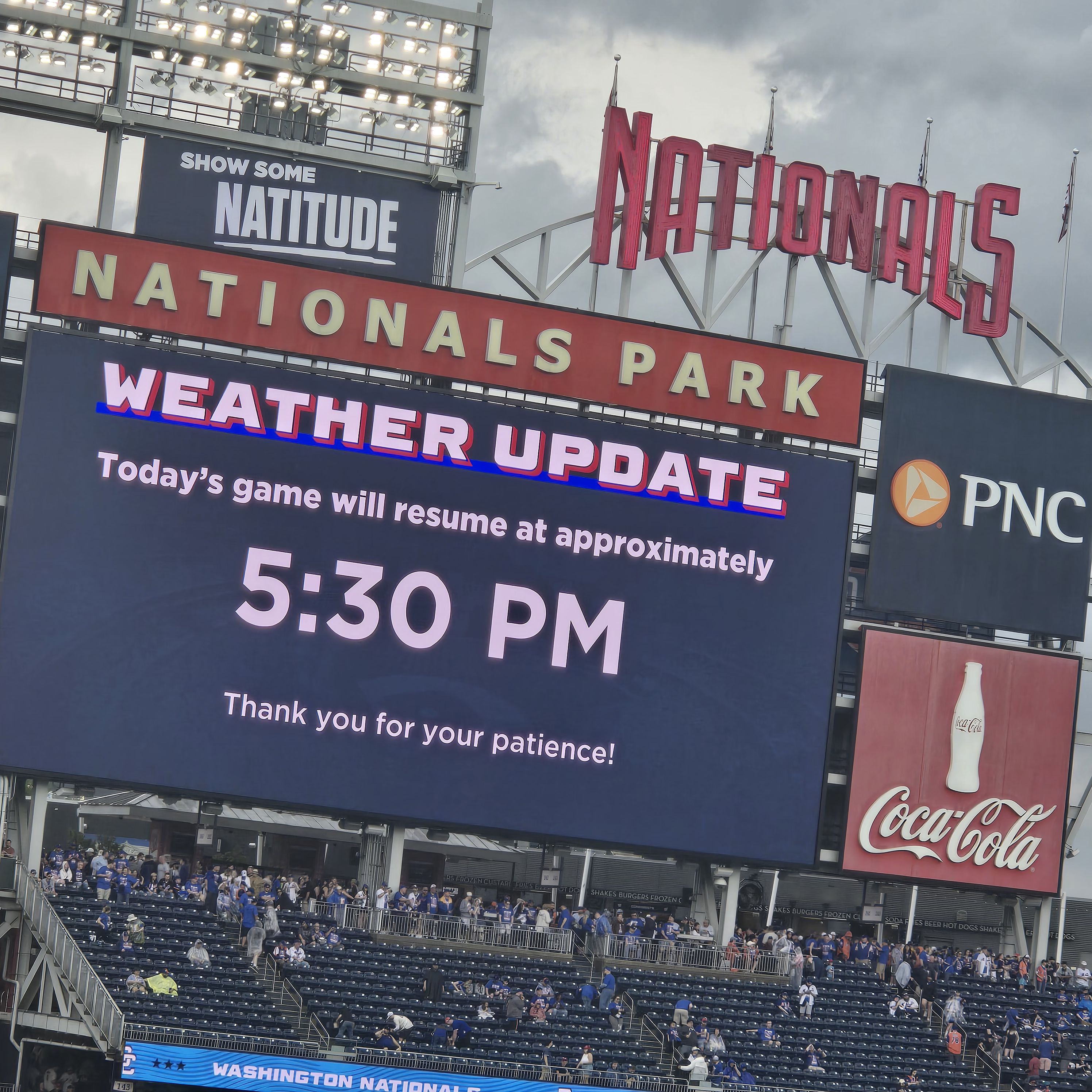
    Well, to get our minds off that, we are going to the Nationals-Cardunals game today. Last night, the Cardinals barely edged out the Nats, 10 to 0. Sigh.

  • I Missed It. What is our Vatican Tariff Policy?

    May 9th, 2025

    On a serious note, I must say that an American pope concerns me, particularly at a time when the United States itself is run by such a globally unpopular figure. There are so many in this world who are fearful of, or convinced of, American arrogance, American influence and American power, that I wonder if an American pope will simply increase anti-American sentiment worldwide.

    For centuries, of course, the pope was Italian. That seemed to be the way it was – the Vatican being in the heart of, even if apart from, the city of Rome. It was something that you didn’t have to think about.

    Recently, there have been two non-Italian popes. The first was Polish and the second from Argentina, both majority Catholic countries, one a Communist country, and the other a country with a history of instability, both with large numbers of impoverished Catholics. And now we have an American (albeit one who has spent a lot of time in Latin America). I am just not sure how this will play out.

    At 69, Leo could be in charge for another 20 years or more, and – maybe for reasons I really don’t understand – it makes me nervous.

    I must also say that, to me, he does not yet look like a pope. He looks like a nice guy for sure, his politics seem good, but he has not yet developed a look of authority, or a look of an elder statesman. He looks more like the guy who got on the Metro just before you and is standing up on the crowded train right next to you.

    He also is not very experienced with the ways of the Vatican, is he? After all, he was appointed a cardinal only 19 months ago, in the fall of 2023. Is it surprising that a new pope has such a short tenure as a cardinal? And such a short tenure living in the Vatican? Is this unusual? I don’t know.

    So, knowing that I know knothing (as the don’t say), why was he chosen so quickly? Was he Pope Francis’ choice and was this the most influential factor? Was it his theological positions? His politics? His personal relations? Does he show an ability to lead that is not yet apparent to me from his personality? Does he get along with everyone? Does his American ethnicity have something to do with it? We will probably never know.

    And, to be truthful, I don’t know what a pope really does. He has a church to lead, he has a state to run, he has finances to grapple with, he has scandals to tamp down, he has personnel to hire and fire, he has officiating to do at religious events (sometimes with pomp and circumstance), he has masses of people he must both please and challenge, he has diplomacy to conduct, he has a pulpit more bully than Teddy Roosevelt ever had. And, while he has tenure, he is always somewhat at risk.

    I wish him luck.

    In the meantime, here we are grappling with a number of things, most important of which is the June 14 “Happy Birthday to You, Emperor Donald” military parade, complete with 6000 marchers and 150 military vehicles that will grace (and crack) our streets next month. I am sure that Trump today is watching carefully the Putin parade in Moscow so that he makes sure that his outdoes the Russian’s.

    Some things are stupid. Some things are unnecessary. This particular parade is both stupid and unnecessary. And you have to wonder who is going to line the parade route to watch it go by. Locals, I am sure, will stay away. Maybe it will attract people from Mississippi, who will flock to the DC and go away in disbelief that none of the restaurants they went to serve catfish.

    In the meantime, Trump and his buddy Howard Lutnick are moving ahead with major trade deals at last. The first arrangement, with the UK, is mammoth, to be sure. The US has been importing about 8 million autos a year, and they will all be subject to at 25% tariff (more or less, presumably more), but 100,000 British cars can come in with just a 10% tariff. The reason given is that the Brits don’t compete with American cars – apparently a Rolls Royce, a Bentley, a McLaren and even a Jaguar or a Range Rover are all in a class by itself.

    And there’s more. We are going to be able to bring in British steel without a tariff? I can’t wait – I am sure we will bring in a lot of British steel. And Rolls Royce is going to sell engines to Boeing. Ok, to that, I think. And we are going to be able to send $5 billion of agricultural products to Britain (if they want them, I guess), which is pretty much a drop in the bucket.

    And details need to be worked out. It seems to me that this is pretty much a non-deal, easy to make with the UK, especially since we already have a trade surplus with them.

    What about China? Now we have 145% tariffs on China, right? But – hold on – last night Trump said that maybe he’d drop them to 80%. Nothing like consistency to make everyone feel at ease.

    Which brings me to the last point of the day. One of the many negative characteristics of our great leader is that he doesn’t pay his bills. We know that from all of the writings about his lurid business career. But no one talks about that here.

    Why does anyone think that Trump will stick to any deal he makes on trade? If he can decide overnight to drop tariffs on China from 145% to 80% (how many different tariff levels on China has he already set forth?), why can’t he do that on and on, including after a deal was made. Remember, that he modified NAFTA during his first term with a deal to end all deals, only to ignore it completely the day he started term #2. As long as Trump is in charge of the country, chaos will continue.

    I heard a small part of the C-Span call-in show this morning. The guest (whose name I did not get) was an economics professor at Harvard, a self-defined conservative, who said: The one thing we know from studying tariffs, is that tariffs always hurt the country imposing them more than they hurt the country against whom they are imposed.

    Is this correct? I guess we shall see.

    And our Vatican tariff policy? 10% per homily may be what Trump suggests. After all, Trump thinks that homily is a byproduct of corn.

  • Which Side Are You On?

    May 8th, 2025

    I have been wondering what the better answer is. Is it

    or is it

    I guess the answer is subject

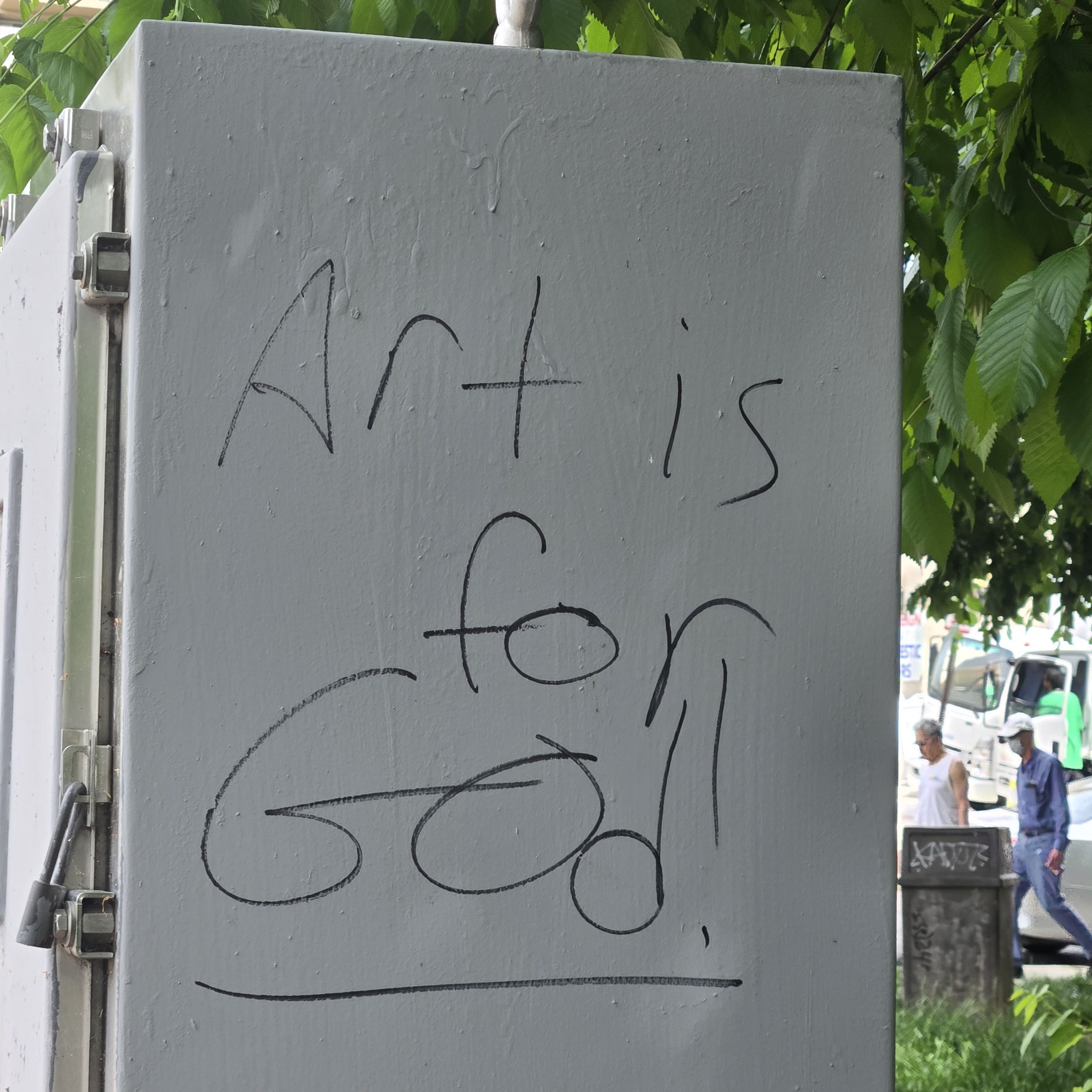
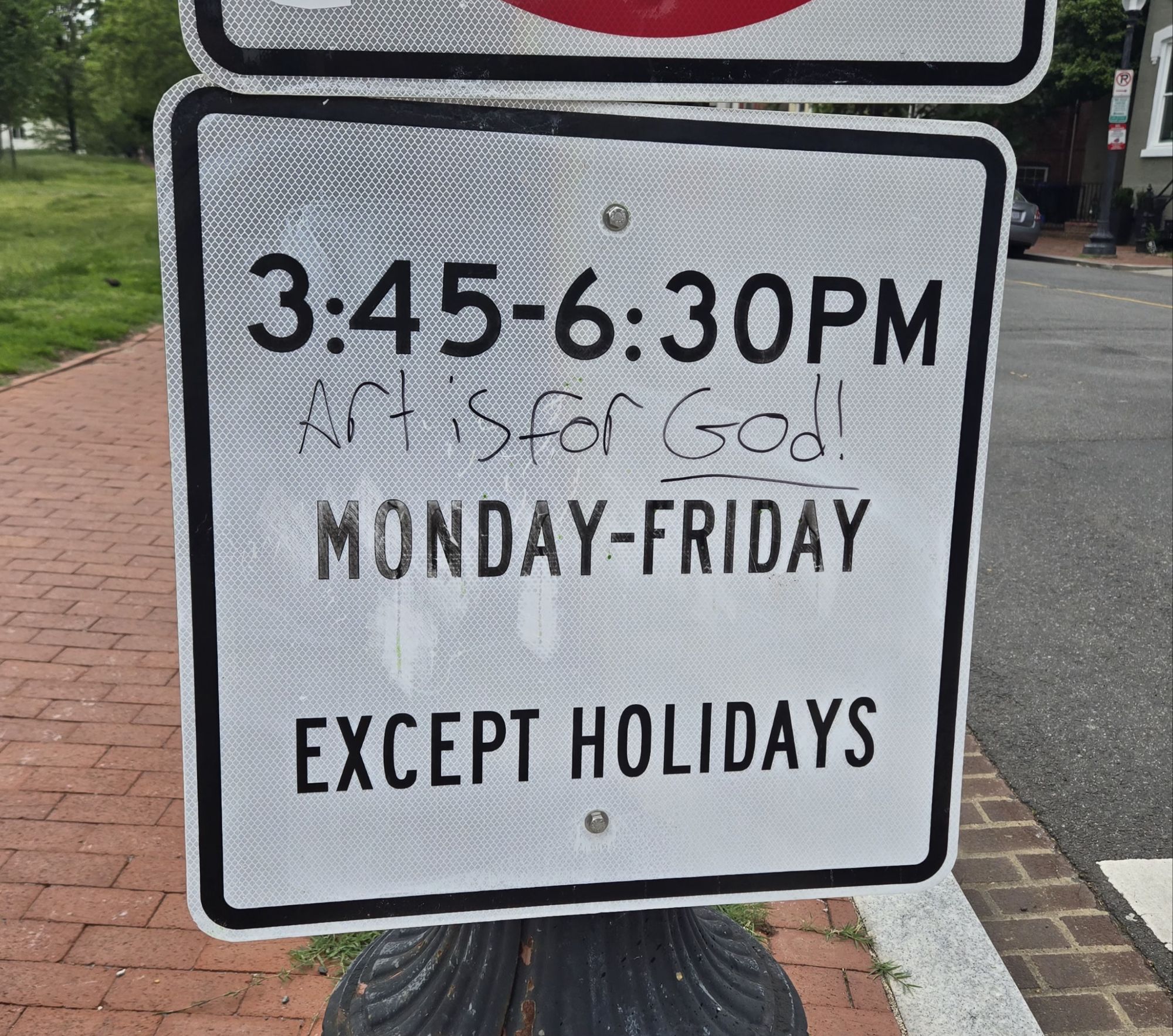
    I guess that is enough of that.  (Seen on a walk down P Street yesterday)

    Usually, the question is not whether you are for God, but rather whether God is for you. Both, of course, are silly questions.

    A more serious question is what does, or should, “belief” in God mean. Many people believe their “belief” in God constitutes proof that God exists. And not only that, but their belief in a specific God with specific characteristics constitutes proof that that specific God exists. And some believe that anyone who does not believe in their specific version of God will be eternally damned, but that they will be eternally rewarded. Therefore, I guess, they are on the side of God.

    It is clear to me that this is nonsense, but worldwide,  I seem to be in the minority, but what do I know?

    Moving on…..

    I just finished a novel written in the early 1950s by L. P. Hartley, The Go-Between. It’s a very good book, and a very good way to let your mind escape the troubles of the day. But, like everything, when you really think about the book, it brings you right back to today.

    The book is structured as a memoir of an Englishman man now in his 60s, thinking back at the summer he turned 13, which he spent visiting a school friend, whose family owned a rural estate and whose members held some relatively minor noble titles. This was a world very different from the lower middle class world in which he normally lived with his widowed mother.

    But, as he said, all was not paradise in Eden. His friend had an older sister (maybe 5 or so years older) whose engagement was about to be announced to a presentable young man who bore the title of Viscount. And while she knew that the Viscount was the right man for her, her heart was with the young, charming farmer who lived nearby. And our narrator during this odd summer became, as the title of the book implies, the go-between, the postman, the fellow who carried secret messages between the two young (but presumably fairly chaste) lovers.

    Now, perhaps our hero was somewhat naive, but he had no clue that he was carrying secret messages setting up secret meetings between his two somewhat older friends. Until he did. And then, he did not know what to do. He knew that if you going to be engaged to one man, you weren’t supposed to be running off to secret meetings with another. He knew that her fiance-to-be would not be very happy, nor her parents, nor her 12 year old brother, if they knew. And he liked all of these people, he didn’t want any of them to get in trouble, and he certainly didn’t want himself to get in trouble, especially as the entire group had been so kind to him all summer.

    All he knew is that he wanted to do what was right. For a long time, he didn’t know what that would be. Perhaps he never did; you will have to read the book (or see the film, one of the plays, the musical or the opera, each of which has been written based upon this book) if you want to know.

    But isn’t this a universal dilemma? At least a dilemma that people in public service also have. Often, they don’t think that what they are doing is correct; they often might be helping support an activity that actually is perverse, is harmful. But if they stop what they are doing, somebody (perhaps everybody) is going to get hurt, and consequently so will themselves. So, they decide to do nothing, or to pretend that they aren’t really doing anything that bad, or they never reach a conclusion at all. Maybe this is where we are, and if so, maybe we will find that the pressure of being a go-between becomes just too strong. And then the dam will break.

    But now, for a second, let’s go back to God. God does not figure in Hartley’s book. Yes, most people seem to go to church on Sunday,  but it seems that is because that just is what you do.

    Our 12 year old boy does not think about church or God. He does not turn to God and ask “What should I do?”

    Of course, some people would. Would they come to a different answer? Would their anxiety be lessened? Would they be more certain they made the right decision? Would they have made a better decision?

    Obviously,  we don’t know the answers as they relate to the characters in the book.

    But as we make decisions every day, the question is very relevant. Does the God each of us may envision influence our decision making? My guess is that we really don’t know the answer to that question even if we think we do. Does that God lead us to making better decisions? My guess is “no”, or at least that there is no evidence, much less proof, that better decisions are made buy those acting as they think God would like them to act.

    But does believing you are following God’s lead as you decide what to do ease the anxiety of decision making. I assume, for many, it does. And that may be enough to make the delusion of thinking there is a God, that you have the correct concept of who that God is, and that you are following the guidance of that God for some eternal purpose worthwhile.

  • Arthur: Rambling On Will Get You Nowhere!

    May 7th, 2025

    A fly came into our house yesterday, through the front door. It didn’t want to be here, that’s for sure. It buzzed and buzzed and flew around with great angst and great energy. I felt for it. I didn’t want to swat it, I wanted to free it. But I couldn’t figure out how to do that.

    So far this morning, I haven’t seen it or heard it. I assume it is gathering its strength and will continue its hopeless quest for freedom later during the day.

    Similarly, a few weeks ago, I saw one lone ant, crawling around a counter in an upstairs bathroom. I wondered how it got there? Through a series of walls? Unlikely. More likely it attached itself to someone’s clothes and, unbeknownst to all, found it self away from its fellow ants in our bathroom. It was a very active ant, and I really didn’t want to harm it. So I didn’t. And I was surprised when, the next day, I saw it again. Or, at least I assume it was the same ant, diligently looking for a way out, a way where it could get on with its life. I did not see it again after that second day. (I didn’t ask Edie about it, for fear that she might have engaged in some violent action that would lead me to have to make a citizen’s arrest. And then where would I be?)

    But it’s not only ants and flies that find themselves in situations that they had never dreamed about. It happens to people all of the time. Think, for example, of the 2 million people of Gaza. They aren’t by themselves, but they are as hopeless as if they were. And then there are those non-Americans who feel forced to leave their homes and come to America, and especially those who had no choice, such as the children who are brought here by a parent, and who all of a sudden find themselves a target of an incessant manhunt. Or the millions who live in, say, Sudan, who I am sure have no idea what is going on that leads to constant violence, hunger and danger.

    What can one do to help any of them when you see that the world’s most prominent and selfless individuals are stymied?

    I saw the results of a recent study performed by a group from Yale about the relationship between public opinion and governmental policy. I was surprised at the results. I am not looking at the polling information now, and I didn’t try to memorize any of the details, but the gist of the findings were that governments did what governments wanted to do and, to the extent they were influenced by anyone outside the governments, it was influence from wealthy people who helped keep the governments in power. The influence of the masses of citizens, particularly when expressed in mass movements, protests, marches and so forth, was almost non-existent in changing or redirecting government policy. It may make you feel good, but that’s about it.

    I wasn’t anticipating that as a result of such a study and, again, I didn’t look at its methodology too closely (read: at all). But I found it quite depressing.

    So what do you do about, say, Gaza? How would you feel if you were living there, had had at least 18 months of hell rained down upon you, had relatives or friends killed, no job, no food to speak of, and so on. And then you hear that Israel, your enemy, was not letting up, but was going to increase their military operations exponentially, drive the entire population of Gaza into a small section of a very small territory, and maintain an indefinite military presence, continuing to control all imports?

    On the other hand, if you lived in Israel, although your physical danger might be less imminent, you had the long term security of your children and their children to worry about, you had guilt feelings (perhaps) over the treatment of innocent Gazans, but you knew that if you let up the pressure, you could quickly be in a situation like they find themselves in today.

    As an outsider, on the third hand, what are you to think?

    As for me, and I have said this before, my thinking today is different from my thinking several years ago. Today, I actually think that permitting, or encouraging, the majority of residents of Gaza to leave is the best alternative. It’s a big world, and they can find their place elsewhere, and if they can’t, their children will be able to. No good will come from 2 million people, with a relatively high birth rate, staying in a territory about the size of the City of Philadelphia, with no way to travel in or out or control their own economic destiny.

    Let me be clear about something else. I blame their situation largely on the Arab leaders, who have refused to recognize or come to terms with Israel or a Jewish population in Palestine over the past 100 years or so. Had the United Nations partition of Palestine been accepted in 1947, none of this would have happened, and the area could have been peaceful and prosperous (putting aside the human predilection to always make things complicated). And the Palestinians’ failure to recognize Israel or come to terms with its existence has led not only to occasional skirmishes and wars, but to growing feelings in Israel that the Arab enemy was eternal and could never be accommodated.

    The current situation in Gaza cannot be allowed to continue. And Hamas, the governing body of Gaza, a body now with no capacity to govern, is not going to give up.

    Donald Trump’s concept that Gaza should be turned over to the United States of America, Canada, Greenland and Panama is ridiculous, to be sure. But someone, perhaps the Arab Peninsula countries working along with Israel need to come up with a way to (1) displace Hamas, (2) free the remaining hostages, (3) relocate the majority of the current population of Gaza safely and with assistance, (4) come up with a viable plan for the future of the land itself, and (5) use this opportunity to set boundaries and rules for the future of the West Bank. And the first of these 5 necessary steps? Provide for the safe transfer of Gazans somewhere where they will not be considered permanent refugees, but will be able to be integrated into their new lands of residence.

    Our role? Money, support, advice. And, yes, we need to agree to take in a share of those being displaced from Gaza. The number? Not sure. How about 180,000? And I would concentrate on family solidity in making the choices of whom to admit. I wouldn’t work too hard trying to eliminate those whose pasts might make them be (or appear to be) dangerous. We can handle that, if we set our minds to it.

    I understand that if I was reading what I just wrote, rather than writing it, I would say: That is a ridiculous idea. And I am not sure I would even argue against my arguing against it. But we have to start the conversation somewhere, don’t we? We can’t just watch bombs being dropped on innocent people, can we? Yes, I guess I already forgot what the Yale studies showed. It showed that what we think is not relevant. Our writings, our protests, and so forth? Meaningless. Completely meaningless.

    This human condition sure is depressing, isn’t it?

    I will concentrate elsewhere. Right now, I am watching a bunch of cardinals marching into the Sistine Chapel to select a new pope. Okay, now imagine the Sistine Chapel (beautiful as it is) sealed off from the outside world (as it will be), and the cardinals being dependent on the outside world for food and sustenance, which is not forthcoming. Or imagine not the cardinals in the Sistine Chapel in this position, but the prisoners we sent to CECOT in El Salvador. Or the impoverished families in Sudan. Or……you get the picture. Or the people of Gaza.


  • When EDADHD Becomes the Norm

    May 6th, 2025

    My guess is that everyone who pays any attention to politics in the United States today is, by necessity, suffering from what I would call Externally Disseminated Attention Deficit Hyperactivity Disorder, or EDADHD. The main symptom of EDADHD is the inability to concentrate on any problem in the country today without having one’s mind diverted to a different but equally important and troubling problem within about 60 seconds. The effects are both the inability to think anything through, and the inability to prioritize. It is, it appears, a condition with a definite cause, spread by clearly enabling forces, but as of yet with no cure.

    The cause is one individual, the contagion is increased by one political party, and a cure may take another four or so years. This does not bode well.

    I thought about this today (for about 60 seconds) when I looked at the first page of the print New York Times, and saw the article about the Guantanamo Naval Base. This leased property, near the eastern end of the Island of Cuba, has been used, with much controversy, to house “terrorists”, apprehended overseas and unwanted even to put in prison in the continental United States, and that number is now fairly minimal. Proposals to close Guantanamo have been floating around for years. But Trump proposed to reverse course completely, of course, and prepare Guantanamo to house up to 30,000 “illegals” either permanently or as they are on their way elsewhere. This got enormous attention in the press, the first small group of individuals were shipped there, and then they were shipped elsewhere, and the thought of using Guantanamo for mass incarceration has not been talked much about since.

    I thought about yesterday when, out of the blue, Trump decided that Alcatraz, a former federal prison located on an island in San Francisco Bay and closed 62 years ago primarily because of the cost of keeping it open. Trump said he wanted to open it again, so one of his top enablers Pam Bondi had to say that it would be cost efficient to open it this time, and now it is drawing attention from everything else for its 60 seconds of fame.

    Also yesterday, Trump decided (out of the same blue) that the United States should put a 100% tariff on foreign films, and for about 60 seconds everyone forgot about both Guantanamo and Alcatraz and tried to figure out what that meant and how that would even work.

    A day or so before that, 60 seconds of attention was focused on how many dolls a typical American child could expect for Christmas, and what they would cost, assuming that the dolls were made in China (almost all are) and the tariffs would be at 145%, or 125%, or 25%, or 10%, or if there would be exceptions from all tariffs for dolls. Any of these scenarios are apparently equally likely.

    And before that there was the attention on Abrego Garcia’s finger tattoos. His fingers do have tattoos, each of which is a symbol of some sort, which – say the experts – have no connection with MS-13 imagery. But someone photo shopped his hands to place M S 1 3 above the actual tattoos on his hands, and Trump has decided those the photo shopped images are authentic, and attention was placed on these fake tattoos for 60 seconds.

    And finally, we can’t overlook the the image of Pope Donald the I and Only. And the 50 or so other political sound bites we have been faced with recently.

    Now, all of these things attracted our full attention for very brief periods of time. And guess what? None of these things are really that important in the overall scheme of things. But this is the beauty of Donald Trump. He can attract our attention through a rapid onslaught of outrageous nonsense, while Rome burns. And we can’t tell the difference between thinking about Alcatraz and losing Social Security. Or better, we can’t really focus on the potential of losing Social Security because, hey, did you hear we may reopen Alcatraz?

    I listened to a podcast with David Brooks yesterday. The host was a fellow named Scott Galloway, whom you may know, but I don’t. It was an interesting 45 minutes (Rockville to my house), but I wish I was part of the conversation because Brooks says so many things that almost right, but not quite. His heart seems to be in the right place, but his logic just doesn’t get him to where he needs to go.

    The premise seemed to be about the unfortunate disappearance of civility and tolerance, the need to accept a variety of views, the need to provide education that really educates, and the need to allow for social mobility. All of that is absolutely correct. But guess what? As they discussed the evidence of this, and gave their thoughts of what could be done about it, they couldn’t keep to one topic long enough to do anything but gloss over it, which meant that they couldn’t see the inconsistencies in much of what they were saying. Why? Because they too suffer from EDADHD, of course.

    Now, if I weren’t suffering from the same disease, I would sit down at my desk, listen to this podcast once again, but slowly with a lot of stops and write down my comments as I went along. Then I would read over what I wrote and see if it made sense and, to the extent it did, I would write up a meaningful blog post that might get us all thinking about more deeply.

    But, I have other podcasts to hear, articles to read, newscasts to listen to, newspapers to scan, books and magazines to read, and – oh, yes – even a life to live. In the meantime, I have to keep my ears open to make sure that I don’t miss any of the five or six sound bites Donald will throw at us today.

    EDADHD is, I am afraid, the bane of our existence.

  • A Feast for Your Eyes

    May 5th, 2025

    Washington, obviously, is filled with museums. And just as obviously, we seldom visit them. After all, you need to have the time, and someone has to suggest going, and the other person has to say “okay”, and you have to follow through. When we are traveling, going to a museum is an obvious choice. At home, not so obvious.

    We do try to get to the National Gallery for big exhibits, and we go tobthe Phillips (we are members), but other than that, it tends to be hit or miss.

    Yesterday,  we actually spent part of the afternoon at a museum, the closest art museum to our house, less than 2 miles away. It’s the American University Museum at the Katzen Arts Center, where Massachusetts and Nebraska Avenues meet. It is convenient, free, has indoor parking (free on weekends), and exhibits that change three or four times a year.

    The spring exhibits run another two weeks. One of the most striking shows the work of Fred Folsom. It’s a large exhibit with two components. One includes very large and detailed works representing crowds in bars. The other is an unusual exhibit of nudes with cigarettes.  Go figure.

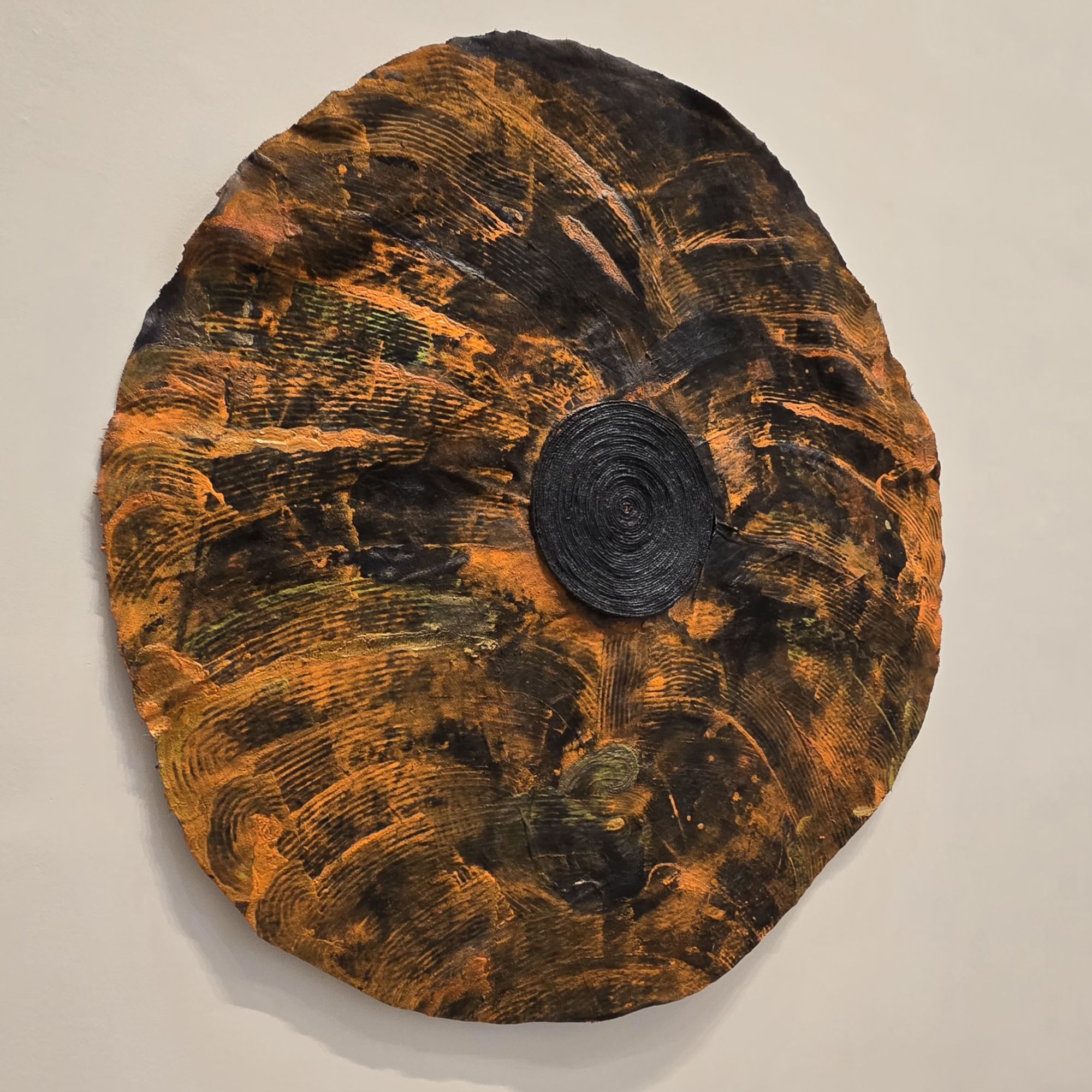
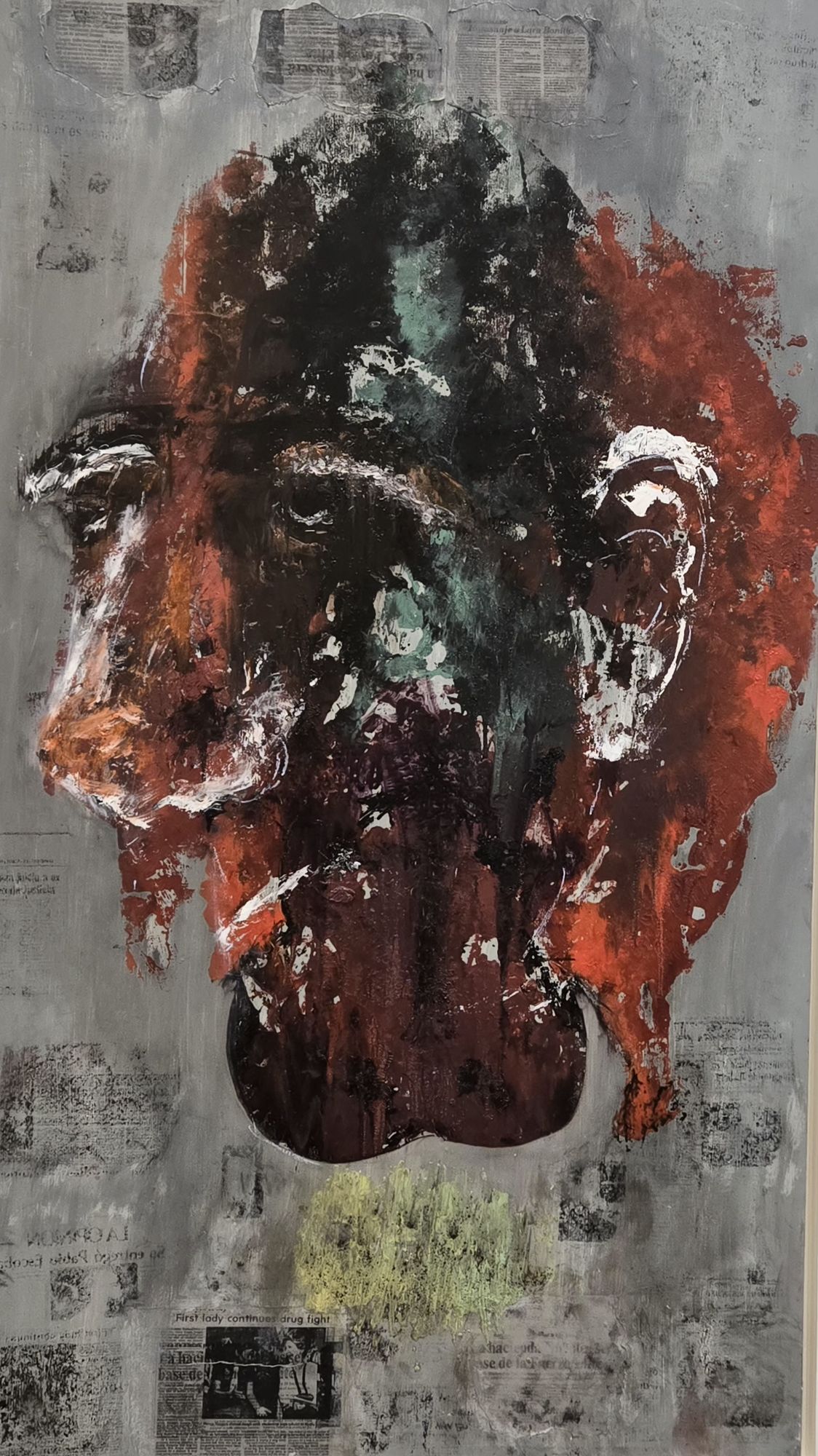
    Then, there is an exhibit of works presented as masters theses this spring. I thought them quite good. Here are some examples:

    The students/artists are Poojah Campbell, Patricia Poku, and Andres Izquierdo.

    There are three more exhibits. One features contemporary Serbian artists, and a second a multimedia artist named Bruce Connor and focuses on psychedelic mushrooms in Mexico in the 1960s. Neither did much for me.

    The final exhibit features a number of pieces which were given to AU when the Corcoran closed a few years ago. The Corcoran distributed their collection broadly. The biggest recipient was the National Gallery, followed by AU and George Washington U. AU itself received 9,000 pieces of art, apparently.  They are now displaying a few of those pieces by artists with a strong connection to DC. They are all worth looking at. Here are a few by Rebecca Davenport, Andrew Stenovich, and Nancy Wolf:

    That’s it for today.

  • What is wrong with this picture?

    May 4th, 2025

    A new Mom’s Organic Market just opened about a half mile from our house. It is directly across Connecticut Avenue from a large Giant (no pun intended, was there?) Food Store, and within a block of a large Saturday farmer’s market. If you head down Connecticut Avenue another half mile, you will find a Streets Market and a Yes! Organic Market. If you head the other direction on Connecticut from our house, within a mile you will find a Safeway and a Magruders. If you go west, towards Wisconsin Avenue, you will find a Whole Foods and a Wegman’s within a mile of us, and if you extend your reach to 1.5 miles, you will find another Whole Foods and an Amazon Fresh. And, oh yes, a Trader Joe’s scheduled to open in that neighborhood soon. I probably forgot one or two major food stores (for example, I forgot the neighborhood Broad Branch Market, which my GPS tells me is .9 miles away, in the residential DC Chevy Chase neighborhood).

    That makes 11 grocery stores, plus there are actually four weekly farmers markets in the crop harvesting months, within 1.5 miles of my house. Now, the neighborhoods that these stores service are, as you would expect, on the more prosperous side. It’s Chevy Chase, Forest Hills, American U Park, Friendship Heights, Van Ness and so forth, straddling the DC/Montgomery County line. If you go another 2 miles out Wisconsin Avenue, for example, and get to downtown Bethesda, a similar array of grocery choices will be happy to serve you. That is another wealthy area.

    But now let’s go across town to Ward 8. DC is divided into 8 wards. We live in Ward 3. Ward 8, mainly African American, lies to the east of the Anacostia River, a part of town you may never find yourself in if you are a tourist (or even a resident of NW Washington). It is not a bad area, it has some nice neighborhoods, a fair amount of new construction, some history, and a lot of people. Ward 8 and Ward 3 each have about 85,000 residents, as all DC wards have relatively equivalent populations (DC has a population just in excess of 700,000).

    Of the 12 grocery stores that are within 1.5 miles of our house, 10 are in the District and two are just over the line into Maryland. And I didn’t list all of the groceries in Ward 3, just those that close to our house. But what if I told you that in all of Ward 8, there was just one major chain grocery store, a Giant on Alabama Avenue? That, other than that, there were only individually owned corner stores, with limited supplies and often higher prices, or that Ward 8 residents had to drive into other parts of the city, or out into Prince George’s County MD to do their shopping?

    Clearly, there is something wrong with this picture.

    I don’t have a ready made answer, but this is the kind of problem that gets ignored as we look at the larger problems that beset us and that get even larger day by day. Just a thought that we shouldn’t forget the more localized problems, as well.

    As to the bigger problem, let me just make one point today. Just because voters seem to be getting more and more worried about and fed up with Trump and the Republicans, that does not mean that they are feeling any warmer towards the Democrats. And current Democratic leadership isn’t doing much to change those perceptions. We had dinner with 8 friends last night, and there was general agreement that the Democrats needed new leaders to step forward who were able to speak not only for themselves but for the party, and who were able to galvanize voters the way Bill Clinton and Barack Obama were able to. In other words, the message does you no good if you don’t have the messenger. Neither Hakim Jeffries nor Chuck Schumer are good messenger. Bernie Sanders and AOC are good messengers, but don’t speak for the party.

    Time is awasting.

    P.S. I just realized I left out a second Giant and a Lidl on Wisc Ave, within 1.3 miles of our house. That makes 14, not 12.

  • Important: Fascism and Antisemitism are not Inevitably Intertwined.

    May 3rd, 2025

    Can I start with a digression? I just want to let you know that this is my 900th consecutive daily blog post. You wonder how I figured that out? I counted. I started with the first one, which was November 15, 2022 and counted. Now, I will admit that I may have miscounted (there is a reason I did not become a CPA – in fact, there are many), and if you want to check up on me, feel free. But do me a favor, and if you discover I am wrong and this is not my 900th consecutive post, keep it to yourself.

    Okay, and a digression to the digression. If you look up “900” on Wikipedia, you get this: “900 (none hundred) is the natural number following 899 and preceding 901.” This may be helpful to some of you who suffer from dyscalculia. (Did you know that is how you spell dyscalculia?)

    I do want to mention two important things that are on my mind on this sultry, hot Washington spring day. They relate to the relationship between Fascism and antisemitism.

    Fascism always involves defining an in-crowd and an out-crowd. Hitler obviously defined Jews as the ultimate out-crowd, a group seeking to control the ethos of Germany and displace true Aryan, or Germanic, values. He then went on to add the Romani to the list of ethnic undesirables, and added homosexuals and the mentally ill (I guess he mixed them together). But the overriding enemies of Germany were the Jews, and because there turned out to be no other way to deal with them adequately, they had to be exterminated, and about 6 million of them were.

    Because of this, Fascism and Judaism became identified with each other. But you do not have to be antisemitic to be a Fascist. Let’s take the most obvious example, Benito Mussolini, who was the first Fascist, becoming leader of Italy a decade before Hitler took over Germany. Mussolini did not show any strong antisemitic tendencies. In fact, there were many Italian Jews who were members of, supporters of, and active in the Italian Fascist party. It wasn’t until Hitler, as a quid pro quo of giving Italy Germany’s support, required Mussolini to adopt racial exclusionary laws in late 1938 that antisemitism played a significant part in Italian Fascist society.

    So let’s turn to Donald Trump and let’s assume today, for the sake of argument, that he talks like a Fascist, acts like a Fascist and hobnobs with Fascists. Just for the sake of argument.

    Just because Trump may not show any overt signs of blatant antisemitism, and just because among Trump’s inner circle there are a number of Jewish advisors, that does not meant that Trump isn’t a Fascist. You can clearly be a Fascist without being antisemitic.

    It’s all a question of who you put in your in-group and who you put in your out-group. Mussolini did not need to put Jews in his out-group. His out-group was not ethnically based; he concentrated on socialists, and intellectuals, and unionists, and Communists. Trump does not need to target Jews, either. He is targeting leftists and liberals and Muslims and most of all black and brown skinned immigrants and asylum seekers. These are Trump’s out-group. The only Jews in his out-group are those who are liberal or leftist, and he does not have to (and does not) attack them because they are Jewish, but because they are leftist or socialist.

    In fact, Jews sort of become favored in the Trump world. Living for 70 years in the real estate development world of New York City, Trump has dealt with Jewish competitors and allies his entire life. He has a Jewish son-in-law, of whom he seems to be fond, and (by conversion) a Jewish daughter. He has Jewish grandchildren. Years ago he has said “The only kind of people I want counting my money are short guys who wear yarmulkes every day.” He is a strong supporter of Bibi Netanyahu, Israel’s prime minister, and of Israel in general. (You can wonder why this is. Is it because they are fighting Muslims, Arabs, brown people? Is it because he needs to show that support to his fundamentalist Christian base? Is is something else?) I think it is hard to call Trump antisemitic, although I understand that some would like to, focusing on some dumb things he has said from time to time.

    Now, you can list all the things that Trump does that align with typical Fascist policies (the most recent being his plan for a big military parade on June 14), but the one that I want to end today with is his attacks on elite American universities, and in particular on Harvard, where I went for my undergraduate degree so many years ago. His attack on Harvard is premised, or so he says, on Harvard’s failure to protect its Jewish students from antisemitic attacks and general fear.

    Trump has given Harvard an extraordinary ultimatum as to how faculty and students should be selected, what subjects should and should not be taught, and so forth. He has withheld billions of dollars of federal funds, and he has threatened their tax exempt status. None of this is likely legal or constitutional, but no matter….

    Let’s look a little broader (and I know this is getting long). Harvard had some serious problems, particularly during the 2023-2024 academic year, following the October 2023 Hamas attack on Israel and Israel’s response, with conflict between students and faculty members favoring one side or another. And, as a result of this, Jewish students were sometimes kept from classes or were afraid to speak out during classes, Jewish students were sometimes barred from certain university activities and so forth. Fear was clearly in the air. At the same time, Muslim students also had their complaints, generally mirroring those of the Jewish students. We don’t have to look at the merits of those complaints here.

    Harvard established two task forces (I wrote about this a few days ago) to look into the grievances of Jewish and Muslim students, and the two task force reports (totalling about 500 pages) were released this week. Harvard’s relatively new president, Alan Garber, has promised certain actions in light of the task forces’ findings and recommendations.

    Harvard Hillel had a program on Zoom Thursday night to discuss the findings. You can see the program (about 90 minutes) on YouTube, and if you have any interest in the subject, I suggest that you do. I am not going to outline the specific findings of the reports here, but just will say this: don’t belittle the degree of conflict that existed at Harvard last year, and the difficulties and feelings of isolation that Jewish (and perhaps also Arab) students were facing. The stories are credible and riveting.

    And the one thing that I had only thought of slightly and now will think of as much more important than I thought, as I try to understand what has been going on, is how different the Harvard of 2024 is from the Harvard of 1964 when I was there. When I was at Harvard, and the undergraduate student body was about 1/3 Jewish, the word antisemitism was never mentioned. And there was no reason it should have been, because it was not visible in any way that I saw. There certainly was no exclusion of Jewish students (except to some of the eating clubs, perhaps, but who cared?), there was no need for a Hillel as a refuge (Hillel existed, but more as a social club), and there were plenty of course offerings to satisfy those who wanted Jewish studies (religious, linguistic, historic, philosophical) to be part of their college curriculum.

    Today, none of this is apparently true. There are 1/3 or so the number of Jewish students, Hillel is definitely a refuge and center of the college life of some (maybe many) of them, and the number of courses offered on Jewish topics is many fewer than was the case 60 years ago, or apparently even 20 or 30 years ago. You add this to a diversified student body with many more non-Jewish students of middle eastern ethnicities, many more courses on Arab and middle eastern studies, and a slant towards the “progressive” approach to recent history (oppressor/oppressed; colonial regime/indigenous regime), and add in the Gaza War and the century of conflict between Jew and Arab in today’s Israel, and you do get the perfect storm.

    Harvard, and similarly situated universities, do have a lot to deal with, to be sure. The Fascist move of the Trump administration to take over control of universities and stomp on their freedom to solve their own problems and continue their great traditions (and their ways to benefit broader society) will (1) only make everything much worse, and (2) constitute one element of many which are creating not the danger of a Fascist regime in this country, but the consolidation and strengthening of the Fascist regime we already find ourselves under.

  • Fact/Fiction. History/Mythology

    May 2nd, 2025

    So this morning, I read that RFK, Jr. thinks that jet fumes are a major cause for America’s subpar health. Yes, chemtrails, substances hidden in jet fuels for nefarious or other scientic purposes by government agencies, such as DOD’s DARPA, are indeed the cause of our problems. No matter that this theory has been debunked for years, and that there is no legitimate scientific evidence for it.

    Then I read that Oklahoma (is this true? I saw it on a Bulwark post.) is changing its high school social studies curriculum to include a unit on how the 2020 presidential election results were manipulated to make Joe Biden the presumed winner, as opposed to the real winner, you know who.

    Just last night, I finished reading Peter Partner’s The Knights Templar and their Myths. It is relevant to all of this. Let me explain:

    The Knights Templar was a religious order founded during the Crusades to help protect travelers to the holy land during the approximately 100 year period that Christians held sway. Members were among the last military groups to hold the fort at Acre when the last Christians were kicked out of that territory.  In the meantime, the order obtained great wealth in land and resources, became the biggest ship owners in Europe and Europe’s first international bankers, supported by a high degree of papal privilege.

    Then, in 1307, it all came tumbling down, the order destroyed, and many of its leaders tried and executed. The story is well known, and it’s one I have long been interested in.

    And the story of the Templars did not end with the destruction of the Templars, but continues to this day, connected to freemasonry and various branches of esoteric knowledge. What Partner does, probably more thoroughly than anyone else, is separate history from myth, but citing evidence of one and origins of the other.

    Partner died about ten years ago, so we can’t ask him to do the job. We need to find someone new, someone who can look at the pronouncements of Robert Kennedy Jr. and the contents of the Oklahoma social studies curriculum, and separate history, or fact, from mythology, or fiction. They need to be able to do it with the structure that Partner used. The first half of his book is “just the facts, ma’am”. The second half talks about the mythology. At no point does Partner mix up the two, at no point does he suggest that one might be the other, and when discussing the mythology, he is precise as to where each myth got started, how it was propagated, and who carried it along.

    Current journalists don’t write this way. They combine fact and myth in the same paragraph, confusing that eeader as to what should be in one category and what shoukd be in another. Print journalists have to put everything into the first few paragraphs, knowing you probably won’t turn the page. Online journalists have to stretch things out, so you will scroll through all the ads to the end. Of  course, there are articles that deal with one or the other, but they are specialized, not general news articles, and they don’t normally do a side by side writeup.

    Until then, we remain frustrated, confused, and in disbelief. But at least we have our wits about us.

    (By the way, a shout out to East Coast Industrial Supply Company, whose large, ugly, noisy and dirty truck just came up our quiet(ish) street, stopped in front of my house, and then accelerated in a big cloud of gray smoke, which wafted over everything. Where are you when I need you, Bobby Junior? Chemtrails are shortening my life.)

  • Fair Harvard, thy Sons to thy Jubilee Throng……(huh?)

    May 1st, 2025

    I tried to skim through the two reports recently released by Harvard, one showing the results of its antisemitism task force, and one showing the results of its anti-Muslim task force. They both agreed that there was a problem at the university, but they largely had opposite recommendations. What’s a university to do?

    Basically, each committee said there was too much bullying and bias against the group it was looking at, while the anti-Muslim task force said that there needs to be more teaching of the Palestinian problem, while the antisemitism task force said there needs to be more teaching of Israel.

    Together, the two reports are more than 500 pages long, and there is a lot that I did not see at all. But I didn’t see (maybe it is there somewhere) any place where antisemitism and anti-Israel activities were separated, and I didn’t see anywhere where anti-Muslim and anti-Palestinian activities were separated. And I think that this is one thing that must happen.

    I also wonder whether it was wise to have two separate task forces looking at these two related, but different, issues. What started out as necessary studies because of polarities has now ended with reports which seem to firm up the polarities. As I said, what’s a university to do? Perhaps they should do something that I haven’t seen they are thinking about. That would be taking the two task forces, combining them into one task force, and telling them to come up a joint project. This probably will not happen.

    The other thing that should be done (and as to this one, I think that Harvard will be trying) is to separate arguments pro or con Israel or the Palestinians, from attacks (either personal, live attacks, or written attacks) on fellow students. And protests, which cannot be completely stopped and maybe should not be, would be policed to make sure there were no such personal attacks (and probably also that non-Harvard students, faculty or staff, or maybe just non-students, could not take part in the protests). And clearly, the protests would have to be each way on both sides.

    Standards of instruction are harder to police, I would think, because freedom of speech for instructors is important. You do not want Harvard’s administration (much less the federal government) telling tenured professors and other instructors what to teach. At least I think that you don’t. (We may come back to this later.)

    One of the problems that universities have faced generally is that, as universities (putting aside the positions of individual instructors) have often taking positions as institutions on various subjects, including subjects regarding the freedom of oppressed people around the world. I think, by the way, we can agree that Palestinians surrounding Israel have been oppressed, even if we can reach different conclusions on who there oppressors are, or whether their own actions as a group justifies, or necessitates, their oppression. Many universities, including Harvard, have said that from now on they are going to be institutionally neutral. Of course, this may be easier to promise than to accomplish.

    So, we have at many universities, two strains of teachers on these topics. We have the strain of “progressive” historians, who believe that the most important important change since the end of World War I (in addition to the development and then fall of Communism) has been the end of colonialist regimes throughout what has been known as the Third World. Of course, Israel was never a “colony” in the way Algeria or Barbados has been; it is a completely unique development. Yet, for many or most of those who support the destruction or end of the State of Israel, it adds to their argument to describe Israel as a colonial outpost just like former French and British colonies were, and therefore that the colonial regime must be ended.

    On the other hands, those who support Israel, many of whom consider themselves Zionists, either believe that Jews have an historic or a God-given right to the land of Israel, or because they were pushed out of other places during the mid-20th century (that would include North Africa and parts of the Near East, as well as most of Europe), that they had no where else to go. And for those who believe that the Holy Land has been designated by God for the Jewish people, there are those on the other side that believe that the land of Israel is Muslim land, meaning land which has been conquered in the name of Allah, as this land has been in the past, can never been handed over to non-believers.

    It may be difficult for these two groups of instructors to reconcile with each other, but it would be nice if it were possible, so that anyone taking courses on either Palestine or Israel would be able to see multiple narratives. In other words, just as the institution itself pledges neutrality, perhaps with this very volatile subject, the instructors should discipline themselves to do the same. Is that at all realistic? In other words, could the teaching staff become part of the solution, as opposed to part of the problem?

    Perhaps, in normal times, this would be possible. But these are not normal times, as we know. There is a murderous war going on in Gaza, with Israel fighting an enemy that refuses to give up no matter how bad it is losing, and with actions being taken by settlers in the West Bank against Palestinian villagers and certain presumed “militants”, with the IDF and the police forces either backing the settlers, or just standing by and watching. As long as this is the situation on the ground, it becomes more difficult for academics to speak about the situation without emotion or bias.

    Of course, Harvard has more problems than this. Remember that Trump is calling off all federal aid to the university, and Harvard has filed suit. I assume it will eventually win the lawsuit, but not before the administration puts additional pressure on the school, including (as they have) threatening its tax exempt status, investigating its law review and so forth. Potential acts against Harvard was even brought up today at Trump’s cabinet meeting.

    In addition to actions at universities claimed to be related to antisemitism (which they don’t seem to be in reality) and not at all to anti-Muslim activity, there appears to be a continued upswing in related activity outside of the university campus. Just last week, for example, a woman was harassed by a large group of Hasidic men for participating in a pro-Palestinian rally (or just being at the rally, perhaps). There were apparently about 100 men, yelling, threatening, murder and rape, and chasing the woman, who was afraid to run home because she did not want anyone to know where she lived. I heard her report from her (she has hidden her name) and she, too, has said, like Palestinians on the West Bank, that the police simply stood by. I am sure we will learn more about this.

    I wish I had a clever way to end this one, but I don’t.  Today is Israeli Independence Day, Yom Haatzmaut, and in two weeks, it will be Palestinian Catastrophe Day, the day of the Nakba. It has been 75 years. And so it goes.

  • Feed a Cold; Starve a Fever

    April 30th, 2025

    I am sitting here this morning with a sore throat and a runny nose, and I had to cancel a meeting and a lunch appointment for today. Not that I could not have sat through both in some discomfort, but I didn’t want to start an epidemic or a pandemic that might get out of control.

    I actually don’t remember the last time I had something that forced me to cancel appointments or curtail activities. I think it was the two times I got COVID, and that has been a couple of years ago.

    When I was young and got sick, my mother kept me out of school, something that not all mothers did. And she had a strict rule that, if I had a fever, I was not to go back to school until my fever was gone at least 24 hours, and sometimes 48 hours. Once year in elementary school, I was shocked to discover that I held the class record for the number of days missed.

    When I was working, I thinking I also used a temperature as my guidepost. So on a day like today, when I didn’t feel well, but had no temperature, I would go to the office, although sometimes I would hole myself up away from the others. It’s only fair.

    So far (and I obviously know that one day this will change), I have been pretty lucky with my health. I have been in a hospital only twice, and the last time was in 1969. The first time, I was two years old and it was feared that I had meningitis, which I did not. I think I have written about the second time on this blog, but I am sure you don’t remember it, so I will tell the story once more.

    I was in Army basic training in Ft. Ord, California, when I developed what I think was a boil on the bottom of my right forearm. One of the fun things we did in basic training was to “low crawl” under barbed wire, and naturally you needed to use the bottoms of your forearm to move along. And, because of this large and ugly boil, that was something that I felt I just should not do.

    So I went to on the early morning sick leave van (that’s another story) to the base hospital, met a nice young doctor who was interested that I was a lawyer in basic training (that’s still a third story), and he told me that he was going to lance the boil, bandage it up, and let me avoid activity for, I think, two days. I went back my platoon with my doctor’s note, and lazed around the rest of that day. But when I got up the next morning, I knew something was wrong. I was lightheaded and feverish and knew I needed to go back to the infirmary. And I did.

    Was my doctor embarrassed? Concerned? Expecting me? I don’t know. All I know is that he put me in the hospital. Because I had a law degree, even though I was just a trainee, he told me he was going to do me a favor and put me in a single room. The biggest reason he was doing this is that Ft. Ord was in the middle of a meningitis epidemic and he wanted to keep from infected people. Being in the private room (which had no TV, no radio, no books, no telephone and virtually no visitors) was psychologically tough. I can’t say it was like being in solitary confinement, but it probably was to a great extent.

    My only visitors (other than food deliveries) were nurses who came in several times a day to give me penicillin shots. The penicillin shots were given in my rear, and I had so much for so many days that I actually could not walk. Even going to the bathroom was torture. I was in that room for several days (four? five?) and then was visited by a General who said “Who are you and why are you in this room?” He told me that no one below a colonel got a private room, and he immediately had me transferred to a ward for the next two days before I was released. Did my doctor get in trouble? I have no idea.

    I also have no idea why I got so much penicillin. I can’t say I ever got a real diagnosis. But my infection from the lanced boil must have been much more dangerous than I thought at the time. Otherwise, I would have been treated much more cavalierly.

    That has really been it for hospitals. The only real surgery I ever had was for a hernia, and that was done as an outpatient. Other than that, my only hospital experiences so far have been to visit other people.

    I understand how lucky I have been to date.

    Just finished the meeting I could not attend on Zoom. Now it’s noon. Time to feed my cold.

  • Canada and MSNBC and So Much More. Really.

    April 29th, 2025

    How is this for a good statement (thanks, Harry Rado)?

    Judge Coughenour is a Senior Judge on the United States District Court for the District of Western Washington in Seattle. He was appointed to the Court 41 years ago by a guy named Ronald Reagan.

    As we get near Trump’s 100 Days, we also get near the end of Rachel Maddow’s nightly comeback on MSNBC. Last night,  Rachel (I call her Rachel and if she wants to call me Art, that’s fine with me) had some frightening words. She said that she expects that Trump, losing more and more support in the polls, will not only fail to reverse course, but will double down on outlandish things. She was not more specific, but this is very different from what Lawrence O’Donnell, who follows Rachel at 10 p.m., has consistently said. He says continually: Trump will blink and back down. So who claims MSNBC does not provide diversity?

    Speaking of MSNBC, there are a lot of changes afoot, as you may or may not know. The biggest change is that MSNBC and NBC are getting a divorce, although staying under the Concast umbrella. MSNBC and CNBC, along with 9 other cable channels, are being set loose to live or die under a new corporate structure. Most of their journalists will wind up in one, but not the other. How this will affect MSNBC programming in the short run is becoming clear, as a modified program schedule starts next Monday, but MSNBC in the the long run is much less clear. I hope it keeps its current identity and does not try to be more “neutral” as we have seen CNN attempt to become (very unsuccessfully, IMHO).

    This raises another issue – federal finding for public radio and TV, facing a challenge in Congress. As I understand it, the funding goes to the local stations, who use the money both for local operations and for subscribing to PBS and NPR programming. So, a cut-off would be significant. Interestingly, one of the planks in the Liberal platform in yesterday’s Canadian elections was an increase in funding for Canadian public broadcasting.

    Which brings me to Canada. Mark Carney, the prime minister now elected to a full term, has one person to thank for his victory, and that is Donald Trump. Trump’s full-blown attack on Canadian independence turned the country from Conservative to Liberal overnight. Yes, as Trump apparently said yesterday in an interview with The Atlantic. “…I rule the world.”

    Or, I guess not. Better if he had said, “I interfere with the world.” His interference may change the world, but not in ways he would like.

    Going back to Lawrence O’Donnell for a second, Trump may be blinking again on the 25% tariffs on Canadian auto parts, providing a multi year lead time to let the industry prepare for more manufacturing here. Of course, why bother if Canada becomes a state? Wouldn’t we want State of Canada to be economically strong?

    Clearly, none of this makes any sense. And that leads to O’Donnell’s other consistent conclusion, that Donald Trump is mentally ill and delusional. Anyone disagree with that? And that brings us right back where we started. With Judge Coughenour.

  • An Aside: The film’s the thing wherein I’ll catch…..

    April 28th, 2025

    You can sit at home and watch on your computer or your TV tens of thousands (am I exaggerating?) of films. Cable stations, streaming sites, YouTube. All over. Not only too many to watch, but too many to choose from.

    Yet, the movie theater business still exists, although not as vibrantly as it once did. And beyond that, film festivals appear to continue to be big business.

    DC is filled with film festivals. In addition to the DC Film Festival, there is the EU film festival, the Jewish film festival (which now seems to be running 12 months a year), festivals focusing on certain genres, like documentaries, and on certain countries of origin, like Korea and Iran, to name two examples. Over the past year, we have actually gone to some showings at these festivals. We went to two films at the Jewish film festival, and two at the EU festival this year, and last night we went to the first of two we are seeing at the 2025 DC Film Festival.

    The film last night is called (in English) “Rodrigue in Love”, and it’s a French comedy (rom-com, I guess, would be more precise) that is to be released to theaters in June. It was fun, to be sure, but I think, as they say, loses something in translation. I do not know French and, as opposed to a lot of people, have no affinity for the language, which to me sounds like a bunch of squished up vowels. But my guess is that, for those who understand the language, the film is much more clever. The subtitles were relatively flat, and the film is not a physical comedy, so I know a lot must have been lost.

    The story takes place in Avignon, where there is an annual theater festival. As I understand it from Wikipedia, there are actually two festivals that take place there simultaneously, the “On” and the “Off”. The On is the official festival, while the Off is a large, chaotic, informal festival with performances by amateur theater companies taking place all around town. I assume that “Rodrigue in Love” takes place in the Off festival, but it isn’t specified.

    At any event, we have a struggling (to put it mildly) company putting on a play written by the company’s director titled My Sister Collapses (or something like that), starring a young down-on-his-luck actor, performing in a third class theater, tickets being free. It is a slapstick comedy, a genre not preferred by the with-it theater crowd. And when the star of the show runs into an actress who is not so down-on-her-luck, and finds that she remembers him from a workshop they did together four years before, he decides that she is the girl for him. To impress her, he tells her that he has the lead in Corneille’s El Cid, playing Rodrigue.

    Fiction becomes reality becomes fiction. The main story line in El Cid is about two lovers who come from two different never-to-seen-together classes, and that is exactly what we have in the film. And the only reason the fiction is able to be continued is that the plays are all being performed at the same time, so that the actress is never able to come and see the El Cid. Until she can.

    It reminded me of a play I saw years ago, Boeing Boeing, where the lead actor was able to maintain relationships with a number of international stewardesses, carefully paying attention to their schedules, until jets were introduced on the cross-Atlantic flights and everyone began to stumble on each other.

    The portrayal of the festival in Avignon is very interesting and the life of struggling actors is fun to watch, but clearly would not be fun to live. That reminds me of something else…….

    We at the Haberman Institute for Jewish Studies are putting on a Zoom interview with actor Richard Kind next month, where he will talk about his career and how it intersects with his Jewish upbringing and life. I have been reading about Richard Kind, and saw someone wrote that once he spoke to a high school or college class and was asked (of course): For a young person who wants to be an actor, what do you suggest for them? His answer was: Don’t do it.

    Apparently the instructor tried to modify his words, saying something like: I think what Mr. Kind is saying is that, unless you really love becoming an actor, don’t do it. At which point, Kind interrupted, and said: That’s not what I meant. I meant “Don’t do it”.

    If you saw the struggles and frustrations of the life of young struggling actors in Avignon, you two would respond, if asked by someone of becoming an actor, “don’t do it”.

    By the way, if you are interested in Richard Kind, go to http://www.habermaninstitute.org, and register. It’s free.

    As for the DC film festival, our other film is not French (I am happy to say), it’s Icelandic. Called “Odd Fish”. Thursday night.

    My Icelandic is only moderately better than my French. But I remember my old high school Latin teacher, Eugene Schmidt. He was, so they said, fluent in Icelandic.

  • Saturday Doings

    April 27th, 2025

    We had tickets for yesterday’s baseball game between the Nationals and the NY Mets. We knew two things. First, that the weather was chancy. Will it or will it not rain? Second, we knew that if we decided not to go, rain would be certain.

    The game was delayed about an hour and a half, and here is the story:

    The Mets won 2-0, which was of course too bad, but it showed once again how strong Washington’s starting pitching is, as is its defense. The hitting is inconsistent, and that may improve, and I do think the team is competitive and improving. The difference between the teams in this game was only one pitch and one home run. By the way, there were over 33,000 attending, although this included many New Yorkers.

    After the game, we went to the American Legion hall in Silver Spring to hear at least the second set of our friends, Little Red and the Renegades.

    The music as usual was the best. But did you ever have dinner at the American Legion in Silver Spring? Burger or hot dog, if you eat red meat. If not, fried chicken or fish nuggets, french fries, or fried onion rings. There probably are 100 restaurants in Silver Spring. If so, 99 are better than this one. But not cheaper.

    Today, a more relaxing day. Grandkids here this morning. Film this evening.  Nothing in between.

  • A Leap Into the Unknown

    April 26th, 2025

    A headline in this morning’s NYT: “If AI systems become conscious, should they have rights?”

    Whew!

    This raises a few questions. One of course is “What does it mean to be conscious?”

    Clearly, AI systems will be able to become superhuman in their responses, and, yes, their cognative (using the term broadly) abilities. But to be “conscious”, I believe they have to “know” (almost as an onlooker) that they are thinking, rather than just reacting to certain stimuli. Does that make sense?

    And can that ever happen? For most of human history, the answer would be “of course not”. But today? One never knows.

    This in turn leads to another question. People are autonomous beings. They are, by and large, in control of themselves. But AI systems are not autonomous. Even if they can think and compute better than humans, they are not their own bosses. By that I mean that AI systems are the property of something else, and that something else will presumably be owned by humans. If that’s not the case, we will really be in trouble.

    That brings me to slavery. When there was slavery, slaves basically had no rights. They were owned by other people. Once slavery was abolished, formerly enslaved people obtained the rights of other humans. They were now autonomous, not owned by others.

    But AI systems, at least as far as we can see ahead, will be owned by others, and not autonomous. They will be akin to very smart enslaved people, of whom there were undoubtedly many.

    Of course, in today’s America, humans are not the only holders of rights. Our courts have given corporations rights, including the rights of free speech. Some of our courts have given fetuses certain rights. Other courts have given certain animals certain rights. Corporations are not thinking beings. Whether fetuses or animals are conscious in the way we think of that term is debatable,  and debated.

    If AI systems are given rights, does that mean they will be able to have their own lawyers to protect their rights? And who will hire them? Who will pay them? And, I guess, you have to ask whether the lawyers will be human or will themselves be AI?

    And will those lawyers (whomever or whatever they may be) be able to argue that the AI systems, at least once they are able to clone themselves, or even improve upon themselves, should no longer be controlled by others, but should be autonomous.

    But of course, under our legal system, these positions will be up to judges, right? But who knows? Will those judges be human, or will they be AI?

    Oh, what a tangled web we weave.

←Previous Page
1 … 21 22 23 24 25 … 62
Next Page→

Blog at WordPress.com.

searching

Loading Comments...
  • Subscribe Subscribed
    Art is 80
    Join 71 other subscribers

    Have a WordPress.com account? Log in now.

  • Art is 80
    View site in Reader
    Manage subscriptionsSign upLog in
    Report this content
    Collapse this bar