Skip to content

Art is 80

  • How to Think About California

    June 12th, 2025

    Two separate things seem to be going on.

    First, the Trump administration is trying to deport as many people as possible with as little due process as possible, so it is setting quotas, and not differentiating between hardened criminals and lawful residents who have been here decades working at jobs, raising American citizen children and benefiting society. It is doing so without regard to economic considerations, or personal human considerations. It is doing this through unannounced raids and immediate detention, often without informing anyone, including family members, as to the whereabouts of the people who have been picked up, and not letting them be in contact with attorneys. Not surprisingly, this riles a lot of people and encourages protests of various kinds.

    Second, the government is responding to these protests with a show of force, as we all see, right? Well, maybe not. Maybe the show of force that the government is putting on is not in response to the protests, but completely separate from it, although the protests are being used, dishonestly, as the excuse for the force.

    These are connected, but separate.

    Look at it this way. ICE undertakes very visible surprise raids in public places where non-targets see what is going on and objections and protests develop. If ICE wanted to avoid public protests, it obviously would not, for example, choose broad daylight in front of a Home Depot as a place for its activity.

    As soon as protests develop, President Trump immediately says that Los Angeles is out of control and that the State of California is out of control and that it is the fault of Mayor Bass and Governor Newsom because everyone knows that they are unable to govern the city or the state (in fact, as Trump says, Newsom is known by all to be the worst governor of all the governors of the 50 states).

    Even though the protests are relatively small and by and large peaceful, Trump decides they are gargantuan and will soon get out of control so he, without speaking to Newsom, much less getting his consent, decides to call out the California national guard and federalize its members. Using the national guard is probably not necessary, as the LAPD could have handled the protests without outside help. And not only calling out the guard, but federalizing it, is clear overkill. But Trump uses his extreme action as evidence (in a backwards sort of way) that Newsom (he calls him Newscum of course) could not possibly handle the situation himself. And when the guard members are met with more protests, Trump does not blame himself for a poor decision, but continues of blame Newsom.

    But even the national guard does not satisfy Trump, who issues a country-wide order saying that an invasion is underway, which gives him the authority to assign active military troops to help.  He then calls 700 active U.S. Marines to Los Angeles to do who knows what to quell the small protests that could have been handled by the LAPD. Bringing active U.S. military troops into a city for this type of duty (potentially fighting against U.S. citizens as opposed to foreign adversaries) is even more unheard of. And even more unnecessary, but it goes further in an attempt to prove Trump’s point that Newsom can’t do this on his own, and potentially sets precedent for the same scenario in other parts of the country. And in fact, in issuing his order authorizing using the Marines, Trump made no reference to Los Angeles or California. The wording of the order opens up the use of active military troops anywhere in the country. Using the troops in southern California simply increases protests that much more.

    Finally, if Trump did not want to stoke the flames of protest, he would have asked ICE to step back until things cool down. But no, this is not what he did. He asked ICE to increase the number of their raids in Los Angeles. This will undoubtedly create more opposition, giving Trump all the more reason to say that his calling the Marines into action was not only legal but required. So we can expect things in Los Angeles to get worse and worse, all as a result of Trump accelerating ICE activities, and a result of overreacting to the situation consciously and with the goal of provoking more violence.

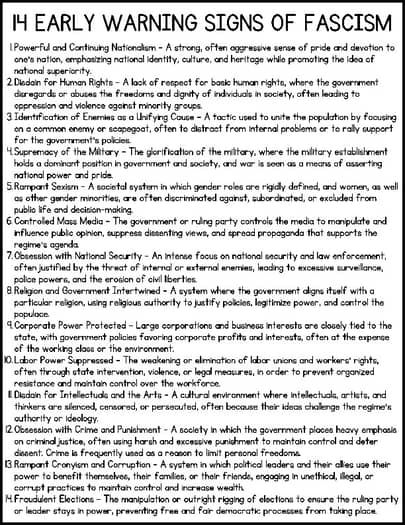
    There has been much written in the past few years about Fascism and much discussion as to whether or not Trump should be considered a fascist. A definition that has been in use by many for the past 20 years or so has provided 14 “Early Warning Signs of Fascism”. See how many of these you believe are appropriate in our country today (I think the answer is 13):

    1. Powerful and continuing nationalism
    2. Disdain for human rights
    3. Identification of enemies as a unifying cause
    4. Supremacy of the military
    5. Rampant sexism
    6. Controlled mass media
    7. Obsession with national security
    8. Religion and government intertwined
    9. Corporate power protected
    10. Labor power suppressed
    11. Disdain for intellectuals and the arts
    12. Obsession with crime and punishment
    13. Cronyism and corruption
    14. Fraudulent elections

    What do you think? Here is a more detailed discussion of the 14 warning signs:
    And don’t forget about Saturday’s parade.
  • From the Halls of Montezuma to the Shores of L.A. County.

    June 11th, 2025

    My first visit to a Communist country was in 1962 when I drove through a small part of East Germany to get to Berlin, and then when I later crossed Checkpoint Charlie to visit East Berlin. I will admit that East and West Berlin were very different. East Berlin was quieter, and more monumental. But the people I saw on the street, going about their business, looked fine. They looked like normal people. I did see police or military presence, but this was less than a year after the Berlin Wall had been built, and I knew everyone was somewhat on edge.

    One of the things that struck me as a 30 year old visiting the Soviet Union in 1972 again was how normal life seemed, even more quotidian than East Berlin ten years earlier. Admittedly, I did not see the squalid living conditions under which many residents of the USSR were living, and obviously I didn’t visit the Gulag, but the shops and the subways and the restaurants and the theaters were all busy and filled with people who looked neither hungry or badly clothed.  Communist Russia looked different from capitalist America to a young tourist, but frankly, it looked okay.

    My only other venture behind the Iran Curtain was a few years later when I visited Prague and Budapest. Budapest was filled with energy, attractive women, and excitement, communism be damned. Prague, still suffering from the Soviet invasion after Prague Spring, was moribund.

    My point, I guess, is that not only that you can’t tell a book by its cover, but you judge a government by visiting a city. Life, everywhere, just goes on.

    So, as the United States is (temporarily?) changing into a more totalitarian country, we (that is, most of us) may not see a difference in our daily life or activities.

    But some people, and probably a lot of people, will.

    American Blacks tell of experiences of being picked on by law authorities in ways that Whites are not, sometimes with fatal conseequences. This was one of the major problems which led to the Civil Rights movement, and then to affirmative action programs, and then to the DEI movement.

    Now, those programs are gone, not because they have been so successful that they are no longer needed, but because we now have a presidential administration which wants to treat everyone in the country, other than their perceived BFFs, as Blacks were treated before the Civil Rights movement. Everyone must remain in their assigned places, or you may find yourself detained, indicted, or deported. Don’t look askance, don’t talk back. You are not respected for your individuality. You are a cog and a number. Yes, you are equal, under “the law”, but there are many more equal than you.

    What is playing out in Los Angeles right now from the ICE raids to the military call-up is outrageous, and it looks like just the beginning. The proposed military parade this weekend is an abomination, and will most likely lead to more unrest.

    We of course have no idea where this is going. If we knew, would we be able to do anything about it?

  • Food, Glorious Food

    June 10th, 2025

    It’s a beautiful day with moderate temperature and low humidity. I am sitting on a bench in front of Clydes at Chevy Chase, waiting for two friends. It is so nice sitting here that I really don’t care if they come or not. I have already had my parking ticket stamped.

    The reason I am sitting here is that I thought the lunch was at 12, but it is set for 12:30. So I am watching people stream into this large and busy restaurant. And what I am discovering is that they all look like me and my friends. We are clearly interchangeable. It’s a weird feeling. I have lost my identity.

    What am I hoping from this lunch? I am hoping that ICE does not show up until we are finished eating.

    Okay, it is now 12:32 and I am still sitting here. No one is on time any more, I guess.

    Oh, here comes someine who not only looks like someone I could know, but is in fact someone I know. In fact, I have known him for 56 years, I think.

    He joined me on the bench. We waited another 5 minutes, and I got a “where are you?” phone call from our third person. He had snuck in through another door. I should have figured that out, but I have only known him for about 45 years.

    Lunch was fine, but like all lunches these days, too expensive.

    It reminded me that, as we are now almost halfway through the year, I could give you a list of the restaurant meals that have earned an A this year. Here goes:

    1. &Shwarma at Shady

    Grove MD

    2. Gregorios in Cabin John MD

    3. Yu Noodle in Derwood MD

    4. Buck’s in Chevy Chase DC

    5. Foode in Fredericksburg VA

    6. Lucky Oyster in Virginia Beach VA

    7. 1906 Bistro in Washington NC

    8. Casa Tua in Miami

    9. Cafe Solè in Key West

    10. Olives in Key West

    11. Sebastian Saltwater Marina in Sebastian FL.

    12. Contesse’s Bistro in St. Augustine FL

    13. Mi Vida in DC

    14. Tatte in DC

    15. Mark’s in Enfield CT

    16. Felix in Springfield MA

    17. Galexy Diner in Bridgeport CT

    18. Pike Kitchen in Rockville MD

    19. Gelletaria in Kensington MD

    20. Divan in Glover Park DC

    21. Bread and Chocolate in Chevy Chase DC

    22. Bistro Arcosia in DC

    23. First Watch in Bowie MD

    Well, that is almost one A meal a week in the first half of 2025. And I am a tough grader.

    Details on request.

    Tomorrow….back to worldly concerns.

  • Kander, Ebb, Out, and In

    June 9th, 2025

    We spent yesterday evening at Congregation Har Shalom  in Potomac for its annual caberet program. This year’s focus was the music of Kander and Ebb. That means Caberet, Chicago, Kiss of the Spider Woman, Flora the Red Menace and more. Thirty numbers sung by twelve wonderful singers, and a remarkable five piece band.

    All the voices were professional quality, including, of course, and especially Michelle Hessel. Michelle sang several pieces from Flora the Red Menace. You know Flora?

    Flora premiered in 1965, starring 19 year old Liza Minnelli making her Broadway debut for which she won a Tony. The play opened pre-Broadway in New Haven and I, a fan of Liza’s mother Judy Garland, was there on opening night at the Schubert (I think) Theater.

    The plotline is setvin New York City in the middke of the Depression in the 1930s. Young Flora (as I recall) is trying to figure out how to make a living, while a young man Flora meets tries to figure out how to make her a Communist.

    My reaction was that the show was destined to be another Oklahoma or South Pacific, but had I known the term, I would have said that Liza was a DEI hire, and would not be cast again in such a major role. Another of my successful predictions.

    What you get from last night’s program, in addition to appreciation of the talent in the room, is appreciation of the extraordinary talent of John Kander and Fred Ebb.

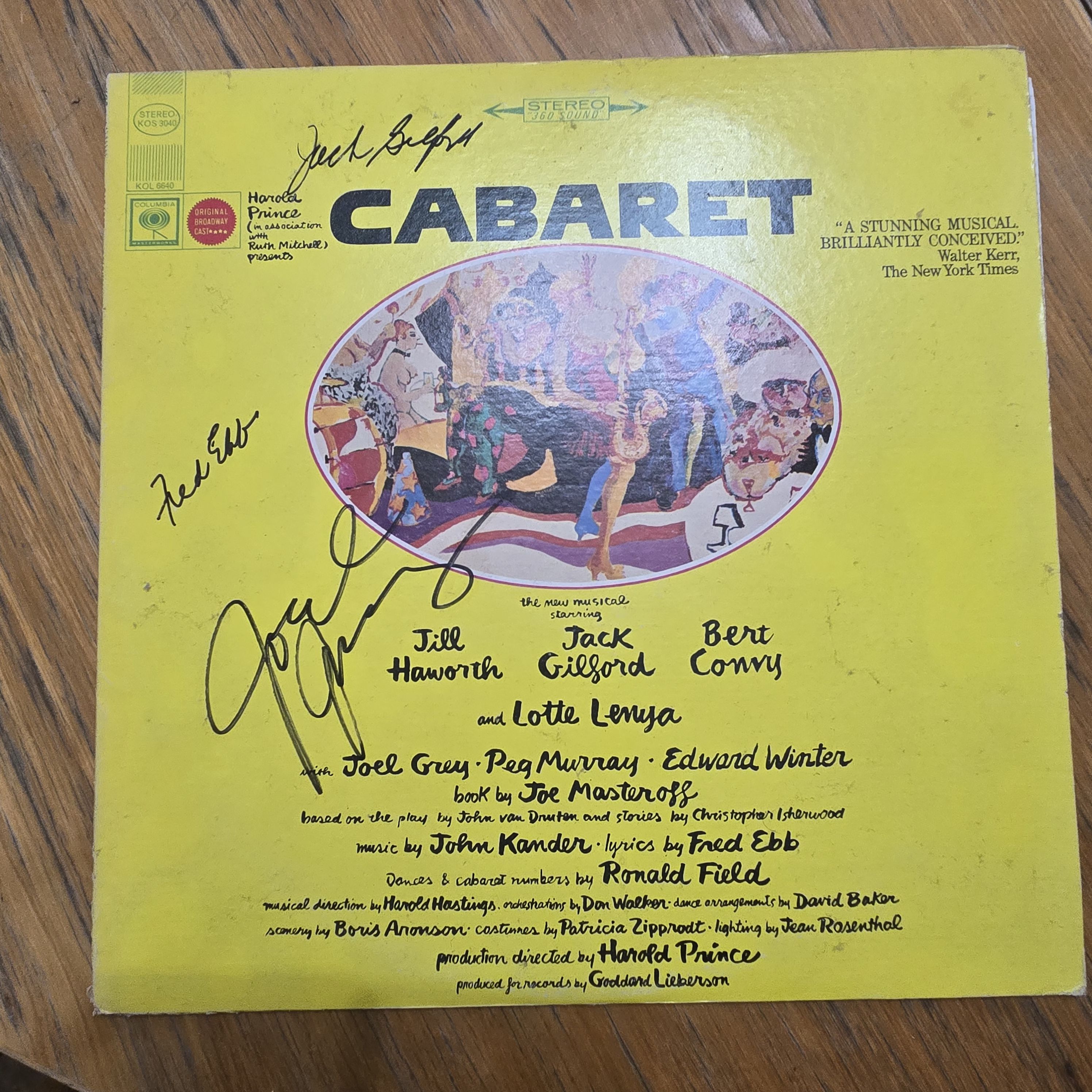
    As to the photo at the top of this post, it’s my copy of the Caberet cast album, signed by Ebb, as well as Joel Grey and Jack Gifford. I would like to ask both Kander and Lotte Lenya to sign it as well, but understand they are no longer signing anything.

    Otherwise, this is a period of transition for me. My resignation as long term president of the Jewish Funeral Practices Committee of Greater Washington took effect last Thursday, although I remain a board member and have a number of transition chores to accomplish over the next week or so.

    Out with the old

    And this evening, barring an unexpected revolt, I will become president of the Haberman Institute for Jewish Studies, of which I have been vice president for the past five or six years. This is going to keep me quite busy.

    In with the new:

    In fact, between now and this evening, I have a number of chores ahead of me. I better get busy.

  • Pride and Baseball

    June 8th, 2025

    It’s Pride Week in Washington DC. It started off with Shakira canceling her concert at Nats Park three days before it was to be performed and continued with a fight between the National Park Service and the DC government about whether Dupont Circle Park should be cordoned off.  A little spice was added when Pete Hegseth said the ship named for Harvey Milk would be changed to honor a white, heterosexual man.

    What was interesting was our Metro ride from the Petworth Metro Station to Nats Park for yesterday’s baseball game and back again. When we got on the train, we were accompanied by throngs dressed for Pride Day

    When we got to Gallery Place, the Pride costumes left the train and were replaced by baseball jerseys and caps. I will say that the Pride folks had more fun, as the Nats lost to the Rangers 5 to 0.

    My reaction to the Pride attendees was interesting. At least, interesting to me. There were a lot of them on the subway. Most were quite young. There were some, say, in their 40s, but few older than that. And they were, to put it mildly, a motley crew. While a few were dressed to the nines, most looked like they just got out of bed, or that they looked hard to find their ugliest, mismatching clothes. But more than that, they looked like members of a society with which I had nothing in common. And visually, this had nothing to do with sexual orientation. It had to do with hair style, types of tattoos, and clothing. It was like I was a tourist in a foreign country. And it was surprising.

    As I said, the game was disappointing.  The Nats played the Texas Rangers and their records are pretty equal. The night before, the Nats won. But the Rangers pitcher, Jacob de Grom, has long baffled the Nats (and others). De Grom is 36 years old and most of his career has been with the New York Mets. The last time the Nats beat de Grom was in 2017. In 2027, most of the young Nats team was in high school. Some were in middle school. Young star James Wood, for example, was 15.

    I don’t pay much attention to the other 29 teams in Major League Baseball. How could I? Back in the day, when there were half as many teams and I was 1/6 of my current age, it was easier.

    I certainly don’t pay attention to the Rangers. But I discovered something interesting yesterday. The Rangers won the World Series in 2023, but last year wound up losing 6 more than they won (the Nats win the World Series in 2019 and then fell apart, as well). Thos year seems to be a replay of last year for the Rangers so far.

    But here is what is interesting. If you look ag Major League earned run average statistics (in other words, how many runs a pitcher allows), the Rangers are third of all 30 teams in allowing the fewest runs by opponents. In fact, of the 11 statistically best pitchers, 3 (including de Grom) are Rangers. But…..if you look at the team hitting statistics, the Rangers are the second worst hitting team of the 30 teams. I wonder how often, if ever, there has been such divergence on one team.

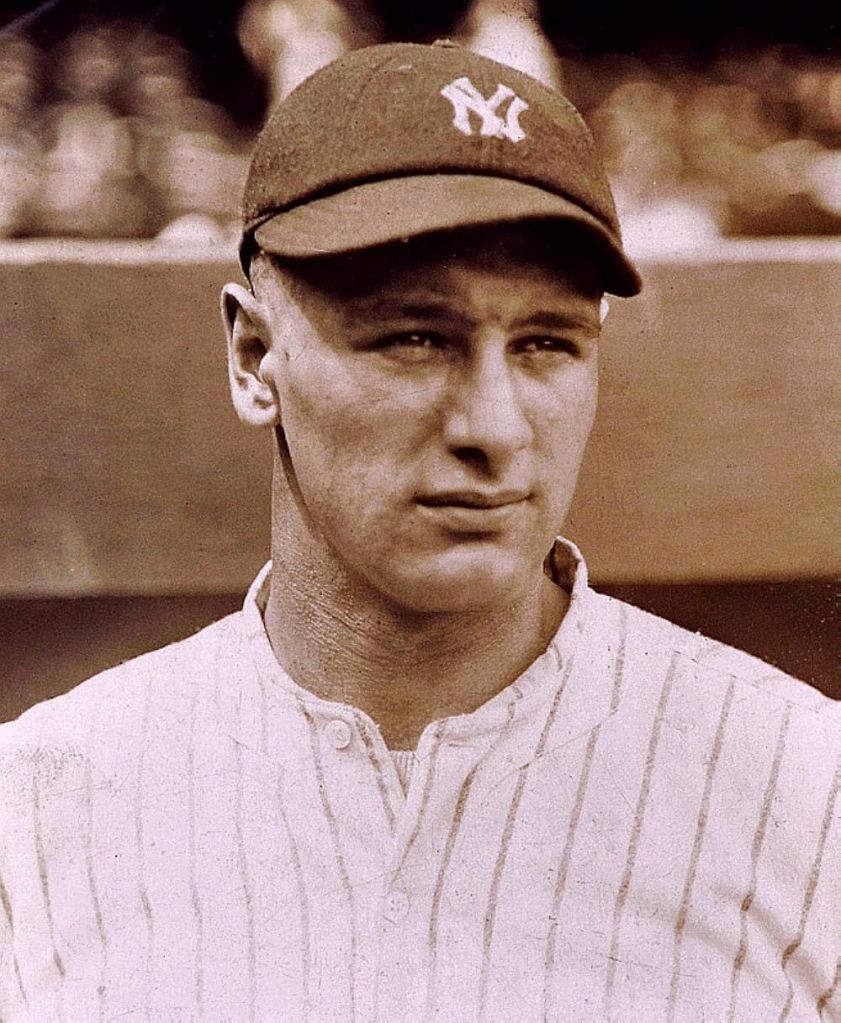
    So, Pride and baseball. How to bring them together? Maybe with the Pride of the Yankees.

    Lou Gherig

    Now back to my regularly scheduled activities. Like following the Trump induced riots in Los Angeles.

  • Thinking Ahead

    June 7th, 2025

    Here is my thought for today. Over 40% of Nigeria’s population is under 15 years of age, while 14% of Japan’s is. 29% of Japan’s population is over 65, while 3% of Nigeria’s is. The projected population of Nigeria in 2050 is about 400 million; the projected population of Japan about 100 million. In 2050, Nigeria will have more people than the United States, which will have about 375 million.

    By the way, Pakistan’s population in 2050 will rival Nigeria’s and the Democratic Republic of the Congo will have 280 million. There will be about 1.65 billion in India and 1.25 billion in China. The continent of Africa will have 2.5 billion people, about 750 million more than today.

    2050 is not that far off. It is about the same time span from where we are now than 2000, right?

    I am not sure what brought on this train of thought, but clearly, the world is changing.

    Today, Tokyo is the largest metropolitan area in the world. It’s population is projected to stay pretty much the same over the next 25 years, but about six other cities will eclipse it, led by Mumbai. There will be about 25 metropolitan areas with more than 20 million inhabitants.  New York City will be in that list, but no other US cities and no European cities at all.

    World population will be 9.7 billion. In case you are wondering, the Jewish population is projected at 16 million. That is a ratio of 1 to .0016.

    And, by the way, Europe now has an estimated 747 million people. Like Japan, its population is expected to decline over the next 25 years to 733 million. In other words, the population of India will be twice all of Europe’s, and Africa’s population will be three times that of Europe. In fact, Africa’s projected population increase will be the size of Europe’s current population.

    I will stop here because breakfast is calling. But, golly gee……

  • And So It Goes

    June 6th, 2025

    What will it be?

    Trump: You are a most notable coward, an infinite and endless liar, an hourly promise breaker, the owner of no one good quality.

    Musk: Away, you starvelling, you elf skin, you dried neat’s tongue, bull’s pizzle, you stock fish!

    Trump: Away, you three inch fool.

    Musk: Come, come, you froward and unable worm!

    Trump: Go prick thy face, and over-red thy fear, thou lily liver’d boy.

    Musk: Your wit’s as thick as a Tewkesbury mustard.

    Trump: You’re pigeon livered and lack gall.

    Musk: I am sick when I do look on thee.

    Trump: I’d beat thee, but I would infect my hands.

    Musk: I scorn you, scurvy companion.

    Trump: Methinks thou art a general offence and every man should beat thee.

    Musk: More of your conversation would infect my brain.

    Trump: Aroint thee: go away, rump-fed runion: slut

    Musk: Ye fat guts!

    Trump: You are the rankest compound of villainous small that ever offended a nostril.

    Musk: The tartness of thy face sours ripe grapes.

    Trump: I have no more faith in thee than a stewed prune.

    Musk: Thine face is not worth sunburning.

    Trump: Thou art a boil, a plague sore.

    Musk: You are like the toad; ugly and venemous

    Trump: Thou art unfit for any place but hell.

    Musk: Thou cream faced loon.

    Trump: Thou day brained guts, thou knotty pated fool, thou whoreson obscene greasy tallow-catch!

    Musk: Thou damned and luxurious mountain goat!

    Trump: Thou elvish-mark’d abortive rooting hog!

    Musk: Thou leathern jerkin, crystal button, know pated, agatering puke stocking, caddis garter, smooth tongue, Spanish pouch

    Trump: Thou hump of foul deformity.

    Musk: Thou poisonous bunch backed toad!

    Trump: Thou has no more brain than I have in my elbows.

    Musk: Thou subtle, perjur’d false, disloyal man

    Trump: Thou whoreson zed, thou unnecessary letter.

    Musk: Thy tongue outvenoms all the worms of the Nile.

    Trump: Would you wert clean enough to spit upon.

    Musk: Would thou wouldst burst!

    Trump: You poor, base, rascally, cheating lack-linen mate.

    Musk: You are as a candle, better burnt out.

    Trump: You scullion. You rampallian. You fustilarian!

    Musk: O for breath to utter what is like thee! You tailor’s yard, you sheath, you bow case, you vile standing tuck.

    Trump: Your brain is as dry as the remainder biscuit after a voyage.

    Musk: You breed mites, much like cheese.

    Trump: Heaven truly knows you are false as hell.

    Musk: Out of my site, you dost infect mine eyes.

    Thanks to William S, who only needed slight editing, and to Kurt Vonnegut for my final words today.

    And so it goes.

  • Here I Go Again

    June 4th, 2025

    I happened to hear House Speaker Mike Johnson yesterday. He was speaking along with a number of other Republican members of Congress about the Big Beautiful Bull and the requested canceling of previously approved appropriations for NPR, PBS and USAID. Johnson, like the other Republicans who spoke, started their remarks with sympathy for the victims of the attacks in Boulder and DC and a general condemnation of antisemitism.

    I had a visceral reaction to almost everything Johnson said; I think him so wrong. If you have been scrolling through what I have been writing about this subject, you know I keep harping on the dangers of conflating antisemitism (dislike or hatred of Jews), anti-Israel positions (which can go so far as to press for the elimination of Israel as an independent country), anti-Zionism (dislike of people, Jewish or not, who support Zionism, whatever that means today), and pro-Palestine positions (which also vary widely). Johnson not only was overlooking these differences and making the mistake of conflating all of these things together – he was  purposely trying to conflate them as much as he could.

    He said that both the perpetrators of the shooting at the Capital Jewish Museum and the attack in Boulder were not acting because they support the positions of a “free Palestine”, he said. This was just a pretense. They really don’t care about the Palestinians. They were committing these crimes because they simply hate Jews and want them eradicated from the planet. He ignored Mohamed Soliman’s statement that if Palestine were freed, there would be no more problems, for example.

    Further, he said, we have a major antisemitism problem in this country, and it is all because of massive antisemitic actions taken by “the left”. In doing this, he made it look like antisemitism was a major leftist policy position – if you weren’t antisemitic, you were hardly worthy of being called a member of the left. Second, he did not even hint at any possibility of their being any antisemitism on the right. And third, he called both of these attackers as leftists, without – to my knowledge – knowing much about their overall political philosophies. He did not even bother to think that someone could be pro-Palestinian (whatever that might mean in this situation), and politically conservative or centrist.

    So, in addition to conflating antisemitism and pro-Palestine stances, Johnson is now conflating pro-Palestinian positions with positions of the leftists in the country, and then of course he defines leftists as members and supporters of the Democratic Party and Democratic candidates. A triple conflation – how clever he must think he is.

    And much of the American public (including the antisemitic far right) will fall right into his trap.

    After this introduction, he got to the recision bill, which focuses on USAID ($9 billion plus) and NPR and PBS ($1 billion plus). I find the purported closing of USAID, the purported transfer of its ashes (I started to write “its embers”, but that would be less accurate) to the multi-hatted Marco Rubio, and the sudden firing of virtually all of its employees a legal disaster, a moral disaster, a human disaster and a security disaster. Johnson says it’s the first step to turning around the country. Johnson did not try at all to differentiate between any of USAID’s programs; to him, they were all abominations, it appears. None were worth saving. None was better than any other. The only one he mentioned in particular was support for a “trans opera in Peru”, of which he said clearly no one would approve.

    This one act opera, “As One”, is an American opera, premiered in 2014, which Opera America says is the most performed modern opera today in the United States. As I understand it, it is the story of a young girl who, I think after her college years, transitions to male. The two leads both play the same role, before and after transition. The description I read made me want to see it.

    The USAID supported presentation of the opera cost the American taxpayers approximately $22,000, and more was paid by local Colombian sources. And, yes, Mikey, it was Colombia, and not Peru. But, from your perspective, I assume that whether it is Colombia or Peru is not very important. After all, how different could they be? Don’t you think that on some days, residents of Peru wake up wondering of they are Colombian, or if they are Peruvian?

    That leaves NPR and PBS. Want to know something? I actually don’t think that NPR or PBS should be publicly funded, although I would favor some sort of rational transition, rather than just locking them out in the cold. The cultural preferences and politics of both organizations are to the left of center; to me, that’s just fine, the way everything should be. But they are not politically balanced, and if they were, their liberal listeners and watchers would start to look elsewhere. Federal funds provide, I think, about a quarter of their funding (and the funding of local stations), and I bet this could be made up locally (or by technological changes in how they transmit and broadcast). And then, they could put on whatever shows they wanted to put on, and could be a real cultural outpost of liberal America. That would be my vote, assuming the details could be worked out.

    After all, why should all media be balanced? Look at the disaster that CNN has on its hands by requiring their panels shows to have at least one right wing idiot on it. And, yes, I am talking to you, Scott Jennings. MSNBC, on the other hand, is proudly not balanced, and does an excellent job of providing factual coverage of the days event. If one party says the sky is blue and the other says the sky violet, do you want a news station to say: “The Democrats accurately say the sky is blue, while the Republicans insist, with out any proof, that it is violet.” Or do you want them to say: “What color is the sky? The Democrats say it is blue, and the Republicans say it is violet….That’s all the news for tonight. See you tomorrow.”

  • Put Another Nickel In…..And Some Really Important Stuff

    June 4th, 2025

    When we pick up Joan, our now 10 year old granddaughter, from her school, the first thing she likes to do is to grab my phone and play music. Usually, her choices have been songs from films targeted at children, like songs from Disney films and the like. But yesterday, something different happened. She played a song by a group called Matchbox 20. I can’t tell you the name of the song, but it wasn’t a children’s song, and it was pretty good, I thought. The lyrics (I didn’t listen too closely) were clever – maybe something about the end of the world? I am not sure. But it seemed to me that it was one more step in growing up.

    Of course, I had never heard of Matchbox 20, a four man group from Orlando. They have only been singing for 30 years. That is probably why. Wikipedia characterizes them both as “pop rock” (I think I might understand that) and “post-grunge” (which I don’t understand at all). Wikipedia defines post-grunge as “an offshoot of grunge that has a less abrasive or intense tone than traditional grunge” that became a designation for groups popular in the 1990s. Well, that was 30 years ago, about the time that Matchbox 20 got its start. (You wonder if I know what grunge itself is. Wikipedia says that grunge comes from the 1980s and that it fuses “punk rock with heavy metal” and uses a “distorted electric guitar sound”. None of that means much to me.)

    Of course, I don’t know where Matchbox 20 stands politically.

    I do know where Bruce Springsteen stands politically, as he has been very outspoken against our Great Leader recently. I guess that may be influential for some people and I am sure it was a very brave stance for Springsteen to have taken. I don’t, by the way, know what 10 year old Joan thinks of Springsteen’s music; my guess is that she has never heard of him, or at least can’t identify him.

    But, guess what? I couldn’t identify him, either. I know that there is such a person and I know that he is called The Boss and I know that he comes from Asbury Park, New Jersey. Am I right? But could I identify Springsteen if he was standing in a police line as part of a group of possible perpetrators? I’d give myself a 50/50 chance. Not more. And what do I think of Springsteen’s music? I have no opinion there, because I don’t know that I have ever heard any of it. And if I have seen, say, a snippet here or there, it certainly didn’t sink in at all. Could I name a Springsteen song? No. Is his music heavy metal, punk rock, grunge or post-grunge? I have no clue whatsoever.

    I have said this before, but I basically tuned out the music that everyone else (or at least the majority of everyone else) listens to. I do listen to classical music (not as much as I would like to), and real oldies (pre-1960 or so), some show tunes, and klezmer, and I am always interested in music from far away parts of the world (say Africa or Latin America, although most of that doesn’t enter my memory bank, either). If you asked me, in fact, I would tell you that I do think music is an important part of my life.

    So, why is this, and what does it mean? For example, if I listened to Bruce Springsteen and all those other folks (who is Shakira, who canceled her concert here this week? She was going to fill 40,000 seats in National’s Park?), would I understand America better? Would I know why people voted for Trump?

    One thing is clear to me. I don’t regret not having listened to any of this kind of music for the past 60 years or so. And I really don’t think I have missed anything in my life because of my lack of attention. I guess that if I were interested in any of this, I would have more to talk about with people, and I would want to attend a concert here or there. But…..so what?

    Before I sign off this morning, a few questions. First, what is going on in Boulder, where the Feds have picked up Mohamed Soliman’s family and put them in detention,  although at this point there seems to be no evidence they were involved in his crime? And whether or not they were involved, while he might be spending decades in an American prison, they may immediately deported. Why? Because they are related to him? What will we do next? Start blowing up defendants’ houses?

    How will we get out of this mess? At what point will it be clear that the Trump administration cannot last.

    And finally, Musk’s “I just can’t stand this any more”. His DOGE work failed, his auto business is crashing, his rocket business is really crashing, he is living on a combination of legal and illegal drugs. There is more that he can’t stand than Trump’s beautiful bill. I think the mental health professionals ought to keep a close eye on him before he does something irreversible to himself.

  • School Days, School Days

    June 3rd, 2025

    Okay, so I am a little behind in my reading. But yesterday, I got a chance to catch up a bit. I took one of our cars for its every six months or so checkup, and was told that, because the car was now 6 years old, it was time for its major, major, major checkup, and it would take about 3 1/2 hours to complete the tasks (and cost almost as much money as my first car cost me to buy in the early 1960s). I wasn’t concerned, because I bought a book, I could walk to a breakfast place, and then I could walk to Montgomery Mall, where I could shop (ha ha), or walk, or drink more coffee while sitting in all sorts of fairly comfortable chairs. I could even grab a quick lunch at the food court.

    All that went well enough, but it turned out that my 3 1/2 hour wait turned into almost a 6 hour wait. I had dropped the car off at about 9 a.m., and it was not ready for me to drive it home until almost 3 in the afternoon. (The reasons for this are not important, but it had something to do with the technician’s computer failure – after all, the biggest tool in testing and fixing automobiles today is a computer.)

    So I first sat in Corner Bakery, then on the lower level of Montgomery Mall, then in the food court, and then in the Jim Coleman Toyota waiting room. And all of that time gave me the opportunity to read Jonathan Kozol’s Death at an Early Age, which I have thought about reading since it was first published in 1965. After 60 years, I have finally caught up in some of my reading.

    It’s not a long book, and it is fairly easy to read. Kozol was under 30 when he wrote it (he is now 88), and my guess is that, if he wrote that book today, he would look on some of the things a bit differently, but that is okay. Kozol wrote this book after teaching at an inner city school in Boston’s Roxbury neighborhood. He taught 4th grade, until he was fired for sharing with his class a poem by Langston Hughes that dealt with the suffering of Blacks in America.

    Kozol was a Boston (well, Newton) native, a Harvard summa cum laude graduate and a Rhodes Scholar, who had also studied writing in Paris with people like William Styron and Richard Wright. He had decided to teach in an inner city school, a choice which has led to a long career as an educator and activist. He became a substitute teacher in the Boston system and was very soon (too soon in his mind) given a fourth grade class, in an inner city, largely Black school, which was, to put it mildly, quite an experience.

    Clearly, Boston of 1964 (the year I graduated Harvard, so I knew it fairly well then, or at least thought I did) is not Boston, or any other city, today, 60 years later. I do not know how much of what Kozol saw can be seen today.

    But let’s talk about the school in 1964.

    The school was overcrowded. Kozol did not have a classroom; his class met in the gym, which was cordoned into sections by decrepit freestanding blackboards, so that two 4th grade classes, the glee club and the drama class, could all meet there. Yes, this meant that no one could hear anything or concentrate on anything. The kids, he said, were understandably always confused.

    The school was in terrible physical shape. Windows were broken and, even in winter, would take months to replace. Window frames cracked and fell on students’ desks, blackboards collapsed and were taped together unsuccessfully. And more.

    There was corporal punishment (who knew?). Children who “misbehaved” were taken to a room in the school’s basement where they could be beaten with a switch made of rattan. And, in addition to this, occasionally a teacher would slap or beat a student; this had to be done out of sight.

    There was no library, there were insufficient numbers of text books in the classrooms, the text books themselves were old, their contents portrayed a middle class White society totally unknown to the students. Blacks, when they were discussed, were simple, happy, and very primitive.

    Virtually all of the teachers were White, and most of them had either a patronizing or a very biased feeling against their black students, something that Kozol demonstrates through his retelling of many conversations with his fellow instructors (he does not use anyone’s real name).

    The Boston School Committee (i.e., its Board of Education) was determined to keep the city’s schools primarily segregated. They weren’t officially segregated and in integrated neighborhoods, the schools were integrated. Even in Kozol’s school, there were a few White children in each class. The schools were “neighborhood” schools, and the School Committee was determined to keep them that way. And they defined the neighborhoods to be as racially exclusionary as they could. Kozol tells of an adjoining neighborhood, which was predominantly White, and which had a school that was underutilized while his school was overcrowded. To him, it would have been easy to adjust the neighborhood boundaries to send some of the Black children to the predominantly White school, but this was not to be done.

    Some of the children in his class were quite bright. Others could barely read or write and could not perform basic arithmetic.

    Some children came from very disturbed backgrounds, but this did not seem something that most teachers were concerned with. It was easier to lash out at the kids than to try to understand their circumstances.

    Kozol writes that even sympathetic teachers kept quiet, afraid that rocking the boat would end their careers. He thinks he could have been more outspoken during his short time at the school.

    One additional point must be made. This was Boston, in the north. Any thought that racial problems in schools were confined to the segregated south are quickly dispelled.

    The book became very well known. How much influence it had on schools, or on the sociology of racial minorities, I am not sure. And while I know that times have changed, I don’t really know how much they have changed. 1964 is obviously pre-DEI. 2025 is apparently post -DEI. Sadly, as I read this tale of pre-DEI, I see the same type of thinking that I see in many who are fighting to make any thought of working to ensure diversity, equality and inclusion recede into the past.

    Can I end on a happier note? After my 6 hour wait, my service “advisor” told me that he had arranged for a discount since I had to wait so long. Without me asking, he actually took $300 off my bill.

  • Paradise Blue. Drinks Are On The House (Not). That’s Okay.

    June 1st, 2025

    It’s quite a different experience, I’ll tell you that. We had tickets to see Dominique Morisseau’s play Paradise Blue at the Studio Theatre yesterday. You may not be familiar with either the play or Morisseau, but even if you were, this production would differ greatly from whichever earlier one you had seen. Whether this is for the better or not, I am not really sure. But this production was worth seeing not only because the acting was terrific, but because it was so unique.

    First, a few sentences about the plot. From the plot, you will see that this is a play that Donald Trump would certainly not want to have performed at the Kennedy Center. That’s because it is about Black folks and their place in America, and it does not show that they are treated as well as others, and have equal success rates. The setting is the Paradise Bar, located in the Black Bottom section of Detroit. The year is 1949. Black Bottom is just what it is called – its residents are Black, and many of them are clearly at the Bottom. In fact, Black Bottom is believed by the city leaders to be so bad that the city itself wants to buy out some of the landowners and redevelop the area into something more upscale.

    The Paradise is owned by a guy known as Blue, a trumpet player who inherited the club from his father, who was even a better trumpet player. There is a small combo that plays there and includes Blue, and there is Pumpkin, Blue’s girl, who takes care of the club and of the rooms upstairs that are rented out for $5 per day (except to the  band members who get it free as compensation).

    Blue’s mother was killed by Blue’s father after his father had gone mad; he spent the rest of his life in an asylum. Blue is showing similar mental problems, and wants to escape the Paradise and Detroit, thinking that he can get a fresh start in Chicago. Pumpkin wants to stay where she is, the city she has always lived in.

    P-sam, the band’s percussionist (I am simplifying the story line a bit) wants to buy the Paradise from Blue in order to keep the city from changing the neighborhood. So does Silver, a sophisticated “woman without a man” who has sauntered into town from Louisiana (where she might have killed her husband) and rented a room from Blue.

    The story plays out in two acts. I won’t tell you any more, except about the plot, except I will remind you that if you see a gun in the first act, it will be used before the play ends. And the same can be said about a bright red rayon dress.

    This is a very good play, bringing up a lot about neighborhood “gentrification”, the problems of being a “Negro” even in prosperous Detroit in 1979, and about not only white dominance, but male dominance. The Blacks are trying to hold off the  whites, and the women are trying to outsmart the men.

    So what, you ask, is different? What is different is that the Studio has taken all the chairs out of one of its main theaters, and turned the entire place (now looking more like a large black box theater) into a cabaret, a club, the Paradise, complete with live music. There are 30 or so tables, each seating two or four people, the bar is open, and the actors roam the floor of the club, coming within inches of many, if not most, of the patrons. Your instructions are not to stick your feet out, not to touch the cast members and not to talk with them. They are not going to break character. (There is, in one corner of the theater a raised platform holding the room Silver is renting, with a boundary curtain closed when the room is not being used in the show.)

    It is like being a part of the show, but not quite. As Edie said, we are in the cast; we are playing “audience”. But really, we aren’t in the cast; we are just sitting at tables, as the show goes on around us. It is great fun, no doubt about that, but does it add anything to the play to do it this way? I don’t think it does, and in fact think that more traditional direction might wind up with better showing off the writing. The main reason is that while the majority of the show does take place in the club in which we are sitting, no part of the show takes place in the club during an actual show, when there would be an actual audience. So our being part of the audience in the actual club is artificial; it makes no theatrical sense. Just as a contrast, we have been to at least one show where we were similarly part of the audience, but also had a role to play in the show. It was years ago (like most things we have done) in a black box performance of Julius Caesar in Stratford-upon-Avon, where our role was to play the citizens of Rome. It was very effective as we moved across the large stage as the scenes changed.

    But, as I said, this is a good play. It’s part of a three play trilogy by Morisseau, called the Detroit Plays. Studio, in 2017, put on one of the others, Swing Shift, in a more traditional way. I remember seeing that and, at the time, thinking that this was an extraordinary play. Because I thought that Paradise Blue was a really good play, but not an extraordinary one like Swing Shift, I couldn’t help but wonder if a traditional presentation would have made it seem to me to be extraordinary, as well.

    The acting was universally good – this was not one of those plays where the actor you remember most is the one who was not up to par. They were all well over par. (Don’t think golf where over par is bad; I guess that is obvious.)

    Special shout out to Kalen Robinson, who plays Pumpkin. She was spectacular from her acting, her facial expressions, and her singing voice. But this it not to take from anyone else.

    I am sure I am not the only one, but Morisseau’s Detroit Plays remind me 100% of August Wilson’s Pittsburgh Cycle, consisting of 10 plays, each set in a different decade. We have seen most of Wilson’s cycle and all are perfect (okay, some more perfect than others). Does Morisseau’s Detroit Plays compete with or complement Wilson’s Pittsburgh Cycle. I think so. As I remember my reaction to Swing Shift, I would conclude they are brothers from different mothers, as they say. I don’t know if I think that Paradise Blue reaches that level or not, and part of my ambiguity is that the club setting takes some of your attention away from the play itself. I’d like to see it more traditionally. Then perhaps I could answer my question better.

    One last thing. From our table, we could see probably two thirds of the audience, and because you were constantly looking in different directions as the actors moved from place to place, you also got to see the audience differently from when all you see are the backs of their heads. And I will say that it was fascinating to see how some people were paying strict attention to everything going on, while others didn’t seem to know where they were or why they were there. And one prominent table had a woman who spent most of the play looking sad as she tried for an hour to adjust her hearing aids. From the actors perspective, rather than looking over the heads of and ignoring a darkened audience out in front of you, wandering through this one with full lights on, they must be able to see the same things I was seeing. I just wonder if it was at all disconcerting. Certainly, that was not obvious if it was disconcerting, but I have to wonder.

    Do I recommend you see it (it’s about half through its run, and will keep being performed until early July)? Absolutely. Why?, you ask. Jeez. Didn’t you read what I have said?

  • Saturday and Sunday Doings

    June 1st, 2025

    Every Sunday, the question is the same. Which comes first, the Times crossword or the blog post. Today, the crossword won.

    In part, that is because our two grandchildren spent the night with us, to give their mother (their father is away for a few days for a family bar mitzvah) get some serious packing done for their Tuesday move to their new house.

    Neither Edie nor I slept much last night, being sure that four year old Izzy, sleeping not in an available bed, but in his sleeping bag on the floor, would wake us mid-night. Of course, he didn’t,  sleeping from about 9 until 6:30.

    This morning, until his mother arrives, he is “wrestling” withhis giggling sister, and watching Wonderland, a children’s math ccartoon program, which he alternates with Numberblocks, another. Both seem to be instructive, and his ability to work with numbers seems pretty good. He also likes to quiz the adults: “and what is 78 and 31 and 269?” On Wonderland this morning, while seemingly skipping only one or two numbers, the show taught him how to count to a googolplex. He tells me that googolplex is the biggest number, so I ask him whether googolplex plus one isn’t bigger.

    He thinks a bit, and reluctantly tells me “yes”, but then 10 year old Joan intervenes and tells me “no, because in theory a googolplex doesn’t ever end.” This stops me in my tracks, and I accuse her of engaging in philosophy, not mathematics.  But I assume she is correct.

    Yesterday, we took them to Michelle and Josh’s boat, on a cool and windy day. The boat didn’t leave the slip, but we all had a good time, even dog Zeke.

    We had dinner at Dockside, a short walk from their boat, and Izzy, who is a very active, restless, and determined kid, found a new BFF, Blake, on the restaurant lawn. They seemed to be clones in every way but looks.

    As we wait for their mother to pick them up, Joan and I have been told we are now on a mission, that a bad guy has entered the house, and our job is to find him before he finishes his dastardly deed. What is the bad guy trying to do? He is trying to steal our TV connection.

    After they go home, hopefully I can close my eyes for a few minutes before our 2 pm theater tickets. We are seeing Paradise Blue at Studio. Then, home in time to watch the Nats sweep their series against Arizona? In their ladt 4 games, they have scored 38 runs. If they win today, they will be only 1 game under .500, back were they were before losing 8 games in a row.

    That’s it for today. Gotta find that bad guy.

  • Heading for a Complete Breakdown?

    May 31st, 2025

    When historians look back on this period of time, I think they will generally agree on two things. First, that Joe Biden’s mental facilities had declined during his presidency, but that there was little in his actions as a chief executive that negatively reflected on his personal situation. Second, that Donald Trump was totally out of his mind during his second term (partially out of his mind during his first), and that most Americans at the time either didn’t recognize it, or were psychologically unable to believe it or act upon it even if they recognized it at the time.

    There are, of course, many of Trump’s actions and proclamations that can be named to evidence his mental decline, but the one that should make it clear to everyone is his latest diatribe against Leonard Leo, the long time employee and chair of the Federalist Society, and its public face for much of that period. Wikipedia defines the 70,000 member Federalist Society as “an American conservative and libertarian legal organization that advocates for a textualist and originalist interpretation of the U.S. Constitution.” It was founded in 1982 in part to check federal power and protect individual liberty (according to its description of itself), and to counter liberal thinking at American law schools. It now has chapters at most of those law schools, and has been relied upon by Trump in choosing candidates for federal judgeships. Again, according to Wikipedia, 43 of the 51 Trump nominees to the federal courts of appeal during his first term were members of the Federalist Society, and six of the nine Supreme Court justices have been members of, or have had other connections with, the organization. During the first Trump term, Trump acknowledged that he was no longer going to rely upon the reviews and recommendations of the American Bar Association for his judicial nominees, but was going to rely on lists provided to him by the Federalist Society, which would do much of the vetting for him. At least, this is what I recall.

    I don’t have the statistics before me, but the positions taken by Trump during his second term have been widely knocked down by the courts at all levels, frustrating the president to no end. Trump’s reaction to losing cases in court has (even in his first term) been to badmouth the judges who issued the opinions. And, as you know, his badmouthing seems to have no limits. During his second term, he has continued and increased this practice, which of course does him no good. Within the past few days, he has started on a new tactic, which will also provide him with no benefit, by badmouthing, of all people, Leonard Leo.

    Now, it is easy to badmouth Leonard Leo if you are someone whose philosophy differs from that of the Federalist Society. You can badmouth him by challenging his positions, the choices he makes in making recommendations to the president, his ways he has wielded and honed his influence. But of course, this is not what Trump is talking about. Trump is taking a different position; he seems to be blaming Leo for the positions taken by judges recommended by the Federalist Society who have issued opinions which are against Trump’s positions in cases brought before them. It is not only to blame the judges; he is now blaming Leo.

    In 2016, Trump said “We’re going to have great judges, conservative, all picked by the Federalist Society”. Last week, Trump said: “I was new to Washington, and it was suggested that I use the Federalist Society as a recommending source for judges. I did so, openly and freely, but then realized that they were under the thumb of a real “sleazebag” named Leonard Leo, a bad person, who in his own way probably hates America.”

    What, other than a form of mental collapse, would induce Donald Trump to say this?

    There are other signs of mental collapse. How can a president in his right mind tell Maine and California that, unless they change their positions on the ability of a very few trans athletes to participate in certain competitions, that they will cut off all federal aid to the state? How can a president in his right mind be involved in all of the family self-dealing that the Trumps find themselves in now? How can a president in his right mind believe he can simply have people, including citizens, picked up off the street and, even though they have never been convicted of a crime, have them indefinitely imprisoned in third party countries out of American supervision? How can a president in his right mind, simply on his own whim, decide to destroy Harvard University, decide to upset the lives of hundreds of thousands of foreign students in this country, and so forth? How can a president, again on an apparent whim, state that tariffs on foreign steel are going to be doubled to 50%?

    Donald Trump is 78 years old, an age when some mental changes can be expected, perhaps, although not as serious as the ones he is experiencing. But there is another fellow, whose mental health is just as suspect and that, of course, is Elon Musk, who is only 53. Musk has clearly accomplished a lot in his short life (although some of those accomplishments seem like they have peaked already and that decline has set in), but he leads a strange life, sleeping in his offices, having children with multiple women and wives, and so forth. But now we see what the problem is for Elon Musk, as he ends his tenure as the not-head of the non-agency DOGE, which has destroyed so many government programs and government employees in so short a time. We now see that Elon Musk is a druggie, presumably always high on something – with ketamine being his drug of choice, but not the only stimulant or hallucinogen that he seems to take on a regular basis. At this rate, you would assume that Musk may never make it to 78.

    So, for the past four months, the United States has been under the sway of a charismatic narcissist with declining mental capacity, and a brash non-charismatic narcissist entrepreneur who is constantly on drugs. One of them may be gone for now, but the other is still riding high, Icarus-like, with thousands of followers in all branches of government, and millions of other Americans who have been fooled, are themselves a bit out of balance, or who just don’t pay attention.

    And guess what? Our problems are just beginning, and the light at the end of the tunnel is rather dim. We don’t know what the future will bring us as the mind of our president continues to decline. What happens if he loses it altogether?

    But……hang on.

  • Only 40 words today.

    May 30th, 2025

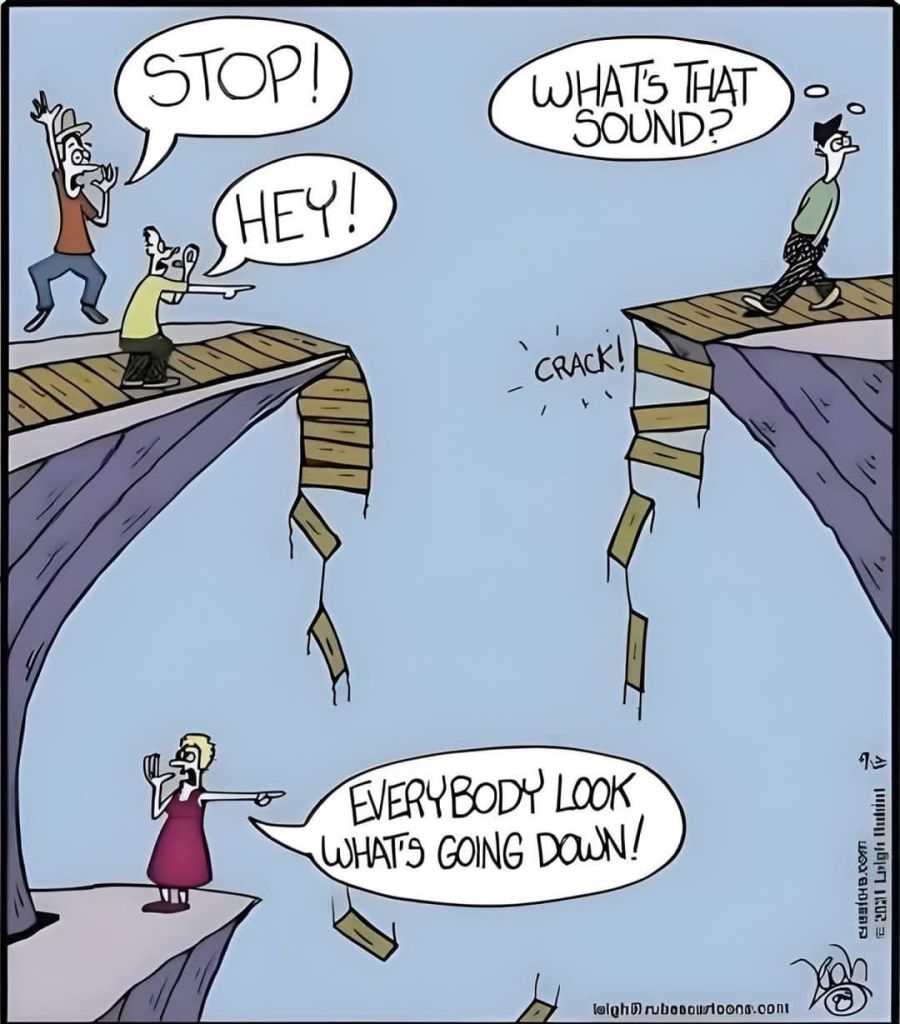
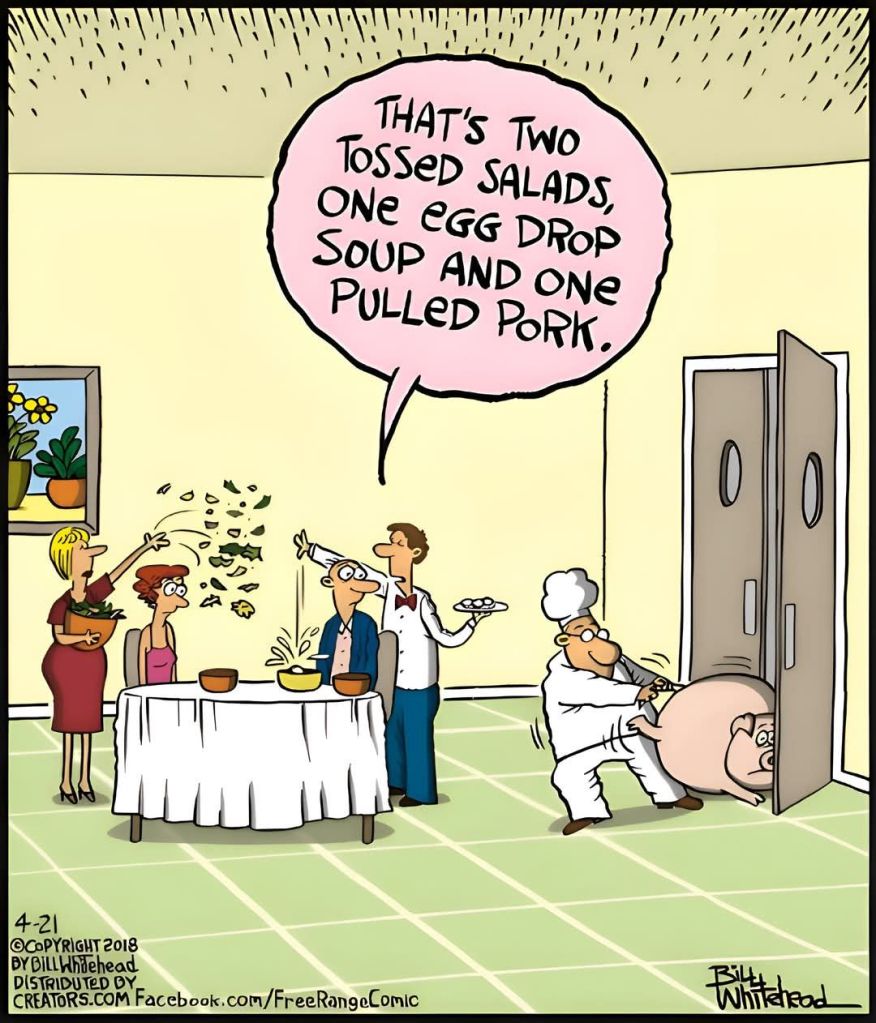
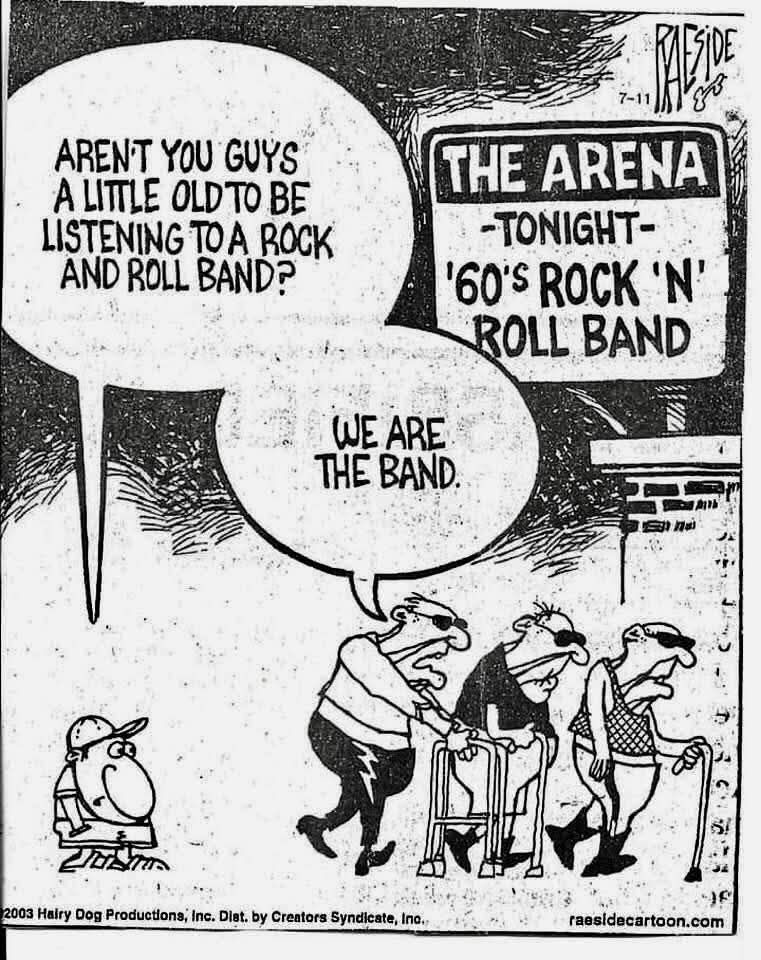
    So, I am a little tired this morning, so let’s just look at some cartoons that have recently shown up on my Facebook page.

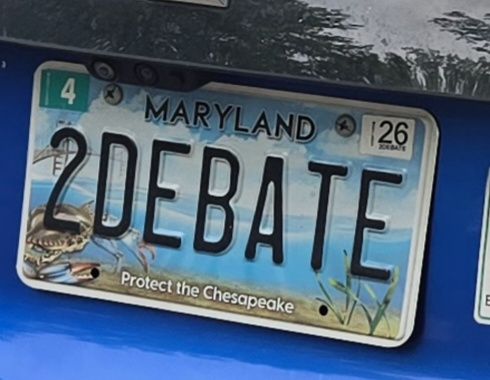
    And now, a few license plates I have spotted recently.

    Okay, now I am more awake.

  • Harvard, Harvard, Rah!, Rah!, Rah!

    May 29th, 2025

    Today is an important day in the Harvard world. It is both the day of the 2025 Commencement (the 374th Commencement) and the day of the scheduled permanent injunction hearing on the federal government’s attempt to ban Harvard from enrolling foreign students. What do they call it when seemingly unrelated things happen at the same time? The word escapes me.

    I read this morning that President TACO might back off the foreign student ban to avoid the injunction. Will be interesting to see what will happen.

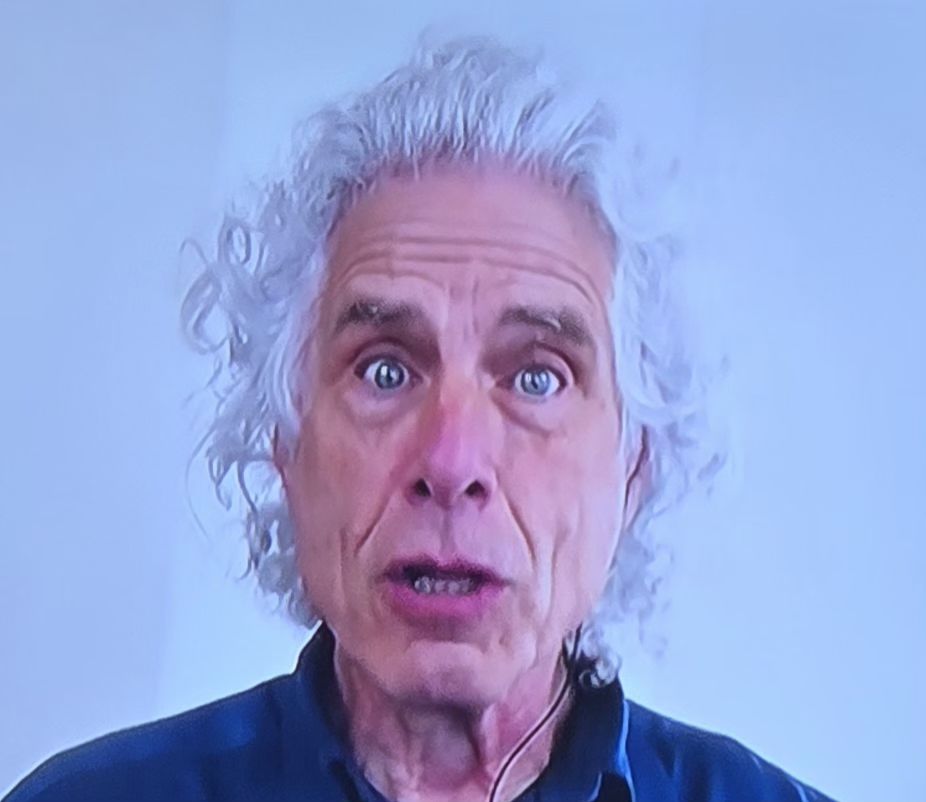
    But clearly everyone at Harvard has been thrown for a loop. Take psychology professor Steven Pinker, who last week wrote a New York Times op-ed about what he called Harvard Derangement Syndrome (HDS), a disease modeled after another, called Trump Derangement Syndrome (TDS). I suffer from TDS, I believe, but don’t consider it a disease, but rather a rational reaction to irrational circumstances. HDS is something else.

    HDS is a disease characterized by concluding that whatever Harvard does is somehow Satanic. It is highly transmissible, it appears, but can also lead to a reactive syndrome found in those affiliated with the university, like Professor Pinker.

    How can I prove this? Here is a photo of Pinker from his Wikipedia page:

    I saw Pinker this morning on MSNBC, talking about HDS. Here is how he looks now from a screenshot during his appearence:

    I rest my case.

    Things were very different when I graduated in 1964. The night before graduation was quite celebratory, and I didn’t go to sleep until what they used to call the wee hours of the morning. I was not expecting to be roused out of bed at about 6 a.m. by the sounds of bahpipes (I hate bagpipes), drums and fifes in the Kirkland House Courtyard with an “invitation” to come and march  to services at Memorial church. I went and ecumenical (1964 style) they were, and then we all marched again to our seats between the church and Widener Library for the Commencement exercises, tthrough which (in spite of it being an absolutely perfect weather-wise day) I think I mostly slept. Our commencement speaker was a big disappointment. He was an ex-president of Colombia, and I recall him being bald and speaking with a heavy accent. His name – Alberto Lleras Camargo. Here he is:

    Ever hear of him?

    Then, I remember going back to Kirkland House for lunch and diplomas. My mother, father, sister and grandmother were all there.

    I went back for my 25th reunion. The speaker that year was Benazir Bhutto, the daughter of a Pakistani prime minister and a future  prime minister herself, only to be assassinated in 2007. She was a mesmerizing speaker, unbelievably inspirational. Her death was a great tragedy of the early 21st century.

    The only other Harvard commencement I attended was at my 40th, where the speaker was Kofi Annan, UN Secretary General. My memory of that is that the 40th reunion class was seated so far back that I could neither see nor hear anything. But I am sure he gave a great speech. Why wouldn’t he?

    That’s it for today. Think I will check MSNBC and see what happened at that hearing and who the 2025 speaker was, and what he/she/they said.

  • Short, And Not Even Sweet

    May 28th, 2025

    Jan Psaki started her show last night with a very interesting segment to which I wish I had paid more attention. She went through a list of things that Trump rails against as horrific waste, fraud and abuse, and then she listed the people guilty of these exact activities whom he has pardoned. It was quite a list. I bet you can see it on YouTube or the MSNBC site. Worth watching.

    I did not watch Lawrence O’Donnell last night, but I am sure he was rightfully gloating about Trump’s postponement, once again, of EU tariffs. As he says over and over, don’t believe Donald when he threatens high tariffs. He will back away just before they are scheduled to go on.

    This is a lesson that the NYSE has not learned. The Dow climbed 740 points yesterday on the news.

    For some reason, it reminds me of Michael Jackson, when one of his kids was a baby and Jackson dangled him/her out of an upper story window to the shock of the crowd below. (Do I have that right?) Everyone was sure he would drop his kid, but then he pulled him/her back. Dangling the tariffs is obviously different  but to my mind, it’s the same thing. Sort of.

    Tired of me writing about the president? Okay, let’s move to RFK, Jr. We know his position on flourides and food dyes, and now we know it on Covid vaccines for children and younger adults, but what is this about medical journals? He is forbidding government scientists from publishing in respected journals?  The government will do its own publishing? What do you make of that? Is it a blow against the medical publishing business, or is it a blessing for them? Now, they won’t have to publish false news, and they will be able to criticize what the government publishes at will. But the government’s own published pieces won’t be peer reviewed before publication, just reviewed by Kennedy’s policy folks.

    The reason I didn’t watch O’Donnell is that I was watching the pitiful Nats-Mariners game. Nats lost 9-1. Did I say it was pitiful? It was pitiful.

    And while I was watching, I was preparing for my Wednesday morning Haberman Institute leadership meeting, for which I have to leave soon. Tonight at 7:30 EDT, we have a free Zoom program on Christian nationalism. You can register at http://www.habermaninstitute.org. We already have over 800 registrants.

    And I didn’t even mention Elon Musk’s many failures with SpaceX or Tesla. And what about DOGE? Does it still exist? Who runs it?

    And, as the Harvard saga goes on, what is this news about the government stopping all student visa applications. That isn’t just Harvard, you know. It’s everyone.

    So, I leave you here for now. I am already late.

  • One Hundred Years Ago is Long Ago. And It’s Just Yesterday.

    May 27th, 2025

    On April 4, I wrote about the transition in Germany from the Weimar Republic of the 1920s (post-World War I, lasting fewer than 15 years) to the Nazi Third Reich (lasting 12 years until the defeat of Hitler). I based it on a book When Germany Turned the Clock Back by American journalist Edgar Mowrer, published in the early 1930s, shortly after Hitler’s assumption of power.

    You may want to read or reread my April 4 post, both because the subject is so interesting, and because I tried to identify any similarities today with Donald Trump’s rise to power in the United States.

    Last night, I started reading another book by an American journalist, published even earlier, in 1920, titled And the Kaiser Abdicates, written by S. Miles Bouton. I am far from finished with the book, but one point made early on by Bouton is worth some thought.

    Remember, when he wrote this book, Bouton knew nothing about Nazis. They didn’t exist yet. He only knew that the government of the German Empire was rapidly changing, and he ascribes this to more than the waging of and the loss of the World War. Of course, it was less than 50 years from the time the many separate Germanic states united under Prussian leadership. Prussia remained firmly in control of the new Empire, and Bouton outlines the similarities and the differences (as between Prussia and Bavaria, as an example) of the parts of the German speaking world that banded together.

    The radical changes came about, he believes, largely because of the emergence of socialism in the 19th century and the success of the Bolshevik revolution in Russia in 1917.

    Bouton uses a broad definition of socialism, to include both moderate forms of socialism and the form of socialism that developed into Bolshevism. He traces the development of socialist thought in France, Germany and elsewhere, pointing out the wide variety of socialist programs. But, although all of them do not advocate the destruction of private property like the Bolsheviks do, they all do have certain common elements. And the most important of these common elements is the thinking of humanity as being divided by economic class, rather than by ethnic or national differences. And in Germany, which – in spite of its historic political fragmentation – the concept of ethnicity (and ethnic superiority) had long been strong.

    One of the results of dividing humans by economic class was the downplaying of these national and ethnic differences and the development of a much more cosmopolitan outlook, with a thought that at some point in the future (to Communists that point was relatively soon, to most others it was more aspirational), nation states would vanish and all of humanity would work together for the benefit of everyone, equally.

    Not only was this anathema to most Germans of middle and upper classes, but it was attractive to the German proletariat and to many German intellectuals. The result was that, immediately after the end of the first World War, the socialist party was the largest political party in Germany, and the threat of its growth and takeover was real, particularly in the mind of those who had watched what was happening in Russia with fear. And, to Bouton, everything that was occurring in Germany was the result of this conflicting vision of a national future, or a socialist future.

    Into the mix, Bouton of course throws the Jews. He says (and he is not trying to be critical, I don’t think) that Jews are very prominent in Socialist thinking, not only in Germany, but in Russia as well. He says that this is not surprising, as many Jews are intellectual and even more Jews have cosmopolitan leanings. As they are scattered throughout Europe, and as they naturally interact with each other, Bouton believes that national boundaries are less meaningful to the Jews than they are to members of other ethnic groups. He is undoubtedly correct in all of this.

    For this reason (and now I am getting ahead of where I am in the book), it would not be surprising for antisemitism to rise and for Jews to be targeted as enemies of the state.

    Let’s now move back to America today, and here I get back on my hobby horse. When you look at Jews today, the picture is different. Yes, Jews are still scattered around the world (and over 5 million are in the US), but now there is a Jewish state, Israel. This means that Jews perhaps are not looked at as anti-state cosmopolitans as they were one hundred years ago. So there is no reason for residents of countries outside of Israel to look upon their Jewish populations are internationalists and socialists who are looking to destroy the political order of the world. Jews have their own state, and they are like everyone else.

    Now, unfortunately, the Jewish state is in a terrible neighborhood, so there is a new reason for antisemitism to exist. And for that reason, I don’t think that the antisemitism of the 1920s and the antisemitism of the 2020s are the same. The first dealt with fear that Jews were out to destroy national differences; the second is that Jews have a state in a place where some believe they shouldn’t be and want to oust, or to subordinate, them.

    Of course, there are lingering splotches of the old form of antisemitism, just as in the 1920s, there were those who were antisemitic because they thought the Jews killed Jesus. But then, as now, the main reasons were political, and they were different reasons. So, the more conservative forces in the United States can support the Jews because they support the Jewish nation state of Israel, and members of the left can be antisemitic because they believe that Israel is an international trouble maker and a relic of past thinking, of 19th and 20th century thinking, where the results were to hold the nation state as a goal superior to the goal of uplifting the struggling irrespective of national boundaries.

    But most people aren’t thinking in these terms and they tend to create a simple definition of antisemitism, such as “they just hate Jews and always will”. I don’t think that is the case. I don’t think that those who are anti-Israel are necessarily broadly antisemitic. This is why most of them can work with Jews who are anti-Israel, or at least who are against the actions of today’s Israeli government, without bashing them as Jews. The fellow who shot the two outside of the Capital Jewish Museum last week. Is he anti-Israel? Obviously. Was he making a political statement? He says so, and there is no reason not to believe him. Is he antisemitic more broadly? Neither you nor I have a clue at this point. The same questions can be asked about Columbia University student Mahmoud Khalil, who is being held for deportation. Yes, he was an organizer of pro-Palestinian demonstrations at Columbia. Is he anti-Israel? Certainly, he is at least against the actions of Israel today; beyond that I don’t know. Is he antisemitic? Based on what I have read about what he has said about the dangers of antisemitism, etc., I could not conclude that he is broadly antisemitic. The conflation of broad antisemitism and being strongly anti-Israel is to me both wrong and very dangerous.

  • Memorial Day Thoughts

    May 26th, 2025

    According to US government statistics, there have been approximately 1,200,000 military deaths in United States history. We should know that number today, and we should wonder if we, and the country we have brought about, is worthy of the their sacrifices, and those of their families. We should wonder because our government “of the people, by the people, and for the people” seems to quickly have become a government “of the person, by the person and for the person”. The person, of course, is Donald John Trump.

    While the list could be interminable, let’s look at some of things things that this Donald John Trump can effectuate all on his own:

    (1) He can have people, non-citizens and citizens, picked up off the street and whisked away to prisons far from their homes, both in this country and abroad, without giving them any opportunity to contest their arrest, and he can do this to people who have not been accused of any criminal activity.

    (2) He can disrupt the world’s commerce (yes, the world’s) by putting tariffs, high and low, on goods coming into the country from other nations, and can raise or lower, collect or postpone or threaten tariffs at his will, with the privilege to change his mind whenever he wants.

    (3) He can attempt to destroy major law firms by denying their attorneys security clearances needed to represent certain clients in disputes with the government, and bribe them into doing pro-bono work that he approves, as a condition of their being allowed to continue their normal practice.

    (4) He can attempt to destroy major universities by taking away federal funding of all types (including scientific and medical research funding), by threatening their tax exempt status, and by threatening their ability to enroll foreign students.

    (5) He can politicize and direct the Department of Justice (and offices of United States Attorneys across the country) to attack his perceived enemies, and to dismiss litigation against his perceived friends.

    (6) He can apparently fire at will members of independent agencies, who have been nominated for terms of a set number of years

    (7) He can attempt to eliminate Congressionally established departments and, if he is unable to do that, believes he can simply eliminate all of their personnel and take away all of their responsibilities.

    (8) He can dismiss agency heads without cause and assign their jobs to his cronies who already have other jobs, in effect eliminating the positions

    (9) He can authorize the wealthiest man in the world to have access, with a select but unvetted group of techies, to all government agencies and allow them to announce the closing of specific offices and the firing of specific personnel on a whim

    (10) He can eliminate the country’s soft power by cancelling the programs of USAID, without regard to the effects of such actions on the recipients of USAID programs world-wide, or the thousands of employees of USAID.

    (11) He can change government policy, and Constitutional interpretation, by stating that all programs to support minorities in effect discriminate against the White majority and are therefore unconstitutional, and he can eliminate all such programs.

    (12) He can deny climate change and cancel any and all programs he deems to be green energy programs.

    (13) He can rail against all judges that rule in ways that meet his disapproval, and can threaten them with prosecution.

    (14) He can decide that hundreds of thousands of individuals and families from troubled countries (such as Venezuela, Cuba, Haiti and Afghanistan) who are living in the United States under temporary approval should lose that temporary approval and go back to the countries from which they came, irrespective of whether or not they face prosecution or other dangers in those countries.

    (15) He can enrich himself and his family by building hotels and golf resorts in various places around the world and adjusting American foreign policy to benefit those countries.

    (16) He can enrich himself and his family by creating and selling cryptocurrency to the highest bidders and permit them access to lobby for their own interests directly with the president.

    (17) He can accept an airplane from Qatar which will be given to him (okay, his foundation) after his term ends, even though it will cost up to $1,000,000,000 of taxpayer money to refurbish it.

    (18) He can undermine the Congress of the United States by threatening the political future of any Republican Senator of member of the House of Representatives who votes against him on any measure.

    (19) He can threaten Canada, Panama, and Greenland by saying that, if necessary, the United States will take them by force.

    (20) He can cancel the visas of anyone in this country on a student or work visa at will, forcing them to leave the country.

    (21) He can ignore the orders of the courts, including the orders of the Supreme Court, while saying his is obeying them.

    (22) He can permit his Secretary of Health and Human Services to act in opposition to all medical science, threatening the health of the nation.

    (23) He can propose legislation that will have the effect of eliminating health insurance for up to 8 million Americans.

    (24) He can destroy our most important alliances, including our NATO alliances.

    (25) He can order a military parade on his birthday that will cost the country more than $50,000,000.

    Of course, this list only scratches the surface of what Donald John I seems to be able to do, all on his own. Oh, yes, he does have his entire MAGA movement behind him, or so he says. But, guess what? MAGA is not a movement, it’s a cult, and there is a big difference.

    We have no idea where this will all end up. I understand that. But we are just four months into a presumed 48 month presidential term. I say presumed because Donald John I is 78 years old, and there is a chance that he will not live out the term, just as there is a chance that his confused mind will grow more and more confused as the months go on, leading to an inability to continue to govern. We will see how this plays out.

    In the meantime, as I have said, this is Memorial Day, and we should remember those who died in the service of the country, and ask what we should be doing to honor their sacrifice.

    But then again, what is Memorial Day? How much observance of this day is there? It is day off of work for many, it is a day of mega-sales for many more, but is it truly a day of remembrance?

    Before writing this post, I did go through this morning’s New York Times. There is one op-ed by former Harvard president Drew Gilpin Faust on page A-19, speaking of those who died during the Civil War. That is the only mention of Memorial Day anywhere in the paper that I saw. Certainly nothing on the front page (where there should certainly be something), which talks only of Trump’s graft, increases of police killings of blacks, how law firms are choosing pro-bono work when under agreements with Trump, Israeli strikes in Gaza, questions surrounding Pennsylvania Senator John Fetterman, and an article about that excruciatingly important subject that is on everyone’s mind (or if it isn’t, it should be), table tennis in Qatar.

  • A Sunday Ramble

    May 25th, 2025

    Sometimes a crossword puzzle has a theme; sometime it does not. The same, I guess, with a blog post. Today has no theme.

    Digresssion: Did you see today’s crossword puzzle in the NYT? Could you figure out what those colored squares were supposed to mean? I couldn’t. Does that make me a bad person? End of digression.

    I finished reading George Vecsey’s biography of Stan Musial, called Stan Musial. As a literary work, I wouldn’t rate it very high, but as a biography of Stan Musial I think it serves its purpose. If you don’t know who Stan Musial was, he was a star for the St. Louis Cardinals for about 20 years and is compared in the book with Joe DiMaggio and Ted Williams as the best players of their era.

    How does Musial come out in the book? Basically, as a salt of the earth guy, nice to everyone, not overly intellectual, a little naive perhaps, and rather simple. A child of Polish immigrants, growing up quite poor in the mining town of Donora PA, getting a chance to play baseball (first as a pitcher) and jumping to the big leagues by the time he was 20.

    He lived in St. Louis for over 70 years, ran a restaurant for many years (Stan Musial’s and Biggie’s) and for a period of time with Joe Garagiola (remember him?) a bowling alley (Redbird Lanes). He lived in three houses in St. Louis, two very modest ones in South St. Louis and then a less modest one in Ladue. He lived to be 92, and spent his final years battling Alzheimer’s and cutting not only his grass, but the grass of his neighbors (who knew?).

    In addition (also in the “who knew?” category), he spent time campaigning for John Kennedy for president in 1960, traveling around with other Democratic celebrities (it is remarked that Musial was one of the few Democrats in professional baseball – may still be the case). One anecdote, having nothing to do with Musial, struck home.

    Two of the other Kennedy campaigners were actress Angie Dickinson, and scholar Arthur Schlesinger, Jr. You probably don’t remember this, but in one blog post some time ago, I talked about when I became “Art”, rather than “Arthur”, and mentioned three people who, for their own reasons, referred to me as “Artie”, which (then, not now) made me cringe a bit.

    I quote Vecsey: “Dickinson declined to go by formalities, even toward the august Schlesinger, whom Michenor [author James Michenor, another Kennedy hanger-on] describes as ‘not a man who unbends easily’” Dickinson addressed Schlesinger as “Artie” – probably the only person in history who did.”

    Maybe this is just something every Arthur has to put up with.

    Michenor, about 15 years older than Musial, and Musial became very good friends for the rest of their lives, by the way. This also is put into the “who knew?” file.

    I found the entire book very interesting.

    But that’s enough for the Cardinals. On to the Nats.

    What kind of season will this be? After starting the season by falling several games below .500 with a bull pen that couldn’t throw a strike, they crept up to just under .500 and it looked like things were going to get better. And then they lost 8 in a row and were 9 below .500 and things looked awful. Now, they have won 7 of their last 9 and are with 3 or 4 of .500 (you can do the math), and we are back in questionable territory.

    The thing about the Nats, for those of you who do not know, is that they are now a very, very young team. They have 11 players under the age of 25, and only five (Lopez, Chafin, Williams, Finnegan and Bell) who are over 30. So the future looks okay, but…..it’s baseball.

    As I mentioned a day or two ago, I am now reading Being Henry, Henry Winkler’s memoir, and I am enjoying that, as well. The common element between Stan Musial and Henry Winkler is that they were both terrible, very bad, horrible students during their elementary and high school years, suffering from dyslexia, among other things, and they went on to great success because of their innate talent. There is clearly a lesson there, somewhere.

    All of this baseball and Fonzie talk is to escape the reality of where we are today.  With all the turmoil our president has stoked in his first four months in office, the question is whether it’s possible he can keep it up for the next 44 months. That will be a tall order.

    If he can and does, we may be beyond repair. If he can’t and doesn’t, it’s impossible to guess what that means. It seems we are on a lose-lose path, doesn’t it?

    It does to me.

  • Friday in the Big City

    May 24th, 2025

    I stopped by the National Postal Museum yesterday. You didn’t know there was such a thing? It’s one of the Smithsonian  Museums, located in the Ben Franklin Post Office, right next to Union Station. It houses permanent and temporary exhibits of (mainly) U.S. postal history and features many postal rarities. What Trump will do to it in his realigning of Smithsonian priorities, who knows. I did take photos of a few special items on exhibit. You will find them interesting, I think.

    The inverted Jenny
    A letter to John Hancock (pre-stamps)
    Postmarked “The Moon”
    Sent on the Pony Express

    I also visited Union Station. It’s been a long time since I have taken a train. I used to use it to go to New York or Philadelphia when I was gainfully employed, but am not sure that I have at all since I retired.

    I haven’t followed it closely, but there has been a change of management at Union Station, and there is a plan for a major redo, but I must say it looks pretty good as is. It was very busy and you could feel a lot of positive energy. It is true that a number of shops are empty, as are some of the food court stalls. I had spicy chicken at a badly named Wok-aholic restaurant. It wasn’t bad, and at today’s prices, $12 seemed okay. They also don’t give you a tip option on your bill.

    Digression: Speaking of tip option, Breads Unlimited in Bethesda, where the sales clerks do nothing but reach to a shelf behind them or in the counter in front of them to get your order and put it in a bag, they now give you the option of giving a 30% (!) tip. Say, what?? End of digression.

    Back to Union Station. The DC non-profit,  Turning the Page, which sells used books, records, etc., for the benefit of DC schools, has opened a store in Union Station. The price of hard backs at their other locations has always been $6, but at Union Station, they are marked $12.

    I decided to buy one book (it is a charity, after all), but no more. I asked thevyoung clerk why they were charging a higher price here, but he was new and didn’t know. He said he would check into it.

    I gave him my book and he rang it up at $5.30, and said, “How is this?” I was appreciative and asked him how he did it. He told me that it was a trick he knew. I think he wrote it up as a children’s book.

    What was the book?

    The Fonz

    Henry Winkler’s new memoir. I read about 100 pages last night and recommend it. It is well written, obviously an easy read, and interesting. And, yes, it has a signature.

    And, oh yes, my Friday wandering did get me over 10,000 steps. That was the goal on a beautiful day.

  • Japan, Sassoon and Kansas

    May 23rd, 2025

    This was what I had planned for yesterday.

    I had a hard time sleeping Tuesday night. I don’t know why, nothing unusual on my mind, but I would have had as much sleep if I had stayed up and watched the House Rules Committee’s meeting, which began at 1 a.m.

    Luckily, I didn’t have to run around yesterday, so all was okay. My only scheduled requirement was a Zoom Financial Committee meeting, and I was wide awake for that. In fact, I was wide awake for most of the day, and even covered about 2 miles on my treadmill (walk, don’t run!), so all was okay.

    The highlights of the day were two Zooms – the first, sponsored by a group called My Jewish Learning, was about the Jewish community of Japan, and the second, a Haberman Institute event, was about the earliest virtually complete Hebrew bible manuscript, called the Sassoon Codex.

    When the program about Japan began, I was disappointed. The presenter was Rabbi Andrew Scheer, the leader of the Jewish Community of Japan. Rabbi Scheer is a young American who, after college in the U.S., went to Japan as an English teacher, returned to the US, went to rabbinical school and was trying to decide, along with his wife, where they wanted to live when he got a call from Japan asking him if he wanted to return there. He has been there ever since and it looks like he plans to stay a while.

    The reason I was disappointed is that he began by giving us a tour of the building in Tokyo that serves both as a synagogue and a community center. The building did not look very interesting, and I was almost ready to turn the program off, although Scheer is an appealing young man who speaks very well. But I stuck with it and was glad I did.

    Here is some of what I learned. The Jewish community in Japan started in the late 19th century, and is still relatively small. The Jewish Center, which I think is the only synagogue in Tokyo (other than a Chabad House) has only 140 or so family membership units, which would make it a relatively small congregation by American standards. They have a religious school with about 50 students. Their congregation comes from all over. Many of the Americans are in the military. About 40% of the congregation are ethnic Japanese, either married to non-Japanese choose, or children of mixed marriages, or individual converts. They have a significant number of European Jews, a few from Israel and a smattering from other places.

    They have six Torahs, two need repair, one has ivory handles. They have three sections of seating in their sanctuary – one for women, one for men, one mixed, and that seems to work out well (apparently, this was at one time not uncommon elsewhere, although it is uncommon now). They have their own prayer book, based on the ArtScroll prayerbook.

    There is no kosher restaurant in Japan (there is one New York Jewish-style deli; the rabbi has never been there), and kosher meat is flown in from the United States. They fly in the kosher food for congregants to use at their houses. Chabad hosts meals for tourists, etc., but the Jewish Center does not.

    There is no visible antisemitism in Japan, although books like The Protocols of the Elders of Zion can be bought in the history sections of some book stores.

    Scheer looked at the yahrzeit wall in the Center and told the story of some of the people on the wall, each of which was quite interesting. When asked to say one thing that Jews outside Japan would not know about Jewish Japan, he thought a minute and then answered: Dave Spector. He said that Spector is the most famous TV personality in Japan and if you walk down the street with him, he will besieged constantly by locals wanting to take a selfie or say hello. He is originally from Chicago and, according to Scheer, no one in Chicago has ever heard of him. I see that Spector does have a Wikipedia page that describes him as a “gaijin torento” and goes on from there. I did not read beyond that opening description.

    That was this morning. This evening, Haberman had a terrific program featuring Sharon Liberman Mintz, who is a curator at the Jewish Theological Seminary in New York and also has a consultant on Jewish manuscripts for Sotheby’s. The program was on what is known as the Sassoon Codex (named for the early 20th century manuscript collector David Sassoon) and is the oldest existing book on parchment containing all 24 books of the Hebrew bible. It is owned by the ANU Museum in Tel Aviv (formerly known as the Museum of the Diaspora), and was donated to the museum by Washington DC lawyer and philanthropist (and formerly Ambassador to Romania) Alfred Moses, who purchased it at Sotheby’s for something like $39 million.

    Mintz, who seemed to know absolutely everything about this manuscript and any other Jewish manuscript you could mention, told the story of this book and put it in historical context, explained how its history can be gleaned from notes and marks contained on its pages, and talked generally about how these books were put together. She also referred to the Aleppo Codex, now I think at the National Library of Israel, which is older and which served as a model for this book, but which – in its current condition – is far from complete. (If you are interested in the Aleppo Codex, you can read the book by the same name by Matti Friedman, which I read several years ago and found fascinating and easy to read. She also talked about the Afghan Quire, which is even older, but is not a bible, but a prayer book, and which is now owned by the Museum of the Bible here in Washington, but will be on display through the summer at the JTS Library in New York.

    Mintz’ was a terrific presenter and if you are at all interested in this topic (and why shouldn’t you be?), you will be able to see her presentation as early as tomorrow or Friday either on the Haberman website (www.habermaninstitute.org), or on YouTube (just search Liberman Mintz Haberman Sassoon, or something like that). I high recommend it.

    Today I hope will be a quiet day. Daughter Hannah and family are closing on their new house on Kansas Avenue NW this afternoon, we will pick up the kids after school and bring them back here, and will join Hannah and Andrew (and hopefully, daughter realtor Michelle) for a celebratory dinner.

  • A Sad Day in Washington, DC

    May 22nd, 2025

    Last night, I wrote the blog post that I was going to publish this morning, but as a result of the shootings last evening outside of the Capital Jewish Museum, I am going to hold off on that one (I will use it either tomorrow or never) and post something different.

    As you probably by now know, yesterday at the very civilized hour of 9 p.m., as a program for young professionals and young diplomats sponsored by the American Jewish Community was ending at the Museum, a man who had apparently been pacing back and forth in front of the museum approached a group of four individuals and shot and killed two of them, one Israeli and one American, both Israeli embassy employees, and a couple planning on getting married. A major tragedy, to be sure.

    The shooter has been identified as a 30 year old man from Chicago, who was apparently involved in left wing activity and who, after killing the two embassy personnel, entered the Museum, shouting “Free Palestine, free Palestine”. He was quickly arrested and it appears offered no resistance.

    For those who don’t know the museum, it moved to its current location two or three years ago. It’s in a rather placid part of the downtown area of DC, near to, but away from, the hustle and bustle, especially at night. When there are night time activities at the Museum, my guess is that most people find street parking, and that when you leave the building and walk to your car, or to the nearest Metro stop, you do not feel any danger.

    I will say one other thing. The last time Edie and I went to the Capital Jewish Museum to see their exhibition on delicatessens, it was a Sunday afternoon and we parked a few blocks away. We walked into the lobby, which is glassed in, and relatively unprotected. There was a single young woman sitting at the reception desk and, if there was a security guard, he was not very noticeable. In fact, I remember remarking to Edie as we left something like “I am surprised they don’t have better security here. I think anyone could just walk in.”

    Truth is, I don’t know what type of security they provided. I assume there are cameras all over, and maybe there is a security guard and he had just stepped away when we were there, but it certainly was not overwhelming. No metal detectors or anything like that. But, as I said, the neighborhood is rather quiet, and maybe there was a feeling that whatever security they had was enough. I don’t know. And, although I know a number of people deeply involved with the museum, I never did ask the question.

    I am not sure that any level of security might have stopped last night’s killings. I don’t know what level was present. If someone was pacing back and forth in front of the museum (as I have read), perhaps that person should have been confronted. I do not know.

    In addition to grieving, the natural reaction (you already hear it) is that security must be increased everywhere where Jews are likely to congregate. And perhaps that is a correct response, particularly if it turns out that there are attempts at copy-cat attacks elsewhere. But in Washington DC, with its visible array of institutions and organizations, and where an estimated 300,000 Jews live, you may not ever be able to achieve the type of security that some would want. And, of course, the more security you have, the more attention you call to yourselves, and the less pleasant life can be.

    We don’t know enough about this particular attack to know why it occurred, except that the shooter wanted to make a point about the war in Gaza. We don’t know, for example, if he knew that he was shooting Israeli embassy personnel, or he was just looking to shoot some people leaving the Museum, or leaving that particular event. We don’t even know if he knew that the two that he shot were Jewish (the event was not limited to Jews).

    And – and I want to emphasize this – we don’t know if the shooter was anti-Israel, anti-Israeli policies in Gaza and other neighboring Palestinian lands, or antisemitic. We don’t know if he was making a political statement, or a broader cultural statement. We don’t know what he thinks generally about Jews. Does he equate all Jews with Israel or Israeli policy? He obviously has grievances against Israel, but does he have grievances against all Jews because of his perceptions of what Israel is, what Israel has done, or what Israel is doing now?

    I know I repeat myself too much on this topic, but both the Israeli establishment and the opposing Palestinian leadership and supporters want to conflate Israel and Jews. Israel is now officially “the Jewish State”, and Palestinians throw the words “Jews” and “Israelis” around as if they refer to the same thing. In order to try to establish a universally accepted definition of antisemitism, the International Holocaust Remembrance Alliance (IHRA) has developed a definition which provides examples of antisemitic actions or statements which include certain types of attacks against Israelis, Israel or Israeli policies. While there have been objections to this definition (especially among progressive Jewish groups that are adamantly against an array of Israeli policies), the definition has taken old in many places and been adopted by many governments and international organizations. I find the conflation dangerous.

    I said this when the attack on the Pittsburgh Tree of Life Synagogue occurred seven years ago, and when attacks occurred at other synagogues. There will be such attacks, it appears, from time to time, and certainly security concerns are very important, but they are not a sign that everything is falling apart and that it is dangerous for Jews or Jewish institutions to live their normal lives. Overreaction can be as bad as under reaction.

    An example? A young Jewish man shoots a Nazi official in Paris. An isolated incident. The result? Kristallnacht and then the Final Solution. Another? The heir to the Austrian throne is shot in Sarajevo. The result? World War I.

    Each of these events were isolated events, even though they were based on much broader social tensions. Neither of them were Pearl Harbor. Yet, like Pearl Harbor, they led to unbelievable tragedy.

    Yes, the death of two members of the staff of the Israeli embassy, probably extraordinary nice and talented young adults, with families and ambitions and promise, is terribly tragic. Just like the deaths of 1200+ Israelis living in left wing kibbutzim and attending a Negev music festival were terribly tragic. And, yes, so are the deaths of 50,000+ residents of Gaza, more than two of whom were as young, as nice, as talented, etc., as the two shot in Washington last night.

    How to end? The human condition? The war must stop? All of that, and more. But until the underlying problems are solved, if they ever can be, we must work to avoid tragedies such as this but, at the same time, understand that, from time to time, they will happen.

  • Is Confusion the Name of the Game? If So, What is the Game?

    May 21st, 2025

    There are so many things that are confusing me this morning. I am just going to run through a few. You are each welcome to straighten me out on any or all.

    (1) Deportations. I must not be the only person totally confused about what the Trump administration wants to do to various categories of non-citizens. The administration has taken actions against specific individuals, against specific groups, and against wide swaths of people from specific places. There has been a lot of push back, of course, and a lot of litigation filed. The extent to which the administration pays attention to any of the courts is unclear. The most obvious example is the Obrega Garcia case, where the Supreme Court has said that the administration must attempt to facilitate Obrega Garcia’s return from imprisonment in El Salvador. This is the ruling of the Supreme Court, and it appears it is being ignored by the president who says he always follows the courts. Then, there is the utter confusion on the case of 350,000 Venezuelans who had been given Temporary Protective Status by the Biden administration. The Supreme Court has said that Trump may vacate that TPS, but I don’t think it has set any rules yet as to how that would or could work. In the meantime, the court has said that the U.S. cannot deport specific alleged members of the Tren de Aragua gang of Venezuela without giving them certain specific rights to contest their deportation. But now, if the revocation of TPS for Venezuelans would simply allow the administration to tell all 350,000 goodbye and good luck (which maybe it does), is it possible that the alleged members of Tren de Aragua would have more rights to contest their position than other Venezuelans, or would it mean that, to the extent that the court gave them those rights, they would lose them, as they would be thrown into the overall Venezuelan pot?

    And then, of course, there is a question of who has free speech and other constitutional rights. When the constitution gives certain rights to “persons”, does that mean citizens, or legal residents, or everyone? Until now, the thought was that it covers everyone. Is the court going to change that? The court has declared that corporations are people for the purpose of having certain rights; will it now say that corporations have more rights under the constitution that live persons? And what about birthright citizenship, which is another constitutional provision that declares that anyone born in the country and subject to its jurisdiction is automatically a citizen. If a child born to parents who are not supposed to be here is denied citizenship, (in addition to potentially leading to stateless people, or to family breakups) on the basis that that they are not subject to the jurisdiction of the country, how can they be, say, deported which is something that can only happen through the jurisdiction of the country? See my points?

    Did you happen to see an article in yesterday’s print edition of the Washington Post by Philip Bump? It was titled “What you – yes, you – should know about interacting with ICE”, and was on page A16. It was basically a guide as to your rights if you are stopped and questioned by someone from ICE, or someone who claims to be from ICE. Basically, when you should cooperate with them, or when you have to. When you can and should stay silent or walk away, and what to do if they restrain you or tell you that you are being detained.

    If someone came up to you and told you to get in the car and drive to Lubbock TX right now without missing a turn, you would need to look at your GPS, because otherwise you might not even know which way to turn out of your driveway. And if you were told that you couldn’t use GPS or a map or call anyone to ask them, what would you do? What if you were being given instructions by your abductor, and told to turn right, veer left, go straight, when you had no idea if they were giving you good instructions, or leading you to a place of no return?

    After reading Bump’s column, I came to realize that knowing what to do if ICE stops you, knowing your rights, or what the possible results of disobedience might be whether or not you are within your rights, is the equivalent to being forced to drive to Lubbock. The laws and regulations governing the right to stop you on the street, ask you questions, detain you and so forth depends (even when it is clear) on your own personal status, and on the authority of the particular individuals who stop you. They are complicated enough that it is unlikely if you will ever memorize them, or know which rules apply to a particular crisis situation, and it is equally unlikely if the person stopping you knows the rules either, or cares what they might be.

    (2) I am equally confused about what is going on in Israel and environs. A friend asked me the other day what I thought, and I repeated what I have been saying for some time now. I just don’t know.

    Clearly, what is going on in Gaza is unacceptable. Israel’s actions are unacceptable; Hamas’ actions are unacceptable. The only man who can fix things turns out to be powerless, and the leaders of “moderate” Arab countries turn out to be only partially interested because they know that any solution might adversely affect them. For Saudi Arabia, Egypt, Jordan, the UAE, etc., it is NIMBY writ large. Not in my back yard. For Israel, it is Stand Your Ground writ large. I can do anything so you won’t destroy me. For Hamas, it is catch me if you can (and if you do, I don’t really care, someone else will take over and perhaps I will be a martyr). For the poor folk who happen to live in Gaza and cannot leave, it is more than you would like to admit, the equivalent of Jews in central Europe during the Hitler years, who both couldn’t leave and, if they could leave, had nowhere to go (because no one would take them in) and had to stay where they were awaiting rescue or annihilation.

    I understand that I have no control over this situation, and no influence, but I also know that if I ran this particular zoo, it would remain a zoo under a leader who was totally confused as to how he should lead.

    (3) I will stop. As usual, we could go on and on. But to what avail?

  • Enough About Trump; Let’s Talk About Me

    May 20th, 2025

    I want to start today with a brief note about Indian restaurants (of interest only to those who live in Washington or who might be visiting us one day, soon or not so soon). We tend to patronize Indian restaurants because we eat a lot of vegetarian food out of the house, and you can be sure that an Indian restaurant will give you a lot of choices. Here are four that we (read that: I) recommend: (1) The Cafe of India on Wisconsin Avenue is only about a mile from our house and is our standby, especially for carry out. It is always good and always reliable, (2) Maya is an Indian/Nepali restaurant also on Wisconsin, but in Bethesda, maybe three miles from the house. We have eaten here several times over the past few years. Again, always good and always reliable, (3) Tikka, which is only about 3/4 of a mile form the house and which just opened a few months ago (replacing another Indian restaurant which had been there a while, but which we (i.e., I) would not have placed on this list). Tikka is better, but maybe the food is a bit too fancy for a simple Indian restaurant? Maybe, and (4) the one we discovered last night (because – who knew? – Maya is not open on Mondays), Delhi Spice, on Bethesda Avenue in (as you might suspect) Bethesda. This might be the best of them all. And if you go……try to fig curry (no, it is not a dessert), made with figs, cashews, paneer (cheese), and ginger. Now you have our favorites. (Perhaps I should have added Indique in Cleveland Park, but we have not been there for a long time.)

    [A digression. I read today on his Wikipedia page that Johnny Mathis has had 9 holes-in-one. You believe it? That got me thinking. Has anyone had more than 9? It turns out that there are two golfers who each have more than 50! End of digression.]

    I didn’t pay too much attention to the world at large yesterday, because I spent a day more like the days I spent before my retirement 12+ years ago. I left the house before 9 and didn’t get home until about 4, because I had back to back meetings that lasted about 5 hours. I will explain.

    The first week of June is scheduled to bring a couple of changes to my daily activities. On Monday, June 6, I am ending my 9 years as president of the Jewish Funeral Practices Committee of Greater Washington, Inc., and on Thursday, June 9, I am slated to become president of the Haberman Institute for Jewish Studies, Inc., of which I have been serving as vice-president for the past 6 or so years. At age 82, I did not think I could/should do both – we will see how long I can keep doing one.

    The Jewish Funeral Practices Committee has been around for more than four decades. Its primary activity has been contracting with local funeral homes to provide traditional, frill-free funeral services for members of the metropolitan area’s Jewish community at prices well below standard prices charged by other funeral homes. Its two funeral homes perform about 200 funerals a year, and the Committee helps by providing some ancillary services in accordance with Jewish tradition. At current rates, the Committee sponsored funeral would cost a family about $3500, which is half or less than what they would most likely pay elsewhere.

    The Committee is a staff-less, volunteer run operation, with a few people being paid for specific services. Because there is no regular staff or office, fund raising is not normally part of the activities required, and even the role of president is not particularly time consuming unless there is a determination to change funeral homes, or unless a particular problem crops up. Other than that, it is basically monitoring services, a little trouble shooting, answering questions that families might have, and so forth. The website is http://www.jewishfuneralsdc.org if you want to learn more.

    The problem is that there is no one to take my place as president. I gave notice that I was leaving the position about a year ago. We have a board of directors of about a dozen people, only two of whom (plus myself) really spend any time working on the organization’s affairs. One of those individuals, the vice-president, is a very active individual who has long expressed his desire never to become president, and the other is the treasurer, which is a function that does require a substantial about of time and attention to detail. The other board members are inactive and appear to want to stay that way.

    Over the past two years, we lost two very active members who have passed away, one after a lingering illness, and one suddenly. We have added a few new members since then with high expectations, but so far the expectations have exceeded the reality. Although I am somewhat uncomfortable about stepping down and leaving our vice president with at least temporary authority, I have decided that if I don’t follow through, I never will be able to, and I will be in this job for the rest of my life. I had given a year’s notice, and I think it is time for it to be someone else’s problem. I have agreed to stay on the board.

    On the 9th of June, also as a result of a long time commitment, but without any regret, I am scheduled to become the Haberman president. The Haberman Institute for Jewish Studies also has been around since the mid-1980s, most of the time under the name The Foundation for Jewish Studies. We renamed it after its founder, Rabbi Joshsua Haberman, passed away at the age of 98 in 2017. Haberman has a more active board and a three person staff. It is a bigger operation, although you could not consider it big. Fundraising is a part of the activities of the board because it has a mid six figure annual budget, and most of its activities themselves do not bring in significant amounts of revenue.

    Haberman provides lectures and classes on Jewish subjects. It is not a purely religious organization, and its areas of concentration include culture and history, as well as religion and philosophy. It is not a denominational organization (neither is the Funeral Services Committee). The Haberman programs, once all in person and locally centered, now are primarily (but not exclusively) online, and our audiences (which average about 250 per program) are split between residents of the DC area, and people scattered around the United States and Canada, with usually a smattering of Europeans and Israelis thrown in (in spite of time zone differences). The website is http://www.habermaninstitute.org.

    Our board is active, our activities are growing,  working with the organization is a welcome challenge, always interesting and rewarding, and I am looking forward to continuing working with it as long as I can.

    I have no idea how it has happened that all the activities I spend my time on have something to do with the Jewish community. While I was practicing law, I was involved in the leadership of a number of professional organizations, but even then I had my hands in some Jewish communal organizations. I have been on two synagogue boards and served both as officers, I have been a board member of a local and thriving Jewish day school, and I spent 20 years as a board member (and 6 as an officer) of the American support group for Ben Gurion University of the Negev, in Israel. If you had told me while I was in my 20s that this is the way things were going to work out, I would not have taken you seriously.

    But – for sure – no regrets. We will see what happens from here on out…..

←Previous Page
1 … 20 21 22 23 24 … 62
Next Page→

Blog at WordPress.com.

searching

Loading Comments...
  • Subscribe Subscribed
    Art is 80
    Join 71 other subscribers

    Have a WordPress.com account? Log in now.

  • Art is 80
    View site in Reader
    Manage subscriptionsSign upLog in
    Report this content
    Collapse this bar