The summer exhibits at American University’s Katzen Center Art Museum were on display for about two months. So why is it that we do not go until the very last day? It can’t be distance. We are talking about a museum a mile from our house. It can’t be cost. The museum is free. It certainly can’t be the quality of what they show.
This summer featured seven different artists in the large three story museum. All were worthwhile to see, but I will focus on two. There is, by the way, extensive information on all seven on the museum website.
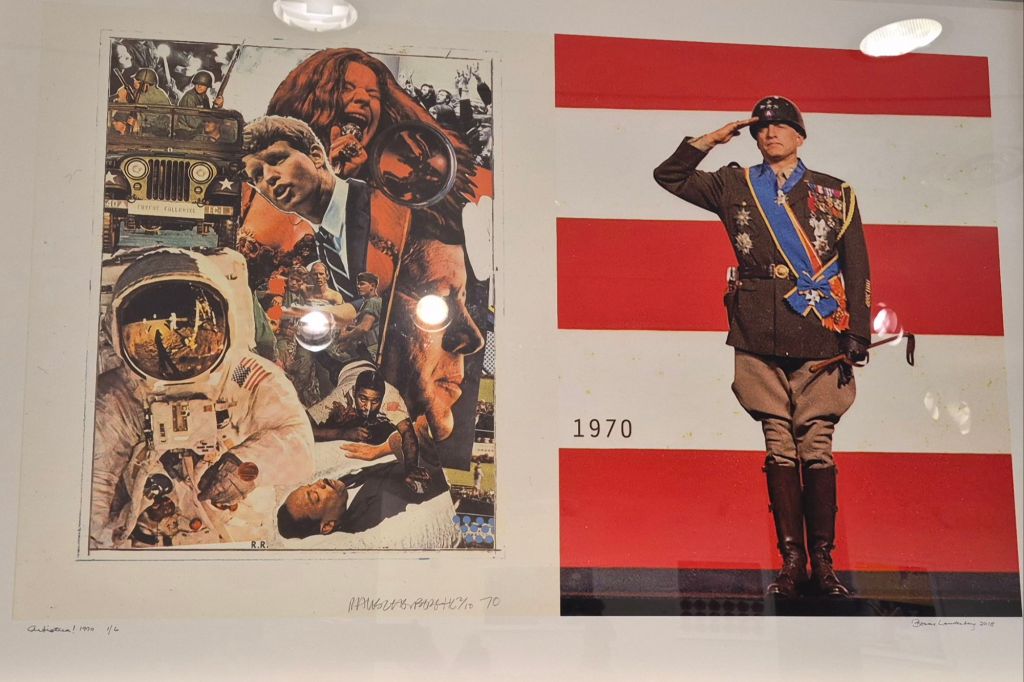
Bonnie Lautenberg was married to Senator Frank Lautenberg of Ohio. Let’s say she is a photographer (because she is) with an imagination and a very creative eye. I am not sure how to describe this exhibit concisely, but here is attempt: she took a still from a film of a given year and paired it with a piece of art from the same year. Some times, she paired it because of color.
Sometimes, because of theme.
Sometimes, because of composition.
This is just a small portion of what was on display. Okay, since you asked, here is one more.
The other exhibit that was equally creative, if not more so, was called “Ghost in the Machine”, works by artist Timothy Makepeace. Let’s see if I can explain that one.
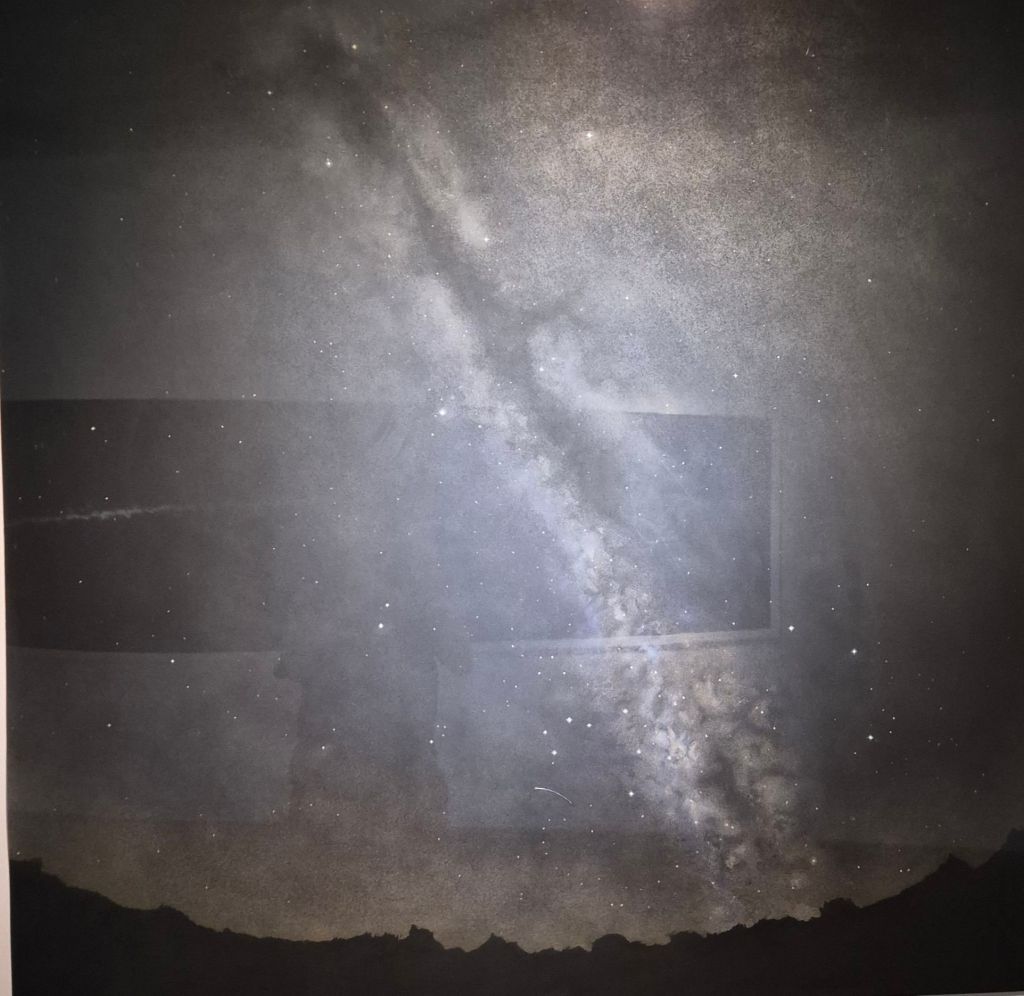
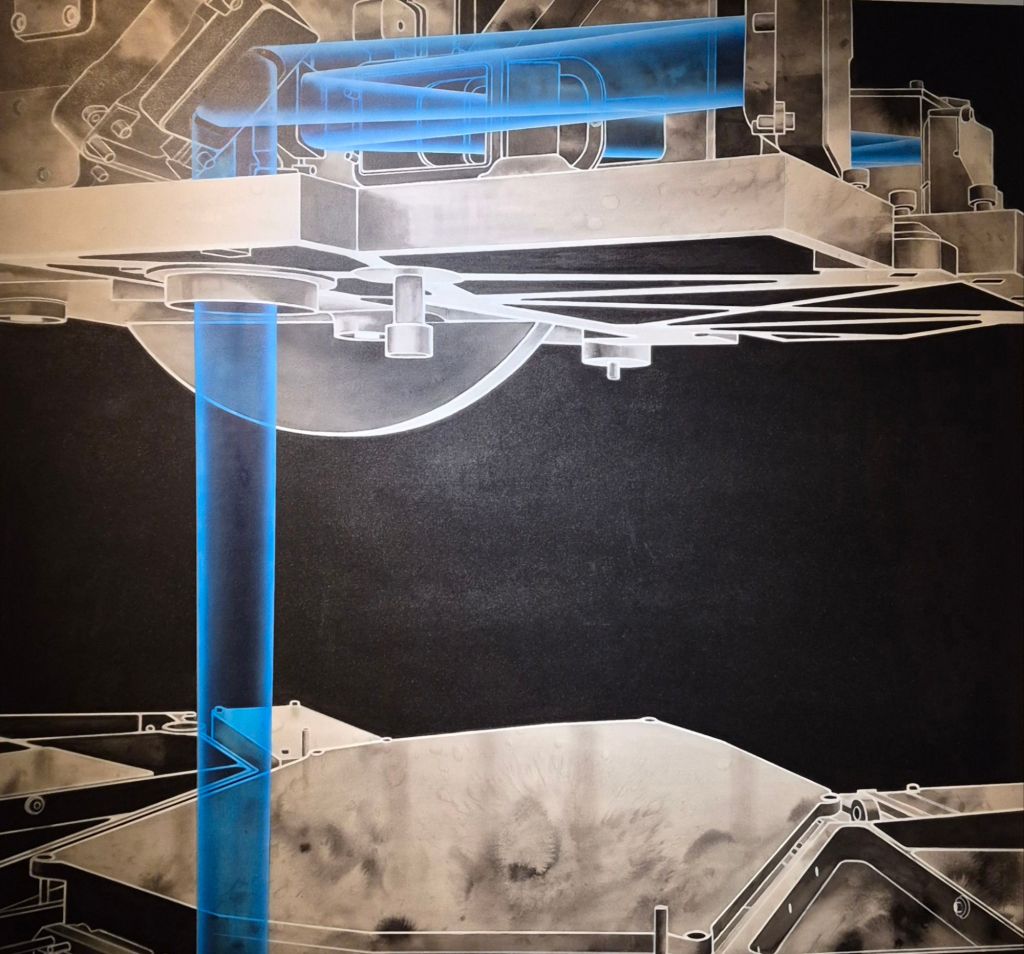
The art is based on NASA’s James Webb Telescope, and was created as the telescope was being assembled at the Goddard Space Center. It builds on Makepeace’s long concentration on (my words) the border between imagination and reality in looking at the solar system and beyond.
The top drawing is of the stars in Sagittarius, which I accept as a personal portrait. The middle drawing is one of a portion of the telescope itself. The bottom is a drawing of an orbital path across a sinusoidal rake of the stars (you probably have to look that up).
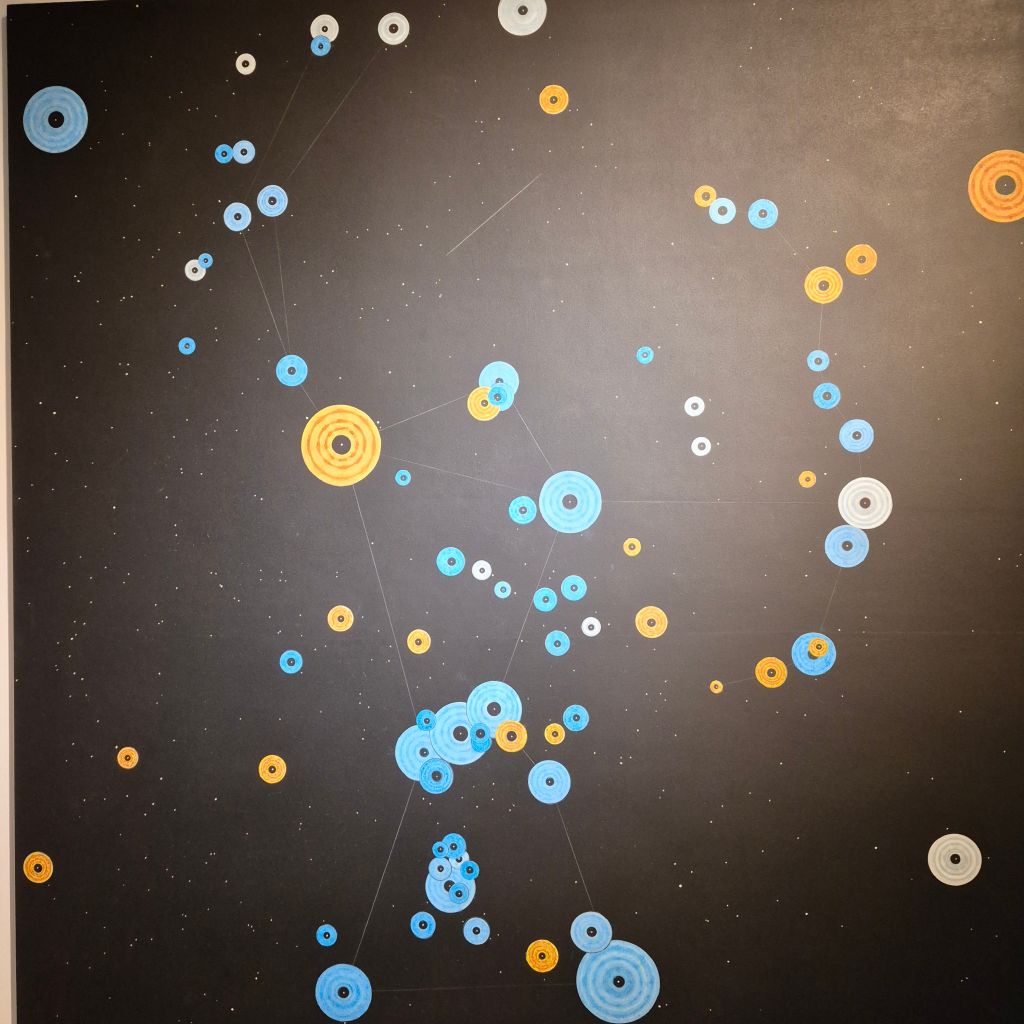
And here is Orion.
If you go on the Katzen website, you can read the entire brochure explaining the Makepeace exhibit.
Yes, there was more, including work by the late A. Brockie Stevenson.
And by Richard Dana
And more.
Sorry we did not go earlier. Sorry you did not get there at all.
Something you should know: J.D. Vance’s grandmother, when she died, had 19 loaded handguns. That explains a lot, I think.
Something else you should know: Gavin Newsom’s father’s best friend was J. Paul Getty and Newsom says that as he started a number of different businesses over his early life, the Getty family were always there to invest in them.
Here I am on a Sunday morning, with C-Span2’s BookTV on, having finished the Sunday NYT crossword (which I really liked today), writing this blog post.
As you can see, I have watched two interviews this morning – – J.D. Vance and Gavin Newsom. Now, what do the two of them have in common? Yes, they are both politicians, but something more than that. They both come across as highly smug and appearing to feel superior to others. And they both talk about how important humility is to them.
Clearly, being humble is not either of their strong suit. But is there anyone who is more haughty than the two of them (other than Donald Trump)? The answer is “yes”, and that person is someone named Kara Swisher, whom I knew nothing about until I heard David Rubenstein interview her this morning before the interviews of Newsom and Vance. She is probably the cockiest person I have ever come upon.
What goes along with cockiness (especially when it isn’t backed by anything), is the appearance of insincerity. The most insincere politician in the past several decades has been, I think, Mike Pence. No matter what Mike Pence says, I am sure he doesn’t believe it. And, it turns out, I have the same response to everything J.D. Vance says and everything Gavin Newsom says. It is obviously clear that I would never support J.D. Vance as a presidential candidate, I think I could say the same thing about Newsom. I had always thought that Newsom should not be the Democratic candidate in 2028, and I think the interview I watched this morning has convinced me of that. If he is the candidate (and I guess there is a fighting chance he will be), I may sit out the entire campaign.
“If Watergate happened tomorrow, it would be a twelve hour story.” That’s a direct quote from Vance on this interview (June 2026). I would suggest that this interview, well reported at the time, should be re-aired and re-aired if Vance is the candidate, but along with commentary, because almost everything he said is utter nonsense, but stated in a very cocky (and therefore insincere appearing) way. Perhaps, some people would listen to Vance and agree with him, being seduced by the hubris that I find so off-putting. So, just re-airing the interview is not enough. His nonsense must be pointed out and explained.
Before I leave this, I should say one other thing. The interviewer of Kara Swisher was David Rubenstein. If I could pick someone to be in my next life,I would probably choose David Rubenstein. And one remarkable about Rubenstein is how humble he does appear. And therefore how unique.
I will never be David Rubenstein in a subsequent life. But one thing I would like to do in this life is interview David Rubenstein. Anyone know how to make that happen?
One last thing before we stop today. Did anyone see the quote from the Pakistani Foreign Minister after the signing of the Saudi-Pakistani-Turkish mutual defense treaty? He said:
“The Islamic world must united to confront the common threat posed by Israel. Israel poses a threat to all of us. Islamic countries must adopt a coordinated approach to address this threat.
“Israel is a product of the Balfour Declaration, which was established in the 1940s as an illegitimate state, and it could post a direct threat to any of the countries in the region.
“No matte who comes to power in Jerusalem – whether it is Bennett or any other leader – the differences are only marginal. Their attitude towards the Palestinians and their anti-Islamic mindset will not disappear. They continue to incite Muslim countries against once another, and as long as the Palestinian issue is not resolved, the Islamic world must stand against them as one.”
So, the problem continues. On both sides. Even where you have a country like Pakistan which (a) does not come close to bordering Israel, (b) is not an Arab country, (c) has been acting as a “neutral” (?) mediator between the U.S. and Iran, and (d) has nuclear weapons.
The topic for my Thursday morning breakfast group this week was the war trials that took place in Japan following its surrender after the atomic bomb was dropped on Hiroshima and Nagasaki. Earlier this year, we spent two Thursday mornings on the Nuremberg trials that followed the surrender of Germany. So we were pretty well filled with information and thoughts about war trials – how defendants were chosen, how judges were chosen, how crimes were defined, and so forth and so forth.
But I began to think about a different aspect of all of this. I began to think about what happened to Japanese and German society when the war ended. Both countries were completely militarized, both countries were completely ruthless, and both countries were highly expansionist. Both peoples were very nationalistic, and they each had a belief in their own ethnic (and, yes, physical) superiority. Before and during World War I, I would guess it would be hard to find an American who had a good word to say about either people. Jerries and Japs were the worst. So much so that Japanese-Americans were incarcerated in remote prison camps, and many German-born Americans were imprisoned.
But then something happened. Within a relatively short period of time, the Germans and Japanese stopped being monsters. Today, over 80 years after the end of the war, they are still two of our strongest (and, yes, in some ways most powerful) allies. Their societies have been remarkably unmilitaristic, and no one is afraid that one day they will run into someone from Germany or Japan in a dark ally.
What happened? I don’t have an answer to that question, I just have the question. Yes, there were decisions made by the allies not to “overly” punish those who were defeated. Those who fought for their governments, those who supported the ideologies of the government…..they were let alone, not punished for the most part, unless they were determined to have been specifically guilty at a high level of war crimes. It is also true that both Japan and Germany were “occupied” by foreign powers for a period of time, and it is true that the Allies (in Europe) and the United States (in Japan) did expend much effort and money to bring about a change in German and Japanese society. And, clearly, something worked. Both societies underwent a 180, very quickly.
This has happened in other places as well, for different reasons. For example, in today’s Turkiye after World War I, the rigid Ottoman Empire was replaced by the Turkish Republic led by Kamal Ataturk, whose goal was to westernize Turkish society, and end all of the mythology of Islamic society. Women could wear western clothing, men no longer wore a fez, secularization became the rule of law. Society (at least in the urban areas) was turned on its head almost immediately. This was all accomplished internally.
The same could be said about several other Muslim countries. Iran, even before the last Shah, had become a relatively free Muslim country, as had Afghanistan. Beirut was as free as could be – the Paris of the Middle East. None of these places are like that today. They each underwent at least two complete social revolutions.
And then look at the USSR. In early 1917, in spite of obvious tensions, Russia was a tsarist empire and everyone knew their place. In November, Russia was no longer and the USSR was a presumably monolithic Communist empire. It stayed that way for over 70 years and then it changed once again, this time to a money driven oligarchy, which it is struggling to maintain.
The list goes on. Think of Cuba, never a paradise, but once a capitalist country, and then a socialist country. After 80 years of socialism, is it absurd to think that may change? What about Iran and other countries of the Middle East? What would be needed to bring about changes there?
Of course we are now at war with Iran (sort of), and we are trying our best to destroy Cuba’s already destroyed economy. Is it unheard of to think, for better or for worse, that we might succeed one day in helping create a secular Iran or a capitalist Cuba? What would we have to do in order to accomplish this? What would be the ethical questions involved? Ethical considerations have changed drastically. In the colonialst mid-20th century, it seemed natural for countries like Britain and the U.S. to take control of other countries and set them on what seemed to us to be proper paths. This is certainly not the case today.
Perhaps in 1945 we and our allies had the moral strength and the will to accomplish these major tasks, as well as general world-wide support, but now we don’t.
If individual societies will have to reform themselves, where will their leaders come from? How would replacement governmental structures, replacement economic systems, be developed and agreed upon and adopted with a minimal of economic or social disruption? Can it happen internally without the existing internal structure totally disintegrating (Russia and Turkiye)? Do we need a major war, not the kind we currently are involved with in Iran, with atomic bombs and firebombed cities before a society today is ready for change, and only then with outside guidance?
It seems to me that a total societal change cannot take place until after any internal or external war that sets the stage is ended. If a war is still going on, you cannot redo society. Instead, you need to fight the war.
It’s really a conundrum. You feel for the people living under control of the Iranian or Afghan or Cuban governments today. But without something cataclysmic, perhaps nothing can happen. And today, no one really accepts an externally driven cataclysm as acceptable. So perhaps we are stuck.
There are other things we have learned as well. At one time, the United States and its allies, even with the differences between them, could all be viewed as men (the multi-gendered term “men”) of good will. But now that we see that our own government can be taken over by people who do not fit in that category, can we even presume to think that we can play the role we played in 1945?
You can see the goal that I would like our world to strive for, you can see the place where it would be nice to wind up. But it looks like while we suffer under that old “Chinese curse” of living in interesting times, we are also constrained by that good old American saying:
(1) You are all wondering how the new Prius is doing on gas mileage. We had the first real try to see how it would perform on the road, as we drove 75 miles (each way) yesterday to Orange, Virginia, to have a very nice visit and lunch with our old friends, Jeff and Karen Dwyer. When I say we are old friends, we realized that we have known each other for 51 years. Does that qualify?
Because I can get a bit neurotic about mileage on a Prius, I made sure to hide the calculation as we drove. Otherwise, I would be adjusting my speed and so forth continually to try to maximize my efficiency, and I just wanted to see how it would do on its own. Going down, the mileage was 61.4 mpg, and coming back 63.5 mpg, so I think it is doing just fine.
(2) So, we just got the July jobs report and, rather than increasing by an anticipated 85,000 or so, employment in the nation fell by 23,000. To make matters worse, job numbers for the past two months, May and June, were revised down over 100,000, which I think is about a 40% decrease. And to make things even worse than that, the average wage increases were below inflation.
Obviously, this is a bad sign for the economy, right? Certainly a bad sign for those Americans who can not find jobs, and for those employers with technical positions open who can not find enough Americans. But….
Clearly, all is not bad. Upon hearing the news, the stock market rises. Companies’ payrolls obviously are lower than anticipated; more for the investor class. And by the way, as the majority of the readers of this blog are of a certain age and have managed to put away a certain amount of savings, it is important to remember that 93% of the stock market (latest figures) are owned by the wealthiest 10% of the population. And you wonder why the Democratic Socialists are gaining votes.
(3) For those of you who are interested, I would strongly suggest that you go to the Haberman Institute website and click on the “Program Recording Archive” and watch/listen to our last two programs, both of which are very interesting. The two sessions are:
With Pen and Pistol: Heroines of the Holocaust by Prof. Lori Weintrob of Wagner University. It’s the story of the role of women in Holocaust resistance, and I think you will be surprised at much of what she says.
Mordecai Kaplan’s Reconstructionist Vision: What Panned Out? What Fell Short, by Rabbi Bradley Artson of the American Jewish University. It is a beautifully composed essay not on the Reconstructionist movement per se, but on Kaplan’s vision for a reconstituted American Jewish community, creating theological adjustments to conform to modern life.
(4) I have thought about it long and hard. I think that Paul Toboni’s three moves at trade deadline time for the Washington Nationals are disastrous, especially sending Lius Garcia, Jr. to the Yankees. Now, everyone on the team feels like they have been ripped apart, they all know that they probably have no long range future with the club, and they know that the club will be on the losing end of things for some time to come. We received 9 players (8 of them pitchers, none of them seasoned) for two reliable and much loved infielders and one pitcher. I understand that the pitcher, Foster Griffin, was only under a one year contract, but you would think that we would fight to keep him, not trade him for four unknowns.
I know: we will see. But even if we see that we have acquired some strong pitching (which we obviously need), the destruction of what was building this year was not worth the price.
(5) The goal of the Repugnantcans in crucifying Fauci is not to jail him, but to make him spend the rest of his life and all of his money defending himself. What could be more sickening?
(1) The Day of My Discontent started with my determination, once and for all, to resolve my differences with T-Mobile. It started when I decided it was time for a new phone and I wandered into a store called Metro by T-Mobile, which in my naivete I thought was the same as T-Mobile. After I had arranged for the phone, the salesman told me they were affiliated with T-Mobile, but they were not T-Mobile. I still don’t know what this really means, but he told me that my phone number would be transferred to the new phone, but that my future bills would come from Metro by T-Mobile, not from T-Mobile. My service, though, I was told would remain T-Mobile. Okay, I said.
Everything was fine until I opened my next credit card bill, and saw that there was an auto-pay charge on it for $140 from T-Mobile. Like nothing had changed. (I was also getting billed by Metro, of course.). I called T-Mobile and told them what was happening, assuming there was a mistake. No mistake, they said. They told me I had two lines, I only transferred one of them, and I still had the other, and there would be no reduction as long as I had the other one. I told them that the other line was given to me as a “free” line, which “there was no reason not to take”. I had never used it; it had never been connected to a phone. Too bad, they said, it’s yours.
This was about a month or so ago, not long after I got the new Metro phone. I told them that I wanted to cancel it, and they said “okay, give me your PIN”. I told them I had been with T-Mobile for probably 20 or more years, and I didn’t even know I had a PIN. They told me they needed a PIN to cancel my account, that they couldn’t give me a new PIN on the phone, because they needed to see my personal ID to know I was I (me was me? I was me?), so I had to go to a store where they could see my ID and change my PIN. I told them that I was going to be away for over two weeks and could not do that until I returned. The nice lady told me she put an extensive note in my file, and the lapse of time should not be a problem.
On Monday, I went to the T-Mobile store in Silver Spring and got a new PIN. The store, of course, told me that they could give me the PIN, but they could not cancel the account and I would have to call T-Mobile back. I did that today.
To make a long story shorter than it otherwise would be (if not short), I was on the phone with a T-Mobile lady (who is clearly one of their best employees – she should be CEO) who told me that she understood my predicament, but that I owed two months service for the phone number I didn’t use, for service they did not provide me. I told her that was ridiculous; she agreed. I told her I shouldn’t have to pay anything for a free number that was never even connected to a phone. She agreed. In fact, she agreed with everything I said. But she told me that the “system” did not allow the account to be cancelled if there was an outstanding balance, and that as long as I held on to that balance, it would increase every month. She understood and agreed with what I was saying, but it was not allowed by the “system”. The “system” said I had to pay. When I asked her who else I could talk to, she told me I could talk to every employee and officer of T-Mobile and that they would all tell me the same thing, because they were all bound by the system and it didn’t matter how much they might agree with my position.
I knew when I was beaten.
(2) My credit card bills are usually not a problem. I look at everything, and usually I understand everything. In the rare times when I can’t figure something out, I usually pick it up again later in the day and finally understand the charge. I also always pay the bill on time to avoid late fees and/or interest.
My current bill came while we were out west, and by the time I got it, it was almost the due date, so I simply wrote a check covering the amount of the bill, and sent it on the next day. This was about 10 days ago. Today, I took a closer look at the bill, and saw two charges (which I have already paid) that totally baffle me:
Freeshipping.com. $19
Simple Life, Dover DE $44.90
Going on the two websites tell me nothing. And the days the bills were posted were July 4 and July 6. Where was I then? I was on the Eurodam heading to Alaska on the 4th, and in Juneau on the 6th. What could they possibly be, and do I really even care, since I already paid the bill?
I will keep looking.
The Day of My Discontent
(I know this isn’t much of a post, but I needed to be out of the house this morning before 8 a.m. for a 9 a.m. meeting and then coming home so we can leave by 10:30 to drive a few hours into the Virginia countryside to meet some friends for a nice lunch. Hopefully today will not be another day of discontent.)
In 1986, there was a major change to the United States Tax Code (In fact, there were many changes, but I am just referring here to one of them). Before this change, if you purchased a property on December 31 of a given year, you could depreciate it as if you had owned it the entire year. After the change, depreciation would not start until December 31.
I remember a quote from a real estate investor right after the law was changed. It was reported in the Wall Street Journal as something like: “We have all been riding our bicycles very fast downhill, thinking we were great athletes.”
I know it’s far from a perfect analogy, and I know that I have no idea if what I am saying bears any relationship to reality, but when I think of that quote today, I think of Blake Butera, the manager of the Washington Nationals. Blake Butera is only 33 (almost 34) years old, and obviously has never managed a major league team before. He is the youngest manager in major league baseball today, and the youngest manager in the league in over 50 years.
Going into mid-season, Butera’s Nationals were outperforming everyone’s expectations, playing 50-50 ball, and having an offense that basically topped the league. It’s win-loss record was affected by a sub-par pitching and particularly by very sub-par relief pitching.
This past Monday, August 3, was the MLB trade deadline. If you wanted to trade any players, it was then or never (this year). What were the Nationals going to do? Traditionally, teams that think they have a chance to make the playoffs will hold on to what they have. Those that don’t will often trade good players for others they feel can fill some longer term need, or trade those whom they think may opt to go elsewhere when their contracts run out (if they only have this year or maybe one more on their present contract).
As it turned out, the Nationals offloaded three quality players. For a week or so before the trade deadline, it was unclear what the Nats were going to do. There was rumor after rumor.
Let me back up a minute. A couple of points. For the past few years, the Nats have been comfortably in last place. Towards the end of the last season, virtually the entire top tier management of the Nats was fired and replaced. A few deals were made over the summer and some of the younger minor league players who had been in the Nats system had matured to the point where they were ready for the big league.
Not only were the 2026 Nats more ready than assumed, but – as you can guess – they were a very young team. Hardly anyone was even 30. And when you added them to their 33 year old manager, they were ready to show the baseball world what they could do, and they did.
But I believe, in part because they are so young and relatively inexperienced, and because they had formed such a successful and cohesive group, they were scared to death as the trade deadline loomed. And it showed in their performance, a four game series against league leading Atlanta. The Nats lost all four games. And they lost three players.
One of these players is Luis Garcia, Jr, who had become the regular first baseman and had been in the Nationals pipeline for ten years, who is now a Yankee. A second was Curtis Mead, an infielder from Australia, who happened to have been brought to the Nats primarily, as I understand it, by Blake Butera with whom he had worked in Tampa Bay. A third, pitcher Foster Griffin, was the team’s steadiest pitcher, his first year with the team coming after three years pitching in Japan, but who only had a one year contract with the Nationals.
All three were fan favorites. Big fan favorites.
In return for them, the Nats picked up one outfielder and nine or ten pitchers, only a few of whom are ready for the major leagues today, although none of them are beginners and all of them are good prospects. One one level (or two levels) this all makes sense. The Nats actually had more good hitting fielders than they need, perhaps, and not enough pitching strength. They figured they were going to lose Griffin anyway (someone would outbid them when he became a free agent), that the Mead trade for a well thought of young pitcher Connelly Early was worth it, and that the four pitchers they received in return for Garcia were also going to pay off.
But, as one reporter put it (don’t remember who or where), Paul Toboni (the Nats’ general manager) traded this summer’s fun for potential longer term stability.
I assume the Nats’ brass decided that the Nats were not going to make the playoffs (they certainly were not supposed to), and that they should think about 2027 or 2028. This was the original plan anyway.
Now, I have no idea how these decisions were made. I don’t know how closely Toboni listened to Butera in deciding what to do. But I do know that the two brief post-trade deadline interviews with Butera that I have watched show a much less perky, confident guy than the one who managed the team the first part of the year. And I can only imagine what the effect of losing three teammates and friends, so rapidly and unexpectedly, is on the overall morale of the team.
Of course, everyone has resilience, but it takes a while for the resilience to show itself. It hasn’t shown itself yet, as the Nats are (as I write this) losing their second game to the Phillies, 5-0, and their seventh in a row (unheard of for this year before now).
But I can tell you one thing. It is up to Blake Butera to bring his team together. He is no longer a great athlete pumping downhill. The terrain has changed.
I dedicate this song to John Cornyn and Thom Tillis (and to Susan Collins and even Lisa Murkowski and all the others), who really don’t like Trump, but really do, because he made them (and continues to make them) love him. As they will show, probably today, when they vote the nomination of Todd Blanche out of committee to become our next real, as opposed to acting, Attorney General. Even as they leave office. Even as they continue to be castigated by the president. It makes no difference.
Why? What it is that binds them?
“That old black magic has them in its spell
That old black magic that he weaves so well
Those icy fingers up and down their spines
The same old witchcraft when his eyes meet thine.
The same old tingle that they feel inside
And then that elevator starts its ride
And down and down they go
Round and round they go
Like a leaf that caught in the tide
They should stay away, but what can they do?”
[pronouns changed in this one]
Yes, they don’t write them like they used to. And yes, what they wrote back then takes on new meaning today.
In the meantime, as the Republicans go lockstep into an abyss, as they usually seem to, the Democrats too are playing to character as they are standing in a big circle firing weapons at each other, hoping that they remain standing while their so-called comrades in arms fall. Tonight, we will hear the results of one of the last big primary days of the 2026 mid-terms. All eyes will be on Michigan, and the race in the Democratic primary for Senator between Congresswoman Haley Stevens and former Detroit health officer Abdul El-Sayed.
It looks like El-Sayed is going to win, although the polling has been a bit here and there. But he certainly has captured the interest of younger Michiganers and of Michigan independents. He is a good campaigner, attractive, well spoken and appealing. She seems to be none of those things, and that is a problem. In part, it’s a problem because, they say, he might have difficulty beating the Republican in November in this close, battleground state, and, those same “they” say, she would have less of a problem. That of course supposes that those who support El-Sayed in the primary would vote for Stevens in the final race with the same enthusiasm, rather than just sit it out at home. To me, that is not obvious.
El-Sayed is no Ilhan Omar, struggling into the country from her birthplace in Somalia. El-Sayed is a Detroit area native, a graduate of the University of Michigan, a Rhodes Scholar with a degree from the University of Oxford, and an epidemiologist with a medical degree from Columbia. No slouch, El-Sayed. Haley Stevens is a native of the same Detroit suburb as El-Sayed, went to American University here in Washington, and has worked for Democratic political campaigns (Clinton, Obama) since her graduation and before her 2018 election to Congress.
As usual, the contest centers around the Jews. What else? Stevens is a moderate and, as I understand it, a firm supporter of Israel (not necessarily of Netanyahu), and a major recipient of funds from AIPAC. El-Sayed is a progressive (his word), but not a socialist (he repeats this again and again) and not a member of the DSA. El-Sayed, perhaps obviously, is a Muslim and, if elected, would be the first Muslim ever elected to the U.S. Senate. His position on Israel is fairly typical for the left wing of the Democratic Party – the war in Gaza was/is a genocide, Israel should not receive (unlimited, at least) military support from us, and Israel should treat its Palestinian citizens as it treats its Jewish citizens.
But it gets tricky when El-Sayed is asked (1) whether Israel should exist, and (2) whether Palestinians outside of Israel should have a “right of return”. His answers on these two questions are more equivocal, and as you parse through his words, you tend to reach that never-never land of one big Middle East country filled with Muslims and Jews, where everyone has equal rights and one vote, and where they all get along, irrespective of whether a particular government cycle has more Muslim or Jewish participation. Of course, this could never happen, which makes the concept of one big state (from the river to the sea for both groups) impossible.
On the other hand, on all other issues, I think that El-Sayed would play a much more important and helpful role in the American Senate. So, it’s a tough choice. Glad it’s a decision that I don’t have to make.
Starting with the most important news that I saw this morning. “Arthur” is this year the 5th most popular name for a boy baby in the U.K. In this United States, lagging far behind, it is number 87.
British Arthurs will, I assume, largely be Arthurs. I don’t think that many of them will become Arts, although I have no way of really knowing. I believe that some of them will be Arties to their upper tier families. And many of them, I bet, will decide……..to go by their middle names.
Remember Sir Arthur Treacher? At some time, of course, he became a fast food fish house, but well before that he was an English actor who was the archetypical English butler. I guess, as he aged, jobs became scarce and he financed his retirement by allowing an American fast food company to use his name. I was never very sure of that.
But at one point, when I was younger but not underage, I saw Sir Arthur on a TV variety show where the host pronounced him to be “one of the seven lively arts”, and listed the other six. This was well before Treacher was a chain of fish houses, and when he still had about him at least an air of respectability, and he stood up very tall (he was about 6’4″ when he was just slouching normally), and said: “I am not an art. I am an Arthur. Nobody calls me Art”. (Of course, I don’t remember it word for word…..)
I resembled that remark.
Digression. Who first said: “I resemble that remark”? It was probably someone like Shakespeare or John Milton, but I identify it with Steve Allen and my Aunt Lee. End of digression.
I resembled that remark. I was always Arthur, never Art. I guess I always had a bit of the Treacher in me. I thought that calling an Arthur Art was a form of degradation. No one was going to do that to me.
And no one did…..until someone did. That someone was Kenneth Koger, my sixth grade teacher at my new school (now the Reed School, then the Ladue Elementary School), who on the first day of class stood up in front by his desk and said “There are only two people new to the school today. Art and me.” I almost crawled under my desk. I didn’t know anyone in the room, I had to spend at least the next year with all of them, and they thought my name was Art. What was I to do? I thought about correcting Mr. Koger before he could do more harm, but that would set me off as either an arrogant or impolite oddball. I was in a jam. I did nothing. I became Art.
I know I have said some of this before, but I also know that you don’t remember any of it, so that is okay. My family kept calling me Arthur, my friends and acquaintances all called me Art. I don’t remember how I introduced myself in those days. Some times I resented Koger, sometimes I was glad he did what he did, uncomfortable as it was. Maybe it made me “more of the gang”.
After that, other than family, everyone pretty much called me Art. The exception sometimes was girls who I either took out on a date or was otherwise friendly with. Some of them called me Arthur, or switched back and forth. If I were then the person I am today, I would have asked them why they did that, and when they did that. I would have been disappointed at their answers, I am sure. My guess is it was all unconscious and they didn’t even realize they were doing it.
And then there was Edie. When I called her up for the first time at the suggestion of a mutual friend and asked her out, I wasn’t certain that she got my name, so I asked her if she did. She was (maybe embarrassingly) uncertain and said, with a question in her voice, “Artie”? That almost ended it. I felt like my old friend Treacher.
Now, I don’t really pay attention to whether anyone calls me Arthur or Art. I do know when people call me Artie. That would be Edie’s old friend Linda Ward Smyth, or my college classmate David Reisen. That’s pretty much it.
Until David Reisen in the early 1960s called me Artie (we were not even close friends; he had been a high school classmate of one of my roommates), it never occurred to me that anyone would, and it was too rare of an instance for it to both me. Today, I sort of like it.
My mother had a first cousin named Artie Weiss. Of course, he was really Arthur (never called Arthur to my knowledge), but was always Artie. Way back when, I did notice that this did not bother him, and I wondered why. But of course, I never asked. Too late now, by far.
And then there was the old (?) Italian tailor in St. Louis who used to shorten my pants (I went there with my father many times), Angelo Tucci. He called me (because he thought it was cute? because he didn’t know any better? because his Italian childhood language did not allow him to pronounce a “th”?) Artur. With an emphasis on the second syllable. ArTUR. Like that. How did that make me feel? Important. It sounded important.
And then there was/is my old friend/client/fellow attorney in California, Rick Tell (haven’t talked to him in about 20 years), who always (not frequently, but always) called me Arturo. I liked that, too.
As I have often said, Arthur is too formal, Art is too informal, and Artur and Arturo are both a little too cutesy. What will the new thousands of British Arthurs wind up being called? I think they will by and large remain Arthurs. I think that the fewer Arthurs born in the United States will be Arts. As we know, two countries, two languages.
Okay (on another topic), nothing is new. Trump loses a golf tournament and says he wins, falls down in the polls and says he is on top, says negotiations with Iran started today while Iran says they haven’t, lets Todd Blanche says “no money for Jan 6 demonstrators” while he says “yes, there will be”. Nothing is new.
The Relecting Pool at the Lincoln Memorial has once again been drained, and is totally closed and fenced off,
Donald is still claiming vandalism the problem at the rather than incompetence. In the same neighborhead, Donald has also spent 5 million dollars regilding two statues that frame Memorial Bridge as you drive to or from the Lincoln Memorial. The restored monuments appear ugly and garish to most people, but apparently not to Donald, who finds them beautiful.
Whether they were also gilded with incompetence, by the way, we will see. Check back in a few weeks and we will see how they look.
But back to the reflecting pool. In spite of her earlier outlandish assurances that the reflecting pool was destroyed by vandalism (something we always knew was false), U.S. Attorney Pirro has now concluded that vandalism played no role, and that the fault lay in the way Trump’s friendly installers screwed up the job. This is probably true, and, and was probably always the case. And Pirro’s original claim that Olympic star David Hearn and certain others destroyed the Pool was inexcusable.
But Trump, who doesn’t care who suffers because of his uncalled for conclusions as to who was at blame, continues to lie about what happened with no factual basis.
He is one sick president. And the people who continue to support him are equally sick.
We spent several hours with friends last night bemoaning Trump and his supporters, wondering once again how so many bad things are happening. The group of us were on average about 80 years old.
Younger Americsns are not spending their time complaining like we are last night. One reason is that they are spending their time working and raising their children. We aren’t doing either of those things. We have time to complain about how the world is changing. And we spend a lot of times talking about how sad we find the world to be. We are impatient for things to improve.
At age 80, we hope to see who the next president elected in 2028 will be, and if the next president will help bring things get better. If the president elected in 2028 is successful, he/she will likely be re-elected in 2032 for a second term. In 2032, I will turn 90 years old. Whether I will still be alive, I don’t know.
But if I were 45 years old, I would most likely live to see about 10 more presidential elections. I would look towards the future differently than I view it when in my 80s. I would be much more patient.
It turns out that the new car is fine. In my 2019 Prius, the default was to show the mileage of your current trip, and to get the total car mileage, you needed to push the odometer button 2 or 3 times. In the 2026 Prius, the full odometer is the default, and when you hit the odometer button once, you get the number of miles before your next maintenance appointment, which is 9700 miles away. A common mistake, they say.
THIS IS A FASCINATING POST, BUT THE PROBLEM MIGHT BE SOLVED.
Brief background: You may recall that we leased a new 2026 Prius LE and picked it up a week ago today. It is a snazzy red car, and the dealer, Jim Coleman in Potomac, had to search for one, found one outside of Philadelphia at another Toyota dealer and sent someone up a week ago Friday to drive it down. (I wrote about the car earlier this week in this blog.)
We traded in a 2019 Prius LE, which we owned, and the value of that car enabled us to have a pretty good lease deal – about $250 a month for 36 months. I actually think they should have given us more for the car, but to avoid aggravation, I only talked them up $1000 from their original offer. I didn’t want to argue nickels and dimes, and I didn’t want to spend my time shopping other dealers, and this is the 6th car we got from Jim Coleman, so I made the deal.
I did not like our salesman, but that’s who we got; I found him rather ignorant about a lot of things he should have known about, but he told us that he had worked for Coleman for 17 years. He is from Nepal and his English was not quite fluent and I put his verbal confusion to that. His boss (I don’t know what the title is, something like “sales manager”) told us that he didn’t want to send someone 150 miles away to get the car unless we signed the lease agreement first, telling us that, if the car did not meet our satisfaction, we didn’t have to take possession. I said that was fine (I trusted Jim Coleman) and signed the lease agreement with one line left out – that line was the odometer reading, which our salesman said he would fill in when he brought the car down.
That was last Friday, and last Saturday we went in to pick up the car (it looked like it should) and sign the many other pieces of paper that required a signature.
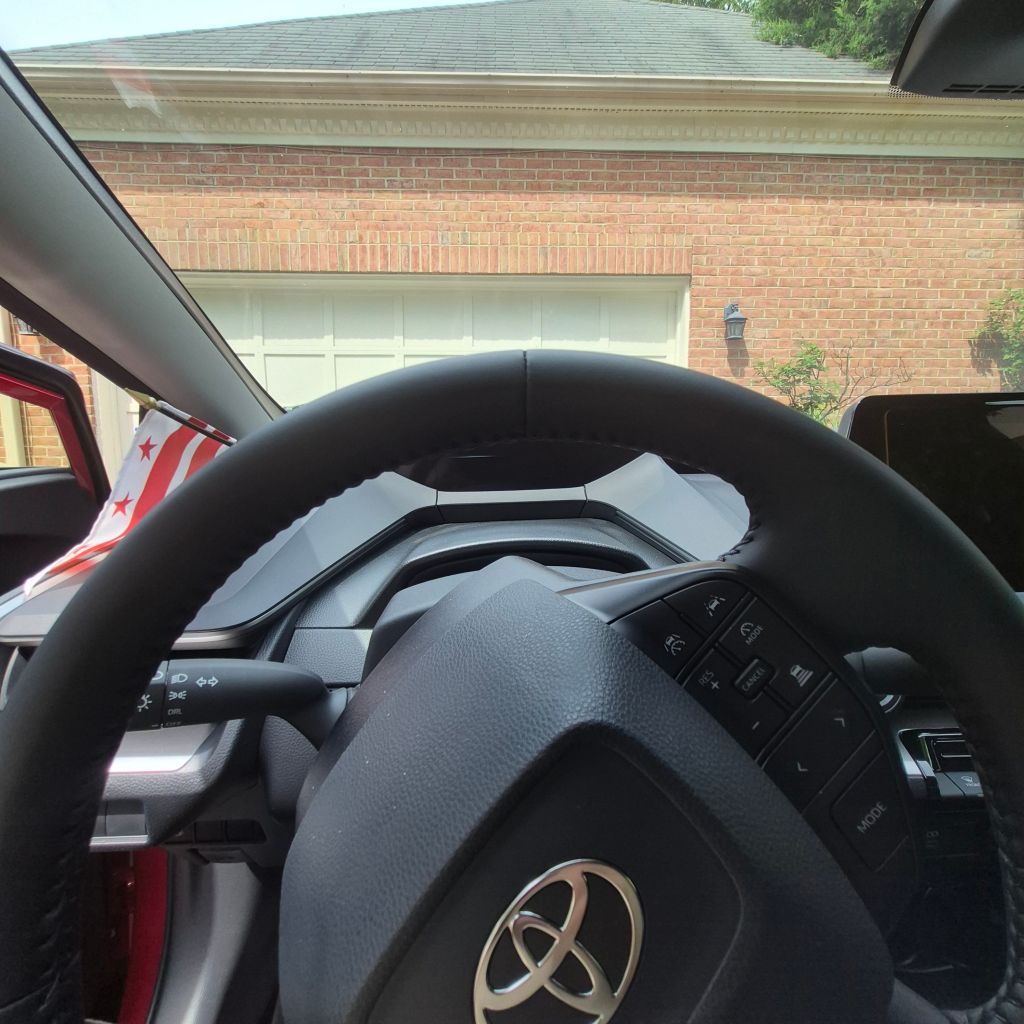
As I said in my post last week, although our 2019 Prius and our new 2026 Prius were the same model, they were far from the same car, and especially the dashboard was entirely different and I had to learn new everything. The screen about the steering wheel was crowded with all sort of information – perhaps too much. On the lower left edge of the screen was the figure “160”, which was a mileage reading, and I assumed was the odometer reading. It made sense, since this was a new car just driven down from Philadelphia, about 140 miles from DC.
Throughout the week, each time I drove the car, I learned something else about the display and controls. Most of my concentration was on the GPS function, and the radio and Sirius settings. I drove about 120 miles over the course of the first six days, and the “odometer” setting as expected increased to close to 300.
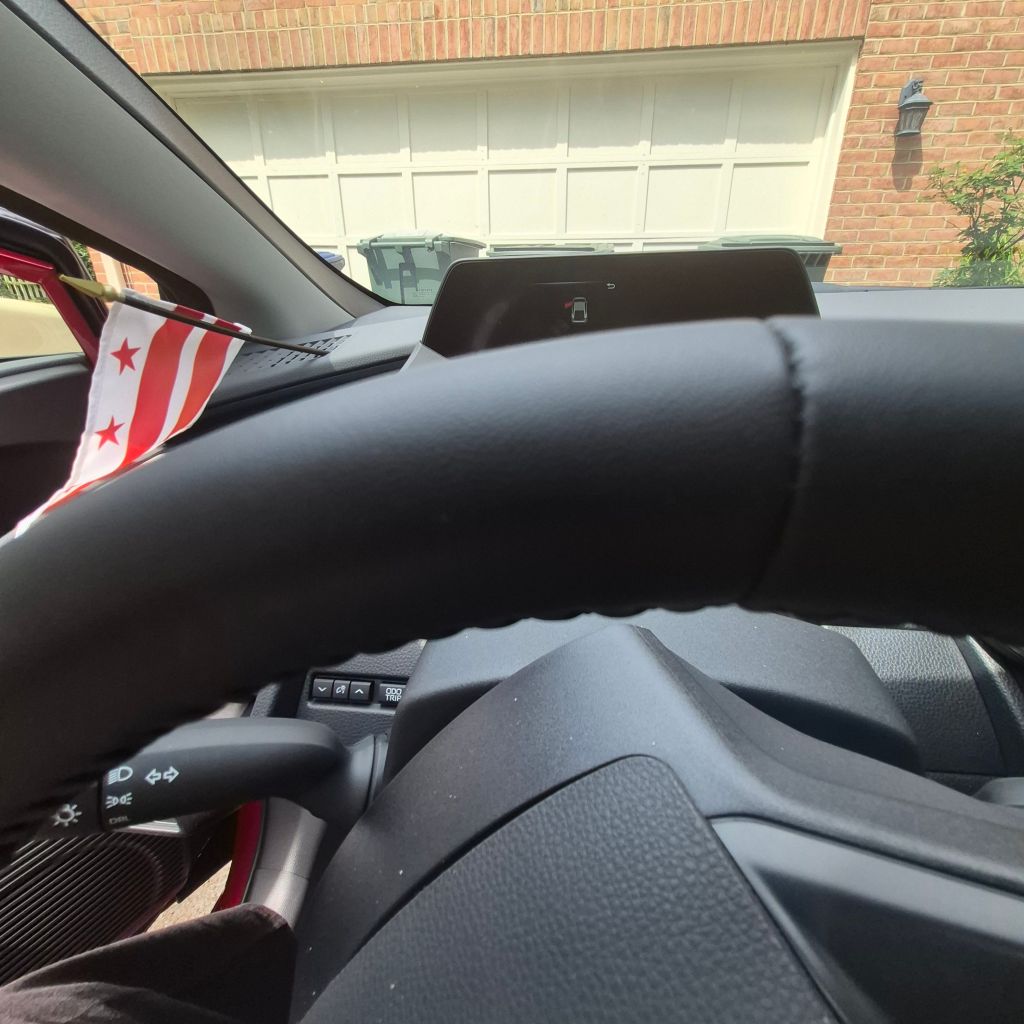
Yesterday, I took the 400+ page user manual and went through to see what more I could learn. To my surprise, I learned that there was an odometer button on the dashboard, through which I could go from the full odometer setting to specific trip settings. It, and another button controlling the brightness of the dashboard panel, is located away from all of the other controls, and is in fact hidden from sight by the steering wheel. In other words, you have to look for it to find it, but once you find it, it is right there.
I pushed that odometer button to see how many trips I could record, and saw I could record the current trip, and two others. This solved a problem I had because, especially on road trips, I use all those buttons, to see how far I had gone since the last stop, how far that day, and how far the entire trip. Then, I pushed the button one more time, knowing that would get me to the full odometer reading which I assumed would be about 300.
The reading was more like 9600 miles!!!
I went back to the documents I signed on Saturday, and the dealer inserted the number 200 whenever asked the odometer reading on several documents, including some which are recorded with the DC motor vehicle office and one which says “Federal law (and State law, if applicable) requires that you state the mileage upon transfer of ownership. Failure to complete or file a false statement may result in fines and/or imprisonment.” In then states that the “odometer now reads 200 (no tenths) miles….”.
I have written the Coleman business manager, who led us through the paper work, and asked him what the next step was. It is now about 11 a.m. on Saturday and I have not heard back. Maybe he is not in today; maybe he is trying to figure out first what happened.
I actually have no problem with the car (even with the 9000 miles), as it is a three year lease and not a purchase. But as I spent a great deal of last night tossing and turning and trying to figure out how to approach this, I find a number of problems and can not just say “no problem”. It is a problem.
Here are the things I have come up with. If I forgot anything, let me know.
We have totally inaccurate information certified to public agencies (in addition to my contract with Coleman), and they are exposed to disciplinary action and possible criminal responsibility.
Our three year lease agreement provides for 36,000 miles before we have to pay 1 1/2 dollars for each extra mile. If we drive 12,000 miles a year, when we turn the car in the mileage will be at about 45,000, and the documents will show us responsible for extra mileage charts.
On one of the documents (perhaps it is the one that transfers title), Coleman had a choice of putting an “X” in a box that says “new” or a box that says “old”. They put the “X” in “new”.
We have been charged for leasing a new car, not a used car, and I think almost 10,000 miles on a car makes it used. No question about that. I think our lease price must be adjusted. Where to adjust it, I don’t know. Our payments are now about $260 a month. They had told me that without the trade-in or an up front payment, they would be about $600 a month. That would be about $7200 a year, rather than $3200 a year, a difference of $4,000. Maybe a used car knocks 20% of the value, so the $3200 would be reduced by about $1440 a year? That would bring our monthly payment from $260 to about $150 a month. Any one have other thoughts on this one?
The lease says that we have the typical Toyota new car warranty, which would be 3 years, or 36,000 miles. The 3 years hasn’t changed, but again we would probably drive about 45,000 miles over the three years, so need an extension to the warranty period.
Each lease agreement has a “buy-out” price, representing the amount that the lessor can pay if they want to take full title to the car. We bought on the lease on our 2019 in 2022. The buy-out price would also have to be adjusted to reflect a car that already had over 9,000 miles on it.
We obviously don’t know who has been driving the car over the past year. My bet would be that it was someone who worked at/owned the dealership. But we don’t know the history of the car – we don’t know the maintenance history, or if it had been involved in any accidents. That, too, is important to know.
Going back to the title of this post, buying a car should be easy. Very easy. I have no idea what Coleman will suggest we do. Every option is complicated.
A photo gallery:
The carWhat you see on the dashboard when you enter the car.What you see when you push the odometer buttonThe view when you are driving. No odometer button.The view if you duck down. You see the odometer button.
We went to the National Gallery of Art yesterday to see the three room Mary Cassatt exhibit. Cassatt was an American, born into a wealthy family, who decided she wanted to be an artist. She went to Paris to study for a while, and a while turned out to be more than 50 years. She hobnobbed with the Impressionists and gained more than a modicum of fame.
There are about 40 pieces in the show. Most of them belong to the National Gallery which has more Cassatts than any other museum. I did not know that.
I was not overwhelmed by the paintings. That does not mean I did not like them, but somehow I felt they looked worse in real life than in reproductions. Here are three I liked the best. You will of course be seeing them in reproduction.
First, her mother.
Next, a young girl.
Then, a young woman
The exhibit also included many prints, a discipline in which Cassatt did much work (but nobody ever told me). She was often influenced, apparently, by Japanese print making. That serms obvious.
But not always.
Did she ever paint a man? I am not sure.
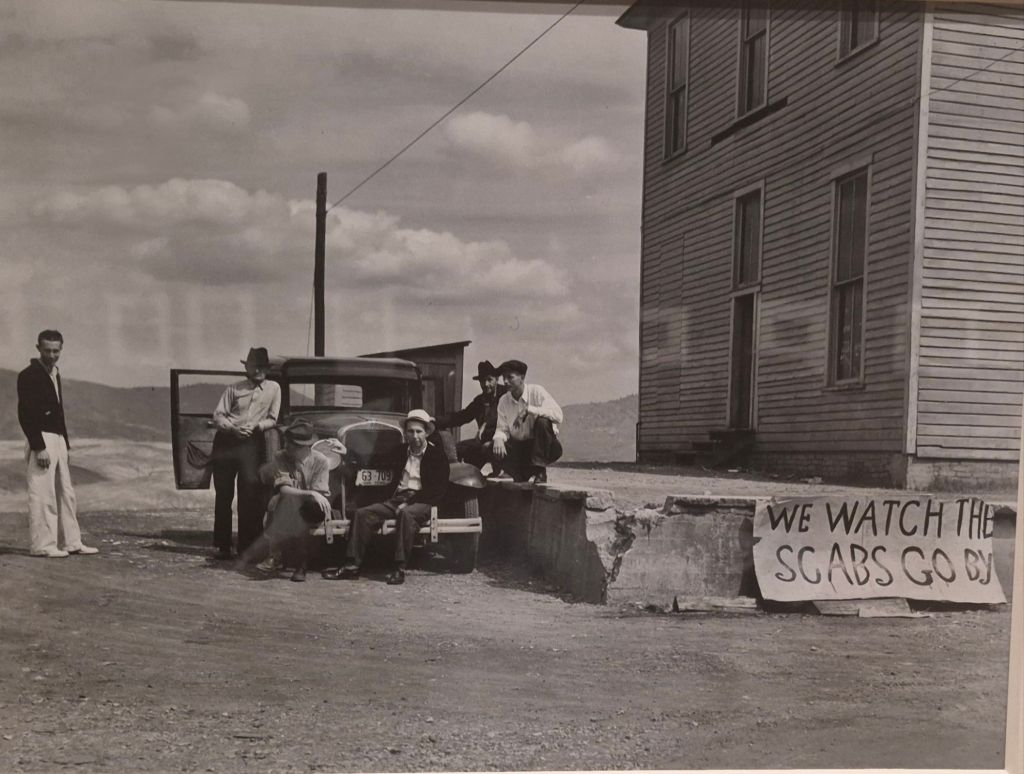
We saw two other special exhibits. One was perhaps the most unusual exhibit I have ever seen at the museum. 140 photographs, taken as early as the 1850s, to demonstrate mining and minors mainly .. but not exclusively in the United States. If you want to see it, you only have a few months before it moves to Milwaukee. Here is one example.
Here is another.
There are 138 more.
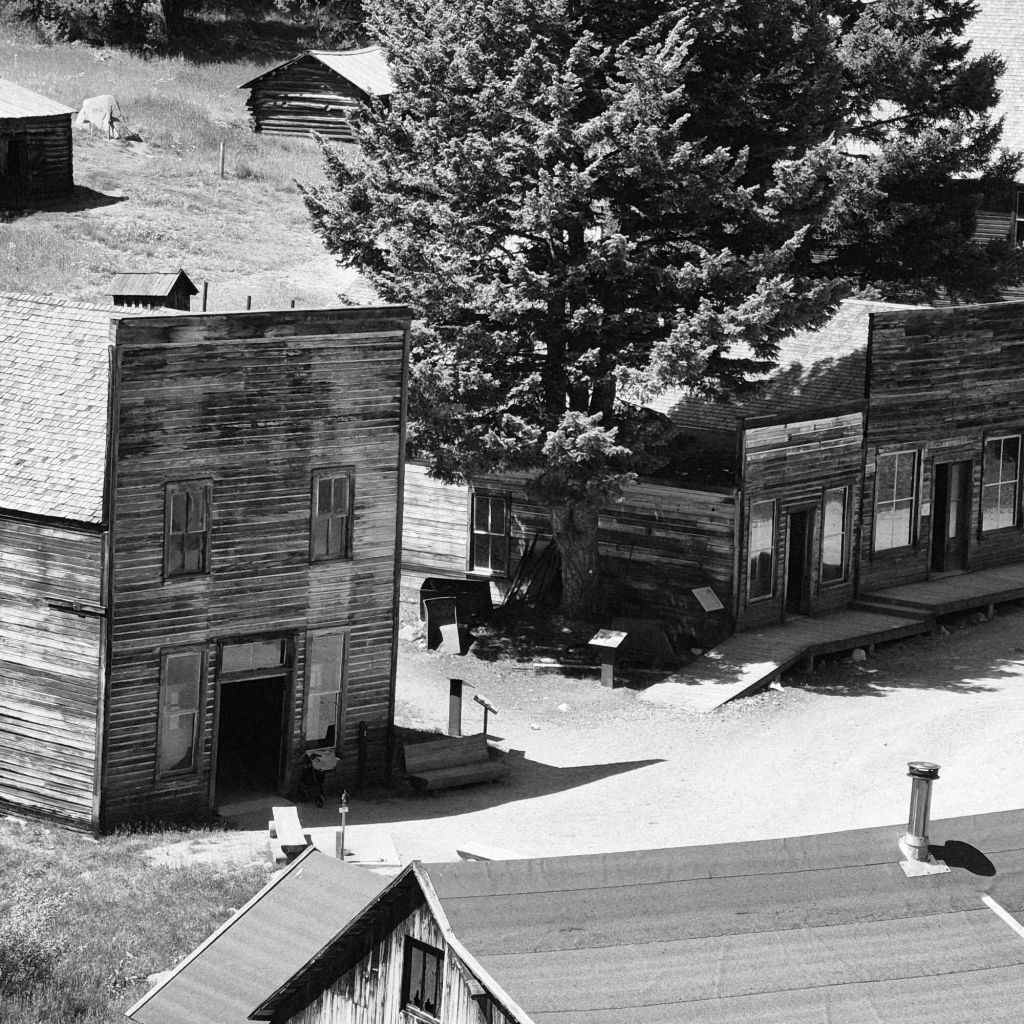
The one just above was take at Granite Silver Mine in Montana. Now a ghost town, then it had a population of 3000. Granite is about 100 miles south of Garnet, the gold mining ghost town we visited last month, which once had 1000 residents. This is a photo I took of Garnet.
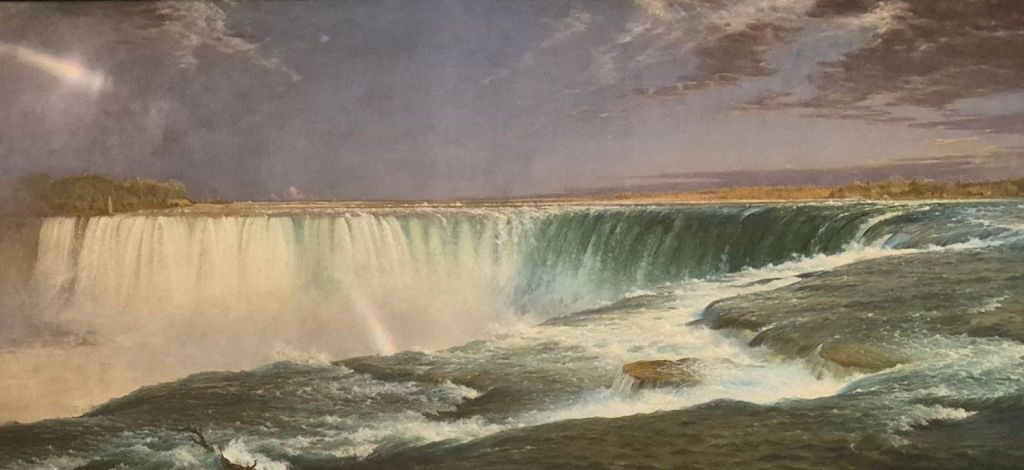
Next to this exhibit, there is a smaller exhibit on art devoted to Niagara Falls. It is centered around Frederic Church’s well known painting.
Washington artist Sam Gilliam painted a tribute to this painting, which he called “Niagara on the Potomac”.
Do you remember those films of Adolph Hitler speaking to crowds in Germany? He would start off slowly, but as his speech went on, he would pick up speed, his tone would change, his look would become more intense, and soon he was like a 33 rpm recording being played at 333 rpm, seemingly totally out of control. To most, he seemed like a mad man. But to about 1/3 of Germany, he made perfect sense, and due to the political indifference of another third of Germany, that was enough to propel him to power.
It has been said by many, including me and maybe you, that the analogy here between Hitler and Trump are clear.
But yesterday’s hearing (not really a hearing, but more like a roast without humor), with Tony Fauci as the only person called to testify, showed that Trump is not the only Republican who manner of speaking can be compared to Hitler’s. The party is full of them.
And like Iran still has a nuclear program after it has been obliterated, so the Republican party will have a strong odiferous residue of Trump-smell after Trump’s reign is obliterated on January 20, 2029.
I have trained my Facebook algorithm to send me many right wing sites. Whether they are people or bots, I do not know, but they say vicious things, and the comments responding to the posts are equally vicious, often more so. Of course, Meta does nothing about this, because “both sides must be heard”.
But now we see that it isn’t only deluded or depraved Facebook users, it is also a large portion of Republican party leadership. If you have doubts, turn on any portion of yesterday’s hearing.
When Hitler came to power, the evening where his National Socialist party first went after political opposition with no holds barred is known as the Night of the Long Knives. Fauci is still alive and in one physical piece after yesterday, but only because we have a constitution that protects against self-incrimination. The knives have been out for Fauci since at least the waning days of the Biden administration, so Biden, to protect a man with a 50 year career as a dedicated and, for most of that time, universally respected government scientist, Biden pardoned him prospectively for anything he did prior to the date of the pardon, January 20, 2025.
Other than yelling at him and making absolute fools of themselves, the Republicans can’t do much to Fauci, other than try to get him for crimes committed after that date. The most likely allegation of criminal activity would be for perjury. And that is why Fauci had no choice but to take the 5th over 100 times.
Committee chairman Rand (Rant?) Paul, a man who doesn’t get along with most of his fellow Senators or his Kentucky neighbor seems to recognize this and says he intends to hold Fauci in contempt for taking the 5th. Lots of luck there, Randy.
But Paul wasn’t the only Republican shaming himself. Ron Johnson of Wisconsin, a first class imbecile (that is true) is still spouting fake cures for Covid-19. Josh Hawley is trying to trap Fauci into answering fake questions (like, what color is my tie?) on the theory that if you answer one question, you have waived your right to plead the 5th. And Bernie Moreno of Ohio, with his WTF screed, hopefully accomplished nothing but give a helping hand to Sherrod Brown in their Senate race. So thank you, Bernie Moreno.
Oh well, that was yesterday and today is another day. Unfortunately, time for another verse, same as the first.
(1) The Major League Baseball trade deadline is this coming Monday, August 3, at 6 p.m. Eastern Standard Time. Trades will be announced between now and the deadline and then trading for the year stops for all practical purposes. Major league players have contracts with their current teams which, under MLB rules, require players to become “free agents” after a set number of years. A free agent can sign with his own team and extend the contract, or go anywhere else.
This all means that the dynamics of Major League trading must take into account a number of things. For those teams who believe they have a chance to go into the season ending playoffs and maybe make the World Series, it is a time to add players who will fill holes and help them to get there, sometimes even if a given player will become a free agent at the end of a season. For a team not expecting to make the playoffs and which has a quality player who will become a free agent at the end of a season, it enables that team to get players in return rather than simply lose the player when October comes. And then of course there are those trades where both teams are looking to their long term needs, not necessarily to help for this season alone. And finally of course, Major League baseball players make wildly different amounts of money, and Major League teams have wildly different amounts of money to spend, so that, too, becomes a factor.
The baseball season in Washington this year has been a very pleasant surprise. The Nationals, coming off several very unsuccessful season, started this season with entirely new non-player personnel. New manager, totally new coaches, new general manager, new everything. It was expected it would take some time to make their mark, but the Nationals, almost 2/3 of the way through the season, stand at 55-53, a little above the middle of the pack, much better than anticipated. They are doing so well because of an extraordinary offense (the Nationals have collected a number of younger players who are beginning to come into their mature baseball years). The Nationals are performing only at 55-53 because of their poor pitching record (their starting pitchers have been so-so; their relievers have, overall, been just awful). So, at the trading deadline, with a team which certainly has the possibility (if not the probability) of making the playoffs, the hope and the fear is that the Nationals will make a number of deals.
Presumably any deals that they make will be to better the quality of their pitching staff. This will be welcome, but the fear is that it might come about by trading away part of their stellar offense, trading away players that the team’s fans have been counting on. No one knows what current management will do.
There has been one trade so far, a trade with the Red Sox, which sent a promising young Australian player, infielder Curtis Mead, to Boston for a respected young pitcher, Connelly Early. This is the type of deal you would expect, although everyone hated to see Mead (who was having a breakout year, with unexpected power) go. Early has not yet pitched for the Nationals, because he has been dealing with an elbow inflammation, but hopefully he will be healthy soon. Mead, on the other hand, in his first game with the Red Sox, was hit by a pitch on his wrist, has a broken wrist, and will be out for some period of time, perhaps for the entire season. Very sad for Mead (and unfortunate for the Red Sox); everyone wished him the best on his new team.
So the Nationals are filled with young stars, and no one wants any of them to depart. Whatever deals are made to help the pitching staff (and they are necessary) will have a degree of disappointment and frustration in them. The Nationals for several years have been trading away their better players to get young, even more promising players and that strategy this year has finally seemed to pay off. I hope we don’t have to go through more of the same. It must stop some time.
When I say that the Nationals have surprised everyone this year with their offense, I mean that in capital letters. As you probably know, there are 30 Major League teams. Here is where the Nats stand in several batting categories.
Batting average: 5th
Home runs: 1st
Runs Batted In (RBIs): 1st
Runs scored: 1st
Hits: 2nd
Doubles: 4th
Triples: 3rd
Walks: 8th
Stolen bases: 1st
Slugging: 1st
On the other hand, its pitching is much different
Earned run average: 27th
You see what I mean. It sets the team up for some potentially interesting and necessary trades. But they may be painful.
(2) One a completely different topic, having decided I was reading books that were too fact filled, and that I needed some more relaxed reading for a while, I have read two Penguin mysteries, written (and published) in Penguin Paperbacks in the mid-1950s. The books were not carbon copies of each other, but they shared some characteristics. They both had interesting characters and plot lines, and neither author succeeded in being able to write a good conclusion. The endings of both books tied too many loose strings together, and the protagonists in both cases were reconciled with the loves of their lives for what looked like might turn out to be happily-ever-after happiness.
One book, Cork and the Serpent, by English author Macdonald Hastings (one of a series of books featuring Sir Montague Cork, insurance company president and venerable claims investigator), I am not going to really mention. The other, The Content Assignment, by American author Holly Roth, I will.
You probably never heard of Roth. I certainly had not, but her books were apparently pretty good on the whole. This one is a Russia against the West thriller, with the CIA tracking down a document that shows the Communist plan for future world domination, step by step. The prime CIA operative, a woman named Ellen Content, disappears and her English journalist/boyfriend is determined to find her. Of course, he does, two years after her disappearance from a ship crossing the Atlantic from Britain to New York.
This was Roth’s first book. For the majority of this book, Ellen Content is presumed lost at sea. What is a bit eerie is that ten years after the book was published, in 1964 Holly Roth was lost at sea. She and her husband owned a former Norwegian rescue boat which had been refitted as a sort of yacht, and which was crossing the Mediterranean when it faced a storm. The story is that Content was on the deck and was swept overboard, and that her husband, who was down below, was unable to rescue her when she stopped responding to his calls. To my knowledge, there is no question of foul play.
When I read this, I thought about all the people who have been lost at sea, and I thought that it might be interesting to write a post about them. I looked at Wikipedia’s list (of course, there is such a list), and realized that the vast majority of them were people I had never heard of. Perhaps the three most prominent were Natalie Wood (we will never know what happened there), Robert Maxwell (Ghislaine Maxwell’s journalist/spy? father), and Rudolf Diesel (inventor of the diesel engine). I don’t know what really happened to any of them for sure, but I do know that I do not want to be lost at sea. Ever.
I don’t usually post very personal things on the blog, but today I am going to make an exception. I am going to post a memorandum I wrote on July 16, 2009, 17 years ago. I was 66 years old, and was still working. I had thought I was healthy, until I went to a new doctor, who didn’t seem to think so at all. He led me through about six months of physical uncertainty that, while I hadn’t forgotten about, I had not thought about for some time in detail. There are probably some lessons here – both for patients and for doctors. But I don’t expect they will be taken seriously. But here goes. Here is:
The Story of My Blood Pressure as of July 2009:
“End of December. Physical exam by Dr. A______. My blood pressure: 145/XX. He tells me I need medication. He prescribes Zestril, 5 mg., 1 per day. Tells me to return in a few weeks for blood pressure check. Other than blood pressure, everything on physical exam seems okay.
“January. I notice that my toes are beginning to hurt (sore, painful to walk on them) and they are turning red. My hands and feet are cold at night. One instance at restaurant where fingers turn white and go numb. Call Dr. A______ back, and tell him it must be the medication.
“Go back to see Dr. A______. BP 160/90. He tells me my symptoms can not come from the medication. I tell him that they must and that I don’t want to take Zestril any more. He wants me to see a rheumatologist. He calls Dr. M______ and asks him to see me on an emergency basiss. I got to Dr. M_______ directly from Dr. A______’s office. Dr. A_______ tells me from now on I should follow Dr. M______’s advice on blood pressure medication, which I find weird. Dr. A_____ tells me definitely not to stop taking the Zestril without starting the substitute immediately. I remember his words: “I can not let you go through a weekend unprotected.” I conclude from this that I have a serious condition.
“Dr. M______ takes my blood pressure. Still around 160/90. He also tells me that Zestril won’t cause the symptoms. Suggests that I have Reynaud’s syndrome, and that I should wear warmer socks. I tell him that I have never had any problems like this, and that it had to come from the medication. He disagrees, but tells me that I should switch to Norvase. He also takes blood tests to check for lupus, etc. Tests are all negative. I switch medication. All symptoms clear up within a few days. No more problems with hands or toes. That does not surprise me.
“The Norvasc (5 mg, twice a day) causes no side effects. I am pleased. In a few weeks, I go back to Dr. A______. Pressure still in the 145/xx range, as I recall. Dr. A_______ says I should get an electrocardiagram. Again, I remember what he said: “You are taking a serious medication and it is not doing any good. There might be something else going on.” I call a cardiologist for an appointment for the test. To be Done in March.
“Dr. A_______ also gives me an electrocardiogram test. I have not yet seen cardiologist. Dr. A______ tells me that the good news is that the exam did not show anything seriously wrong with my heart. No hardening of tissue. A small leak, not to worry about. But I should see the cardiologist. And, he told me that the cardiologist, not him, should be in charge of my blood pressure medication.
“I go to see Dr. R______, a cardiologist (whom I knew). He talks about relaxation, meditation, yoga, salt, etc. My blood pressure is still about 145/XX. He tells me to get a home BP reading machine, to keep records several times a day, when I am doing different things. He asks about my medication. I tell him about Norvasc. He says that he is not surprised that Norvasc does not help; he does not think of it as an effective medication. He proscribes Toporol (1.25 mg per day) and a baby aspirin. Wants me to schedule a Heart Scan. I do. The heart scan turns out very well. We schedule a stress-echo test. That also turns out well. Dr. R________ tells me that I am probably not a prime candidate for a heart attack, but that we still need to get the pressure down.
“I keep records. I take Toporol for four days. Then I have a day when the pressure spikes. Goes as high as 160. Then 170. I think again that it is the medicine. Dr. R_______ is away for the weekend when I call, but his office tells me to stop taking the Toporol.
“Dr. R________ returns. He is very surprised that his office told me to stop taking the Toporol. He does not agree. I decide to see what happens if I take no medication at all. I keep taking blood pressure readings. They are similar to what I get with the medications.
“Dr. R________ tells me to go back on the Toporol and also to take Nifedipine. I am happy with the results. For two weeks my readings are primarily in the low 120s. I give the numbers to Dr. R_______. It looks like we have solved the problem.
“The, one day, my numbers are all in the 130s. The next day, the 130s and 140s. I know this is not good enough. Dr. R________ wants everything at about 120. My numbers keep rising, now to 150. I call Dr. R_________ at home. He is going on a 2 week vacation. He tells me to increase the Toporol to the full 2.5 mg tablet. I do.
“Over the next few days, my numbers are in the 130s, not the low 120s. I know this is not good enough. I call Dr. R________’s office and the nurse talks to a different Dr. R_______, who tells me to take 2 Nifedipine in the morning and one Torporol at night. And to take my blood pressure reading only one time in a day, in the morning.
“I follow this advice for several days, but am quite tired, with my eyes especially weary. The readings are not making much progress. 130s, 140s. I think the 2 Nifedipines are too much. I call the office again. I am told not to stop taking the Nifedipines, and to come into the office. I cut back the Nifedipines anyway. I am not tired or weary any more.”
This is the end of the memo. I don’t remember if I went back to see the second Dr. R________ again, or if I went to see the first Dr. R_______ when he returned from vacation. One thing I do know. I never went back to see Dr. A_______ again. I changed my primary physician to Dr. D____, whom I still see. He told me to stop taking the Nifedipine and the Toporol He prescribed me two different medications, Labelatol and Amlodopine. They have done a good job keeping my blood pressure in the low 130s, but not the 120s. Dr. D_______ has told me that he can get my pressure to the low 120s, if I want, but it will most likely be a tradeoff as to how I feel, because he does not think it can be done without discomfort and side effects. I told him that I really didn’t want the side effects, and he said he would make the same decision. The low 130s are good enough for me, I think, and for him.
Shortly after I retired in 2012, I had one episodes are A-fib, with a clearly uneven heartbeat. I went back to Dr. R_______’s office and he referred me to the A-fib specialist in the office, Dr. M________, who assured me that he could control the a-fib. I don’t think he did anything at the time other than examine me, saying let’s see how soon I have another episode, and that he would until then just check me on a regular basis. He also told me to stop taking my blood pressure, and that even if it spiked now and the to, say, 140, it was no big deal, as high blood pressure take quite some time to lead to something serious, that it doesn’t work over night. It has been 16 years and I have not had any other episode. About two years (I think about 2), he fired me, saying his exams were not uncovering anything and doing anything. That obviously was fine with me.
During the time
I guess the point of all of this is people obviously respond differently to the same medications. It didn’t surprise me that I had to go through a number of possibilities until I found something that controlled the pressure without giving me side effects. But what was so unnerving in all of this is that the doctors didn’t believe me when it seemed clear to me that problems that I was suddenly having were in fact side effects of medications and not some brand new condition that coincidentally just showed up when I changed medications. And I was surprised when one doctor insisted that I keep taking one medication, even though it hadn’t helped and was giving me (in my opinion) side effects, and that another doctor told me that he wasn’t surprised about any of that as he thought that the medication itself was a total ineffective drug. And that one doctor said that we have to get you to 120, no matter what, while another was satisfied if I remained in the range. That Dr. A_________ couldn’t leave me unprotected for a weekend, and Dr. M________ said that blood pressure takes a long time to actually be dangerous.
And what about the relationship betwen anxiety and blood pressure. It seemed clear to me back in 2009 when I was checking several times a day. All the doctors discounted it.
You will have to forgive me for this one if you are not from St. Louis and you are not about my age.
This morning, I started thinking about TV news, and all of a sudden two names popped into my mind: Frank Eschen and John Rodell. Both were newscasters on KSD-TV, channel 5. I remember Frank Eschen as an older man. Apparently he died at age 50 in 1960. John Rodell, on the other hand, was John Roedel (I probably knew that at some point) and he lived until 2007, when he died at 86.
The other local TV personalities I remember:
Russ David
Dotty Bennett
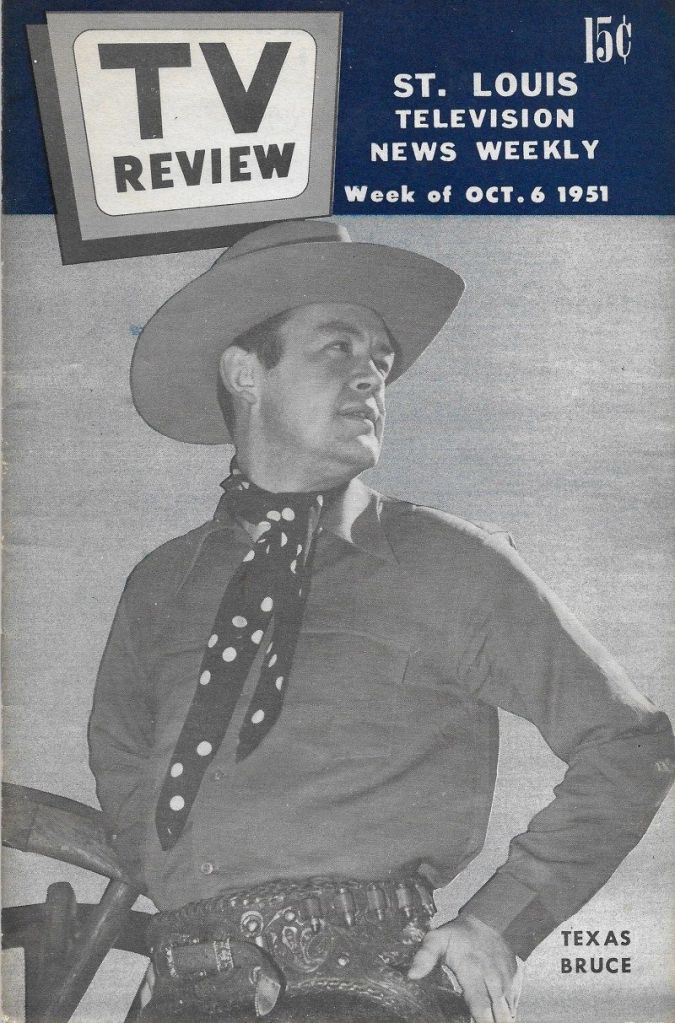
Texas Bruce
Ernie Heldman
Sammy Gardner
Charlotte Peters
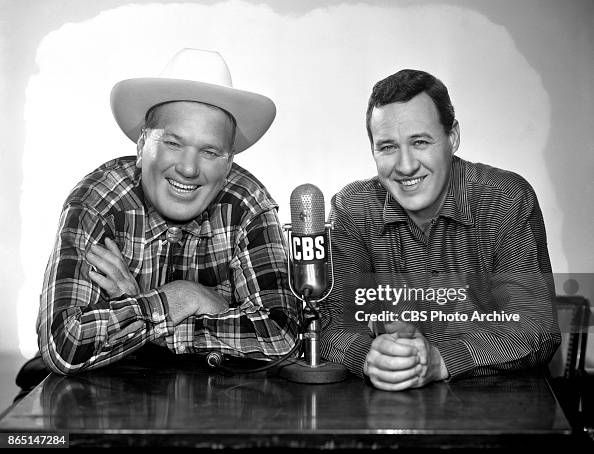
Texas Bruce was on five days a week and tought us “border Spanish”. Like “hasta la vista, vaqueros”. I remember my surprise when I discovered he wasn’t from Texas and his name wasn’t Bruce. But I guess he would have had a harder time as Cowboy Harry Gibbs.
Ernie Heldman was a magician who had a weekend show with his wife (was her name Arleen?) as his assistant. I bet he had a good time doing his show. I bet she didn’t.
They were sponsored by Pepsi Cola. Whenever anyone says, “Say the magic word”, I still know what it is. I remember when I learned where the Heldmans lived in University City. It was such an ordinary house.
Sammy Gardner was a musician. I think he played the clarinet. He had a combo called the Mound City Six and for a while they had a weekend TV show, which I loved. The Mound City Six was a dixieland band. Every week. What could be better?
Russ David was also a musician and pianist. He popped up everywhere, and he had his own TV variety show, too. I connect him with Pevely Dairy (“white in the bottle, pink on the cheeks”). Is that right? I was never a big fan, but he seemed to be ubiquitous. And I remember Dottie (Dotty? Dottye?) singing with him, don’t I?
As to Charlotte Peters, I remember her name, but not much else.
Of course, I remember the sportscasters. Harry Caray broadcast the Cardinals games (before a sex scandal sent him to Chicago).
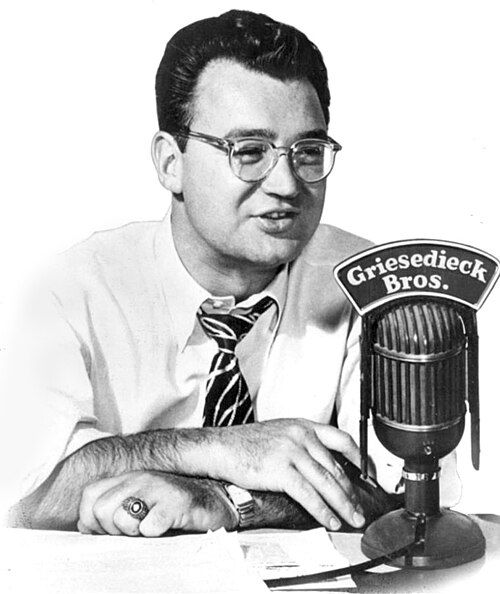
The original Cardinals’ sponsor in those days was Griesedieck Bros. Brewery (“GB for me, the flavor is terrific, try it and see, refreshing GB beer”). Then, of course, Anheuser Busch bought both GB and the Cardinals.
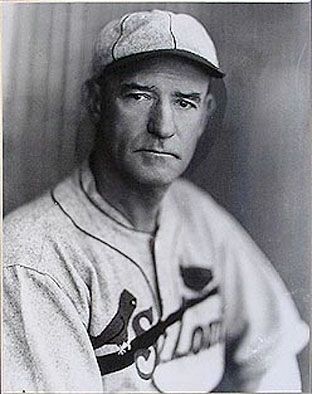
Caray’s sidekick was former Cardinal Gabby Street, until he died in 1951. Street looks more serious in this picture than I remember him.
The Browns, meanwhile, had the all time best broadcast duo, Buddy Blattner and Dizzy Dean.
As a team, they lasted longer than the Browns did.
Well, that’s about it for my memory. We now leave those exciting days of yesteryear. Back to the future. It’s 2026.
(1) I am thinking about a subject for my next presentation for my Thursday morning breakfast group, which will probably be some time in the fall. It will probably be on the Jews of Alaska.
What is there to say? I am sure I will find some interesting tidbits. After all, Alaska has had an important Jewish Senator, Ernest Gruening, and Anchorage, its largest city, has had two Jewish mayors. And the little known Slattery Plan (the historic basis for Michael Chabon’s novel The Yiddish Policeman’s Union) proposed bringing refugees from Nazidom to four Alaskan cities, both to give the refugees a place to land, and to spur Alaskan development. We will see what else.
(2) What will Trump’s next move be in Iran? It has been reported that Secretary Hegseth and General Caine have so far pushed back on accelerating the war now. This is not surprising considering that Hegseth is running out of weapons and Caine has no idea what will be required for a victory that would end the conflict.
By the way, how is it that the greatest military power in the world is running out of weaponry, when places like Ukraine, Russia, Israel, and even Iran and Yemen can seem to fight on and on? It does seem strange.
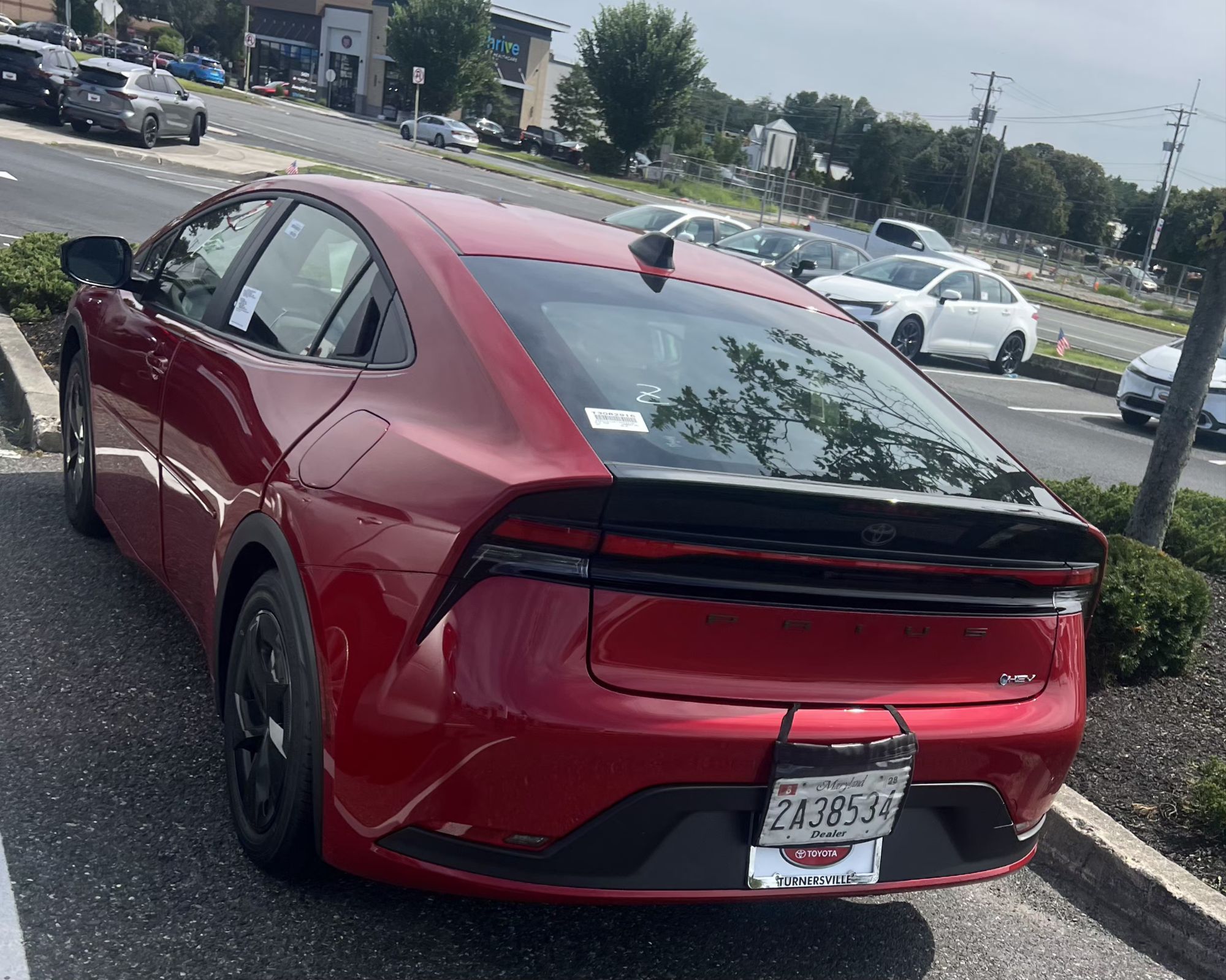
(3) We picked up the new Prius yesterday, and it is a very attractive shade of red called Supersonic Red, a replacement for the earlier red tone, Hypersonic Red. Great minds at work here. It is also very sleek and cute, and is rated to get 57 miles per gallon.
Because I was most interested in non-plug-in fuel efficiency, this was my choice, and we didn’t consider anything else. I didn’t even test drive the car.
What surprises me most is the differences between the 2019 and 2026 models. It is not like driving an updated 2019. It is a different car altogether. And it will take some getting used to.
The 2026 Prius seems to be smaller. In fact, it is a tad longer and wider (just a tad), but it is lower and sleeker. This apparently does not affect the front seats, but makes for less head room in the back. This means that back seat passengers will no longer say, “Boy, is there a lot of room back here.”
What is really different is the dashboard, completely unrelated to the 2019. It will take some getting used to. It used to be that there were four ways to display mileage – how far I have driven on my current trip, how far the car has driven altogether, and two other measures, called A and B, which I used on road trips to calculate how far we had driven that day and how far we had driven on the trip as a whole. These two additional measures, A and B, don’t seem to be there any more. This is one example.
On the other hand, the screen is larger and placed a bit higher and displays GPS maps, which can be operated by touch screen or voice, so I can throw away the device into which I would place my phone. That is a big improvement.
On the third hand, the Prius several years ago eliminated the rear window wiper. We will see how much I miss that. Generally, it has been said that the newer models go for form over function, while the earlier ones did the opposite.
I should add that the new Prius gives you four ways to drive your car – ECO, Normal, Sport, and EV. Push a button and you go from one to another. ECO gives you most fuel efficiency. Sport gives you most zip. This is new.
(4) Finally, a shout out to Erna Marcus, who discovered that the official plural of Prius is Prii, and that it was the result of a Toyota sponsored poll from 2012. “Who knew?”, I responded to the news. Erna answered, “Google did.”
Our major activity today will be to head out to Jim Coleman Toyota to pick up our new Prius LE and turn in our six year old Prius LE. It has done us will and I trust it will be treated well by Coleman and restored to its original condition before being placed in the hands of someone who really wants a well-loved 2019 vehicle.
We own our current Prius, and we are leasing the new one. That creates a kind of magic because it means, without putting down any cash (only our old car), we will sign a three year lease, paying under $250 per month for our new car. And the new car will come not only with a three year warranty for repairs with parts and labor, but will also cover the new car’s standard maintenance. On the old car, it seemed that every time I took it to be serviced (twice a year or so), I came away with a bill for servicing and replacements in the $500 to $700 range, so as I look at it, this new car is almost free. (Of course, when our three year lease ends……)
Why a Prius? Well, we have had, I think, five of them and they have all been comfortable to drive and have saved us quite a bit on gas. Our new Prius will has an EPA (EPA?) estimate of 57 MPG. No other car, other than an electric one that you have to charge and charge and charge, has that kind of mileage. I looked at the actuals on our current car last night. Over the 65,000 miles, the car tells me that we have driven at a rate of 56+ MPG, so we should at least equal that.
We are getting the baseline Prius – interestingly, as you look at the three more expensive models, your gas mileage estimates go down. So what would be the point? If we, for example, went up to the next level, the price goes up about 20% and you get a heated steering wheel, heated front seats, power front seats, and a skylight that you cannot open. That is it. Except for the power seats, I don’t see the point. And scooting the seat forward or back without electronic assistance doesn’t seem worth a 20% price hike. Oh, yes, you also get leather, rather than cloth, upholstery inside. To me, that is a negative, not a benefit. The MPG estimates on the more expensive model goes down from 57 to 52 MPG.
Our current Prius is white. For whatever reason, Toyota does not give Prius buyers many choices – now it is limited to white, sort of white, pretty much white, gray, sort of gray, pretty much gray, black, sort of black, pretty much black, red and blue. I wanted a color. My first choice was blue, my second choice was red. The dealer could not find a blue LE within a reasonable distance, but found a red one in Turnersville, New Jersey. Turnersville, by the way, is, I think, the only town in New Jersey that I have never heard of. I think it is near Philadelphia. The car was (I hope) driven down here last night and will be in pristine condition when we go to get it in a few hours.
The dealer sent this picture last evening, when the car was on its way down.
Other than that, not much to report, I guess. Trump looked pitiful (and sounded more pitiful) at the White House Correspondents’ Dinner last night, and mentalist Oz Pearlman did his normal tricks, but seemed somewhat out of sorts. Maybe he always does, I don’t know. But he did last night. Of course, he had a tough crowd to deal with. Did you watch? It was some of the most boring TV I have seen in some time. My guess is that Donald, who sat through the whole thing, wished he were somewhere (anywhere) else. Melania didn’t come, nor to did J.D., nor Marco R. The crowd, they say, was smaller than at the original aborted dinner, but I guess that is because of the change in venue from the Hilton to the Waldorf Astoria. The Hilton gets rented so far in advance that I did not think they would be able to set aside their large ballroom on such short notice. The Waldorf, which I have heard is struggling and still bears the stigma of having been the Trump International, was, I guess, more available, but with a smaller room.
The topic of the presentation at my Thursday morning breakfast group yesterday was the story of King Leopold II of Belgium who wound up as the proprietor of the Congo Free State (later the Belgian Congo, Zaire and the Democratic Republic of the Congo). The territory was one of the remaining parts of Africa not claimed as a colony by a European empire (or would-be empire) and Leopold felt Belgium was being left out. But Leopold was not an absolute monarch; he was a constitutional monarch, and the Belgian parliament, or whatever it was, refused to go along with his idea for Belgium to claim ownership of this vast territory (by vast, the DRC today is about 1/3 larger than the state of Alaska). So Leopold decided to take the territory for his own, and he did, with the help of Henry M. Stanley (not his real name – of Dr. Livingstone, I presume fame). And he did, and held it as a personal possession for decades before Belgium finally decided to take it as a colony of the country.
Because my mind always goes back to the same topic, it reminded me of Donald Trump. And in particular, Donald Trump’s takeover , or presumed takeover, of Gaza, when he declared that an extra-legal organization that he founded would take over control of the area with contributions from many countries and that he, Donald John Trump, would be in charge and run it. The United States was not going to run Gaza, the United Nations certainly was not going to run it. Donald Trump was.
And you can also look at Venezuela and, in futuro, Cuba. The United States Congress has not, I do not think, passed any laws giving the United States any control over the independent country of Venezuela, but Donald John Trump says that he (or in this case maybe “we”, but who knows what “we” means to royalty like Trump) runs Venezuela, through his agent the Secretary of Energy, Chris White (whoever he is). And if Donald John Trump’s blockade of Cuba works and Cuba succombs, Donald John Trump will also presumably personally run Cuba, without any American legal help, through his factotum, Marco Rubio.
I have recently spoken about the book I was reading The Remaking of Italy, published in 1941, and how the description of Mussolini’s governing Italy was so similar to descriptions of Trump governing the United States. Fascism is fascism, and power is power. And yesterday, Edie was reading a review of the new Christopher Nolan film, The Odyssey, where the reviewer said that Nolan was for sure filming Homer’s epic poem, but that he was doing it in a way that made it a story about Trump’s United States.
Yes, everything reminds everyone about Trump. But I want to get back to King Leopold, who ruled Belgium for over 40 years, and who, when his government refused to agree with something he wanted to do, just went ahead and did it anyway, and presumably did things by whim as they occurred to him. (I really don’t know anything about Leopold other than what I put in the first paragraph above, by the way, so I am sort of making the rest of it up.)
Look at Saudi Arabia. One day last week, I said that I thought that Spokane was weird. Well, if Spokane is weird, it is nothing compared to Saudi Arabia, a family run kingdom awash in oil, attempting to modernize and diversify. The relationship between Saudi Arabia and the United States has always been a bit unusual, from the days of Aramco (originally, joint venture between the kingdom and Standard Oil of California), through the various interconnections with the Bush family, the role of Saudis on 9-11, the refusal to let Jews into the country, the spread of Wahabi Islam, and the killing of Khashoggi.
Donald John Trump has tried to be friendly with new Saudi leadership and recently it was announced that we were going into a relationship with the country that would let them refine uranium for a peaceful (presumably) nuclear program without safeguards. It was announced that an agreement had been reached (again without any Congressional role) and would be signed, and then, presumably by whim, Donald John Trump decided that he wouldn’t sign it unless the Saudis agreed to recognize and established normal relations with Israel. All of a sudden, the deal was, it seems, no deal, and Donald John Trump says it was never something that should have been made public at all. He apparently blames his Secretary of Energy, or at least the Energy Department, for leaking the whole arrangement prematurely. Do you think Secretary Chris White (whoever he is) was too busy running Venezuela?
At any rate, the mess continues. Iran “who really is desperate to make a deal” is refusing to make a deal, oil prices are up, etc., etc.
I have a busy day ahead, so will stop now. Sorry this is a bit disjointed. So am I. Trying to buy a new car, and my back and forth with the dealer has been strange. As strange as Spokane? As strange as Saudi Arabia? In short…..yes.
Zohran Mamdani is 34 years old. That is too young to be mayor of New York City, and that explains a lot of things.
Digression. Of course, he is not the youngest person in history to take on positions of major responsibility. Look at what Alexander the Great did before dying at 32, and look at what Jesus did before dying at 33. End of digression.
But being 34 could explain his intemperate call for the arrest of Benjamin Netanyahu if he comes to New York to address the United Nations.
I am pretty sure he was not surprised that he did not have the authority to arrest Netanyahu and ship him off to The Hague. But he said he would do it, setting off an unnecessary firestorm, and giving Trump the opportunity to ridicule him and to, once again, show the Democrats to be a party of radical, lunatic, antisemitic leftists.
It also once again threw the Jews into a central place in American politics, which is the last place they should want to be. But there we are.
Of course, if Mamdani is too young to be where he is, perhaps Netanyahu at 76 (like Trump at 80) is too old to be where he is. But that is another story for another day.
Israel has made a lot of mistakes in recent years. One, of course, was permitting a cascade of security failures that allowed the devastating Hamas atttacks in October 2023. There is no reason that attack occurred with such severity. Had Israel paid attention to its own sophisticated security apparatus, it probably would have been nipped in the bud. Of course, a true internal investigation into what went wrong has been stymied by Netanyahu and the Knesset which he controlled.
And Mamdani and many others, including many scholars and Jewish scholars, believe Israel’s response has been genocidal. This is, to me, unimportant, because “genocide” is a word which clearly has ambiguous definitions, and whether or not Israel was/is committing genocide depends on the definition you are using.
But, genocide or not, many, including me, condemn Netanyahu and his government for their response, just as we condemn Hamas for its attack, which can also be called genocidal. I do not know if Mamdani has called the Hamas attack genocidal, but he has more than once called it a “horrific war crime”.
Mamdani has also said that a two state solution does not seem workable. This is now a mainstream thought, one I agree with, and one that is hard to disagree with in 2026. Whose fault is that? Probably everyone’s.
In 2018, Israel’s basic laws were changed to formally denote Israel as a Jewish State. Mamdani thinks that this was a mistake (as do I), just as I (and I am sure Mamdani) believe that calling the United States a Christian country is wrong. (Mamdani, by the way, says that he also disagrees with countries, such as Saudi Arabia, which elevate Islam.) Israel is 20% Arab and those Arabs are and always have been Israeli citizens and should be treated fully as such.
One of the important Palestinian positions is that those displaced from Israel in 1948 and their descendants should have the right to return to Israel. This is a pisition which Mamdani appears to accept (to what extent, I do not know), as do many American Democratic Socialists, and one I strongly disagree with, unless Israel succeeds in expanding its borders into Gaza and the West Bank (something I also disagree with), which it might.
The American Jews are in an awkward position, the Democratic Party is in an awkward position, both caused by the actions of Israel and the responses of part of the left wing of the Democratic Party. This is very unfortunate when the most important domestic issue is the defeat of the Republicans. And Mamdani, and those Democrats who agree with his positions on the Middle East, are simply making this more difficult. As, by the way, is AIPAC, also caught in the middle, which has inserted itself into Democratic party contests, again bringing unwanted attention to Jews in America and feeding antisemitism.
I start with an obvious admission. I only know what I know about this subject, only what I see in or on media. Having said that……
I understand the difficulty even a rational Congress would have with the administration’s latest request for another $67.1 billion for the war in Iraq (the money presumably is to carry out the war going forward, and to replenish some of the military weaponry and equipment used so far). If you add this to the money contained in previously approved funding for the Department of Defense (a/k/a Department of War), some, or much, of which is unspent apparently, and add all of that to the money being requested for the upcoming fiscal year, you are talking about real money.
On the other hand, we are engaged in active fighting with Iran, we have troops and equipment and bases all over the Middle East, and we have used up (or have had destroyed) materiel that we need for our defense. We need to protect what we have, and we need to get what we need.
Here is part of what I don’t know. Is there someone on some Congressional staff who is really studying the requests of the administration and who can look at the requested $67.1 billion supplemental, and say: we need this, but not this, and that but not so much of that, and so forth? Or is it simply going to be an up or down vote? Is there anyone in the employ of any Congressional committee whose job it is to examine the overall budgeting and expenditures of the DOD/DOW and make ongoing recommendations to the elected officials? I don’t know, but there should be.
Of course, in order for this to be accomplished (and a big task it is or would be), you need to have the cooperation of the administration, and this administration is not at all big on cooperation, and it gets even more complicated when you get to matters of secrecy, necessary for our defense. And you compound this even further when one or another side can not be trusted, when amounts budgeted or set aside for certain items are not spent or our used in different ways that intended. And finally, as we all know (or think we know), the DOD/DOW has never been audited (and maybe for some of the reasons set forth above) can not be.
So it may be that the money being requested will simply be given to “protect our troops”, although how each dollar would protect any single troop may be hard to detect.
With all this being said, I have to add that, as I watched Secretary Hegseth be queried by the Senate Appropriation Committee Democrats yesterday, I was disappointed at most of the questioning (as usual). There were exceptions: Senators Ossoff, van Holland, and Peters. But by and large, the questions did not probe sufficiently the issues.
For instance, I don’t think anyone asked about the effect of these requests on the national debt. I don’t think anyone concentrated on whether these additional defense expenditures would result in an decrease in other expenditures in order to keep the national debt from climbing more than it has to.
There were some questions as to what would happen if the supplemental funds were not approved. The answers were that there would be other ways to support the most important things, but other matters necessary for our defense would be shortchanged or ignored. This requires more probing, of course, and I saw no sign that anyone was going to follow up and ask for details.
The other issue related to how the war was going to end. Obviously, no one can predict the future and, as one of those testifying said, “the enemy has a vote”, but what is clear is that the definition of what would constitute a victory is missing, and that this makes everything very difficult.
At first, there was regime change, and making it impossible for the Iranian military to “engage in combat” and keeping Iran from developing a nuclear bomb at any time in the future. Now regime change is off the table, and while the administration claims that Iran no longer has any military capacity, Iran certainly acts like it does and, although Hegseth may think this is no more than flies or gnats flying around, they cause real harm and there is no sense yet of this ending. And, then of course, President Trump himself has said that it would be expected that Iran would be able to keep some missile capacity, although Hegseth, like most Trump officials, says, in effect, that “Trump, who always means what he says never means what he says.”
But what does it mean that we will fight until Iran can no longer ever ever ever have a nuclear weapon, or maybe any sort of nuclear program? When can we possibly say that this goal (according to Hegseth, the most important and most consistent goal) has been met?
And then, of course, there is the question of the Strait of Hormuz, about which enough has been said.
Trump himself has no idea of what to do, except “keep ’em guessing” as to our next steps, and bully them into……into what? Today, he tried a trick from old cowboy movies, or Netflix thrillers: Until you do what I want, I am going to kill one of you every ten minutes!
For Trump, the president with a disturbed adolescent mind, it was: Every time you attack a commercial ship, Iran, I am going to blow up a bridge or an urban power plant!! So there!! “Thank you for paying attention.” Statements like this must drive the military, who rely on set goals, which enable them to make the best strategic and tactical choices, crazy. Here their tactical choices are being made for the, the concept of strategy is being ignored or overridden, and of course the goals have never really been set, or have not been set in way that are, in any event, achievable.
Meanwhile, China bides its time with infinite patience and worldwide success, chuckling to each other as they discuss the United States: “Gee, they really are living in interesting times.”
I was tired enough yesterday and I had a number of post-vacation things to do, so I did not leave the house. But I did have a chance to do something I rarely do. A copy of the latest edition of the Yale Law Report was in our mailbox and I decided, during a period when I felt incapable of doing anything else, to scroll through it and see what’s going on at the law school I graduated from almost 60 years ago and which, except for its architecture, is hard for me to recognize, it is so much busier than it was then.
The first 30 pages of the journal were devoted to events at the school, activities of various student clinics, and activities of the faculty. Remarkable stories about advances in working on potential legal framework changes for palliative health care, about how to regain adherence to the rule of law, on potential settlement terms of the Russian-Ukrainian war, the relationship between law and technology (including AI), how to advance various forms of environmental protection, how to slow down use of the Supreme Court’s “Emergency Docket”, how to cope with federal actions that threaten local public safety, programs to introduce Yale students to foreign legal systems and to introduce foreign legal students to the American legal system, how to analyze the effects of tariffs, how to increase laws internationally to protect women from violence, issues regarding drug patents, protection of immigrants, denial of benefits for certain Agent Orange survivors, and so on.
Virtually every one of these activities seem to me to be directed to the public good; there are very, very few that I would possibly question. The issue also discussed 18 books written by faculty or others close to the school, and had a number of feature articles, in addition the usual class notes and condolences.
I assume that the magazines published by many or most other law schools could have an equal number of activities that should be applauded. As do all of the medical schools, and other professional schools serving the various interests of mankind.
My question is a simple one. With all of this good work going on, hard and good work, why is the world in such miserable condition? And I don’t mean this as a silly or facetious question. It’s a serious one. With all of this work going through the efforts of clearly very bright people……why is everything so screwed up?
I am now reading a book titled The Remaking of Italy, written under the pseudonym of “Pentad”, and published in 1941 with Mussolini in control, and World War II flaring. It is a remarkable book in that it tells the story of the Italan peninsula from pre-Roman times until the then present, and the political changes are constant. Some for the better, more for the worse, but throughout all of this political uproar, life, for those able to keep alive, keeps going. Books are written, art is created, science makes discoveries, and so on.
So, today is not any different. Errant political leaders suppress progress for many, but the world goes on. People do what people do.
Under Mussolini (the strongman who could not resist the stronger man from the Third Reich), and in a war where Italians knew they would be a loser even if their side won, it was probably hard to glimpse a better future. As “Pentad” said:
“It seems that, against the growing and irrepressible aspirations towards solidarity, liberty, and justice, there frequently arise resisting forces which try to paralyze those aspirations,and often succeed in so doing. When this happens, the idea of Lex succombs to that of Rex and the individual loses every guarantee.”
We are not living in Mussolini’s Italy and World War II is long over. But we are living in Trump’s America, and we all (should) see the leadership parallels. “Pentad” makes it clear that this too will pass. But “Pentad” also makes it clear that it may not pass tomorrow, and that it may not pass in time for the current generation to see it pass. “Pentad” also makes it clear that it will not disappear on its own, and not by external forces, but by internal actions when the time is ripe. Mussolini will die, the war will end one way or another, but the “remaking” of Italy will be up to the Italians. A lesson to remember.
By the way, you may wonder who “Pentad” was. First, as you may know, a “pentad” is a group of five somethings. In this case, it was a collaboration of five authors, Italian and British who felt the necessity of hiding their identities. From what I see, today in 2026, no one can yet identify them.
We got home yesterday at about 3:30. Our trip is over. Back to the real world for a month or so, and then it is off to Maine to wrap up the summer. Hopefully, today will be quiet here. A recovery day, after our unexpectedly extended return.
When I go downstairs this morning, I should find two newspapers. On our 16 day trip, I only saw one newspaper. None on the boat at all, and none on land. If I wanted to read a newspaper, I guess I could have found one at CVS. Certainly not in any of the hotels.
So you can imagine my shock when yesterday, on the plane from Chicago, the man sitting next to me in seat 11D, began reading the New York Times page by page, line by line. I glanced at his newspaper and, although it was Sunday, he was reading the Times from Thursday. At first, I had no explanation, but then I realized why. It probably took him three days to find the Thursday edition.
Over the course of the last week, I did turn on MS NOW or CNN a few times. But not on the boat. Neither channel was available on Holland America’s Eurodam. There were only BBC and CNN International as news channels. That was another surprise.
There were few signs of politics anywhere. And we saw no signs of the upcoming midterm elections. I had expected to see evidence of the big Senate election in Alaska, where former Democratic Congresswoman Mary Peltola is looking to flip the seat currently held by her Republican opponent Dan Sullivan. But……nothing. At least, yet.
Another thing about the places we visited is that the minority populations are truly minorities. Yes, we were on Indian reservations, and the indigenous populations are “honored” everywhere, but the overall numbers of native Americans is quite small. And while Seattle’s population is about 8% Black (its metro population only about 6%), while the metro DC population is 24%, the Black population elsewhere is hard to count. Even Spokane, the only other sizeable city we visited, is less than 2% Black. And the Hispanic population is also relatively small. Only the Asian population in Seattle is by percentage larger than in DC. As for Hispanics, the DC population by percentage is three times larger.
I was impressed by most of the cities we visited, although in Alaska, I must say that Ketchikan and Sitka were more appealing than Juneau. Seattle always impresses and, as I said earlier, Spokane seemed just plain weird (” i after e, except after w”). Wenatchee and Kalispell were delightful, but physically Missoula was surprisingly unimpressive. This included the hodgepodge campus of the University of Montana. Let me put it this way. If I were interested in becoming an architect, and if Montana had an architecture school, I would not apply.
Do I have more to say about the trip? Sure. Will I say it? Not today.
There would be advantages living in a place like Missoula. For one thing, when you turn in your rental car, you simply park it and give your key to a fellow inside the terminal. When you check in for your flight, there is no line and agent is willing to do everything for you. At TSA, there is no line and a friendly TSAgent. You look on the schedule board and you see there are about 8 flights leaving in the morning, and only eight gates. From your waiting chair, you watch other take offs.
I will abbreviate the rest. Our 12:34 flight left Missoula at approximately 5:40. First, there was a 2 hour delay because “all flights were grounded at O’Hare”, then another 2 hours because our crew was timed out and they had to get another crew into Missoula, and another 45 minutes because we missed our window to take off.
That meant we missed our connection to DC obviously and we weren’t going to get into O’Hare until after 9 and the only available dc flights would have got us to Dulles around midnight, so they automatically booked us on a 6 a.m. flight, which, with Michelle’s help from home (it was chaos trying to change anything in Missoula), we rebooked at 11:15. So we should be home at about 2:30 p.m. at National.
Of course, our bags are at O’Hare and we are pretty barebones here. We hope our bags are put on the 11:15 and not the 6 a.m., but we will find out when it is too late to do anything about that.
We are at the O’Hare Super 8 because we didn’t want to pay $400-$500, apparently a normal airport last minute rate, but the O’Hare Super 8 turns out to be 8 miles from the airport. United did not give anyone hotel vouchers because “the delay was weather related”, but our taxi driver said there was no ground stop and the weather was fine.
More to come, I am sure.
P.S. Edie told me there were even more typos than usual. I am sure you understand. But I just corrected (most of) them.