I don’t know why I ask that question. There is no such thing as a lucky number. We may think that a number is lucky, but, at the same time, we know that it isn’t.
But if “eleven” isn’t lucky, what is it? I know. Eleven is the number of days that have passed since the beginning of the year 2025 and, so far, for so many people, it hasn’t proven itself to be a lucky number.
But for me, so far, the eleven days of January have not been bad. I don’t live in Israel or Gaza or Sudan or Syria or Lebanon or Yemen or Ukraine or Kursk or California, or any of those places where conditions have been subprime. And while I have followed the tragedies that have hit in those places, they haven’t hit me directly.
So what have I, or in most cases, we, been doing this year so far?
We have finished our first TV serial of the year. Okay, maybe we could have chosen better, but we watched “The Twelve”, a ten part Netflix series in Flemish, set in Ghent. A woman is accused of two murders and is on trial. The jury hears the case and must reach a verdict, but individual jurors have their own issues. The series focuses on both, weaving between them successfully. Most interesting were the differences between American and Belgian criminal trials. In Belgium, you apparently only need 8 of 12 guilty votes to convict and if you have 7 votes, the judge (the “court”) gets a vote, to see if it can come up to the required 8. This is one of many differences.
I have watched several YouTube videos (each about 45 minutes long) about life in northern Russia (not Siberia, but in European Russia), including videos about the cities of Murmansk and Archangelsk, as well as small, remote villages (whose residents at this point are all quite old). Created by a Moscow activist named Ilya Varlamov, I found them eye opening as to the current conditions in those places. Be glad you don’t live there. I have also watched videos about Krasnodar and Kaliningrad. Kaliningrad doesn’t seem that bad. At least when compared to the others.
I’ve listened to a few podcasts on the Russo-Ukraine War and, like most of the podcasts on the war I have heard, they make it sounds like Ukraine is the odds-on favorite, and that Russia is falling apart at the seams. But that is what I have been hearing for over two years now. I have also listened, as previously reported, to Aaron David Miller talking about the state of the world. He believes it to be pretty awful and – guess what – he doesn’t really know how to go about fixing. it.
We watched three PBS specials. One a documentary on Jimmy Carter’s relationship to music, another a concert featuring the Blind Boys of Alabama, and the third a biopic about Josephine Baker. All three shows get A’s from me. You can probably find them on PBS Passport.
We took our day trip to Centerville and Chestertown MD, and had a superb lunch at Watershed Alley in Chestertown, and I had almost equally good lunches at &Shwarma in Rockville and Grigorios in Potomac. A good restaurant start to 2025. But then the snow came.
We saw “Jack and the Beanstalk”, the British Players annual panto, co-produced by daughter Michelle and enjoyed our grandchildren’s responses to the ritual corny characters and scenes.
I watched Oliver Stone’s 2016 film Snowden, which I thought excellent, although I can’t talk to its accuracy, and I actually read two books: Stuart Hampshire’s book about the philosophy of Spinoza, and an absolutely delightful biography of a salmon, called Salar the Salmon, by a British naturalist, Henry Williamson.
I heard a terrific presentation by a professor at USC about various Jewish languages, beyond Yiddish and Ladino (you can watch it on the Haberman website, http://www.habermaninstitute.org), participated in a discussion about how people with different political philosophies can find common ground, and attended a breakfast discussion with a 25 year veteran of the DC Metropolitan Police Force.
I followed the nightmare in California, the frightening antics of our next president, and the funeral of President Carter, I accompanied Edie to an eye doctor appointment, and we went to the Avalon and saw the new Pedro Almodovar film, The Room Next Door (neither of us liked it very much)
That, along with seeing our grandchildren, watching two hockey games, and shoveling some snow, pretty much filled my activity book (along with talking to some friends and email or texting with others, reading newspapers and on-line news, a little grocery shopping, and carrying the laundry from the basement to the second floor) about does it.
We have been thinking for some time about the effect on climate change on social movement. We know that there has been increasing desertification in various parts of the world, especially in parts of Africa, which have led to hunger, deprivation, migration and war. We have seen the flooding that has taken place in countries such as Bangladesh, where displacement on account of rising sea levels affects a significant percentage of the population. We have seen hurricane after hurricane hit Florida, and even more so hit various of the islands of the Caribbean. We have read about some of the inhabited islands of the Pacific and Indian Oceans, whose future as a place of human habitation is in doubt. We have tracked wild fires in the American west now in recent years, just as we have tracked drought and falling water levels. We have been accustomed to instability and most of us have ignored it.
Now it’s hitting even closer to home. Three thousand miles to the west of Washington DC, we see large parts of Los Angeles and Los Angeles County ravaged by wild fires. We have, over the past five days or so, seen thousands of homes destroyed. We have seen more damage to Los Angeles in less than a week than three years of war have brought to Kiev. And, we have seen much of the damage being felt not by the residents of trailer camps, whose homes seem to attract deadly tornadoes on a regular basis, but by middle class, upper middle class, upper class and upper upper class families.
This Saturday morning, January 11, 2025, we do not know when these fires will end. Or how much more of Los Angeles will be destroyed. And when these fires are stopped, or when they burn themselves out, we will wonder when the next one will occur. Will it be as bad? Will it be worse?
We Americans keep saying how lucky we are. We live in a free country. We are protected by two oceans. We have seen peace and most of us have seen at least a modicum of prosperity. This has been the true definition of American exceptionalism. We as Americans are not exceptional. We are just the benefits of the luck of the geographical draw. But climate change appears to be unstoppable. We will no longer be able to pretend that we are exceptional. We are now America the Vulnerable.
There are other ways we are vulnerable as well, of course. We have seen that we are politically vulnerable. We have seen our adversaries grow their weaponry, and this means not only their explosives, but their ability to move missiles and bombs and the like around the world with tremendous speed and accuracy. We have seen that we are vulnerable to disease, and that a fast spreading disease can quickly lead to a world wide pandemic, disrupting society in so many ways. And we have seen that we are more and more at risk as Artificial Intelligence is growing, and we know that one day AI may control us more than we control it.
But now I am thinking about Los Angeles. How do you rebuild such a large part of a city. It’s not as simple as a homeowner calling College Hunks Haul Junk to clear the site, and then asking your brother-in-law, a contractor, to build you a new house. It will be unbelievably complicated. It will take years and years before areas this large can be rebuilt and, during those years and years, families aren’t going to be waiting around in shelters or in friends’ houses; they will be trying to get on with their lives in other parts of Los Angeles or elsewhere.
We can look elsewhere for lessons. World War II obviously devastated most of Europe and Japan. Cities were totally bombed out, infrastructure destroyed. Yet when I went to Europe for the first time in 1962, only 17 years after the end of World War II, everything (almost everything) looked pretty good. I have never been to Japan – where Tokyo was firebombed, and Hiroshima and Nagasaki nuked – but the rebuilding proceeded much the same way. These were miracles, in a way, helped along by the U.S. becoming the financial sponsor of so much rebuilding. But the destruction of Europe and Japan were the results of war and, for the past 80 years, we have been able to keep extensive or long lasting wars at bay in those parts of the world.
Climate change is different.
It is much easier to keep the peace (hard as that may be) than to avoid drought, rising seas, hurricanes, tornadoes, and forest fires. If the world is going to be more and more threatened by natural phenomena, the idea of rebuilding in areas which have been destroyed becomes more uncertain. Does it make sense to rebuild in areas which have become increasingly hurricane prone, or on coasts which are more likely to be flooded on a regular basis, and so forth? Does it make sense rebuild in an area where you are going to be more and more prone to uncontrollable fires? Decisions must be made.
Of course, the complete loss of one’s home is traumatic, hard to really comprehend. It’s traumatic in Los Angeles, and in Gaza, and in places which are destroyed by, say, earthquakes. And when you have areas as large as the ones destroyed in Los Angeles, the loss of one’s home is only the start. Yes, everything you have collected over the years, from art work, to clothes, to jewelry, to family portraits and heirlooms, and more are all gone. But your future is also disfigured. Jobs are gone, for example. Each of these California communities had businesses that accounted for thousands of jobs that can no longer be fulfilled. And when jobs are gone, so are salaries. Infrastructure, for another, is destroyed – water, electricity, gas lines, schools, fire houses, everything is gone. How will it be replaced? And when?
Nineveh is no more. The great Mayan cities are no more. And so on. For now, Los Angeles exists. But for now long?
Okay, you say: “What a mess this is?”
I agree with you. Los Angeles is a mess. And, because I wrote this post quickly on a Saturday morning, I guess it’s a mess, as well.
As many of you know, I have been involved with Jewish funerals for many years, both helping families of Adas Israel members arrange their funerals, and as a member of, and for the past seven years, president of the Jewish Funeral Practices Committee of Greater Washington, Inc. The Committee has been around for more than 40 years, working out arrangements with local funeral homes (currently, one in Silver Spring MD and one in Alexandria VA) to provide traditional Jewish funerals at very affordable rates, well below the costs of standard funerals.
One of the elements of Jewish funeral tradition (and of Muslim funeral tradition) is for burial to be as soon as possible after death, usually within 24-48 hours; there are reasons for this, including reasons relating to concern for the survivors, as long waits for burials can bring additional psychological stress. Another belief is that all are equal in death. So, for example, traditional Jewish practice would have everyone, from the very rich to the destitute, buried in a plain, unadorned, wooden casket.
In other words, many features of Jewish practice are the opposite of what took place regarding the funeral of Jimmy Carter. This is not peculiar to Carter. It has been (and will undoubtedly continue to be) the case with other American presidents, as well.
Carter died under hospice care in Plains, GA. His body was transported to Atlanta, where it sat in state at the Georgia state capitol building and there was a ceremony, and then it was flown to DC where it was placed for a few days in the Capitol rotunda, where the public could pay their respects, and then it was driven to the National Cathedral in Northwest Washington, where there was a lavish funeral ceremony, and then driven from the cathedral to Joint Base Andrews in Prince George’s County, where it was loaded onto a plane to Fort Moore, Georgia, where it was placed in a hearse and driven to the Maranatha Baptist Church in Plains, Georgia, where there a final funeral ceremony and burial. Whew!
This is the norm for burials of presidents. I know there were similar ceremonies held for Gerald Ford, who died in California, lay in state at the Capitol, had a funeral at the National Cathedral, and then had another ceremony in Grand Rapids, Michigan where he was buried. George H.W. Bush died in Houston, was brought to Washington, lay in state at the Capitol, had a funeral at the National Cathedral, was flown to Houston for another funeral service and then taken to College Station TX for a final service and burial. And so forth.
Is all of this movement of the body of a deceased president really necessary? My own suggestion would be to have a burial service soon after the death of the president, and then have memorial services at appropriate locations afterward. There is no real reason why the coffin and body need to be at the Cathedral or church services, why the body needs to be transported around and about, or even why an empty casket can’t be set up in the Capitol rotunda for people to pay their respects.
A third tenet of Jewish practices prior to burial are designed to pay respect to the body of the deceased (including body washing and watching); unnecessary transporting just does not seem either respectful or necessary to me. I know – you may have a very different opinion, but the differences from at least the Jewish norm may be instructive.
Having said all of this, I did turn on my television yesterday to watch some of the proceedings. I saw the casket being loaded into the hearse at the Capitol, and I followed the hearse both as it was driven to the Cathedral and the, after the funeral, as it was driven from the Cathedral to Joint Base Andrews. They had a pace car leading the procession in front of the hearse, with a rear mounted camera, and you could follow the complete route of the hearse. I do like road trips, as you may know, and a road trip where I could just sit at my desk and watch the city roll by was a pleasure, as I knew every place on the way.
As to the funeral itself, I was watching it off and on. I tended to turn off the sound when there was preaching or when a soloist or the large choir was singing, and turn on the sound when there was a speaker I wanted to hear. That means that I heard Stu Eizenstat, Jason Carter and Andrew Young and others. I thought that all three spoke eloquently – Eizenstat giving a full and laudatory report on President Carter’s public service years, Jason talking about his grandfather the family man, and Young talking about Carter and civil rights. I also listened to President Biden, but did not think his words were particularly memorable (or maybe I am just tired of listening to President Biden now). I also enjoyed watching the former presidents, vice presidents and their spouses interacting as they sat the first two rows – Presidents Obama and Trump sitting next to each other and conversing proved to me that Obama could talk to anyone. Trump did not really speak to anyone else. Melania sat on the end of a row and looked all alone, as if she were out of place.
All in all, I think the services were very well done. It’s just that there was no thought given to quick burial, equality in death, and respect for the body.
I don’t expect things to change. I don’t think the majority of Americans would agree at all with my feelings. But I thought I should at least put my thoughts out for consideration.
A few decades ago, we knew a woman living in Israel, who was deathly afraid of Arabs. She had been born in Poland. I am not sure about her precise history, but she was clearly a victim of the Holocaust (she had probably been born around 1930) and knew what could happen if a group of people who hated you suddenly attacked or wound up in charge. She was convinced that one day, the Arabs would come for her. She passed away, at a fairly young age, in a hospital in a town in northern Israel, after an infection set in following a routine surgery to remove her gall bladder.
I am reminded of this as I watched the tragedy unfold in so many parts of Los Angeles, as the fires are destroying homes and lives and landscapes. As I write this Wednesday evening, 100,000 people have been displaced, well over 2,000 buildings have been destroyed, five people have died and many more have been injured. Yes, California has had its share of wild fires, and some knew that the dryness of this year’s “rainy season” had increased the potential for fires throughout Southern California, no one was thinking that there could be a situation like the one that actually has come about. Not that the residents of these portions of Los Angeles thought that they were immune from natural disasters. For their entire lives, they have been deathly afraid of……..earthquakes, and certain that, one day, their lives would be affected by the movement of the earth’s tectonic plates.
All their lives, the fear of earthquakes. And they were taken down by a fire.
Yes, disaster can strike from unexpected places. We all know that, even if we don’t act as if we do most of the time.
As one of my first books of 2025, I read Stuart Hampshire’s book titled simply Spinoza. It’s not a biography (Spinoza’s life story is told in an appendix of about six or eight pages), but an attempt to understand his philosophy and manner of thinking. Hampshire, who taught for years at Oxford, was a very dense writer; paragraphs in this book could run four or five pages. Yet, even Hampshire described Spinoza’s writing as terribly dense – too dense for normal reading. And he mentioned at least two times that scholars have not been able to fully understand certain aspects of Spinoza’s thinking.
Yet some things were clear, the most important being that Spinoza concluded (not felt, but concluded), on the basic of logic that was to a large extent beyond my thinking, that God does not exist except to the extent that everything in the universe is an element of God (a philosophy known as pantheism). So, to Spinoza, normal religion was irrelevant. There was no God to pray to, because we are each God, or a part of God, as is every planet, tree and insect. He also concluded, as I understand it, that mankind does not really have free will, in spite of what we may think (this, like many other things, shows 17th century Spinoza agreeing with most 21st century scientists and thinkers). Everything we do (in fact, everything that happens) is the inevitable result of what has preceded it, and happens either as a result of something in our internal makeup or of something that affects us externally. We think we are making a choice; we aren’t. We think things happen by chance; they don’t.
Under this theory, the fires were inevitable. From the time of creation (I use that term loosely, because I don’t think that Spinoza would say that God “created” anything, since we are all part of God and not separate from God, and it is illogical to say God created itself), it was inevitable that on Sunday night the fires would start spreading in Los Angeles County.
Now, when the fires burn themselves out, people will assess their losses, grieve, and rebuild, but we don’t know what will happen, even though whatever happens is inevitable.
Yes, this is a kind of predestination, but it isn’t John Calvin’s version, who believed that God had a conscious plan for each of us. It’s predestination because we are all part of God, and God works in accordance with the system of God, and we are part of that system. We are not externally instructed to do more, or to do less, or to turn right, or to turn left, but Spinoza’s logic, he says, explains why we do what we do.
But it does mean that, if we were smart enough, we could put all the pieces together and see the future. We are far from being able to do that, even with the gains being made by Artificial Intelligence, but who knows? Maybe one day Artificial Intelligence, if it can be programmed to (or can program itself to) utilize perfect logic and see into the workings of God (i.e., the workings of everything). to see into the workings of the universe, past, present, and future. But not in our lifetimes.
And that brings me to our inevitable president-elect, Donald Trump. Years ago, Donald Trump castigated the government of California for not managing its forests. Remember when he said that the forests of California should be raked? And just today, he has said that the fires are the fault of Governor Newsom, whom he calls Newscum.
Digression: That reminds me of when Chubb Peabody was governor of Massachusetts and some opponent or critic said that he was the only governor of Massachusetts ever to have two cities named after him – Peabody and Marblehead. End of digression.
Today, he said the fires were Newsom’s fault not only because of forest mismanagement but also because of water mismanagement. And, although I don’t think that he addressed it today, back when he was talking about raking the leaves out of the forests, he also said that the United States government was not going to provide any funds to California to repair forest fire damage.
This may be both Trump’s first big test and the Congressional Republicans’ first big test. Will Trump stick to his “no relief money for California” position? If he does, will Congress let him get away with it?
We can’t answer that question with any degree of certainty. But the answer is inevitable.
(My apologies to Spinoza for what I am sure is a total misinterpretation of everything he ever thought, wrote or said.)
It is certainly tempting to write about the next four years of the United States of America, with its 51 states, and 2 new territories, but enough people will be doing that today, so I will avoid the temptation and write about something equally timely – the 20 or so books I read in 2024 to which I gave an A rating. I think 20 A rated books is quite a lot – I read 65 books altogether, and 20/65 = about 30%.
So here goes:
(1) The Threat by Andrew McCabe. Andrew McCabe, one of Donald Trump’s enemies, who was for two years acting Director of the FBI, and a career long FBI agent, gives an account of how the agency operates, of his background, training and early assignments, and then working on various Trump related investigations. McCabe comes across serious and well intentioned and successful in his career. Trump not so much. [Goodreads: 4.17]
(2) Our Unfinished March by Eric Holder. This is a relatively short book about voting rights in the United States. About their history, and about today’s shortcomings, along with suggestions for the future. Very well done, I thought. [Goodreads: 4.30]
(3) Britain and the Jews of Europe by Bernard Wasserstein. We hear a lot about how the U.S. refused to open its borders to Jews during the Hitler years, and this book – by a British born University of Chicago professor emeritus – gives the companion story of what happened in the United Kingdom. I found it very interesting. [Goodreads: 3.50]
(4) The Sign and the Seal by Graham Hancock. I have read this book several times over the past twenty years because I find it so fascinating, and I recommend it so often. Graham Hancock, after viewing the sculptures on the exterior walls of the Cathedral in Chartres, became interested in what happened to the Ark of the Covenant, which had disappeared from the Bible without explanation sometime before the sacking of Jerusalem by the Babylonians. In tracing the possible journey of the Ark, Hancock gives you history lessons that will change the way you look at much of the world. [Goodreads: 3.94]
(5) Winter Journal by Paul Auster. Auster died on April 30, 2024, shortly after I finished reading this 2012 book. What I remember about it is not so much the details of what ran through his mind as he wrote about his life, past and present, but just how good the writing is. Period. [Goodreads: 3.90]
(6) Disloyal by Michael Cohen. Say what you like about former Trump lawyer, Michael Cohen, but it is hard to despise him after reading this book. His rather unusual background growing up, his underhanded ways to make a living as a lawyer and investor in New York taxi medallions, his relationship with Donald Trump, his time in prison, and his conversion to upstanding citizen. Well written, and very informative. [Goodreads: 4.09]
(7) News is Where You Find It by Frederick Wile. I wrote about this in a blog post. Indiana born, Jewish newspaper correspondent who spent time as a reporter in Germany during the Weimar and early Hitler years, and had to be sneaked out of Germany, perhaps just in time. Written in the 1930s, and not reprinted, it is very difficult to find. Goodreads knows nothing about it. Unfortunately.
(8) Jamaica Inn by Daphne DuMaurier. This is another re-read, and it was as good this time as the first time. A young orphaned girl goes to live with her aunt on the moors of Devon and finds things not at all to her liking. [Goodreads: 3.90]
(9) The Daughter of Time by Josephine Tey. This is a British mystery, but a very odd one. The main sleuth stays in bed with a bad back, and the question is whether or not Richard III murdered his way to the English throne. If this one sentence description discourages you, ignore the description and read the book anyway. [Goodreads: 3.90]
(10) The Invention of Russia by Arkady Ostrovsky. The story of Russia from Gorbachev to Putin, this book has won many awards. Published in 2015, it will give you a good background that you might want to really understand that strange country. [Goodreads: 4.03]
(11) American Emperor by David Stewart. All of Stewart’s American history books are good and this one, about Aaron Burr, is no exception. [Goodreads: 3.92]
(12) The 1619 Project. Depends what side of the issues you are on? I hope not; it shouldn’t. This book, as you probably know, contains a serious of serious essays by prominent thinkers on a number of topics related to Black America and its history. You may argue with a little of (I did), but the vast amount is history and factual description, not opinion. You will be glad you took the time to read through it. Everyone should. [Goodreads: 4.62]
(13) Strongmen: Mussolini to the Present by Ruth Ben-Ghiat. Like Madeleine Albright’s book Fascism, which I read last year, this book does a very good job talking about the commonalities and appeal of “strongmen” and their differences. [Goodreads: 4.24]
(14) Oath and Honor by Liz Cheney. I wrote a blog post about this one as well. A detailed story of the investigation into Donald Trump. Should be read, even though…… [Goodreads: 4.58]
(15) The Quest for Corvo by A.J. A. Symonds. This is a third re-read, a 1934 quest/biography about author Frederick Rolfe, the mysterious Baron Corvo. It is both a biography, and the story of how Symonds went about obtaining information about the mysterious, and already dead, author. [Goodreads: 3.96]
(16) Verdict of Twelve by Raymond Postgate. Another unusual British mystery that talks not only about the crime and the trial, but digs into the lives of the twelve jurors and follows their thoughts until the verdict is reached. Published in 1940. [Goodreads 3.78]
(17) The Nixon Memo by Marvin Kalb. A fascinating book putting yet another spin on Richard Nixon. This book shows how, in a concentrated and purposeful manner, Richard Nixon, post-presidency, re-created himself as an important and closely listened presidential foreign policy advisor. [Goodreads: 4.00]
(18) Germany Puts the Clock Back by Edgar Mowrer. Mowrer published this book in 1938, tracing Germany from the end of World War I, through the ill fated days of the Weimar Republic, through the Nazi ascendancy and the first five years of the Hitler regime. Kristallnacht had not yet occurred. Read this and you will learn a lot about how and why Hitler was able to come to power. [Goodreads: 4.14]
(19) Moses Hess on Religion, Judaism and the Bible by Svante Lundgren. Finally, still another that was the subject of a recent blog post. Hess was a 19th century German Jewish thinker who was decades ahead of his time. Friend of Marx, Engels, Herzl and everyone else. Read my post so I don’t have to repeat it here. This book is listed on Goodreads as published in 1992 (I think it was probably his doctoral dissertation), but there are no reviews listed, and no rating.
That is it for A’s. Without description, here are my B+ ratings, with Goodreads ratings, as well: The Island of Crimea by Vasiily Aksyonov [3.81], The Generations of Winter by Aksynov [4.17], The Wife of Ronald Sheldon [3.60], In America: Tales from Trump Country by Catriona Perry [3.79], America in Retreat by Bret Stephens [3.87], Silver Seas and Golden Cities by Frances Parkinson Keyes [no Goodreads rating], The Nude Spins (The Lady Vanishes) by Ethel Lina White [3.74], Six Curtains for Stroganova by Caryl Brahms and S.J. Simon [3.68], and Through the Russian Revolution by Albert Rhys Williams [4.04].
One of the things that I want to do this year is to see as many of the various museum exhibits in Washington that I can. To help me do this, I decided to keep a calendar of closing dates, so I would have a one stop easy reference place.
Here it is January 7, and I am already giving myself a failing grade. Last Sunday, January 5, the first exhibit that I have not seen closed. It was at the Renwick Gallery and had been viewable since last May. Titled “Subversive, Skilled, Sublime: Fiber Art by Women”, I think it was clearly worth seeing. Because we had something else to do at 2 p.m., I would have had to go in the morning, but because of the snow, I decided that last minute grocery shopping was more important.
Interestingly, the Renwick has a lot about this exhibit on its website under “past” exhibitions. I suggest you look at it.
Agueda MartinezElse RegensteinerMarguerite Zorach
These are three that I liked. There are many more.
Now, next Sunday, a number of other exhibits are closing. There is another fabric exhibit, this one at the National Museum of Women in the Arts, there is the Gordon Parks photography exhibit at the National Gallery, and an exhibit on the Mongols at the Sackler Museum of Asian Art. The concern of course is that the snow and the cold will keep me away. We will see.
The reason I couldn’t go the Renwick Sunday afternoon is that we went, with Hannah and our grandchildren to see Jack and the Beanstalk, a British panto put on by the British Players. Our other daughter, Michelle, has been involved with the British Players for years, and has performed in a number of pantos, and both directed and produced others. She was the co-producer of this one.
It was well done, and the kids loved it, even though our four year old grandson couldn’t keep from adding to the script. Like, when the Princess appeared and some character said that “royalty” has come, he yelled out “Where’s the king?”. And when the dairy farmer complained that she had recently been left a widow, he said “Why doesn’t she get another husband?”
Here is Arthur Rackham’s version.
Finally, I titled this post “Snow Day and Edward Snowden” because, while I spent yesterday doing a number of chores, over the course of the day I watched (yes, I watched the certification of the Electoral College, but….who cares about that?) Oliver Stone’s 2016 film Snowden for the first time. I thought it a terrific film. I enjoyed every minute of it. I have no idea how accurate it was. My assumption is that it was basically accurate as to what Snowden learned and did, but that the scenes and dialogue itself were all fictionalized and, in the hands of Oliver Stone, fictionalized nicely. Of course (well, maybe not “of course”), the film was 100% a hagiography. It made Snowden out to be not only the world’s most patriotic fellow, but one of extreme moral and intellectual strength, loyal to his country (if not to every thing his government was doing) and to his girl friend (now his wife), and – to boot – just filled with charm. Yes, there is more than one side to every story, and this film praises one side of it and ignores the arguments for any other. But I forgive Oliver Stone for this (typically I wouldn’t) because I thought the film so good.
Yesterday was a major snow day. We were shoveled out, but there is an inch or so of new snow, so more needs to be done. Our clearers yesterday were three adult men who shoveled the walkway, the front and side sidewalks, the cars, and the driveway. Did a great job. The cost? “We don’t have a set price. Whatever you think it’s worth.” Go figure.
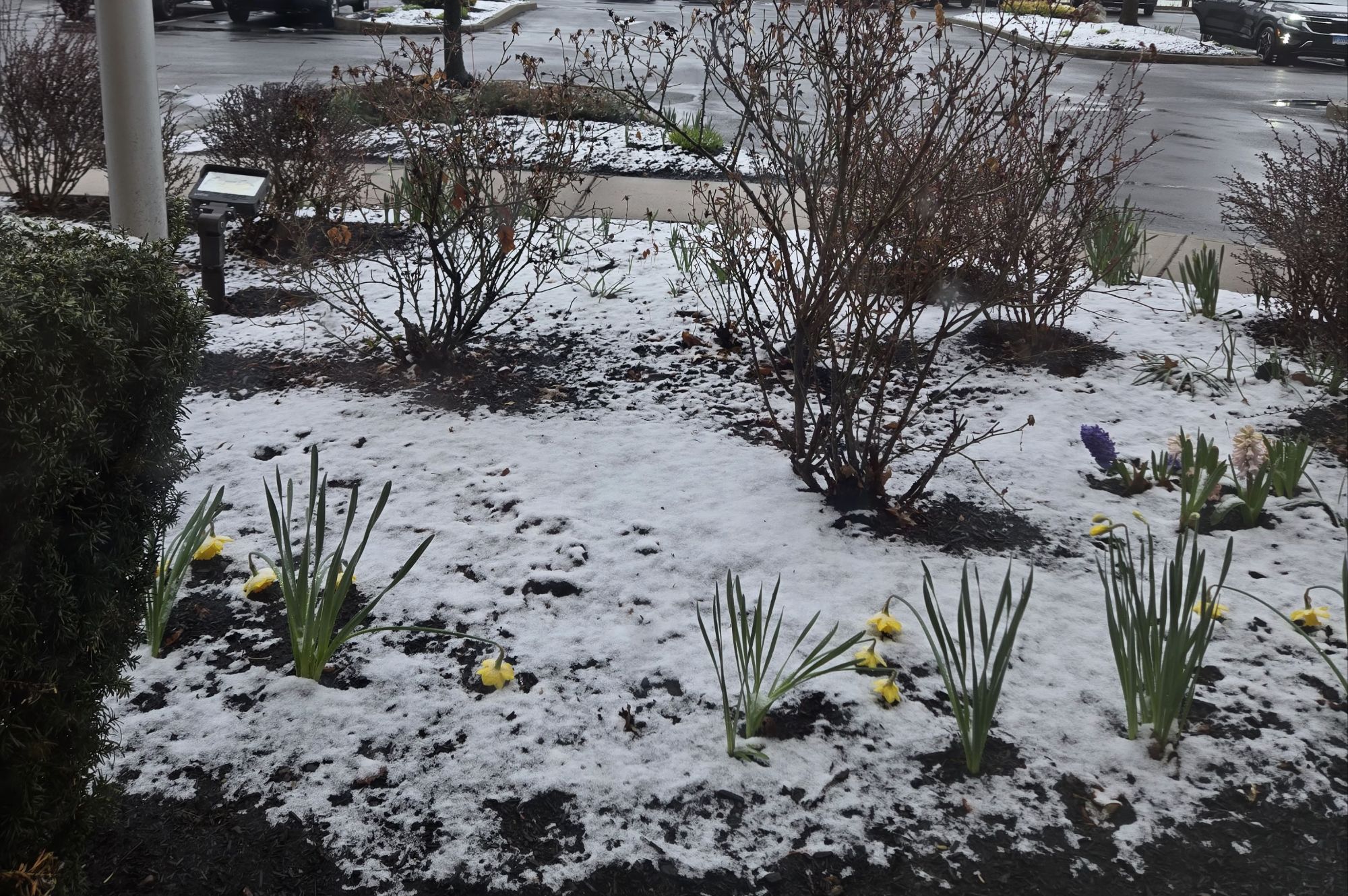
We had been so lucky. The first five days of 2025 had gone by, and there had been no snow. But now it’s caught up with us. You can see from the picture below that we have about five inches or so on the ground, it is 9 a.m., and the snow is supposed to continue until about midnight.
You ask why is all of this snow falling? I do not assume that it is coincidental that today is the day that the day that Congress is to certify Donald Trump’s victory, and that it is crucial to beef up security around Washington to keep all of those MALA (Make America Little Again) Harris supporters from rioting to keep the Congress from doing what some people (i.e., the MAGAs) believe they should do. We shall see what happens, but I understand that millions of Democrats are massing in the DC metropolitan area, and were it not for the snow, were preparing to accost the Capitol to disrupt the proceedings. After all, isn’t that what Americans do?
Okay, let’s turn the page on that. What does a lot of snow remind me of? First, let it be said that I remember no snow storms when I was young. That includes the major Thanksgiving snow storm that was apparently raging the night I was born. The first snow storms I actually remember took place when I was in high school, and I remember hiking from my high school home in what must have been almost a foot of snow, a distance (thanks, GPS) of 3.9 miles, with no sidewalks. Then, I remember the snow storms during college and law school, which I remember we basically just ignored.
Except for one. That was freshman year at Harvard 65 years ago, when my still friend Larry Gillis invited a bunch of us to go to his family’s summer cabin in Derry, New Hampshire for the weekend. It sounded like a great idea, and we plowed through the snow looking forward to a beautiful New England winter weekend. What we did not know was that the cabin had not been winterized, and that there was no heat, and no electricity, and no running water.
And then there was that Veteran’s Day in the late 1970s, when I don’t think there was a forecast for a lot of snow (after all, it was early November), and I had a meeting with a client somewhere off I-66 in Fairfax County. It started to snow, I did not worry, and I had no idea that when I drove down the ramp to get onto the interstate, that I would be on that highway for about three hours, with no opportunity to get off. Did I say three hours? Maybe it was four. Or five.
Before 1986 when changes were made to the tax laws, you could close a real estate transaction as late as December 31 and take tax benefits for the full calendar year. Sometime in the early 80s, I was in Buffalo for a closing that needed to take place before year end. It was quite a complicated transaction – the purchase of and arrangement of rehabilitation funding for an assortment of residential buildings under a HUD low income rental housing program. There had been all sorts of issues delaying the closing, and we were working through them one by one, facing a deadline of December 31 for the closing. On the 30th, the snow began to fall. But, after all, it was Buffalo. Big deal. Except it turned out that it was. It was a major snow fall, and mid-morning on December 31, both the federal government and the City of Buffalo announced that offices would be closing (I think “in an hour”) and that everybody should leave. Now, we were almost finished with the closing. I think everything had been signed, or would be signed before the HUD office was abandoned, but we had to get a deed (or I think it was multiple deeds) recorded by the end of the day, and the Recorder of Deeds had announced they were closing. You wonder what happened? We did get it done, with the Recorder (I don’t know that was his actual title) agreed to stay behind in his closed office to record the deed. And, while we had been panicking trying to get everything accomplished, what did most of the younger (I was then younger) HUD employees thinking about? Not getting home and hunkering down. They were all excited about the possibility of getting in some unexpected skiing.
And then there was what was meant to be a day trip to meet with a client in Bluefield WV. It was a warm winter day, and I remember that I did not even bring a heavy winter coat. I had an early evening plane back home, but after lunch, snow began to fall. And fall. And fall. Then, the airport closed, and I made arrangements to spend the night. Luckily, there was a small restaurant across the street that stayed open, although I think I might have been the only customer. The next morning, the very small airport was still closed, but the roads looked okay, so I thought I would rent a car and drive to Roanoke where the airport was functioning. Except that the only place you could rent a car in Bluefield was the airport. I was in the motel for two or three nights, my only company being the Winter Olympics on TV.
Some other snow surprises? One was exploring the Big Island (“Hawaii”) on our 30th anniversary trip to the furthest west and southern state and discovering that there was snow, and a lot of snow, on top of Mauna Kea, while it was 80 degrees below. And, in 1972, I remember a similar shock when I drove up a mountain road near Granada, Spain, in early June and I found myself surrounded by snow which was deeper than I was tall.
When I was a practicing lawyer, I made it a point not to let snow stop me from collecting my hourly rates. And I remember many times trudging to and from the Van Ness Metro station and our house, a distance of about three quarters of a mile, through dirty snow banks. And I certainly remember those few enormous snows that we have had in DC, to which I am sure today’s snow will not compare.
At any rate, no problem. As they say, “This too will melt.” But not soon.
There had been a shop called, for some reason, Catch-Can about a mile up Connecticut Avenue from our house, which Edie used to frequent infrequently. I was never really in the store, but I think it specialized in what I would call women’s dressy casual (emphasis more on the casual than the dressy) clothes. Several years ago, it closed, and the owner left DC and move to Chestertown MD, in the northern portion of what is known as the Eastern Shore of Maryland, and opened another shop called, for some reason (and probably not the same reason), the Bohemian Trading Shop. Edie recently got a notice that the owner was retiring and closing that shop as well, and thought we should go to their going out of business sale and accomplish two things at once: (1) maybe buy something, and (2) see the store before it closed.
Chestertown is about and hour and three quarters from here, and we got a rather late start, leaving the house about 11:30. The drive takes you out Route 50 past Annapolis, and over the Chesapeake Bay Bridge.
Digression: We had not crossed the Bay Bridge since before the pandemic, and I must admit to have been very confused. There used to be toll booths, where you paid for your passage. Now, of course, you can use EZ-Pass, and I expected to see the toll booths with separate EZ-Pass lanes. But there aren’t any toll booths. You just keep going. And I didn’t see any obvious EZ-Pass cameras that you went under, although I did see some EZ-Pass signs that I paid no attention to. So, how does this work? Did they capture my EZ-Pass, or am I going to get a bill based on my license plate, or what? I admit to confusion.
Any way, you cross the bridge (always fun) and stay on Route 50 across Kent Island, but when you get to the fork in the road, you don’t go to the right like you are going to the beaches, but you turn left and head north. Between that fork and Chestertown (probably about 20 miles), you pass one other half-way sizeable town, Centerville, which I admit I knew nothing about. It’s the county seat of Queen Anne’s County and has been around for well over 200 years. We saw some nice houses, and as we passed the main square and Court House, and we thought (i.e., I thought) about stopping for lunch, because it was lunch time, about 1 p.m.
I looked at Yelp and saw there were a number of restaurants with good ratings, and when we passed the Alibi Gastropub, I pulled over. Here we are in this small town, and the Alibi, with a 4.6 Yelp rating, has quite a menu. We didn’t stop, and went on to Chestertown (15 miles more), but I do want to comment on the Alibi’s menu, which included wild boar meatballs (how have I gone through 82 years without ever having wild boar meatballs?), and a BLT with an added treat of pork belly (another meal I have foregone all my life). Yes, it had other things as well, and the next time I am in Centerville, that’s where I will go, but not yesterday.
OK, on to Chestertown. I must admit that the stop at Bohemian Trading was pretty much a bust, and that Chestertown, a very scenic, old town (population about 5,000) on the Chester River, deserved much more time than we had to give it. It was first settled in the 18th century, has a very nice upscale business section and more old houses than any city in Maryland other than Annapolis. If you Google it and see how many historically recognized homes and commercial buildings are there, you will be surprised. But it was 1:30 before we got there, and 2:30 before we finished our lunch, so we only had time to stop at Bohemian Traders and, of course, the local used bookshop, which is large, well stocked, attractive, well lighted, friendly, and not cheap. But certainly worthwhile visiting and patronizing.
But what I really want to tell you about is the restaurant we chose for lunch – the Watershed. In an old-looking downtown building, it is sleek and modern inside. It has an exceptionally friendly young staff, and is clearly a place for evening “fine dining”. Edie had an ahi tuna salad, with six or seven slices of perfectly seared fresh tuna over a delicate green salad. And I had perhaps the best “frittata” I have ever had, although it could have been easily called a quiche. A perfect mix of eggs, two cheeses, potatoes, herbs, and a little chorizo. Served with the same salad and a just-right dressing. And, yes, there was no wild boar on the menu. But on the other hand, there was pasta with rabbit. And they have bison on the dinner menu.
The other thing about Chestertown? As you can see, they do not charge you $2.50 an hour to park.
It is Saturday morning, and Washington DC has not had a really serious snow for several years (my sole reference is my memory). But now it looks like we may be in for it. Why we aren’t skipping town while we have a chance, I don’t know.
The forecast is for about 24 hours of snow beginning some time Sunday night, continuing throughout Monday. We are in a band of a predicted four to eight inches. That may be bad enough, but the temperatures are not expected to exceed freezing (either Fahrenheit or Centigrade or even Celsius – I checked all three, as you might expect) for the next ten days, at least. So, the snow looks like it will stick around. I bought a new long handled car scraper (our former garage is now a room), and twenty five pounds of something to put on our front sidewalk and driveway.
But our general informal house rule is not to venture out unless we have to if there is danger of ice or slippage. As to shoveling, although our two children volunteer, we normally either do it ourselves if it is easy and flaky (which this probably will not be) or someone will knock on the door and make as an offer that we probably should, but probably will not refuse, to shovel the walk and driveway and shovel out the cars. I know this is a minor problem, as problems go, but when you get to be a certain age, you can’t be too careful, can you?
At any rate, right now the weather is coldish out (30 F), but sunny and clear, and it should stay that way over the weekend.
Changing the subject: you know who Henry Morgenthau, Sr. was? Not Henry Morgenthau, Jr. who became Roosevelt’s Secretary of the Treasury, but his father, a German Jewish refugee who became a lawyer and real estate entrepreneur in New York City and made a fortune? Born in 1856, he was 10 when his family immigrated to the U.S. and he lived for more than 90 years, dying in 1946. He was Ambassador to the Ottoman Empire during World War I, from 1913 to 1916. Interestingly, of the three preceding American Ambassadors to the Ottomans, two were Jewish (Oscar Straus and Solomon Hirsch), the idea being somehow that a Jewish ambassador could best work with the Muslim Turks. As Ambassador during the war years, he was one of the first to call out the mass murdering of Armenians and Greeks by Turkish forces, calling it one of the worst crimes in all of history.
He wrote his memoirs, a book called All in a Lifetime, published by Doubleday in 1922, after his time as an American diplomat. The book is very difficult to find, and I happened upon a copy several years ago. Not only a copy, but one inscribed by Morgenthau, referencing his trip to Palestine when he was Ambassador in Istanbul. The book is inscribed to John D. Whiting, who was an American photographer living in Jerusalem in what was then known as the American Colony. (See the photographs at the end of this post.)
Henry Morganthau, by the way, was the father of Henry, Jr., who became Franklin Roosevelt’s Secretary of the Treasury (Morgenthau, Sr. was appointed Ambassador by Woodrow Wilson), and who was active in Jewish affairs during and after World War II. He was a very interesting man, as well, and worth looking into. Other Morganthaus, Henry Sr.’s grandchildren, including long time (35 year) Manhattan District Attorney Robert Morgenthau and writer and historian, Barbara Tuchman.
Why am I telling you this? Not only because it is all interesting, but because I just sold the book to a prominent London book store, “Peter Harrington”, which you may know. I brought the book to be shipped this morning from our local post office. Because the book was fairly pricey, I wanted to make sure that it was properly insured before it left on its international journey.
Now, I will say that we have been shipping books out for almost 15 years and have shipped over 3,000 here and there. And only once has there been a loss or damage problem, and that was last year, another valuable book, and also a book which we shipped to the U.K. That book was titled The Secret State and it was double signed and inscribed, in Polish and English, by Jan Karski, a Polish-American who had gone back to Poland and, dressed as a Nazi soldier, entered Auschwitz, learning it was death camp before than was widely known, and who reported that back to the American authorities and was basically ignored.
When we shipped the Karski book, I insured it for a few hundred dollars and the book was badly damaged en route. The U.K. authorities said that it was damaged when it was turned over to them by the U.S. Postal Service. I was told that I was going to have a hard time collecting on the policy, but when I presented the material the buyer and I were able to put together, without a delay the Postal Service sent me a check for $200, the proceeds of which I gave to the buyer to cover some of his loss.
Today, when I went to mail Morgenthau to London, I was told that insurance was not available on the parcel. That, if I wanted to send it, it had to go as it was, without insurance. The clerk, with whom I deal with fairly regularly, showed me his computer screen which said that insurance was not available.
What to do……I think in normal times, I would have held onto the book and researched further, but because of the coming snow (aha, you say, here is the connection between Morgenthau and a snow storm), I was afraid I was not going to be able to get to the post office early last week and I didn’t want to delay it. So, out it went.
Hopefully, I will get a nice note (“it got here safe and sound”) from Peter Harrington in a week or so. If not, a big loss (book and money) to start 2025.
By the way, in case you are concerned, the buyer knows the condition. He also knows how to restore it .
For the last several years, when I eat at, or carry out from, restaurants, I try to keep track of them and give them a rating of A through C. C is my version of F.
Last year, I recorded 67 dinner, and 133 lunches. Here are the A+, A, A- and B+ restaurants of 2024 in both categories.
Let me start with two restaurants that I have been to more than once, and that earned consistently high ratings. The first is Cafe of India, on Wisconsin Avenue, just a block south of Fessenden, five minutes from our house. It is where we carry out our Indian food from, and it never (well, hardly ever, disappoints). The other, a Mexican restaurant near daughter Michelle’s house is Villa Maya, located in Rockville in the shopping center at the corner of Norbeck and Bauer. It’s good for food, drink and atmosphere.
I should also say that I keep track of those relatively few times I go out for a real breakfast and that I have been to First Watch in several places around the country. There is no location near our house, but I understand there is one in Gaithersburg and a new one on Colesville Road just east of New Hampshire. I give First Watch an A whenever I have gone – whether it’s Bowie MD, where I have an annual lunch with two of my college roommates, or Virginia Beach, where we ate with a one second cousin, and two second cousins, once removed, or Indianapolis, where we had a different cousin lunch some years ago, or St. Louis.
Okay, let’s dig in:
(1) Java Nation. I like the food at the original location in Kensington, although the larger branch on Rockville Pike is good for something light. This is a lunch, not dinner, spot, and I suggest their Greek omelet.
(2) Sushi Toro. Perhaps I should have included this in the opening paragraph and made it three to start. This is a small restaurant located in what is still called the White Flint shopping center on Nicholson Lane, a short distance off Rockville Pike in North Bethesda. There are only about a half dozen tables (it does a big carry out business), but it is comfortable and the sushi, whether you get the simple, traditional kind, or the Americanized combinations are all very good, and reasonably priced. Oh, yes, closed on Tuesday – something I have forgotten twice.
(3) Ambar. I know there are two of them, one on Barracks Row on Capitol Hill, and one on 7th Street, north of Massachusetts Avenue. We had a very nice dinner one night, wandering in by chance with granddaughter Joan. Have not been back since, and that has been a mistake. Yelp gives it a 4.8. That’s quite high.
(4) Ada’s. Not Adas, the synagogue, but Ada’s on the River in Alexandria. I had lunch there with a former law partner. Pricey for lunch, to be sure. I think I spent over $30. But excellent food, service and view. (And there were a lot of people there paying that price.)
(5) I’m Eddie Cano. I have to qualify this one a bit. This is our neighborhood Italian restaurant, located on Connecticut Avenue, three blocks from our house. And the food (try to eggplant Parmesan and the swordfish) has been very good for some years now. We both eat in and carry out. My qualification is that our last carry-out did not meet expectations or previous experience. I keep it in the list, but it’s also on my watch list.
(6) Gourmet Asian Bistro. You probably haven’t been to this innocent looking restaurant in a small shopping center in what I think is Derwood MD on Muncaster Mill Road. It’s near my accountant’s office and I have eaten lunch there twice when taking things out to her. Both times were excellent and, again, the Yelp rating confirms it.
(7) Izumi. Izumi is a new Japanese restaurant that opened up this year in Adams Morgan on Columbia Road. We have had dinner there twice, and I had lunch there once. Each time, very, very good. Parking? You have to be lucky. We have been.
(8) Maya, Not to be confused with Mexican Villa Maya, Maya is a Nepali restaurant located on Wisconsin Avenue in Bethesda, just below Montgomery Avenue. We were there two or three times this year, and have been there before. All good. Try their vegetarian Thali platter. The word “maya” in Nepali means “love”, we were told.
(9) Amparo, on P Street in the Dupont Circle area is a very trendy and expensive Mexican restaurant, opened a year or two ago by the son in law of friends of ours. It has (to my mind) a very unusual menu, and you have to go with the idea that you are going to try something new. And you should, but bring your wallet; this is not Tex-Mex.
(10) Spring Garden is a carry out (with a few tables) restaurant on Wisconsin Avenue across the street from Cafe of India. It is a go-to place for me, and I generally carry out. Have been there many, many times – never a bad meal.
(11) Moko Sushi is another Japanese restaurant and another restaurant in the shopping center that houses Villa Maya. Very comfortable, a little more upscale than Sushi Toro, and just as good.
(12) Jyoti, an Indian restaurant and an old standby, located on 18th Street in Adams Morgan. Had lunch there this year, and found it just as good as it was years ago, when I used to carry out on my way home. A little more expensive, perhaps, than similar Indian restaurants, but….only a little.
(13) Shanghai Lounge. Looking for a small, unpretentious Chinese restaurant on Wisconsin Avenue south of Glover Park and north of Georgetown. This might be what you are looking for. Very friendly. Only about a half dozen tables. A friend and I use this as our regular four or five times a year lunch spot.
(14) Buck’s Camping and Fishing. I did it again. This should have been at the top. We had a number of dinners here this year, and each was excellent. This is our neighborhood almost normal and trendy upscale restaurant, across the street from I’m Eddie Cano.
(15) Mother Earth Cafe. This is an unusual one. It is a very small unmarked place on 9th Street NW, just south of Rhode Island Avenue. I think only open for lunch, and probably breakfast. Owned by a very interesting and friendly man from Ethiopia, who has lived in more parts of the U.S than I have. Very informal. Very. Hardly a restaurant. You would probably never even notice if you walked by. Not even an identifying sign. Very good food.
(16) Ala is a new small plate Turkish restaurant in the building in Bethesda that used to house Portofino. It’s on Fairmount, north of Old Georgetown Road. Pricey. We had dinner here for Michelle’s birthday.
(17) Aventino in Bethesda, or Bethesda Avenue, but not on Bethesda Row. I did it again for the second time. This should have been at the top of this post. We have had two dinners there – about as good as you can get. Again, not cheap. Oh, yes, Italian, or is that obvious?
(18) Burton’s on Rhode Island Avenue in Hyattsville, MD, in the big, new shopping center on the east side of the street. I stopped there for lunch, concerned that it would be too formal and too expensive for just me, and I was pretty much right. But the quality of my food more than made up for it.
(19) Thai Kitchen in Bethesda, one of those many restaurants stretched out on Wisconsin Avenue that you pass, but never even think of going in. Maya, by the way, is the same in that respect. I had lunch here with another ex-law partner (I have many) only because there was a parking place in front and he has trouble walking. Surprisingly good.
(20) Pho Viet, a Vietnamese (duh!) restaurant on U Street NW. Actually, barely a restaurant. In order to get a seat, you almost have to agree to become intimate with anyone sitting in any of the other dozen or so seats in the restaurant. But what good food. I had lunch. Can’t imagine it’s open for dinner, but maybe.
(21) Yu Noodles on Gude Drive in Rockville. Had lunch with my daughter Michelle (a regular place for her). Interesting menu, not the Chinese food I am used to seeing. Highly recommended. We had lunch.
(22) El Golfo on Flower Avenue in Silver Spring. We go there for the food and the music, and are never disappointed with either. It’s just a typical suburban Salvadoran restaurant like hundreds of others in the DC area, except that the food might be a bit better. Big parking lot next door.
(23) Le Chat Noir. In the same building as Cafe of India on Wisconsin Avenue. We hadn’t been there for a long time. Went for my birthday. Excellent dinner. Quite French. Which means really good bread.
What am I leaving out? Most importantly, I am leaving out the many very good restaurants we have eaten at while on vacations. I might do a post with them another day – I didn’t want this one to be too long.
I will end with just one more place, because I think it may have been a quirk. A few weeks ago, I had no time for lunch and wanted to get a sandwich I could eat in the car. I had stopped at Strosniders in Bethesda (that’s a hardware store) to pick something up, and I just stepped into Edith’s Pizza (no relationship to Edith Hessel) and asked for a chicken salad sandwich on whole wheat to go. The sandwich was perfect. Perfect. The only word to describe it. Oh, on Arlington Boulevard on Bethesda – owned by the Edith who owns Breads Unlimited.
Now, it’s 2025 and I have to start all over. Don’t worry about me. Why, just yesterday I had an A level lunch at &Shwarma Crave (yes, that is correct) in the shopping center on Shady Grove Road that houses Wonder Books. I just picked it for no reason, ordered a chicken shwarma basket for $12, with rice and chicken and tahini and tomatoes and onions and red cabbage and corn and a garlic dressing. Wow, I said (to myself). Then I looked at Yelp. 4.7.
Mediterranean Crave?
And one other question. Why, next door, is there an elephant mural (and a good one) on the outer wall of a 7-11?
WARNING: this post is a downer. Skip it if you wish.
Maybe it is just me, but it seems that the year 2025 has started off with less fanfare than years previously. No one even asked me “Are you two going out New Year’s Eve?” My Facebook friends, who spread out Christmas and Hanukkah greetings, stayed silent for New Year’s Day. No one called. Nothing really seemed to happen. Even the Sugar Bowl has been postponed.
I am not sure why this is the case. I don’t think you can fully blame it on the election of Donald Trump, or on any one cause. It just seems like everyone is tired, just wanting to get on with it without stopping to celebrate or even to reflect.
Of course, the new year already shows the continuation of too many wars, in too many familiar places, and the fact that there were two terror attacks in the United States on News Year’s Day does not help. I know, there has been no official determination that either event was a terror attack, but just like my old friend Potter Stewart (of a few nights ago), I know it when I see it. And I don’t like it.
The attack in New Orleans shows us that the fear of Islamist zealots cannot be dismissed, the attack in Las Vegas shows us the danger of violence surrounding the Trump election cannot be overlooked, and so forth. We may really be in for it, and if the Middle Eastern wars continue, you have to add to that the possibility, or maybe even the probability, of antisemitic attacks, although the incoming government will be, I am certain, on the offensive against a continued rise in antisemitism. At least for now.
Every such incident, and you have to add to it all of the school related violence, leads to tragedies. Death and serious injuries, all of which have repercussions beyond the victims.
Then there are unexpected deaths that involve no violence. I read yesterday a death notice of a 50 year old rabbi, who headed the lower school of a prominent Jewish day school here for the past ten years or so. Today, I see expressions of sorrow from many institutions. It reminded me of the death of my sister’s first grade teacher in the middle of the school year. She was a young woman, who was perfectly healthy and who one day felt sick and who two days later was dead. Some sort of a virus or something that spread to her heart (I certainly don’t remember the details). I was in the 6th grade in the same school, and I remember the shock of this, something we never thought about happening, and how “gee, it could happen to me” spread around. Frightening for the children.
It also occurred around the same time that my grandfather passed away. I don’t remember which was first. His death, of a heart attack days before his 67th birthday, was also unexpected, and created a very unsettling feeling in 10 year old me. And, I remember overhearing someone talking that night, or the next, at the shiva, someone who said to someone else: “This was such a surprise; I thought it was she [i.e., my grandmother] who had been sick.” This remark sent absolute shivers down my back. If my grandmother was the sick one, and my grandfather died, couldn’t I expect my grandmother to go at any time. (In fact, she lived another 16 or 17 years.)
It’s just that these things are so difficult for children to absorb. But, yes, they cope and they get over it, and it probably doesn’t affect them badly as they grow up. And we adults get used to everything, right? But when tragedy comes so often, and when it coincides with a new year which should bring promise and optimism, I think it is that much harder.
Jeez, Arthur, get over it. The sun is shining (sort of) and it’s already Jan 2. Stand up, breathe deeply, and get moving.
Let’s start with Happy New Year. I must admit that, so far, 2025 does not seem that different from 2024, but then again, there are 364 and 2/3 days to go, so I don’t want to judge it prematurely. As for 4050 years ago, Google’s AI (which I neither like nor trust) tells me that “Assur became an independent city-state after the collapse of the Third Dynasty of Ur.” As Longfellow said about that event: “…..Hardly a man is now alive, who remembers that famous day and year.” Assur, by the way, according to Wikipedia (which I do like and do trust), is located about 60 miles south of that formerly evil town of Nineveh, and was an active city for about 3000 years, with a population that at times was under 10,000 and at times over 100,000.
Getting closer to home, there is big news in Washington DC. No, not that Donald is returning to town (he’s making a list, checking it twice), but that it is now illegal to turn right on red anywhere in Washington except where there is a sign telling you that you can turn right on red. And, as of today, there are no such signs. So, as of now, you can’t turn right on red without breaking the law, even though the city (maybe the police) said that they won’t enforce it now, until more people become aware of it.
This, of course, is a big change and, particularly in a city where there is so much transient traffic, and in a country where virtually everywhere else, I think, right on red is both legal and encouraged by the guy behind you, things are going to feel a bit out of joint. Until midnight last night, right on red was legal unless there was a sign (now worthless, it appears) saying you it was forbidden.
It is also true (at least I think it was true from my own careful experience) that drivers turned right on red, even if there was no sign telling them they could not. My guess is that this universal right on red philosophy will continue, even though the law has turned everything upside down. The police, it seems, have better things to do that look for traffic violations. We will see how all this plays out.
Digression: remember the Woody Allen film where he compared New York City to Los Angeles and concluded that the only advantage to Los Angeles was that you could turn right on red? I think this was when right on red was a new thing, and if I recall started in California.
If you remember, yesterday I talked about the film The Six Triple Eight (you should see it) and how it was to be the last film we watched in 2024. But, as usual, I was wrong. Last night, with our house guest friends, while the fireworks were going off in parts of the world closer to the Greenwich Means Line, we watched Maria, the biopic about opera great Maria Callas. Like The Six Triple Eight, Maria is on Netflix.
I thought that Maria was mesmerizing. Angelina Jolie plays the role to perfection. She did not appear to be Angelina Jolie at all, and especially because she was able to do some singing herself, she appeared to be a somewhat more attractive Maria Callas herself.
It’s an unusual film in a number of ways. First, it adopts a slow, easy going rhythm that is maintained throughout the film. I know you don’t know what I mean, but you will when you watch it. Most films have exciting scenes, followed by a slower scene, followed by a tense scene, etc. But this film sets a certain rhythm which is never altered. It just carries you along.
It is also unusual in that this is a film which is focused on the last week of Callas’ life. She died at 53 in her home in Paris after some years of dealing with a failing voice, loneliness, and too many medications and drugs. By concentrating on the last week, the film is also able to get into Callas’ mind as she flashes back to earlier times in her life. The advantage here is that the writer got to pick and choose what to show. It is not a full chronological biography where you can’t afford to leave anything out. It is simply a flash back to particular events which, presumably, could have been on Callas’ mind as she knew her end was nearing.
But you certainly get the main points. A very unhappy upbringing with a over demanding and morally corrupt mother, a marriage to a much older man who presumably meant little to her, and a long affair with Aristotle Onassis, who refused to marry her, and who dropped her for Jackie Kennedy. In a recent biography titled Cast a Diva by Lyndsy Spence, the focus is on the abuse, physical and emotional, she endured throughout her otherwise starred life. In Maria, the physical abuse plays no role.
In her later years, her companions were her two employees, her housekeeper/cook, and her butler/chauffeur. Although Callas died in 1977 (two years, by the way, after Onassis’ death), both Bruna and Ferruccio are still alive, and at least he (now 91) was able to help the director make sure that the portrayal of the failing Callas was accurate.
One last thing about the film. Not surprisingly, it is filled with music, with music from recordings by Callas of some of the arias which made her so admired. This alone would make the film worth watching. And kudos to Netflix’s captioners (if that is what they are) who, in addition to showing the dialogue between the characters in the film, identify each piece, and show the words (in the original languages) as they are sung.
All in all, a great end to a year that the word “great” cannot be attached to.
It is now 11 a.m. in the East, and we have 15 guests coming for a New Years brunch in about 30 minutes. Edie has been hard at work since we got up. It’s time for me to do something too. Quickly.
(1) And first…..time for resolutions. You may recall that I made a New Years resolution in October, on Rosh Hashanah. My resolution was to read the Arts section of the New York Times every day. My goal was to become a little more up to speed on current culture. So far, I think I only missed one day of reading the section, but I have had to make some compromises. For one, since I have never played a video game and don’t think I ever will, I decided I didn’t have to read reviews of video games. I think that was a good decision, but it does compromise my resolution, to be sure. But, I figured, after all, this was a Rosh Hashanah resolution, and I am not Orthodox. I can compromise.
And it probably was a better choice that getting an M.A. in Contemporary Culture from Bowling Green University.
And here it is, time to make a resolution for 2025. I have thought long and hard about this one, have changed my mind several times, but finally have focused on something that I think is attainable. I resolve: to win a billion dollar lottery in 2025. That’s it. I ask for nothing more.
(2) Last night, we watched The Six Triple Eight on Netflix. I would recommend it, but not for the usual reason you recommend a film. As a film itself, it is good, but not outstanding, in my opinion. As a rendition of a true story that you probably know nothing about, it is a very important film and you should see it.
The “Six Triple Eight” was the name of a Women’s Army Corps battalion in World War II composed of African Americans. It was the only such group of African American women (some 800 strong) to be sent overseas, where it was given the task of clearing a backlog of over 17,000,000 pieces of mail to and from troops in Europe which the military had failed to deliver. The women cleared the backlog in 90 days, half of the time allotted to them for the task.
Remember the following: First, like all wars, World War II was awful for all troops fighting it. Second, the American military was fully segregated. Third, it was in fashion for White Americans to believe that Black Americans were inferior in every way, and that Black women were the most inferior of them all, and it was in fashion for White Americans to express their views publicly, both to each other, and to the Black Americans whose qualities were being questioned. Fourth, many or most White American soldiers lived in segregated parts of America, where bathrooms, lunch rooms and water fountains (not to say theaters and schools) were fully segregated.
This is all to say that the women making up the “Six Triple Eight” had a lot to overcome. And overcome they did.
The two leads, Kerry Washington playing the officer leading the batalion
The two leads, Kerry Washington playing the officer leading the battalion, and Ebony Obsidian, a young actress playing a member of the battalion whose White, Jewish boyfriend had been killed in battle months before, were both outstanding. Oprah Winfrey had a small part in one scene playing Mary McLeod Bethune and did her typical fine job. A casting mistake was made, I believe, when they decided that Eleanor Roosevelt should be played by Susan Sarandon, and another when Sam Waterston was cast as FDR, but the roles were small, and so was the amount of annoyance.
Obsidian’s character was named Lena Derriecott, and the real Lena Derriecott lived long enough to act as an advisor on the film to ensure (so it is said) that everything was accurate, and to give a wonderful coda to the film at the end. Derriecott passed away during 2014, just shy of her 101st birthday. The film also ends showing Michelle Obama giving an award to the battalion, and showing actual black and white footage from the war years.
(3) For my last book of the year, I chose one that (what’s new?) no one else has probably ever read. It is called Moses Hess on Religion, Judaism and the Bible, and was written by a Swedish professor of Jewish Studies, Svante Lundgren, in 1992. Hess was born in and lived in Germany in the 19th century, and while no one ever really heard of him (that would include me), he is worth learning about.
I am not going to try to tell you everything here, but let it be said that Hess was Jewish (and Jewishly educated), a Spinozan pantheist, a sometime Christian, an Atheist and a born-again Jew. He was a socialist, and a communist, and a friend and collaborator of Marx and Engels (he used the term “opiate of the people” and “from each according to his ability and to each according to his need” before Marx did). He was also a Jewish nationalist (adamantly against American Reform Judaism which denied that Judaism was anything more than a religion) and friend of Herzl. He believed that Christianity was better than Judaism to the extent that it was universal, while Judaism tended to push away non-Jews, but thought that Judaism was better than Christianity because it was a communal religion, while Christianity was an individualistic religion. He blamed the concept of Christian individualism as being the cause of capitalism, which he believed to be destructive of ideal human societies. He thought that one day, the Jews would have their own state, that it would be socialistic (which it was at the start), that Hebrew would be the language (no one else thought this at the time), and that indeed it would be a light to the nations. He believed in a Messianic Age, nit in a personal messiah.
That’s my summary. You can see why, as to Moses Hess, attention must be paid.
Leopoldstadt closed yesterday at Washington’s Shakespeare Theatre, and we saw the matinee performance. I went into the theater expecting to love Leopoldstadt or, if that was too great an expectation, I expected to find it an impressive work of art.
I am not an expert on playwright Tom Stoppard (or Sir Tom, if you please), but the two of his plays that I remember having seen, I did love. One was Arcadia, that we saw years ago in a wonderful performance at the Folger. The other, Rosencrantz and Guildenstern are Dead, I have seen maybe more than once, although I can’t tell you when or where.
Leopoldstadt, I should say at the beginning, won the Olivier award for best play in 2020, based on its London opening, and won a Tony for best play in 2023, after it opened on Broadway. So what’s not to like.
It’s the story of a Jewish family (yes, some members had converted to Christianity, presumably for other than spiritual reasons, and others had intermarried) in Vienna, following them from 1899 through World War II when most of them perished, and featuring the reflections of three who survived the years of the Holocaust. Stoddard has said that the play, which he found difficult to write, was partially autobiographical (his four grandparents were all murdered in the Holocaust), but that he placed the story in Vienna, rather than in what was Czechoslovakia where he was born.
He was born in 1937, and the next year went with his family to Singapore. His father was a physician employed by Bata Shoe Company, whose owner transferred its Jewish employees out of Czechslovakia when the Nazis moved in. His father soon died, and his mother moved the family to India when Japan occupied Singapore. He went to school in Darjeeling and his mother remarried a British officer, a man named Stoppard.
Before I tell you what I didn’t like, I should tell you that I was surprised when we picked up our programs as we were led to our seats. You know the insert where any cast substitutions are listed? Well, the programs had such an insert, showing us that five (that five!) of the primary actors (and about 15 individual roles, since many actors had multiple roles) were being played by understudies. Whether I would have enjoyed the play more with the original cast, I don’t know, just as I don’t know when the understudies first played these roles. Was it just for today’s performances, or have these substitutes been in place for weeks? And, I should add that four of the five had previously been in the cast for Leopoldstadt in Boston at the Huntington Theater.
The main problems I had with the show were with (1) the script, (2) the acting, and (3) the directing. I also was not happy with the set, or the loud recorded intermittent music. Let’s take them briefly, but one at a time.
The script. The script part conversation, and part (probably the greater part) didactic lecturing, like you were in a college class. Yes, it was one character talking to another, but that was incidental. You heard that the Austrian empire had opened itself up to its Jewish citizens and that would never change. You heard about Herzl’s plan for a Jewish country of its own, and how some people just weren’t happy even thinking about moving to a desert. You heard about what was going on in Germany, then about the Anschluss, then about Kristallnacht, each in the form of what were basically monologues. As to the conversations beyond the monologues, I thought the words all sounded like they were scripted; little of the conversations seemed natural.
The acting. As I said, most of the prime actors were stand-ins, and I don’t know if this affected the way the play came across. Or maybe it was because of the stiffness of the script. Whichever it was, each of the actors seemed like they were doing just that – reading a script, acting. There seemed to be a disconnect between the actors and their roles. Even the young children (there were about a half dozen of them) seemed stiff in giving their few lines. It just seemed below par.
The directing. I am on less firm ground speaking of this, but the stage is very large, and everything takes place inside rooms in a home. Except in the few scenes with big family crowds, the actors were often too far from each other, and had to take large strides in rooms that should have been a bit more homelike. Also, because this is such a talkative play, with so much of it seeming like a series of lectures, you would think that talented directors would come up with ways to humanize these segments. But perhaps it’s impossible. The result was that Leopoldstadt, except for one scene where the gentile wife of the then Jewish paterfamilias culminates an affair with an Austrian dragoon, is the least physical show I have seen in a long time. I want to say one more thing about that seduction (if that is the proper word) scene. Apparently the result of this dalliance (and there was a hint that this was not the only time the two were together) a son was born (it was 1924), who was raised as the son of the husband of his gentile birth mother. When the Anschluss with Germany occurred in 1938, the presumed father turned the family business over to his son. When a Nazi representative told the father that he had to sign papers turning the business over to the State, the father had no problem signing. He later told the family doctor that he had no problem doing this because he had previously turned the company over to his presumed son who was the product of this dalliance and therefore was an Aryan, not a Jew. It just seemed a bit hokey to me. Not possible.
Well, that is my brief and disappointed review. The audience seemed appreciative. But we met friends in the lobby after the show. And guess what? They agreed with me. And I met an old acquaintance and his wife on the Metro platform coming home. They did not agree with me. They liked it, but they said they have spoken to several of their friends who felt like I did.
So was it the play or the production? I will never know because, even if given the opportunity, I do not want to sit through it again.
Oh, I didn’t mention the music. I will just say it was overdramatic and unnecessary.
(1) Chef’s Surprise! We had dinner last night at Aventino, the terrifically, very good Italian restaurant in Bethesda. When it came time for desert, the menu listed several enticing gelati, including a very enticing flavor -“Chef’s Surprise!” -, which I ordered. Our waitress asked me if I wanted to know what it was before it came, and she was very, very pleased that I didn’t. I really didn’t. When it came, Edie and I puzzled over its excellent, but unexpected taste, and couldn’t identify it.
I asked the waitress to finally let me in on the secret. The flavor was chestnut, and in the gelato were small pieces of candied chestnut. Next time when I see “Chef’s Surprise!” on a desert menu, I will know what to expect.
Now that that mystery has been solved, does anyone know what soup de jour is? And how all the chefs in the world learn what it is, so that they will know what to serve every day?
(2) Ballet. One of my final books of the year 2024 was Six Curtains for Stroganova by Caryl Brahms and S.J. Simon. You ask how I chose that book. For one thing, it was staring me in the face on the top of a pile of Penguin paperbacks. For another, it was only 191 pages long. And, finally, I am a sucker for most anything that smacks of Russia.
The book was written in the 1940s, when the Soviet Union was an Allied partner, and is a very, very clever (sometimes laugh out loud – except I don’t) satire. It takes place around 1900, when Russia is still Russia. Vladimir Stroganov (grandson of Moishe the money-lender, and son of Moishe’s son) is a pampered young man, whose family in Omsk has given him enough money to permit him to create a ballet company. Natasha is a young ballerina, with a very pushy stage mother. Vladimir falls in love with Natasha, Natasha’s mother (known only as “the mamoushka”) falls in love with Vladimir’s family’s money and Natasha goes along for the ride. Vladimir and Natasha marry, and Natasha announces that Omsk is not good enough for her, that she wants to go to St. Petersburg, be the lead ballerina in Vladimir’s company, and be so loved that she gets six curtain calls.
They all move to the capital. Vladimir rents a theater shared by a circus. And things go wrong from there. Vladimir’s biggest competition is the real Serge Diaghilev. And the competition is cut throat. Equally cut throat is the competition between Natasha and two better known ballerinas for the top roles in the two companies. And then there is the new potential backer, who has a lot of money when Vladimir’s money is running low, but who also has his own “Natasha”, who can do everything but dance. The mamoushka butts in continually. But who turns out to be the most powerful? Perhaps the otherwise unknown woman who is in charge of the curtains.
It is all great fun. I recommend it. If you can find it.
(3) Korea. From a satire on ballet, I went to the opposite extreme for my next book, Philip Deane’s Captive in Korea. Deane was a Greek born newspaper reporter, working for an unnamed newspaper (I think it was the London Observer) and sent to Korea in 1950 to cover the war. His description of Korea as a backwater occupied by the poorest of the poor, the hungriest of the hungry, and the most wretched of the wretched, certainly contrasts with the Korea of today. The description of the war conditions he sees in his early days there are hard to comprehend. And then he is captured by the North Koreans.
He is in their custody for over two years, kept not with the military POWs, but with civilians – journalists, diplomats, clergy, professionals and so forth. Always on the move, never properly clothed, generally freezing (really freezing) or too hot, starving most of the time, wounded, sick with no medical care. Conditions so bad that you would think that most of the prisoners would die. Which they did.
We fret about the wars going on in Ukraine and the Middle East (and if we are really sensitive, also about those chronically raging in parts of Africa), but they may pale in comparison with Korea. In the three years of the Korean War (a war which ended with an armistice still threatening to explode 75 years later) which accomplished absolutely nothing, Google’s AI tells me that 3,000,000 people (military and civilian) died. Can you even imagine?
Do I recommend this book (also hard to find, I am sure)? Yes, if you want to read about absolute misery. No, if you would rather read a satire about ballet.
(4) Potter. I had a hard time sleeping the night before last, and when I actually fell asleep, I had several dreams. The one that stuck in my mind? I was a relatively young man (as I usual am in my dreams), living in a large house with a bunch of others, and I decided I wanted a coca-cola. So I went to the corner store, bought a chilled bottle (the vendor apologized profusely for having to charge me $4) and took it to the park nearby, where I sat on a bench. A couple sat down next to me, and the man held out his hand and said “Hi. I am Potter Stewart”.
I was shocked that I had met a Justice of the Supreme Court in my neighborhood park, and reported it back to the people with whom I shared the house. One of them said to me: “That’s impossible. He’s dead. ” I said: “Yes, I know he is. But he’s also in the park.” Stewart died in 1985.
Last night, by the way, I recall an equally strange dream. I was talking to friends, but decided I needed to take a walk to get a little exercise. I told them I was going to go up Connecticut Avenue “to the Circle” and come back. On my walk, I saw a vacant lot on the east side of the street (in real life, there are no vacant lots there), and I was surprised at how empty it was. Next to it was a sign “COMING SOON: 5 NEW SHOPS”. That surprised me, too, but not nearly as much as when I looked back at the vacant lot and discovered that it was no longer vacant, but now held 5 new shops. “SOON” was an understatement.
That’s it for this morning. Two days left in 2024. I think I will start my yearly recap tomorrow.
I am asked that question quite a bit. Most recently, it was yesterday, when I was having lunch with a good friend. He had told me that he wasn’t sure which way things were tending, and wondered what I thought. I just sat there, maybe I smiled (at least maybe I smiled to myself), and said nothing. And then, finally, I said: “I have nothing to say.” I really have no idea.
The question from the beginning has been whether Israel’s very tough response to the October 2023 attack by Hamas has been necessary. Has it been necessary for 45,000 or so individuals in Gaza to die as a result of Israeli assaults? That is perhaps the biggest question, as it is in every war, including those instituted and waged by the United States. And there are so many people who can answer that question and be sure that their answer is correct. I am not one of them, on either score.
Israel has, by and large, been willing to live with the status quo for the past 50+ years, with the hope that sometime, some way, things would get better. The Israelis knew that they had to remain militarily strong to discourage any large scale attacks against its territories or people, and they knew that many of their neighbors thought that their country was an illegitimate outpost of foreigners, supported by American and European money. They knew that some of their neighbors not only wanted their country destroyed, but also thought that the Jewish Israelis should be forced to leave the area, or face a second Holocaust.
But they thought they were managing things. Even though Iran was talking big and sending a lot of money to several large proxies in the area, they counted on Iran not giving the go-ahead for all out war, knowing what that would mean to the Iranian homeland. Iran, they figured, was in the business of fomenting chronic irritation, but not complete destruction.
As to Hamas and its control of Gaza, Israel believed that, again in spite of major flare ups from time to time, Hamas was “under control”, through various secret relations and even unknown financial support.
On October 7, 2023, Israel was proven wrong. Yes, perhaps if Israel had not had some important security lapses, had they believed what they saw about a year of preparation for attack in Gaza, had they not taken troops away from the borders, had they better protected their new and quite expensive security fence and cameras, the attack might not have occurred. But they let these things go because they thought that Gaza would remain relatively quiet for the foreseeable future. Yes, they were wrong.
As Israel was responding to the situation in Gaza, the country was attacked from the North, by Hezbollah troops in Lebanon, also supported by Iran. The Gaza attack led to over 1,000 Israelis, mostly civilians, killed; the attacks from Lebanon led to the evacuation of a much larger number of Israelis from their homes. Israel responded by invading southern Lebanon, forcing the Hezbollah to retreat to the other side of the Litani River (I think that’s about 20 miles from the border). They then signed a treaty with Lebanon, keeping Hezbollah north of the river, giving the Lebanese Army some additional powers and responsibilities, and allowing Israel to respond to any treaty violations (as defined by Israel).
Israel has also been the recipient of drone and missile attacks from Yemen, from far away Yemen, and the IDF has now responded by retaliating against that country with some major air attacks and with President Netanyahu saying, in effect, “they aint’ seen nothin’ yet”.
Israel is clearly going all out. It is responding to what it considers a surprising, but nevertheless, an existential threat. It is now or never. There is no choice in the minds of most Israeli leadership – we kill them or they will kill us. Period.
When Gazan authorities give the death toll numbers, they say that they don’t distinguish between military and civilian. There is a reason for this. In effect, in their government’s eyes, every Gazan is a fighter for the end of “Israeli occupation”. They don’t distinguish between civilian and military because they don’t recognize the difference. That division is not something that they accept. Consequently, when fighting a land where its government proclaims everyone to be a freedom fighter, or whatever the proper term would be, Israel in response does not recognize these differences.
The article in yesterday’s New York Times titled “Israel Loosened Limits on Strikes, Multiplying Risks to Gaza Civilians” is a fascinating article (even if the headline writer does not seem to see the melding of military and civilian as I laid out above), demonstrating that the limits that Israel put on its military activities prior to October 2023 have been altered. Now, without approval from above, military officers individually can direct attacks which they know will kill civilians, and with central approval, the number of civilians who can be killed gets increased by a factor of at least five. Thus, 45,000 killed in Gaza, and the number grows. And, as I said above, the reason is clear: this is an existential war brought on by its neighbors.
Obvious, many think that Israel’s calculations in this respect are wrongheaded, and immoral. Maybe they are, but Israel (now under a determined, militaristic government) doesn’t really care. The fight is an existential fight. Niceties can come later.
There are those in the West who think that Israel should just give up and that is does not deserve to exist as an independent state and whose residents should just go somewhere else, period. There are those in the West who think that if Israel acted with more restraint, or acted nicer in general, everything would calm down. There are those who even think things would calm down if Israel ended its occupation and ended all limitations it has put on Gaza.
The Israel government disagrees. They believe that they have tried that in the past and that it won’t work. But they also believe that one day, the active fighting will end, and something will have to be done about its then-defeated neighbors. But it does not appear that they know exactly what will have to be done.
And of course, surprises occur. No one expected a successful revolt in Syria, cutting off Iranian supply routes. Time will tell if Israel can take advantage of that. No one knows if the Saudis will join Israel in fighting the Houtis. No one knows the future of the Abraham Accords.
Had the Palestinians recognized Israel in 1948 or any time subsequent to that, the wars wouldn’t occur again and again, and yes, maybe Israel could have ended the occupation and felt secure. But that’s not what the Palestinians wanted. The Palestinians (I speak of their leadership, of course) welcome the fighting, because they think that they so outnumber the Israelis, that they will definitely win. And when they win, many or most of them would like the Jews to vanish from their midst or become the second class citizens they were for so long in most Muslim nations.
So many Israelis respond: “You can’t kick us out; we will kick you out.” And the International Court of Justice now has to decide if Israel is committing genocide, a word that has many definitions. I don’t think anyone can say that Israel is perpetuating an Arab Holocaust. But there are those who would like to see all or most Arabs leave Gaza and the West Bank for greener pastures (or at least better sand), and that may actually happen, I think.
Listening to a podcast recently about some historical events, the presenter said: “When historians look at this, they have the benefit of hindsight. They know what will happen next and where this will lead. But when you are living through it, you have no idea what is going to happen.”
That’s why I remained silent. I am not personally involved. I am not a decision maker with regard to these events. I am given no inside information. And – I am not looking at it as a historian.
If the Israelis are successful in creating a situation that increases their security, their current leaders, now so often derided, will be viewed as very clever statesmen. If Israel is not successful and is faced with, or creates, some major catastrophe, they will be damned. Future historians will know what happened after the Middle Eastern wars of 2023-2025. We don’t.
Do you know who Adeel Akhtar is? Probably not. He’s a British actor, born in London to parents of South Asian heritage. I like him because he is about my height, he graduated from law school, but he decided to become an actor. He has won a number of awards, according to Professor Wiki, and I have seen him now in at least three TV series, two quite recently. He has a very winning way about him, I think, and a unique way of speaking that sets him off from other cast members, and makes him memorable. He never quite seems like the right actor for the role when you first see him, but he grows on you very quickly.
I first saw him in a Harlan Coben series, Fool Me Once, where he played a police detective who never quite fit in at the station, who certainly had his own relationship problems, who had a major health scare in the middle of a pursuit, but – if my weak memory serves – was a hero in catching the guy he figured out to be the one who needed to be caught. I saw that series a few years ago, and liked it.
Recently, I have seen two other series in which Akhtar was in the cast. Because this is not a quiz, I will tell you what they were. First was Killing Eve, where he played a psychiatrist (or maybe a psychologist), who worked for some government spy agency (maybe MI6), but treated both friend and foe. The other one was Black Doves, where he got an unlikely promotion and became Prime Minister of the United Kingdom.
I don’t know if you have seen either of those series. I thought that, for the most part, Killing Eve was a treat. When I say “for the most part”, I mean the following: for the first three seasons, Killing Eve was very clever, quite confusing, 50% realistic and 50% absurd. It fell apart in its fourth and final season and became 85% absurd and 15% (if that) realistic. And, yes, those percentages have a scientific basis, I am sure. As one critic said of the fourth season: it shows you can indeed get too much of a good thing.
You know the premise? Eve (Sandra Oh) works for the equivalent of the British Secret Service (the organization that provides protection to government employees and VIP visitors to the UK). She is a bit of a hapless individual, I would say. She is married to a teacher and lives an ordinary life, although her job is a bit out of the ordinary. She fails to protect an important witness which results in several deaths, and is fired. But then she is hired by a very unusual stiff-lipped British woman, Carolyn, (Fiona Shaw) who works for MI6 and runs an operation off-the-books, so to speak, to catch an assassin, who has been murdering people around the world.
The assassin is quickly identified as a mysterious woman who goes by the name of Villanelle (Jodie Comer), a cold blooded young woman (the actress is only 31) who can murder anyone without any emotional effect, and who is impossible to catch, although she does nothing to hide. She seems to be Russian-born, and she has a handler, Konstantin, played by Kim Bodnia, of whom I had never heard, but who deserves an Emmy or an Oscar or whatever for his acting.
It turns out that Villanelle and Eve develop a very firm and unshakeable love/hate relationship with each other, as they chase each other around the world. And it turns out, of course, that no one is who they seem, that the world is not what you think it is and is not what any of the characters think it is, and you don’t find out who is who until the very end of the program, where everything is tied together. Or not.
Trigger warning: a lot of people get killed in ultra-violent manner. If you don’t like to see that, don’t watch it. But it’s all in good fun. And very unusual. And you have to like the characters.
Black Doves, starring Keira Knightly, is another story. It only has 6 episodes (as opposed to 32, I think, for Eve), but has been renewed for a second year. It has a lot of similarities to Killing Eve, but there are a lot of differences. The similarities: both are British, both involve British security services, both involve mysterious international criminal outfits, both involve mysterious off-the-books operations that you can never quite define.
In Black Doves, Keira is Helen, the wife of the British Minister of Defence and mother of four year old twins, who is also Daisy (maybe), a “Black Dove”, an assassin and spy recruited by an organization that is out to stop criminal activity, sort of, but more importantly to obtain information that can be sold to the highest bidder. She was Daisy before she was Helen and, in fact, were she not a Black Dove, she never would have married her husband, whom she doesn’t dislike, but clearly is not in love with. She has another lover, but he is killed, and he wasn’t who she thought he was, of course. But she is trapped because of the twins, who were certainly unplanned.
So Helen leads this double life and, like Eve, cannot be caught, although she does everything out in the open. Her wife-role is very public, but she leaves the kids with the nanny to go out and murder people in her other role, and she has tea with assassins and old friends in the open and the press ignores her, and no one ever sees her.
As in Killing Eve, there is a lot of brutal murdering, no one is who they seem to be, all events are improbable, and until the end, you have no idea what is going on. In Eve, you understand that you aren’t expected to know what is going on and that the whole thing is some sort of big joke. In Black Doves, the lightness is repressed (although I think it is still somewhat of a comedy) and you feel you should understand what is going on and you have no clue, whatsoever. In fact, we had a hard time remembering anything that happened in the previous episode when we tuned into a subsequent episode.
In episode six, you are hand-walked through everything you missed and at the end, you know everything, and it all makes sense. Not that it could have happened, but at least the story makes sense. In Eve, even after you are told the full story at the end of the fourth year, you still have questions – nothing at all makes sense, and the whole thing is, as I said, a joke.
At any rate….does anything I said make sense? Let me end with a very short summary. Watch Killing Eve, unless you don’t want to. Do not watch Black Doves, unless you really want to.
First, I am going to spell it Hanukkah because my phone tells me any other spelling is incorrect, and I can not stand the continual criticism.
Second, and you probably know this, Hanukkah is a post-Biblical holiday commemorating the victory of the Jews of the Holy Land over the Greeks, who had captured and defiled the temple in Jerusalem (that is history) and the miracle of a lamp that had one day of oil but burnt for eight days (that is mythology). The revolt was led by the Macabee family (not their real name), who became tyrants themselves (history). Power always corrupts.
Perhaps except for the seven years I was away at school, I have been at Hanukkah candle lightings eight days every year. That means I have been present at the lighting of over 3500 candles. But, as they say, who’s counting? (Yes, it’s me.)
In religious terms, Hanukkah is a “minor” holiday. Even the most religious Jews work every day of Hanukkah (except for Shabbat, and every Hanukkah has at least one of those), but Hanukkah has become a “major” holiday on the calendar of many Jews, especially those with children and grandchildren. (This is where Art avoids the relationship between Hanukkah and Christmas.)
My favorite Hanukkah story remains the time an old friend was president of the DC Women’s Bar Association and had to pick an evening for their annual gala, which drew enormous crowds. The only available nights at the preferred hotel were during Hanukkah. My friend did not know if this would be acceptable to the many Jewish lawyers, so she called a mutual friend, the most observant Jew she knew, and asked.
She was told it was no problem. I paraphrase: “You light the candles and that is it. Then, you go out to the dinner. Or you even light the candles when you get home.”
Relieved, my friend signed the contract with the hotel, and the invitations went out. You can imagine the firestorm that erupted.
I, of course, knew nothing of this. But my office phone rang one morning. It was my friend, the WBA president, with a simple question: “Art, is Hanukkah a holiday you celebrate only if you aren’t religious?”
Years ago, a former rabbi of our congregation said that she thought that, in fact, Hanukkah was the most important Jewish holiday because had not the Macabees retaken the temple, Judaism would have ceased to exist. I remember this because I had never heard anyone say this before. As I thought about it over time, though, I realized that no one ever said this before because she was wrong. I wonder what she thinks today.
I don’t want to forget the dreidels, although there were none last night. I will honor them by recalling a cartoon I saw last year. A lady dreidel gets out of the shower. An impatient male dreidel looks at her as she steps out and says: You mean you aren’t dry and ready?
At any rate, the first candles were lit, and blessings sung with verve last night at Michelle’s, with first class latkes fried by Josh. I topped mine with feta cheese. Feta cheese, you say? Art, you have played right into the hands of those damn Greeks.
Like most Reform Jewish families in St. Louis in the 1940s and 1950s, we celebrated Christmas. It obviously had no religious significance, but it was a holiday celebrated, I thought, by Jews and Christians, with Christians giving it an additional twist by calling it the birth of Jesus. But as a young boy in St. Louis, I didn’t think that Jesus was even real; he was a delusion to my mind. But, of course, Santa Claus was real. And he had nothing to do with Jesus. He brought presents to everyone.
I don’t remember exactly when I stopped “believing” in Santa Claus. I don’t remember whether it started with mild doubt, or if one day I had an epiphany. But I do remember (how old could I have been – 6? 7?) being ashamed at how gullible I was.
We did have a chimney and we did put stockings up on the mantelpiece and on Christmas morning the floor was strewn with wrapped presents. We did not have a tree or any other Christmas decorations.
And of course we celebrated Hanukkah as well with candles and blessings and tiny gifts sometimes, I think. But Christmas was the big gift day.
Of course, in school, we sang Christmas carols. I still think that the melodies of the most common ones are beautiful. When we sang them, and anything in them mentioned Jesus, I mouthed the words. They weren’t going to make me blaspheme.
But I have never minded the Christmas season. I like the holiday lights and decorations and the general good cheer. But of course Christmas isn’t what it used to be. Now, I think there are as many or more Halloween decorations on houses as there are at Christmas, and they are often much more clever and artful. There no longer are Christmas windows in shops to look at. In fact, this year, I haven’t even noticed many Christmas trees, or Christmas decorations around town. Or, for that matter, Hanukkah decorations – the menorahs you used to see in shops just don’t seem to be there. And I haven’t heard one carol on the radio and, this morning, the Washington Post and the New York Times barely acknowledge the holiday.
I have no idea why this is, but maybe, if there was a war against Christmas, it has been won. I just don’t know.
But back to celebrating Christmas in a Jewish house when I was young. I don’t think many Jewish houses do that today, although now there are so many mixed houses where everything is celebrated. Which is fine with me. But, are there other connections between Jews and Christmas? I can think of two.
First, there is Jesus himself. Without getting into the religious mythology (and to me all religions are based on one or another mythology), one thing that we know is that Jesus thought himself as Jewish, and that’s good enough for me.
And then, there are the Christmas songs. Not the “Adeste Fideles” types. But the ones that are basically the product of America. Written for the most part in the 20th century. Do you know how many of them were written by Jewish composers?
I know you know that Irving Berlin wrote “White Christmas”. I think everyone knows that. But here is a list of some other Christmas songs that were written by Jewish composers (and I am sure it isn’t complete):
“Chestnuts Roasting on an Open Fire”
“Winter Wonderland”
“Let it Snow, Let is Snow, Let it Snow”
“Santa Claus is Coming to Town”
“Rudolph the Red Nosed Reindeer”
“Rockin’ Around the Christmas Tree”
“A Holly, Jolly Christmas”
“Sleigh Ride” (lyrics)
“It’s the Most Wonderful Time of the Year”
“Silver Bells”
“Have Yourself a Merry Little Christmas”
“I’ll Be Home for Christmas”
“Jingle Bell Rock”
“Frosty the Snowman”
“Santa Baby”
“The Christmas Song”
So what do I take from this?
I am not really certain. But I know that, without Jews 2000+ years ago, there would be no Jesus. And without Jews 2000 years later, Christmas would be celebrated very differently in the United States. Which makes me think that the celebration of Christmas (as a time of presents and good cheer and family dinners) in the 1940s and 1950s by Reform Jewish families in St. Louis might just have been OK after all.
Merry Christmas. (Tomorrow will be Hanukkah’s turn – I have eight days to deal with that one).
Apparently, there are about 165 million salmon caught every year (Google AI). Seems like a lot. Makes you question whether it’s even worthwhile to be a salmon.
But it may be that if Edie and I stopped eating salmon, the catch would be considerably smaller. Consider this weekend. Friday night, Hannah and her family came over, and we had salmon. I either overbought or they underate, so Saturday Edie and I had salmon for lunch. Saturday night, we ate at friends’ house and they served salmon. Sunday, we had lunch at a restaurant with Edie’s cousins, and without considering our recent past, we both ordered salmon.
Last night, going with friends (2/3 visiting from Seattle), we said, “basta!” and ordered pasta.
The moral of this story is……non-existant.
What else? Oh, yes. Winter vacation. We have nothing planned. But we thought it would be nice to go some place warm and interesting for a week or so during February or early March, and I thought about Panama City. There is an old city, modern high rises, a beach or two, a canal (yes, my process was indeed “a man, a plan, a canal, Panama” or was it the reverse?), trips to rain forests and more including – believe it or not – dozens of kosher restaurants. Then, our president-elect says we are (he is) going to take back the Panama Canal (remember when that was called Indian giving? for shame), and we think Americans might be personae non grata.
So maybe we should just go to Greenland and see the Northern Lights. Whoops. Same problem. But we could also see the Northern Lights from parts of Canada. Whoops, again. Maybe we should just stay where we are.
Some people living in other countries may wonder if Americans are excited to have a president who wants to more than double our size. Let me just say this. Manifest Destiny ain’t what it used to be.
At any rate, and on a very different topic, I have been called to active duty and will soon be leaving for deepest Nebraska to join my NORAD crew mates tracking Santa tonight. It promises to be very exciting. In many households, Santa will be served latkes, not cookies, and we are not sure whether his belly full of jelly will approve or whether he will have to curtail his flight. He has also been warned to stay out of the skies of New Jersey for obvious reasons, but he may not listen to us. The weather report for Trenton, therefore, is “cloudy, with a chance of latkes”.
What kind of a person would not only throw this stuff in a box and keep it, but then show it to the world with not even a whiff of embarrassment?
Souvenirs of the USSR.
I brought back a lot of souvenirs when I visited the Soviet Union in 1974, including toothpaste, a sugar cube, and platic toothpicks. Yes, also some things that were worth more rubles. But they weren’t in the box.
Clean hands and a clean mind
Kult Soap from Germany and Patti Soap from Portugal, both from other trips of the 1970s.
Beware……
Yesterday, it was letter openers. Today, pocket knives. One is German. The others, probably not.
The Biograph
Remember the Biograph on Pennsylvania Avenue, where you could see all those films they didn’t show elsewhere? It’s a CVS now, but if it ever becomes the Biograph again, I will have deep discount tickets. Even for the midnight shows.
Bulldogs, Bulldogs
Another bar of soap and another window sticker. Borrr-ringgg.
You’re in the army, now
This is better. My army dog tags. Are they fancier and techier now?
Pins
Well, we have Girl Scouts and TWA and turtles from Niagara Falls, and Adlai Stevenson, and more. Even a red star from the USSR.
Geronimo
A reproduction belt buckle from the 1904 St. Louis World’s Fair. I also have about 150 real Fair pieces, but they aren’t in a box.
Getting tired? Here we have an old photo from a DC driving license, a picture of my sister, the ballerina, when she was 10 or so, and a luggage tag of my mother’s.
Almost done. A Missouri mill, worth 1/10 of a penny. Can’t buy much with that today.
And finally, very old sunglasses. They don’t fit behind my ears, but I can fit them on my nose.
In addition to stashing things in shoe boxes, I have the annoying (to me) habit of putting odds and ends on book shelves in front of the books. Let’s take two shelves as examples.
Orange-Tip Butterflies
The beautiful orange-tip butterflies are found in various Asian locations. But these three were found in a shop in San Juan, Puerto Rico. I have had them about 40 years, and they haven’t aged a bit. Mounting a butterfly is probably not a nice thing to do, and these are the only ones I have. But I have long wished I had more than I do.
Cigarette box inserts
Cigarette silks were like Crackerjack prizes 100 or more years ago. Here, we have a pre-1917 Russian flag silk (this is the current Russian flag, but was displaced by a Communist flag during the days of the USSR). And we have an early Zionist Hatikvah silk, showing the Zionist flag and the song’s melody and lyrics. The poem was published in the 1870s and the music around 30 years later, in about 1900, by Naftali Ingber and Shmuel Cohen, respectively. In 1948, Hatikvah became Israel’s national anthem, and the flag, slightly altered, became the flag of the State.
Paperweight
This kaleidoscopic paperweight comes from ______, was designed by ________, and can be dated in approximately ________. Where did I get it? Who knows?
Railroad watch
This form of pocket watch was known as a railroad march. The brand is Elgin, and this watch was owned by my great grandfather, Abraham Hessel. It is the only thing of his that I have. He died in 1939. Before my time.
Me
This is me, about 50 years ago. The secretary of a client in Los Angeles made it from a photo. We had never met. She made Christmas tree ornaments for a group that they had close relationships with. For mine, knowing I would have no tree, she left off the hook to hang it with. I was surprised that she gave me so little hair. The beard I had from 1974 (when I got out of the Army Reserves) until 2001. The ornament, like me, now looks its age.
A mezuzah
This mezuzah, I think came from Europe with Edie’s father. I have forgotten exactly why I think that, but that is indeed what I think. But it is odd, because it appears to have been carved from one piece of wood, meaning that the Biblical quote required to be inside it is nowhere to be found. I should research this.
Who is this?
You have to ask daughter Hannah about this one. In fact, I guess I should. I assume she made it in high school. I am sure it isn’t me.
My old buddy, Vlad the First
This is the largest of a series of nesting dolls that goes from Lenin to Stalin to Khrushchev and on. Sadly, I think they have tightened or dried out because I can not open them up. Did I get this on a trip to Russia? Nope. At a street fair in New York.
There is a bit more on the shelves, but I have shown enough. And, yes, there are many more shelves. Here is a picture of everything in situ.
You didn’t even know there was a contest, but there was (in my mind). The contest was to come up with the best name for the incoming presidential term. I had suggested that we were going to have three presidents (Trump, Musk and Ramaswamy), so that the administration should be called the TP administration – the country being TP’d, as old Halloween revelers might put it.
And then I heard Congresswoman Debbie Wasserman Schultz refer to “Trump and President-elect Musk”.
Tim Snyder had a different idea, as I heard on TV last night. Tim Snyder ignored Ramaswamy and focused on the other two. He determined that Musk appeared to be even more powerful than Trump, so he suggested that the administration was to be the Mump administration. America suffering from a bad case of the Mumps.
I give Snyder the prize.
It’s hard to know what is going to happen now. I admit that I did not stay up until 1 a.m. this morning to see the Senate vote on the continuing resolution that will fund the government until sometime in March. But I do know one thing – March is not too far away. And I also know that sometime – and I have no idea when – we are going to be facing the question of approving an increase in the national debt. I don’t really know what position the Mumps will take on the debt question, and I wonder if they do. As I understand it, the Congressional Budget Office (I think that is who) has determined that an extension of the Trump tax cuts by the Mumps administration would require an approved national debt increase. The Mumps wanted that increase to be approved during the Biden (remember him?) administration, so they wouldn’t have to worry about it, but now they do. So will they still want to abolish any debt limits for the four years of the Mumps? No one really knows.
What we do know is that, while the GOP will control both the House and the Senate, their majorities are so slim that it will matter much more for determining what goes on the floor agendas and who heads the various committees than it does on what legislation will finally be voted on. For example, during the last few days, we have seen that 35-40 Republican members of Congress will vote pretty much against any measures which would increase the financial cost of the government. In other words, unless a spending bill is accompanied by a savings bill, the vote will be “no”. And of course, 35-40 “no” votes is 33-38 more than the Republicans can afford to lose. And then in the Senate, we will have the 60-40 rules, which means that the Republicans can pass nothing (other than through budget reconciliation bills and the like) without winning over 7 or 8 Democrats.
So, what will happen? All we know is that it will be very chaotic. Very chaotic. And it was fascinating, wasn’t it, the departing Senator Mitt Romney voted against the extension package last night? Why would he do this? It wasn’t because he didn’t favor the bill itself. He did. As a “simple protest of the absurd way this is to run government” (his tweet on X).
This brings me to the Washington Commanders (nee Redskins), who have played their home games for the last 27 years at a stadium current called Northwest Stadium in Landover, Prince George’s County, Maryland. Prior to that they played at RFK Stadium in the District on the Anacostia River just east of the Capitol Hill neighborhood. That stadium has barely been used for the past decade and it and the surrounding parking area and the building which serves as the armory for the DC National Guard have been very underutilized. One of the reasons for the lack of activity at the site is that it has been federally owned real estate, managed by the National Park Service, which clearly had better things to busy itself with.
Included in the original extension bill (of 36 hours ago) was a provision to transfer the RFK site from the federal government to the District of Columbia. The District has been having extensive conversations with the new owners of the Commanders about building a new stadium to replace RFK and have the Commanders move back to town. At the same time, the Commanders have been talking to Maryland officials about demolishing Northwest Stadium and rebuilding the site. All seemed cleared for this to take place, but when the second version and third version of the extension bill (24 hours ago, and 12 hours ago) were brought forward, the transfer of RFK was omitted.
This omission was largely due, as I understand it, to a tween that Elon Musk made stating his opposition to spending U.S. taxpayer money on subsidizing the Commanders or the NFL. A fine thought, perhaps, but the trick was that there was no money to be spent by the federal government at all. In fact, a savings, since once the area was transferred to the District, the federal government would not have to pay for security or upkeep. Total ignorance on the part of Musk, or purposeful misinformation?
The transfer had already been approved by the House months ago, so the only thing needed was Senate approval, which is why it was added to the extension bill in the first place. Its omission from the legislative language was certainly a sad day for DC and the Commanders.
But miracles still happen. After the extension bill was approved, at 1:15 a.m., a separate bill was introduced (I am not sure of the exact process) to approve the land transfer and approved unanimously by the Senate by voice vote. This was so far the biggest surprise of the day. Apparently, no one expected that to happen.
Well, Congress is going home, and the next Congress (assuming there is a Speaker elected) will reconvene on, I think it is, January 3. Then, on January 20, the country will experience the beginning of the Mumps pandemic. We can only hope that Mumps, will the assistance of the RFK who is becoming a part of the federal government rather than leaving its control, will not also bring about a resurgence of Measles, COVID, or Polio.
There have been many films, largely bad, where the young family hires a young, attractive woman to be their nanny. Everything starts out all right, but soon, the nanny turns out to attack the children, or to seduce the husband, or to do some other combination of things which create a nightmare.
The latest of that genre is Subservience, now streaming on Netflix. But there’s a twist. Megan Fox, the nanny, is not human, but rather an AI creation, a SIM or, insultingly, a Spark.
The time seems to be the present. The houses are contemporary. The cars are certainly not futuristic. The place seems to be Colorado.
The only unusual aspect is the prevalence of SIMs. The male protagonist is Nick. Nick has a wife, Maggie, who needs a heart transplant and is hospitalized. They gave a daughter, Isla, who is maybe 6, and a baby son. Nick is a construction foreman working on a new high rise.
Nick is overwhelmed by his wife’s illness and absence and buys a SIM. He becomes her “principal user”, which means she is programmed to do whatever is necessary to respond to his wishes, to protect him, and to make him happy. She is able to communicate with him, speaking perfect English, and by touching him, she can read his stress level, blood pressure, and so on. She keeps the house looking perfect, cooks the meals and takes care of the children.
You can see where this is going. She determines, with his wife absent, that he needs some physical intimacy and, although he fights it, she is impossible to discourage, and he eventually gives in. Not smart, but probably not avoidable.
In the meantime, the high rise construction is behind schedule and Nick’s boss fires everyone other than Nick, hiring SIMs to replace them. This leads to his former workers concluding that Nick must have conspired with the boss against them, and this leads Nick’s SIM (whom Isla has named Alice) to go into a very aggressive protective mode. Also not good.
By the way, Maggie’s operation is successful. It appears that the entire surgical crew are SIMs. As are restaurant servers and bartenders, among others.
I won’t tell you everything that happens, but I will tell that Alice learns to reprogram herself to give her more intuitive power and emotional understanding, and then learns how to upload her newfound attributes into the overall SIM system that should be controlling her, the result being the creation of Alice clones.
Why do I tell you all of this? Because there are more and more prominent voices calling out the dangers of uncontrolled AI becoming dominant over human society, changing and improving themselves as they go along, with humans becoming more powerless and less important. And Subservience, while not portraying a future exactly as it could possibly be, does show what could happen if humanity loses its autonomy, and AI runs amok.
Perhaps “They will not replace us” should be reoriented from its current use and become the future motto of the human race in its fight to preserve the species? Danger is lurking.