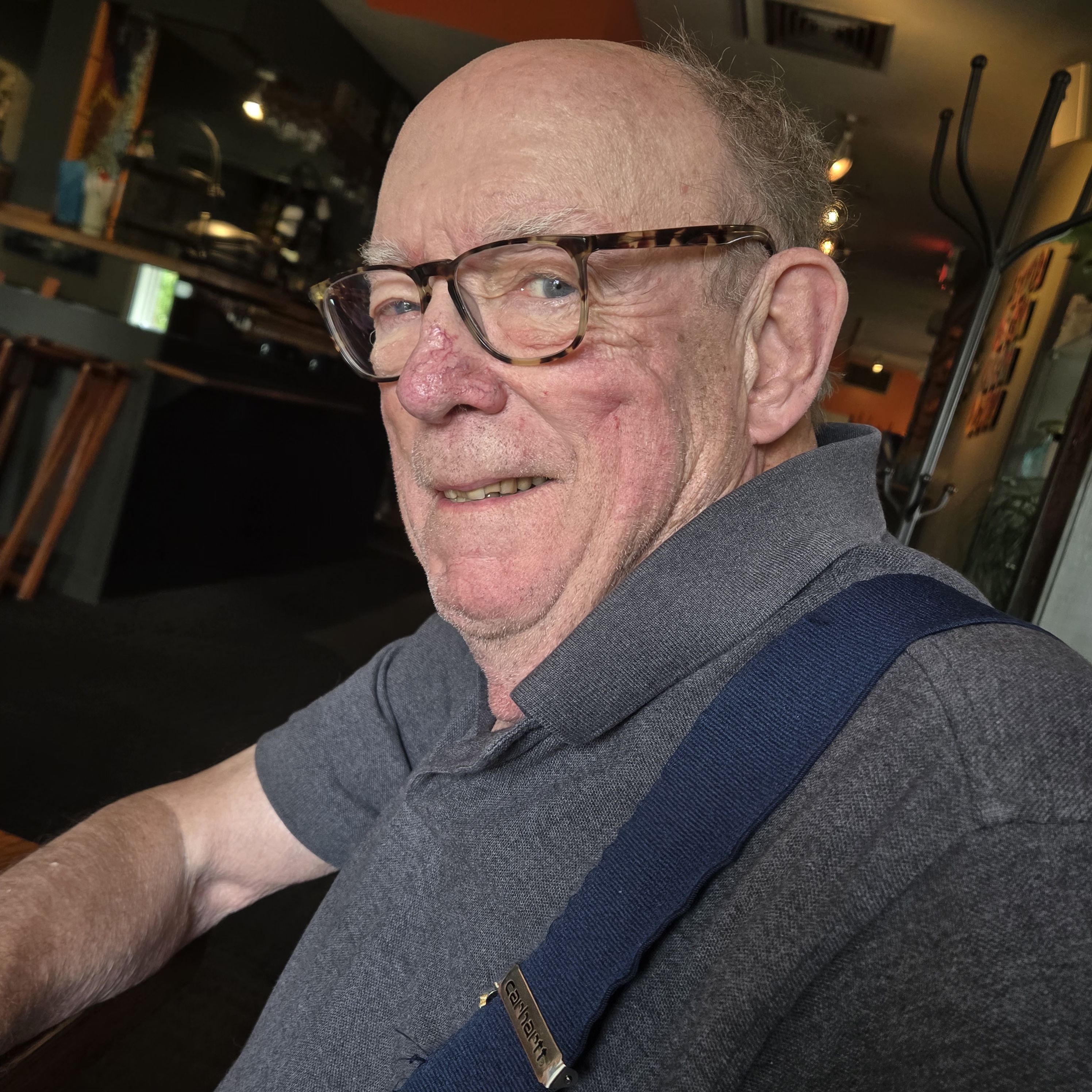
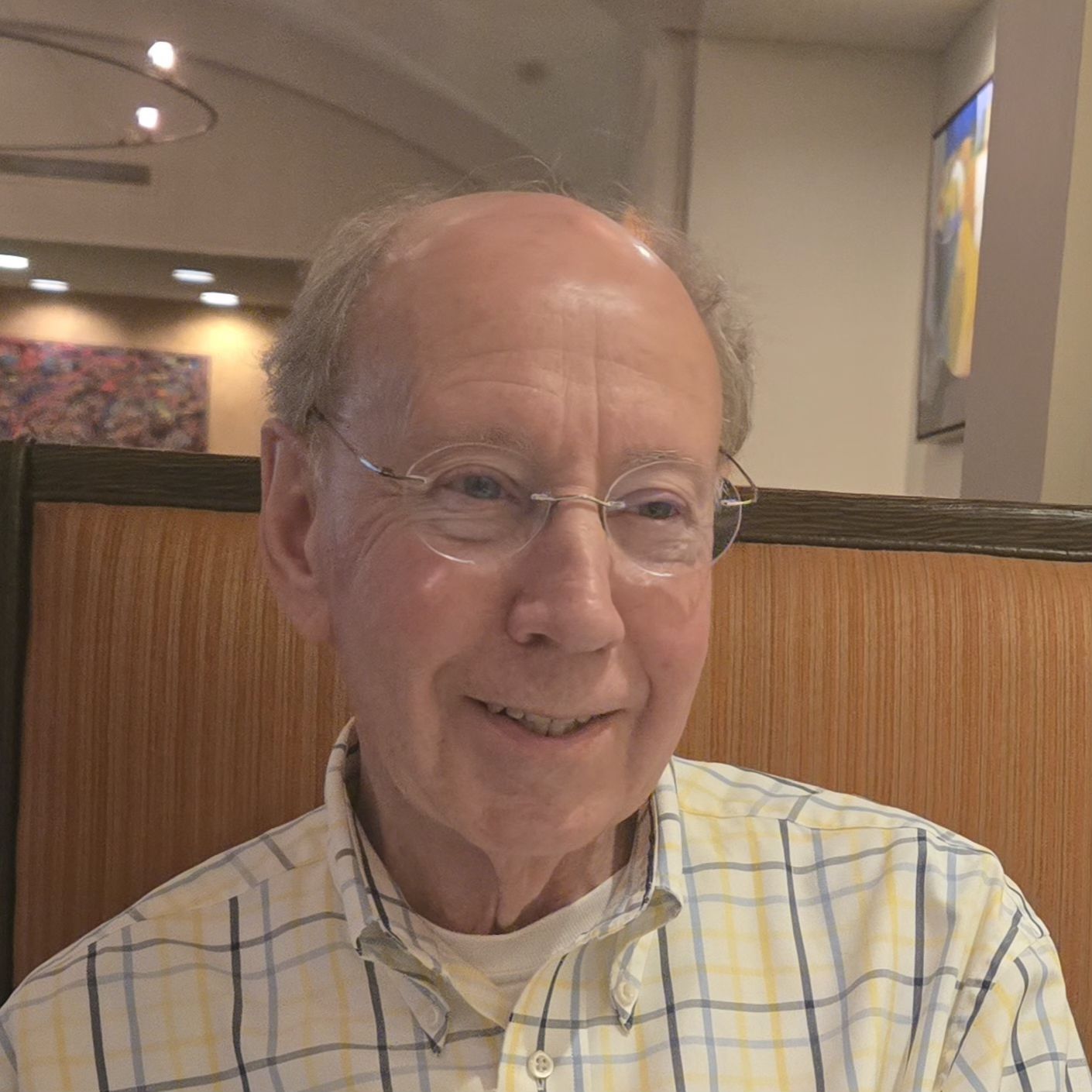
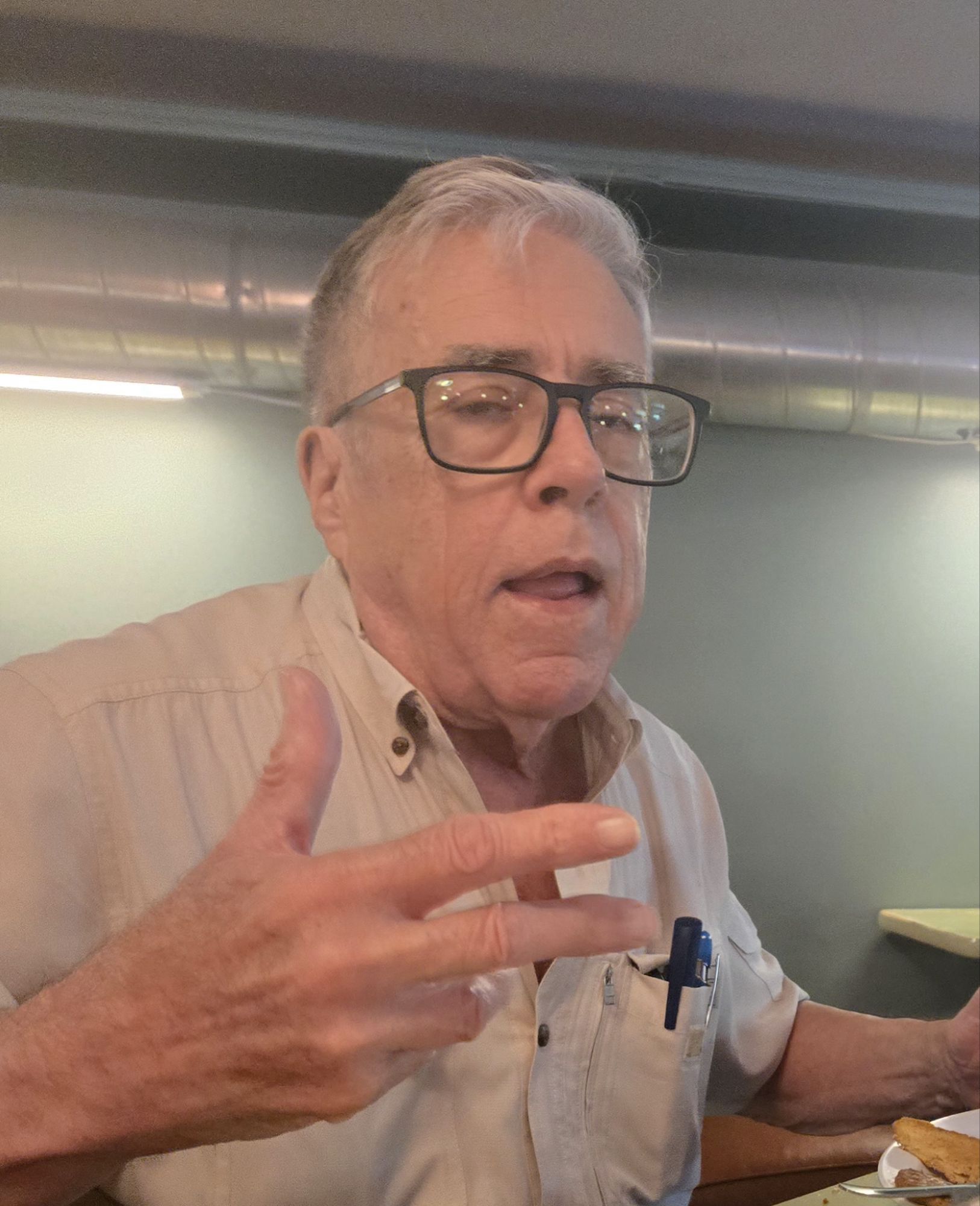
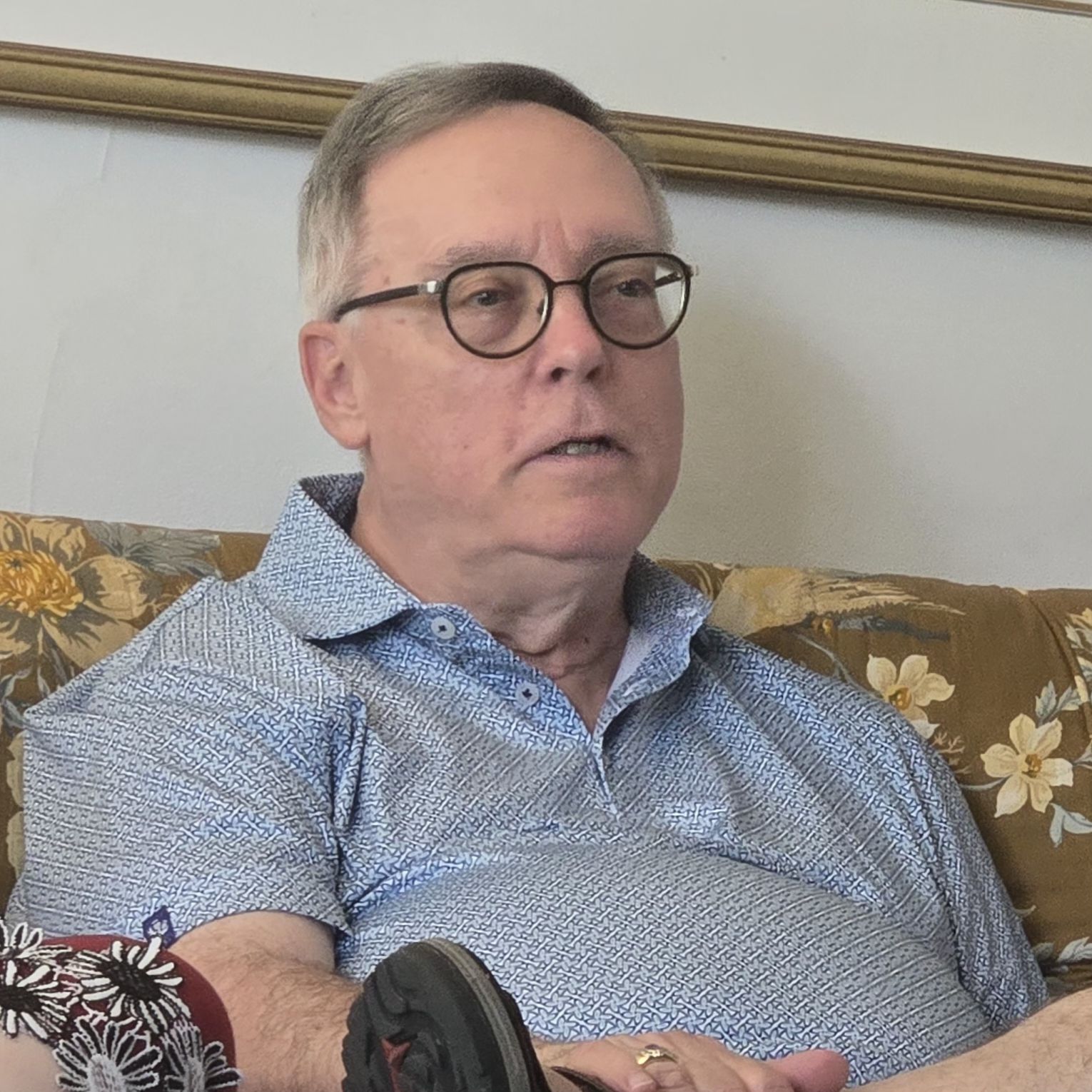
Art is 80

  • I Missed It. What is our Vatican Tariff Policy?

    May 9th, 2025

    On a serious note, I must say that an American pope concerns me, particularly at a time when the United States itself is run by such a globally unpopular figure. There are so many in this world who are fearful of, or convinced of, American arrogance, American influence and American power, that I wonder if an American pope will simply increase anti-American sentiment worldwide.

    For centuries, of course, the pope was Italian. That seemed to be the way it was – the Vatican being in the heart of, even if apart from, the city of Rome. It was something that you didn’t have to think about.

    Recently, there have been two non-Italian popes. The first was Polish and the second from Argentina, both majority Catholic countries, one a Communist country, and the other a country with a history of instability, both with large numbers of impoverished Catholics. And now we have an American (albeit one who has spent a lot of time in Latin America). I am just not sure how this will play out.

    At 69, Leo could be in charge for another 20 years or more, and – maybe for reasons I really don’t understand – it makes me nervous.

    I must also say that, to me, he does not yet look like a pope. He looks like a nice guy for sure, his politics seem good, but he has not yet developed a look of authority, or a look of an elder statesman. He looks more like the guy who got on the Metro just before you and is standing up on the crowded train right next to you.

    He also is not very experienced with the ways of the Vatican, is he? After all, he was appointed a cardinal only 19 months ago, in the fall of 2023. Is it surprising that a new pope has such a short tenure as a cardinal? And such a short tenure living in the Vatican? Is this unusual? I don’t know.

    So, knowing that I know knothing (as the don’t say), why was he chosen so quickly? Was he Pope Francis’ choice and was this the most influential factor? Was it his theological positions? His politics? His personal relations? Does he show an ability to lead that is not yet apparent to me from his personality? Does he get along with everyone? Does his American ethnicity have something to do with it? We will probably never know.

    And, to be truthful, I don’t know what a pope really does. He has a church to lead, he has a state to run, he has finances to grapple with, he has scandals to tamp down, he has personnel to hire and fire, he has officiating to do at religious events (sometimes with pomp and circumstance), he has masses of people he must both please and challenge, he has diplomacy to conduct, he has a pulpit more bully than Teddy Roosevelt ever had. And, while he has tenure, he is always somewhat at risk.

    I wish him luck.

    In the meantime, here we are grappling with a number of things, most important of which is the June 14 “Happy Birthday to You, Emperor Donald” military parade, complete with 6000 marchers and 150 military vehicles that will grace (and crack) our streets next month. I am sure that Trump today is watching carefully the Putin parade in Moscow so that he makes sure that his outdoes the Russian’s.

    Some things are stupid. Some things are unnecessary. This particular parade is both stupid and unnecessary. And you have to wonder who is going to line the parade route to watch it go by. Locals, I am sure, will stay away. Maybe it will attract people from Mississippi, who will flock to the DC and go away in disbelief that none of the restaurants they went to serve catfish.

    In the meantime, Trump and his buddy Howard Lutnick are moving ahead with major trade deals at last. The first arrangement, with the UK, is mammoth, to be sure. The US has been importing about 8 million autos a year, and they will all be subject to at 25% tariff (more or less, presumably more), but 100,000 British cars can come in with just a 10% tariff. The reason given is that the Brits don’t compete with American cars – apparently a Rolls Royce, a Bentley, a McLaren and even a Jaguar or a Range Rover are all in a class by itself.

    And there’s more. We are going to be able to bring in British steel without a tariff? I can’t wait – I am sure we will bring in a lot of British steel. And Rolls Royce is going to sell engines to Boeing. Ok, to that, I think. And we are going to be able to send $5 billion of agricultural products to Britain (if they want them, I guess), which is pretty much a drop in the bucket.

    And details need to be worked out. It seems to me that this is pretty much a non-deal, easy to make with the UK, especially since we already have a trade surplus with them.

    What about China? Now we have 145% tariffs on China, right? But – hold on – last night Trump said that maybe he’d drop them to 80%. Nothing like consistency to make everyone feel at ease.

    Which brings me to the last point of the day. One of the many negative characteristics of our great leader is that he doesn’t pay his bills. We know that from all of the writings about his lurid business career. But no one talks about that here.

    Why does anyone think that Trump will stick to any deal he makes on trade? If he can decide overnight to drop tariffs on China from 145% to 80% (how many different tariff levels on China has he already set forth?), why can’t he do that on and on, including after a deal was made. Remember, that he modified NAFTA during his first term with a deal to end all deals, only to ignore it completely the day he started term #2. As long as Trump is in charge of the country, chaos will continue.

    I heard a small part of the C-Span call-in show this morning. The guest (whose name I did not get) was an economics professor at Harvard, a self-defined conservative, who said: The one thing we know from studying tariffs, is that tariffs always hurt the country imposing them more than they hurt the country against whom they are imposed.

    Is this correct? I guess we shall see.

    And our Vatican tariff policy? 10% per homily may be what Trump suggests. After all, Trump thinks that homily is a byproduct of corn.

  • Which Side Are You On?

    May 8th, 2025

    I have been wondering what the better answer is. Is it

    or is it

    I guess the answer is subject

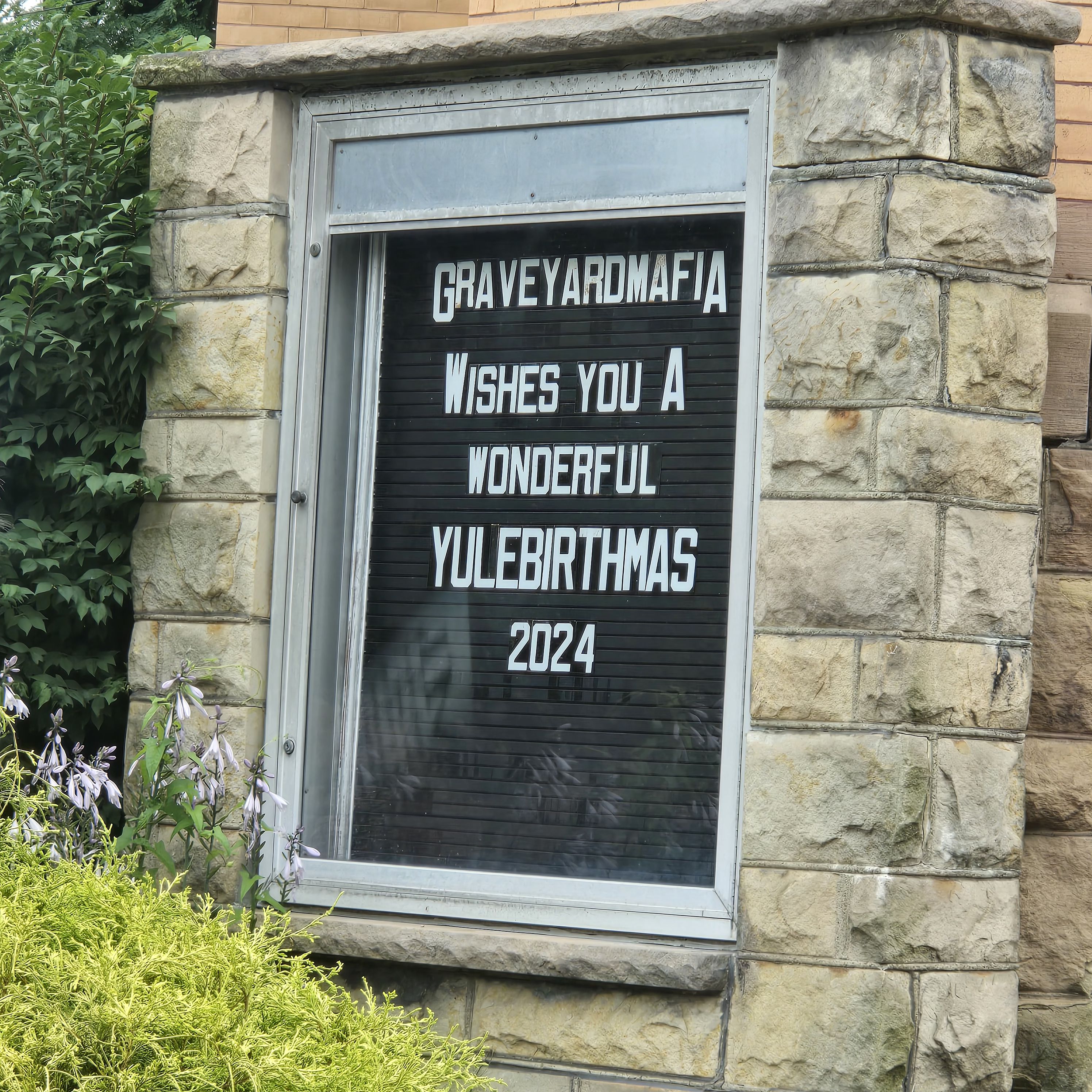
    I guess that is enough of that.  (Seen on a walk down P Street yesterday)

    Usually, the question is not whether you are for God, but rather whether God is for you. Both, of course, are silly questions.

    A more serious question is what does, or should, “belief” in God mean. Many people believe their “belief” in God constitutes proof that God exists. And not only that, but their belief in a specific God with specific characteristics constitutes proof that that specific God exists. And some believe that anyone who does not believe in their specific version of God will be eternally damned, but that they will be eternally rewarded. Therefore, I guess, they are on the side of God.

    It is clear to me that this is nonsense, but worldwide,  I seem to be in the minority, but what do I know?

    Moving on…..

    I just finished a novel written in the early 1950s by L. P. Hartley, The Go-Between. It’s a very good book, and a very good way to let your mind escape the troubles of the day. But, like everything, when you really think about the book, it brings you right back to today.

    The book is structured as a memoir of an Englishman man now in his 60s, thinking back at the summer he turned 13, which he spent visiting a school friend, whose family owned a rural estate and whose members held some relatively minor noble titles. This was a world very different from the lower middle class world in which he normally lived with his widowed mother.

    But, as he said, all was not paradise in Eden. His friend had an older sister (maybe 5 or so years older) whose engagement was about to be announced to a presentable young man who bore the title of Viscount. And while she knew that the Viscount was the right man for her, her heart was with the young, charming farmer who lived nearby. And our narrator during this odd summer became, as the title of the book implies, the go-between, the postman, the fellow who carried secret messages between the two young (but presumably fairly chaste) lovers.

    Now, perhaps our hero was somewhat naive, but he had no clue that he was carrying secret messages setting up secret meetings between his two somewhat older friends. Until he did. And then, he did not know what to do. He knew that if you going to be engaged to one man, you weren’t supposed to be running off to secret meetings with another. He knew that her fiance-to-be would not be very happy, nor her parents, nor her 12 year old brother, if they knew. And he liked all of these people, he didn’t want any of them to get in trouble, and he certainly didn’t want himself to get in trouble, especially as the entire group had been so kind to him all summer.

    All he knew is that he wanted to do what was right. For a long time, he didn’t know what that would be. Perhaps he never did; you will have to read the book (or see the film, one of the plays, the musical or the opera, each of which has been written based upon this book) if you want to know.

    But isn’t this a universal dilemma? At least a dilemma that people in public service also have. Often, they don’t think that what they are doing is correct; they often might be helping support an activity that actually is perverse, is harmful. But if they stop what they are doing, somebody (perhaps everybody) is going to get hurt, and consequently so will themselves. So, they decide to do nothing, or to pretend that they aren’t really doing anything that bad, or they never reach a conclusion at all. Maybe this is where we are, and if so, maybe we will find that the pressure of being a go-between becomes just too strong. And then the dam will break.

    But now, for a second, let’s go back to God. God does not figure in Hartley’s book. Yes, most people seem to go to church on Sunday,  but it seems that is because that just is what you do.

    Our 12 year old boy does not think about church or God. He does not turn to God and ask “What should I do?”

    Of course, some people would. Would they come to a different answer? Would their anxiety be lessened? Would they be more certain they made the right decision? Would they have made a better decision?

    Obviously,  we don’t know the answers as they relate to the characters in the book.

    But as we make decisions every day, the question is very relevant. Does the God each of us may envision influence our decision making? My guess is that we really don’t know the answer to that question even if we think we do. Does that God lead us to making better decisions? My guess is “no”, or at least that there is no evidence, much less proof, that better decisions are made buy those acting as they think God would like them to act.

    But does believing you are following God’s lead as you decide what to do ease the anxiety of decision making. I assume, for many, it does. And that may be enough to make the delusion of thinking there is a God, that you have the correct concept of who that God is, and that you are following the guidance of that God for some eternal purpose worthwhile.

  • Arthur: Rambling On Will Get You Nowhere!

    May 7th, 2025

    A fly came into our house yesterday, through the front door. It didn’t want to be here, that’s for sure. It buzzed and buzzed and flew around with great angst and great energy. I felt for it. I didn’t want to swat it, I wanted to free it. But I couldn’t figure out how to do that.

    So far this morning, I haven’t seen it or heard it. I assume it is gathering its strength and will continue its hopeless quest for freedom later during the day.

    Similarly, a few weeks ago, I saw one lone ant, crawling around a counter in an upstairs bathroom. I wondered how it got there? Through a series of walls? Unlikely. More likely it attached itself to someone’s clothes and, unbeknownst to all, found it self away from its fellow ants in our bathroom. It was a very active ant, and I really didn’t want to harm it. So I didn’t. And I was surprised when, the next day, I saw it again. Or, at least I assume it was the same ant, diligently looking for a way out, a way where it could get on with its life. I did not see it again after that second day. (I didn’t ask Edie about it, for fear that she might have engaged in some violent action that would lead me to have to make a citizen’s arrest. And then where would I be?)

    But it’s not only ants and flies that find themselves in situations that they had never dreamed about. It happens to people all of the time. Think, for example, of the 2 million people of Gaza. They aren’t by themselves, but they are as hopeless as if they were. And then there are those non-Americans who feel forced to leave their homes and come to America, and especially those who had no choice, such as the children who are brought here by a parent, and who all of a sudden find themselves a target of an incessant manhunt. Or the millions who live in, say, Sudan, who I am sure have no idea what is going on that leads to constant violence, hunger and danger.

    What can one do to help any of them when you see that the world’s most prominent and selfless individuals are stymied?

    I saw the results of a recent study performed by a group from Yale about the relationship between public opinion and governmental policy. I was surprised at the results. I am not looking at the polling information now, and I didn’t try to memorize any of the details, but the gist of the findings were that governments did what governments wanted to do and, to the extent they were influenced by anyone outside the governments, it was influence from wealthy people who helped keep the governments in power. The influence of the masses of citizens, particularly when expressed in mass movements, protests, marches and so forth, was almost non-existent in changing or redirecting government policy. It may make you feel good, but that’s about it.

    I wasn’t anticipating that as a result of such a study and, again, I didn’t look at its methodology too closely (read: at all). But I found it quite depressing.

    So what do you do about, say, Gaza? How would you feel if you were living there, had had at least 18 months of hell rained down upon you, had relatives or friends killed, no job, no food to speak of, and so on. And then you hear that Israel, your enemy, was not letting up, but was going to increase their military operations exponentially, drive the entire population of Gaza into a small section of a very small territory, and maintain an indefinite military presence, continuing to control all imports?

    On the other hand, if you lived in Israel, although your physical danger might be less imminent, you had the long term security of your children and their children to worry about, you had guilt feelings (perhaps) over the treatment of innocent Gazans, but you knew that if you let up the pressure, you could quickly be in a situation like they find themselves in today.

    As an outsider, on the third hand, what are you to think?

    As for me, and I have said this before, my thinking today is different from my thinking several years ago. Today, I actually think that permitting, or encouraging, the majority of residents of Gaza to leave is the best alternative. It’s a big world, and they can find their place elsewhere, and if they can’t, their children will be able to. No good will come from 2 million people, with a relatively high birth rate, staying in a territory about the size of the City of Philadelphia, with no way to travel in or out or control their own economic destiny.

    Let me be clear about something else. I blame their situation largely on the Arab leaders, who have refused to recognize or come to terms with Israel or a Jewish population in Palestine over the past 100 years or so. Had the United Nations partition of Palestine been accepted in 1947, none of this would have happened, and the area could have been peaceful and prosperous (putting aside the human predilection to always make things complicated). And the Palestinians’ failure to recognize Israel or come to terms with its existence has led not only to occasional skirmishes and wars, but to growing feelings in Israel that the Arab enemy was eternal and could never be accommodated.

    The current situation in Gaza cannot be allowed to continue. And Hamas, the governing body of Gaza, a body now with no capacity to govern, is not going to give up.

    Donald Trump’s concept that Gaza should be turned over to the United States of America, Canada, Greenland and Panama is ridiculous, to be sure. But someone, perhaps the Arab Peninsula countries working along with Israel need to come up with a way to (1) displace Hamas, (2) free the remaining hostages, (3) relocate the majority of the current population of Gaza safely and with assistance, (4) come up with a viable plan for the future of the land itself, and (5) use this opportunity to set boundaries and rules for the future of the West Bank. And the first of these 5 necessary steps? Provide for the safe transfer of Gazans somewhere where they will not be considered permanent refugees, but will be able to be integrated into their new lands of residence.

    Our role? Money, support, advice. And, yes, we need to agree to take in a share of those being displaced from Gaza. The number? Not sure. How about 180,000? And I would concentrate on family solidity in making the choices of whom to admit. I wouldn’t work too hard trying to eliminate those whose pasts might make them be (or appear to be) dangerous. We can handle that, if we set our minds to it.

    I understand that if I was reading what I just wrote, rather than writing it, I would say: That is a ridiculous idea. And I am not sure I would even argue against my arguing against it. But we have to start the conversation somewhere, don’t we? We can’t just watch bombs being dropped on innocent people, can we? Yes, I guess I already forgot what the Yale studies showed. It showed that what we think is not relevant. Our writings, our protests, and so forth? Meaningless. Completely meaningless.

    This human condition sure is depressing, isn’t it?

    I will concentrate elsewhere. Right now, I am watching a bunch of cardinals marching into the Sistine Chapel to select a new pope. Okay, now imagine the Sistine Chapel (beautiful as it is) sealed off from the outside world (as it will be), and the cardinals being dependent on the outside world for food and sustenance, which is not forthcoming. Or imagine not the cardinals in the Sistine Chapel in this position, but the prisoners we sent to CECOT in El Salvador. Or the impoverished families in Sudan. Or……you get the picture. Or the people of Gaza.

  • When EDADHD Becomes the Norm

    May 6th, 2025

    My guess is that everyone who pays any attention to politics in the United States today is, by necessity, suffering from what I would call Externally Disseminated Attention Deficit Hyperactivity Disorder, or EDADHD. The main symptom of EDADHD is the inability to concentrate on any problem in the country today without having one’s mind diverted to a different but equally important and troubling problem within about 60 seconds. The effects are both the inability to think anything through, and the inability to prioritize. It is, it appears, a condition with a definite cause, spread by clearly enabling forces, but as of yet with no cure.

    The cause is one individual, the contagion is increased by one political party, and a cure may take another four or so years. This does not bode well.

    I thought about this today (for about 60 seconds) when I looked at the first page of the print New York Times, and saw the article about the Guantanamo Naval Base. This leased property, near the eastern end of the Island of Cuba, has been used, with much controversy, to house “terrorists”, apprehended overseas and unwanted even to put in prison in the continental United States, and that number is now fairly minimal. Proposals to close Guantanamo have been floating around for years. But Trump proposed to reverse course completely, of course, and prepare Guantanamo to house up to 30,000 “illegals” either permanently or as they are on their way elsewhere. This got enormous attention in the press, the first small group of individuals were shipped there, and then they were shipped elsewhere, and the thought of using Guantanamo for mass incarceration has not been talked much about since.

    I thought about yesterday when, out of the blue, Trump decided that Alcatraz, a former federal prison located on an island in San Francisco Bay and closed 62 years ago primarily because of the cost of keeping it open. Trump said he wanted to open it again, so one of his top enablers Pam Bondi had to say that it would be cost efficient to open it this time, and now it is drawing attention from everything else for its 60 seconds of fame.

    Also yesterday, Trump decided (out of the same blue) that the United States should put a 100% tariff on foreign films, and for about 60 seconds everyone forgot about both Guantanamo and Alcatraz and tried to figure out what that meant and how that would even work.

    A day or so before that, 60 seconds of attention was focused on how many dolls a typical American child could expect for Christmas, and what they would cost, assuming that the dolls were made in China (almost all are) and the tariffs would be at 145%, or 125%, or 25%, or 10%, or if there would be exceptions from all tariffs for dolls. Any of these scenarios are apparently equally likely.

    And before that there was the attention on Abrego Garcia’s finger tattoos. His fingers do have tattoos, each of which is a symbol of some sort, which – say the experts – have no connection with MS-13 imagery. But someone photo shopped his hands to place M S 1 3 above the actual tattoos on his hands, and Trump has decided those the photo shopped images are authentic, and attention was placed on these fake tattoos for 60 seconds.

    And finally, we can’t overlook the the image of Pope Donald the I and Only. And the 50 or so other political sound bites we have been faced with recently.

    Now, all of these things attracted our full attention for very brief periods of time. And guess what? None of these things are really that important in the overall scheme of things. But this is the beauty of Donald Trump. He can attract our attention through a rapid onslaught of outrageous nonsense, while Rome burns. And we can’t tell the difference between thinking about Alcatraz and losing Social Security. Or better, we can’t really focus on the potential of losing Social Security because, hey, did you hear we may reopen Alcatraz?

    I listened to a podcast with David Brooks yesterday. The host was a fellow named Scott Galloway, whom you may know, but I don’t. It was an interesting 45 minutes (Rockville to my house), but I wish I was part of the conversation because Brooks says so many things that almost right, but not quite. His heart seems to be in the right place, but his logic just doesn’t get him to where he needs to go.

    The premise seemed to be about the unfortunate disappearance of civility and tolerance, the need to accept a variety of views, the need to provide education that really educates, and the need to allow for social mobility. All of that is absolutely correct. But guess what? As they discussed the evidence of this, and gave their thoughts of what could be done about it, they couldn’t keep to one topic long enough to do anything but gloss over it, which meant that they couldn’t see the inconsistencies in much of what they were saying. Why? Because they too suffer from EDADHD, of course.

    Now, if I weren’t suffering from the same disease, I would sit down at my desk, listen to this podcast once again, but slowly with a lot of stops and write down my comments as I went along. Then I would read over what I wrote and see if it made sense and, to the extent it did, I would write up a meaningful blog post that might get us all thinking about more deeply.

    But, I have other podcasts to hear, articles to read, newscasts to listen to, newspapers to scan, books and magazines to read, and – oh, yes – even a life to live. In the meantime, I have to keep my ears open to make sure that I don’t miss any of the five or six sound bites Donald will throw at us today.

    EDADHD is, I am afraid, the bane of our existence.

  • A Feast for Your Eyes

    May 5th, 2025

    Washington, obviously, is filled with museums. And just as obviously, we seldom visit them. After all, you need to have the time, and someone has to suggest going, and the other person has to say “okay”, and you have to follow through. When we are traveling, going to a museum is an obvious choice. At home, not so obvious.

    We do try to get to the National Gallery for big exhibits, and we go tobthe Phillips (we are members), but other than that, it tends to be hit or miss.

    Yesterday,  we actually spent part of the afternoon at a museum, the closest art museum to our house, less than 2 miles away. It’s the American University Museum at the Katzen Arts Center, where Massachusetts and Nebraska Avenues meet. It is convenient, free, has indoor parking (free on weekends), and exhibits that change three or four times a year.

    The spring exhibits run another two weeks. One of the most striking shows the work of Fred Folsom. It’s a large exhibit with two components. One includes very large and detailed works representing crowds in bars. The other is an unusual exhibit of nudes with cigarettes.  Go figure.

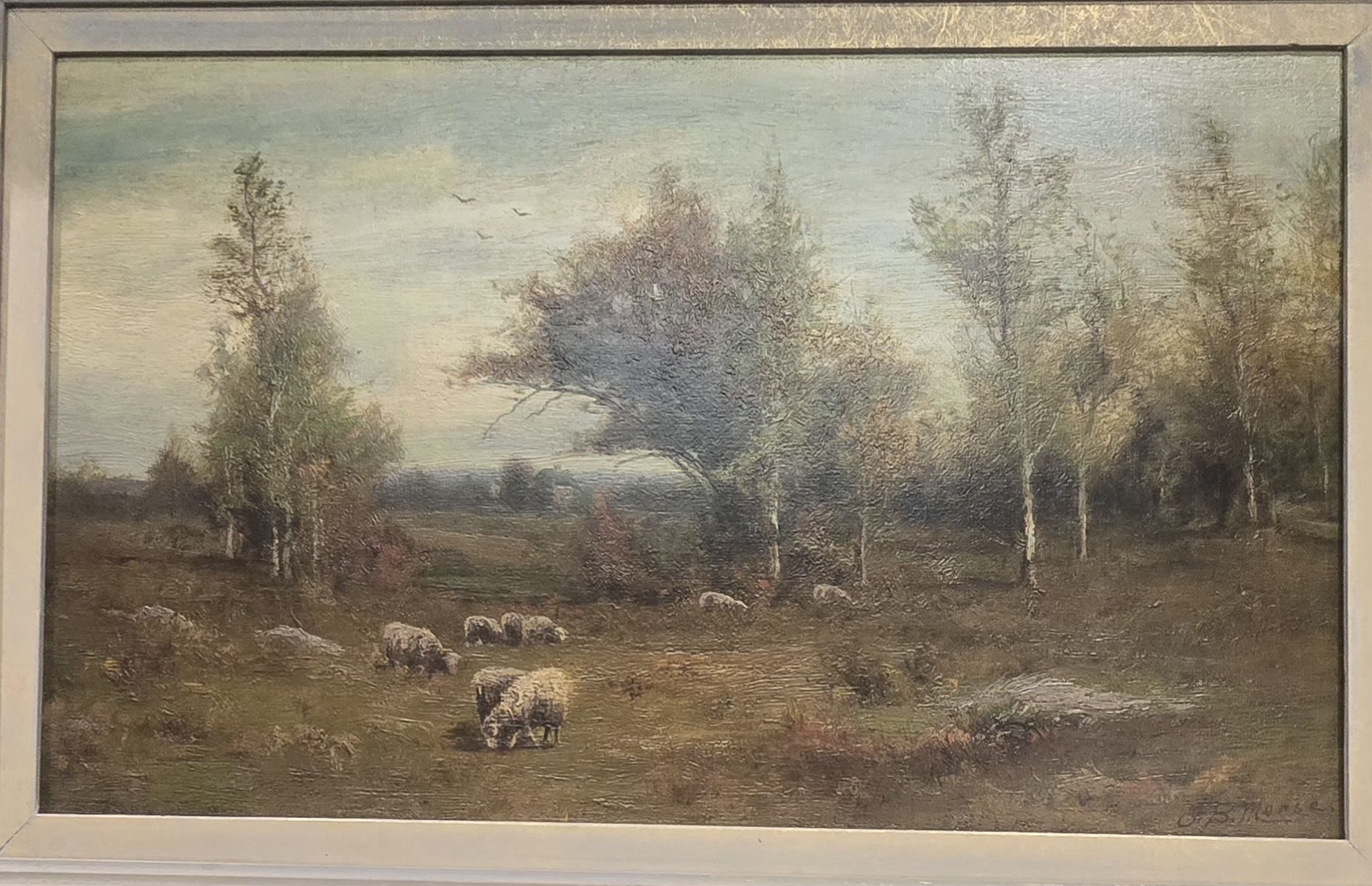
    Then, there is an exhibit of works presented as masters theses this spring. I thought them quite good. Here are some examples:

    The students/artists are Poojah Campbell, Patricia Poku, and Andres Izquierdo.

    There are three more exhibits. One features contemporary Serbian artists, and a second a multimedia artist named Bruce Connor and focuses on psychedelic mushrooms in Mexico in the 1960s. Neither did much for me.

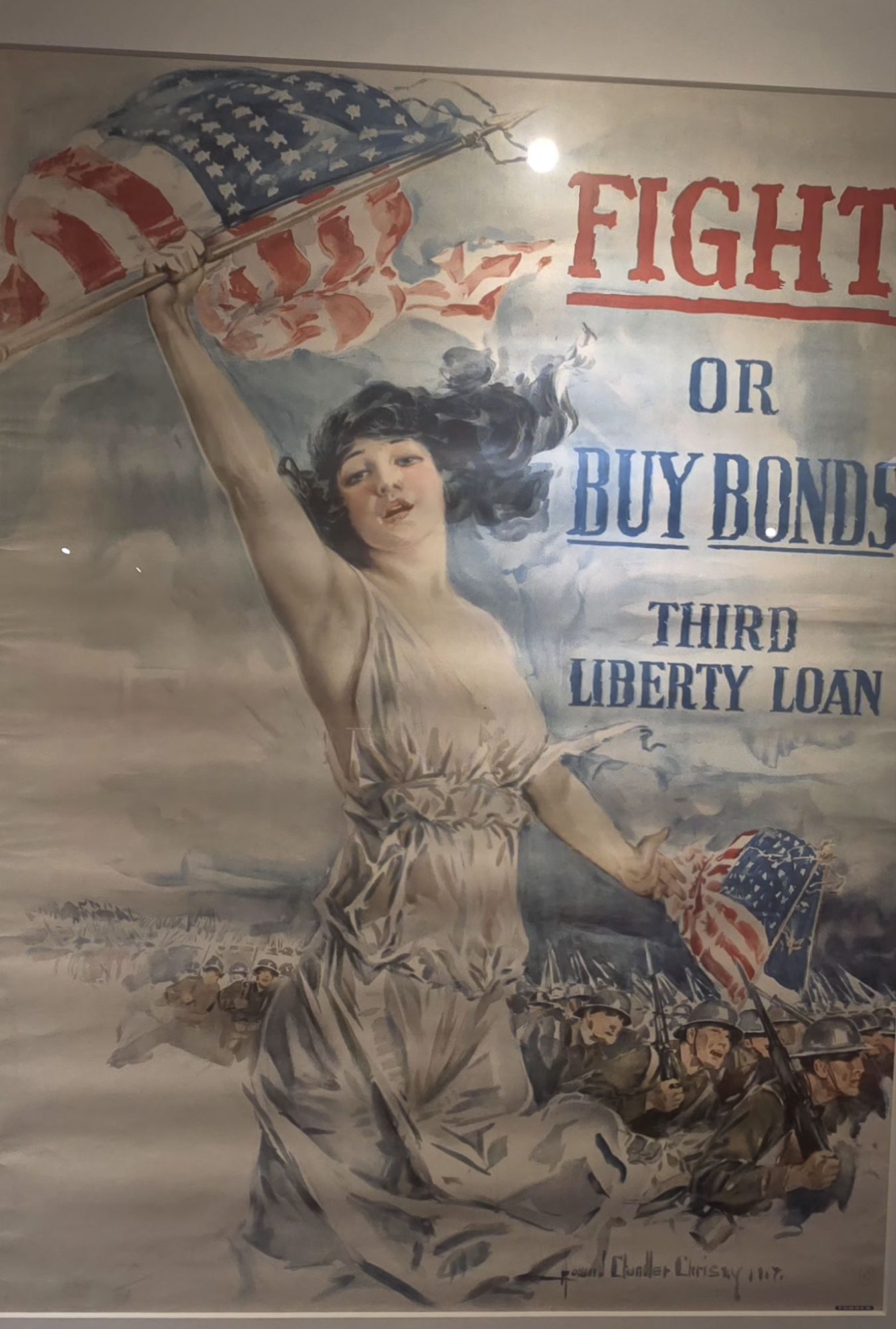
    The final exhibit features a number of pieces which were given to AU when the Corcoran closed a few years ago. The Corcoran distributed their collection broadly. The biggest recipient was the National Gallery, followed by AU and George Washington U. AU itself received 9,000 pieces of art, apparently.  They are now displaying a few of those pieces by artists with a strong connection to DC. They are all worth looking at. Here are a few by Rebecca Davenport, Andrew Stenovich, and Nancy Wolf:

    That’s it for today.

  • What is wrong with this picture?

    May 4th, 2025

    A new Mom’s Organic Market just opened about a half mile from our house. It is directly across Connecticut Avenue from a large Giant (no pun intended, was there?) Food Store, and within a block of a large Saturday farmer’s market. If you head down Connecticut Avenue another half mile, you will find a Streets Market and a Yes! Organic Market. If you head the other direction on Connecticut from our house, within a mile you will find a Safeway and a Magruders. If you go west, towards Wisconsin Avenue, you will find a Whole Foods and a Wegman’s within a mile of us, and if you extend your reach to 1.5 miles, you will find another Whole Foods and an Amazon Fresh. And, oh yes, a Trader Joe’s scheduled to open in that neighborhood soon. I probably forgot one or two major food stores (for example, I forgot the neighborhood Broad Branch Market, which my GPS tells me is .9 miles away, in the residential DC Chevy Chase neighborhood).

    That makes 11 grocery stores, plus there are actually four weekly farmers markets in the crop harvesting months, within 1.5 miles of my house. Now, the neighborhoods that these stores service are, as you would expect, on the more prosperous side. It’s Chevy Chase, Forest Hills, American U Park, Friendship Heights, Van Ness and so forth, straddling the DC/Montgomery County line. If you go another 2 miles out Wisconsin Avenue, for example, and get to downtown Bethesda, a similar array of grocery choices will be happy to serve you. That is another wealthy area.

    But now let’s go across town to Ward 8. DC is divided into 8 wards. We live in Ward 3. Ward 8, mainly African American, lies to the east of the Anacostia River, a part of town you may never find yourself in if you are a tourist (or even a resident of NW Washington). It is not a bad area, it has some nice neighborhoods, a fair amount of new construction, some history, and a lot of people. Ward 8 and Ward 3 each have about 85,000 residents, as all DC wards have relatively equivalent populations (DC has a population just in excess of 700,000).

    Of the 12 grocery stores that are within 1.5 miles of our house, 10 are in the District and two are just over the line into Maryland. And I didn’t list all of the groceries in Ward 3, just those that close to our house. But what if I told you that in all of Ward 8, there was just one major chain grocery store, a Giant on Alabama Avenue? That, other than that, there were only individually owned corner stores, with limited supplies and often higher prices, or that Ward 8 residents had to drive into other parts of the city, or out into Prince George’s County MD to do their shopping?

    Clearly, there is something wrong with this picture.

    I don’t have a ready made answer, but this is the kind of problem that gets ignored as we look at the larger problems that beset us and that get even larger day by day. Just a thought that we shouldn’t forget the more localized problems, as well.

    As to the bigger problem, let me just make one point today. Just because voters seem to be getting more and more worried about and fed up with Trump and the Republicans, that does not mean that they are feeling any warmer towards the Democrats. And current Democratic leadership isn’t doing much to change those perceptions. We had dinner with 8 friends last night, and there was general agreement that the Democrats needed new leaders to step forward who were able to speak not only for themselves but for the party, and who were able to galvanize voters the way Bill Clinton and Barack Obama were able to. In other words, the message does you no good if you don’t have the messenger. Neither Hakim Jeffries nor Chuck Schumer are good messenger. Bernie Sanders and AOC are good messengers, but don’t speak for the party.

    Time is awasting.

    P.S. I just realized I left out a second Giant and a Lidl on Wisc Ave, within 1.3 miles of our house. That makes 14, not 12.

  • Important: Fascism and Antisemitism are not Inevitably Intertwined.

    May 3rd, 2025

    Can I start with a digression? I just want to let you know that this is my 900th consecutive daily blog post. You wonder how I figured that out? I counted. I started with the first one, which was November 15, 2022 and counted. Now, I will admit that I may have miscounted (there is a reason I did not become a CPA – in fact, there are many), and if you want to check up on me, feel free. But do me a favor, and if you discover I am wrong and this is not my 900th consecutive post, keep it to yourself.

    Okay, and a digression to the digression. If you look up “900” on Wikipedia, you get this: “900 (none hundred) is the natural number following 899 and preceding 901.” This may be helpful to some of you who suffer from dyscalculia. (Did you know that is how you spell dyscalculia?)

    I do want to mention two important things that are on my mind on this sultry, hot Washington spring day. They relate to the relationship between Fascism and antisemitism.

    Fascism always involves defining an in-crowd and an out-crowd. Hitler obviously defined Jews as the ultimate out-crowd, a group seeking to control the ethos of Germany and displace true Aryan, or Germanic, values. He then went on to add the Romani to the list of ethnic undesirables, and added homosexuals and the mentally ill (I guess he mixed them together). But the overriding enemies of Germany were the Jews, and because there turned out to be no other way to deal with them adequately, they had to be exterminated, and about 6 million of them were.

    Because of this, Fascism and Judaism became identified with each other. But you do not have to be antisemitic to be a Fascist. Let’s take the most obvious example, Benito Mussolini, who was the first Fascist, becoming leader of Italy a decade before Hitler took over Germany. Mussolini did not show any strong antisemitic tendencies. In fact, there were many Italian Jews who were members of, supporters of, and active in the Italian Fascist party. It wasn’t until Hitler, as a quid pro quo of giving Italy Germany’s support, required Mussolini to adopt racial exclusionary laws in late 1938 that antisemitism played a significant part in Italian Fascist society.

    So let’s turn to Donald Trump and let’s assume today, for the sake of argument, that he talks like a Fascist, acts like a Fascist and hobnobs with Fascists. Just for the sake of argument.

    Just because Trump may not show any overt signs of blatant antisemitism, and just because among Trump’s inner circle there are a number of Jewish advisors, that does not meant that Trump isn’t a Fascist. You can clearly be a Fascist without being antisemitic.

    It’s all a question of who you put in your in-group and who you put in your out-group. Mussolini did not need to put Jews in his out-group. His out-group was not ethnically based; he concentrated on socialists, and intellectuals, and unionists, and Communists. Trump does not need to target Jews, either. He is targeting leftists and liberals and Muslims and most of all black and brown skinned immigrants and asylum seekers. These are Trump’s out-group. The only Jews in his out-group are those who are liberal or leftist, and he does not have to (and does not) attack them because they are Jewish, but because they are leftist or socialist.

    In fact, Jews sort of become favored in the Trump world. Living for 70 years in the real estate development world of New York City, Trump has dealt with Jewish competitors and allies his entire life. He has a Jewish son-in-law, of whom he seems to be fond, and (by conversion) a Jewish daughter. He has Jewish grandchildren. Years ago he has said “The only kind of people I want counting my money are short guys who wear yarmulkes every day.” He is a strong supporter of Bibi Netanyahu, Israel’s prime minister, and of Israel in general. (You can wonder why this is. Is it because they are fighting Muslims, Arabs, brown people? Is it because he needs to show that support to his fundamentalist Christian base? Is is something else?) I think it is hard to call Trump antisemitic, although I understand that some would like to, focusing on some dumb things he has said from time to time.

    Now, you can list all the things that Trump does that align with typical Fascist policies (the most recent being his plan for a big military parade on June 14), but the one that I want to end today with is his attacks on elite American universities, and in particular on Harvard, where I went for my undergraduate degree so many years ago. His attack on Harvard is premised, or so he says, on Harvard’s failure to protect its Jewish students from antisemitic attacks and general fear.

    Trump has given Harvard an extraordinary ultimatum as to how faculty and students should be selected, what subjects should and should not be taught, and so forth. He has withheld billions of dollars of federal funds, and he has threatened their tax exempt status. None of this is likely legal or constitutional, but no matter….

    Let’s look a little broader (and I know this is getting long). Harvard had some serious problems, particularly during the 2023-2024 academic year, following the October 2023 Hamas attack on Israel and Israel’s response, with conflict between students and faculty members favoring one side or another. And, as a result of this, Jewish students were sometimes kept from classes or were afraid to speak out during classes, Jewish students were sometimes barred from certain university activities and so forth. Fear was clearly in the air. At the same time, Muslim students also had their complaints, generally mirroring those of the Jewish students. We don’t have to look at the merits of those complaints here.

    Harvard established two task forces (I wrote about this a few days ago) to look into the grievances of Jewish and Muslim students, and the two task force reports (totalling about 500 pages) were released this week. Harvard’s relatively new president, Alan Garber, has promised certain actions in light of the task forces’ findings and recommendations.

    Harvard Hillel had a program on Zoom Thursday night to discuss the findings. You can see the program (about 90 minutes) on YouTube, and if you have any interest in the subject, I suggest that you do. I am not going to outline the specific findings of the reports here, but just will say this: don’t belittle the degree of conflict that existed at Harvard last year, and the difficulties and feelings of isolation that Jewish (and perhaps also Arab) students were facing. The stories are credible and riveting.

    And the one thing that I had only thought of slightly and now will think of as much more important than I thought, as I try to understand what has been going on, is how different the Harvard of 2024 is from the Harvard of 1964 when I was there. When I was at Harvard, and the undergraduate student body was about 1/3 Jewish, the word antisemitism was never mentioned. And there was no reason it should have been, because it was not visible in any way that I saw. There certainly was no exclusion of Jewish students (except to some of the eating clubs, perhaps, but who cared?), there was no need for a Hillel as a refuge (Hillel existed, but more as a social club), and there were plenty of course offerings to satisfy those who wanted Jewish studies (religious, linguistic, historic, philosophical) to be part of their college curriculum.

    Today, none of this is apparently true. There are 1/3 or so the number of Jewish students, Hillel is definitely a refuge and center of the college life of some (maybe many) of them, and the number of courses offered on Jewish topics is many fewer than was the case 60 years ago, or apparently even 20 or 30 years ago. You add this to a diversified student body with many more non-Jewish students of middle eastern ethnicities, many more courses on Arab and middle eastern studies, and a slant towards the “progressive” approach to recent history (oppressor/oppressed; colonial regime/indigenous regime), and add in the Gaza War and the century of conflict between Jew and Arab in today’s Israel, and you do get the perfect storm.

    Harvard, and similarly situated universities, do have a lot to deal with, to be sure. The Fascist move of the Trump administration to take over control of universities and stomp on their freedom to solve their own problems and continue their great traditions (and their ways to benefit broader society) will (1) only make everything much worse, and (2) constitute one element of many which are creating not the danger of a Fascist regime in this country, but the consolidation and strengthening of the Fascist regime we already find ourselves under.

  • Fact/Fiction. History/Mythology

    May 2nd, 2025

    So this morning, I read that RFK, Jr. thinks that jet fumes are a major cause for America’s subpar health. Yes, chemtrails, substances hidden in jet fuels for nefarious or other scientic purposes by government agencies, such as DOD’s DARPA, are indeed the cause of our problems. No matter that this theory has been debunked for years, and that there is no legitimate scientific evidence for it.

    Then I read that Oklahoma (is this true? I saw it on a Bulwark post.) is changing its high school social studies curriculum to include a unit on how the 2020 presidential election results were manipulated to make Joe Biden the presumed winner, as opposed to the real winner, you know who.

    Just last night, I finished reading Peter Partner’s The Knights Templar and their Myths. It is relevant to all of this. Let me explain:

    The Knights Templar was a religious order founded during the Crusades to help protect travelers to the holy land during the approximately 100 year period that Christians held sway. Members were among the last military groups to hold the fort at Acre when the last Christians were kicked out of that territory.  In the meantime, the order obtained great wealth in land and resources, became the biggest ship owners in Europe and Europe’s first international bankers, supported by a high degree of papal privilege.

    Then, in 1307, it all came tumbling down, the order destroyed, and many of its leaders tried and executed. The story is well known, and it’s one I have long been interested in.

    And the story of the Templars did not end with the destruction of the Templars, but continues to this day, connected to freemasonry and various branches of esoteric knowledge. What Partner does, probably more thoroughly than anyone else, is separate history from myth, but citing evidence of one and origins of the other.

    Partner died about ten years ago, so we can’t ask him to do the job. We need to find someone new, someone who can look at the pronouncements of Robert Kennedy Jr. and the contents of the Oklahoma social studies curriculum, and separate history, or fact, from mythology, or fiction. They need to be able to do it with the structure that Partner used. The first half of his book is “just the facts, ma’am”. The second half talks about the mythology. At no point does Partner mix up the two, at no point does he suggest that one might be the other, and when discussing the mythology, he is precise as to where each myth got started, how it was propagated, and who carried it along.

    Current journalists don’t write this way. They combine fact and myth in the same paragraph, confusing that eeader as to what should be in one category and what shoukd be in another. Print journalists have to put everything into the first few paragraphs, knowing you probably won’t turn the page. Online journalists have to stretch things out, so you will scroll through all the ads to the end. Of  course, there are articles that deal with one or the other, but they are specialized, not general news articles, and they don’t normally do a side by side writeup.

    Until then, we remain frustrated, confused, and in disbelief. But at least we have our wits about us.

    (By the way, a shout out to East Coast Industrial Supply Company, whose large, ugly, noisy and dirty truck just came up our quiet(ish) street, stopped in front of my house, and then accelerated in a big cloud of gray smoke, which wafted over everything. Where are you when I need you, Bobby Junior? Chemtrails are shortening my life.)

  • Fair Harvard, thy Sons to thy Jubilee Throng……(huh?)

    May 1st, 2025

    I tried to skim through the two reports recently released by Harvard, one showing the results of its antisemitism task force, and one showing the results of its anti-Muslim task force. They both agreed that there was a problem at the university, but they largely had opposite recommendations. What’s a university to do?

    Basically, each committee said there was too much bullying and bias against the group it was looking at, while the anti-Muslim task force said that there needs to be more teaching of the Palestinian problem, while the antisemitism task force said there needs to be more teaching of Israel.

    Together, the two reports are more than 500 pages long, and there is a lot that I did not see at all. But I didn’t see (maybe it is there somewhere) any place where antisemitism and anti-Israel activities were separated, and I didn’t see anywhere where anti-Muslim and anti-Palestinian activities were separated. And I think that this is one thing that must happen.

    I also wonder whether it was wise to have two separate task forces looking at these two related, but different, issues. What started out as necessary studies because of polarities has now ended with reports which seem to firm up the polarities. As I said, what’s a university to do? Perhaps they should do something that I haven’t seen they are thinking about. That would be taking the two task forces, combining them into one task force, and telling them to come up a joint project. This probably will not happen.

    The other thing that should be done (and as to this one, I think that Harvard will be trying) is to separate arguments pro or con Israel or the Palestinians, from attacks (either personal, live attacks, or written attacks) on fellow students. And protests, which cannot be completely stopped and maybe should not be, would be policed to make sure there were no such personal attacks (and probably also that non-Harvard students, faculty or staff, or maybe just non-students, could not take part in the protests). And clearly, the protests would have to be each way on both sides.

    Standards of instruction are harder to police, I would think, because freedom of speech for instructors is important. You do not want Harvard’s administration (much less the federal government) telling tenured professors and other instructors what to teach. At least I think that you don’t. (We may come back to this later.)

    One of the problems that universities have faced generally is that, as universities (putting aside the positions of individual instructors) have often taking positions as institutions on various subjects, including subjects regarding the freedom of oppressed people around the world. I think, by the way, we can agree that Palestinians surrounding Israel have been oppressed, even if we can reach different conclusions on who there oppressors are, or whether their own actions as a group justifies, or necessitates, their oppression. Many universities, including Harvard, have said that from now on they are going to be institutionally neutral. Of course, this may be easier to promise than to accomplish.

    So, we have at many universities, two strains of teachers on these topics. We have the strain of “progressive” historians, who believe that the most important important change since the end of World War I (in addition to the development and then fall of Communism) has been the end of colonialist regimes throughout what has been known as the Third World. Of course, Israel was never a “colony” in the way Algeria or Barbados has been; it is a completely unique development. Yet, for many or most of those who support the destruction or end of the State of Israel, it adds to their argument to describe Israel as a colonial outpost just like former French and British colonies were, and therefore that the colonial regime must be ended.

    On the other hands, those who support Israel, many of whom consider themselves Zionists, either believe that Jews have an historic or a God-given right to the land of Israel, or because they were pushed out of other places during the mid-20th century (that would include North Africa and parts of the Near East, as well as most of Europe), that they had no where else to go. And for those who believe that the Holy Land has been designated by God for the Jewish people, there are those on the other side that believe that the land of Israel is Muslim land, meaning land which has been conquered in the name of Allah, as this land has been in the past, can never been handed over to non-believers.

    It may be difficult for these two groups of instructors to reconcile with each other, but it would be nice if it were possible, so that anyone taking courses on either Palestine or Israel would be able to see multiple narratives. In other words, just as the institution itself pledges neutrality, perhaps with this very volatile subject, the instructors should discipline themselves to do the same. Is that at all realistic? In other words, could the teaching staff become part of the solution, as opposed to part of the problem?

    Perhaps, in normal times, this would be possible. But these are not normal times, as we know. There is a murderous war going on in Gaza, with Israel fighting an enemy that refuses to give up no matter how bad it is losing, and with actions being taken by settlers in the West Bank against Palestinian villagers and certain presumed “militants”, with the IDF and the police forces either backing the settlers, or just standing by and watching. As long as this is the situation on the ground, it becomes more difficult for academics to speak about the situation without emotion or bias.

    Of course, Harvard has more problems than this. Remember that Trump is calling off all federal aid to the university, and Harvard has filed suit. I assume it will eventually win the lawsuit, but not before the administration puts additional pressure on the school, including (as they have) threatening its tax exempt status, investigating its law review and so forth. Potential acts against Harvard was even brought up today at Trump’s cabinet meeting.

    In addition to actions at universities claimed to be related to antisemitism (which they don’t seem to be in reality) and not at all to anti-Muslim activity, there appears to be a continued upswing in related activity outside of the university campus. Just last week, for example, a woman was harassed by a large group of Hasidic men for participating in a pro-Palestinian rally (or just being at the rally, perhaps). There were apparently about 100 men, yelling, threatening, murder and rape, and chasing the woman, who was afraid to run home because she did not want anyone to know where she lived. I heard her report from her (she has hidden her name) and she, too, has said, like Palestinians on the West Bank, that the police simply stood by. I am sure we will learn more about this.

    I wish I had a clever way to end this one, but I don’t.  Today is Israeli Independence Day, Yom Haatzmaut, and in two weeks, it will be Palestinian Catastrophe Day, the day of the Nakba. It has been 75 years. And so it goes.

  • Feed a Cold; Starve a Fever

    April 30th, 2025

    I am sitting here this morning with a sore throat and a runny nose, and I had to cancel a meeting and a lunch appointment for today. Not that I could not have sat through both in some discomfort, but I didn’t want to start an epidemic or a pandemic that might get out of control.

    I actually don’t remember the last time I had something that forced me to cancel appointments or curtail activities. I think it was the two times I got COVID, and that has been a couple of years ago.

    When I was young and got sick, my mother kept me out of school, something that not all mothers did. And she had a strict rule that, if I had a fever, I was not to go back to school until my fever was gone at least 24 hours, and sometimes 48 hours. Once year in elementary school, I was shocked to discover that I held the class record for the number of days missed.

    When I was working, I thinking I also used a temperature as my guidepost. So on a day like today, when I didn’t feel well, but had no temperature, I would go to the office, although sometimes I would hole myself up away from the others. It’s only fair.

    So far (and I obviously know that one day this will change), I have been pretty lucky with my health. I have been in a hospital only twice, and the last time was in 1969. The first time, I was two years old and it was feared that I had meningitis, which I did not. I think I have written about the second time on this blog, but I am sure you don’t remember it, so I will tell the story once more.

    I was in Army basic training in Ft. Ord, California, when I developed what I think was a boil on the bottom of my right forearm. One of the fun things we did in basic training was to “low crawl” under barbed wire, and naturally you needed to use the bottoms of your forearm to move along. And, because of this large and ugly boil, that was something that I felt I just should not do.

    So I went to on the early morning sick leave van (that’s another story) to the base hospital, met a nice young doctor who was interested that I was a lawyer in basic training (that’s still a third story), and he told me that he was going to lance the boil, bandage it up, and let me avoid activity for, I think, two days. I went back my platoon with my doctor’s note, and lazed around the rest of that day. But when I got up the next morning, I knew something was wrong. I was lightheaded and feverish and knew I needed to go back to the infirmary. And I did.

    Was my doctor embarrassed? Concerned? Expecting me? I don’t know. All I know is that he put me in the hospital. Because I had a law degree, even though I was just a trainee, he told me he was going to do me a favor and put me in a single room. The biggest reason he was doing this is that Ft. Ord was in the middle of a meningitis epidemic and he wanted to keep from infected people. Being in the private room (which had no TV, no radio, no books, no telephone and virtually no visitors) was psychologically tough. I can’t say it was like being in solitary confinement, but it probably was to a great extent.

    My only visitors (other than food deliveries) were nurses who came in several times a day to give me penicillin shots. The penicillin shots were given in my rear, and I had so much for so many days that I actually could not walk. Even going to the bathroom was torture. I was in that room for several days (four? five?) and then was visited by a General who said “Who are you and why are you in this room?” He told me that no one below a colonel got a private room, and he immediately had me transferred to a ward for the next two days before I was released. Did my doctor get in trouble? I have no idea.

    I also have no idea why I got so much penicillin. I can’t say I ever got a real diagnosis. But my infection from the lanced boil must have been much more dangerous than I thought at the time. Otherwise, I would have been treated much more cavalierly.

    That has really been it for hospitals. The only real surgery I ever had was for a hernia, and that was done as an outpatient. Other than that, my only hospital experiences so far have been to visit other people.

    I understand how lucky I have been to date.

    Just finished the meeting I could not attend on Zoom. Now it’s noon. Time to feed my cold.

  • Canada and MSNBC and So Much More. Really.

    April 29th, 2025

    How is this for a good statement (thanks, Harry Rado)?

    Judge Coughenour is a Senior Judge on the United States District Court for the District of Western Washington in Seattle. He was appointed to the Court 41 years ago by a guy named Ronald Reagan.

    As we get near Trump’s 100 Days, we also get near the end of Rachel Maddow’s nightly comeback on MSNBC. Last night,  Rachel (I call her Rachel and if she wants to call me Art, that’s fine with me) had some frightening words. She said that she expects that Trump, losing more and more support in the polls, will not only fail to reverse course, but will double down on outlandish things. She was not more specific, but this is very different from what Lawrence O’Donnell, who follows Rachel at 10 p.m., has consistently said. He says continually: Trump will blink and back down. So who claims MSNBC does not provide diversity?

    Speaking of MSNBC, there are a lot of changes afoot, as you may or may not know. The biggest change is that MSNBC and NBC are getting a divorce, although staying under the Concast umbrella. MSNBC and CNBC, along with 9 other cable channels, are being set loose to live or die under a new corporate structure. Most of their journalists will wind up in one, but not the other. How this will affect MSNBC programming in the short run is becoming clear, as a modified program schedule starts next Monday, but MSNBC in the the long run is much less clear. I hope it keeps its current identity and does not try to be more “neutral” as we have seen CNN attempt to become (very unsuccessfully, IMHO).

    This raises another issue – federal finding for public radio and TV, facing a challenge in Congress. As I understand it, the funding goes to the local stations, who use the money both for local operations and for subscribing to PBS and NPR programming. So, a cut-off would be significant. Interestingly, one of the planks in the Liberal platform in yesterday’s Canadian elections was an increase in funding for Canadian public broadcasting.

    Which brings me to Canada. Mark Carney, the prime minister now elected to a full term, has one person to thank for his victory, and that is Donald Trump. Trump’s full-blown attack on Canadian independence turned the country from Conservative to Liberal overnight. Yes, as Trump apparently said yesterday in an interview with The Atlantic. “…I rule the world.”

    Or, I guess not. Better if he had said, “I interfere with the world.” His interference may change the world, but not in ways he would like.

    Going back to Lawrence O’Donnell for a second, Trump may be blinking again on the 25% tariffs on Canadian auto parts, providing a multi year lead time to let the industry prepare for more manufacturing here. Of course, why bother if Canada becomes a state? Wouldn’t we want State of Canada to be economically strong?

    Clearly, none of this makes any sense. And that leads to O’Donnell’s other consistent conclusion, that Donald Trump is mentally ill and delusional. Anyone disagree with that? And that brings us right back where we started. With Judge Coughenour.

  • An Aside: The film’s the thing wherein I’ll catch…..

    April 28th, 2025

    You can sit at home and watch on your computer or your TV tens of thousands (am I exaggerating?) of films. Cable stations, streaming sites, YouTube. All over. Not only too many to watch, but too many to choose from.

    Yet, the movie theater business still exists, although not as vibrantly as it once did. And beyond that, film festivals appear to continue to be big business.

    DC is filled with film festivals. In addition to the DC Film Festival, there is the EU film festival, the Jewish film festival (which now seems to be running 12 months a year), festivals focusing on certain genres, like documentaries, and on certain countries of origin, like Korea and Iran, to name two examples. Over the past year, we have actually gone to some showings at these festivals. We went to two films at the Jewish film festival, and two at the EU festival this year, and last night we went to the first of two we are seeing at the 2025 DC Film Festival.

    The film last night is called (in English) “Rodrigue in Love”, and it’s a French comedy (rom-com, I guess, would be more precise) that is to be released to theaters in June. It was fun, to be sure, but I think, as they say, loses something in translation. I do not know French and, as opposed to a lot of people, have no affinity for the language, which to me sounds like a bunch of squished up vowels. But my guess is that, for those who understand the language, the film is much more clever. The subtitles were relatively flat, and the film is not a physical comedy, so I know a lot must have been lost.

    The story takes place in Avignon, where there is an annual theater festival. As I understand it from Wikipedia, there are actually two festivals that take place there simultaneously, the “On” and the “Off”. The On is the official festival, while the Off is a large, chaotic, informal festival with performances by amateur theater companies taking place all around town. I assume that “Rodrigue in Love” takes place in the Off festival, but it isn’t specified.

    At any event, we have a struggling (to put it mildly) company putting on a play written by the company’s director titled My Sister Collapses (or something like that), starring a young down-on-his-luck actor, performing in a third class theater, tickets being free. It is a slapstick comedy, a genre not preferred by the with-it theater crowd. And when the star of the show runs into an actress who is not so down-on-her-luck, and finds that she remembers him from a workshop they did together four years before, he decides that she is the girl for him. To impress her, he tells her that he has the lead in Corneille’s El Cid, playing Rodrigue.

    Fiction becomes reality becomes fiction. The main story line in El Cid is about two lovers who come from two different never-to-seen-together classes, and that is exactly what we have in the film. And the only reason the fiction is able to be continued is that the plays are all being performed at the same time, so that the actress is never able to come and see the El Cid. Until she can.

    It reminded me of a play I saw years ago, Boeing Boeing, where the lead actor was able to maintain relationships with a number of international stewardesses, carefully paying attention to their schedules, until jets were introduced on the cross-Atlantic flights and everyone began to stumble on each other.

    The portrayal of the festival in Avignon is very interesting and the life of struggling actors is fun to watch, but clearly would not be fun to live. That reminds me of something else…….

    We at the Haberman Institute for Jewish Studies are putting on a Zoom interview with actor Richard Kind next month, where he will talk about his career and how it intersects with his Jewish upbringing and life. I have been reading about Richard Kind, and saw someone wrote that once he spoke to a high school or college class and was asked (of course): For a young person who wants to be an actor, what do you suggest for them? His answer was: Don’t do it.

    Apparently the instructor tried to modify his words, saying something like: I think what Mr. Kind is saying is that, unless you really love becoming an actor, don’t do it. At which point, Kind interrupted, and said: That’s not what I meant. I meant “Don’t do it”.

    If you saw the struggles and frustrations of the life of young struggling actors in Avignon, you two would respond, if asked by someone of becoming an actor, “don’t do it”.

    By the way, if you are interested in Richard Kind, go to http://www.habermaninstitute.org, and register. It’s free.

    As for the DC film festival, our other film is not French (I am happy to say), it’s Icelandic. Called “Odd Fish”. Thursday night.

    My Icelandic is only moderately better than my French. But I remember my old high school Latin teacher, Eugene Schmidt. He was, so they said, fluent in Icelandic.

  • Saturday Doings

    April 27th, 2025

    We had tickets for yesterday’s baseball game between the Nationals and the NY Mets. We knew two things. First, that the weather was chancy. Will it or will it not rain? Second, we knew that if we decided not to go, rain would be certain.

    The game was delayed about an hour and a half, and here is the story:

    The Mets won 2-0, which was of course too bad, but it showed once again how strong Washington’s starting pitching is, as is its defense. The hitting is inconsistent, and that may improve, and I do think the team is competitive and improving. The difference between the teams in this game was only one pitch and one home run. By the way, there were over 33,000 attending, although this included many New Yorkers.

    After the game, we went to the American Legion hall in Silver Spring to hear at least the second set of our friends, Little Red and the Renegades.

    The music as usual was the best. But did you ever have dinner at the American Legion in Silver Spring? Burger or hot dog, if you eat red meat. If not, fried chicken or fish nuggets, french fries, or fried onion rings. There probably are 100 restaurants in Silver Spring. If so, 99 are better than this one. But not cheaper.

    Today, a more relaxing day. Grandkids here this morning. Film this evening.  Nothing in between.

  • A Leap Into the Unknown

    April 26th, 2025

    A headline in this morning’s NYT: “If AI systems become conscious, should they have rights?”

    Whew!

    This raises a few questions. One of course is “What does it mean to be conscious?”

    Clearly, AI systems will be able to become superhuman in their responses, and, yes, their cognative (using the term broadly) abilities. But to be “conscious”, I believe they have to “know” (almost as an onlooker) that they are thinking, rather than just reacting to certain stimuli. Does that make sense?

    And can that ever happen? For most of human history, the answer would be “of course not”. But today? One never knows.

    This in turn leads to another question. People are autonomous beings. They are, by and large, in control of themselves. But AI systems are not autonomous. Even if they can think and compute better than humans, they are not their own bosses. By that I mean that AI systems are the property of something else, and that something else will presumably be owned by humans. If that’s not the case, we will really be in trouble.

    That brings me to slavery. When there was slavery, slaves basically had no rights. They were owned by other people. Once slavery was abolished, formerly enslaved people obtained the rights of other humans. They were now autonomous, not owned by others.

    But AI systems, at least as far as we can see ahead, will be owned by others, and not autonomous. They will be akin to very smart enslaved people, of whom there were undoubtedly many.

    Of course, in today’s America, humans are not the only holders of rights. Our courts have given corporations rights, including the rights of free speech. Some of our courts have given fetuses certain rights. Other courts have given certain animals certain rights. Corporations are not thinking beings. Whether fetuses or animals are conscious in the way we think of that term is debatable,  and debated.

    If AI systems are given rights, does that mean they will be able to have their own lawyers to protect their rights? And who will hire them? Who will pay them? And, I guess, you have to ask whether the lawyers will be human or will themselves be AI?

    And will those lawyers (whomever or whatever they may be) be able to argue that the AI systems, at least once they are able to clone themselves, or even improve upon themselves, should no longer be controlled by others, but should be autonomous.

    But of course, under our legal system, these positions will be up to judges, right? But who knows? Will those judges be human, or will they be AI?

    Oh, what a tangled web we weave.

  • It Seems Pretty Good To Me

    April 25th, 2025

    Yes, it seems pretty good to me.

    I am talking about what I understand to be the Trump proposal to end the war between Russia and Ukraine. As I understand it, it would be an agreement between Russia and the United States to end the war. At least, that is how it was described in the broadcast I heard this morning. Ukraine is not yet part of the deal (I am not sure if Russia and the US actually have a deal yet), and will be expected to be bludgeoned by the two superpowers to agree to it. I would suspect that, if Russia and the US have reached an agreement and Ukraine does not agree, Russia will increase its bombing, the US will stop protesting, and the US will stop giving any support whatsoever to Ukraine’s resistance. That sounds fair, doesn’t it?

    Now, I am just going by a CBS radio broadcast I heard this morning, but what I understand is that Ukraine would agree to three things: (1) Crimea is Russia, (2) the eastern part of Ukraine which Russia now occupies remains with Russia [Russia has already “annexed” it]; and (3) Ukraine will never, never, never try to become a member of NATO. When asked if Russia was giving anything up, our President says that they are being asked to give up a lot. When pressed to be a little more precise, he said: Russia will be giving up the right to keep fighting.

    So, as I say, that sounds fair. That is, if you are Russian. If you are Russian, then you would describe this proposal as follows: We win!

    It does put Zelensky in a tough place, and I don’t know enough about what is going on internally in Ukraine to know what popular sentiment would want. Look at it from a couple of ways.

    As to Crimea, the home of Russia’s naval base (decimated in the Black Sea from what it was prior to the conflict), there are more Russian speakers than Ukrainian speakers. Neither group is native to the place, but the Soviets moved the natives out of Crimea long ago. On the other hand, Crimea is part of Ukraine’s identity, has the best weather of any place around, controls the northern part of the Black Sea, and – not least – is part of Ukraine, as it has been since Khrushchev’s time, and as it has been when the boundaries of Ukraine were demarcated thirty years ago.

    As to Donbas in the east of Ukraine, also a part of the country since its creation with the breakup of the Soviet Union and part of the Ukraine SSR during Soviet time, it is the industrial base of the state, but not the agricultural base. And the industrial facilities are heavy, dirty, old and to a great extent out of step with the 21st century. It is also by far the poorest part of Ukraine and, again, has a large number of Russian speakers. I understand that no country wants to lose part of itself, but…..I honestly do not know if Ukraine of the future would be better off with this region, or without this region.

    As to NATO, I don’t know how you can enforce this if, say, twenty years from now Ukraine and NATO think that its joining would be beneficial for both.

    On the other hand, if there is one thing Ukraine knows, it is that Russia (even beyond Putin) can’t be trusted and that Russia does not believe that Ukraine really is a separate country (I know, that might be two things). How do you reach an agreement with a party you distrust in this manner, particularly when there are no security arrangements being put in place. And, from the perspective of the rest of Europe, which also does not trust Russia, how do you keep from feeling that once Russia wins the Ukraine war, a war with Lithuania, say, won’t be far behind, with similar results. For that matter, why wouldn’t China feel the same way when it comes to deciding their next step regarding Taiwan?

    I was thinking the other day about Trump telling Zelensky he should just give in, so that the fighting will stop. King George could have told that to George Washington, no? And someone could certainly have told that to Abraham Lincoln. Such messages are somewhat circular: stop fighting while the war’s results are still up in the air because if you stop fighting, you will be able to stop fighting. And when the party being asked to stop fighting didn’t start the fighting, you are simply back to the big guy bullying the little guy.

    Donald Trump certainly has no problem with Russia starting a war to take over all or part of another country. He probably has no real problem if China decides to invade Taipei, because it would mean one less headache for him to manage in the long run. And after all, we have to keep in mind that he believes that the United States can takeover Canada, Greenland and Panama on whatever basis he chooses. Oh, yes, and Gaza.

    Speaking of Gaza…….you know what? I’d really rather not right now. Maybe later. It’s already time for lunch.

  • The Weird Witches or the Wayward Witches? The Answer? No One Knows.

    April 24th, 2025

    Does everyone know the Folger Shakespeare Library?

    It’s located on Capitol Hill at 3rd and East Capitol Streets SE, and of course, it is more than a library, although if it were only a research library, Dayenu. It is a theater, a museum, and now a cafe, and probably more.

    It’s an independent non-profit created to house, maintain, and build upon the collections of Henry Clay Folger, former president and chairman of Standard Oil, and its endowment is controlled by Folger’s alma mater, Amherst College.

    Long a DC cultural attraction, the Folger closed a few years ago to undergo a virtually complete renovation and expansion. It reopened about 9 months ago. I visited yesterday for the first time.

    For those who have not yet seen the new Folger, let me describe it in one word: spectacular!

    I didn’t go through the entire building. For example, I didn’t go into the theater itself, which is a virtually exact replica of Shakespeare’s Globe Theatre, and where they are getting ready to open a production of Twelfth Night, which will run through the early summer. But it is open to visitors.

    Those who have been to the Folger may remember the paneled faux-old English gallery, where manuscripts were displayed. It’s a gallery no more, but has been turned into an inviting  cafecand lunch spot.

    There are entrances on the east and west sides, and to the left in this picture are two glass doors through which you can look into the public reading room, which was also quite busy yesterday.

    But what I really wanted to talk to you about is the 12,000 square foot exhibit space on a downstairs level that had not been public space before. It is through this level that you now enter, and go past the information desk to see the two large and extraordinarily interesting exhibits.

    The first exhibit is, not surprisingly, about Shakespeare. There are examples of early Folios, published in the 1630s. The Folger has over 80 First Folios, about a third of the world’s total. And of course, even more later folios, published shortly thereafter.  Were it not for these publications, the first published collections of any playwright’s works, many of his plays would have been completely lost.

    The exhibit also concentrates on the performance of Shakespeare over the past 400 years. Included are the earliest playbill still existing, just to give one example, from 1697.

    The second, even larger,  exhibit is called “How to be a Power Player: Tudor Style”. It tells you everything you need to know…how to dress, how to speak, how to run a house, how to be a soldier. You name it.

    The items on display are amazing. Here are some examples.

    A first edition of Machiavelli’s The Prince from 1564.

    How to plan the perfect funeral, and how the funeral of Sir Philip Sydney turned out.

    How about Anne of Cleves’ personal prayerbook?

    Or the proclamation releasing Sir Walter Raleigh from the Tower of London?

    And this is only a smattering of what is on display.

    By the way, the Folger’s website is excellent.  I could have saved my time putting this together and just sent you there. Maybe I will do that next time.

    And as to the Macbeth witches – weird or wayward? One of the many unanswerable questions. Another is: Who really wrote these plays, anyway?

  • One Way Ticket to Zurich, Please

    April 23rd, 2025

    I think I want to learn more about Daniel Kahneman. Kahnman, as you may know, was a behavioral psychologist who won a Nobel Prize in Economics in 2002, and was the author of the best selling book, Thinking, Fast and Slow, which was published in 2011. Thinking, Fast and Slow posired that there are two kinds of thinking, one which works largely by instinct (fast thinking), and one which works largely through logic (slow thinking), and that one is not better than the other. When something calls for fast thinking, and you hold back to put your logical hat on, you are not necessarily going to come up with a better reaction, just a different one. There is a place for both types of thinking.

    Yes, maybe that is what he said; I don’t claim to fully understand it, and over his career, he said a lot more. Look at the 18 points listed under “notable accomplishments” on his Wikipedia page. He was a prolific writer and public speaker. I heard him once speak at Ben-Gurion University of the Negev and was impressed. I felt a minor connection to him because his son was a Technion classmate and old friend of one of our Israeli friends.

    But none of that is what I want to talk about today. I want to talk about Kahneman’s death in 2024 in Switzerland at 90. I remember reading about it then, and thinking “that’s too bad”, and going on with my life. But I didn’t know how he died until I read a column in Sunday’s New York Times Opinion section by Katarzyna de Lazari-Radek and Peter Singer. Maybe you saw it.

    They stated that it was revealed last month that Kahneman died via assisted suicide, something that is legal in Switzerland (or perhaps. That Kahneman, who was not fatally ill, had written the following: “I have believed since I was a teenager that the miseries and indignities of the last years of life are superfluous, and I am acting on that belief. I am still active, enjoying many things in life (except the daily news), and will die a happy man. But my kidneys are on their last legs, the frequency of mental lapses is increasing, and I am 90 years old. It is time to go.” They also report that Kahneman was their guest on their podcast a week before he died where he talked about his plans, among other things. And that he carried them out as promised.

    I didn’t know much about assisted suicide, other than what I have read from time to time in the newspapers. I knew that it was legal in some states (now I know 10 plus the District of Columbia and under consideration in about eight others), and that it is highly regulated and restricted in all of those states, requiring a number existing preconditions, such as a fatal disease, or chronic excruciating pain or discomfort, and that various forms of certifications by doctors and other professionals are required. What I did not know at all was that in Switzerland (and it has been the case in Switzerland for over 80 years), none of those preconditions are necessary.

    In Switzerland, you only have to be of sound mind. And you have to do the deed yourself. In other words, no one can administer to you the medications that will end your life. You are given the means and the instructions, and left to your own devices.

    Kahneman was provided assistance through a Swiss non-profit called Pegasus, and I looked up their website, too. They have only been established since 2019, but look to know what they are doing. Their English language website is very tastefully done.

    I also read a bit about assisted suicides in Switzerland. There are apparently about 1000 assisted suicides in Switzerland each year (do not hold me to the number – sources vary), and most of them involve assistance from nonprofits like Pegasus, which are not medical organizations. As I understand it, doctors do not get involved in these assisted suicides; and euthanasia (which involves helping someone perform the final act itself or actually administering the dosage) is illegal.

    And as I said, although many who commit suicide via this practice are very ill, one’s medical condition does not affect eligibility. Of course, many are against this practice, and many (perhaps most) Swiss doctors are some of the biggest critics. Yet it seems to be ingrained in Swiss culture and recent votes in Zurich on abolishing its legality have upheld the practice by very large margins (like 3 – 1), and by margins almost as large when the question was whether it should be made illegal for foreigners who come to Zurich for this purpose. In fact, the majority of those seeking this help are from abroad, and I now have read that 60% of them are German.

    Kahneman wasn’t German (he was Tel Aviv born and American). Nor was French director, Jean-Luc Godard, who died via assisted suicide in his house in Switzerland. He was 91, and also apparently not fatally ill. A family member quoted on Godard’s Wikipedia page said “He was not sick, he simply was exhausted”. Another example given was the case of Sir Edward Downes, a well known British symphony conductor and his wife Joan, who committed suicide together with the help of another Swiss suicide organization, Dignitas, in 2009. Downes was 86 and had become virtually blind and deaf. His wife, who had been a choreographer, was his caretaker and only 74. But when she was diagnosed with pancreatic cancer which had already spread to her liver, and was only given weeks or months to live, they made a choice. She was fatally ill, and he did not know how he could carry on, given his condition, without her. He did not have a fatal condition and could have lived, with diminished senses, for years.

    So how do I feel about this? In fact, I don’t know. My instinctual feelings (fast thinking per Kahneman) are to sympathize and emphasize with the individual who wants to end their lives, and to support their choices. And my logical conclusions (slow thinking per Kahneman) reach the same result. But there must be a third type of thinking that even Kahneman didn’t describe. Because, truth be told, something holds me back from giving my approval. What kind of thinking this is, I am not sure.

  • Autarky – The Word of the Day.

    April 22nd, 2025

    I learned a new word today. Autarky. A country which is economically self-sufficient is an autarky. The United States is obviously not an autarky. Apparently, North Korea is the country today which is closest to being an autarky. What it is not able to make or extract or grow itself, it just does without. Yes, North Korea can operate in isolation, but it certainly is not a place where any of us want to be.

    I have not anyone heard anyone use to word “autarky” in discussing the Trump attempt to refine the American balance of trade. But I did recently hear an analyst say that, throughout the world, countries are looking to increase their self-sufficiency, something that will certainly rattle what has been a fairly accepted global economy. It is certainly what Trump has in mind.

    I was thinking about this because I remember our extensive tour of western Turkey about 12 or so years ago. It was my first time in Turkey, and it became one of my favorite countries for many reasons. One of the reasons is that Turkey looked to me to be a self-sufficient country. It seemed to have everything.

    For example, the agriculture of Turkey looked so prosperous that I thought Turkey could feed itself completely without looking outside the country. I had no idea (I still don’t know) whether this was an accurate impression, but every place looked fertile, and the country had such a variety of climates that it seemed so to me. Then, when we were in Istanbul, I remember walking through an area filled with shoe manufacturing companies, shoe stores, really everything that had anything to do with shoes. Blocks and blocks of businesses having to do with providing shoes for the Turks. Our shoes are all made in east Asia, with the exception of luxury brands made in Europe. It seemed clear to me that Turkey never had to depend on China for their shoes.

    Then, we went to the metropolis of Bursa, an industrial center with a population of over 3 million. Maybe you have never heard of Bursa, located on the Sea of Marmara across from Istanbul, but it is an impressive place, filled, among other things, with large automobile plants. It seemed that Turkey must make everything it needs right in Bursa; I had not seen such extensive (and tasteful) architectural manufacturing plants anywhere else.

    But it turns out that Turkey is not an autarky. Turkey has an energy shortage and imports most of its energy. But it also turns out that Turkey is apparently working hard to increase its energy production with more solar, wind, and other forms of renewable energy. It also turns out that Turkey is working hard to make its entire defense industry self-sufficient, not dependent on the U.S. or Russia or anywhere else. And it looks like it might succeed. Finally, Turkey is now operating, according to sources I looked at, with a positive balance of trade, something that most countries strive for.

    Of course, Turkey has its problems. And they are big ones, including employment problems, inflation, religious fundamentalism, and a power hungry leader who wants to stay in power at all costs. But, with regard to economic sufficiency, it seems to be on the right path.

    It is hard to find countries who are not dependent on the global market. North Korea is one, but it costs them too much to be so. Turkey is striving to be one, but it will probably never succeed in its entirety. I couldn’t find a perfect index on the internet, and most of the articles I did find concentrated on food. In order to be self sufficient in food, you need a wide variety of climates and you need a sophisticated agricultural center. The countries with the greatest amount of food sources are places like Argentina, because of its climate and fertility, and New Zealand, in part because of its limited population.

    Trump would like to turn the US into an autarky. It’s a big task. It can not be done without throwing the entire world into a global marlstrom, and when that happens, we become the center of that maelstrom, particularly if it is attempted to be done too quickly, with everything changing at the same time.

    If Trump concentrated on only certain segments of the economy – pharmaceuticals and electronics for example – there might be a chance over time. But that is obviously not his style.

    His style is to destroy worldwide and then to rebuild in this country, the rest of the world be damned. It will not work. And in destroying everything around him, he will destroy himself. We already see this coming.

  • Easter Thoughts

    April 21st, 2025

    I admit to not paying much attention to Easter. Sometimes, Easter passes by me completely. But I think that is largely because I am not a Christian. If I were a Christian and a believer in Christian theology, I would of course take Easter very seriously. And even if I were a Christian who took much of the theology with a grain of salt, I would still take Easter seriously, and expect the holiday to be respected by everyone. Yes, by everyone, but especially by people who claimed to be, or self-identified as, Christian.

    And I think that if someone who presumably was a Christian disrespected the holiday, I would be upset, I would not have any respect for the individual, and I would conclude he was, at best, a hypocrite.

    So what do we make of Donald Trump and his Easter “greeting”? And I quote: “Happy Easter to all, including the Radical Left Lunatics who are fighting and scheming so hard to bring Murderers, Drug Lords, Dangerous Prisoners, the Mentally Insane, and well known MS-13 Gang Members and Wife Beaters, back into our Country.” And “Happy Easter also to the WEAK and INEFFECTIVE Judges and Law Enforcement Officials who are allowing this sinister attack on our Nation to continue, an attack so violent that it will never be forgotten”. And more, including calling “Sleepy Joe” a “highly destructive Moron”.

    I don’t think I have to provide an answer to my question. We all know that virtually no Republican Christians will do anything about it. They will just let it pass by and, yes, they will agree with its sentiments. And some of them will conclude that the way Christians should think about Easter and the resurrection of their savior just doesn’t apply to Donald Trump, although it applies to everyone else. This is the America we now live in.

    Of course, we have to admit that, for most of us, it is still better to live in the United States than to live in, say, Sudan. Did you happen to see the front page article on Sunday’s New York Times, with the headline “Aid Cuts Hit Hungry in a City of Shellfire and Starvation”? And if you saw it, did you read it? I quote Declan Walsh’s article:

    “Abdo, an 18-month old boy, had been rushed to a clinic by his mother as he was dying. His ribs protruded from his withered body. The next day, a doctor laid him out on a blanket with a teddy bear motif, his eyes closed.

    “Like the other 11 children, Abdo starved to death in the weeks after President Trump froze all U.S. foreign assistance, said local aid workers and a doctor. American funded soup kitchens in Sudan, including the one near Abdo’s house, had been the only lifelines for tens of thousands of people besieged by fighting.

    “Bombs were falling. Gunfire was everywhere. Then, as the American money dried up, hundreds of soup kitchens closed in a matter of days.”

    So, who in the United States government is to blame? Certainly, Donald Trump, with whom the buck stops. And Elon Musk, who has been in charge/not in charge of decimating the government. And Marco Rubio, our Secretary of State, who has given strong verbal support to the collapse of USAID, and into whose department the remnants of AID have been placed. And Peter Marocco, who was apparently directly in charge of the destruction of USAID and who has just been fired by Rubio for reasons apparently not completely clear.

    But if deaths result from both the actions taken and the method by which these actions have been taken, shouldn’t, as they say, someone be held responsible? And the responsibility of all of these pro-life individuals should be responsibility for taking lives, right? And in my book, putting aside legal niceties, this means “murder”. Not “killing”, like in a war or when someone is threatening your spouse, but “murder”.

    Now, going back to these folks all being Christians. One of the Ten Commandments, to which both Jews and Christians should adhere, is explicitly a prohibition of murder. Once again, most Republican Christians will let this just pass by. Most of them don’t read the front page of the Times, and don’t have any idea of the various ramifications of stopping the AID funds. And, guess what? No one is really going to tell them.

    And then there is bombing the Houtis in Yemen. We are doing this because there needs to be a response to the Houtis targeting ships in the Red Sea and firing missiles at Israel. I understand that something needs to be done about this. And careful bombing would seem to be a possible reaction. But for two problems. First, that the bombing is, from all accounts, accomplishing nothing. Second, that the result of the bombing of a country with whom we are not at war, is resulting in multiple deaths of Yemenis and this again comes close to the definition of “murder”.

    So maybe Easter should be a motivator for some of the true Christians who are supporters of Trump and his programs to take a closer look at the effect of his policies and at Trump himself. They may be able to find somewhere in themselves the ability to put aside their blinders and let the sun shine in. And that could make a lot of difference.

    I will end this where I should have started it, with Easter greetings to all who celebrate. And I just saw that Pope Francis has died. He put up the good fight on most issues. I hope the Catholic Church does not follow so much of the rest of the world and move backwards.

  • I Don’t Play Bridge or Know What This Means, but it’s a No-Trump Post.

    April 20th, 2025

    We did get to a museum yesterday. The Phillips Gallery.  I assume, without really knowing, that the Phillips does not depend on federal funding, so that all Trump could do is to try to take away its tax exempt status. As Harvard’s tax exemption has been threatened, this now seems to be a Trump weapon that, if successful, could be widely used.

    Now, why would Trump attack the Phillips? Perhaps he won’t,  but I can’t help thinking about the recent Phillips exhibit of George Grosz anti-Fascist drawings.

    So you never know.

    But there is less chance that anyone will object to the exhibit of the work of Alphonse Mucha (1860-1939), Czech artist whose work has been so influential.

    I learned a couple of things about Mucha that I didn’t know.  I learned, for example, that for a time he shared a studio with Paul Gaugin. I had never thought of them in the same world before.

    As my wife pointed out, Mucha was basically a commercial artist. Maybe he was the first successful commercial artist, and I heard a docent answer a question and say that he earned a very good income. His art work was not for collectors or museums. He designed advertising posters for cigarettes, and travel locations, and liquor. He made posters for theatrical productions. He drew many, many book and magazine covers. These are all on display at the Phillips. 

    Another thing I did not know is that he had a contract with Sarah Bernhardt for six years, not only designing the still famous posters for her agow, but also designing sets, printed programs, jewelry and costumes.

    Unfortunately, because his art work is all on paper, it is all shown behind glass, so that photography is difficult because of glare. But here is one example of his work:

    Standing at one of his smaller pieces was a young woman with a sketch pad in one hand and a bold ink pen in the other. She was copying the drawing, and I must say her work was near perfect. She told me it was only a hobby for her and that it was the second of the Mucha drawings she had copied. The first had taken her 5 hours. Her work amazed me, but also that she could do it so precisely and casually, just standing there, her pad resting only on her arm.

    One other thing about Mucha. He was very influential in the development of what might be called psychedelic art – the posters for the Grateful Dead et al. There were a lot of pschedelic art from the 1970s in the show as well.

  • I Dare You! I Double Dare You!! I Triple Dare You!!!

    April 19th, 2025

    I listened to/watched an conversation between Tim Miller and Anne Applebaum yesterday on Bullwark, which as usual gave me some new perspectives to think about.

    Here is one. What is the parallel between the Russo-Ukraine and the Israel-Hamas wars? The parallel is that Hamas denies Israel’s existence as an independent state, and Russia denies Ukraine’s existence as an independent state. I had never equated these two antagonists in this way before, but now it seems obvious. Russia’s attack on Ukraine and Hamas’ on Israel come from the same basic position, and this is one of the reasons that both of the wars are so difficult to end and, at least as important, as difficult (or impossible) to keep from reprising themselves in the near future. Of course, there are differences. In the case of Russia, Russia was attacking a force it deemed much inferior to its own, and in attacking Israel, Hamas was attacking a force deemed much superior to itself. And the results to date have been different. Israel is destroying Hamas’ home of Gaza, while Russia and Ukraine have to date fought to a standoff (albeit that the fighting has virtually all been on Ukrainian territory).

    Nevertheless, the wars continue and the magic hand of Donald Trump has so far done nothing to bring them to an end, or even to workable ceasefires.

    The second point is that totalitarian governments may succeed in bolstering the power or finances of the totalitarian leaders for a time, but they virtually always succeed in destroying the country under their control. Applebaum talked about Hungary and Viktor Orban. She cited the current position of Hungary in Europe as being the poorest (or, by some standards, second poorest) country in Europe, whose population is much less financially secure than before he took power. And she then looked at various other indexes, which also show Hungary at or near the bottom. She made it clear that this was all as a result of Orban’s leadership, as before he came to power, Hungary looked to be one of the more successful of the ex-Communist countries.

    She also talked about Venezuela, now the poorest country in South America, formerly the wealthiest. She did not mention Cuba, but presumably could have done so. Her one exception was China, which she attributed to China’s careful opening of itself to the world’s free market.

    On this basis, she does not seem to feel it unlikely that the United States will suffer financially as a result of Trump if he is allowed to continue doing what he has been doing. And she made it clear (she didn’t need to do this; it’s obvious) that it is very hard to stop him.

    She also compared Orban and Trump in two more ways. First, she said that Trump, now only three months into his four year term (that means 94% of his presidency is in front of us), has been consolidating his power much more quickly than Orban did. She feels this a very concerning comparison. Secondly, she looked at the steps that Orban took and believes that much of what Trump is doing is copy-catting him. Trump’s attacks on universities, the press, and various businesses, including law firms, apparently parallel steps taken by Orban in Hungary.

    This reminds me of Hitler, and his using American race laws as a basis for some of his antisemitic legislation – or at least as a basis for knowing that he could get away with his antisemitic legislation without expecting a major outcry from the populace.

    And this shows that people can get used to a lot. I always hearken back to my first days in U.S. Army basic training at Ft. Ord in California. I was a young, free American, with all the rights given me by the constitution and the laws. Suddenly, I was in the most totalitarian of existences. People with a higher rank (that was almost everyone) could yell and curse at me, force me to do things that no one would even think to ask me to do outside of basic training, and keep me from doing anything I might have wanted to do outside of what they insisted I do. The American constitution no longer seemed to apply at all.

    Of course, I was not alone. In my platoon alone, there were probably about 40 of us, all in the same position of shock. Did we yell and scream? Did we rebel? Did we fall into massive depression? Did we try to escape? We did none of these things. We accommodated. Within approximately 2 seconds, we accommodated. And I think that, by and large, that is what happens when people are suddenly faced with massive totalitarian inspired societal changes.

    Today, there are massive protests scheduled around the country, as there have been now daily, as well as weekly. The Supreme Court seems to be holding its own against the administration, with only Alito and Thomas sticking to the party line. There are rumblings of discontent among Republican legislators, but rumblings get you nowhere. So we still don’t now where all this is going.

    It looks like there will be more than one showdown between the administration and the courts. The administration is now warned that it cannot deport individuals without giving them a modicum of due process. The administration has been told that it cannot fire certain groups of people en masse, or use en masse firing to effectively shut down agencies established by Congress. The administration has been told that the First Amendment prohibits them from shutting out the Associated Press just because they keep calling the Gulf of Mexico by its name. There have been decisions that stop the administration from putting restrictions on law firms for objecting to governmental actions. Cases involving universities are pending.

    There is little question at this point, it appears, as to where the courts are going on all these cases. There is also little question but that the administration will try to weave its way around what will be a series of anti-administration decisions. But when will the administration cross a judicial “red-line”? And what will happen when it does?

    Enough for now. Going to a museum.

  • Obituaries, Life Lessons and ….. Back to Trump.

    April 17th, 2025

    I quote from the NYT obituary of Irmgard Furchner, who was a secretary to the commandant of a Nazi concentration camp and who was convicted by a German court of being an accessory to murder (in fact, to 10,000 murders) in 2021: “But in the ruling against her by Germany’s federal court of justice in August 2024 [on appeal], the judges wrote: The principle that typical, neutral professional activities of an everyday nature are not criminal does not apply here since the defendant knew what the main perpetrators were doing and supported them doing it.”

    Yes, this is a German, not an American, court. And, yes, this deals with the Nazi period, not the Trump period. Yet, one wonders how much mid-level and lower-level federal employees during the Trump administration should be concerned about what might happen after the Trump days are over, and it becomes time when their activities during these years are examined. Something to think about.

    On the same page of yesterday’s newspaper, there is an obituary for former Deputy Secretary of State Richard Armitage. A different lesson can be learned from the Armitage obituary. He was the individual who, during the run up to the Iraq War, apparently in a private conversation let slip the fact in 2003 that Valerie Plume was a CIA operative, something then reported publicly by Robert Novak (if you remember none of this, that’s okay). A barrage of criticism followed, and Armitage went on to apologize profusely for his error, to serve honorably in his position and to have the bravery as a life long Republican to speak out against Trump during the 2016 campaign and to actively support both Clinton and Biden in 2016 and 2020.

    The lesson to be learned here? Actually, a few. First, mistakes will be made and it is not necessary to cancel someone when the make a mistake. Second, that apologies are brave, not cowardly. Thirdly, that when your side is wrong on something significant, admit it and don’t just follow the crowd or stay silent.

    All important lessons.

    I saw that Senator Van Hollen has met with Kilmar Abrego Garcia, not at CECOT, but at what appeared to be a luxurious hotel restaurant. I also saw that President Trump, asked about various of the allegations against Abrego Garcia, said that “We will have to see the truth”, providing something that will be put into the court record, showing that even Trump is apparently at this time not sure about him.

    I spent a little time last night looking at the evidence against Abrego Garcia, although this is not, or at least should not be, the crux of the case. Here is what I found out.

    1. He came to the US from El Salvador at age 16, after his family had been threatened by gangs in El Salvador.
    2. He has lived in Maryland since he got here.
    3. He had been arrested in 2019 at a Home Depot parking lot. He says he was looking for a day job. He was one of four men; the government says that two of the men were clearly known as MS-13 members (I don’t know anything about this), and that Abrego Garcia was assumed to be an MS-13 member because he was wearing a Chicago Bulls cap, and a sweatshirt that showed rolls of money covering the faces of American presidents (I looked for a picture of sweatshirt, but could not find it). The Prince George’s County policeman who made the arrest was later fired for improper activity in an unrelated case. There were two hearings at this time, and immigration lawyers ordered that he  not be sent back to El Salvador because of fears of retribution.

    4. He had been stopped, but not arrested, in 2022 in Tennessee because he was driving a van with 7 passengers and the officer who made the stop thought that it might be a case of sex trafficking. No charges were filed, and Abrego Garcia and the passengers were let go and not retained.
    5. Four years ago, after a domestic fight, his wife got a temporary restraining order against him. Since then, she says, things have gotten much better, they have worked on their marriage and even gone to counseling. He has one child with her, by the way, and she has two from previous relationships or marriages whom he now fathers.
    6. A Fox News commentator, Jesse Waters, says that everyone in El Salvador knows that a Bulls cap means the wearer belongs to MS-13. I read that, in fact, that a government profiling document says that a Bulls hat can indicate membership in Tren de Aragua, the Venezuelan gang, not MS-13.
    7. Pam Bondi has said that Abrego Garcia “is” a sex trafficker, which there is no evidence of whatsoever.  She has said that two courts have said that he is MS-13, which is also untrue.  She calls him a “terrorist”, and says that his wife and child are safer now that he is not in the country.

    In fact, none of this is relevant to whether or not Mr. Abrego Garcia should be returned to the United States. He should be returned to the United States because he has received no due process, required under the constitution, and for other procedural reasons. The president is correct: we have to find out the truth.

    More than this, once Abrego Garcia is returned to the country, his return will make it more clear that all of the 260 or so men sent to

    CECOT, presumably all Venezuelan, will have to be returned as well for the same procedural reasons, something that the courts have already ordered. But I think that the impact of returning Abrego Garcia on the fate of the other prisoners, and the potential threat to the entire CECOT arrangement, are some of the reasons that Trump et al are digging in so strong.

    But I think he will be returned. I don’t think that any judge would believe that an American president, especially one who prides himself on his dealmaking, can’t facilitate his release.

  • Trump, Trump, Trump

    April 17th, 2025

    Here is the difference, Mr. Trump:

    When you buy a building, you want to get it for the best terms possible. If the seller needs to sell it and wants to receive $5 million, you can say to him, ” Here’s the deal. I will buy it for $2 million. If that works, fine. If not….goodbye.” And you can walk away and wait to see if he calls. If he does, fine. If not, no problem; there are other buildings you can buy. Either way, the deal is over.


    Working out, say, tariffs with China is different. You can not just say “nevermind” and the deal is never over. A deal that is bad for China will cause you problems, not only China. And once you make a deal, you don’t walk away from each other, like the parties to a real estate contract. You have to live with it. If you just decide you don’t like the deal you made and abruptly announce you are changing it, you lose credibility, no one will want to deal with you, and once again you have a big problem.

    A real estate deal and a deal involving tariffs are not even distant relations. The Art of the Deal is irrelevant.

    You don’t seem to understand this.

    And then there is Harvard. You want to turn the president of Harvard into a Trump employee who will spend his time implementing your policies as to what to teach, whom to hire, whom to admit, and so forth. You want him to do this because you think that Harvard doesn’t take care of its Jewish students because it is too woke. Come on…….

    When Harvard told you that you don’t run their university, you said that you would cancel $2 billion of federal support for programs that you may or may not like, that may or may not be important, etc. You obviously don’t care, but guess what? Your sledgehammer approach is one reason (there are many others) why you should never become the president of Harvard (or any other university).

    When Harvard said that they were not willing to respond to your Mafia-like protectionist demands, you raised the ante, and have now told your independent Department of the Treasury’s IRS  to take away Harvard’s tax exempt status. Lotsa luck, as they say. You don’t have much of a chance to succeed here, even if the IRS follows your instructions. And, obviously, this threat is not going to move Harvard to accept your demands.

    So, I am wondering what you do next? Do you bring criminal charges against all Harvard administrators? Do you take any Harvard faculty members who are not citizens and send them to El Salvador. Do you tell any organization or entity which continues to have any relationship with Harvard that you are going to have the IRS audit them? Are you going to burn down the entire Harvard campus? Yes, you have a lot of choices.

    Let’s go back to antisemitism for a minute. I, for one, don’t you think you are antisemitic. No, let me put it another way. I don’t think you dislike Jews any more than you dislike everyone else. You clearly dislike everyone, I think, except maybe Ivanka. No, let me put it still a different way. You don’t really dislike any of these people. How could you? You don’t even think of them as people. Obviously.

    But, as to antisemitism, let’s talk about Josh Shapiro. Did I miss your message to him after the arson attack on the Pennsylvania governor’s mansion by someone who didn’t like his stance on Israel? What about “good people on both sides”? And what about those acknowledged antisemites that you entertain at Mar-a-lago, or who have positions in your government? How can you allow that? What about the Musk salute, or the dalliance between Vance and Germany’s right wing party? If you weren’t you, and you were serious about antisemitism, you would surely take some actions against you. Maybe you should ignore that you are you, and give you what you deserve.

    Finally, for now, I would like you to explain one thing to me. When you say, or when your much too young press secretary says, that you will always obey the rulings of the courts, what does that mean? I can see that it doesn’t mean that you will always obey the rulings of the courts, but then I get stuck. Which of your words do I not seem to understand. Is it “always”, is it “obey”, is it “rulings”, or is it “courts”? Can you at least give me a hint?

    Oh, wait a minute. I think I see my problem. You and I may agree on the definition of each of these words, but we may there is another word, one that seems innocuous but which clearly holds the key. The word is “will”.

    I look at the word “will” in this context as referring to any time after you make the statement. But you may be looking at “will” as meaning “any time in the future”. Not the future from the time you make a statement, or from any other definite time, but simply the future, the future that never comes. As you look at it, you can always disobey a court because whenever you disobey the court, it is the present, and quickly it is the past. And as you disobey the court, you can say that you “will” never do that in the future.

    Clever, Don, clever. You have my respect for that one. Brilliant.

  • The World We Live In

    April 16th, 2025

    I wasn’t happy with my post yesterday. The subject was good, but the organization and writing could have been better. So, for the first thing today, I am going to try to restate some of what I said yesterday, but restate it better.

    Here goes: who would imagine that the president of the United States would have people grabbed off the street, incarcerated but not accused of or indicted for criminal behavior, kept from their attorney, and moved out of the country to a notorious prison in Central America without any hearing or other procedure, and with the United States giving up any control over the individual or over the conditions or length of their incarceration? Just like the “desaparecidos” in Argentina. Or those who wound up in the Gulag in the Stalinist USSR.

    That is what I tried to say yesterday. I have a few more things for today.

    First, another podcast I suggest you listen to. This one was posted yesterday by Ezra Klein. He was in conversation with Tom Friedman, and the main topic was China. I learned a lot, and it gave me a lot to think about. Friedman has just returned from a trip to China. He said so much of interest that I know I can’t do it justice, which is why you should listen to it. Basically, he believes that the U.S. and China no longer know enough about each other. There has apparently only been one Congressional delegation to China in the past six (I think, six) years, and that there are virtually no American tourists in China now, and virtually no American students. He says that any thought that China is able to steal our secrets, but not able to innovate is 100% wrong, and he talked about the quality of their electric vehicles, the development of their solar panel industry, the speed of their construction and development, their dark factories (factories where everything is done robotically, so they don’t need lights) and much more. He doesn’t think China is perfect, by any means, but he also thinks that the Trump policies are going to put us at an enormous disadvantage and that we should be working to open China and partner with them to serve the world, not to try to isolate and ostracize them. The podcast can be found, as they say, wherever you listen to podcasts. I just go to YouTube.

    Next, if you missed Joe Biden’s speech yesterday, that’s ok. He read the speech, his voice was soft, his energy not very energetic. On the other hand, former Maryland Governor Martin O’Malley gave a good introduction. He has been getting a lot of press lately. Shouldn’t he be in the mix for 2028? He is an attractive candidate.

    And did you watch Marjorie Taylor Green’s town hall? I missed the scuffling and tazing, and was a bit shocked when she said that over 50% of Democrats wanted to see Trump assassinated. So I looked it up. It was a Rasmussen poll after the Butler PA attempt last year. The question asked was whether the United States would be better off without Trump. That is a bit different, I think. And a no brainer.

    And so it goes.

←Previous Page
1 … 9 10 11 12 13 … 49
Next Page→

Blog at WordPress.com.

searching


Loading Comments...
 

    • Subscribe Subscribed
      • Art is 80
      • Join 68 other subscribers
      • Already have a WordPress.com account? Log in now.
      • Art is 80
      • Subscribe Subscribed
      • Sign up
      • Log in
      • Report this content
      • View site in Reader
      • Manage subscriptions
      • Collapse this bar