“Falling crucifix kills priest during live-streamed mass in Equador”.
This headline greeted me this morning when I turned on my computer and, yes, it was apparently very legitimate. It was apparently a wedding mass, and the crucifix was affixed to the wall behind the priest, until it wasn’t. The question is: is there a meaning behind this tragedy? Is it part of God’s plan?
You remember Thornton Wilder’s book, The Bridge at San Luis Rey? A rope bridge in the mountains of Peru collapses in the 1700s, and five people are killed. Brother Juniper sees the tragedy, and spends years trying to figure out what the connection was between these five people, if any, and tries to ascertain God’s reason for selecting these five people for joint death. He believes that he may have succeeded in figuring out what God was doing, whom He was punishing and whom He was rewarding. He makes public his conclusions. The church Inquisition determines that it is neither possible, nor appropriate, to try to contemplate God’s actions on a scientific basis, arrests Father Juniper, and executes him.
I better leave well enough alone.
The book won Wilder a Pulitzer Prize in 1927, one of three that he won. Another was for Our Town in 1938, and the third for The Skin of Our Teeth in 1942. These were both for Drama. I have seen each of these more than once. Our Town, showing small town life and small town death, and the relationship between the dead and the living (from the perspective of the dead) is a very nostalgic play, even for someone who has no common background to engender the nostalgia. The Skin of Our Teeth is a fantasy play about how we would react if the world as we know it is destroyed, and replaced by another world. Always one of my favorites.
I have never read The Eighth Day, the novel that won Wilder the National Book Award in 1968. I am not sure why not.
It is even stranger that I haven’t read his The Ides of March, Wilder’s historical fiction about the end of the Roman Republic, another book that is usually highly acclaimed. It is strange because I not only have a copy of this book, but I have a copy that was not only inscribed by Wilder to a Washington governmentalv official, but was annotated by Wilder, almost page by page, for his benefit. One day, I will donate it to the Wilder archives at Yale’s Beinecke Library, I think, but not yet.
The story of this book is interesting. It was years ago, when my law office was a lunchtime walk away from Dupont Circle and I used to take the opportunity to stretch a bit by walking to Second Story Books and looking at the books that they sell outside (then sold for $2 a book; now for $2 to $4 depending on the day of the week). I used to try to go on Thursdays. That was the day they turned over the books.
I have long looked for books signed by their authors – sort of a cross between fly fishing and being actively involved in conservation of rare artifacts. I long ago learned that you can’t judge a book by its cover (I am not have been the original source of that common phrase, but I am perhaps the only one who took it seriously), so will look at books that might be less than pristine.
One day, I picked up this jacket-less book by Wilder and saw that it was briefly inscribed by TNW. The cover page said that the book was by Thorton Wilder (no middle initial), so I didn’t know if this was him or not, but I took the book for $2 and brought it back to my office, quickly discovering that Wilder’s middle initial was indeed N. It was only then that I saw the annotations, and realized that I had found something worth more than $2.
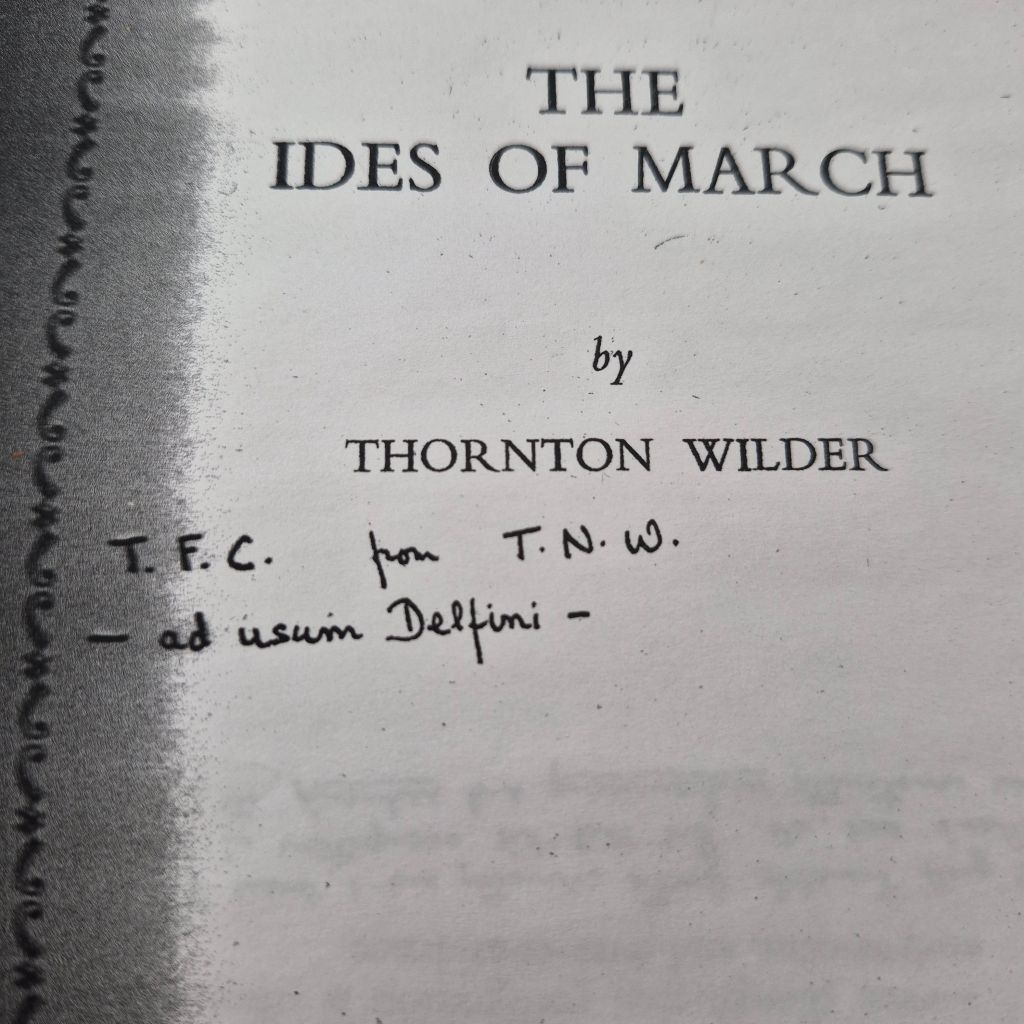
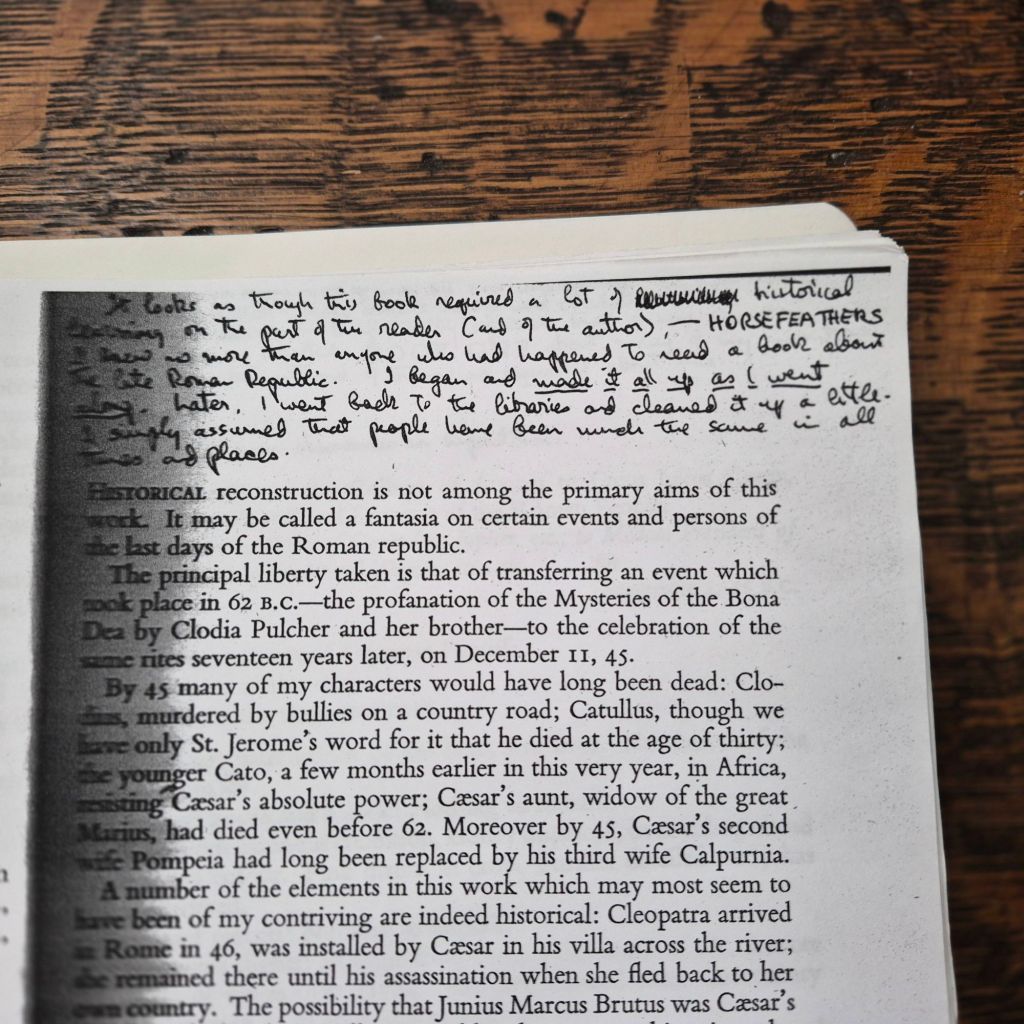
Inside the book was a British Airways boarding pass made out to someone named Catherman, and Wilder’s final inscription said: “all best wishes, every day of his life, to Terry Catherman.” Catherman was an American diplomat and high ranking USIA and Voice of America official, who had died a few years before I found the book. What his relationship was to Wilder, I do not know.
Was I planning on writing about Thornton Wilder when I sat down this morning at the computer? Not at all. It was falling crucifix that led me to think of poor Father Juniper and then poor Terrence Catherman who, had he not passed away, would this year celebrate his 100th birthday.
By the way, over the weekend, we saw The Flying Lovers of Vitebsk, a play about Marc and Bella Chagall at Theater J. Your odds would have been better if you bet on me writing about Marc Chagall this morning. But I hope you didn’t make that bet. The show did not do much for me.

