There is so much going on, but let me start with #1.
#1. Happy Indigenous Peoples Day from me right here in Washington, DIP (District of Indigenous People-ia). Seven years ago, the DC City Council abolished Columbus Day and replaced it with Indigenous Peoples Day, but they didn’t try to change the name of the District, which is still the District of Columbia. Now perhaps, after he decides which ocean he is going to rename the American Ocean, Trump (who is a big Columbus fan, by the way) will try to rename the District to the District of America. Then he could rename the city to Washington/Trump (sorry, Trump/Washington) and then determine that the renaming of the Day by the City Council was null and void, so we will again have Columbus Day, right here in Trump/Washington, DA. Stranger things have happened.
#2. I saw a post yesterday from someone on some platform that gave the best explanation of the diesel deal with Russia. It went something like this:
The United States is at war with Iran
Russia is supporting Iran in this war, and supplying Iran with materiel
We are buying diesel fuel from Russia
Russia is using the money we are sending them to send military equipment to Iran to fight us.
We are therefore funding the war against ourselves.
Again, thanks to Walt Kelly, “we have met the enemy, and they are us”. (By the way, “us” can either stand for “you and me and the rest of everyone” or the U.S. – but I guess you figured that out.)
#3. I present two charts:
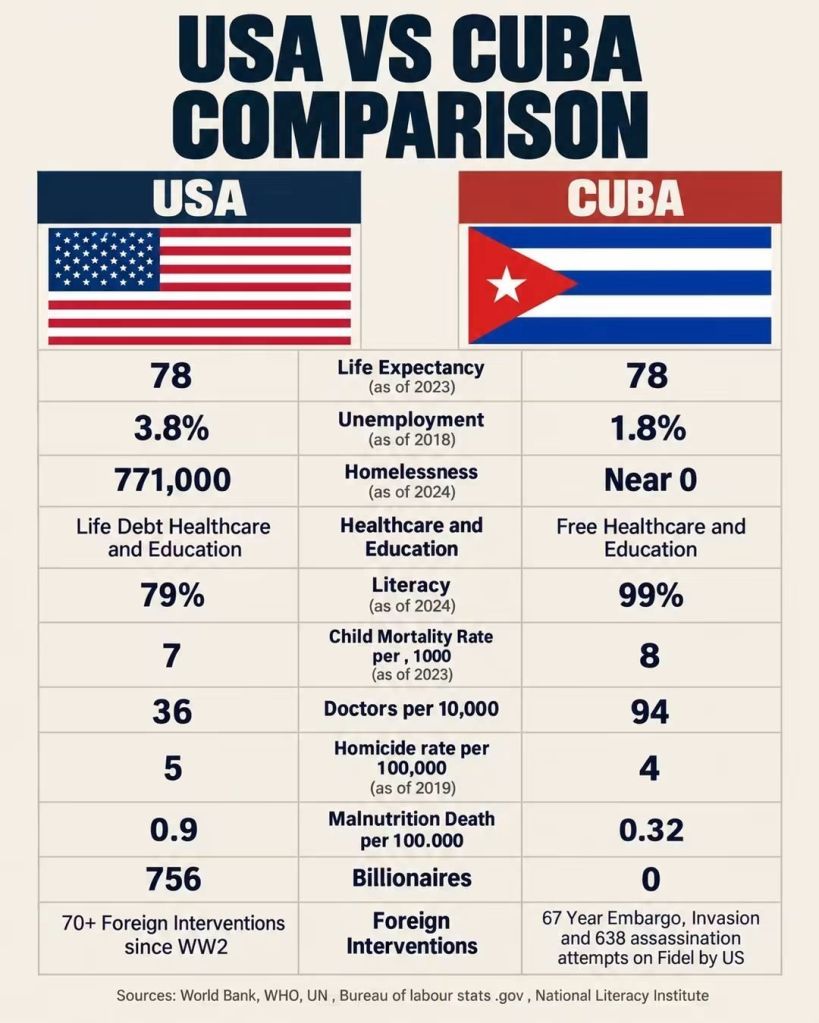

I present the top chart not to laud the government of Cuba, which certainly has its problems (both internally and externally driven), but to demonstrate the failures of so-called American capitalism.
I present the second chart to demonstrate something that those who live in the states on the left of the chart already know – if a state is well educated, it will vote Democratic. In this regard, I call to your attention an article in Sunday’s Washington Post by James Marriott titled “Reading the Signs of a Post-Literate Age”. His premise is that, for the reasons he described, we are becoming less literate. If he is correct, this really augers well for the future of the Republican Party.
#4. We saw The Score at the Shakespeare Theatre yesterday, and I must say I didn’t find it very appealing. It starred Brian Cox, an 80 year old actor (plaudits to him) playing 62 year old Johan Sebastian Bach on his 1747 visit to Frederick the Great. Bach lived in Leipzig and Frederick’s court was in Potsdam.
The play takes a real event, the visit, and fictionalizes is into a “what might have really happened” narrative – a narrative of things the history books don’t tell us. What we know is that the visit occurred, that Frederick was a true Renaissance Man who was, among other things, a fine musician and composer, and that he really wanted to meet Bach. C.P.E. Bach, the composer’s composer son, worked at the court of Frederick and arranged the visit. Frederick and Bach were very different personalities – Frederick fairly secular for his age, Bach quite religious, and their musical tastes were different. Frederick composed a complex melody and challenged Bach to turn it into a three part fugue on the spot, which Bach did. Frederick then asked Bach to compose a six part fugue based on the same melody. Bach responded by telling him he could not do that ad lib, but that he would do it when he returned home and send it to him. Frederick did not anticipate that Bach would be able to do it, but he did, and later published the peace, called The Musical Offering, dedicated to Frederick. That is what we know.
The play cannot decide if it is an historical drama or a comedy, which I found disconcerting. There seem to be historical anomalies. For example, in the play, Prussia has occupied Leipzig militarily to the great consternation of Bach. In real life, unless I am overlooking something, the Bach visit occurred 6 or 7 years before Prussia moved into Saxony and occupied Leipzig. The play introduces an overly silly French character – none other than Voltaire – unnecessarily as a fly on the wall at the meeting. It is true that Voltaire spent three years in Potsdam, but again, this came well after the time of the Bach visit. The play introduces three composer friends of C.P.E. and they and Frederick himself make a large bet that Bach will fail – the other side of the bet was taken by C.P.E. (who had no money, in case he lost). This never occurred, as far as anyone knows.
So, I didn’t like the play. I thought the acting was spotty. Clearly, Cox is a good actor (you don’t need me to tell you that), but he played the part differently than I think Bach himself would have played it. My basis for that? I have none at all, but I think the fact that I think it shows something lacking in Cox’s interpretation of the role.
#5. After the play ended, we went immediately to the Martin Luther King Library (it’s only 2 or 3 blocks – depending how you count blocks – from the Shakespeare Theatre) to see the last feature of the Washington Immigration Film Festival. The film, titled Left Lane Straight, tells the story of the film maker’s family – Sephardic Greek Jews who survived the Holocaust and wound up in the United States. The movie is really well done (if a little too long at the end), and tells the relatively unknown story of the Jews who were exiled from Spain, wound up in the friendly Ottoman Empire, but began to have problems when nationalism affected the Empire’s European territory, including Greece and Bulgaria. Most of the Jews of northern Greece, a prosperous and prominent community, wound up dead at Treblinka, but this family survived, by hook, crook and a lot of guts and luck, making for a very interesting story. The filmmaker and, I think, a cousin of hers, had taken a lot of videos of their parents and grandparents in the 1990s (don’t many of us wish we had done that?), and they formed the basis for the film and the story line. Perhaps there is a way that I can get the film shown by the Haberman Institute. Keep posted.

