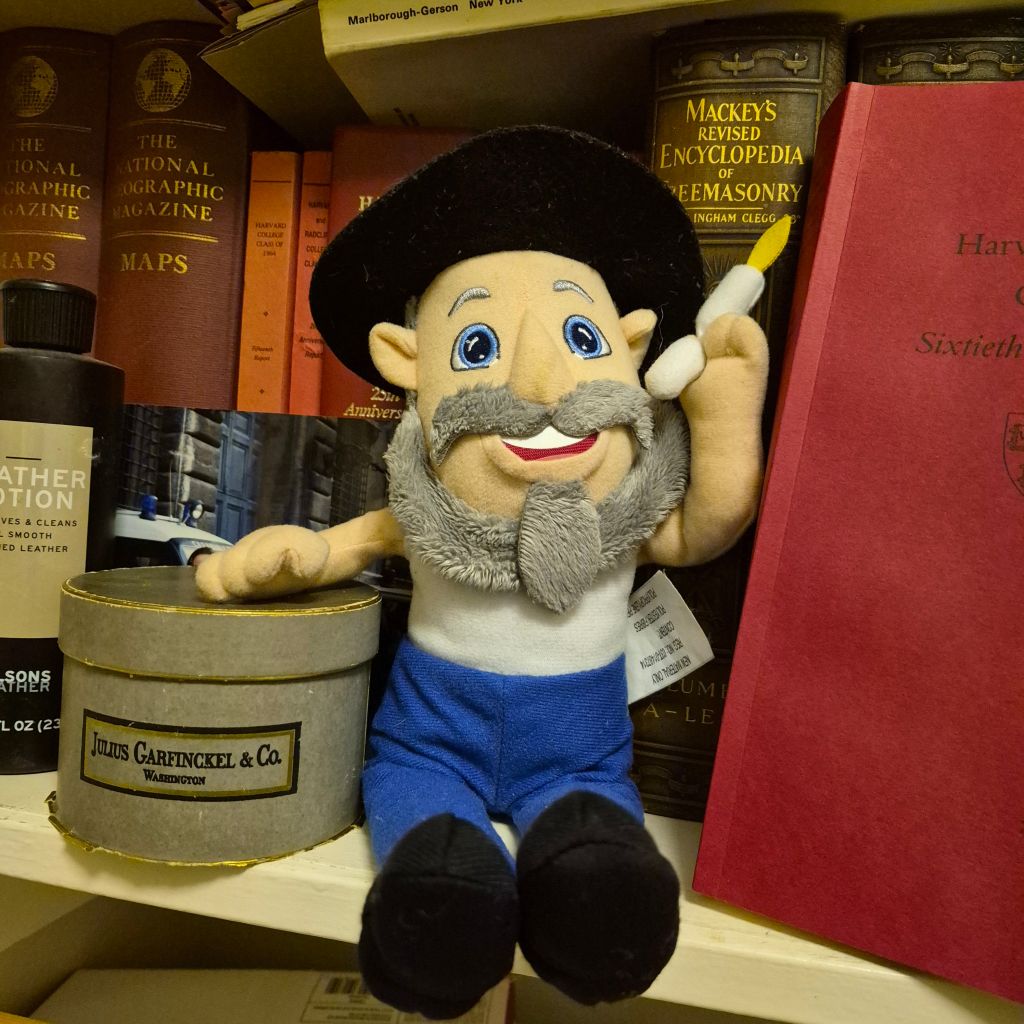
I have been looking for someone who seems happy with the world, and I found him on a shelf in a closet. I am going to leave him there, so that he is not exposed to the rest of the world.
I am trying to ignore much of that world, as well. Looking for other things to think about.
For example, today I thought about something that happened in 1968. Depending on how you look at it, 1968 is a long time ago, or just yesterday. To me, it is pretty much just yesterday, although 1968 is 58 years ago. When I was born, 58 years ago was 1884, and I certainly never thought of that as just yesterday. But I digress.
In 1968, when I was living in St. Louis after law school graduation, a co-worker was a volunteer with the Missouri School of the Blind. He spent his time with the youngest children, I think elementary and middle school age, chaperoning groups of them to various places in the city, places they would otherwise not get to. I remember him coming to work one Monday morning, extraordinarily upset because he took a bunch of those children on Sunday to a bowling alley, but when he got there, he was told that the alley would not let the children bowl. Why? Because one of the kids in this group was Black, and the bowling alley excluded Blacks. I remember him saying: “These were just young kids. They couldn’t see. What did they know of Black?”
Another Digression: Yes, the 1964 Civil Rights Act required all places of public accommodation to stop any racial exclusion, but there was a movement among some bowling alleys to deny that they were subject to the act, saying that they were not a place of public accommodation, but just a place where people got together to play a recreational sport (recreational sports were not covered by the act), while some became “private clubs”, where you could join for $1 if you were white. I don’t know the details about this particular St. Louis venue. End of another digression, but…..
A further digression: It wasn’t until the Americans with Disabilities Act was passed in 1990 that a bowling alley was clearly identified as a public accommodation under federal law. End of further digression.
Moving back even further in time (i.e., even before 1884), I remember the story that my grandmother told, growing up in the Austrian-Hungarian Empire, living in a locale where there were apparently very few Jews. She went to a Catholic convent elementary school, and her mother (my great-grandmother Tovah Dicker) planned a party for her fifth or sixth birthday, inviting all the children in her class. No one showed up, and they learned that the kids were all forbidden by their parents to go to a party in a Jewish house. That would have been in the late 1870s.
And then there is the well known story, from about the same time, of the wealthy Jewish banker, Joseph Seligman, who was turned away when he and his family showed up at the hotel in Saratoga Springs, NY, where they had stayed for years and where they had made reservations. That was also the late 1870s, and apparently marked one of this first times Jews had been excluded from a hotel in this country, or at least the first time such an event became a major news story.
And, yes, I am going somewhere with this.
When I was growing up, St. Louis was a pretty segregated city. Except for the Blacks who worked as housemaids or laborers, I had no experience with members of that race. I never thought of it in terms of right or wrong. That is just the way it was. There were many places where Blacks were not allowed (restaurants, for instance). But, after all, there were places where Jews were not allowed. Mainly country clubs and certain residential neighborhoods (perhaps the majority of residential neighborhoods), and Jews took that, too, as just the way things were. We Jews never wanted to join clubs that wouldn’t have us. We never needed to move into neighborhoods that didn’t want us. We were fine. How the Blacks felt at the time, I don’t know. There was nothing they could do about that, that’s for sure. And this is just the way it was.
But since the 1870s and even the 1960s, many changes have taken place. Starting with the passage of federal and state antidiscrimination laws, and moving on to changes in the way most people looked at their social and societal environments, things changed and, even when the law may not have specifically required integration, integration happened, right? (Let’s leave out the problems with integrating schools, and the apparent shortfalls in integrating churches.)
Do you know the journalist Catherine Rampell from MS NOW and The Bulwark? I find her a very professional journalist and easy to watch TV personality. She was a guest on a TV show yesterday morning talking about the economy and the new jobs report, and while she was talking, I decided to look her up on Wikipedia (I do that a lot, as you might imagine). She was raised in Palm Beach FL, and her parents were the name partners of the largest accounting firm in Palm Beach. They served very rich clients, and I am sure made a very good living doing it. Her background seems clearly to have been economically privileged, and she was educated in private schools and then Princeton.
After I read her bio in Wikipedia, I went on to her parents, starting with her father. In reading about her father, I came across an incident that reminded me of my grandmother’s story of 150 years ago, and then of my co-worker’s experience in the bowling alley in 1968.
In 1990, Catherine Rampell’s brother was four years old. He went to a preschool and one of his classmates had a birthday party. All the children in the class were apparently invited, but young Rampell was not. This was because the party was to be held at the Palm Beach Bath and Tennis Club, which did not permit Jews, even 4 year old Jews, to come onto their property.
The story goes on to show what Richard Rampell did about it, but I don’t need to go through that here.
My purpose of all of this, I guess, is to show that, even when things look like they have improved, retrogression is always just around the corner. While you have courts and governments that are progressive, rather than retrogressive, those who want to move backward tend to be marginalized and dealt with one at a time, as necessary. But when your government changes, and the retrogrades wind up in charge, you find that there were more people than you may have thought longing for the 1870s. That seems to be where we are today, and we have to change that. Vote blue, as they say, in November.
In the meantime, I will continue to make sure that my Mensch on the Bench (not to be confused with an Elf on the Shelf) remains sheltered from the evils in this world. When things improve I will let him out.

