It was a beatiful day yesterday, so instead of going to a museum, we took a walk. We went to the Palisades section of Washington that sits high above the Potomac River. We took a simple route- Davenport to Nebraska/Loughboro down to its end at the Delacaria Reservoir and water works, at Potomac Ave. We walked up Potomac Ave, admiring the beautiful homes built with beautiful views of park, river, and Virginia, and then noticed a marked trail that skirted the river side of the fenced reservoir grounds. This is what we saw:

Perhaps “two trails diverged in a yellow wood”, but we only saw one trail and the woods looked green, but we took it, not really knowing where it was going, or how long it would take to get there.
Our first clue:
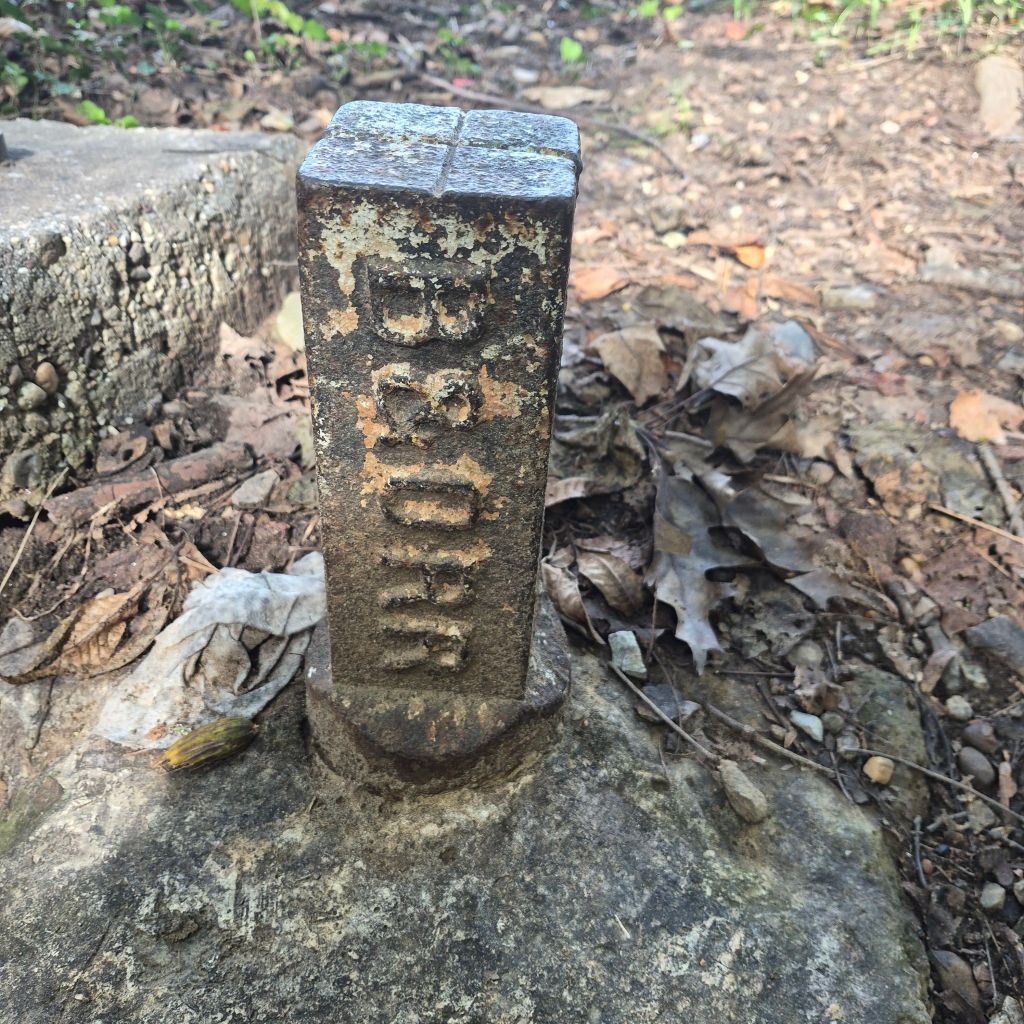
It’s a 19th century boundary marker, and on it is the following message: B & O R R, the Baltimore and Ohio Railroad. That meant we were in an old railroad right-of-way, and that meant we were heading to the paved Capital Crescent Trail, which runs 11 miles from Silver Spring to Georgetown.
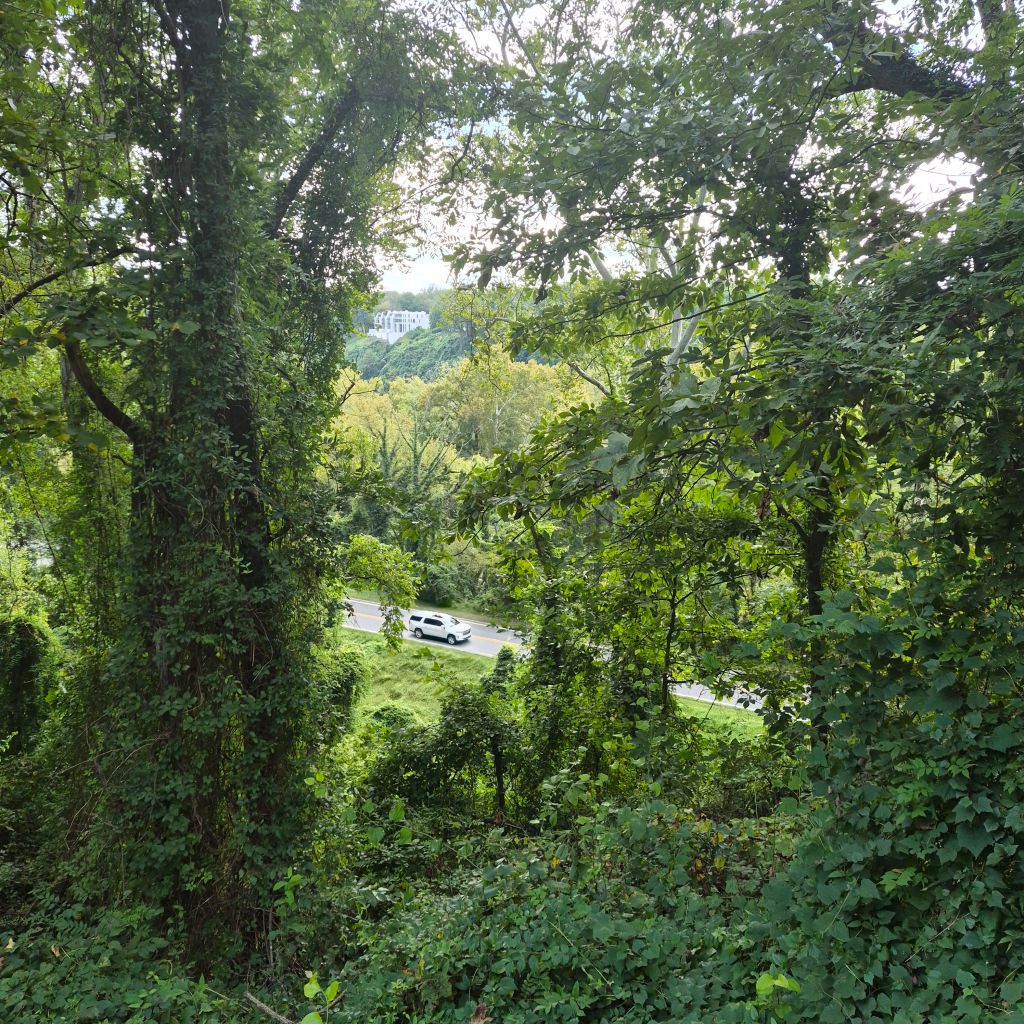
Before we reached the Capital Crescent (and it wasn’t that far), there were some nice views, this one looking over Canal Road:
And after we reached the trail, we ducked many speeding bicycles and said hello to joggers and fellow walkers, and we soon passed from the District of Columbia into Maryland, and saw two benches, each dedicated to a deceased cyclist.
We stopped at this one:
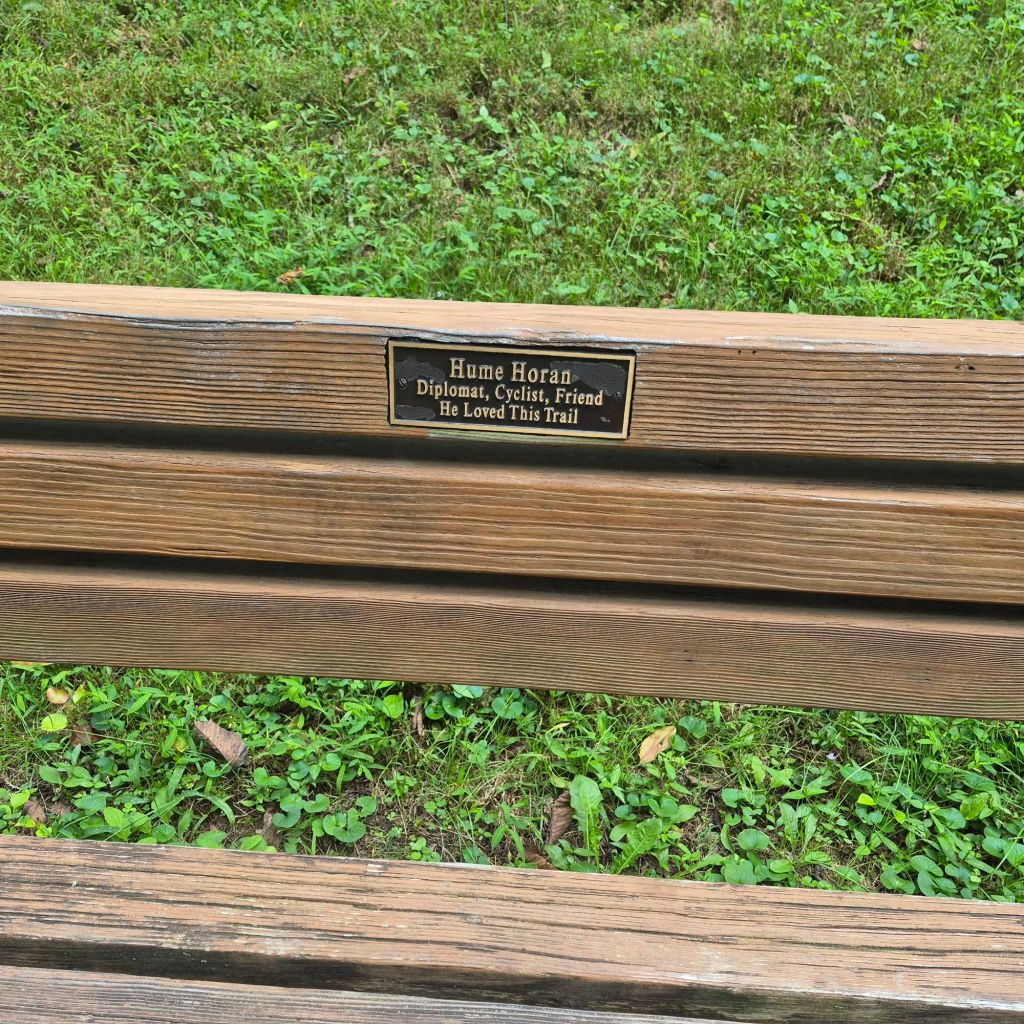
This bench is dedicated to Hume Horan, “diplomat, cyclist, friend”, and for some reason, it led me to the question: who was Hume Horan?
Hume Horan (1934-2004) was a member of the United States Foreign Service, who served as our Ambassador to Cameroon, Equatorial Guinea, Ivory Coast, Sudan and Saudi Arabia. His born name was Hume (his mother’s last name) Entezam (his father, who divorced his wife when Hume was three) was an Iranian diplomat, who also was head of the National Iranian Oil Company. His mother later married a journalist named Horan.
Among other things, Horan had the knack of being kicked out. He was sent to a prep school in Rhode Island, the Portsmouth Priory, and was kicked out (he was happy to be kicked out, apparently). And he was kicked out of Saudi Arabia by King Fahd. Why did this happen? According to the Association for Diplomatic Studies and Training, it started when King Fahd decided to by some ballistic missiles from China after the United States had cut off all military sales to the kingdom. Horan was told to send a strong message of disapproval to the king, which he did. But at the same time, the U.S. from Washington apparently sent a different message to King Fahd which was much milder than the one set by Horan under instruction. The king was very angry at Horan, and his ambassadorship ended after nine months. (And yes, there was a back story – Pres. Reagan did not want to cut off arms sales to Saudi Arabia, but Congress did, and passed a law to that effect, back when Congress could do something. Reagan vetoed the law, and Congress overrode his veto. Thus, Horan was in a difficult position, being required to inform King Fahd of the American position, while Horan’s president wanted to make clear to Fahd that it was all Congress, not himself. )
Horan’s last diplomatic position was working with Paul Bremer in Iraq after the U.S. “won” that war. He died of prostate cancer that must have cut short that position.
So, don’t blame Hume Horan. Yes, he was kicked out of Portsmouth Priory, and kicked out of Saudi Arabia, and even benched in Montgomery County, but over all, his career seems very successful.

