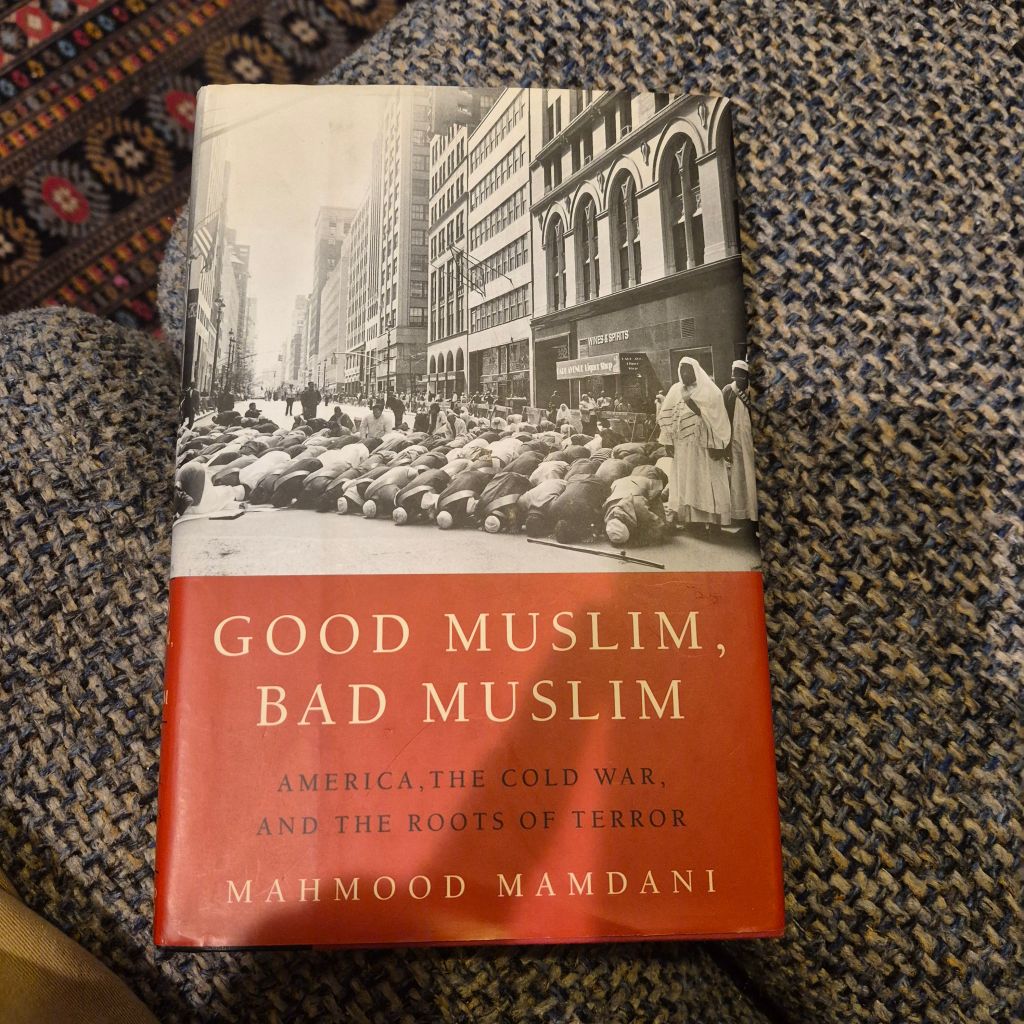
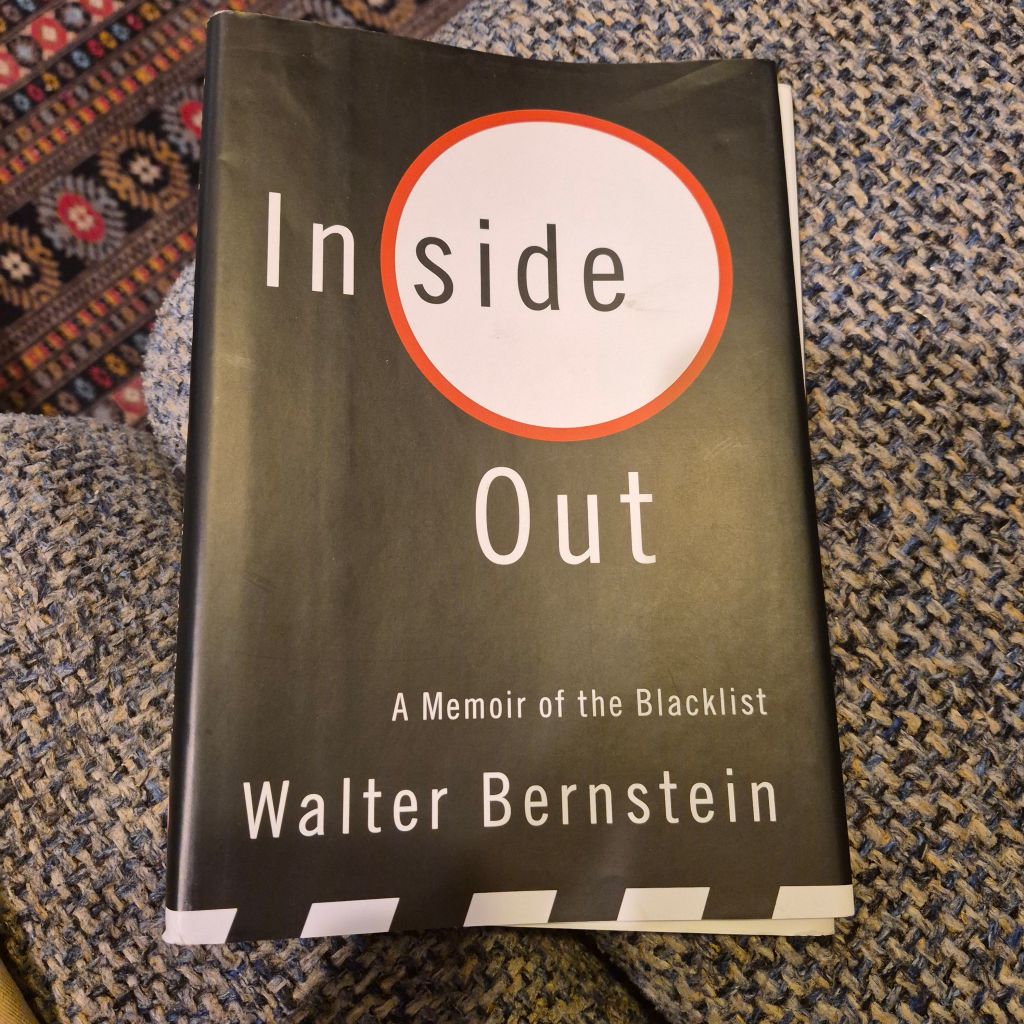
I haven’t read this book, but think I will make it my next one after I finish Walter Bernstein’s I8nside, Out, about a writer’s experience with the Hollywood and Broadway “blacklists” in the 1950s.
I am not sure what Good Muslim, Bad Muslim says, but it is by Zohran Mamdani’s father, who teaches or taught at Columbia, and I thought it might give me some insight as to the mayor’s thinking. Or at least some context. The book is an explanation for the rise of Islamic terrorism, and was published 22 years ago, in 2004. (Am I the only one who has trouble realizing that 2004 was over 20 years ago? In 2004, Zohran was 12.)
In looking quickly at the introduction to the book, it seems to focus on nationalism, not religion, and not to necessarily equate Islamic terrorism with other forms of nationalism, but to show how closely related they are, and how it is western culture that paints it as very different. And, while certainly condemning the Holocaust, he also seems to define it as a not unusual phenomenon (the phenomenon of one group deciding to annihilate another), but large in size and European. He says that if you look at other parts of the world, particularly in Africa (remember, Mamdani is from Uganda), there are many such examples. But Europeans (and I guess Americans), he says, look at European wars very differently than they look at wars elsewhere. What he says about Israel, I don’t yet know, or about the Palestinians.
Looking at the world as a battleground between rival nationalities is of course the way Timothy Snyder talks about Nazi philosophy and perhaps you can also equate it with Trump’s stated MAGA philosophy, which seems to have defined an “American” race, which should have dominance over competing cultures around the world, and which should keep itself as pure as possible, hence the strong anti-immigrant and strong border policies.
Just like the Jews got in the way of Hitler’s concept of racially pure European societies structured in a pro-German hierarchy, the Jews in Israel get in the way of Arab nationalism in the Middle East. Always the Jews.
As to Walter Bernstein and the blacklist, I must admit that his name meant nothing to me when I found the book. He was a Hollywood (and New York City) writer, a fellow traveler of the Communist Party from his college days on, and member of the party starting in the later 1940s, after the end of World War II. I am only about halfway through the book (it seems to becoming a habit for me to write about a book before I have finished it; probably not a good habit), and I haven’t really got to his being blacklisted yet.
He describes his New York City background as being impoverished and his immigrant father as both a teacher and a writer, but he seems to have been privileged in many ways. He went to summer camp, his parents went to a summer family retreat on a regular basis, and he met, through his parents, some well know New York intellectuals. He talks about being a poor student, but somehow got into Dartmouth, and spent the summer before college living with a family in France. So it is a bit confusing.
He graduated from Dartmouth in 1940 and was soon drafted in the army, spending time at Ft. Benning for basic training, but then being put into a journalist/entertainer unit where he spent the remainder of the war years working for an army newspaper called Yank!. He got into this unit with some strings pulled, and his Communist background (clearly not hidden) did not seem to affect his assignments, including his appointment (aborted before it could actually take place) as the Moscow correspondent of Yank!. (It was Moscow that decided that they did not want the paper to have a Moscow office.)
Bernstein clearly had one knack that I lack. He had the knack of meeting famous people, while my only knack is consistently finding good parking spaces. For example, he, as a military reporter, is flying to Naples and he is sitting next to General Benjamin Davis, leader of the Tuskegee Airmen. He gets on another plane in Naples to fly to Bari, and the other passenger is Ernest Hemingway’s wife, or ex-wife, Martha Gellhorn. His buddy in basic training is future China expert, Robert Conquest. It goes on and on.
The most interesting portion of the book that I have read involves his being sneaked into Yugoslavia and having the first interview with Tito in his wartime headquarters. This comes from his having met two Yugoslav partisans when he was stationed in Cairo (“stationed” is not the right word, because as a journalist in the military, he seemed to be able to go anywhere he wanted, when he wanted, with whom he wanted; strange military service in the middle of a war), who told them they could smuggle him into meet Tito and that, especially because of Bernstein’s communist connections (which again did not seem to affect his military service), Tito would be happy to talk to him. Getting him to Tito turned out to be far from easy. He had to wait for a plane going to the right place, and then sneak onto the plane and be left on a coastal island where there were villagers and partisans, to trade his American uniform for a partisan uniform, and hike for over a week up and down mountains, hiking at night, hiding during the day, with a group of partisans.
The interview came off, but Yank! wouldn’t publish it because (a) Bernstein was not authorized to go into Yugoslav territory, and (b) there were two civilian reporters who had already been promised by the U.S. army that they would have the first interview with Tito. Bernstein was threatened with severe punishment (perhaps a court martial), but he sent the article he wrote to The New Yorker (for whom he had done some freelancing when he was still at Dartmouth) and they published it. Although he was afraid this would cause even more problems, it turned out to work in his favor, because the article was so well and widely received, that the army apparently did not dare carry on with its promised discipline. He heard nothing about a potential court martial, or any other form of punishment, again.
Okay, that’s all I know right now about Bernstein. Well, one more thing. He lived until he was 101.
Going back, for a minute, to the importance of nationalism in recent world events, you could conclude that the fight against Hitler was a fight against nationalism, and that the post-war split among the allies was solely related to ideology.
Or could you?

