We saw Othello at the Shakespeare Theatre yesterday (between Fathers’ Day brunch at Hannah’s and dinner at Michelle’s) and the production was, as expected, very good. Good acting, good directing, good staging, good choreography, good entertainment.
But I must say that, although Othello has been around for over 400 years, performed over and over again, I don’t think it worthy of its success. Okay, who am I to say this? I know virtually nothing about the play and its history, which has been studied and studied.
But I know how simplistic it is. Othello himself is a Venetian general (originally from North Africa) who marries a noble woman, Desdemona, and his chief aide, Iago, decides to poison their relationship and convince him that Desdemona is unfaithful to him (she is not) and is having a relationship with a rival of Iago, a soldier named Cassio. Othello falls for it, and everybody (almost) dies. That is the entire play. This worn out story that repeats itself through history and theater over and over. And it makes it easy to watch and comprehend, which may be why, among all of Shakespeare’s work, this early one is so often put on the stage.
Now, I must say that, although the plot is trite (and, pretty unique for Shakespeare, there are no complicating subplots), the script is quite good. Filled with memorable lines about wearing one’s heart on one’s sleeve and loving “not wisely but too well”. And many more. I’m not denying the guy had talent.
And there are a couple of unusual twists (I don’t think that is the right word; I am not thinking of unexpected plot twists, of which there are none, but of unusual idiosyncratic – oxymoron, I know – elements). I will list three of them.
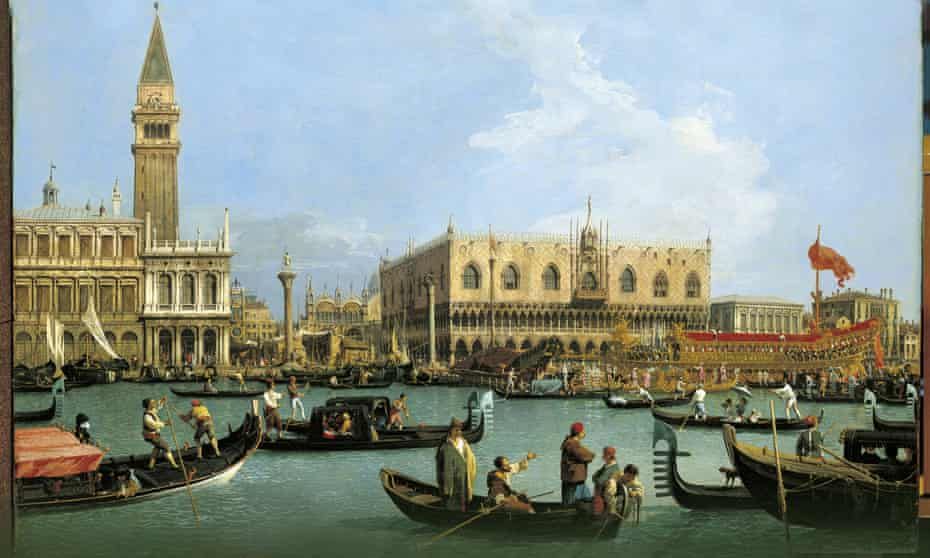
First, Othello is “Black” and a “Moor”, and he is from North Africa. Now, Venice in the 17th century was a pretty cosmopolitan place, and there were certainly Blacks in Venice. There has been scholarly work on the Black gondoliers, and on Venetian Black slaves and freed slaves, and even on Black/White marriages and relationships. There were also obviously Moors in Venice; this term applied to people from North Africa and did not refer to skin color. The term Moor also did not delineate religion, and Othello was a Christian. Whether he was born and raised in Venice as a Christian, or whether he came to the city-state as a Muslim and converted, we obviously don’t know. We do know he had no hesitation in leading the Venetians against the Muslim Ottomans.
We also don’t know whether Shakespeare wrote this play as a study in race relations, although it has certainly come to be performed and discussed as if he did. There are relatively few references to to Othello’s “blackness” during the play (after the initial scene discussing his marriage) and had he been, say, a Spaniard or a Greek in Venice, you could imagine the play written just as it was with the references changed. Black, White or whatever, Othello was accepted by his Venetian compatriots. And, in fact, we don’t even know what Shakespeare has in mind when he calls Othello “Black”.
The second oddity (that is probably the word I should have used above) is why Iago (called over and over and over and over again, in the script, “honest”) is out to get Othello. There is no hint that it is related to skin color or ethnicity. In fact, there is not hint that it is related to anything. There has been 400 years of speculation (he was himself in love with Desdemona, he was jealous of Cassio’s position in Othello’s eyes or in Desdemona’s eyes, he did it for sport, etc., etc.). Perhaps some view this lack of evidence of a motive as a strength in the play, inviting speculation and conversation. But to me, it is a weakness.
Thirdly, the story line begins in Venice and ends in Cyprus. It appears that Venice has defeated the Ottomans, although this is not clear. In fact, the military aspects of this play (as well as the time line) is also very confusing and impossible to understand, it appears. In real life, Venice and the Ottoman Empire fought a major series of battles over the Island of Cyprus about 30 years before Shakespeare wrote Othello and Venice lost control of the island forever. But obviously this is not what happened in the play.
Enough criticism. Did I enjoy the show? Yes, for the obvious reasons. Well performed and entertaining. Just like watching any battle of the sexes. Just like Who’s Afraid of Virginia Woolf, another ridiculous, but entertaining show, where you can always enjoy the performance.
If I had reviewed Othello in 1604, and if I had liked the performance, I would have praised it, and said that the play itself would have a short half life. It’s the opposite of what I said when I saw Liza Minnelli in her very first public performance at the initial New Haven premier of Flora the Red Menace. My conclusion was that Minnelli had no future in theater, but that Flora, the play, was going to be a big time hit. Shows you what I know.
 Art is 80