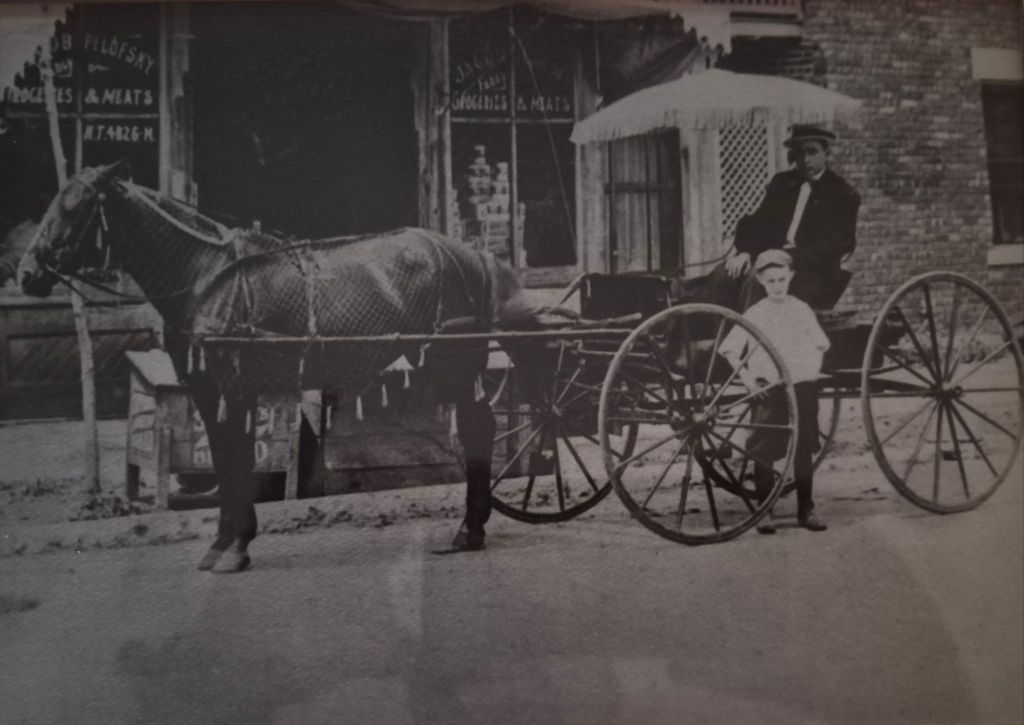
This is a picture of my father when he was four or five in Kansas City. The year was probably 1908. And, no, everything was not up to date in Kansas City. Or maybe it was.
Last night, we had dinner with 9 of the 12 friends we have supper with three or four times a year, and the discussion turned (after many other subjects) to computers and smartphones and AI, and their effects on the education and socialization of children. One of the group had recently done a lot of research on, and given a presentation on, the use of computers and AI in schools around the world, and its effects, which seem to be generally harmful and universally so, not just in the United States.
I am not sure I had too much to add to the discussion, which dealt in part with how difficult it will be (and is) to regulate artificial intelligence in today’s environment, except to say that no matter what we try to do, we won’t be able to stop “progress” and that the world is going to change and become unlike anything we know today. Chances are that will be good for some, and less good for many others.
So, take my father. I view him as a contemporary of mine, just one generation back. He was born in Kansas City MO in 1903, and died in St. Louis in 1979, obviously too early. But look at the changes that he saw. Clearly, in 1908 when he was a young boy, horses and buggies were the main ways around town. In 1903, the year he was born, the Wright Brothers first took to flight at Kitty Hawk. The world still was enjoying peace in its time; it was 12 years before the start of World War I which changed everything. Teddy Roosevelt was the president, the trusts and robber barons were being tamed, and uncontrolled immigration from Europe was at its height. Not only did television not exist, radio was still almost 20 years away. And, although telephones were invented in the 19th century, in 1903, probably about 5% of homes had a telephone in this country; and you can be sure that the home of my grandparents were not included in that number.
I remember sitting, on July 16, 1969, with my grandmother, in the common room of the Delmar Gardens Nursing Home in University City MO watching the first moon landing on the television, and talking about the changes she had seen in her life. She was born in Lviv (then Lemberg, later Lvov) in the Austrian-Hungarian Empire in 1872. She remembers her first (or one of her first) jobs as a very young girl, helping to stuff bullets for the Emperor’s army. But even compared with Kansas City of 1908, Lemberg in the 1870s was quite primitive.
I was born in 1942. In a sense, I don’t think one realizes that changes that they have seen over their life. My memories over the past 83 years lead me to think that things were always up to date. But think of these things that I remember (especially, you who are much younger than I am).
- I remember when no automobiles had automatic shifts, and when now and then you saw cars from the 1920s driving down the street.
- I remember an ice man bringing ice to our house, a knife sharpener coming down the street ringing a bell, mile delivered in the morning, and eggs in the afternoon.
- I remember when there was no TV in St. Louis and when there was only AM (no FM) radio.
- I remember when the first supermarkets opened.
- When I first went to school and learned to write, I remember dipping a quill into an ink well, writing a few letters and dipping again.
- I remember when a fountain pen seemed a luxury, and the extraordinary invention of the ball point pen which changed everything.
- I remember, throughout my youth, mimeograph machines, and carbon paper
- I remember never being able to really figure out slide rules beyond the basics, and I remember when there were adding machines, not calculators, and they were almost as large as a typewriter.
- I remember when all airplanes had propellers, and how travel changed when commercial jets began to appear.
- I remember when dictating machines were introduced, and the first time computers were available in the office, and how bulky they were then.
And I remember a day in the early1980s, when I was working on a real estate transaction in San Juan PR, and a bunch of us were meeting in the office of the contractor, when he pulled out his pocket calculator that could do all sorts of tricks. We were all mesmerized. What would they think of next? How is this thing even possible?
Of course, every major society change changes society. From the time that hunter/gatherers became agriculturalists, to the time that agricultural Britain became industrial Britain and on and on. With artificial intelligence and super computers and quantum computers and who knows what else being developed, there are clearly going to be some consequences that will be negative, some foreseeable, some not. And there will also be improvements, benefiting most but not all. The nature of education may change, the nature of social interactions may become much different.
The one thing that will remain constant, as they say, is that there will always be changes. The society that our grandchildren will know will be such that they will look back at the pictures of my life and feel sorry for all that we missed. Will the future be better than the present? We don’t know. We may have lived in a golden age. But perhaps our age was not as golden as it has seemed, and the next generation may see progress in many spheres beyond our wildest dreams.
 Art is 80