- As usual, on a Friday, I start my day by going to Breads Unlimited. I buy a challah, a danish, and a cup of coffee. The challah is $8.95, the danish just under $4, and the coffee $3. I don’t begrudge the shop a profit, but those prices are on the high side and have increased twice over the past year or so. They also have started to add a 3% credit card fee. When I go to pay with my card, I get another option. I can give the clerk (whose tasks were to put my choices in a bag, pour my coffee into a cup, and ring up my bill) a 20% or a 30% tip or a different tip that I have to determine and then input, or “no tip”. To me, “no tip” seems like I am insulting the clerks (whom I see every week). And of course, the clerks are staring at me (smiling in the friendliest of manners) as I am checking out.
Dear Ethicist: what should one do in this circumstance?
2. Do you know this man?
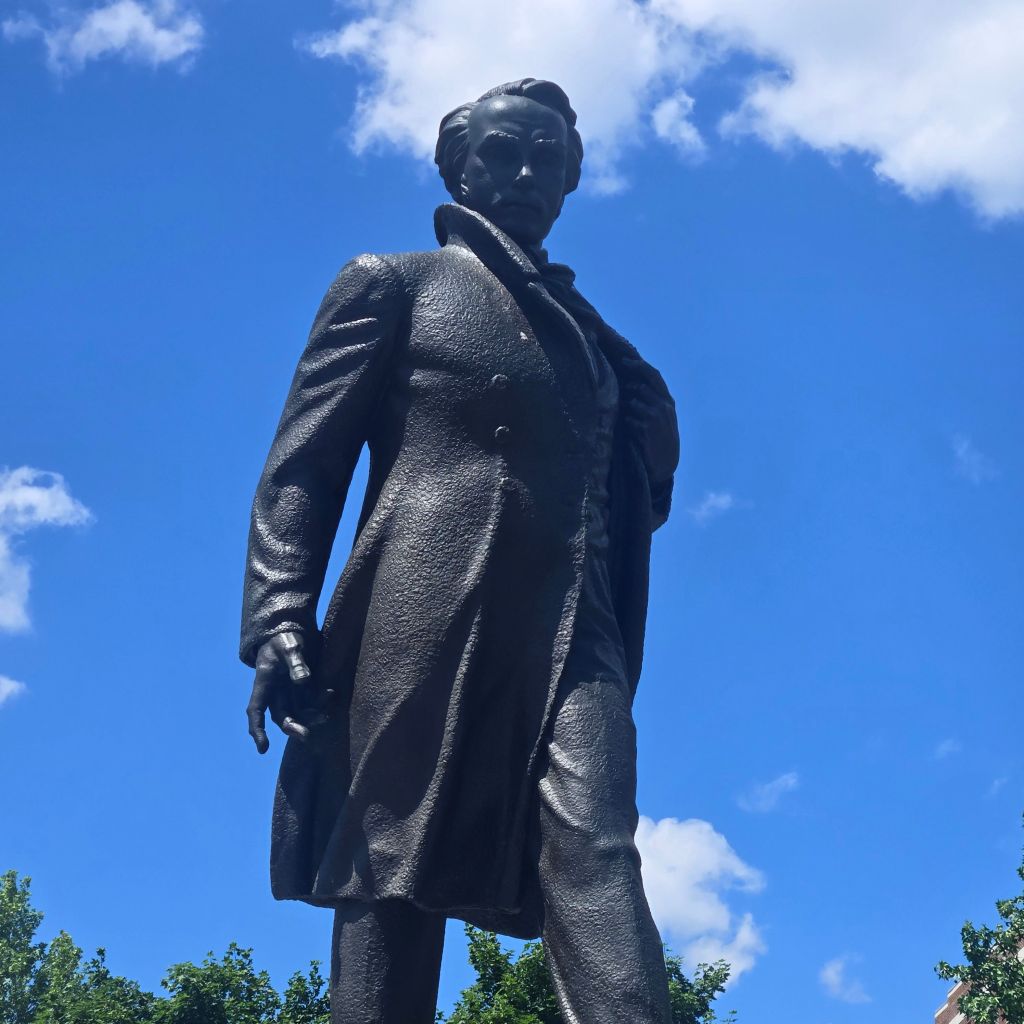
He is Taras Shevchenko, and was a major Ukrainian poet, painter, patriot, and cultural figure during the first half of the 19th century. He stands prominently on P Street NW, between 22nd and 23rd.
I decided to learn a little more about him. He was born a serf, was obviously both bright and creative, was freed as a teenager, studied art in St. Petersburg, where he met many cultural figures, got in trouble with the authorities, was exiled, got out of trouble, allowed back, etc. Just like a lot of cultural figures in 19th century Russia. He was a champion of the poor and of equal rights for all. He was not a full blown rebel, but was later idealized by the Communists. He believed in pan-Slavic unification. He was well thought of by contemporary Russian-Jewish writers and he was against minority descrimination of any kind.
His earliest writings pegged Polish landlords and their Jewish agents as being enemies of the common people, but anti-Jewish sentiment seemed to vanish from later writing.
The statue was dedicated in 1964 as a tribute to growing ethnic patriotism in eastern Europe. Believe it or not, Wikipedia says 100,000 people, many of Ukrainian ancestry were involved in dedication day ceremonies. The head of the commission who pushed for the statue was Georgetown Professor Lev Dobriansky, whom I knew a little because he was a colonel in my Army Reserve unit.
Dobriansky was strongly and vocally opposed to everything about the Soviet Union and a patriotic ethnic Ukrainian. It is ironic that anti-Soviets lauded Shevchenko as a Ukrainian, while the USSR praised him as a champion of a classless society.
By the way, does anyone ever read anything Shevchenko wrote?
3. This will be qiick. I listened to Kevin Roberts of the Heritage Society on C-Span this morning. I think I disagreed with everything he said. The core of Roberts’ Heritage message is that the non-profit is simply upholding and trying to restore American values. I understand that about half of Americans share many of Roberts’ positions. But another half share my positions, which constitute American values as much as his do. Can we just stop saying that those Americans we disagree with do not have American values?

