We drove to Baltimore yesterday to see the Washington National Opera’s production of West Side Story. First, a matter of introduction. We have not been regulars to WNO productions over the years. But when Donald Trump announced the name change for the John F. Kennedy Center for the Performing Arts, and announced a potential two year closure for a total rebuild of the facility, the WNO, which had been housed in the Kennedy Center for about 50 years, was one of the first organizations to announce that they were leaving, even though they had yet to find a new venue. This made attending, and supporting, Washington Opera performances an act of political necessity, and we responded first by going to see its version of Scott Joplin’s Treemonisha, and then buying tickets to see West Side Story.
Treemonisha was performed at George Washington University’s Lisner Auditorium, which seats about 1500, considerably less than the opera house at the performing arts center formerly known as Kennedy, which seats about 2400. But Baltimore’s historic/modern Lyric Theater seats, according to my smart phone, an audience of 2434, virtually the same number as the opera house. West Side Story is being performed at two venues, the Lyric in Baltimore and then the Strathmore Music Center in Bethesda. And perhaps this will be the WNO venue for the next several years, splitting their shows between these three venues.
We had never been in the Lyric, which first opened in 1894. While the theater itself has been basically kept the same, everything else has been modified several times, so from the outside the theater looks like it was built in, I think, the 1980s when it was last remodeled, but the theater itself has not changed.
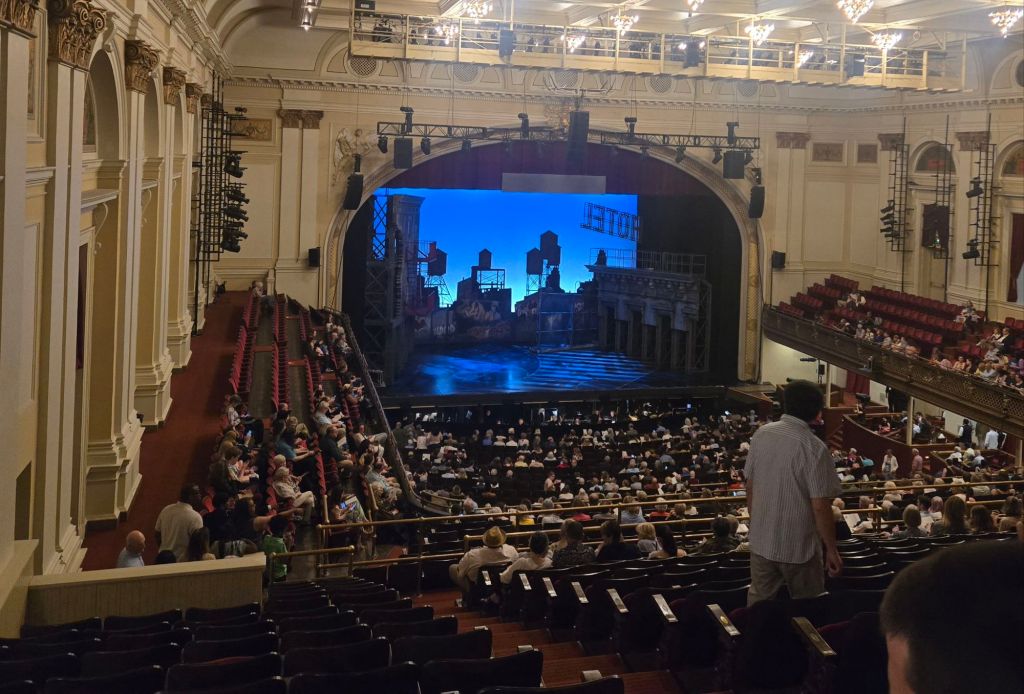
West Side Story has not changed, either. At least it has not changed since it was first staged in 1957. And, as you probably know, it is the story of star-crossed lovers (a la Romeo and Juliet) who come not only from separate families, but from different ethnic groups, Tony and Maria. Tony is a member of The Jets, an “American” street gang fighting for a bit of turf in New York City’s west side. Maria’s brother is a leader of The Sharks, a “Puerto Rican” street gang, fighting for the same turf. They fall in love at a dance sponsored by a “let’s all be friends” organization, but within 24 hours, there is a “rumble”, and Tony, although trying at first to keep the peace, winds up in a fight and kills Maria’s brother, Bernardo. This leads to vengeance by the PR’s, and Tony is shot and killed towards the end of the show.
The story is a familiar one, as you can see, and perhaps is supposed to have a moral attached, that hate does not pay. On the other hand, it is a brutal musical, even if you know how it will end so that the suspense is gone, and, 60 years after it was written, it is in fact dated. This does not take away from Leonard Bernstein’s music or from the original choreography of Jerome Robbins, but truth be known, I think it does take away from Arthur Laurent’s book and Stephen Sondheim’s lyrics, filled with “I dig”s, and “daddy-o”s. And, yes, “rumble”s.
And the dating does not only come from the vocabulary, but from the concept of New York City turf-craving street gangs, and from one of those gangs being “Puerto Rican” and the other “American”. Politically correct, it is not.
But the music and the performances were great, especially Ryan McCartan as Tony, but really everyone. The dancers made no mistakes, nor did the 50+ musicians in the pit.
Orihinally, the quartet was going to call it East Side Story, and set the play on that side of Manhattan, not near Gracie Mansion, but on the Lower East Side. There were still going to be two rival street gangs, but neither would be “American” nor “Puerto Rican”. One gang was going to be Jewish, and other gang was going to be Catholic, and their “rumble” was to be exacerbated by competing holidays of Passover and Easter. It is hard for me to conceive of a more dangerous, politically incorrect, and hard to justify, concept. And (maybe this is why it seemed okay to the creative quartet at this time, each of whom was of course Jewish) I don’t think there were Jewish/Catholic street gangs in New York in the 1950s, battling each other. It was clearly a rough time in New York for Puerto Ricans, so maybe the change over brought something closer to reality for the New York City audiences. But maybe, it has never been politically correct, irrespective of the time or the location.
I wonder, in the original, which side was which. I would assume (if I had to guess) that the Jewish Tony would fall in love with the Catholic Maria. After all, from Broadway’s Abie’s Irish Rose to Broadway’s Ragtime, that has been the pattern. Yes, those male Jewish writers/composers never write about the gentile boy and the Jewish girl. Somehow, I guess, that feels uncomfortable.
One other thing. As I said, West Side Story is a brutal play. Turf wars, two murders, knife fights, a gun shot, and more. Movies have ratings based on what are deemed appropriate ages for viewing. Stage plays and musicals do not. Leonard Bernstein’s daughter Jamie, who wrote a very nice piece which was published in the WNO program, said that she was 5 when the play opened its first preview (by the way, at the National Theater in Washington), and she was not allowed to attend. In fact, although she knew all the songs by heart, she was not allowed to attend the show for years after that. But there were a number (not a huge number, but a number) of young children in the audience. In fact, in front of us there was a husband and wife and their two kids, aged 4 and 6. I don’t know what the kids (very well behaved, by the way) understood from the play, but there certainly were many “this is just a play” explanations from the parents as the show went on.
Anything else I want to say about this? Yes…..do you know that you can take popcorn to your seats at the Lyric Theater?
 Art is 80