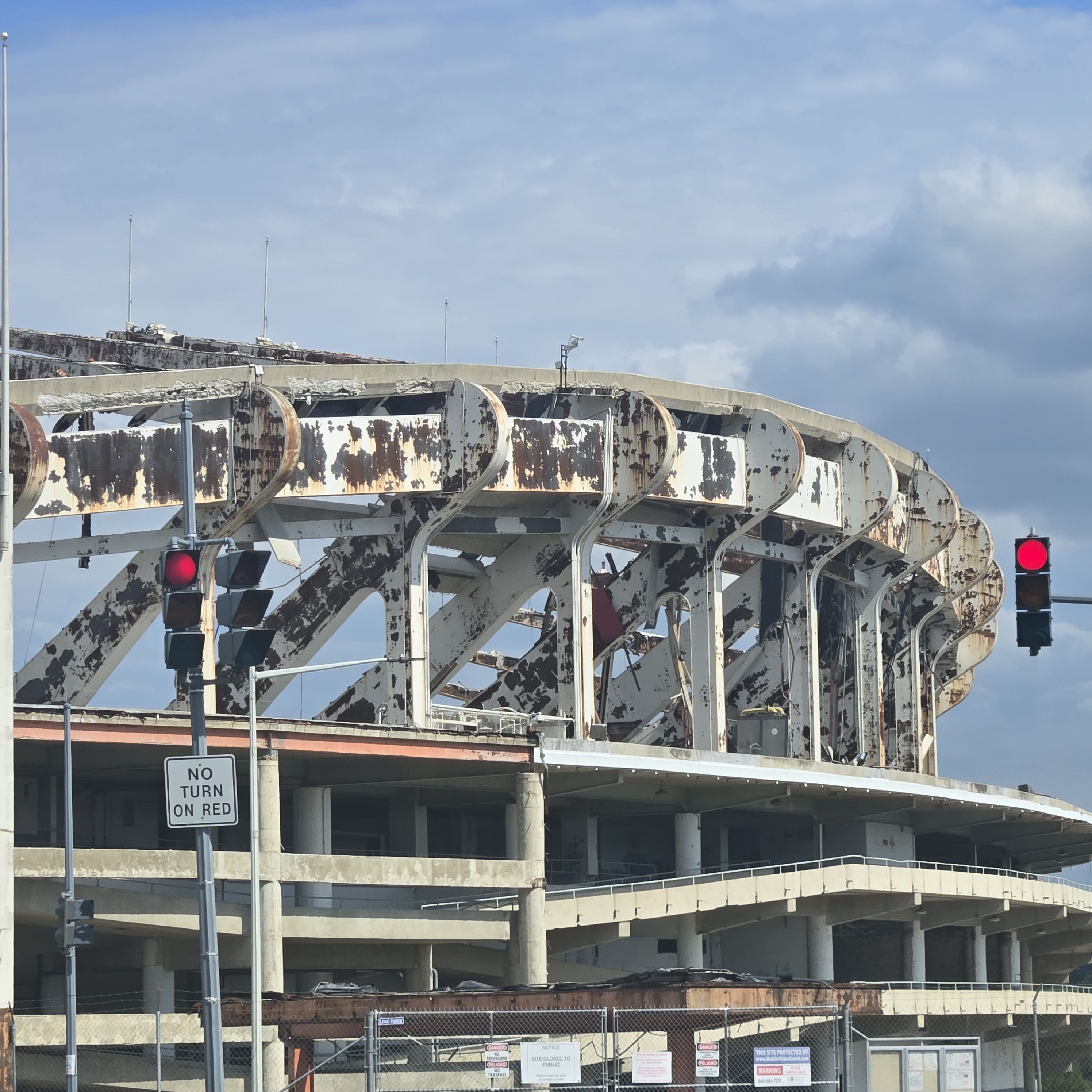
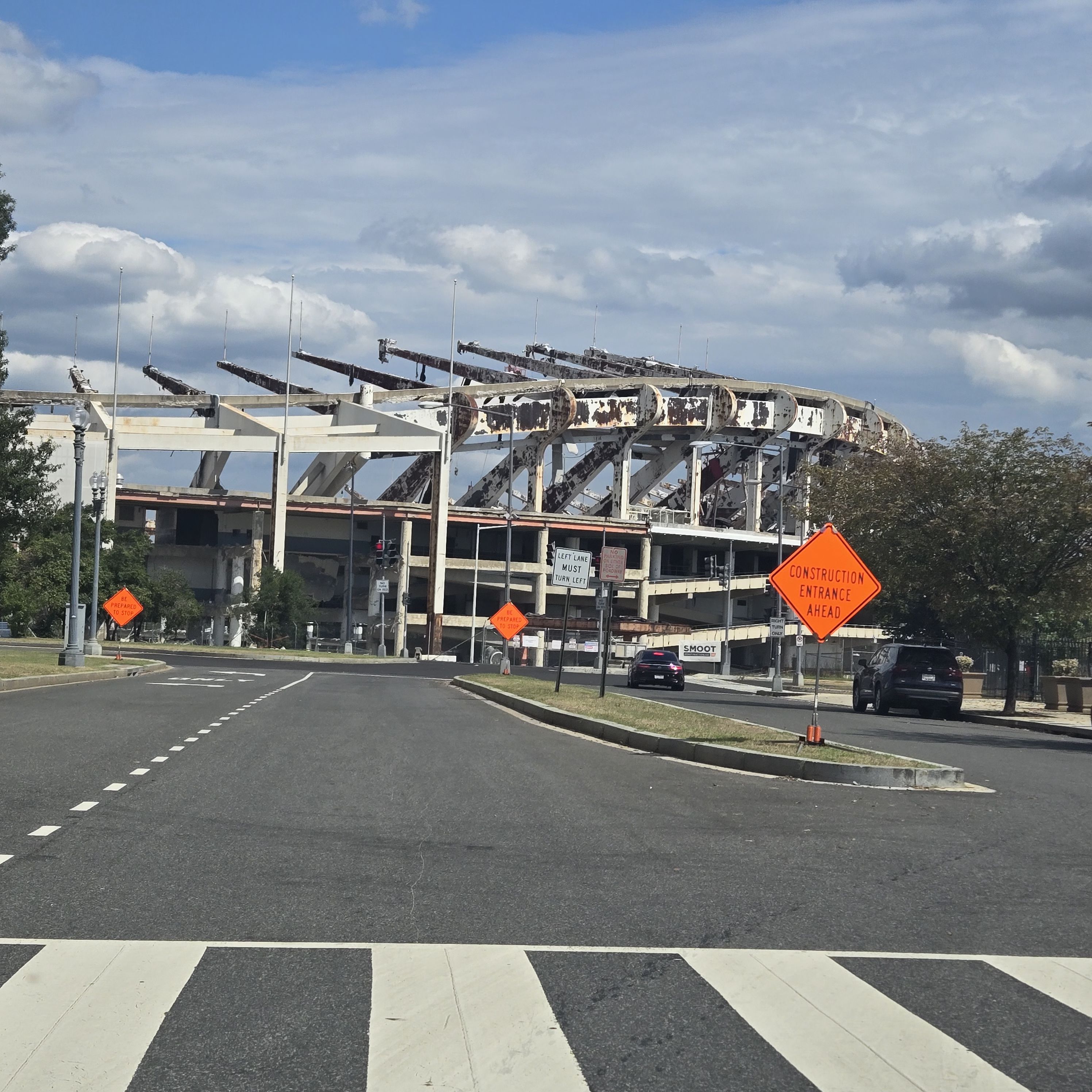
For those who don’t believe that the Washington Commanders are going to move into DC from Prince George’s County, just look at what is happening at the site of the proposed new stadium. Not London Bridge, but RFK Stadium, is coming down.
RFK was the home of the Redskins for 35 years, and for shorter periods the home of both the Senators and the Nationals. Google it, and you will see it has had quite the history, but like us all, its days are limited, and its final years less than prime. But it gets recognition:

This afternoon, we attended a program at the Capital Jewish Museum, co-sponsored by the Haberman Institute, featuring Vanderbilt Professor Shaul Kelner, author of the recent acclaimed book, Cold Exodus, and U. of Maryland researcher Yelena Luckert, who was born the Soviet Union. Both were excellent. The topic was the decades-long American movement to enable Soviet Jews to leave the USSR or openly practice Judaism, basically a study in a grassroots organizational movement, focusing on methods to mobilize and define goals that are still in use today by movements with very different goals.

These were our presenters. Quite a coincidence that they look so much like the photos behind them, I think.
I told the audience in my brief remarks that it was too bad I hadn’t met Prof. Kelner before, because he could have interviewed me about my 1972 trip to the Soviet Union. Not that it had anything to do with the movement to free the Jews, but I did learn a lot about one Jew, the young Soviet medical student who befriended me.
He seemed fearless and was confident that one day, he would wind up in the US. Did he? I don’t know. He wrote me after my return to Washington, but I didn’t write back to him. I was afraid that our correspondence could backfire on him, and I wanted no part of that.
I called him fearless. That’s because he was unafraid to taunt authority at a time when he could have been kicked out of school or even jailed for just that.
I remember telling him that, in the United States, I could often tell who was Jewish by looking at them, but that in Moscow, I could not tell.
He told me that he could, and for the rest of the time I was with him, he played that game to the hilt. We would walk down the street, and he would spot someone and ask them if they were Jewish. They always were, and no one minded the question. We went into a restaurant for lunch, and he asked the man who seated us the same question. He was Jewish as well. I was surprised that no one’s feathers looked at all ruffled.
There were more such incidents, but the highlight, and that which made me most fearfull of winding up in the Gulag, is when we walked by an office building, and I was told that it held the headquarters of Sovietische Heimland, the official Soviet Yiddish language magazine, published to convince people outside the USSR that Jews inside the USSR were, as they say in Yiddish, hunky-dory. I told him that was interesting, and he immediately said, “Let’s go meet the editor”, and then, ” Don’t worry, we’ll be okay.”
And we did. And we were. The editor was short, somewhat elderly, quite thin, with a pencil mustache (as I recall). He looked a little uncertain but less nervous than I was. I was introduced, to my shock, as a regular American reader of the magazine, someone who could read Yiddish, but not speak it. Whoa! (By the way, I could then – not now – understand some basic Russian).
I was afraid he would ask me what my favorite recent article was, and after a few minutes, I suggested we let the editor get back to work. We left the building. I took a deep breath.
 Art is 80
One response to “Initials of the day: RFK and USSR.”
The line under the picture of the presenters has a typo.
Sent from Yahoo Mail for iPhone
LikeLike