At the same time as we in the United States are concerned about the possible reelection of an individual who appears to have issues with the American way of government, I have read several books about similar leaders – Fascist, Communist and so forth. In fact, I have been reading books about people like this for the past 60 years. For some reason, I never tire of them.
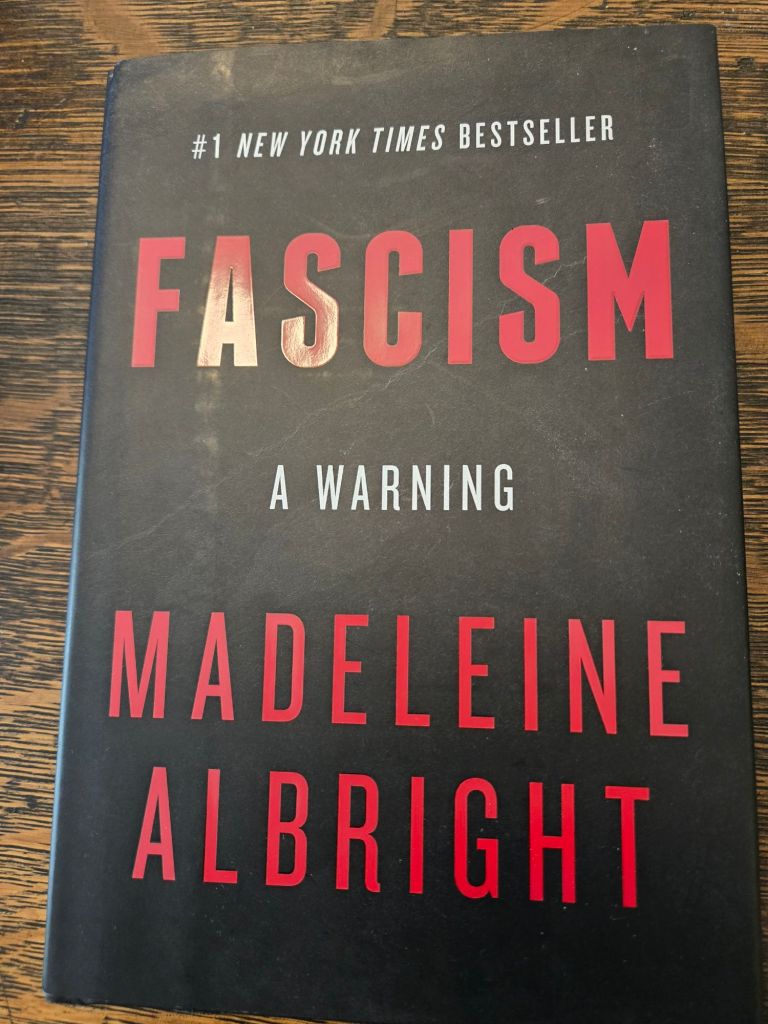
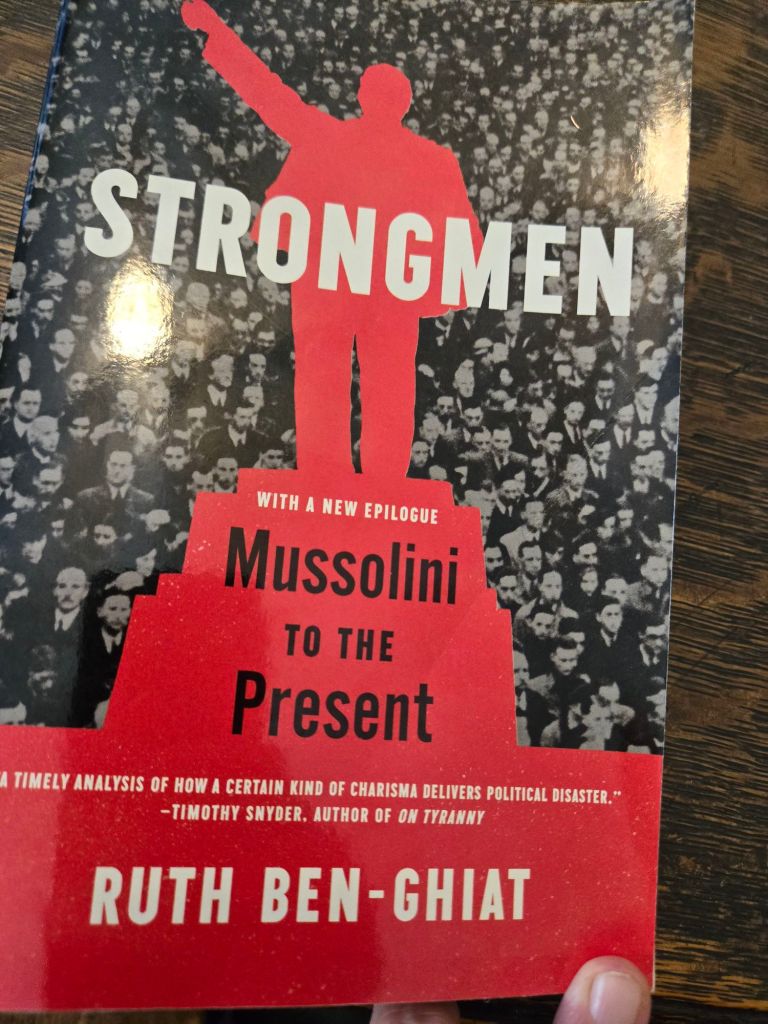
I am going to suggest you read three books, one fairly recent, one recent and one really recent. They all present pictures of totalitarian leaders that we have some familiarity with, and they all make reference to our current situation. The fairly recent book is called Fascism, and is the last book written by the fascinating former Secretary of State Madeleine Albright. The recent book is Strongmen, written by the fascinating NYU professor Ruth Ben-Ghiat. The really recent book is Autocracy, Inc. by the fascinating journalist Anne Applebaum.
Albright and Ben-Ghiat tell the story of all the usual suspects – Mussolini, Hitler, Stalin, Xi and all the others. And they tell the stories very well. Applebaum, in her short, very recent book, goes one step further.
Okay, here is where I make my confession. I have read Fascism and I have read Strongmen, but I have not yet read Autocracy, Inc. But I have heard Applebaum now three times, and have absorbed enough to be able to write this short post. I hope that I will stumble upon the book soon and read it.
And what gave me the thought to write about these books today is a podcast I listened to yesterday on YouTube. Again, I “listened to it” on YouTube, because I was driving my car and believe that driving and watching are not yet compatible. It’s a 50 minute podcast where Applebaum is being interviewed by Ben-Ghiat at the 92nd Street Y. I am sure you can find it, and that you will find it entertaining, frightening and educational. I should add that the the two participants on the podcast are in total agreement with each other. There was no debate, but each had things to say to support, and to augment, points made by the other. And that, oh yes, I agree with both of them.
Applebaum’s thesis in her new book is that authoritarian leaders are no longer driven by ideology. Or, at least, that they don’t have an “ideology uber alles” mentality. They are driven by other forces: one of course is their personal wealth, security and power. Beyond that, they all believe that authoritarian rule is necessary today, and that democracy is old-fashioned, unwieldy, and terribly inefficient. And they believe that we (“we” means the United States and Western Europe) are their enemy.
Each of these autocrats believe, they say, one other thing. They believe that they can work together to accomplish their goals and to thwart ours. And that they can do this irrespective of ideology. Thus a fascist and a communist and a religious fanatic and an authoritarian of no named persuasion can all work together as allies to support each other. How else can you show how China and Iran are jointly supportive of Putin’s Russia? Appelbaum and Ben-Ghiat describe this as “transactional” totalitarianism. And they show that this is pervasive, pretty much brand new, and particularly dangerous in today’s modern, interconnected world.
As an aside in this discussion, and I think as a way to bring thinking about this back home, Ben-Ghiat brought up Donald Trump’s selection of J.D. Vance as his running mate. Both Ben-Ghiat and Applebaum are concerned about the possible reelection of Trump, and view him as a wannabe authoritarian leader. Hence, his kowtowing to Putin, Xi, Kim and others. He wants to be one of them, they believe, and relate to them transactionally, the way they relate to each other. But how does Vance fit into the picture?
According to Ben-Ghiat, Trump’s selection of Vance is just another example of transactionalism at work (I started to say “at play”, but realized that might be misread), and shows that, with Trump, authoritarian transactionalism clearly trumps ideological or any other considerations. How else, she says, can you possibly explain choosing as your running mate a man who previously referred to you as America’s Hitler?
She goes on to talk about Trump’s followers, who have by now been trained, to think along these same lines. The history of the thinking or the statements of the vice presidential candidate is not important. Nor his experience or competence, apparently. He was a “transactional” choice of Trump’s (and a bad one), and that is fine with the world of MAGA.
The goals of all of these figures, they say, are power, wealth and personal security. (Actually, I am not sure if that is what they say, but that is certainly what they imply and what I infer.) Far down on their list of goals, if it shows up there at all, is the welfare or physical status of the people or the nation they lead. You cannot negotiate with Putin, for example, on the assumption that you can present him with something that would benefit the Russian people. It is not a major interest of his. In fact, if the condition of the general population is negatively affected by some action that will benefit the boss, that is just fine. No problem, whatsoever.
They site the example of Venezuela, once the richest and now one of the poorest countries in Latin America. Maduro, they say, doesn’t care that the country he leads has become an economic disaster (and for sure does not have to be) and that almost 8 million people of a total of 30 million have (at least temporarily) emigrated. He is in power, he is wealthy, and he is trying to remain secure.
This is clearly where the world is in 2024. I am not sure about Ben-Ghiat, but Applebaum wants to make it clear that she believes that nothing in history is inevitable, and that things do change and can change if people will it so. She also makes it clear, however, that she is not an “optimist” and never has been; not in her DNA. But, she says, because you know that things can (even if they won’t necessarily) change for the better, you need to show optimism to younger generations if you want them to try to improve their world. If you just tell them things are inevitably going to continue falling apart, she says, what chance is there?


One response to “Transactional or Ideological Leaders, or Is Ideology So 20th Century?”
As long as a leader has the military in back of him, stays in power. A case in point is Maduro
LikeLike