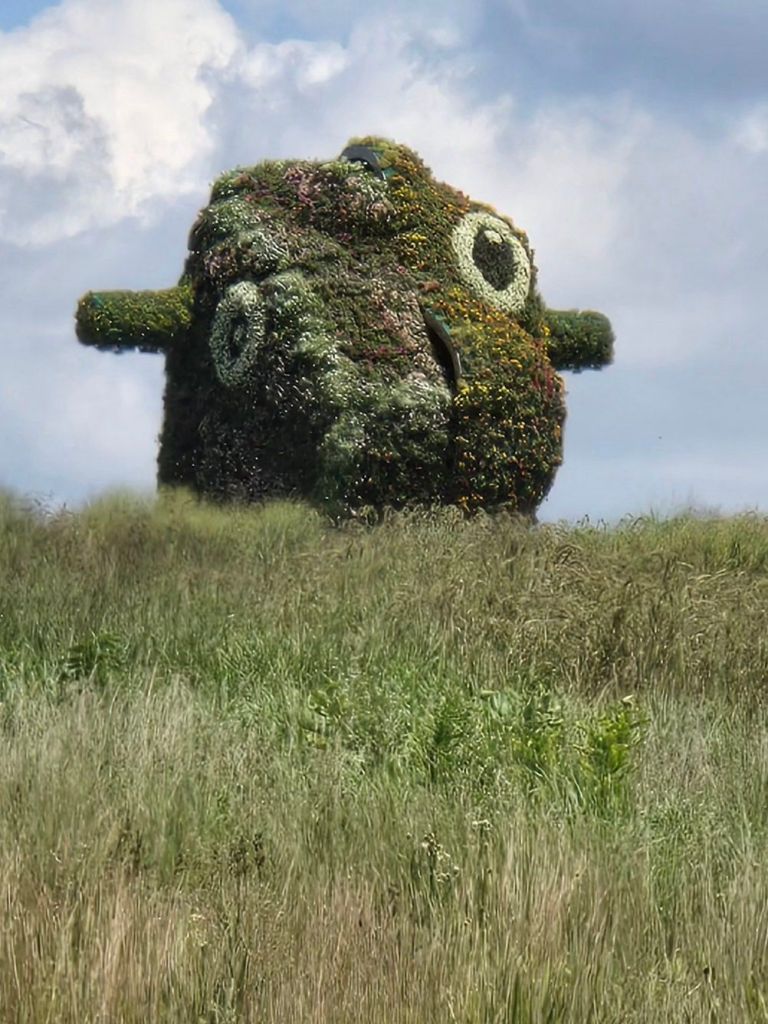
Yesterday, we went to the Glenstone Museum in Potomac. For those of you unfamiliar with it, let me describe it for you. Two brothers, the sons of a real estate entrepreneur, go into business for themselves and begin buying up companies and properties, and before you can blink your eyes, they are multi-billionaires. One is now in his early 70s and one in his late 60s. The younger brother, Mitchell Rales, owns a swath of property in suburban Potomac, Maryland, and builds a fancy house there. He collects art, and gets involved with a number of Washington DC museums. Even today, he is the president of the National Gallery of Art, the largest art museum owned by the U.S. government.
Rales has been himself a major collector of contemporary art for some decades. What to do with it? Oh, I should have said that the swath of property he owns, which is in one of the most high end areas of one of DC’s wealthiest suburban areas, is about 300 acres in size. What a perfect place for a museum.
So, ten or fifteen years ago, Rales establishes Glenstone, hires some well known contemporary architects, and builds two museums (one considerably larger than the other), and two separate restaurant buildings (one more casual than the other), installs part of his art collection in the museums, and invites the public to come and view the art and the setting (around which he has placed a considerable amount of contemporary sculpture) for free (the food isn’t free).
Yes, there are some rules. And they are, as Tim Walz might say, weird. No children under twelve is one of them. Another is that there can be no photography inside the galleries, only outside.
And right now, there is a problem for visitors, in that the main gallery, the Pavilions he calls it, is closed for renovations, to be opened sometime after the start of 2025. But there is more than enough to see now, both on the grounds and in the smaller gallery. But you have to go because, as you now know, pictures are verboten. Let me just say that virtually every work of art in the, say, six or seven gallery building is a work of art. Works by artists you know (or should), and primary works, not secondary.
The art work is all from the period following World War II. The full collection now is comprised of approximately 1300 pieces. Glenstone is the largest privately owned art museum in the United States.
You enter at the “Arrival Center”, and from there, it is about a half mile walk, past the Pavilions, through the meadows, to the Gallery and cafe. There is cart service available. There are several trails which blend the natural beauty with the sculptures placed here and there.
The number of visitors each day is limited to about 600, and you generally need advance reservations on line (a very easy process) and, with the main exhibit space closed, it might be easier to get immediate access now. And, oh, yes, it was over 90 degrees yesterday. That is actually too hot to do much wandering. You probably want to pick a cooler day.
The net work of Mitch Rales and his wife is in excess of $5 billion dollars. I don’t know if that includes the value of the museum, museum site and art collection. Since it is privately owned, I assume that it does. But maybe not, as Glenstone is actually owned by a foundation created by Rales. It is said that the value of the assets of the foundation itself is $4.3 billion dollars. That is a lot of money, no? In fact, it puts the worth of Glenstone on a par with the worth of the Metropolitan Museum of Art in New York. Try to process that for a minute.
Two more points. First, the entire area is landscaped organically, with native plants only. Secondly, the Rales family have planted about 13,000 new trees since acquiring the property. And nature is as much a target as the art.
And even one more point. The guides in the gallery (and there are many of them) are terrific. They are all (I think) art or art history students or graduates, they are there to talk to guests as well as to protect the art work, and they know everything. Don’t be afraid to ask them a dumb question. Their answer will be very smart.
After Glenstone, we went to Nats Park to see the Nationals play the Los Angeles Angels. The Nats won 5-4 in 10 innings. What was most interesting about the game was the Nats’ third baseman, a young fellow named Jose Tena. Jose Tena came to the Nats fewer than two weeks ago from the Cleveland Guardians at the trading deadline (July 31) in a trade that sent Lane Thomas to Cleveland. Tena is an infielder who had done very well in the minors and was considered to be a sold future big leaguer. He was assigned to the Nats’ Rochester NY AAA team, but called up yesterday (the Nats sent another young infielder back down to Rochester).
It was, I think, an unexpected call up, and Tena arrived in Washington a little before 4 p.m. for a 6:45 game. That meant, although he was the starting third basemen, that he hadn’t even had a chance to meet or say hello to many of his new teammates. He had two hits, and drove in two runs. One of his hits was a walk off hit in the 10th, when the Nats’ fifth and winning run scored. It was a good debut. He probably won’t do that every game.
Many were unhappy when Thomas, who had played in the outfield for a number of years, and was a good steady ball player, was traded. For three years in a row, the Nats have traded some of their better players (especially those in their late 20s or early 30s) away at the trade deadline to get younger prospects. The Nats, and their farm teams, are now filled with young prospects. But I would hope that these prospects can do something for the team before they, too, are in their late 20s and early 30s and just get traded away at the trading deadline. Just saying.
 Art is 80
One response to “Art and Baseball”
How I wish I could visit Glenstone, and regularly. I
LikeLike