The first post in this series got us exactly one block from Rhode Island’s start at Connecticut. Let’s see how far we get with this one. We start at 17th Street and move northeast.
The first building we see on our right is the headquarters of the Human Rights Campaign.
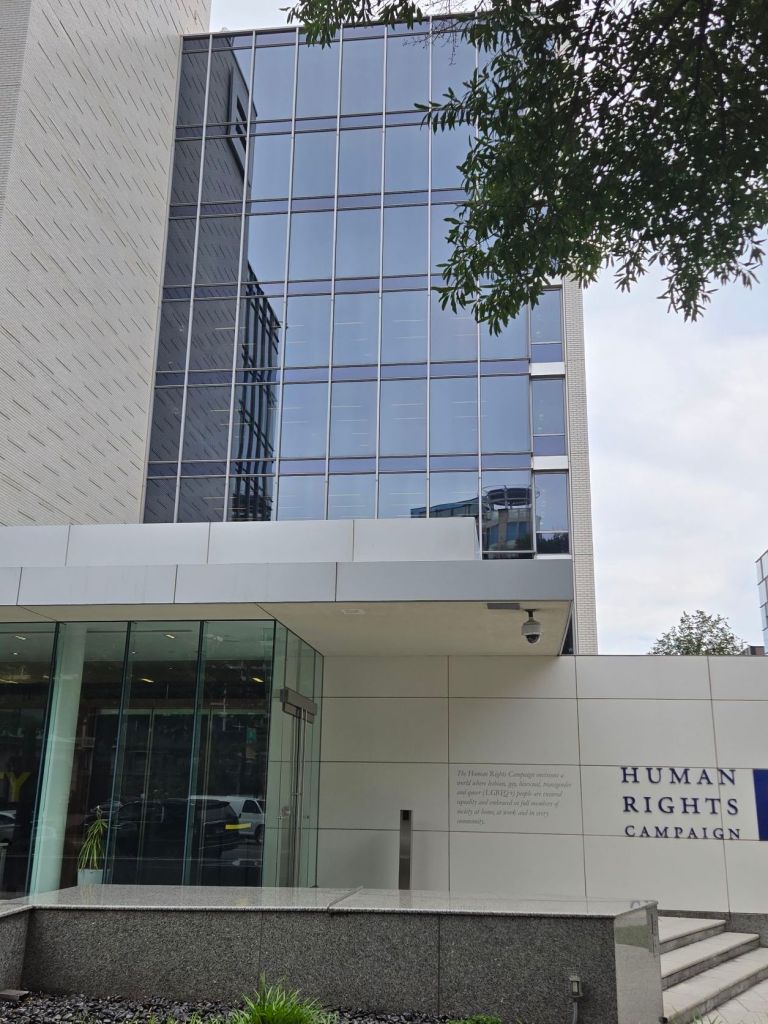
The Human Rights Campaign is a non-profit which serves the LGBTQ+ community. Their website states that they have already come out in support of Kamala Harris for President. And, although they are not a race-oriented organization, they have adorned the 17th Street side of their building like this:
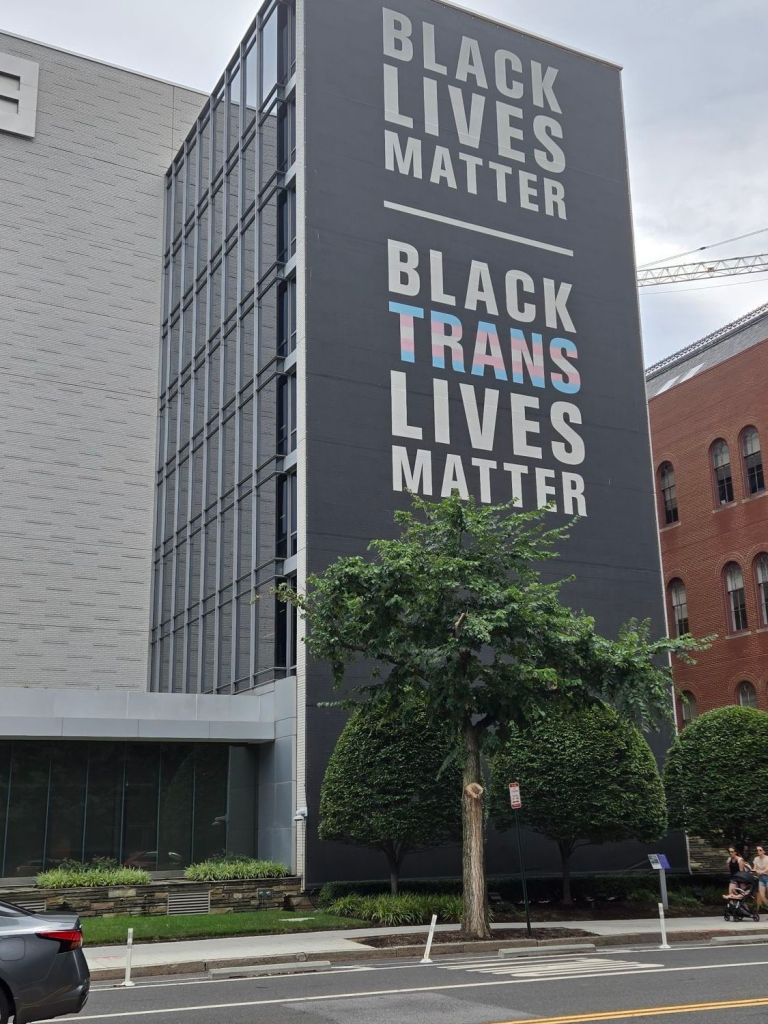
The HRC has occupied this building for the past 20 years. Before that, from 1953 through 2002, it was the headquarters of B’nai Brith and the small but excellent B’nai Brith Museum. And for those of us who remember the incident, it was the site of the attack by the Hanafi Movement, which held hostages in the building for several days and gave Washington DC its first taste of Islamic terror.
By the way, the artifacts previously housed in the B’nai Brith Museum are now located on the campus of the Hebrew Union College in the Skirball Museum in Cincinnati.
Next to the HRC building is a flat front building, the home of the Center for Strategic and International Studies.

CSIS was established, I think, as part of Georgetown University, in 1962 and became independent in 1987. It moved to Rhode Island Avenue in 2013. I don’t see much about CSIS, but a visit to http://www.csis.org will show the range of its studies and activities. In the last week of July alone, CSIS is offering web programs on Gaza’s Water Crisis, Countering China in the Gray Zone; Lessons from Taiwan, Global Regulation of Essential Patents, and The Defense of Guam.
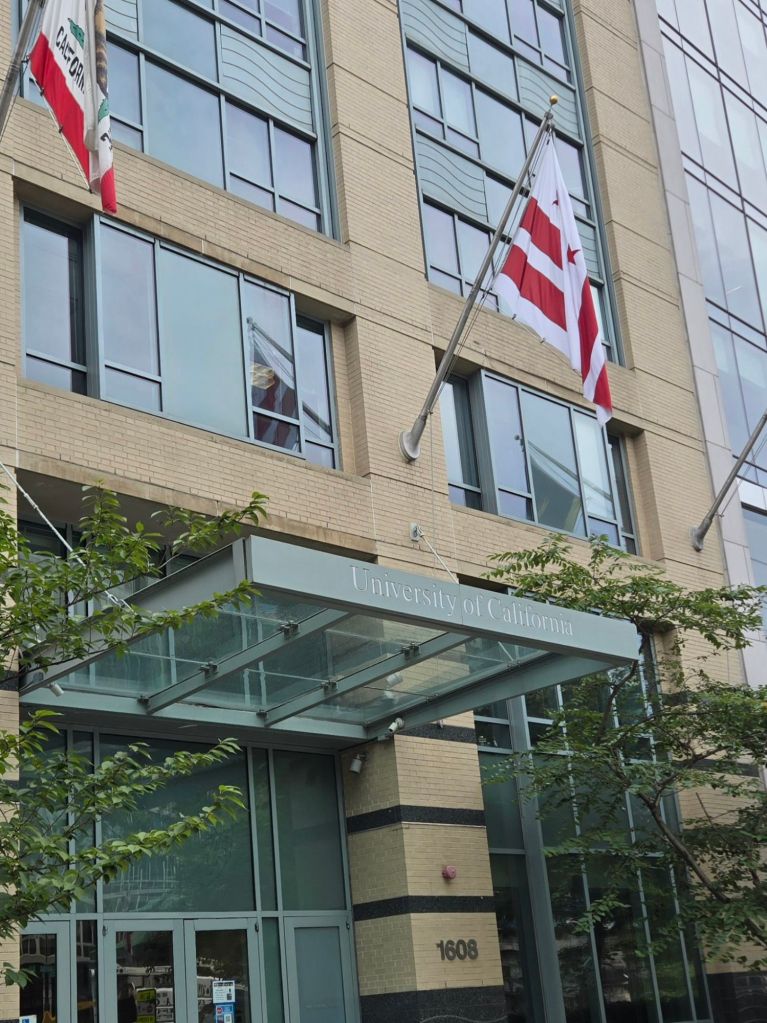
And next to CSIS is the Washington branch of the University of California, one of the many university branches here in Washington.
16th Street, Rhode Island Avenue and Massachusetts Avenue meet at a circle, Scott Circle. 16th Street runs under the circle.
Scott Circle is named for General Winfield Scott.

This 15 foot high statue stands in the middle of the Circle. Created by New York sculptor Henry Kirke Brown, it is said to have been the third major equestrian statue in the United States.
Winfield Scott (“Old Fuss and Feathers”) led the American Army for 20 years prior to the Civil War. He had fought in the Mexican War and in various of the Indian Wars and, in 1852, he ran for President, but lost to Franklin Pierce.
There are two monuments on the sides of Scott Circle, one dedicated to Daniel Webster and one to Dr. Samuel Hahnemann.

Daniel Webster served as both a Congressman and a Senator, and served two terms as Secretary of State. He was a lawyer who argued over 200 Supreme Court cases, including the Dartmouth College case, which solidified the validity of contracts. Webster was an orator and an opponent in the years prior to the Civil War of the theory that states could ignore, or nullify, laws which they disliked. This bas-relief, one of two on the monument, depicts a famous debate between Webster and Senator Hayes of South Carolina.
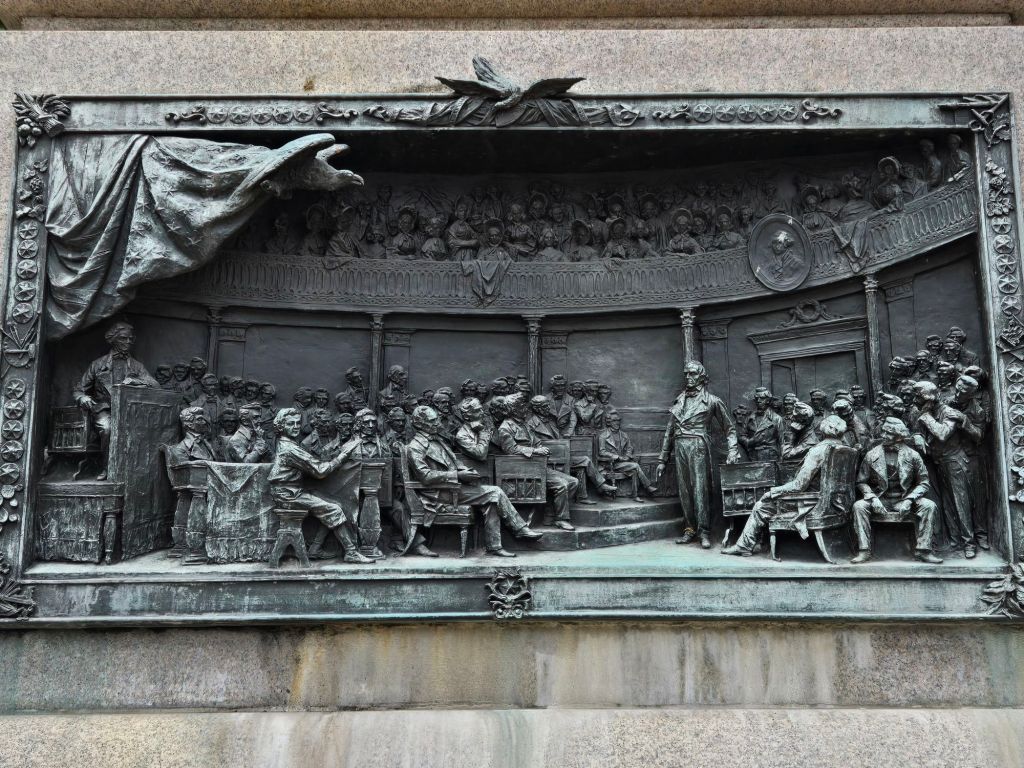
Two more things. The sculptor was Gaetano Trentatove, originally from Italy. And, no, Daniel Webster did not write a dictionary.
The opposite sited memorial is to German doctor Samuel Hahnemann. He was a contemporary of Webster, was German and never visited the United States. This made him an unusual and controversial subject for a monument. Hahnemann was the founder of the medical science of homeothopy, now largely discredited, but then pretty much the rage.
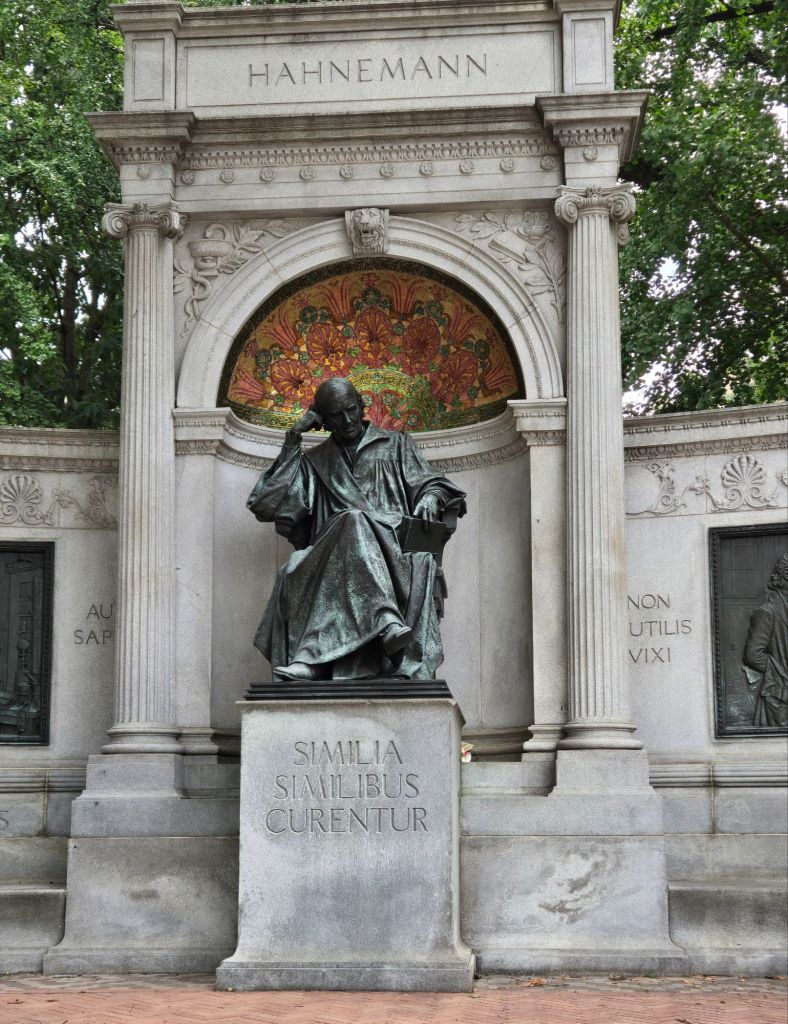
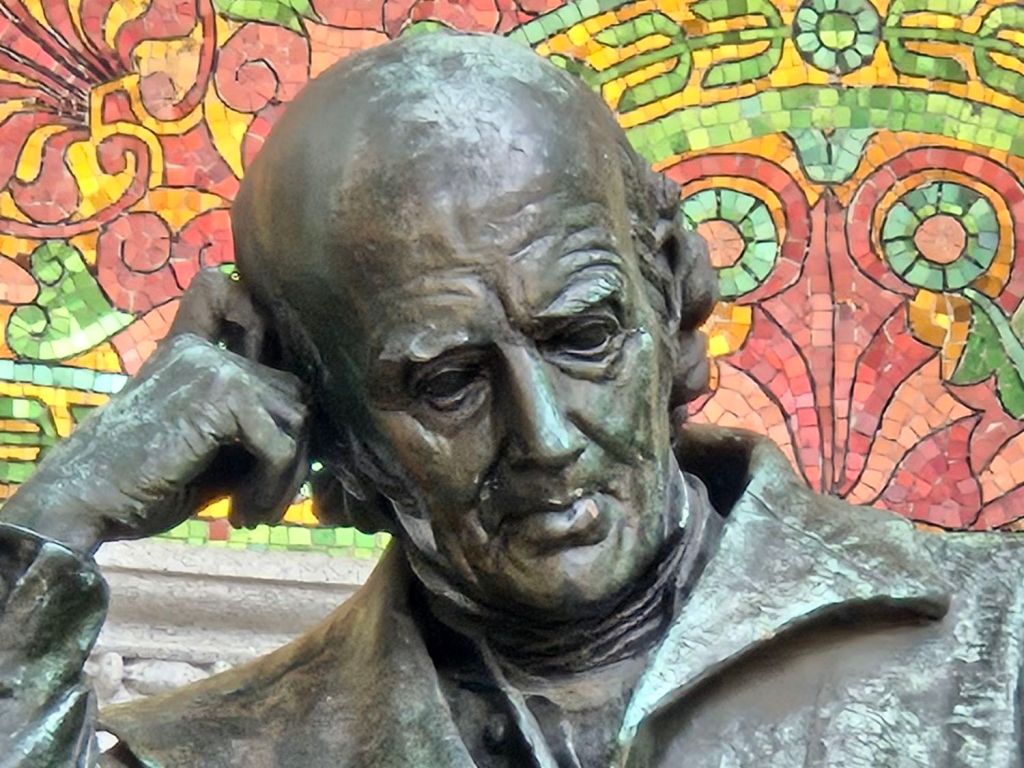
The sculptor, Charles Henry Niehaus, was born in Germany, but was living in Ohio.
Both the Hahnemann and Webster monuments were dedicated in 1900. Now, onward toward Logan Circle, three blocks away.
 Art is 80
One response to “A Walk Down the Street. Take 2”
Very good tour guided walk, thx.
The Supreme Court currently in the throes of Hahnemann’s miasm.
LikeLike