I did my usual. I got in my car to drive to Rockville, opened my phone to YouTube and selected a talk about a subject I thought might be interesting to listen to as I drive. Being tired of podcasts on Ukraine and Gaza, I decided to learn a little about Garibaldi, the architect of the unification of Italy in the mid-19th century. I know the name Garibaldi; you probably do, too. But who was he and what did he do? I listened and was amazed.
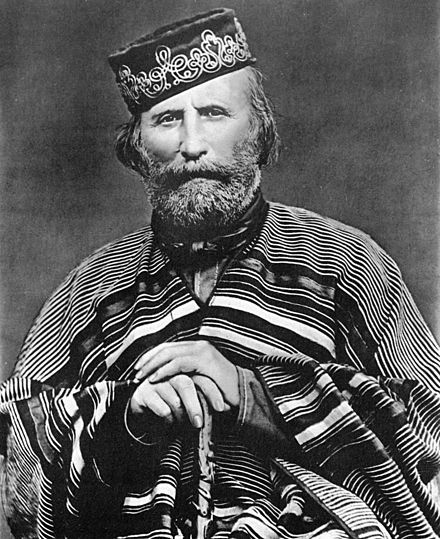
I am doing this from memory, so don’t cite this post as evidence in a court of law (that includes you, Michael Cohen), but here goes.
You may know him as Giuseppe Garibaldi. But in fact, he was born (when Napolean was still lord and master of much of Europe) in Nice, on the Riviera, and given the birth name of Joseph-Maria Garibaldi. His parents were Italian born, but they lived in a French speaking land, and Garibaldi was fluent in both languages.
His father was a business man from Genoa and teen age Garibaldi went to sea, coming back to shore when he was about 21 and earning his living as a tutor and teacher (Garibaldi, you see, was one very smart guy). But travel called.
In addition to being smart, Garibaldi was an inveterate traveler. Over his life, he went everywhere. First, in his mid-20s, he went to Russia, as a crew member of a ship delivering oranges. There, he met a man involved in the early Young Italy movement. Garibaldi decided to go to Italy and get involved, and stayed there a short time, becoming a political activist, something that would last him his entire life.
Italy, of course, during this time was not one country, even after Napoleon was no longer around. There was part of northern Italy occupied by the Austro-Hungarian Empire. There was part ruled by the Kingdom of Sardinia. There was part ruled by the Kingdom of Sicily. And there was part under the control of the papacy. Unification, for most, seemed a daunting task.
Having been involved in pre-revolutionary activity in Italy, and marked for arrest, Garibaldi escaped and went to Tunis, in north Africa. Then, his journey continued and he went to South America, where he apparently lived for almost 15 years, first in Brazil and then in Uruguay. In both places, he got himself involved in more revolutionary activity, in an attempt to separate the state of Rio Grande de Sul from the rest of Brazil. It was called the Ragamuffin War and you, like me, probably know nothing about it. But the Riograndense Republic resulted from this rebellion and existed for about ten years before it lost its independence. Again, at some point during this conflict, Garibaldi decided to leave Brazil and went to Uruguay.
Uruguay was a relatively new country, a barrier land to separate Argentina and Brazil, and it had its own political turmoil, which led to a civil war. Garibaldi collected a large number of Italians (I assume expatriates who had moved to Latin America) to form an army (this is where he adopted the “red shirt” uniform he became known for) and fought on the “good guy” side of that war, trying to keep Uruguay from being gobbled up by the military leaders of Argentina. He lived and fought in Uruguay for about six years. During this time, he also married, had several children, and became involved in the Freemason movement, guided not so much by Masonic imagery, as by the Masonic ideal of non-denominational, ethnically based, freedom.
A new pope, Pope Pius IX, was elected when Garibaldi was about to turn 40, and for the first time since he was in his mid-20s, Garibaldi began to think again about the unification of Italy, something that it was rumored the Pius favored (he really didn’t). He decided to return to Italy, taking a number of red-shirted army members with him from Uruguay, to help with the unification of his homeland. (Well, not really his homeland, I guess, French born as he was)
Garibaldi wanted first to help the King of Sardinia, but that didn’t work out, but he led armies against the Austrians (unsuccessful) in the north and against the French in Rome (who were protecting the Pope and the Papal States). He escaped with a few of his men (the majority if his army left him after the defeat in Rome) to San Marino, and then was able again to leave Italy, and he wound up this time in Tangier. He stayed there a short time only and, in 1850, when he was 43, Garibaldi came to New York, where he took up residence, perhaps surprisingly, on Staten Island.
He worked in a candle factory for a year or so (his wife had died in San Marino), and then went with a friend to establish business ventures in Latin America. They stopped as various points in Central America and then went all the way around Cape Horn and up to Lima, Peru. Throughout all of these travels, Garibaldi was treated very well, and known as an Italian patriot and military leader. In Lima, he was apparently given command of a trading ship of some kind, and he went on a still further journey, traveling to China, to the Philippines, and to Australia. He became one of the most traveled celebrities of the 19th century.
Garibaldi sailed the ship back across the Pacific to Chile, where it was loaded with copper and wool, and then he against went around Cape Horn and brought the ship to Boston, where it was unloaded. He then went back to Staten Island, but was soon given a ship to take across the Atlantic, taking goods from New York to England, so he said good-bye to America and found himself back in Europe. He was now 43.
It would be too much to describe his next six years here. Let us just say that he went back to the Italian peninsula, this time allied himself by and large with the Kingdom of Sicily, but working with others managed to remove the Austrians and wrest everything from the Pope except for what is now Vatican City and then combine the kingdoms of Sardinia and Sicily. In fact, Garibaldi became the head of the Kingdom (no longer a kingdom) of Sicily and voluntarily gave up his leadership to Sardinia for the purpose of united the peninsula in 1861.
Garibaldi was now a genuine hero. According to the podcast, he was then invited to come back to the United States by President Lincoln (or on behalf of the president) and create an army of Italian immigrants in the Union (there were many) to join the war against the Confederacy. This did not work out (it would be interesting to look into this further), and I think Garibaldi stayed in Italy until…….
Until Bismark attacked France in 1870 or so, when Garibaldi went back to his birthland (if not his homeland), and helped the French repel the Prussians. Yes, first fighting against Bonaparte France, and then fighting for France against Prussia. And, believe it or not, he stayed in southern France and even became a member of the French Parliament.
But he was restless, and Italy called once again. He spent the rest of his life there, dying in 1882.
During his last years, he remained active, not militarily but politically. He was an influential member, this time of the Italian parliament. He was a progressive’s progressive. OK, for this I did go back to Wikipedia – this was not part of the podcast. Quoting Wikipedia:
Garibaldi suggested a grand alliance among various parties of the left. “Why don’t we pull together in one organized group Freemasonry, the democratic societies, workers clubs, Rationalists, Mutual Aid, etc., which have the same tendency towards good?”
He suggested a Congress of Unity, and had an illegal, but well publicized meeting, which endorsed such policies as “universal suffrage, progressive taxation, compulsory education, administrative reform and abolition of the death penalty.”
I again quote Garibaldi: “Shouldn’t a society (I mean a human society) in which the majority struggle for subsistence and the minority want to take the larger part of the product from the former through deception and violence but without hard work, arouse discontent and thoughts of revenge from those who suffer?”
Before he died, Garibaldi became involved in one more crusade, albeit from afar. This was the independence of the Balkan countries from the Ottoman Empire. In fact, he wanted the Turks to return to the Asian side of the Bosporus, so that even Constantinople would free itself from the Ottomans.
Again to quote him: “On this side of the Bosporus, the fierce Ottoman will always be under the stimulant of eternal war, and you will never obtain the sacred rights of man.”
One last quote, this not by Garibaldi but by English historian A.J.P. Taylor, who called Garibaldi “the only wholly admirable figure in modern history”.
Who knew? Not I.
 Art is 80
One response to “My USPS Frustration Can Wait: Let’s Talk About Something Else. Something Italian…..”
Art,
I had not known much about Garibaldi except his name. Thank you for this information.
I am impressed beyond words at your ability to recall so many details of the podcast. I am jealous of your brain.
LikeLike