For those of you who followed our recent road trip, you may remember that I posted about our visit to Selma, Alabama, and how surprised we were to find the central area of the city almost a ghost town, with vacant storefronts and abandoned buildings. The date of the post was April 13, if you want to go back and look at my description of Selma in general.
Of course, I didn’t mention everything (that is never possible), and one of the things I didn’t mention was that there is a used book store on the main street of the city (Broad Street) that is one of the few commercial businesses that seems to remain open. It had its hours posted on its front door, but – irrespective of that – it was closed when we were there on a Saturday morning. Nevertheless, it appeared to be an active business, as outside the store (as you often find in used book stores), there was a “free bin”. As in most used book stores’ free bins, most of the books, which were available for the taking, were overpriced as free – by subject or condition they probably had negative worth.
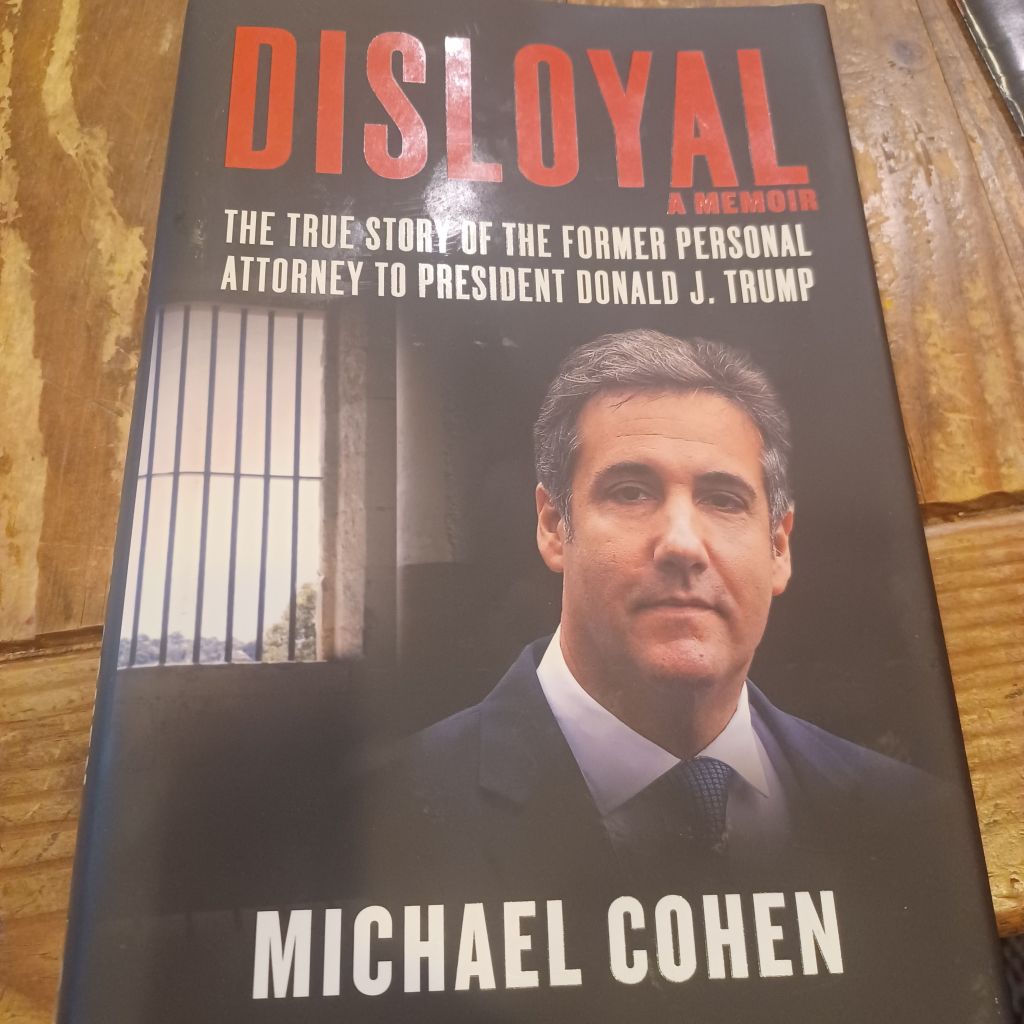
But sitting there in the free bin was an almost pristine copy of Michael Cohen’s book about his time with Donald Trump, Disloyal, which Cohen wrote while he was languishing in prison, and which he published in 2020. Since it came out and especially as Michael Cohen became a regular TV news show guest and now a prospective main witness in the “Stormy Daniel” trial, I had been intrigued by the book. But I wasn’t going to shell out my hard earned dollars to buy a copy.
But here it was. In Selma, Alabama of all places. Staring me in the face. In great condition. At no cost. I couldn’t refuse. So I took it.
And last night, while I was watching the Nationals beat the Marlins, 11-4, I started reading the book. It’s well enough written (i.e., it’s very readable) if not great literature, and the print is big, which always helps. The book is about 400 pages long, and I read just over 100 last night. Those pages describe the pre-Trump Michael Cohen and the early Trump (year 2006) Michael Cohen, and that’s easily enough for me to set forth my impressions. I will read the rest of the book, and maybe my impressions of Cohen will change after he talks about his decision to swap loyalty for disloyalty. We will see.
Until his presidential run in 2016, I never paid much attention to Trump. Since that time, of course, I have learned too much about Donald Trump. I also thought I had learned enough also about Michael Cohen, who had been his lawyer (sort of) and his fixer (more his fixer than lawyer, perhaps) and liaison with the public. I learned that at one time, Cohen had said he would take a bullet for Trump, and then that he had changed his mind. That he had gone to jail for lying to Congress, and that he had publicly atoned and was cooperating with officials, and writing a book. I saw Cohen on TV from time to time and found him surprisingly appealing personally.
I guess that my surprise, though, is what is surprising. It shouldn’t be surprising that someone whose success depended in part on his appeal is, in fact, appealing. And because I find him an appealing and intelligent and well spoken person, I tend to take his conversion from mouthpiece to critic as honest, and I tend to believe what he is now saying. This is, I think, still my position, in spite of what I have read in the first 100 pages of his book.
But what I think about his truthfulness is not very important. What is important is what the 12 jurors and 6 alternates and Judge Juan Merchan think when Cohen testifies in the coming days in the Trump criminal trial. And what I learned from this book (and what I am sure the defense attorneys know in spades) is that Michael Cohen was no naif who got caught in the Trump web unawares of what was going on, but rather that Michael Cohen, from his early years, was someone one needed to treat with wariness.
Cohen grew up in an upper middle class family on Long Island, in a wealthy suburb of New York City, Lawrence NY. His father was survivor of the Holocaust in Poland, who hid with his family during the war, and then immigrated first to Canada and then the United States, where he went to medical school and became a well respected physician. Michael went to a Jewish Day School for elementary school, and then to a prestigious private high school, the Woodmere Academy. He says that he could have been a good student, but never wanted to be, so he fooled around a lot, became a class clown, and palled around and pranked around with his friends.
He also says he was always interested in money – money was always his goal. Even at age 6, he says, when he had a lemonade stand in front of his house, he would drag a picnic table into the middle of the street to make sure that the traffic would have to slow down. His lemonade stand was, he says, very successful.
His father really wanted him to become something – either a doctor or a lawyer, and Cohen, a very good son it appears, obliged, although he never studied at American University and when it came time to choosing a law school, he simply chose one he knew he could get into, Cooley Law School in Lansing Michigan, then affiliated with Western Michigan University, but now on its own and unaccredited. Then he went back to New York.
During high school, college and law school, Cohen spent his summers working for his mother’s oldest brother, Morty Levine, who ran a “country club” in Brooklyn (sort of a private community center with both restaurant and athletic facilities, including a swimming pool) that catered largely to Mafiosi and other mobsters. Young Michael liked and respected these gangsters, and palled around with some of them. This was big time stuff – Cohen tells about the time one “member” shot another “member” at the club and paid young high schooler Michael $500 to remain quiet.
At the same time Cohen was making money in other ways – and not small money. He was importing cars from Europe and selling them at a large profit. Working through some of his gangster connections to do so.
After law school, Michael opened a law office and I guess was pretty successful (personal injury cases and the like), but his heart wasn’t in it. It was more into his side businesses. And the side business that made him a lot of money was the acquisition of New York City taxi medallions. He tells the story of how he did this, and of how he made a fortune in a less than respectable business, so that by the time he was in his 40s, he was a millionaire many times over, had bought an apartment in the former Delmonico Hotel, now a Trump condominium, where three units were combined for the Cohen family home. He bought other Trump units and rented them out. And he convinced his parents and his in-laws to buy into the Trump Building that is next to the UN Building.
Throughout this time, as Cohen was intent on not only being rich, but being an important man in the center of things, even before he was working for Trump, he had run twice for political office in New York (and met the city’s political leaders and leading journalists) and was ingratiating himself into the highest levels of New York commercial society.
It was through his acquisition of his units in the Trump world that he first met Donald Jr. and through Donald Jr his father. The rest is history, of course.
My obvious point is obvious. Before Michael Cohen was doing outrageous things for Donald Trump, he was doing outrageous things for Michael Cohen. He was no naif. He knew exactly what he was doing, although even he was surprised as to how much he, an unabashed egoist, was captured by the charisma of the amoral and sometimes irrationally vicious Donald J. Trump.
So, how genuine is his current conversion to decent human being? And how much will his testimony stand up against Trump’s defense lawyers in the current trial?
As Rachel M would say, “keep your eyes on this space”.
 Art is 80
One response to “You Think You Know Michael Cohen? Think Again.”
Very interesting. Hope you do a post on the rest of the book. Judy Judyhpass@gmail.com Sent from my iPad
>
LikeLike