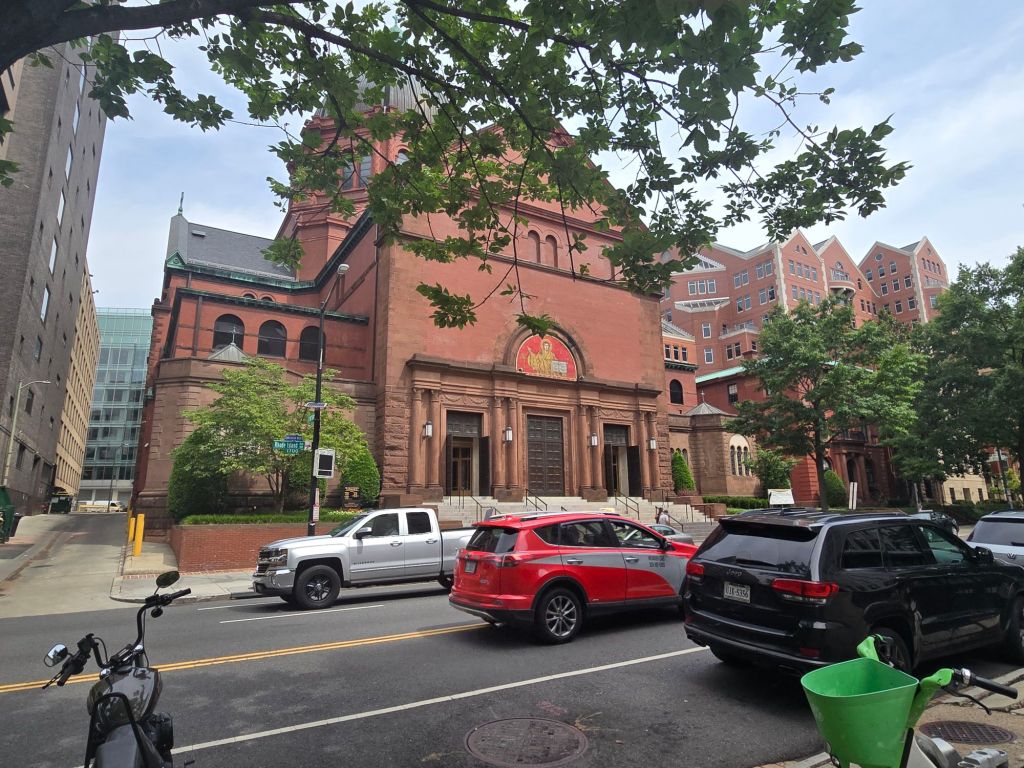
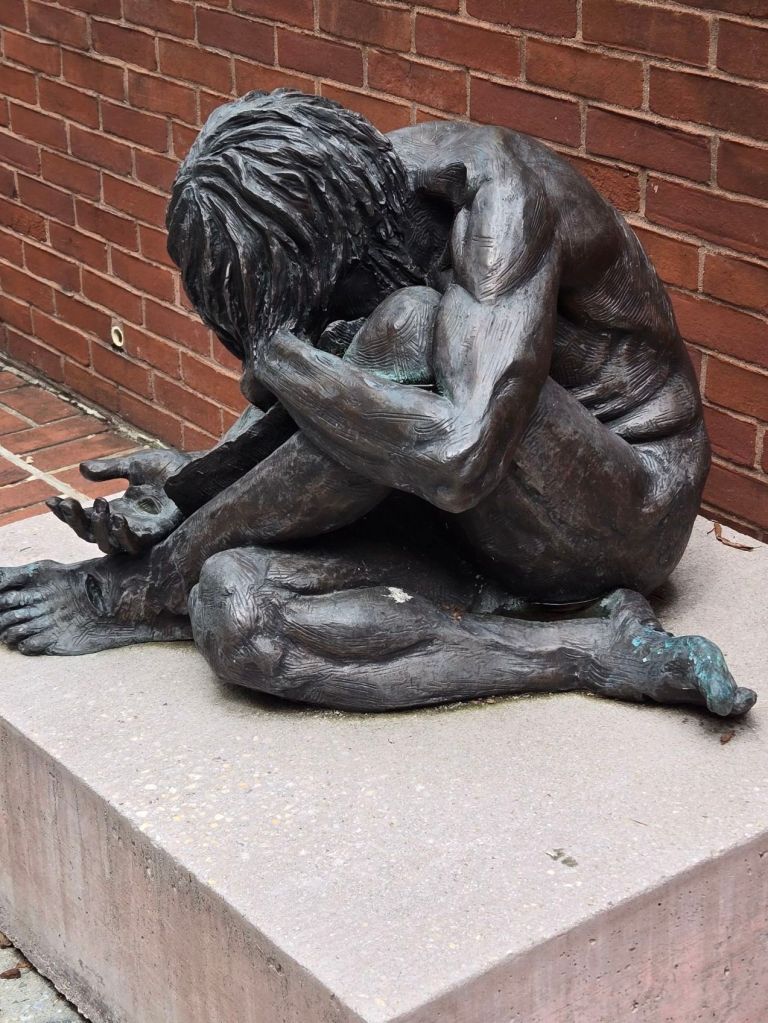
For past 35 years, Washington’s Adas Israel Congregation has hosted an annual program titled “Garden of the Righteous”, each year honoring some individual, group of individuals, who hid or saved Jews during the Nazi years. There is normally a ceremony, followed by the dedication of an inscription on a bronze marker set in an actual garden on the Adas Israel lawn, on the Quebec Street side.
In years past, the Garden of the Righteous program was often held in conjunction with other programming, and the agenda included a role for Adas Israel religious school students to participate. This is no longer the case, and the programs now are generally stand alone programs held typically on a Sunday afternoon. Each program is informative and extraordinarily uplifting, but for whatever reason or reasons, attendance has fallen off. The program this past Sunday, for example, had perhaps 50 attendees in addition to those who had a place on the agenda. Something needs to be done.
Of course, time is running out. The Holocaust ended in 1945, and next year that will be 80 years ago. So while some Jewish survivors, who were young at the time, still live, I would guess that none of the actual rescuers do. So now, the honors generally go to the children and grandchildren of the rescuers, and sometimes to the children and grandchildren of those rescued as well.
This year, the honors went to the van Damme family of Antwerp, Belgium, and the daughter and son-in-law of one of the rescuers came over from Antwerp for the occasion. There was also one of persons saved by their family – a now 95 year old Washington area resident, who was a teenager during the years of World War II. He gave a stirring (if a bit long) account of the story, thanking not only the van Damme family, but also several other Belgian families involved in the rescue.
Hirsch Grunfeld, his parents and younger brother lived in Antwerp, and in 1941 and 1942 were in grave danger as the occupying Germans, with the help of Belgian collaborators, were rounding up Jews and sending them east to extermination camps. Hirsch was 15 at the time, and his brother was 9. Young Alice van Damme girl (who was 22 at the time) witnessed a round-up and decided that she had to do something. What gave her the courage to actually do something, who knows? Those who were involved in hiding Jews or other resistance activities became involved for various reasons, sometimes reasons actually unknown to themselves or surprising themselves. But they put their lives at grave risk (and this is of course not an exaggeration) and went about their business.
Alice van Damme sprang into action, got in contact with the underground in Antwerp, and convinced her extended family to take in and hide Jewish children from two families, the Grunfelds (the parents, and each of their sons being hidden in different places) and another. All of the Grunfelds survived the war.
If you go to this website: https://www.adasisrael.org/garden-of-the-righteous you will see the stories of all 35 honorees, starting with Jan Karski, the famous Polish diplomat who traveled back to Poland and sneaked into Auschwitz in disguise, and then tried to warn the Americans as to what was happening, and running all the way to the van Dammes.
The programs themselves generally go beyond a “thank you” and a presentation by someone who was rescued. This year the program included a very fine talk about a counselor from the Belgian embassy, and a full musical program by soprano Lilly Arbisser and pianist/musicologist Malignan, performing pieces composed by Jewish composers murdered in the Holocaust.
It was a special program, and the fact that a total audience of about 70 (20 of whom were participants) was a shame. The website says that the program was live streamed. I assume this means that a recording will soon be available for you to watch. I suggest you do and that next year, if you are in the vicinity, you attend. You won’t be disappointed.
I don’t like being late with putting up a post. But it happens on those days when I am busy all morning, and didn’t have time to write one the night before.
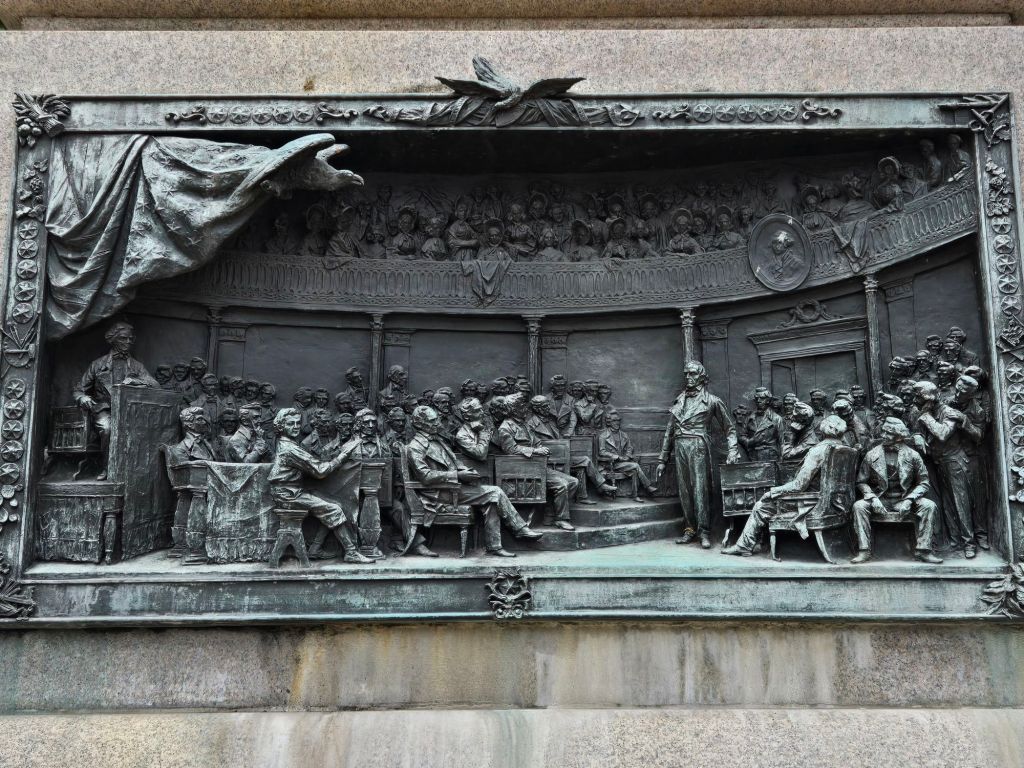
Actually, I had a topic, I was going to write about, but I think I will postpone it to another day, and talk about antisemitism. I have done that before (my general themes being (a) Jews sometimes falsely identify a comment as antisemitic, (b) I don’t think that criticism of Israel is necessarily antisemitic, and (c) we are not living in 1933 Germany because we have a government that is supportive of us, not against us), but I am going to look at things a bit differently today.
And that is because of something I heard yesterday.
A digression: My vocabulary fails me. As I understand it, a podcast is something that is audio only, and if it is also on a screen, it’s a video cast. Is that correct? I actually am not certain. But I tend to listen to programs on YouTube through Bluetooth in my car when I am driving a distance of 30 minutes or so or more. It’s a video cast, but I don’t look at it (for obvious reasons), just listen to it. So what am I doing? Am I listening to a podcast, or am I listening to a video cast, or is there still another way to describe it?
At any rate, yesterday I heard a talk by Rabbi Yossi Goldman, who was speaking to the Jewish Learning Institute. The Jewish Learning Institute, as you may know, is a Chabad entity, run out of Brooklyn, and puts out educational programs through the Chabad world. I have not heard very many of their programs and don’t seek them out, but Mr. YouTube thought this is one I might be interested in, and he was right.
Yossi Goldman, born in New York, is an Orthodox rabbi and was (or maybe still is), a Chabad rabbi. He was apparently the first Chabad rabbi in South Africa, where he lives, but at some point became a large congregation’s rabbi in Johannesburg, and I think he is still there.
Second digression: South Africa has a substantial Jewish population, although it has diminished over the past several decades. Religiously, it is by and large Orthodox. Ethnically, it is by and large Lithuanian. The synagogue that Rabbi Goldman leads is in a suburb of Johannesburg, the Sydenham-Highlands North Hebrew Congregation.
Third digression: Correct me on this if I am wrong, but this is what I think I heard and when I googled it, it seemed accurate. During the COVID pandemic, South Africa closed all religious institutions to in person services. Everything was done remotely. A couple of years ago, this was relaxed and in person services were permitted under two conditions: first, that everyone is masked, and second, that no more than 50 persons can attend a service. Goldman said that, in his shul, he has 50 live congregants and 1400 seats.
Okay, here goes:
Basically, Goldman says that there always has been antisemitism, and that there always will be. Not that it isn’t important to fight against antisemitism, but the battle will never succeed in actually eliminating it (that reminded me of trying to eliminate Hamas, but that’s another story). So, he says, get used to it being there, and don’t let it get you down. Instead, he says, hold your head up, be proud that you are Jewish and continue to do what you can to better the world. You can’t control what other people do when all is said and done, but you can control what you do.
As to why there is antisemitism, he concludes that you shouldn’t look at what people say, because their reasons are just excuses. He says that there is one reason for antisemitism, and that is that Jews irritate other people. That’s because they are never satisfied with what is, and are always the prime voices behind what could be, or what should be. Moving back to South Africa, for example, he pointed out that when Nelson Mandela was arrested in 1963, there were others arrested at the same time. These others included (he didn’t name them in his talk) Lionel Bernstein, Denis Goldberg, Arthur Goldreich, Harold Wolpe and Bob Hepple, all Jewish.
He said that it isn’t surprising that in Soviet Russia Jews were accused of being bourgeois and globalists, and in America, they were accused of being Communists. In each situation, Jews were irritating the power structure.
Goldman concludes that being irritants is part of the mission of the Jews to improve and better the world, and that irritants were always be opposed by those they are irritating. So, he concludes, antisemitism must be fought, but we must expect it to be with us forever.
Now, it’s not that I agreed with everything Goldman said. He thinks, for example, that all anti-Israel speech is antisemitic. I don’t agree. But he thinks that Jews are irritants in the Middle East (and need to be), just as they were irritants to the Nazis in Germany in the 1930s. That’s just the way it is, and always will be.
You may want to listen to or watch Goldman’s speech. It’s called “Why the Jews?” and I found it on YouTube.
Here we are, living in 2024, our senses bombarded with fake news, conflicts on our border as some people are trying to get in and others trying to stop them, and – for these and other reasons – everything seems topsy-turvy.
I have a collection of over 700 Penguin paperbacks from the 1930s to the early 1960s, and, during COVID, I read them to the virtual exclusion of any other books. I read, I think, about 150 of them and then stopped. But I just read three more. Two were re-reads (not from recent years, but from years long past) and one was new to me. What did I discover? Fake news, problematic borders, and a topsy-turvy world.
The books were first written in 1872, 1914 and 1936,but we’re all set in the late 19th century. Sure, that was a different time, but the problems then were like the problems today. Just on a different scale.
Let’s start with fake news. The book published in 1914 was by French writer Andre Gide and is called The Caves of the Vatican. I had not read it (or, to my knowledge, anything else by Gide before). I found the book fun, and assume that’s what Gide intended. I am not going to go through the entire plot – the book concerned three sisters, each of whom married a very different type of husband and, to that extent, it’s a family story. It’s also a crime novel – although the crime (a random murder that turns out to be not very random) does not occur until quite late in the book. But the story revolves around fake news, even in France (where it is set) and in 1890 (when it is set).
I will try to simplify and stick to the point. One of the three sisters is married to an odd businessman, who doesn’t seem to have much of a knack for business, and who is about as unworldly as you can get. Because the sisters inherited a good deal of money, though, she lives very well. One day, at her country estate, she is visited by a man who tells her that he has been sent to her by the Cardinal himself, and that he has a very important message that has to be delivered orally, and that requires absolute confidentiality – she cannot tell a soul. She agrees, and he explains to her the problem. The Pope (Pope Paul III) has been kidnapped by the Freemasons, and is being held in Rome in Castle San Angelo. The Vatican does not want the story to get out for obvious reasons, and the Freemasons have agreed to keep the kidnapping secret as well, provided that they get, by a certain date, a very large ransom that Church emissaries are trying hard to raise. He asks his hostess to help in this effort and provide him a significant donation. Of course, the donation must be made immediately, and it has to be made in cash, with nothing traceable to any financial institution. Of course, she agrees.
But also, of course, she tells her husband, who decides that he, too, must do something and what he decides to do is to set off for Rome to rescue the Pope. Why himself, who has never been out of the neighborhood of his estate in his life? Because, of course, the Pope must be rescued and he is blessed to be one of the only people in the world to whom this terrible secret has been disclosed. He can’t just sit there and do nothing.
See, even in 1890, purveyors of fake news existed (at least in Gide’s fiction), and the news spread, and the news was believed and acted upon with alarming consequences. (To find out more, you will have to read the book)
The second book, one that I had read before and like as much now as I did the first time through is Daphne du Maurier’s Jamaica Inn, which you may have also read. This is a story about border control, in Cornwall, the very southwest of England. Again, I am not going to give away the plot. I am only going to tell you that the inn called Jamaica Inn is set in the moors and is no longer frequented by travelers, but is instead the site of an enormous fencing and smuggling enterprise. Clearly, the local authorities cannot control it, try as they might, and clearly the national government cannot control the border in any meaningful way.
Of course, the border in Cornwall is not a land border, but a sea border, where ships come in and dock at will. There are all sorts of ships – some carrying stolen cargo or cargo to be smuggled into the country, and some holding families and other innocent travelers. The owner of Jamaica Inn, a very troubled and powerful man, is (it turns out) second in command of a group of men known as the “wreckers”. The wreckers go out to sea, capture ships coming into shore, take them over, drown all on board, take the cargo themselves and then sink the ships.
It is only towards the end of the book that the gig is up, not only regarding the guilty individuals who hang out at Jamaica Inn, but for others, because the government is beefing up its patrols. England will now protect its borders.
I understand this is not a perfect analogy to our border situation. In fact, it may not be an analogy of any type at all. But the point remains – at the time when the book is set (and again we are probably talking about late 19th century), border control was a problem.
By the way, if you have never read Jamaica Inn, I recommend it. It is a quick read (about 250 pages), and very engrossing, if a little too cute at the end.
A short digression. Jamaica Inn actually exists, or it did 30 years ago when we visited it, and is apparently the inn on which du Maurier based her story. Whether it was ever a hotbed of crime, I don’t know, but there is a history of maritime crime in Cornwall. After all, think of the Pirates of Penzance. They really did exist, doing nefarious things (and not nearly as comical as described by Mr. Gilbert), boarding ships, sinking ships, taking contraband.
OK, now the third book. I had read this one before and perhaps you did, too. It is Erewhon by Samuel Butler. When I read it so many years ago (high school?), I remember being intrigued as I started and then getting real bored as the book went on. This time……I had exactly the same reaction.
You probably know the general story. In a remote British colony, the story’s protagonist, a young man, wants to know what’s behind the mountains that no one (no “white” man) has ever crossed. He ventures out and after having an adventurous and lengthy multi-day hike, he finds himself on the other side of the mountain and in a world unknown to any Brit. A world of another civilization, in some ways much like his, in some ways totally different, and a civilization which – years and years ago – gave up technological progress as unnecessarily evil and harmful to society.
Yes, the only machines are in a museum and anyone found with a machine of any sort, or perhaps even a machine part, is guilty of a terrible crime. Why? Because the machines were dehumanizing, they became more important than humans, there was a belief that machines would get better and better and one day rule the world, rule human beings. They must be stopped before they get anywhere near that point.
But other parts of this society are very strange. People are punished for not being perfect, for example. You can be punished for poverty, and you can be punished for physical imperfections. And you can be punished if you get sick.
So no one will ever admit to sickness, will ever go to a doctor (I think there are no doctors), because if you become sick, you can be sent to prison, flogged or fined. Your entire family will suffer.
Of course, you may see this topsy-turvy world in different ways. It is totally opposite our society, of course. We don’t punish people who are sick or poor or physically unattractive or disabled, do we? Or….do we?
In any event, you get the idea. All societies are topsy-turvy. Even ours, and not only in the 1800s, when the world of Erewhon was discovered, but today. Especially today.
Final digression. When I was in Moscow in 1972, the Moscow that was the proud capital of a Communist country, I went to the circus. And the famous Moscow circus with dancing bears and all, was a one ring circus, not a three ring circus, so everyone was watching the same acts. And, at the mid-point, there was a break for a short, maybe 15 minute, skit.
The skit involved a beautiful little rural Soviet town where everyone was a Communist and everyone was happy. But then an Orthodox priest came to the village and tried to convert the people and especially the children, who in turn ridiculed and attacked him unmercifully. I was amazed. In the United States, a religious figure coming to a small heathen town would be a hero, right? Here it was just the opposite. Topsy-turvy. It was the best possible example of how societies can have opposite values, so opposite that when you – a member of one society – views another, you can’t believe what you see. It was a real life Erewhon, I thought, but called the Soviet Union.
For the past several weeks, the temperatures have been basically in the 80s, with an occasional jump to the 90s or decline to the 70s. Today, the high is expected to be closer to 55, and the hourly forecast for rain or drizzle winds between 50% and 65%. Okay, that happens. What’s the big deal?
The big deal is that this is Star Wars Saturday at Nationals Park and, because 3 1/2 year old Izzy is a Star Wars fanatic, we decided this would be a good day for a family outing to the baseball game – and we invested in six tickets. The game is at 4 p.m., and I think it’s 50-50 whether they are going to call it off. The reason is that tomorrow, although the temperature is supposed to climb back into the 70s, the chances of rain and the intensity of the rain are likely to be higher than today, and that game is more likely to need to be canceled.
But the problem is that this series is against the Toronto Blue Jays, an American league team that the Nationals don’t play very often. How will they reschedule two games in Washington DC for these two teams? For that reason, my guess is that they will go out of their way to get today’s game in – that means rain delays. And rain delays generally last at least 45 minutes each, because each time you have to cover and then uncover the infield with a tarpaulin. (Sign of age? It took me a while – “tarp”, I knew, but what is it short for? “Tarpolion”? “Tarpulin”? Or was that one of the lesser known emperors of Rome?)
What to do? (Talk about first world problems?)
Yesterday, I had a pretty free day. I started with my normal early Friday morning bakery trip to pick up our weekly challah, and then had a 9 a.m. Zoom interview with a potential new board member for the Haberman Institute for Jewish Studies. But other than that, nothing really scheduled until dinner.
I saw that the Reston VA library was holding its semi-annual sale and, even though it was Day 3 of the sale, I decided to take the drive. Reston, for those who don’t know it, was a planned city, about 20 miles west of Washington, still in Fairfax County, that was imagined and designed in the early 1960s by developer Robert E. Simon, who had an ego large enough to decide to name that place after himself. I remember the early days, when its survival was questionable, but where a town center and mid-rise apartments were built on the edge of a small but attractive lake, and middle and upper middle income housing subdivisions were carefully located nearby.
I remember that, when I started working at HUD in 1969, my direct superior lived in Reston and commuted to Southwest DC every day, something I then found astounding. I still find that commute astounding, although today, you can make the trip a bit easier (even considering much more traffic) either by taking a limited access toll road, or by taking the Metro (Reston is on the Silver Line that goes to Dulles Airport, about five miles further west).
Today, there is no question about Reston’s success. Its population is now over 60,000, and it’s skyline makes it look like a very successful mid-sized city. General Dynamics has its main headquarters in Reston, along with many other government contracting firms, especially those with a defense orientation, and Fannie Mae has a major facility there. It is no longer in the boondocks. (By the way, do you know that “boondocks” is a Tagalog word form the Philippines, and it means “mountains” and came into use in English as a remote place during the war in the Philippines at the end of the 19th century?)
At any rate, I went to the Reston library yesterday, and was a bit disappointed with the sale, perhaps because people already had two days to pick it over. I only bought two books, signed by the authors, and paid a total of $6.50.
The first is called Nofziger and it is from the early 1970s, a memoir by Lynn Nofziger, Richard Nixon’s and Ronald Reagan’s long time aid, and the man who John Dean said helped Nixon compose his “enemies list”. I met Nofziger once in what I would guess would have been the 70s. Nixon was no longer in office and Nofziger was working, I guess, as a consultant and had an office in an old town house, off Dupont Circle. I wish I could remember why I went to see him (it had something to do with my law practice, but I have no idea what) and was quite surprised. In those days, when lawyers wore two and sometimes three piece suits and every man seemed to wear a sport jacket, Lynn Nofziger had no jacket, just a dress shirt with an open collar. But more than that – he wasn’t wearing any shoes. He was in his stocking feet when he opened the door to meet me, when we spoke in his (quite elegant and comfortable) office and when he saw me out. That, I remember clearly. Why I was there? No clue.
The other book that I bought was one that I had never seen before or heard of. It was published by Bobbs-Merrill in 1939, is titled News is Where You Find It, and was written by Frederick William Wile, whom you have never heard of. Wile was a journalist – he passed away in 1941 – and I don’t (at this point) know anything about his career. But he had inscribed the book nicely and signed it, so I brought it home.
I must admit to some surprise when I opened it. Wile was born in La Porte Indiana in the 1870s. The first chapter, the only one I have looked at yet, told about his German father, who had immigrated to the United States in 1848 (no surprise there) from Binswangen, Germany. I looked up Binswangen (that’s what I do) and found it to be a very small town (under 2000 people even today) in the Rhineland. The Wikipedia entry says very little. In fact, all it talks about is its historic synagogue (spared by the Nazis from burning), now a community center, and the age of its historic Jewish community. That was it.
Going back to the book with this in mind, I was still surprised to see that his father was Jewish (as was his mother, a Guggenheim), and was a banker in La Porte and a founder of, and the “Reader” in, Congregation B’nei Zion in La Porte.
I have been to La Porte, located in northern Indiana, just southeast of Michigan City (on Lake Michigan), and never thought of it as a very interesting place, and certainly not as a center of Jewish life. I looked up Congregation B’nei Zion, and it no longer exists. In fact, it was already struggling when Wile wrote his book in 1939. But the B’nei Zion Cemetery is still maintaining its own (although it looks like it may not have had any burials in the past 15 years or so), and there are 18 Wiles buried in the cemetery, including Frederic William and his two parents.
In any event, I found all this very interesting. When I finish reading (re-reading) Daphne du Maurier’s Jamaica Inn, I am going to go right to it, and see if it’s worth reading (slowly or quickly) through. If so, I will dul report and Fritz Wile will no longer be forgotten.
By the way, as to Michigan City, still considered a good weekend retreat from Chicago, was the home of my great aunt Sophie and her large family of Kottlers. Not sure where any of them are now.
That’s it for today. Now back to thinking about the weather. Go, Nats.
Many of you remember when I posted on Facebook some of the conversations I had with Joan when she was younger – when she was between the ages of 2 and 5, to be precise. Then, I stopped, largely because her conversations with me became more grounded in reality, no longer as “cute” as I found them in her earlier years.
Well now, in just a few weeks, Joan will turn 9. And I thought it time to think about those years gone by.
Let’s go back beginning when Joan turned 4, in May 2019:
I asked Joan, the day after her birthday, if it felt any different to be four. She said “a little” and I asked her how she felt now. She responded: “I feel I’m almost five.”
I asked Joan what the doctor said after her four year checkup. Joan said “she told me I should work on phone numbers.”
Four year old Joan has dinner at our house. It was getting late, so we decide to take her up before we clean up. We get up to go, but she turns to me and says “Not you, Cinderella, you have to stay here and clean everything up.”
Me: Why did the chicken cross the road? Joan: Because the light turned green.
Four year old Joan told me she had a very unhappy friend today, who wanted chewing gum, but didn’t have any. “Why”, I asked, “did she need gum?” Joan looked at me and said: “She didn’t need gum. She wanted gum. Need and want are two different things.”
Four year old Joan is singing a song she wrote: “Can you survive? Can you survive? Hiding behind the door without a flashlight. Can you survive?”
Four year old Joan is very precise. She told us that her class walked on Friday to a playground and a splash park several blocks away. Her grandmother said to her what she must have walked by a certain store. “No”, said Joan, “we didn’t.” Knowing that was impossible, her grandmother told her she must have walked past it. “No”, insisted Joan, “it was on the other side of the street”.
Four year old Joan is confused about baseball. “How can you sit in the stands?”, she asks
Her grandmother told four year old Joan that she (her grandmother) had a play date with a friend that afternoon. Joan looked at her and said: “Not a play date; you had a talk date”.
Her father often talks to Joan in Spanish. Joan seems to understand but we have never heard her speak Spanish. On the way home today, I asked her if she knew the word for “basement”, assuming that it was a word she wouldn’t have learned. Casually, she says “sotero”.
Her preschool is closed this week, so we will take care of Joan. Her grandmother says: “Maybe we’ll do some weeding”. “OK”, says four year old Joan, “I’ll bring my gardening gloves.”
“How was Mt Vernon today?”, asked four year old Joan’s mother? “Did you know”, she answered, “that George Washington died in his own bed?”
I was trying to teach Joan tic tac toe. The first three games, I was X and she was O and I won all three games. Joan’s response was “I want to be X so I can win”.
When we went to Baltimore the other day, I told Joan we were going on the Beltway. Joan told me she knew the Beltway: “It’s the road to IKEA”.
At dinner last night, Joan’s father was talking about his job. He works for a government contractor. Edie asked him a question, and he said; “That’s up to the White House”. We didn’t know Joan was listening, but she immediately said: “You mean Trump gets to decide?”
Four year old Joan started her final pre-school year this week. One of the teachers is a native Spanish speaker. Because Joan’s father often speaks to her in Spanish, she has developed a pretty good comprehension of some basic Spanish. So her teacher has been talking to her in Spanish and told me Joan understands everything. I asked Joan if her teacher taught her any new words. She gives me a quizzical look and says: “No, I already know all the words”.
Four year old Joan asked me if I knew her two children. I asked their names. She responded: McTunafish, and McPictureframe.
Four year old Joan, Edie and I walk from the store to our car. We pass a beautiful 2019 Corvette. I say: “Look at my new car”. Joan says “nooooo”, that there is no car seat. We walk on past a massive and complex construction vehicle, with a dirt bucket in front and more attachments than a Swiss army knife. Casually, Joan says, “Look at your new truck.”
Four year old Joan says she is going to be a food designer. Her first new food she has named a kabobka. You put a piece of bobka on a stick and hold it while you eat it.
Yesterday, I was reading an article about the origin of Jewish last names. I said to Edie: “Do you know where the name Sachs comes from?” Joan answers: “I think they were named after a saxophone.”
At the dinner table, we were talking about what adults call their parents. Four year old Joan’s father asked her what she was going to call them after she grew up. Without missing a beat, Joan said: “Poppy and Peepee”.
I went to the National Gallery this week to see a special exhibit called “The Anxious Eye: German Expressionism and its Legacy”. I enjoy, if that’s the word, German art of the early 20th century, to see how the turmoil of those years is reflected in artists’ visions. My disappointment, if that’s the word, with this exhibit was how each work of art, irrespective of who the artist was, was so similar every other work in the exhibit. Almost “seen one, seen them all”.
So when I left that exhibit, and after I had a half serving of “deep chocolate” gelato (the other reason to visit the NGA), I decided to do something different: to select one piece of art, concentrate on it, and learn more about it than I otherwise would.
The portrait above is by Titian. A master artist, perhaps THE master artist if 16th century Venice, Titian lived a long (even by today’s standards) and productive life. Approximately 300 of his paintings remain today. Several are in Washington at the National Gallery.
Titian, known for his use of color, painted many portraits, as well as landscapes, religious scenes, and everything else. This portrait, painted by Titian when in his 40s, is of 12 year old Renuccio Farnese.
My thoughts was that this is a very attractive 12 year old, almost contemporary in his look, but that he seemed out of place in his fancy red and gold outfit. And what about that oversized cape? And who was young Renuccio anyway?
It turns out, from what little I could find out, that Renuccio had what in Yiddish is termed yichas, i.e., he comes from good stock. His father was a Farnese and his mother an Orsini, and both of those families were Renaissance Italy elite. And Renuccio’s grandfather, Alessandro Farnese had a very important job as well, where he was better known as Pope Paul III.
At the time this painting was done, the Farnese family was the leading family in Parma, just a bit west of Venice, where successful Titian was plying his trade. And this portrait was apparently commissioned for Renuccio’s mother.
What was our 12 year old Farnese doing at the time? Yes, of course he was studying. But, thanks to his grandfather and to the Italian custom of nepotism at its highest level, Renuccio was also the custodian of properties, including a large church, of the Knights of Malta, in Parma. And that oversized cape with the Knights of Malta cross is, of course, a Knights of Malta cape.
But what was Titian saying? Here’s a little boy with a man’s job? Here’s a little boy with too big of a job? Here’s a little boy who we hope will grow into his job? We don’t know. Just like we don’t know what his mother thought of the portrait.
By the way, I only know a little about what happened to Renuccio, other than he died at only 35. I have read that he became a cardinal at 15 (I think that, in those days, you didn’t have to be a priest to be a cardinal) and that he became Bishop of Naples, Ravenna and Bologna (and I don’t know if those were three separate positions or just one).
I wish I knew more. Was a smart or dumb? Nice or nasty? And why did he die so young?
Going back for a minute to German anxiety, the exhibit also included a room of more contemporary works influences by the artists of the 1920s and 1930s. Here is one I like, by Israeli artist Orit Hofshi. Called “Time….the Ceaseless Lackey to Eternity”.
A few days ago, I posted my thoughts after reading the first parts of Michael Cohen’s book Disloyal, the story of his relationship with Donald Trump. Cohen, of course, will be a major witness in the “Stormy Daniels” trial and, while it is doubtful that he will saying anything too surprising, his credibility as a witness is very important. Because he had plead guilty to lying to Congress and served jail time, it is important that the prosecutors convince the jurors that he is believable.
My main point earlier was that Cohen, likeable as a TV commentator, is not likeable based on how he conducted his life pre-Trump, nor how he conducted his life during his first years working with Trump. Having now read the full book, I still find him a rather scurrilous individual. Perhaps the Michael Cohen of 2024 is not the same as the Michael Cohen of 2020 and before. It will be up to the prosecutors to convince the jury of that.
Cohen was a self-admitted sycophant of Donald Trump, mesmerized (he uses that word) by him for reasons he claims not to understand. He also was a successful lawyer and businessman, who had earned many millions of dollars (taxi medallions, law practice and real estate), who had no need of employment by Trump. But he enjoyed the challenge, he says, and he liked playing with the big boys and yes he was mesmerized by Trump.
But Cohen was already a big boy. He had run for public office twice (lost both times) and had met, and kept in contact with, New York’s top journalists and politicians. He was interested in money over everything and strove successfully to hob nob with those who controlled money. Without Donald Trump, he would have been fine.
I have met people like Michael Cohen, of course. And every time I meet someone like him, my reaction is: boy, he sure is different from me.
I have never understood the concept of making money (really a lot of money) as a major goal. I’d like to have the money, of course. I think everyone would. But doing what you have to do to get it has just never interested me.
Go back to when I practiced law. The firms I was with were generally connected to the low income, assisted housing industry. Representing people connected with constructing, developing, maintaining and financing government assisted low income housing projects. I enjoyed that work – thinking I was doing good for the world. But there were aspects of that work that I didn’t enjoy. I didn’t enjoy representing clients in transactional work. Buying and selling land or property. I never cared who owned the property. And I certainly never had any interest in the negotiations leading to a deal. Do I care if the price of a building is $17 million or $18 million? Not at all.
But for people out to make millions (billions, in fact) in New York real estate (and there are a lot of them), transactions and the details of transactions, are their love and their life. And they also like to buddy up with rich and powerful people who can introduce them to deals, or smooth their deals through approvals once the deals are underway. I myself don’t ever think I have made a friend because of what I think that person could do for me financially. But Donald Trump certainly does. So does Michael Cohen.
The other thing I learned about Michael Cohen from his book is that (even if he didn’t know it), Michael wanted to be another Donald Trump, and he thought he could be one if he stuck around Trump enough. I learned that, just like Donald Trump, Michael Cohen has an enormous ego. An enormous ego. Unpleasantly enormous.
But it, at the same time, is a mystery. How Michael Cohen, who wanted so much for Michael Cohen, could in effect stick around as Donald Trump’s fixer for so long.
What else did I learn? Of course I learned that every bad story I have heard about Trump is true. I learned that Trump does not believe what he says. I learned that he really does want to be a dictator. I learned that Cohen, in 2000, believed that if Trump lost in 2020, he would not leave office, but would do whatever he could to stay in office. There would be no peaceful transition of power. You gotta give it to Cohen here.
I learned one more thing about the Trump phenomenon. I now know why Trump is so popular among evangelicals. Cohen didn’t tell me why. But I think it is clear from what he does say. He says that, early in the campaign, there was a fear that believing Christians would not be able to support Trump, and that something needed to be done about that. It was decided to hold a large meeting for about 50 of the biggest personalities in Evangelical Christianity, where Trump could present his case. The meeting was held. And, according to Cohen, Trump was able to end the meeting with each of the guests eating out of Trump’s hands.
Cohen attributes this to Trump’s duplicitous being convincing style. I go one step further. Trump got along with the top evangelicals because they are clones of Trump, or Trump is a clone of them. They too strive for money, and respect, and a large audience, and don’t believe a thing that they say as literally as they say it. They were a natural audience and partners for Trump and, of course, their congregants listen to them and believe everything they say. So while it might seem an impossible partnership in one sense, in a different sense it seems obvious and inevitable.
Cohen was investigated as part of trying to determine why he paid Stormy Daniels $133,000, and his Congressional testimony that he never got reimbursed made no sense. Of course, he did get reimbursed, being paid “legal fees”, so it might have been inevitable that he was indicted. But Cohen’s telling of his indictment and prison experiences are interesting. Cohen says that, after the FBI raided his house and took his computers and papers, he was indicted not only on lying to Congress, but on some things related to his taxi medallion business and on tax evasion. He was also told that his wife (whom he describes as unbelievably honest and innocent) would also be indicted (I assume on the tax charge, with them filing jointly). And that all the charges would be increased against both unless he pleaded guilty. And so he did, even though that, on other than the lying to Congress, he never understood what he did that was criminally wrong. He finds himself a victim of the American judicial system as do so many others.
I am not quite sure what to make of that. I did have a client who served time in prison for something having to do with overcharging the government in connection with a low income property. He told me that he did not do what the government said it he did, but that his brother (who worked for him) did commit the crime. But his brother, he said, was divorced and had young kids, and he couldn’t let his brother go to jail, so he pleaded guilty and served a year in federal prison. Was my client telling the truth? Is Michael Cohen? Who knows?
Finally, one other thing. Perhaps obvious. He and Donald Trump may have been partners in crime for 15 years or so. But as soon as he was indicted, Trump dropped him like a hot potato. Between the time when Cohen’s apartment was raided by the FBI and he called the President to tell him, and when he wrote this book three years later, Cohen and Trump had not spoken at all.
Last night CNN’s Kaitlan Collins made a fool of former attorney general William Barr after he said he will vote for Donald Trump by pointing out that Barr, the former chief legal officer of the United States was backing an insurrectionist and a man with 88 criminal counts against him, among other things. Barr looked about as uncomfortable as one can look before muttering that he will support the Republican ticket.
I assumed that would be the highlight of the show, but no, it wasn’t. Her next guest was Michael Moore, who (in spite of sounding a bit incoherent) gave a plea to President Biden to cut off funding to Israel until the Gaza War is ended. It was an “l support Israel and I hate antisemitism but this war is outlandish” kind of plea, calling – among other things – on the moral authority of the Pope and Biden’s Catholic faith.
But then he said something that took me aback. He quoted what he called the Likud Party charter from 1977. The Likud Party of course is the party of Benjamin Netanyahu and in 1977 was the party of Menachem Begin, who became Israel’s first Likud Prime Minister.
From what I can see, Moore was not quoting the party’s charter, but their 1977 platform. The platform said that Israeli sovereignty would control the land from – you may have already guessed it – the river to the sea.
Wikipedia has an entire entry called “From the River to the Sea” that you may find interesting. I did. But it got me thinking. What if “they” are right? What if Israel is engaged in what should be viewed as a form of genocide?
Let’s look at it in two different ways. First, let’s look at those religious (is that really the right word?) Zionists who believe God did give the land of Israel to the Jews and that the land of Israel goes from the river to the sea. Presumably they would do anything to fulfill God’s wishes, using the conquest of much of this area by Joshua, as related in the biblical texts, as a model. We could call them Aggressive Zionists.
And then there are those who are tired of now-and-then wars and constant pressure and tension from Arabs who want to destroy Israel and who believe that the only solution to totally eliminate the threat. Let’s call them Defensive Zionists.
And we can assume that most Jewish Israelis have a little, or a lot, of both in them. (I say Jewish Israelis of course because 20% of Israel proper is Muslim…but that’s another story.) And let’s assume from the perspective of a Jew living in Israel, neither position is irrational.
The current Israeli government is made up of Aggressive Zionists and Defensive Zionists. Extreme examples of both. They were voted into the Knesset by the Israeli population. And, by my definition, they believe in Israeli sovereignty from the river to the sea. And their strength has grown, it would appear, substantially since 1977.
So now let me extrapolate. The horrific attack by Hamas occurs. As bad and perhaps unnecessary as it was, it gave Likud the excuse it needed, or the rationale if not the excuse, to – in effect – go nuclear.
By this, I mean to work to eliminate the possibility of non-Israeli sovereignty anywhere from the river to the sea. To simply flatten Gaza. To set the stage for the mass emigration of Gaza residents because it will be impossible for them to stay. And all those other Arab countries with room to spare will no longer be able to bury their heads in their omnipresent sand, and will have to take them in.
Certainly there will be casualties, and these are to be regretted, at least for the most part. But the casualties will be forgotten or fade from importance as time passes. At least, this is the theory.
And while this is going on, there will be similar pressure for dispersal from the West Bank and, after Gaza is resolved, West Bank pressure may be increased even more.
After all, they may think, the vast majority of Jews in Israel were either kicked out of Europe or out of the Muslim middle east or North Africa. Horrendous situations then, maybe even worse than what is happening now. And people move all the time. All around the world. Voluntarily. By necessity. For all sorts of reasons. Why should these moves be any harder or special in any way.
This is obviously not a pretty picture, and we may want to oppose it. But what is the way to do that? Or, you may think that we shouldn’t oppose it. You may be an Aggressive or a Defensive Zionist who thinks it’s time to take a stand. You wouldn’t be alone.
One last thing – this presents one facet of this story. A similar piece written about Palestinian leadership would probably look even worse.
People (and I include myself in that group) like things to be simple. Thankfully, the situation regarding Ukraine is simple. Ukraine is a recognized sovereign country and Russia had agreed to respect and protect its borders, and then Russia invaded Ukraine with more than 100,000 troops. Simple. Russia is wrong, and Ukraine is right.
Unfortunately, the situation between Israel and Palestine (or is it Israel and the Palestinians, or is it Israel and Hamas?) is much more complicated, and the rights and wrongs are much murkier. This is the reason that I haven’t written about the student protests until now. I am not sure what to say.
What I do know is that the participants of the protest groups are not monolithic.
Some would like to see Israel disappear and the Jews disappear (from the region or completely) with the disappearance of the state.
Some would like to see Israel simply stop occupying Gaza and the West Bank.
Some would simply like a ceasefire.
Some would like to see one state containing Jews and Arabs.
But they all know that they cannot force any of those things to happen. So they become more and more frustrated. They decide to narrow their goals, even as they keep their vocabulary broad. They focus on the universities against whom they are protesting. The universities should not support Israel (or should not support Israel’s war, depending on whom you ask). They should divest! If they divest, the companies from whom they are divesting will struggle. How will they stop struggling? They will themselves diversify from Israel.
Or they concentrate on the United States government. Any American can do that, of course. They concentrate on the money which the U.S. gives Israel, and especially the money that Israel uses to support its military.
But there is no subtlety here. There can’t be. Subtlety is too complex.
So supporters of Israel are caught in the crossfire. And because subtlety is too complex, all supporters of Israel are caught. Even those who are against the Gaza war.
And Jews are caught in the crossfire. That’s because most Jews are supporters of Israel, whether or not they support this particular war, the occupation in general, or the current Israeli government. Subtlety is too complex, so unless a Jew declares himself in solidarity with the protests, Jews are caught in the crossfire.
And the more Jews speak out against the protests, the more they become targets. And for sure, protests look for targets.
But does this mean that the protestors are (as a whole) antisemitic (obviously some are)? I don’t think so, unless you identify being Jewish with support of Israel. Israel likes to think of itself as the homeland of the Jews – this is one of the ways it garners support from the diaspora. Jews have a right of return to Israel. It can be hard to separate the two, to be sure. It, again, is complex.
And, of course, the protestors want their protests to be successful. You try to achieve success in any way you can. Is it more like to exceed of you attack Jews as well as the state of Israel? Perhaps it is. At least that is what protest leaders bank on.
And protestors can’t go halfway. They can’t acknowledge anything good about Israel, or bad about Hamas or other Arab leadership. They can’t talk about release of the hostages. Much too complex.
And, yes, there is the question of leaders and followers. Followers follow leaders; they always do. And followers usually take what leaders say very seriously. Typically, followers take what leaders say much more seriously than leaders themselves. The leaders are tacticians, the followers are the true believers.
I am not sure how much sense any of it makes.
But you see why I haven’t written about this yet. I don’t want to be knee-jerk; I want to be nuanced. But I do crave simplicity.
But what about simply fighting fire with fire? I hear that all the time – but can you tell me any time when that has been successful? When there is a real fire……do you fight it with fire?
(You will note that I have not even hinted at what I believe are the appropriate actions for a university to take. I bet you know why.)
For those of you who followed our recent road trip, you may remember that I posted about our visit to Selma, Alabama, and how surprised we were to find the central area of the city almost a ghost town, with vacant storefronts and abandoned buildings. The date of the post was April 13, if you want to go back and look at my description of Selma in general.
Of course, I didn’t mention everything (that is never possible), and one of the things I didn’t mention was that there is a used book store on the main street of the city (Broad Street) that is one of the few commercial businesses that seems to remain open. It had its hours posted on its front door, but – irrespective of that – it was closed when we were there on a Saturday morning. Nevertheless, it appeared to be an active business, as outside the store (as you often find in used book stores), there was a “free bin”. As in most used book stores’ free bins, most of the books, which were available for the taking, were overpriced as free – by subject or condition they probably had negative worth.
But sitting there in the free bin was an almost pristine copy of Michael Cohen’s book about his time with Donald Trump, Disloyal, which Cohen wrote while he was languishing in prison, and which he published in 2020. Since it came out and especially as Michael Cohen became a regular TV news show guest and now a prospective main witness in the “Stormy Daniel” trial, I had been intrigued by the book. But I wasn’t going to shell out my hard earned dollars to buy a copy.
But here it was. In Selma, Alabama of all places. Staring me in the face. In great condition. At no cost. I couldn’t refuse. So I took it.
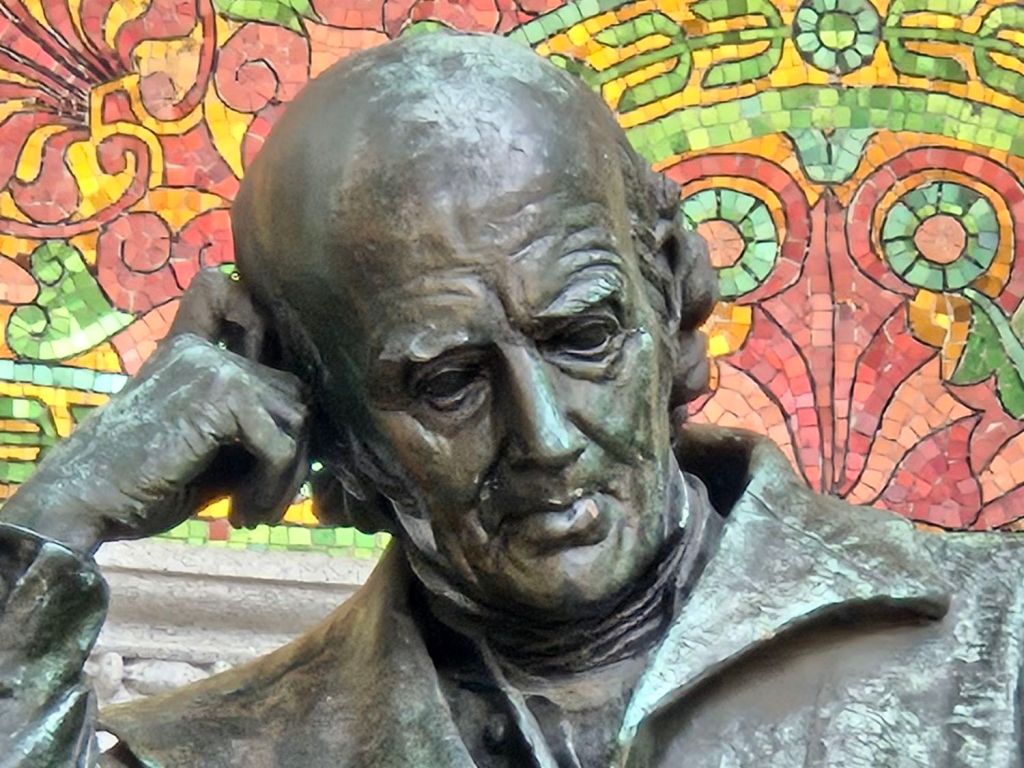
And last night, while I was watching the Nationals beat the Marlins, 11-4, I started reading the book. It’s well enough written (i.e., it’s very readable) if not great literature, and the print is big, which always helps. The book is about 400 pages long, and I read just over 100 last night. Those pages describe the pre-Trump Michael Cohen and the early Trump (year 2006) Michael Cohen, and that’s easily enough for me to set forth my impressions. I will read the rest of the book, and maybe my impressions of Cohen will change after he talks about his decision to swap loyalty for disloyalty. We will see.
Until his presidential run in 2016, I never paid much attention to Trump. Since that time, of course, I have learned too much about Donald Trump. I also thought I had learned enough also about Michael Cohen, who had been his lawyer (sort of) and his fixer (more his fixer than lawyer, perhaps) and liaison with the public. I learned that at one time, Cohen had said he would take a bullet for Trump, and then that he had changed his mind. That he had gone to jail for lying to Congress, and that he had publicly atoned and was cooperating with officials, and writing a book. I saw Cohen on TV from time to time and found him surprisingly appealing personally.
I guess that my surprise, though, is what is surprising. It shouldn’t be surprising that someone whose success depended in part on his appeal is, in fact, appealing. And because I find him an appealing and intelligent and well spoken person, I tend to take his conversion from mouthpiece to critic as honest, and I tend to believe what he is now saying. This is, I think, still my position, in spite of what I have read in the first 100 pages of his book.
But what I think about his truthfulness is not very important. What is important is what the 12 jurors and 6 alternates and Judge Juan Merchan think when Cohen testifies in the coming days in the Trump criminal trial. And what I learned from this book (and what I am sure the defense attorneys know in spades) is that Michael Cohen was no naif who got caught in the Trump web unawares of what was going on, but rather that Michael Cohen, from his early years, was someone one needed to treat with wariness.
Cohen grew up in an upper middle class family on Long Island, in a wealthy suburb of New York City, Lawrence NY. His father was survivor of the Holocaust in Poland, who hid with his family during the war, and then immigrated first to Canada and then the United States, where he went to medical school and became a well respected physician. Michael went to a Jewish Day School for elementary school, and then to a prestigious private high school, the Woodmere Academy. He says that he could have been a good student, but never wanted to be, so he fooled around a lot, became a class clown, and palled around and pranked around with his friends.
He also says he was always interested in money – money was always his goal. Even at age 6, he says, when he had a lemonade stand in front of his house, he would drag a picnic table into the middle of the street to make sure that the traffic would have to slow down. His lemonade stand was, he says, very successful.
His father really wanted him to become something – either a doctor or a lawyer, and Cohen, a very good son it appears, obliged, although he never studied at American University and when it came time to choosing a law school, he simply chose one he knew he could get into, Cooley Law School in Lansing Michigan, then affiliated with Western Michigan University, but now on its own and unaccredited. Then he went back to New York.
During high school, college and law school, Cohen spent his summers working for his mother’s oldest brother, Morty Levine, who ran a “country club” in Brooklyn (sort of a private community center with both restaurant and athletic facilities, including a swimming pool) that catered largely to Mafiosi and other mobsters. Young Michael liked and respected these gangsters, and palled around with some of them. This was big time stuff – Cohen tells about the time one “member” shot another “member” at the club and paid young high schooler Michael $500 to remain quiet.
At the same time Cohen was making money in other ways – and not small money. He was importing cars from Europe and selling them at a large profit. Working through some of his gangster connections to do so.
After law school, Michael opened a law office and I guess was pretty successful (personal injury cases and the like), but his heart wasn’t in it. It was more into his side businesses. And the side business that made him a lot of money was the acquisition of New York City taxi medallions. He tells the story of how he did this, and of how he made a fortune in a less than respectable business, so that by the time he was in his 40s, he was a millionaire many times over, had bought an apartment in the former Delmonico Hotel, now a Trump condominium, where three units were combined for the Cohen family home. He bought other Trump units and rented them out. And he convinced his parents and his in-laws to buy into the Trump Building that is next to the UN Building.
Throughout this time, as Cohen was intent on not only being rich, but being an important man in the center of things, even before he was working for Trump, he had run twice for political office in New York (and met the city’s political leaders and leading journalists) and was ingratiating himself into the highest levels of New York commercial society.
It was through his acquisition of his units in the Trump world that he first met Donald Jr. and through Donald Jr his father. The rest is history, of course.
My obvious point is obvious. Before Michael Cohen was doing outrageous things for Donald Trump, he was doing outrageous things for Michael Cohen. He was no naif. He knew exactly what he was doing, although even he was surprised as to how much he, an unabashed egoist, was captured by the charisma of the amoral and sometimes irrationally vicious Donald J. Trump.
So, how genuine is his current conversion to decent human being? And how much will his testimony stand up against Trump’s defense lawyers in the current trial?
As Rachel M would say, “keep your eyes on this space”.
I am a simple minded person. I find the subtleties between a president acting in his official capacity and a president acting in his personal capacity too difficult to determine. I am not looking forward to court challenges after court challenges suggesting that a particular presidential act is one or the other.
One of the man points of pride that Americans have is when they look at the chaos that develops in so many parts of the world and are able to say “But we are a nation of laws”. It’s as simple as that. If a president is above the law…..we are no longer a nation of laws. What could be simpler to understand?
Now, the courts have dealt with questions of immunity and limited immunity, particularly when it comes to law enforcement officials for some time. Let me again be simple minded. If a law enforcement officer takes an action which, if taken by another person, would arguably be criminal, and he does it in the course of his occupational work, he has limited immunity……unless he does it knowing that he is wrong in doing it, and shouldn’t be doing it. Now, of course, it’s hard to look into someone else’s mind (in any criminal case), so you have to rely on a somewhat different standard. If the official should have known that what he was doing was illegal – because of his training, because of societal norms, because of other examples of which he was aware – that sort of thing – he can be guilty of a crime.
So go back to former president Trump. If he knew, or should have known, that he lost the election, and he was still trying to overturn the election, he is guilty of a crime. If he honestly believed that he won the election and that everything he was doing was legitimate, then – no crime. That’s the way I look at it.
But the Supreme Court doesn’t appear to be looking at it this way. The justices seem to be considering saying: if an action is in within the official duties of a president, he is immune from prosecution, no matter what. And that is what Trump’s lawyers are maintaining. That’s why they hope at least for a remand to a lower court to determine whether Trump’s actions leading to the January 6 riots were within his presidential duties. Or better, a blanket immunity determination.
This is why, both in arguing before the Supreme Court and in the lower courts, the lawyers say such outrageous things. If a president targets a rival for assassination, no problem; he is immune. If the president cancels an election; no problem, he is immune. If the president wants to ignore or change the results of a vote, no problem, he is immune.
In other words, I think the focus is all wrong. The idea of having individual District Court or Courts of Appeals judges trying to determine whether the assassination of a political rival is within one’s presidential duties could lead to all sorts of results – one judge says yet, one says no, it goes to the Supreme Court, whatever the Supreme Court says is viewed as political, and we are no longer a nation of laws. It is that simple.
Instead, the Court should be focusing on whether Trump knew or should have known that his conduct was illegal. Again, it is that simple. This morning’s New York Times front page says something similar. I think they got it right.
A guest on Lawrence O’Donnell last night put it a different way. Even more basic and frightening. By even considering the arguments in the way they are considering them, she declared that the Supreme Court is moving outrageous positions which should be ignored into the mainstream. That no matter what the Court decides, these positions can now be part of the American political debate and that that, in and of itself, harms our democracy.
There’s a lot to think about here. Think about it.
Last week, I wrote a post which listed some of my problems with the wording of the traditional Haggadah and with the modifications that over the past fifty years or so everyone seems to feel empowered to make. Now that the seders for this year are history, I can stop thinking about the Haggadah for the rest of the year. Now, all I have to do is to respond to the 8 days of Passover.
I have said this before, and I will say this again, but I don’t like any holidays. They disrupt my routine for (at least at this time of my life) no reason. I don’t seem to gain benefit from holiday religious functions, from festive meals (or non-festive fasting), or from partying in general. I like an undisturbed calendar, which allows me to spend most of my time as I want.
Of course, Passover is the ultimate routine messing-up holiday, lasting 8 days (4 days actual holidays and 4 days semi-holidays), and mandates dietary rules that are difficult to follow. And, of course, this is the point of it all. But…..
If your house is kosher for Passover, you see all sorts of changes. For one thing, you use different dishes, pots, pans and silverware. Of course, it is a pain to move all of these things and then move them all back again, but I really don’t mind doing that. It’s like exercise, so it’s OK. And I like our Passover dishes.
But the food changes, too, beyond what you might think. While there may not be any issues with fresh fruit and vegetables, processed foods generally must be marked kosher for Passover. That limits some foods altogether, and certainly limits brand that you might be accustomed to the rest of the year. A simple example: let’s say you like Ben & Jerry’s Cherry Garcia Ice Cream. Well, you can’t have it in your house on Passover. Do I understand why that is? No – to me, much of the requirement to have a “P” is simply a way for the certifying rabbis to be able to send their kids to expensive yeshivas. But, that’s the way it is.
And then there is the central question of “no leavening”. Do I understand why matzoh is OK, but bread is not? Not really. And now that everyone is so sophisticated and can make Passover rolls that look and taste just like ordinary rolls, do I understand why that is OK? Not really.
To make matters more confusing, I understand that the five grains prohibited on Passover (unless refined in a way that avoids the prohibition) are wheat, barley, oats, rye and spelt. Yet, at the same time, I understand that matzoh, which must be made without leavening (which, as I say, I really don’t understand) must be made with one of the five prohibited grains. Go figure. (I have also read that, due to translation issues, oats may really not be oats, but a kind of barley – but it is a few thousand years too late to change this one).
Then there is a question of what is known as kitnyot, certain types of grains and similar foods that the Ashkenazic rabbis, in their wisdom, have decided should also be prohibited on Passover, but which Sephardic and Mizrachi rabbis have decided can be eaten on Passover. This includes legumes, and corn, and rice and a number of other things. So think of this confusion – what do you do if you are Ashkenazic and your Sephardic friend invites you over for dinner. Do you eat as if you are Sephardic in their house? Does your friend agree not to serve you any food that is not approved by the Ashkenazic rabbis? Or do you say, “I can’t come because you have cooked rice in your house on Passover and therefore I can’t eat anything you make this week”. Or do you just ignore your Sephardic friends over Passover. See the confusion?
And then there’s another “rule” that the majority wins – so that, as I understand it, in Israel where the majority of Jews are Sephardic, the Sephardic rules are supposed to apply to everyone. But do you think you can enforce that against observant Ashkenazic Jews?
It is all just confusing. And I don’t know why I am bothering to talk about any of this today in this post, because there’s nothing I can do about it, and I don’t really want to think about it.
You ask about me. Let’s just say I am Ashkenazic in my house and Sephardic outside of my house. And that I think back warmly on that Passover maybe 25 years ago, when I was on a business trip in Charleston West Virginia and ordered dinner in the dining room of the Marriott Hotel, forgetting all about Passover and enjoying a normal dinner. Guess what. Lightning did not strike, nothing evil occurred and life went on. And one more thing: what happens in Charleston, stays in Charleston.
All right, I think this might bet he most chaotic post I have ever written. ’twill be better tomorrow. (Should I have capitalized ’twill?) By the way, I am not even going to proof this one…..
Last night, we went to see At the Wedding, the play by Bryna Turner, at the Studio Theatre until April 28. I knew little about it, had read no reviews, and only knew that it took place at a wedding (duh!), and that one of the guests was the bride’s ex. Oh, yes, and it was a comedy and only 75 minutes long.
Hannah works at Studio and she was able to get us comps, so we didn’t have to actually buy tickets. Because of this, the easiest thing for me to say is that it was worth every penny we spent. But I am not going to say that because it would have been worth the full price of our tickets. Rare, indeed, for a 75 minute play; normally, whether or not you like the play, you do feel a little cheated. But not tonight. It was absolutely the right length.
The play is very funny. The script is extremely clever. The direction, by Tom Story, is right on. And each actor played their part with precision. In fact, “precision” is a good word to use here. It was like the play was both very natural (I think thanks to Dina Thomas, who plays Carlo) and completely, movement by movement, choreographed. All for comedy.
The gist of the play is the Carlo is the ex (not sure what that means here; I don’t think she was married) of the bride, who is now changing her life style and marrying a man (the groom himself never appears in the play). Carlo, who is now alone, subconsciously (or perhaps consciously) tries to torpedo the wedding by, first, not sending an RSVP, second, trying to make a “boring” party more dramatic, and third, telling the bride she should forget the wedding and run away with her. Meanwhile, you have a rather ditzy blond friend who has a love/hate relationship with Carlo, an ill at ease English teacher named Eli, a bisexual woman who thinks she is in a six year “open” relationship with the Eli (does he?) , of course Eva the bride, and the bride’s mother (who of course knows Carlo well and perhaps misses her), played by the wonderful Holly Twiford (who really knows how to get drunk on stage). And the lone bartender/server, a comic character who only speaks in one scene but is there throughout.
And the music. Of course, with the exception of YMCA, I hardly knew any of the playlist than ran through the show, but the selection was perfect. It was continual, each song complemented the one before, and each song was just right for each scene. And the music plays both in the background and, for short sequences when the cast burst into the well choreographed dances, in the foreground.
And then it turns out that the entire show was a take on Samuel Coleridge’s The Rhyme of the Ancient Mariner, where the ancient mariner (here, Carlo) shoots the black albatross that is guiding the ship to safety (here Eva) , resulting in the death of the entire crew (nobody here is calm and collected), other than the mariner himself. But he, because of his action, has to carry the albatross across his back and feel his responsibility every day all day. And there was Carlo, happy with Eva but clearly afraid of her happiness, who leaves Eva and has been carrying Eva on her back ever since.
It’s not like there is a real plot. More like vignettes at the wedding, all involving Carlo. My question was: how could Bryna Turner have written this clever dialogue, with no plot but with people, and thoughts, weaving in and out. I think the script is masterful.
And then, how did Samuel Taylor Coleridge come to play his part? Did she start with The Rhyme of the Ancient Mariner and say – I want to riff off that poem? Or did she write a first draft with no mention of the Ancient Mariner and it just happened that someone who read the draft said “Hey, Bryna, this is just like Coleridge’s Ancient Mariner? Hard to know.
Oh, and did the audience like it? On their feet as soon as the cleverly choreographed curtain call began.
So for those of you who have seen a couple of recent reviews where I have been less than complimentary to things that most people rave about, I offer my opinion of At the Wedding as evidence that there are some things I really do like.
I was graduating from college, and we are only about 30 days from the 60th reunion that I am not going to attend. But that’s not important.
What is important, as I look at the 466 page Harvard and Radcliffe Class of 1964 Sixtieth Anniversary Report is a statistic that I find interesting. If you can believe what you read, there were 1509 members of the combined graduating classes, and of the 1509, 1052 are still alive. That means that, in a country where the average life span is now registered at just over 76 years (ouch!), over 70 percent of the Harvard/Radcliffe class of 1964, individuals now (with exceptions, of course) 81-82 years old, remain alive.
We can speculate as to why that is, but that is not my purpose here. It is just to lay out an interesting, and I think relevant, fact.
But let’s move the clock back 60 years (and maybe I have said some of this – maybe all of this – before). Final exams. I have a vague feeling that I didn’t have final exams the semester before graduation. Do I remember that correctly? Why was that? Did no one have final exams? Did I have some, but not all, final exams? I just don’t remember.
What I do remember is that we had a week or more between the end of classes and graduation day, and my roommate Doug and I decided to hit the road, rather than just hang around Boston. We took a trip to Montreal and Quebec (that would be my first time in Canada, I believe, other than driving Detroit to Buffalo between St. Louis and Boston), and we got there by hitch-hiking. We just left Kirkland House, wearing sport jackets to look respectable (in retrospect, why we thought that made us look respectable I don’t know), carried a small amount of baggage (I don’t remember how much – maybe we each only a green Harvard book bag), and stuck out our thumbs.
The trip was fine. None of the people who picked us up turned out to be an axe murderer. The Canadians, after a little conversation, let us into the country, although we were on foot and didn’t know how we were going to get from the small border crossing in (I think) Vermont to Montreal. We played tourist in Montreal, although I have no real memory of what we did, other than we visited Doug’s grandfather, who lived at the time outside of Montreal in a nursing home, or a seniors home, and was 100+ (which then seemed old). And we met a women friend of his who had participated in the Oklahoma land rush.
I remember hitchhiking to Quebec City from Montreal turned out to be difficult because no one wanted to pick us up and the rain kept falling, and I remember hitchhiking from Quebec back to Boston was almost a disaster because there was virtually no traffic on the road we were on and we were about to become Canadian citizens when a car with a Massachusetts license plate appeared out of nowhere and drove us back not only to Cambridge, but to Kirkland House.
Then came graduation itself. My parents, my sister and my grandmother all came from St. Louis for the festivities, although I don’t remember how much time I spent with them. I recall being awakened at a terrible hour (maybe 6 a.m.) on graduation day (that was maybe 3 hours after I went to bed) with horns and drums and being given a ridiculously short amount of time to get into the courtyard and to be marched to Memorial Church for some kind of religious-ish service (I bet that doesn’t happen any more).
I remember the weather was perfect and the speech by a former president of Costa Rica, whom no one ever heard of, was as dull as can be. But the concert for the graduation and reunion classes with the Boston Pops conducted by Leonard Bernstein (he was at Harvard for his 25th reunion) at Symphony Hall was a real treat.
And that’s what I remember. Was anyone there for their 60th reunion? I don’t know. I remember there were some old timers there for their 50th and that seemed extraordinary at the time. And of course anyone there for their 60th would have been a member of the class of 1904, and that seems downright ridiculous.
After graduation, I drove with my family for a few days in Washington DC. It was my third or fourth time here, and I remember a lot about those earlier visits. About the visit with my family, I remember not a thing.
We all know that COVID played havoc with Passover seders. No need to repeat all of the make-dos needed in 2020, 2021 and even 2022.
But the thought was that 2023 would be different, that it would be like 2019, or 2018, or even 1965. For those of you who remember my post on this blog on April 7, 2023 (that’s a joke!), you know that our 2023 seders did not turn out as planned. A reprise: Hannah’s family was to fly to Massachusetts to be with Andrew’s parents, but then 2 year old Izzy got sick, and Hannah and Izzy had to remain at home and go seder-less. In the meantime, Edie got sick three days before Passover and I started to feel ill the day before Passover, so we cancelled the first night seder that we were going to hold for Michelle’s family, and assorted other relatives and friends. Edie and I streamed the Adas Israel community seder which (at least for streaming, did not give us a seder experience). The next morning, however, both of us felt well enough to host a seder, Michelle’s family agreed to come, Edie prepared everything in a day, the seder was held, all enjoyed themselves and no one else got sick.
My blog ended with a promise that next year (i.e., this year, 2024) all would return to normalcy.
Not so fast, Arthur.
Because of our advancing ages (or should I say advanced ages?), it was agreed that no seders this year would be at our house, and that Hannah would host both (Michelle and family moved into their new house 3 days ago, and certainly was not seder-ready). Edie was to make dessert, and I had no assignments whatsoever.
We were surprised when our phone rang a little before 7 yesterday morning, with the news that Andrew didn’t feel well and had a slight fever, and Hannah’s seder was off.
So once again, the Hessel house (i.e., Edie) went into action to prepare a seder meal for a smaller crowd – for a total of only 5. My role was as a wing man only – two grocery stores, one wine store, a fish market, pick up one of our guests, assisting at home when asked, and oh yes, buying a new food processor because our Pesach processor just conked out.
At 6:30, the five of us gathered around our beautifully decorated seder table (that’s not being sarcastic; it was – even if it was the breakfast room table, not the dining room) and turned on my computer to Zoom with Hannah’s family for the first part of the seder – up until the beginning of the telling of “the story”. The reason we did that was to see the main events: 3 1/2 year old Izzy asked the intro “ma nishtanah?” and the first of the four questions (the one about eating only matzohs) in perfect 3 year old Hebrew, and Joan followed through with the other three questions. (Actually Joan too started with “ma nishtanah” because she said the couldn’t start in the middle.)
After that bravura performance, the Zoom went off, and it was time to explain the matzoh. Usually that was my job, but Michelle had (with no intention) sat down in the chair nearest the three matzohs, so I told her “you’re on”. Well, I had never heard Michelle lead a seder before, but let me tell you this. She gets an A+. She obviously employed her stage presence, she knew how to insert the right amount of humor, she knew exactly what sections to skip over, she knows many of the songs and prayers in Hebrew, and she knew how to throw in a few references to the current situation without affecting the flow of the evening. A perfect first night.
Now, what is going to happen on the second night? Andrew was feeling pretty good last night, so the thought was that maybe they could still host seder sheni. But I don’t think we really know yet. It is after 10 a.m., and there has been no contact.
Whatever it is, it will be fine.
But next year, 2025? I am sure we will be back to normal by then.
Yesterday, we saw “Hester Street” at Theater J. The reviews have been good. The run has been extended.
Here is my review: I really liked the violin.
I appreciate the hard work of the cast and crew, but I really didn’t like much else.
Some background:
“Hester Street” is a world premiere, a stage version (with music) of the 1975 film “Hester Street, which itself is a screen adaptation of a book by Abraham Cahan, written in the 1890s, called “Yekl”. My friends at Wikipedia tell me that Abraham Cahan originally wanted to call the book “Yankele the Yankee” – a much better title – but was convinced to change it to “Yekl” by his good friend William Dean Howells, who thought the book an important addition to American literature and who convinced the publisher Appleton to release the book. The book apparently was not a commercial success, but was read extensively when published, in Yiddish, the The Forward (Forwertz), Cahan’s Yiddish language newspaper.
The story was then a contemporary story of Jews immigrating to New York City’s Lower East Side, some wanting to keep Old World customs, and others wanting to become “Yankees”. Yankele, who changed his name to “Jake” and moved to America three years earlier brings his wife, “Gitel” and son “Yossele” from Russia to join him. He changes Yossele’s name to “Joey”, but can’t convince Gitel to change her Old World ways. And he meets “Mamie”, also an immigrant, but one, who just like Jake, wants to forget what happened on the other side of the ocean and become an American. This dilemma is the basis of the show.
I have not read the short novel by Cahan, although it appears to be available in full on line, as well as in many print editions. So I can’t judge it. I did see the acclaimed film twice, once shortly after it was released and the second time several years ago, streaming on TV. Just like the stage play, most people really liked the film, and it won some awards. I didn’t like the film the first time I saw it, and when I saw it again, I think I went in with an open mind. But I didn’t like it any better the second time.
It’s not that I objected to the story line. It’s a good story line. What I didn’t like in the film was that it was very stylized, that none of the characters had any depths, that each seemed to be a caricature. I had the same reaction to the stage play. Plus, the playwright (not connected to the 1975 film) wanted to be able to explain the noise and chaos of the Lower East Side, and decided to do it through music (live musicians, who also have a role in the story – a pianist, a violinist and a trombone). But the music was not very profound, IMO, sort of a cross between music hall and klezmer, and the lyrics were down right silly – “the land of milk and honey” and “when will they kick us out?”. Except, as I said, I liked the violinist, who was able to use her instrument to actually create some of what was intended.
I think that the show is set in the 1870s. One hundred and fifty years later, American Jews don’t have to worry about this dilemma – Jews who want to remain attached to Orthodox religious customs may be do so, and those who want to be “cultural Jews” may do that. And perhaps that’s remarkable. Even with an upsurge in antisemitism (i.e., anti-Israel sentiment), no one is thinking that we are about to be kicked out of the country, or about to be the victims of wide discrimination.
So at the first Passover seder tonight, we can worry about the situation Israel finds itself in and the repercussions existing on so many university campuses, but we don’t have to worry about ourselves and our own security. We can still say “Next year in Jerusalem”, knowing that it is much more likely that we will celebrate next year in the same place we are celebrating this evening.
One of the books I own is a copy of Thornton Wilder’s The Ides of March, which Wilder himself annotated, page by page. The Ides of March, as you might guess, concerns Julius Caesar and his last days, and it set in Rome, about 2000 years ago.
In one of his annotations to the preface, Wilder writes: “It looks as though this book required a lot of historical learning on the part of the reader (and the author). HORSEFEATHERS. I knew no more than anyone who happened to read a book about the late Roman Republic. I began and made it all up as I went along. Later, I went back to the libraries and cleaned it up a bit. I simply assumed that people have been much same in all times and places.”
I actually have never read The Ides of March, and don’t know what I think of it as a novel. The reviews were quite mixed, but I have not read them either.
But I have read Amos Towles’ A Gentleman in Moscow. I read it shortly after it was published in 2016. I read it because so many friends had raved about it. I didn’t like it at all. I may be the only one.
The reason I didn’t like it is that it was neither factually conceivable, nor very well done fantasy. And it didn’t present itself as a fantasy. Rather, it seemed to have been written in a this-could-have-happened style, even if it didn’t. HORSEFEATHERS.
Towles is apparently a child of fortune. His father, his Wikipedia bio says, was an investment banker and philanthropist. He went to Yale and Stanford, and spent some time on a fellowship in China. Was he ever in the Soviet Union? Or in Russia? I don’t know the answer to that, but if he has been, it was probably on a brief vacation or business trip.
If you look up the book itself on Wikipedia, you will see that Towles says he got the idea of the book from the time he spent in luxury hotels in Switzerland (yes, that’s what he said – no matter how many times you read it over) and the fact that Russia has a tradition of “house arrest”. I frankly know little of the Russian tradition of house arrest – unless the house that someone was chained to was somewhere in Siberia, perhaps – but Russia’s tradition of internal exile was far from house arrest (someone might be confined to a city, or a region, but to their own house?).
In the book, and the new miniseries (more on that below), the Metropol post-revolution remained just as it was in tsarist times. In fact, this was not so – it was almost immediately converted into quarters (living and work) for Soviet bureaucrats. Later it was turned back into a hotel – but largely for foreign visitors. The idea that it remained as the host of formally attired Russians is absurd.
Further, Russia was chaos during the early and middle years of the Soviet system. Nothing was as clean as the book and series presents, with just occasional interruptions of an elegant life by cartoon-like Soviet officials and soldiers. The problems of the Soviet Union were much more serious than a lack of veal for the hotel restaurant’s saltimbocca.
I was curious to see what the 4 part mini-series, which dropped (is that the correct word?) on Paramount/Showtime recently, would be like. Would they rescue the flawed book? Alas, no chance.
We watched the first two episodes last night. All of the problems of the book are still there. Plus two.

For reasons only known in the UK, it appears that all television series originating there must have a requisite number of Black and Indian actors. I have noticed this for several years – but never researched the background. Normally, it is pretty much irrelevant. You know it might not be exactly like this in real life, but honestly, who cares? But in a historical drama, I care.
There were very few Blacks in pre-revolutionary Russia, Pushkin’s grandfather notwithstanding. But in the TV version of A Gentleman, 10% to 20% of Russians turn out to be Afro-Russian, including some of the main characters. And while I am not sure we have seen any south Asians yet, I bet you they will surface by the end of Episode 4.
And, secondly, something that never occurred to me reading the book. That is that all Russians speak English (even though they sing in Russian) with a heavy aristocratic English accent. Who knew?
Yes, I am going to watch the final two episodes, although nothing can correct the problems of the first two (and nothing will attempt to correct those deficiencies).
And yes, I understand that I am in a small minority here. But that has never bothered me. When you grow up in St. Louis rooting for the Browns and not the Cardinals, you learn how to live in the minority.
“A six year old returns home from Sunday School. His father asks him what he learned. He tells his father that he learned about Passover. How God told the Jews they should leave Egypt, how He led them to the Red Sea (OK, the Sea of Reeds), and when they came to the shore, he sent atomic helicopters to take the Jews over the sea, while He used lasers and ray guns to push back the Egyptians, so the Jews could leave in peace.
The father says: Did they really teach you that?
The son responds: Well, not really. But if I told you what they really said, you’d never believe me.”
I have no opinion on the overall question as to whether or not the Exodus took place. Well above my pay grade. There is a long tradition connected to this story, of course, with Biblical origination. Although there has been no real evidence, as I understand it, that the Exodus took place, more and more of Biblical history has been found to be accurate, so I can’t categorically deny the Exodus. And in fact, I don’t really care if the Israelites (whomever they may have been at that time) lived in today’s Egypt, were enslaved in Egypt, or (one way or another) escaped from Egypt. I don’t care. Well, that’s not quite right. I care from a historical point of view – I don’t care from a religious point of view.
As most of you know, it is traditional, at a Passover seder, to read the Haggadah, so as to tell the story of the Exodus to the children at the table. The Haggadah, composed primarily from Biblical sources, was first put together over a thousand years ago by the Gaons in medieval Babylonia, today’s Iraq. It remained virtually unchanged for centuries until sometime in the 20th century, when it became common to modify it for various purposes. You could have a women’s Haggadah, a save-the-earth Haggadah, various children’s Haggadahs and so forth. I have never felt comfortable with any of the modifications, all of which I think distort the message of the holiday.
Not that I necessarily know what that message is, but I know it isn’t about what the modified Haggadahs turn it into.
So, do I like the “original” Haggadah? Not really. Parts of it are repetitive, parts make little sense. And parts I just downright disagree with.
For example – I know that the Egypt of the 21st century is not the Egypt of 3500 years ago. But the name is the same – Egypt in English, Mitzrayim in Hebrew. But think about it. When you hear the words “Egypt” or “Mitzrayim”, you don’t really differentiate. You think about the geographic land of today’s Egypt.
So, reverse things a minute. You are an Egyptian. And you know that every year the Jews, all over the world, have a holiday where they talk about being enslaved by Egyptians, by Egypt being beset with plagues by God, with God casting the Egyptian army into the sea and drowning them, etc. How would you feel? Wouldn’t your reaction be: hey, that’s my ancestors they’re talking about?
So, in my ideal Haggadah, the badmouthing of Egypt and the Egyptians would end. There would, for example, be no mention of the plagues.
Well, you say, the plagues are fun. Frogs jumping here and there and all that. But the plagues devastate the land, and honor the murder of Egyptian children. Yes, but you say, we dip our fingers into our wine and droplets of wine fall on our plate to show we have compassion and shed tears about this. Big deal!
We know that there was a Jewish kingdom that, in one form or another, lasted over 1,000 years, covering part of today’s Israel and part of the West Bank. That is history. We really don’t know who the Israelites and the Judeans were (they weren’t “Jews” yet), and how they came to be a distinct group. We don’t know how this group was expanded. There is a lot we don’t know. So the Bible, the same document that said that Adam was the first man and Eve the first woman (fashioned from Adam’s rib), tries to explain: Abraham went to Canaan, he went into a covenant with God, who promised the land to his survivors, there was a famine, some of his descendants went to Egypt (for a while, this is what Abraham did, too) and there (somehow) they became a “great nation”. It’s a terrific story, but at this point of our knowledge, that is all that it is. It may be true, somewhat true, just a bit true, or completely false. And we shouldn’t, in this day and age, make more of it than it is.
There are other things in the Haggadah that I don’t like. Such as the statement that in every generation “they” are out to kill us. But that God will protect us. History belies this on both sides – some generations have not been assaulted by others, and in some generations, God’s saving qualities have been starkly insufficient.
And then there’s Elijah. He comes, like Santa Claus (except he gets wine, not milk and cookies), to every seder. I really like Elijah – he is the precursor to the Messiah. And, boy, do we need a Messiah. But when we open the door to let Elijah in, why do we have to “pour out our wrath” and ask God to destroy the nations that don’t believe in Him? Ridiculous, I would say. Leave that out.
I will stop my criticizing here. I am not objecting to seders, per se, by any means. Getting everyone together with a rather ritualized meal is great. Having children participate, have them learn about their community’s history…..all to the good. But there are ways to do it, and there are ways not to do it. And too often we choose the second.
First, for those who have been wondering (from yesterday’s post), how to access Ori Soltes’ presentation for the Haberman Institute from Wednesday night, you have come to the right place.
Secondly, the Trump jury. I, like most, thought that the jury selection process for the Trump “hush money” trial would take weeks and weeks. But, lo and behold, it looks like the jury will be seated within about a week of the beginning of voir dire.
Now this works both ways. On the one hand, it seems to mean that the trial will be held in a very efficient and time sensitive manner. On the other hand, since it is important for the prosecution to have a jury where not one person would be a hold out from a guilty decision (assuming the evidence supports guilt), nothing can be more fatal (is that even a term – more fatal?) than selecting jurors quickly without sufficient vetting. And it appears this is what might be happening.
From what I understand, two things: First, jurors with a history of possible bias are being selected – one juror, for example, listens to CNN, one reads the New York Times, one has an account on Truth Social, etc. Recognizing that it is undoubtedly difficult to find potential responsible jurors in Manhattan who don’t pay attention to the news, it is important, I think, to note that the playing field is not level. By that, I mean that, from the perspective of a prosecutor, you need a vote of 12 out of 12 to convict. All you need is one hold-out, one person for whom you thought wrongly that their potential bias would not control their thinking, and you have lost the case. From the perspective of the defense, it is much simpler – you can make 11 mistakes in jury selection, and still be found not guilty, or have a mistrial declared.
Second, I understand that, although it was determined that jurors’ identities would remain secret, this may not be the case. This is because the voir dire is very detailed, and will be part of the public record. And already people who have been questioned for jury duty, or even selected, have been identified by some in the media, and undoubtedly by others who may have nefarious aims.
And that category might include the defendant himself and undoubtedly would include his followers. The idea that this jury trial could continue without jury intimidation is undoubtedly fantasy.
And if Trump or those working for Trump or under his control are involved, we will have violations of the gag order. What will the judge do, and how will that affect the trial? And the presidential campaign?
Is it possible for the Court to select a jury that may be biased, but that, nonetheless will cast their votes based on the evidence and not on their biases? Of course it’s possible, but in this case may not be likely.
My one experience:
Many years ago, in law school, I participated in a mock trial. We had to present a real case to a volunteer jury. We had the record of the case, the trial transcript and, I think copies of all motions and depositions. We had students playing the role of all the witnesses and the defendant. I do not think we were told how the case was actually decided.
We were of course in New Haven. The case, a rape case, involved a well known local gangster from West Haven. Our volunteer jury was made of women who were all members of a local social club. I was one of two lawyers representing the defendant.
In order to make the case as real as possible, we decided not to change any of the names.
That was a big mistake. My co-counsel and I really felt good about the way we handled the case. It was perfectly clear that the prosecution had presented a weak case. Their witnesses were not as convincing as ours, and their only evidence was circumstantial at best. So we were shocked when the jury came back: “Guilty”
We asked the jury why they voted as they did. And the answer was they knew the defendant by name and therefore knew he must be guilty.
So….innocence or guilt according to the evidence turned out to be irrelevant, even though the jurors pledged to decide based on the evidence. It was their biases that controlled their votes.
This is why I worry if even one juror goes into this trial with a pro-Trump bias. And, although I don’t really care what happens to Trump in the case, I am concerned that an acquittal will help his campaign. And that I do care about.
As to the trial itself…..if Kafka were only alive.
Last night, I had the privilege of introducing a speaker for the Haberman Institute for Jewish Studies, Professor Ori Z. Soltes of Georgetown University, whose presentation was titled: “The Changing Face of Jewish Art in the Modern and Contemporary World”. It was a truly wonderful presentation which not only discussed individual works of art, but also posed the obvious question of how a piece of work could be defined as Jewish.
For example, there are works of art portraying a Jewish subject, but by a non-Jewish artist. Conversely, there are works by Jewish artists which seem to portray totally non-Jewish subject matters. There are works of art by artists who were born Jewish, but were neither religious, nor whom necessarily identified with the Jewish community. There are works portraying “Jewish symbols”, which were not necessarily Jewish symbols. And so forth. And of course, Soltes did not give his own definition of Jewish art, but demonstrated the ambiguity in the term itself.
Within a day or two, the program should be available to be watched on the Haberman website: http://www.habermaninstitute.org. I suggest you look at it.
But as I listened to the presentation, my mind went to a question about Jewish art that Professor Soltes did not discuss (that isn’t a criticism) and to my recent visit to the Montgomery Museum of Fine Arts in (of course) Montgomery, Alabama. It is not a large museum, but it’s a museum with a lot of good art, and I did what I usually do at a museum. I stopped at works for art that seemed interesting to me, and I took a picture.
What I realized (maybe while even I was doing this) was that virtually all of the art that was the most interesting to me was, in fact, Jewish art. That is, it was either a work of art by a Jewish artist, or a work showing a Jewish subject. I do not know why this is. Perhaps, it is because things Jewish are the most interesting to me intellectually. Or perhaps it is because I am genetically drawn to such works. Or a combination. I am not sure.
This first piece is called “The Caucus” and is by Jewish-American artist William Gropper (1897-1977). He was born to immigrant parents. His father was university educated and spoke eight languages, but couldn’t find appropriate employment. His aunt was killed in the Triangle fire. He became a radical. Not a Communist party member, but someone who spend time in the USSR and worked for radical publications. He was of course also strongly anti-Fascist.
The Caucus shows three men, presumably American, presumably quite self-important, in some sort of a meeting with one of them clearly expressing his opinion. You can assume that the other two would, as well. And you can conclude that whatever they are so engaged in is of no real importance.
There was a lot of this type of art done in the middle third of the twentieth century. I think they called it social justice art, or social realism. Is there something Jewish about this work? I don’t know. Is this a work that would only be done by a Jewish artist? Other than Gropper, I think of Ben Shahn, also Jewish. But German caricaturist George Grosz – he wasn’t Jewish.
Let’s move on.
This one, called Composition With Three Figures, is by Abraham Rattner (1895-1978), like Gropper, American born of immigrant parents. As opposed to Gropper, I don’t know what Rattner’s politics were. He was not a caricaturist. He was more of an abstract artist, a master at the use of color. But many of his paintings, I now know, had a religious tinge about them. Whether that tinge was purposeful or accidental, I am not sure. I don’t think he tried to make religious paintings. But you can feel something of the spiritual in his work. Rattner’s work and Gropper’s are very different. Was there a commonality that attracted me to both?
Let’s do two more.
First, Daniel by Joseph Hirsch (1910-1981). Hirsch, whom I had neve heard of, apparently did a lot of religious painting……sort of. He took scenes from the Bible and updated them, placing them in modern backgrounds, clothing the subjects with contemporary dress. Here is apparently shows Daniel speaking to the king, Belshazzar, and entreating him to bring morality back into his government. An updating of a portion of the Daniel story, and a criticism of modern government – two in one.
In style, nothing could be more different than the other two. But again, I was attracted. And, oh, I guess I should make it clear that I was attracted to each of these paintings before I looked to see the names of the artists.
Finally, look at this one.
This is not by a Jewish artist. In fact is is by John Singer Sargent. But when I looked at the description, I saw it’s a portrait of Mrs. Louis E. Raphael (Henriette Goldschmidt). I don’t know how this painting wound up in Montgomery, but the Raphaels were, as I understand it, the second wealthiest Jewish banking family in London, behind only the Rothschilds.
Again, a very different type of art. But again, I really liked it. More than most Sargent portraits, I think, although I have never seen a Sargent that I haven’t liked. But there was something about Henriette Goldschmidt that spoke to me, I guess.
OK, to be honest, there were other pieces that attracted me that had nothing Jewish about them. Something by Reginald Marsh, by Edward Hopper, by William Christenberry, a Washington DC artist born in Alabama. But still.
Our 13 day journey ended last night as we took our suitcases out of our car just as the sun was setting shortly before 8 p.m. We had traveled just under 3000 miles (2994.6 to be exact), and our 2019 Prius, as usual, took each gallon of gasoline 61.6 miles. No complaints there, and I treated the car to the super-duper overpriced Flagship special car wash in gratitude.
Much of today was devoted to being tired, I must admit, although I faked being wake, if not woke, as I went through my first day back errands. For many, I had an 8 year old companion as my granddaughter Joan accompanied me on much of my sojourn.
First, we walked the laundry to Zips (a little less than a half mile away), and Joan engaged the clerk in a conversation about whether it was worth $39.99 to get your Uggs cleaned. “That why I only have rain boots”, she said, since you just need to get them wet to get them cleaned. And, having never been to a Zips before, she was amazed when the clerk said that everything would be ready tomorrow. “That doesn’t happen where my daddy takes the cleaning”, she said.
Next, we went next door to Bread Furst, our neighborhood bakery/cafe and while I just pointed to one of the pastries to take home for my breakfast (as well as a baguette, of course), Joan had other ideas. She pointed to the Messy Bacon and Egg Sandwich, and said “I’d like Messy Egg Sandwich”, she told the server, “but no bacon”. She also got me in a weak moment, when we were checking out, and she brought over a chocolate milk and said, “I think I’ll take this, too”. (Who am I to say “no”?)
She didn’t come with me to the car wash. “I only go to car washes where you can sit in the car and watch the water come at you”, she explained, “like they have in Massachusetts”. But she did come with me on my biggest purchase of the day, a dryer. Ours had conked out just before we left on our trip.
It was a last minute decision to come with me; at first she said she didn’t like picking our dryers. But she changed her mind. On the way to Bray and Scarff in Bethesda, Joan told me she was thirsty, and wondered if I had water in the car (which I didn’t).
It didn’t seem to be a big problem, and I admit I was surprised after we walked into the appliance store, and the sales clerk said “hello” to us, “how can I help you?”, and Joan responded with “Do you have any water?” The salesman didn’t miss a beat and said, “Sure, let me get you a bottle”, and I really he thought that is why we came into his store. Until, I said “I think we’d like a dryer, too.”
Now, those of you who really know me may know that I am anything but a careful shopper. I am a fast shopper. I had done no research. All I knew is that our old dryer, which lasted maybe 20 years, was a Whirlpool, and that Joan’s family had bought a Maytag about a year ago when their old dryer died.
So I asked the clerk if I should get a Maytag or a Whirlpool, or should I get something else. I knew I wanted large capacity, and I wanted something that would last. He told me I could get a Speed Queen, which would last about 25 years and cost me an arm and a leg. Or I could get something else.
Well, I still wondered about Maytag versus Whirlpool, and he told me they were now made by the same company; that it made no difference. He pointed out a model that he suggested. I asked him if there was any reason that I shouldn’t get it. He said there wasn’t. I asked him how long it would last. He said 8 to 12 years, and then he told me there was a one year warranty, but I could get another 5 years, for just an arm (not an arm and a leg), and that meant that if anything happened to it during that time period, they would fix or replace it. I said “well…….”, and he said “you know how things are made today, anything can happen”, and “most people do buy the five year warranty”. So, of course, I said “OK”.
While I was buying the dryer, Joan was busy looking at refrigerators. She told me that she found the one that had the bottles of water in it, and another that had an empty egg carton. Now, Joan likes to tell me that my jokes aren’t funny, so I wasn’t surprised when she told me that after I asked her whether she thought the carton came with the refrigerator or it was an egg-stra. But, in fact, she did me one better, telling me that she thought the egg carton was there so that customers might know what they might put in their new refrigerator. As she put it, “so they just put it in there as an egg-sample.” That’s Joan.
And that was pretty much my day. Tomorrow will be different – I might even unpack. I might also plan our next road trip, scheduled for July. And on Thursday, I think Joan and I will go on another adventure. “Where do you want to go?”, I asked her. “To Ikea”, she said. And if not that, “we can go get a treat”. Oh, it’s Spring vacation.
We clocked in just before 8 p.m. Later, I’ll let you know how the recovery went.
For those of you who thought we must have put 3000 miles on the car – nah. Only 2994.6. And that includes over 500 miles today, an exception to our general 5 hours or 300 mile rule. But it’s the last day, and you don’t want to stay in another hotel if you are only 2 or 3 hours from home.
So we started in Spartanburg SC and drove on I-85, bypassed Charlotte, turned on to I-77 and then I-81 and finally I-66.
We did make two major stops. First in Statesville NC for coffee. It’s a exurb of Charlotte, a town with an appealing central area and many beautiful homes. It is no Selma.
We were also surprised to see that there is an old synagogue in Statesville. And I mean old. From the 1890s. One of the oldest synagogues in the country still in operation and the oldest religious institution in Statesville.
Congregation Emanuel, Statesville NC
Our second stop was in Wythesville VA. We had lunch at The Old Log Cabin, a labyrinthine restaurant in a building whose core was built in the 1780s and whose newest portion was completed in the late 19th century.
The Old Log Cabin Restaurant
Finally, we did see cows, horses, sheep and even a farmer as we drove across the country.
Yesterday was the last tourist day of our vacation. Today, we started to go home. From Montgomery to Washington takes about 12 hours of driving time. At our tender age, we try to schedule no more than 5 hours, but because we are anxious to get home before everyone runs out of whole wheat matzos, we decided to divide it up 6 and 6.
The best laid plans….
First, I had a hard time sleeping last night, really for the first time on the trip. I assumed I would get tired mid-afternoon but hoped it wouldn’t slow me down. We got our usual start at about 9, gassed up the car and headed up Interstate 85, with a goal of reaching Charlotte. We failed (more about that ahead) and we are in Spartanburg SC for the night. About an hour and a half short of our goal. But we tried.
At first everything went swimmingly and before you knew it, two and a half hours had passed and we were nearing Atlanta. We had two choices. Stay on 85 and go through the city, or take 285 and bypass it. An easy choice. We hadn’t been to Atlanta for a decade or so we decided to drive through and gawk at the tall buildings.
And gawkworthy they are. The tallest building is 73 stories and there almost 30 buildings 30 stories or more. I-85 and I-75 combine forces and go right through the center. Unfortunately, something was going on, half the lanes were blocked and we crept through downtown slower than you could walk through. Probably lost 30 to 40 minutes.
Digression 1. Coming into Georgia, we entered the eastern time zone. We had forgotten that. By my calculations, we lost another hour. Exactly.
Then, as we neared Greenville SC and Bob Jones University we saw an ominous sign, telling us an incident had occurred 20 miles ahead and all lanes were blocked. GPS said the delay would be well over an hour. So we diverted, taking a nice road through SC’s lake country to Anderson, which we really didn’t see, but from which we got on another state highway which took us back to I-85. Again, by my calculations, we used up over an hour to save about the same amount of time.
Digression 2 (or should I say Anti-digression 1?). As we drove this morning, we passed a number of turn offs I would have liked to explore. In Alabama, there was Tuskegee, Auburn and Opalika. In Georgia there were Callaway Gardens and Warm Springs and Something Else.
After leaving Atlanta we stopped for lunch in the, I think, suburb of Norcross, where we ate at Flora’s in a small strip shopping center, chosen randomly. Norcross, it turns out is over half Hispanic, and we could tell that Flora’s was Salvadorian. How? By the flag and the papusas. The food was pretty good and cheap, the restaurant itself the model of unpretentiousism. But what was amazing is that no one seemed to speak English. There were three young waitresses, none of whom could. The menus were in Spanish. We had entered another country. Here is my lunch:
Chicken Dorado at Flora’s
About an hour after lunch, my lack of sleep caught up with me. We stopped at McDonald’s for a $1.39 cup of coffee and saw a very large antique mall with over 40 vendors and went in. We made some modest purchases, but if you are ever at that McDonald’s, go into the mall. It is first class.
After that, everything seemed normal until we had to divert to and from Anderson, and as we went through Greenville and approached Spartanburg, the clock on the wall said 6:30 and we figured it was time to stop. Back in another Hampton Inn, our fourth or fifth. Do we love Hampton Inns? Not really, but it avoids the “where shall we stay?” discussions.
This one, by the way, is in Moore SC, not quite Spartanburg. And, as you know, this is the most God-fearing part of a God-fearing state. That means that, except for fast food, almost all restaurants are closed on Sunday night. We had to go Latino again, this time a Mexican restaurant (or one with a Mexican name), Los Mexicanos. That is Mexican, isn’t it? The vegetable fajitas were quite good.
So that’s the story with one exception. We were leaving the hotel waiting for a light to change to turn left to go to dinner. A black car came roaring at us at a high speed — backwards!! I swerved out of the way, it roared past us, and turned into a shopping center parking lot and sped on — all still backwards. Truth is stranger than fiction.
By the way, speaking of food, I didn’t mention that yesterday we had supper at Rock and Roll Sushi in Montgomery. Rock videos to accompany your meal. But the ahi tuna salad was memorable.
Tuna Salad at Rock and Roll Sushi
I just saw that there are 80:Rock and Roll Sushi locations. Can you believe that?