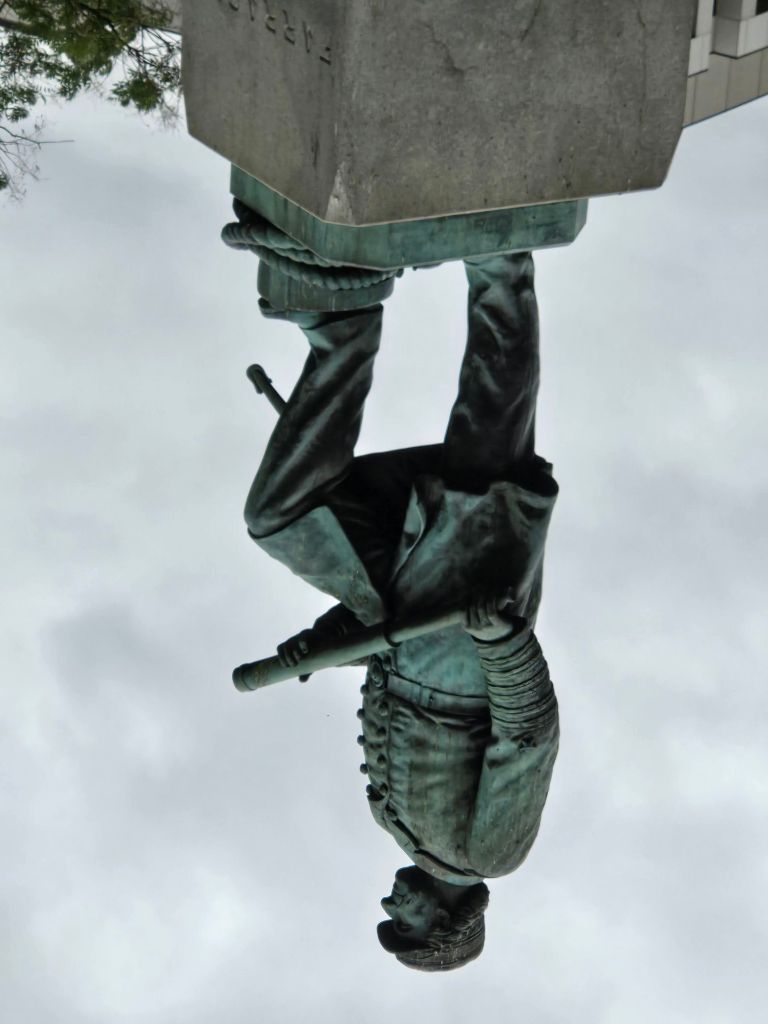
The photos are from today’s stroll on the Dyke’s Marsh Wilderness Trail off the Potomac south of Alexandria VA.


The photos are from today’s stroll on the Dyke’s Marsh Wilderness Trail off the Potomac south of Alexandria VA.


If you are planning to watch the recent Danish film, “Loving Adults”, stop reading this now. What will come will be a SPOILER.
Okay, so it isn’t the greatest film ever made. It’s a simple film, well acted, and there is really only one plot line. You won’t get lost. It gets mediocre reviews on both IMDB and Rotten Tomatoes.
But what intrigued me (and entertained me) was not so much its twists and turns, but that each twist and turn was so unexpected. Here goes:
Christian and Leonora have been married for twenty years. He is half owner of a successful construction firm. She, trained to be a concert violinist, gave up her career to care for their only son, now 19, who needed care because of a chronic medical condition, now less severe.
All seems well, except for one thing. Christian falls in love with Xenia, a young engineer who works for him. Leonora finds out about the affair, much to Xenia’s pleasure. She wants Christian to leave Leonora, so the more Leonora knows, the better.
But Xenia does not count on one thing. Unknown to her, in order to provide medical care for their son (they brought him to the US for surgery, which saved his life), Christian, through his business, engaged in some sort of illegal activity which earned him unearned income, and which the company has covered up ever since. Leonora knows about the criminal activity and tells Christian that if he dares leave her for Xenia (leaving her without an income and with a son who still needs much attention), she will go right to the police and expose the fraud and, as far as she is concerned, Xenia will have the opportunity to visit Christian for the next several years in jail, and his business will fail.
What to do? Christian can think of only one thing. Leonora is a runner. She runs lengthy distances every morning, generally on the same route, wearing a dark red hoodie. Christian decides he run her over and get her out of his way. He drives up to her from the rear as she runs along a country road, hits her, sees her still writhing and backs up and runs over her again. Then he drives to the car wash, and then home.
His son notices that he is nervous and asks him what’s wrong. He, of course, says he is fine. And he is fine, if shaken, until…….Leonora comes in the room and says “Good morning”, and talks about a longer route she decided to use for her run that morning. Christian has killed a stranger, a young woman, a mother of three. It’s clearly a hit and run, and there is nothing apparently to tie Christian to the crime. He has an alibi; he was at his office and the char staff saw him there.
At the car wash, Leonora learns that her husband was there the morning of the accident. She asks to see, and is shown, the video of him bringing his car, which shows his concern that the front of the car is clean. She puts two and two together. She realizes that her husband not only wants to live the rest of his life with Xenia, but that her husband wants her dead.
Her reaction is not what you might think it would be. She suggests that Christian and she go out for a nice dinner to talk things over. She tells him, at a restaurant which has as a complete floor to ceiling wall a crowded aquarium-worthy fish tank, that she can get him put away both for financial fraud and for murder. But she doesn’t want to do that, she says, and she has another idea that will solve their problem and keep them together the rest of their lives. What does she suggest? She suggests something very simple. He should kill Xenia.
What? He can’t do that. Why not? He has already killed one person, and he did it in a way that left no trace of his guilt. And, with Xenia, he would have an active partner, Leonora, who would help him plan it out. Desperate, he agrees.
Of course, when it comes to it, he cannot bring himself to murder Xenia. But, don’t despair, Leonora knew he couldn’t pull it off, so she puts into action that part of the plan that Christian is unaware of. And, poof, Xenia is no more.
How can it be that Leonora herself is so cold blooded? Well, for that, you have to go back into her history, when Leonora was just a teenager, and her boyfriend died after falling off a cliff. He didn’t really fall, you see. He was pushed by young Leonora who found out he was cheating on her.
So what brought these two together – Leonora the murderer, and Christian, the future murderer? We are not sure. But all we know is that they never were caught, Xenia’s body was never found, and Christian and Leonora sold their house, left town, and, who knows, maybe lived happily ever after.
That’s it. A simple, unique story line. And a movie you now don’t have to watch. The film is about 1 hour and 45 minutes long. It only took you about five minutes to read this post. I saved you 1 hour and 40 minutes. You’re welcome.
(1) Many of us still remember the Vietnam War. The idea that it ended 50 years ago seems absurd. And for those of us who do remember, we certainly recall the tremendous polarization in the country. We had governments from both parties (Johnson and the Democrats; Nixon and the Republicans) who were supportive of what we were doing in Vietnam (trying to stop the Communists from the North from taking over the country and trying to keep an important domino from falling). The majority of the country, I think, was supportive of the war, but a strong minority of the country, and I think the majority of those under, say, 30, were vehemently opposed to it.
There were all sorts of demonstrations, marches, and other actions (legal and otherwise), and all sorts of confrontations, confrontations between opposing groups, and between activists and governmental forces. The country was falling apart. But it didn’t.
The war ended when our government decided we couldn’t win it. We pulled out one day (just like we pulled out of Afghanistan). Some celebrated. Others were appalled. But the world went on. And the country was fine.
Israel is now engaged in a war in Gaza which it, too, may not be able to “win”. There remains much opposition to the war and/or its conduct in Israel, and large demonstrations continue on a regular basis. The government seems, however, to be ignoring the demonstrators and continuing to prosecute the war. But one day, they might realize that they have to stop. If so, the world will go on. Israel might not then be “fine”, but it will be in better shape than it is today.
(2). What the Israeli leadership does not seem to understand is that whether Israel wins, loses or draws, it will have to continue to live in its neighborhood, and with its neighbors. You would think it would be preparing for that day, but it does not seem to be.
This is one of the reasons that opposition to everything Israeli grows around the world. And the Arabs are consequently left off the hook.
But let’s remember that this fight started when five Arab countries attacked the new country of Israel in 1948. Had they not, had the Arabs accepted the United Nations’ partition plan for the Mandate Territory, we would not be where we are today. Instead, chances are that there would be a prosperous primarily Jewish Israel, and a prosperous primarily Arab Palestine, living next to each other in peace.
Let’s remember the number of subsequent times that Arab countries have attacked or were prepared to attack Israel. This would include 1967, when Israel captured the West Bank from Jordan, and Gaza and Sinai from Egypt. Had the 1967 war not been necessary, none of that would have happened. After that war, when Israel signed a treaty with Egypt and returned Sinai, Egypt simply refused to take back Gaza. And Jordan, when faced with the possibility of a treaty which would have included the return of the West Bank, refused to take the West Bank back.
Until then, Palestinian nationalism was latent, but then it exploded. And it was given additional strength because of the absolute refusal of the Arabs in neighboring states to do anything for the residents of Gaza and the West Bank, except to treat them, their children, their children’s children and their children’s children’s children as Palestinian refugees who had the right to return or to migrate to Israel proper. In other words, from the beginning, the Arab states have planned for the destruction of Israel and the creation of a larger Arab state stretching from the river to the sea. (Yes, Jordan and Egypt signed treaties with Israel – no one else did – but these were for pragmatic purposes and never reflected the overwhelming feeling of their own citizens, nor probably the feelings of their leaders, who continued to educate the next generations about the eventual destruction of Israel and the evil of the Jewish people.
(3) Today in the United States, we are faced with many young people, on campuses and off campuses, some even Jewish, who are calling for a Gazan victory of Israel, for the “right of return” of Palestinians to the land of Israel and to the possible destruction of Israel and maybe of the 6+ million Jews living in Israel.
We bemoan this. We call it antisemitism (whether it is or not), as well as anti-Israel. And we wonder how it came about. And we speculate. Latent antisemitism is talked about a lot, but in my opinion is a very small part of the problem. One large part of the problem is the actions of the Israel government, and its messaging. We can’t overlook that. Then there is the overall “social justice” movement, dividing the world into the oppressed and the oppressing, and which classify the Jews as oppressors (oppressors far in time removed from those who were oppressed during the Nazi years). Then, there are the Arabs and the Arabists on campus, both as students and as faculty. And Arab money coming into universities (most often from Qatar) funding Middle East Studies departments, and with a not so subtle agenda. And extraordinarily successful creation of student organizations on a national basis. None of this happened by accident. Israel’s neighbors have long known how to vilify Israel and brainwash their young. Now, they know how to do it here, too, it seems.
Just saying.
Sometimes, it is so hard to decide what to write about in the morning. Today will be either Books or Baseball. Or both.
Let’s start with baseball. I know that for some of you this is a foreign subject, so I will make it as clear as I can. In 2019, the Washington Nationals won the World Series. Then (for reasons not necessary to detail here), the team fell apart, and the owners decided to get rid of everyone and start from scratch. They call it rebuilding. Five years later, the team is rebuilding and the fans are tired of it.
The worst year was 2022, when they only one 55 games and lost 107. For those who are unfamiliar with baseball, that is very bad. Last year, they won 71 and lost 91, still not very good. As of today, May 29, 2024, they have won 24 and lost 29. Still not very good.
This is not going to be a long essay. Just a few points. Results in baseball depend a lot on five things (in addition to luck and the strength of your opponents). Batting average, batting power, pitching, base running and fielding.
The Nationals’ base running and fielding has been very good this year and last. They have not had much power either year; clearly something they must work on. But as to batting average and pitching, strange things have happened.
Last year, the Nationals’ strength was their ability to get on base; even when they were losing most games, they were among the top teams in team batting average. This year, the team batting average has plunged. Players who have returned from last year are by and large hitting for much lower averages than they did.
On the other hand, last year’s pitching was very bad. The Nationals ranked 27 out of 30 for Earned Run Average (roughly, the number of runs per game allowed by team pitching) at 5.02. This year, so far that number is 3.94. There is a reason for this – the Nationals (like most teams) have five starting pitchers who rotate. All of a sudden, we have four terrific starting pitchers: Trevor Williams (2.29), Mackenzie Gore (3.04), Jake Irvin (3.43) and Mitchell Parker (3.45). Our fifth starter, Patrick Corbin (6.12) is in his last contract year and it would be nice if he were gone sooner than that. The numbers in parentheses are, of course, their individual ERAs.
They are also young. Williams is 32, but Gore is 25, Irwin 27 and Parker 24. (Corbin is 34). There is another young Nats’ pitcher, who is touted to be a star, but who has yet to reach stardom and is now on the injured list. That is Josiah Gray, who should be ready to pitch again soon. Gray is 26 and if he comes back as a starter soon, someone has to go. Wish it could be Corbin – maybe turn him into a reliever for his last year. The Nats also have a couple (at least) of very strong pitching prospects in the minor leagues. Keep your eyes on Clyde Cavalli, who is 25, and DJ Herz who is only 23.
The Nats are also strong with young outfielders, both now on the team (like Jacob Young and even Lane Thomas), and in the minors. James Wood, Robert Hassell, and Dylan Crews are top prospects. Alex Call comes up now and then and helps out nicely. And then there is Stone Garrett, who was having a terrific rookie year last year until he broke his leg, and he has not yet returned, but is expected to relatively soon.
And their middle two infielders (CJ Abrams and Luis Garcia) should be strong for years. Their catching staff is also adequate. But first and third base remain problems, although young Trey Lipscomb (only 23) should be back up soon at third.
It’s unclear why the hitting has been so weak so far. There are games where everyone gets hits, but more games where almost no one does. Part of the problem is that the Nats acquired some mid-career players to help in those positions where their prospects are not quite ready – Nick Senzel at third base, Joey Gallo at first. They have proven very disappointing, and weaker than Dom Smith and Heimer Candelario at third from 2023.
So let me conclude: The Nats have a lot of talent, some of it now on the field, some of it currently injured, and some of it in the minor leagues. The talent may not be perfectly balanced. They have too many outfielders (that’s why they had to let Victor Robles go last week when Lane Thomas came back from the injured list). And they really need to get first string first and third basement. Perhaps Joey Meneses could be their first string first baseman (now he plays there at time, and is the Designated Hitter at other times), but he hasn’t lived up to what was hoped for him. And perhaps Trey Lipscomb will be back soon at third. I would like to see the Nats turn one of their outfield prospects into a first baseman (easy to do, I think), but I haven’t seen anyone suggest it.
I don’t know how the rest of 2024 will go, of course, but it could go well. All the Nats need to do is hit. And bring James Wood up from the minors for power. Couldn’t Woods play first base? I think he could.
As for Books…….some other time.
I have only been to Prague twice. The first time was in 1974 and the second time in 1998 (both dates are approximate). In 1974, Prague was one of the saddest looking cities I ever had seen. Everything was gray. Everyone building looked like it needed attention. Every passerby was looking down and looking morose. There were few shops open that I saw. The restaurants were depressing. Even the skies were gray.
In 1998, gray Prague had come to life. Not only did every building look like it had just received a new coat of paint. Not only did everyone seem to be in love with life. Not only were there too many tourists sites to see, as well as too many tourists. Prague itself looked less like a normal city than like an inhabited Disneyland.
The transformation had been complete. That was then; this is now. How did it happen?
I can’t say that I understand it well, but I understand the transformation better than I did, say, a week ago, when I had not yet read Michael Zantovsky’s book Havel, a Life, published in 2014. I found a nice copy of the book, signed by the author, at Lost City Books in Adams Morgan, where I had not been in years. Zanatovsky was, for a short while, Vaclav Havel’s press secretary when Havel was the Czech president, and then, as a Czech diplomat, was Ambassador to the United Kingdom, to Israel and to the United States. He is also a scholar and translator and now very active with the Aspen Institute.
It takes a commitment to read a 500 pages biography of Havel, but he is worth the time. I am not going to recite his life story. Only enough to give you some background you may not already know.
Vaclav Havel was born in 1936 in the Republic of Czechoslovakia, a country carved out of part of the Austro-Hungarian Empire at Versailles after World War I, and a country doomed to be dismembered first as a result of the agreement between Hitler and Chamberlain at Munich, and then by the Nazis ignoring the agreement reached in Munich altogether and marching in and taking over the entire country. Havel came from a wealthy family. His father was a factory owner; his father’s brother was a leader (I think maybe THE leader) in Czech film production. Under German rule, his family lost everything.
His family was patriotic and anti-Nazi. Havel became well educated; he was an intellectual. He became a playwright and well known in avant-garde circles. In my mind, he was the inheritor of the senses of humor, satire and anarchy of another famous resident of Prague, one Franz Kafka. Havel’s dramatic works were, from the descriptions given in Zantovsky’s book, clever, sharp, biting, but all had to be done with an eye to the Communist society that enveloped Czechoslovakia at the end of World War II, starting in the mid to late 1940s.
Although he was not one of the leaders of the 1968 Prague Spring Czech revolt, he was one of the premiere dramatists and essayists of the time, well known in academic and popular circles. And of course, the march of Soviet troops into Czechoslovakia to crush the revolt, curb the intellectuals, and clamp down on any sense of personal individualism both affected Havel deeply, and explains the Prague I saw in 1974.
In 1977, Havel was one of the leaders of the group behind, and one of the signers of, Charter 77, an attempt to open up Czech society to more freedom of thought and expression. He was probably the most visible of the Charter 77 activists, visible enough to be thrown into prison for four years in 1979.
When he was released from prison, he lay low. But after the next Czech revolt, the Velvet Revolution, which spelled the end of Soviet influence in Czechoslovakia in 1988, Havel found himself chosen as the first president of the post-Communist country.
Now things will start to seem more familiar. Havel was clearly what we would call politically liberal. His name was known world wide both for his intellectual accomplishment and now his political position, and he traveled world wide. He was a globalist in that he was one of the first to work to get Czechoslovakia allied with the west, both through EU and NATO membership. This was quite a task, as there were those in his country who were tired of foreign alliances, those who felt Russia would be provoked, and those who felt Czechoslovakia would be called on to participate in conflicts they would otherwise avoid. But he carried the day, as he did on many domestic reforms.
But things weren’t completely smooth for several reasons. The biggest was that longstanding disagreements and jealousies between Czechs and Slovaks led to a split of the country during Havel’s presidency. Yes, Havel the peacemaker and globalist could not keep his country in one piece. And within the Czech Republic itself, there were continual battles between legislators and the executive. All of this took its toll on Havel, physically and emotionally.
Digression: Can you tell the difference between a Czech and a Slovak? Did you know that these groups apparently never really liked each other, and that there was a feeling when Czechoslovakia was created after World War I that it was a bad marriage of two different peoples? Did you know that Slovaks were often looked down upon by Czechs? That Slovaks were much less happy with the end of Communism than Czechs? That the capitalistic transformation of the country hurt the Slovak economy and helped the Czech economy? That when the country was still together, there was concern that some agencies were overly-Czech? That for a short while, the two parts of the country had two different parliaments, with the overall president often caught in the middle? I didn’t. And, by the way, if a Czech and a Slovak marry and have a child, what is that child anyway?
Digression number two: The Czech Republic? Czechia? What is it anyway?
The book also talks about Havel’s long marriage to his wife, Olga, and that they seemed to have a somewhat open marriage, permitting dalliances here and there on both sides, and his second marriage to a younger and ambitious actress after Olga’s death. And, even more than his private life, Zantovsky talks about Havel’s health, which was never good, but which got appreciably worse after he left the presidency in 2003. He was a smoker, developed lung cancer, which was successfully operated on but weakened his lung capacity. He was in an out of hospitals, and suffered greatly from depression, and the thought that he had failed in everything he ever tried to do.
If you are interested in looking at Czechoslovakia as an example of how a country coped with the collapse of Communism, and are interested in how Havel, a talented playwright became a charismatic, respected, and in many ways successful president, dealing with a substantial amount of transitional internal chaos, you may want to read this book. I don’t think you will remember most of the details, but you will certainly see the big picture, and appreciate the difficulties changing all social norms in an ongoing society.
Now that I have finished reading Havel, a Life, I have started on a book with a related theme, The Invention of Russia, written by Arkady Ostrovsky. I have read the long first chapter, which deals with the thinking going on in the minds of various elite Communist leaders in Russia, as to how to deal with changes that might need to be made after Stalin’s death, how all prospective modifications were met with internal objections, and how this back and forth led to the ascendancy of Mikhail Gorbachev and the end of the Soviet Union. More on this to come.
You know what this is? This is the approximate number of members of the American military who have died in wars in which we have been involved, from the Revolutionary War forward. One Million, Two Hundred Thousand.
And today is Memorial Day, in theory the federal holiday on which we commemorate our war dead, and remember their sacrifices and the sacrifices of their families. But we don’t really do that, do we?
I understand that the holiday, or its predecessor, was first celebrated in the South, to commemorate the dead from the Confederate army and navy during the Civil War, and that it quickly spread to the North, and around the country. It was General John Logan, head of the Grand Army of the Republic, who is credited with creating the holiday, then called Declaration Day, in 1868. Today, no one thinks of John Logan except when strolling around Washington’s Logan Circle.
It was originally called Decoration Day because it was a day to decorate the graves of fallen soldiers. That was a way to remember, for sure. And even today, in military cemeteries such as Arlington’s, there are American flags placed in front of each tombstone. And the holiday was celebrated on May 30, whether that day was a Sunday, a Tuesday, or a Friday.
Everything changed in 1971, when the then recently passed federal law creating Monday holidays came into effect. Decoration Day officially became Memorial Day. May 30 was changed to the fourth Monday in May. And the holiday became another three day weekend, with trips to the beach, barbeques and the opening of public swimming pools in much of the country. The summer had unofficially begun.
Most American military deaths occurred during the earlier years of the country – the Revolutionary War, of course, and then the big one – the Civil War – where over 600,000 died. We got into World War I late, so fewer than 200,000 Americans met their deaths, but in World War II, where we fought four years, American deaths exceeded 400,000. Although over 50,000 died in Vietnam, and similar numbers in Korea, our wars since then, mechanized as they have become, have seen fewer and fewer American casualties.
Fewer war deaths is certainly a good thing. But it means something else. It means war deaths, and the memories of war deaths, have receded into the past. The percentage of families who experienced these tragedies during the Civil War and during World War II were enormous. The last Civil War veteran (I remember he was an underage drummer boy) died, I think, in the 1950s. World War II ended in 1945 – almost 80 years ago, which means that the youngest living World War II veterans are now 97 or 98, and the children of those killed in the war are all now in their 80s. Memories certainly recede.
But shouldn’t we do more to remember those who gave up their lives, some necessarily perhaps, and some accidentally or without necessity in the defense of their country. And shouldn’t we look at not only the deaths of those who fought in the wars, but those who are considered collateral damage – civilians caught in the fight. Of course, since the Civil War, we have not had battles on the home ground, they have been abroad. But we have participated in wars that resulted in deaths in Southeast Asia, in Iraq, in Korea, and in so many more places. We should remember those who died at our hands in those wars, too.
Perhaps moving the holiday to Monday to create a three day weekend was just the thing not to do. The Fourth of July would have been a better holiday to move, wouldn’t it have? After all, it is a holiday of celebration. Maybe we should have left Memorial Day as it was, maybe it should have remained as Decoration Day, and maybe our activities should be less celebratory and focus more on memory.
There are those of who know what is best for America and, to a large extent, for the rest of the world. We vote Democratic, we are uncomfortable with the positions of virtually all Republicans and the personas of most of them, we only cringe a little bit at the “far left” (in American terms) Democrats whose ideals we may share, but whom we view as politically impractical. We call ourselves liberal, but not too liberal. We certainly don’t agree with those progressives who divide the world into oppressors and oppressed, and find the totalitarian Moslem countries oppressed and liberal (if often misguided) Israel as oppressors.
We think we have common sense and don’t understand why some people don’t agree with us. Whether we live in Arizona or Maine, Florida or Idaho, our educations have been similar, so we think pretty much alike. We are aghast at Trump and his followers, we are aghast at Robert F. Kennedy Jr. and his, and we are sad that the Democrats aren’t gaining more traction as the November election nears.
But there is something that it appears that we do not understand. We are in the minority. Most people in this country do not think like we think. They think differently. And, unfortunately, neither I nor you can explain how the majority of Americans are thinking this day, because we cannot understand how they think (yes, we can say it’s because of this or that, but we are only partially correct) because it seems so wrong.
We are used to the possibility of very close elections in this country. The Republicans have a candidate that is a disgrace to American politics, completely outside of the pale, as they say. But he may win, and he may win by a large margin.
I am a White male, and most of my friends are White. White males, they say, are favoring Republicans by 20 points. This is an extreme difference, but there has been a Republican-favoring difference for some time. The Democrats have been winning elections, for the most part, because of the vote of minorities – Blacks, Hispanics, Asians, and yes, Jews. But those groups are beginning to change, and if members of these minority groups move only a bit towards the right, we will find Democrats losing all over.
We all recognize that much of the world is a mess. When the world is a mess, those in power suffer. It is so easy for the opposition to say: elect me, and I will get you out of this mess. It is much harder for the incumbents to say: elect me, I will govern as I have been governing, and this mess will disappear.
If the Republicans do well in November, as I suspect they will, the Americans who voted for them will see that the world is still a mess. Maybe they won’t see that immediately, but they will eventually see that. And things will turn back again. They always have. But now, we sort-of-liberals are in the minority.
Now, of course, being in the minority does not mean that you are wrong. To the contrary, people in the minority are often, perhaps usually, correct. And the worse thing is to give up your principles because they don’t capture the approval of the majority. It’s when the minority gives up, goes into hiding, allows themselves to be influenced by majority opinions they know to be wrong, that things really get into trouble. An active minority is necessary to get things turned around, and I am afraid that’s going to be our job for the next four years.
Now of course, I may be wrong. Maybe, the rabbit will be pulled out of the hat, and the Democrats might find themselves remaining in power. I can foresee all sorts of scenarios where this might happen. But at this point, that doesn’t seem what is most likely. So let’s be prepared.
Remember the old saying: I’d rather be right than be president? I am not saying that, either. We would rather be right and have a president who agrees with us, supported by the vast majority of voters. But sometimes that doesn’t happen. And we need to recognize that, and realize that.
The song “Turn, Turn, Turn” dates only from the late 1950s, but Pete Seeger, the composer, took the words from the biblical book of Kohelet, or Ecclesiastes, the same book where it is declares that “there is nothing new under the sun”. Some find this book very pessimistic – but no need. The message is clear to me. People are people, the wind blows first one way, then another, you can work hard and find your work still undone, waiting for the next generations to finish it. The human condition.
Enough of “May you live in interesting times!”. How about “May you live long enough to see the world turn once again!”?
Whenever I am asked to list my favorite authors, I always put Robert Ardrey on the list. Although I have read four of his books, the one that always comes first to mind is African Genesis, which was first published in 1967. Subtitled “a personal investigation into the animal origins and nature of man”, it is just that, his conclusions as to how mankind evolved in Africa from its animal ancestors. One of the conclusions I recall him reaching is how various forms of primates of they types we call apes or monkeys developed the use of crude weapons long before mankind came on the scene. In his musings about war and peace, he talked about how some authors wonder how, throughout all these centuries, there has been so much war. He, as I recall, on the other hand, finds it a wonder that, throughout all these centuries, there has been so much peace.

I can’t say I remember exactly what he said, but perhaps we can put it this way. Mankind emerged from animal groups that shared many of mankind’s most prominent characteristics. This includes the drive for self-protection, which means you must have a society and social relations, and that means you must have real estate, or territory, where you can live unmolested, and you must have dominance over that territory and be able to organize and protect it against assault, or – to turn things around – to assault neighboring territories when either you need more space, or you fear that you will be attacked by your neighbors, who perceive that they need more space.
At least, this is close enough. And if Ardrey didn’t say it, I just did. And I think he’d agree with it.
Yesterday on YouTube, I listened to a lecture by Canadian professor Margaret MacMillan (University of Toronto), who gave this year’s Isaiah Berlin Lecture at Wolfson College, University of Oxford. Her topic was “Thinking About War in the Modern Age”. You should watch/listen to this if you have an hour to spare (and if you do, stay on for the Q and A). Why? Because MacMillan is a terrific presenter, and because she has organized this talk perfectly. Although she did not cite Ardrey (and, who knows, perhaps she has never heard of him), much of what he had written resonated in what she said. This includes her conclusion that war is such an integral part of human nature and human society, and that evidence of war exists before evidence of, say, language, that talks about ending war and “making the world safe for democracy” are naive, and should be abandoned. She also concludes that war and violence are two different things. Violence is spontaneous, while war (at least offensive war) is always planned and thought out well in advance. (Of course, she adds that the planning rarely works, and that every war takes on a life of its own, in spite of what those who start the war think will happen.)
MacMillan’s conclusions are very similar to Ardrey’s. She is not surprised there is a war going on the Ukraine or in the Middle East, or that tensions are rattling up around Taiwan and the South China Sea. She is surprised that we, in the west, have been without war, or at least without a war noticeable to our societies, since 1945. And she thinks we have grown complacent, to our disadvantage, and are unprepared (psychologically unprepared I think she means for the most part) for what may be long and vicious wars which have now begun. Of course, in talking about the genesis of mankind in Africa, Ardrey does not speak about modern weaponry, while MacMillan, speaking about war in our modern society, does, and finds much to be aghast about.
Am I going anywhere else with this? I will tell you that what got me thinking about Robert Ardrey and what got me to turn on Margaret MacMillan was the claim by Trump and the Trump campaign that, in executing and enforcing the search warrant at Mar-a-Lago, President Biden and the Department of Justice were seeking to assassinate Donald Trump. This is because there was a boiler plate authorization to use deadly force as necessary in enforcing the warrant (I have not seen the exact language; I am repeating what I have heard on the news). The fact that this was standard language (used, for example, in enforcing similar search warrant’s on President Biden’s homes and former office) was irrelevant in the Trump mind, and the fact that he was 1000 miles away when the warrant was served was also irrelevant.
There are many terrible things about Trump making this off-beat claim. Most terribly, it gets people thinking about assassinations. We have had four (is that right?) presidents assassinated – Lincoln, Garfield, McKinley and Kennedy. We have had live attempts on, at least, Theodore Roosevelt, Gerald Ford and Ronald Regan. We don’t need another one.
Yet with 350 million people in the country, and with close to 450 million guns in the country, shouldn’t we be surprised that there have been so few attempts on the lives of our presidents and not that there have been so many? Part of this, of course, has to do with our law enforcement agencies. Maybe most of it does. And we do protect our presidents, past and present, with a substantial amount of resources. But isn’t it only a question of “when”, not “whether”, it will happen again?
There are so many things that Donald Trump and his crew have done, do and are threatening to do that seem to dangerous to me. We don’t need one more.
By the way (before I close for the day), one more thing. Donald Trump says many things I do not believe. But one thing he says I do believe: I believe he can obtain freedom for Evan Gershkovich from his Russian prison. And that we will not have to pay a penny for it. I imagine the following:
Trump: If we stop supplying Ukraine with arms, tell them we are now neutral in the conflict and suggest that they agree to a ceasefire on your terms or get annihilated, and if we drop out of NATO and tell the members of NATO that we will not protect them or come to their aid if you attack them, will you free Evan Gershkovich and also let me and my family build world class office buildings in Moscow and elsewhere?
Putin: Let me think about that a minute……..YES!!
One day last week, we saw an article from a respected publication that suggested ten films to watch this month on Netflix. I dutifully wrote down the names of the films, not knowing anything about any of them. The first on the list was a film called “Madame Web”. It was number one on the list, and – when I turned on Netflix – I saw that it was the number 1 searched film on Netflix. What could be bad?
I will tell you what could be bad. “Madame Web” could be bad. We stuck with it for about 15 or 20 very uncomfortable minutes. You know what it’s about? It’s about a rare poisonous spider in the Peruvian Amazon which is connected to a civilization of spider-people who live in the treetops of the jungle. A young pregnant American anthropologist found the rare spider thirty years ago, but was shot by her guide, who wanted it for himself. She was rescued by the spider people, gave birth and died. Thirty years later her daughter is (of course) a New York Fire Department EMT, and seems to have spider people allies to help her out when she gets into trouble.
Clearly not the film for us. And guess what – 89% of Rotten Tomatoes critics didn’t like it either. So what could be the secret of its “success”?
And where do we go from here? To India, of course, and to a film I selected at random (not on any list that I know) called “Laapataa Ladies”. (I just realized that I have no idea what “Laapataa” means, if anything). What a charming film. And what does Rotten Tomatoes think? 100% approval rating. Until this morning, I had no idea.
In deepest rural India, two young men get married. They don’t know each other, but they wind up on the same train with their brides, heading back to their native villages. The same train, different brides, different villages.
The brides just happen to be dressed in identical traditional bridal veils which hide their faces, impossible to tell one from the other. And, the brides (perhaps this is another custom) remain silent. And it’s a long train ride, people go to the “loo”, they move around, they get something to eat, they fall asleep. And suddenly, one of them realizes that he is home, grabs his wife’s hand, and leaves the train.
When he gets to his home village and it’s time to introduce his new wife to his extended family and friends, he lifts off her veil, and …… voila. He has brought home the wrong wife.
The other groom does not make the same mistake. All he knows is that his bride is missing. The “abandoned” bride, who has also left the train, has no idea where she is, or how to reach her husband. She is completely lost.
I am not going to tell you more, except (1) it’s a comedy, (2) the scenes of rural India are fascinating, and (3) because it’s a Bollywood film, everything turns out perfectly in the end. In addition to the four main characters, the family and friends of the groom who lost his bride, and the three unusual people who befriend the lost bride, the plot centers around the police chief of the village and his two assistants, one perfectly stupid, and the other completely amoral. They become convinced this is an example of a marriage scam ravaging the country – a fake marriage, a fake groom, a real dowry putting gold jewelry into the hands of the fake groom, and a disappearance, leaving the “bride” bereft. But this is not the case here. Here, it is a more complex story, showing the vulnerability of women in traditional India and their attempts to lead lives of purpose.
Recommended. “Laapataa Ladies”. Netflix.
So, it’s a story about two different women. Recently, while on my stationary bike, I have been watching a Spanish series, titled “Between Lands”, the lands being Almeria on the southern coast, and La Mancha in the center of the country. This is not a tale about two women, but about two men. Maria’s long time boyfriend leaves town and doesn’t contact her, and years go by. In the meantime, she marries (under very strange circumstances) Manuel, the nephew of an ornery olive farm owner from La Mancha. Then her boy friend re-appears.
The first six or so episodes have been interesting enough, but on a visit back to Almeria to see her mother and her ailing brother, Maria reconnects with her ex-boyfriend, and they engage in one episode of passion before she decides that he is history, and her marriage is her future. She goes back to La Mancha with her husband. And she discovers she is pregnant.
Now this is one of those series that focuses on unexpected twists. Whenever something good happens, you know that within fifteen minutes something equally bad will happen. The twists get a bit tiring, but it’s clearly a series where things will work out in the end, so you stick with it. You felt really good that Maria has decided that her husband Manuel is her choice, and that all they have to worry about now is his evil uncle, his young son, and some of the other characters you have met in La Mancha.
But the pregnancy has made things messy again. Who is the father? It could be either. So far, neither prospective father knows about the pregnancy. I don’t think I can take whatever is coming next as they try to figure it out and cope with the possibilities. I am through with “Between Lands” prematurely.
The search for the perfect entertainment continues…..
So, I got a little push back when I put something on Facebook yesterday, suggesting that the recognition of a Palestinian state by Ireland, Spain and Norway might be just the thing to do. And, by the way, these three countries are not the first to recognize a Palestinian state – many others have done so over past thirty years. So far, those recognitions have been meaningless.
Here is my thinking.
Do we favor a two state solution? If so, guess what…..you can’t have a two state solution if you don’t have two states. So, the second state is a necessary step. And this recognition has to come some time. Maybe this is the time.
Now, Benjamin Netanyahu is yelling and screaming about this. But you can’t take his emotional reaction too seriously, if you want a two state solution. Netanyahu does not want a two state solution. And because he does not want a two state solution, he has to want one of two things: either he wants the continuation of the Israeli occupation ad infinitum, or he wants an Israel from the river to the sea with a guaranteed Jewish majority, or with two classes of citizenship. Probably neither of these choices are possible, so why should we play along with him?
Of course, you also can’t take the Hamas leadership seriously either. They don’t want a two state solution. What do they want? They want to induce Israel to act more and more irrationally against both Gaza and the West Bank, losing friends along the way, until – one way or another – Israel collapses, and a single state, this one run by Palestinians, will stretch from the river to the sea.
Under the Hamas one state solution, what will happen to the Jews? Under the Netanyahu one state solution, what will happen to the Arabs? We don’t know either way, and we can’t take a chance that either will be mercilessly endangered, can we?
There has been talk about a two state solution for decades. It appears that there will never been the perfect time for its implementation, especially as long as no one in the immediate area is in favor of it. So, if you really want a two state solution, you have to bite the bullet (figuratively) for once and for all and get started.
But there is a big difference between recognizing a state-to-be and recognizing a state-that-is, and there now is no Palestinian state-that-is to recognize. Many things must be resolved in order for a Palestinian state to actually exist. Palestine may think it already exists as an independent state – it’s been about 35 years since it has claimed it was. But it really isn’t, and it knows that. The 1988 Palestinian Declaration of Independence has had no real effect and has been forgotten by many outside observers today. There was no on-the-ground follow-up.
Let’s look at a few of the things standing in the way.
For example, at this point, the two parts of the territories occupied by Israel (and which would make up a future state) are being led by two very different and competing factions, neither of which seems competent enough to do the job on its own, and neither of which has shown the ability to work with the other, and where one of the two factions is a true terrorist organization bent on Israel’s destruction. Until the Palestinian state has a governmental structure (with all that entails) and recognized leadership, you can only recognize a state-to-be, and not a state-that-is. There will have to be a constitutional convention, or a constituent assembly, or something to create such a structure.
Then again, it won’t help the situation if you recognize a state which will pose a continual threat to Israel, with the ability to make, store and use as it will destructive weapons against its neighbor. One the other hand, residents of a Palestinian state-that-is must have control over their own travel, and their importing and exporting (especially as to food and other necessities).
Therefore, recognition of a Palestinian state-that-is must come with a treaty between the parties, and this treaty must be monitored and enforced, presumably by outside forces. This will require concessions on the Palestinian side, and even bigger concessions on the Israeli side, as Israel refuses to rely on any outside party to help secure their border. The United States will undoubtedly have to use its influence to assure Israel that it can relax with some external controls, as unpopular as that will be among some circles in this country.
And finally, a state-that-is must have boundaries, and the situation in the West Bank, where hundreds of thousands of Israeli Jews live, will require boundary adjustments of the type that have been almost agreed to in past years, and those Jews living outside of the negotiated boundaries will simply become citizens of new Palestinian state. And, of course, similar decisions have to be made regarding East Jerusalem.
So, I am all for recognizing the Palestinian state-to-be, and setting the rules and beginning the process to create the Palestinian state-that-is. I will say it again – the moderate Arab states, the United States, and other interested parties (but probably not the United Nations) will have to come together as the sponsoring parties of the new state-to-be (and eventually the new state-that-is), and move things along with (to quote a book with which most of us are familiar) “a heavy hand and an outstretched arm”.
Having said all of this, I must recognize that I have no idea what Ireland, Norway and Spain have in mind in saying they are going to recognize a Palestinian state in short order. I doubt that they and I are thinking the same way, although they have said it’s to spur a two state solution. And the actions of the three European powers might be a catalyst for the creation of the Palestinian state-that-is, but only if all parties of interest treat it as progress, and chip in to guide it along, and don’t treat it simply as something to be fought tooth and nail.
And by the way, if all they want to do is say “we now recognize the existence of a Palestinian state, whatever that is”, only chaos can result.
Remember Portnoy’s Complaint? At the end of the book, after working out all of the dysfunction in the Portnoy family that has so seriously crippled their son, at the very end of the book, when Portnoy goes to his psychiatrist, having increased his understanding but knowing he has more work to do, his psychiatrist looks at him and simply says “Now vee perhaps to begin? Yes?”
Yesterday, we renewed our membership at the Phillips Gallery. Actually, “renewed” is not the right word, because there has been a lapse. The polite young lady at the admission desk looked us up and saw that we had let our membership lapse in 2004. This was probably about the year she was born. She asked for certain information. While our address had not changed, she had my old office telephone number, and no email address. “There probably wasn’t email back then”, she offered. At any rate, we are now up to date.
The occasion yesterday was our going to look at the museum’s large exhibit of the work of Pierre Bonnard. According to Wikipedia, Bonnard painted 242 works of art. According to the Phillips, the exhibit has 58 of them. Not bad.
I really knew very little about Bonnard. The last exhibit of his work at the Phillips was (ready for this?) twenty years ago, in 2004, the year our membership lapsed. Did we go to the 2004 Bonnard exhibit and say “Meh”? Or was this the first major exhibit at the gallery after we let it lapse? This is probably something that we will never know (or think about again).
I should say that today, after spending an hour or so with him yesterday, I am not a Bonnard fan, although I understand him better than I did. Let’s see. He was French, and it seems that everything he painted was set in France. Either in Paris, or somewhere in the South where he had a home overlooking Cannes, or elsewhere on the Riviera. He was sort of an impressionist, and sort of not (i.e., he seemed to like fuzzy lines and paintings that look a bit unfinished, but – at least to me – he didn’t have the skill of a, say, Monet). He used a variety of colors, and was able to capture light, and sunlight, through his use of color.
I don’t think he was particularly imaginative. He painted pretty much what he saw. Landscapes out the windows of wherever he was, or landscapes a short walk from his house. Scenes of bedrooms and bathrooms, and coffee drinking. His wife Marthe, over and over again, clothed and unclothed, youngish and oldish. He had an, again to me, annoying habit of painting a landscape and then throwing a face of his wife in for good measure. Or throwing in his dog. Or his wife and his dog.
I always throw Bonnard in with another French painter, whom I think I like better, Edouard Vuillard. I am sure I have a good reason to do that. But there are other artists whom I have never paired with Bonnard. One of those is Henri Matisse. If you asked me before yesterday, I would have told you that Bonnard was older than Matisse by, say, 20 years?
But, no. Bonnard was born in 1867, and Matisse in 1869. Bonnard died in 1947, Matisse in 1954. They were contemporaries. They were friends. And what I noticed even before I checked the dates is that their work had a lot of similarity, largely I think because of their use of color, and of large areas of color within the scenes they were painting.
Now, having said that, I think that Matisse (who I also think a bit overrated, although his art is often more appealing to me that Bonnard’s) had a much broader range. He didn’t stick to what he saw outside his window or in his bathroom. But the structure and the use of color were similar, even if Bonnard’s lines were fuzzy, where Matisse’s were more precisely drawn.
At any rate, it was nice to see the exhibit (and by the way, the curators did quite a job bringing together pieces from many, many museums and collections, and their placing of the work by subject, rather than by chronology, was interesting). I did learn something.
I will leave you with a few examples of his work which I thought were some of the best.


There was an article in last Sunday’s New York Times Magazine titled “Israel’s Extremist Takeover”. Did you read it? If not, I think you should, unless reading about all of Israel’s problems and shortcomings just make you sick. Then you should skip it.
Israel, like all countries, is made up of many countries. Or, to put it another way, there are many Israels. The Israel I like to think of, and the ones that most of my Israeli friends live in, is a beautiful country, with open, generous, intelligent people doing amazing things, with high rise buildings and fields of flowers and desert views with camels and mountains, with buildings from the biblical period and from last week, and beaches, and museums, and extraordinary universities. A mix of religious Jews and secular Jews, religious Arabs and secular Arabs. But it’s also a country surrounded by enemies. And a country that has occupied external territory now for 57 years. And a country filled with zealots, none of whom I have ever knowingly met personally during my ten or so visits to the country, but who in many ways are now in control.
This is not the time to go through the history of Israel, but a few points might be helpful. As a political movement, Zionism started around 1900. Towards the end of World War I, in 1917, the British issued the Balfour Declaration supporting a homeland for Jews in the area now called Israel. This declaration was adopted first by the League of Nations, and then by the United Nations, and in 1948, by a vote of the United Nations, the State of Israel was created, and the State was immediately attacked by five (I think) Arab armies. While Israel won the war, there was no treaty, simply an armistice, with temporary armistice border lines, but no formal agreed upon borders.
And the war in 1948 resulted in thousands of Palestinians fleeing from, or being forced out of, their homes in Israel proper, and becoming refugees, stateless refugees whom surrounding Arab states refused to absorb, except on a temporary basis. The United Nations, for the first and only time, created an organization (UNRWA) to serve the Palestinians refugees, not to enable them to resettle elsewhere, but to maintain them as permanent refugees with a hope to return home.
Another war occurred in 1967, with Israel coming out on top again and quickly, and finding itself occupying the entire city of Jerusalem, the Sinai, Gaza and the West Bank of the Jordan River. Again, no peace treaty, although later treaties were worked out with two of the parties – Egypt (in return for Sinai), and Jordan. But Israel occupied the remaining areas – Gaza (because Egypt, its former occupier, wouldn’t take it back), the West Bank and East Jerusalem.
While the original Zionists were by and large secular, after 1967, a group of religious Zionists began to plan for the eventual inclusion of the West Bank in the State of Israel. After all, most of the biblical events occurred in the West Bank, not in Israel proper. And they began to argue for Jewish settlements in the occupied territory. Others thought there should be Jewish settlements in Gaza, not for religious reasons, but basically for security (as well as access to additional land for agriculture and sunbathing). Although the Israelis withdrew physically from Gaza under Ariel Sharon, they maintained control of Gaza’s borders.
Although Israel has remained in control of East Jerusalem, the Palestinians still maintain that East Jerusalem (and perhaps all of Jerusalem) should be theirs. Neither of these areas are analyzed in the Times Magazine article, which is devoted to the West Bank, which now has hundreds of thousands of Jewish Israeli settlers. And while most of those settlers are ideologically inactive and live in highly urbanized ares, there are groups of radical settler leaders who are out to make the West Bank Palestinians disappear.
The article goes through the history of the West Bank since 1967, focusing not only on the radical religious Zionists, but on their allies in the Israeli Defense Forces, the Israeli Shin Bet (security service), the Israeli police forces, the Israeli courts, and the Israeli government in general. And it focuses in particular on the current Israeli government, and on ministers Ben-Gvi and Smotrich, who were some of the most radical of the radicals in the West Bank.
I am not going to repeat what is in the article now. I really think you should look at it. It confirms what you have probably already been thinking, but adds more than you realized. And, of course, under the camouflage of the Gaza war, the radical settlers in the West Bank have been emboldened, and unrestricted.
What to do? I go back to what I have said before. Israel can’t help itself, and Palestinians can’t help themselves. They are unable to work out an arrangement between them. The United Nations, as an organization, is compromised, and governed under an archaic structure. Only the moderate Arab nations, with the help of the United States and like-minded countries, can bring about, police, and control a fair peace in the area, and set the stage for long term progress and reconciliation. And this to-be-formed coalition cannot let Israel’s government, nor the Palestinian leadership (whoever that may turn out to be), stop it from working towards a solution.
And this means that, here in the United States, the polarization must stop. There needs to be a national policy on the subject. Without that, we will be part of the problem, as we have been. We cannot abide either knee-jerk Palestinian supporters, or knee-jerk Israel supporters. There must be a solution as fair as possible to everyone.
And what do I feel about the ICC possibly indicting Israelis as well as Gazan leaders. You know….the Israeli leaders are not worthy of adulation. Maybe they are committing war crimes, or other crimes outside the borders of their country. If so, I am not going to defend them. Any more than I would defend Donald Trump and his gang if they faced similar charges.
I am strongly for the security of the State of Israel, and today that is far from assured, as there seem to be more and more people who question Israel’s right to exist. That position should be off the table. But how do you remove it from the debate? Not the way we are going about it now.

OK, onward. Time for the rest of my day.
I am not going to do justice to this one, but will do the best I can.
Last night, we went to B’nai Israel in Rockville to here George Washington University Professor Eric Cline talk about the collapse of an entire civilization. The talk was sponsored by the Biblical Archeological Forum, the Biblical Archeological Society of Northern Virginia (in case you haven’t figured it out, which you haven’t, BASANOVA) and the Haberman Institute for Jewish Studies. By my count, there were over 150 in attendance.
When did the civilization collapse? In the 12th century B.C.E., over 3000 years ago. (By the way, looking at the audience, it wouldn’t surprise me if some of the people there were present at the time.)
Cline is an excellent speaker and presenter and the tale he told was a fascinating one.
We are talking about the Bronze Age, and we are talking about the lands of the eastern Mediterranean. And we are talking about evidence from all sorts of archeological findings and – yes – there is some uncertainty about some of what he tentatively concludes.
He describes are period that, he says, has not been duplicated until very recently. A world in which several powerful empires, spread out over a large amount of land and water, cooperated with each other, traded with each other, and were dependent on each other. We are talking about Egyptians, Cypriots, Hittites, Assyrians, Babylonians, Philistines, Mycenaeans, and more, ranging throughout most of today’s Middle East, Turkey, and Greece. And their relatively peaceful and codependency lasted for about 500 years.
Then, chaos hit. The perfect storm. There was drought, there was famine, there were invasions (from the Sea Peoples, as we call them), there were earthquakes, there was disease, there was an enormous number of deaths. Everything came apart. Starting with the ports of today’s Lebanon, the trade and business centers of that world, which no longer received the goods to trade and which were at the same time invaded, it was the proverbial domino theory, as one empire fell after another.
He makes it clear that this did not happen in one day, although you can point to a short period of time when things came to a head, but over maybe a century. But it is clear that it happened.
Between this Bronze Age collapse and the growth of the Iron Age (he makes it clear again that you cannot point to a particular day or week and say “this is the start of the Iron Age”), there is a period that some scholars call a dark age. But Cline says it wasn’t a dark age, it was an age of transformation to a new period, and the transformation took several hundred years, and some areas transitioned better than others.
The areas that had the easiest transition to a renewal of organization and power were Cyprus, one of the first areas to smelt iron, and what became the Assyrian and Babylonian empires we know from the Biblical texts. Areas such as Egypt, he puts in the middle, and the area populated by Hittites (in today’s Turkey) and the areas of what are now Israel, Palestine, etc. had the most difficult and unsuccessful transitions.
This meant that there was a power vacuum in the area now known as “from the land to the sea”, it was this area that was filled by Israelites, and Canaanites, and Philistines, and Moabites, and Edomites, and all of the others tribes we know from biblical texts and which can be identified through archeological findings.
And, unfortunately, this is where things get a bit murky. We don’t really know where all these groups came from. They weren’t there before; they were there after. Did the Israelites come from their exile in Egypt? Quite possible, he says, but the archeological evidence is lacking. And the other groups? Did they come down from the hills of the north? Were they Hittites who moved south? It is apparently still unclear.
Equally unclear is how the Israelites became the most powerful group in the area. The biblical account is clear, but again, as there is no real evidence of the account as set forth in the Book of Joshua. When you look at Jericho and others cities mentioned as conquered and destroyed during the conquest of the land in the Bible, you find no archeological evidence of their destruction. When you look at cities where there is such evidence of destruction, they are not cities mentioned in the Bible.
So there are many theories put forth by many scholars. Invasion and conquest, peaceful assimilation, no migration at all but a transformation of existing peoples. None of these conjectures can be proven.
He went on to talk about all of the current archeological work being done in this part of the world. All of the new techniques being used – including DNA research. New discoveries, new sites. He thinks the next twenty years of archeological discovery will be by far the most exciting yet. He thinks we still have a lot to learn.
Cline ended his talk by speaking of the present. He believes that our society is in great trouble, is probably now in decline, and that further decline is probably inevitable. All of the problems of 3000 years ago are with us today. War, disease, climate change leading to drought and famine, fires, invasions. All here. He believes it is important for us to recognize that, and to prepare for it. So we will wind up like the Cypriots, and not the Hittites.
I didn’t do his talk justice. It was masterful. In 2014, Cline published a book titled 1177 B.C.: the Year Civilization Collapsed, which came out in a revised edition in 2021 (he says ignore the 2014 edition; the revision contains much new material), and this year he published After 1177 B.C.: the Survival of Civilization, on which he based most of his presentation. He thinks that, within ten years or so, that book too will be revised because of a cascade of new discoveries not yet made.
This talk was in person only. I am going to see if we can get him to repeat it for the Haberman Institute. If so, we will do it on Zoom and have it available on YouTube. As RM says, keep your eyes on this space.
Before we start, let me say this …….. this is the 550th consecutive daily blog post under Artis80.
(1) Macbeth. Washington’s Shakespeare Theatre recently featured a production of Macbeth starring Ralph Fiennes and Indira Varma as the loving couple. It ran for about a month in an unusual space that had room for a very limited audience, so limited that all Shakespeare subscribers were not able to see the production. It had rave reviews.
Luckily, the same production ran in London last year and was filmed. Same cast, and also directed by Simon Godwin, the artistic director of DC’s Shakespeare Theatre. The movie version is being shown this weekend, and we saw it at Shakespeare’s Harmon Theatre last night.
Maybe it’s just a Shakespeare thing. Yesterday, you might recall, I wrote about Richard III, and compared the Richard III character is Shakespeare’s play of that name (evil incarnate) with the Richard III character in Josephine Tey’s 1951 book The Daughter of Time. Tey’s book, and current scholarship, find that the early histories of Richard III (the last of the Plantagenet kings) were written during the early days of the Tudor kings (Richard’s enemies and successors) and most likely portrayed a much more balanced individual as demonic.
In Macbeth, the title character is also a pretty evil guy (albeit with a now and then conscience) married to a pretty evil woman (without a conscience, but who does appear to go mad at the end). Whether the real Macbeth (about whom not much appears to be really known) is as evil as portrayed by Shakespeare is also a question. And, although Shakespeare in Macbeth had to be more creative in his plot and character development than he did in Richard III, there are parallels.
In Richard, Shakespeare based his play on historical writing by which the Tudors had to prove their legitimacy as the rulers of England, and in Macbeth, as I understand it, Shakespeare wrote to please King James I of the Scottish Stuarts, who identified themselves as descendants of Banquo’s sons.
As to the production itself, it lived up to the reviews, unsurprisingly. But the real question is whether it would have been better to have seen the play than the filmed version of the play. I guess there are benefits on both sides, although I would guess that seeing the play might have been the preferable experience. With the film, although you might pick up more of the audio, you lose the spontaneity of live theater, and more importantly, although you get to see closeups of the actors, these are closeups of actors playing on stage, and not playing to the screen. What do I mean by this? I mean that, particularly in their soliloquies, when on stage, the actors might look as if they are talking to themselves, but when filmed, they all seem to be looking just above the camera – it’s a bit disconcerting to me. They look like they are trying to talk to the movie audience (which is not what they are doing), but don’t know exactly where the camera is.
But it was a nice night, access by Metro was easy, we ran into friends we hadn’t seen in a long time, and had an interesting talk with our seat neighbor, who actually had seen the stage version as well.
(2) A Loving God. I should probably not even start this, but here goes, as succinctly as I can be. We heard Rabbi Shai Held, the president of the Hadar Institute, a Jewish learning organization, speak yesterday afternoon and this morning at Adas Israel. Held is a well respected scholar and administrator, and the author of a new book called Judaism is About Love, which he wrote to contradict the oft stated axiom that the Old Testament God is a God of Vengeance and the New Testament God a God of Love (which Held says is one of the only antisemitic tropes that still has a life of its own). The book, published about two months ago, has had very strong reviews, and I am curious about it.
I must say, however, that I didn’t find the two sessions with Held very inspiring. In fact, I went to the session this morning to give him a second chance after yesterday’s talk. My problems (maybe not worth writing about) is that I don’t believe in a God with human emotions – to me that is a form of anthropomorphism that is old school. Held, although he says that “love” as a human emotion and “love” as maintained by God are two different things (or perhaps one thing, but on two different levels), conceives of a God who has love. And Held demonstrates his understanding of God’s love (again this is what I got from his two talks, not from his book) by cherry picking verses from the Bible and ignoring others, or saying that the others are not part of the core of the biblical message. He also seems to accept the “truth” of stories of God in the Bible as being accurate (maybe no historically accurate, but spiritually accurate, if that makes sense).
He talks about the covenant between God and the Jewish people as being upheld by God even when the Jewish people ignore it. To me, that makes no sense. I don’t think there is a God who drafted a covenant. I think the covenant is man made, and therefore can continue as a matter of faith whether or not it is followed; and because there is no thinking God on the other side, there is no way for God to get out of it even if God wanted to. (Am I making sense?)
He contrasted his theology to “process theology”, about which I know nothing except that I understand it is a way of looking at the world as being unfinished, and having a partnership between humans and God to perfect it. That is sort of a bottom up theology that involves mankind actively. On the other hand, it seems that Held’s theology is top down – looking at it from God’s perspective, something that I am unable to do.
I know, I really should read the book before criticizing Held on the basis of two short talks. Maybe I will – but you know, this isn’t the kind of book I normally read (or that I am able to finish if I start to read it).
If you had told me a week ago that my blog post today would be about King Richard III of England, I would have given you a look of disbelief. I probably had never given two minutes of thought to Richard III and if you asked me to tell you what I knew about him it would be limited to (1) Shakespeare wrote a play about him, (2) he was bad, bad, bad, and (3) they recently found his bones buried Jimmy Hoffa style under a parking lot or in a construction site or something. That’s it.
Today, I am still far from expert, but I know more than I did then (and probably more than I ever will again) because of my odd reading habit. I have such a strange way of deciding what book to read next. I pick a book at random, say to myself “this is the next one”, and start reading – unless the first few pages convince me otherwise, I will read to the end. I do not have what is typically called a plan.
A few days ago, I picked up a short book (I admit that short books do often win out over long books when I pull one off a shelf or from a pile) titled The Daughter of Time by Josephine Tey. I had no idea what it was about. I hadn’t heard of it. I didn’t know that Josephine Tey was a pseudonym for Elizabeth MacKintosh, who wrote plays and books under various names. I didn’t know it was about Richard III. And I didn’t know that the British Crime Writers’ Association in 1990 voted it the best crime novel of all time, or that the Mystery Writers of America had voted it the fourth best mystery novel of all times. I bet you didn’t know that, either.
The format is odd and original. Scotland Yard detective Alan Grant (presumably not related to my late friend Alan Grant) is laid up in bed following an embarrassing on the job injury, and is looking for something to wile away the hours. As a detective (by the way, he is the protagonist in several other Tey mysteries), he is an expert in face recognition. He discovers a portrait of Richard III and decides he does not look villainous, and with the help of some friends, including a young American who enjoys researching and has time to spare, he looks into the history of Richard III, one book at a time. Was he really as bad as they say?
Not that I remember ever seeing Shakespeare’s Richard III, but the King in the Bard’s play is demonic – he is hunchbacked, has a withered right arm, kills his two nephews to gain the throne after his brother, King Edward IV, unexpectedly dies, and is defeated by Henry VII in a battle in which he is willing to give away his kingdom for a horse, but is in fact killed. He died in his early 30s and reigned only about two years. He was the last of the Plantagenets, and Henry the first of the Tudors. It was the late 15th century.
But how much of that is accurate? What if the real Richard was not hunchbacked, and did not have a withered right arm? What if he was not at all demonic. What if he did not kill his two nephews (known as the “Boys in the Tower”, although they were not toddlers, but rather in their late teens)? What if he accepted the crown reluctantly? What if he was an all around good guy, and in fact that his largesse was one of the causes of his quick downfall? What if in fact it was the Tudors who were the bad guys? What if the history books got it all wrong, because it was the Tudors who wrote the history books?
Each character in the book has studied something about Richard III during their schooling, and the Richard III they have studied is much closer to Shakespeare’s Richard than to any alternative version of Richard. How did this come to be, if the real Richard was in fact so different from the Richard that is taught throughout the United Kingdom?
Today (2024), there is a lot of intellectual activity concentrated on discovering who Richard III really was. Spurred on by the discovery of his burial (proven apparently by DNA), the Richard III Society is trying hard to restore, if that’s the right word, his reputation. Reading The Daughter of Time would, one would think, make that a relatively easy task. The book is filled with citations to reference works that Grant and his American friend look at. Whether anyone has done a specific analysis of Tey’s book, I don’t know.
I guess what surprised me was that Tey’s book was published in 1951. That’s over 70 years ago, and well before most of what I have discovered to be the research conducted to find the real Richard. And the book intimates that these questions have been asked for hundreds of years. Nevertheless, the curricula in the British schools stuck to the picture of the bad, bad Richard, citing as a regular matters, books that were either written by Richard’s enemies, or written later, but based on those earlier writings. During the two years Richard was king, there appear to have been no contemporary writings on the subject, and – again according to Tey – it would not have been wise to write anything favorable about Richard III during the early Tudor days.
The “history” unraveled in The Daughter of Time is complex, some of it confusing to a novice like I am, and I am not laying it out here. You can look into it if you want. Let me give you just a hint – Alan Grant, in his bedside research, discovers that the early books were written by Richard’s enemies, that Richard really had no reason to kill his two nephews (one of whom was to have been the next King of England), but the Tudors did. And he carefully goes through the time lines, the fate of various historic characters, some of whom were clearly “survivors” and others “innocent victims”.
One last thing: fake news. Once again, fake news comes to the fore. The winner gets the spoils, yes, but also creates the history. Refuting that history is very, very difficult. Once the fake news spreads, it can affect generations. It ignores factual history and creates its own history, and its own made up history that sets the stage for the future.
Was Richard III a good guy or a bad guy? Obviously, I don’t really know, but – having read the book – for now, I will stand with him against those god-awful Tudors. You have to take a stand, you know. “Which side are you on?”
Digression: why did she call the book The Daughter of Time? That’s the real mystery.

And so it’s time once again to go back and look at some of the conversations I had with her when she was even younger. On May 2, I published some of the conversations we had when she was 4. Let’s go back another year, and look at what we spoke about when she was 3.
On May 10, my blog post was titled Once in a Wile (No Spelling Error), and told the story of unknown journalist Frederic William Wile (1873 to 1941) through the first 250 pages of his memoir, News is Where You Find It. Like me, several readers were intrigued and wondered what the remaining 250 pages would show. I will tell you today. But first, go back and read the first one if you have not already.
I do have to say that the even journalists must age, and that included Fred Wile. He stopped being a young, energetic guy eager to prove himself, and turned into a seasoned journalist, with habits, responsibilities and all that entailed. That did take some of the fun out of reading the book to be sure, but there was more than enough remaining to keep me going.
We left his story when World War I broke out in July 1914 and, all of a sudden, the German population turned into a bunch of militant partisans. His description of Berlin in the days immediately following the start of the war (and of the German government of pressing for what might have been an unnecessary war) were fascinating. What Wile was probably not expecting was the he himself would be caught up in the partisan reaction.
Because Wile, an American, was writing for both American and English newspapers at the time (the US being neutral, but Britain being quickly at war against the Germans), Wile was arrested and accused of violating a newly established ban on transmitting information from Germany to England. Specifically, Wile was charged as being party to a scheme to send information to America (permitted) for transmission to England (verboten). His many German contacts were unable, or unwilling, to help him, but the American embassy was able to get him on a special train chartered to move the entire staff of the British embassy out of Berlin.
Wile was the only American on that train. His description of the long train trip (more than twice as long as usual) to the Dutch border, and the number of troop trains he saw as they went through Germany was interesting. He got to Holland, then Britain, and the took a liner through the dangerous Atlantic to New York, where his family already had come.
He spent his first months lecturing around the country, and then took a job in Washington where he had a regular weekly column on the goings on with the war in Europe. He was now in his 40s, and settling down, and Washington was neither as exciting or interesting as Europe was, but he had regular employment. And then, when the war was over, he went back to Europe to cover President Wilson at Versailles. He talks in the book a bit about the negotiations and participants, but his main focus is on the adulation that Wilson received in Europe, both as the man who ended the war, and as the man with a vision of how a post-war world would look. Not only in Paris, but everywhere he went, Wilson was looked at as a savior, a superman, a man of the future, almost as the second coming of you-know-who.
A digression. Today, Woodrow Wilson is a damned individual, so disparaged because of his southern attitude towards Blacks that his name is being taken off public buildings as if he was a clone of Robert E. Lee and Stonewall Jackson. Even my neighborhood high school, which from the day it opened was Woodrow Wilson High School has now been renamed. But when Wile was writing, the nation’s treatment of Blacks was far from front page news. Segregation was the law and basically not questioned. And, when he was in Berlin pre-war and decided to show the Germans what American entertainment was like, he got his friends together and they put on a black-face minstrel show without second thought or qualms.
Back to our main story. Wile spent most of the rest of his life here in Washington DC as a regular columnist for the Washington Star, then the premiere DC newspaper. His focus turned some from foreign to domestic affairs. He mentions but for some reasons decided that “this is not the time” to discuss the failure of Wilson’s international visions.
He was of liberal bent, as journalists go, and he is not very complementary about the three Republican presidents who served in order: Harding (no one looked more like a president, and acted less like one), Coolidge (he was “silent Cal” not because he didn’t talk, but because when he did he never said anything), and Hoover (a big disappointment because he had been so effective when he was helping in so many ways the recovery of Europe after the World War). On the other hand, he was fascinated by Roosevelt: his triumph over disability, and his determination to remake the country in a new way and the energy he used to accomplish his goals. He recognized Roosevelt’s attempt to stack and increase the Court was a big mistake and rightly unsuccessful. He was unclear if Roosevelt’s economic policies themselves were the ones that ended the Depression, although he welcomed them, but he thought Roosevelt’s primary achievement was in giving the American government a social conscience. An interesting thought, since we question that social conscience today.
But there’s more. In addition to his work as a print journalist, Wile became a radio journalist. Okay, big deal, you say. But wait. Wile (perhaps along with H.B. Kaltenborn) became the first radio journalist. His first broadcast for NBC came in 1923. And in 1923, radios as we know them had not yet come to be, except experimentally. Those few people who had radios still had crystal radio sets…..and that is what Wile’s first broadcast was on. Reception, to put it mildly, was problematic. When you think of it (or at least when I think of it), 1923 was really not that long ago. Yes, 101 years from today, but only 19 years from when I was born. To think that radio was just in its infancy back then is a surprise.
But he stayed on radio, and became a regular, and, in 1928, when the Allied countries had a large conference in Europe to talk about extending the earlier post-war agreement on limiting naval armaments, Wile went to England and reported the proceedings (NBC now working in conjunction with the BBC) back to America. This meant that he was the first journalist to broadcast live from Europe to the United States. Or, as he said, he was the first journalist to report live today to people who were listening to him yesterday.
Finally, a remark about the difference between reporting today and reporting back then. Wile commends (really commends) FDR for his ability to speak to the public over radio – his voice, his timing, his words. He thinks that will be crucial for politicians in the future. He also talks about Roosevelt’s press conferences, held sometimes in the Oval Office, sometimes elsewhere in the White House. There might be up to 100 reporters and photographers present. And there were unwritten rules that each and every journalist followed. Roosevelt categorized what he said. Some things he said were not for distribution to the public at all. Some things could be used as background, but could not be attributed to himself or his administration. Some things could not be reported until an all-clear was given. And of course, some things were for immediate consumption. Wile doesn’t even mention Roosevelt’s disability, which was so well hidden from the public.
No one broke these rules except, very very occasionally by mistake. Can you even imagine this today, when transparency is demanded? Have we made progress or regressed? Hard to say.
Final digression of the day. When I was in college and came to DC one spring vacation on a Young Democrats trip, we had a nice meeting with then attorney general Robert Kennedy, who told us various things “off the record”. The Harvard Crimson reporter who covered the trip for the newspaper, reported our meeting with Kennedy as follows: “Speaking off the record, Attorney General Kennedy told us……” I think that is the precise moment when things changed.
For the past week, we have been hosting a couple from Israel. They each have been in Washington once before, but it was a couple of decades ago and, in case you don’t know, the city has changed. I spent yesterday showing them the city, something I like to do, and don’t do as often as I used to.
We started about 9 and ended, after lunch, at around 2. We each had one rule. Theirs was that we should skip the mall, because they spent parts of the last two days there, visiting museums and monuments. Mine was that we stay within the boundaries of the District of Columbia. Oh, yes, one other thing – it was chilly and off and on again raining the entire time.
Here is our route (and what you may treat yourself to if you come to town).
We started at our house and drove them by the Israeli ambassador’s house, two blocks from ours. The house was built by Macedonian speculators six or seven years ago and sat empty with a price tag of $15,000,000. I assumed there was something untoward about the Macedonians and their investment, but I’m probably wrong. At any rate, Israel finally bought it for just over $9 million, which still seemed like a lot. Then they put a security fence around the property, and put flesh colored bars on the first floor windows. The house has escaped pro-Palestinian protestors for the most part. There is 24 hour Secret Service protection at the property; perhaps that is why the demonstrators have let it alone.
Then, I pointed out the residence of the Kuwaiti ambassador, two houses away. We then drove to Connecticut Avenue, past the condominium where (when it was a rental property) Harry Truman lived as vice president, and turned right onto Van Ness, so I could show them the embassies. Of course, we started with Israel’s, now bedecked in blue and white flags, and surrounded by signs and posters and trash and one lonely woman holding a sign saying “Israel kills babies”, or something totally different that means the same thing. The woman was wearing a keffiyeh; my friends said that women never wear a keffieyh, but we decided to let her alone in her ignorance, rather than tell her of her mistake. I can never remember all of the embassies in the area off Van Ness, but I can try: China, Singapore, Ethiopia, Ghana, Bangladesh, Malaysia, Pakistan, Morocco, Austria, Slovakia, Egypt, UAR – what did I forget. We also looked at the old Intelsat Building, a building of large and unique design – I told them that its future is very uncertain, and has been since Intelsat decided to move to Tyson’s Corner some years ago.
(Yes, I get it. If I continue at this rate, it will take me another 5 hours to write a blog you won’t have time to read anyway. We will speed up.)
From there? Wisconsin Avenue to Cleveland Park, with a loop involving Newark and Macomb Streets and a numbered cross street in order to show them Cleveland Park’s 100+ year old homes, and back to Wisconsin.
We passed (and looked at) the National Cathedral, and then I drove down Massachusetts Avenue to look at more embassies and embassy residences, at the statues of Churchill, Mandela and Ataturk, at Bill and Hillary Clinton’s Washington House and the Harvard Center for Hellenic Studies, the Kahlil Gibran park, the Mosque and more. Then again back to Wisconsin Avenue and down the Glover Park and then Georgetown, where we wound around several commercial blocks, and then several residential blocks, and then went to the Georgetown University campus, where we thought about taking a walk, but there was no obvious parking spot. We drove down to the water at the foot of Georgetown and looked around there, and I pointed out Sweden House and a sign that mysteriously points to the Embassy of Liechtenstein, and then drove on.
We went onto the Rock Creek Parkway, past the Watergate and the Kennedy Center, and then we wandered around south of the Mall and parked near the Franklin Delano Roosevelt Memorial, which they hadn’t seen. We parked the car, and spent maybe 20 minutes at this large memorial; they were duly impressed.

Digression: when we looked to park for the FDR memorial, something seemed off. First, it was that there were twenty or more police cars parked on the road. Second, the police cars all looked like they were 30 or 40 years old. It turns out that it is a police appreciation week of some sort, and these cars were driven here as part of the celebration. I was told by one of the drivers that each of the cars was privately owned – they came from New York, California, Ohio, Massachusetts, Pennsylvania, Illinois and I am sure elsewhere. I only took one picture, thinking I would take more but when we left the FDR, they were all gone. Like it was all a mirage.
Back in the car for more touring. SW DC – the Wharf, Arena Stage, the Mies van der Rohe apartments, Buzzard Point, Ft. McNair, Audi Stadium. SE DC – Nationals Stadium, the new Navy Yard area, the Navy Yard itself, the path on the Anacostia. Then Capitol Hill including Barracks Row and the Marine Barracks, and on up to H Street and the streetcar, Gallaudet University, and Union Market, where we had a nice, casual lunch.
After lunch, I drove up New York Avenue to 7th Street NW, and went south, showing them the Convention Center, the arena where the Wizards and Caps play, the National Portrait Gallery and Chinatown. I dropped them off at the Natural History Museum, the one Mall museum still on their to-do list. It was a little after 2 p.m.
I think they got more than they bargained for.

Trying to get back on my morning schedule today.
OK, so first the Boy Scouts decided you could be a Boy Scout if you were gay, and then they decided that you could be a Boy Scout if you were a girl, and now they aren’t Boy Scouts anymore, they’re just Scouts. But – I think the official organization is still the Boy Scouts of America, or rather Scouts BSA, which is sort of silly. Am I right?
Who’s the loser in all of this? The Girl Scouts? I haven’t seen that the Girl Scouts are welcoming boys to join. Or that it’s even under consideration.
And then there are the question of those who are non-binary. They can be Boy Scouts to be sure, but can they be Girl Scouts? (I don’t really care about this question, by the way)
Somehow, it is clear to me that there is something wrong with this picture. It’s confused. And it’s a sign of the times.
Digression #1. I decided to make a list of the U.S. presidents who were Eagle Scouts. So I looked it up. Here is the list.
Gerald Ford
End of digression.
From the start of this post, you are probably thinking that it is going to be a post about Scouts (boys, girls or otherwise). But, no…….it is about being prepared. Because, with all of the changes, “Be Prepared” remains the motto of Scouts BSA. Unchanged.
And I am thinking about how necessary it is to be prepared. You and me.
First and foremost, we have to be prepared for a Trump victory in the 2024 presidential election.
Second, we have to be prepared for the failure of Israel to eradicate Hamas, and the loss of international respect for the Jewish state.
Thirdly, we have to be prepared for a Russian victory in Ukraine, and further Russian incursions into NATO countries at a time when Once Again President Trump wants to pull us out of NATO.
Fourthly, we have to be prepared for a total disruption of the world’s climate, leading to the collapse of power grids, the flooding of coastal areas, the drying up of vast amounts of now marginal land, and the continuing migration of desperate people from south to north.
Fifthly, we have to be prepared for …………I think I should stop here.
The thing is that we would not have to live through any of this if we just used our common sense and worked together to solve or mollify so many of the world’s problems. The only reason we can’t do this is that we are members of the human species. And, it appears, there it no getting around that. We need to embrace it.
So, for that reason, I am not trying to write a depressing post. I want us to embrace our humanity. And embracing our humanity means in part recognizing that many or most of us are irrational beings prone to believe that we are going to be saved in an afterlife, or that bad things really don’t happen to good people, or that – whatever clan or group is ours – all the other clans or groups are out to get us. Or that what happens to them won’t happen to us, and therefore it’s OK. Or that, if we can only earn enough money or garner enough riches, we and our loved ones will be just fine.
None of this is true, of course, and maybe we all know it. And it’s our reaction to knowing it that makes us act so irrationally.
But we can’t let it get to us. We must be prepared. Be prepared to let it be, because one day – soon or not – things will change again. That’s something you can bet on for sure, even if you won’t be around long enough to see it happen.
By the way, I am not saying that you should not fight against trends you think are harmful. You should. Of course. But while doing so, you have to recognize two things. One: you might lose the fight. So….be prepared. And Two: you might win the fight but lose the war. After all, there are unintended consequences to everything, as I hope we have learned by now. So….be prepared.
The Chinese are very smart (that’s a generalization that may or may not be true). We have misinterpreted some of the things they have said. For example, we think that “May you live in interesting times” is a curse. I don’t think so. I think, in fact, it’s a blessing. Embrace it.
One last thing: I give myself very good advice, but I very seldom take it. (And that has nothing to do with the Chinese.)
Last night we saw the film “Who Are The Marcuses?” at the Jewish film festival here in Washington. I will tell you who they are. They are the remarkable couple who gave more than $500,000,000 to Ben Gurion University of the Negev several years ago, the largest gift ever made to an Israeli institution. I was involved with Ben Gurion University for a period of about 20 years when I was a board member of American Associates, Ben Gurion University of the Negev, and for six of those 20 years, I was the organization’s treasurer. I have been to its campuses in Beersheva and Sde Boker 8 or 9 times, and only once to its campus in Eilat, on the Red Sea. I never met the Marcuses, but I do know their daughter Ellen quite well, who served with me on that board.
The film was made a few years ago and, particularly with COVID and all, and because I left the board a few years ago, we had not had the opportunity to watch it until last night. While I cannot tell you what I would have felt about the film if I didn’t have the background that I do have, I can tell you that I was disappointed in the film when I saw it.
First, the story. Then, my disappointment. Howard and Lottie Marcus were both refugees from Germany, each of whom left the country shortly after Hitler came into power and wound up in New York City. Howard was a dentist, who was able to establish a practice in New York. Lottie was a young woman who was able to gain employment, make friends, and create an active life in her new country. They met. They married. And Howard’s practice began to earn him a good living, and he wanted to set aside some money to save for the future.
Benjamin Graham was a British born Jewish economist who became a mentor to a young man from Omaha, Nebraska named Warren Buffet. Graham was also a friend of young Lottie; they were both members of a New York based ski club. Graham became a dental patient of Howard Marcus. Marcus knew of Graham’s reputation in finance and asked him how he should invest his money. Graham suggested his young protege, Buffet.
The rest is history. The Marcuses began investing money with Buffet shortly after Buffet began helping people invest their money, kept doing so, and never touched the money they invested. It grew and grew.
Meanwhile, Howard kept up his dental practice, although the Marcuses at some point decided to move west, and relocated to San Diego. They had only one daughter, Ellen. They lived very modestly.
At some point, as the Marcuses aged, their estate lawyer said that they had better plan what they wanted to do with their money, and learned that they had never discussed their financial situation with their daughter, by then a mature adult. You can imagine how surprised she was to learn that her parents’ estate would be worth several hundred million dollars. She told them that, while she wanted them to leave her enough so that she would never starve or be homeless, and the same for their one granddaughter, that she did not want to have to deal with hundreds of millions of dollars, and that they should find a place to give it away.
Eventually that led to Ben Gurion University, a growing and progressive university in Israel that, among other things, was at the forefront of the study of water resources and water recycling as a necessary key to the future of humanity. And eventually, the Marcuses made this enormous gift to the university, which had to wait patiently because both of the Marcuses lived long lives, Howard living to 104, and Lottie to 99.
It’s a wonderful story. But what about the film? The main problem with the film, I thought, is that it tried to do too much, which would have been impossible even if Cecil B. DeMille had directed the film. And Cecil B. DeMille did not direct the film.
“Who Are The Marcuses?” tried to do at least four things: (1) tell the story of the Marcus family and their gift, (2) tell the story of water research and accomplishments not only at Ben Gurion University, but throughout all of Israel, (3) tell the story of modern large scale philanthropy and its importance, and (4) tell the story of the University in general. Talk about biting off more than you can chew!
Yet the film provided a teaser for all of this. Stories and photos of the Marcus family, largely narrated by Ellen. Stories about Israeli water management, largely narrated by Seth Siegel, the author of the remarkable book, Let There Be Water, which really does tell the complete story. Stories about large scale philanthropy in general, largely told by Warren Buffet, who spoke warmly of the Marcuses and much more. And stories about BGU, told by three University presidents, Avishai Braverman, Rivka Carmi and Danny Chamovitz. as well as a number of BGU faculty members, and Doug Seserman, the executive director of Americans for Ben Gurion University.
You can see why I can’t tell how someone unfamiliar with these topics would react to the film. From my perspective, knowing a fair amount about each topic, all I could think about is how much better and more completely each story could have been told.
But maybe for someone new to all of this, the movie would have been an eye opener. For that reason, I absolutely think you should see it the next time you see that it is playing near you. I always want people to understand what an important place BGU is, and this film at least gives you a hint of that.
I don’t mean to be too hard. There is nothing in the film that I disagreed with. I just wish it would have been better. Maybe, for me, that feeling would have been inevitable, irrespective of whether the film succeeded for others.

If you read this blog on a regular basis, you may know that I attend a breakfast meeting every Thursday (sometimes live with real food, sometimes each to his own, on Zoom) with about 30 or more men, all about the same age (if you consider 70-100 the same age). Each week, one of us makes a presentation on a subject of our choice.

You may also know that I attend a breakfast meeting on most Friday mornings, with a smaller and less cohesive group, a breakfast sponsored by my ex-law partner of 20 or so years. These sessions have a guest presenter.
This week, I had both meetings, and each of them told me some things I didn’t know.
The Thursday presentation was about 19th century photographer Eadweard Muybridge. You may know Muybridge, who was born in England in 1830 and died there is 1904, although he spent almost all of his adult life in the United States. He is known for his sequential photographs (at least that is what I call them), mainly of horses and people, where you see a series of photographs, taken one shortly after another, so that if you flip the pages they are on, they almost look like a primitive motion picture. Indeed, some regard Muybridge as a founding father of motion pictures.
His series pictures included running horses (he was able to actually show how horse legs moves during faster gaits, something that cannot be caught by the naked eye), and people (often nude, and including himself, which were accepted during a rather prudish era because of their scientific interest. He also photographed nature (as Ansel Adams would do much later), and made stereopticon photos, able to be watched through stereopticons in three dimensions.
But I never thought how these sequential photographs were made. It turns out that the famous horse photographs were made using 24 sequential cameras, set at a very fast shutter speed, and timed to go off within something one and a half seconds of each other, all operated automatically. Quite an achievement for 1878.
Muybridge was an interesting guy. He early went to San Francisco where he was a book dealer, but left shortly after he learned that his wife was pregnant and he was not the father. Why did that require him to leave town? Because he shot and killed his wife’s male friend during a card game, was arrested, and tried for murder. There was no question but that he fired the shots that killed his rival, but he was acquitted at trial on the basis that the murder was justifiable. I guess that’s the way things were in those days.
His departure ended his book selling days, and that’s when he became interested in the still new art of photography. And, his career mushroomed, his innovations in his new field multiplied, and his murder trial was apparently simply forgotten.
The guest at my Friday breakfast meeting was Katie Frohardt, the Executive Director of an organization called Wild Earth Allies. I had never heard of Wild Earth Allies, and was amazed at all it seems to be doing.
Frohardt, born in Connecticut, schooled in Virginia and back in Connecticut, married and moved to the DC area. Her new husband, working for the United Nations in the mid-1990s, became part of a team working to help Rwanda recover from its 1995 holocaust, and Katie, not wanting to be a new bride left at home, got a job with US AID, also in Rwanda, where they lived and worked for a few years.
Sometime after their return to the United States, and after she had a variety of jobs related to her field of land use planning and conservation, she founded her current organization to work on specific projects around the world, providing technical help to other local organizations involved in worthwhile projects. She talked about some of these projects, including projects still in Rwanda to conserve certain wild animal species such as silverback gorillas, and in the neighboring Democratic Republic of Congo (working with Grauer’s gorillas and with blue monkeys (previously thought to be extinct). But they are also working in the United States (she gave as an example work being done to restore the Great Cypress Swamp in Delaware) and in Belize (where they have been working with fishermen to keep tortoises from being caught in fishing nets), and in Cambodia (preserving the forest habitats of Asian elephants) and elsewhere.
What a fascinating group of important programs assisted by an organization with only 8 employees in its home office. Frohardt is an excellent spokesperson, and made many interesting points. One concerned animal poaching, obviously a major problem, but she didn’t talk about the problem, she talked about the poachers, who poach to make a living, and how expert they become on animal habitats and animal habits, and what great employees they make for conservation organizations once they leave poaching behind. As to the fishermen in Belize, they mainly fish for lobsters, and they use netting. It was discovered the small LED lights in their netting will both keep tortoises away and increase the lobster harvest; this is something now being tried in other places across the world.
This coming week? I don’t know about the Friday program yet, but I have been informed that the topic of the Thursday program is “Why, why not, and because”. We will see…….
There are a lot of people who flock to air shows. That’s not us. We have never even been to an air show. But once, ten or fifteen years ago, we were visiting our friend Joan Levin in her upper floor apartment on Michigan Avenue in Chicago overlooking Lake Michigan on the day of the annual Chicago Air Show. The show takes place off the city on Lake Michigan and, looking out Joan’s window, it was like we were part of the show. It turned out that the height of the planes and the height of Joan’s apartment were not too different, and we hardly had to raise our eyes to see each show entry just a few hundred yards from us. We had a great time.



But have we gone to any air shows after that? No, in part because we were spoiled by our vantage point in Chicago.
I read, though, that there was to be a 60 plane air show today, or if not a show, a flyby today, focused on the Mall and the Lincoln Memorial and the Washington Monument, but with the planes starting in Frederick MD and coming down the Potomac. The show was to demonstrate the history of general aviation (I wasn’t sure exactly what that meant). But we decided we would watch the flyby not by going down to the mall, but by stopping at the Palisades upriver from its journey through the heart of DC, but near our house.
The weather today is beautiful, sunny with fleecy white clouds, temperature in the 60s. We picked a spot which overlooks the Potomac below and where there is a space to watch between the green trees which block a view of much of the river. There were several others who picked the same spot and we stood there for about an hour watching the planes go by.
I can’t say it was an exciting hour. But it was very, very pleasant. Apparently, there were 56 planes, including several old biplanes, three helicopters, a sea plane or two, both single engine and double engine planes old and new, most flying solo, but several following each other closely, and three three-plane formations. A nice way to spend a little time on a pretty day.
The Palisades is part of the regular flight path to Reagan National Airport, and before the show began, we saw the planes flying away from the direction of the mall. Then, the planes from National stopped flying, even though the flyby planes were flying at a much lower altitude than today’s jets fly. When the show was over, the jets began to fly again.
Then, we decided it was lunch time. About 1:30 or so. Where to go? We wanted somewhere we could eat outside, and I remembered that we weren’t that far from Pralines, a restaurant over the line in Maryland, and there we went, eating on their large outside and very flower bedecked grill. The last time we had eaten there, we had dinner with friends that was excellent. When was that? Last summer? The summer below? At any rate, today was a disappointment. We had lunch, not brunch. I had a chicken pot pie (something I order now and then, and used to order a lot when I was really young), and it was OK, although the crust was not really edible. Edie had a salad Nicoise (the large, not the small), which had about two tablespoons of tuna, two pieces of potato, one and a half (I think) anchovies, several string beans and a lot of lettuce. Just not what you’d expect.
From there, we went to the Italian Bar, up the street from our house, for espresso and gelato. And then home.
A nice Saturday. Now relaxing with the Nationals-Red Sox game on (the Red Sox are not wearing red socks). We have house guests this week from Israel, and they will be our supper companions.
A little off the beaten track today. I mentioned a week or so ago that I had picked up a book titled News is Where You Find It by a journalist that I had never heard of, Frederic William Wile. Wile was born in La Porte IN in 1873 and died in Washington in 1941. The book was published in 1939 and is a memoir, with the first few chapters devoted to his childhood and education and the remainder to his career. The book is close to 500 pages long, and I have read the first half. I found the book so interesting that I am writing about the first 250 pages today. These 250 pages end with the start of the First World War, when Wile was in Berlin as a correspondent for American and English newspapers.
La Porte is in northern Indiana. In 1873, it had about 6000 residents (today about 45,000). Wile’s father, and some of his Wile relatives wound up in La Porte, where his father became a small town banker and someone active in local political affairs. Wile was the youngest in his family – his oldest brother was about 15 years his senior. His father had been born in a small town in Germany and, like many other Germans, came to the United States in 1848.
Surprising to me his father (and his mother, whose last name had been Guggenheim) was Jewish, and was active in the local synagogue, where he was the “reader”, presumably because he had had a Jewish education of some sort in Germany. In 1939, when the book was written, the synagogue was already struggling. There is no longer a synagogue in La Porte (the closest is in Michigan City IN, only about 12 miles away), but there is a cemetery in which Wile (as well as his wife and parents) are buried. And, by the way, the history of the Wile house in La Porte, built in 1861, is written up on the website of Preserve Historic La Porte. The website also tells you that the Guggenheim house was right next door.
In spite of being Jewish, Wile was sent to Notre Dame for college. South Bend is only about 40 miles from La Porte, so that’s not surprising. What is surprising is that, according to what I gleaned from the book, anti-Catholic feeling in northern Indiana was much stronger than anti-Jewish feeling and that Notre Dame (founded exactly 100 years to the day before the day I was born) was having difficulty buying property to expand its small campus. Fritz Wile’s father to the rescue – he bought the property in his name and later transferred to the school, thus thwarting the opponents of Catholics in Indiana.
It was also surprising that Wile was not the only Jewish student at Notre Dame in the 1890s. He says there were six in a small class, and that (although they were required to attend chapel), there was no proselytizing and no antisemitism visible amongst the faculty or student body. Throughout his life, Wile remained loyal to Notre Dame and close to his classmates and teachers. He praised Catholic liberalism generally.
Enough of that. Based on his life story, Wile must have been a charmer. He always wanted to be a journalist, and although his first job in Chicago (the magnet for all those growing up in La Porte), he soon talked himself into a stringer position with a local newspaper. The deal was basically for him to cover a small local story, turn in copy, and if the story was used, he could become a regular stringer. Not much, right? But it was something. He excitedly covered the story, wrote it up, sent it in and, without one word being changed, it was printed on the first page of the newspaper. He never looked back.
After several years in Chicago as a cub reporter, he was called into his editor’s office one day. Feeling he did something dreadful, he was shocked when his editor said that he wanted to assign him to London, where the paper’s correspondent had said that the work was too much for one man. It was the middle of the Boer War and a lot of news was coming out of England. Within a few days, Wile – who had not been east of South Bend in his life – was on his way to New York, then on a boat, and then in England. He was in his mid-twenties.
One of the things that amazes me about Wile is his ability to talk to anyone and get them to speak back to him. He also (and this is clear from the book itself) was an extraordinary writer, and had an amazing memory, as he soon learned to interview without a notebook. And he had another talent – he was always in a place where something was going on, and where he encountered people on a regular basis that others only read about.
Take the ship carrying him to England. Who else was on this regular commercial liner? Well, for one, John Philip Sousa, traveling not alone but with his entire band on the way to their first European tour. And then there was Henry Adams, and the president of U.S. Steel, Charles Schwab (no, not the Charles Schwab who advertises on TV today), and others, all of whom he met. And when Wile met someone, he remembered them later and, more surprising, they remembered him.
He stayed in England several years and then was transferred to Berlin, where he stayed for 14 years, until the war broke out. The book talks about his time in both countries – his personal activities, his professional work, and what generally was going on in that part of the world.
He interviewed everyone. Take, for example, Mark Twain (Samuel Clemens, of course), whom he met in 1900 in London, and to whom he devotes seven pages in his book. Twain, the 65, spent the summer of 1900 being idolized in Britain, and was staying at the elegant Brown Hotel in London. Wile arranged to interview him, showed up at the hotel, but was given a note by the concierge that said “Will Mr. Wile please come to 26 Eaton Square? SLC”.
Taking a hansom cab (this was 1900 after all) to that address, he was surprised to find that it was a “Swedish massage” establishment and that (and I quote) “a liveried doorman said that Mr Clemens was waiting for me, and would I mind walking right up to the second floor, where he was receiving his daily treatment? There, in a morgue-like room lay the great humorist, prone, on a marble-slabbed table and naked as the day he was born, the while a muscular Norseman pawed him vigorously and rhythmically from head to foot, as Mark obliviously pulled and puffed on a strong cigar. We shook hands, and he smilingly apologized for so unconventional a reception of a reporter.” The interview (including a walk through Hyde Park) went on from there. Clemens told him that the book of his he thought was the best was Huckleberry Finn.
Another interview which I enjoyed reading about was his brief meeting with J.P. Morgan, who was apparently someone who never agreed to be interviewed, who was genial and smiling, told him nothing whatsoever, walked him to the door, still smiling, asking Wile to give him a call the next time he was in New York to speak with him again. And his interview with the Swedish king, a man who also never had one on one interviews with foreign reporters. That interview started with King Haakon saying: “What shall we speak today – English, French, German, Italian, Russian, Japanese or Spanish? You see, I know them all…….”. And there were so many more.
But the culmination of the first half of the book was the beginning of World War I on July 25, 1914. The heir to the throne of the Austro-Hungarian Empire had been murdered in Sarajevo by two Serbians. Austria gave an ultimatum to Serbia (apparently written in conjunction with Prussia, which had been building up its military for a number of years), containing a number of demands. There was concern that if Austria invaded Serbia, the Russians would jump to Serbia’s defense, and that the Prussians would then feel obligated to defend Austria, and the French would jump in to help their Russian ally. Whether England would enter such a war was unclear. But we all know what happened.
Apparently (and I did not know this), Serbia agreed to all but one of the Austrian demands, and that was satisfactory enough to Emperor Franz Josef to call off any plans of invasion. But now, once again, fake news takes the foreground. Perhaps because the Prussian War Party (as Wile calls it) was just looking for an excuse to show its muscle and win a quick victory, the Austrian position was not reported to the people of Berlin. Berlin was told that Serbia had rejected Austria’s demand and that war was imminent.
I quote again: “My long standing preconceptions of Berlin as the phlegmatic capital of a stolid people were obliterated for all time at eight thirty o’clock on Saturday evening, July 25, 1914. Along with them went equally cherished beliefs that, however incorrigible the War Party’s lust for international strife, the German masses were pacific by temperament and predilection. As soon as the news of Serbia’s alleged rejection of Austria’s ultimatum was made known, Berlin gave way to a babel and pandemonium of war frenzy probably never equaled in a civilized community.” And, again the rest is history.
I will leave it here for now, only to say that my chance encounter with this unknown book by a today unknown journalist was an extraordinary find. I am confident that the second 250 pages will be just as informative and enticing.
Remember the scene from “Fiddler on the Roof”? I don’t remember the precise context, but Tevye, responding to the opinions of others said to one “you’re right” and to another espousing the exact opposite “you’re right”, forcing a third to say “they can’t both be right”, to which Tevye said “you’re right, too”.
In general, people seem to lack what I would call “subtlety of thinking”. In other words, you can be on one side or another, but it’s very difficult to find that both sides are right, or equally right, because if both sides of an argument have their points, what’s the next step?
Isn’t this the situation that we find ourselves in regarding the Israel-Hamas situation? Everyone must have a side (or remain completely disinterested), and must self-identify with that side. No one can say: we have a big problem here, let’s not take “a side”, let’s figure out how to solve the problem.
We see how taking a side can be existentially dangerous. “If you take “their” side, then it shows that you are rotten to the core. Period.” And you know where that can lead.
And there are, of course, always victims. Here, the people of Gaza. I will make an assumption. A significant percentage of the Gazans hate Hamas, a significant percentage support Hamas, and a significant percentage just wish the whole issue would disappear. I don’t know how to define “significant percentage” in these three categories, and don’t believe anyone else could. And of course, identifying how specific individuals think is impossible, and their thinking might change day to day, or week to week. But I will make another assumption. Virtually all Gazans hate Israel.
One would hope that the American position would be “secure Israel, stop the fighting, support the population of Gaza”. But that is a position that requires one to stop thinking that you have to identify with one side or another. And it doesn’t look like this is going to happen.
So, let’s look at it another way. What are the goals of each side? Does Israel simply want to go back to October 6 and before? Does Israel want to eliminate Arab control of Gaza? Does Israel want a workable two state solution? We do not know what the answer to this question is. Israel (and I speak of the government, not the people) wants to “destroy Hamas”. But what does that even mean? And how is that even possible? There are many in Israel who believe that security of their country is impossible as long as Arabs control Gaza. They are right. And many who think that you can’t secure Israel as long as the occupation continues. They are right. And there are those who say they are both right, and they are right, too.
On the other hand, clearly people in Gaza want political freedom. But what does that mean? Do they want to be governed by Hamas? What today is the alternative? Maybe there isn’t one. Do they even think of the possibility of a joint free state with the West Bank, split in two by the State of Israel?
The Palestinian authorities say that about 35,000 Palestinians have been killed in the war, and that 2/3 are women or children. We don’t know if these figures are correct – and some question the 2/3, but I don’t. Look at it this way – half of the adult population are women, and 50% are 18 or younger, so if you take the 50% younger and half of those older than 18, 2/3 is actually a modest number.
But this is not what I even wanted to talk about today. I wanted to talk about Americans. I have so many questions that I can’t even narrow them down and ask them in a sensible manner. Neither can anyone else, I am afraid.
So what’s a president to do. We don’t want to be complicit in increasing the number of Palestinians killed and wounded. We don’t want to be complicit in keeping food and health care from the Gazan population. But we don’t want Hamas to come out of this war with control over Gaza. What is a president to do?
And what about Jewish Americans? Where does their loyalty stand first? With Israel or with the U.S.? That’s a real question. Think of all the American Jews who cast their American votes based on candidates’ positions on Israel, for example. Are they right? For many, Jews are a fifth column in the United States, influencing American decision making to benefit a foreign country. What if they are right, too?
Israel wants American Jews to identify with Israel. Israel wants to be a “Jewish” state, irrespective of the 20% non-Jews who are citizens of the country. Palestinians (and others) want the area of Mandate Palestine to be a “Muslim” state. Most Muslims have voted Democratic, and most Jews have voted Democratic, but now things are split – a significant portion of the Democratic party is coming out on the side of the Arabs, and a significant (very significant) part of the Republican party is coming out on the side of the Jews.
Joe Biden, at first known as a president extraordinarily supportive of Israel, is now seen differently, if he decides to withhold weaponry to Israel if it is to be used against civilians in Gaza. But who are civilians, and how can we tell another country how to use weapons we supply them once we supply them? We can’t run Israel’s war strategy. And we want to protect Israel.
Those who favor sending arms to Israel are correct. Those who favor conditioning arms on not further harm to the civilian population are correct. Those who say that they both can’t be correct are correct. What’s a poor president to do?
We need an internal discussion that does not “take sides”, that has a goal of creating peace. The multinational conversations going on in Qatar and Cairo don’t seem to be doing this. That’s in part because Hamas finds itself benefiting from the chaos, and apparently doesn’t mind how many Gazans will be martyred. And they certainly seem to have no desire to return any hostages, most of whom are probably dead, anyway.
Months ago, I said that we need a multi-Arab coalition (supported by the United States) to go into and take control of Gaza, run it as a UN mandate, perhaps, and take control from Hamas. As long as Hamas remains in power, there cannot be true progress, and I don’t believe that Israel can eliminate Hamas. But if a united Arab organization takes control, perhaps under the auspices of the Abraham Accords, peace can be attained, and we (all of us) will have time to sit back and really plan out the future. But to expect the Palestinian population to organize itself and overturn or even replace Hamas is pie in the sky. Not going to happen.
I understand I am just rambling on, and these paragraphs are not necessarily even connected to each other. But……that’s the purpose of a blog, isn’t it?