In order to give my credit card to a waiter at a restaurant, I have to take my hand, put it in my back right pocket in my pants, pull out my wallet, open my wallet, pull out the correct card, and give it to the waiter. Normal stuff.
Last night, we had an Indian dinner at Malabar, down the street from us (more or less) at Connecticut and Albemarle (more or less). As the meal ended, our very spirited waiter gave us our bill (I was spirited too, to the tune of one glass of Tempranillo) and maybe, but only maybe, I gave him my credit card. I say maybe, but only maybe, because I don’t remember going through any of the steps listed above. But I then did go through the steps, and discovered several cards in my wallet, but none of them were the correct card, which had disappeared. Where could I have left it? I had used it once that morning, but I just tapped on something with it, never losing possession. I was baffled.
Then, our spirited waiter danced to our table and gave me back my credit card. Now, logic says that I had given it to him a few minutes earlier, but – as I said – I had no memory of that or of going through any of the many preliminary steps. It was like he had picked my pocket and taken only my card. Or that he had magically lifted the card from my pocketed wallet, and magically returned it to me at the table. I still don’t understand.
He was quite a character. I guess he was of Indian
descent, but he told us he was from Kenya. He was very friendly, but he was also, by instinct, a teacher. We were his pupils, and he was determined to educate us as best as possible. To teach us how to eat. We ordered a Goan stew with halibut, and a spinach dish. He added okra to the mix, and we ordered some bread, parata. He told us to eat the vegetables with the bread, and the stew with the rice. He told us to eat the vegetables and the bread first, because the parata is better eaten quickly, and the rice will taste the same whether we eat it right now, or wait several minutes. He also told us that the kitchen normally serves the halibut with a flavored rice, but he thinks that the flavor of the flavored rice does not really go with the flavor of the halibut, so he serves it with plain rice.
The comparison with yesterday’s lunch at Karma Modern, another high end Indian restaurant, is fascinating. I had lunch with three old co-workers. Actually, to be honest, they had lunch with an old co-worker. They are all of an age where they still work.
Our waitress was a young woman who was Asian, but not Indian. I ordered a dish called cauliflower and peas, which was served with paratha, whic, by the way, is a buttery, flaky Indian bread. Here is a picture (not mine):
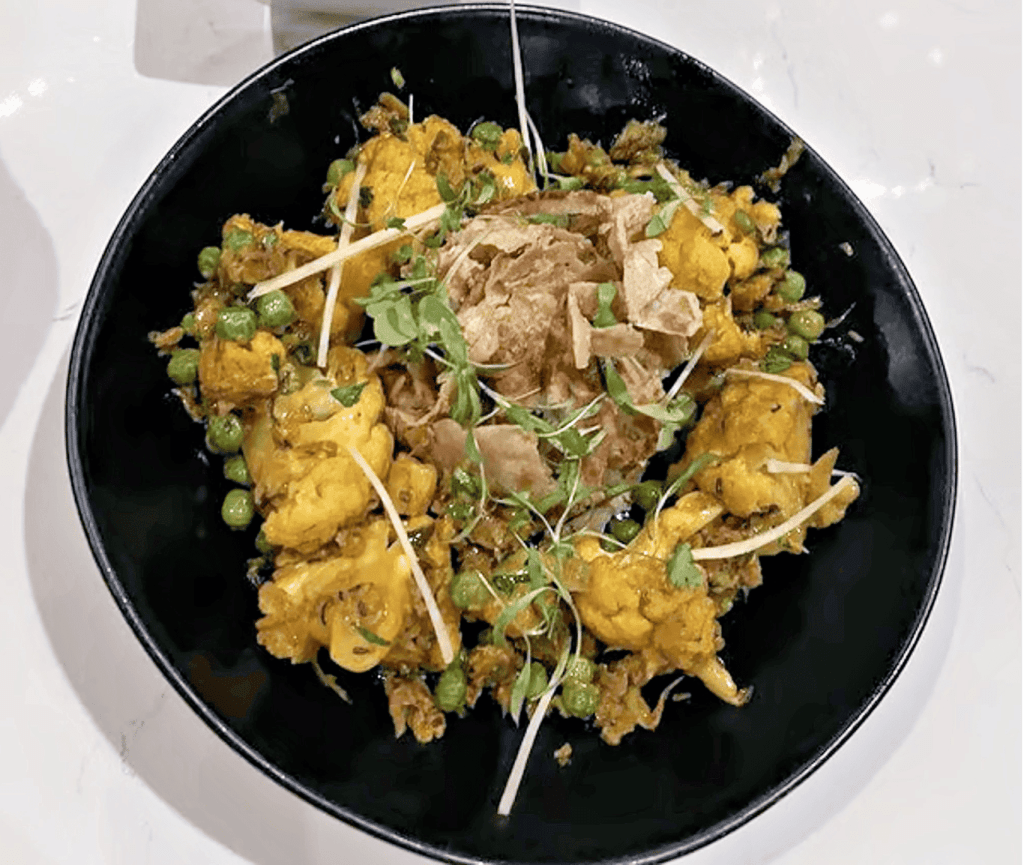
As you can see, the vegetables are around the edge, and the bread folded up, but not cut, in the center of the bowl. I thought this a bit weird, and said to the waitress: how should I eat this?
She was not meant to be a teacher, except in the most progressive of schools. Her answer: Anyway you want to.
I said that I could eat the vegetables with a fork, and the bread with my fingers. I could take the entire paratha out of the bowl, or just take small pieces out. Or I could take pieces of bread and use them to lift the veggies out, not using my fork at all.
She was not of much help. I told her that I thought if I had just come from India, I would probably scoop it out. She agreed and said it took her a while not be disgusted by that. Strange comment from a waitress. But she again said that I could eat it any way I wanted.
Well, okay. But imagine if our Malabar waiter waited at Karma Modern. He would have told me how to eat my lunch in no uncertain terms.
After we got home, we watched the last two episodes of Ripley, the Netflix series based on Patricia Highsmith’s novel The Talented Mr. Ripley. It was low key, fun, and in black and white. Tom Ripley is a con artist who did not have Fred Trump as a father. But he was given an unlimited allowance by a Trump-like guy to convince his son to come back to America. His son has been hanging out on the Amalfi Coast.
Things don’t work out as anticipated (to say the least) and Tom Ripley gets into jam after jam, all totally of his own making. As I said watching the 8 part series, “He would never have survived if he didn’t have Patricia Highsmith as a friend.”
Speaking of Highsmith, if you don’t know much about her, read the Wikipedia bio. She belongs in the category “People I am glad I am not.” Near the top of that list.
 Art is 80