It’s Thursday morning, and that means that I started off my day listening to one of my friends make a presentation at our morning breakfast meeting. Today, Ken Glazer spoke about “Theseus’ Boat”. Ken is a retired lawyer, who has been studying philosophy at the University of Maryland for the past six or seven years, and now teaches a course on “philosophy and the law”.
And what is Theseus’ Boat? I couldn’t have told you 90 minutes ago, but now I can. Imagine an old wooden ship. A plank needs replacing. Then another, then another, then another. Pretty soon, while the boat looks just as it did before the first plank rotted, each and every plank has been replaced over time. The question is: is this the same boat? It is still Theseus’ boat, if he still owns it, but is it the same boat?
Take Abraham Lincoln’s axe. Made of two pieces, a handle and a blade. The blade gets too old and worn to sharpen, so it is replaced. Is this still Lincoln’s axe? If so, and the handle is replaced later, so that neither the handle nor the blade is the same as those that Lincoln held in his hand, is it still Lincoln’s axe?
Take a river (this is more common example). The water in the river keeps flowing. When you look at a river at the same place, you never see the same thing. Is it still the same river?
You may not (okay, I am sure you do not) remember when I talked about the historic renovation low income housing project in Baltimore that, in accordance with various federal rules, was to retain a certain portion of the existing, historic external walls. The developer/builder knocks the walls down in their entirety. But he preserves the bricks and stacks them up, concluding (incorrectly under federal rules) that if he uses the original, old bricks in constructing the (new) walls, he will have retained the historic walls. Putting aside the federal rules, as a matter of philosophy, if not law, is he correct?
And then there is a question of animals. The most prominent example? A caterpillar turns into a butterfly. Is it the same animal?
And what of human beings, who grow, shed cells continuously and so forth? Is an 80 year old the same person as he/she was when they were 8? If you measure this by the cells that make up the body, maybe not. If you measure this psychologically, that might be a more difficult question. But it comes into play when you think about someone who, as a teenager, murders someone else and is sentenced to life in prison without parole. Forty years later, after four decades in prison, he seems like a “new man”. He shows no trace of violence, he is kind to all, he has earned university degrees, he writes, he counsels, he certainly does not get involved in threats or violence in any way. Is he the same person as the teenager who was sentenced for murder? Does it make sense to keep him incarcerated for life? What does society get out of this, other than the expense of his imprisonment?
That reminded me of something else. You may have guessed it already. It’s the Epstein situation. The crimes alleged in the Epstein case took place 20 to 40 years ago. All sorts of individuals were presumably involved, many of whom have presumably led honorable lives (you know what I mean) over the past few decades. Are these people the same people who committed crimes 30 years ago? Does it make sense to “cancel” them or to arrest and try them in 2026 for things that happened in, say, 1996? And what about the victims, the survivors? Are they, in their 40s or 50s, the same people they were when they were 16 or so? Does dredging up things that happened so long ago constitute justice or retribution? Is it fair to the alleged perpetrators as they are today (or to their families), and does it do anything for the survivors, other than bringing up their old trauma again and again? Are the legal answers and the philosophical (or moral) answers to these questions the same, or different?
To me, these are all very provocative questions and thoughts, and worth pondering. So I thank Ken for my morning wake-up.
But, as usual, something said at the session got me wondering about far away places. Such as El-jem, Tunisia. Two thousand years ago or so, it had a different name, Thysdrus, and was a city of the Roman Empire, Africa province. There was an ampitheater there at the time. It is still there.
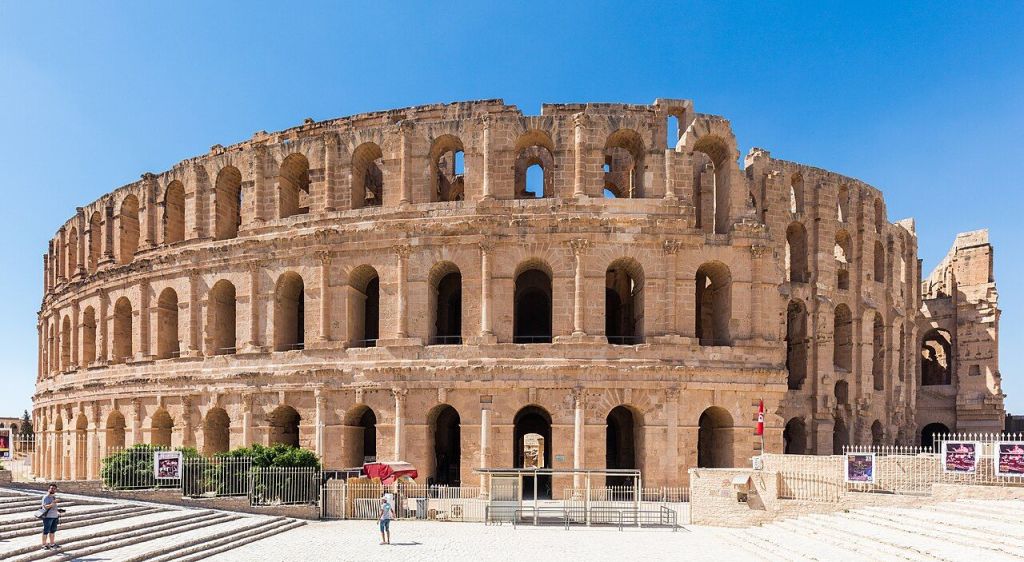
Are Thyrsus and El-jem the same city?
You do not have to answer this last question.
 Art is 80