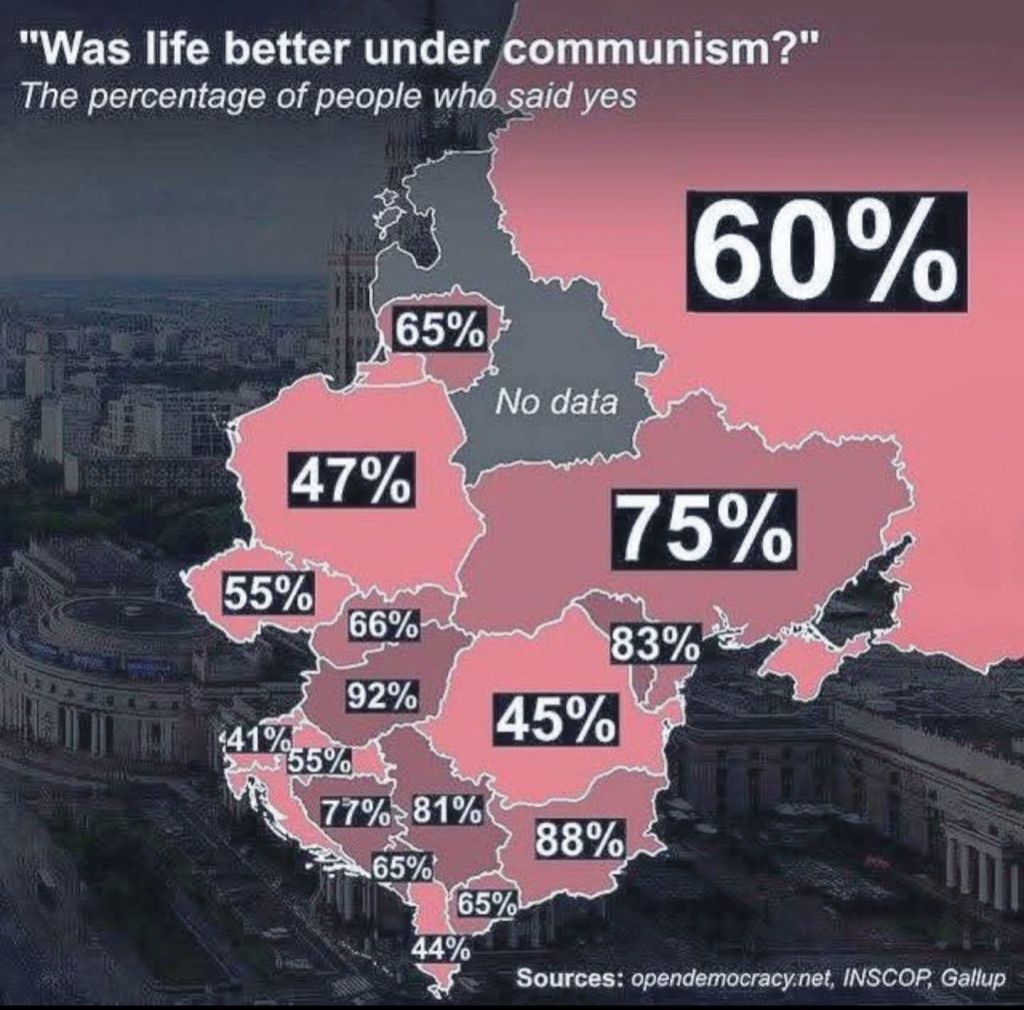
This Gallop poll is rather shocking, isn’t it? The majority of people who live in countries under Communism say, 30 years later, that life under Communism was better. This is in spite of the obvious restraints on personal freedoms, the limits on wealth accumulation (unless you were part of the governing elite), the lack of a fair judicial system. Gives you something to think about.
I remember being in Berlin about 20 years ago, near Alexanderplatz in what had been East Berlin, in an upscale shop that sold artisansal soaps, talking to the young clerk. She was doing fine, but she told me that her parents, successful in Communist East Germany, were at a loss trying to find their place in the now free united Germany.
I also re-reading a memoir of an American, who became a Communist after graduating from Harvard, and who defected to East Germany when he was in the U.S. Army stationed in Austria. He built a life in East Germany, became a translator and editor, and raised a family. Quite comfortable. Then, he was given permission to return to the U.S. and came for his 50th reunion. His wife had died and he decided to stay here. He thought life was much more difficult here, when he had to deal with the American health care system and figure out his income taxes every year.
And we have a friend from Lithuania, whose parents had left her with an aunt and uncle when she was a baby and they escaped west, winding up in Chicago. She says she had a fine life in Vilnius, but when she was at the university, she was able to join her parents in Chicago, and she did. Much to her surprise, life in the Lithuanian neighborhoods of Chicago was much harder, in every way, than life had been for her in Vilnius. Today, by the way, her son lives in Lithuania.
I am not advocating for Communism, but pointing out that, while the challenges we face in Trump’s corrupt America are formidable, America has never been a the paradise, the goldene medina, that it is sometimes cracked upto be.
I just finished reading Stacy Schiff’s biography, Samuel Adams, Revolutionary. I found the writing a bit dense, but putting that aside, the book is the result of a lot of research and worth reading.
The book concentrated on the colony of Massachusetts in approximately the thirty years prior to the signing of the Declaration of Independence. Adams was a rabblerouser, an activist, and maybe the first to call for complete independence from Britain. He was not looking for personal wealth, and was often living on the financial edge. He was not looking for notoriety and wrote under a large number of pseudonyms. He had burned most of his papers and is a difficult biographical target, and that does show in the book. And he was a thorn in the aide of the British, who never quite could figure out the best way to deal with him.
Massachusetts, and especially Boston, was in more ferment than I had realized during this period, trying to maintain as much liberty as it could without bringing down the wrath of King George. Sometimes, they went too far, and British troops were brought into the city. The reaction of the Bostonian’s? Read today the reaction of Chicago to the National Guard. The reaction was the same.
And the troops? They were never sure what their role was, and there was always the fear that something bad might occur. And it did. The Boston Massacre that so frightened everyone that the troops were withdrawn.
And then of course there was the Boston Tea Party, where a large number of colonists, dressed as Indians and yelling fake war chants, threw hundreds of crates of tea overboard. Even today, we can’t identify most of the participants.
I didn’t know much about the origins of the Tea Party. I guess I never thought about it. Because of British duties, Massachusetts was boycotting British goods. Nothing was coming into the port, other than what was being smuggled. The British thought they could break the boycott by bringing in tea that could be sold at a large discount. The tea was available because the warehouses of the British East India Company were bursting at the seams, and there was a need to dispose of the excess.
My point here is that life in Boston between 1740 and 1776 was far from calm, the future far from certain. When the British decided that they had enough and they would chase down Adams and John Hancock and James Otis, who were hiding in Concord, and the shots there and in Lexington were heard ’round the world, uncertainty grew. The colonists banded together, first through what were known as Committees of Correspondence, and then through the Constitutional Conventions, to which Adams was a delegate. Things went downhill from there, and the full war with England was the result.
Going back to the map that started this long post, it makes you wonder. If someone had polled Americans, say in 1812, and asked them if they were better off when they lived in a British colony, what would the results have shown?
 Art is 80