We sat around with friends last night, basically telling anecdotes about things that happened during our lives that were “interesting”. It may be that most days, you get up have three meals and go back to sleep, without anything happening that is particularly memorable. But on some days, interesting things do happen. You may remember these days all the time, or they may just pop up in your mind now and then. My question is: how do you preserve these small, and disconnected events, so that you – and maybe your children and grandchildren – will remember them?
We ca n start with a couple of incidents from my 1962 summer in Europe with three college friends (who are still my friends today):
(1) We are driving in our rental Opel Rekord toward the Brandenburg Gate in Berlin. We had rented our car in Paris, and it had Danish plates. We are minding our own business when a police car behind us starts flashing its lights, with a voice telling us to pull over. I am behind the wheel, wondering what I could have done wrong, and naturally concerned. We stop, a young policeman gets out of his car and walks to us, and says (I don’t even remember the language he used): “My wife and I are planning on a trip to Copenhagen next month. I wonder if you could give us some tips on restaurants and sites.”
We relax, laugh and tell him we aren’t Danish. He is, as you would imagine, very embarrassed and says that he owes us a favor, thinks a bit, and says: “Would you like to see the Reichstag?”
To remind you: the Reichstag is the German parliament building, burned down in 1933 shortly after Hitler took control. It was most likely a false flag operation, but blamed on Communists, giving Hitler an opportunity to increase his control over internal German politics. The Reichstag remained a ruin during the 12 Nazi years, but was occupied by Soviet troops when Berlin was freed from Nazi control in 1945. In 1962, the Reichstag was still a ruin, now within the British quarter of occupied Berlin, and not open to the public.
We told our friendly policeman that that would be great, and he said “Follow me.” He pulled in front of us, turned his siren and flashing lights on, and led us to the gate to the Reichstag grounds. He said something to the guard at the gate, the gate opened, and we were driving towards the ruined building on a road on which such travel was verboten.
We parked, walked to the building, and entered. It was a completely gutted ruin, with no internal walls remaining – only the external walls and support columns. All over the walls on the inside was Russian graffiti (the equivalent of “Kilroy was here”) written by Russian soldiers. We walked up some concrete stairs and found ourselves on the roof, along with a number of British soldiers who maintained a lookout post from which they could see over the one year old Berlin Wall into Communist East Berlin. After we were given some information by one of the soldiers about what they were looking for in East Berlin, an British officer appeared, asked who we were and how we got there, admonished our friendly police officer, and kicked us out.
To our knowledge, we were the only innocent tourists to visit the Reichstag in almost 30 years. Today, of course the Reichstag has been expanded and restored beautifully. Edie and I were in Berlin some years ago, and toured the building, now again the home of the German parliament. The Russian graffiti is no longer there.
(2) On one of our first days in Paris in 1962, we wandered through Montmarte (it must have been a Sunday), looking at the work of the many painters lining the sidewalks and streets. One in particular struck me, and I bought it.
It didn’t take me long to realize that I had probably made a mistake. There were four of us who were going to be traveling in our small Opel all around Europe for another ten weeks or so with our luggage and with two pup tents. How was I going to protect and hold onto this painting?
The answer to every question an American had in Europe in 1962 was to be found at the closest American Express office, so that is where I went, with painting in hand. The AmEx clerk was an attractive young French woman, and I asked her if American Express had a way to hold this painting for me.
The answer was “no,” but after some more conversation, she told me that she would take it to her apartment and keep it for me. All I had to do was tell her when I was coming back, and she would bring it to work that day.
I knew I would probably never see the painting again, but thought at least it would have a good home. I don’t even think I knew her name, or that I told her mine. But on the appointed day, I showed up at AmEx, and there she was, maybe surprised that I showed up right on time, and there was my painting.
Today, 63 years later, we still have the painting. The artist, Rafael Daroca Benavent, was still alive in his late 90s a few years ago. Today, I am not sure.
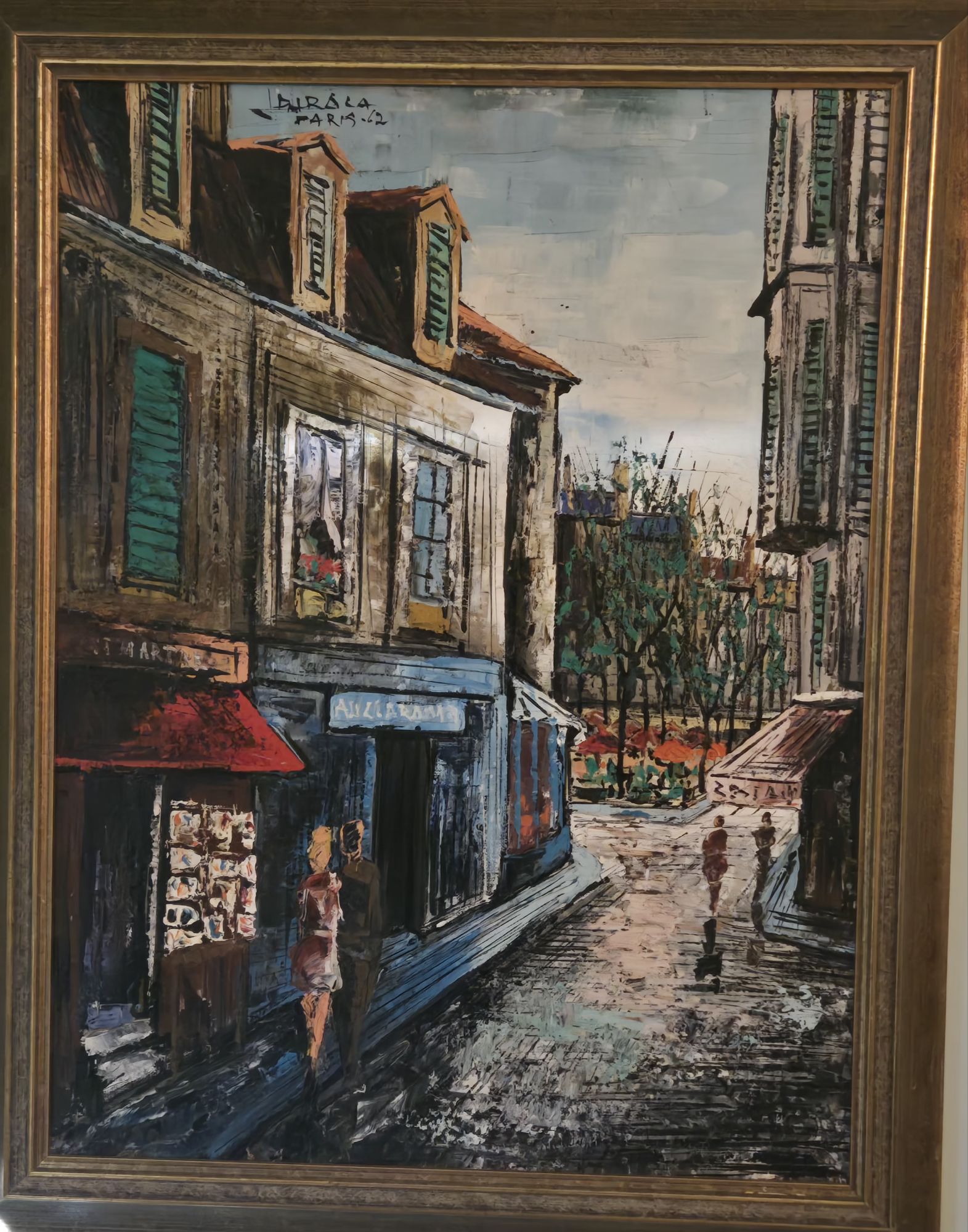
Yes, the perspective is weird. But there something about the design and colors…..
 Art is 80