Reading the Yale Alumni Magazine this morning, on page 52, I came upon something exciting. I doubt that many Yale graduates get to page 52, so – after I tell you this important bit of trivia – you will be a member of an elite group. This revelation came in a review of a new book, Bite by Bite: American History Through Feasts, Foods and Side Dishes.
And I quote: “A history of nachos reveals that the snack is not a venerable Tex-Mex tradition, but rather the on-the-fly creation of a border-town cook during World War II. The cook’s name was Nacho.”
Where can I possibly go from there?
I can go to one more interesting note from the Yale Magazine. It’s the back cover, equally surprising.
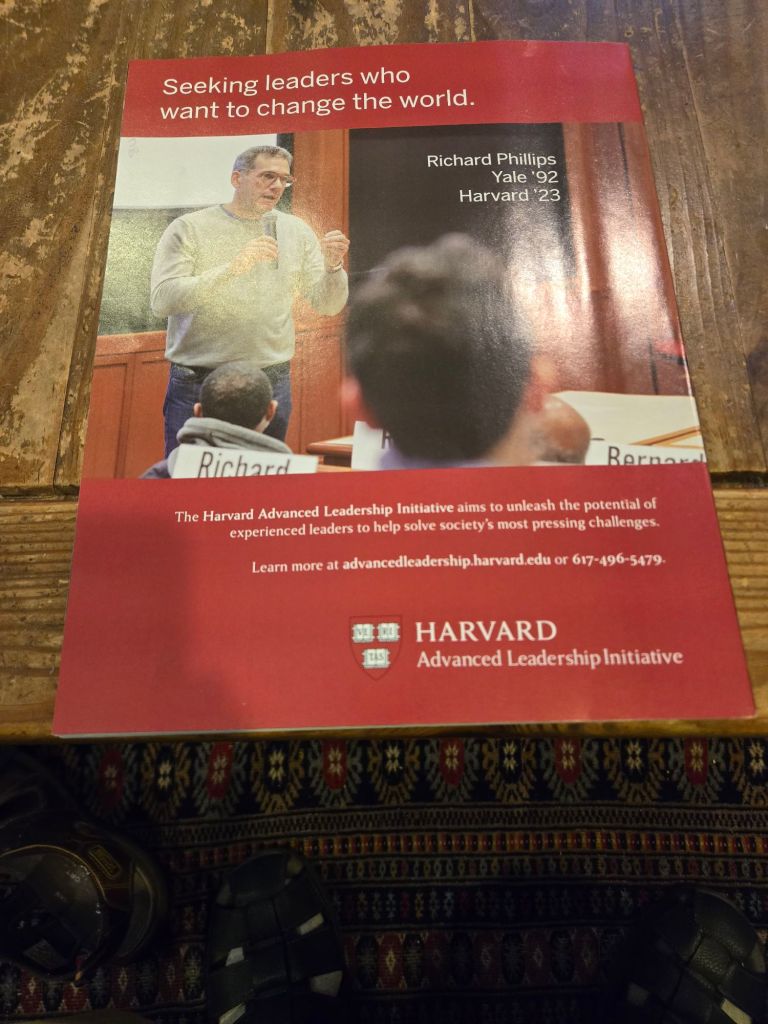
The back cover of the Yale Alumni Magazine is an ad from Harvard.
Sticking for a minute with magazines, did you read this Sunday’s NYT Magazine article on pennies? A long but interesting article, with a couple of points. First, it costs more than a penny to make a penny. Second, while establishments must give out pennies for change, hardly any shoppers use pennies for payment, which means pennies just “disappear” requiring more pennies to be minted. And so it goes.
The article talks about the many ways the government could ween the public off pennies as Canada did through simply rounding prices to the nearest nickel. The article did not discuss a possible step that I have heard discussed before. That you could turn each of your pennies in and get a nickel back. This possibility is why I have been amassing big jars of pennies all these years. Now, I guess I will just treat them as an art installation. I just need to find the right museum. Imagine: you enter a square room with white walls. It is totally empty except for, say, five large glass jars filled with pennies. The only other item would be a small explanatory posting on one wall:
“For my retirement”
Arthur Hessel
American (1942- )
Mixed Media
One other thing about the article. It was published in the Times Magazine of September 8, 2024. But I had read the article on-line on August 30, and expected to see it in print on Sunday, September 1. The fact that it was published electronically and identified as a New York Times Magazine article over a week before it appeared in print sure tells you something, doesn’t it?
But what does it tell you?
By the way, I am sitting here with today’s Times print edition. In the 24 page first section, there are exactly 4 ads. Tiffany, Rolex and something called “deel” (“your forever people platform”) have full page ads. Monica Rich Kosann (a jeweler with a website but no street address) has a smaller ad. That’s it.
Today’s Washington Post’s 18 page front section also has 4 ads. But just one is a full page ad.
That sure tells you something, too.
Grammatical question. Is it “a NYT article” or “an NYT” article? English is so complicated.
 Art is 80