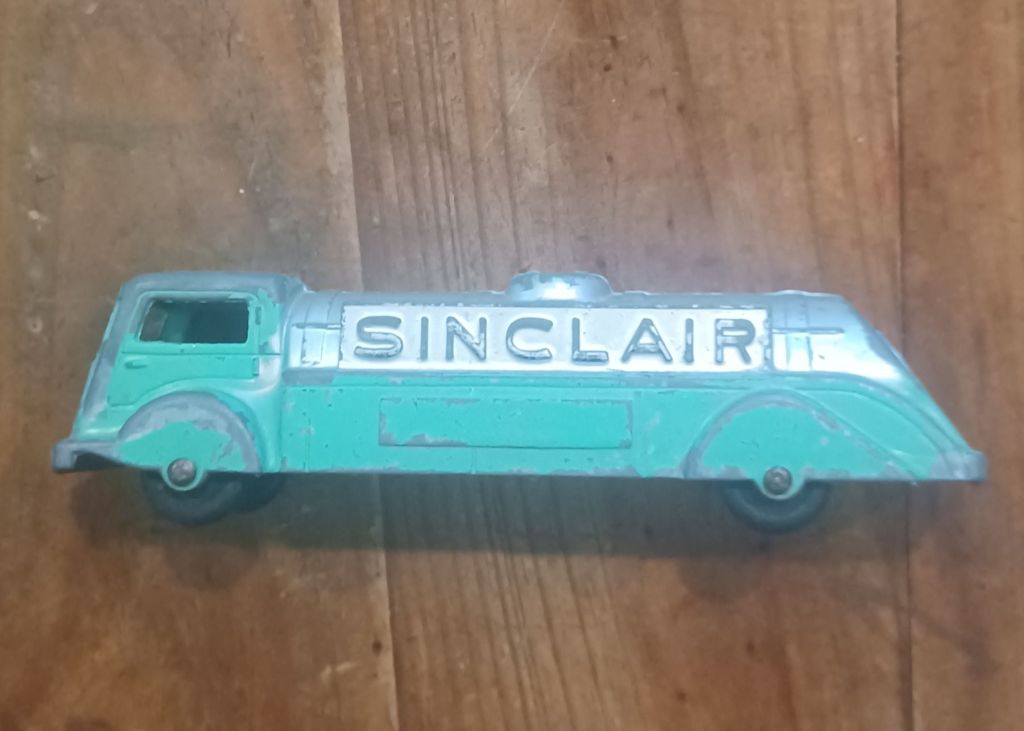
This is my 1940 vintage toy Sinclair truck. I also have a coresponding red Texaco truck. They are part of about a dozen vehicles that I have had for about 75 years. They were hand-me-downs from my older cousin Eddie Zerman, who probably never missed them. But I have dragged them with me since wherever I have lived.
We have had five house guests this past week, who range in age between 81 years and 14 months old. Our youngest guest has played with the cars, and our oldest guest and I began talking last night about the name Sinclair. (To be more accurate, I started talking about the name Sinclair and he humored me.)
I had learned years ago, when first reading Graham Hancock’s The Sign and the Seal, his fascinating book about the Ark of the Covenant and the Knights Templar, that Rosslyn Castle in Scotland, a building with many Templar inscriptions, belonged to members of the clan Sinclair, and that the clan’s founders had come from present day France and been named St. Claire. At least that’s my recollection.
[Digression #1: Everyone should read The Sign and the Seal]
Then I began thinking about whether or not the Sinclair of Sinclair Oil was related to the Scottish clan. After extensive (i.e., virtually no) research, once again I conclude I don’t know. I am sure you are surprised.
What’s more. I don’t care. But I became interested in Harry F. Sinclair, for whom the company is named, sometime last night and devoted a little time to learning more about him.
If you go http://www.sinclairoil.com, you can look at “How We Started”, and see a brief description of “The Legendary Harry F. Sinclair”, described as the founder of the company, a “brilliant, stubborn, ambitious risk taker”, who created the company in 1916 after merging several small petroleum companies and quickly built it into the 7th largest petroleum company in the country within about ten years. You learn he was the son of a druggist, who suffered a financial reverse when he was 21, losing the store along with everything else, but within 10 years was the richest man in the state of Kansas.
What a story!
[Digression #2] Remember Paul Harvey on the radio? A very professional story teller/journalist who would have a program discussing all of the great things someone like Harry Sinclair did and then remind you to stick with him during the commercial, because after the break, he was going to tell you “the rest of the story”.
OK, here goes. The rest of the story.
Yes, Harry Sinclair’s father was a pharmacist and Harry studied pharmacology at the University of Kansas, and took over the store, but the business failed. He became a lumber merchant, selling lumber to petroleum companies and began himself to speculate in buying and selling oil leases, became very successful, and indeed was a millionaire when he was 30.
With three friends, he bought and expanded a bank in Oklahoma and went on to found his eponymous [another word used in this blog the first time] oil company. He also found time to own a professional baseball team (the Indianapolis Hoosiers which became the Newark Peppers in the short lived Federal League) and a thoroughbred stable, which owned a Kentucky Derby champion, and three Belmont Stakes winners.
BUT, remember Teapot Dome? Or at least hearing about the Teapot Dome scandal of the Harding administration, even if you don’t know what it was? Well, there was a large oil reserve in Wyoming, owned by the federal government as set aside as an emergency military reserve supply. That is, that’s what it was until Secretary of the Interior Albert Fall decided to lease the oil field to Harry Sinclair in 1921. Six years later, the Supreme Court voided the leases, saying that they had been issued corruptly.
Harry Sinclair and others were indicted for violating various criminal statutes. The judge declared a mistrial in his criminal trial, because it was discovered that Sinclair had hired a detective to follow each of the jurors. This led to new charges and a conviction. And jail time.
Interestingly, according to Wikipedia, while in the DC prison, the authorities allowed Sinclair to work as a pharmacist and to travel outside of the prison to provide medication to prisoners on work details, leading to continuing accusations that he was being given special treatment. Which he was.
When he got out of prison, his personal reputation was ruined for life, but he went back to the presidency of Sinclair Oil, a position he held until 1949. He passed away in 1956.
So let’s go back to the Sinclair Oil website. You remember when Trumpist Kellyanne Conway talked about “alternative facts”, right? With Sinclair, we clearly have “selective facts”. Where is Paul Harvey when we really need him?
 Art is 80