All right, so my friend told me that I am not to write about more than one topic per day. And he told me that there he does not need to read the plot of a book that he will never hear about again. Okay, BUT…..another friend last night told me that he LIKES to see the plots of books he won’t read, because this lets him learn a little about something he would otherwise know nothing about. So what’s a blogger to do?
It reminds me of the story (which I am making up right now) about how Shakespeare was once approached by his boyhood friend Yitzhak ben Yinglish, who said to him: “Why do you keep writing about Kings of England? I get so tired of reading about those. Can’t you find a more interesting topic?”
Shakespeare, who respected his friend Yitzhak, decided to change his subject matter to honor his friend, and he wrote The Merchant of Venice. Yitzhak never spoke to him again.
So we Bards have to be careful, you see.
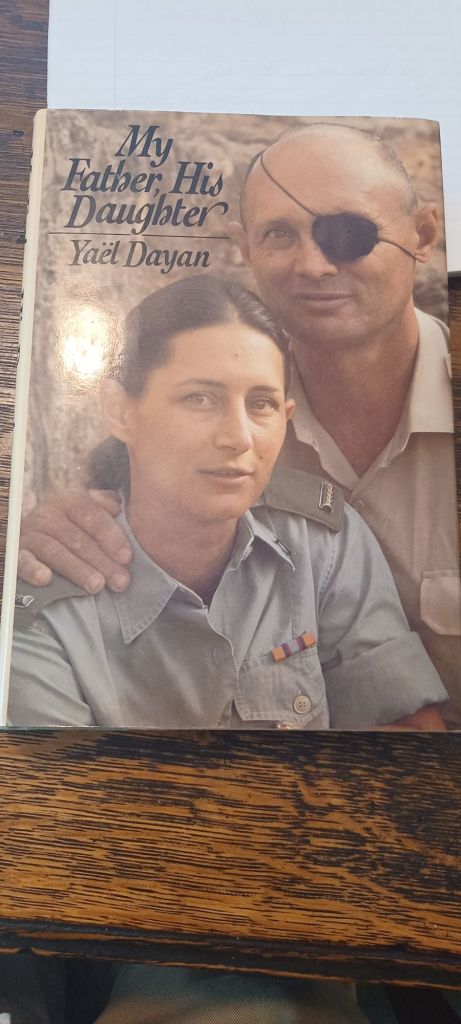
My plan was to write about Yael Dayan’s book, My Father, His Daughter, about her relationship with her father Moshe Dayan. You remember Moshe Dayan? Israeli military leader and politician, who became the GOAT after the 1967 war and the goat after the 1973 war? He was a bright, talented leader, and his daughter, who became a writer, and died a month or so ago at 84, was equally not just an overage Joe. She wrote this book in 1985, a few years after her father passed away.
I read it at the suggestion of a third friend. (I know what you are saying: “He has THREE friends? Who knew?” I will admit that this is about all there are, and so goes life.) This friend is an academic, a biblical scholar, and I was surprised that she recommended this book, which seemed out of character for her, so I thought I better read it. I prepared to be impressed.
But I wasn’t.
Sure, there are interesting things. For those of you who saw the film Golda, starring Helen Mirren as Golda Meir, you might remember the scene where, during the most worrisome part of the 1973 War, it appeared that Moshe Dayan had a nervous breakdown and was out of commission for a while. This never happened, according to his daughter, but……maybe it did?
And, the descriptions of the two times Moshe Dayan slapped his daughter very hard seem out of character with their otherwise close and loving relationship. What was their relationship really like? Dayan clearly seemed to favor his daughter over her two younger brothers (so says his “favored” daughter), and took her along with him whenever she wanted to accompany him, to review secret military locations, to review the troops, whatever. Sort of irresponsible, it seems to me.
You probably know that Dayan lost an eye. It happened during World War II, and he wore a patch after that. You may also know that he was sexually very active and his wife of thirty some odd years, according to her daughter, accepted his various affairs. (She also said that a doctor once told her that he felt that Dayan’s head injury which led to the eye loss might have also led to uncontrollable promiscuity. “Hmmmm”, as they say, the number of “m’s” reflecting their credulity.) Yael would never write a memoir called My Mother, Her Daughter, because her relationship with her mother hardly seemed to exist. Maybe her mother favored her brothers? Who knows? (We do know that her brothers were not in favor of her writing this book, and she respected their wish to be mentioned only now and then in the book, so there is more to the story of this family.)
Eventually, Yael’s mother Ruth, who passed away at 103 a few years ago, did leave her husband. And Moshe became more involved with other women, and now Yael seemed less approving, criticizing both her father for his bad taste in women, and the women themselves, about whom she was never complimentary.
But what goes around, comes around, as somebody once said (and others repeated repeatedly). When Dayan died at the age of 66 of long term heart issues, he left a will which he had written just written a few months before. He left everything to his girl friend, with whom he had been living for some years, and who didn’t get along with Yael or her brothers at all. He left Yael a letter saying that he did that because his children had enough money to take care of themselves, but his girl friend didn’t. There was no question that he was of sound mind when he wrote the will, but to say it was disappointing to Yael and her brothers is an understatement of the greatest magnitude. The Dayan house, and everything with in it, and all of his archeological treasures (he had many) went to his friend. Nothing went to his ex-wife of 35 years.
Moshe Dayan does not come across as very likeable. Neither does Yael. She was very much an elitist, whether or not that is how she looked at herself. You can almost read at the end of every paragraph the words that she did not, but could have written. Something like: “My father was an exceptional man, and I am his exceptional daughter.” I just didn’t like her. And I didn’t think the writing was very good – but who am I to say that about anybody else?
My friend who recommended the book says she knows someone who knew Yael, and that I am misreading her. Perhaps so. But, if so, I think she is deserving of my misreading.
Okay. The end. Yes, this it too long. No, I didn’t go through the plot of the book (to satisfy my first friend) but I did say something things about it that you might otherwise not be aware of (to satisfy my second friend). No, I did not talk about more than one thing. And did I proofread this post? That will remain my secret.
And I tried to satisfy my third friend (whom I don’t think has ever read my blog), by at least reading the book.
 Art is 80