We went to Nationals Park yesterday to see if the Nats could extend their one game winning streak. And guess what? They doubled it.
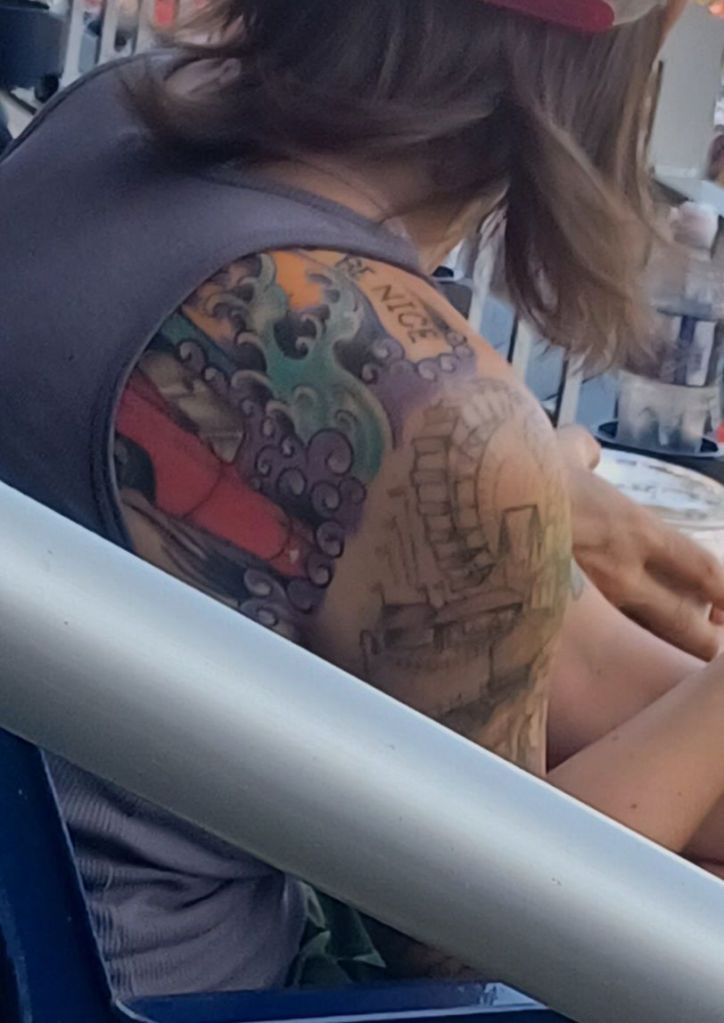
Sitting near us was a woman with a lot of tattoos. She was as interesting as much of the game. Was she pretty? I have no idea. My eyes never got above her neck.
I have written about tattoos before, generally negatively,for reasons I am not going to repeat here. But there are always exceptions. And this woman, with her not yet full body set of artistic tattoos is an exception.
I obviously only could see some of this art work. And you can see even less from the photo. You can see the red vehicle on her back and part of a slogan that ends “be nice”. You can see the Ferris wheel on her shoulder that is part of an amusement park display. And beneath the amuset park, covered by the bar in the photo, is a 1950 style blond bathing beauty in a two piece bathing suit. And there was more.
So that reminds me of a short story by H.H. Munro, or Saki as he was known. Written before World War I (Saki was killed in the war), and titled “The Background”, it tells the sad story of M. Henri Duplis, a middle class resident of the Grand Duchy of Luxembourg who, by chance, comes into a little bit of unexpected money.
He decides to splurge and spend it all in one place. He decides to get a tattoo, and travels to the north of Italy, where the continent’s most renown tattoo artist lives. He agrees to a tattoo which will cover his entire back, from his neck down. It will be an artistic rendition of The Fall of Icarus.
(By the way, Henri did not know what The Fall of Icarus was about, but that’s another story.)
The cost of the tattoo is 600 francs, the precise amount of our hero’s windfall.
Two unfortunate things happen. First, Henri spends some of his money on other items. Second, after finishing his work, the tattoo artist dies, leaving collection of the 600 francs to his widow.
When Henri tells her that he can only pay 430 francs, the widow becomes livid, consults a lawyer, and determines that under Italian law, the tattoo does not become the property of M. Duplis until the full bill is paid. Recognizing that it will never be paid, the widow does the most logical thing. She, a civic minded individual, decides to donate the work to the City of Bergamo, which happily accepts it.
Legal actions ensue and the courts determine that Bergamo has full rights to this work of art. Bergamo determines to exercise its rights, first by telling poor Henri that he is not allowed to display this work of art in public or in private without their specific permission. Secondly, that he cannot get it wet, by means of swim, bath or shower, for fear of diluting its value.
This is too much for Henri. He realizes he must leave Italy and return to the friendlier environment of Luxembourg. But not so fast, Henri.
He is stopped at the Italian border. Don’t you know, he is asked, that it is illegal to take public art out of the country?
Like Charlie on the MTA, it looks like he is stuck.
I wanted to tell our neighbor at the stadium about the story, but was afraid her boyfriend might send me from Section 205 down to Section 105.
As Groucho would say: “Lydia, oh Lydia, Lydia the tattooed lady.”
You think that’s really her name?
 Art is 80