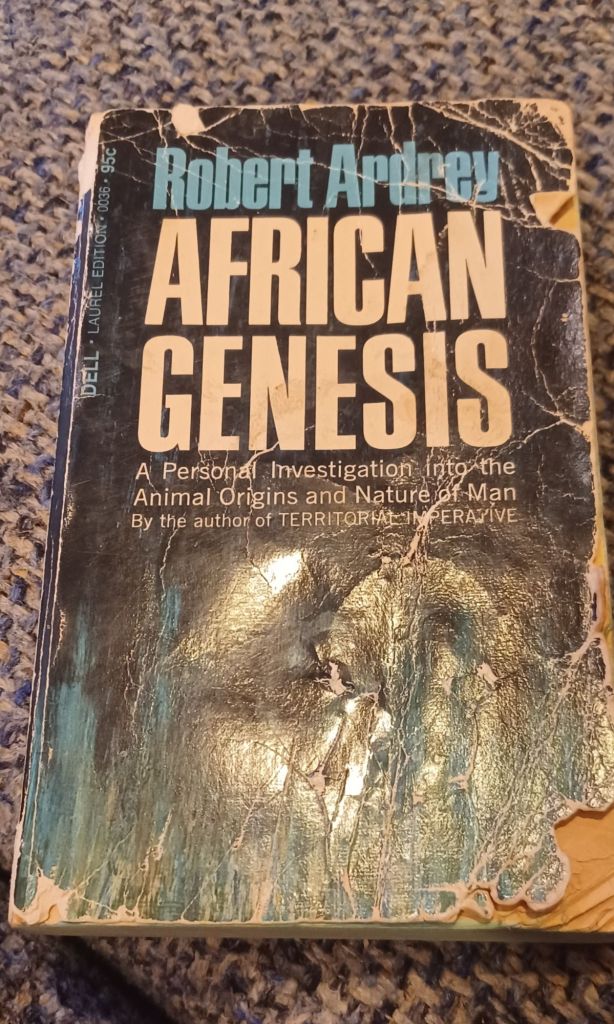
Whenever I am asked to list my favorite authors, I always put Robert Ardrey on the list. Although I have read four of his books, the one that always comes first to mind is African Genesis, which was first published in 1967. Subtitled “a personal investigation into the animal origins and nature of man”, it is just that, his conclusions as to how mankind evolved in Africa from its animal ancestors. One of the conclusions I recall him reaching is how various forms of primates of they types we call apes or monkeys developed the use of crude weapons long before mankind came on the scene. In his musings about war and peace, he talked about how some authors wonder how, throughout all these centuries, there has been so much war. He, as I recall, on the other hand, finds it a wonder that, throughout all these centuries, there has been so much peace.
I can’t say I remember exactly what he said, but perhaps we can put it this way. Mankind emerged from animal groups that shared many of mankind’s most prominent characteristics. This includes the drive for self-protection, which means you must have a society and social relations, and that means you must have real estate, or territory, where you can live unmolested, and you must have dominance over that territory and be able to organize and protect it against assault, or – to turn things around – to assault neighboring territories when either you need more space, or you fear that you will be attacked by your neighbors, who perceive that they need more space.
At least, this is close enough. And if Ardrey didn’t say it, I just did. And I think he’d agree with it.
Yesterday on YouTube, I listened to a lecture by Canadian professor Margaret MacMillan (University of Toronto), who gave this year’s Isaiah Berlin Lecture at Wolfson College, University of Oxford. Her topic was “Thinking About War in the Modern Age”. You should watch/listen to this if you have an hour to spare (and if you do, stay on for the Q and A). Why? Because MacMillan is a terrific presenter, and because she has organized this talk perfectly. Although she did not cite Ardrey (and, who knows, perhaps she has never heard of him), much of what he had written resonated in what she said. This includes her conclusion that war is such an integral part of human nature and human society, and that evidence of war exists before evidence of, say, language, that talks about ending war and “making the world safe for democracy” are naive, and should be abandoned. She also concludes that war and violence are two different things. Violence is spontaneous, while war (at least offensive war) is always planned and thought out well in advance. (Of course, she adds that the planning rarely works, and that every war takes on a life of its own, in spite of what those who start the war think will happen.)
MacMillan’s conclusions are very similar to Ardrey’s. She is not surprised there is a war going on the Ukraine or in the Middle East, or that tensions are rattling up around Taiwan and the South China Sea. She is surprised that we, in the west, have been without war, or at least without a war noticeable to our societies, since 1945. And she thinks we have grown complacent, to our disadvantage, and are unprepared (psychologically unprepared I think she means for the most part) for what may be long and vicious wars which have now begun. Of course, in talking about the genesis of mankind in Africa, Ardrey does not speak about modern weaponry, while MacMillan, speaking about war in our modern society, does, and finds much to be aghast about.
Am I going anywhere else with this? I will tell you that what got me thinking about Robert Ardrey and what got me to turn on Margaret MacMillan was the claim by Trump and the Trump campaign that, in executing and enforcing the search warrant at Mar-a-Lago, President Biden and the Department of Justice were seeking to assassinate Donald Trump. This is because there was a boiler plate authorization to use deadly force as necessary in enforcing the warrant (I have not seen the exact language; I am repeating what I have heard on the news). The fact that this was standard language (used, for example, in enforcing similar search warrant’s on President Biden’s homes and former office) was irrelevant in the Trump mind, and the fact that he was 1000 miles away when the warrant was served was also irrelevant.
There are many terrible things about Trump making this off-beat claim. Most terribly, it gets people thinking about assassinations. We have had four (is that right?) presidents assassinated – Lincoln, Garfield, McKinley and Kennedy. We have had live attempts on, at least, Theodore Roosevelt, Gerald Ford and Ronald Regan. We don’t need another one.
Yet with 350 million people in the country, and with close to 450 million guns in the country, shouldn’t we be surprised that there have been so few attempts on the lives of our presidents and not that there have been so many? Part of this, of course, has to do with our law enforcement agencies. Maybe most of it does. And we do protect our presidents, past and present, with a substantial amount of resources. But isn’t it only a question of “when”, not “whether”, it will happen again?
There are so many things that Donald Trump and his crew have done, do and are threatening to do that seem to dangerous to me. We don’t need one more.
By the way (before I close for the day), one more thing. Donald Trump says many things I do not believe. But one thing he says I do believe: I believe he can obtain freedom for Evan Gershkovich from his Russian prison. And that we will not have to pay a penny for it. I imagine the following:
Trump: If we stop supplying Ukraine with arms, tell them we are now neutral in the conflict and suggest that they agree to a ceasefire on your terms or get annihilated, and if we drop out of NATO and tell the members of NATO that we will not protect them or come to their aid if you attack them, will you free Evan Gershkovich and also let me and my family build world class office buildings in Moscow and elsewhere?
Putin: Let me think about that a minute……..YES!!
 Art is 80