Here we are, living in 2024, our senses bombarded with fake news, conflicts on our border as some people are trying to get in and others trying to stop them, and – for these and other reasons – everything seems topsy-turvy.
I have a collection of over 700 Penguin paperbacks from the 1930s to the early 1960s, and, during COVID, I read them to the virtual exclusion of any other books. I read, I think, about 150 of them and then stopped. But I just read three more. Two were re-reads (not from recent years, but from years long past) and one was new to me. What did I discover? Fake news, problematic borders, and a topsy-turvy world.
The books were first written in 1872, 1914 and 1936,but we’re all set in the late 19th century. Sure, that was a different time, but the problems then were like the problems today. Just on a different scale.
Let’s start with fake news. The book published in 1914 was by French writer Andre Gide and is called The Caves of the Vatican. I had not read it (or, to my knowledge, anything else by Gide before). I found the book fun, and assume that’s what Gide intended. I am not going to go through the entire plot – the book concerned three sisters, each of whom married a very different type of husband and, to that extent, it’s a family story. It’s also a crime novel – although the crime (a random murder that turns out to be not very random) does not occur until quite late in the book. But the story revolves around fake news, even in France (where it is set) and in 1890 (when it is set).
I will try to simplify and stick to the point. One of the three sisters is married to an odd businessman, who doesn’t seem to have much of a knack for business, and who is about as unworldly as you can get. Because the sisters inherited a good deal of money, though, she lives very well. One day, at her country estate, she is visited by a man who tells her that he has been sent to her by the Cardinal himself, and that he has a very important message that has to be delivered orally, and that requires absolute confidentiality – she cannot tell a soul. She agrees, and he explains to her the problem. The Pope (Pope Paul III) has been kidnapped by the Freemasons, and is being held in Rome in Castle San Angelo. The Vatican does not want the story to get out for obvious reasons, and the Freemasons have agreed to keep the kidnapping secret as well, provided that they get, by a certain date, a very large ransom that Church emissaries are trying hard to raise. He asks his hostess to help in this effort and provide him a significant donation. Of course, the donation must be made immediately, and it has to be made in cash, with nothing traceable to any financial institution. Of course, she agrees.
But also, of course, she tells her husband, who decides that he, too, must do something and what he decides to do is to set off for Rome to rescue the Pope. Why himself, who has never been out of the neighborhood of his estate in his life? Because, of course, the Pope must be rescued and he is blessed to be one of the only people in the world to whom this terrible secret has been disclosed. He can’t just sit there and do nothing.
See, even in 1890, purveyors of fake news existed (at least in Gide’s fiction), and the news spread, and the news was believed and acted upon with alarming consequences. (To find out more, you will have to read the book)
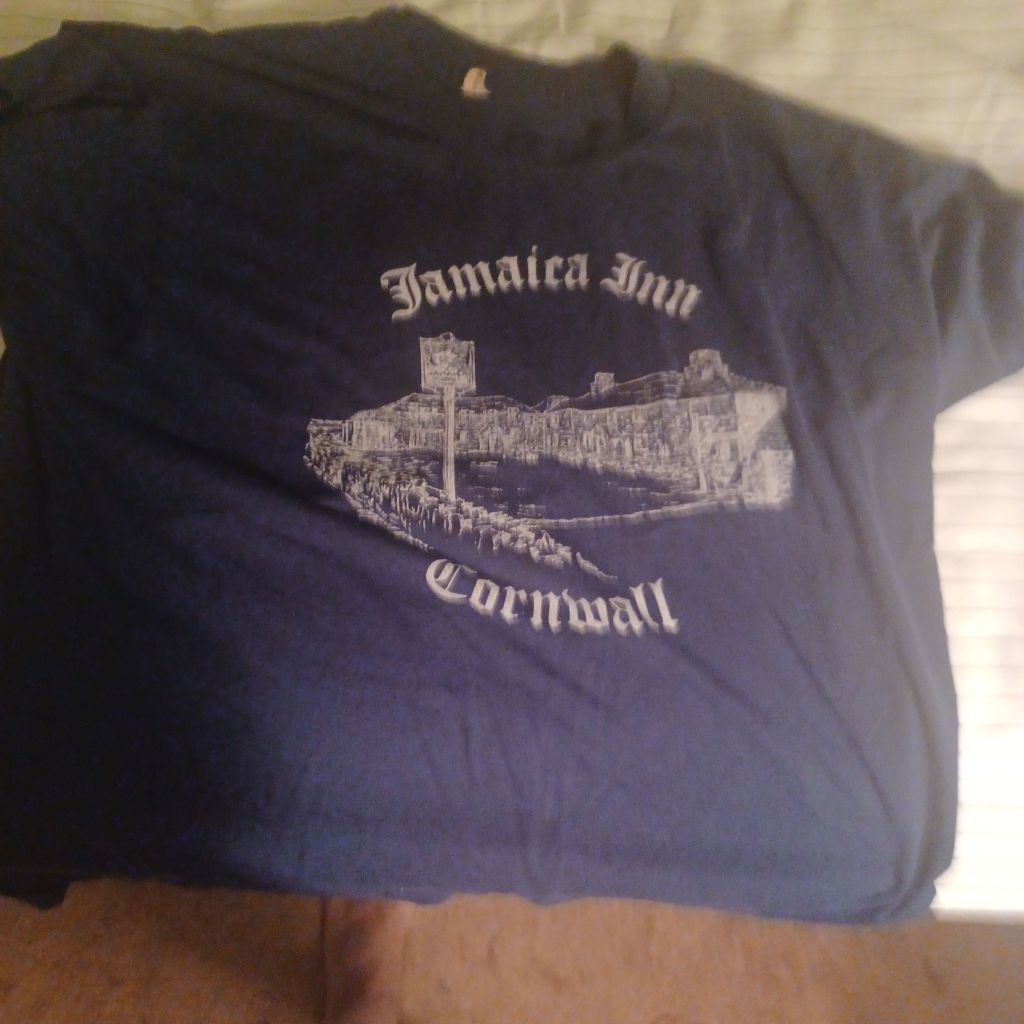
The second book, one that I had read before and like as much now as I did the first time through is Daphne du Maurier’s Jamaica Inn, which you may have also read. This is a story about border control, in Cornwall, the very southwest of England. Again, I am not going to give away the plot. I am only going to tell you that the inn called Jamaica Inn is set in the moors and is no longer frequented by travelers, but is instead the site of an enormous fencing and smuggling enterprise. Clearly, the local authorities cannot control it, try as they might, and clearly the national government cannot control the border in any meaningful way.
Of course, the border in Cornwall is not a land border, but a sea border, where ships come in and dock at will. There are all sorts of ships – some carrying stolen cargo or cargo to be smuggled into the country, and some holding families and other innocent travelers. The owner of Jamaica Inn, a very troubled and powerful man, is (it turns out) second in command of a group of men known as the “wreckers”. The wreckers go out to sea, capture ships coming into shore, take them over, drown all on board, take the cargo themselves and then sink the ships.
It is only towards the end of the book that the gig is up, not only regarding the guilty individuals who hang out at Jamaica Inn, but for others, because the government is beefing up its patrols. England will now protect its borders.
I understand this is not a perfect analogy to our border situation. In fact, it may not be an analogy of any type at all. But the point remains – at the time when the book is set (and again we are probably talking about late 19th century), border control was a problem.
By the way, if you have never read Jamaica Inn, I recommend it. It is a quick read (about 250 pages), and very engrossing, if a little too cute at the end.
A short digression. Jamaica Inn actually exists, or it did 30 years ago when we visited it, and is apparently the inn on which du Maurier based her story. Whether it was ever a hotbed of crime, I don’t know, but there is a history of maritime crime in Cornwall. After all, think of the Pirates of Penzance. They really did exist, doing nefarious things (and not nearly as comical as described by Mr. Gilbert), boarding ships, sinking ships, taking contraband.
OK, now the third book. I had read this one before and perhaps you did, too. It is Erewhon by Samuel Butler. When I read it so many years ago (high school?), I remember being intrigued as I started and then getting real bored as the book went on. This time……I had exactly the same reaction.
You probably know the general story. In a remote British colony, the story’s protagonist, a young man, wants to know what’s behind the mountains that no one (no “white” man) has ever crossed. He ventures out and after having an adventurous and lengthy multi-day hike, he finds himself on the other side of the mountain and in a world unknown to any Brit. A world of another civilization, in some ways much like his, in some ways totally different, and a civilization which – years and years ago – gave up technological progress as unnecessarily evil and harmful to society.
Yes, the only machines are in a museum and anyone found with a machine of any sort, or perhaps even a machine part, is guilty of a terrible crime. Why? Because the machines were dehumanizing, they became more important than humans, there was a belief that machines would get better and better and one day rule the world, rule human beings. They must be stopped before they get anywhere near that point.
But other parts of this society are very strange. People are punished for not being perfect, for example. You can be punished for poverty, and you can be punished for physical imperfections. And you can be punished if you get sick.
So no one will ever admit to sickness, will ever go to a doctor (I think there are no doctors), because if you become sick, you can be sent to prison, flogged or fined. Your entire family will suffer.
Of course, you may see this topsy-turvy world in different ways. It is totally opposite our society, of course. We don’t punish people who are sick or poor or physically unattractive or disabled, do we? Or….do we?
In any event, you get the idea. All societies are topsy-turvy. Even ours, and not only in the 1800s, when the world of Erewhon was discovered, but today. Especially today.
Final digression. When I was in Moscow in 1972, the Moscow that was the proud capital of a Communist country, I went to the circus. And the famous Moscow circus with dancing bears and all, was a one ring circus, not a three ring circus, so everyone was watching the same acts. And, at the mid-point, there was a break for a short, maybe 15 minute, skit.
The skit involved a beautiful little rural Soviet town where everyone was a Communist and everyone was happy. But then an Orthodox priest came to the village and tried to convert the people and especially the children, who in turn ridiculed and attacked him unmercifully. I was amazed. In the United States, a religious figure coming to a small heathen town would be a hero, right? Here it was just the opposite. Topsy-turvy. It was the best possible example of how societies can have opposite values, so opposite that when you – a member of one society – views another, you can’t believe what you see. It was a real life Erewhon, I thought, but called the Soviet Union.
 Art is 80