So what could be worse than Gaza in 2024? Maybe Haiti. And Haiti, for reasons too complicated to discuss here, has never been in great shape. But I will say this – Haiti in 1977 and Haiti in 2024 were much different places.
Haiti today is apparently controlled by rival gangs and has a non-functional government. It is overcrowded and food supplies are limited. Tires burn in the center of streets. Hospitals have been bombed or attacked. No place is safe.
Haiti in 1977 were calm, calm, calm. It was under the dictatorship of the man known as Baby Doc Duvalier (the son, not surprisingly of another man known as Papa Doc), and it was one of the safest places in the world. It was said that a traveler could leave his suitcase on a busy street corner and come back a week later and it would still be there, untouched. In part this was because Baby Doc ran, as they say, a very tight ship, as did his father, so that the population was terrorized by the Ton Ton Macoute, a large group of thugs who kept order for the Duvaliers. (I read that Ton Ton Macoute was a figure from Haitian mythology, who kidnapped young children, carried them away in a gunny sack, killed them, and at them for breakfast.)
Baby Doc took over from his father in 1971 and remained in power for 15 years. Like his father, he not only kept Haiti’s population terrorized, but he also robbed the country blind. When he was overthrown in 1986, who moved to Miami, with almost a billion dollars, and lived almost another 30 years. A billion dollars in 1986 would be almost three billion today.
The reason I compare today’s Haiti with Haiti in 1977 is that in February 1977, we went to Haiti for our honeymoon. It was a compromise location – Edie wanted to go somewhere warm with a beach, and I wanted to go somewhere interesting. It was a good compromise. (By the way, Bill and Hillary Clinton went to Haiti for their honeymoon the year before.)
We flew from Miami to Port-au-Prince. It was a sprawling, poor city, with a lot of people, all dressed in bright colors. Again, it felt very safe. And it certainly was not overrun with tourists. We stayed in the Hotel Oloffson, in the center of the city, a 19th century wooden mansion that had been built as as the home of a former president of the country and turned into a hotel in the 1930s. It is still operating (as much as anything is operating) today. It was very atmospheric, had a good restaurant, is centrally located. It was known to readers of Graham Greene as the site of his novel, The Comedians, and it was clearly the place to stay. As I recall, the only downside was that our room looked over a patio that adjoined a ball room, or party room, and that one night we were entertained by a wedding band, entertained until after 3 a.m.
I don’t remember all the sights we saw in Port-au-Prince. I remember Baby Doc’s palace, I remember the market (many items sculpted out of rare mahogany), and I remember traveling to the suburb of Petionville, where the Haitian elite lived. And I remember that the Haitian elite lived very well, as compared to the Haitian masses, and that Petionville, located in the mountains east of the city, also had a temperature which was much, much cooler and more pleasant than the hot, crowded city.
One of the characteristics of being White travelers in Port-au-Prince in 1977, is that you were hounded by young boys, probably 10-12, who wanted to sell you things, or wanted candy or cigarettes. We met one charming young fella, who clearly looked upon us as susceptible prey and offered to show us around. We let him do that, although I don’t remember anything about the day. But the next day he reappeared with a gift for us (a small painting that he said his brother had done, and which we still have, although we don’t have it hanging up – the quality was not the best), and was ready (to our surprise) to stay with us the next day. (By the way, I am not sure how we communicated with him – pigeon English, I expect.)
He was not at all concerned when we told him that we weren’t going to wander around the city that day, but planned to take a bus to the town of Jacmel, south of Port-au-Prince, which we had been told was worth visiting. No problem, our young friend said, he knew Jacmel backwards and forwards and would be our guide. OK, why not?
We went to the bus depot and got on a colorfully painted bus, with luggage on the roof, along with animals, and overfilled with people, for what I recall was about an hour or two trip south. When we got to Jacmel, we learned, again not surprisingly, that our friend had never been there before, and that he knew less about Jacmel than we did. Jacmel was the home of an American expert on Haitian art, Seldon Rodman, and we decided to find him. We found his house, but no one was at home. What we couldn’t find was a place to get lunch. We took the bus back – I remember it being less colorful and less crowded.
From Port-au-Price, we flew north to Cap Haitien, the original capital of the country, and where we could visit the palace of Henri Christophe, one of the first kings of Haiti. The palace called Sans Souci, is located outside of the town, and I remember we took a bus to the entrance of the grounds, where you had the option of walking to the palace, or riding on a donkey. We did one or other.
Getting to Cap Haitien was an experience. We flew, and the plane seated eight passengers and had room for a pilot and copilot. There was no copilot, however, and there were eight passengers. The pilot was a young, blond, very White man; maybe he was 20. I am sure the FAA had not inspected the plane or certified him. He told Edie that she could be his copilot, so she got a front row seat. The flight was fascinating. We flew very low, so we could see the topography (largely mountainous) and the large number of rural Haitians (could almost see their faces) as we took the relatively short flight.
We stayed in a hotel that overlooked Cap Haitien and had an absolutely first class restaurant, and a nice swimming pool. I am sure the hotel (it was a small hotel) is no longer there. The restaurant had one dish that was so good that Edie made it again and again after we got home. Neither of us now has any idea what it was.
From Cap Haitien we stayed at a small beach resort on the west coast that was simple, simple, simple. I remember sand, pine trees, and picnic tables and that was it. It was fine for us – but nothing to recommend.
Of course, in 1977, you traveled differently from today. You took American Express Travelers checks with you, and when you needed to buy something, you used credit cards. But there weren’t ATMs – you couldn’t go to the bank and get cash.
This led to two problems. One – we found a painting we really liked – but we couldn’t buy it and bring it home, because credit cards were no use in Haiti, you needed cash. Who knew? We certainly didn’t. Two – we had one travelers check left, and I went to a bank to cash it. The bank refused to cash it, saying that they didn’t think my signature matched the signature on the check. We spent the last cash we had on a taxi to the airport – we didn’t have money for the “exit fee”. It looked like we were going to live the rest of our lives in Haiti, until another American, a man from Lubbock Texas who ran a television repair shop there, took pity on us and gave me $25 in exchange for the remaining travelers check. That’s the only reason we live in the United States today.
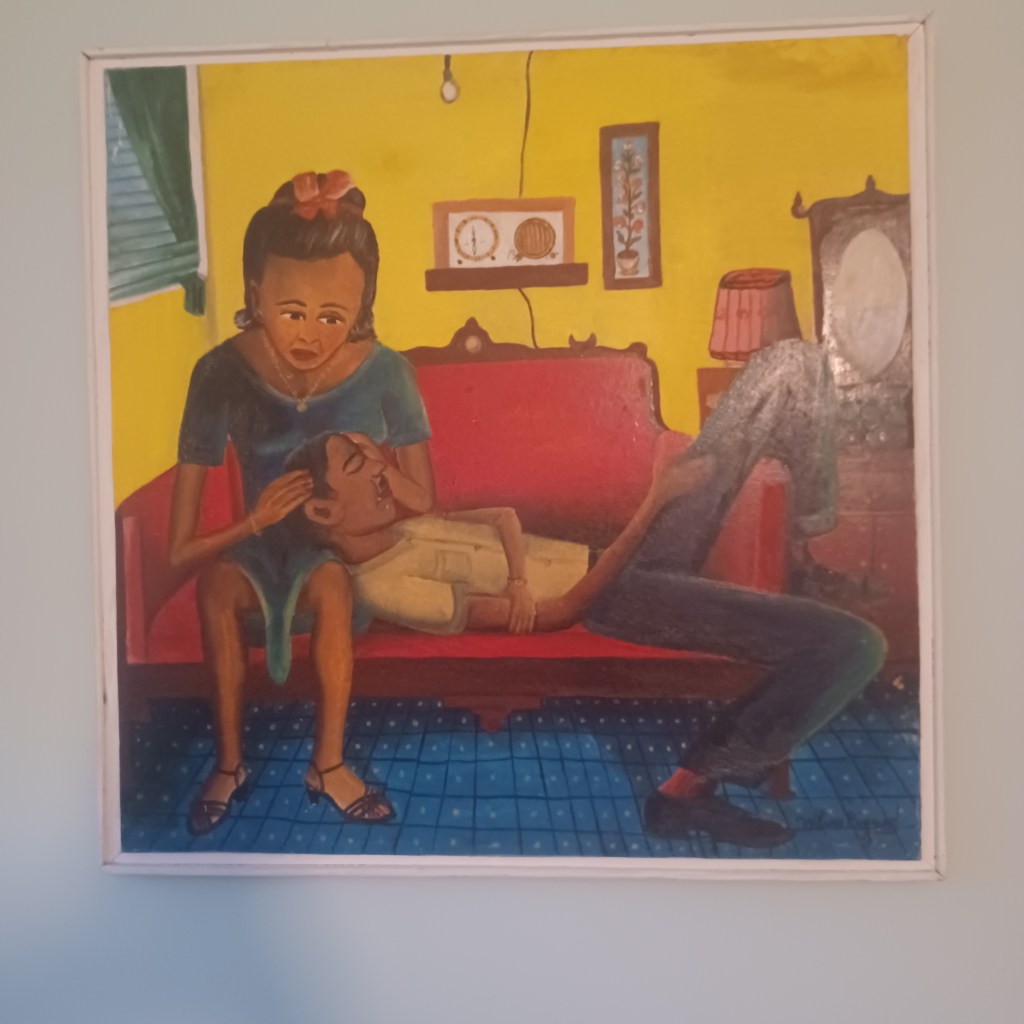
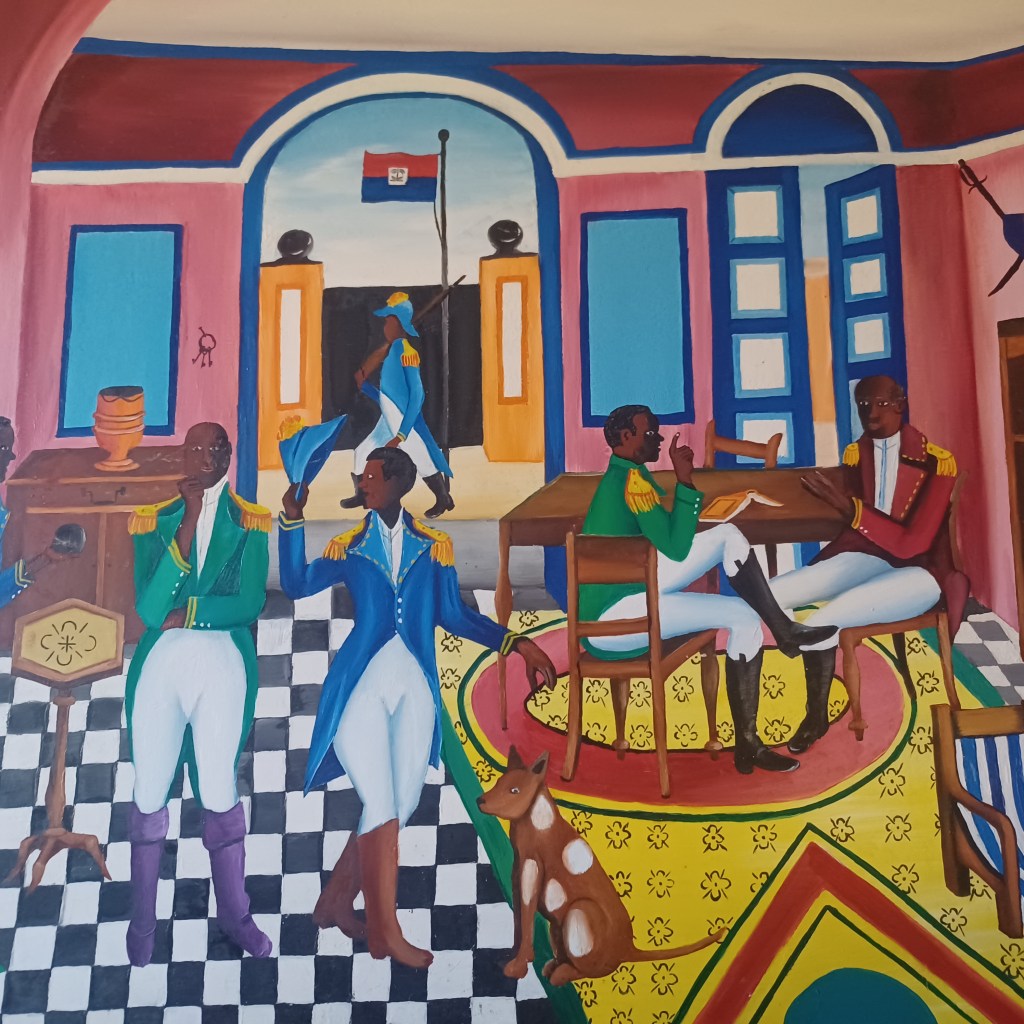
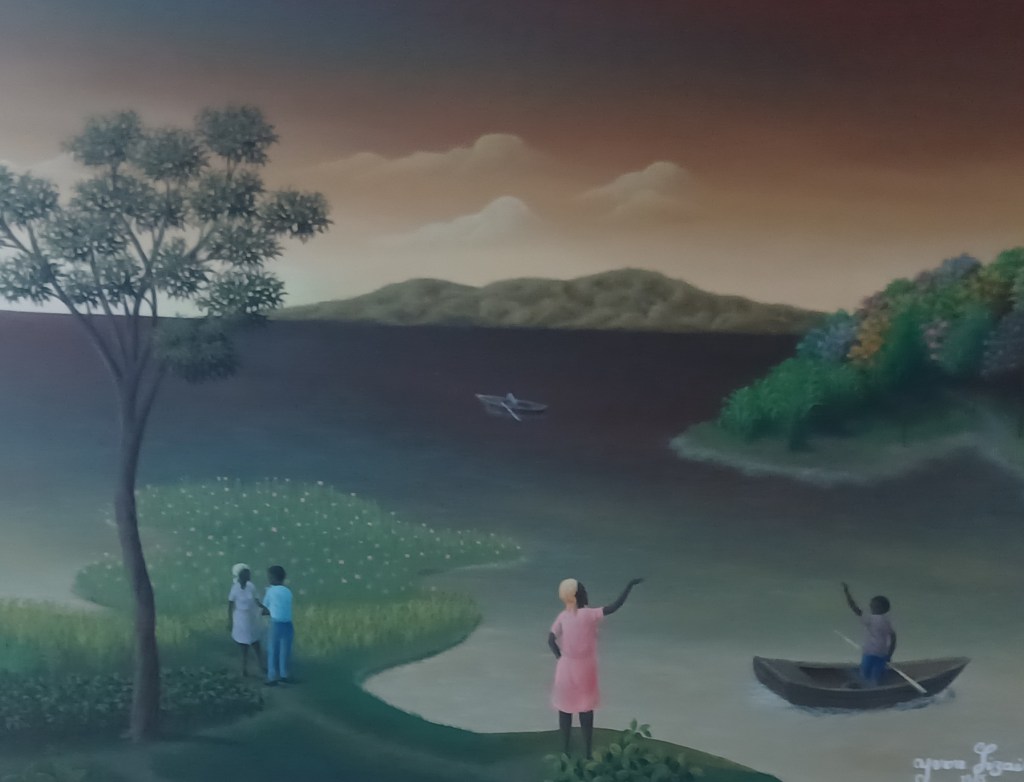
While we couldn’t bring back the painting we wanted, we have acquired a few Haitian paintings over the years.
 Art is 80
4 responses to “Haiti Today and in 1977”
Good story, vivid, thanks
LikeLike
Great story! Your flight from Port-au-Prince to Cap Haitien reminds me of our flight from Victoria Falls to Lonestar Airfield in southeast Zimbabwe. We flew on a four seat single engine propeller plane with a pilot and no co-pilot. Although the pilot looked very young, he assured us that he had at least 5 years experience flying in the African bush. I flew in the co-pilot seat and had a great view of the topography below because we flew at a very low altitude. The primary differences between your flight and our flight other than the number of passengers that each plane could accommodate were that our flight was 4 hours plus and we had to stop half way to refuel, in addition to the fact that we landed on an airstrip in the middle of nowhere and got picked up by a driver from Singita Pamushana, the 5 star luxury safari camp where we were staying. It was well worth the time and expense of getting there. After arriving at SP, we were treated like royalty. It was quite an experience that we will never forget.
LikeLike
hmmmm. Probably same pilot
LikeLike
No doubt!
LikeLike