Who said that? Ruth Bader Ginsburg…..
A friend shared a Facebook post this morning that reads:
“We can fix all this cheating with a revote with ID and in person. Who’s not scared to report this?”
So it goes.
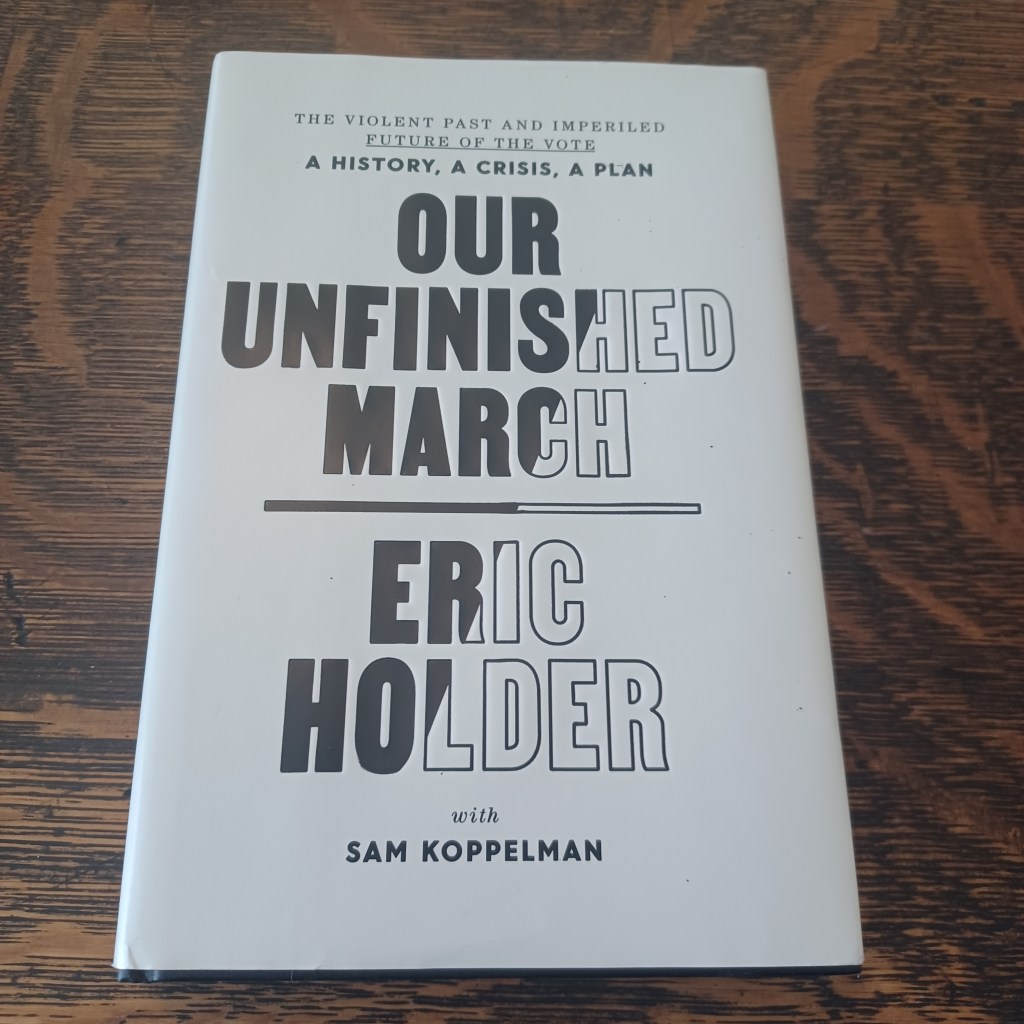
The response to the millions of people who somehow still believe that the last presidential election was wrongly decided because of mass cheating and fraud (and that is a lot of people – perhaps more than half of those voting Republican and a majority of those who support Trump), and who believe that the way to “fix” this is to require voter IDs and end absentee and mail voting, is simple: They should read Our Unfinished March: The Violent Past and Imperiled Future of the Vote – a History, a Crisis, a Plan by Former Attorney General Eric Holder (with Sam Koppelman), published in 2022. It’s a remarkable book.
Now, I am sure, many Republican leaning voters will say: well, it’s Eric Holder; who could believe him? I can’t help them from thinking this, but suggest that – nevertheless – they read this book, and see if their thinking on the topic is at all changed. And, by the way, the book is short (224 pages before you get to the “notes”), and extremely readable and easy to absorb.
The book is divided into three sections, each equally compelling. The first section deals with voting history in the country from the time of the founding fathers (should “founding fathers” be capitalized? And, if so, why?).
In this section, Holder looks at voting restrictions in the various “states” before they became states and then after the creation of the United States. Not only at the exclusion of slaves, but the exclusion of women, and of white men without a certain amount of property or assets (and in certain places, the exclusion of those who were not of specific religions). Different in each colony, and compromised when the U.S. Constitution was adopted.
Then comes the Civil War, and the 14th Amendment (which did not mention voting rights and was therefore insufficient to guarantee all men – women still excluded – a right to vote), and then the 15th Amendment, which stated that voting could not be denied on the basis of “race, color, or previous condition of servitude”, but still did not deal with gender.
Blacks were allowed to vote after the passage of the 15th Amendment throughout the country, but then the Jim Crow laws began to take effect and states in the south found ways to exclude blacks (not by requiring IDs – that would come much later), but by having poll taxes or literacy tests which were not fairly administered (at all) and so forth.
A chapter on voting rights for women, the suffrage movement, and the conflict that sometimes was raised between Black voting advocates and women voting advocates, followed by a discussion of implementing Brown v. Board and integrating schools, the civil rights movements, the death of John F. Kennedy and the passage of the Civil Rights Act and Voting Rights Act during the administration of Lyndon Johnson.
The second section of the book starts with the Obama years, and the perception (I think quite accurate) of the backlash to having a Black president, from the birther controversy stoked by Donald Trump, the immediate statement by Mitch McConnell that the primary goal of the Republicans was to make sure Obama was a one term president and so forth.
And then the gutting of the Voting Rights Act by the Supreme Court (no longer would the voting laws of targeted states be subject to federal review), after Congress had extended it not only on a bipartisan basis, but on an overwhelmingly bipartisan basis. And then, on the day the Court decision was announced, first Texas and then virtually every other previously targeted state, began to pass laws to make it harder to vote – cutting polling hours, eliminating polling places in minority areas, requiring IDs (one state said university ID’s were not sufficient, but gun permits were), etc.
The final portion of the book gives Holder’s suggestions for how to get beyond the sorry state we now find ourselves in. I should add that, in doing this, he does contrast the US to other democracies – we are clearly the outlier in trying to make it more difficult to vote; everyone else has been making it easier. (No surprise here, of course.)
Here are some of his suggestions (because he gives many and knows that some will not be implemented, his suggestions sometimes overlap):
- Automatic voter registration when a citizen turns 18
- Same day registration for those not automatically registered
- Allowing 16 and 17 year old to pre-register
- Allowing registration on-line
- Allowing felons to register after they have served their sentence
- Polling places should be geographically accessible
- Election Day should be a work holiday
- Expanding the use of mail in and absentee voting.
- Voter IDs for everyone, and free Voter IDs (theory is that making someone have, say, a driver’s license in places where a driver’s license has a fee attached, is equivalent of a poll tax)
- Making sure that voter roll purges are accurately implemented
After he gives his thoughts on voting rights, Holder deals with three other related topics – the Senate filibuster, House gerrymandering, and the Electoral college, and how all of these are being used to help suppress the vote.
I could not recommend this book more highly.
I should say that I picked up Holder’s book after reading another books related to Black America and the civil rights movement, John Meacham’s relatively new book on John Lewis, His Truth is Marching On: John Lewis and the Power of Hope. I enjoyed this book as well. It is a bit hagiographic , but perhaps Lewis deserves that. Meacham does not deal with Lewis’ years in Congress – this is a book about John Lewis during the years of the civil rights movement – his intensity and stubbornness, his unwavering loyalty to nonviolence, his suffering, his success. Well worth reading, if only to remind you how central Lewis was to the entire movement.
That’s it for today. Over 70 degrees in DC. Have to get outside.
 Art is 80