“Joan Baez: I am a Noise” is a new documentary on the life of now 82 year old Joan Baez. We saw it Saturday night at the Avalon. We were really looking forward to the film, because, as I have said, everyone loves Joan Baez, and, although we knew that the film delved into her psychology, we expected to be uplifted by her music and, in general, her life.
The film, however, is not what we (or at least I, and I think we) expected. It does have clips of her singing, of course, but this is not a film to celebrate her talent as much as it is to dig deeply into what is, as it turns out, a very complicated mentality.
First, here is why I think everyone loves her. Her voice is (has been) perfect in tone and pitch. Her politics have been brave and generally on the side of humanity and human rights. She was, and remains, very physically attractive. And her way of carrying herself just makes it appear that she would be someone who could be friends with you. What more could you want in a person?
Apparently, this film was first conceived of as a film dedicated to her “farewell tour” of a few years ago, but it became something else. Much of this was, it appears, because it turns out that her mother, who died not that long ago at, I think, 100, had been a hoarder of Baez family memorabilia. She had a storage locker, which Joan had never been in but which she had access to, that had boxes and boxes of tapes, clippings, school records and assignments, drawings, and so forth, that seems to have been so complete and so interesting that they overtook the idea of just showing the tour performances.
And at some point, the filmmakers and Baez herself decided that, instead, the film should be a biography, almost a memoir, of her success and the frustrations that accompanied her success. And so we start with her childhood, and end with seemingly somewhat isolated, but quite comfortable, life today.
Her family was accomplished. Her father, born of Mexican parents, had a PhD from Stanford and was a co-inventor of the x-ray microscope and a university professor. Her mother was born in Scotland and was, as her daughter, a very engaging person. The family, consisting of three girls and their parents, traveled the world and lived quite comfortably.
But during high school, Joan apparently felt like an outsider, a Mexican, someone who didn’t fit in. She was talented in many ways – her voice, for sure, but she was also an artist, sketching her life cartoon-like, from an early age. Her mother, of course, kept those cartoons.
Joan suffered from high anxiety and underwent therapy during those years, but then something happened and she became famous, and by the age of 18 and 19, was the toast of town wherever she went. The film doesn’t precisely detail her social life, but does spend a lot of time talking about, and speculating about, her relationship with Bob Dylan (she was responsible for introducing Dylan to the world, and at some point, he seemed to have outgrown her and left her behind), and with her husband of something under ten years, David Harris, who went to jail for 20 months during her marriage for avoiding the draft (or something like that) and with whom she had her only son.
Her career continued to sky rocket. Record albums, concert tours in the U.S. and abroad, and through all of this she had incredible emotional ups and downs, all of which are detailed, including several years when her main food seemed to be quaaludes. A real roller coaster about which we (certainly I) knew nothing.
The film also talks about her relationship with her older, and more reticent sister, Pauline and her younger sister Mimi (known as Mimi Farina), which was both close and fraught, and with her father (from whom she was estranged for a time) and mother. Both her parents lived to what they used to call a ripe old age; both her sisters have passed away.
At some point not that long ago, she decided to have more extensive therapy to determine what caused her emotional problems and to try to be able to mitigate them. During this period, she and her therapist focused on recapturing childhood memories. Although the film (and probably the therapy as well) somewhat was blurry on this topic, there seems to have been some sort of conclusion that she, and her two sisters, were all most likely/probably/perhaps the victims of childhood sexual abuse by her father. This isn’t detailed and even she, I think, does not know if her memories are real – her father consistently said – it appears – that she has “false memories” and that nothing like this could possibly have happened. I think, I think, the film is inconclusive on the point.
At any rate, Joan Baez, her farewell tour done, lives in a comfortable, somewhat jumbled house in California where she tends her garden, does her art, and searches her memories. She looks terrific for 82, and admits she is in much better shape than most her age, and still looks like she become your good friend. Her emotional turmoil, it appears, is largely behind her.
I think we all found the film a bit too intense and too packed with too many aspects of her life. But I am not telling you to stay away from it. Joan Baez is just a very complicated person – much more complicated than you or I could have imagined.
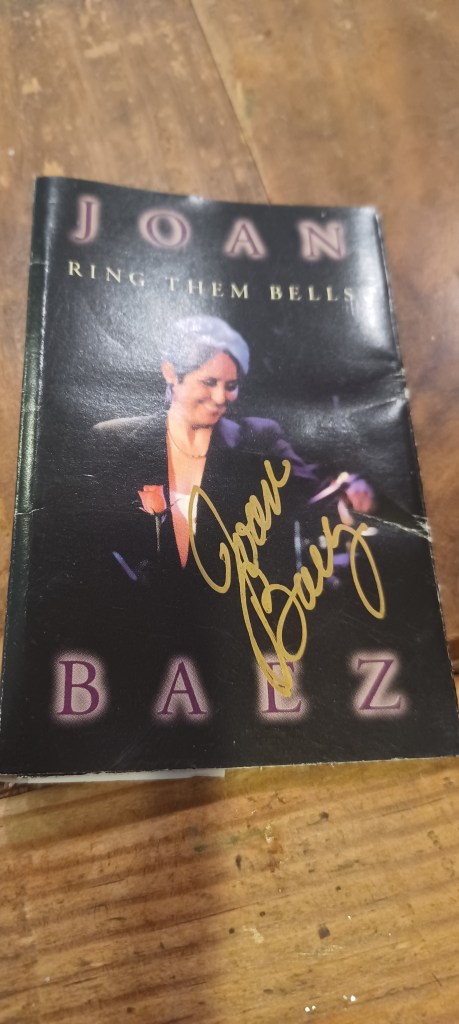
One personal note: years ago, Joan had a concert at George Washington University’s Lisner auditorium. She had just released a new cassette and she was having a “signing” at Tower Records, then just off the GWU campus. My daughter Michelle, who does a lot of singing and does it very well, was in high school, I think, and I took her to the signing to meet Joan Baez (I don’t think Michelle knew who she was at the time). After we bought the cassette, I told Joan Baez that Michelle might be the next Joan Baez (I know, tacky, huh?), and she was very gracious and said “just a minute”, calling back to one of her aids, saying “get me two tickets for the concert tonight”, which the proceeded to give us. Wonderful house seats.
You see why I think we could have been friends?
 Art is 80
2 responses to “Everyone Loves Joan Baez (I Think), ……..”
Those house seats were a sweet gift from that complicated but very generous and special person. Thanks for sharing that personal memory. I hadn’t known of her emotional troubles, just her progressive activism and that exceptional voice.
LikeLike
David Harris was
LikeLike